Showing posts with label Chris Pratt. Show all posts

Friday, March 13, 2020

Onward (2020) review


Onward (2020)

What’s this? Two Pixar films in one year? And they’re both original stories? “Huzzah!”, the internet proclaimed. Yes, it’s safe to say that 2020 marks a new era for one of the most revered animation studios in the industry. For starters, it’s the first feature in the studio’s history to not involve one of its most prominent figures, John Lasseter, after he left the company in 2018 due to the various sexual misconduct allegations directed against him, with fellow Pixar mainstay Pete Docter now serving as the studio’s Chief Creative Officer. But the change that has excited the internet the most is that following the release of Toy Story 4 last year, Pixar announced that it would be their last ‘sequel’ film for the foreseeable future in favor of doing more original stories like the ones that made them famous in the first place. For fans of the studio, this was a very big deal given the arguably mixed run that Pixar has had over the past few years when it came to doing follow-ups to some of their most beloved works. Personally, though, I’ve loved most of the films that came out during that time, which means that the demand for Pixar to do more original stories wasn’t that big of a concern for me, especially given how the internet often has intense expectations for Pixar films either way. Nevertheless, here we are with the first Pixar film of 2020, Onward, which serves as the second feature-length directorial effort of Dan Scanlon. Since joining Pixar in 2001, Scanlon served as a storyboard artist for the first Cars and was the co-director of that film’s direct-to-DVD short, Mater and the Ghostlight. Scanlon would ultimately make his feature-length directorial debut with the company via Monsters University, the 2013 prequel to the studio’s 2001 masterpiece Monsters’ Inc. But as for Onward, Scanlon’s main source of inspiration for this suburban fantasy adventure was his own personal experiences of losing his father at a young age and the relationship that he formed with his older brother in the wake of that moment. And with that personal backstory in mind, it’s easy to see why Onward ends up being yet another classic (and devastatingly emotional) outing from Pixar. 

In the old days, the world was full of beings who could conjure powerful magic. However, these magical abilities proved to be incredibly difficult to learn, and in due time, this world of fantastical creatures began to rely more on technology instead, thus paving the way for a more modern lifestyle. In the present day in the town of New Mushroomton, a teenaged elf named Ian Lightfoot (voiced by Tom Holland) celebrates his 16th birthday. During this time, Ian begins to wonder about what his father Wilden was like since he unfortunately passed away before he was born. And as luck would have it, his widowed mother Laurel (voiced by Julia Louis-Dreyfus) gives him and his older brother Barley (voiced by Chris Pratt) a gift from their father, which turns out to be a mythical wizard’s staff. Almost immediately, Barley, who’s a massive fan of fantasy role-playing games, deduces that their dad had studied magic and the brothers discover that he had collected a rare Phoenix gem that would allow them to cast a Visitation spell that would bring him back to life for one day. Ian soon discovers that he possesses the rare ability to conjure such magic, but unfortunately, his attempt to use the spell isn’t a complete success, resulting in only the lower half of their father’s body materializing into existence. And since the powers of the Phoenix gem that their father found were used up during this attempt, Ian and Barley head out on a quest to find a new gem in the next 24 hours so that they can complete the spell and reunite with the father that they never got the chance to know.

Onward certainly crafts a fun fantasy world that combines its cast of mythical creatures with the visual aesthetic of modern-day suburbia. However, for those fearing that this means that Pixar has just made a film that relied entirely on modern references like several of its competitors tend to do, that’s not even remotely the case here. Sure, you do have some characters using cell-phones here and there and other bits of modern technology, but moments like these never overtake the key narrative points of the story while still resulting in plenty of fun visual gags that are brought to life by Pixar’s always-stellar animation. Admittedly, I wouldn’t call this the ‘best-looking’ Pixar film to date, but since this is still Pixar we’re talking about, the animation is top-notch regardless. And given the nature of the plot in which the main characters are guided by Barley’s extensive knowledge of role-playing games, this film is filled with tons of references to the genre. While I’m personally not too familiar with the likes of Dungeons and Dragons and other popular fantasy RPG’s, those who are will surely love all the nods that this film contains and how, from what I can tell, it perfectly captures the spirit of these adventures. But, of course, Pixar also knows how to deliver on the emotional depth of their stories, and Onward is no exception. After all, this is a story in which two brothers are trying to bring their father back to life (even if it’s just for one day) that’s based heavily on writer/director Dan Scanlon’s own life. Thus, it goes without saying that Onward hits hard when it comes to its emotional beats.

Onward also happens to be quite special in the fact that it serves as an unexpected crossover between Spider-Man and Peter Quill AKA Star-Lord… all joking aside, it’s kind of funny how Tom Holland and Chris Pratt’s characters in this film end up mirroring their respective superhero roles in the MCU to a tee. Ian’s the socially awkward teenager with something to prove while Barley’s the boisterous rogue who, despite his goofy nature, has experienced quite a bit on an emotional level. With that in mind, Holland and Pratt do phenomenal jobs in their respective roles. The brotherly camaraderie between them is superb and just like they’ve done for years now over in the MCU, these two brilliantly handle all the film’s big emotional moments. Holland and Pratt are then backed nicely by the duo of Julia Louis-Dreyfus as Ian and Barley’s mother Laurel and Octavia Spencer as Corey, a manticore who the brothers seek out given the significant role that her species often plays in fantasy RPG’s. And while the fact that the film focuses primarily on Ian and Barley means that Laurel and Corey admittedly don’t get that involved in the action until the climax, they also form a fun partner dynamic once the two of them meet up. Julia Louis-Dreyfus brings just as much heart to her role as Tom Holland and Chris Pratt do to theirs as a mom who’s fully dedicated to keeping her boys out of trouble while Octavia Spencer has a lot of fun with Corey’s arc of rediscovering her adventurous spirit after several years of being in an unfulfilling job as the owner of a local family restaurant.

As I’ve pointed out several times over the years, I’m not exactly part of the crowd who continues to have incredibly high expectations for Pixar films to the point where any Pixar film that isn’t an outright masterpiece ends up getting ignored. It’s a tragic fate that has, unfortunately, affected quite a few of the studio’s films over the years such as Brave, Monsters University and The Good Dinosaur. And while Onward technically hasn’t been a flop with critics and audiences (although that pesky coronavirus will certainly do a number on it at the box-office), I also wouldn’t be surprised if it ends up getting completely overshadowed by Soul, Pixar’s other 2020 release that will be coming out in June. It’d be quite the sad scenario if that did happen, though, since I would argue that Onward is another masterpiece from the legendary animation studio. Like many of Pixar’s classic outings, Onward is a delightful fantasy adventure that delivers an excellently written story full of highly endearing characters. The fantastical world that it creates is a lot of fun to explore and the main adventure that its heroes go on is so well-handled that you don’t need to be an expert in the lore of Dungeons and Dragons to appreciate it (although it would make the journey even more satisfying). But, of course, the best Pixar tradition that Onward dutifully maintains is its impeccable ability to tug at the heartstrings with a story that’s just as much about brotherhood as it is about two brothers hoping to get the chance to have a connection with the father that they never knew. Because of all this, it’s easy to see real growth in Dan Scanlon’s talents as a director and how he’s shaping up to be a major standout amongst Pixar’s next generation of filmmakers. And while I again recognize the fact that this film will undoubtedly be impacted by the global pandemic that we’re all dealing with right now, I also hope that it’s ultimately the main reason why since that’d be a much easier pill to swallow than the fact that this is another Pixar film that isn’t being regarded as a ‘15/10 masterpiece’.

Rating: 5/5!

Pixar films have almost always been accompanied by one of the studio’s shorts that precede the main feature… however, while I’ve been reviewing Pixar films on this site for the past 8 years now, I’ve realized that I don’t usually talk about the shorts that they’re paired with. The only instance where I have addressed one of them was in my review of Coco when I also reviewed Olaf’s Frozen Adventure, and that was just due to the unique situation of it being a Frozen short instead of something that came directly from Pixar. Thus, I’ve decided that starting now, every Pixar review that I do from this point on will conclude with a brief discussion about the short that accompanies it (if there is one). This new tradition begins with, of all things, a Simpsons short.

PLAYDATE WITH DESTINY

Playdate with Destiny (2020)

The most famous animated family in pop culture recently joined the Disney universe following Disney’s purchase of 20th Century Fox (now 20th Century Studios) last year. This fact is well-reflected in this short, as it opens with a shot of Mickey Mouse’s iconic silhouette… before being revealed to be an image of Homer Simpson holding two donuts and then cutting to a title card proclaiming that ‘Disney welcomes The Simpsons’. And at the end of the short, Mickey can be seen in the production logo for producer James L. Brooks’ company Gracie Films as one of the theater patrons. Anyway, Playdate with Destiny is the second theatrical short to come from The Simpsons; the first was The Longest Daycare, which ran with 2012’s Ice Age: Continental Drift. Both shorts revolve around the youngest member of the Simpsons family, Maggie, with this new short consisting of her meeting a boy named Hudson, the adventures that they go on together, and her efforts to see him again the next time she’s taken to the park, which becomes rather complicated when Homer’s the one taking her instead of Marge. Keeping in line with the fact that Maggie usually never speaks on the show, this short is almost entirely dialogue-free and instead opts for visual humor. And while there’s been plenty of debate over the years regarding the quality of a show that’s been on the air for three decades now, this is a genuinely cute little short that develops a whirlwind romance out of an innocuous playdate between two babies. I wouldn’t go as far as to say that this is one of the best things to come out of The Simpsons (which, admittedly, I can’t say much about anyway since I haven’t watched a lot of it), but it’s still a pleasant watch nevertheless. And if that wasn’t enough, the events of this short will be addressed in an upcoming episode of the show that’s set to air on April 19th.

Wednesday, February 13, 2019

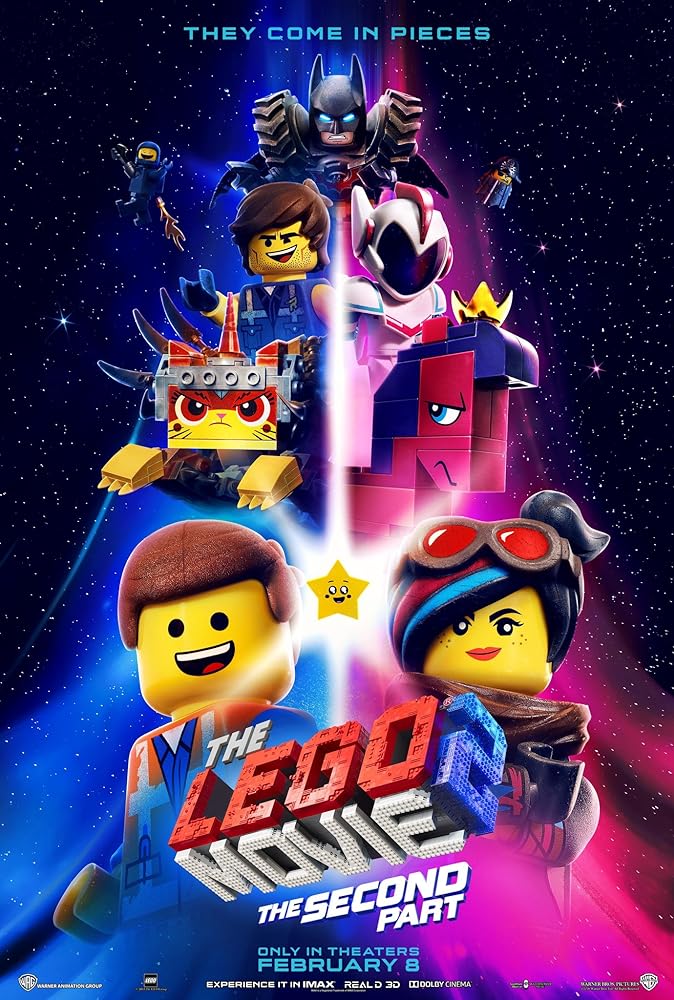
The LEGO Movie 2: The Second Part (2019) review

Will Arnett, Elizabeth Banks, Charlie Day, Nick Offerman, Chris Pratt, Alison Brie, Tiffany Haddish, and Stephanie Beatriz in The Lego Movie 2: The Second Part (2019)

In 1934, Danish carpenter Ole Kirk Christiansen renamed his toy company LEGO, a name that was derived from the Danish phrase leg godt, meaning ‘play well’. In 1949, two years after they started producing plastic toys instead of wooden ones, LEGO would begin to develop what would end up becoming the company’s most famous product, interlocking bricks. And thus, over the next few decades, LEGO would quickly become one of the most iconic toy brands of all-time, allowing its customers to create all sorts of unique objects out of these plastic bricks. Over 650 billion LEGO pieces have been produced since 1958, and the company has developed a wide variety of themed sets ranging from original franchises like Bionicle and Ninjago to popular IPs such as Lord of the Rings and Star Wars. Aside from the toys, LEGO has also expanded into other facets of media, including numerous video games and their own chain of theme parks a la Disney and Universal. It’s a different story, however, when it comes to films. Prior to 2014, almost all official LEGO films were direct-to-video releases, with most of them being based around the company’s now-discontinued Bionicle franchise. But then, in 2011, Warner Bros. announced that they would be making the first theatrically-released LEGO film, which would serve as the first project from the studio’s recently revived animated film division, Warner Animation Group. In the years leading up to its release, however, some were rather skeptical about how the film would turn out. Given the franchise’s worldwide success and appeal, many assumed that it would end up being nothing more than a massive cash grab and one big toy commercial. And then Phil Lord and Christopher Miller were announced as its directors.

Ever since they made their directorial debut in 2009, Lord and Miller have very much made a name for themselves as a duo who have managed to make excellent films out of seemingly disastrous concepts. Their exploits have ranged from directing two hilarious comedies based on a previously obscure 80’s television series to producing/writing what many now consider to be the best Spider-Man film of all-time. And sure enough, when The LEGO Movie hit theaters in February 2014, it was a smash hit with critics and audiences. The film grossed over $469 million worldwide and was widely praised for its gorgeous animation, witty dialogue, and emotionally poignant story that genuinely celebrated LEGO’s devoted fandom. Because of its success, several spin-offs were then announced, with two of them being released in 2017. One was a spin-off about the original film’s breakout star, Will Arnett’s hilarious take on Batman, and the other was an adaptation of LEGO’s popular Ninjago line. But now we return to the LEGO world that started it all with The LEGO Movie 2: The Second Part. This time, however, Lord and Miller aren’t back to direct, though they are still involved as producers and the film’s primary screenwriters. It was originally reported that the film would serve as the directorial debut of Rob Schrab, who had previously directed episodes of the cult classic series Community. Ultimately, though, Schrab was replaced by veteran filmmaker Mike Mitchell, who’s no stranger to animation having previously directed Shrek Forever After and Trolls for DreamWorks. And even after half a decade and three whole LEGO films, that LEGO charm is still on full display.  


At the end of the original LEGO Movie, the citizens of the town of Bricksburg, led by the seemingly ordinary construction worker Emmet Brickowski (voiced by Chris Pratt), banded together to stop the evil Lord Business (voiced by Will Ferrell) from destroying their world. Unfortunately, the city is then overrun with invaders from the planet Duplo, effectively turning it into a wasteland, Apocalypseburg. And yet, while everyone else in the city has embraced their new apocalyptic lifestyle, Emmet continues to remain upbeat despite his girlfriend Lucy AKA Wyldstyle (voiced by Elizabeth Banks) wishing that he’d mature just like the rest of them. Things only manage to get worse when a new invader arrives in the form of the Duplo army’s leader, General Sweet Mayhem (voiced by Stephanie Beatriz). Sweet Mayhem proceeds to capture Lucy, Batman (voiced by Will Arnett), 1980s astronaut Benny (voiced by Charlie Day), MetalBeard the Pirate (voiced by Nick Offerman), and Princess Unikitty (voiced by Alison Brie) and brings them to her homeworld, the Systar System. There, they meet the galaxy’s ruler, the shape-shifting Queen Watevra Wa-Nabi (voiced by Tiffany Haddish), who seeks to marry one of them (which ends up being Batman) in what Lucy believes is a blatantly evil scheme. Meanwhile, back in Apocalypseburg, Emmet embarks on a journey to the Systar System himself to rescue his friends. Along the way, he ends up meeting the badass Rex Dangervest (also voiced by Chris Pratt), a galaxy-defending archaeologist/cowboy/raptor trainer who agrees to help him out while also showing him what it takes to truly be a hardened warrior.

As is the case with all these recent LEGO films, The LEGO Movie 2 boasts gorgeous animation provided by the Australian animation company Animal Logic. While technically a computer-animated film, the implementation of stop-motion animation aesthetics helps to give the film the same charm that can be found in the numerous LEGO fan films that have been made over the years. Plus, these animators deserve a lot of credit for their impressive attention to detail when creating a world that’s entirely made from LEGOs. This brilliant animation is then matched by the film’s equally terrific screenplay, which perfectly blends its heartfelt narrative with its riotous humor. Thanks to Lord and Miller’s excellent comedic sensibilities, this film arguably surpasses its predecessor when it comes to its sight gags, snappy dialogue, and hilarious cameos. But, of course, just like the first film, there’s also a lot of heart to this story thanks to its wonderful messages and themes. The original LEGO Movie served as a celebration of creative thinking and expanded upon its seemingly traditional ‘hero’s journey’ storyline to show that everyone is special in their own, unique way. The sequel then proceeds to take that even further by highlighting the importance of cooperation and seeing things from a different perspective, which is best exemplified through the expansion of the first film’s biggest plot twist that revealed that everything in the LEGO world was being manipulated by a human kid named Finn (Jadon Sand). Going off the first film’s ending, the sequel brings in Finn’s younger sister Bianca (Brooklynn Prince), which ends up affecting both their world and the LEGO world in interesting ways.

Almost all the major players from the first film’s cast return and are all great once again in their respective roles. It all starts, of course, with Chris Pratt, who continues to make Emmet one of the most endearing main protagonists in recent animation history. Emmet also benefits from having another solid character arc in this one based around the apparent necessity for him to grow up, which he mainly does through his interactions with Rex Dangervest AKA an amalgamation of Star-Lord, Owen Grady, and Faraday from The Magnificent Seven remake. Simply put, it’s a lot of fun to witness Chris Pratt playing these two roles that respectively represent his comedic roots and the charismatic leading man status that he holds today. Elizabeth Banks also gets a lot of great material to work with as well as Lucy/Wyldstyle, with the film continuing to follow the overall arc of cutting through her tough exterior (which, without spoiling anything, leads to a subtle yet very satisfying payoff at the end). And, of course, Will Arnett continues to be hilarious as LEGO Batman, even if he already had his big character arc in The LEGO Batman Movie. After that, there are the usual supporting players; Nick Offerman as MetalBeard, Alison Brie as Unikitty, Charlie Day as Benny (“SPACESHIP!!”), etc. They’re then joined by the big newcomers to this film, Tiffany Haddish as Queen Watevra Wa-Nabi and Stephanie Beatriz as General Sweet Mayhem. Haddish continues to prove why her star’s been on the rise these past few years and the film takes full advantage of her character’s shape-shifting abilities. And while Beatriz doesn’t necessarily get as much to work with as her co-stars, she works off Elizabeth Banks incredibly well in the scenes between Lucy and Mayhem.

So, can we just all agree that the LEGO Movie franchise is one of the best around? Thanks to the continued involvement of Phil Lord and Chris Miller (even when they’re not directing), this series has delivered time and time again with films that boast gorgeous animation, fun characters, and excellent emotional poignancy. As such, I’m genuinely surprised that some are saying that The LEGO Movie 2 isn’t as good as the first film (it’s that damn ‘not as fresh’ argument that long-time readers know I’m not a big fan of). On the contrary, I’d say that it’s just as good as its predecessor. Is it the better of the two? Well, that one’s legitimately up for debate, but I’d argue that this one tops the original when it comes to its humor. Whatever the case may be, though, The LEGO Movie 2: The Second Part is an absolute must-see. Even though it’s been years since I was in the big LEGO craze that defined my childhood (still waiting for that LEGO Bionicle film…), I’m still very much drawn to these films because they continue to do a wonderful job paying tribute to their fandom by matching their creativity with the LEGO brand. After all, one of the main lyrics to the original film’s classic tune ‘Everything is Awesome’ states that ‘everything is better when we stick together’. And sure enough, this film directly addresses the importance of unity while also providing some timely commentary on the dangers of toxic masculinity. In short, it’s yet another carefully constructed masterpiece (pun intended).


Rating: 5/5!

Sunday, June 24, 2018

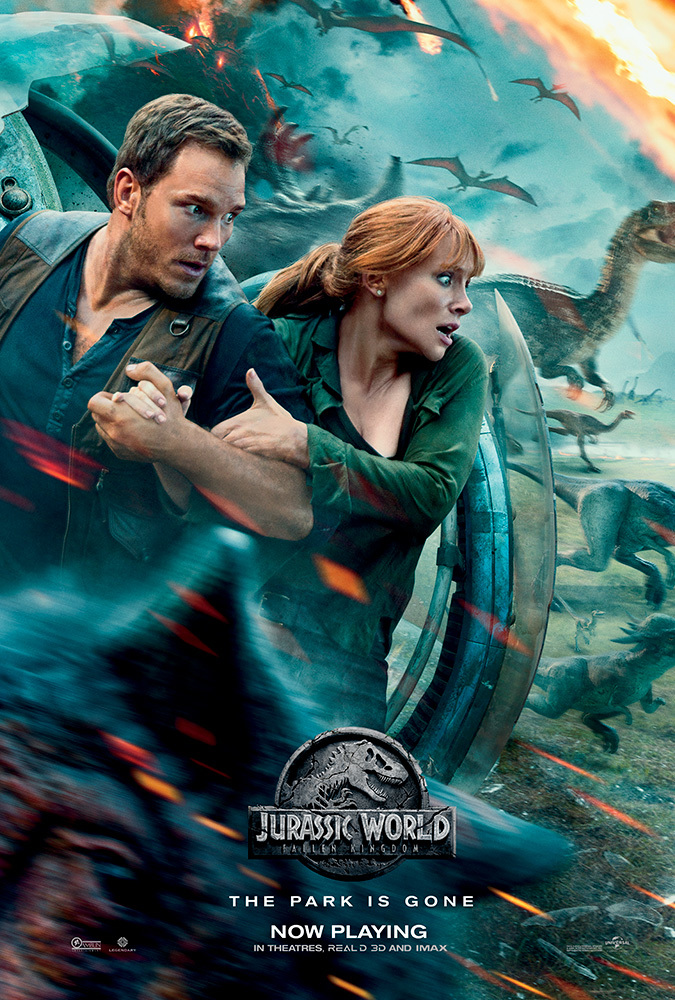
Jurassic World: Fallen Kingdom (2018) review

Jurassic World: Fallen Kingdom (2018)

Jurassic Park is a film series that needs no introduction at this point. What started with director Steven Spielberg’s 1993 adaptation of author Michael Crichton’s 1990 novel of the same name has gone on to become one of the most famous franchises in pop culture history. The original Jurassic Park still stands as one of the most famous blockbusters of all-time, touted for its groundbreaking visual effects (both animatronic and CGI-based) that were used to bring the story’s dinosaur creatures to life. Because of this, it was the highest-grossing film of its time, earning over $914 million worldwide, a record that stood for four years until James Cameron’s Titanic became the first film to earn over $1 billion at the worldwide box-office (Jurassic Park would ultimately join the billion-dollar club itself when it was re-released in 3-D in 2013 for its 20th anniversary). It was then followed by two immediate sequels, the Spielberg-directed The Lost World: Jurassic Park in 1997, which adapted Crichton’s 1995 sequel novelization that was made after the success of the first film, and the Joe Johnston-directed Jurassic Park III in 2001, the first film in the franchise that was not based on a Crichton novel. Both films did well at the box-office but neither of them was as well-received by critics and audiences compared to the first film. After that, a planned fourth film spent several years stuck in development hell due to numerous rewrites of the script, with writers like William Monahan, John Sayles, and Mark Protosevich being brought in to try and make it all work, ultimately to no avail.

It ultimately saw the light of day in 2015 with Jurassic World, directed by Colin Trevorrow, fresh off his 2012 indie hit Safety Not Guaranteed, who also co-wrote it with writing partner Derek Connolly. Serving more as a direct sequel to the original Jurassic Park (while still recognizing the previous two films as canon), the film was a monster hit at the box-office when it was released that summer. It earned over $208 million on its opening weekend in the United States and over $524 million worldwide, officially setting the record for the biggest opening weekend of all-time, a record that has since been outdone by Avengers: Infinity War both domestically and worldwide. And while critics and audiences seemed to be just as split on it as they were with the previous two films, it was still considered to be the best of the original film’s sequels. Cut to three years later and the series continues from its biggest financial hit to date with Jurassic World: Fallen Kingdom. This time, though, Colin Trevorrow isn’t in the director’s chair due to the commitment that he made to Star Wars: Episode IX before he ultimately left the project, though he and Connolly are still involved here as the film’s main writers. Instead, we have J.A. Bayona, who was previously considered to direct Jurassic World before he backed out due to fear of it being a rushed production, behind the camera. Like Trevorrow, Bayona’s been well-known for his work in the indie circuit with critically-acclaimed hits like 2007’s The Orphanage, 2012’s The Impossible, and 2016’s A Monster Calls. And for his first major blockbuster outing, he proceeds to give us yet another enjoyable dinosaur-centric adventure that does manage to carve out its own identity when compared to its four predecessors.

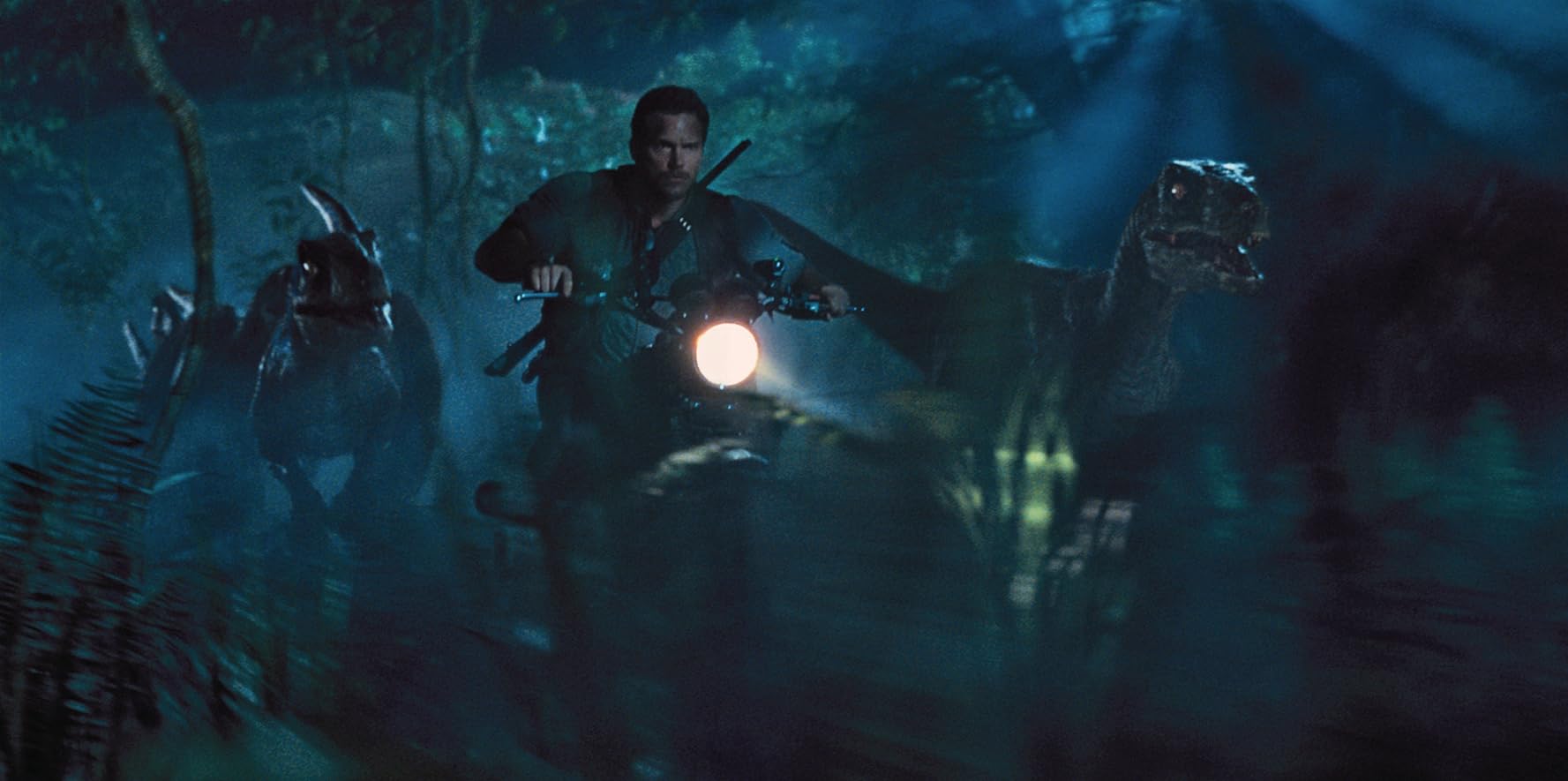
It has been three years since Jurassic World, the second major attempt at realizing industrialist John Hammond’s vision of a theme park featuring genetically-cloned dinosaurs was abandoned after the park was ravaged by its newest creation, a genetically-produced hybrid dinosaur known as the Indominus Rex. When it’s discovered that the island of Isla Nublar is about to be ravaged by an eruption from its previously dormant volcano, the U.S. Senate decides to not attempt to rescue the island’s dinosaurs to avoid any further dinosaur-related catastrophes. While this is going on, Claire Dearing (Bryce Dallas Howard), Jurassic World’s former operations manager who now runs an activist group seeking to rescue the dinosaurs, is approached by Sir Benjamin Lockwood (James Cromwell), who was Hammond’s primary business partner in his initial dinosaur-cloning experiments. Lockwood and his aide, Eli Mills (Rafe Spall), devise a plan to extract the dinosaurs from the island and have them moved to a safe location away from any human interference. Claire is selected to lead the rescue team and she also recruits her ‘ex’ Owen Grady (Chris Pratt), Jurassic World’s former Velociraptor trainer, who is ultimately convinced to go when it’s revealed that Blue, the last surviving member of both his raptor pack and her species in general, is one of Lockwood and Mills’ primary targets. Once on the island, however, Claire and Owen learn that Mills and his team have different plans for the dinosaurs. Instead of transporting them to safety, Mills plans to have the dinosaurs be sold off to buyers all over the world. And as for Blue, she’s needed to further the development of a new genetic hybrid that’s touted as being even more dangerous than the Indominus Rex, the Indoraptor.

Many have touted Jurassic World: Fallen Kingdom as being more akin to a horror film, and it’s easy to see why. The way in which some of the film’s biggest sequences are filmed does give off a neat horror vibe, whether it’s a young girl being hunted by a vicious raptor in her own home or two characters being hunted by a Baryonyx in an abandoned facility that’s slowly being destroyed by lava. And overall, this does give a nice new spin to the traditional franchise concept of humans being hunted by dinosaurs. Still, even with that in mind, admittedly the story doesn’t always match the quality of some of this film’s most memorable sequences. This is especially the case when one big twist regarding a secret about one of the new characters is brought up but is never expanded upon after that reveal despite it being based around an intriguing new concept for this universe. Still, like the previous films, Fallen Kingdom doesn’t skimp on its dinosaur action, with a thrilling finale set not on the island of Isla Nublar but an old gothic mansion. On that note, Fallen Kingdom is quite arguably the best-looking film yet out of the Jurassic Park franchise. The cinematography from Bayona regular Oscar Faura produces some truly vibrant imagery, especially during the sequences where Isla Nublar is being ravaged by its volcano. And for those who were disappointed by the previous film only featuring one dinosaur animatronic in favor of CG-created dinosaurs (which weren’t even ‘bad’, even…), you’ll be pleased to know that Bayona goes for a greater balance between the two visual mediums in this film. Yes, there’s quite a lot of CG dinosaurs in this film, but there are also plenty of instances where the same great style of animatronics that was perfected by the legendary Stan Winston (which won him an Oscar for Best Visual Effects for his work on the original Jurassic Park) are on full display.

Chris Pratt and Bryce Dallas Howard are the only major cast members from Jurassic World to reprise their roles in this film, and the two of them are just as excellent here as they were in that film. Pratt’s great charisma is once again in top form here, and this film does give him some stronger character development to work with through the emotional bond that he shares with Blue. And while Bryce Dallas Howard doesn’t necessarily get to work with the same great transformative arc that Claire underwent in the first film, going from an uptight, work-focused businesswoman to a more emotionally-driven badass, she still gets to have just as plenty of badass moments as Pratt does. Plus, the two have excellent chemistry, better here than in the first film, even. As for the rest of the cast, while a lot of them do end up filling the franchise’s typical collection of characters who end up being ‘dino-chow’, all these actors and actresses do solid jobs in their respective roles. You’ve got your reliable screen veterans like James Cromwell as Sir Lockwood, Ted Levine as the imposing leader of Mills’ mercenary group, and Toby Jones as an auctioneer working in cahoots with Mills. And then you also have some solid newcomers as well, namely the other two members of Owen and Claire’s core group, Daniella Pineda as tenacious paleo-veterinarian Zia Rodriguez and Justice Smith as timid systems analyst Franklin Webb. But easily the most talked about member of this film’s cast is Jeff Goldblum making his heralded return to the Jurassic Park franchise as Dr. Ian Malcolm, who last appeared in 1997’s The Lost World: Jurassic Park. But as Goldblum himself noted in an interview, Malcolm does not factor that much into the film’s plot, as he only appears briefly at the beginning and end in sequences that do not have him interacting with any of the main characters. Still, for what it’s worth, Goldblum does make the most out of his brief appearance, delivering more of the stoic truths that he uttered in previous films that tie into the franchise’s biggest themes revolving around the ethical debate of resurrecting creatures who have been extinct for millions of years.

With a mediocre 50% rating on Rotten Tomatoes (at the time that I’m writing this), Jurassic World: Fallen Kingdom continues the series’ trend of several folks feeling that the sequels don’t even remotely compare to the quality of the original film. But as someone who didn’t necessarily grow up with this franchise (outside of seeing Jurassic Park III when I was like six while over at a friend’s house), I’ve never held these heightened expectations against any of the sequels while still regarding the original film as one of the all-time greats. With that in mind, I enjoyed this film just as much as the other entries in the Jurassic Park franchise. To his credit, J.A. Bayona delivers what is easily the darkest installment of the series to date both thematically and visually. His horror genre roots do come in handy here, producing some effectively tense visuals that are bolstered further by Oscar Faura’s stunning cinematography. And while plot and character development are still not exactly this series’ strongest suit, it does deliver on everything else that fans of the franchise love about it when it comes to its wide array of dinosaur creatures and the chaos that is regularly caused by them. As such, this film ends on a truly fascinating note that paves the way for what will surely be an exciting conclusion to this new Jurassic World trilogy. This third installment will be hitting theaters in the summer of 2021 and will see Colin Trevorrow returning to the director’s chair and closing out the trilogy that he started a la J.J. Abrams returning to direct Star Wars: Episode IX (which, coincidentally, was originally set to be directed by Trevorrow). Until then, we have Jurassic World: Fallen Kingdom, another worthy follow-up to the iconic blockbuster that was the original Jurassic Park.


Rating: 4/5

Thursday, June 21, 2018

Jurassic Park: The Story So Far


Welcome, ladies and gentlemen, to the next installment of an ongoing series here on Rhode Island Movie Corner, ‘The Story So Far’. This is where I recap the past installments of a franchise in time for its latest release. In doing so, it allows you, the readers, an opportunity to catch up on a franchise if you find that you don’t have enough time to watch its previous installments and just want to know about its most important details before seeing the new film. And for today’s segment of ‘The Story So Far’, we’re looking at one of the most famous franchises in recent film history, Jurassic Park. Ever since director Steven Spielberg’s adaptation of author Michael Crichton’s best-selling novel of the same name hit theaters in 1993, it has gone on to become of the most beloved blockbusters of all-time, heralded for its groundbreaking visual effects. It then proceeded to get two follow-ups, 1997’s The Lost World: Jurassic Park, which Spielberg directed as well, and 2001’s Jurassic Park III, directed by Joe Johnston. Both films did well at the box-office though they weren’t as well-received by critics and audiences when compared to the first film. After that, a planned fourth film spent several years languishing in development hell until director Colin Trevorrow returned audiences to the island of Isla Nublar in 2015 with Jurassic World. Upon its release, the film set numerous box-office records amidst a critical reception that admittedly made it just as polarizing as the previous two films. But, of course, we’re back again with this cautionary tale of ‘man vs. nature’ with this year’s Jurassic World: Fallen Kingdom, directed by J.A. Bayona. But until then, let’s return to the early days of this crazy, little dinosaur experiment and embark on an adventure ’65 million years in the making’ as we recap the events of the Jurassic Park series.

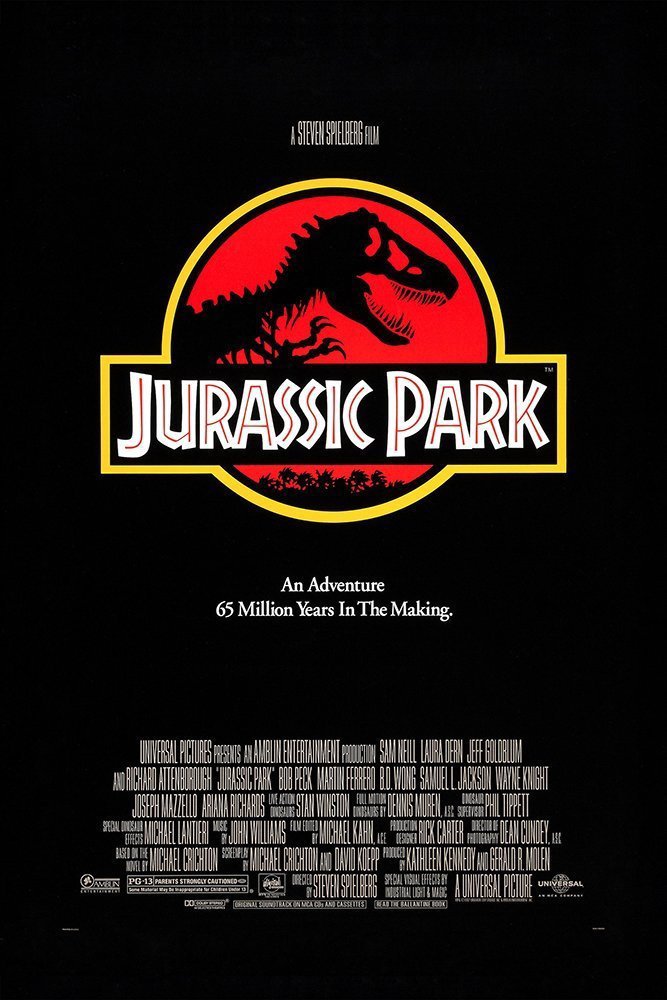
Jurassic Park (RELEASED: 1993)

Jurassic Park (1993)

On the island of Isla Nublar, located off the coast of Costa Rica, industrialist John Hammond (Sir Richard Attenborough) and his company InGen have developed a way of cloning dinosaurs utilizing dinosaur DNA that has been extracted from fossilized mosquitoes. Hammond plans on showcasing his new discovery to the world via an immersive theme park called ‘Jurassic Park’. However, while transporting a Velociraptor to a new enclosure one night, one of the company’s dinosaur handlers is killed when the raptor tries to break free, resulting in a lawsuit from the employee’s family. Because of this, Hammond’s investors demand that he hires a team of experts to visit the park to ensure that it’s maintaining good safety standards. Thus, Hammond invites paleontologist Dr. Alan Grant (Sam Neill), paleobotanist Dr. Ellie Sattler (Laura Dern), and mathematician/chaos theorist Dr. Ian Malcolm (Jeff Goldblum) to the island. Along the way, they’re joined by lawyer Donald Gennaro (Martin Ferraro), who represents Hammond’s investors, and once they arrive on the island, they meet Hammond’s grandchildren, tech-savvy Lex Murphy (Ariana Richards) and her younger brother, dinosaur enthusiast Tim (Joseph Mazzello). This proves to be a bit of an issue for Grant who, as evident from an earlier scene where he discusses raptors with a kid at a dig site, isn’t that big a fan of children. But the tour goes on as planned, with the group being told that the dinosaurs on the island are unable to breed because they are all female, something that Malcolm questions as he claims that this attempt of theirs to control nature is doomed to fail. As for the tour itself, it ultimately ends up being incredibly underwhelming as most of the dinosaurs that the group is meant to come across don’t show up. The only dinosaur that they do come across is a sick Triceratops that they find once they temporarily leave their tour vehicles. Ellie decides to stay and study the Triceratops while Grant, Malcolm, Tim, Lex, and Gennaro return to the tour vehicles right as a tropical storm begins to make landfall on the island, which forces the tour to be put on hold.  

Jeff Goldblum in Jurassic Park (1993)

Meanwhile, Jurassic Park’s disgruntled main computer programmer, Dennis Nedry (Wayne Knight), initiates a plan to steal some of InGen’s fertilized embryos for a rival company. To do so, Nedry temporarily shuts down the park’s security system, which also ends up shutting off all the power in the park. To make matters worse for Grant and company, this ends up occurring right when they’re stationed near the Tyrannosaurus Rex paddock. Sure enough, the T-Rex breaks loose, eating Gennaro (while he’s hiding on the toilet in a nearby restroom) and injuring Malcolm while Grant and the kids barely manage to escape. Nedry’s own efforts to leave the island with the embryos in tow ends up being disastrous as well when he gets lost on the way to the docks and is killed by a venom-spitting Dilophosaurus (disclaimer: Dilophosaurus did not spit venom in real-life; this was something that Michael Crichton invented for the novel). When Ellie and the park’s warden, Robert Muldoon (Bob Peck), head out to try and find Grant and the kids, they rescue Malcolm and barely manage to escape from the T-Rex when it chases after them. Once back at the park’s visitor center, Hammond and his chief engineer, Ray Arnold (Samuel L. Jackson), decide to reboot the park’s entire system when they find that they’re unable to figure out a way around Nedry’s hacks. When Arnold fails to return from turning the power back on, Ellie and Muldoon head out to investigate. Muldoon ends up getting killed by a pair of Velociraptors while Ellie manages to reach the primary maintenance shed and gets the power back up and running again, coming across Arnold’s severed arm in the process.

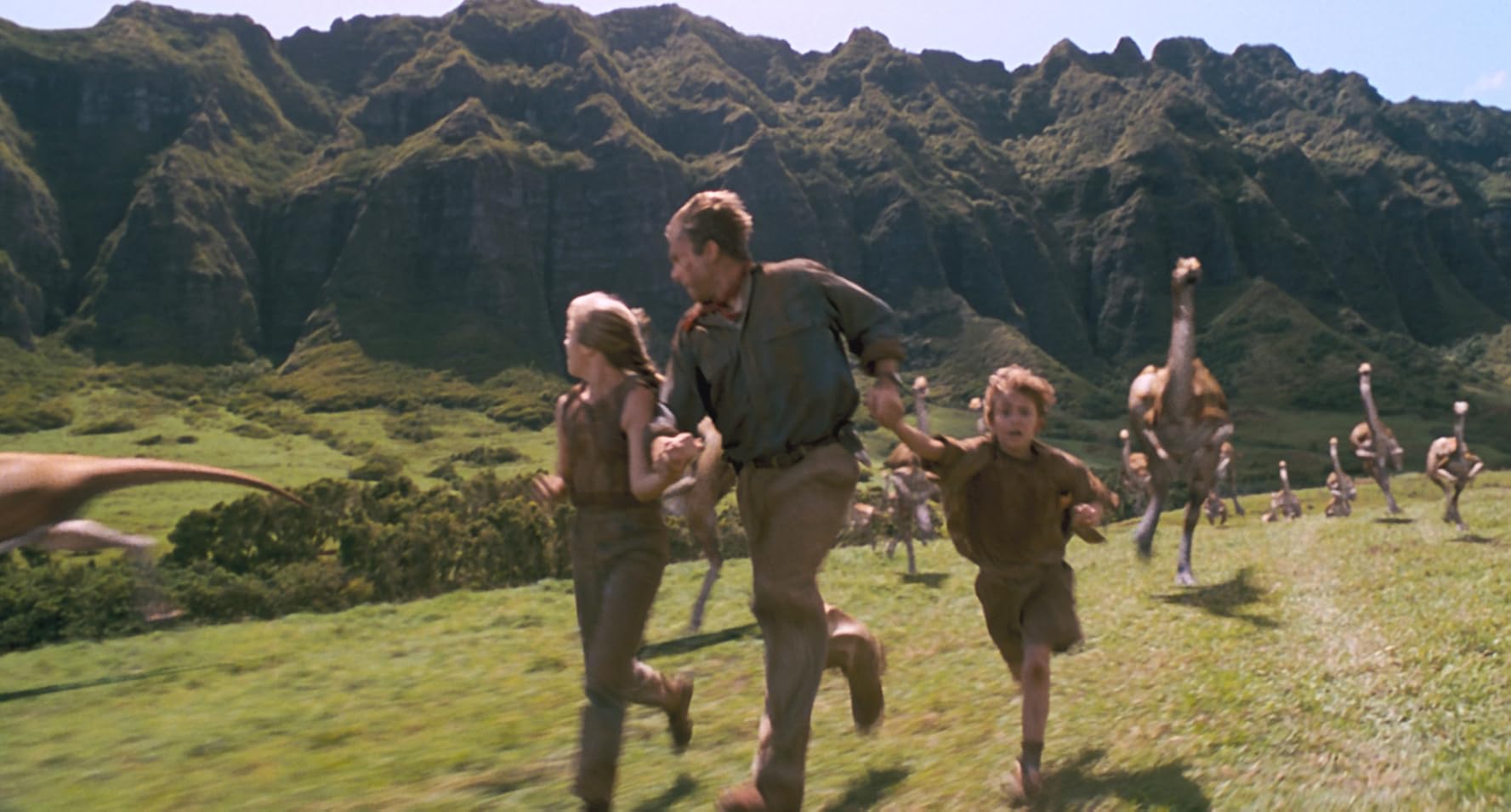
Sam Neill, Ariana Richards, and Joseph Mazzello in Jurassic Park (1993)

As Grant and the kids begin their journey back to the visitor center, they come across a bunch of broken egg shells, with Grant realizing that Malcolm was right and that the dinosaurs can breed after all due to the parts of their DNA that were taken from frogs who can change their sex in a single-sex environment. After enduring everything from a Gallimimus stampede (and subsequent T-Rex attack) to Tim nearly dying when they try to climb over an electric fence right when the power is turned back on, the trio manages to return to the visitor center and reunite with Ellie. Unfortunately, they are then pursued by the raptors, who first chase Tim and Lex through the kitchen before cornering the lot of them in the control room. The group manages to temporarily keep them at bay when Lex manages to use the park’s UNIX computer system to restore power to the entire park, fixing both the phones and the electric door locks. As Hammond calls for a helicopter to evacuate, the group are forced to flee once again when the raptors break through the windows of the control room. They eventually end up in the visitor center’s foyer, where they get cornered by the raptors. Luckily for them, the T-Rex pops up by surprise and kills the raptors, giving them ample time to escape. After reuniting with Hammond and Malcolm, the group finally escapes the island via helicopter, with Grant having gained a newfound appreciation for children thanks to the time that he has spent with Tim and Lex.

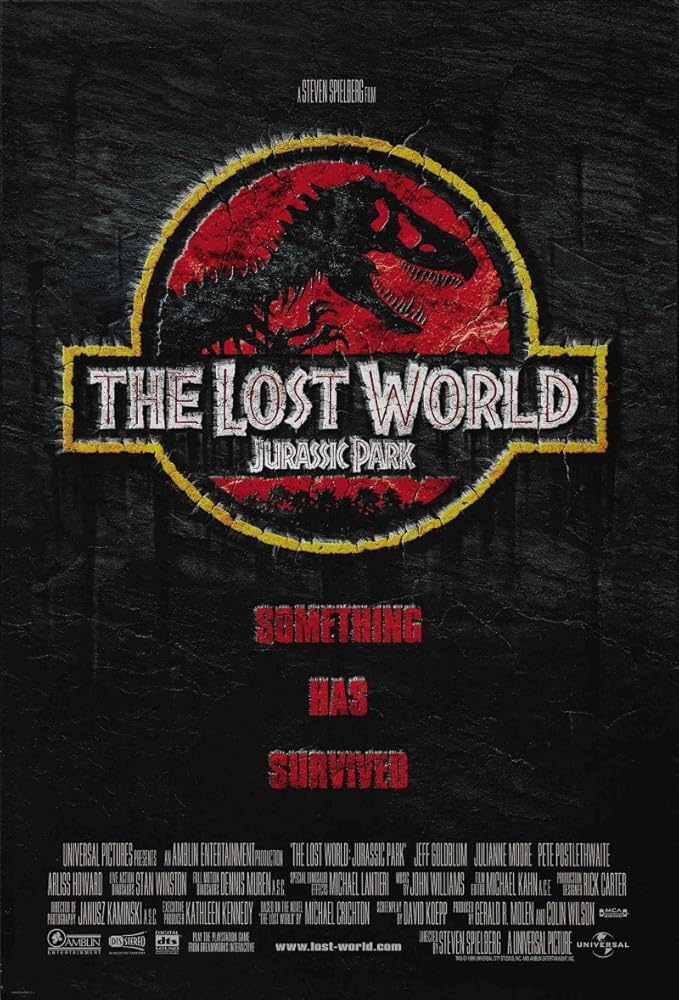
The Lost World: Jurassic Park (RELEASED: 1997)

The Lost World: Jurassic Park (1997)

After the success of the film adaptation of Jurassic Park, Crichton published a sequel, The Lost World, in 1995, which was subsequently adapted to the big-screen by Spielberg two years later. Set four years after the events of the original film, it opens with InGen once again finding itself in hot water when a young girl named Cathy Bowman (Camilla Belle) is attacked by a swarm of Compsognathus while on vacation with her family. As it turns out, the family had landed on another Costa Rican island, Isla Sorna, which is revealed to be the site where the company had created the dinosaurs before they were moved over to Isla Nublar. The site was ultimately abandoned when a hurricane ravaged the area, leaving the dinosaurs on their own without any sort of measures in place to restrain them. InGen, now headed by John Hammond’s nephew Peter Ludlow (Arliss Howard), plans on using the island to fix their financial troubles caused by the incident on Isla Nublar. While this is going on, John Hammond approaches Ian Malcolm and asks for his help in ensuring the dinosaurs’ survival by having him travel to Isla Sorna with a team to document them to prove that they’re perfectly fine in their natural habitat. While Malcolm is hesitant to return to the area, he is ultimately convinced to go when he learns that one of the members of Hammond’s team is his girlfriend, paleontologist Sarah Harding (Julianne Moore), who’s already on the island. Now intent on getting her out before something happens to her, Malcolm meets up with the other two members of their team, engineer/field equipment expert Eddie Carr (Richard Schiff) and video documentarian Nick Van Owen (Vince Vaughn). Before they head off, Malcolm is also forced to deal with the increasingly strained relationship that he has with his daughter Kelly (Vanessa Lee Chester).

Jeff Goldblum, Vince Vaughn, and Richard Schiff in The Lost World: Jurassic Park (1997)

Once the group lands on Isla Sorna, they reunite with Sarah while also discovering that Kelly had stowed away with them in their mobile base. Soon after, a team of mercenaries and hunters led by Ludlow and big-game hunter Roland Tembo (Pete Postlethwaite) arrive on the island to enact InGen’s plans by capturing multiple dinosaurs and having them sent to a theme park that’s planned to be built in San Diego. They also capture an infant T-Rex that Tembo plans on using as bait to lure its parent, which he’s primarily looking to capture. Clearly aware of why this is, as Malcolm later puts it, ‘the worst idea in the history of bad ideas’, Nick and Sarah break the dinosaurs out of their cages, allowing them to wreak havoc upon the InGen team’s camp. They also take the infant T-Rex back to the mobile base to fix its broken leg. This, of course, causes its parents to arrive on the scene, knocking the base off a cliff while Malcolm, Sarah, and Nick are still inside and eating Eddie when he tries to pull it back up. The trio ultimately gets rescued by the InGen team and, because of the loss of both teams’ communications equipment, are forced to form an uneasy ‘alliance’ with them to reach the island’s abandoned radio station and call for rescue. The group ends up getting chased by the adult T-Rexes and a bunch of velociraptors, with numerous casualties along the way. Malcolm’s group manages to reach the radio station, fend off the raptors, and call for a helicopter while the InGen team successfully manages to capture the male T-Rex, who’s then transported to the site of the new theme park in San Diego.

The Lost World: Jurassic Park (1997)

Back on the mainland, the ship transporting the T-Rex ends up crashing into InGen’s docks when it arrives earlier than expected without responding to any calls from the harbormaster. After it’s discovered that the ship’s crew has been killed, the T-Rex is accidentally released from the cargo hold, allowing it to rampage through the city where it menaces suburbia, eats ‘unlucky bastards’ who happen to be played by the film’s screenwriters (no joke, that’s what the character played via cameo by screenwriter David Koepp is listed as), etc. To get it back on the ship, Malcolm and Sarah collect the infant T-Rex from the new park’s facilities and transport it back by car, luring the adult T-Rex back with them just like when they first took the infant back to their mobile base on the island. When Ludlow tries to intervene, he gets trapped in the cargo hold by the adult T-Rex and is devoured by the infant while Malcolm and Sarah manage to tranquilize the former and trap them both in there so that they can be sent back to Isla Sorna. The next day, Malcolm, Sarah, and Kelly watch a news report on the infant and adult T-Rexes being transported back. An interview with John Hammond reveals that plans have been made with the Costa Rican Department of Biological Preserves to turn Isla Sorna into a nature preserve, allowing the dinosaurs to live in peace without any sort of interference from humans. Thus, as the film ends with a shot of the family of T-Rexes reunited on the island, Hammond quotes the line that Malcolm famously stated in the previous film, affirming that ‘life will find a way’.

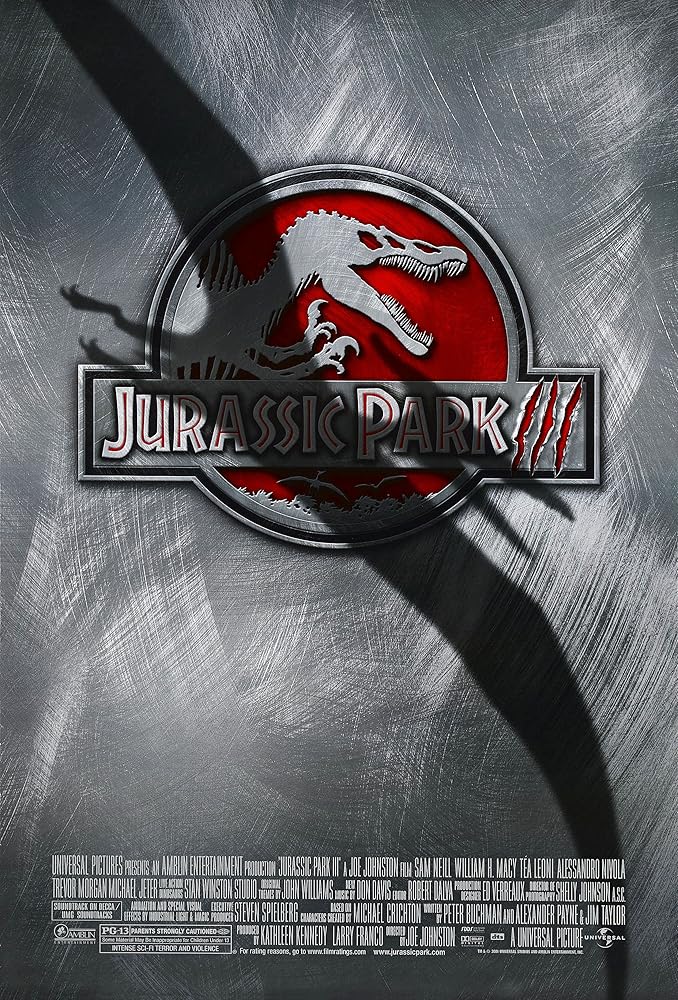
Jurassic Park III (RELEASED: 2001)

Jurassic Park III (2001)

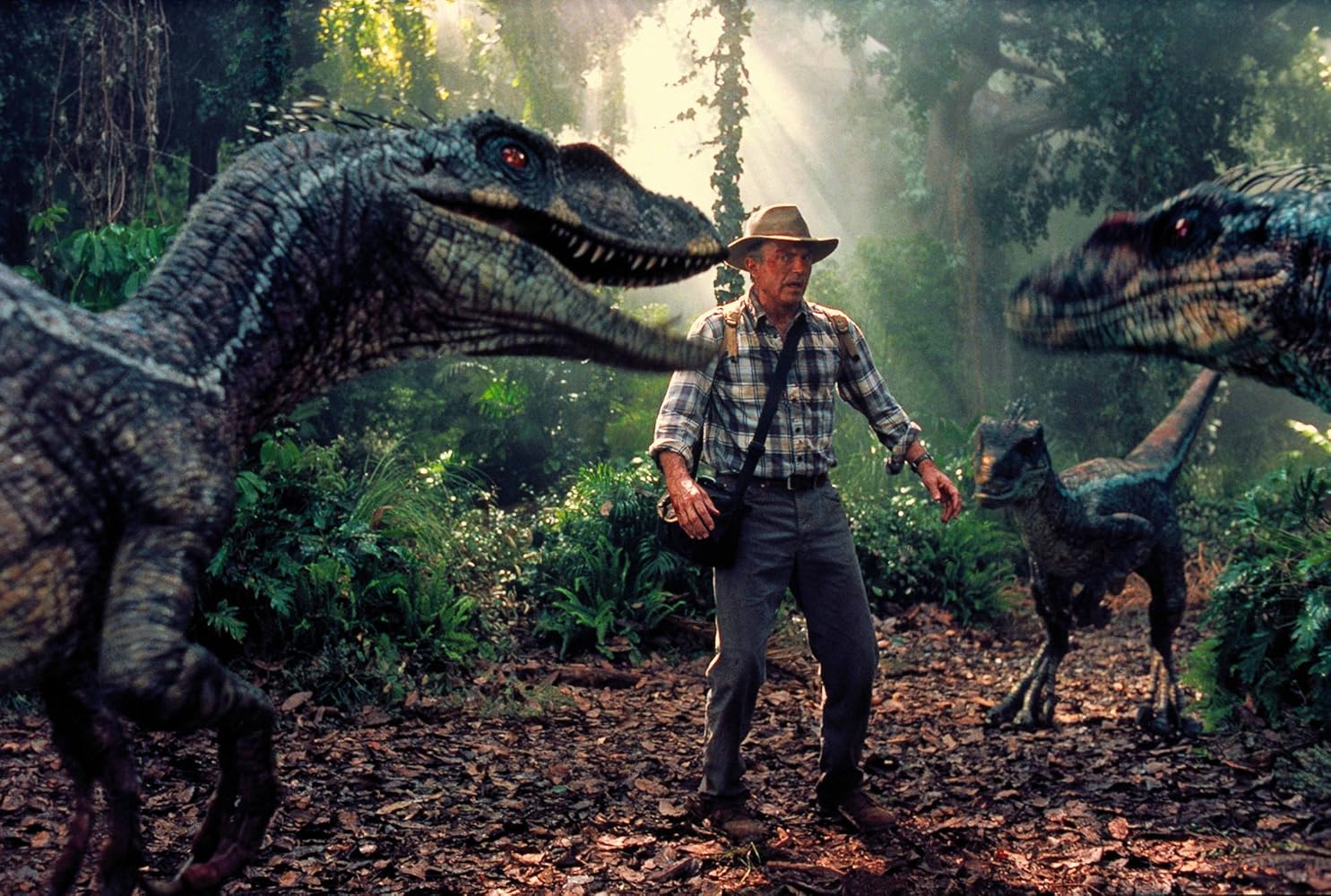
Four years after the events of the previous film, Jurassic Park III opens with 12-year-old Eric Kirby (Trevor Morgan) parasailing near the island of Isla Sorna with family friend Ben Hildebrand (Mark Harelik). To their horror, the other passengers on their boat are killed by something that is unseen due to fog and the two end up having to detach themselves from the boat before it crashes into a bunch of rocks, resulting in them being directed right towards Isla Sorna. Meanwhile, back on the mainland, Dr. Alan Grant finds himself struggling to find funding for his team’s research while Ellie Sattler has since gotten married to U.S. State Department worker Mark (Taylor Nichols), whom she has had two kids with. One day, Grant is approached by Paul (William H. Macy) and Amanda (Tea Leoni) Kirby, who offer him funding for his research in exchange for an aerial tour of Isla Sorna. Despite his initial dismissal about returning to the area (to the point where he responds to a question about it at a university lecture by stating that ‘no force on earth or heaven will get him on that island’), Grant agrees to their offer. He is joined by his assistant, Billy Brennan (Alessandro Nivola), on the trip along with a bunch of mercenaries who are ‘financed’ by the Kirbys, Udesky (Michael Jeter), Cooper (John Diehl), and Nash (Bruce A. Young). Once they arrive at Isla Sorna, however, Grant discovers that the group plans on landing there. Despite his objections, they do land and, soon enough, they end up stranded when they crash into a Spinosaurus that had been chasing Cooper, who is subsequently eaten by it along with Nash. After escaping both the Spinosaurus and a T-Rex, who gets killed by the former, Grant learns that the Kirbys had lied to him. Instead of being a rich couple, they are recently-divorced parents who own a hardware store and have come to Isla Sorna in search of their son Eric and Amanda’s boyfriend Ben, who have been missing for the past eight weeks.

Sam Neill in Jurassic Park III (2001)

The group finds Ben and Eric’s parasail, with Ben’s skeletal remains still attached to it and no sign of Eric, meaning that he’s potentially still alive. After being chased by a group of Velociraptors, who kill Udesky, Grant is separated from the group and is rescued from the raptors by Eric, who’s managed to survive on his own for the past eight weeks. When the duo manages to reunite with the others, Grant learns that the reason why the raptors have been chasing them is because Billy had taken a pair of raptor eggs to provide their dig site the funding that they obviously won’t be getting from the Kirbys. Grant, furious at this decision, takes the eggs to ensure that the group will survive, remarking that Billy ‘is no better than the people who built this place’. When the group enters an aviary full of Pteranodons, Billy saves Eric from being taken by them but is seemingly killed in the process. Eventually, the group begins to make their way downriver by boat, barely managing to ward off the Spinosaurus with fire while Grant phones Ellie for help. When the group gets cornered by the Velociraptors once again, Grant manages to ward them off by surrendering the stolen eggs to them and using Billy’s 3-D printed replica of a Velociraptor larynx to confuse them. Once they reach the coast, they end up getting rescued by the U.S. Marine Corps and the U.S. Navy, who were called there by Ellie. Billy is revealed to be alive and the group leaves the island while noticing a bunch of Pteranodons departing as well. As Grant remarks, they’re ‘looking for new nesting grounds’.

Jurassic World (RELEASED: 2015)

Chris Pratt in Jurassic World (2015)

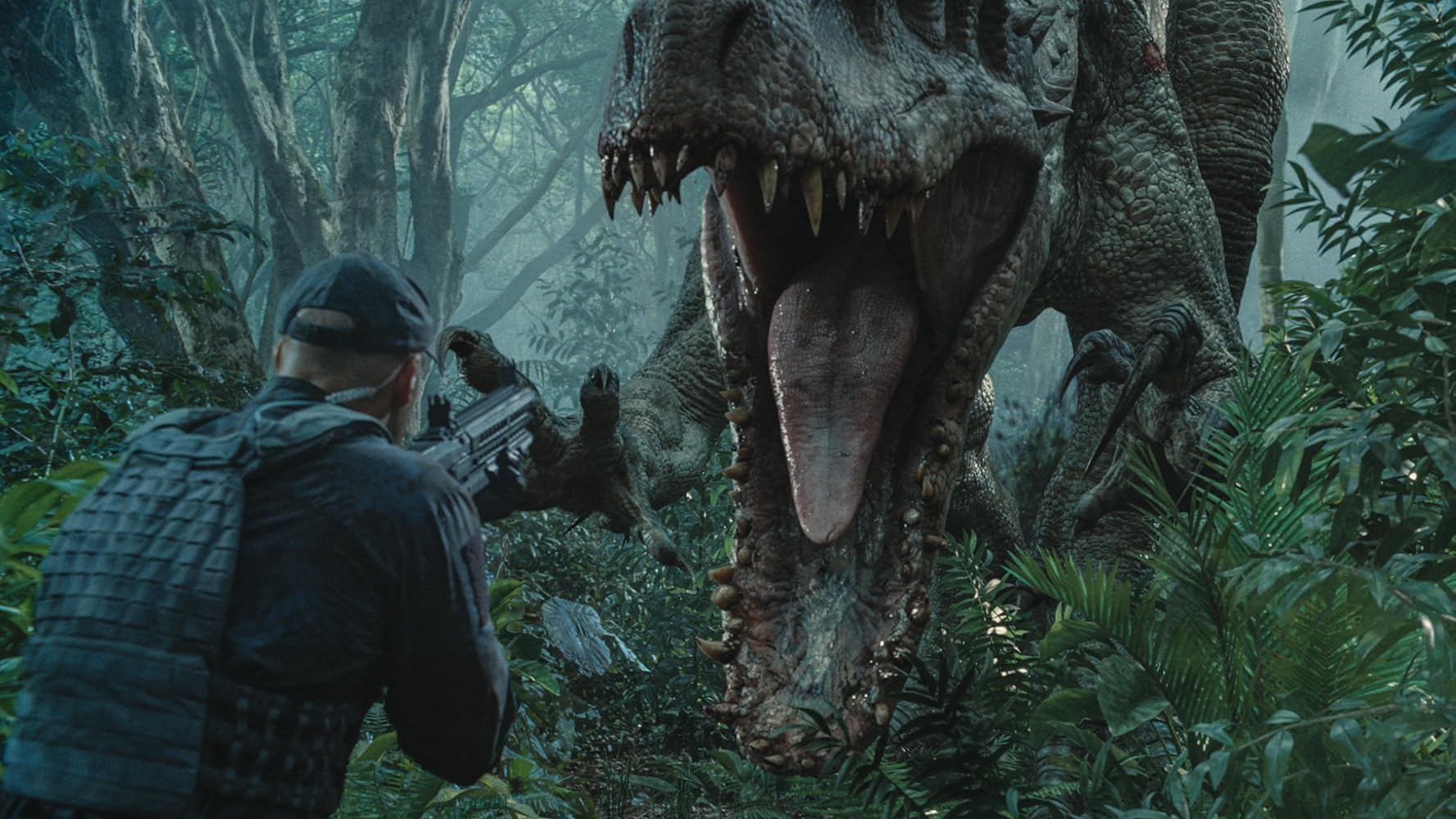
Generally ignoring the events of the previous two films (which still recognizing them as canon), Jurassic World takes place 22 years after the events of the original film. In the years since, John Hammond’s idea of a dinosaur theme park has been revitalized by the Masrani Corporation, with ‘Jurassic World’ operating on the exact same site on Isla Nublar. Bickering brothers Zach (Nick Robinson) and Gray (Ty Simpkins) Mitchell travel to the park to visit their aunt Claire Dearing (Bryce Dallas Howard), who serves as the park’s operations manager. As soon as they arrive, though, she immediately brushes them off to deal with the pressure coming from her boss, ‘pilot’ Simon Masrani (Irrfan Khan), to develop a new attraction that would help boost their attendance numbers. Under the direction of Hammond’s former lead scientist Dr. Henry Wu (B.D. Wong), a new dinosaur known as the Indominus Rex is created from the combined DNA samples of various dinosaurs, including the T-Rex, and other creatures. Claire is then forced to ask for the assistance of the park’s velociraptor trainer Owen Grady (Chris Pratt), whom she had one ‘bad’ date with, to ensure that the Indominus’ enclosure is properly secured. Once there, however, they find that the Indominus has seemingly managed to escape. As it turns out, the Indominus managed to fool them with its camouflaging ability (taken from cuttlefish DNA) and escapes for real once Owen and a few other workers go in to inspect the site. Masrani attempts to subdue it by sending in the park’s Asset Containment Unit, but most of the team ends up getting killed by it, resulting in Claire ordering a complete evacuation of the northern half of the island.

Jurassic World (2015)

Unfortunately for Claire, a new problem emerges when Zach and Gray end up wandering into a restricted area via the park’s gryosphere attraction. The two brothers end up getting attacked by the Indominus and barely manage to escape from it by jumping off a waterfall. While Claire and Owen head out to try and rescue them, they end up coming across the old Jurassic Park Visitor Center and begin heading back to the resort in one of the old park’s jeeps, which they manage to repair. Meanwhile, Masrani pilots an attack helicopter to hunt the Indominus. This ends up being a complete disaster, however, as the helicopter crashes into the resort’s aviary, resulting in a swarm of Pterosaurs attacking the resort’s guests. Owen and Claire manage to find Zach and Gray while park security manages to subdue the attacking Pterosaurs. Soon after, Vic Hoskins (Vincent D’Onofrio), head of InGen’s security team, assumes command of the situation. Hoskins and Owen had come into conflict earlier over the former’s suggestion of using the latter’s quartet of trained raptors (Charlie, Echo, Delta, and Blue) for military use. Despite Owen’s objections, he agrees to partake in Hoskins’ plan to use the raptors to hunt down the Indominus. Unfortunately, once Owen and the raptors come across the Indominus, Owen realizes one of the biggest secrets surrounding the creature’s creation… it’s part raptor. This allows the Indominus to become the Raptors’ new ‘alpha’, resulting in the pack beginning to hunt InGen’s troops.

Chris Pratt in Jurassic World (2015)

Owen, Claire, Zach, and Gray barely manage to escape and return to the Jurassic World Visitor Center. Once there, they discover that Hoskins has been working in conjunction with Dr. Wu on new hybrid dinosaurs to further his plan of having them be used for military purposes. While Hoskins ends up getting killed by Delta, Owen manages to regain the trust of his raptor pack right as the Indominus returns. After Echo and Delta are killed by it (Charlie was killed earlier during the Indominus hunt by a missile), Gray remarks that they need something with ‘more teeth’ to stop it. Thus, Claire orders one of the park’s control room operators, Lowery Cruthers (Jake Johnson), to open the gates to the T-Rex paddock as she manages to lure the T-Rex into a fight with the Indominus… and yes, she does all of this while wearing heels. With assistance from Blue, the last surviving member of Owen’s raptor pack, the T-Rex manages to corner the Indominus at the edge of the resort’s lagoon. Before the Indominus can attack again, it is swiftly grabbed by a Mosasaurus and dragged underwater. Blue and the T-Rex depart, though the former shares one last moment with Owen beforehand. As Isla Nublar ends up being abandoned once more, Zach and Gray reunite with their parents, Karen (Judy Greer) and Scott (Andy Buckley), at an off-site shelter in Costa Rica while Owen and Claire prepare for whatever comes next by deciding to stick together ‘for survival’. The film ends with the T-Rex perched above the abandoned Jurassic World site, once again in control of its home environment. But as it’s established in the trailers for the upcoming Jurassic World: Fallen Kingdom, the future of said home is put into jeopardy by way of the island’s previously dormant volcano.


And that is the ‘Story So Far’ when it comes to the Jurassic Park series. Thanks for following along and you can expect a review of Jurassic World: Fallen Kingdom sometime in the next few days. While I am aware that the overall reception towards this franchise’s sequels tend to vary amongst critics and audiences, I’ve personally enjoyed all the films in this franchise (yes, even Jurassic Park III despite the 2.5/5 rating that I gave it a few years back in the retrospective that I did on the original trilogy prior to the release of Jurassic World). Thus, I am eagerly looking forward to this new film, which I hear will provide an interesting set-up for the new trilogy’s finale that’s set to come out in 2021 and will see Colin Trevorrow return as director.


Sunday, April 29, 2018

Avengers: Infinity War (2018) review

Don Cheadle, Robert Downey Jr., Josh Brolin, Paul Bettany, Chris Evans, Scarlett Johansson, Elizabeth Olsen, Chris Pratt, Mark Ruffalo, Zoe Saldana, Benedict Wong, Anthony Mackie, Chris Hemsworth, Dave Bautista, Benedict Cumberbatch, Chadwick Boseman, Sebastian Stan, Danai Gurira, Karen Gillan, Pom Klementieff, Letitia Wright, and Tom Holland in Avengers: Infinity War (2018)

(Fear not, my fellow MCU fans who have yet to see this film, as this review will not (I repeat… NOT) be addressing any major spoilers from it. I mean, heck, who do I think I am? That guy from Forbes who spoiled the ENTIRE FILM before it even came out?)

(Seriously, though, what the hell, Forbes?)

In just a few days, Marvel Studios’ 2008 blockbuster Iron Man will celebrate its 10th anniversary… and thinking about that is truly surreal as I still remember going to see that film in the theaters. And like many others at the time, I had no idea of what was about to unfold before our eyes. Back then, the live-action film side of the superhero genre almost entirely consisted of films based on a single character or a small group of heroes. At the time, no one had ever really attempted a massive crossover-centric franchise between multiple big-name comic icons aside from various animated films and TV shows. But after Marvel’s film division made a $525 million financing deal with Merrill Lynch in 2005 to distribute their own films instead of licensing them to other studios, a plan was put into motion to attempt a ‘cinematic universe’ featuring all the major superheroes whose film rights were still owned by Marvel at the time. In other words, they couldn’t immediately work with some of their biggest properties, including Spider-Man, the Fantastic Four, and the X-Men, as the former’s film rights were owned by Sony and the latter two’s rights were owned by Fox. Thus, they had to go with some of their lesser-known heroes to start off this new franchise of theirs… and yes, as crazy as it may seem, Iron Man was, technically speaking, a ‘lesser-known’ Marvel superhero prior to 2008. But, of course, that all changed when the character’s first feature film adaptation became one of the most critically/commercially successful films of the year. And it all concluded with a game-changing post-credits scene in which main protagonist Tony Stark was approached by Nick Fury, the head of the government organization known as S.H.I.E.L.D. who came to talk to him about the ‘Avenger Initiative’. Thus, a cinematic universe was born…

Since then, Marvel Studios has continued to deliver top quality superhero flicks year in and year out. And while not all their films have been runaway hits, they haven’t necessarily made a downright ‘horrible’ MCU film no matter what directorial conflict or issue with the studio’s now-defunct ‘creative committee’ has ever occurred. And really, the main reason why this franchise has worked as well as it has is that studio president Kevin Feige and his team have made a considerable effort to ensure that the franchise takes its time to develop the universe and its characters before bringing them all together in one film. That was the case with Phase 1 of the franchise, which culminated in the genre’s then-latest landmark installment, 2012’s The Avengers. The heroes of the MCU were then subjected to some darker storylines in Phase 2 before reuniting again for the equally darker Avengers follow-up, 2015’s Age of Ultron. And now, as we near the end of Phase 3, the Avengers are back for Marvel Studios’ biggest endeavor yet, Avengers: Infinity War. A true cinematic epic that has been a full decade in the making, this film sees the Avengers taking on their greatest threat yet, Thanos, who has been continuously built up ever since he first appeared in the first post-credits scene of the original Avengers. And while Joss Whedon isn’t behind the camera for this installment, a suitable pair of successors are in Joe and Anthony Russo, who have already given us two of the MCU’s greatest installments to date in 2014’s Captain America: The Winter Soldier and 2016’s Captain America: Civil War. Sure enough, they once again deliver with a truly jaw-dropping cinematic spectacle that pulls off some of the gutsiest moves that the superhero genre has ever seen.

Over the course of the past 18 installments of the Marvel Cinematic Universe, its various superheroes have come across a variety of powerful objects that were spawned from a series of gems known as Infinity Stones, which were formed in the wake of the Big Bang. And it is these six stones that attract the attention of one figure, Thanos the Mad Titan (Josh Brolin), an alien warlord from the planet Titan who embarks on a mission to retrieve them all so that he can achieve his lifelong ambition of wiping out half the universe. To make sure that this doesn’t happen, all the world’s heroes unite to prevent the Mad Titan from getting his hands on the stones. In New York, ‘genius, billionaire, playboy, philanthropist’ Tony Stark AKA Iron Man (Robert Downey Jr.) teams up with his teenaged protégé Peter Parker AKA Spider-Man (Tom Holland), sorcerers Dr. Stephen Strange (Benedict Cumberbatch) and Wong (Benedict Wong), and scientist Bruce Banner AKA the Hulk (Mark Ruffalo) to safeguard the Time Stone housed within Strange’s special artifact, the Eye of Agamotto. In the African nation of Wakanda, fugitives Steve Rogers (Chris Evans), Natasha Romanoff AKA Black Widow (Scarlett Johansson), Wanda Maximoff AKA Scarlet Witch (Elizabeth Olsen), and Sam Wilson AKA Falcon (Anthony Mackie) ally with Wakanda’s king T’Challa AKA Black Panther (Chadwick Boseman) to protect the artificial being Vision (Paul Bettany), who’s powered by the Mind Stone. And in the far reaches of space, the Guardians of the Galaxy, consisting of thief Peter Quill AKA Star-Lord (Chris Pratt), Thanos’ adopted daughter Gamora (Zoe Saldana), warrior Drax (Dave Bautista), weapons expert Rocket Raccoon (Bradley Cooper), tree creature Groot (Vin Diesel), and empath Mantis (Pom Klementieff) end up running into Thor the God of Thunder (Chris Hemsworth), who managed to survive an attack by the Mad Titan himself.

Now at this point in the MCU’s run, I will fully admit that I’m just becoming a broken record at this point when it comes to listing all the great things that one can expect in an MCU film. And sure enough, that’s once again the case with Infinity War. You have your amazing action sequences that are bolstered by outstanding visual effects while also showcasing the Russo brothers’ growing strengths as action directors after they originally got their start in comedy. You have the franchise’s great sense of humor that produces an endless array of classic moments that never once take away from the dramatic context of the plot. And in the case of these Avengers films, this great humor is then further fortified by all the terrific character interactions between all the franchise’s great heroes, from Iron Man and Doctor Strange to the trio of Thor, Rocket, and Groot… and yes, that’s only naming a few of this film’s noteworthy combinations. But then the Russo brothers take things one step further by pulling off one of the gutsiest endings that the superhero genre has ever seen. Now, obviously, I won’t reveal anything about what happens in it for those who haven’t seen the film yet, but you could say that it’s possibly a response to the long-standing (and rather questionable) argument that Marvel films don’t have any real stakes in them. And with that in mind, while I know that this ending will probably get reversed somehow in next year’s fourth Avengers film, it is handled perfectly in this film with such a strong sense of emotional poignancy that it rivals any major ‘awards season favorite’.

Given that most of this film’s ensemble cast has already been in at least three or more previous MCU films, there’s really no need to talk about their performances because they’re all just as great as they’ve always been. From the original Avengers squad to the Guardians of the Galaxy to more recently introduced heroes like Black Panther and the MCU’s rendition of Spider-Man, Marvel Studios has managed to create one of the most legendary ensemble casts in film history. Now, admittedly, despite all that, it should be noted that you shouldn’t go into this film expecting a lot of new bits of character development for these heroes as it’s more about the battle against Thanos. And because Infinity War does boast the largest cast of heroes that has ever been seen in a superhero film, some characters do get a little more attention than others, like Thor (who was confirmed by the Russos themselves as having the most screen-time of any main protagonist in the film), Gamora (given her connection to Thanos), and Star-Lord (due to the romance between him and Gamora). This, in turn, could very much perpetuate the ever-growing argument that the MCU is getting too overcrowded. However, just like in Age of Ultron, this ultimately isn’t that much of an issue in the long run because of one simple reason, and it’s the one that I’ve been referring to time and time again. Because all these characters have been given great bits of character development in previous MCU films, there’s not that much of a need for a lot of that in this film as it’d just bog down its proceedings to the point where it ruins the pacing. And just like the previous two Avengers films, at the very least every major superhero gets to have his or her standout moment whether it’s via a hilarious joke or a badass action sequence.    

And then there’s the big bad of this film AKA the one that the MCU has been teasing for years, Thanos. Given all that build-up, along with all the jokes that were made about the character’s initial inactivity during his cameo appearances in Guardians of the Galaxy and Age of Ultron, clearly expectations were high for the Mad Titan to truly leave a lasting impression on viewers. This was especially a matter of the utmost importance for many people after several past MCU villains have been heavily scrutinized by critics and audiences for not being as well-developed as the franchise’s protagonists. Thankfully, that’s not an issue here as Thanos does, indeed, live up to the hype as one of the MCU’s greatest villains. First off, the motion-capture effects used to turn Josh Brolin into the character are outstanding, truly showcasing how far the art form has evolved over the years especially when compared to Brolin’s previous appearances in the role. At the same time, Brolin himself is also phenomenal as one of the most emotionally-driven villains that the franchise has ever seen. Yes, there is quite a lot of emotional heft to Thanos’ arc in this film. Despite all the terrible things that he and his followers, the Children of Thanos (a rather underutilized but still all-around serviceable group of imposing subordinates), does to our heroes, much like Erik Killmonger in Black Panther you’re able to get a sense of how truly committed Thanos is to his goals. And as we soon find out, he ends up going to some incredibly dark places to achieve those goals. In other words, in a film that is full of so many great characters, Thanos might arguably be the most compelling figure of them all.

Anyone who knows me probably guessed beforehand that I was going to love this film seeing how I’ve never given any of the previous MCU films a negative review. But in this instance, I want to truly emphasize why this entry in the franchise is something special. Because for most of this film’s two and a half hour runtime, it gives us everything that fans of the MCU have come to love about the franchise. It has the great action sequences, the wonderful interactions between all its main characters, and an endless array of quotable lines. But then comes this film’s ending, which takes so many daunting risks for an MCU film and yet all of which end up paying off because of how well-handled it is. And even though it’ll probably get fixed somehow in the fourth Avengers film, and even though it comes in a film where character development for its well-established heroes is admittedly not its primary focus, it will still leave one hell of a lasting impact regardless of one’s overall views of the MCU. That is a testament to the phenomenal job that Kevin Feige and his team have done in creating a franchise that has taken its time when it comes to world-building. It is a testament to the amazing direction from the Russo brothers, who have given us three of the MCU’s greatest outings in just the past five years. And it is a testament to the sterling performances of the franchise’s top-notch cast of endearing main protagonists along with one of the best villains in the history of both the superhero genre and film in general. Simply put, for long-time fans of the MCU, Avengers: Infinity War is the culmination of one of the most rewarding cinematic experiences of all-time.

Rating: 5/5!


Wednesday, August 2, 2017

Kathryn Bigelow/Mark Boal Double Feature Review

Image result for kathryn bigelow and mark boal

This weekend sees the release of the new crime drama, Detroit. Based on the infamous 12th Street Riot that occurred in Detroit, Michigan half a century ago in 1967, it is the latest film from director Kathryn Bigelow. Bigelow has been working in the film industry since 1978 and has often worked alongside her ex-husband, James Cameron. While most of her early works did not attract much attention at the box-office, many of them fared excellently with critics, including the 1987 vampire western Near Dark and the 1995 sci-fi thriller Strange Days. She also helmed the 1991 action thriller Point Break, a film that has gone on to become one of the most famous action films of the 90’s. But today, I won’t be doing a ‘Directorial Retrospective’ on Bigelow’s career, and that’s only because I don’t have enough time to get it done before Detroit is released. Instead, I’m going to focus solely on the last two films that she directed since they share a common factor, the same screenwriter. Both these films were written by Mark Boal who, prior to his work in the film industry, served as a journalist for the likes of Rolling Stone and Salon. Detroit serves as the third collaboration between the two and it’s a partnership that has earned them much critical praise. And from the looks of it, that hot streak will continue with Detroit. Thus, today on Rhode Island Movie Corner, I’ll be doing a double feature review of 2009’s The Hurt Locker, which won the Oscar that year for Best Picture, and 2012’s Zero Dark Thirty which, despite tons of critical praise, attracted a fair amount of controversy over one of the biggest aspects of its narrative.

THE HURT LOCKER (2009)

Image result for hurt locker poster

We start off today’s proceedings with 2009’s The Hurt Locker. Although technically a 2008 production, it didn’t see a wide release until the following year and, thus, it ended up being a contender during 2009’s awards season. And it did well during that awards season in a run that was capped off by it winning the Oscar for Best Picture. Kathryn Bigelow also became the first female director to win the Oscar for Best Director, and rightfully so. The Hurt Locker is a highly suspenseful war film, and not just because it focuses on the day-to-day proceedings of bomb disposal squadrons in Iraq. A lot of the film’s tension also stems from the personal conflicts that emerge within the film’s main squadron, who lose their leader due to an IED (Improvised Explosive Device) and get a new leader who’s more gung-ho by comparison. Each of the three main leads, Sgt. William James, Sgt. J.T. Sanborn and Specialist Owen Eldridge are well-layered protagonists who each go through their own personal dilemmas that are set against the backdrop of the Iraq War. This includes, but is not limited to, Eldridge’s guilt over his inability to protect his former squad leader and an incident where James attempts to get revenge for the apparent death of a young friend of his, who is revealed to still be alive much later. Bigelow does a fantastic job of showcasing how each of these three guys are affected by the horrors of war, which adds to the tension when you know that, in this environment, any of them could be killed at any moment. Plus, these three are portrayed excellently by Jeremy Renner, Anthony Mackie, and Brian Geraghty, respectively. In conclusion, as is the case with any Oscar year, there will most likely be some out there who question this film’s legitimacy as 2009’s Best Picture winner. In this case, though, I do think that it was well-deserving of its Oscar win thanks to its great tension and strong character development.

Rating: 4.5/5

ZERO DARK THIRTY (2012)


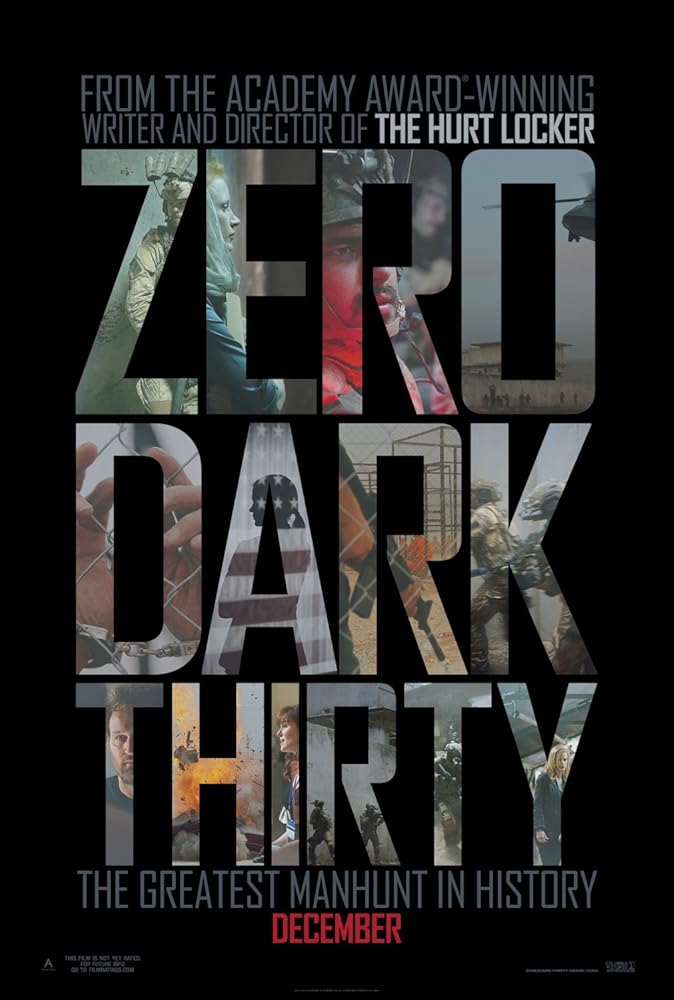
After the success of The Hurt Locker, Kathryn Bigelow and Mark Boal teamed up once again in 2012 for a film based around one of the biggest recent events of that time; the successful operation where SEAL Team Six eliminated the notorious leader of al-Qaeda, Osama bin Laden. However, upon release, while the film was another critical success for the duo, it ended up attracting a considerable amount of controversy for various reasons. The biggest of these was due to sequences in the film where the main characters forcefully interrogate prisoners who are connected to al-Qaeda. This then led to some people arguing that the film carries a pro-torture mentality. Sometime after the film’s release, there was then another bit of controversy when some government officials claimed that the filmmakers weren’t given permission to use the classified information that was tied to the operation… as well as some backlash over the film’s use of audio recordings from September 11th in the intro. So yeah… this film was easily one of the most controversial films of that year. By comparison, the biggest controversies surrounding The Hurt Locker were a few post-release copyright/defamation lawsuits. Ultimately, though, I won’t be making any comments about any of this film’s controversies here today because I don’t like to get into politics when it comes to my reviews. Instead, I will say that, unfortunately, I found Zero Dark Thirty to be a rather dry political thriller. Now, to be clear, this is not an ‘action’ film; instead, it’s a political drama focusing on the behind-the-scenes efforts of those involved in the manhunt for Osama bin Laden. The big SEAL Team Six raid only takes up the final half-hour of the film. And that’s fine and all, but I feel that the film suffers from two big issues. With a runtime of over two and a half hours, it is way too overlong with a middle section that drags too much. It also doesn’t help that the film is severely lacking in terms of emotional attachment.

Now, for the record, I do get what Bigelow and Boal were going for with this film. Their intent was to show both the stress and the time-sensitive nature of the U.S. government’s hunt for Bin Laden following the September 11 attacks, a situation which becomes even more imperative with each subsequent terrorist attack that happens over the next decade. And for the most part, they do succeed in at least getting that across. I even get why this has been well-regarded as a thinking man’s political thriller. However, there’s ultimately a rather soulless feel to the whole proceedings, partially because it’s hard to connect with any of the main people involved in the operation. The only character in the entire film to get any major bit of character development is Jessica Chastain’s Maya, the young woman who dictates most of the operation. To her credit, Chastain is excellent in the role and while most of the other big names in the film are limited to smaller roles, they all do good jobs as well. This includes the likes of Jason Clarke, Mark Strong, Joel Edgerton, and Chris Pratt, just to name a few. However, by the end of this film, I found myself left with an empty feeling overall, even during its recreation of the attack on bin Laden’s compound. And the thing is, when this film first came out, I was really looking forward to it because, like many others, I had been caught up in the hype surrounding the country’s success in finally getting bin Laden. But for a film that was touted as the story of the ‘greatest manhunt in history’, said manhunt ended up being quite the underwhelming affair on the big screen.


Rating: 2.5/5

Friday, May 5, 2017

Guardians of the Galaxy Vol. 2 (2017) review

Image result for guardians of the galaxy 2 poster

Flash back for a second to 2012, when Marvel Studios announced the then-upcoming releases that would make up Phase Two of their ever-expanding Marvel Cinematic Universe. There were the usual suspects, like sequels to Iron Man, Thor, and Captain America, but then there was one notable entry in that list that piqued the interest of fans; Guardians of the Galaxy. And that was primarily because, when it was first announced, most people probably thought the same thing that Djimon Hounsou’s character Korath says in the film when the character that he confronts, Peter Quill, mentions his ‘other’ name, Star-Lord; “Who?” I’ll admit that I was one of those people. At that time, I had no idea who the Guardians of the Galaxy were and I bet that, back then, even some of the biggest comic book fans in the world had no idea who they were either. Marvel was literally going with what was, at the time, a ‘C-list’ superhero team to headline one of their big-budget blockbusters. Thus, there was arguably quite the uncertainty surrounding writer-director James Gunn’s then-newest film. And yet, at the end of the day, it’s safe to say that it far surpassed our expectations. Not only was it one of the funniest and most entertaining films of the entire MCU but it was also one of the most heartfelt and emotional. Gunn succeeded in making us, the audience, care about a group of outlaw protagonists that featured a talking tree creature who could only say ‘I Am Groot’ and a genetically-modified talking raccoon who liked to use big guns and explosives; no small feat, indeed. Plus, it also basically confirmed that the team at Marvel Studios were truly the kings of the superhero film genre, with a winning streak that most studios dream to achieve.  

One MCU Phase later, we’re back with everyone’s favorite bunch of intergalactic a-holes in Guardians of the Galaxy Vol. 2. James Gunn is back to write and direct, once again, and the main cast of the first film (those who survived, at least) return to reprise their respective roles. This time around, Star-Lord and company find themselves on a new adventure that reveals the truth about something that has bugged Peter Quill since the beginning; his heritage. At the end of the first Guardians of the Galaxy, he learned that while his mother was from Earth (or, as the cosmic side of the MCU puts it, ‘Terra’), his father, described by his mother as ‘an angel made of pure light’, was of a different origin. This explained why he could withstand the force of the Power Stone (one of the six Infinity Stones that have been gradually introduced over the course of the MCU’s run) that everyone was after in that film when he held it in his bare hands during the big climactic battle. This film ultimately explores that answer and then some as Peter finally reunites with the father that he never got to know before. But, of course, now the question is this; how does this film hold up compared to its immediate predecessor? Well, unlike many of the other reviews for this film, I’m not going to get into that debate. Instead, I’ll just talk about exactly what this film is; yet another fun entry in the Marvel Cinematic Universe that provides fans with the same great elements that they loved about the original Guardians of the Galaxy.   

Guardians of the Galaxy Vol. 2 opens just a few months after the events of the first film. After successfully saving the galaxy from the Kree radical Ronan the Accuser, the Guardians; charismatic thief Peter Quill AKA Star-Lord (Chris Pratt), stoic assassin Gamora (Zoe Saldana), the slightly maniacal warrior Drax the Destroyer (Dave Bautista), hot-headed thug Rocket Raccoon (voiced by Bradley Cooper), and Rocket’s best friend, tree creature Groot (voiced by Vin Diesel) who, following his sacrifice at the end of the first film, was revived yet is only an infant during this film due to the short gap between it and its predecessor, have since been working odd jobs for various intergalactic organizations. However, due to some trouble caused by Rocket, the team find themselves pursued by their most recent clients, the Sovereign, led by their High Priestess Ayesha (Elizabeth Debicki). Not only that, but she ends up hiring the crew of Ravagers led by the Guardians’ occasional ally/foe Yondu Udonta (Michael Rooker) to chase after them as well. However, things get a little more complicated when one of Yondu’s lieutenants, Taserface (Chris Sullivan; And yes, that’s his name, Taserface), initiates a mutiny against his captain. While all of this is going on, Peter begins to learn more about his true heritage, namely when he finally meets his long-lost father, Ego (Kurt Russell), who is revealed to be a celestial being with unparalleled power.

Guardians of the Galaxy Vol. 2 once again delivers many of the same great things that we loved about the first Guardians. Visually speaking, the film is gorgeous; hell, this is up there with Doctor Strange as one of Marvel Studios’ best-looking films. Obviously, it doesn’t go to any of the truly surreal places that Doctor Strange went but it still provides us with bright and colorful visuals throughout. After all, this was the first film ever to be shot in 8K, currently the highest screen resolution out there, and the results are fantastic. In terms of the trademark sense of humor that the original film (and the entire MCU in general) had, there are, of course, plenty of great humorous moments and bits of dialogue in this film courtesy of writer/director James Gunn. But, at the same time, the film also provides us with some great emotional moments as well, once again proving how much we care about this team and its members. And does this film have a kick-ass soundtrack, just like its predecessor? Abso-frigging-lutely! And, believe it or not, that’s about as much as I can say about this film because there is quite a lot that happens in it; so much so that if I start to talk about any of it, I run the risk of going into spoiler territory. Thus, you can expect a ‘Spoiler Post’ sometime later this month. What I can say here, in a non-spoiler fashion, is that Gunn does a solid job once again with the overall story. Sure, there are a few narrative hiccups here and there, maybe a bit of a slow start even. But like I said before, the emotional core is just as strong as it was in the first film, all tied to a great storyline in which Peter Quill finally reunites with his long-lost father.

The main cast is just as great as they were in the first film; Chris Pratt, Zoe Saldana, Dave Bautista, Bradley Cooper, and Vin Diesel all slip back into their respective roles with ease and once again have terrific camaraderie. So now, let’s talk about the new additions to the cast. Well, technically, I’m starting out with the new additions to the Guardians that return from the original film; Yondu and Gamora’s vengeful sister, Nebula (Karen Gillan). Given that both characters, for the most part, acted as antagonists to the Guardians in the first film, it’s cool to see them transition into more central roles in this film’s overall plot. Rooker, especially, gets a fantastic arc to work with as Yondu. At the same time, though, Gillan gets more to do this time around as the film does a nice job of exploring the tense relationship between Nebula and Gamora. The other new addition to the team is Mantis (Pom Klementieff), who is first introduced as Ego’s assistant or perhaps, as Drax puts it, ‘pet’. Right out the gate, Klementieff proves to be a fantastic addition to the team as the empathic being who has some trouble when it comes to social interaction. But that is exactly what helps make her just as endearing as the rest of the Guardians. How about the villains? Well, this is another aspect of the film that I can’t delve into here because of the risk of bringing up spoilers. All I can say is that the ones who we were initially led to assume were the villains don’t factor into the plot that much. But the true villain of the film? Dare I say, this character is one of the best in Marvel Studios’ oft-maligned collection of villains.

I’m going to refrain from using a certain phrase that I’ve seen tossed around in quite a lot of the reviews for this film. In fact, I’m not even going to say it here; if you’ve seen any of the other reviews for this film, you’ll know exactly what I’m talking about. Said phrase is the one that is commonly brought up when it comes to reviews for most sequels as it is the result of comparing them to their predecessors. Do I agree with this statement, in any way? Well, in some cases, yes, but I feel like this ‘argument’ is becoming increasingly overused in this instance. I’m not saying that this film is perfect; there are a few flaws here and there, namely some narrative hiccups. But that does not, at all, take away from my overall enjoyment of Guardians of the Galaxy Vol. 2. I absolutely loved this film. It delivers exactly what fans of the original were hoping for. A solid story with a strong emotional core, great and endearing protagonists, fun new characters, exciting new developments for certain returning characters, beautiful visuals, hilarious dialogue, and a kick-ass soundtrack all come together for another great addition to the Marvel Cinematic Universe. In fact, feel free to stop reading this review right now and go see this glorious entry in the superhero genre. Seriously, I’m just holding you folks back at this point. You’ll laugh, you’ll cry, you’ll jam to ‘Awesome Mix Vol. 2’. What’s more important to note, though, is that you’ll have another great time in the expansive Marvel Cinematic Universe. Let’s see, where are they at now in terms of their track record with their films, 15 for 15? That must be some kind of record…


Rating: 5/5!