Showing posts with label Joel Edgerton. Show all posts

Thursday, March 8, 2018

Red Sparrow (2018) review

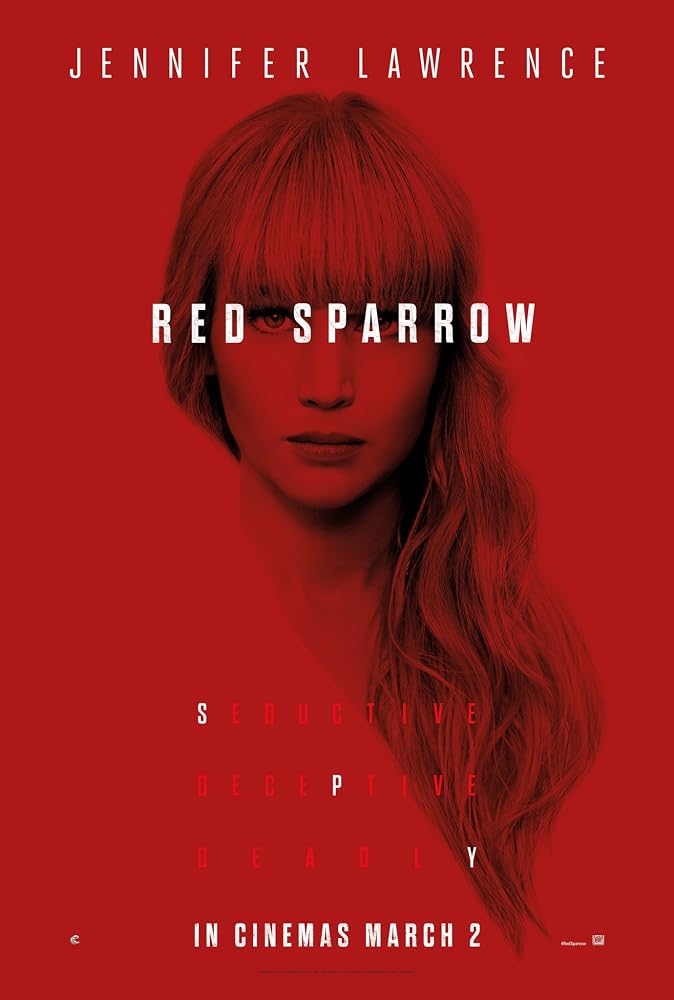
Jennifer Lawrence in Red Sparrow (2018)

For Jennifer Lawrence, 2011 was very much a breakout year for her. First, she earned an Oscar nomination for her role in the rural drama Winter’s Bone. After that, she appeared as Mystique in the surprisingly successful reboot of the X-Men franchise, X-Men: First Class. And then, that same year, she was cast in the lead role of Katniss Everdeen in The Hunger Games. The first adaptation of author Suzanne Collins’ best-selling book series hit theaters the following year and was a major critical and commercial success. This success for both Lawrence and the Hunger Games franchise continued the following year with the even more critically/commercially successful Catching Fire, which was the first of the series to be directed by Francis Lawrence (who, for the record, is unrelated to his lead actress). At the time, Lawrence was mainly known for his work in music videos. Some of his most famous videos included Aerosmith’s theme from Armageddon ‘I Don’t Want to Miss a Thing’, Shakira’s first big hit in the United States ‘Whenever, Wherever’, and the iconic video for Lady Gaga’s ‘Bad Romance’. Alongside that, he also directed the 2007 blockbuster hit I Am Legend and the 2005 film adaptation of DC Comics’ demon-hunting anti-hero, Constantine. And as for The Hunger Games, his work on Catching Fire led to him being brought back to direct the franchise’s two-part finale, Mockingjay. But now the two Lawrence’s are back for a new film, Red Sparrow. Based on the 2013 novel of the same name by former CIA operative Jason Matthews, the film sees Lawrence star as a seductive Russian agent. And while both Lawrence’s do their best with the material, it ultimately isn’t enough to make up for the film’s lackluster narrative and sluggish pacing.

As the film begins, Russian ballerina Dominika Egorova (Jennifer Lawrence) suffers a devastating career-ending leg injury during her latest performance. With no way of supporting herself and her sick mother Nina (Joely Richardson), Dominika agrees to a job offered to her by her uncle Ivan (Matthias Schoenaerts), who’s a top-ranking member of Russian Intelligence. Dominika is tasked with seducing a corrupt Russian politician to extort information from him; however, the job ends up going south when the politician is murdered by an assassin. After learning that this was part of Ivan’s plan all along, Dominika is then coerced into a new proposition; be executed so that there are no witnesses to the murder or become a member of Russian intelligence. Dominika agrees to the offer and is sent to a remote school where she is trained to become a ‘Sparrow’, agents capable of extracting information from their targets through seduction. When Dominika proves to generally excel in her training, she is sent to Budapest to investigate into a suspected Russian mole codenamed ‘Marble’. To figure out the mole’s identity, Dominika must meet and earn the trust of a CIA operative named Nate Nash (Joel Edgerton) who is also stationed there who was reportedly the last known person to work with ‘Marble’. But as Dominika begins to find ‘Marble’, she also finds herself locked into a game of cat and mouse where the threat of execution from her superiors is always imminent.

To the film’s credit, it starts off on a solid note. After a tension-filled intro that effectively sets up its two main leads, the build-up in this film is quite excellent in terms of the situation that Dominika ends up getting into. In other words, this film does have a legitimately engaging story at first. However, this ultimately ends up getting ruined by two things. The first is the film’s hefty runtime of nearly two and a half hours. Now, to be clear, this is very much one of those ‘slow burn’ kind of stories AKA the ones that are more dialogue-driven than action-driven. Despite this, though, it does feel like a half hour or so of the film could’ve been trimmed out without even losing anything important from the story. The other thing that hurts this film is that the story itself, unfortunately, falls apart by the end. Despite a few reports that stated that the ending of the film was changed from what occurred in the novel to give it a stronger feminist tone, the ending ends up being incredibly banal. Without even spoiling anything about what happens at the end, let me just say that you’ve seen how this one is going to play out before in other films. You know, the kind of ending where the main protagonist makes a critical power move that ensures her the best option for survival? That is exactly what happens at the end of this film. I mean, at the very least, the film itself isn’t poorly made on a technical level. Francis Lawrence reteamed with a lot of his Hunger Games collaborators for this film and they once again produce a film that’s well-shot and features some solid fight sequences.

And as far as the film’s cast is concerned, they’re all solid in their respective roles. It all begins, of course, with Jennifer Lawrence who, as always, is giving it her all here. She does do an excellent job in terms of conveying her character’s ability to seduce her targets while also showing her vulnerable side when put through the story’s most emotionally taxing moments (which, to be perfectly frank, are quite frequent in this film). In other words, she possesses an effective magnetic screen presence in this film despite all its narrative issues. Her role in the film is also very well-balanced with Joel Edgerton’s character; obviously, Dominika is still the focus of the story, but the film does just enough to set up the character of Nate Nash without having Edgerton overshadow Lawrence at any point. Plus, it also helps that the two have solid enough chemistry when it comes to their romantic scenes. But as for everyone else in the film, while they all do fine in their roles, these roles are quite limited when compared to Dominika and Nate. Jeremy Irons is great as always as enigmatic Russian general Vladimir Korchnoi as is Charlotte Rampling as ‘Matron’, the imposing headmistress of the school that Dominika goes to as part of her ‘Sparrow’ training’. Matthias Schoenaerts walks a fine line between charismatic and sinister as Dominika’s uncle Ivan while Mary Louise Parker manages to slip in a few humorous jokes into this generally solemn narrative as an American chief of state that Dominika interrogates as part of her investigation. Ultimately, though, a lot of these side characters end up being incredibly one-note, often getting sidelined in favor of our main protagonists.

It’s a shame, really. I really wanted to like this film as much as I did Francis Lawrence’s three Hunger Games films (I even warmed up to Mockingjay Part 2 a bit more upon my most recent re-watch of it). Ultimately, though, Red Sparrow is unfortunately waylaid by its incredibly bland narrative. While it does start off solid enough, it then loses steam at the end with a ‘been there, done that’ ending that serves as a mediocre conclusion to a story that has been going on for way too long. Thus, as much as I don’t like to compare films that boast similar plots in my reviews, this film does feel like a weaker clone of what we got last summer in David Leitch’s action-thriller Atomic Blonde. But while Atomic Blonde also had an admittedly simple plot, it just had a lot more ‘oomph’ to it compared to Red Sparrow. Sure, the film is decently shot, and Jennifer Lawrence is great as always in the lead role, but that doesn’t really make up for this film ultimately leaving not that much of an impression. It legitimately makes me curious as to how the ending played out in the novel. Heck, I bet that even if that ending was just as conventional as the one that they went with for this film, it still would’ve been a lot more substantial than what we ultimately ended up getting. Thus, while far from being the worst film that Jennifer Lawrence has been in (and no, I’m not going to mention that ‘other’ film here; let’s be honest, folks, you know exactly which one I’m talking about…), Red Sparrow is an unfortunately disappointing outing for this talented director-actress duo.


Rating: 2/5

Wednesday, August 2, 2017

Kathryn Bigelow/Mark Boal Double Feature Review

Image result for kathryn bigelow and mark boal

This weekend sees the release of the new crime drama, Detroit. Based on the infamous 12th Street Riot that occurred in Detroit, Michigan half a century ago in 1967, it is the latest film from director Kathryn Bigelow. Bigelow has been working in the film industry since 1978 and has often worked alongside her ex-husband, James Cameron. While most of her early works did not attract much attention at the box-office, many of them fared excellently with critics, including the 1987 vampire western Near Dark and the 1995 sci-fi thriller Strange Days. She also helmed the 1991 action thriller Point Break, a film that has gone on to become one of the most famous action films of the 90’s. But today, I won’t be doing a ‘Directorial Retrospective’ on Bigelow’s career, and that’s only because I don’t have enough time to get it done before Detroit is released. Instead, I’m going to focus solely on the last two films that she directed since they share a common factor, the same screenwriter. Both these films were written by Mark Boal who, prior to his work in the film industry, served as a journalist for the likes of Rolling Stone and Salon. Detroit serves as the third collaboration between the two and it’s a partnership that has earned them much critical praise. And from the looks of it, that hot streak will continue with Detroit. Thus, today on Rhode Island Movie Corner, I’ll be doing a double feature review of 2009’s The Hurt Locker, which won the Oscar that year for Best Picture, and 2012’s Zero Dark Thirty which, despite tons of critical praise, attracted a fair amount of controversy over one of the biggest aspects of its narrative.

THE HURT LOCKER (2009)

Image result for hurt locker poster

We start off today’s proceedings with 2009’s The Hurt Locker. Although technically a 2008 production, it didn’t see a wide release until the following year and, thus, it ended up being a contender during 2009’s awards season. And it did well during that awards season in a run that was capped off by it winning the Oscar for Best Picture. Kathryn Bigelow also became the first female director to win the Oscar for Best Director, and rightfully so. The Hurt Locker is a highly suspenseful war film, and not just because it focuses on the day-to-day proceedings of bomb disposal squadrons in Iraq. A lot of the film’s tension also stems from the personal conflicts that emerge within the film’s main squadron, who lose their leader due to an IED (Improvised Explosive Device) and get a new leader who’s more gung-ho by comparison. Each of the three main leads, Sgt. William James, Sgt. J.T. Sanborn and Specialist Owen Eldridge are well-layered protagonists who each go through their own personal dilemmas that are set against the backdrop of the Iraq War. This includes, but is not limited to, Eldridge’s guilt over his inability to protect his former squad leader and an incident where James attempts to get revenge for the apparent death of a young friend of his, who is revealed to still be alive much later. Bigelow does a fantastic job of showcasing how each of these three guys are affected by the horrors of war, which adds to the tension when you know that, in this environment, any of them could be killed at any moment. Plus, these three are portrayed excellently by Jeremy Renner, Anthony Mackie, and Brian Geraghty, respectively. In conclusion, as is the case with any Oscar year, there will most likely be some out there who question this film’s legitimacy as 2009’s Best Picture winner. In this case, though, I do think that it was well-deserving of its Oscar win thanks to its great tension and strong character development.

Rating: 4.5/5

ZERO DARK THIRTY (2012)


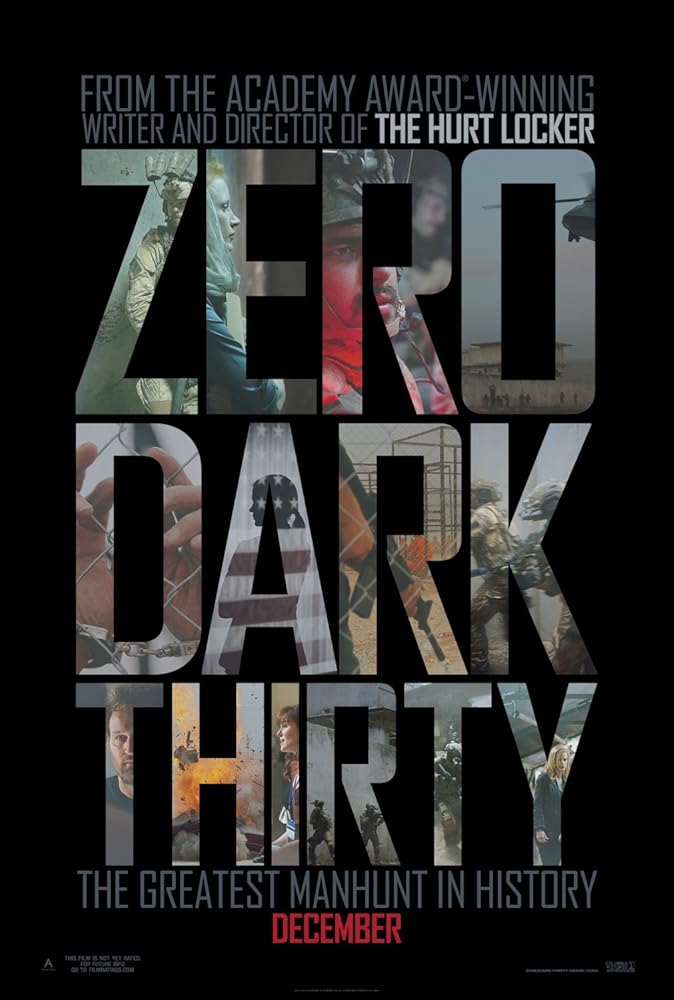
After the success of The Hurt Locker, Kathryn Bigelow and Mark Boal teamed up once again in 2012 for a film based around one of the biggest recent events of that time; the successful operation where SEAL Team Six eliminated the notorious leader of al-Qaeda, Osama bin Laden. However, upon release, while the film was another critical success for the duo, it ended up attracting a considerable amount of controversy for various reasons. The biggest of these was due to sequences in the film where the main characters forcefully interrogate prisoners who are connected to al-Qaeda. This then led to some people arguing that the film carries a pro-torture mentality. Sometime after the film’s release, there was then another bit of controversy when some government officials claimed that the filmmakers weren’t given permission to use the classified information that was tied to the operation… as well as some backlash over the film’s use of audio recordings from September 11th in the intro. So yeah… this film was easily one of the most controversial films of that year. By comparison, the biggest controversies surrounding The Hurt Locker were a few post-release copyright/defamation lawsuits. Ultimately, though, I won’t be making any comments about any of this film’s controversies here today because I don’t like to get into politics when it comes to my reviews. Instead, I will say that, unfortunately, I found Zero Dark Thirty to be a rather dry political thriller. Now, to be clear, this is not an ‘action’ film; instead, it’s a political drama focusing on the behind-the-scenes efforts of those involved in the manhunt for Osama bin Laden. The big SEAL Team Six raid only takes up the final half-hour of the film. And that’s fine and all, but I feel that the film suffers from two big issues. With a runtime of over two and a half hours, it is way too overlong with a middle section that drags too much. It also doesn’t help that the film is severely lacking in terms of emotional attachment.

Now, for the record, I do get what Bigelow and Boal were going for with this film. Their intent was to show both the stress and the time-sensitive nature of the U.S. government’s hunt for Bin Laden following the September 11 attacks, a situation which becomes even more imperative with each subsequent terrorist attack that happens over the next decade. And for the most part, they do succeed in at least getting that across. I even get why this has been well-regarded as a thinking man’s political thriller. However, there’s ultimately a rather soulless feel to the whole proceedings, partially because it’s hard to connect with any of the main people involved in the operation. The only character in the entire film to get any major bit of character development is Jessica Chastain’s Maya, the young woman who dictates most of the operation. To her credit, Chastain is excellent in the role and while most of the other big names in the film are limited to smaller roles, they all do good jobs as well. This includes the likes of Jason Clarke, Mark Strong, Joel Edgerton, and Chris Pratt, just to name a few. However, by the end of this film, I found myself left with an empty feeling overall, even during its recreation of the attack on bin Laden’s compound. And the thing is, when this film first came out, I was really looking forward to it because, like many others, I had been caught up in the hype surrounding the country’s success in finally getting bin Laden. But for a film that was touted as the story of the ‘greatest manhunt in history’, said manhunt ended up being quite the underwhelming affair on the big screen.


Rating: 2.5/5

Sunday, September 20, 2015

Black Mass (2015) review


Contrary to what recent critical and commercial buzz may suggest, Johnny Depp is technically still one of the biggest stars in Hollywood. Consistently one of the highest-paid actors in the industry, he’s the star of Disney’s biggest live-action film franchise, ‘Pirates of the Caribbean’, with the series’ fifth installment set to come out in 2017. Not only that, but he has also had some solid critical/commercial hits over the years as well, many of which came with his most frequent collaborator Tim Burton. It’s just that in recent years, Depp has hit a bit of a rough patch as he has been a part of some highly notorious box-office bombs, including ‘The Lone Ranger’ and this past January’s ‘Mortdecai’. Because of this, his newest film, ‘Black Mass’, is being hailed by many as a ‘return to form’ for Depp. In it he plays, as the trailers promote, ‘one of the most notorious gangsters in U.S. history’, former South Boston crime boss James ‘Whitey’ Bulger. The film covers the story of how Bulger ended up becoming a key informant of the FBI through the workings of one of his old friends, agent John Connolly, resulting in an ‘unholy alliance’ that lasted for nearly two whole decades. Depp is most definitely the star of the show here in this highly engaging crime thriller that may not reinvent the wheel when it comes to the crime film genre but is still a well-made biopic about one of the most infamous criminals that America has ever had to deal with.

In 1975, James ‘Whitey’ Bulger (Johnny Depp) is in charge of all organized crime in South Boston as the head of the Winter Hill Gang while his younger brother William ‘Billy’ Bulger (Benedict Cumberbatch) is a member of the Massachusetts Senate. However, Bulger constantly faces opposition from the Angiulo Brothers, who run crime up in the North End and are intent on taking over his turf. Around the same time, John Connolly (Joel Edgerton), an old childhood friend of the Bulger brothers, returns to Boston having now become an agent with the FBI. Looking to take down the Angiulos as well, Connolly approaches Bulger with the idea of him becoming an informant for the FBI. That way, not only can the FBI finally take down the North End gang, who have been frequently flying under their radar for years, but Whitey will also be able to get rid of his North End rivals once and for all. Whitey agrees to the deal but is instructed by Connolly and the FBI to not commit any crimes or murder anybody. But, as things turn out, Bulger does not follow these orders as all as he continues his business as usual, expanding his empire while Connolly keeps the FBI off his tail. Soon enough, Whitey’s increasingly violent actions start to put their relationship in hot water once the FBI finally starts looking into their corrupt affairs.

‘Black Mass’ primarily focuses on Bulger’s ‘alliance’ with the FBI from 1975 to 1990. This film doesn’t cover anything about his time as a ‘fugitive’ after he got exposed by the media. Instead, his eventual fate of finally being apprehended in 2011 is relegated to the film’s final moments. But that’s totally fine because ‘Black Mass’ is still a very compelling crime drama even if it doesn’t tell ‘the whole story’. And ultimately the main reason why this film is so captivating is due to how fascinating of a character Whitey Bulger was. As noted in the film’s opening narration, despite all that he did over the years as the ‘kingpin’ of crime in South Boston, he was also a beloved figure in his neighborhood. Cold and quiet but also menacing and ferocious, you can never take your eyes off of him whenever he’s on screen, especially in scenes where he’s threatening someone. Admittedly, the film is a rather straight-forward effort as far as the gangster genre is concerned, not really pulling a lot of ‘major’ punches in terms of its story. But at the end of the day, I don’t hold this against the film that much because this is truly meant to be an acting showcase. As a director, Scott Cooper definitely knows how to get great performances out of his cast.  

As it has been advertised, Johnny Depp is absolutely fantastic in this as Whitey Bulger. While I personally feel that Depp’s been doing fine as an actor in recent years in terms of his performances, even when taking into account all of the very eccentric roles that he has played, I will concur that this is one of the best performances of his career. Not only does he completely disappear into the role of Bulger, but he also perfectly captures Bulger’s intimidating demeanor to the point where he legitimately does become quite scary at times. But while Depp has been getting the most attention for his turn as Bulger, Joel Edgerton is equally outstanding as John Connolly. Whereas Bulger is cold and intimidating, Connolly is more conniving and corrupt, loyal to the Bulger brothers but willing to break the law to help them out. The film actually does a really nice job of balancing out the roles of these two men and Edgerton more than holds his own against Depp. As for the rest of the cast, they’re just as excellent with their roles in the film ranging from major, like Cumberbatch as Billy Bulger and Rory Cochrane and Jesse Plemons as two of Bulger’s associates in the Winter Hill Gang, to minor, like Corey Stoll as the FBI agent who heads the investigation into Bulger’s criminal activities and Dakota Johnson as Bulger’s first wife, who’s only in the film for about five minutes or so, disappearing altogether after a crucial scene in which their son ends up dying from Reye Syndrome.

‘Black Mass’ is definitely one of those films that makes me want to read more into the true story that inspired it; in this case, the tale of Whitey Bulger and his time as an FBI informant. And to be perfectly frank, considering that I’m from New England, this does make the story even more intriguing to me given how big of a deal this must have been back in the day. Of course the main selling point of the film is Johnny Depp’s transformational and ferocious performance as the infamous New England mob boss. It’s easily one of the best performances of his career but another career-best performance comes from Joel Edgerton as the man who allowed the ‘alliance’ between Bulger and the FBI to happen in the first place, John Connolly. At this moment, they’ve become some of the biggest frontrunners for Best Actor and Best Supporting Actor, respectively, at next year’s Oscars. Heck, if we’re talking ensemble awards, this film also features an excellent ensemble cast as well. I can’t really go as far as say that ‘Black Mass’ is one of the all-time greatest gangster flicks, nor is it one of my absolute favorite films of the year, but it’s definitely a solid film that held my interest from beginning to end that, above all, proves that Johnny Depp isn’t just a one-trick pony as some may feel that he is nowadays given his recent films.


Rating: 4.5/5

Monday, December 15, 2014

Exodus: Gods and Kings (2014) review


Easily one of the most famous sections of the Hebrew Bible is the Book of Exodus, the story of how the Israelites, who were slaves of Egypt, escaped captivity and left for what they called ‘The Promised Land’, the land of Canaan, led by their leader Moses. Moses himself had originally been born Hebrew but when the King of Egypt demanded that all newborn male Hebrew babies were to be killed, Moses’ mother saved him from that fate by setting him adrift on the Nile, where he was ultimately picked up by the Pharaoh’s daughter who adopted him into the Royal Family. There have been multiple adaptations of Exodus, including not one but two films of the same name; ‘The Ten Commandments’, both of which were directed by Cecil B. DeMille. He first directed a silent version of the story in 1923 and then ‘partially remade’ it in 1956, this one starring Charlton Heston in the role of Moses and is commonly regarded as one of the greatest film epics of all time. There’s also the 1998 animated, and in some cases fairly underrated, adaptation titled ‘The Prince of Egypt’, which was made by DreamWorks. This year, director Ridley Scott takes on the story with ‘Exodus: Gods and Kings’, a film that has received quite a bit of controversy these past few months in regards to its casting. As for the film itself, it’s a pretty decent take on this iconic story, even though there are certain things it could’ve done better.

The film begins as Moses (Christian Bale) is already a part of the Royal Family, serving as a general in the Egyptian Army working alongside his ‘brother’, Prince Ramesses (Joel Edgerton). One day, Moses travels to the city of Pithom to see into the current situation with Egypt’s slaves and while there, one of the slaves, Nun (Ben Kingsley), tells him about his true lineage as a Hebrew man who was raised by Pharaoh Seti’s (John Turturro) daughter after he was saved from being executed as a result of Seti ordering that all Hebrew newborn males were to be killed. Moses eventually reveals his true identity to Ramesses, who becomes Pharaoh after Seti’s death, and is exiled because of it. He soon begins a new life as a shepherd living in the town of Midian with his wife Zipporah (Maria Valverde) but one day, after getting caught in a rockslide, he comes across the famous ‘burning bush’ and is told by God, represented in this film by a young boy named Malak, to return to Egypt to demand that the Hebrews be set free. Moses does end up returning to Egypt, but Ramesses refuses to free the Hebrews. As a result, God inflicts the ‘Ten Plagues’ upon Egypt in order to try and change Ramesses’ mind, even if Moses isn’t exactly on board with some of the things God does to the people of Egypt.  

This film’s greatest strength is easily its visuals, which do a phenomenal job of recreating key moments in the story of Exodus, from the ten plagues of Egypt (e.g. the water in the River Nile turning into blood, the swarms of frogs and locusts, etc.) to the parting of the Red Sea, even if the sequence itself is admittedly a little lackluster. Still, this is easily one of the biggest takes on the story of Exodus on film to date in regards to its overall scale and scope, perhaps even more so than the Heston version. However, the film does lack a bit in terms of character development, namely in regards to the relationship between Moses and Ramesses. I don’t want to compare this film too much with other adaptations of Exodus, but one of the biggest strengths of ‘Prince of Egypt’ was that it really did a good job in conveying the relationship of these two men in that, despite the fact that they ended up being enemies, they were still brothers (not actual brothers, but you get the idea). This film states that these two had grown up as ‘brothers’ but in the film itself, they don’t spend that much time together before they become enemies. While I’m not saying that this film should’ve 100% copied what ‘Prince of Egypt’ did in terms of the ‘Moses-Ramesses’ relationship, it could’ve really benefitted from more scenes between the two.

As noted earlier, there was quite a bit of controversy surrounding this film, not over the film’s take on the story of Exodus like the controversy surrounding the other major biblical film of the year, ‘Noah’, but in regards to its casting. Namely, the thing that made a lot of people angry about this film is that while the supporting cast of the film was probably cast in terms of race, four of the main roles (Moses, Ramesses, Queen Tuya, and Joshua) were all played by white actors (Christian Bale, Joel Edgerton, Sigourney Weaver, and Aaron Paul, respectively). Because I never like to talk about the subject of race in film, I won’t go into too much detail about it but I do want to point out some recent comments made by Scott in regards to this whole debacle. He said that the main reason as to why this film was cast the way it was is due to the fact that if he had cast a lesser-name actor of proper race in the lead role of Moses, then he would’ve been unable to get a movie of this scale (on a budget of $140 million, for the record) financed. So ultimately, regardless of what your stance is on this whole ordeal, Scott’s words are pretty true, showcasing a prime example of the recent controversy surrounding the idea of ‘whitewashing’ in Hollywood. Though like I said earlier, I won’t go any further into this matter.

But I will say that from a performance-perspective, the acting in this movie is pretty good, even with the whole ‘race’ controversy in mind. The two biggest standouts are easily Christian Bale and Joel Edgerton in the lead roles. Bale provides a pretty interesting take on Moses, who he referred to as ‘schizophrenic’ (another controversial statement that I won’t be going much into). This is definitely shown in scenes where Moses is talking to God where, from the perspective on an onlooker, it looks like he’s talking to himself. At the same time, Bale also does a great job at conveying both Moses’ leader-ship qualities and his humanity, the latter of which is highly emphasized in scenes where Moses disagrees with some of God’s decisions. Edgerton, as Ramesses, is a bit over-the-top at times but other times he also gives a very subdued and emotionally powerful performance, like in a key scene near the end where Ramesses experiences a personal tragedy. As I noted earlier, while the film could’ve benefitted from having more scenes between the two before they became enemies, Bale and Edgerton do work off each other really well. The rest of the cast is solid too, but some don’t get as much to do as Bale and Edgerton. Despite being one of the main characters in the film, Aaron Paul has arguably only a few lines in the entire movie. The same can be said for Sigourney Weaver, who has a very limited amount of screen-time.

This might end up being a case similar to Scott’s film ‘Kingdom of Heaven’, which was mainly panned when it was initially released in theaters but then got more recognition when the film’s ‘Director’s Cut’ was released. Scott has stated that there is a ‘four-hour’ cut of the film so I won’t be surprised if that version ends up getting released sometime in the near future. As is, ‘Exodus: Gods and Kings’ isn’t a bad movie. It did hold my interest from beginning to end and the film certainly delivers in terms of its visuals and its overall scale and scope. However, the film can sort of be argued as being a case of ‘style over substance’ as it is lacking a bit in terms of character development. I wouldn’t say that the film is completely devoid of ‘substance’ but it really could’ve been better had certain things been done, like spending more time developing the relationship between Moses and Ramesses and giving some characters more to do. Still, the film definitely benefits from two strong performances from Christian Bale and Joel Edgerton so as is, it’s a decent take on the story of Exodus. I can’t say it’s the absolute best adaptation of the story but I am interested in seeing the ‘Director’s Cut’ of the film to see if it will fix any of the problems with the theatrical cut.


Rating: 3/5