Showing posts with label James Gunn. Show all posts

Saturday, August 14, 2021

The Suicide Squad (2021) review

2016 wasn’t exactly the best year for the DC Extended Universe. Simply put, this was meant to be the year where the franchise would officially kick-start its efforts to rival the likes of the Marvel Cinematic Universe. And yet, while both of its 2016 releases did quite well at the box-office, with each grossing at least over $700 million worldwide, neither film managed to fare as well with critics. This was especially the case for the latter of the two films, Suicide Squad, despite it being one of the most anticipated films of that year. Not only did it boast one of the most notable marketing campaigns in recent memory, but the concept of a superhero film based almost entirely around supervillains allowed it to stand out amongst its peers. However, upon its release, the film was just as much of a critical dud as its fellow 2016 DCEU release, Batman v. Superman: Dawn of Justice. Now, admittedly, both films were negatively affected by studio interference that had a clear impact on what was ultimately released in theaters. In Suicide Squad’s case, it was the result of Warner Bros. trying to course-correct after BvS received tons of flak for its dour tone. Thus, what director David Ayer originally envisioned as a ‘soulful drama’ was drastically altered in post-production (to the point where, no joke, the final cut was handled by a movie trailer production company) in a failed attempt at making it more light-hearted. Despite this, however, its $746.6 million turn at the box office paved the way for a sequel, albeit without Ayer as its director due to his commitment to a different DCEU project, Gotham City Sirens. Thus, this new sequel ended up going in a different direction thanks to one James Gunn.

Now I know what some of you might be thinking… isn’t James Gunn more of a Marvel guy? And to be fair, you wouldn’t be wrong for thinking that. Since 2014, Gunn has mainly been known for his work in the Marvel Cinematic Universe. It all started when he took some of the most obscure characters in the Marvel universe, the Guardians of the Galaxy, and turned them into some of the MCU’s most popular characters with their first official solo outing, which still stands as one of the MCU’s most highly acclaimed and widely beloved installments. He then followed that up in 2017 with an equally successful (and arguably superior) follow-up, Guardians of the Galaxy Vol. 2. And just a few months later, before much of the MCU’s post-Endgame slate was even confirmed, a third Guardians film was set up with Gunn once again returning to write and direct it… but for a while, he wasn’t. I’m not going to focus on this next bit too much since, as many of you know, I don’t like to get into deep political discussions on this site, but basically, in 2018, Gunn ended up pissing off one too many a Trump supporter, who then proceeded to target him over old Twitter posts that he had made from 2008 to 2012 that featured… let’s say, dated attempts at humor. And while Gunn had already apologized for these tweets back around the time that the first Guardians of the Galaxy film was in the works, their resurgence resulted in Disney making the utterly shocking decision to fire him as Guardians of the Galaxy Vol. 3’s director. Thankfully, Disney eventually realized that they probably shouldn’t have given in to right-wing morons and Gunn was reinstated to his original job in 2019, with Vol. 3 currently set for a May 2023 release. But before all that happened, DC promptly stepped in to offer him the gig of the second Suicide Squad film, and it’s a good thing that they did because The Suicide Squad is yet another example of what happens when the DCEU realizes that it doesn’t need to take itself ‘that’ seriously to match the high quality of the MCU.

The South American nation of Corto Maltese has recently come under attack after an insurrection led by dictator Silvio Luna (Juan Diego Botto) and his second-in-command, Major General Mateo Suarez (Joaquín Cosío). All the while, one of their main associates, Dr. Gaius Graves AKA The Thinker (Peter Capaldi), has been working on a secret experiment codenamed ‘Project Starfish’ in Corto Maltese’s Nazi-era laboratory, Jotunheim. In response to this, government official Amanda Waller (Viola Davis) reinitiates her black ops unit Task Force X, which consists of some of the most notorious supervillains in the world who are forced to cooperate under the promise of a reduced prison sentence and the threat of death via explosive devices implanted into their necks. Once again under the command of Colonel Rick Flag (Joel Kinnaman), Task Force X, now consisting of returning members such as the unpredictable Harley Quinn (Margot Robbie) and new recruits such as mercenary Robert DuBois AKA Bloodsport (Idris Elba) and hard-edged vigilante Christopher Smith AKA Peacemaker (John Cena), travel to Corto Maltese to investigate. However, in their efforts to help the locals deal with Luna and his army, they soon realize that they’re dealing with a lot more than they had originally bargained for, especially when it comes to what ‘Project Starfish’ truly is.

I’ve often found the newer installments of the DC Extended Universe to be the antithesis of the franchise’s initial outings. Whereas the likes of Batman v Superman: Dawn of Justice and Justice League (the ‘Snyder Cut’, specifically…) were overly dark and serious, which arguably wasn’t the best route to take for these iconic characters, films like Aquaman and Shazam felt far more natural when it came to embracing their comic book roots. And when it comes to James Gunn’s The Suicide Squad, it is probably the best example of this out of any post-Justice League installment of the DC Extended Universe, especially when compared to its predecessor. Regardless of all the issues that occurred during its post-production process, the original Suicide Squad utterly squandered the potential of its unique premise of focusing on supervillains by being a tonally uneven mess with an ugly visual style and a shockingly harsh mean streak. The Suicide Squad, on the other hand, doesn’t fall victim to any of that. It boasts far better visuals and effortlessly follows in the footsteps of Gunn’s Guardians of the Galaxy films by expertly balancing its strong emotional moments with its hilariously snappy dialogue. And while this next part isn’t necessarily the original Suicide Squad’s fault since it most likely had to maintain a PG-13 rating, The Suicide Squad fully embraces its R-rating. Simply put, this film can get so damn intense at times that it legitimately rivals the most graphic sequences from the likes of the Deadpool films and Logan. And yet, while this may seem like something that would make the film even harsher than its predecessor, Gunn’s skillful direction prevents that from happening.

Case in point, this film serves as another great case where Gunn manages to take characters who aren’t necessarily ‘heroic’ and give them such great character development that you come to love many of them by the end of it. Much of this is thanks to the outstanding ensemble cast that Gunn has assembled, whether it’s some of his most frequent collaborators, the few returning leads from the first Suicide Squad, or some incredibly exciting newcomers. Of course, you’ve got Margot Robbie returning as Harley Quinn in what may just be her best performance in the role to date as the film dutifully maintains the excellent retooled characterization that she was given in Birds of Prey while also fully capitalizing on the madcap personality that has made Harley such an iconic character. The far better-refined script and direction also results in stronger performances from those returning from the previous film, especially Joel Kinnaman, who gets to have a lot more fun as Rick Flag this time around instead of being the cold and stoic figure that he was in the previous film. Ultimately, though, the biggest standouts of the cast are its newcomers. Idris Elba headlines the film excellently as Bloodsport, who’s easily the most level-headed member of the group, and while he’s technically playing one of the more unlikable members of the squad, John Cena’s phenomenal charisma still manages to shine through as the hilariously douchey Peacemaker (It’s easy to see why he and James Gunn are going to be teaming up again for a Peacemaker series on HBO Max next year). And to close out the main cast, we have an outstanding trio of supporting players in Daniela Melchior as Cleo Cazo AKA Ratcatcher II, arguably the most sympathetic and ‘heroic’ member of the team, Sylvester Stallone as the voice of the fearsome but lovably goofy King Shark, and David Dastmalchian as Abner Krill AKA the Polka-Dot Man. He may be one of the weirdest characters that you’ve ever seen in the world of comics, but thanks to Dastmalchian’s wholly endearing portrayal, he’s truly unforgettable.

Simply put, The Suicide Squad is everything that the first Suicide Squad wasn’t. It’s a film that wholeheartedly embraces the concept of supervillains who are sent out on missions where they aren’t meant to survive but also succeeds in one of the main things that the previous film tried to accomplish: finding the humanity within its ‘villainous’ characters. Obviously, not every ‘villain’ in this film is meant to be ‘redeemed’, per se, but when you have a director like James Gunn who, above everything else, fully understands the importance of strong character development and emotional poignancy, it truly goes to show just how pivotal all that stuff is to the enduring success of the superhero genre. It’s the reason why the MCU has continued to be the cultural juggernaut that it is today… and why the DCEU struggled considerably out of the starting gate as many of its early films tended to emphasize style over substance. Ultimately, though, if you were to ask me why a film like this works better than something like Batman v Superman: Dawn of Justice, I’d say that it’s because The Suicide Squad has a greater understanding of how superhero films should be like tonally. Sure, it can be serious when it needs to be, but at the end of the day, it’s a far better idea for a superhero film to embrace the goofier elements of its source material rather than it trying to be something that it’s not.     

Rating: 5/5!

Saturday, May 16, 2020

Scooby-Doo: A Televised and Cinematic Retrospective


Nicole Jaffe, Casey Kasem, Don Messick, Heather North, and Frank Welker in Scooby Doo, Where Are You! (1969)

Today’s retrospective is going to be a fun one, folks, because we’re about to delve into one of the most iconic franchises in pop culture history. It’s a franchise whose legacy is so strong that it has managed to endure for half a century and still shows no signs of stopping anytime soon. Yes, folks, today we’re talking about the adventures of that lovable talking dog, Scooby-Doo. It all began in 1969 when writers Joe Ruby and Ken Spears developed the original Scooby-Doo, Where Are You! series for Hanna-Barbera, officially introducing audiences to the Mystery Inc. gang; Fred, Daphne, Velma, Shaggy, and their talking dog, Scooby-Doo. Since then, this original incarnation of the show has gone on to produce numerous follow-up series that have taken the franchise in unique new directions and several films. While most of these films have gone direct-to-video, a few of them did see a theatrical release, and this weekend sees the video-on-demand release (which was originally meant to be a theatrical one until the Coronavirus pandemic stepped in) of the newest Scooby-Doo film, simply titled Scoob. And in honor of its release, today we’re looking back at some of the Scooby-Doo films that have come out over the years, and I do mean some since… well, there’s like forty of them and I’d be here all day if I discussed them all. With that in mind, I decided to primarily focus on six films; four of them animated and two of them live-action. When it comes to the animated Scooby-Doo films, there are four films that I feel are the ones that my generation is the most familiar with, so those will be the ones that I’ll be focusing on even though there were a few from the early 2000s that I remember watching when I was younger. But, of course, Scoob isn’t the character’s first foray into theatrically-released films (you know, back when it was meant to be theatrical), so I’ll also be covering the two live-action Scooby-Doo films that came out in the early 2000s. And so, with all that in mind, it’s time to split up and search for clues (and don’t forget about the Scooby snacks) as we look at some of the most notable feature-length films that star the one and only Scooby-Doo.

But first, let’s delve a little into the history behind this franchise’s run on the small screen…

PART 1 – A History of Scooby-Doo TV Shows

Scooby Doo, Where Are You! (1969)
Scooby-Doo, Where Are You! (1969-1970)
It all began, of course, with Scooby-Doo, Where Are You, which premiered on CBS on September 13th, 1969 as part of the network’s Saturday morning lineup. The show was primarily created to counter growing protests from parent-run advocacy groups over the increasing amount of violence seen in Saturday-morning cartoons. And as it turns out, Hanna-Barbera was responsible for a lot of the shows that these groups were against, including Space Ghost and The Herculoids, which had all been canceled that same year because of all this. To both appease the watch groups and to revitalize the network’s Saturday-morning lineup, CBS’s daytime programming executive at the time, Fred Silverman, approached William Hanna and Joseph Barbera to develop a show that was like the network’s hit series, The Archie Show. Since that show was about the characters of the famous Archie comic series performing in a band, Silverman tasked the duo with creating a show about a teenage rock band who solved mysteries between gigs. Hanna and Barbera then proceeded to put two of their writers, Joe Ruby and Ken Spears, and artist Iwao Takamoto in charge of the project, and while the idea of the main characters being in a rock band was ultimately scrapped after a while, it would eventually result in the show that we know and love today. And so, Scooby-Doo, Where Are You was born, introducing audiences to the teenaged mystery-solving gang known as Mystery Inc, consisting of their confident leader Fred Jones, fashion-lover Daphne Blake, bespectacled genius Velma Dinkley, cowardly slacker Shaggy Rogers, and their talking Great Dane, Scooby-Doo.

The original show promptly established the series’ long-running formula. Each episode revolved around the Mystery Inc gang as they travel to a location that’s currently dealing with a supernatural monster. Once they agree to investigate, the gang splits up to search for clues. Fred and Velma head off to find clues, Daphne usually ends up kidnapped, and Shaggy and Scooby search for food before they inadvertently come across the monster. After coming across enough clues to deduce that the monster isn’t real, Fred comes up with an elaborate trap to catch it. And while the trap usually goes awry due to cartoon hi-jinx, the monster is ultimately captured and is promptly unmasked to reveal the culprit, who is usually someone that the gang had met earlier. The culprit then proceeds to boast that they “would have gotten away with it too, if it weren’t for those meddling kids and their dog” before being taken to jail. The show proved to be a massive hit for both CBS and Hanna-Barbera, and after a 17-episode first season, it was renewed for a second season that premiered on September 12th, 1970 and consisted of 8 episodes. This second season incorporated more slapstick humor into the show and upbeat ‘chase scene’ songs that were reminiscent of those featured in The Archie Show. It was also notable for being the season where Heather North officially took over the role of Daphne from Stefanianna Christopherson. And while there would technically be a third season of the show (more on that later), Scooby-Doo, Where Are You officially ended its original run on October 31st, 1970 after 25 episodes.

Don Adams in The New Scooby-Doo Movies (1972)
The New Scooby-Doo Movies (1972-1973)
Two years later, the show was reborn as The New Scooby-Doo Movies, which premiered on September 9th, 1972. While it thoroughly maintained the premise of its predecessor, it was also expanded from half-hour episodes to hour-long episodes (hence the ‘Movies’ subtitle) and each episode featured a notable guest star who helped the gang solve mysteries. Some of the series’ most notable guests included Don Knotts, Dick Van Dyke, and while technically voiced by other actors, the Three Stooges. This version of the show lasted two seasons and ran for 24 episodes, with its last episode airing on October 27th, 1973. After that, reruns of Scooby-Doo, Where Are You were shown until 1976 when the franchise’s run on CBS had finally come to an end. It proceeded to move to ABC around the same time that Fred Silverman moved to the network and started its run there by packaging new episodes of the show with another Hanna-Barbera show, Dynomutt, Dog Wonder, to create the Scooby-Doo/Dynomutt Hour. First debuting on September 11th, 1976, the Scooby-Doo segments came from the series’ third incarnation, The Scooby-Doo Show, although this title technically wouldn’t be used until 1980 when the episodes hit syndication. This series introduced a new character in Scooby’s dim-witted cousin Scooby-Dum… who only appeared in this series (that should give you an idea of how the character was received). 16 episodes of this crossover were produced, concluding on December 18th, 1976, but The Scooby-Doo Show would live on in subsequent programming blocks. 8 new episodes were made for a block titled Scooby’s All-Star Laff-A-Lympics, which ran from September 10th, 1977 to October 28th, 1978 and consisted of it, Dynomutt (now known as The Blue Falcon and Dynomutt), Laff-A-Lympics, Captain Cavemen and the Teen Angels, and Where Are You re-runs.

The Scooby-Doo/Dynomutt Hour (1976)
The Scooby-Doo Show (1976-1978)
The second run of this block was retitled Scooby’s All-Stars and it ran from September 9th, 1978 to October 28th of that same year. Whereas Scooby’s All-Star Laff-A-Lympics was a two-hour block, Scooby’s All-Stars was condensed down to an hour and a half one with the removal of The Blue Falcon and Dynomutt and the re-runs of Scooby-Doo, Where Are You. With that said, though, 9 of the 16 The Scooby-Doo Show episodes that were produced that year were designated as Where Are You episodes. And while the following 7 episodes were run under the Scooby’s All-Stars moniker, all 16 episodes were officially repurposed under the Scooby-Doo, Where Are You name when they were released on DVD in 2007. Yes, folks, this is where the mythical third season of Scooby-Doo, Where Are You that I mentioned earlier comes into play. As such, the original series that started it all officially concluded on December 23rd, 1978 on ABC with a total of 41 episodes over 3 seasons. At this time, however, the series was beginning to face a serious dilemma as Hanna-Barbera had begun to feel that its formula had officially run its course. This was especially evident in the 1979 primetime special Scooby-Doo Goes Hollywood, which was a parody of said formula in which Shaggy and Scooby attempt to move on to other shows when the former gets tired of their same old routine. Meanwhile, in the real world, ABC had begun looking into the show’s potential cancellation due to declining ratings. It also didn’t help that the show’s original backer, Fred Silverman, was now working for NBC. Thus, the show was massively retooled for the 1979-80 season, namely by introducing a brand-new character in Scooby-Doo’s nephew, Scrappy-Doo, and renaming the show Scooby-Doo and Scrappy-Doo.

Scooby-Doo and Scrappy-Doo (1979)
Scooby-Doo and Scrappy-Doo (1979-1980 (Half-Hour Incarnation))
Through this new show, the focus shifted from the original Mystery Inc. gang to the trio of Scooby, Scrappy, and Shaggy. Fred, Daphne, and Velma, meanwhile, were reduced to minor supporting roles. Nowadays, Scrappy is generally considered to be one of the most reviled characters to come out of the franchise due to many finding him to be a massively annoying sidekick; not even Joe Ruby and Ken Spears, the franchise’s creators, were fans of him. But back in 1979, this new addition was exactly what the show needed to stay on the air. The first incarnation of this version of the show ran for one season, debuting on September 22nd, 1979 and concluding on January 5th, 1980 after 16 episodes. It was then followed by a different version of Scooby-Doo and Scrappy-Doo, which ran for 33 episodes for 3 seasons, beginning on November 8th, 1980 and concluding on December 18th, 1982. Instead of traditional 30-minute episodes, this new version of the show consisted of three 7-minute shorts per episode. These episodes removed Fred, Daphne, and Velma entirely and deviated from the franchise’s formula by having the monsters that the trio come across be actual monsters instead of costumed criminals. The first 20 episodes were packaged with another Hanna-Barbera show, Richie Rich, to form The Richie Rich/Scooby-Doo Show. As for the final 13 episodes, they were packaged with The Puppy’s New Adventures in The Scooby and Scrappy-Doo/Puppy Hour. And to close out this ‘trilogy’ of shows featuring Scrappy-Doo, there was The New Scooby and Scrappy-Doo Show, which debuted on September 10th, 1983. It was later renamed The New Scooby-Doo Mysteries in 1984 and ended on December 1st after 2 seasons and 26 episodes. Through this show, the series returned to the traditional half-hour long format and notably brought back Daphne to the main ensemble while Fred and Velma returned for some episodes in Season 2.

The 13 Ghosts of Scooby-Doo (1985)
The New Scooby and Scrappy-Doo Show was also notably the first entry of the series to be primarily developed by writer Tom Ruegger, who would later go on to create other classic shows such as Tiny Toon Adventures and the seminal staple that is Animaniacs. He would also oversee the development of the next installment of the franchise, The 13 Ghosts of Scooby-Doo, which debuted on September 7th, 1985. In this show, Scooby and Shaggy accidentally open an ancient chest that unleashes the 13 most terrifying ghosts in the world, resulting in them, Scrappy, and Daphne having to travel the world to recapture them. Along the way, they are joined by a con artist named Flim Flam and his warlock friend Vincent Van Ghoul who, as the name suggests, was voiced by the legendary Vincent Price. Despite all this, the show only lasted a single season that, ironically, consisted of 13 episodes and concluded on December 7th of that year. Because of this, however, the show ended before the gang had captured the final ghost. Thus, this whole storyline was left unfinished until 2019 when, in an arguably unexpected turn of events, the direct-to-video feature Scooby-Doo and the Curse of the 13th Ghost was released to give this iteration of the franchise its proper conclusion. The film also featured Fred and Velma, who were both absent in the original series. As for the show itself, it ended up being the last main entry of the series to feature Scrappy-Doo, who would then go on to make some appearances in three of the franchise’s made-for-television features (Scooby-Doo Meets the Boo Brothers (1987), Scooby-Doo and the Ghoul School, and Scooby-Doo and the Reluctant Werewolf (both in 1988)). He ultimately wouldn’t return to the franchise until the 2002 live-action film, where he was turned into the main antagonist to poke fun at the character’s controversial reputation.

A Pup Named Scooby-Doo (1988)
A Pup Named Scooby-Doo (1988-1991)
While 13 Ghosts may have been a bit of a dud for the franchise, Tom Ruegger ended up having much more success with the next installment of the series, A Pup Named Scooby-Doo, which debuted on September 10th, 1988. Ruegger would end up leaving the show after its first season, however, which resulted in directorial duties going to Don Lusk, a veteran animator who notably worked for Disney on some of their earliest features such as Pinocchio and Bambi. As for this new show, the title says it all as it focuses on the members of the Mystery Inc gang when they were kids. The show was meant to return the franchise to its roots by revitalizing the classic formula of the gang investigating mysteries that involved criminals dressed up as monsters. But if there was one notable difference compared to previous incarnations of the show, it’s that this show was done in a much more comedic manner that was reminiscent of the classic cartoons made by Tex Avery and Bob Clampett. This style of humor was what Ruegger had wanted to do with The 13 Ghosts of Scooby-Doo but wasn’t quite able to accomplish with that show. Suffice it to say, it worked a lot better the second time around as A Pup Named Scooby-Doo proved to be a solid hit. While its episode count may seem lackluster compared to other incarnations of the show with only 27 episodes produced during its run, it did last for 4 seasons before it concluded on August 17th, 1991. On a more somber note, this was the last instance where Scooby-Doo was voiced by his original voice actor, Don Messick, before his passing in 1997. After this show, the character was voiced by Hadley Kay for a pair of Johnny Bravo crossover episodes in 1997 before Scott Innes took over the role for the first few direct-to-video features of the era.

Frank Welker in What's New, Scooby-Doo? (2002)
What's New, Scooby-Doo? (2002-2006)
Surprisingly, though, A Pup Named Scooby-Doo was the last major Scooby-Doo series for more than a decade. For the next few years, the franchise transitioned into direct-to-video features that primarily came into play thanks to its various shows benefitting greatly from syndication and re-runs. The last of these initial films, 2001’s Scooby-Doo and the Cyber Chase, was the last Hanna-Barbera production that both William Hanna and Joseph Barbera produced before the former’s death on March 22nd, 2001. After that, the studio was fully absorbed into the Warner Bros. Animation department, who proceeded to take control of the development of new Scooby-Doo shows. Thus, A Pup Named Scooby-Doo was the last installment of the franchise to primarily air on ABC as the next two shows premiered on the Kids’ WB block. The first of these was What’s New, Scooby-Doo, which debuted on September 14th, 2002, exactly three months after the release of the first live-action Scooby-Doo film. What’s New, Scooby-Doo promptly revived the franchise’s original format from Where Are You but made appropriate updates to reflect its modern setting. It was the first series where veteran voice actor Frank Welker officially took on the role of Scooby-Doo, having already been the voice of Fred since the original Where Are You series. It was also the first time since 1997 that Shaggy’s original voice actor, Casey Kasem, returned to voice the character after the production crew agreed to honor his request to make Shaggy a vegetarian just like him. At the same time, though, this would also end up being the last series where he voiced the character before his death in 2014, although he did reprise the role for the franchise’s various direct-to-video features and would then make a few cameo appearances in subsequent shows before he retired from voice acting in 2009. The show ran for 42 episodes for three seasons, and while its initial run on Kids’ WB abruptly ended in 2005, its final episode, ‘E-Scream’, aired on Cartoon Network on July 21st, 2006.

Scott Menville and Frank Welker in Shaggy & Scooby-Doo Get a Clue! (2006)
Shaggy and Scooby-Doo Get a Clue! (2006-2008)
Two months later, the next iteration of the series made its debut on Kids’ WB (which, at this point, was now part of the network’s rebranding from The WB to The CW) on September 23rd, Shaggy and Scooby-Doo Get a Clue. The show saw the characters undergo a notable redesign (the second major instance of this in the franchise’s history after A Pup Named Scooby-Doo) that was heavily based on their live-action counterparts from the recent films. And while Casey Kasem was still involved with the franchise as the voice of Shaggy’s uncle, Shaggy himself was voiced by Scott Menville, best known for his role as Robin on Teen Titans. This may explain why this new show did away with the character’s vegetarian update from What’s New, Scooby-Doo. In the show, Shaggy ends up inheriting the fortune of his uncle, Dr. Albert Shaggleford, after he mysteriously disappears. This then leads to him and Scooby discovering that his uncle was an inventor and them having to deal with his uncle’s greatest adversary, mad scientist Dr. Phineas Phibes, who seeks to steal Shaggleford’s latest invention, nano-tech. Like the Scooby and Scrappy-Doo shows, this series focused more on Shaggy and Scooby while Fred, Daphne, and Velma were reduced to cameo appearances. Thus, the two were instead accompanied by Robi, a robotic butler that was built by Shaggy’s uncle. Shaggy and Scooby-Doo Get a Clue ran for 2 seasons, officially concluding on March 15th, 2008. A few months later, the Kids’ WB block was officially discontinued on May 17th. Thus, the next few Scooby-Doo shows made their debut on Cartoon Network, which had been airing re-runs of the franchise since the ’90s.

Matthew Lillard, Mindy Cohn, Grey Griffin, and Frank Welker in Scooby-Doo! Mystery Incorporated (2010)
Scooby-Doo! Mystery Incorporated (2010-2013)
The first of these new shows was Scooby-Doo: Mystery Incorporated, which premiered on April 5th, 2010, and after Shaggy and Scooby-Doo Get a Clue admittedly fared poorly with fans of the franchise, this new show went back to the traditional premise of the Mystery Inc. gang solving mysteries. However, to keep things fresh, Mystery Incorporated went for a tongue-in-cheek approach that parodied both the franchise itself and classic horror films. It was also the first Scooby-Doo series to utilize a serial-based story arc and was generally more serious in tone compared to other incarnations of the franchise. For this show, the role of Shaggy was taken over by Matthew Lillard who, of course, played the character in the first two live-action films. The show even featured Linda Cardellini, who played Velma in the live-action films, in a supporting role as Velma’s rival Marcie Fleach AKA Hot Dog Water. The show ran for 2 seasons consisting of 52 episodes and concluded exactly three years after it premiered on April 5th, 2013. It was then followed by Be Cool, Scooby-Doo, which premiered on October 5th, 2015. It was the third entry of the series to attempt a new art style, which many have often compared to the long-running animated sitcom Family Guy, and it went for a more comedic tone compared to its immediate predecessor. It was the first series where Velma was voiced by Garfunkel and Oates’ Kate Micucci, who took over the role from Mindy Cohn, who had been voicing the character since What’s New, Scooby-Doo. However, the show had a rather interesting release schedule. While the first 20 episodes aired on Cartoon Network, the remaining 6 episodes of the first season aired on Boomerang. After that, the show moved to Boomerang for its second season; however, only its final 11 episodes aired on TV while the first 15 were released via Boomerang’s on-demand service. The show officially concluded on March 18th, 2018 after 52 episodes.

Matthew Lillard and Frank Welker in Be Cool, Scooby-Doo! (2015)
Be Cool, Scooby-Doo! (2015-2018)
This brings us to the most recent incarnation of the franchise, Scooby-Doo and Guess Who. It first premiered on Boomerang’s streaming service app on June 27th, 2019, although it would also be shown on Cartoon Network on July 9th. The show follows the same format as The New Scooby-Doo Movies by having the Mystery Inc gang join forces with a special celebrity guest star to solve mysteries. At the time of this post’s publication, some of its most notable guests have included Weird Al Yankovic, Penn and Teller, and even a few fictional characters such as Batman, Wonder Woman, and Steve Urkel from the classic 90’s sitcom Family Matters. Unlike its spiritual predecessor, however, this show’s episodes are only a half-hour long instead of a full hour. The first season of 13 episodes concluded on September 19th, 2019, and a second season of 13 episodes has been confirmed for a currently undetermined release date, although the first of these new episodes (which guest-starred Whoopi Goldberg) did premiere on September 24th via Boomerang’s Italian network. And so, ladies and gentlemen, that concludes this little retrospective covering the Scooby-Doo franchise’s extensive run on television. Since 1969, there have been 13 major animated series based around the Mystery Inc gang. And while these beloved characters have undergone quite a few changes over the decades in the franchise’s efforts to freshen up its formula, whether by showing them as kids or by introducing new characters to the cast, the core elements of the franchise have always been consistent throughout. Because of this, it is quite arguably one of the greatest examples of a franchise that can successfully appeal to any generation; there aren’t many franchises out there who can lay claim to the prospect of maintaining a relevant role in the pop-cultural zeitgeist like Scooby-Doo has.

Matthew Lillard, Grey Griffin, Penn Jillette, Fred Tatasciore, Teller, Frank Welker, and Kate Micucci in The Cursed Cabinet of Professor Madds Markson! (2019)
Scooby-Doo and Guess Who? (2019-present)
PART 2 – Scooby-Doo Animated Features

Like I said in the intro, I won’t be able to cover every single animated feature that has come from the Scooby-Doo franchise simply because it would take too long to go through them all. And while there were a few that I watched when I was younger thanks to them repeatedly airing on Cartoon Network, like 2003’s Scooby-Doo and the Legend of the Vampire and 2004’s Scooby-Doo and the Loch Ness Monster, I decided to limit it to the four that are arguably the most well-known of the 33 direct-to-video films that have been made since 1998.

SCOOBY-DOO ON ZOMBIE ISLAND (1998)

Mary Kay Bergman, Scott Innes, B.J. Ward, Frank Welker, and Billy West in Scooby-Doo on Zombie Island (1998)

We start things off, of course, with what is arguably the most popular installment of the Scooby-Doo films, 1998’s Scooby-Doo on Zombie Island, in which the gang heads to a mysterious island on the bayou that’s haunted by the ghost of an old pirate and his zombified crew. Thanks to the franchise’s resurgence in the 90’s thanks to syndicated re-runs, this became the first in a long line of direct-to-video feature-length Scooby-Doo films that still runs to this very day. Like I said, this film was that big of a hit for the franchise, and while I’ll admit that my recent viewing of it was the first time that I ever watched it in full, I can clearly see why it has always been so fondly remembered. For one thing, the film boasts some excellent animation, which I know is saying something considering how Hanna-Barbera productions have always been rather infamous for some of their cost-cutting techniques (e.g. reused backgrounds, limited animation, etc.). By comparison, Zombie Island’s animation was outsourced to a Japanese studio, Mook Animation, and the crew was given more time than usual to work on it, resulting in some incredibly atmospheric animation that perfectly matches the film’s bayou setting. And thanks to how it sets up a new standard for the franchise by having a darker storyline where the monsters weren’t just costumed criminals, Zombie Island ends up being one of the best-written installments of the franchise. Plus, while the film did get quite a bit of flak at the time for being too scary for younger audiences, nowadays I’d argue that it’s quite tame despite its premise. Because of all this, I’d argue that Zombie Island is the franchise equivalent of the Batman franchise’s 1993 cult classic, Batman: Mask of the Phantasm. In other words, Zombie Island is so well-made that it could’ve easily been upgraded to a full-on theatrical release, and even if it ended up being a commercial dud like Mask of the Phantasm admittedly was when it was first released, I bet that it probably would’ve spawned the same kind of dedicated cult following. And yet, Zombie Island clearly didn’t need a theatrical release to become a bona fide cult classic.

Rating: 4.5/5

Scooby-Doo: Return to Zombie Island (2019)

(It’s also worth noting that this film ended up getting a sequel in 2019, Scooby-Doo: Return to Zombie Island. However, to keep this retrospective from going on too long, we won’t be looking at it today… plus, based on what I’ve read, this one isn’t exactly popular amongst fans of the original for various reasons that range from a controversial retcon to a considerable tonal shift).

SCOOBY-DOO AND THE WITCH’S GHOST (1999)

Scooby-Doo and the Witch's Ghost (1999)

Thanks to the success of Zombie Island, a second direct-to-video feature was put into production to come out the following year, Scooby-Doo and the Witch’s Ghost. However, whereas the filmmakers were able to work on Zombie Island without any direct influence from the studio, it wasn’t the same case with Witch’s Ghost, namely through the hiring of different writers whose original ending saw the titular ‘Witch’s Ghost’ revealed to be a fake. And yet, despite both this and the decision to tone things down after the darker proceedings of Zombie Island, the core crew was able to work around this by having a real ghost at the end so that they could maintain the ‘realistic monsters’ approach of its predecessor. With all this in mind, Witch’s Ghost is another solid installment in the series and once again features some excellent animation. It may not necessarily be as well-polished or atmospheric as its immediate predecessor, but as a native New Englander, I do appreciate how the film perfectly captures the beauty of the region in the fall. This one also has some fun supporting players headlined by Tim Curry as a popular horror novelist who asks the Mystery Inc gang to accompany him to his hometown in Massachusetts, which is supposedly haunted by the ghost of his Wiccan ancestor. The film is also notable for the introduction of the Hex Girls, an eco-Goth band who would end up becoming major fan-favorites and recurring characters in the franchise with appearances in some future direct-to-video features and shows like What’s New Scooby-Doo and Scooby-Doo: Mystery Incorporated. And so, despite the setback of the original crew having to deal with new writers that weren’t as familiar with their methods, Scooby-Doo and the Witch’s Ghost is another delightfully dark and entertaining adventure with the gang. While it may not be ‘as good’ as its immediate predecessor, this one does just enough to maintain its more mature and atmospheric style.    

Rating: 4/5

SCOOBY-DOO AND THE ALIEN INVADERS (2000)

Scooby-Doo and the Alien Invaders (2000)

The title for this one says it all as the Mystery Inc gang comes across a bunch of aliens while they’re stranded in New Mexico. And luckily for the crew that had been responsible for these initial direct-to-video features, the production of Alien Invaders was a lot more like Zombie Island rather than Witch’s Ghost in that they were able to work on it without any major demands from the studio. However, it is worth noting that, of the direct-to-video features we’ve discussed so far, Alien Invaders is perhaps the most light-hearted of the bunch. While the titular aliens are excellently designed and the film still does a decent job of maintaining the solid animation style of its predecessors, its overall proceedings feel much more in line with the traditional atmosphere of the franchise’s past incarnations. It’s also easily the most straight-forward of the bunch in terms of its script and doesn’t pull any major punches except for one major reveal near the end regarding two of its new characters. Overall, though, that doesn’t stop the film from being another entertaining adventure with the Mystery Inc gang since I do feel that its lighter and arguably more comedic tone matches the typical campy nature of classic sci-fi B-films. The film even sees Shaggy and Scooby get to have their own love interests when they meet a photographer named Crystal and her dog Amber. Granted, the two of them do turn out to be aliens at the end, but it’s rather nice to see Shaggy and Scooby get to partake in a romantic subplot since that’s not the kind of storyline that they usually get involved in when it comes to this franchise. And so, Scooby-Doo and the Alien Invaders ends up being quite a lot of fun. While those who prefer the truly atmospheric and haunting style of Zombie Island might be disappointed by how this film ends up going back to the traditional antics of a typical Scooby-Doo mystery, I’d argue that there’s nothing wrong with that classic Scooby-Doo vibe.

Rating: 4/5

SCOOBY-DOO AND THE CYBER CHASE (2001)

Grey Griffin, Scott Innes, Gary Anthony Sturgis, B.J. Ward, and Frank Welker in Scooby-Doo and the Cyber Chase (2001)

I can safely say that the last of the direct-to-video Scooby-Doo features that we’ll be looking at today, Scooby-Doo and the Cyber Chase, is the one that I’ve watched the most out of these four. Simply put, the fact that this film revolved around the Mystery Inc gang getting transported into a video game instantly made it appealing to me when I was younger since I’m just as passionate about video games as I am with films. However, I should note that, for the crew that had been working on these direct-to-video features, this was, unfortunately, another case like Witch’s Ghost where they were severely hindered by studio interference. Just like that film, they had to deal with the studio bringing in a new writer who had no experience with the franchise and delivered a script that the crew was vastly underwhelmed by. And because of this, Cyber Chase was ultimately the final entry of the series that the core crew behind Zombie Island was personally responsible for; with that in mind, I can see why some may consider this to be the weakest of the first four direct-to-video features. Not only is the main villain, the Phantom Virus, an incredibly passive antagonist, but the plot itself is even more basic in its execution than Alien Invaders. This one also happens to have the weakest animation out of these four films. While I wouldn’t call it ‘terrible’, I also wouldn’t be surprised if some people thought that this was just an extended episode of What’s New, Scooby-Doo (ironically, though, this is the only entry of the four that’s been given a Blu-Ray release). At the very least, there are a few worthwhile moments here and there, especially towards the end when the gang meets up with their digital doppelgangers since the game that they’re in is based on their adventures. And so, because of this, I still find this to be an entertaining outing despite its various shortcomings. We may be far removed from the quality of Zombie Island at this point, but for those like me who grew up with this one, I’d say that it’s still a decent watch even if it isn’t quite as good as its predecessors.

Rating: 3/5

PART 3- Scooby-Doo Live-Action Films

Matthew Lillard and Neil Fanning in Scooby-Doo (2002)

Once again, I want to preface this next section of the retrospective by noting that I’ll only be covering the first two live-action Scooby-Doo films since they were the ones that were released in theaters (that and they’re the only ones of these that I’ve seen) while the others were direct-to-video releases. In 2009, there was a prequel, Scooby-Doo: The Mystery Begins, which was then followed by a sequel in 2010, Scooby-Doo: Curse of the Lake Monster. There was also a spin-off that was released in 2018, Daphne and Velma, which focused solely on the titular duo.

SCOOBY-DOO (2002)
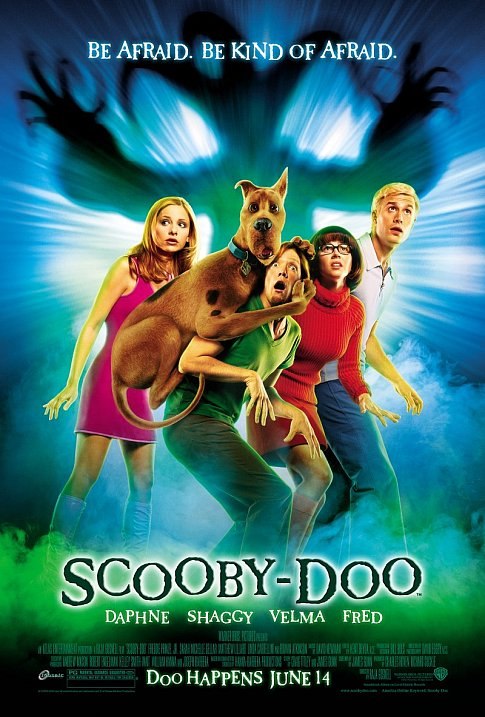
Matthew Lillard, Sarah Michelle Gellar, Linda Cardellini, and Freddie Prinze Jr. in Scooby-Doo (2002)

After being in the works since the mid-’90s, a live-action Scooby-Doo film finally came to fruition in the early 2000s under the direction of Raja Gosnell, a long-time editor in the industry who has worked on everything from the Home Alone films (he would end up directing the Macaulay Culkin-less third installment in 1997) to Mrs. Doubtfire. But perhaps the most interesting member of the film’s crew is one of its writers, James Gunn. Yes, more than a decade before he became known as the director of the Guardians of the Galaxy films, Scooby-Doo served as one of Gunn’s first major outings as a screenwriter. Originally, the plan was to have the film be a dark parody of the franchise that would be based around many of the classic fan theories about the original show, such as Shaggy being a stoner and Velma being a closeted lesbian. In other words, this version of the film would’ve very much been in line with the kind of projects that Gunn would become known for. And yet, while Gunn has since gone on to state that an R-rated cut of the film does exist, it was ultimately toned down to a more family-friendly PG rating. That said, though, several of the intended adult jokes can still be found in the film, resulting in a fascinating hybrid that, while technically geared towards kids, still wants to have something there for the adults (e.g. Shaggy finds a new love interest (Isla Fisher), whose name is Mary Jane. His response? “Like, that is my favorite name!”). However, this didn’t stop the film from garnering a mixed-to-negative reaction from both critics and fans of the franchise; thus, nowadays many tend to view it as one of the prime examples of a lackluster live-action adaptation of a popular animated franchise along with the likes of Alvin and the Chipmunks and Yogi Bear. And yet, while I fully recognize that this may just be my nostalgia talking since I watched this one quite a lot when I was growing up, I’d argue that there are some genuinely good things in this film and a lot of it has to do with the main cast. Say what you will about the rest of the film, but I think most would agree that the casting of the Mystery Inc gang was quite perfect.

While the 2003 Looney Tunes film Back in Action poked fun at his performance by having his animated counterpart accuse him of making him sound “like a total space cadet”, Matthew Lillard nails the role of Shaggy to the point where, as noted earlier, it led to him officially taking on the role from Casey Kasem after his retirement. Meanwhile, Linda Cardellini is an equally pitch-perfect choice for Velma as is Freddie Prinze Jr. as Fred. And when it comes to casting Daphne, who gets a great character update here where she evolves from being more than just the damsel in distress, you honestly can’t go wrong with Buffy the Vampire Slayer herself, Sarah Michelle Gellar. Pair this with some solidly funny lines here and there and some delightfully quirky production design and you have a film that I’m not afraid to admit that I still enjoy even after all this time. Now don’t get me wrong, this is far from being a flawless flick. Is it incredibly cheesy in that early 2000’s family film kind of way? Yeah. Is it rather confused as to what kind of film it wants to be, potentially alienating both sides of its target audience in the process? Yeah, especially since it strays heavily from the franchise’s well-established formula by opening with the gang splitting up a la Zombie Island. And unlike that film, where the gang disbanded on completely amicable terms, this film’s split ends up being far more bitter by comparison. Ultimately, though, while I do understand why this film doesn’t exactly have the best reputation amongst longtime fans of the franchise, it still manages to be a lot of fun. All in all, it’s a perfectly undemanding popcorn flick that, thanks to its reasonably short run-time, never ends up overstaying its welcome. And as far as being one of those infamous live-action adaptations of a popular cartoon, I’d argue that it’s far from being one of the worst to come from that genre.   

Rating: 4/5

SCOOBY-DOO 2: MONSTERS UNLEASHED (2004)
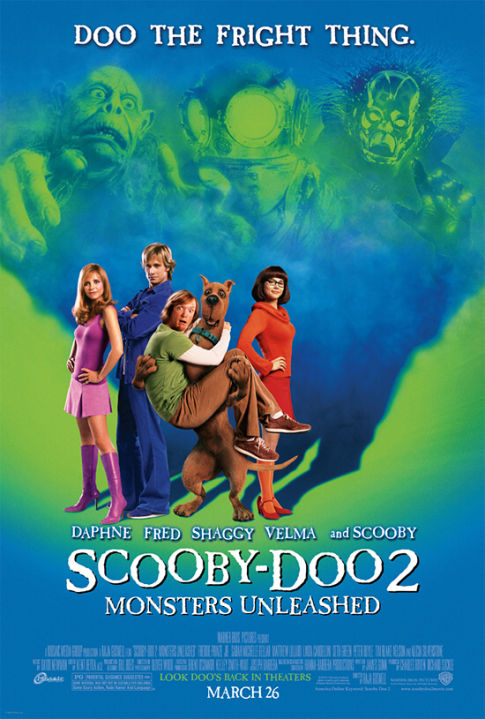
Matthew Lillard, Sarah Michelle Gellar, Linda Cardellini, Freddie Prinze Jr., and Neil Fanning in Scooby-Doo 2: Monsters Unleashed (2004)

While the first live-action Scooby-Doo film wasn’t exactly a critical darling, it was still a sizable hit at the box-office, grossing over $275 million worldwide. Thus, a sequel was promptly put into production, reteaming the main leads with director Raja Gosnell and writer James Gunn. And instead of a plot that was fully intent on satirizing the franchise, Scooby-Doo 2: Monsters Unleashed features a far more traditional Scooby-Doo plot as the gang deals with a mysterious masked figure who’s been bringing all the monsters that they’ve caught in the past to life. It’s also worth noting that this sequel does away with a lot of the adult jokes that were left over from its predecessor’s R-rated origins, resulting in a more generally light-hearted adventure. However, this also means that a lot of the lowbrow humor that was in the first film is even more common here. And yet, this is another case where I’m fine with that, for the most part, because the film ends up being just as fun as its predecessor. Just like before, a lot of this has to do with the lead quartet of Freddie Prinze Jr., Sarah Michelle Gellar, Matthew Lillard, and Linda Cardellini continuing to prove why they were perfectly cast in their respective roles. And because this one doesn’t revolve around the gang splitting up, their overall dynamic is even better than it was in the first film. Plus, the film also has a genuinely heartwarming subplot in which Shaggy and Scooby try to prove that they’re more than just a pair of screw-ups. And so, while I once again want to make it clear that this is by no means a ‘masterpiece’, Scooby-Doo 2 is just as much of a fun and easygoing popcorn flick as its predecessor. Those who were turned off by the first film’s major deviations from the franchise’s formula may find this one to be more enjoyable as a classic Scooby-Doo adventure thanks to its ‘back to basics’ approach. And really, one of the reasons why I can’t bring myself to rag on these films too much is because, in a lot of ways, they were largely responsible for making me a fan of the Scooby-Doo franchise and these characters.   

Rating: 4/5

And that concludes this big retrospective on the Scooby-Doo franchise when it comes to its extensive history on television and a selection of its most notable cinematic outings. As always, thanks for following along and be sure to sound off in the comments below with your own personal experiences with this historic franchise. And yes, you can expect a review of the franchise’s newest cinematic adventure, Scoob, sometime soon.


Friday, May 5, 2017

Guardians of the Galaxy Vol. 2 (2017) review

Image result for guardians of the galaxy 2 poster

Flash back for a second to 2012, when Marvel Studios announced the then-upcoming releases that would make up Phase Two of their ever-expanding Marvel Cinematic Universe. There were the usual suspects, like sequels to Iron Man, Thor, and Captain America, but then there was one notable entry in that list that piqued the interest of fans; Guardians of the Galaxy. And that was primarily because, when it was first announced, most people probably thought the same thing that Djimon Hounsou’s character Korath says in the film when the character that he confronts, Peter Quill, mentions his ‘other’ name, Star-Lord; “Who?” I’ll admit that I was one of those people. At that time, I had no idea who the Guardians of the Galaxy were and I bet that, back then, even some of the biggest comic book fans in the world had no idea who they were either. Marvel was literally going with what was, at the time, a ‘C-list’ superhero team to headline one of their big-budget blockbusters. Thus, there was arguably quite the uncertainty surrounding writer-director James Gunn’s then-newest film. And yet, at the end of the day, it’s safe to say that it far surpassed our expectations. Not only was it one of the funniest and most entertaining films of the entire MCU but it was also one of the most heartfelt and emotional. Gunn succeeded in making us, the audience, care about a group of outlaw protagonists that featured a talking tree creature who could only say ‘I Am Groot’ and a genetically-modified talking raccoon who liked to use big guns and explosives; no small feat, indeed. Plus, it also basically confirmed that the team at Marvel Studios were truly the kings of the superhero film genre, with a winning streak that most studios dream to achieve.  

One MCU Phase later, we’re back with everyone’s favorite bunch of intergalactic a-holes in Guardians of the Galaxy Vol. 2. James Gunn is back to write and direct, once again, and the main cast of the first film (those who survived, at least) return to reprise their respective roles. This time around, Star-Lord and company find themselves on a new adventure that reveals the truth about something that has bugged Peter Quill since the beginning; his heritage. At the end of the first Guardians of the Galaxy, he learned that while his mother was from Earth (or, as the cosmic side of the MCU puts it, ‘Terra’), his father, described by his mother as ‘an angel made of pure light’, was of a different origin. This explained why he could withstand the force of the Power Stone (one of the six Infinity Stones that have been gradually introduced over the course of the MCU’s run) that everyone was after in that film when he held it in his bare hands during the big climactic battle. This film ultimately explores that answer and then some as Peter finally reunites with the father that he never got to know before. But, of course, now the question is this; how does this film hold up compared to its immediate predecessor? Well, unlike many of the other reviews for this film, I’m not going to get into that debate. Instead, I’ll just talk about exactly what this film is; yet another fun entry in the Marvel Cinematic Universe that provides fans with the same great elements that they loved about the original Guardians of the Galaxy.   

Guardians of the Galaxy Vol. 2 opens just a few months after the events of the first film. After successfully saving the galaxy from the Kree radical Ronan the Accuser, the Guardians; charismatic thief Peter Quill AKA Star-Lord (Chris Pratt), stoic assassin Gamora (Zoe Saldana), the slightly maniacal warrior Drax the Destroyer (Dave Bautista), hot-headed thug Rocket Raccoon (voiced by Bradley Cooper), and Rocket’s best friend, tree creature Groot (voiced by Vin Diesel) who, following his sacrifice at the end of the first film, was revived yet is only an infant during this film due to the short gap between it and its predecessor, have since been working odd jobs for various intergalactic organizations. However, due to some trouble caused by Rocket, the team find themselves pursued by their most recent clients, the Sovereign, led by their High Priestess Ayesha (Elizabeth Debicki). Not only that, but she ends up hiring the crew of Ravagers led by the Guardians’ occasional ally/foe Yondu Udonta (Michael Rooker) to chase after them as well. However, things get a little more complicated when one of Yondu’s lieutenants, Taserface (Chris Sullivan; And yes, that’s his name, Taserface), initiates a mutiny against his captain. While all of this is going on, Peter begins to learn more about his true heritage, namely when he finally meets his long-lost father, Ego (Kurt Russell), who is revealed to be a celestial being with unparalleled power.

Guardians of the Galaxy Vol. 2 once again delivers many of the same great things that we loved about the first Guardians. Visually speaking, the film is gorgeous; hell, this is up there with Doctor Strange as one of Marvel Studios’ best-looking films. Obviously, it doesn’t go to any of the truly surreal places that Doctor Strange went but it still provides us with bright and colorful visuals throughout. After all, this was the first film ever to be shot in 8K, currently the highest screen resolution out there, and the results are fantastic. In terms of the trademark sense of humor that the original film (and the entire MCU in general) had, there are, of course, plenty of great humorous moments and bits of dialogue in this film courtesy of writer/director James Gunn. But, at the same time, the film also provides us with some great emotional moments as well, once again proving how much we care about this team and its members. And does this film have a kick-ass soundtrack, just like its predecessor? Abso-frigging-lutely! And, believe it or not, that’s about as much as I can say about this film because there is quite a lot that happens in it; so much so that if I start to talk about any of it, I run the risk of going into spoiler territory. Thus, you can expect a ‘Spoiler Post’ sometime later this month. What I can say here, in a non-spoiler fashion, is that Gunn does a solid job once again with the overall story. Sure, there are a few narrative hiccups here and there, maybe a bit of a slow start even. But like I said before, the emotional core is just as strong as it was in the first film, all tied to a great storyline in which Peter Quill finally reunites with his long-lost father.

The main cast is just as great as they were in the first film; Chris Pratt, Zoe Saldana, Dave Bautista, Bradley Cooper, and Vin Diesel all slip back into their respective roles with ease and once again have terrific camaraderie. So now, let’s talk about the new additions to the cast. Well, technically, I’m starting out with the new additions to the Guardians that return from the original film; Yondu and Gamora’s vengeful sister, Nebula (Karen Gillan). Given that both characters, for the most part, acted as antagonists to the Guardians in the first film, it’s cool to see them transition into more central roles in this film’s overall plot. Rooker, especially, gets a fantastic arc to work with as Yondu. At the same time, though, Gillan gets more to do this time around as the film does a nice job of exploring the tense relationship between Nebula and Gamora. The other new addition to the team is Mantis (Pom Klementieff), who is first introduced as Ego’s assistant or perhaps, as Drax puts it, ‘pet’. Right out the gate, Klementieff proves to be a fantastic addition to the team as the empathic being who has some trouble when it comes to social interaction. But that is exactly what helps make her just as endearing as the rest of the Guardians. How about the villains? Well, this is another aspect of the film that I can’t delve into here because of the risk of bringing up spoilers. All I can say is that the ones who we were initially led to assume were the villains don’t factor into the plot that much. But the true villain of the film? Dare I say, this character is one of the best in Marvel Studios’ oft-maligned collection of villains.

I’m going to refrain from using a certain phrase that I’ve seen tossed around in quite a lot of the reviews for this film. In fact, I’m not even going to say it here; if you’ve seen any of the other reviews for this film, you’ll know exactly what I’m talking about. Said phrase is the one that is commonly brought up when it comes to reviews for most sequels as it is the result of comparing them to their predecessors. Do I agree with this statement, in any way? Well, in some cases, yes, but I feel like this ‘argument’ is becoming increasingly overused in this instance. I’m not saying that this film is perfect; there are a few flaws here and there, namely some narrative hiccups. But that does not, at all, take away from my overall enjoyment of Guardians of the Galaxy Vol. 2. I absolutely loved this film. It delivers exactly what fans of the original were hoping for. A solid story with a strong emotional core, great and endearing protagonists, fun new characters, exciting new developments for certain returning characters, beautiful visuals, hilarious dialogue, and a kick-ass soundtrack all come together for another great addition to the Marvel Cinematic Universe. In fact, feel free to stop reading this review right now and go see this glorious entry in the superhero genre. Seriously, I’m just holding you folks back at this point. You’ll laugh, you’ll cry, you’ll jam to ‘Awesome Mix Vol. 2’. What’s more important to note, though, is that you’ll have another great time in the expansive Marvel Cinematic Universe. Let’s see, where are they at now in terms of their track record with their films, 15 for 15? That must be some kind of record…


Rating: 5/5!

Wednesday, August 6, 2014

Guardians of the Galaxy: SPOILER POST


(WARNING!!!)

The following post contains spoilers for the 2014 Marvel Studios superhero film, ‘Guardians of the Galaxy’. If you have not yet seen the film, I’d recommend that you please refer to my Spoiler-Free review of the film (and then see the film) before reading this post for here I will be discussing key moments of the film in detail.

You have been warned!!!


Well, considering that this year I’ve done spoiler posts for every major superhero film that has come out this year so far: ‘Captain America: The Winter Soldier’, ‘The Amazing Spider-Man 2’, and ‘X-Men: Days of Future Past’, I figured that I should finish this year 4 for 4 and do a spoiler post for Marvel Studios’ latest and strangest film, ‘Guardians of the Galaxy’, which I have to say really impressed me considering how I was fairly hesitant about it when it was first announced. My original reaction to this announcement can best be summed up by what Korath the Pursuer (Djimon Hounsou) said after Peter Quill pronounced to him that he was Star-Lord: “Who?” I legitimately did not know who the heck these characters were and I remembered at the time that I was even questioning why Marvel was deciding to go with this fairly obscure group as the focus of one of their Phase Two films. Well, that hesitation soon began to go away after the marketing campaign for the film began and I was very eager to see how this film turned out… and sure enough, it did not disappoint. So today, as I’ve done with all of the other Spoiler Posts this year, I’ll be talking about a few of the aspects of this film that I wasn’t able to talk about in my original review of the film for fear of spoiling things for those who haven’t seen the film.

THE SOUNDTRACK


I only briefly mentioned this part of the movie in my original review so now I’ll elaborate on it a little bit further. The soundtrack to the film is, quite simply, phenomenal; it’s easily one of the best soundtracks to ever grace not just a superhero film, but any film for that matter. While I haven’t seen the other two films he directed, ‘Slither’ and ‘Super’, I can tell that James Gunn definitely has quite the keen eye when it comes to picking really good soundtracks for his films, and here it’s no exception. It also works incredibly well within the context of the film itself. In the film, the songs that are played in the movie (a great selection of 70’s and 80’s tunes) are on a mixtape that Peter Quill has in the Walkman that he always has with him. He had it when he was taken by the Ravagers when he was a kid so, in other words, this is how he stays attached to the world that he left behind. While I do question why ‘I Want you Back’ by the Jackson 5 and ‘Ain’t No Mountain High Enough’ are on the official soundtrack for the film, titled ‘Awesome Mix Volume 1’ (like the mixtape in the film itself), when in the movie they are actually part of ‘Awesome Mix Volume 2’, which was the gift Quill’s mother had given to him before she died (by the way, I cannot wait to see what songs will be in the sequel), this is a great film soundtrack that complements the movie incredibly well, in terms of both the film’s overall tone as well as being a crucial part of Quill’s character.

THE HUMOR


Pretty much every film in the MCU has had a good amount of funny dialogue and of course the same can be said for ‘Guardians of the Galaxy’. Of course, as you expect from a superhero film, ‘Guardians’ does play things seriously when it needs to but at the same time it’s not completely serious compared to some of the recent films from DC. As I noted in my review, one of the main reasons why I prefer Marvel films to DC films is because they’re much more light-hearted. ‘Guardians’ in particular is easily one of the funniest out of all of the MCU films (arguably as much or possibly even funnier than ‘Avengers’ though that might be up for debate). In fact, there were even some lines that I’m amazed managed to appear in a film that is part of the generally family-friendly MCU that is owned by Disney. The one that stands out to me the most when it comes to this film’s more risqué jokes occurs before the final battle when the Guardians return to Xandar to warn the Nova Corps about Ronan’s impending attack. Of course, they’re still considered criminals by Nova Corps after their capture and arrest on Xandar and later escape from prison, so Star-Lord sends a message to one of the members of the Nova Corps, Rhomann Dey (John C. Reilly), which basically says that ‘he may be an a-hole but he’s not 100% a dick’. Ultimately, the Nova Corps accept their help with Star-Lord noting that ‘they got my dick message’. I don’t think I need to elaborate any more on that. It speaks for itself.

Aside from that, here are some of my personal favorite hilarious moments from this film; there’s the sort of random reference to ‘Footloose’, the story of the great hero Kevin Bacon and how he convinced a town full of people ‘with sticks up their butts’ that dancing is the greatest thing in the world, during a scene where Star-Lord is talking with Gamora (Gamora’s response, asking ‘who put the sticks up their butts’, is priceless). There’s the scene where Rocket lays out his plan for getting the group out of prison, part of which apparently involves in them needing to steal one prisoner’s prosthetic leg. Star-Lord then proceeds to acquire the leg… but it turns out that Rocket was just joking; he didn’t really need the leg (though in a later scene, he asks if he can take a Ravager’s robotic eye). But probably my favorite moment in the film occurs during the finale on Xandar. The group is on Ronan’s ship, the Dark Aster, when they are approached by a group of his soldiers. Groot then proceeds to impale quite a few of them (did I also forget to mention this is probably the most violent MCU film to date) with one of his arms and slams them against the wall multiple times. Once he’s done, he turns to the group and innocently smiles. Of course, these are just my personal favorites but there are plenty more incredibly hilarious bits of dialogue in this film. Sound off in the comments below about your favorite lines/moments from the film.

THE EMOTIONAL RESONANCE


Probably the one thing that surprised me the most about this film was how much I was emotionally invested in it. For being one of the funniest of the MCU films, it actually starts off on a pretty damn depressing note as a young Peter Quill watches his mother die before his eyes before he is taken by the Ravagers. Talk about a dark way to start off a superhero film. Anyway, the emotional resonance of this film is easily one of its greatest strengths. Despite the fact that the Guardians are criminals and, to quote Peter Serafinowicz’s character, ‘a bunch of a-holes’, you do care about them because they’re all just trying to find a place where they belong and over the course of the film they become quite the close family. The scene where Rocket gets emotional over someone calling him ‘vermin’ certainly hits in the feelings department as is the scene during the finale when Groot sacrifices himself to save the group when the Dark Aster crash lands on Xandar despite Rocket pleading with him not to do it (also, the bit where Groot puts one of his twigs on Rocket’s face to comfort him… let me tell you folks that really got me teary-eyed).

Thankfully, as we see, Groot does survive because he has the ability to regenerate. This results in an incredibly cute mid-credits scene where he dances to ‘I Want you Back’ behind Drax’s back (he stops dancing when Drax looks over at him, continuing to do so once Drax looks away again). And yes, despite this, I am aware that now every MCU film since ‘The Avengers’ has had a character supposedly die but then come back (Coulson in ‘Avengers’, Pepper in ‘Iron Man 3’, Loki in ‘Thor: The Dark World, Nick Fury in ‘Captain America: Winter Soldier’, and now Groot in this movie) a little bit later, which some feel is one of the big ‘problems’ with the MCU (I’ll get into another problem some people have with the franchise when I talk about the villains). This has never really bothered me before and it certainly didn’t here. Though I will say this… even though Marvel has pulled this trick for every Phase Two film (as well as the first ‘Avengers’ film), I have the feeling that a permanent death will happen sooner or later… maybe in ‘Avengers: Age of Ultron’ (we all know how Joss Whedon likes to kill off major characters so I’m guessing one could potentially kick the bucket in the film). Ultimately though as I said, I’m not too bothered by this recent trend.

THE GUARDIANS


If I was asked who my favorite member of the Guardians were from the five in this movie, it would actually be a little tough for me to decide because I really like all five of them. Though, if I had to choose just one, I guess I’ll have to go with Groot. Yeah, I know that it’s an obvious answer but Groot’s just so likable. Sure, he’s Rocket’s partner-in-crime but he’s also the most innocent of the five. Rocket was also one of the best of the bunch with his hot-headed nature. But I have to say that the one that surprised me the most was actually Dave Bautista as Drax. I remember reading an article somewhere online in which the writer predicted that Drax would end up being the least popular of the five Guardians because he was the most serious in nature given his whole backstory and his thirst for vengeance. However, that serious persona actually resulted in him having quite a lot of funny lines with my favorite occurring during the scene where Rocket says that metaphors will go over his head (“Nothing goes over my head! My reflexes are too fast… I would catch it…”). Gamora, like Drax, is also more serious in nature which means that she doesn’t have as much comedic dialogue as the rest of the group. However, I will say that she had two of the best lines in the entire film; one is during the escape from prison where, during an argument amongst the group, she laments that she is “going to die surrounded by the biggest idiots in the galaxy”. The other is during a scene between Gamora and Star-Lord where he tries to kiss her but she stops him before he can do so, saying that she wasn’t going to fall for his “pelvic sorcery”. Finally, we have Star-Lord, the ‘Han Solo’ of the group perfectly portrayed by the charming and hilarious Chris Pratt, the third major Chris of the MCU after Chris Hemsworth and Chris Evans.

THE VILLAINS


As I noted in the review, I’ve heard a lot of people say that the weakest part of the film for them is the villains which I also noted apparently connects to a major problem that some people apparently have with the MCU in that the villains of the MCU films, to put it simply, ‘haven’t been that good’. Now I hate to be controversial here, but I feel that this is being incredibly unfair to any of the villains in the MCU who aren’t named Loki. Sure, at the end of the day, Loki is still the best MCU villain by far and there have been some fairly weak MCU villains, like Malekith in ‘Thor: The Dark World’ or Ivan Vanko in ‘Iron Man 2’ or Emil Blonsky in ‘The Incredible Hulk’. But even with that said, that doesn’t mean that there haven’t been some really good MCU villains. Obidiah Stane was a pretty awesome villain in the first ‘Iron Man’. Red Skull (‘Captain America: The First Avenger’) may not have been the most ‘developed’ superhero film villain ever but he still had a great villainous presence which I’d say can sometimes make up for a lack of proper character development. Hell, ‘Captain America: The Winter Soldier’ actually got by without really even having a singular main villain at all. HYDRA was the ‘main threat’ of the film and the titular ‘Winter Soldier’ was more of a henchman. So in short, even if most of the MCU villains haven’t been as great as Loki, that doesn’t exactly mean that a lot of them are ‘bad’ villains. Case in point, I really liked both of the main villains of ‘Guardians of the Galaxy’.


First off we have Ronan, played by Lee Pace. I thought that Pace did an excellent job in the role. The makeup for the character was phenomenal (as it was for the other main villain, who I’ll get to momentarily) as Pace was quite unrecognizable as Ronan the Accuser. That and I do feel that if anything, it wasn’t like he didn’t have any villainous motivation other than the whole ‘just because he’s evil’ thing. He’s a radical Kree who opposes the peace treaty between his race and the Nova Corps’ home world of Xandar so he teams up with Thanos. He agrees to get him the orb that Peter comes across on the planet Morag in exchange for Thanos destroying Xandar for him. However, after he acquires the orb and realizes the great power within it, he makes the incredibly ballsy move and defies his ‘ally’. I felt that there was at least more depth to Ronan than Malekith, who had a lot of his scenes (including one that showcased what clearly must have been his major motivation; his family) cut from ‘Thor 2’. I also liked that the final battle between him and the Guardians wasn’t so anti-climactic. I was worried that it was going to be that way when Star-Lord fires a weapon at Ronan, and it almost looked like he was instantly defeated but thankfully that wasn’t the case. And then guess what… they do it again. Rocket crash-lands Star-Lord’s ship the Milano into Ronan’s ship where he then proceeds to hit Ronan with the Milano. But after the Dark Aster crash-lands on Xandar, Ronan still manages to survive and it isn’t until the Guardians use the Infinity Gem within the Orb (more on that in a little bit) that Ronan is finally defeated. Whether or not you think he’s a good villain you at least have to give him credit… he endured more than some of the other MCU villains.


If we’re focusing on character development, then I’d say that Nebula (Karen Gillan) was a more interesting villain than Ronan was, given her relationship with Gamora. They’re both adopted daughters of Thanos and there is quite the sibling rivalry between them, especially considering that Thanos favors Gamora over Nebula. Like Pace, Gillan was fantastic here as she had quite the menacing presence in the role (her first major role as a villain). However, I do wish that she had more to do in the first half of the film because during that part of the film, she’s really just ‘there’ and doesn’t really do much other than just doing whatever Ronan tells her to do. Thankfully, she does get more to do in the second half of the film (after the Guardians visit the Collector on Knowhere) and her fight sequence with Gamora on the Dark Aster is one of the major highlights of the film. Also, unlike Ronan, she does survive the final battle. After her battle with Gamora, she falls off the ship (after cutting off her robotic hand) but then proceeds to land on a Ravager ship which she then commandeers. I’m glad that this happened because I am interested in seeing more of her in the MCU. I am aware that in the comics she started out as an enemy of the Avengers so… given that ‘Avengers 3’ is likely focusing around Thanos, maybe she can be in ‘Avengers 3’, perhaps? If anything, I’m just glad that there are more opportunities for her to appear in future MCU films because she wasn’t killed off in this movie.

THANOS AND THE INFINITY GEMS


While he may not be the main villain of ‘Avengers 2’, it’s very much clear that they’re clearly building up Thanos’ role as the main villain of ‘Avengers 3’. This film gave us our first look of the character as portrayed by Josh Brolin and I must say that even though he’s only in the film for a very brief amount of time, he’s already made quite the impression. The motion capture effects for him do look pretty good… not only that, but he looks frigging huge compared to what he looked like in ‘Avengers’. This film shows that it’s looking like Marvel will be exploring more of the ‘Cosmic Universe’ in the next few MCU films. One way these films will impact future events will be the introduction of the rest of the Infinity Gems, the six stones (Soul, Time, Space, Mind, Reality, and Power) that, when used with a glove known as the Infinity Gauntlet (which made a brief ‘blink and you’ll miss it’ appearance in Odin’s treasure room in the first ‘Thor’ movie), gives the user god-like powers. As of now, three (potentially four) Infinity Gems have been revealed.


The first was the Tesseract from ‘The First Avenger’ and ‘The Avengers’, which has been confirmed to be the Space Gem. That makes sense considering that the Tesseract was, to put it simply, a ‘portal’ between worlds. The second Infinity Gem introduced in the MCU was the Aether from ‘Thor: The Dark World’. Now I don’t know if it has officially been confirmed yet but some reports are stating that it is the Reality Gem, which allows the user to fulfill any wish they might have. Finally, the one that appears in ‘Guardians of the Galaxy’, contained in the orb that Star-Lord finds on Morag, is the Power Gem. However, while so far these three have been the only official Infinity Gems revealed in the films, there is supposedly a fourth that is in Loki’s staff that he used in ‘Avengers’. If so, I’m guessing that it’s the Mind Gem considering that Loki used his staff to brainwash people like Hawkeye and Dr. Selvig. So in that case, we have yet to see the Time and Soul Gem but it’s pretty much a given that we will soon see them. One thing I’m interested in seeing is how Thanos will collect all of the Gems because right now he actually does not have any of them, nor does he have the Gauntlet. The Tesseract and Gauntlet are on Asgard, the Aether is with the Collector, the Power Gem is with Nova Corps, and (again, if it does contain one of the Gems) Loki’s staff is currently under the ownership of Baron von Strucker (as seen in the mid-credits scene of ‘Captain America: The Winter Soldier’).

THE POST-CREDITS SCENE

Well, I guess I’ll finish this off by just briefly going over the post-credits scene for the film; not the mid-credits scene where a baby Groot dances to ‘I Want You Back’… I’m talking about the other one. Now for the record, this scene doesn’t actually really add much to the story but I felt that it was at least worth it just for the incredibly odd/random cameo that occurs in it. Earlier on in the film, the Guardians had met with the Collector on Knowhere where they learned that the object within the orb that Star-Lord found is one of the six Infinity Gems. The Collector’s assistant Carina then proceeded to grab the stone in defiance for his abuse towards her, causing an explosion that destroys his archive. We return to him in the post-credits scene as he sits in his archive drinking when one of his exhibits, the telepathic Russian cosmonaut dog Cosmo, comes up to him and licks his face. Someone else starts talking and then we find out that this ‘person’ is actually none other than Howard the Duck. Yes, the same duck that appeared in the infamous 1986 bomb of the same name is in ‘Guardians of the Galaxy’ and would you believe it, he’s voiced by Seth Green. I have to admit… I did not see that coming… that being the fact that Green voiced him (I actually did know he was going to be in the post-credits scene).

Howard The Duck2 low
"What do you let him lick you like that for?...Gross!"


Like I said, this scene actually doesn’t add much. According to James Gunn, this was just done for fun and wasn’t supposed to be taken that seriously. Still, it is pretty surreal that Howard the Duck appears in this and for that matter is now officially a part of the Marvel Cinematic Universe (I’ll let that sink in a moment for you folks…). Then again, he did appear in the ‘LEGO Marvel’ video game so maybe it’s not that surprising that he would appear in the MCU, even if it was basically just done as a joke. So that’s ‘Guardians of the Galaxy’ for you. It’s certainly one of the strangest superhero films ever but it’s also one of the best in the entire MCU. It’s incredibly funny but also takes itself seriously when it needs to. Not only that, but I found myself emotionally invested in the film… a film that stars a talking raccoon and a tree creature that can only say ‘I’ and ‘am’ and ‘Groot’ (in that order). Because of that, I say the following… Kudos Marvel Studios, Kudos director James Gunn, and Kudos to the great cast and crew of this film; you truly made a phenomenal superhero film. When this was first announced, I had no idea who most of these characters were. Now, I’m eagerly awaiting the sequel that is set to come out in 2017.