Showing posts with label Kurt Russell. Show all posts

Saturday, October 30, 2021

Disney Retrospective - The Medfield College Anthology

(Today’s retrospective is dedicated to Disney Legend Tommy Kirk (1941-2021), who starred in numerous hit projects for Disney including 1957’s Old Yeller, where he directly participated in one of cinema’s most devastating sequences, and 1959’s The Shaggy Dog, in which he played the young inventor who transformed into the titular character. He also appeared in two of the films that we’ll be covering today, where he played the son of one of Disney’s most notable recurring antagonists of the ’60s. Rest in Peace, Mr. Kirk.) 

Today’s Disney Retrospective is going to be a little different than most of the ones that I’ve done so far since I’m not necessarily focusing on a single franchise. Instead, we’ll be looking at a bunch of films that share one thing in common, their setting. In the ’60s and ’70s, several live-action Disney films were set at the fictional Medfield College, which was named after a town in Massachusetts where several friends of Walt Disney lived. Many historians have noted that Walt visited them frequently and often used to land one of his planes on their property on a private airstrip that is partially still around today. So then, what films will we be looking at today if I’m not doing a single franchise? Well, there are two main series of Disney films that took place at Medfield College. The first of them follows the exploits of a well-meaning but forgetful science professor who creates an incredibly rubbery substance that he calls ‘Flubber’. There were two films made in the ’60s about this character and the original film would end up getting remade in the ’90s, resulting in a film that I’m sure many folks of my generation are decently familiar with. The other series of films is a trilogy (plus a 1995 made-for-TV remake of the first film) that centered around a student at Medfield named Dexter Riley, notably played by Kurt Russell, who tries to help keep the college from falling into financial ruin via various inventions that end up affecting him in unique ways. In fact, every single film that we’re about to discuss in today’s retrospective consists of a plot where the main characters try to help the college get out of debt, so I apologize in advance if it seems like I’m starting to repeat myself at times. Thus, without further ado, it’s time to head back to school, Disney style, as we look at the seven Disney films that were set at Medfield College. This is the Medfield College Anthology.

Also, just a quick disclaimer before we begin. While the following 7 titles were the only Disney films that were specifically set at Medfield College, another Disney film, 1976’s The Shaggy D.A., is set in the town of Medfield, which means that it’s technically set in the same location. However, since that film doesn’t feature the college at any point, I won’t be looking at it today.

ACT 1 – THE FLUBBER SAGA

THE ABSENT-MINDED PROFESSOR (1961)

We begin today’s retrospective with one of Disney’s earliest live-action hits, The Absent-Minded Professor, which was based on a 1942 short story titled A Situation of Gravity by Samuel W. Taylor as well as being partially inspired by Hubert Alyea, a chemistry professor at Princeton University who was known for his explosive (figuratively AND literally) science demonstrations. It was one of many classic live-action Disney films directed by Robert Stevenson, whose work with the company includes the likes of 1968’s The Love Bug and, of course, the one and only Mary Poppins. With a pedigree like that, it shouldn’t come as that big of a surprise that this film is another well-made family-friendly Disney comedy that features plenty of entertaining sequences that fully capitalize on the concept of a miraculous rubber substance that can defy gravity, such as the famous scene where the main protagonist, Professor Ned Brainard, uses it to help Medfield’s struggling basketball team. Fred MacMurray headlines the film nicely as Professor Brainard as does Nancy Olson as Brainard’s fiancĂ© Betsy Carlisle, who he, unfortunately, keeps forgetting to get married to. This is also notably the first appearance of a recurring Disney villain, Keenan Wynn’s greedy land developer Alonzo Hawk, who would go on to appear in this film’s sequel and the previously reviewed Herbie sequel, Herbie Rides Again. In short, despite the usual ‘dated politics’ that are often seen in an older film like this and the fact that it gets a bit meandering near the end despite a modest 97-minute runtime, The Absent-Minded Professor is another indisputable classic of Disney’s early forays into live-action films.

Rating: 4/5

SON OF FLUBBER (1963)

Thanks to the success of the original Absent-Minded Professor, a sequel was announced not long after its release, thus making it one of the first major Disney films to get a sequel. Really, though, the fact that this occurred at all is quite fascinating given that this was back when Walt Disney was still alive. As anyone well-versed in Disney history will surely point out, Walt wasn’t too keen on the idea of sequels, famously quoting that “you can’t top pigs with pigs” in response to the idea of doing follow-ups to the studio’s iconic Three Little Pigs short. And to be fair to Walt’s stance on the matter, Son of Flubber does often come off as one of those sequels that, for the most part, simply rehashes a lot of the same beats as its predecessor. You’ve got Professor Brainard’s various experiments and the wacky antics that ensue, a scene where he pranks his romantic rival with said experiments and a major sporting event where Medfield’s group of underdogs use them to beat their physically superior rivals from Rutland (only here it’s during a football game instead of a basketball game). There are also a few plotlines that are very much in line with what some sequels end up falling victim to by undoing elements of the previous film’s happy ending, such as a love triangle subplot involving an old flame of Professor Brainard’s that ultimately goes nowhere. But for what it’s worth, Son of Flubber still manages to be another enjoyable comedic romp thanks in large part to the return of all the major cast and crew members from the first film, from director Robert Stevenson to stars Fred MacMurray, Nancy Olson, Keenan Wynn, and Tommy Kirk. Thus, while it’s very much a sequel that’s not as good as its predecessor, there’s still just enough of all the things that made The Absent-Minded Professor an enduring staple of Disney’s live-action catalog to make this a worthwhile watch.

Rating: 3/5

(Now, before we continue, I just want to note that there are technically two other Absent-Minded Professor films that served as pseudo-sequels to the original. These two made-for-TV films starred Harry Anderson of Night Court fame as Professor Henry Crawford, the late Professor Brainard’s successor as Medfield College’s chemistry professor who rediscovers Brainard’s lost formula for flubber. However, due to issues regarding the availability of these films, I won’t be covering either of them today. While the 1988 Absent-Minded Professor film can currently be found on YouTube, the same can’t be said for its 1989 follow-up, The Absent-Minded Professor: Trading Places. At the time of this retrospective’s publication, I cannot find it anywhere online, and to be perfectly blunt, I personally feel that attempting to find it would be too daunting of a process for the sole purpose of covering it here.)

FLUBBER (1997)

Just one year after he wrote and produced the live-action remake of 101 Dalmatians, John Hughes tackled a different Disney remake with the remake of The Absent-Minded Professor, Flubber. It was also notably the second time that he had collaborated with director Les Mayfield, who had previously helmed a different Hughes-penned remake, 1994’s Miracle on 34th Street. Overall, Flubber is a lot like the 101 Dalmatians remake in that it generally maintains all the main story beats from the original; missed weddings, flying cars, a big basketball game, etc. Likewise, any changes that are made to Bill Walsh’s original script, outside of making this film’s version of Flubber a sentient substance, mostly come in the form of aesthetic differences that are in line with the remake’s more modern setting. For example, instead of a loyal canine companion, this film’s Professor Brainard is accompanied by a flying robot assistant named Weebo (notably voiced by The Little Mermaid herself, Jodi Benson). However, despite doing quite well at the box office, where it earned over $178 million worldwide ($93 million of that domestically), Flubber didn’t exactly do well with critics. And for the most part, this stems from something that I mentioned a few months ago when I reviewed the 101 Dalmatians remake in that this was during a time when John Hughes’ work underwent a considerably noticeable tonal shift. In other words, whereas Hughes had made his mark on the industry with his sharply written (and often edgy) comedies, his 90’s films were known more for their juvenile slapstick humor, and Flubber is undoubtedly a prime example of that with pratfalls and head smacks galore.

And yet, even with that in mind, I still find this to be an enjoyable watch. Now, full disclosure, I will fully admit that what I just said is largely stemming from the fact that this is an incredibly nostalgic film for me as I watched it repeatedly growing up (and before you ask, I also watched the original a couple times on VHS when I was younger). That said, though, I also recognize WHY this one didn’t fly well with everyone (no pun intended), such as the argument that Robin Williams may not have been the best choice for the lead role since Professor Brainard isn’t exactly the most likable protagonist. And yet, Williams still manages to find some opportunities to display his comedic talents and all-around earnest persona (even in a role like this that, to be fair, wasn’t that much different from its 1961 counterpart) because… well, he was just that good. Regardless of the quality of the films that he was in, Williams’ talent was always able to shine through and serves as a keen reminder of why he continues to be missed to this day. In short, if you’re willing to ignore some of the weird narrative updates that Hughes makes to this story (e.g. the subplot involving Weebo’s romantic feelings towards Brainard) and a couple instances of incredibly dated 90’s CGI, Flubber is a relatively harmless remake of The Absent-Minded Professor. The original is still the better film at the end of the day, but to be perfectly frank, I can’t bring myself to be too hard on what was very much a childhood favorite of mine.

Rating: 3.5/5

ACT 2 – THE DEXTER RILEY TRILOGY

THE COMPUTER WORE TENNIS SHOES (1969)

We now move on from the antics of Professor Brainard to the adventures of Medfield student Dexter Riley, originally played by Kurt Russell who, for those who are unaware, mainly got his start in the business as a prominent male lead for Disney in the ’60s and ’70s. As for the first installment of what is called the Dexter Riley trilogy, 1969’s The Computer Wore Tennis Shoes, it very much establishes the key recurring beats that would define these three films. Each installment revolves around an incident in which Dexter gains incredible powers from the latest Medfield experiment as he works with Medfield’s bumbling Dean Higgins (Joe Flynn) to help win money for their financially struggling school while dealing with the threat of corrupt businessman A.J. Arno (Cesar Romero), who also wants to capitalize on Dexter’s newfound abilities. In this first film, an electric shock that Dexter sustains while working on Medfield’s newly acquired computer ends up turning him into a walking supercomputer, and while this ultimately results in a largely by-the-numbers plot, this is still a solidly entertaining family flick that’s fully bolstered by the series’ three main leads. Even in the early stages of his career, Kurt Russell successfully showcased the strongly charismatic screen presence that would end up defining him as an actor. Joe Flynn, meanwhile, provides solid comedic relief as Dean Higgins while Cesar Romero is enjoyably over the top as main antagonist A.J. Arno. As such, while it’s admittedly a rather average outing as far as Disney’s live-action filmography is concerned, The Computer Wore Tennis Shoes does succeed in being a pleasantly easygoing crowd-pleaser.

Rating: 3.5/5

NOW YOU SEE HIM, NOW YOU DON’T (1972)

The lead trio of Kurt Russell, Joe Flynn, and Cesar Romero all returned for a follow-up in 1972, Now You See Him, Now You Don’t. The film also saw the return of the original’s director, Robert Butler, a veteran director of television who has notably helmed the pilot episodes of several classic shows such as Batman with Adam West (and, of course, Cesar Romero) and the original pilot for Star Trek that featured Jeffrey Hunter’s Christopher Pike rather than William Shatner’s James T. Kirk. In this film, Dexter and his friends come up with a special formula that can turn them invisible. This results in what is quite frankly the most entertaining premise of the entire trilogy, especially since this film does a better job than its predecessor did when it comes to capitalizing on the potential of its premise with plenty of fun invisibility-related set pieces such as the one where Dexter helps Dean Higgins win a game of golf. And while some of the film’s invisibility effects have obviously dated quite a bit, the whole film, in general, is better-paced and a lot more consistently humorous than the first film was. All this helps it to overcome another straightforward plot that, dare I say, kind of feels like it straight-up ignores the events of the previous film at times. In other words, there’s not a single mention of everything that Dexter went through in the first film, including the fact that A.J. Arno tried to have him killed (which, as you might have guessed, is not brought up at all once Arno makes his first appearance in the film after being released from prison). Still, for what is undoubtedly another one of those often forgotten live-action Disney films from the studio’s ‘darker days’ (especially seeing how it surprisingly isn’t on Disney+ at the time of this post’s publication unlike the other two films in the trilogy), Now You See Him, Now You Don’t is, against all odds, a superior sequel.

Rating: 4.5/5

THE STRONGEST MAN IN THE WORLD (1975)

The final installment of this trilogy, 1975’s The Strongest Man in the World, saw a notable change in direction. This time, directorial duties were handled by the brother of trilogy writer Joseph L. McEveety, Vincent McEveety, whose work we’ve previously discussed on this site via the Herbie the Love Bug retrospective that I did a few years ago as he had directed two of that franchise’s films and a few episodes of its short-lived TV series. Unfortunately, this is easily the weakest installment of this trilogy as it’s derailed by some questionable narrative and production decisions. It’s not outright terrible, per se, as there are a decent number of sequences that properly maintain the kind of wacky scientific antics that these films are known for. However, the film suffers considerably from some incredibly weak pacing, with some sequences dragging on for way longer than they need to be. Not only that, but the film has a surprisingly limited amount of screentime for Kurt Russell as Dexter, who’s literally absent for at least a third of the runtime. Instead, more time is spent with Dean Higgins, A.J. Arno and his right-hand-man Cookie, and new characters like Eve Arden and Phil Silvers as the owners of rival cereal companies, the former of whom teams up with Medfield to promote the super-strength formula that Dexter and his friends come up with. Now, granted, this may have had something to do with Kurt Russell beginning to transition into non-Disney projects at this point in his career, but nevertheless, the severe lack of his trademark charisma is quite noticeable. As such, the Dexter Riley trilogy ends up concluding on a mediocre note as The Strongest Man in the World is, unfortunately, a major dud that’s largely undone by a messy plot that, despite having just enough of its predecessors’ most recognizable elements, almost feels like it’s from another franchise.

Rating: 2/5

THE COMPUTER WORE TENNIS SHOES (1995 REMAKE)

Finally, we conclude today’s retrospective with the made-for-TV remake of The Computer Wore Tennis Shoes, which first premiered on February 18th, 1995 on ABC. This was one of four remakes of classic live-action Disney films that aired on the network during the 1994-95 season, with the other three being remakes of The Shaggy Dog, Escape to Witch Mountain, and Freaky Friday. It also notably served as the directorial debut of Ant-Man trilogy director Peyton Reed who, just two years later, would helm another made-for-TV old-school Disney ‘remake’ via The Love Bug with Bruce Campbell. But whereas Reed’s Love Bug was admittedly more of a sequel than a remake given the role that the series’ main protagonist Jim Douglas played in it, this new version of The Computer Wore Tennis Shoes is a more straight-forward remake that, like Flubber, doesn’t make a lot of noticeable changes to the original’s script. Outside of the usual modern aesthetic updates, the only major narrative differences include things like having its main antagonist be the resident genius from Medfield’s rival Hale University (who happens to be 12 years old, by the way…) instead of a corrupt businessman and a decently improved role for the film’s female lead and Dexter’s love interest Sarah Matthews. That latter difference is particularly notable seeing how, in the original trilogy with Kurt Russell, all three films paired his Dexter up with a different female lead who barely factored into the main plot.

In the remake, Dexter Riley is played by Kirk Cameron, who does a solid job in the role overall even if his version of Dexter is arguably cockier than Kurt Russell’s Dexter was in the scenes from the original film where Dexter’s fame started to go to his head. Still, like with any of Lindsay Lohan’s star-making roles, a project like this shows that, despite Cameron’s current reputation, he was a genuinely talented young male lead. Here, he’s joined by 90’s comedy mainstay Larry Miller in a scene-stealing turn as the remake’s equivalent of Dean Higgins, Dean Valentine, and Dean Jones (who, of course, would then go on to reprise his role as Jim Douglas in The Love Bug two years later) as Hale’s Dean Carlson albeit in a relatively minor role compared to everyone else. As for the film itself, I’ll fully admit that there’s not much else for me to talk about as it’s very much your standard made-for-TV film. Despite a few overly campy moments and some plotlines that don’t really go anywhere such as a pair of government agents who think that Dexter’s been responsible for a recent string of high-profile government hacks, it’s an enjoyable little piece of 90’s nostalgia. Granted, I don’t recall ever watching this when I was younger (although I wouldn’t be surprised if I had) but I do believe that I would’ve enjoyed this as a kid just as much as I did with the likes of classic Disney Channel Original Movies from the ’90s and early 2000s like Halloweentown, The Luck of the Irish, and Smart House.

Rating: 3.5/5

And that concludes today’s retrospective on the 7 Disney films that were set at Medfield College. Thanks for following along and be sure to sound off in the comments below with any childhood memories that you have of these films.

Saturday, February 22, 2020

Miracle (2004) review


Eddie Cahill in Miracle (2004)

Today on Rhode Island Movie Corner, we’re celebrating the 40th anniversary of one of the most iconic moments in not only the history of sports but also the history of the entire United States. On February 22nd, 1980, the U.S. Men’s Hockey Team played against the Soviet Union Men’s Hockey Team at the 13th Winter Olympics in Lake Placid, New York. At the time, the Soviet Union squad was one of the most dominant forces in Olympic history and had taken the Gold Medal in 5 of the last 6 Olympic Games. But against all odds, coach Herb Brooks’ squad of amateur/college players pulled off the impossible and defeated the supposedly unbeatable Russians 4-3 on route to a historic Gold Medal run. This moment in history would forever become known as the ‘Miracle on Ice’ and provided a jolt of national pride that America was arguably quite lacking at the time. But now this brings us to the 2004 film adaptation of this historic event, simply titled Miracle. Released by Disney and directed by Gavin O’Connor, the film was a solid success both critically and commercially upon its release. It grossed over $64 million worldwide and scored good reviews with critics, and even nowadays, I find that many people still regard this as one of the best sports films of all-time. Unlike the actual Miracle on Ice, 2020 doesn’t connect to any specific anniversary for this film, but it did celebrate its 15th anniversary last year. Thus, I figured that now is the perfect time to celebrate an undisputed classic of the sports film genre; a film that flawlessly works around its genre’s predictability to perfectly capture the spirit and emotion of the legendary game that it’s based around.

In the summer of 1969, University of Minnesota Ice Hockey coach Herb Brooks (Kurt Russell) is hired as the new head coach of the U.S. Men’s Hockey Team. Brooks, who had previously played on the 1960 squad but was cut right before their Gold Medal run at the Olympics that year, proposes that the only way they can defeat the unstoppable force that is the Soviet Union’s hockey team is by changing their strategies and the ways that they practice. However, Brooks’ radical ideas are initially met with skepticism by the members of the United States Olympic Committee, especially after he ends up selecting the initial 26-man roster on the first day of what was meant to be a week-long tryout session. Nevertheless, Brooks sticks to his guns and selects a team made up of amateur and college players, including players from Boston University and several who had previously played for Brooks at the University of Minnesota. The only problem, however, is that Boston and Minnesota are responsible for one of the fiercest rivalries in college hockey, and sure enough, that hostility starts to become an issue once the team gets on the ice. However, Brooks manages to work around this by implementing a strict training regime that pushes the players to their limits so that he can properly instill in them the values of playing hockey for the United States of America. And in the process, the team starts to come together as they head to Lake Placid, where they find themselves becoming the catalysts behind a newfound sense of national pride as they brace themselves for the inevitable battle with the Soviets.    

As I alluded to in the intro, sports films can often get dinged for having predictable plots that usually revolve around a team that’s established as being major underdogs but end up winning the most important game of the season against their biggest rivals. This is especially the case for films that are based on true stories since there’s a very likely chance that audiences are well-aware about the history of events that they’re based on going into them. But while Miracle is quite arguably one of the most blatant examples of the latter since, let’s face it, we all know what happened on that fateful February day 40 years ago, this never hurts the film in any significant manner. A lot of this is thanks to how director Gavin O’Connor perfectly conveys the tumultuous atmosphere of everything that was going on in America at the time without ever shifting focus away from Herb Brooks and his team. Whether it’s the opening credits montage that covers events like the Three Mile Island incident and Watergate or a sequence where Herb’s wife Patti (Patricia Clarkson) diverts his attention to news on the developing hostage crisis in Iran, the film never shies away from how American morale was arguably at an all-time low. But just like in real life, the film does a wonderful job of building up to the climactic game against the Soviets and showing just how big of a deal it ended up being for the U.S. In fact, the attention to detail when it came to recreating this game is so authentic that legendary sportscaster Al Michaels didn’t even bother to re-record his iconic final words from the original broadcast (“DO YOU BELIEVE IN MIRACLES? YES!”). Why? Well, it was quite simply because he knew that he couldn’t even remotely come close to replicating the pure, unbridled emotion of that moment.

But, of course, the best aspect of this entire film is Kurt Russell’s phenomenal lead performance in the role of Herb Brooks. Russell fully commands the screen as the legendary hockey coach who pushed his team 24/7 to be the best that they can be. And yet, as much as the film focuses on the instances where he dishes out tough love to them like no one’s business, it also makes an effort to emphasize his humanity amidst all the pressure that he was clearly under to lead his team to victory. Much of this comes through in the scenes that he shares with Patricia Clarkson as Herb’s wife Patti who, despite her admittedly limited role as the generally passive ‘supporting wife’, does get to have a few instances where she keeps her husband in line when he starts to become too focused on his coaching responsibilities. After that, they’re backed by solid supporting players like Gavin O’Connor regular Noah Emmerich as Herb’s assistant coach Craig Patrick and Sean McCann as Walter Bush, the team’s general manager who also serves as Herb’s liaison when it comes to defending his actions to the U.S. Olympic Committee. As for the 20 men who made up the 1980 U.S. Men’s Hockey Team, the filmmakers primarily relied on casting actual hockey players in the roles. And while the film does tend to focus on some players more than others (namely, the quartet of goalie Jim Craig (Eddie Cahill), team captain Mike Eruzione (Patrick O’Brien Dempsey), defenseman Jack O’Callahan (Michael Mantenuto), and forward Rob McClanahan (Nathan West)), their overall camaraderie is outstanding.  

I still remember going to see this film in theaters back in 2004 when my family and I were on vacation in New Hampshire. I also remember a time in 2008 when, due to various reasons that range from having to do a school project on the ‘Miracle on Ice’ to just casually watching it at home on DVD, I ended up re-watching this film at least 3 or 4 times in the span of a month. In other words, just like another classic Disney sports film of the era, 2000’s Remember the Titans, Miracle is a film that I have quite a lot of history with, and upon re-watching it for this review, it’s easy to see why. Sure, it can be just as predictable as other films in the sports genre from a story perspective, but to be fair, this is the ‘Miracle on Ice’ we’re talking about. Thus, in this instance, it’s not a big deal that you already know the outcome of the film going into it because that’s not the point of it all. Instead, Miracle succeeds immensely thanks to excellent direction from Gavin O’Connor that perfectly conveys the historical importance of this legendary game and an unforgettable performance from Kurt Russell in the lead role of head coach Herb Brooks. I may not have been alive to witness the ‘Miracle on Ice’ in person, but this film more than does its job when it comes to authentically recreating such a spectacle on the big screen. And really, it doesn’t matter how many times you re-watch the actual game itself or this film’s interpretation of it as the climactic medal round matchup between the United States and the Soviet Union still stands as one of the most exhilarating finales in the history of sports films.   

Rating: 5/5!

Thursday, August 8, 2019

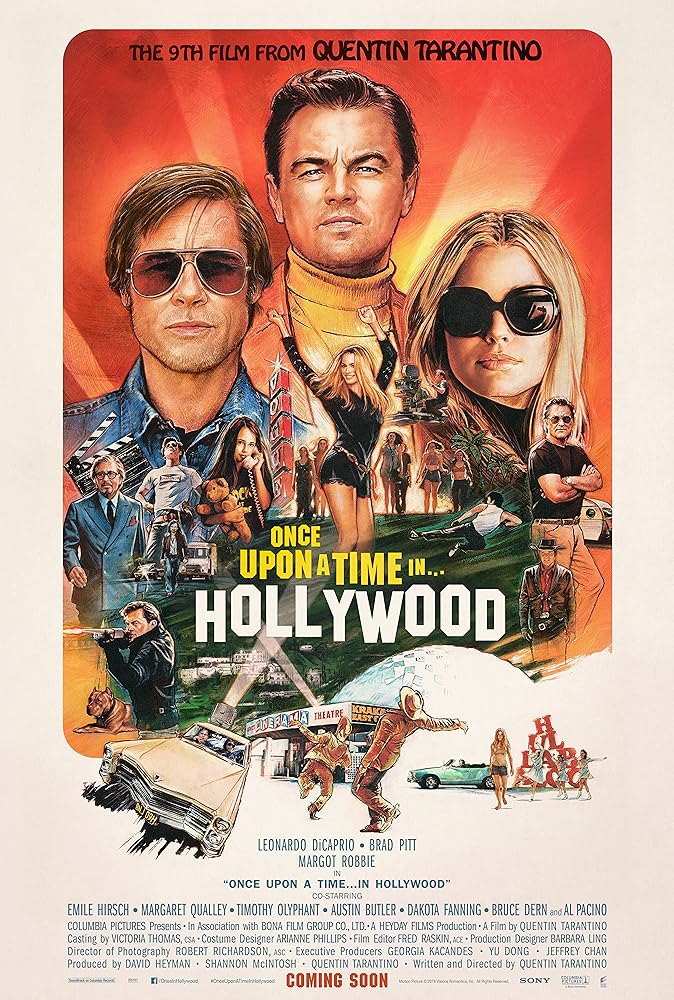
Once Upon a Time in Hollywood (2019) review

Once Upon a Time ... in Hollywood (2019)

It’s easy to point out some of the most notable trademarks of director Quentin Tarantino, whether it’s his knack for snappy dialogue or how he often goes against traditional storytelling conventions (e.g. the non-linear narrative of his 1994 classic Pulp Fiction). And yet, it can be argued that perhaps his most famous directorial trademark is his extensive knowledge of film thanks to an entire lifetime spent watching them. Because of this, every Quentin Tarantino film to date is chock-full of references to other films, whether it’s a homage to a specific genre (e.g. the Kung-Fu, spaghetti western, and revenge thriller films that inspired Kill Bill) or if they’re just simply brought up during conversations between characters. And while this aspect of Tarantino’s work has proven to be a bit more controversial in recent years, it’s still undoubtedly one of the main reasons why he continues to be one of the most prolific filmmakers in the industry, which is especially apparent in his newest film, Once Upon a Time in Hollywood. Serving as Tarantino’s ninth directorial effort (and, per his own words, his second-to-last film before he plans on retiring), Once Upon a Time in Hollywood truly is a love letter to the Golden Age of Hollywood as it’s set in its final days before the New Wave took over in the ’70s and ’80s. In the process, it also covers one of the most infamous events from that time, the rise of the sinister cult known as the Manson Family. However, when it comes to effectively combining its two main storylines into one cohesive narrative, that’s where the film admittedly starts to stumble.

The year is 1969 and the film industry has begun to undergo some radical changes. Of the various stars living in Los Angeles, none are arguably affected by this more than Rick Dalton (Leonardo DiCaprio). For years, Rick was the star of the popular Western TV series Bounty Law, but ever since the show’s cancellation (due in large part to his growing addiction to alcohol), he’s now been limited to less fulfilling villain roles on other shows like Lancer and F.B.I. And if that wasn’t enough, Rick soon discovers that his new neighbors are prominent film director Roman Polanski (Rafal Zawierucha) and his wife, rising starlet Sharon Tate (Margot Robbie). Thus, having recognized that he’s quickly becoming a has-been, Rick sets his sights on ways to rejuvenate his career, which sees him rely heavily on the support of his longtime stunt double Cliff Booth (Brad Pitt). Instead of just following the advice of casting agent Marvin Schwarz (Al Pacino) and going to shoot Spaghetti westerns in Italy, Rick plans on getting acquainted with Polanski, who’s fresh off his 1968 directorial effort Rosemary’s Baby. However, things become rather complicated when Rick and Cliff end up having a run-in with a group of hippies who have been living at an old Hollywood ranch with their ‘leader’, Charles Manson (Damon Herriman).

Once Upon a Time in Hollywood is ultimately two stories in one. One is the story of an actor struggling to resuscitate his career in an ever-changing industry while the other focuses on the dangerous Manson family and their infamous crime that was the 1969 murder of an eight-month pregnant Sharon Tate and four other witnesses. And to be perfectly blunt… these stories do not gel well in the slightest. The film ultimately focuses more on Rick Dalton’s attempts at relaunching his career, which would’ve worked perfectly as its own film. But because of this, the whole subplot involving the Manson family feels incredibly tacked on. There are only about one or two major sequences involving the Manson family in this nearly three-hour film and Charles Manson himself is literally only in one scene. This especially comes into play during the film’s finale, which has undoubtedly been its most polarizing aspect. Obviously, I won’t spoil anything from it here for those who haven’t seen the film yet, but I do understand why it’s so controversial because of the real-life context behind it and how the overall limited use of the Manson family arguably cheapens its impact. And yet, despite the film’s often inconsistent narrative, it still gives us exactly what we’ve come to expect from a Quentin Tarantino film. He still gives us plenty of great dialogue-based sequences, with many of them doing a phenomenal job when it comes to building up suspense that ultimately results in a solid bit of payoff. If anything, it’s clear that Tarantino hasn’t lost his stride when it comes to his sharp dialogue, which makes it unfortunate that the rest of the film isn’t quite as tightly focused by comparison.

Like any Tarantino film, Once Upon a Time in Hollywood is a premier case of an actors’ showcase, and it’s all highlighted by the dynamic lead duo of Leonardo DiCaprio and Brad Pitt. While this may only be the first time that these two legendary stars have worked together, their camaraderie is superb, thus perfectly conveying their characters’ tight-knit friendship. DiCaprio brilliantly handles Rick Dalton’s ‘fall from grace’ arc and is also given a bunch of opportunities to flex his comedic abilities thanks to Tarantino’s knack for dark humor. Pitt, meanwhile, brings the same cool aura that he often brings to a lot of his performances as Cliff Booth, who also has an enigmatic vibe to him thanks to a subplot (that, admittedly, feels like it doesn’t get as much attention as it should) revolving around a long-standing rumor about him. Closing out the film’s trio of leads is Margot Robbie in the role of Sharon Tate. Robbie fully commits to the role of Tate, excellently encapsulating the late starlet’s mannerisms and effervescent spirit. Unfortunately, her role in the film ends up being one of the worst cases of underutilizing an actress in recent memory as she’s barely in it, effectively serving as another example of why everything with the Manson family ends up feeling incredibly extraneous. The rest of the film’s stacked ensemble cast is basically a who’s who of recognizable faces, from Tarantino regulars like Kurt Russell and Bruce Dern to reliable supporting players like Al Pacino and Luke Perry in what is ultimately his final film role. Admittedly, most of them are just in it for a single scene apiece, but at the very least, they do make the most out of their limited screen-time.

For film fandom, a Quentin Tarantino film is practically the very definition of an ‘event film’. Whenever one’s released, it’s practically guaranteed to be one of the most anticipated films of its year and, in turn, usually ends up being one of the best-reviewed films of that year. This is certainly the case this year with Once Upon a Time in Hollywood… which makes things rather awkward for me since, unfortunately, I found it to be rather underwhelming. Now before any of you film buffs get on my butt about this, let me be clear; this doesn’t mean that I think that the film was ‘terrible’ because it’s not even close to being that. When the film presents a scene that’s classic Tarantino, it’s handled just as brilliantly as some of the most iconic moments in previous Tarantino films. However, while Once Upon a Time in Hollywood may have all the hallmarks of a classic Tarantino film, it’s fatally undermined by an unfocused script that can’t decide on which story it wants to tell. Simply put, this should’ve just been the story of an actor who’s past his prime and trying to cope with the end of Hollywood’s Golden Age. But instead of just focusing on one storyline, it also tries to incorporate another in the form of the Manson family and their murder of Sharon Tate. However, this is ultimately done in a rather haphazard manner as the Manson family subplot is extremely underdeveloped, which certainly isn’t helped by the limited screen-time of Tate despite a phenomenal turn from Margot Robbie in the role. As such, while I’m aware that I will ultimately be in the minority on this, Once Upon a Time in Hollywood ends up being one of the weaker outings of Quentin Tarantino’s career as it lacks both the punch and soul of the various classics that have defined his career. Sure, it’s generally well-made and features an excellent cast, but at the end of the day, it just feels… empty…

Rating: 2.5/5

Friday, May 5, 2017

Guardians of the Galaxy Vol. 2 (2017) review

Image result for guardians of the galaxy 2 poster

Flash back for a second to 2012, when Marvel Studios announced the then-upcoming releases that would make up Phase Two of their ever-expanding Marvel Cinematic Universe. There were the usual suspects, like sequels to Iron Man, Thor, and Captain America, but then there was one notable entry in that list that piqued the interest of fans; Guardians of the Galaxy. And that was primarily because, when it was first announced, most people probably thought the same thing that Djimon Hounsou’s character Korath says in the film when the character that he confronts, Peter Quill, mentions his ‘other’ name, Star-Lord; “Who?” I’ll admit that I was one of those people. At that time, I had no idea who the Guardians of the Galaxy were and I bet that, back then, even some of the biggest comic book fans in the world had no idea who they were either. Marvel was literally going with what was, at the time, a ‘C-list’ superhero team to headline one of their big-budget blockbusters. Thus, there was arguably quite the uncertainty surrounding writer-director James Gunn’s then-newest film. And yet, at the end of the day, it’s safe to say that it far surpassed our expectations. Not only was it one of the funniest and most entertaining films of the entire MCU but it was also one of the most heartfelt and emotional. Gunn succeeded in making us, the audience, care about a group of outlaw protagonists that featured a talking tree creature who could only say ‘I Am Groot’ and a genetically-modified talking raccoon who liked to use big guns and explosives; no small feat, indeed. Plus, it also basically confirmed that the team at Marvel Studios were truly the kings of the superhero film genre, with a winning streak that most studios dream to achieve.  

One MCU Phase later, we’re back with everyone’s favorite bunch of intergalactic a-holes in Guardians of the Galaxy Vol. 2. James Gunn is back to write and direct, once again, and the main cast of the first film (those who survived, at least) return to reprise their respective roles. This time around, Star-Lord and company find themselves on a new adventure that reveals the truth about something that has bugged Peter Quill since the beginning; his heritage. At the end of the first Guardians of the Galaxy, he learned that while his mother was from Earth (or, as the cosmic side of the MCU puts it, ‘Terra’), his father, described by his mother as ‘an angel made of pure light’, was of a different origin. This explained why he could withstand the force of the Power Stone (one of the six Infinity Stones that have been gradually introduced over the course of the MCU’s run) that everyone was after in that film when he held it in his bare hands during the big climactic battle. This film ultimately explores that answer and then some as Peter finally reunites with the father that he never got to know before. But, of course, now the question is this; how does this film hold up compared to its immediate predecessor? Well, unlike many of the other reviews for this film, I’m not going to get into that debate. Instead, I’ll just talk about exactly what this film is; yet another fun entry in the Marvel Cinematic Universe that provides fans with the same great elements that they loved about the original Guardians of the Galaxy.   

Guardians of the Galaxy Vol. 2 opens just a few months after the events of the first film. After successfully saving the galaxy from the Kree radical Ronan the Accuser, the Guardians; charismatic thief Peter Quill AKA Star-Lord (Chris Pratt), stoic assassin Gamora (Zoe Saldana), the slightly maniacal warrior Drax the Destroyer (Dave Bautista), hot-headed thug Rocket Raccoon (voiced by Bradley Cooper), and Rocket’s best friend, tree creature Groot (voiced by Vin Diesel) who, following his sacrifice at the end of the first film, was revived yet is only an infant during this film due to the short gap between it and its predecessor, have since been working odd jobs for various intergalactic organizations. However, due to some trouble caused by Rocket, the team find themselves pursued by their most recent clients, the Sovereign, led by their High Priestess Ayesha (Elizabeth Debicki). Not only that, but she ends up hiring the crew of Ravagers led by the Guardians’ occasional ally/foe Yondu Udonta (Michael Rooker) to chase after them as well. However, things get a little more complicated when one of Yondu’s lieutenants, Taserface (Chris Sullivan; And yes, that’s his name, Taserface), initiates a mutiny against his captain. While all of this is going on, Peter begins to learn more about his true heritage, namely when he finally meets his long-lost father, Ego (Kurt Russell), who is revealed to be a celestial being with unparalleled power.

Guardians of the Galaxy Vol. 2 once again delivers many of the same great things that we loved about the first Guardians. Visually speaking, the film is gorgeous; hell, this is up there with Doctor Strange as one of Marvel Studios’ best-looking films. Obviously, it doesn’t go to any of the truly surreal places that Doctor Strange went but it still provides us with bright and colorful visuals throughout. After all, this was the first film ever to be shot in 8K, currently the highest screen resolution out there, and the results are fantastic. In terms of the trademark sense of humor that the original film (and the entire MCU in general) had, there are, of course, plenty of great humorous moments and bits of dialogue in this film courtesy of writer/director James Gunn. But, at the same time, the film also provides us with some great emotional moments as well, once again proving how much we care about this team and its members. And does this film have a kick-ass soundtrack, just like its predecessor? Abso-frigging-lutely! And, believe it or not, that’s about as much as I can say about this film because there is quite a lot that happens in it; so much so that if I start to talk about any of it, I run the risk of going into spoiler territory. Thus, you can expect a ‘Spoiler Post’ sometime later this month. What I can say here, in a non-spoiler fashion, is that Gunn does a solid job once again with the overall story. Sure, there are a few narrative hiccups here and there, maybe a bit of a slow start even. But like I said before, the emotional core is just as strong as it was in the first film, all tied to a great storyline in which Peter Quill finally reunites with his long-lost father.

The main cast is just as great as they were in the first film; Chris Pratt, Zoe Saldana, Dave Bautista, Bradley Cooper, and Vin Diesel all slip back into their respective roles with ease and once again have terrific camaraderie. So now, let’s talk about the new additions to the cast. Well, technically, I’m starting out with the new additions to the Guardians that return from the original film; Yondu and Gamora’s vengeful sister, Nebula (Karen Gillan). Given that both characters, for the most part, acted as antagonists to the Guardians in the first film, it’s cool to see them transition into more central roles in this film’s overall plot. Rooker, especially, gets a fantastic arc to work with as Yondu. At the same time, though, Gillan gets more to do this time around as the film does a nice job of exploring the tense relationship between Nebula and Gamora. The other new addition to the team is Mantis (Pom Klementieff), who is first introduced as Ego’s assistant or perhaps, as Drax puts it, ‘pet’. Right out the gate, Klementieff proves to be a fantastic addition to the team as the empathic being who has some trouble when it comes to social interaction. But that is exactly what helps make her just as endearing as the rest of the Guardians. How about the villains? Well, this is another aspect of the film that I can’t delve into here because of the risk of bringing up spoilers. All I can say is that the ones who we were initially led to assume were the villains don’t factor into the plot that much. But the true villain of the film? Dare I say, this character is one of the best in Marvel Studios’ oft-maligned collection of villains.

I’m going to refrain from using a certain phrase that I’ve seen tossed around in quite a lot of the reviews for this film. In fact, I’m not even going to say it here; if you’ve seen any of the other reviews for this film, you’ll know exactly what I’m talking about. Said phrase is the one that is commonly brought up when it comes to reviews for most sequels as it is the result of comparing them to their predecessors. Do I agree with this statement, in any way? Well, in some cases, yes, but I feel like this ‘argument’ is becoming increasingly overused in this instance. I’m not saying that this film is perfect; there are a few flaws here and there, namely some narrative hiccups. But that does not, at all, take away from my overall enjoyment of Guardians of the Galaxy Vol. 2. I absolutely loved this film. It delivers exactly what fans of the original were hoping for. A solid story with a strong emotional core, great and endearing protagonists, fun new characters, exciting new developments for certain returning characters, beautiful visuals, hilarious dialogue, and a kick-ass soundtrack all come together for another great addition to the Marvel Cinematic Universe. In fact, feel free to stop reading this review right now and go see this glorious entry in the superhero genre. Seriously, I’m just holding you folks back at this point. You’ll laugh, you’ll cry, you’ll jam to ‘Awesome Mix Vol. 2’. What’s more important to note, though, is that you’ll have another great time in the expansive Marvel Cinematic Universe. Let’s see, where are they at now in terms of their track record with their films, 15 for 15? That must be some kind of record…


Rating: 5/5!

Monday, April 17, 2017

The Fate of the Furious (2017) review

Image result for fate of the furious poster

I think it’s safe to say that when the original Fast and the Furious came out in 2001, not many people figured that it would eventually lead into one of the biggest film franchises in recent years. And yet, here we are now at the eighth installment of the Fast and the Furious franchise. Seriously, it’s crazy to see how far this series has come since its early days. Who would’ve thought that by the time that its fifth installment came about in 2011, the franchise that had always attracted a mixed-to-negative response from critics would manage to turn things around and start to do just as well with critics as it’s always done with audiences? Whether it’s due to the shift from street racing to action heist plots or the addition of Dwayne ‘The Rock’ Johnson as fan-favorite Luke Hobbs, the series has seen a major increase in both critical and commercial success thanks to its most recent outings. Case in point, the most recent entry, 2015’s Furious 7, became the first film in the series to gross over $1 billion worldwide. Of course, part of the reason for this was that the film was impacted by the death of franchise star Paul Walker halfway through shooting. Thus, the film ended up becoming a poignant send-off to one of the series’ original stars, while still being another enjoyably over-the-top entry in the series. But the story isn’t over yet for Dominic Toretto and his crew. Now under the direction of F. Gary Gray, fresh off 2015’s smash hit Straight Outta Compton, the crew finds themselves up against their most intimidating adversary yet, one of their own, in The Fate of the Furious. Yes, you may snicker at that title, but if you’re a fan of Fast and the Furious, you’ll be pleased to know that this film features more of the same great over-the-top action that this series is known for.

Things have been going quite well for Dominic Toretto (Vin Diesel) and his crew ever since the events of Furious 7. No longer having to worry about dealing with anyone that’s trying to hunt them down, they’ve been spending most of their time living in peace, with Dom enjoying his honeymoon with his wife, Letty Ortiz (Michelle Rodriguez), in Cuba after she regained her memories of their marriage in the previous film. However, when the team is called in to steal an EMP device from a military complex in Berlin, they are surprised when Dom shockingly betrays them by taking the device and getting their ally, Diplomatic Security Service agent Luke Hobbs (Dwayne Johnson), arrested by the local government. As they soon come to find out, Dom is in cahoots with the most elusive cyberterrorist on the planet, Cipher (Charlize Theron), who unbeknownst to them has managed to coerce Dom into working for her thanks to a crucial ace in the hole. Thus, Letty, Hobbs, and the rest of the crew; fast-talker Roman Pearce (Tyrese Gibson), tech expert Tej Parker (Ludacris), and hacker Ramsey (Nathalie Emmanuel), find themselves in a difficult situation as they’re now forced to combat their longtime friend. With the aid of their old ally, government agent ‘Mr. Nobody’ (Kurt Russell), the team embarks on their latest mission; to take down Cipher before she instigates nuclear war and to, hopefully, get Dom back on their side. They even gain an unexpected ally in their old nemesis, Deckard Shaw (Jason Statham), who they had imprisoned at the end of Furious 7.

Well, seeing how this is the eighth entry in the franchise, I’m well-aware that I’m just repeating myself at this point when it comes to talking about these films. Let’s be honest, folks, eight films in, you know exactly what to expect from this series. You’re not going to get anything Oscar-worthy out of this film’s straightforward ‘stop the bad guy from doing something terrible’ plot. But, of course, that’s not what you’re here for. You’re here for the ridiculous and yet still all-around awesome action sequences that defy all logic and physics with characters who are basically superheroes at this point. And, of course, this film has plenty of that to go around, including an epic chase through New York City involving an army of cars remotely controlled by Cipher. Seriously, though, if you’re one of those who scoffs at the sight of Dwayne Johnson pushing away a torpedo (that has been fired by a submarine) with his bare hands or Vin Diesel managing to finish a street race all while his car is almost entirely on fire, then this film isn’t for you. But, for those who are fans of the series, this doesn’t disappoint when it comes to delivering exactly what this franchise is known for. But, at the same time, it’s all handled with solid execution from a directing standpoint. F. Gary Gray, who’s no stranger to action films having directed the 2003 remake of The Italian Job (which, fittingly enough, starred Charlize Theron and Jason Statham), handles the action well and the film’s overall tone is probably the most consistent that it’s ever been at with this series since Fast Five. In other words, it’s a well-balanced mix of fun, over-the-top action and light-hearted banter with just enough dramatic heft in there that never overshadows the previous two aspects. Because at this point, the franchise is very much self-aware when it comes to not trying to be something that it isn’t.

And, of course, it wouldn’t be a Fast and Furious film without arguably the most definitive aspect of the franchise (yes, even more so than the action), family. Yes, despite the scandalous feud between stars Vin Diesel and Dwayne Johnson that clearly isn’t ‘just a publicity stunt’ and this film’s big plot-line of Dom going against his family, the camaraderie amongst the cast is as strong as it’s ever been. And the big reveal surrounding Dom’s actions, without giving anything away, are, surprisingly, well-handled. It isn’t anything too outlandish like I know some were assuming when the first trailer came out. Instead, it manages to tie in with the whole ‘family’ aspect quite well. Of course, the rest of Dom’s crew is just as solid as they’ve ever been, from Tyrese getting a lot of the best humorous moments as Roman to Dwayne Johnson being his usual badass self as Hobbs. Hobbs also gets quite a lot of memorable scenes with Deckard Shaw, as Jason Statham thankfully gets a much more substantial role this time around. Sure, the idea of him becoming an ally to Dom’s crew may seem like a major stretch considering that, in the last film, he killed their crewmate Han but I’ll admit that I’m interested in seeing how they handle this going forward. Plus, it does lead to one super entertaining action sequence that he’s directly involved in. And then, there’s the main villain Cipher, who most certainly ends up being one of the series’ best villains. Charlize Theron plays the part excellently and while she does spend most of the film monitoring the action instead of being out in the field (which may come as a disappointment to some given Theron’s clear skill in terms of fight sequences as evident from Mad Max: Fury Road and the upcoming action thriller Atomic Blonde), her ability to coerce Dom into working for her makes her an entertainingly cold villainess.  

I won’t lie, folks… this may have just become my new favorite entry in the Fast and Furious franchise. I’m kind of reeling at the surreal nature of that statement; I just said that about the eighth (eighth!) installment of the franchise. The only other instance in film history where that was even remotely possible was Harry Potter and the Deathly Hallows: Part 2 back in 2011… and that’s not even my favorite entry in that series, so this is a first for me. But, as a fan of this franchise (at least since the fourth film), this delivered on everything that you’ve come to expect in a Fast and Furious film. Yes, it’s just as simply plotted as its predecessors. And yes, the action is insane… and yet it’s still so damn awesome. Somehow, someway, the filmmakers are continuing to raise the bar in terms of the crazy stunts that this series is known for. And despite what I just said about the film being just as silly and over-the-top as its predecessors, its handling of the whole ‘Dom going rogue’ storyline is surprisingly well-handled. Yeah, it easily could’ve gone a lot worse but the way that they handle it does make sense once you realize the specific reason why Dom is forced to go against his team. Pair all that with the same great over-the-top action and the strong camaraderie of its cast and you have another super entertaining action thrill ride. And with a record-breaking weekend at the global box-office in the books (over $532 million to be precise), this series clearly isn’t slowing down. And you can bet that I’ll be looking forward to the next two installments of this apparent new ‘trilogy’ that the filmmakers are implicating is being set up by this film.

Rating: 4.5/5


(P.S. As it turns out, my next post on here will be the 500th post that I’ve published on Rhode Island Movie Corner. With that in mind, stay tuned for an extra special post to celebrate this momentous occasion.)

Sunday, October 9, 2016

Deepwater Horizon (2016) review (450th Post!)

Image result for Deepwater Horizon poster

In 2013, Mark Wahlberg and director Peter Berg teamed up for Lone Survivor. The film told the true story of ‘Operation Red Wings’, a 2005 joint military operation that went south as a group of Navy SEALs found themselves stuck right in the middle of enemy territory in Afghanistan. The film was a solid success with both critics and audiences and it seems as if Berg and Wahlberg have now become a new major collaborative duo when it comes to doing films based on real-life incidents and the heroes who were directly involved in them. Later this year, they have another project coming out in the form of Patriots Day, the story of the aftermath of the 2013 Boston Marathon bombings. But before that, they have a different ‘true story’ project that comes out first with Deepwater Horizon. Deepwater Horizon tells the story of what became one of the largest environmental disasters in the history of the United States; the 2010 BP Oil Spill. It occurred on April 20th, 2010 on the semi-submersible Mobile Offshore Drilling Unit Deepwater Horizon, when a buildup of methane gas caused a massive explosion. 11 workers lost their lives and a considerably large amount of oil, over 210 million gallons to be precise, was released into the Gulf of Mexico. Obviously this was a major incident when it occurred and sparked tons of controversies, particularly in regards to BP’s handling of the whole situation. But similar to what Michael Bay did with 13 Hours earlier this year, Berg doesn’t really delve into the political side of the incident. Instead, the film focuses in on the workers who were on the rig at the time of the explosion and their efforts to survive. And ultimately like Lone Survivor, Deepwater Horizon is an intense and visceral action/disaster thriller that keeps you on the edge of your seat throughout.

On April 20th, 2010, Chief Electronics Technician Mike Williams (Mark Wahlberg), Dynamic Positioning Operator Andrea Fleytas (Gina Rodriguez), and Offshore Installation Manager Jimmy Harrell (Kurt Russell) arrive at their place of operations, the oil rig Deepwater Horizon. However, it appears that things aren’t really going too well at the moment on the rig, which is currently situated at the Macondo Prospect oil field in the Gulf of Mexico off the coast of Louisiana. As soon as they arrive, they notice another team leaving and learn that they hadn’t done the cement log test that they were supposed to be doing in order to analyze the integrity of the rig. As the crew begins to deal with increasing pressure from their ‘superiors’, namely BP Executives Donald Vidrine (John Malkovich) and Robert Kaluza (Brad Leland), in regards to them being ‘behind schedule’ on their drilling operations, Harrell manages to convince them to run tests on the rig in order to ensure that everything is running smoothly. The first test seems to imply impending disaster but when Vidrine requests a second test on a different section of the rig, that test goes much smoother. However, it turns out that the first test was indeed correct as a build-up of methane gas in the main pipe causes a massive explosion that engulfs the entire rig in fire, putting Williams, Fleytas, Harrell, and the rest of the 126-man crew in an extremely perilous situation as they try to escape from the burning rig.

One thing that I really have to give director Peter Berg credit for in regards to both this and Lone Survivor is that he does a really good job in regards to establishing a great sense of tension by means of the action. Seriously, this film is intense. In fact, sometimes I even wonder how this film managed to get by with a PG-13 rating considering some of its most intense moments, namely a scene in which Harrell pulls a John McClane from Die Hard by taking out a shard of glass from his foot (eck…). Well, to be more specific, all of the action in the film occurs in the second half following the explosion. The first half of the film is primarily build-up, as we see the main members of the crew head out onto the rig and deal with the problems that are starting to emerge on it. But once the second half rolls around and the big explosion occurs, it is non-stop tension throughout. As a few other critics have no doubt pointed out, this is practically like a horror film with the devastation of the explosion posing a very considerable and constant threat to the crew members. Because this is a PG-13 rated film, the action doesn’t get as brutal as it did in the R-rated Lone Survivor (save for the aforementioned ‘pulling glass out of foot’ scene) but you’re still on the edge of your seat throughout. I mean just seeing these people on a burning rig with nothing but fiery destruction going on in the background really gets to you, especially considering that this really did happen. In short, this film definitely pumps up the adrenaline during these scenes.

Now from what I hear, it appears as if this film has been a bit controversial amongst certain audiences, namely due to the fact that, as I alluded to earlier, it avoids going into the politics surrounding the incident as well as the consequences of the subsequent oil spill. Instead, the film focuses in on the explosion that started it all and the people who were on the rig at the time of the incident. But even with that said, sort of like Lone Survivor admittedly this film is more action-oriented than it is character-oriented. Ultimately the primary members of the crew that get the most focus/screen-time are Mike Williams, Andrea Fleytas, Jimmy Harrell, and Drill Crew Floorhand Caleb Holloway (Dylan O’Brien) and even then their characterizations are fairly simple at best; Williams is the main guy trying to get back to his family, Harrell is the wise veteran, Donald Vidrine is treated as an antagonist in the whole ordeal, etc. But overall this film actually does do a decent enough job when it comes to setting up the whole incident from their perspective. Because the film does take a considerable amount of time setting things up before the rig explosion, we as an audience are allowed to connect with Williams, Fleytas, Harrell, and their fellow crew-members. This is particularly evident by the cast’s solid camaraderie as well as the final moments of the film. I’m not spoiling anything when I say that if you’re familiar with this incident, you probably already know that the primary crew members do get rescued at the end. But the final scene in which Williams really starts to cope with everything that he just went through is quite powerful. In fact, I’d say that it’s one of the best bits of acting that Mark Wahlberg has ever done.

Well it seems as if Peter Berg and Mark Wahlberg have become quite the team when it comes to doing films based around real-life heroes. This was the case with Lone Survivor, I bet it will be the case with Patriots Day, and it’s definitely the case with Deepwater Horizon. The primary similarity between this and Lone Survivor is that both films are quite intense in regards to the incidents that they depict. Sure pretty much all of the action in this film occurs in the second half but when it does, boy is it intense. If anything, Peter Berg definitely succeeds in terms of creating a truly visceral thriller. And while the film does focus more on the intense action than it does with its characters, just like Lone Survivor, at the very least it still does a pretty solid job at allowing us to connect with the workers on the oil rig, even if it’s mostly just centered around a select few crew members. But like Lone Survivor, it does end by respectfully paying tribute to those who lost their lives during the incident. Now if you’re going into this expecting to see anything in regards to what happened afterwards, whether it’s how BP ended up getting charged on 11 counts of manslaughter as a result of their ‘gross negligence’ or the effects that the subsequent oil spill had on the environment, prepare to be disappointed because you won’t find any of that here. However, as far as being an intense and visceral action thriller is concerned, the film definitely succeeds in that regard.  

Rating: 4/5


Monday, January 4, 2016

Short Review Triple Feature

Greetings ladies and gentlemen! As I noted a few days ago in my Quentin Tarantino directorial retrospective, I’ve been spending a lot of time developing my ‘Top 12 Favorite Films of 2015’ posts for you folks, which I can confirm for you all will start being published on this blog on January 6th. Until then, as a result of me being primarily focused on those posts, I haven’t had much time to do full reviews for the films that I usually see around this time of the year; in other words, anything I see during the last few days of 2015. As I’ve established before, I’ve been partaking in an annual post-Christmas tradition in the form of a double feature run that I have been doing with my good friend Matthew Goudreau, who’s currently working as an Entertainment Staff Writer with ‘The Young Folks’, every year since 2012. But due to the both of us being rather busy, we actually weren’t able to do it until the first day of 2016 but even if it wasn’t 2015 anymore, this should still be considered as our 2015 run. In 2012, it was ‘Les Miserables’ and ‘Django Unchained’. In 2013 it was ‘The Wolf of Wall Street’ and ‘American Hustle’. And last year, it was ‘Into the Woods’ and ‘The Imitation Game’. So today, as one last post before the big ‘Best Films of the Year’ posts, I’ll be doing a pair of quick reviews of the two films that we saw back-to-back this time around. But this time, however, I’ll be adding in an additional review of a film that I saw the day before I did the double feature screening with Matt on the last day of 2015.  

First up on the list is the film that I saw on December 31st, 2015, New Year’s Eve. It was the last ‘new’ 2015 release that I watched in 2015.

JOY


David O. Russell and Jennifer Lawrence have become one of the biggest director-actor duos in recent years. The two first collaborated on 2012’s ‘Silver Linings Playbook’. That film not only landed Lawrence her second Oscar nomination for Best Actress, after her breakout turn in 2010’s ‘Winter’s Bone’, but also her first win. The two teamed up again the following year, along with her ‘Silver Linings’ co-stars Bradley Cooper and Robert De Niro, for ‘American Hustle’. While only in a supporting role this time around, Lawrence once again got major award buzz for her performance as the unstable wife of Christian Bale’s character and earned her third (and second straight) Oscar nomination, this time for Best Supporting Actress. And while Lupita Nyong’o ended up winning that award that year for her turn in ‘Twelve Years a Slave’, Lawrence was still regarded as being one of the best parts of ‘American Hustle’. This year the duo of Lawrence and O. Russell are at it again, along with Bradley Cooper and Robert De Niro, again, for ‘Joy’. This time Lawrence is the true star of the show in this semi true story about Joy Mangano, a divorced mother from Long Island who became famous in the 90’s for her invention of the Miracle Mop, a self-wringing mop that kept users from having to touch the wet mop head as they would have to have done if they used a regular mop. Her invention was a huge success and Mangano became a highly successful entrepreneur for the Home Shopping Network. She’s been developing new inventions for the network ever since.   

I say ‘semi’ true story because O. Russell has gone on record saying that the film is not entirely based around Mangano’s life. Instead, the screenplay is based around several different stories of women who dared to change their lives around. So while the film may not delve into the full story of Mangano’s rise to fame, it’s still a solidly-executed story of a young woman with the weight of the entire world on her shoulders who manages to overcome all of that through both her perseverance and her ingenious invention. Her life struggles make her easy to sympathize with and relate to and Jennifer Lawrence is superb as always in the role of Joy, as are Robert De Niro as Joy’s father Rudy, who gets quite a lot of humorous lines of dialogue (If you recall my review of ‘American Hustle’, I questioned why that film was being regarded as a comedy when it really wasn’t. ‘Joy’, on the other hand, does a much better job when it comes to comedic dialogue), and Bradley Cooper in the role of an executive from QVC who helps Joy sell her product on the network. Admittedly the film takes a little while to get going and there is quite a bit of uncomfortableness that comes from Joy’s mother’s (Virginia Madsen) role in the film, a woman who spends all of her time watching soap operas and never leaving her room. But once Joy starts to produce and sell her new invention, that’s where the film really starts to shine. Many of you are aware that even though I really liked ‘Silver Linings Playbook’, I wasn’t too big on ‘American Hustle’ and thought that it was one of the more ‘overrated’ films of that year. ‘Joy’, on the other hand, is a film that I’m happy to say that I’m much more positive towards. This one has been more polarizing with critics but at the very least I feel that Lawrence should at least get another Oscar nomination for her work on this film.

Rating: 4/5

And now we move onto the two films that I saw with Matt on January 1st, New Year’s Day.

THE HATEFUL EIGHT


Good ol’ Quentin Tarantino is back with yet another balls-to-the-wall cinematic experience with his eighth feature film, fittingly titled ‘The Hateful Eight’. A western set in post-Civil War Wyoming, the film centers around a group of eight strangers who end up stuck together in a Haberdashery due to a harsh blizzard. These people include bounty hunter John Ruth (Kurt Russell), known as ‘The Hangman’ due to his insistence on making sure his bounties hang, his current prisoner/bounty Daisy Domergue (Jennifer Jason Leigh), fellow bounty hunter Major Marquis Warren (Samuel L. Jackson), ‘new sheriff’ Chris Mannix (Walton Goggins), the haberdashery’s caretaker Bob (Demian Bichir), ‘hangman’ Oswaldo Mobray (Tim Roth), cow-puncher Joe Gage (Michael Madsen), and former Confederate general Sanford Smithers (Bruce Dern). The major selling point of the film was that it was shot in Ultra Panavision 70, a format that hadn’t been used since the 60’s with films like ‘Ben-Hur’ and ‘It’s a Mad, Mad, Mad, Mad World’. Ever the film buff, Tarantino prepared a special ‘roadshow’ release of the film, complete with an overture, intermission, and special booklet, that was 20 minutes longer than the version that would be released nationwide and would be screened in any theaters that still had 70 mm projectors. Of the roughly 100 theaters that screened this special version of the film, the closest to me was the Providence Place Cinema. However, I saw the film in Lincoln so, yes, I only saw the film in its ‘digital release’ form and not in the way that Tarantino had intended. I will see if I can get to see the film’s roadshow release while it’s still running.

But even though I didn’t see the film in the 70 mm format, it is still a beautifully-shot film in terms of its vast landscapes and fresh color palette. As for the film itself, it’s exactly what you’d expect from a Tarantino film. The first half of the film is mostly build-up and exposition between characters but Tarantino is easily one of the best in the business in terms of establishing tension that keeps the audience guessing as to what’s going to happen next and, perhaps most importantly, who’s going to be on the end of another person’s bullet by the end. Admittedly the film is a bit flawed. It loses some momentum in the second half, you do feel the film’s hefty 160+ minute runtime in places, and admittedly Tarantino’s violent action sequences are starting to get a little ridiculous, from heads exploding to people coughing up tons of blood after they drink poisoned coffee. But at the same time, as noted earlier, Tarantino’s direction in terms of establishing suspense and tension is once again superb and the film’s ensemble cast is superb as well. If I had to name the biggest standouts of the film, I would have to go with the three that most people are talking about. Those three are Samuel L. Jackson, of course (this is a Tarantino film after all), as the badass Major Warren, Walton Goggins as arguably the most charismatic of the bunch (even though you really wouldn’t use that word to describe any of these characters) as Mannix, and Jennifer Jason Leigh as, to put it as nicely as I possibly can, the extremely feral Domergue. For Tarantino fans, ‘The Hateful Eight’ will deliver on everything you come to expect from the legendary filmmaker. It’s by no means his best work but still a must-see in every sense of the word.

Rating: 4/5

THE BIG SHORT

Big Short, The Poster

Finally, we have ‘The Big Short’, an interesting against-type project for director Adam McKay. Known for his numerous collaborations with Will Ferrell on comedies like ‘Anchorman’ and ‘Talladega Nights’, ‘The Big Short’, based on the book of the same name by ‘Moneyball’ author Michael Lewis, is more of a drama that focuses on the financial crisis of 2007-2010 that came as a result of the fall of the housing market and build-up of the credit bubble. The film primarily follows the stories of three separate parties; hedge fund manager Michael Burry (Christian Bale), who is the first to notice the impending collapse of the market, another hedge fund manager Mark Baum (Steve Carell) who is notified of this by trader Jared Vennett (Ryan Gosling) and uncovers the fraudulent practices of collateralized debt obligations (CDOs), and up-and-coming investors Charlie Geller (John Magaro) and Jamie Shipley (Finn Wittrock), who get involved with the credit default swap market with their help of their friend, retired banker Ben Rickert (Brad Pitt). All of these characters spend their time in the film working to take advantage of the practice of credit default swap that would bet against the housing market. And despite the fact that obviously this ends up working in their favor, they pretty much all come to the conclusion that in doing so, they’re profiting at the expense of pretty much everyone else in the world except for the banks, resulting in the question of how are they any better than the banks for doing this.

So yeah, sounds like a pretty downer story, right? Well, that’s where McKay’s comedic talents come in as the film manages to have a lot of comedic dialogue that for the most part sort of makes up for the more depressing elements of the story. A lot of the humor comes from Ryan Gosling, whose character Jared Vennett serves as the film’s narrator and Gosling brings a charismatic and also quite boisterous attitude to the role. Now I’ll admit that I know very little about all of this stuff about the housing market and the credit bubble and so on and so forth. And that’s okay because the film is totally aware about that too. It knows that a lot of us aren’t economics majors. So what it does in order to at least make more sense for people like me who don’t know anything about all of this is by cutting to random cameos where celebrities like Margot Robbie and Selena Gomez address the audience and give us a better understanding of all of this trading business, from Robbie talking about loans while in a bathtub to chef Anthony Bourdain talking about CDOs. I’ll admit that there’s sort of a surreal nature to these scenes but thanks to McKay’s direction, a superb cast (if I had to pick a standout I’d go with Gosling for his aforementioned narration work), and an actually solid mix of comedy and drama, ‘The Big Short’ is a fascinating look into one of the biggest incidents in the recent history of this country while also pointing out all of the BS that was responsible from it; BS that, as Brad Pitt put it, hasn’t gone away.


Rating: 4.5/5