Showing posts with label Bryce Dallas Howard. Show all posts

Thursday, October 22, 2020

The Mandalorian: Season 1 Review (Disney+)


“This is the way.”

WARNING: FOR THOSE WHO ARE NEW TO THIS SITE, WHENEVER I REVIEW A SEASON OF A TV SHOW, I USUALLY TEND TO DIVE RIGHT INTO SPOILER TERRITORY TO PROPERLY DISCUSS EVERY KEY DETAIL OF THAT SEASON. WITH THAT IN MIND, IF YOU HAVEN’T WATCHED SEASON 1 OF THE MANDALORIAN YET, MAJOR SPOILERS AHEAD!!!

(So… you’re probably wondering why it took me nearly a full year to get around to this. Well, you can primarily chalk that up to me being consistently preoccupied with other projects like my Top 12 of 2019 list and the retrospectives that I’ve done for franchises such as Scooby-Doo, National Treasure, and Bill & Ted. And yes, I know how incredibly ironic that argument is given the fact that COVID-19 basically left us with a lot more free time on our hands, but I guess you could say that I’m just one of those folks who likes to finish the projects that I’m currently working on before starting a new one. But now, with Season 2 set to debut on October 30th, the time has finally come for me to tackle the Star Wars franchise’s first live-action TV series.)

At this point, I really don’t need to explain how big of a franchise Star Wars has been for the past four decades since its enduring cultural legacy and monumental impact on practically every major form of media clearly does the job for me. However, some of you might be surprised to learn that the one facet of the media landscape that Star Wars hasn’t really delved into until recently is live-action television. Yes, for the longest time, the Star Wars franchise’s forays into television were primarily animated. This included, among others, the two spin-off series in the ’80s that were produced by the Canadian animation studio Nelvana, Droids and Ewoks, Genndy Tartakovsky’s critically-acclaimed Clone Wars series which ran from 2003 to 2005, and the various shows that have been produced by Dave Filoni such as The Clone Wars and Rebels. Now, to be clear, this doesn’t mean that there haven’t been any live-action Star Wars TV projects… it’s just that it’s been quite a while since they were made. For starters, there were a pair of made-for-television films centered around the Ewoks, Caravan of Courage: An Ewok Adventure in 1984 and Ewoks: The Battle for Endor in 1985. But for the longest time, the Star Wars franchise’s biggest connection to live-action television was the infamous 1978 production that was the Star Wars Holiday Special, and to mirror George Lucas’ own thoughts about it… the less said about it, the better. However, in 2005, not long before the release of Episode III – Revenge of the Sith, plans for a new live-action TV series set in the Star Wars universe were announced at that year’s Star Wars Celebration. Officially titled Star Wars: Underworld in 2012, it was reported that the show would be set in-between the events of the prequel and original trilogies and, unlike the films, was going to be more of a noir-inspired show that focused on both the criminal and political conflicts occurring all over a galaxy far, far away.

There were, reportedly, around 100 episodes planned with at least half of them having nearly completed scripts (according to prequel trilogy producer Rick McCallum, they were in the ‘second draft’ stage). However, the series soon found itself hitting a brick wall when it became clear that it would be way too expensive of a show to be produced for either network or cable television. And while it was reportedly still in the works following Disney’s purchase of Lucasfilm in 2012, Underworld ultimately never saw the light of day. The only noteworthy elements that came out of it were plotlines that influenced the franchise’s future anthology films, Rogue One and Solo. However, this did not stop Lucasfilm from making another attempt at developing the first official live-action Star Wars TV series, which finally came to be in the form of The Mandalorian, arguably the biggest project to headline the launch day content of Disney’s new streaming service, Disney+. The show is primarily the brainchild of Jon Favreau, AKA the man responsible for kick-starting the Marvel Cinematic Universe with the original Iron Man and other hits such as the modern holiday classic Elf and the live-action remake of Disney’s The Jungle Book. As the title suggests, the show largely focuses on the titular group of warriors within the Star Wars universe who often work as bounty hunters. Mandalorian culture was first introduced in Episode V – The Empire Strikes Back through the character of Boba Fett who, while not technically an official Mandalorian, has consistently been one of the franchise’s most popular characters despite his admittedly limited role in the original trilogy. But now there’s a new Mandalorian bounty hunter on the scene thanks to a show that not only does a wonderful job of expanding upon the considerably massive Star Wars universe, but also delivers on everything else that fans have come to expect from the biggest franchise in cinematic history.

The Mandalorian takes place about five years after the events of Episode VI – Return of the Jedi. While it’s still plenty of years before the remnants of the Galactic Empire reunite to form the First Order, the galaxy is still rife with plenty of lawless individuals. It is in this environment that Din Djarin (Pedro Pascal), a member of the Mandalorian tribe who is solely referred to by others as ‘The Mandalorian’, goes about his business as one of the galaxy’s most revered bounty hunters. After delivering his latest bounties to his primary associate on the planet Nevarro, Bounty Hunters’ Guild leader Greef Karga (Carl Weathers), Karga directs The Mandalorian to his newest client, a mysterious, unnamed man (Werner Herzog) who’s revealed to be a former member of the Empire. Said client promises the Mandalorian a large amount of Beskar steel, the material used to craft Mandalorian armor, in exchange for the capture and return of his target, and while he isn’t given much information about the target apart from its age and last known location, the Mandalorian promptly embarks on his new assignment. But while he does manage to successfully find the target, he is surprised to discover that it is a young green-skinned alien with large ears. And while the Mandalorian does obey the Bounty Hunter code by delivering the target back to the Client without any questions asked, he soon begins to form a bond with ‘The Child’ and ultimately decides to protect it when he begins to grow concerned about what the Client plans to do with it, especially once he learns that it possesses some mysterious abilities. Naturally, though, this promptly makes them two of the biggest targets in the galaxy as they are forced to go on the run from anyone daring enough to try and hunt them down.

To properly discuss this show, I’m going to have to mention something that is guaranteed to rile up the Star Wars fandom… subverting expectations. It’s a concept that has almost single-handedly fueled the flames of the franchise’s annoyingly vocal group of haters following the release of The Last Jedi, AKA another Star Wars release that made headlines for going against the fandom’s expectations. At the same time, though, it has also arguably become the internet’s new standard for how all future Star Wars projects are to be judged given the largely polarizing reaction towards The Rise of Skywalker. And yet, while none of this has ever had a significant impact on my thoughts towards the franchise’s recent outings, The Mandalorian is, indeed, another case where those involved genuinely managed to take us by surprise. In other words, I have the feeling that, going into this show, a lot of folks were primarily expecting it to be something along the lines of a gritty western given the fact that it would be focusing on one of the Star Wars galaxy’s many bounty hunters. And while that is very much an accurate description of the show in terms of both its plot and overall atmosphere, the reveal at the end of Chapter 1 regarding ‘The Child’, who is shown to be from the same race as Yoda, adds a unique additional layer to what this series is ultimately about. Instead of just being a story of an emotionally distant bounty hunter traversing the galaxy and hunting down his targets, it’s also about that same bounty hunter learning to take on the responsibility of being a father figure for the far more innocent being that he was originally sent to capture. Sure enough, this is what  gives this show the kind of emotional depth that has thoroughly bolstered the franchise’s best cinematic outings while still giving Jon Favreau and his crew plenty of great opportunities to showcase a different side of the Star Wars universe in a creatively satisfying manner.

Said story comes together phenomenally in this eight-episode season. That said, though, I am aware that there has been some criticism about the show’s pacing which, from what I can gather, often revolves around the fact that these episodes are usually about half an hour long at best. And yet, as cool as it would’ve been to have longer episodes that would have given us more time with these characters, I also feel that these shorter episodes allow for a much tighter overarching plot, which helps the show avoid any stretches where its proceedings start to drag. Sure, there are a few episodes around the halfway point that deviate a bit from the main plot, but as much as one could very well describe these as ‘filler’ episodes, they still manage to be just as engaging as the episodes where the Mandalorian contends with those who are hunting ‘The Child’. In fact, one of the best things that I can say about this show is that each of these episodes gives off a terrific episodic feel, which is an approach that has always worked wonderfully for Star Wars (almost all the films are referred to as ‘Episodes’, after all…). Of course, much of this is thanks to what Favreau has described as a “Dirty Dozen/Magnificent Seven type” crew of directors which consists of Dave Filoni, Rick Famuyiwa, Deborah Chow, Bryce Dallas Howard, and Taika Waititi. All five of them do a wonderful job of capturing that classic Star Wars feel in their respective episodes whether it’s thanks to the strong comedic banter between characters or the top-notch action sequences. The show also happens to boast some of the sharpest visuals from any Star Wars production to date. Much of this is due to how it was shot, with most sequences being filmed in front of a massive video wall that utilized fully rendered backgrounds courtesy of Epic Games’ Unreal Engine. It’s a technique that was clearly inspired by Favreau’s work on both The Jungle Book and The Lion King, and while this does mean that a lot of the show’s visuals are CG-based, the visual effects work here is so seamless that you’d legitimately never notice.

The show also follows in the footsteps of the franchise’s best outings by featuring a top-notch ensemble cast, although it is worth noting that, technically, Pedro Pascal is the only ‘main’ star since he’s the only one apart from ‘The Child’ (who, like Yoda before him, is a puppet) to appear in all eight episodes. And since the Mandalorian is always in full Mandalorian armor, sometimes it’s Pascal’s stunt doubles (Brendan Wayne and Lateef Crowder) in the suit instead of him. Nevertheless, Pascal (and, by extension, Wayne and Crowder) does a phenomenal job in the role as he perfectly conveys the character’s world-weary nature while simultaneously excelling at the physical demands that stem from a character who never shows his face but still manages to relay so much simply through his actions. Of course, I’d be remiss if I didn’t bring up the character that has clearly been the series’ breakout star, The Child, affectionately referred to by fans as ‘Baby Yoda’ for obvious reasons. Just like how Yoda was portrayed in the original trilogy (and The Last Jedi), The Child is brought to life by puppetry with only minimal CGI used… which can partially be attributed to the fact that co-star Werner Herzog straight-up called Favreau and his team ‘cowards’ for even considering going the full CGI route. Naturally, this is one of the many reasons why The Child instantly becomes an utterly adorable character and undeniable scene-stealer. As for everyone else in the cast, they very much make the most out of their roles even if they only appear in a few episodes. It all begins with the series’ female lead, Gina Carano as Cara Dune, a former Rebel shock trooper who’s later revealed to be from Princess Leia’s ill-fated home planet of Alderaan. Cara doesn’t appear until Episode 4 and only appears in 3 episodes overall, but that doesn’t stop Carano from being another fine addition to the franchise’s ever-growing line of terrific female heroines as her MMA background is a perfect match for a character who is immediately established as a no-nonsense, badass warrior.

Much of what I just noted with Carano also applies to the other main characters in this show. Established veterans such as Carl Weathers and Nick Nolte (the latter of whom provides the voice of Kuiil (who’s portrayed physically by stuntwoman Misty Rosas), an Ugnaught moisture farmer who becomes one of the Mandalorian’s most loyal allies) are great as always in their respective roles. The same can be said for other standout supporting players such as Emily Swallow as the Mandalorian tribe’s wise Armorer and Taika Waititi as bounty hunter droid IG-11, who immediately proves to be another great addition to the franchise’s collection of droid characters. This cast is so terrific that even characters who are only in single episodes such as Bill Burr’s hot-headed mercenary Mayfeld (a casting choice that has been widely noted as incredibly ironic given his long-standing criticisms of the franchise) and Ming-Na Wen’s cold and calculating assassin Fennec Shand prove to be just as memorable as the main protagonists. Finally, we come to the two main antagonists of the season, both of whom fully succeed at making quite an impression even with their admittedly limited screen-time. First, there’s Werner Herzog (yes, that Werner Herzog) as the Mandalorian’s enigmatic new client. He only appears in a few episodes and could ultimately be considered as being more of a ‘red herring’ villain given how the story plays out, but Herzog steals the screen in every scene that he’s in thanks to his strong screen presence. This then brings us to the other villain of the season, Giancarlo Esposito’s Moff Gideon, a former member of the Empire’s secret police. This character doesn’t even appear until the penultimate episode of the season and yet Esposito still manages to immediately set him up as one of the most imposing antagonists in franchise history, especially since it’s recently been confirmed that he’ll play a much larger role in Season 2.

Given my affinity for the recent Star Wars films, it probably isn’t that surprising that I really loved Season 1 of The Mandalorian. However, before we go any further, I just want to elaborate a bit on what I mean by that. You see, as much as I love this show, that doesn’t automatically mean that I think that it’s the ‘best’ Star Wars project that has come out since Disney purchased Lucasfilm in 2012. Now to be clear, I’m not trying to discourage anyone who legitimately thinks that it is because, in the show’s defense, it truly is a sharply produced series that is quite arguably worthy of that honor. It’s just that, from experience, I find that this argument often tends to stem from all those wholly obnoxious Last Jedi haters who use it as part of their unwavering efforts to rag on the recent trilogy. It’s even gotten to the point where they’ve been touting Jon Favreau and Dave Filoni as the ones who will allegedly ‘save’ Star Wars even though I know damn well that they’ll just start hating on them if the two of them ever did something that they don’t like because… well, that’s just what they always do. So instead, I’m just going to focus on why The Mandalorian is simply yet another rousing success for the Star Wars franchise. Thanks to the strong creative guidance of Jon Favreau and the phenomenal work from his directorial crew, The Mandalorian is a highly compelling, for lack of a better term, ‘episodic saga’ that manages to deliver a genuinely unique spin on the classic Western genre of storytelling that it’s very much inspired by. Its breathtaking visuals rival those of the recent Star Wars films and it also boasts one of the franchise’s best ensemble casts, and because of all this, it definitively sets the stage for what is sure to be an exciting new era for the Star Wars franchise.

SEASON 1 RATING: 5/5!

Now, before we conclude today’s review, I wanted to do something along the lines of what I did a few years back when I reviewed the first few seasons of Agents of S.H.I.E.L.D. and do a rankings list of my favorite episodes from this season. But since this season only consisted of eight episodes, I decided to rank them all instead of just doing a traditional Top 5. Before we continue, though, I need to stress one important detail. This will not be a case where I’ll be ranking them from ‘worst’ to ‘best’ because, as I alluded to earlier in this review, there were honestly no ‘bad’ episodes from this season. Each of these eight episodes were wonderfully crafted by their respective directors and are all memorable in their own unique ways, which is another reason why I decided to cover all of them instead of a select few.

8. CHAPTER 2: THE CHILD

We start this list off with Chapter 2, ‘The Child’, which was the first of two episodes directed by Rick Famuyiwa, fresh off 2015’s critically-acclaimed coming-of-age drama Dope. Precisely continuing from the pilot episode’s unforgettable cliffhanger, this episode sees the Mandalorian begin the journey back to Nevarro with The Child in tow. He does begin to run into some trouble, however, when he fights off a bunch of rival bounty hunters who are also after The Child. And if that wasn’t enough, he then discovers that his ship, the Razor Crest, has been thoroughly scavenged by Jawas, thus forcing him to try and negotiate with them (with the help of Kuiil) so that he can get it back in working order. As I noted earlier, this episode’s placement at the bottom of the list doesn’t mean that it’s a ‘bad’ episode. Sure, it may be a rather short one at just half an hour long, but it’s chock-full of great action sequences such as the Mandalorian’s first attempt at pursuing the Jawas, which promptly ends with him getting hit with a whole bunch of electric shocks that knock him right off the top of their Sandcrawler. There’s also a lot of great humorous moments, like when the Mandalorian gets so frustrated with the Jawas during their negotiation that he nearly sets some of them on fire with his flamethrower. Eventually, though, he and Kuiil manage to strike up a deal with them that results in him having to collect the egg of a vicious horned creature known as a Mudhorn. And while the Mudhorn does proceed to give him quite a bit of trouble, he ends up being aided by The Child, who manages to subdue it with the Force. Thus, the Mandalorian acquires the egg and gives it to the Jawas, who promptly devour its contents, and he and Kuiil manage to fix his ship, with the latter rejecting his offer to tag along as his new crew member. All in all, this is a really fun episode that, like the pilot, does a great job of slowly but surely revealing more of the overall story which, in this instance, namely stems from the reveal that The Child is one with the Force. Really, the only reason why it’s at the bottom of this list is that it simply ends up being outdone by the other 7 episodes.

7. CHAPTER 7: THE RECKONING

I realize that placing this episode at, fittingly enough, the number 7 spot on this list may be a bit controversial given the fact that it was one of two episodes this season that received a perfect 100% rating on Rotten Tomatoes. But just like Chapter 2, this ultimately comes down to overall preference rather than me having anything bad to say about it. The episode begins with the Mandalorian being contacted by Greef Karga, who requests his help in taking down the Client and his Imperial forces on Nevarro in exchange for Greef clearing up their current predicament with the Bounty Hunters’ Guild. He then proceeds to recruit both Cara Dune and Kuiil to aid in the mission but is surprised to learn that the latter has rebuilt IG-11 after he’d destroyed it in Episode 1 and has reprogrammed it so that it can now serve as The Child’s protector. Naturally, he ends up taking issue with this, not only because IG-11 was originally intent on killing The Child but because he’s also been established as having a severe distrust of droids, which is ultimately expanded upon in the finale. It also ties into a recurring plot-point in this episode where the group is repeatedly riddled with personal conflicts, such as The Child force-choking Cara due to a misunderstanding and Kuiil revealing that he used to work for the Empire (albeit as an indentured servant), which doesn’t fly well with Cara given her history with the Rebels. Despite running the occasional risk of over-complicating these proceedings, these moments serve as some excellent bits of character development for the Mandalorian and his crew, especially since many of them are given highly effective pay-offs by the end of the season.

Anyway, the group eventually makes their way back to Nevarro, where they meet up with Greef and his crew and are informed that they’ll have to travel to the town on foot since it’s been completely overtaken by the Client’s troops. At one point, the group is attacked by a group of winged creatures and while Greef sustains some serious injuries from this encounter, The Child ends up healing him with the Force (On a side note, remember when Rey did the exact same thing in Rise of Skywalker and yet a lot of people gave her crap for it?). Because of this, Greef ultimately decides to go against his group’s ‘true’ plan of killing the Mandalorian by killing his associates instead and promising to legitimately help the Mandalorian and his crew protect The Child. However, instead of just ending with a traditional finale where the Mandalorian and crew successfully take down the Client by fooling him into thinking that they’ve brought The Child to him, the episode ends up taking a much different route. During the meeting between the two parties, the Client receives a call from one of his associates… before he and his men are promptly annihilated by a barrage of gunfire. The Mandalorian, Cara, and Greef barely manage to survive this onslaught before finding themselves cornered by the Client’s associate, Moff Gideon, and his army of stormtroopers. Gideon proclaims that he’ll soon have The Child in his possession as we see a pair of scout troopers pursuing Kuiil as he brings The Child back to the Razor Crest. The episode ends on a tragic note as the Troopers kill Kuiil and grab The Child. And so, while this may not be my personal favorite episode from this season, its incredibly intense climax is an undisputed highlight as it perfectly sets the stage for an epic finale.

6. CHAPTER 1: THE MANDALORIAN

While the first episode of a new series usually ends up being overshadowed by the episodes that follow, that doesn’t mean that they can’t be just as great by comparison, and that certainly applies to The Mandalorian’s pilot episode, which served as Star Wars mainstay Dave Filoni’s live-action directorial debut. Thanks to this episode, we get an excellent introduction to the title character and the section of the Star Wars galaxy that he inhabits right from the opening sequence where he nabs an overly talkative bounty. This, of course, then paves the way for our first glimpses at the season’s main plot as the Mandalorian accepts a high-paying commission that’s being offered by a mysterious Client with former ties to the Empire. It’s the episode where we first meet the good-natured Kuiil, who helps the Mandalorian prepare for his journey by helping him learn how to ride a mountable creature known as a Blurrg. Ultimately, though, the biggest highlight of this episode is its action-packed climax in which the Mandalorian reaches his target’s location and proceeds to take on a whole bunch of goons with the help of droid bounty hunter IG-11. As he’s basically known to do nowadays, Taika Waititi is an utterly delightful standout as the no-nonsense assassin droid and the comedic rapport between IG-11 and the Mandalorian is fantastic, especially whenever the latter has to keep the former from initiating his self-destruct function. This, of course, then brings us to the episode’s instantly iconic finale as the two bounty hunters find their target and discover that it’s a young alien child. And while IG-11 intends on killing it, the Mandalorian proceeds to subdue his new associate since he intends on bringing The Child back alive. Thus, thanks to Dave Filoni’s excellent direction and the sharp script from Jon Favreau, this first episode is a brilliant kick-starter for this great new series.

5. CHAPTER 6: THE PRISONER

Rick Famuyiwa’s second episode of the season begins with the Mandalorian reuniting with one of his old colleagues, Ranzar ‘Ran’ Malk (Mark Boone Junior), who requests his help in teaming up with a bunch of his mercenaries to rescue one of their own from a New Republic prison ship. And while this is the only episode in which Ran’s crew of mercenaries appears, they instantly manage to be a solidly memorable gang of criminals. This includes Bill Burr’s ex-Imperial sharpshooter Mayfeld (“I wasn’t a stormtrooper, wise-ass!”), Natalia Tena’s Xi’an, a fiery Twi’lek who’s implied to be one of the Mandalorian’s old flames, Clancy Brown’s Burg, the group’s Devaronian muscle, and a protocol droid named Q9-O voiced by Richard Ayoade. Overall, this episode delivers a delightfully exciting heist plot as the crew infiltrates the ship, fights off its collection of guard droids, and rescues Xi’an’s brother Qin (Ismael Cruz Cordova), who’s shown to have a complicated history with the Mandalorian. Sure enough, the Mandalorian then finds himself double-crossed by Mayfeld and his crew but is eventually able to get back at them by subduing Mayfeld, Xi’an, and Burg and sticking them in one of the ship’s cells. And as for Q9-O, he gets destroyed when he attempts to kidnap The Child after learning about the Mandalorian’s current situation. The only one that he ‘spares’ is Qin, who is then brought back to Ran’s space station, and while Ran immediately sends a gunship after his old associate, he is instead met with a trio of X-Wing pilots who were ‘guided’ there by the Mandalorian thanks to a distress signal that he got from the prison ship and promptly attack his base of operations. Now admittedly, this is one of those episodes that, as I mentioned earlier, is more of a ‘filler’ type episode since it deviates quite a bit from the main plot. And unlike the other episode from this season that could also be described as a ‘filler’ episode, this one doesn’t open in a way that, at the very least, still feels somewhat connected to everything and there aren’t many allusions to what’s mainly going on apart from when the mercenaries discover The Child. Still, for what it’s worth, this is a highly entertaining episode that still managed to do quite a lot with its ‘B-plot’.  

(It’s also worth noting that this episode features a bunch of fun cameos from various veterans of the Star Wars universe. The lone human guard that the crew comes across while on the prison ship, Davan, is played by Matt Lanter who, of course, is best known for voicing Anakin Skywalker in The Clone Wars. And as for the three X-Wing pilots who attack Ran’s station, they’re played by series directors Dave Filoni, Rick Famuyiwa, and Deborah Chow.)

4. CHAPTER 3: THE SIN

Chapter 3 proved to be quite notable upon its debut as it was the first piece of live-action Star Wars material to be directed by a woman. In this case, the honor goes to Deborah Chow, who’s directed episodes for various shows over the years such as Mr. Robot and Jessica Jones and is set to headline the production of another upcoming Star Wars series centered on Obi-Wan Kenobi. And sure enough, as far as her role in the future of this franchise is concerned, she immediately makes one hell of an outstanding first impression thanks to this action-packed episode that also does a great job of officially setting some of the series’ biggest character beats into motion. While it opens with the Mandalorian finally returning to Nevarro and delivering The Child to his client, it ends with him openly defying the Bounty Hunter Code to rescue The Child out of concern for its safety. This then results in one of the best action sequences of the entire season as he infiltrates the client’s facility and takes out a whole bunch of his stormtroopers, including one that he thoroughly torches with his flamethrower. But the action doesn’t stop there as he soon finds himself cornered by Greef Karga and all the other bounty hunters in the area who now have a new target… him. And yet, at a point where it seems as if he’s fully outnumbered, he ends up being saved by his fellow Mandalorian warriors, which is a nice bit of payoff to an earlier scene where he was criticized by some of them for working with Imperials since their Tribe’s past conflict with the Empire, the Great Purge, was what forced them to go into hiding. Nevertheless, that doesn’t stop them from helping one of their own even if, as the Mandalorian points out, they’ll have to relocate now that they’ve made themselves known. This is, after all, the episode that properly establishes the Mandalorian tribe’s principles as best represented by what has easily become this show’s definitive quote, “This is the Way”. And with that, Chapter 3 is another standout piece of this great season thanks in large part to Deborah Chow’s fantastic direction.

3. CHAPTER 5: THE GUNSLINGER

Of these eight episodes, Chapter 5 has the lowest critical score of the bunch on Rotten Tomatoes with a 74% rating. While not panned, per se, the episode did catch quite a bit of flak from critics due to the one thing that has become the internet’s favorite topic when it comes to judging Star Wars, its use of nostalgia. But as I’ve said before, that sort of thing doesn’t affect my views on this franchise in the slightest, and because of that, I’d argue that this was a damn good episode regardless of how much it harkened back to the franchise’s past adventures. For one thing, it starts off on a fantastic note as the Mandalorian fends off a rival bounty hunter complete with a badass quip when the latter has the guts to use his “I can bring you in warm… or I can bring you in cold” line that he had used back in the first episode (“That’s my line!”). However, due to the damages that the Razor Crest sustained during the battle, the Mandalorian is forced to make a pit stop on Star Wars’ original sand planet, Tatooine, in that notoriously “wretched hive of scum and villainy”, Mos Eisley Spaceport. It is there that the Mandalorian meets a wannabe bounty hunter named Toro Calican (Jake Cannavale) who asks for his help in capturing mercenary Fennec Shand (Ming-Na Wen), who’s worked with practically every crime syndicate in the galaxy, so that he can officially join the Bounty Hunters’ Guild. The dynamic that forms between these two is easily one of the best parts of this whole episode as it’s largely defined by the great contrast between the battle-hardened and fully experienced Mandalorian and the rookie Toro, who’s clearly shown to be in over his head when it comes to this line of work.

As for the episode itself, we get a highly entertaining chase storyline as the two bounty hunters go after Fennec. They encounter some Tusken Raiders along the way (complete with a great humorous bit where Toro bad-mouths them before it’s revealed that a pair of them are standing right behind them) and unlike Anakin Skywalker in Revenge of the Sith, the Mandalorian recognizes exactly what they’re up against when it’s clear that Fennec… has the high ground. Sure, the finale of this episode is a rather predictable one as Fennec convinces Toro to turn on the Mandalorian by revealing his situation with The Child, which results in the Mandalorian promptly taking him out instead, but that doesn’t stop this from being a fun little subplot that nicely complements the main plot. Like Chapter 6, this could very well be described as a ‘filler’ episode but that doesn’t mean that it’s any lesser when compared to the other episodes just because it doesn’t focus too much on the Mandalorian and The Child’s predicament. Case in point, the whole opening sequence with the rival bounty hunter is what gives this episode the edge over Chapter 6 since it starts the episode off in a way that properly sets up its main conflict while still continuing to stress the fact that the Mandalorian is a wanted man. The other noteworthy aspect of this episode is Ming-Na Wen, who’s fantastic in the role of Fennec Shand, especially thanks to how she’s effectively established as a considerable foe for both the Mandalorian and Toro. Plus, while her role in this episode ultimately ends with her getting shot by Toro (who, at the very least, recognized the possibility of her betraying him), the episode ends with a mysterious figure approaching her body, implying that she may not be dead just yet. And so, with all this in mind, I’d argue that Chapter 5 is the most underrated episode of this season. I’m not denying that a lot of it is driven by that classic Star Wars nostalgia, but just like The Force Awakens and The Rise of Skywalker, I don’t really see why that’s such a bad thing.

2. CHAPTER 4: SANCTUARY

Jon Favreau has noted that Chapter 4 was the most challenging episode of the season due to its large-scale action sequences and forest setting… which is why he intentionally gave it to the most untested director of the bunch, Bryce Dallas Howard (who, to be fair, has directed a few short films and the 2019 documentary Dads). Ultimately, though, Howard delivers a true gem of an episode that is not only a great action-packed affair but one that also delivers on some strong emotional poignancy. The episode begins with the Mandalorian and The Child, now firmly on the run from the Bounty Hunters’ Guild, landing on the forest planet Sorgan. It is here where we are first introduced to Cara Dune who, despite seeming hostile at first to the point where she and the Mandalorian get into a brief brawl, ends up becoming a friendly acquaintance. The bulk of the episode’s plot, however, revolves around the two of them being approached by members of a nearby village who ask for their help in fending off a band of Klatooinian raiders. And if that wasn’t enough, the Mandalorian and Cara then discover that the raiders also happen to possess an Imperial AT-ST. Thus, in a nod to classic films such as Seven Samurai and The Magnificent Seven, the two proceed to train the villagers so that they can fight back, resulting in a great nighttime battle where the group is able to take down the powerful walker. Ultimately, though, the biggest moment of this episode occurs right at the end when the Mandalorian reveals that he plans on leaving The Child at the village so that he can be safe. One of the villagers, widower Omera (Julia Jones), suggests that he stays as well to the point where she nearly becomes the first person to take off his helmet since he was a child before he ultimately stops her. Sadly, this chance at a peaceful life is tragically shattered when another bounty hunter arrives on the scene, and while he’s quickly taken down by Cara, the Mandalorian quickly realizes that he and The Child are still very much in danger. And so, the episode ends with the two of them bidding a somber farewell to the villagers as they head back to their ship. With a devastating yet powerful ending like that, it’s easy to see why Chapter 4 has been touted as one of the season’s best.

1. CHAPTER 8: REDEMPTION

While Chapter 4 certainly gives it some competition, the best episode of this season ends up being Chapter 8, which was brought to us by everyone’s favorite comedic genius from New Zealand, Taika Waititi. Sure enough, the episode starts off in true Waititi fashion with a great comedic bit where the two Scout Troopers who grabbed The Child (played by Adam Pally and Jason Sudeikis) impatiently wait outside the town to bring it to Moff Gideon. One of them continuously tries to get a peek at The Child and they both shoot at a nearby transmitter with the exact kind of piss-poor accuracy that stormtroopers are notoriously known to have. And sure, there are a few points where the troopers mistreat The Child (to the point where one of them straight-up punches him after he gets bitten), but the little one is thankfully saved by IG-11. IG-11 then proceeds to help the Mandalorian, Cara, and Greef by riding into town on one of the scout troopers’ speeder bikes and taking out a whole bunch of Gideon’s stormtroopers. That said, though, there’s a lot more to the ensuing battle between the two sides than just that. For starters, even though he was only introduced at the end of the previous episode, Gideon immediately proves to be one hell of an imposing villain by subtly revealing that he knows all about our heroes. He knows that Cara was originally from Alderaan, that Greef is a disgraced magistrate, and that the Mandalorian’s real name is Din Djarin. And while the gang manages to put up quite a fight against Gideon’s forces (complete with The Child using the Force to fight off a flamethrower-wielding stormtrooper), the Mandalorian ends up suffering a devastating head injury. But while he initially tells the others to go on without him, he’s ultimately healed by IG-11, who becomes the first being to take off his helmet. And while the Mandalorian promptly reminds IG-11 of the Mandalorian creed that says that no one is to ever see his face, IG-11 reasons that he can be the exception given that he’s not human. It’s also worth noting that, after a few glimpses of it in previous episodes, we finally witness Din Djarin’s backstory where it’s revealed that he was the sole survivor of a Separatist droid attack that killed his parents before being rescued by the Mandalorians, who adopted him into their tribe as a Mandalorian foundling.

The group then proceeds to head to the Mandalorian tribe’s hidden covert but is stunned to find it almost completely abandoned save for the Armorer. After being shown The Child for the first time, the Armorer informs the Mandalorian that he’s to return it to its own kind, and given its powers, she suggests that The Child hails from an ancient enemy of the Mandalorians… the Jedi. Until then, The Child is a Mandalorian foundling and the Mandalorian is his protector as the Armorer officially appoints him his signet (modeled after the Mudhorn that they fought in Chapter 2) that designates them as a ‘Clan of Two’. He’s also given an official Mandalorian jetpack, which is a nice callback to a key moment from the end of Chapter 3 (“I’ve got to get one of those…”). But once again, the action doesn’t stop there. In their efforts to escape, the group finds themselves facing down a whole bunch of stormtroopers at the end of their escape route in the sewers. This then results in a solidly effective emotional moment in which IG-11 nobly sacrifices himself by finally initiating his self-destruct function to take them all out. And while the group is then attacked by Gideon in his TIE fighter, the Mandalorian uses his newly acquired jetpack to great effect and successfully manages to crash Gideon’s ship. With no immediate threat on the horizon, the Mandalorian officially heads off to find whoever The Child truly belongs to (though not before giving Kuiil a proper burial) while Cara decides to stay on Nevarro and serve as Greef’s enforcer. But then, if that wasn’t enough, the episode ends with Gideon breaking out of his crashed TIE Fighter with the help of a key weapon from Star Wars’ past, the Darksaber. This distinctive black lightsaber first appeared in Star Wars: The Clone Wars and, over the course of both that show and Star Wars: Rebels, has been in the possession of several major characters such as Darth Maul. And while I’ll openly admit that I’m not exactly up to date on all of Dave Filoni’s Star Wars shows, I can still see why this big reveal must’ve been a huge deal for fans of the franchise. With all that in mind, it should go without saying that Chapter 8 is a kick-ass season finale. Admittedly, it does cover quite a lot of ground in just 46 minutes, but thanks to Waititi’s excellent direction, none of it ever feels rushed. Instead, it’s just a high-octane thrill ride of an episode that ends this outstanding first season on an equally outstanding note.

And with that, we finally conclude this extensive review of Season 1 of The Mandalorian. Thanks for following along and be sure to sound off in the comments below with your own thoughts on the Star Wars franchise’s first live-action TV series. I also want to note that, unlike what happened here with Season 1, I will do my best to stay up-to-date on Season 2 so that I can get a review of that season published in a reasonable timeframe.

Monday, June 17, 2019

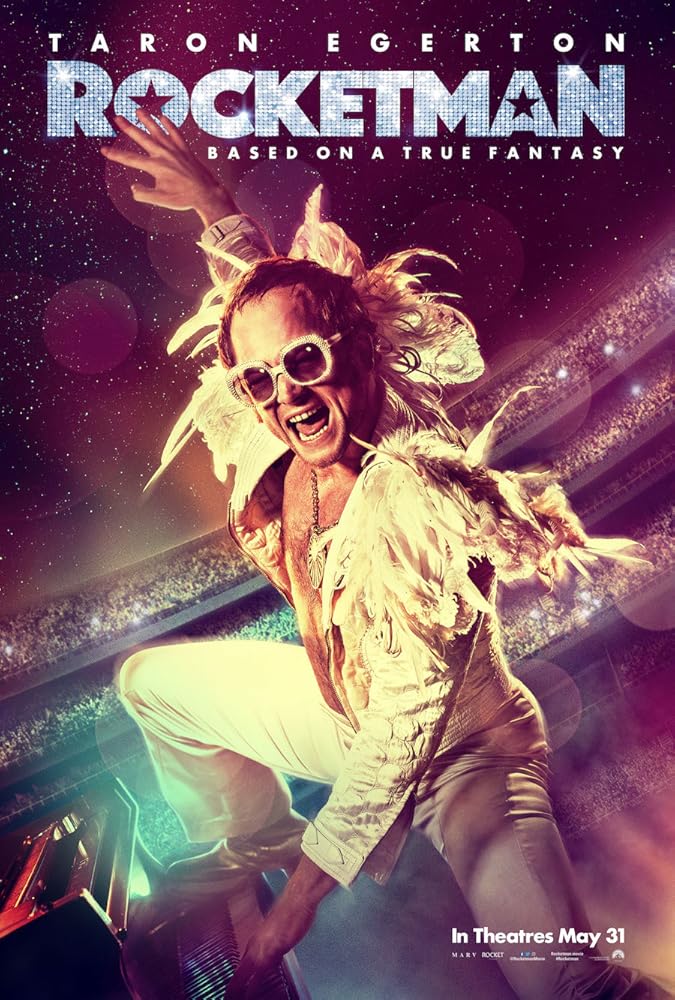
Rocketman (2019) review


Taron Egerton in Rocketman (2019)

What more can be said about Elton John that hasn’t been said already? For the past five decades, he’s been one of the most iconic figures of the entire music industry. With over 300 million records sold worldwide, he’s currently amongst the Top 5 best-selling artists of all-time with classic hits like “I’m Still Standing”, “Goodbye Yellow Brick Road”, and “Tiny Dancer”, and of course, that’s just to name a few. Aside from that, he’s also provided the soundtracks for films like Disney Animation’s smash hit The Lion King and DreamWorks Animation’s The Road to El Dorado as well as the music for Tony Award-winning hits like Aida and Billy Elliot: The Musical. Outside of the world of music, he’s also played a huge role in combatting HIV/AIDS through the Elton John AIDS Foundation, which has raised over $450 million since 1992. And now the story of his life is being brought to the big screen in a film that shares the name of his 1972 classic, Rocketman. John serves as an executive producer on this production while his husband David Furnish is one of the film’s main producers. Directorial duties, meanwhile, go to Dexter Fletcher, a long-time veteran of the film industry who started out as an actor but has recently transitioned into directing with films like Wild Bill and Eddie the Eagle. It’s also worth noting that this isn’t Fletcher’s first time working on a musical biopic as he came on board to finish last year’s Queen biopic Bohemian Rhapsody after Bryan Singer was fired two weeks prior to the end of filming. And while that film may have ultimately attracted a mixed critical reception, Rocketman has been fittingly praised as a lively musical fantasy all topped off by a phenomenal lead performance by Taron Egerton as the one and only ‘Rocket Man’.

In the county of Middlesex, England, a young Reginald Dwight (Matthew Illesley as a young boy, Kit Connor as a teenager) starts to develop a passion for music. And while he doesn’t get much encouragement from his emotionally distant mother Sheila Eileen (Bryce Dallas Howard) and his frequently absentee father Stanley (Steven Mackintosh) due to his time in the Royal Air Force, his loving grandmother Ivy (Gemma Jones) brings him to lessons at the Royal Academy of Music. Several years later, ‘Reggie’ (Taron Egerton) decides to embark on a solo career after spending several years with the R&B band Bluesology. He ends up changing his name to ‘Elton John’ and is signed to a deal with publisher Dick James (Stephen Graham) and manager Ray Williams (Charlie Rowe). He is then paired with songwriter Bernie Taupin (Jamie Bell) and the two begin to craft multiple hit tunes that turn Elton into one of the biggest recording artists in the world. During this time, he also strikes up a relationship with John Reid (Richard Madden), who not only becomes his new manager but also his lover as Elton begins to further embrace his identity as a homosexual. In the process, however, Elton starts to develop nasty drinking and drug habits that threaten to undermine his relationships with his friends and family.  

It’s been said that musical biopics tend to be one of the trickier film genres to truly get right. While there have been plenty of well-received musical biopics over the years like the Johnny Cash biopic Walk the Line and the N.W.A. biopic Straight Outta Compton, many have noted that almost all these films tend to abide by the genre’s typical tropes. This includes everything from segments where the main characters fall on hard times (usually due to drug use) before going back to doing what they do best to montages that cover their rise to fame without really delving into how that came to be. By comparison, Rocketman goes about things a little bit differently. To be clear, it’s still very much a traditional musical biopic that goes through the genre’s usual story beats. However, director Dexter Fletcher manages to work around this by giving the film a fun visual style, and that’s very much apparent in its musical numbers. Some sequences see Elton performing alongside his younger self and in another, his performance of ‘Crocodile Rock’ is such a big hit that it briefly results in him and everyone in the audience levitating into the air. But most importantly, all of them do a great job in capturing Elton John’s signature flashy style, and this is then matched by the film’s excellent handling of his story. Compared to some of the other films of this genre, Rocketman is a lot more upfront about the various struggles that its subject has gone through, namely Elton’s drug and alcohol addictions. Plus, whereas Bohemian Rhapsody was widely criticized for its handling of the portrayal of Freddie Mercury’s sexuality, Rocketman is more open about Elton John’s, resulting in stronger emotional poignancy.

In a way, the stars were truly aligned when it came to Taron Egerton playing the role of Elton John. Not only did John have a notable cameo in Kingsman: The Golden Circle (Kingsman director Matthew Vaughn also happens to be one of this film’s producers), but Egerton performed a standout cover of “I’m Still Standing” in Illumination’s Sing. Thus, it goes without saying that Egerton does a fantastic job performing all of John’s classic songs. At the same time, he also does a great job when it comes to both replicating John’s extravagant stage presence and conveying the emotional turmoil that John sometimes found himself in. He also benefits greatly from the strong connections that he creates with his co-stars, namely Jamie Bell as John’s long-time partner Bernie Taupin and Richard Madden as his manager/lover John Reid. Thanks to a strong performance from Bell and the excellent camaraderie that he and Egerton share, the film does a wonderful job exemplifying the strength of Elton and Bernie’s friendship, especially due to it establishing that the latter is quite arguably the only one to fully accept Elton’s sexuality. This is then effectively contrasted with Elton’s relationship with John Reid who, despite forming a romantic relationship with him, proves to be a considerably toxic toll on his life. In other words, it’s a role that provides a nice change of pace for Richard Madden, who’s usually known for playing more heroic characters (e.g. Prince Charming in Cinderella).

In January 2018, Elton John announced that following a three-year Farewell Tour, he would officially be retiring from touring to spend more time with his family. As such, now is quite arguably a perfect time to attempt an Elton John biopic, and the one that we get is easily one of the best of the musical biopic genre. Even as someone who has gone on record saying that I did like last year’s Bohemian Rhapsody, I do concur that it wasn’t exactly the definitive Queen/Freddie Mercury biopic that it could’ve been. With that in mind, Rocketman does go about the whole ‘musical biopic’ thing a lot better even if it still abides by the genre’s well-established tropes. However, unlike some of the other musical biopics that have been made over the years, Rocketman is one of the genre’s most openly honest affairs as it balances out its emphasis on Elton John’s career highs and lows so that we can fully understand everything that made him the legend that he is today. And thanks to some excellent direction from Dexter Fletcher and a visual style that deftly honors its subject’s eccentric flair, Rocketman more than lives up to its tagline of being based on a ‘true fantasy’. But, of course, the biggest highlight of this film is its star, as all the charisma that made Taron Egerton the breakout star of the Kingsman franchise is on full display in what is easily the best performance of his career to date. As such, don’t be surprised if he ends up being a major frontrunner in next year’s Best Actor race just like Rami Malek was last year after playing Freddie Mercury in Bohemian Rhapsody. 
  
Rating: 4.5/5

Sunday, June 24, 2018

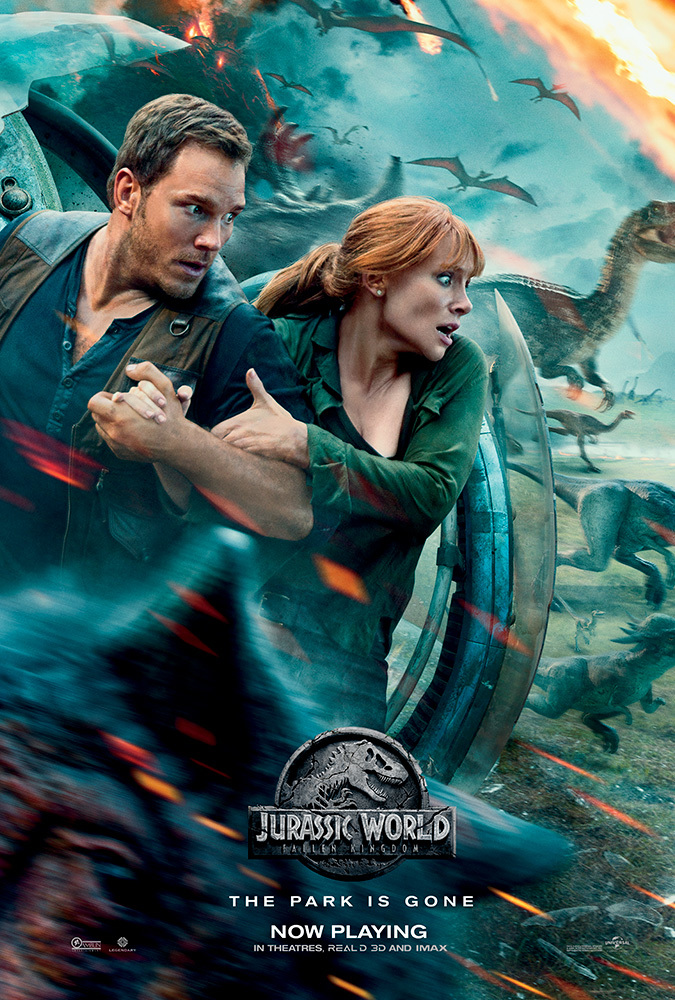
Jurassic World: Fallen Kingdom (2018) review

Jurassic World: Fallen Kingdom (2018)

Jurassic Park is a film series that needs no introduction at this point. What started with director Steven Spielberg’s 1993 adaptation of author Michael Crichton’s 1990 novel of the same name has gone on to become one of the most famous franchises in pop culture history. The original Jurassic Park still stands as one of the most famous blockbusters of all-time, touted for its groundbreaking visual effects (both animatronic and CGI-based) that were used to bring the story’s dinosaur creatures to life. Because of this, it was the highest-grossing film of its time, earning over $914 million worldwide, a record that stood for four years until James Cameron’s Titanic became the first film to earn over $1 billion at the worldwide box-office (Jurassic Park would ultimately join the billion-dollar club itself when it was re-released in 3-D in 2013 for its 20th anniversary). It was then followed by two immediate sequels, the Spielberg-directed The Lost World: Jurassic Park in 1997, which adapted Crichton’s 1995 sequel novelization that was made after the success of the first film, and the Joe Johnston-directed Jurassic Park III in 2001, the first film in the franchise that was not based on a Crichton novel. Both films did well at the box-office but neither of them was as well-received by critics and audiences compared to the first film. After that, a planned fourth film spent several years stuck in development hell due to numerous rewrites of the script, with writers like William Monahan, John Sayles, and Mark Protosevich being brought in to try and make it all work, ultimately to no avail.

It ultimately saw the light of day in 2015 with Jurassic World, directed by Colin Trevorrow, fresh off his 2012 indie hit Safety Not Guaranteed, who also co-wrote it with writing partner Derek Connolly. Serving more as a direct sequel to the original Jurassic Park (while still recognizing the previous two films as canon), the film was a monster hit at the box-office when it was released that summer. It earned over $208 million on its opening weekend in the United States and over $524 million worldwide, officially setting the record for the biggest opening weekend of all-time, a record that has since been outdone by Avengers: Infinity War both domestically and worldwide. And while critics and audiences seemed to be just as split on it as they were with the previous two films, it was still considered to be the best of the original film’s sequels. Cut to three years later and the series continues from its biggest financial hit to date with Jurassic World: Fallen Kingdom. This time, though, Colin Trevorrow isn’t in the director’s chair due to the commitment that he made to Star Wars: Episode IX before he ultimately left the project, though he and Connolly are still involved here as the film’s main writers. Instead, we have J.A. Bayona, who was previously considered to direct Jurassic World before he backed out due to fear of it being a rushed production, behind the camera. Like Trevorrow, Bayona’s been well-known for his work in the indie circuit with critically-acclaimed hits like 2007’s The Orphanage, 2012’s The Impossible, and 2016’s A Monster Calls. And for his first major blockbuster outing, he proceeds to give us yet another enjoyable dinosaur-centric adventure that does manage to carve out its own identity when compared to its four predecessors.

It has been three years since Jurassic World, the second major attempt at realizing industrialist John Hammond’s vision of a theme park featuring genetically-cloned dinosaurs was abandoned after the park was ravaged by its newest creation, a genetically-produced hybrid dinosaur known as the Indominus Rex. When it’s discovered that the island of Isla Nublar is about to be ravaged by an eruption from its previously dormant volcano, the U.S. Senate decides to not attempt to rescue the island’s dinosaurs to avoid any further dinosaur-related catastrophes. While this is going on, Claire Dearing (Bryce Dallas Howard), Jurassic World’s former operations manager who now runs an activist group seeking to rescue the dinosaurs, is approached by Sir Benjamin Lockwood (James Cromwell), who was Hammond’s primary business partner in his initial dinosaur-cloning experiments. Lockwood and his aide, Eli Mills (Rafe Spall), devise a plan to extract the dinosaurs from the island and have them moved to a safe location away from any human interference. Claire is selected to lead the rescue team and she also recruits her ‘ex’ Owen Grady (Chris Pratt), Jurassic World’s former Velociraptor trainer, who is ultimately convinced to go when it’s revealed that Blue, the last surviving member of both his raptor pack and her species in general, is one of Lockwood and Mills’ primary targets. Once on the island, however, Claire and Owen learn that Mills and his team have different plans for the dinosaurs. Instead of transporting them to safety, Mills plans to have the dinosaurs be sold off to buyers all over the world. And as for Blue, she’s needed to further the development of a new genetic hybrid that’s touted as being even more dangerous than the Indominus Rex, the Indoraptor.

Many have touted Jurassic World: Fallen Kingdom as being more akin to a horror film, and it’s easy to see why. The way in which some of the film’s biggest sequences are filmed does give off a neat horror vibe, whether it’s a young girl being hunted by a vicious raptor in her own home or two characters being hunted by a Baryonyx in an abandoned facility that’s slowly being destroyed by lava. And overall, this does give a nice new spin to the traditional franchise concept of humans being hunted by dinosaurs. Still, even with that in mind, admittedly the story doesn’t always match the quality of some of this film’s most memorable sequences. This is especially the case when one big twist regarding a secret about one of the new characters is brought up but is never expanded upon after that reveal despite it being based around an intriguing new concept for this universe. Still, like the previous films, Fallen Kingdom doesn’t skimp on its dinosaur action, with a thrilling finale set not on the island of Isla Nublar but an old gothic mansion. On that note, Fallen Kingdom is quite arguably the best-looking film yet out of the Jurassic Park franchise. The cinematography from Bayona regular Oscar Faura produces some truly vibrant imagery, especially during the sequences where Isla Nublar is being ravaged by its volcano. And for those who were disappointed by the previous film only featuring one dinosaur animatronic in favor of CG-created dinosaurs (which weren’t even ‘bad’, even…), you’ll be pleased to know that Bayona goes for a greater balance between the two visual mediums in this film. Yes, there’s quite a lot of CG dinosaurs in this film, but there are also plenty of instances where the same great style of animatronics that was perfected by the legendary Stan Winston (which won him an Oscar for Best Visual Effects for his work on the original Jurassic Park) are on full display.

Chris Pratt and Bryce Dallas Howard are the only major cast members from Jurassic World to reprise their roles in this film, and the two of them are just as excellent here as they were in that film. Pratt’s great charisma is once again in top form here, and this film does give him some stronger character development to work with through the emotional bond that he shares with Blue. And while Bryce Dallas Howard doesn’t necessarily get to work with the same great transformative arc that Claire underwent in the first film, going from an uptight, work-focused businesswoman to a more emotionally-driven badass, she still gets to have just as plenty of badass moments as Pratt does. Plus, the two have excellent chemistry, better here than in the first film, even. As for the rest of the cast, while a lot of them do end up filling the franchise’s typical collection of characters who end up being ‘dino-chow’, all these actors and actresses do solid jobs in their respective roles. You’ve got your reliable screen veterans like James Cromwell as Sir Lockwood, Ted Levine as the imposing leader of Mills’ mercenary group, and Toby Jones as an auctioneer working in cahoots with Mills. And then you also have some solid newcomers as well, namely the other two members of Owen and Claire’s core group, Daniella Pineda as tenacious paleo-veterinarian Zia Rodriguez and Justice Smith as timid systems analyst Franklin Webb. But easily the most talked about member of this film’s cast is Jeff Goldblum making his heralded return to the Jurassic Park franchise as Dr. Ian Malcolm, who last appeared in 1997’s The Lost World: Jurassic Park. But as Goldblum himself noted in an interview, Malcolm does not factor that much into the film’s plot, as he only appears briefly at the beginning and end in sequences that do not have him interacting with any of the main characters. Still, for what it’s worth, Goldblum does make the most out of his brief appearance, delivering more of the stoic truths that he uttered in previous films that tie into the franchise’s biggest themes revolving around the ethical debate of resurrecting creatures who have been extinct for millions of years.

With a mediocre 50% rating on Rotten Tomatoes (at the time that I’m writing this), Jurassic World: Fallen Kingdom continues the series’ trend of several folks feeling that the sequels don’t even remotely compare to the quality of the original film. But as someone who didn’t necessarily grow up with this franchise (outside of seeing Jurassic Park III when I was like six while over at a friend’s house), I’ve never held these heightened expectations against any of the sequels while still regarding the original film as one of the all-time greats. With that in mind, I enjoyed this film just as much as the other entries in the Jurassic Park franchise. To his credit, J.A. Bayona delivers what is easily the darkest installment of the series to date both thematically and visually. His horror genre roots do come in handy here, producing some effectively tense visuals that are bolstered further by Oscar Faura’s stunning cinematography. And while plot and character development are still not exactly this series’ strongest suit, it does deliver on everything else that fans of the franchise love about it when it comes to its wide array of dinosaur creatures and the chaos that is regularly caused by them. As such, this film ends on a truly fascinating note that paves the way for what will surely be an exciting conclusion to this new Jurassic World trilogy. This third installment will be hitting theaters in the summer of 2021 and will see Colin Trevorrow returning to the director’s chair and closing out the trilogy that he started a la J.J. Abrams returning to direct Star Wars: Episode IX (which, coincidentally, was originally set to be directed by Trevorrow). Until then, we have Jurassic World: Fallen Kingdom, another worthy follow-up to the iconic blockbuster that was the original Jurassic Park.


Rating: 4/5

Thursday, June 21, 2018

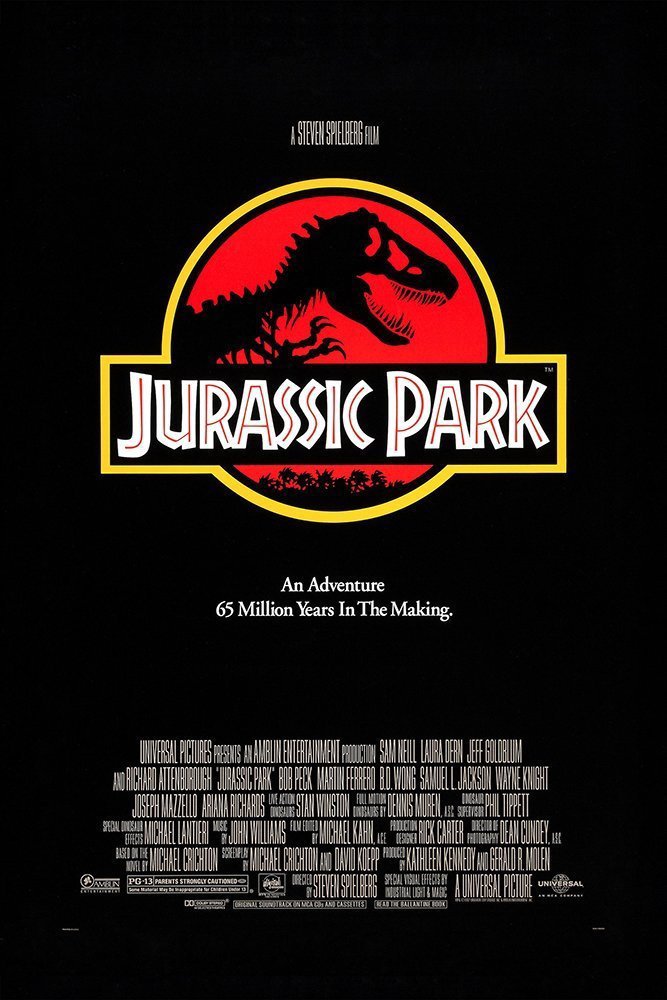
Jurassic Park: The Story So Far


Welcome, ladies and gentlemen, to the next installment of an ongoing series here on Rhode Island Movie Corner, ‘The Story So Far’. This is where I recap the past installments of a franchise in time for its latest release. In doing so, it allows you, the readers, an opportunity to catch up on a franchise if you find that you don’t have enough time to watch its previous installments and just want to know about its most important details before seeing the new film. And for today’s segment of ‘The Story So Far’, we’re looking at one of the most famous franchises in recent film history, Jurassic Park. Ever since director Steven Spielberg’s adaptation of author Michael Crichton’s best-selling novel of the same name hit theaters in 1993, it has gone on to become of the most beloved blockbusters of all-time, heralded for its groundbreaking visual effects. It then proceeded to get two follow-ups, 1997’s The Lost World: Jurassic Park, which Spielberg directed as well, and 2001’s Jurassic Park III, directed by Joe Johnston. Both films did well at the box-office though they weren’t as well-received by critics and audiences when compared to the first film. After that, a planned fourth film spent several years languishing in development hell until director Colin Trevorrow returned audiences to the island of Isla Nublar in 2015 with Jurassic World. Upon its release, the film set numerous box-office records amidst a critical reception that admittedly made it just as polarizing as the previous two films. But, of course, we’re back again with this cautionary tale of ‘man vs. nature’ with this year’s Jurassic World: Fallen Kingdom, directed by J.A. Bayona. But until then, let’s return to the early days of this crazy, little dinosaur experiment and embark on an adventure ’65 million years in the making’ as we recap the events of the Jurassic Park series.

Jurassic Park (RELEASED: 1993)

Jurassic Park (1993)

On the island of Isla Nublar, located off the coast of Costa Rica, industrialist John Hammond (Sir Richard Attenborough) and his company InGen have developed a way of cloning dinosaurs utilizing dinosaur DNA that has been extracted from fossilized mosquitoes. Hammond plans on showcasing his new discovery to the world via an immersive theme park called ‘Jurassic Park’. However, while transporting a Velociraptor to a new enclosure one night, one of the company’s dinosaur handlers is killed when the raptor tries to break free, resulting in a lawsuit from the employee’s family. Because of this, Hammond’s investors demand that he hires a team of experts to visit the park to ensure that it’s maintaining good safety standards. Thus, Hammond invites paleontologist Dr. Alan Grant (Sam Neill), paleobotanist Dr. Ellie Sattler (Laura Dern), and mathematician/chaos theorist Dr. Ian Malcolm (Jeff Goldblum) to the island. Along the way, they’re joined by lawyer Donald Gennaro (Martin Ferraro), who represents Hammond’s investors, and once they arrive on the island, they meet Hammond’s grandchildren, tech-savvy Lex Murphy (Ariana Richards) and her younger brother, dinosaur enthusiast Tim (Joseph Mazzello). This proves to be a bit of an issue for Grant who, as evident from an earlier scene where he discusses raptors with a kid at a dig site, isn’t that big a fan of children. But the tour goes on as planned, with the group being told that the dinosaurs on the island are unable to breed because they are all female, something that Malcolm questions as he claims that this attempt of theirs to control nature is doomed to fail. As for the tour itself, it ultimately ends up being incredibly underwhelming as most of the dinosaurs that the group is meant to come across don’t show up. The only dinosaur that they do come across is a sick Triceratops that they find once they temporarily leave their tour vehicles. Ellie decides to stay and study the Triceratops while Grant, Malcolm, Tim, Lex, and Gennaro return to the tour vehicles right as a tropical storm begins to make landfall on the island, which forces the tour to be put on hold.  

Jeff Goldblum in Jurassic Park (1993)

Meanwhile, Jurassic Park’s disgruntled main computer programmer, Dennis Nedry (Wayne Knight), initiates a plan to steal some of InGen’s fertilized embryos for a rival company. To do so, Nedry temporarily shuts down the park’s security system, which also ends up shutting off all the power in the park. To make matters worse for Grant and company, this ends up occurring right when they’re stationed near the Tyrannosaurus Rex paddock. Sure enough, the T-Rex breaks loose, eating Gennaro (while he’s hiding on the toilet in a nearby restroom) and injuring Malcolm while Grant and the kids barely manage to escape. Nedry’s own efforts to leave the island with the embryos in tow ends up being disastrous as well when he gets lost on the way to the docks and is killed by a venom-spitting Dilophosaurus (disclaimer: Dilophosaurus did not spit venom in real-life; this was something that Michael Crichton invented for the novel). When Ellie and the park’s warden, Robert Muldoon (Bob Peck), head out to try and find Grant and the kids, they rescue Malcolm and barely manage to escape from the T-Rex when it chases after them. Once back at the park’s visitor center, Hammond and his chief engineer, Ray Arnold (Samuel L. Jackson), decide to reboot the park’s entire system when they find that they’re unable to figure out a way around Nedry’s hacks. When Arnold fails to return from turning the power back on, Ellie and Muldoon head out to investigate. Muldoon ends up getting killed by a pair of Velociraptors while Ellie manages to reach the primary maintenance shed and gets the power back up and running again, coming across Arnold’s severed arm in the process.

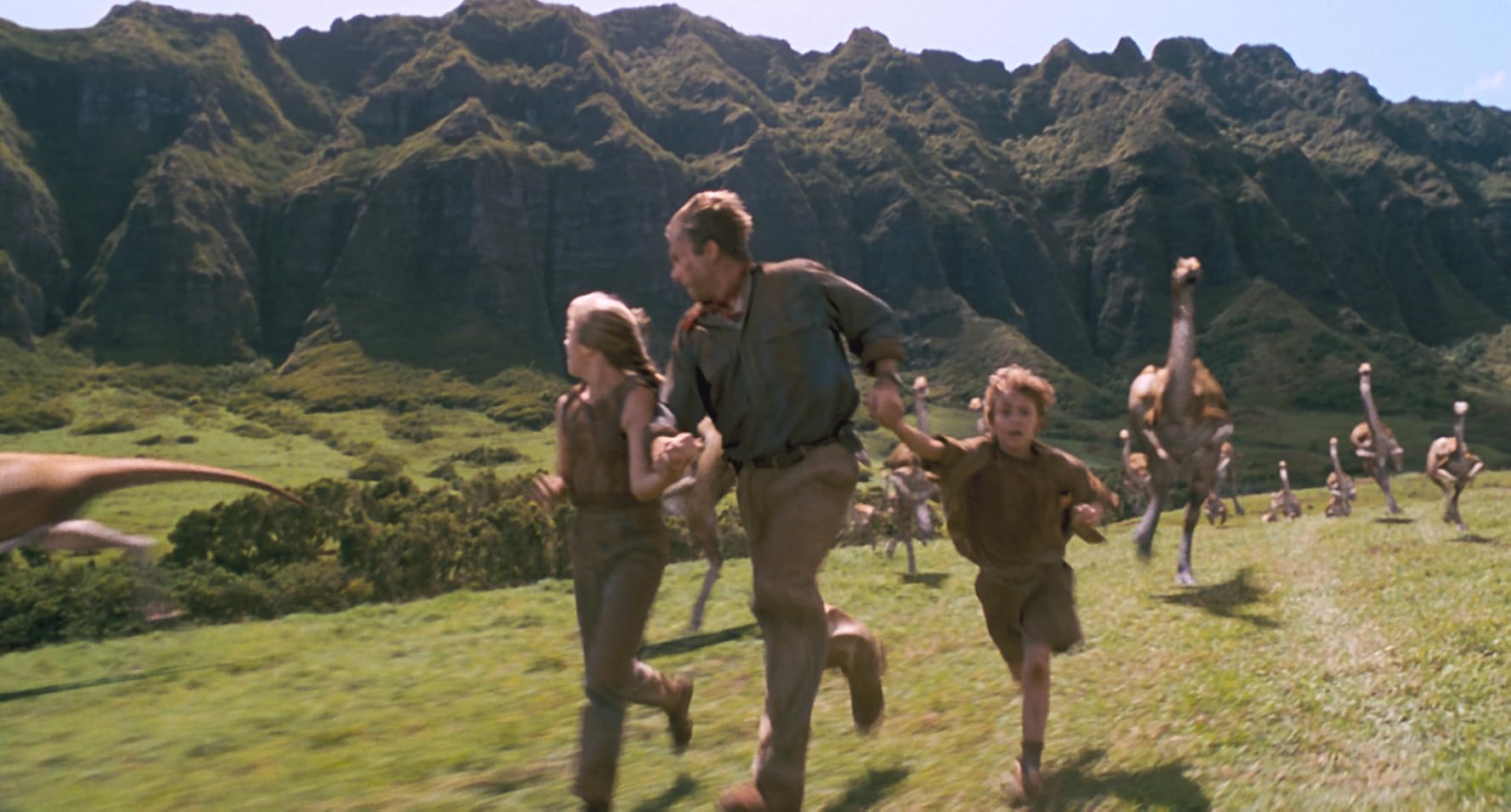
Sam Neill, Ariana Richards, and Joseph Mazzello in Jurassic Park (1993)

As Grant and the kids begin their journey back to the visitor center, they come across a bunch of broken egg shells, with Grant realizing that Malcolm was right and that the dinosaurs can breed after all due to the parts of their DNA that were taken from frogs who can change their sex in a single-sex environment. After enduring everything from a Gallimimus stampede (and subsequent T-Rex attack) to Tim nearly dying when they try to climb over an electric fence right when the power is turned back on, the trio manages to return to the visitor center and reunite with Ellie. Unfortunately, they are then pursued by the raptors, who first chase Tim and Lex through the kitchen before cornering the lot of them in the control room. The group manages to temporarily keep them at bay when Lex manages to use the park’s UNIX computer system to restore power to the entire park, fixing both the phones and the electric door locks. As Hammond calls for a helicopter to evacuate, the group are forced to flee once again when the raptors break through the windows of the control room. They eventually end up in the visitor center’s foyer, where they get cornered by the raptors. Luckily for them, the T-Rex pops up by surprise and kills the raptors, giving them ample time to escape. After reuniting with Hammond and Malcolm, the group finally escapes the island via helicopter, with Grant having gained a newfound appreciation for children thanks to the time that he has spent with Tim and Lex.

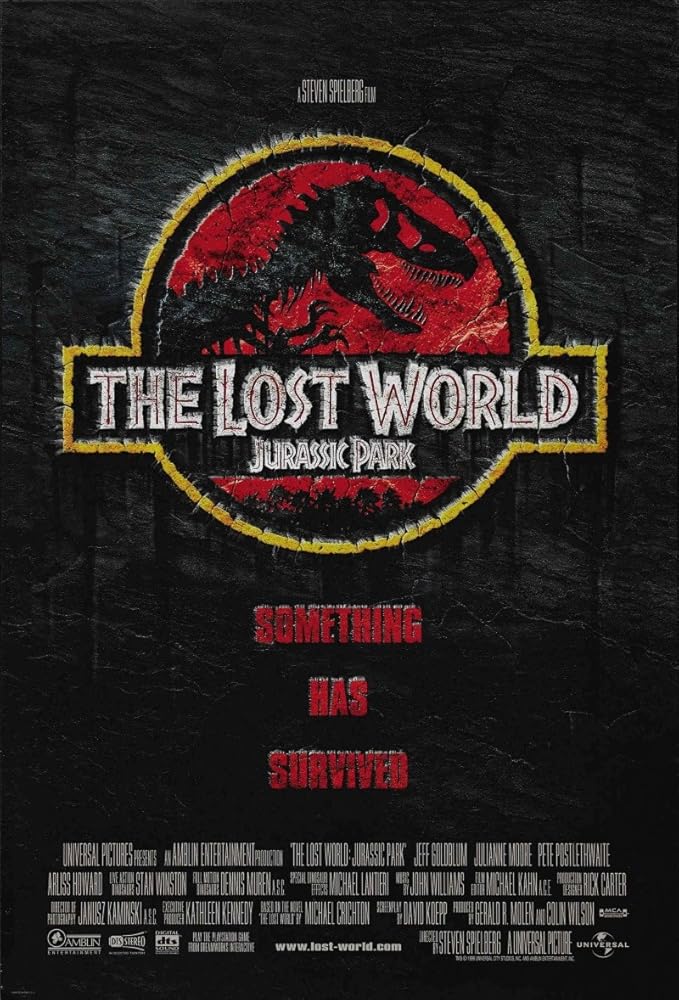
The Lost World: Jurassic Park (RELEASED: 1997)

The Lost World: Jurassic Park (1997)

After the success of the film adaptation of Jurassic Park, Crichton published a sequel, The Lost World, in 1995, which was subsequently adapted to the big-screen by Spielberg two years later. Set four years after the events of the original film, it opens with InGen once again finding itself in hot water when a young girl named Cathy Bowman (Camilla Belle) is attacked by a swarm of Compsognathus while on vacation with her family. As it turns out, the family had landed on another Costa Rican island, Isla Sorna, which is revealed to be the site where the company had created the dinosaurs before they were moved over to Isla Nublar. The site was ultimately abandoned when a hurricane ravaged the area, leaving the dinosaurs on their own without any sort of measures in place to restrain them. InGen, now headed by John Hammond’s nephew Peter Ludlow (Arliss Howard), plans on using the island to fix their financial troubles caused by the incident on Isla Nublar. While this is going on, John Hammond approaches Ian Malcolm and asks for his help in ensuring the dinosaurs’ survival by having him travel to Isla Sorna with a team to document them to prove that they’re perfectly fine in their natural habitat. While Malcolm is hesitant to return to the area, he is ultimately convinced to go when he learns that one of the members of Hammond’s team is his girlfriend, paleontologist Sarah Harding (Julianne Moore), who’s already on the island. Now intent on getting her out before something happens to her, Malcolm meets up with the other two members of their team, engineer/field equipment expert Eddie Carr (Richard Schiff) and video documentarian Nick Van Owen (Vince Vaughn). Before they head off, Malcolm is also forced to deal with the increasingly strained relationship that he has with his daughter Kelly (Vanessa Lee Chester).

Jeff Goldblum, Vince Vaughn, and Richard Schiff in The Lost World: Jurassic Park (1997)

Once the group lands on Isla Sorna, they reunite with Sarah while also discovering that Kelly had stowed away with them in their mobile base. Soon after, a team of mercenaries and hunters led by Ludlow and big-game hunter Roland Tembo (Pete Postlethwaite) arrive on the island to enact InGen’s plans by capturing multiple dinosaurs and having them sent to a theme park that’s planned to be built in San Diego. They also capture an infant T-Rex that Tembo plans on using as bait to lure its parent, which he’s primarily looking to capture. Clearly aware of why this is, as Malcolm later puts it, ‘the worst idea in the history of bad ideas’, Nick and Sarah break the dinosaurs out of their cages, allowing them to wreak havoc upon the InGen team’s camp. They also take the infant T-Rex back to the mobile base to fix its broken leg. This, of course, causes its parents to arrive on the scene, knocking the base off a cliff while Malcolm, Sarah, and Nick are still inside and eating Eddie when he tries to pull it back up. The trio ultimately gets rescued by the InGen team and, because of the loss of both teams’ communications equipment, are forced to form an uneasy ‘alliance’ with them to reach the island’s abandoned radio station and call for rescue. The group ends up getting chased by the adult T-Rexes and a bunch of velociraptors, with numerous casualties along the way. Malcolm’s group manages to reach the radio station, fend off the raptors, and call for a helicopter while the InGen team successfully manages to capture the male T-Rex, who’s then transported to the site of the new theme park in San Diego.

The Lost World: Jurassic Park (1997)

Back on the mainland, the ship transporting the T-Rex ends up crashing into InGen’s docks when it arrives earlier than expected without responding to any calls from the harbormaster. After it’s discovered that the ship’s crew has been killed, the T-Rex is accidentally released from the cargo hold, allowing it to rampage through the city where it menaces suburbia, eats ‘unlucky bastards’ who happen to be played by the film’s screenwriters (no joke, that’s what the character played via cameo by screenwriter David Koepp is listed as), etc. To get it back on the ship, Malcolm and Sarah collect the infant T-Rex from the new park’s facilities and transport it back by car, luring the adult T-Rex back with them just like when they first took the infant back to their mobile base on the island. When Ludlow tries to intervene, he gets trapped in the cargo hold by the adult T-Rex and is devoured by the infant while Malcolm and Sarah manage to tranquilize the former and trap them both in there so that they can be sent back to Isla Sorna. The next day, Malcolm, Sarah, and Kelly watch a news report on the infant and adult T-Rexes being transported back. An interview with John Hammond reveals that plans have been made with the Costa Rican Department of Biological Preserves to turn Isla Sorna into a nature preserve, allowing the dinosaurs to live in peace without any sort of interference from humans. Thus, as the film ends with a shot of the family of T-Rexes reunited on the island, Hammond quotes the line that Malcolm famously stated in the previous film, affirming that ‘life will find a way’.

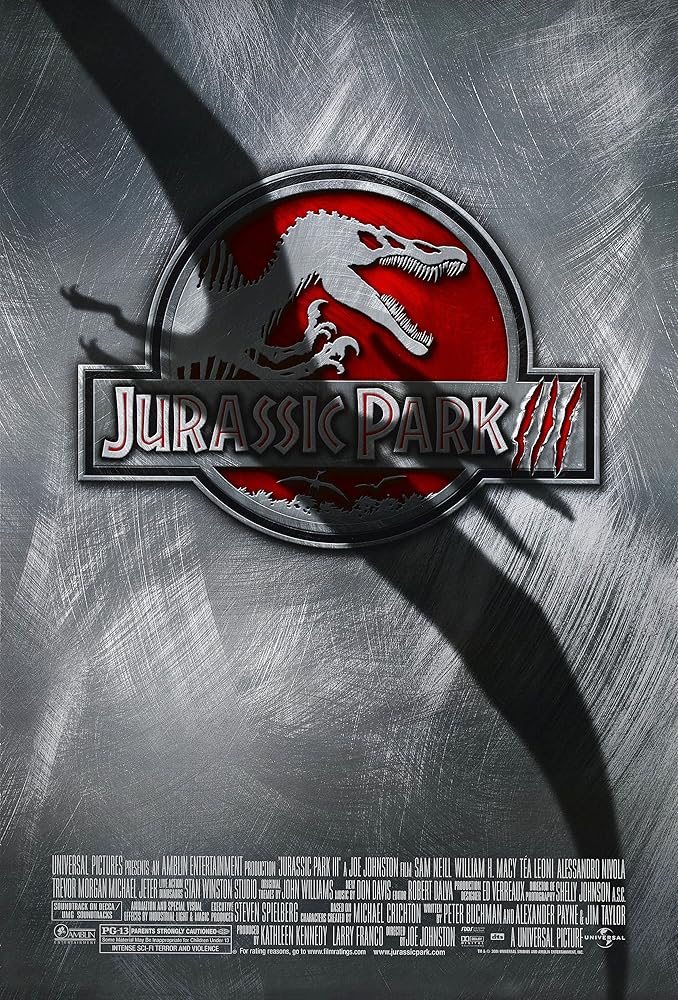
Jurassic Park III (RELEASED: 2001)

Jurassic Park III (2001)

Four years after the events of the previous film, Jurassic Park III opens with 12-year-old Eric Kirby (Trevor Morgan) parasailing near the island of Isla Sorna with family friend Ben Hildebrand (Mark Harelik). To their horror, the other passengers on their boat are killed by something that is unseen due to fog and the two end up having to detach themselves from the boat before it crashes into a bunch of rocks, resulting in them being directed right towards Isla Sorna. Meanwhile, back on the mainland, Dr. Alan Grant finds himself struggling to find funding for his team’s research while Ellie Sattler has since gotten married to U.S. State Department worker Mark (Taylor Nichols), whom she has had two kids with. One day, Grant is approached by Paul (William H. Macy) and Amanda (Tea Leoni) Kirby, who offer him funding for his research in exchange for an aerial tour of Isla Sorna. Despite his initial dismissal about returning to the area (to the point where he responds to a question about it at a university lecture by stating that ‘no force on earth or heaven will get him on that island’), Grant agrees to their offer. He is joined by his assistant, Billy Brennan (Alessandro Nivola), on the trip along with a bunch of mercenaries who are ‘financed’ by the Kirbys, Udesky (Michael Jeter), Cooper (John Diehl), and Nash (Bruce A. Young). Once they arrive at Isla Sorna, however, Grant discovers that the group plans on landing there. Despite his objections, they do land and, soon enough, they end up stranded when they crash into a Spinosaurus that had been chasing Cooper, who is subsequently eaten by it along with Nash. After escaping both the Spinosaurus and a T-Rex, who gets killed by the former, Grant learns that the Kirbys had lied to him. Instead of being a rich couple, they are recently-divorced parents who own a hardware store and have come to Isla Sorna in search of their son Eric and Amanda’s boyfriend Ben, who have been missing for the past eight weeks.

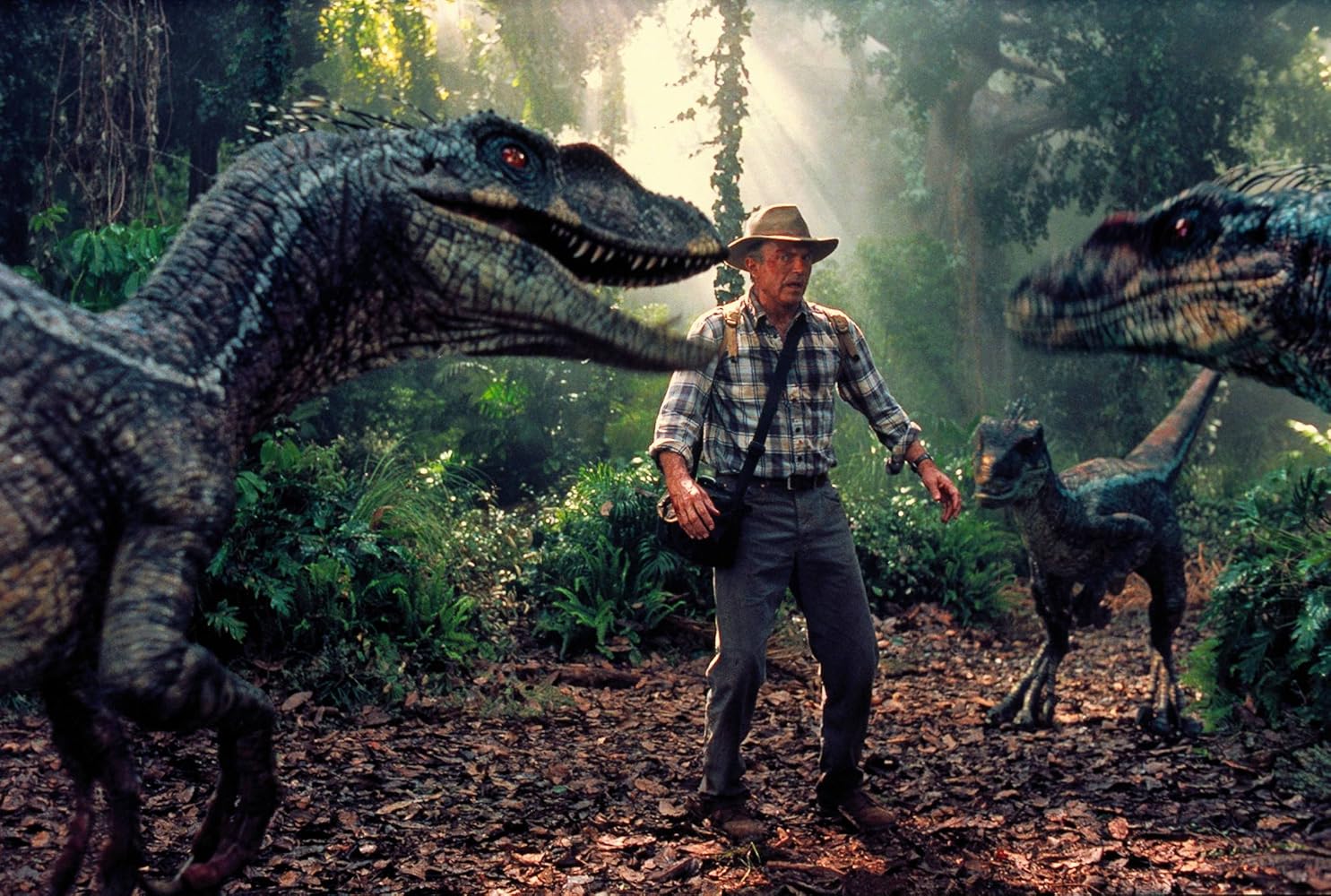
Sam Neill in Jurassic Park III (2001)

The group finds Ben and Eric’s parasail, with Ben’s skeletal remains still attached to it and no sign of Eric, meaning that he’s potentially still alive. After being chased by a group of Velociraptors, who kill Udesky, Grant is separated from the group and is rescued from the raptors by Eric, who’s managed to survive on his own for the past eight weeks. When the duo manages to reunite with the others, Grant learns that the reason why the raptors have been chasing them is because Billy had taken a pair of raptor eggs to provide their dig site the funding that they obviously won’t be getting from the Kirbys. Grant, furious at this decision, takes the eggs to ensure that the group will survive, remarking that Billy ‘is no better than the people who built this place’. When the group enters an aviary full of Pteranodons, Billy saves Eric from being taken by them but is seemingly killed in the process. Eventually, the group begins to make their way downriver by boat, barely managing to ward off the Spinosaurus with fire while Grant phones Ellie for help. When the group gets cornered by the Velociraptors once again, Grant manages to ward them off by surrendering the stolen eggs to them and using Billy’s 3-D printed replica of a Velociraptor larynx to confuse them. Once they reach the coast, they end up getting rescued by the U.S. Marine Corps and the U.S. Navy, who were called there by Ellie. Billy is revealed to be alive and the group leaves the island while noticing a bunch of Pteranodons departing as well. As Grant remarks, they’re ‘looking for new nesting grounds’.

Jurassic World (RELEASED: 2015)

Chris Pratt in Jurassic World (2015)

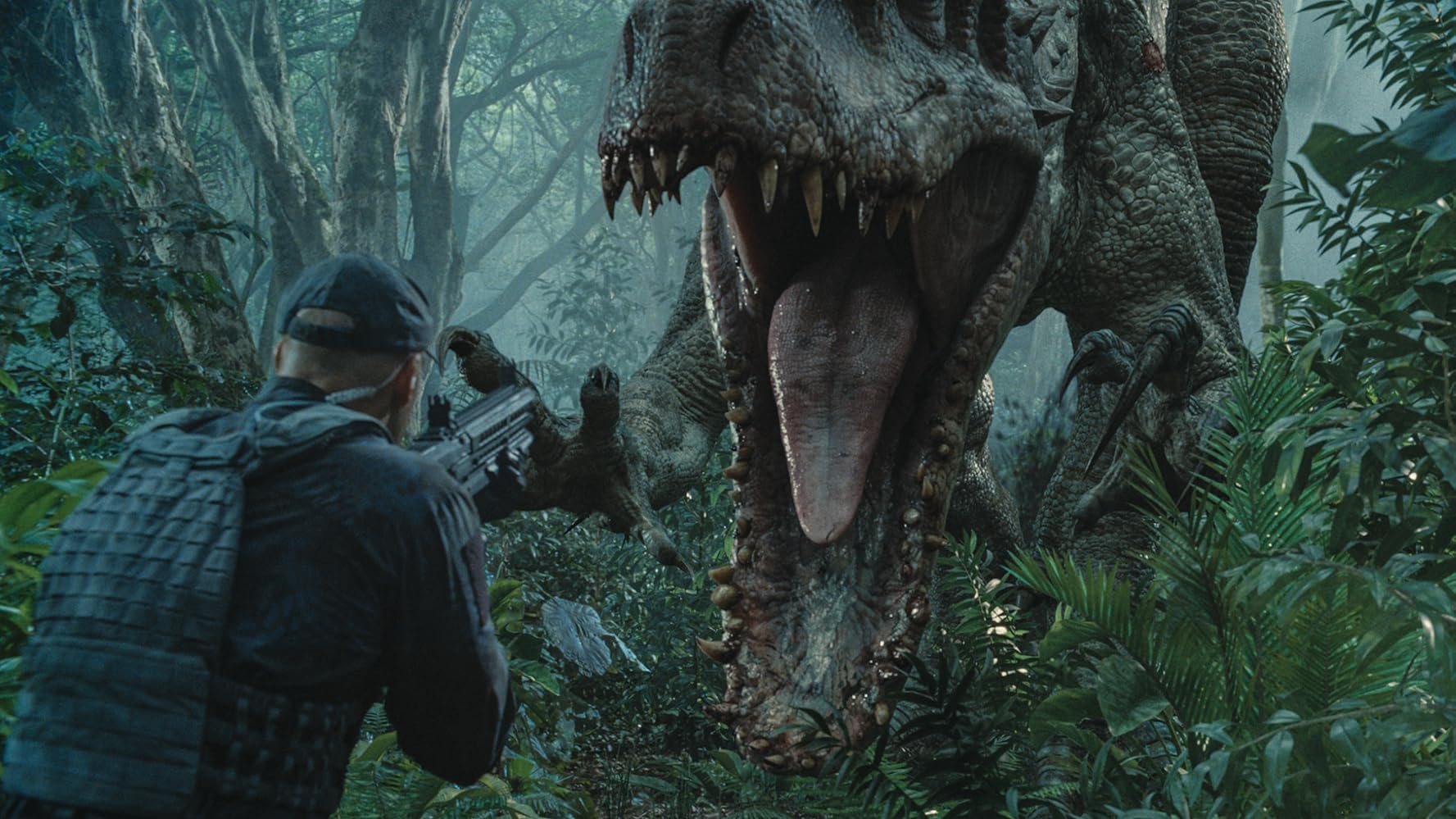
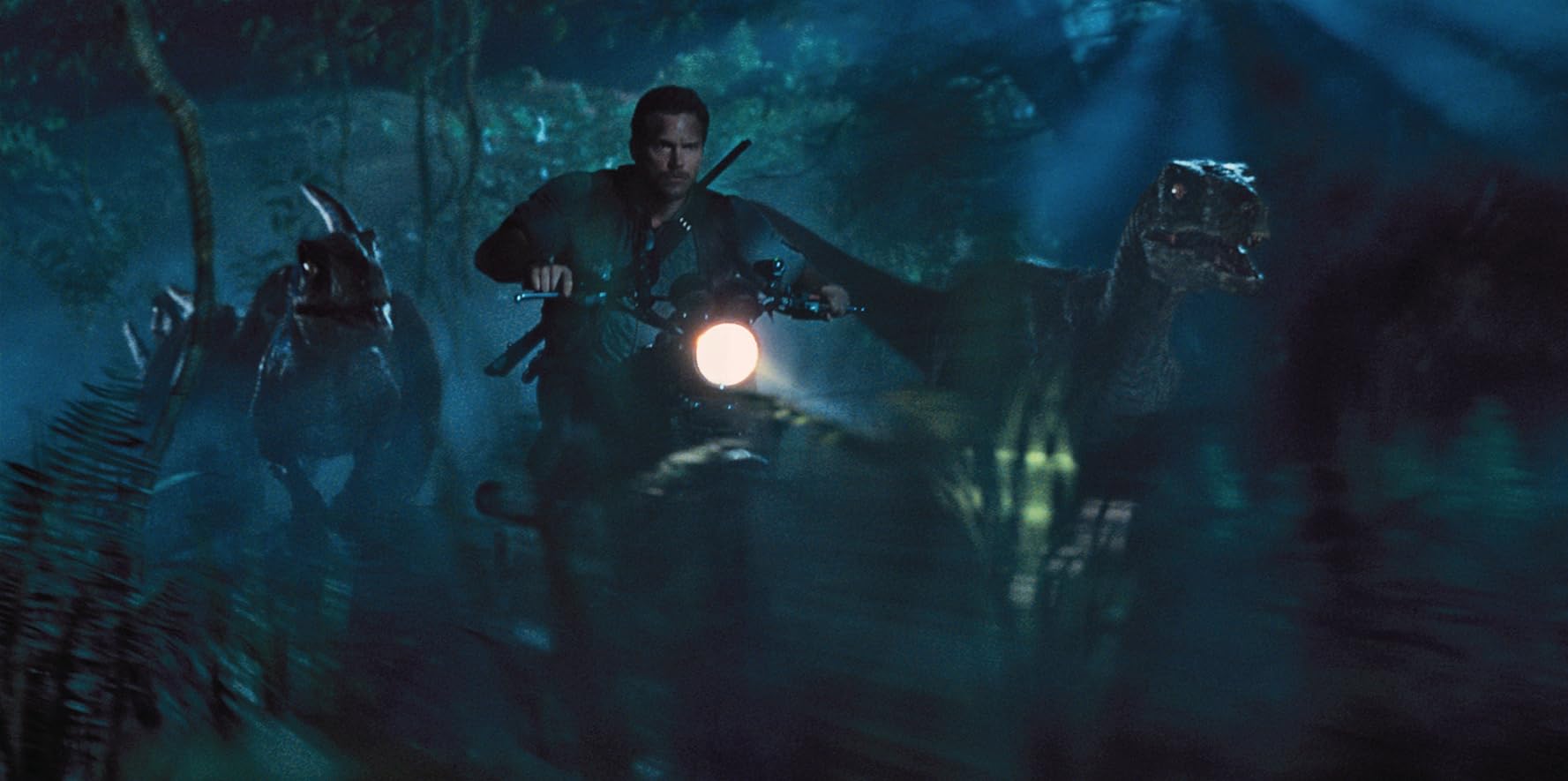
Generally ignoring the events of the previous two films (which still recognizing them as canon), Jurassic World takes place 22 years after the events of the original film. In the years since, John Hammond’s idea of a dinosaur theme park has been revitalized by the Masrani Corporation, with ‘Jurassic World’ operating on the exact same site on Isla Nublar. Bickering brothers Zach (Nick Robinson) and Gray (Ty Simpkins) Mitchell travel to the park to visit their aunt Claire Dearing (Bryce Dallas Howard), who serves as the park’s operations manager. As soon as they arrive, though, she immediately brushes them off to deal with the pressure coming from her boss, ‘pilot’ Simon Masrani (Irrfan Khan), to develop a new attraction that would help boost their attendance numbers. Under the direction of Hammond’s former lead scientist Dr. Henry Wu (B.D. Wong), a new dinosaur known as the Indominus Rex is created from the combined DNA samples of various dinosaurs, including the T-Rex, and other creatures. Claire is then forced to ask for the assistance of the park’s velociraptor trainer Owen Grady (Chris Pratt), whom she had one ‘bad’ date with, to ensure that the Indominus’ enclosure is properly secured. Once there, however, they find that the Indominus has seemingly managed to escape. As it turns out, the Indominus managed to fool them with its camouflaging ability (taken from cuttlefish DNA) and escapes for real once Owen and a few other workers go in to inspect the site. Masrani attempts to subdue it by sending in the park’s Asset Containment Unit, but most of the team ends up getting killed by it, resulting in Claire ordering a complete evacuation of the northern half of the island.

Jurassic World (2015)

Unfortunately for Claire, a new problem emerges when Zach and Gray end up wandering into a restricted area via the park’s gryosphere attraction. The two brothers end up getting attacked by the Indominus and barely manage to escape from it by jumping off a waterfall. While Claire and Owen head out to try and rescue them, they end up coming across the old Jurassic Park Visitor Center and begin heading back to the resort in one of the old park’s jeeps, which they manage to repair. Meanwhile, Masrani pilots an attack helicopter to hunt the Indominus. This ends up being a complete disaster, however, as the helicopter crashes into the resort’s aviary, resulting in a swarm of Pterosaurs attacking the resort’s guests. Owen and Claire manage to find Zach and Gray while park security manages to subdue the attacking Pterosaurs. Soon after, Vic Hoskins (Vincent D’Onofrio), head of InGen’s security team, assumes command of the situation. Hoskins and Owen had come into conflict earlier over the former’s suggestion of using the latter’s quartet of trained raptors (Charlie, Echo, Delta, and Blue) for military use. Despite Owen’s objections, he agrees to partake in Hoskins’ plan to use the raptors to hunt down the Indominus. Unfortunately, once Owen and the raptors come across the Indominus, Owen realizes one of the biggest secrets surrounding the creature’s creation… it’s part raptor. This allows the Indominus to become the Raptors’ new ‘alpha’, resulting in the pack beginning to hunt InGen’s troops.

Chris Pratt in Jurassic World (2015)

Owen, Claire, Zach, and Gray barely manage to escape and return to the Jurassic World Visitor Center. Once there, they discover that Hoskins has been working in conjunction with Dr. Wu on new hybrid dinosaurs to further his plan of having them be used for military purposes. While Hoskins ends up getting killed by Delta, Owen manages to regain the trust of his raptor pack right as the Indominus returns. After Echo and Delta are killed by it (Charlie was killed earlier during the Indominus hunt by a missile), Gray remarks that they need something with ‘more teeth’ to stop it. Thus, Claire orders one of the park’s control room operators, Lowery Cruthers (Jake Johnson), to open the gates to the T-Rex paddock as she manages to lure the T-Rex into a fight with the Indominus… and yes, she does all of this while wearing heels. With assistance from Blue, the last surviving member of Owen’s raptor pack, the T-Rex manages to corner the Indominus at the edge of the resort’s lagoon. Before the Indominus can attack again, it is swiftly grabbed by a Mosasaurus and dragged underwater. Blue and the T-Rex depart, though the former shares one last moment with Owen beforehand. As Isla Nublar ends up being abandoned once more, Zach and Gray reunite with their parents, Karen (Judy Greer) and Scott (Andy Buckley), at an off-site shelter in Costa Rica while Owen and Claire prepare for whatever comes next by deciding to stick together ‘for survival’. The film ends with the T-Rex perched above the abandoned Jurassic World site, once again in control of its home environment. But as it’s established in the trailers for the upcoming Jurassic World: Fallen Kingdom, the future of said home is put into jeopardy by way of the island’s previously dormant volcano.


And that is the ‘Story So Far’ when it comes to the Jurassic Park series. Thanks for following along and you can expect a review of Jurassic World: Fallen Kingdom sometime in the next few days. While I am aware that the overall reception towards this franchise’s sequels tend to vary amongst critics and audiences, I’ve personally enjoyed all the films in this franchise (yes, even Jurassic Park III despite the 2.5/5 rating that I gave it a few years back in the retrospective that I did on the original trilogy prior to the release of Jurassic World). Thus, I am eagerly looking forward to this new film, which I hear will provide an interesting set-up for the new trilogy’s finale that’s set to come out in 2021 and will see Colin Trevorrow return as director.