Showing posts with label Tom Holland. Show all posts

Thursday, April 1, 2021

Cherry (2021) review (Apple TV+)

Adapted from the 2018 semi-biographical novel of the same name by Nico Walker, a US Army veteran who struggled with drug addiction to the point where he was sent to prison for a series of bank robberies that he committed to fund his drug use, Cherry isn’t exactly the kind of film that I watch regularly. That’s usually the case when it comes to films that could be described as ‘arthouse’ flicks which, simply put, is a genre that I’ve never been able to get into. While there have been a few arthouse films that I’ve liked such as 2016’s Swiss Army Man, other films such as 2017’s mother are among some of the worst films that I’ve ever seen. At the end of the day, it all depends on whether a particular arthouse film interests me or not, and in Cherry’s case, the main reason why it got my attention basically had everything to do with its directors; a pair of brothers who, like Walker, hail from Cleveland. These two mainly got their start working on highly regarded television shows such as Arrested Development and Community, but in recent years, they’ve been responsible for hit films such as Captain America: The Winter Soldier, Captain America: Civil War, Avengers: Infinity War, and the highest-grossing film of all-time for the past two years*, Avengers: Endgame. Yes, folks, Cherry is notable for being the first big directorial outing from brothers Joe and Anthony Russo since the landmark outing that was Endgame. In fact, this film even sees them reunite with the MCU’s Spider-Man himself, Tom Holland, who stars in the lead role of a fictionalized take on Nico Walker. However, despite all the talent that’s involved both in front of and behind the camera, Cherry is, admittedly, a rather flawed crime drama despite its ambitious (and, in several cases, good-natured) intentions.

In 2002, a young man from Cleveland (Tom Holland) falls in love with one of his college classmates named Emily (Ciara Bravo). However, when she reveals to him that she has opted to transfer to a different school in Montreal, thus basically ending their relationship, the young man is so torn up about it that he decides to enlist in the U.S. Army. And while he eventually manages to rekindle his relationship with Emily to the point where the two of them get married, his experience as an Army medic in Iraq leaves him completely traumatized and stricken with a severe case of PTSD once he returns home. With no viable options to properly deal with his newfound trauma, the young man resorts to painkillers like Oxycontin, and once Emily can no longer deal with his BS, she becomes an addict as well. Unfortunately, the two of them end up getting into a precarious situation when they consume the large number of drugs that they were supposed to hold for their local drug dealer, Pills and Coke (Jack Reynor), who promptly informs them that they’re all about to face the wrath of his boss, Black (Daniel R. Hill). Thus, to settle their massive debt with Black, the young man embarks on a series of bank robberies, but as time goes on, his messed-up life only begins to spiral even further out of control than it already has.

Cherry is one hell of an ambitious crime drama and not just because it has a decently hefty runtime that’s on par with any of the Russo brothers’ MCU films. No, that runtime is simply an indicator of just how much the main protagonist goes through over the course of the film, from his time in Iraq to his drug-funding bank robberies. That said, though, because of all the material that the film goes through to tell this story, there are quite a few instances where the plot ends up being a bit too sprawling for its own good. As much as the film is a strong showcase of the Russo brothers’ talented direction, especially because of how visually driven it is, there are a few times where it either feels a bit unfocused or completely overwhelmed by its numerous plot threads. And if that weren’t enough, I’d also argue that some of these plotlines end up being far more interesting than others (and, in some cases, don’t get as much attention as they probably should’ve), such as the main protagonist’s PTSD struggles or how the string of bank robberies that he commits slowly but surely start to get messier in their execution. Ultimately, though, what really hurts Cherry is its meandering pace, which only makes this incredibly long film feel even longer. Not only that, but the film also sports a surprisingly crude tone. Now, granted, I recognize that this clearly must’ve been intentional since this is far from being a light-hearted story… and yet, the endless amount of juvenile sex jokes can admittedly be a bit much.

One of the best things that I can say about Cherry is that it’s a prime example of a film where its lead actor gets to show that they are far more than just their career-defining role. Of course, in this instance, I’m mainly referring to Tom Holland, who has spent the last several years playing the Marvel Cinematic Universe’s rendition of Spider-Man but successfully disappears into the transformative role of this film’s main character. Holland does a phenomenal job of blurring the line when it comes to the process of either making his character genuinely sympathetic given the horrible things that he goes through (e.g. having to witness the death of his friends firsthand during the war) or utterly pitiful because of how much he screws up his own life. In other words, Holland’s strong screen presence allows you to find some bits of humanity within a character who’s not exactly the easiest guy to root for (sympathetic PTSD struggles notwithstanding). These complex moral dilemmas also apply to Holland’s main co-star, Ciara Bravo. While Holland’s character is obviously the main protagonist of the film, his wife Emily goes through some fascinating incidents of her own, mostly by way of her also becoming a drug addict simply because she gets fed up with her husband’s antics. Considering that this is basically her first major leading role, Bravo more than holds her own against Holland, and while their characters’ relationship is almost always rocky, they do manage to sport some solid chemistry together.

The Russo brothers have said that Cherry is arguably the most personal film that they’ve made to date, and in a lot of ways, it’s easy to see why. For starters, given the setting of its source material, they got to film it in their hometown of Cleveland, which was also something that they got to do for parts of Captain America: The Winter Soldier. Not only that, but it’s also worth noting that one of the film’s credited writers is their sister, Angela Russo-Otstot. And so, with all this in mind as well as their noble efforts to accurately convey the horrors of PTSD, you can’t really fault Cherry for its ambition… ultimately, though, that same ambition is what ends up hurting it. It’s a film that tries to cover a lot of narrative ground and while it certainly has a run-time long enough to make that happen, it suffers from some incredibly sluggish pacing and often feels incredibly unfocused because of how many plot points it’s trying to juggle, with some handled far better than others. And while the film certainly succeeds at giving off an incredibly uncomfortable vibe by way of the main character’s descent into utterly messed-up territory, most of its content comes off as being a bit too crude for my tastes. Now, with all this said, this doesn’t mean that I think that the film is ‘bad’. At the very least, you can see what the Russo brothers were going for and it benefits greatly from the strong lead performances of Tom Holland and Ciara Bravo. Ultimately, though, I’d say that this needed a few more run-throughs in the editing bay to both streamline the looser parts of its narrative and liven up its pacing.

Rating: 2.5/5

(*Just a few weeks ago, a re-release in China helped push James Cameron’s Avatar back into the top spot that it had held since its initial release in 2009 before Avengers: Endgame overtook it a decade later…)

Friday, March 13, 2020

Onward (2020) review


Onward (2020)

What’s this? Two Pixar films in one year? And they’re both original stories? “Huzzah!”, the internet proclaimed. Yes, it’s safe to say that 2020 marks a new era for one of the most revered animation studios in the industry. For starters, it’s the first feature in the studio’s history to not involve one of its most prominent figures, John Lasseter, after he left the company in 2018 due to the various sexual misconduct allegations directed against him, with fellow Pixar mainstay Pete Docter now serving as the studio’s Chief Creative Officer. But the change that has excited the internet the most is that following the release of Toy Story 4 last year, Pixar announced that it would be their last ‘sequel’ film for the foreseeable future in favor of doing more original stories like the ones that made them famous in the first place. For fans of the studio, this was a very big deal given the arguably mixed run that Pixar has had over the past few years when it came to doing follow-ups to some of their most beloved works. Personally, though, I’ve loved most of the films that came out during that time, which means that the demand for Pixar to do more original stories wasn’t that big of a concern for me, especially given how the internet often has intense expectations for Pixar films either way. Nevertheless, here we are with the first Pixar film of 2020, Onward, which serves as the second feature-length directorial effort of Dan Scanlon. Since joining Pixar in 2001, Scanlon served as a storyboard artist for the first Cars and was the co-director of that film’s direct-to-DVD short, Mater and the Ghostlight. Scanlon would ultimately make his feature-length directorial debut with the company via Monsters University, the 2013 prequel to the studio’s 2001 masterpiece Monsters’ Inc. But as for Onward, Scanlon’s main source of inspiration for this suburban fantasy adventure was his own personal experiences of losing his father at a young age and the relationship that he formed with his older brother in the wake of that moment. And with that personal backstory in mind, it’s easy to see why Onward ends up being yet another classic (and devastatingly emotional) outing from Pixar. 

In the old days, the world was full of beings who could conjure powerful magic. However, these magical abilities proved to be incredibly difficult to learn, and in due time, this world of fantastical creatures began to rely more on technology instead, thus paving the way for a more modern lifestyle. In the present day in the town of New Mushroomton, a teenaged elf named Ian Lightfoot (voiced by Tom Holland) celebrates his 16th birthday. During this time, Ian begins to wonder about what his father Wilden was like since he unfortunately passed away before he was born. And as luck would have it, his widowed mother Laurel (voiced by Julia Louis-Dreyfus) gives him and his older brother Barley (voiced by Chris Pratt) a gift from their father, which turns out to be a mythical wizard’s staff. Almost immediately, Barley, who’s a massive fan of fantasy role-playing games, deduces that their dad had studied magic and the brothers discover that he had collected a rare Phoenix gem that would allow them to cast a Visitation spell that would bring him back to life for one day. Ian soon discovers that he possesses the rare ability to conjure such magic, but unfortunately, his attempt to use the spell isn’t a complete success, resulting in only the lower half of their father’s body materializing into existence. And since the powers of the Phoenix gem that their father found were used up during this attempt, Ian and Barley head out on a quest to find a new gem in the next 24 hours so that they can complete the spell and reunite with the father that they never got the chance to know.

Onward certainly crafts a fun fantasy world that combines its cast of mythical creatures with the visual aesthetic of modern-day suburbia. However, for those fearing that this means that Pixar has just made a film that relied entirely on modern references like several of its competitors tend to do, that’s not even remotely the case here. Sure, you do have some characters using cell-phones here and there and other bits of modern technology, but moments like these never overtake the key narrative points of the story while still resulting in plenty of fun visual gags that are brought to life by Pixar’s always-stellar animation. Admittedly, I wouldn’t call this the ‘best-looking’ Pixar film to date, but since this is still Pixar we’re talking about, the animation is top-notch regardless. And given the nature of the plot in which the main characters are guided by Barley’s extensive knowledge of role-playing games, this film is filled with tons of references to the genre. While I’m personally not too familiar with the likes of Dungeons and Dragons and other popular fantasy RPG’s, those who are will surely love all the nods that this film contains and how, from what I can tell, it perfectly captures the spirit of these adventures. But, of course, Pixar also knows how to deliver on the emotional depth of their stories, and Onward is no exception. After all, this is a story in which two brothers are trying to bring their father back to life (even if it’s just for one day) that’s based heavily on writer/director Dan Scanlon’s own life. Thus, it goes without saying that Onward hits hard when it comes to its emotional beats.

Onward also happens to be quite special in the fact that it serves as an unexpected crossover between Spider-Man and Peter Quill AKA Star-Lord… all joking aside, it’s kind of funny how Tom Holland and Chris Pratt’s characters in this film end up mirroring their respective superhero roles in the MCU to a tee. Ian’s the socially awkward teenager with something to prove while Barley’s the boisterous rogue who, despite his goofy nature, has experienced quite a bit on an emotional level. With that in mind, Holland and Pratt do phenomenal jobs in their respective roles. The brotherly camaraderie between them is superb and just like they’ve done for years now over in the MCU, these two brilliantly handle all the film’s big emotional moments. Holland and Pratt are then backed nicely by the duo of Julia Louis-Dreyfus as Ian and Barley’s mother Laurel and Octavia Spencer as Corey, a manticore who the brothers seek out given the significant role that her species often plays in fantasy RPG’s. And while the fact that the film focuses primarily on Ian and Barley means that Laurel and Corey admittedly don’t get that involved in the action until the climax, they also form a fun partner dynamic once the two of them meet up. Julia Louis-Dreyfus brings just as much heart to her role as Tom Holland and Chris Pratt do to theirs as a mom who’s fully dedicated to keeping her boys out of trouble while Octavia Spencer has a lot of fun with Corey’s arc of rediscovering her adventurous spirit after several years of being in an unfulfilling job as the owner of a local family restaurant.

As I’ve pointed out several times over the years, I’m not exactly part of the crowd who continues to have incredibly high expectations for Pixar films to the point where any Pixar film that isn’t an outright masterpiece ends up getting ignored. It’s a tragic fate that has, unfortunately, affected quite a few of the studio’s films over the years such as Brave, Monsters University and The Good Dinosaur. And while Onward technically hasn’t been a flop with critics and audiences (although that pesky coronavirus will certainly do a number on it at the box-office), I also wouldn’t be surprised if it ends up getting completely overshadowed by Soul, Pixar’s other 2020 release that will be coming out in June. It’d be quite the sad scenario if that did happen, though, since I would argue that Onward is another masterpiece from the legendary animation studio. Like many of Pixar’s classic outings, Onward is a delightful fantasy adventure that delivers an excellently written story full of highly endearing characters. The fantastical world that it creates is a lot of fun to explore and the main adventure that its heroes go on is so well-handled that you don’t need to be an expert in the lore of Dungeons and Dragons to appreciate it (although it would make the journey even more satisfying). But, of course, the best Pixar tradition that Onward dutifully maintains is its impeccable ability to tug at the heartstrings with a story that’s just as much about brotherhood as it is about two brothers hoping to get the chance to have a connection with the father that they never knew. Because of all this, it’s easy to see real growth in Dan Scanlon’s talents as a director and how he’s shaping up to be a major standout amongst Pixar’s next generation of filmmakers. And while I again recognize the fact that this film will undoubtedly be impacted by the global pandemic that we’re all dealing with right now, I also hope that it’s ultimately the main reason why since that’d be a much easier pill to swallow than the fact that this is another Pixar film that isn’t being regarded as a ‘15/10 masterpiece’.

Rating: 5/5!

Pixar films have almost always been accompanied by one of the studio’s shorts that precede the main feature… however, while I’ve been reviewing Pixar films on this site for the past 8 years now, I’ve realized that I don’t usually talk about the shorts that they’re paired with. The only instance where I have addressed one of them was in my review of Coco when I also reviewed Olaf’s Frozen Adventure, and that was just due to the unique situation of it being a Frozen short instead of something that came directly from Pixar. Thus, I’ve decided that starting now, every Pixar review that I do from this point on will conclude with a brief discussion about the short that accompanies it (if there is one). This new tradition begins with, of all things, a Simpsons short.

PLAYDATE WITH DESTINY

Playdate with Destiny (2020)

The most famous animated family in pop culture recently joined the Disney universe following Disney’s purchase of 20th Century Fox (now 20th Century Studios) last year. This fact is well-reflected in this short, as it opens with a shot of Mickey Mouse’s iconic silhouette… before being revealed to be an image of Homer Simpson holding two donuts and then cutting to a title card proclaiming that ‘Disney welcomes The Simpsons’. And at the end of the short, Mickey can be seen in the production logo for producer James L. Brooks’ company Gracie Films as one of the theater patrons. Anyway, Playdate with Destiny is the second theatrical short to come from The Simpsons; the first was The Longest Daycare, which ran with 2012’s Ice Age: Continental Drift. Both shorts revolve around the youngest member of the Simpsons family, Maggie, with this new short consisting of her meeting a boy named Hudson, the adventures that they go on together, and her efforts to see him again the next time she’s taken to the park, which becomes rather complicated when Homer’s the one taking her instead of Marge. Keeping in line with the fact that Maggie usually never speaks on the show, this short is almost entirely dialogue-free and instead opts for visual humor. And while there’s been plenty of debate over the years regarding the quality of a show that’s been on the air for three decades now, this is a genuinely cute little short that develops a whirlwind romance out of an innocuous playdate between two babies. I wouldn’t go as far as to say that this is one of the best things to come out of The Simpsons (which, admittedly, I can’t say much about anyway since I haven’t watched a lot of it), but it’s still a pleasant watch nevertheless. And if that wasn’t enough, the events of this short will be addressed in an upcoming episode of the show that’s set to air on April 19th.

Tuesday, July 23, 2019

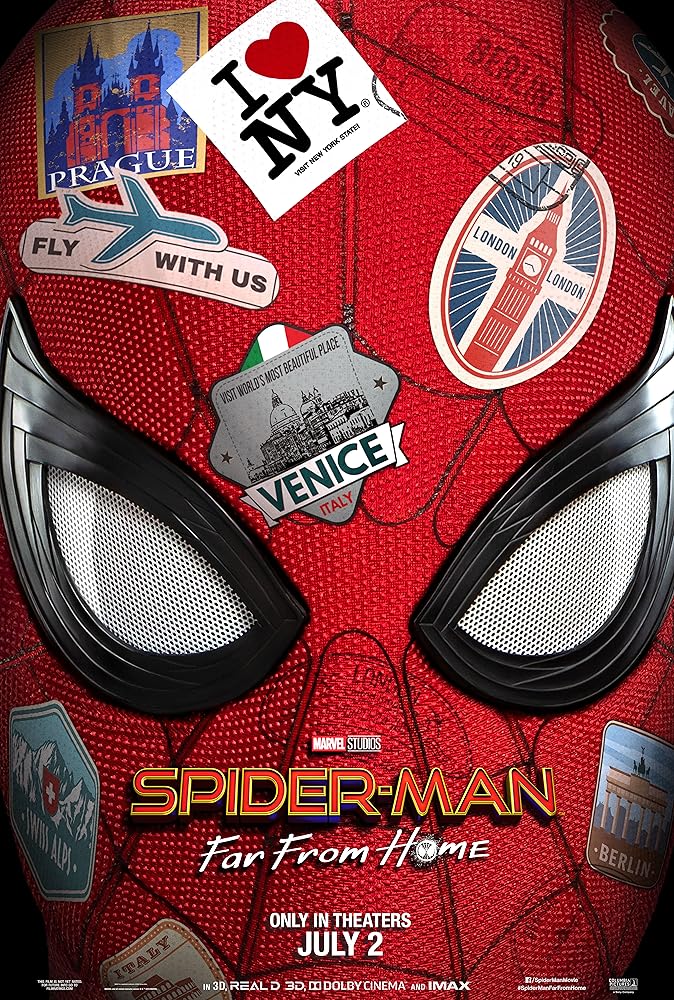
Spider-Man: Far From Home (2019) review


Spider-Man: Far from Home (2019)

(Disclaimer: I apologize in advance, folks, but due to the nature of this being the first MCU film after Avengers: Endgame, I will have to address what is easily the biggest of that film’s spoilers. I have the feeling that most of you reading this have already watched the film (it did just become the highest-grossing film of all time, after all…), but in the slim chance that you haven’t seen it yet, all I can recommend at this point is that you watch Endgame first.)

When we last left the Marvel Cinematic Universe, it had just reached the culmination of its legendary run up to this point with Avengers: Endgame. It goes without saying that the film was a true epic in every sense of the word, effectively providing the franchise’s dedicated fanbase with a satisfying conclusion to what has now officially been designated as ‘the Infinity Saga’. However, as it turns out, it ultimately wasn’t going to be the final installment of this saga. Instead, that honor goes to the follow-up to 2017’s Spider-Man: Homecoming, Spider-Man: Far From Home. As most of you know, Spider-Man’s inclusion in the MCU ultimately came courtesy of a deal between Marvel Studios and Sony. While the latter has held the character’s film rights for the past several decades, the lackluster performance of the Amazing Spider-Man reboot series led to this deal that would see both parties working together to develop a new iteration of the character, who made a phenomenal debut in Captain America: Civil War. Thus, just like Homecoming, Far From Home is an interesting release in terms of its distribution because while Marvel Studios is currently under the Disney banner, both Homecoming and Far From Home are officially Sony productions. And yet, because of Kevin Feige and co.’s involvement in the production, it’s still technically an MCU film at the end of the day, with Homecoming director Jon Watts returning to direct along with most of the main cast from the previous film. And because of this, Far From Home is yet another superb outing for the MCU that brilliantly handles the ramifications of the epic, emotional finale of its immediate predecessor while also giving us a taste of what’s to come for this legendary franchise.

Not long after the events of Endgame, teenager Peter Parker (Tom Holland) returns to his hometown of Queens to resume his duties as the friendly neighborhood web-slinger, Spider-Man. At the same time, though, Peter has struggled to overcome the death of his mentor/father figure Tony Stark. Thus, when Midtown High organizes a summer vacation to Europe, Peter signs up for it, eager to take a break from the superhero lifestyle and hopeful that this trip will give him a chance to reveal the blossoming feelings that he has for his classmate Michelle AKA MJ (Zendaya). Unfortunately for Peter, his superhero life quickly follows him to Europe, and he ends up being approached with a mission by Nick Fury (Samuel L. Jackson) and Maria Hill (Cobie Smulders). The two inform him that due to the cosmic implications of ‘the Snap’, four creatures from another dimension known as the Elementals have arrived on Earth and have caused mass destruction wherever they go. Luckily for them, they have gained a new ally in Quentin Beck (Jake Gyllenhaal), an illusion-based superhero who is also from the Elementals’ dimension and is promptly given the nickname ‘Mysterio’ by the media. Thus, as Peter now finds himself struggling once again to balance his responsibilities as Spider-Man with his desire for a stress-free vacation, he must also grapple with the biggest question of them all; can he live up to the expectations that have been set upon him and become ‘the next Iron Man’?

In the past, I’ve noted that Marvel Studios does a great job when it comes to the kind of films that they do right after the big ensemble pieces that are the Avengers films. The original Ant-Man followed the grand spectacle of Avengers: Age of Ultron with a refreshingly small-scaled affair (no pun intended) while Ant-Man and the Wasp allowed for some well-earned levity after the devastating finale of Avengers: Infinity War. The same situation applies to Far From Home, but in this case, its effectiveness as the immediate follow-up to Avengers: Endgame stems from the fact that the events of Endgame’s finale directly affect this film’s plot. Simply put, the death of Tony Stark is felt throughout, right down to the fact that tributes to him can be seen in practically every European country that Peter visits. Without spoiling anything from the plot, this film is all about Tony’s legacy and how Peter must now work to maintain it, and as one can only expect from an MCU film, this is where the franchise’s phenomenal sense of emotional poignancy comes into play because of how closely tied the MCU’s version of Peter has been to Tony. Another key aspect of this film is its European setting since Far From Home is the first main Spider-Man film (not counting Spidey’s trip to Germany in Civil War since that’s a Captain America film) that’s not primarily set in New York, and because of this, the new locales offer some fantastic imagery that’s even more amazing when viewed in IMAX. All this helps to bolster everything else that you’ve come to expect from an MCU film; I would elaborate on what that stuff is further but, let’s be frank, I’ve already done that in my previous MCU film reviews.  

Like Homecoming, Far From Home primarily revolves around its younger cast members to great effect. Of course, it’s all headlined by Tom Holland, who continues to be a wonderful iteration of Spider-Man. Not only does Holland perfectly embody the combination of Spider-Man’s wisecracking persona with Peter Parker’s endearing awkwardness, but he also brilliantly handles all the emotional turmoil that Peter’s been going through since Tony Stark’s death. He also continues to have excellent camaraderie with Jacob Batalon as Peter’s best friend Ned, who gets his own little subplot via a budding romance with their classmate Betty Brant (Angourie Rice), as well as some wonderful chemistry with Zendaya as the MCU’s ‘MJ’. As alluded to in the plot synopsis, the film begins to develop a relationship between the two that, in turn, does allow Zendaya to have a larger role this time around. After that, there’s the always reliable supporting characters like Jon Favreau as Happy Hogan, Marisa Tomei as Aunt May, and Samuel L. Jackson and Cobie Smulders as Fury and Maria Hill. Finally, there’s quite arguably the most anticipated addition to the cast, Jake Gyllenhaal as Mysterio, and sure enough, he is fantastic in the role thanks in large part to the excellent camaraderie that he forms with Holland. Now for those who are aware of Mysterio’s traditional role in the comics… yes, this film goes exactly the way you think it does when it comes to his overall characterization. Still, the way in which it translates this to tie him into the MCU’s lore is a brilliant method of subverting expectations.

Marvel Studios has been on a roll as of late when it comes to producing sequels that are superior to their already excellent predecessors. That was the case with films like Captain America: The Winter Soldier, Guardians of the Galaxy Vol. 2, and Ant-Man and the Wasp, just to name a few. And sure enough, that trend continues with Spider-Man: Far From Home, which has quite possibly become my new favorite Spider-Man film. Now don’t get me wrong, Spider-Man: Homecoming was a terrific outing for the web-slinger that perfectly encapsulated the character arc of the MCU’s rendition of the character; a young kid who wants to join the Avengers but quickly has to grapple with the reality that he’s still just a kid in a much larger universe. But then you have Far From Home, which takes everything great from Homecoming and amplifies it even further with better action sequences, better visuals, and a tightly-written script which sees Peter Parker now having to face the burden of proving exactly why Tony Stark made him an Avenger. In other words, while I’m sure that I’ve said this plenty of times before when it comes to the MCU, this truly is one of those films that is a pitch-perfect representation of everything great about this franchise. Thus, it ends up being a perfect epilogue to Marvel Studios’ ‘Infinity Saga’, which is quite arguably the most impressive run that any franchise has had in the history of film. And considering all the exciting films and TV shows that Marvel Studios announced at Comic-Con this past weekend, it’s undeniably clear that they’re not even remotely done yet.    

Rating: 5/5!

Sunday, April 29, 2018

Avengers: Infinity War (2018) review

Don Cheadle, Robert Downey Jr., Josh Brolin, Paul Bettany, Chris Evans, Scarlett Johansson, Elizabeth Olsen, Chris Pratt, Mark Ruffalo, Zoe Saldana, Benedict Wong, Anthony Mackie, Chris Hemsworth, Dave Bautista, Benedict Cumberbatch, Chadwick Boseman, Sebastian Stan, Danai Gurira, Karen Gillan, Pom Klementieff, Letitia Wright, and Tom Holland in Avengers: Infinity War (2018)

(Fear not, my fellow MCU fans who have yet to see this film, as this review will not (I repeat… NOT) be addressing any major spoilers from it. I mean, heck, who do I think I am? That guy from Forbes who spoiled the ENTIRE FILM before it even came out?)

(Seriously, though, what the hell, Forbes?)

In just a few days, Marvel Studios’ 2008 blockbuster Iron Man will celebrate its 10th anniversary… and thinking about that is truly surreal as I still remember going to see that film in the theaters. And like many others at the time, I had no idea of what was about to unfold before our eyes. Back then, the live-action film side of the superhero genre almost entirely consisted of films based on a single character or a small group of heroes. At the time, no one had ever really attempted a massive crossover-centric franchise between multiple big-name comic icons aside from various animated films and TV shows. But after Marvel’s film division made a $525 million financing deal with Merrill Lynch in 2005 to distribute their own films instead of licensing them to other studios, a plan was put into motion to attempt a ‘cinematic universe’ featuring all the major superheroes whose film rights were still owned by Marvel at the time. In other words, they couldn’t immediately work with some of their biggest properties, including Spider-Man, the Fantastic Four, and the X-Men, as the former’s film rights were owned by Sony and the latter two’s rights were owned by Fox. Thus, they had to go with some of their lesser-known heroes to start off this new franchise of theirs… and yes, as crazy as it may seem, Iron Man was, technically speaking, a ‘lesser-known’ Marvel superhero prior to 2008. But, of course, that all changed when the character’s first feature film adaptation became one of the most critically/commercially successful films of the year. And it all concluded with a game-changing post-credits scene in which main protagonist Tony Stark was approached by Nick Fury, the head of the government organization known as S.H.I.E.L.D. who came to talk to him about the ‘Avenger Initiative’. Thus, a cinematic universe was born…

Since then, Marvel Studios has continued to deliver top quality superhero flicks year in and year out. And while not all their films have been runaway hits, they haven’t necessarily made a downright ‘horrible’ MCU film no matter what directorial conflict or issue with the studio’s now-defunct ‘creative committee’ has ever occurred. And really, the main reason why this franchise has worked as well as it has is that studio president Kevin Feige and his team have made a considerable effort to ensure that the franchise takes its time to develop the universe and its characters before bringing them all together in one film. That was the case with Phase 1 of the franchise, which culminated in the genre’s then-latest landmark installment, 2012’s The Avengers. The heroes of the MCU were then subjected to some darker storylines in Phase 2 before reuniting again for the equally darker Avengers follow-up, 2015’s Age of Ultron. And now, as we near the end of Phase 3, the Avengers are back for Marvel Studios’ biggest endeavor yet, Avengers: Infinity War. A true cinematic epic that has been a full decade in the making, this film sees the Avengers taking on their greatest threat yet, Thanos, who has been continuously built up ever since he first appeared in the first post-credits scene of the original Avengers. And while Joss Whedon isn’t behind the camera for this installment, a suitable pair of successors are in Joe and Anthony Russo, who have already given us two of the MCU’s greatest installments to date in 2014’s Captain America: The Winter Soldier and 2016’s Captain America: Civil War. Sure enough, they once again deliver with a truly jaw-dropping cinematic spectacle that pulls off some of the gutsiest moves that the superhero genre has ever seen.

Over the course of the past 18 installments of the Marvel Cinematic Universe, its various superheroes have come across a variety of powerful objects that were spawned from a series of gems known as Infinity Stones, which were formed in the wake of the Big Bang. And it is these six stones that attract the attention of one figure, Thanos the Mad Titan (Josh Brolin), an alien warlord from the planet Titan who embarks on a mission to retrieve them all so that he can achieve his lifelong ambition of wiping out half the universe. To make sure that this doesn’t happen, all the world’s heroes unite to prevent the Mad Titan from getting his hands on the stones. In New York, ‘genius, billionaire, playboy, philanthropist’ Tony Stark AKA Iron Man (Robert Downey Jr.) teams up with his teenaged protégé Peter Parker AKA Spider-Man (Tom Holland), sorcerers Dr. Stephen Strange (Benedict Cumberbatch) and Wong (Benedict Wong), and scientist Bruce Banner AKA the Hulk (Mark Ruffalo) to safeguard the Time Stone housed within Strange’s special artifact, the Eye of Agamotto. In the African nation of Wakanda, fugitives Steve Rogers (Chris Evans), Natasha Romanoff AKA Black Widow (Scarlett Johansson), Wanda Maximoff AKA Scarlet Witch (Elizabeth Olsen), and Sam Wilson AKA Falcon (Anthony Mackie) ally with Wakanda’s king T’Challa AKA Black Panther (Chadwick Boseman) to protect the artificial being Vision (Paul Bettany), who’s powered by the Mind Stone. And in the far reaches of space, the Guardians of the Galaxy, consisting of thief Peter Quill AKA Star-Lord (Chris Pratt), Thanos’ adopted daughter Gamora (Zoe Saldana), warrior Drax (Dave Bautista), weapons expert Rocket Raccoon (Bradley Cooper), tree creature Groot (Vin Diesel), and empath Mantis (Pom Klementieff) end up running into Thor the God of Thunder (Chris Hemsworth), who managed to survive an attack by the Mad Titan himself.

Now at this point in the MCU’s run, I will fully admit that I’m just becoming a broken record at this point when it comes to listing all the great things that one can expect in an MCU film. And sure enough, that’s once again the case with Infinity War. You have your amazing action sequences that are bolstered by outstanding visual effects while also showcasing the Russo brothers’ growing strengths as action directors after they originally got their start in comedy. You have the franchise’s great sense of humor that produces an endless array of classic moments that never once take away from the dramatic context of the plot. And in the case of these Avengers films, this great humor is then further fortified by all the terrific character interactions between all the franchise’s great heroes, from Iron Man and Doctor Strange to the trio of Thor, Rocket, and Groot… and yes, that’s only naming a few of this film’s noteworthy combinations. But then the Russo brothers take things one step further by pulling off one of the gutsiest endings that the superhero genre has ever seen. Now, obviously, I won’t reveal anything about what happens in it for those who haven’t seen the film yet, but you could say that it’s possibly a response to the long-standing (and rather questionable) argument that Marvel films don’t have any real stakes in them. And with that in mind, while I know that this ending will probably get reversed somehow in next year’s fourth Avengers film, it is handled perfectly in this film with such a strong sense of emotional poignancy that it rivals any major ‘awards season favorite’.

Given that most of this film’s ensemble cast has already been in at least three or more previous MCU films, there’s really no need to talk about their performances because they’re all just as great as they’ve always been. From the original Avengers squad to the Guardians of the Galaxy to more recently introduced heroes like Black Panther and the MCU’s rendition of Spider-Man, Marvel Studios has managed to create one of the most legendary ensemble casts in film history. Now, admittedly, despite all that, it should be noted that you shouldn’t go into this film expecting a lot of new bits of character development for these heroes as it’s more about the battle against Thanos. And because Infinity War does boast the largest cast of heroes that has ever been seen in a superhero film, some characters do get a little more attention than others, like Thor (who was confirmed by the Russos themselves as having the most screen-time of any main protagonist in the film), Gamora (given her connection to Thanos), and Star-Lord (due to the romance between him and Gamora). This, in turn, could very much perpetuate the ever-growing argument that the MCU is getting too overcrowded. However, just like in Age of Ultron, this ultimately isn’t that much of an issue in the long run because of one simple reason, and it’s the one that I’ve been referring to time and time again. Because all these characters have been given great bits of character development in previous MCU films, there’s not that much of a need for a lot of that in this film as it’d just bog down its proceedings to the point where it ruins the pacing. And just like the previous two Avengers films, at the very least every major superhero gets to have his or her standout moment whether it’s via a hilarious joke or a badass action sequence.    

And then there’s the big bad of this film AKA the one that the MCU has been teasing for years, Thanos. Given all that build-up, along with all the jokes that were made about the character’s initial inactivity during his cameo appearances in Guardians of the Galaxy and Age of Ultron, clearly expectations were high for the Mad Titan to truly leave a lasting impression on viewers. This was especially a matter of the utmost importance for many people after several past MCU villains have been heavily scrutinized by critics and audiences for not being as well-developed as the franchise’s protagonists. Thankfully, that’s not an issue here as Thanos does, indeed, live up to the hype as one of the MCU’s greatest villains. First off, the motion-capture effects used to turn Josh Brolin into the character are outstanding, truly showcasing how far the art form has evolved over the years especially when compared to Brolin’s previous appearances in the role. At the same time, Brolin himself is also phenomenal as one of the most emotionally-driven villains that the franchise has ever seen. Yes, there is quite a lot of emotional heft to Thanos’ arc in this film. Despite all the terrible things that he and his followers, the Children of Thanos (a rather underutilized but still all-around serviceable group of imposing subordinates), does to our heroes, much like Erik Killmonger in Black Panther you’re able to get a sense of how truly committed Thanos is to his goals. And as we soon find out, he ends up going to some incredibly dark places to achieve those goals. In other words, in a film that is full of so many great characters, Thanos might arguably be the most compelling figure of them all.

Anyone who knows me probably guessed beforehand that I was going to love this film seeing how I’ve never given any of the previous MCU films a negative review. But in this instance, I want to truly emphasize why this entry in the franchise is something special. Because for most of this film’s two and a half hour runtime, it gives us everything that fans of the MCU have come to love about the franchise. It has the great action sequences, the wonderful interactions between all its main characters, and an endless array of quotable lines. But then comes this film’s ending, which takes so many daunting risks for an MCU film and yet all of which end up paying off because of how well-handled it is. And even though it’ll probably get fixed somehow in the fourth Avengers film, and even though it comes in a film where character development for its well-established heroes is admittedly not its primary focus, it will still leave one hell of a lasting impact regardless of one’s overall views of the MCU. That is a testament to the phenomenal job that Kevin Feige and his team have done in creating a franchise that has taken its time when it comes to world-building. It is a testament to the amazing direction from the Russo brothers, who have given us three of the MCU’s greatest outings in just the past five years. And it is a testament to the sterling performances of the franchise’s top-notch cast of endearing main protagonists along with one of the best villains in the history of both the superhero genre and film in general. Simply put, for long-time fans of the MCU, Avengers: Infinity War is the culmination of one of the most rewarding cinematic experiences of all-time.

Rating: 5/5!


Tuesday, July 11, 2017

Spider-Man: Homecoming (2017) review

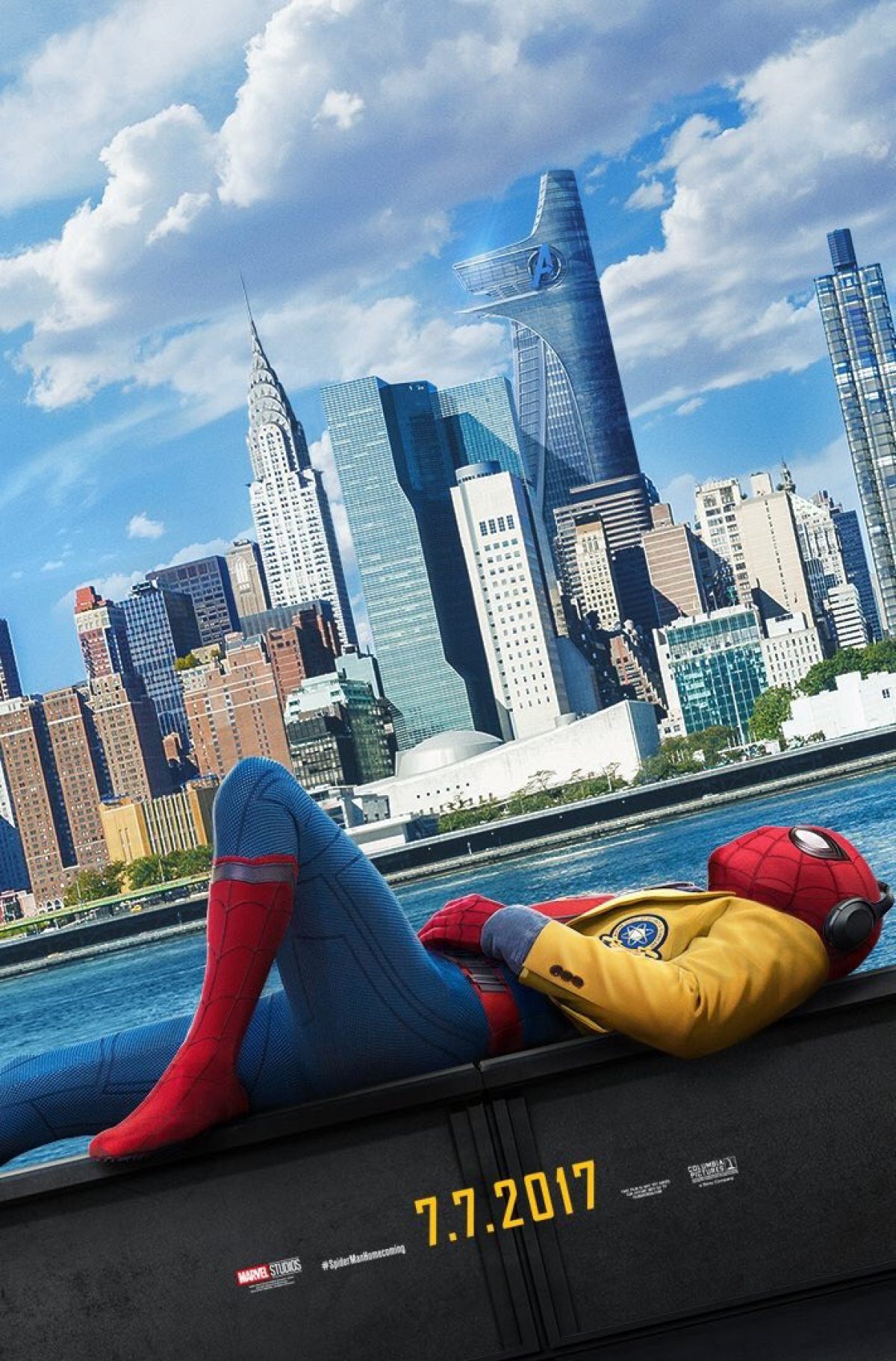
Image result for spider-man homecoming poster

It could be argued that Spider-Man is Marvel Comics’ most popular character. His characterization as a regular high-school student from New York who finds himself immersed in the larger Marvel universe has made him an incredibly endearing character to audiences young and old. This has also translated well to the web-slinger's time on the big-screen, as Spider-Man films have grossed over $3 billion worldwide. Of course, it all started with the trilogy of films directed by Sam Raimi and starring Tobey Maguire in the lead role, which ran from 2002 to 2007. The first film was one of the three major releases, alongside Bryan Singer’s X-Men and 1998’s Blade, that helped revitalize the superhero film genre after the low point that it experienced in the late 90’s. It was then followed by an even better-received sequel in 2004… and then an extremely polarizing third installment in 2007. That would ultimately be the final installment of the series, as Raimi backed out of directing the impending fourth installment when he felt pressured by the studio into getting it done by 2011. Thus, just one year later, Sony decided to reboot the Spider-Man franchise, with Marc Webb taking over as director and Andrew Garfield cast as the new Spidey. However, the short amount of time that had gone by since the Raimi series ended, paired with the fondness that many had for those films, ended up having a majorly negative effect on the Amazing Spider-Man films. While the first Amazing film managed to hold off a decent amount of the skepticism that had been surrounding it, the second Amazing film ended up being even more polarizing than Raimi’s third film. It was also the lowest-grossing Spider-Man film to date, barely grossing over $700 million worldwide.

The harsh reception to Amazing Spider-Man 2 put a lot of pressure on Sony, who have owned Spider-Man’s film rights since the 80’s. Clearly, their plans at the time to develop their own ‘Cinematic Universe’ a la Marvel Studios were not going over well with critics and audiences. And so, in 2015, they decided to strike a deal with Marvel Studios who, due to Marvel’s initial handling of their characters’ film rights, were originally unable to use some of the company’s biggest heroes for the first few years of the Marvel Cinematic Universe’s existence. This new deal, which was made official in February 2015, would allow Sony to hold onto Spider-Man’s film rights while also giving Kevin Feige and his team at Marvel Studios creative control over future films, thereby allowing everyone’s favorite neighborhood web-slinger to finally appear in the MCU. However, this also meant that the series would see another bit of rebooting for the second time in five years. Tom Holland, breakout star of 2012’s The Impossible, took on the role of Peter Parker and officially made his MCU debut in last year’s Captain America: Civil War. And overall, his turn as Spidey in that film was well-received by critics and audiences, proving that he was more than ready to take on the lead role in his own film. And so, here we are now with Spider-Man: Homecoming. General newcomer Jon Watts takes on directorial duties for this collaboration between Sony and Marvel Studios. To reiterate, because Sony still owns Spider-Man’s film rights, this is a Sony release, unlike the other MCU films which are distributed by Disney. However, given the involvement of Kevin Feige and co., it’s also the newest installment of the Marvel Cinematic Universe. Thus, with the involvement of the studio that has continued to deliver top-quality hits time and time again, I’m pleased to say that good ol’ ‘Underoos’ is indeed back and, more importantly, is better than ever in his latest on-screen adventure.

During the events of Captain America: Civil War, teenager Peter Parker AKA Spider-Man (Tom Holland), who gained spider-like abilities after being bitten by a genetically-altered spider, was recruited by billionaire Tony Stark AKA Iron Man (Robert Downey Jr.) to aid in the Avengers’ internal conflict in that film. Afterward, Tony gives Peter the new and improved suit that he had made for him but also tells him that he’s not yet a member of the Avengers. Thus, Peter returns home to Queens, where he lives with his Aunt May (Marisa Tomei), and his life as a ‘regular’ student at Midtown High while continuing to fight crime around town under the ‘supervision’ of Tony’s long-time bodyguard, Happy Hogan (Jon Favreau). But despite this, Peter is still left wishing for an opportunity to do more than just deal with minor incidents. He eventually manages to find a chance to prove himself when he starts to come across criminals that are using new and dangerous weapons that have been crafted from the Chitauri remains of the Battle of New York in the first Avengers. This soon leads to him coming into conflict with the man in charge of these recent criminal operations, Adrian Toomes (Michael Keaton), who uses a mechanical wingsuit to become ‘the Vulture’. However, the intensity of the situations that Peter soon finds himself in also gets him into trouble with Tony, who wanted him to maintain a more ‘grounded’ lifestyle. Thus, Peter now finds himself being pressured into proving that he’s capable of dealing with the kinds of threats that the Avengers face on a regular basis.

In the months leading up to its release, the filmmakers promoted Spider-Man: Homecoming as a high school film that was reminiscent of the classic 80’s films written and directed by John Hughes. And overall, the film does deliver on being just that, from its greater focus on the younger members of its cast to its various homages to films like Ferris Bueller’s Day Off. But, of course, at the end of the day, this is still a ‘Marvel Cinematic Universe’ film, so it also has all the great things that you’d expect from the MCU at this point. The action sequences are excellent, which in turn are backed by solid visual effects, and there are plenty of humorous moments that never take away from the more emotional moments of the story. And because this film is centered on a superhero who’s still in high-school, the advice that his mentor gives him (‘Stay close to the ground’) applies nicely to the overall scope of the film. Instead of being one of the high-level Avengers films, this is just a nicely scaled solo film that sometimes verges into the larger-scaled escapades of other MCU films but never once diverges from its high-school setting. I mean, if I had any sort of issue with this film, it’d be that it admittedly feels a bit overlong. Now, to be fair, this film is only about two hours and ten minutes long, which is on par with most of the other ‘solo’ MCU films. Heck, this isn’t even the longest Spider-Man film to date; The Amazing Spider-Man 2 was a little over two hours and twenty minutes long. Still, this film’s second half is made up mostly of its biggest action sequences, so it sometimes feels like the film never ends. Don’t get me wrong, I’m not saying that there were any points where the film dragged or anything, but perhaps it could’ve benefitted from some better pacing.

As noted before, this film focuses heavily on its younger stars, and all of them do excellent jobs in their respective roles. Of course, leading them all is Tom Holland who, as we already saw from Captain America: Civil War, is a great fit for the role of Peter Parker/Spider-Man. Not only does he have Spidey’s trademark quips down perfectly, but he’s also given a great overall arc in which he finds that he must prove himself within the larger world of the MCU. In some ways, it’s a lot like the arc that Tony Stark went through in Iron Man 3, in which he realized that his suit didn’t define who he was. And in this film, the fact that Tony knows himself well enough to not want Peter to go down the same route that he went truly goes to show how effective the MCU has been in terms of developing its characters in a consistent manner with each new film. Meanwhile, Holland is backed by some memorable supporting characters, including Jacob Batalon as Peter’s best friend Ned, who ends up learning about Peter’s big secret. And thanks to Batalon and Holland’s terrific camaraderie with each other, Ned proves to be one of the great MCU sidekicks, up there with the likes of Luis from Ant-Man and Wong from Doctor Strange. Another standout is Zendaya, who plays one of Peter’s classmates, Michelle. Her role in the film is a minor one but she does get some great lines of dialogue thanks to her hilariously dry wit. Rounding out the main ‘youth’ cast is Laura Harrier as Peter’s main love interest Liz Allan, who has solid chemistry with Holland, and Tony Revolori as Flash Thompson. It’s a different Flash than the ones we’ve seen in the previous film incarnations of Spider-Man but he still serves his purpose as a constant pain in Peter’s side.

As for the film’s adult leads, there was some controversy surrounding the casting of Marisa Tomei as Aunt May due to Tomei being the youngest actress to date in the role. However, Tomei does prove to be a great fit as the MCU version of Peter’s loving aunt. She works well with Holland while also getting one of the best humorous bits in the entire film right at the very end. Meanwhile, Jon Favreau gets to work with what is easily his biggest role in an MCU film to date (outside of directing, of course) as Happy Hogan, characterized excellently here as Peter’s begrudged liaison between him and Tony Stark. On that note, I’m aware that a lot of people were worried that Robert Downey Jr. was going to hog the limelight in this film to the point where it’d practically be Iron Man 4. Trust me, though, when I say that this isn’t the case. Tony’s only in the film for about 10 minutes and is used perfectly, both in terms of being the goofy genius, billionaire, playboy, philanthropist that we all know and love as well as being an effective mentor for Peter. And, of course, there’s the main villain, Adrian Toomes AKA the Vulture. Is he another one of Marvel’s ‘mediocre’ villains? No, not at all… in fact, I’d dare say that since the start of Phase 3, Marvel Studios has improved quite a bit when it comes to their villains. Michael Keaton is excellent in the role and the character is set up solidly as a former salvage operator who got screwed over by Stark Industries after the events of the first Avengers. This effectively continues the series’ tradition of having Spider-Man’s adversaries be more ‘sympathetic’ than just pure evil. And then, if that wasn’t enough, there’s one big twist surrounding the character that makes him even more of a personal threat for Peter.

There was quite a lot of backlash surrounding this film prior to its release, from its ‘allegedly spoiler-y’ trailers (personally, I didn’t think that they gave away too much) to its admittedly subpar main poster (though, seriously, how does a poster impact the quality of the film that it’s for?). Thankfully, though, that didn’t stop Spider-Man: Homecoming from becoming yet another satisfying entry in the Marvel Cinematic Universe, as well as a much-needed win for Sony after their last few attempts from this franchise fared poorly with audiences. Sure, this is still technically the second time in half a decade that Spider-Man has seen an on-screen reboot, but the filmmakers wisely avoid going down many of the same routes that the character’s previous incarnations went. Jon Watts’ direction is solid and the film finds a nice mix between the high-school antics that its young protagonist deals with on a regular basis and the grand-scale adventures within the larger MCU. And thanks to its terrific ensemble cast and the continuously great atmosphere that one can always expect from the MCU films, Spider-Man: Homecoming is a fun new spin on this beloved character. Now, with that said, I’ll admit that I’m still a little bummed about how the previous incarnation of Spider-Man, the Amazing Spider-Man series, was rather unceremoniously tossed aside after only two films. Yeah, I know I’m in the minority when it comes to liking those films, but why couldn’t they have just been given the opportunity to continue but through the way that they’re doing now and have Kevin Feige and his team come in to fix things up, allowing Andrew Garfield’s Spidey to be a part of the MCU? Still, I won’t lie… after his appearance in both Civil War and now this film, I’m fully onboard with Tom Holland’s portrayal of Spider-Man and, therefore, any future films featuring Marvel Studios’ version of the friendly neighborhood web-slinger.


Rating: 5/5!

Saturday, May 7, 2016

Captain America: Civil War (2016) review


Sometimes it’s hard to believe that it’s been nearly a decade since the release of the first Marvel Cinematic Universe film, Iron Man, back in 2008. At that time, no one ever figured that this franchise would evolve into what it is today. After all, there had never been anything like the Marvel Cinematic Universe up to that point. And yet 8 years later, here we are… two whole phases into the Marvel Cinematic Universe with 12 films, 4 TV shows, and much more on the way. Marvel Studios has pretty much established itself as the most prolific force in the superhero genre, so much so that pretty much every other studio has been trying to emulate their success. And sure, the studio has faced some criticism over the years. There are some who argue that their films are ‘all the same’, even though in reality Marvel has actually covered quite a few different genres over the years from heist films to 70’s spy thrillers. And of course, there’s that damn superhero fatigue argument as well as the fact that some people actually think these films are ‘ruining’ the film industry, namely the fact that other studios have tried to use the ‘cinematic universe’ formula with non-superhero franchises. But here’s the thing… it’s not like Marvel was directly responsible for other studios implementing this formula into other franchises. All they’ve been doing is just continuing to produce quality films/TV shows. And now that the infamous Creative Committee that was responsible for incidents like Edgar Wright’s departure from Ant-Man is no more, clearly it looks like things are going to continue to run smoothly for what is easily one of the most critically and commercially successful franchises out there today.

I apologize if that last part went a bit too far into rant territory. Anyone who knows me knows I can get rather irritated when that fatigue argument comes into play. Anyway, kicking off Phase III of the MCU is Captain America: Civil War. Captain America: The Winter Soldier directors Joe and Anthony Russo, who prior to Winter Soldier had only been known for comedies, return to helm the final installment of the Captain America trilogy. And as some of you might have already guessed from the title, this particular entry takes inspiration from one of the most notable, and in most cases infamous, Marvel storylines of the past decade, Civil War. Written by Mark Millar (Kick-Ass, Kingsman: The Secret Service), this seven-part series saw the heroes of the Marvel Universe split between those who supported and those who were opposed to a new government act intent on regulating superhero activity in the wake of increasingly catastrophic superhero-related incidents. Specifically, this storyline saw Captain America, an opponent of the act, face off against Iron Man, who to the surprise of many supported the act, with each leading their own ‘team’ to combat the other. This new film follows a similar plotline but bases it within the overall context of the MCU’s lore and, as a result, doesn’t feature all of the characters that were in the original storyline. In other words, no X-Men and no Fantastic Four because they’re still over at Fox. And without having read the original series, it seems as if this version is a much more toned down affair compared to the comics. But given the generally polarizing nature of the original story, that might be for the better. Because yet again the Russos deliver another action-packed and character-driven superhero epic that pulls a lot of changes in regards to what will happen next for the MCU and its heroes.  

Captain America: Civil War opens up about a year after the events of Age of Ultron. During this time, it is established that public opinion towards the Avengers has started to wane in the wake of the countless international incidents that they have been involved in. And unfortunately the situation only proceeds to get worse for the team when a mission in Lagos, Nigeria ends up causing even more collateral damage. This immediately leads the United Nations into setting up the ‘Sokovia Accords’, a new act that would put the group under the control of an international governing body. This proves to be a very polarizing point of debate amongst the group’s members. Specifically, Steve Rogers (Chris Evans) AKA Captain America opposes it on the grounds that it hinders their ‘freedom’ while Tony Stark (Robert Downey Jr.) AKA Iron Man supports it due to him taking responsibility for having started the whole ordeal with Ultron. The situation becomes even more complicated when Cap’s best friend Bucky Barnes (Sebastian Stan), who following his supposed death in 1945 was revived and brainwashed into being the Hydra assassin known as the ‘Winter Soldier’, is suspected of bombing a peace conference. As Cap tries to protect his friend, who claims that he wasn’t responsible for the bombing, the Avengers soon find themselves on opposite sides of ‘the law’. On Cap’s side there’s Bucky, Sam Wilson (Anthony Mackie) AKA Falcon, Wanda Maximoff (Elizabeth Olsen) AKA Scarlet Witch, Clint Barton (Jeremy Renner) AKA Hawkeye, and ‘new recruit’ Scott Lang (Paul Rudd) AKA Ant-Man. On Iron Man’s side there’s Natasha Romanoff (Scarlett Johansson) AKA Black Widow, Vision (Paul Bettany), James Rhodes (Don Cheadle) AKA War Machine, Wakanda prince T’Challa (Chadwick Boseman) AKA Black Panther, and ‘new recruit’ Peter Parker (Tom Holland) AKA Spider-Man.   

For the record, this is not a straight-up adaptation of Civil War, which is probably a good thing considering the storyline’s generally polarizing reception. As someone who hasn’t read that storyline, it seems as if the film takes on a less extreme atmosphere than the comics. Obviously the conflict between the Avengers is still there but in the comics, Iron Man apparently took on an extremely authoritarian role in order to hunt down anyone opposed to the registration act. Thankfully that’s not the case here. Despite what it may seem, Iron Man is not the ‘villain’ of the film and neither are the other members of his ‘team’. And that’s the cool thing about this story; the Avengers aren’t the ‘bad guys’ in this situation and yet it’s still interesting to watch them get into one hell of a moral debate over everything that’s happened since they’ve made themselves public to the world. Not only that, but both sides actually do have valid points to stand on instead of it seeming like the writers are favoring one ‘team’ over the other. Obviously that means that there are quite a lot of scenes where the protagonists talk with one another, perhaps more so than there are action sequences. However, the film is still a fun ride throughout and sports some particularly epic action sequences, once again highlighting the Russos’ talent for directing action with this film giving them the added benefit of having more characters to work with. Interestingly enough, while this did seem like it would be the most serious MCU film to date, it still maintains the generally light-hearted nature of the franchise in general. In other words, the franchise’s trademark humor is still there in droves, and I’m aware that this will turn some people off as there have been some who have been critical towards the MCU films for relying a lot on humor. However, I’ve never seen it as a problem with these films as there are plenty of great and emotional character moments in this film that are effectively balanced with legitimately funny bits of dialogue, mostly coming from the interactions between the characters. 

In the months leading up to the film’s release, there was some discussion over why the film was still being deemed as a Captain America story considering that almost all of the other main superheroes in the MCU (save for Hulk and Thor who, spoilers, are not in this film whatsoever) were in it as well. For those people, it seemed like Avengers 2.5 was a more fitting title. And yet, somehow, the Russos actually managed to make it all work. At the end of the day, Captain America IS the main character of the story. A lot of the plot revolves around him trying to protect his pal Bucky which of course brings him into a major conflict with Iron Man, something that has of course been previously teased in the Avengers films as a result of their numerous ‘squabbles’ with one another. Aside from Iron Man, pretty much every other ‘Avenger’ in the film is in a supporting role. But that’s totally fine because, just like what Joss Whedon did with the Avengers films, the Russos manage to give every major hero/heroine his/her own moment to shine. Also, similar to The Winter Soldier, this film actually does manage to get by without having a major ‘villain’, as the focus is more on the protagonists and their conflict with each other. With that said, this film does have a ‘villain’, Zemo (Daniel Bruhl) and, well… he really doesn’t add much to the story. So as far as that common argument that the majority of the MCU’s villains are weak is concerned, nothing here is going to change that for those who make that argument.

13 films in, there’s really no need to say much more about the franchise’s returning players; Evans, Downey Jr., Johansson, Stan, Cheadle, Bettany, Rudd, Renner, Olsen, Mackie, etc. They’re just as great as they’ve always been in these films, with all of them having played their respective roles at least more than once by this point. So moving on from that, this film introduces two new players to the MCU. The first is Black Panther, played by Chadwick Boseman. To put it simply, Black Panther is a badass and Boseman absolutely owns the role, both in terms of the action sequences and the character’s overall gravitas. But of course the most hyped element of this film was the return of everyone’s favorite web-slinger, Spider-Man. After being previously unable to join the franchise due to the fact that his character rights are owned by Sony, the recent deal between Sony and Marvel Studios has finally allowed the web-slinger to join the MCU. Now to be perfectly frank, as someone who did like the Amazing Spider-Man films (yes, even the second one), I was a little disappointed that they decided to reboot the Spider-Man franchise, for the second time in five years for the record, instead of just letting the Amazing series continue but with the added benefit of having Kevin Feige and co. in charge to make sure the franchise runs more smoothly in the wake of the second Amazing film’s mixed critical/commercial response. However, even with that said, I have to admit it… Tom Holland is a frigging excellent Spider-Man. Obviously Holland is the youngest onscreen Spider-Man to date as the new series is intent on focusing more on Peter Parker’s high-school years compared to the previous two series. And Holland absolutely owns it in the role, both in terms of the character’s natural wit and the fact that, at least in this story, he is a legitimate ‘outsider’ to the whole ordeal with the Avengers.

13 for 13 when it comes to ‘well-received’ films; there has yet to be an MCU film that has dropped below the fresh percentile on Rotten Tomatoes. Clearly that’s got to be a record when it comes to film franchises. And rightfully so as Captain America: Civil War is yet another sterling success for Marvel Studios. While the film does take inspiration from the Civil War storyline, it doesn’t strive to be a perfect adaptation, which I think many people will agree is a good thing considering the original storyline didn’t go over too well with everyone. By comparison, the film takes on a less extreme route in terms of its plot but still does a great job in conveying the moralistic conflict that the Avengers end up getting into. You actually do understand where both sides are coming from and neither side is meant to be seen as a ‘villain’ even though they are in opposition with one another. Pair that with some particularly excellent action sequences and plenty of great character moments, especially those involving the newcomers Black Panther and, of course, Spider-Man, and you have one hell of a superhero epic. Whereas Winter Soldier was proof that the Russos could handle an action film of this scale, Civil War is proof that they can handle a massive ensemble cast like this one even though the film is mainly focused on Captain America. And that’s very much a good thing because these guys are set to take over for Joss Whedon as Avengers directors with the upcoming two-parter epic that will be The Avengers: Infinity War. Clearly, that film couldn’t be in better hands.


Rating: 5/5!

Sunday, December 13, 2015

In the Heart of the Sea (2015): Short Review

(It’s only a short review this week because, well, with you know what coming out soon I wanted to make sure this review was done before I ‘go dark’ on social media on Monday to avoid unwanted spoilers. In the meantime, please enjoy this review of ‘In the Heart of the Sea’.)


When it comes to ‘Great American Novels’, stories that became a vital part of America’s cultural history, arguably none are more famous than ‘Moby Dick’. Written by novelist Herman Melville in 1851, ‘Moby Dick’ told the story of Captain Ahab and his obsession with killing the titular Moby Dick, the sperm whale that had destroyed his ship and took one of his legs. While the novel failed to attract much attention commercially upon its initial release, it ended up getting more and more attention over time until it became one of the most iconic stories of all-time. In the film/TV world, ‘Moby Dick’ has been seen quite a few adaptations over the years. There have been some straight-forward adaptations, with the most famous being the 1956 John Huston directed film starring Gregory Peck as Captain Ahab, some ‘retellings’ through classic cartoons like ‘Tom and Jerry’ and ‘The Flintstones’, and some films have even implemented references to the novel into their stories, like ‘Star Trek II: The Wrath of Khan’ with many of Khan’s quotes lifted directed from the novel itself.  But what some of you may not know is that the story of ‘Moby Dick’ was partially inspired by a real-life incident involving a giant whale; the 1820 sinking of the whaling ship Essex. In 2000, this story was told via the novel ‘In the Heart of the Sea’ written by Nathaniel Philbrick. 15 years later, Ron Howard directs the film adaptation of the event that inspired one of the most classic stories of all-time. And while the film may not entirely capture the ‘epic’ scale of its source material, it’s still a very engaging old-fashioned adventure.

For the record, if you’re going into this film expecting a lot of whale-ship action, you might be a bit disappointed because that only takes up about one-third of the film. Instead, the film is more about the crew of the Essex as they try to survive after being shipwrecked. Though with that said, for a story as grand in scale as this one, admittedly it feels a bit truncated at times. By that I mean certain parts of the story feel a bit rushed. The film is only two hours long and it does fly by really quick. As a result, it does feel like the film sort of glosses over some important parts of the plot, like the rivalry between Essex’s First Mate Owen Chase and Captain George Pollard Jr., the former being an experienced whaler and the latter being an inexperienced seaman who mainly got the position of Captain as a result of his heritage, and some parts of the crew’s days lost at sea. Though ultimately while the film could’ve definitely benefitted from a heftier runtime, I still found myself admiring the film for its simple old-fashioned execution via Ron Howard’s direction. It’s a simple story of man vs. nature and while the film may not carry as much emotional depth as it’s looking for, there are still quite a few excellent moments peppered in here and there. In particular, the big sequence involving the whale attacking the ship is definitely a highlight and an intense action sequence. And despite the shortcomings with story and character development, the film does feature a solid cast of leads from Chris Hemsworth, who undergoes quite a physical transformation unexpected from someone like the God of Thunder, to new Spider-Man Tom Holland.

Ultimately if you’re in the mood for a simple, old-fashioned tale of survival, you’ll probably enjoy ‘In the Heart of the Sea’. It has some flaws but overall I still recommend it.


Rating: 3.5/5