Showing posts with label True Story. Show all posts

Tuesday, October 17, 2017

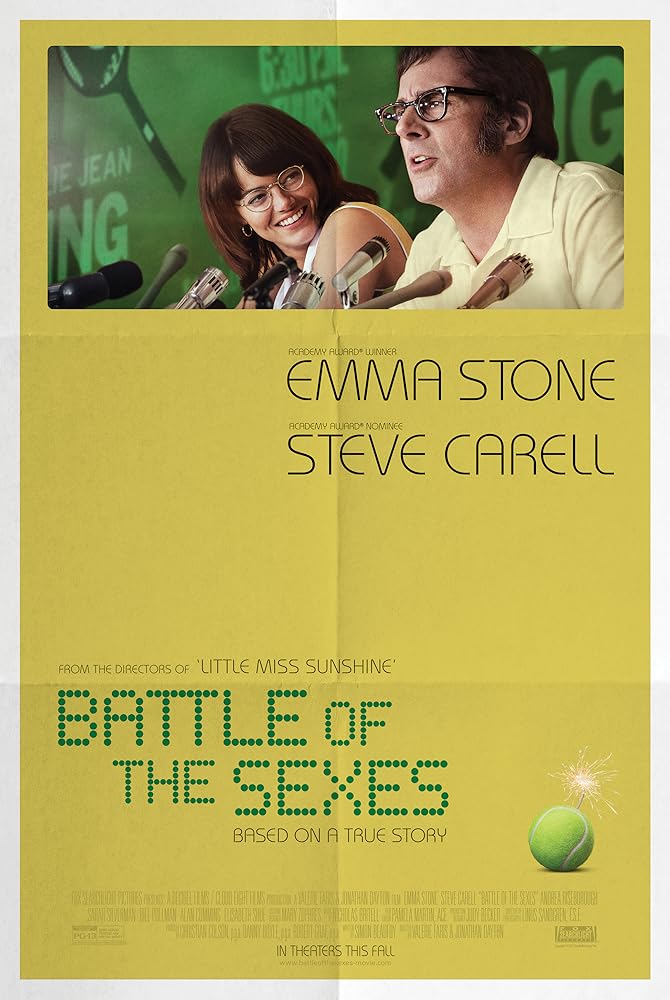
Battle of the Sexes (2017) review


In tennis, the term ‘Battle of the Sexes’ is used to describe an exhibition match that’s held between male and female tennis players. Since 1973, there have been various ‘Battle of the Sexes’ matches that have been played over the years, but only three of these have been primarily designated as such. And in today’s film of the same name, we get to see the true story of what is easily the most famous of these particular tennis matches, the 1973 nationally televised exhibition match between Billie Jean King and Bobby Riggs. King’s victory in the match proved to be quite a game-changer when it came to female tennis players earning more respect in the sport, and she would later go on to become the founder of both the Women’s Tennis Association and the Women’s Sports Foundation. And in this film, we learn the full story behind this milestone moment in her life thanks to the directing team of Jonathan Dayton and Valerie Faris. This husband and wife duo has been responsible for some well-received films over the years, including 2006’s Oscar contender Little Miss Sunshine, which ultimately won two Oscars for Best Original Screenplay and Best Supporting Actor for Alan Arkin, and 2012’s Ruby Sparks, a film written by its main actress, Zoe Kazan. And with their latest directorial endeavor, they give us a captivating true story drama with a well-executed feminist undertone and an outstanding lead performance from its leading lady in the role of one of the most famous tennis players of all-time.

In 1973, Billie Jean King (Emma Stone) is the top-ranked female tennis player in the world. At the same time, she’s also been quite an outspoken activist when it comes to male and female tennis players earning equal payouts from their victories. Unfortunately, she and her friend Gladys Heldman (Sarah Silverman), the founder of World Tennis magazine, haven’t been able to make much leeway on that front. At the time, male players were earning eight times more than female players which, as explained to the two women by US Lawn Tennis Association chief Jack Kramer (Bill Pullman), was because “the men are more exciting to watch”. In response to this, King, Heldman, and eight other players decide to hold their own tournament which ultimately becomes the Virginia Slims circuit, even though it also ends up getting them kicked out of the USLTA. While all this is going on, cocky former tennis star Bobby Riggs (Steve Carell) comes up with a crazy idea. He gets in touch with Billie Jean and challenges her to an exhibition match with a purse of $100,000. Billie Jean declines, though, and Riggs plays her longtime rival, Margaret Court (Jessica McNamee), instead. However, when Court ends up losing to Riggs in an embarrassing blowout, Billie Jean decides to finally accept Riggs’ offer and compete against him so that she can redeem the reputation of female tennis players in the male-dominated sport.

Battle of the Sexes is a highly engaging sports drama, even when considering the fact that those going into the film most likely know the outcome of its story (I mean, heck, I kind of already spoiled it in the intro). But even with that in mind, the film’s focus is geared more towards the build-up to the main event and Billie Jean’s efforts to champion equal pay amongst her fellow tennis players than the actual match itself. And through it all, the best thing about this film is that by the time the iconic match finally occurs, we are fully behind Billie Jean because of how important it is for her to win. That and she also proves to be quite a likable protagonist with a solid emotional arc based partially around her growing relationship with her hairdresser Marilyn (Andrea Riseborough) despite her marriage to Larry King (Austin Stowell (disclaimer: not THAT Larry King)). It also helps that she’s played by one of the most charismatic actresses in the industry, Emma Stone, as this is easily one of the best performances of her career. Meanwhile, Steve Carell is great as well as he slips into the role of the loud-mouthed, self-promoting Riggs with ease. In short, Battle of the Sexes reminds me a lot of another sports film that came out last year, Eddie the Eagle. These two films, both of which were based on true stories, ultimately succeeded because of how effective they were in making us sympathize with their main protagonists in their athletic endeavors. And thanks to strong direction from Jonathan Dayton and Valerie Faris, as well as an excellent ensemble cast highlighted by Emma Stone in what could potentially be another Oscar-winning performance for her, Battle of the Sexes is quite the rousing affair that couldn’t be more timely.


Rating: 5/5!

Monday, October 2, 2017

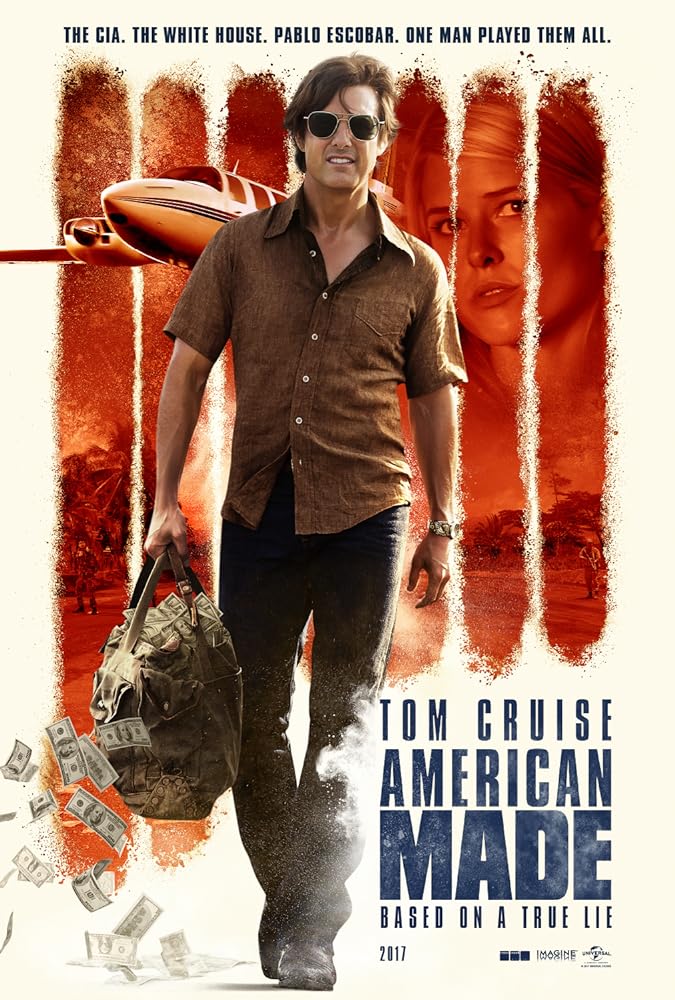
American Made (2017) review


Over the years, we’ve seen plenty of films that have been based on true stories that seem outright ridiculous to those who have never heard of them and yet totally happened. This has ranged from films like Martin Scorsese’s Wolf of Wall Street, which told the story of hard partying, drug-using stock traders, to Michael Bay’s Pain and Gain, the tale of a group of small-minded bodybuilders who partake in kidnapping and extortion to try and get rich. And as for the latest entry in this ‘genre’ of crazy stories that really happened, we have American Made. This film tells the story of Barry Seal, who went from being a commercial airline pilot to a drug and weapons smuggling informant for both the CIA and the Medellin Cartel in the late 70’s and early 80’s. It’s a film that certainly has a lot of big names working on it, that’s for sure. In the director’s chair is Doug Liman, who’s given us quite a lot of hits over the years including 1996’s Swingers, the first Jason Bourne film, 2002’s The Bourne Identity, and 2014’s cult hit Edge of Tomorrow. This film also sees him reuniting with his lead actor from Edge of Tomorrow, the one and only Tom Cruise, in what is shaping up to be a more dramatic turn for the legendary action star. And together, they give us an entertaining, albeit a bit flat, black comedy that’s fully bolstered by Cruise’s excellent performance in the lead role. 

In the late 70’s, pilot Barry Seal (Tom Cruise) works for Trans World Airlines, having notably been one of the youngest pilots ever in the company’s history. However, he decides to leave TWA when he is approached with a ‘better offer’ from CIA agent Monty Schafer (Domhnall Gleeson). After being given his own plane by Schafer, Barry is tasked with flying reconnaissance missions for the CIA in South America. Soon, this escalates into Barry serving as a liaison between the CIA and Panamanian Dictator Manuel Noriega. However, not long after this, Barry is then approached by Jorge Ochoa (Alejandro Edda) and Pablo Escobar (Mauicio Mejia) of the Medellin cartel. The cartel then proceeds to have Barry smuggle their drugs into the U.S. for them. However, when the DEA soon comes into the picture, Barry is forced to move to the small town of Mena, Arkansas with his wife Lucy (Sarah Wright) and their three kids to avoid suspicion. But that doesn’t stop Barry from continuing to work with both the CIA and the cartel, and thanks to the continued success of his operations, Barry is able to amass more and more wealth while also maintaining the secrecy of his endeavors through his ‘charitable’ actions in the community of Mena. Soon, though, Barry finds himself in an increasingly tense situation as he tries to balance everything that he’s been getting involved in.

While I usually don’t like to make a lot of comparisons between films, it’s safe to say that American Made shares quite a few similarities with The Wolf of Wall Street. After all, both films are about mildly successful men who get ahead in life when they partake in business practices that aren’t exactly legal. Both films also maintain an irreverent tone throughout with various bits of black comedy thrown in. But just like Wolf of Wall Street, American Made is a solidly entertaining ‘dark comedy’ based on a true story that only gets crazier and crazier once Seal begins to get involved with multiple parties at the same time. Liman’s direction is excellent and the film’s strong pacing gives it a fast-paced feel without ever seeming like it’s rushing through the plot. And thanks to the screenplay by newcomer Gary Spinelli, there are plenty of great humorous bits of dialogue throughout, primarily whenever Barry is narrating (again, like Wolf of Wall Street). I also appreciate the efforts made by Liman and his crew to give this film a nice retro aesthetic, and I’m not just talking about its status as a period piece set in the late 70’s and early 80’s. Right from the opening credits, which utilize the old logos of the production companies that worked on this film, American Made has a nice old-school aesthetic that makes it seem like the film was genuinely shot in the 80’s.

However, if I did have one gripe with this film, it’d be that the overall proceedings can sometimes be a bit dry. And that’s mainly because the character development in this film is admittedly rather slim, meaning that you don’t really connect with any of its characters apart from Barry. And even then, he’s still kind of ‘just there’ as far as main protagonists go. Still, Tom Cruise does do a fantastic job in the role. As some tend to point out, it’s been quite some time since Cruise’s days as a dramatic actor. After all, that’s where his career initially started before the Mission: Impossible franchise turned him into the action star that we know him as today. Thus, it can be argued that this is one of the rare instances where Cruise delves out of the action genre for once to remind us that he is very much more than just an action star. And here, he’s incredibly charismatic (as usual) even in the role of a morally grey character. In short, Cruise very much carries the film, and while most of the supporting roles are minor by comparison, there are still some great standouts from the film’s supporting cast. Sarah Wright has solid chemistry with Cruise in the role of Barry’s wife Lucy, who gets to have some great back-and-forth moments with her husband whenever he starts acting crazy. And as for the most prominent member of the supporting cast, Domhnall Gleeson, he too works great with Cruise as Barry’s government liaison, who works just as much as Barry does in his line of work to move up the ranks within the CIA.

I think many will agree that Doug Liman has been one of the most consistently reliable directors in the film industry. While he has had some critical misfires over the years, he’s also given us plenty of great films as well, and American Made is no exception. From the looks of it, it seems like this film is a decently faithful take on the real-life events that make up its story. And sure, like any film based on a true story, there clearly must have been some deviations from the truth; however, as Barry states in the trailer, ‘some of this s*** really happened’. And I guess you can say that it’s only fitting that Liman was the one to tell this story given that his father Arthur was, in fact, connected to this whole ordeal as the chief counsel for the investigations surrounding the Iran-Contra affair in the mid-80’s that had basically been spawned from all this. Sure enough, American Made is a well-made drama mixed with great bits of dark humor. Now, granted, that doesn’t mean that it’s flawless, as it does suffer from not really having much emotional depth to it. However, it’s all worth it for one of the best recent performances of Tom Cruise’s career. While he has certainly proven himself to be one of the best action stars in the business thanks to films like Mission: Impossible, Jack Reacher, and Edge of Tomorrow, a film like this proves that he’s also a great actor when given a great script to work with. And while American Made may not exactly be one of his best films, it still stands as an entertaining crime drama based around an interesting tidbit of this country’s history.


Rating: 4/5

Sunday, February 28, 2016

Eddie the Eagle (2016) review

eddie-the-eagle-poster

A lot of sports films have featured classic stories of underdogs; athletes who managed to defy all expectations to make their mark in sports history, whether it be a fictional character like Rocky Balboa in the Rocky films or a real-life person like Daniel ‘Rudy’ Ruettiger in Rudy. This film is an underdog story as well but not necessarily in the same way that other underdog sports stories are. The reason why this one is unique is because its main protagonist was by no means a ‘successful’ athlete if based solely on his career stats. And yet it was ultimately his story and determination to overcome all odds that resonated with fans the world over. This is Eddie the Eagle, the story of Michael ‘Eddie’ Edwards, the first major representative for Great Britain in Olympic ski jumping. Edwards competed in the 1988 Winter Olympics in Calgary, Canada, which was also the basis for another noteworthy underdog sports film, Cool Runnings, the story of the first Jamaican national bobsled team (clearly that year’s Olympics was full of many firsts). However, Edwards ultimately ended up coming in last in both the 70m and 90m ski jump events. In the end, though, he became a worldwide sensation not because of his achievements in the Games but because of his ‘never say die’ spirit that many felt represented the true spirit of the Olympics. This story is now represented on the big-screen with Taron Egerton taking on the role of Edwards and Hugh Jackman co-starring as Edwards’ coach, though not his actual real-life coach. To be perfectly frank, if you’ve seen a lot of sports films you’ll know what to expect from this film in terms of the plot. But even with that in mind, the film is ultimately much like Eddie himself; it may not raise the bar or anything but it very much has its heart in the right place.

Ever since he was a boy, Michael ‘Eddie’ Edwards (Taron Egerton) dreamed of becoming an Olympic athlete. However, that dream of his proves to be a rather difficult one to accomplish due to his general lack of athletic ability, which constantly results in his father Terry (Keith Allen) trying to get him to look for a ‘real job’ while his mother Janette (Jo Hartley) is much more supportive of his dream. Eventually Eddie realizes that he’d be much more suited for the Winter Olympics, so he takes up downhill skiing. But that ends up going nowhere for him either when he’s informed by the British Olympic Association that he won’t get the chance to qualify for the downhill skiing squad at the upcoming Winter Olympics in Calgary. Undeterred, Eddie switches to ski jumping, a sport that hasn’t seen a British competitor since 1929, and travels to Germany to train, despite the fact that he’s never done it before and is constantly told by others that ‘the time to start jumping is when you’re five or six’. While there, he meets Bronson Peary (Hugh Jackman), a former Olympic skiing champion who was kicked off of his squad by his coach Warren Sharp (Christopher Walken) as a result of misconduct and being ‘disrespectful of the sport’. Although unwilling to help at first, Eddie eventually manages to get Peary to help him train, or in other words to help him not crash every time he lands. But when the British Olympic Association initiates a rule change that initially prevents him from qualifying for the Olympics, Eddie is forced to work even harder in order to achieve his dream.

So yeah, ‘Eddie the Eagle’ can be a rather straight-forward story at times as far as sports films are concerned. Some will no doubt notice quite a few of the genre’s familiar tropes here, like the gruff and indifferent coach who eventually warms up to the main character by the end of the film or a moment where the main character fails to qualify for the next event but gets the chance to continue anyway by some sort of miracle. Plus, it should also be noted that this film apparently isn’t that historically accurate. According to Edwards himself, the film is only about 10-15% factual in regards to what really happened. For one thing, as noted earlier, Hugh Jackman’s character is entirely fictional whereas in reality Eddie had two coaches, John Viscome and Chuck Berghorn. But even with those two things in mind, ‘Eddie the Eagle’ is still a very satisfying feel-good sports ‘dramedy’ not because of the story but because of its spirit. After all, what was Eddie ‘The Eagle’ Edwards remembered for anyway? Not for his accomplishments in ski jumping but because of his heart. This guy may have never been the most talented skier in the world but he never gave up even when everyone kept telling him that he wasn’t going to amount to anything in the world of Olympic sports. That kind of attitude is one that many of us can take inspiration from and that I feel makes up for the film’s more formulaic moments. The film also maintains a solid light-hearted atmosphere throughout, which results in some very funny moments like when Eddie’s over-eagerness results in him deciding to immediately try bigger ski hills after just completing a single successful ski jump on the smaller hills.  

Taron Egerton had one hell of a breakout year in 2015 when he starred as Gary ‘Eggsy’ Unwin in Kingsman: The Secret Service (on a side note, this film is produced by Kingsman director Matthew Vaughn). Pretty much an unknown prior to the film’s release, Egerton ended up arguably outshining his more famous co-stars like Colin Firth and Michael Caine thanks to his strong charisma. That charisma also carries through into this film as well as he takes on a much different kind of character compared to Eggsy in Eddie Edwards, a role that’s more comedic in nature due to Eddie’s goofy antics and aforementioned occasional over-eagerness. Egerton has solid comic timing during the humorous parts of the film but also perfectly conveys Edwards’ steadfast spirit and everyman status, which makes you root for him the whole way. He’s backed by an equally terrific performance by Hugh Jackman as Eddie’s coach Bronson Peary. While he may be in the more traditional role of the washed-up former athlete who finds redemption through being a coach for the main character, that and his character isn’t even a real person, Jackman also maintains strong charisma throughout (he is Hugh Jackman, after all) and it actually is rather satisfying to see Peary go through his own arc of redemption by helping Eddie achieve his dreams. Plus, Egerton and Jackman have excellent chemistry, which is always a plus in films like this.     

Those who have seen enough sports films to point out all of the usual tropes of the genre are most certainly going to take note of this film’s more formulaic moments. And if you’re going into this film expecting a lot of historical accuracy, then you won’t find it here. But neither of those points should take away from this film’s biggest strength and that is the fact that it very much wears its heart on its sleeve. Sure it may focus on an athlete who never really achieved anything major from an actual athletic perspective but that athlete will win you over with his optimism and the conviction that he carries to never give up no matter the odds. And let’s face it, this type of message is most certainly a good thing in today’s increasingly cynical society. So quite simply, if you’re just looking for a nice and simple feel-good film, Eddie the Eagle is most certainly the kind of film for you. Its ‘never say die’ spirit is very much admirable, it maintains a solid light-hearted nature throughout that results in quite a few funny moments here and there, and it highly benefits from the strong camaraderie and performances of its leads, Taron Egerton and Hugh Jackman. I had a lot of fun watching this film and, heck, I’ll admit that I was this close to audibly cheering Eddie on during his big jump near the end of the film in the same way that one would root for Rocky Balboa as he goes the distance in the ring.  


Rating: 4.5/5

Monday, February 1, 2016

The Finest Hours (2016) review


In February of 1952, members of the United States Coast Guard performed what has since been regarded as one of the most famous rescue missions in the organization’s history. In the midst of a particularly harsh ‘Nor’easter’ storm that had hit the East Coast, a four-man crew from the Coast Guard station in Chatham, Massachusetts braved the storm and the harsh waters of the Atlantic in order to help the crew of the SS Pendleton, a T2 tanker that had broken in half about 20 miles or so off of the Chatham coast. In fact, it was the second of two T2 tankers that suffered the same exact fate on the very same day, the other being the SS Fort Mercer. Ultimately, though, it was the Pendleton rescue that became known as the most famous small boat rescue in U.S. Coast Guard history and the story of this daring rescue mission is brought to life on the big-screen in Disney’s ‘The Finest Hours’, which is primarily based off of the book of the same name by Michael J. Tougias and Casey Sherman that chronicled the events of that day. ‘The Finest Hours’ is driven by some particularly stand-out performances from its two main leads, Chris Pine and Casey Affleck, and while the film is admittedly a bit straight-forward when it comes to its proceedings, it’s still a fittingly honorable and suitably thrilling take on this fascinating true story of the heroism of four men in some of the harshest conditions imaginable.    

The leader of the four-man crew was Boatswain’s Mate First Class Bernard ‘Bernie’ Webber (Chris Pine), who at that time was courting a local girl from the neighborhood named Miriam (Holliday Grainger) who worked as a telephone operator. But on February 18, 1952, T2 tanker SS Fort Mercer ends up getting split in half by the impending winter storm that is set to hit the Cape Cod area. And as fate would have it, another T2 tanker nearby, the SS Pendleton, breaks in half as well. But unlike the SS Fort Mercer, the SS Pendleton was unable to make a distress call for help due to a loss of radio capabilities as a result of the breakage. While another team heads out to help the crew of the SS Fort Mercer, Chatham station commander Daniel Cluff (Eric Bana) dispatches Bernie to help the Pendleton. Despite the severe risks that come from the storm and the fact that they would have to go over the extremely dangerous Chatham Bar to reach them, Bernie and his crew; Seaman Richard Livesey (Ben Foster), Engineman Third Class Andrew Fitzgerald (Kyle Gallner), and Seaman Ervin Maske (John Magaro), head out on Lifeboat CG-36500 to help the crew of the SS Pendleton. Meanwhile, on the Pendleton, Chief Engineer Ray Sybert (Casey Affleck) takes control of the crew, due to the fact that the Captain of the Pendleton was lost because he was on the other half of the ship, in order to keep the ship afloat as long as they possibly can in the hopes that they are rescued before the ship sinks.

‘The Finest Hours’ can be a bit straight-forward at times in terms of its plot. Then again, that’s sort of expected given that it’s a true story and you may or may not be generally aware of what happened and how it all ended going into it. But even with that in mind, the film is full of some genuinely thrilling moments as both Bernie and his crew and the crew of the SS Pendleton, as led by Ray Sybert, try to stay alive in some of the harshest conditions imaginable while out on the open sea. Those sequences set at sea, including the sequence where Bernie’s crew traverses over the aforementioned Chatham Bar, a sand bar that was capable of running ships aground even in lesser conditions compared to the storm that they had to go through that day, are definitely the major highlights of the film. They convey the right amount of tension and suspense and are benefitted by some solid visual effects work. However, there are some who have argued that the film doesn’t really do enough to convey the real emotional core of the story and, as a result, feels a bit too ‘workmanlike’ at times. But overall I think that the film did do a fine enough job in regards to showcasing the valor of its heroes simply by way of the remarkable nature of the situation that they’re put through.

In regards to the film’s cast, the biggest standouts are its two main leads, Chris Pine as Bernie Webber and Casey Affleck as Ray Sybert. As Webber, Pine once again shows off his strong charisma that was also present in many of his other performances like James T. Kirk in the ‘Star Trek’ films or as Cinderella’s Prince in ‘Into The Woods’, while also doing a great job of getting across Webber’s audacity and courage in the face of danger. As Sybert, Affleck is also terrific in the role of the one man who, despite the fact that a lot of the crew didn’t like him very much, took charge of them so that they could survive. The two are backed up by a solid supporting cast that includes, among others, Ben Foster, Kyle Gallner, and John Magaro as the other members of Bernie’s crew and Eric Bana as Webber’s commanding officer Cluff. Pine also has really solid chemistry with the film’s main female lead Holliday Grainger, resulting in some very charming and sweet romantic moments between them. However, Grainger ends up being rather underused in the role of Bernie’s girlfriend Miriam. While the trailer may have implied that she would have a fairly substantial role in the film, as primarily evident in the sequence in the trailer where she confronts Cluff over sending Bernie and his team out into the storm on what very much seems to be a ‘suicide mission’, that’s really all that she gets to do in this film. In other words, she’s basically stuck in a ‘50’s era housewife’ role. Though from what I hear, at the very least this is more than what her character actually did in real-life. In reality, Miriam was stuck at home with the flu while all of this was going on.

The consensus on Rotten Tomatoes notes that this film is ‘old-fashioned to a fault’ and I will say that this is a pretty accurate description of the film. For some, this may be just a bit too ‘old-fashioned’ for their taste. But as traditional as it may get from time to time, it’s still a very solid and exciting adventure that highlights one of the most fascinating rescue missions in U.S. Coast Guard history. To truly put this moment into perspective for you folks, Webber and his crew had to rescue a 33-man crew commandeering a 35-foot boat that could only hold 12 in the midst of an extremely harsh winter storm. And while some may argue the film is a bit too subdued in regards to how it handles its true story, overall I’d say that the film does do a fine job in conveying the heroism of its real-life subjects. And to top it all off, the film has a solid cast buoyed (no pun intended) by leads Chris Pine and Casey Affleck and some genuinely tense action sequences backed by solid visual effects. In short, it’s a neat little look into a fascinating true story that took place in the New England area. Being a local New Englander myself, I’ll admit that I’m always fascinated by true stories like this that took place in this area, with other notable examples being ‘Black Mass’ and, to some extent, ‘The Social Network’. ‘The Finest Hours’ is the latest of these films and overall I say that it’s very much worth checking out for those looking for a good-old fashioned rescue drama.


Rating: 4/5

Wednesday, October 21, 2015

Bridge of Spies (2015) review


What can be said about Steven Spielberg and Tom Hanks that hasn’t been said before? They’re two of the biggest and most beloved names in the film industry and in 1998, the two teamed up for the first time for that year’s highly acclaimed war drama, ‘Saving Private Ryan’. Since then, Hanks has starred in two other Spielberg films, 2002’s ‘Catch Me if You Can’ and 2004’s ‘The Terminal’, and the two of them also co-produced a pair of WWII-set HBO miniseries in 2001’s ‘Band of Brothers’ and 2010’s ‘The Pacific’. One whole decade after their last film collaboration ‘The Terminal’, Hanks and Spielberg re-unite again on the big screen in the latter’s latest directorial effort, ‘Bridge of Spies’. Co-written by another famous duo, the Coen Brothers, ‘Bridge of Spies’ sees the duo of Hanks and Spielberg take on a different war; the Cold War. This film tells the true story of the 1960 U-2 incident in which lawyer James B. Donovan negotiated the prisoner exchange of U-2 pilot Francis Gary Powers and Soviet spy Rudolf Abel after he had previously defended the latter in court and, most importantly, kept him from getting a death sentence. And ultimately while the film can be a bit dry at times, there’s still no denying the masterclass effort that comes from Spielberg’s direction, the performances of its two main leads, and this film’s excellent representation of what life was like during the Cold War.

The year is 1957 with both the U.S. and Russia firmly locked into the paranoia of the Cold War as each anticipate/fear a potential nuclear attack from either side. In Brooklyn, Rudolf Abel (Mark Rylance) is arrested by police on the charge of being a Soviet spy. With the intention of at least giving Abel a fair trial so that it won’t come across as some sort of Soviet propaganda, insurance lawyer James B. Donovan (Tom Hanks) is tasked with being Abel’s lawyer in court. Despite the clear fact that Abel will be convicted as well as the backlash that he ends up facing from the American people for defending Abel in court, Donovan takes on the case and while he ultimately does lose it, he manages to convince the Judge to lower Abel’s sentence from a death sentence so that he could one day be useful in the case that the U.S. needs to bargain with the Soviet Union. Sure enough, that day comes when pilot Francis Gary Powers (Austin Stowell) gets shot down in the Soviet Union while undertaking a reconnaissance mission for the CIA. This results in Donovan being sent to East Berlin as a ‘neutral negotiator’ in a prisoner exchange involving Powers and Abel, which gets a bit more complicated when another American, student Frederic Pryor, also gets captured, in this case by East Germany in the midst of the construction of the Berlin Wall, on spy charges.

Watching this film, there’s no denying the strength of Spielberg’s direction; how he constructs his scenes and how they are paced. Everything that you can normally expect from a Spielberg film is here from the excellent cinematography by Spielberg regular Janusz Kaminski to a majestic score which in this case was not done by Spielberg’s go-to composer John Williams but by Thomas Newman instead. Spielberg also really excels in establishing the ‘Cold War’ atmosphere and the paranoia that came from both sides of this conflict, especially in the U.S. as shown through how Donovan is initially viewed as a social pariah amongst his fellow citizens for defending a ‘traitor’ in court. All of this, for the most part, makes up for the film’s primary issue and that is that it admittedly drags at times and other times can come off a bit dry. Now obviously because this takes place in the Cold War, the film is more focused on politics than it is about the action. For the record, this film does manage to be engaging from beginning to end, primarily due to its strong morals as displayed by Donovan, but ultimately for what’s classified a thriller, there’s not that much tension because we know what’s going to happen and Donovan is never in any real danger. That and, even for a film that’s 141 minutes long, it has to cover quite a lot of ground. It’s basically two stories in one; Donovan’s defense of Abel in court and his subsequent negotiations to get back Powers and Pryor.

Tom Hanks is, well, Tom Hanks. He’s practically a national treasure at this point. You know that he’s going to be good no matter what, especially in a Spielberg film, and of course he’s excellent here as the Atticus Finch-esque Donovan. In a country that, at the time, was broiled in the politics of the Cold War, Donovan worked to preserve the ideals of the Constitution (AKA ‘The Rulebook’ as he illustrates in a scene in which he’s talking with a member of the CIA) even during a case he clearly wasn’t going to win. Donovan may not be a particularly deep lead character but Hanks imbues him with the everyman quality that he is so great at doing, making him very likable through and through. Hanks is backed up by a solid supporting cast that also includes Amy Ryan as Donovan’s wife and Alan Alda as his legal partner Thomas Watters but the biggest standout of the film ends up being Mark Rylance as Rudolf Abel. Rylance plays the role with a quiet thoughtfulness and, in a way, a bit of an unsuspecting nature as Abel is only once shown to do anything spy-related. Like Donovan, Abel stays true to his morals as he refuses to become an ally of the United States government even though that would help him get out of his current predicament as a prisoner of the United States. I can definitely see why Spielberg casted Rylance in the lead role/titular character of his next film, his adaptation of Roald Dahl’s ‘The BFG’, because this is easily one of the best performances that I’ve seen this entire year.

I can’t really say that ‘Bridge of Spies’ is one of Spielberg’s best films, even though it’s certainly been getting some of the best reviews of any film that he’s ever directed. The film does do its job in recreating the world of the Cold War as well as the paranoia and fear that came from this part of U.S. history through the eyes of a man who fought to preserve the country’s morals even if it made him an outcast in his home country. It’s just that, even for a film that’s over two and a half hours long, it has to basically cover two stories in that runtime; the case of Rudolf Abel and the prisoner exchange for Francis Gary Powers. And as a result, the film admittedly can be both a bit dry and a bit overlong at times and there’s not as much tension as it wants to have. But at the end of the day, this is still a Steven Spielberg film and you can always expect a well-crafted and well-directed effort whenever he’s behind the camera. As some of you might have guessed from an earlier analogy that I made, the story of James B. Donovan and Rudolf Abel reminded me of ‘To Kill a Mockingbird’. Donovan is basically this story’s ‘Atticus Finch’ as both display the same morals from a political and human standpoint. So in short, while I can’t really list this as one of my favorite films of this year, ‘Bridge of Spies’ definitely delivers when it comes to being the kind of film that you’d expect to see from Steven Spielberg.


Rating: 4/5

Monday, October 12, 2015

The Walk (2015) review


In a way, this film sort of has a bit of a chip on its shoulder as it is a film released in the post-9/11 era that is based almost entirely around the Twin Towers of the World Trade Center. But hopefully that doesn’t completely turn people away from this film because it actually focuses on a true story of the Twin Towers that was magnificent instead of tragic. When the towers were first built in 1973, the initial reaction towards them was generally negative amongst New Yorkers, many of whom referred to them as being ‘ugly’ and ‘oversized’. But on August 7th, 1974, that all changed when French high-wire artist Philippe Petit ‘humanized’ the Towers by tightrope walking between them, situated at least 1,350 feet up in the air. This unique part of history had previously been explored in the 2008 documentary ‘Man on Wire’, which won the Oscar for Best Documentary that year. This year sees the release of a new adaptation of Petit’s story in the form of ‘The Walk’, directed by Robert Zemeckis, director of numerous film classics including ‘Forrest Gump’, ‘Who Framed Roger Rabbit’, and my all-time favorite film trilogy, ‘Back to the Future’. With ‘The Walk’, Zemeckis achieves a pure cinematic achievement by giving us a film that is not only visually stunning but also one that is full of heart that will hopefully inspire others to follow their dreams, however impossible they may seem.

As he narrates throughout the film while stationed on the torch of the Statue of Liberty, we are introduced to Philippe Petit (Joseph Gordon-Levitt), who in 1973 was a juggler/wire-walker who performed daily in the streets of France having been inspired to become a performer after a trip to the circus when he was younger. One day, after a minor incident during a performance requires a trip to the dentist, he learns about the Twin Towers that are currently under construction in New York City from a magazine. Inspired to tight-rope across the towers before they are completed, Petit starts to train in the art of high-wire walking under former circus performer Papa Rudy (Ben Kingsley) and begins to plan his coup to walk across the Twin Towers with the help of his girlfriend Annie (Charlotte Le Bon) and a few other ‘accomplices’ as well, including photographer Jean-Louis (Clement Sibomy) and algebra teacher Jeff (César Domboy). Once in New York, Petit comes across additional help as well in Barry Greenhouse (Steve Valentine), a life-insurance agent who works at the Towers, French speaking local New Yorker Jean-Pierre (James Badge Dale), a second photographer named Albert (Ben Schwartz), and stoner David (Benedict Samuel), who all help Petit as he undertakes the illegal operation of rigging his wire from the observation decks of what were, at the time, the tallest buildings in the world.

Obviously the biggest selling point of the film is the 20-minute sequence at the end in which Petit performs his famous high-wire act between the towers. Zemeckis has stated that he wanted the audience to get an idea of what the view was like for Petit on the high-wire instead of just looking at it from the audience’s usual perspective down below and he definitely succeeds in that regard. This was a film that was made for IMAX 3D, effectively making you feel like you’re on the high-wire along with Petit. Though with that said, it has been reported that some audiences ended up getting sick during this part when the film first premiered in New York. So if you’re scared of heights, this definitely isn’t your kind of film. But hopefully that doesn’t completely discourage some of you from seeing this film because the high-wire walk really is one of the best film moments of the year and even though you know what’s going to happen, you’re still on the edge of your seat throughout this entire sequence. The buildup to it is really great as well. Again, while we may know how everything turns out, it’s actually really fun to watch Petit and his team undertake their obviously illegal operation. We see how Petit comes across his ‘accomplices’, how he and his team figure out how to rig the wire to the towers, and see them overcome certain obstacles and issues. It’s all done at a brisk pace that makes the film compelling throughout.

One of Robert Zemeckis’ greatest strengths as a director is that he really knows how to find the heart and characters within an unbelievable story. And one of the reasons why this film works as well as it does is because while it is definitely a visually beautiful film, it also has a great amount of heart to it as well. It’s an awe-inspiring tale of the strength of the human spirit and how one man was able to make a seemingly impossible dream of his possible, which in turn can hopefully inspire others to make their own dreams a reality. A lot of this is due to Joseph Gordon-Levitt’s phenomenal lead performance as Petit. Not only does Levitt get the French accent down very well but he also exudes a ton of charisma, which is obviously a key thing for anyone who is a performer. Levitt is backed up by a very nice supporting cast of characters headlined by Ben Kingsley as Petit’s wise mentor Papa Rudy and Charlotte Le Bon as his lovingly supportive girlfriend Annie. But then there are a few other members of Petit’s band of accomplices that also stand out as well, particularly James Badge Dale as the French speaking New York native Jean-Pierre and César Domboy as Jeff, an algebra instructor who has to overcome a fear of heights in order to help Petit achieve his dream. While some of the members of the team are introduced perhaps just a bit too late into the film to get any real chance to stand out amongst their peers, namely the secondary photographer and the stoner, most of the other members of the group do at least get their own moments to shine during a film that ultimately belongs to Joseph Gordon-Levitt.  

I legitimately have no idea why this film isn’t doing so well at the box-office despite getting great reviews. Is it because of the ‘post-9/11’ thing or the fact that some people got sick watching this film’s climax? Whatever the reason is, I sincerely hope that this doesn’t become this year’s next ‘Tomorrowland’, especially when considering that both films wear their hearts on their sleeves and honor the dreamers of the world. I’ve said it before and I’ll say it again; we need more films like this that promote positive messages of hope and perseverance that will hopefully inspire future generations to dream big. Obviously the biggest aspect of the film is the scene in which Petit walks across the towers, a visually stunning sequence that makes the film an absolute must-see in IMAX as well as the best 3D film that I’ve seen this year. Hopefully 9/11 isn’t one of the reasons why this film isn’t doing so well commercially because even with all that happened on that day in mind, this film is actually a very touching tribute to the Twin Towers in how it honors a joyous moment in the history of the Towers that were originally built as a symbol of hope. I’d also like to point out that this film ends on a particularly poignant note that doesn’t actually bring up 9/11 but does clearly allude to it, resulting in a pretty darn powerful conclusion to what is easily one of my favorite films of this year.


Rating: 5/5!

Tuesday, January 6, 2015

Unbroken (2014) review


Of course we all know who Angelina Jolie is, from her work in acting to her highly publicized relationship with Brad Pitt. But, according to recent comments that she made, it looks like she might soon be retiring from acting and is planning to switch into directing films instead. She made her official directorial debut back in 2011 with ‘In the Land of Blood and Honey’, a romance film set during the Bosnian War. However, that film did not get much attention either critically or commercially. But it’s safe to say that her newest directorial effort, ‘Unbroken’, is no doubt getting much more attention than her directorial debut, given the fact that it’s based on a true story. ‘Unbroken’, based on the book of the same name by Laura Hillenbrand, is the story of Louis Zamperini, a former Olympic athlete and member of the Air Forces who was primarily known for his time spent as a prisoner of war in Japan during World War II after spending more than a month lost at sea when the plane he was on crashed into the ocean. It’s been made clear that this project means a lot to Jolie due to the fact that she became good friends with Zamperini, who had been her neighbor for years up until his death this past July. And as such, ‘Unbroken’ is certainly a well-meaning biopic that aims to do its subject justice. I wouldn’t necessarily say that it’s a ‘perfect’ film, and that it can also be very emotionally draining at times, but it’s still a pretty solid biopic highlighting a story of endurance, resiliency, and the strength of the human spirit.

When he was a young boy whose family had just immigrated to the United States from Italy, Louis ‘Louie’ Zamperini (Jack O’Connell) constantly got into trouble with both the law and other kids. One day, when he notices that Louis can run really fast, his brother Pete (Alex Russell) starts training him to be a runner, telling him that otherwise he’d end up ‘a bum on the streets’ the way he was going. Soon, Louis starts to become well-known as an accomplished distance runner and eventually ends up competing in the 1936 Summer Olympics in Berlin, where he sets a new speed record for a single lap in the 5000 meter run. Louis then enlists in the Air Forces but while he is on a search and rescue mission one day, his plane ends up crash landing in the middle of the ocean when its engines fail, leaving Louis and two other survivors, Francis ‘Mac’ McNamara (Finn Wittrock) and Russell ‘Phil’ Phillips (Domhnall Gleeson), stranded at sea. After more than 47 days at sea, they are finally rescued… but by Japanese forces, who immediately take them prisoner. Louis ultimately ends up in a prisoner camp in Tokyo run by corporal Mutshiro ‘The Bird’ Watanabe (Miyavi), who constantly targets Louis due to his status as an Olympic athlete. Now facing constant abuse from ‘The Bird’, Louis struggles to survive in the hopes of one day being set free.

‘Unbroken’ is, to put it quite bluntly, a very hard-hitting film in terms of how emotionally draining it can get at times, specifically when Louis is in prison in Tokyo and constantly getting abused by ‘The Bird’. And from what I hear, unlike a lot of biopics that dramatize certain aspects of this story, apparently this film really didn’t ‘BS’ a lot of the facts so a lot of this really happened, which is just crazy. At the same time, this story is truly fascinating in regards to seeing Zamperini endure all of this, from having to spend more than a month at sea to years facing all sorts of hell from ‘The Bird’ in prison. Jolie’s direction is solid and the film benefits from excellent cinematography from the great Roger Deakins and a solid score from Alexandre Desplat. The only major complaint I have about the film is that it kind of skimps over some of the earlier parts of Zamperini’s life, namely his childhood and his time as a runner, in favor of his time lost at sea and as a prisoner of war. Now obviously, all of the war stuff does make up the bulk of the story so it does actually make sense that the film focuses on that more. Still, the scenes of Zamperini’s life before the war are fairly brief and are just flashbacks that occur right at the beginning of the film so it would’ve been nice to see a bit more of Zamperini’s early life because I bet there was some legitimately interesting stuff that happened to him then (Disclaimer: I’ve not read the book).

Obviously the role of Zamperini requires a lot of endurance and emotional strength given all that he had gone through. And with that said, Jack O’Connell more than proves that he was absolutely the perfect choice for the role. While the film probably won’t be getting much awards buzz given its generally mixed critical reception, O’Connell is easily the best part of the film, giving a very strong and emotionally powerful performance while also giving off a very likable and sympathetic persona. That persona is effectively balanced against Japanese pop star Miyavi’s equally excellent turn as ‘The Bird’ who, quite simply, is quite the scumbag and Miyavi does a really good job at capturing how much of an a-hole he really was, making that iconic scene from the trailer where Zamperini lifts a giant piece of wood when ‘The Bird’ threatens to have him shot one of the most satisfying moments of any film from this past year. Because they’re the main character in the story, everyone else, including Wittrock, Gleeson and Garrett Hedlund, the latter of whom plays a fellow prisoner of Zamperini’s, doesn’t have as much to work with but overall the film is well-acted from all involved. The whole sequence with Zamperini, Mac, and Phil on the raft at sea does do a great job of showcasing the fairly strong camaraderie between O’Connell, Wittrock, and Gleeson.

While ‘Unbroken’ is only Angelina Jolie’s second film as a director, she definitely shows that she does have potential in directing as shown in this very well-directed film. True it may be very hard to watch at times given the brutality that Zamperini had to deal with while as a prisoner of war in Japan, but at the same time it’s also a fascinating look into the life of a man who went through hell but managed to get through it all thanks to his resiliency and perseverance. Admittedly, the movie could’ve benefitted from spending a little more time focusing on the earlier parts of Zamperini’s life, namely everything before he joins the Air Forces, but then again the main part of Zamperini’s story does consist of both his time spent lost at sea for 47 days and then his time (just a little over two years) as a prisoner of war in Japan so it actually does make sense for the film to maintain the main focus of the story on those two parts of Zamperini’s life. Regardless, it’s clear that Jolie’s main intentions to do the life story of a good friend of hers justice are no doubt present in how this film is made. It’s a very well-made, well-directed, and well-acted biopic that may be hard hitting at times but will also invoke a sense of spirit in you while watching it.


Rating: 4/5

Sunday, December 28, 2014

Post Christmas Double Feature Short Reviews: 2014

Well folks, for the third year in a row, me and my co-panelist on ‘The Feature Presentation’, Matthew Goudreau, embarked on a cinematic double-header as we did our third straight post-Christmas double feature, as we went to go see a pair of potential award contenders yesterday, which has basically been the case with every film we’ve seen in this fashion since we started doing this. In 2012, we went to go see the musical epic ‘Les Miserables’ and Quentin Tarantino’s latest film, ‘Django Unchained’. Last year, it was Martin Scorcese’s hilarious, and in some cases rather underrated, black comedy ‘The Wolf of Wall Street’ and ‘American Hustle’, the film that unfortunately I wasn’t as big a fan of compared to most critics; I was more in the line with the general reaction from most audiences. Like I did these last two years, I’m not going to do full reviews of these two films, only because I’m currently busy prepping my end-of-the-year ‘Best of’ list. So instead, I’m just doing a pair of quick short reviews for each of the two films that Matt and I watched yesterday. So, without further ado, let’s get started.

INTO THE WOODS


Disney has been known for some truly iconic movie musicals, from animated films like ‘The Lion King’ and ‘Frozen’ to live-action classics like ‘Mary Poppins’. Their latest musical, ‘Into the Woods’, certainly has quite the pedigree in terms of talent both behind and in front of the camera. It’s based off of the multi Tony Award winning musical of the same name by famous composer Stephen Sondheim and writer James Lapine. It’s directed by Rob Marshall, who helmed 2002’s Oscar-winning musical ‘Chicago’, and it’s got an all-star cast from top to bottom… and overall it’s a pretty damn good musical with stunning visuals and a nice light-hearted atmosphere that contrasts solidly with the darker turns of the second act. As some have joked, it’s sort of the fairytale equivalent of something like ‘The Avengers’ as it brings together many famous characters from classic fairytales, from Cinderella (Anna Kendrick) to Little Red Riding Hood (Lilla Crawford) to Jack from Jack and the Beanstalk (Daniel Huttlestone). It’s primarily focused around a Baker (James Corden) and his wife (Emily Blunt) who embark on a journey to lift a curse of infertility that was set upon the Baker’s family years ago by an old witch (Meryl Streep) by bringing her four items; “a cow as white as milk, a cape as red as blood, hair as yellow as corn, and a slipper as pure as gold”. And while they’re on this journey, they come across all of the aforementioned fairy tale characters who just so happen to have the items that they need.

There’s been much talk about whether or not Disney would ‘tone down’ some of the darker parts of the musical, like the sexual undertones of the scenes between Little Red Riding Hood and the Wolf (Johnny Depp, who I kid you not is literally in the film for only about five minutes). And it’s true that certain parts were definitely toned down to maintain a family friendly PG rating. But, for the most part, I think it’s for the better. While the story certainly does get dark near the end, this is, for the most part, a fairly light-hearted story with a lot of humor and some fairly over-the-top moments but it’s ‘over the top’ in a good way as it’s a fairly heightened reality being that it’s a fairy tale. The musical numbers are solid and the cast is spot on from top to bottom. A lot of people have been focusing on Meryl Streep as the Witch and while she is great in the role, I have to say the biggest standout of the cast would actually have to be Emily Blunt as the Baker’s Wife, as she provides a much more ‘down-to-earth’ persona compared to most of the other characters in the story. My only real complaint about the film is that sometimes it feels like the story rushes through some moments, like when Jack climbs the beanstalk. I mean, this was probably the case with the musical as well but I do kind of wish that we could’ve gotten to see some of these moments. Still, ‘Into the Woods’ is a solid musical and while I can’t really say how much it stays true to the original musical due to the fact that I haven’t seen it, I have the feeling that this film at least does it justice.

Rating: 4.5/5

THE IMITATION GAME


Then we have ‘The Imitation Game’, based on the true story of Alan Turing, the famous computer scientist who was one of the key figures in cracking the Enigma Code of Nazi Germany during the Second World War by developing a special deciphering machine known as the ‘bombe’ that could encrypt these secret messages much faster than any human can. This story is truly fascinating and in some cases fairly sad due to some key events that happen near the end. I mean, this was a man whose work saved countless lives during World War II and, as some have predicted, it shortened the length of the war by at least two years. And yet unfortunately, in 1952, he was prosecuted for being a homosexual, a way of life that was outlawed in the UK at the time. He died only two years later in 1954 on account of suicide, and it wasn’t until recently (just a year ago, in fact) when his work was finally given the proper recognition it truly deserves. With that in mind, this is without a doubt a must-see ‘true story’ film as Turing was a man who truly left a major impact on all of our lives. You know those devices that you and I use every day… computers? His work is what laid the groundwork for that technology and the fact that he was prosecuted just for being gay (which is just total BS) makes this film even more important in today’s society, where currently only 35 states in the U.S. (and the District of Columbia) allow same-sex marriage.

The main highlight of this film is easily Benedict Cumberbatch’s performance in the role of Turing. I can definitely see a bit of Cumberbatch’s version of Sherlock Holmes in this performance as both men have this sort of awkwardness to them. But while Sherlock is more confident in what he’s doing despite the fact that he seems awkward and strange to everyone around him, Turing is fairly shy in terms of his awkwardness, which makes sense due to the fact that he’s holding in a big secret from everyone around him. Keira Knightley is also superb here as well as Joan Clarke, a fellow code-breaker who Turing gets into a romantic relationship with before finally revealing his secret to her. Not only are the performances great, but the film is really captivating as we see Turing and his team in a race against time to break the Enigma Code as they only have a set amount of time each day to figure it out before it switches at the end of the day. All in all, ‘The Imitation Game’ is a well-acted and well-directed film that truly shines a light on a man who thankfully has begun to receive the recognition that he truly deserves and the struggles that he went through near the end of his life will certainly resonate for many people today.


Rating: 5/5!

Saturday, November 29, 2014

The Theory of Everything (2014) review


Out of all of the famous scientists that have ever lived, from Albert Einstein to Kip Thorne (who just had a movie based around his scientific observations come out in Christopher Nolan’s ‘Interstellar’) Stephen Hawking is no doubt one of the first that comes to mind. After all, he was one of the two leading minds, along with Roger Penrose, on ‘gravitational singularity theorems’, predicted the concept of black hole radiation, and perhaps most importantly explored the union of the ‘theory of relativity’ and ‘quantum mechanics’. But at the same time, Hawking’s own life is quite fascinating given the fact that in his 20’s he was diagnosed with a motor neuron disease connected to amyotrophic lateral sclerosis (ALS, more commonly known as Lou Gehrig’s Disease as well as being the main cause for awareness behind all of those Ice Bucket Challenges you no doubt saw a lot of this past summer) and that story is the focus of ‘The Theory of Everything’. More specifically, this film is based on the book ‘Traveling to Infinity: My Life with Stephen’ by his first wife Jane Wilde as the film not only focuses on his life, but their relationship and how she stood by him as this disease slowly took over his life. And with some terrific and truly Oscar-worthy performances from leads Eddie Redmayne and Felicity Jones, ‘The Theory of Everything’ is a well-directed and moving biopic on the lives of both one of the most famous men in the entire world and the woman who was always there for him in times of crisis.

The film begins in 1962 as Stephen Hawking (Eddie Redmayne) begins his tenure as a graduate student at Cambridge studying cosmology where he quickly makes quite the impression with his teachers, specifically physicist Dennis Sciama (David Thewlis). While at a college party, he meets Jane Wilde (Felicity Jones), an arts major, and soon after they fall in love. But both of their lives take a serious detour one day after Stephen, who begins to show signs of clumsiness, ends up taking a nasty fall at school. At the hospital, he learns that he has a motor neuron disease similar to ALS which affect his muscles, resulting in them slowly degrading away. Because there is nothing that the doctors can do about it, it is projected that he only has two years to live. However, Jane promises to help him get through it driven by their love for each other and they end up getting married. With her love and support, Stephen fights to overcome his disability as he also continues to make quite the impression amongst his fellow physicists in the field of cosmology even as the disease slowly but surely eats away at him to the point where, after a near-death experience with pneumonia, he ends up losing his voice due to a tracheotomy resulting in him having to use a computerized voice to speak.

So I’ll admit that while I am familiar with Stephen Hawking, I admittedly didn’t know that much about him (nor do I know anything about any of the science in most of his work but don’t worry that science isn’t the main focus of this film) before seeing this. Having now seen this film, I can say that his story was a truly intriguing tale. I mean, this was a man who was given only two years to live and yet he managed to fight on even though it ended up resulting in him losing many things, namely the abilities to walk and talk. But of course, there’s more to this story. It’s also a tale of romance from the perspective of both Stephen and his wife Jane and we really see her spirit and determination supporting Stephen through the toughest moments of his life. But even then she does have her limits as I’m sure many will probably have in situations like this. The film does a great job at balancing their roles in the overall story meaning that while this is technically about Stephen Hawking’s life, Jane is as big a part of the story as he is. From an emotional standpoint, you do find yourselves very much invested in their relationship and sympathize with them when they both hit their own low points. All in all, this is a very well-polished film. The direction from James Marsh is solid as is the cinematography by Benoit Delhomme and the score by Johann Johannsson, resulting in a very nice-looking film backed up by a nice musical score.

But the key to this film is the performances from its two leads and I can safely say that after seeing this film that Eddie Redmayne and Felicity Jones are no doubt going to be front-runners for Best Actor and Best Actress at this year’s Oscars. Redmayne disappears into the role of Hawking perfectly and handles the transformation that Hawking went through incredibly well. Equally excellent here is Jones as Jane who does a phenomenal job at conveying both Jane’s strength and emotions in the key moments of the film. And as I noted earlier, because the film makes sure to balance out these two roles in the story, there’s never a time where one of them tries to outshine the other; they work off each other and are both superb. Of course, chemistry is key to making a film romance work and that is very much the case here. The two have excellent chemistry which really makes the relationship between Stephen and Jane feel very much genuine. The film does have a solid supporting cast as well, including Charlie Cox (AKA the new Daredevil for you Marvel fans) as Jonathan Jones, a musician who befriends Stephen and Jane, the latter of whom ended up marrying him after divorcing Stephen in 1995 (and no I don’t really consider that a spoiler given that this is a true story), and David Thewlis as Stephen’s physics professor at Cambridge but at the end of the day this film belongs to Redmayne and Jones.

‘The Theory of Everything’ is definitely one of the best films of this year as it offers a sometimes sad but also extremely uplifting look at how Stephen Hawking managed to overcome the disease that was predicted to take his life in just two years with the love of support of his wife Jane. It’s a well-crafted film that benefits greatly from its direction, writing, cinematography, and its score. And even if you don’t really understand a lot of the science that is talked about in this film… don’t worry you’re not alone and even then, that’s not actually the main focus of the film. Instead it’s about the relationship between Stephen and Jane. And at the end of the day, the best elements of this film are the Oscar-worthy performances from Eddie Redmayne and Felicity Jones in the lead roles of Stephen and Jane, respectively. Their chemistry is superb and both do a fantastic job at portraying these two and the struggles that they both overcame in dealing with Stephen’s ALS. It’s been said that this year’s Oscars are going to be pretty packed in regards to the acting categories but I do hope that both Redmayne and Jones earn Oscar nominations for their work here. In fact, I’d say it would be a genuine travesty if they didn’t get nominated because these are easily two of the best performances I’ve seen this year.


Rating: 4.5/5

Saturday, February 1, 2014

Lone Survivor (2013) SHORT REVIEW


In late June of 2005, in the midst of the war in Afghanistan, the United States Navy SEALs began ‘Operation Red Wings’ in the Kunar Province of Afghanistan. Their goal was to capture and kill Ahmad Shah, the leader of a group of fighters in the area who had pledged his allegiance to the Taliban. Four Navy SEALs were sent in to carry out this mission, but by the time the operation had ended only one of them, Marcus Luttrell, came back alive while the other three members of his squad, along with 8 other SEALs and 8 members of the 160th Special Operations Aviation Regiment lost their lives. Their story was initially told in a 2007 book, ‘Lone Survivor’, which was written by Marcus Luttrell and Patrick Robertson. In 2013, that story was translated to film by director Peter Berg under the same name.

The film itself is very intense, right from the moment the SEALs are first attacked by Shah’s men. Two scenes where they fall down hills are especially brutal. But at the same time, the film benefits from the fact that everyone involved in the production clearly had the upmost respect for those who had lost their lives that day. This is easily one of Peter Berg’s best directorial efforts and Mark Wahlberg, Taylor Kitsch, Emile Hirsch, and Ben Foster all do terrific jobs in the four lead roles. Their camaraderie is exceptional and you really see how they are like ‘a brotherhood’. Now, if I do have one complaint, it is that I feel like there could have been a few more scenes between the four men so that their characters could develop more. And for the record, I’m not referring to the actual four men and the performances of the cast. I’m just saying that the action does takes up the bulk of the film and I wish that there could’ve been just a few more moments amongst the characters so we could get to know them more. Again, this is just from a film perspective, not in regards to the actual events that took place during the Operation and the men who did lose their lives during it. Even with that in mind, ‘Lone Survivor’ is a very well-made war film.
Rating: 4.5/5

Sunday, December 22, 2013

Saving Mr. Banks (2013) review


It’s interesting to note that, in the years since his death in 1966, there haven’t been any films made that center around or feature Walt Disney. After all, he was the man responsible for some of the greatest animated films of all time and one of the biggest companies in the world is named after him. With credentials like that, it makes you wonder why there hasn’t been any attempt to do something along the lines of a biopic. But with this film, the man behind arguably the world’s most famous mouse finally makes his debut on the big screen, albeit through a portrayal by Tom Hanks instead of Disney himself. But Disney’s not exactly the star of this film. Instead, ‘Saving Mr. Banks’ is the tale of ‘Mary Poppins’ author P.L. Travers and her experiences working with Walt Disney during the production of the iconic film adaptation of the novel starring Julie Andrews and Dick Van Dyke. It was the film that earned thirteen Oscar nominations and ultimately five wins and is considered to be one of Disney’s best films. However, as this film shows, the production didn’t really go as smooth as one might have expected but with the help of a talented cast and the proper focus, ‘Saving Mr. Banks’ ends up being one of the best films of the year.

In 1961, P.L. Travers (Emma Thompson) travels to Los Angeles to meet with Walt Disney (Tom Hanks) so that they can discuss the development for the film adaptation of her novel, Mary Poppins. Travers, who has script approval rights, is concerned about Disney turning her beloved story into one of his ‘silly’ cartoons, although Walt assures her that he will do her story justice as he made a promise to his daughters years ago that he will make Mary Poppins ‘fly off the pages of the book’. Still, as pre-production begins, Travers remains very skeptical about the project, objecting to pretty much every decision made in bringing the story to the big screen by Walt, co-writer Don DaGradi (Bradley Whitford) and the Sherman Brothers (Jason Schwartzman (Richard) and B.J. Novak (Robert)). During this time, Travers also reflects on her childhood, when she was a little girl living in Australia in 1906. More specifically, she remembers her alcoholic but loving father Travers Robert Goff (Colin Farrell), who was her inspiration for the character of Robert Banks in the story.

While the film does take a little while to get going, it offers a very interesting look at the production of what is easily one of the most famous films of all time. Sure, it may have been a big hit both critically and commercially when it came out in 1964, but that doesn’t mean that P.L. Travers was happy about it. In fact, she was so angry about what Disney did to her story that she did not allow any future movies based on her stories to be made. As this film shows, there were multiple things that she was against, like the casting of Dick Van Dyke as Bert or having animation in the film via the dancing penguins. But in the end, most of her objections ended up being overruled by Disney who stated that he had final say. As one might expect from a film like this, it is a little dramatized (that ‘final say’ plot point I just mentioned isn’t in here) but it also allows us to see two well-renowned story tellers try to work together despite the fact that they each have different ideas about how the film should be made. I also like that this film did make Travers the main character instead of Disney himself. Don’t get me wrong, I would really like to see a biopic on Walt, but at its core, this story is about P.L. Travers, which I like especially considering that this is a Disney film. The filmmakers could have just made Walt the main character, but thankfully they decided to focus on Travers more. The scenes of her childhood in Australia are well-done and, at times, are rather heartbreaking (particularly this one scene that I don’t want to spoil that involves Travers and her father).

Emma Thompson is outstanding as Travers, conveying the author’s emotions with both skill and grace; her connection with ‘Mary Poppins’ feels real and you understand her hesitation, as I bet most authors would have whenever Hollywood adapts their stories to the big screen. Tom Hanks is just as excellent here. He may not exactly look like Walt Disney, but he succeeds at embodying the spirit and showmanship that Walt himself was known for. For the record, I know that some of you are wishing that they explore some of the more ‘controversial’ aspects about his life, like his supposed anti-Semitic views, but trust me, you won’t see that here (this is his studio we’re talking about here; I’m pretty sure they would not be too keen on doing something like that. They didn’t even want to show that Walt was a smoker.). The two leads work off each other very well and what’s also great about it is that the movie doesn’t try to dishonor either of them. There is obviously a lot more to this story than what we see in the film, but both of them are portrayed in a positive light. Of course, the rest of the cast is excellent as well; Colin Farrell in particular does some of the best work of his career as Travers’ father, who might be suffering from alcoholism but it’s clear that he really loves his daughter no matter what happens.

‘Saving Mr. Banks’, despite a rather slow opening, is easily one of the best films of the year. The tale of the production of ‘Mary Poppins’ is an interesting one, mainly because of some of the conflicting ideas between P.L. Travers and Walt Disney over how it should be made. But one of the great things about this film is that while it’s clear that these two are very different, both are portrayed in a positive way. I mean, considering that this is Disney, there might have been the possibility that the filmmakers would have just been supportive of Walt the whole way through and try to vilify Travers for not agreeing with his ideas, but thankfully they decided to have the story be about Travers, as it should be. A terrific cast certainly helps this film succeed, particularly from Emma Thompson and Tom Hanks, both of whom give extremely Oscar-worthy performances. Expect this film to be a key player in this year’s awards season race. I can’t say it’s the best film this year, but it’s extremely enjoyable nevertheless. Fans of the classic movie will no doubt be interested to see how it all came together.

Rating: 4/5

Friday, November 15, 2013

12 Years a Slave (2013) review


Since 2011, around 5 to 10 films earn Best Picture nominations at the Oscars. It’s common to expect some major upsets to happen during Oscar night, but it seems like the race for this top honor usually comes down to two films almost every year. Some of the most recent examples of this trend include ‘Argo’ and ‘Life of Pi’ last year, ‘Hugo’ and ‘The Artist’ in 2011, and ‘The Hurt Locker’ and ‘Avatar’ in 2009. This year is no different. Having been both a critical and commercial success since being released back in early October, Alfonso Cuaron’s ‘Gravity’ has been receiving major attention during ‘Oscar season’. However, the film that everyone says WILL be the film that wins Best Picture this year is Steve McQueen’s ’12 Years a Slave’. The tale of a free man forced into slavery can be brutal at times, but you can’t deny its status as one of the best films of the year. It achieves this status by not letting up and showing the full detail of the horrors of slavery and is backed up by an outstanding ensemble cast.

’12 Years a Slave’, based on the autobiography of the same name from 1853, is the true story of Solomon Northup (Chiwetel Ejiofor) who, in 1841, lived as a free man in Saratoga, New York with his family, making a living as a violinist. One day, Solomon is approached by two men named Brown and Hamilton (Scoot McNairy and Taran Killam) who offer him a job in their ‘traveling’ circus. Solomon accepts the offer but after a night in Washington D.C., Solomon suddenly finds himself sold into slavery and unable to tell anyone that he is a free man. With a new name, Platt, and status as a ‘Georgia runaway’, Solomon now has to endure his new life as the film follows him on his 12-year journey as the property of various owners, including the kindly preacher William Ford (Benedict Cumberbatch) and the cruel and vicious Edwin Epps (Michael Fassbender).

Most slavery movies might end up avoiding showing some of the severe extremes that slaves went through. This film does not do that; it clearly emphasizes how horrible it was for those who were in slavery at the time. More importantly, it shows that it could corrupt even the nicest person. As you might have guessed, there were people like Edwin Epps who were down-right sadistic and cruel but then you have someone like Solomon’s first owner, William Ford. This preacher is actually nice to his slaves, and yet he’s still a slave owner. Even someone as nice as Ford was involved in this horrible act. That’s the reason why this film works so well; it doesn’t skimp on anything. Because of this, the film is incredibly hard to watch, mainly in part to how McQueen shoots it. He lets a lot of shots run for a while; one scene in particular involving a hanging is very effective and intense. But that was exactly how life was like for slaves back then.

This film also has a terrific ensemble cast, and two actors in particular are surefire contenders for acting awards at the Oscars. In the lead role, Chiwetel Ejiofor gives a very quiet and reserved performance as Solomon Northup. He does a fantastic job at conveying the character’s emotions simply through his facial expressions, which makes his performance all the more powerful. That is because his character realizes that if he even tried to say anything, he would be beaten or worse, killed. Equally outstanding in this film is Michael Fassbender as Edwin Epps. This may be an utterly despicable, heartless, and repugnant human being (his wife Mary (Sarah Paulson) is equally sadistic), but Fassbender just gets into the role and manages to get a lot out of it. These two headline an outstanding cast, most of whom appear in minor roles, including Brad Pitt as a friendly carpenter and Paul Giamatti as a slave trader. But there are some who really stand out in more substantial roles, like Benedict Cumberbatch and newcomer Lupita Nyong’o as Patsey, a fellow slave who befriends Solomon and is lusted after by Epps.

Everyone is saying that this film will win Best Picture at the Oscars, and if it does, I won’t be surprised because this film is easily one of the best of 2013. It’s extremely hard to watch at times, but its unrelenting nature truly reflects what really happened back then. A terrific ensemble cast is led by two heavy contenders for Best Actor and Best Supporting Actor in Chiwetel Ejiofor and Michael Fassbender, respectively. This is a really big deal in the case of the latter because it would be a travesty if this turns out like last year’s Oscars, where Leonardo DiCaprio got snubbed for his outstanding work in ‘Django Unchained’. That better not be the case this year with Fassbender, who has been snubbed by the Academy before. My friend Matt gave this film a proper nickname, ‘White Guilt: The Movie’. I guarantee you’ll be feeling that while watching this movie, along with a few other emotions.

Rating: 5/5!

Monday, April 29, 2013

Pain and Gain (2013) review


(Note: Though this film is based on true events, they will not affect my overall thoughts on the film as a whole)

Director Michael Bay has certainly had an interesting career. His films are huge successes at the box office, and yet usually all of them get a negative reception from both critics and audiences. Most tend to call him one of the worst directors working in Hollywood today, if not the worst. To that I say… not really. Sure, when you get down to it, he’s no Martin Scorsese but even his worst films are better than films from directors such as ‘Seltzerberg’ and Uwe Boll. For his latest film, Bay goes for something a little different than what he’s normally known for; a small-budget dark comedy, ‘Pain and Gain’. As the trailers keep reminding you, this film is based on a true story that was documented in a 3-part article written by Pete Collins for the Miami Sun Times. But does it all work, even when considering the horrific events that it’s based on? Well, for one thing, making it a comedy might not have been a good idea, but in the way that only Bay can do it, the film does manage to be entertaining despite some noticeable flaws.

The year is 1994. Daniel Lugo (Mark Wahlberg) is a bodybuilder who works at the Sun Gym in Miami, Florida. Hopeful of achieving the American Dream, he soon becomes tired of being poor and decides to kidnap one of his clients, the rich and spoiled Victor Kershaw (Tony Shalhoub), and have him sign over all of his money. With the help of his friend and fellow bodybuilder Adrian Doorbal (Anthony Mackie) and recently released convict Paul Doyle (Dwayne Johnson), the ‘Sun Gym Gang’ successfully capture Kershaw and has him sign away everything that he has to them. But, after Kershaw survives the gang’s attempt to murder him, he goes to private investigator Ed Du Bois (Ed Harris) for help when the Miami Police fail to do so.

There has been some controversy surrounding the film as to whether or not the film is making audiences sympathize with the Sun Gym gang, even when they really did commit kidnapping, extortion, torture, and murder. It is true that the members of the gang are the so-called ‘protagonists’ of the film and the movie is marketed as a comedy, but it really doesn’t try and make you sympathize with them because it does get across the fact that these people were greedy, mean and also, on another note, rather stupid, even when they are played here by three very likable actors. However, the film would have worked out better had the writers didn’t make the gang’s victims despicable as well when they’re the ones we should be sympathizing with.

That’s where the movie’s biggest problem lies in that in some areas, it’s rather uneven. Aside from having both the ‘protagonists’ and victims be pretty unlikable, the film’s tone falls victim to the true story that it’s based on. Perhaps doing this story as a comedy wasn’t such a good idea because as crazy as it may sound to anyone who has not read into this whole situation further, this really did happen. People were kidnapped, tortured, and even killed by the Sun Gym Gang and yet the whole film tries to be a comedy. To be fair, the comedy does actually kind of work in the first half of the film, which focuses around the Gang’s attempts to kidnap Victor Kershaw. The three leads work off each other very well and there are some very funny lines spread throughout the film. But then once the film gets to its second half, things get much darker and serious which doesn’t match well with what we were watching before.

So while the film suffers in terms of tone, everything else surprisingly works. Even by Bay’s film standards, this is one of the better scripts and casts that he has worked with in his whole career. Despite playing very unlikable people, Wahlberg, Johnson, and Mackie all do very good jobs, with Johnson being the standout of the three. He actually manages to make his character a bit sympathetic because he starts out as a reformed Christian before he goes back to his criminal ways. We also have solid performances from the supporting cast, which includes Tony Shalhoub as Victor Kershaw, Ed Harris as Ed Du Bois, and Rob Corddry as John Mese, the owner of Sun Gym. Finally, in the way that only Michael Bay can, the film is pretty entertaining in the sense that it is never boring and that’s the best way that I can describe most of Bay’s films.in that, good or bad, they are entertaining popcorn flicks.

‘Pain and Gain’ is a Michael Bay film in every sense of the term. It’s stupid, crazy, but also strangely entertaining despite the fact that Bay tries to make a comedy out of true events that are quite disturbing when you read about it. This film probably would have worked better as a drama because as a comedy, it’s pretty uneven. The second half takes a dramatically dark turn which contrasts with the film’s more lighthearted first half and there is not a single character we can sympathize with; not even the victims of the Sun Gym gang. But as a whole, this is perhaps one of Bay’s better efforts. It has one of the best casts he has ever worked with along with a pretty solid, though partially flawed, script that is self-aware about how ridiculous the story is. All in all, ‘Pain and Gain’ is a solid movie and it’s good to see Michael Bay do something that is not Transformers related for once.

Rating: 3.5/5


Monday, April 15, 2013

'42' (2013) review (100th post!!)


When it comes to baseball legends, there are players like Babe Ruth, Joe DiMaggio, and Ted Williams who have made their mark on the game of baseball. But, it can be argued that none have made quite an impact on not just the game but also the history of America quite like Jackie Robinson. It was in 1947 when Robinson, a shortstop first turned first baseman and later second baseman, made history by becoming the first African American player to play in Major League Baseball when he signed with the Brooklyn Dodgers. Even amidst all of the racism that he had to deal with, Robinson’s character and talent paved the way for future African American ballplayers and he played a key part in the Civil Rights movement. He has become such an icon that his number 42 was the first, and currently only, number to have been retired across the Major Leagues and every year on April 15th (the same day Robinson made his big-league debut) since 2004 Major League Baseball honors him by holding ‘Jackie Robinson Day’, where all players wear 42 in honor of him. ‘42’ the movie, while not the first Robinson biopic (there was also a 1950 film which Robinson himself starred in), mainly focuses on Robinson’s groundbreaking rookie season.

In 1945, Brooklyn Dodgers general manager Branch Rickey (Harrison Ford) makes the bold decision to sign an African-American player, the first in MLB history. He finds his man in Jackie Robinson (Chadwick Boseman), a shortstop from the Kansas City Monarchs of the Negro League. After a year with the Dodgers’ minor league affiliate, the Montreal Royals, Robinson makes history when he joins the Dodgers in 1947. Now faced with harsh racism from all over the country, from the other teams in the league to even some of his Dodger teammates, Robinson is instructed to keep his cool, because if he ever retaliated against it, then everyone would blame it on him and not those who provoked him. He would have to prove himself on the field to become the legend that we know him as today.

One of the best things that a filmmaker can do when making a biopic is to not glorify the person the movie is focused on. Recent films like ‘Lincoln’ and ‘My Week with Marilyn’ excelled at doing that, and for the most part this film also does a good job at doing that as well. However, while the respect towards Robinson is there, this leads to my sole problem with the film in that it plays it just a bit too safe. The movie doesn’t ignore the hostility that Robinson encountered and what it was like for any African American in this country during that time, but key aspects of Robinson’s struggles, which even included death threats directed towards Robinson and his wife (played here by Nicole Beharie), are mostly just glanced over. Really, the film just feels a bit too clean and would have benefitted from being a bit grittier, which probably means that Hollywood had a big hand in shaping the final product.

But that does not mean this is a bad movie; far from it in fact. While the movie doesn’t really do Robinson’s struggle full justice, it is a good ‘feel-good’ movie. It’s also one of the best-looking baseball films to date, with some top-notch cinematography and baseball action. The film also benefits from solid acting all around, most notably from Chadwick Boseman and Harrison Ford. Boseman, a relative newcomer when it comes to film, shines as Robinson, as he perfectly captures the attitude of the Dodgers’ star. As for Ford, he also does a fine job while chewing up the scenery as Branch Rickey. Overall, the acting is solid all-around, including Beharie as Rachel Robinson and Lucas Black as Pee-Wee Reese, who was perhaps the most supportive of Robinson’s teammates on the Dodgers.

In the end, ‘42’ is a really good baseball flick but as a biopic, it really doesn’t do Jackie Robinson full justice. The respect towards him is there, but the movie would have worked a whole lot better had the filmmakers done more in showing what Robinson really went through during his rookie year with the Dodgers because as is, it’s more of a ‘feel-good’ movie. One could only imagine what it was like for him, but this film really serves more of an introduction to Robinson. But while that may be the case, the movie is still a well-acted, well-shot, and overall well-made film that, for some, will serve as a good introduction as to who Jackie Robinson was and the impact that he made in the Major Leagues.

Rating: 4/5