Showing posts with label Emma Stone. Show all posts

Sunday, September 5, 2021

Cruella (2021) review

We’ve seen plenty of iconic Disney villains throughout the studio’s extensive filmography, and yet, there are arguably none who are more famous than the villainess of Disney Animation’s 1961 outing, One Hundred and One Dalmatians: the fashion-obsessed heiress turned sinister dognapper Cruella de Vil. Ever since the original film’s release, Cruella has been regarded as one of the most famous villains in cinematic history and this status was thoroughly maintained in 1996 when 101 Dalmatians became one of the first Disney animated films to get a live-action remake. In said film, Cruella was portrayed by the legendary Glenn Close, and while the film itself wasn’t as well-received as its animated counterpart, Close’s performance was widely regarded as its greatest highlight, promptly earning her a Golden Globe nomination for Best Actress in a Comedy/Musical. She then proceeded to reprise the role in the film’s 2000 sequel, 102 Dalmatians, and while that would basically be it for the 101 Dalmatians live-action film franchise at the time, plans were set into place for a prequel film based entirely around Cruella herself in 2013. And while this did mean that Close wasn’t going to be reprising her iconic role, she still ended up being involved with the project as an executive producer. Thus, Emma Stone took on the role for this new film, which is the latest from director Craig Gillespie who, like previous directors of the live-action 101 Dalmatians films (Stephen Herek and Kevin Lima), has done a bunch of films for Disney in the past such as 2014’s Million Dollar Arm and 2016’s The Finest Hours. And thanks to his strong direction and a top-notch lead performance from Emma Stone, Cruella is a strikingly stylish and edgy new take on the story of its titular villainess.

Growing up, Estella Miller (Emma Stone) was known for being quite the troublemaker which, in her eyes, may have made her responsible for the death of her mother Catherine (Emily Beecham) at a luxurious party hosted by ‘The Baroness’ (Emma Thompson), the owner of one of the top fashion houses in London. Now orphaned, Estella ends up taking on a life of thievery alongside her newfound friends, Jasper (Joel Fry) and Horace (Paul Walter Hauser) Badun. Eventually, her creative sensibilities manage to attract the attention of the Baroness, who promptly hires her as one of her new designers. But while Estella steadily works her way up into being one of the Baroness’ key assistants, she soon discovers that the Baroness has come into possession of a necklace that had been given to her by her mother but had been lost on the night of her death. Now realizing that the Baroness was the one responsible for her mother’s death, Estella, with the aid of Horace and Jasper, promptly embarks on a plot of revenge. Adopting an old persona of hers from childhood, she becomes the rebellious Cruella de Vil and begins to pull off a series of publicity stunts to one-up the Baroness, thus locking the two of them into an intense rivalry that only proceeds to get more complicated once Estella uncovers the Baroness’ darkest secret.

Cruella very much follows in the footsteps of 2014’s Maleficent by presenting a story where the main antagonist of one of Disney’s classic animated films is portrayed in a more sympathetic light as they enact their revenge against those who wronged them. Granted, it’s not like the film makes her a full-on protagonist or anything; in fact, I’d even argue that this one gives its title character more opportunities to be a devious renegade. But overall, the version of Cruella seen in this film doesn’t seem like she’s destined to become as villainous as she’s known for being in other films. Thus, just like Maleficent, I think it’s safe to say that this take on the character hasn’t gone over well with everybody, namely due to the attempt of trying to humanize a character who, at least in other films, wanted to kidnap puppies and kill them for their coats. However, given the context of how this story plays out, it isn’t too big of an issue in the long run because turning Cruella into a rebellious antihero fits perfectly with this story’s 1970’s London setting. And thanks to Craig Gillespie's visually-driven direction, the film excellently captures the punk rock aesthetic of the time, which is only strengthened further by other great elements such as the incredible costume design done by two-time Oscar winner Jenny Beavan and a rocking soundtrack full of classic tunes. Really, the only things that hold this film back are relatively minor at best such as it being perhaps a bit overlong at a little over two hours and some rather predictable final plot twists that reveal the true connection between Cruella and the Baroness.

As noted in the intro, Glenn Close’s performance as Cruella in the 1996 live-action 101 Dalmatians film and its 2000 sequel, 102 Dalmatians, is so iconic that she’s arguably the definitive incarnation of the character for at least one or two generations. As such, one can only imagine the pressure that Emma Stone was under to deliver a version of the character that was just as memorable by comparison… and yet, she fully succeeds in doing so thanks in large part to her indisputable on-screen charisma. She also works incredibly well with Emma Thompson, who basically serves as this film’s version of the kind of villain that Cruella is in other films as the Baroness, a role that Thompson gleefully revels in. And really, it’s simply a delight to see these two go to war with one another over the course of the film’s proceedings. The two Emmas are then backed by some terrific supporting turns from Joel Fry and Paul Walter Hauser as Cruella’s famously bumbling sidekicks, Jasper and Horace. The laid-back persona that Fry brings to Jasper makes him the most grounded member of the group and the one who keeps Cruella from going too far with her actions while Paul Walter Hauser, as is basically expected from him at this point, makes Horace one of the film’s best sources of comedic relief. And while they admittedly don’t have as much to work with by comparison, Mark Strong and Kirby Howell-Baptiste turn in solid work as well as John, the Baroness’ valet, and this film’s interpretation of the 101 Dalmatians franchise’s primary matriarch, Anita Darling.  

As we conclude this review, I should probably preface this final section of it by admitting that, regardless of my overall thoughts on the film, Cruella will always be in my good graces since it was the first film that I was able to see in a theatrical setting in more than a year after everything that happened due to the COVID-19 pandemic. That said, though, this is not just a case where I’m simply being sentimental about how I first viewed it as the film itself is a highly entertaining comedic crime adventure that prides itself on its incredibly stylish visuals and costuming and then proceeds to back it all up with a genuinely unique way of reimagining the story of one of Disney’s most iconic antagonists. Sure, it may go against the traditional ways in which Cruella de Vil has been portrayed on film before, but thanks to Emma Stone’s outstanding performance in the title role (not to mention an equally terrific supporting cast), it still works in a way that doesn’t end up betraying the source material. Simply put, the enthusiasm that the cast and crew clearly must have had for this material couldn’t be more apparent in a film that also manages to have the kind of edge to it that you normally wouldn’t get from a Disney production. With all that in mind, it’s easy to see why this has managed to be the very definition of a crowd-pleaser that was recently confirmed to be getting a sequel. And while it’s currently unclear as to what route it’ll end up taking, perhaps they can go with the suggestion that was made during an interview that the two Emmas had with Rotten Tomatoes and make it a Godfather II-style prequel/sequel that could potentially see Glenn Close returning to play an older Cruella.

Rating: 4.5/5

And don’t forget to vote for your favorite theatrically released film from the summer of 2021 by going to the link below. Voting ends September 15th!

Click Here to Vote in the 2021 installment of Rhode Island Movie Corner's Annual End of Summer Fan Vote

Tuesday, October 17, 2017

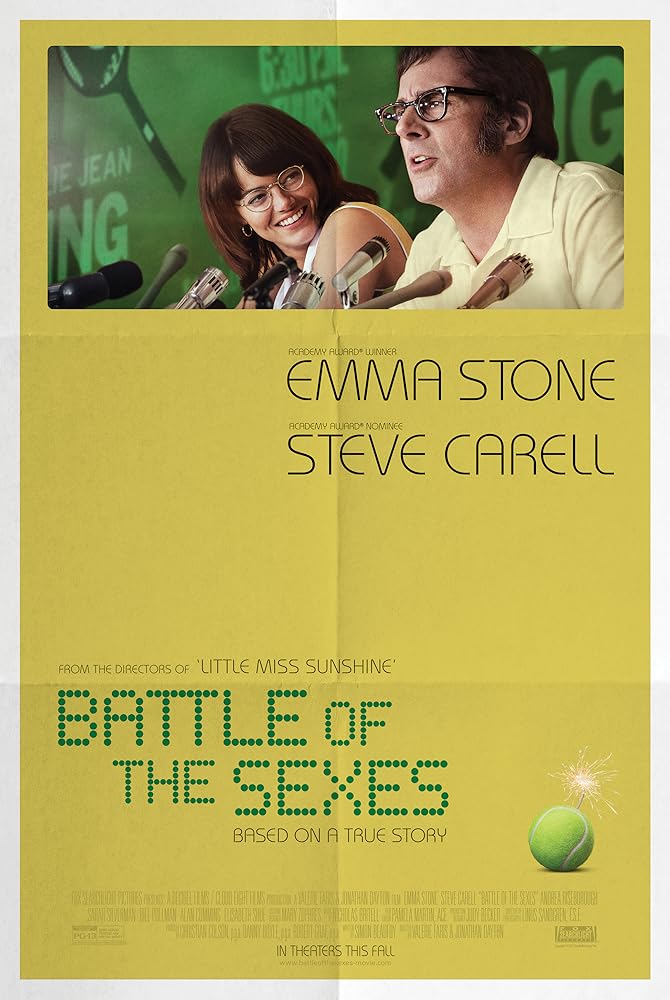
Battle of the Sexes (2017) review


In tennis, the term ‘Battle of the Sexes’ is used to describe an exhibition match that’s held between male and female tennis players. Since 1973, there have been various ‘Battle of the Sexes’ matches that have been played over the years, but only three of these have been primarily designated as such. And in today’s film of the same name, we get to see the true story of what is easily the most famous of these particular tennis matches, the 1973 nationally televised exhibition match between Billie Jean King and Bobby Riggs. King’s victory in the match proved to be quite a game-changer when it came to female tennis players earning more respect in the sport, and she would later go on to become the founder of both the Women’s Tennis Association and the Women’s Sports Foundation. And in this film, we learn the full story behind this milestone moment in her life thanks to the directing team of Jonathan Dayton and Valerie Faris. This husband and wife duo has been responsible for some well-received films over the years, including 2006’s Oscar contender Little Miss Sunshine, which ultimately won two Oscars for Best Original Screenplay and Best Supporting Actor for Alan Arkin, and 2012’s Ruby Sparks, a film written by its main actress, Zoe Kazan. And with their latest directorial endeavor, they give us a captivating true story drama with a well-executed feminist undertone and an outstanding lead performance from its leading lady in the role of one of the most famous tennis players of all-time.

In 1973, Billie Jean King (Emma Stone) is the top-ranked female tennis player in the world. At the same time, she’s also been quite an outspoken activist when it comes to male and female tennis players earning equal payouts from their victories. Unfortunately, she and her friend Gladys Heldman (Sarah Silverman), the founder of World Tennis magazine, haven’t been able to make much leeway on that front. At the time, male players were earning eight times more than female players which, as explained to the two women by US Lawn Tennis Association chief Jack Kramer (Bill Pullman), was because “the men are more exciting to watch”. In response to this, King, Heldman, and eight other players decide to hold their own tournament which ultimately becomes the Virginia Slims circuit, even though it also ends up getting them kicked out of the USLTA. While all this is going on, cocky former tennis star Bobby Riggs (Steve Carell) comes up with a crazy idea. He gets in touch with Billie Jean and challenges her to an exhibition match with a purse of $100,000. Billie Jean declines, though, and Riggs plays her longtime rival, Margaret Court (Jessica McNamee), instead. However, when Court ends up losing to Riggs in an embarrassing blowout, Billie Jean decides to finally accept Riggs’ offer and compete against him so that she can redeem the reputation of female tennis players in the male-dominated sport.

Battle of the Sexes is a highly engaging sports drama, even when considering the fact that those going into the film most likely know the outcome of its story (I mean, heck, I kind of already spoiled it in the intro). But even with that in mind, the film’s focus is geared more towards the build-up to the main event and Billie Jean’s efforts to champion equal pay amongst her fellow tennis players than the actual match itself. And through it all, the best thing about this film is that by the time the iconic match finally occurs, we are fully behind Billie Jean because of how important it is for her to win. That and she also proves to be quite a likable protagonist with a solid emotional arc based partially around her growing relationship with her hairdresser Marilyn (Andrea Riseborough) despite her marriage to Larry King (Austin Stowell (disclaimer: not THAT Larry King)). It also helps that she’s played by one of the most charismatic actresses in the industry, Emma Stone, as this is easily one of the best performances of her career. Meanwhile, Steve Carell is great as well as he slips into the role of the loud-mouthed, self-promoting Riggs with ease. In short, Battle of the Sexes reminds me a lot of another sports film that came out last year, Eddie the Eagle. These two films, both of which were based on true stories, ultimately succeeded because of how effective they were in making us sympathize with their main protagonists in their athletic endeavors. And thanks to strong direction from Jonathan Dayton and Valerie Faris, as well as an excellent ensemble cast highlighted by Emma Stone in what could potentially be another Oscar-winning performance for her, Battle of the Sexes is quite the rousing affair that couldn’t be more timely.


Rating: 5/5!

Thursday, July 6, 2017

In Defense of the 'Amazing Spider-Man' films

Image result for The Amazing Spider-Man series

This weekend sees the release of the next installment of the Marvel Cinematic Universe, Spider-Man: Homecoming. This new film is a collaboration between Marvel Studios and Sony, the latter of whom still hold the rights to the character as they have had for many years now. However, thanks to a deal that they made in 2015 with Marvel Studios, Spider-Man: Homecoming is very much a part of the MCU, with the webslinger having made his long-awaited series debut in last year’s Captain America: Civil War. It’s also worth noting, though, that this is the second major reboot that the character has had in half a decade. Some may express a bit of concern about this happening as often as it has in this timeframe, but based on its current critical reception, it looks like Spider-Man: Homecoming will turn out to be another big success for Marvel Studios and their legendary Cinematic Universe, while also serving as a bit of redemption for Sony and their own Marvel output. However, today on Rhode Island Movie Corner, I’d like to make an argument in defense of the previous film incarnation of Spider-Man, the one that ended up putting a major dent in Sony’s reputation when it comes to their handling of the character. I’m, of course, referring… to the Amazing Spider-Man films. Obviously, this first attempt at rebooting the Spider-Man film franchise did not go over too well with audiences, especially after the second entry in the series was both a critical and commercial underperformer. And, basically, that’s exactly why we now have this second reboot; the first one was that big of a disaster amongst critics and audiences. However, I still have a soft spot for these two films, despite them now being mostly remembered by the internet as nothing more than a failed attempt to copy Marvel Studios’ success.  

But before I get into the films themselves, let’s start with a little history. Of course, as many of us know, the friendly neighborhood webslinger’s first major outing on the big screen was Sam Raimi’s original Spider-Man trilogy. Prior to this, there had been several attempts at a Spider-Man film, even one directed by James Cameron. Finally, Raimi was brought in by Sony, who had bought the film rights to the character in 1985. The first installment of this new series, simply titled Spider-Man, was a huge hit when it was released in 2002. It was the first film ever to gross over $100 million during its opening weekend at the U.S. box-office. Thus, it is now generally regarded as one of the major catalysts in the modern-day resurgence of the superhero film genre, alongside 2000’s X-Men and 1998’s Blade. Two years later, Raimi and his crew returned for a sequel; Spider-Man 2. And while it didn’t outdo its predecessor at the worldwide box-office, many viewed it as a superior sequel and, thus, it became one of the most beloved entries in the superhero genre. It was then followed by Spider-Man 3 in 2007 and… well, you already know what happened with that one. While it was another box-office success for the franchise, even to the point where it became the highest-grossing entry in the trilogy, it only did ‘okay’ with critics and was mercilessly SAVAGED by audiences for its mishandling of the famous ‘alien symbiote’ storyline from the comics, which saw Peter Parker adopt a darker persona. Said storyline is also known for the creation of one of his most infamous adversaries, Venom, who in the film was ultimately relegated to a minor supporting role after being written in by studio demand. Still, despite the polarizing reaction, plans were still in place for a fourth film. However, in 2010, it was announced that Raimi was stepping down from the project because he felt pressured by Sony into getting it done by a 2011 release date.

Image result for Sam Raimi Spider-Man

Thus, in 2012, Sony decided to instead reboot the Spider-Man franchise. Director Marc Webb, who was fresh off 2009’s critically-acclaimed romantic drama indie (500) Days of Summer, was brought in to direct the first installment of this new Spider-Man series, The Amazing Spider-Man. Andrew Garfield, fresh off an award-nominated performance as Eduardo Saverin in The Social Network, was cast in the title role while Emma Stone was brought in to play Peter Parker’s original love interest from the comics, Gwen Stacy, who had previously appeared in a minor supporting role in Spider-Man 3 played by Bryce Dallas Howard. Upon release, the film did manage to hold off most of the skepticism that had been surrounding it; it did fine with critics and it grossed over $750 million worldwide. Still, there were some dissenters out there, and part of the reason why is admittedly understandable. Because to be perfectly blunt… The Amazing Spider-Man is basically just a retread of the original Spider-Man. It’s the same general story of an unpopular high-school student who gains superpowers after being bitten by a radioactive spider. His uncle dies, he falls in love with one of his classmates, a close colleague of his becomes the main villain, and the film ends with Peter having to sever any chances of a romantic relationship with his love interest. Sure, the film adds in the plotline of Peter’s parents, skirts around Uncle Ben’s famous ‘With Great Power Comes Great Responsibility’ line, and the part where Peter breaks off his relationship with Gwen does go differently than before because she immediately realizes why he’s doing this. But at the end of the day, this origin story isn’t that different from the 2002 film’s origin story. I mean, to be fair, that was just an unfortunate side-effect of this film’s status as a reboot that came out only a decade after the release of Raimi’s first film. On that note, thankfully the new series with Tom Holland has decided to skip past the character’s origin, which is good seeing how we’ve already seen it twice now on film since 2002.

Still, I’d argue that this film does just enough to differentiate itself from Spider-Man’s previous onscreen incarnation. I mean, if anything, it’s not like this is a direct ‘carbon copy’ of Raimi’s film. The biggest change comes with the increased role of Peter’s parents, Richard and Mary Parker. Having only been mentioned in the Raimi films, the first Amazing film opens with Peter’s parents leaving him at Uncle Ben and Aunt May’s while they go off on an important business matter, only to never return. Thus, most of the film’s plot revolves around Peter learning more about his parents’ secrets and why this led to their disappearance which, in turn, ultimately leads him on the path to becoming Spider-Man. Now, admittedly, despite what I just said, the film doesn’t really focus too much on what happened to Peter’s parents save for a brief flash of a newspaper article mentioning that they were killed in a plane crash. Afterward, it basically just turns into a Spider-Man story that only occasionally ties everything back to Peter’s past. However, it does seem like there was initially going to be a greater focus on Peter’s parents based on the film’s several deleted scenes. These scenes include, among other things, some additional character development for Dr. Curt Connors, Richard Parker’s colleague, and an expanded role for their seemingly sinister superior, Dr. Kafka, who straight-up disappears from the film after the big action sequence on the bridge. Some of these scenes even appeared in the trailer, only to then not appear in the final cut. As we’ll soon see, that’s basically one of the biggest dilemmas with these films. Clearly, a lot of material was left on the cutting room floor, perhaps so that it could be saved for the sequel. On that note, thankfully, the plotline with Peter’s parents returned in the sequel and was given more attention there than in the first film.

Image result for andrew garfield and emma stone spider-man

Ultimately, though, the main reason why I liked these films more than the Raimi films (which, to be clear, I still like by the way) is that I just liked the characters in this series more, especially Peter and Gwen. While I do feel that both Tobey Maguire and Kirsten Dunst were solid in the Raimi films, Andrew Garfield and Emma Stone totally have them beat when it comes to chemistry. I mean, after all, these two were a couple in real-life, and that is indeed apparent in the several scenes where they’re together. As for Andrew Garfield’s performance in the role of the iconic webslinger, I much preferred his take on the character over Tobey Maguire’s. And, for the most part, it seemed like most critics were happy with Garfield’s take on the character as well. However, there have been some who felt that he wasn’t that good when it came to portraying Peter outside of the suit. They argued that he was whiny and that he didn’t look the part of a high-school nerd. And I’ll admit that, yes, Tobey Maguire was perhaps better when it came to conveying Peter’s nerdy qualities when he wasn’t in the suit. However, I don’t really agree with the ‘whiny’ argument, which in the first film mainly comes into play when Peter argues with Uncle Ben in the scene before his death. And the main reason why is one that gets brought up by several cast and crew members in the film’s behind-the-scenes material; at the end of the day, Peter is just being a teenager. At that age, teenagers will often find themselves lost at times and, thus, make questionable decisions. And that’s exactly what Peter does at times in this film, as a lot of his inner turmoil is, of course, based around him not knowing why his parents left him at such a young age. In short, I fully appreciate how this new version of Peter was characterized overall, which I would argue makes him more sympathetic than Maguire’s Peter.

But if there’s one clear thing that Garfield did indeed do better than Maguire, it’s being Spider-Man. Spider-Man is a character who is well-known for the comedic quips that he spurts when he’s fighting crime, and Garfield had that part down perfectly. Sure, some may argue that he didn’t do this that much in the first film save for the scene where he confronts the carjacker (“You’ve found my weakness. It’s small knives!”) but at the very least, things only got better in the sequel, where Garfield truly shined in the role. By comparison, Maguire never really got the chance to use Spidey’s trademark quips. I don’t know whether it was because of Raimi or the screenwriters, but Maguire’s Spider-Man was much more serious in tone. Thankfully, there were a few instances here and there where Maguire did throw out some quips at his enemies. It’s just that they really were few and far between. The first instance of this that I can recall came in the second film when he’s fighting Dr. Octavius at the bank. When Octavius remarks that Spidey is getting on his nerves, Peter then proceeds to joke that “he has a knack for that”. The other major instance that I can think of comes in Spider-Man 3, during his first fight with Flint Marko AKA the Sandman. When he first confronts Sandman, he informs him that he’s ‘the sheriff around these parts’. Then, after the fight, he goes to the roof of a skyscraper to empty out the sand in his costume, where he poses the question, “Where do all these guys come from?”. I will say that, at the very least, Spider-Man 3, which was co-written by Raimi and his brother Ivan, did allow Maguire to be more comedic in the role of Peter. However, considering that part of this included his infamous ‘emo’ phase (which really wasn’t as bad as the internet constantly puts it out to be; if anything, it was far from being the film’s biggest problem), that’s up for debate. Garfield, thankfully, never went ‘that far’ when playing the character.

Image result for emma stone spider-man

The real standout of these films, though, was Emma Stone in the role of Gwen Stacy, who is hands down the best on-screen love interest that Spidey has ever had in these films. Again, nothing against Kirsten Dunst, as she had good chemistry with Tobey Maguire and even a solid character arc in the second Raimi film as she navigated through her complicated love life. But at the end of the day, Mary Jane Watson was mainly just a damsel in distress who was constantly being saved by Peter. Gwen, meanwhile, was by no means a ‘damsel in distress’. Sure, she got cornered a few times by the Lizard in the first film and was captured by the Green Goblin during the finale of the second film, but she also played an active part in helping Spider-Man defeat his enemies. She helped to develop the cure for the Lizard’s mutagen in the first film and helped make Peter’s web-shooters resistant to Electro’s attacks in the second film. Heck, during a scene in the first film when she’s confronted by the Lizard, she straight-up wards him off with fire. But easily one of her most defining moments in these films came at the end of the first film which, like the ending of the first Raimi film, had Peter breaking off his current romantic relationship with her. Except in this instance, instead of it ending with Peter just walking away, Gwen immediately realizes why he is doing this; during the final battle, her father, Captain George Stacy, is killed by the Lizard. With his dying breath, he makes Peter promise to ‘leave Gwen out of it’, knowing that he’ll make many enemies as Spider-Man in the future. However, by the end of the film, it seems as if Peter and Gwen’s relationship might not be over after all. Though as we’ll soon see in the second film, this relationship becomes quite complicated.

The two are backed by an excellent supporting cast. Denis Leary is a major standout as Gwen’s father, George Stacy. Given his status as a New York City Police Captain, he provides a nice contrast to Peter’s actions as Spider-Man while also getting some of the best lines in the film, from “38 of New York’s finest versus one guy… in a unitard” to his response to when Peter tells him about Connors transforming into a giant Lizard (“Do I look like the mayor of Tokyo to you?”). And I won’t lie… I teared up quite a bit when he died. Sure, his role in the sequel was odd, to say the least, as he mainly appeared as a vision of Peter’s, forcibly reminding him of the promise that he made to him. Still, he was easily one of the best parts of the first film. Meanwhile, Martin Sheen and Sally Field are both fantastic as this series’ iterations of Uncle Ben and Aunt May. Their takes on these classic characters are a bit more authoritative in tone compared to Cliff Robertson and Rosemary Harris’ performances in the Raimi films. They still are the loving surrogate parents in Peter’s life but they do take on a stricter parenting role whenever he gets into trouble, especially Uncle Ben. And on that note, while it is pretty much the same as the scene from the first Raimi film, Webb does do a good job when it comes to handling Uncle Ben’s death in this film. Heck, I’ll even admit that perhaps I found this one to be just a tad bit more heartbreaking seeing how this happened while Ben was looking for Peter after an intense argument between them. And as for Sally Field as Aunt May… well, recently she’s distanced herself from these films, stating that it wasn’t ‘her kind of film’ but that she did it for her friend, producer Laura Ziskin, who had also produced the Raimi films. The Amazing Spider-Man would ultimately be one of the last projects that she worked on before her death in 2011. Field also stated that she felt that there wasn’t much depth to the character; a shame, really, because I’d argue that she gave it her all in the role, especially in the sequel.

Image result for dr. connors amazing spider-man

As for the main villain, Dr. Curt Connors AKA the Lizard, I think that he was the series’ best ‘sympathetic’ villain since Dr. Octopus in Spider-Man 2. After all, that’s a common starting point when it comes to some of Spider-Man’s adversaries in these films; not all of them are just straight-up ‘bad guys’. In fact, almost all of them have a personal connection to Peter in some way, shape, or form. In this instance, Dr. Connors was a close friend of Peter’s dad who worked alongside him at Oscorp. And when we first meet him, we learn that he and Peter’s father were experimenting with cross-species genetics to try and find cures for diseases along with other potential scientific breakthroughs, including the possibility of humans being able to regenerate limbs. Connors himself only has one arm, hence why he’s fully determined to make his experiments work. While there was some material with Connors that was cut from the final film, including a scene where we see that he has a son, Rhys Ifans does a great job in making Connors a sympathetic character who’s trying to heal himself as much as he wants to heal the world. But, after one failed test, he becomes a diabolical creature and his goals become corrupted as he works to turn all of New York into lizard beings like himself. Dr. Connors had previously appeared in the Raimi films as well, played by Dylan Baker. Sadly, for Baker, he was never given the opportunity to become the Lizard, though, apparently, he was being set up to do so in the unmade fourth film. Thankfully, we finally got to see this character fully realized on the big screen in the first Amazing Spider-Man, and I think that it was also good that they started out with him instead of re-doing a villain from the Raimi films. Obviously, they re-did Green Goblin in the second film but, again, that was the second film. At that point, I’d argue that it was okay for them to try and do a new take on a previously seen character.

Finally, one of the other major things that I think the Amazing films do better than the Raimi films is its action sequences, namely whenever Spidey is swinging through the city. Admittedly, the first Raimi film has become rather dated in terms of its effects; you can clearly tell whenever a digital double of an actor is used during a fight scene. Thankfully, the Raimi films did improve from an effects standpoint as they went on. Thus, by the time that the Amazing films came around, Spider-Man’s web-slinging became more fluent than ever from a visual perspective. The second film, especially, featured some of the best Spider-Man swinging sequences ever put on film. With that in mind, I do think that Webb managed to improve as an action director the same way that Christopher Nolan did between Batman Begins and The Dark Knight. In Nolan’s instance, while Batman Begins was a great return to form for Batman on the big screen after almost a decade, its biggest shortcoming was its poorly edited fight sequences, which I attribute to it being Nolan’s first big action film. Thankfully, Nolan stepped up his game three years later with some exceptional fight sequences in The Dark Knight. Now, for the record, I’m not saying that Webb pulled off a Dark Knight-level leap in quality when it came to the second Amazing film. But, like Nolan, this was a case where the first Amazing Spider-Man was his first big action film. And while the action was solid enough in the first film, Webb managed to take it one step further in the sequel. For one thing, the sequel has action sequences that are set during the day instead of at night like in the first film. Seriously, the only major daytime action sequence in the first film… was one that took place within a school.

Related image

On that note, now it’s time to talk about that infamous sequel, 2014’s The Amazing Spider-Man 2. Like Spider-Man 3, it experienced an extremely polarizing response from critics and audiences that leaned more towards the negative. And while it was one of the top-grossing films of the year, with over $708 million worldwide… it was ultimately the lowest-grossing Spider-Man film to date. Thus, the following year, Sony made a deal with Marvel Studios to co-produce a second reboot franchise, which would allow the character to finally make his long-awaited debut in the Marvel Cinematic Universe. This also meant that all of Sony’s plans at the time to continue the Amazing series ended up falling by the wayside. But as for me, I was in the minority of people who did like The Amazing Spider-Man 2. And after re-watching it again as research for this post… I found that I still liked it. Hell, scratch that, I love it. As I noted before, it improved upon its predecessor in terms of the action sequences and visuals, effectively becoming the best-looking Spider-Man film to date. And just like its predecessor, it benefitted greatly from the lead performances of Andrew Garfield and Emma Stone. Garfield fully embraced Spidey’s comic persona while Stone’s Gwen continued to be his best on-screen love interest. Sure, the two do spend most of the film apart from each other after they break up due to Peter’s guilt over not sticking to the promise that he made to her father. But when they do share romantic scenes, boy are these two cute together. The scene where the two rekindle their relationship on top the Brooklyn Bridge is especially heartwarming… though also a bit gut-wrenching when you know exactly what’s about to happen to them. But I’ll get to that later…

Remember how there was quite a lot of material left on the cutting room floor with the first film? Well, it’s an even bigger problem with this one. Once again, several scenes that were even featured in the trailer ended up being removed for various reasons, and in this instance, it does indeed impact the overall narrative. This includes a scene where Peter’s best friend Harry Osborn (Dane DeHaan) informs him that his father’s company, Oscorp, has been watching him and his family for years and, in what is perhaps the most notable (or ‘infamous’, depending on your point of view) deleted scene of the bunch, Peter is reunited with his long-lost father, who is revealed to have survived the plane crash, which we see happen in the film’s opening sequence. There were also a few scenes featuring Shailene Woodley as Mary Jane Watson, but her scenes were cut because Webb wanted to focus more on Peter and Gwen’s relationship instead of the one that would obviously occur between Peter and MJ. But unlike the previously mentioned deleted scenes, these haven’t been released yet, and now that Sony has moved onto a new series, it’s unlikely that we’ll ever see them. To me, this film feels very much like Iron Man 2, which also tried to set up a lot of material for future films to the point where it ended up being detrimental to its main plot. But whereas Iron Man 2 didn’t do ‘terribly’ with critics and was part of the continually-developing Marvel Cinematic Universe, Sony didn’t have the same kind of leeway with the Amazing films. Thus, several big-name actors ended up being vastly underutilized in roles that were clearly meant to be expanded upon in future films. This includes Felicity Jones as Harry’s assistant Felicia, who would’ve become the vigilante Black Cat from the comics, and B.J. Novak as scientist Alistair Smythe, who was well-known in the comics for creating robots known as the Spider-Slayers.

Image result for amazing spider-man 2

Ultimately, though, the film ends up facing the same dilemma as Spider-Man 3; a narrative that featured several main villains, three to be specific. However, while I do think that both films clearly bit off more than they can chew by having all these villains in one film, I still think that Spider-Man 3 was more problematic when it came to it having ‘too many villains’. And that’s because, after about 2-4 viewings of that film, I’m still unsure as to who the main villain of that film was. At first, it seemed like it was going to be Harry Osborn AKA ‘New Goblin’, but he’s put out of commission for a bit due to a sustained bout of amnesia. Then, there was Sandman, and for the most part, he was the ‘main threat’ of the film, especially given the big personal connection that he has with Peter as it’s revealed that he was the one who killed Uncle Ben. But then, like Harry, he too exits the film for a decent amount of time before coming back at the end. And then, of course, there’s Venom… who’s only in it for like ten minutes or so before he’s killed off. Amazing Spider-Man 2, at the very least, was a bit clearer as to who the main villain was; Electro. Sure, there’s a point in the film where he’s taken into custody for a bit, but by the end, he’s still ultimately the big threat for Spidey to stop. As for Harry, he slowly but surely changes into the Green Goblin by the end of the film; in other words, he was clearly meant to be one of the ‘big baddies’ in future films, though he does play a major part in this film’s finale. And as for the film’s third villain, Rhino, he was only meant to be a ‘book-end’ villain, first appearing at the beginning of the film and then returning at the end. I mean, to be fair, while Spider-Man does have a wide array of adversaries in the comics, not all of them are big enough to be ‘main villains’. And it seems like Spider-Man: Homecoming is doing a similar thing; Michael Keaton’s Vulture is the main villain while the film will also feature characters like Shocker and the Tinkerer in smaller roles.

And overall, I was fine with the villains in this film. Paul Giamatti was delightfully hammy in his brief appearance as the Rhino; again, a brief appearance, but it did result in a fun opening sequence and ending, even though the latter cuts to the credits before the fight gets underway. As for Jamie Foxx as Electro, the film continued the series’ tradition of sympathetic villains who weren’t ‘bad guys’ just because they’re evil. In the case of Electro, he starts out as a lowly Oscorp employee named Max Dillon who is led to believe that he’s Spider-Man’s best friend after Spidey saves him one time. After transforming into the electrically-powered being Electro, Max is confronted by Spider-Man again, and even though Peter attempts to peacefully subdue him, this fails and the ensuing battle leads to Max’s opinion of Spidey being forever tarnished. Sure, maybe this happens rather abruptly… that and Foxx’s take on the character is very reminiscent of Jim Carrey’s portrayal of Edward Nygma AKA the Riddler in Batman Forever, complete with a whole subplot that focused heavily on the fact that his transformation occurred on his birthday. In fact, there are a lot of overly goofy moments in this film, more so than just anything that Electro does. Thus, one of the major criticisms of the film was its tendency to have some noticeable tonal shifts. I do see where people are coming from with this, but it ultimately didn’t bother me that much. Plus, going back to what I said before about how this film had some of the best Spider-Man action in any film to date, the creation of Electro does lead to some awesome electricity-based visuals and action sequences. And I also don’t mind the changes that were made to Electro’s overall design. I mean, to be fair, I don’t see how they could’ve put Foxx in a green and yellow spandex suit complete with a lightning-bolt shaped mask; that would’ve made things even sillier if you ask me. And finally, with Dane DeHaan as the new Harry Osborn AKA Green Goblin, I thought that he was an interesting new take on the character, as we see traces of both his long friendship with Peter and his eventual descent into anarchy. If he had been given another film to work with, I think his take on the character would’ve become even better.

Image result for amazing spider man 2 sinister six

On that note, what were the plans then if the franchise hadn’t stalled out with this film? Well, obviously, there would’ve been a third (and maybe even a fourth) Amazing Spider-Man film, once again directed by Marc Webb and starring Garfield and DeHaan. But perhaps the most notable planned follow-up was a spin-off that focused on Spider-Man’s most notorious group of adversaries from the comics, the Sinister Six. The film was set to be written and directed by Drew Goddard, to the point where he even dropped out of handling show-running duties on Daredevil to work on this film. And the lineup for this gang of villains was directly teased in the credits of Amazing Spider-Man 2. This included, of course, returning characters Green Goblin and Rhino along with two characters that were teased in the film itself during a scene set at Oscorp that showcased their technology; Doc Ock and Vulture, the latter of whom will finally make his big-screen debut in Spider-Man: Homecoming. Finally, the other two confirmed villains were Kraven the Hunter, who would’ve debuted in the third film, and either Chameleon or Mysterio as implied by a bright-white mask. Ultimately, though, as we all know, this film, along with a planned Venom spin-off (that, apparently, is now back in development with Tom Hardy set to star in the lead role), were both canceled after the Marvel Studios deal was made official. It’s a shame, really, because I was interested in seeing both these films. Sure, it probably would’ve been difficult to try and make a film based around villainous characters and not superheroes, but I’m sure that it could’ve been done. Instead, we ultimately got our first big villain-centered comic book film in 2016 with DC’s Suicide Squad. And while that film also didn’t fare too well with critics, I still think that we’ll eventually see a good supervillain-led film in the future.

Anyway, back to Amazing Spider-Man 2… amidst all the goofy moments in this film, there are also some genuinely brilliant moments as well. Early on, there’s a scene where Peter saves a young kid from bullies and then proceeds to befriend him, complimenting his wind turbine science project and so on and so forth. This kid, Jorge, later returns at the end of the film where he dresses up as Spidey before the real Spidey comes back after being on a brief hiatus. In short, this was arguably the greatest on-screen instance of Spider-Man being the kind of role model to younger audiences that he’s always been known for. There’s also the scene where Peter talks with Aunt May about his father’s secrets which, as noted before, is a prime example of how Sally Field was truly giving it her all in the role despite her eventual thoughts on the films. Finally, of course, there’s the tragic finale in which, like in the comics, Gwen dies after sustaining injuries from a long fall. Say what you will about the rest of the film, but this moment is handled perfectly, thanks in no small part to Garfield and Stone’s excellent performances. Sure, it’s not exactly like it was in the comics, where the Goblin drops her from the George Washington Bridge, but we already got a scene like this in Raimi’s first Spider-Man film (with thankfully less tragic results). Instead, it occurs within a clock tower, and there’s even a neat little Easter egg where the clock stops at 1:21; #121 is the issue of Amazing Spider-Man in which Gwen died. Simply put, this was a truly emotional and heartbreaking scene that, along with all the other previously mentioned ‘brilliant’ scenes, is why I take issue whenever someone says that this is one of the worst superhero films of all-time… far from it. This is NOT the 2015 reboot of Fantastic Four, even though both films were clearly affected by hasty studio interference. And this is also NOT Batman and Robin, even though both films do have plenty of corny moments in them. Now, for the record, I do understand if some consider this to be a ‘middle-of-the-road’ entry in the genre, but worst? No way!

Image result for tom holland andrew garfield spiderman

Which is why I’m still a bit disappointed that this series had to end with a whimper by being replaced just like the Raimi films were. Now, don’t get me wrong, while I do prefer Garfield’s take on Spider-Man over Maguire’s, I did love Tom Holland’s portrayal of the character in Captain America: Civil War. Like Garfield, Holland had Spidey’s comedic quips down perfectly, and I also loved how this new take on the character is really focusing in on his high-school years, more so than Maguire and Garfield’s iterations combined (“I can’t go to Germany… I’ve got homework!”). And again, it looks like Spider-Man: Homecoming is shaping up to be the best Spider-Man film since Spider-Man 2, thanks in no small part to the influence of Kevin Feige and his team at Marvel Studios. But I must ask… why then couldn’t they just continue the Amazing films but do what they’re doing right now and have Feige and his team brought in to rework things so that the series could continue at a smoother pace? After all, as I’ve noted numerous times, Feige and his team clearly know what they’re doing. The Marvel Cinematic Universe wouldn’t be where it is today, in the middle of Phase III and building up to what will surely be an epic conclusion to the current age of the franchise in Avengers: Infinity War, without them. Now, I’ll admit, maybe they figured that the plans for future Amazing films were just too messy at that point to be salvaged, but given how many characters have been ‘redeemed’ through their roles in the MCU, I bet that they could’ve saved it. But, of course, that didn’t happen, and it does make you feel bad for Marc Webb and Andrew Garfield, both of whom are talented at what they do. It’s a shame, really, that both were ultimately hindered by a pair of films that were severely affected by studio influence. 
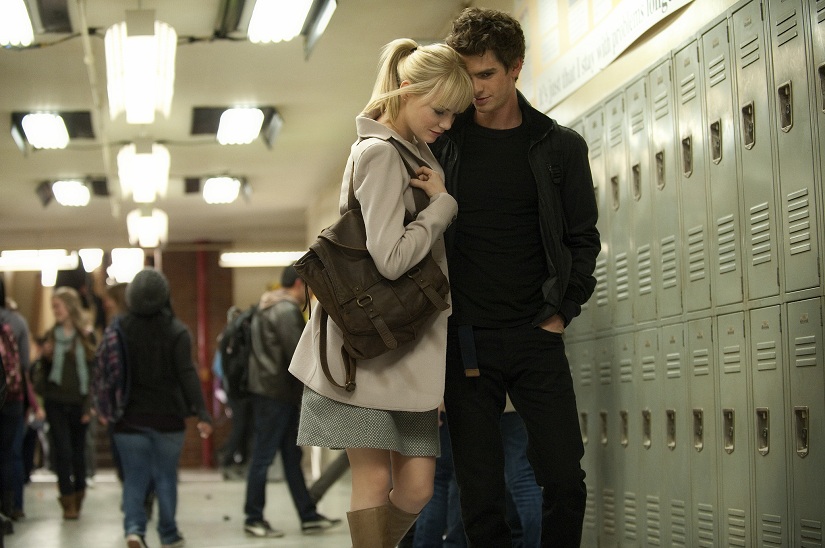
Image result for amazing spider-man peter and gwen


Well, even though the internet has mostly forgotten about them by now, I still really enjoy the Amazing Spider-Man films. In fact, I won’t lie… I have a stronger personal connection to them than I do the Raimi films which, again, I do still like. For one thing, the Amazing films were the first Spider-Man films that I ever saw in theaters. Yes, I’ll admit that I didn’t see any of the Raimi films in theaters, mainly because I was too young for them at the time. I did catch a few glimpses of the first Raimi film back in 2002, but that was at the drive-in and it was a situation where my dad and brother were seeing it while my mom and I went to see another film. The Amazing Spider-Man was my first true Spider-Man film seen in theaters. In fact, that instance was a special one for me as it was the first time that I ever went to an early screening. One of my local radio stations had a contest where they were giving away tickets to an IMAX screening of the film in Providence to those who called in and correctly named a film that the hosts used an audio clip from. And as fate would have it, I won on the day that the audio clip came from Marc Webb’s first film, (500) Days of Summer (how fitting!). And I remember this because my mom called it in for us (I had just been dropped off at school) and when she told the hosts that I gave her the answer, one of them joked that the film was rated R… even though it wasn’t. And I guess that part of the reason why I loved Amazing Spider-Man 2 so much is that I saw it at one of those ‘perfect times’. It was the last day of my freshman semester at college and the film was exactly what I needed after a rather rough second semester. In conclusion, yes, I know that I’m in the minority when it comes to liking these films. But remember, film is subjective; thus, it works in different ways for different people. Case in point, a lot of people my age are still very fond of the Raimi films, which in turn impacted their thoughts on the Amazing films. And, heck, I’ll even admit that back then, I was as skeptical as most people were about these films when they were first announced. But at the end of the day, I was surprised to find that I really connected with these films, more so than I ever did with the Raimi films.

Tuesday, February 28, 2017

89th Academy Awards: Results + Recap Post

BEST VISUAL EFFECTS: THE JUNGLE BOOK

Related image

BEST EDITING: HACKSAW RIDGE

Image result for hacksaw ridge poster

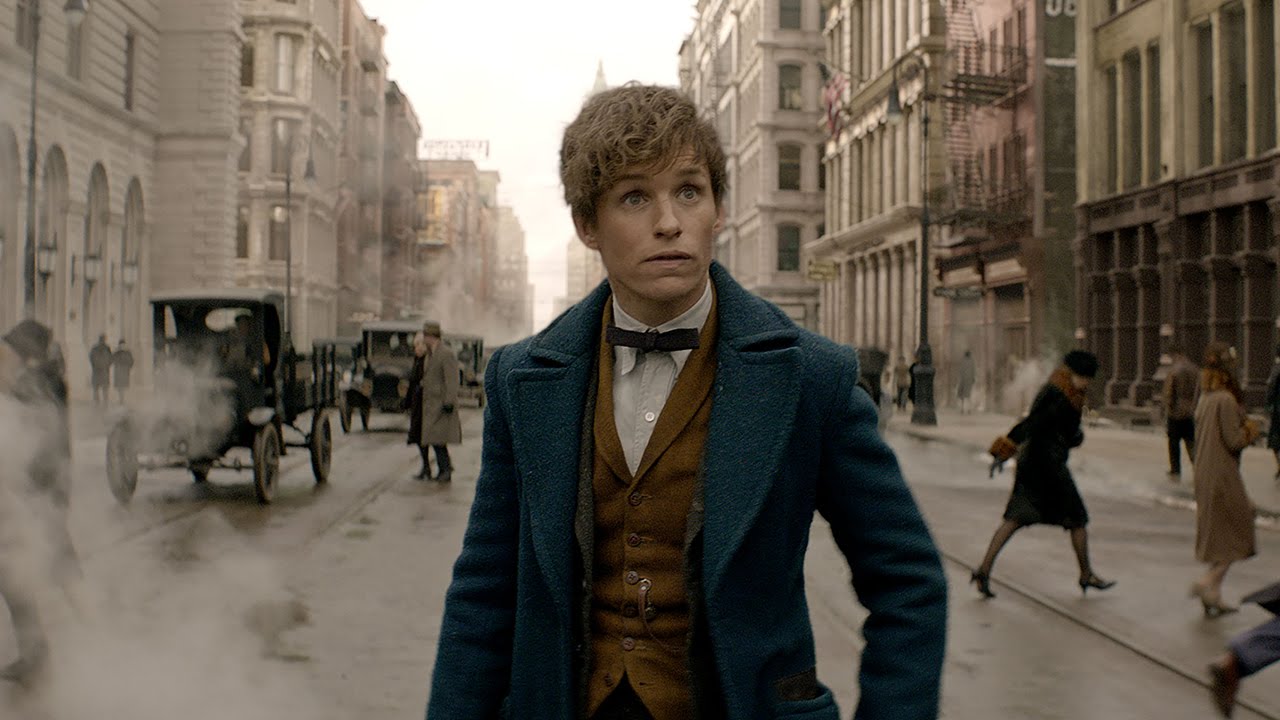
BEST COSTUME DESIGN: FANTASTIC BEASTS AND WHERE TO FIND THEM

Image result for fantastic beasts and where to find them

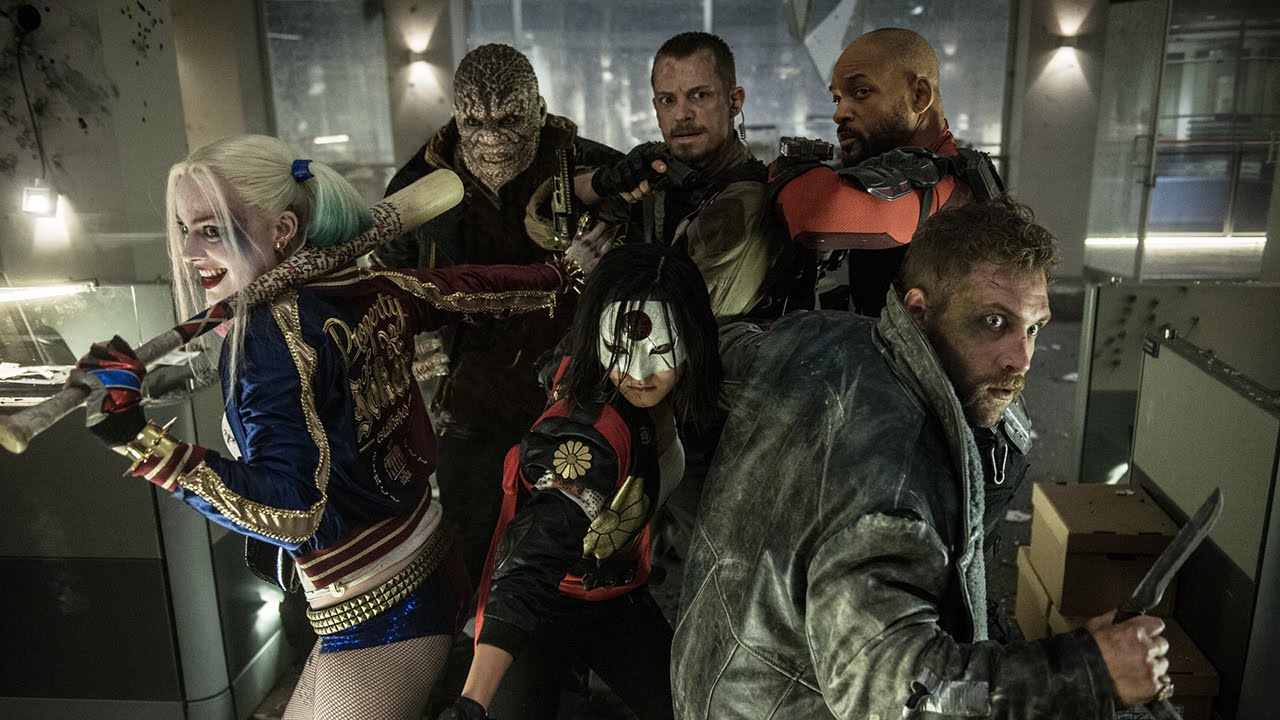
BEST MAKEUP/HAIRSTYLING: SUICIDE SQUAD

Image result for suicide squad

BEST CINEMATOGRAPHY: LA LA LAND

Image result for la la land

BEST PRODUCTION DESIGN: LA LA LAND

BEST SOUND MIXING: HACKSAW RIDGE

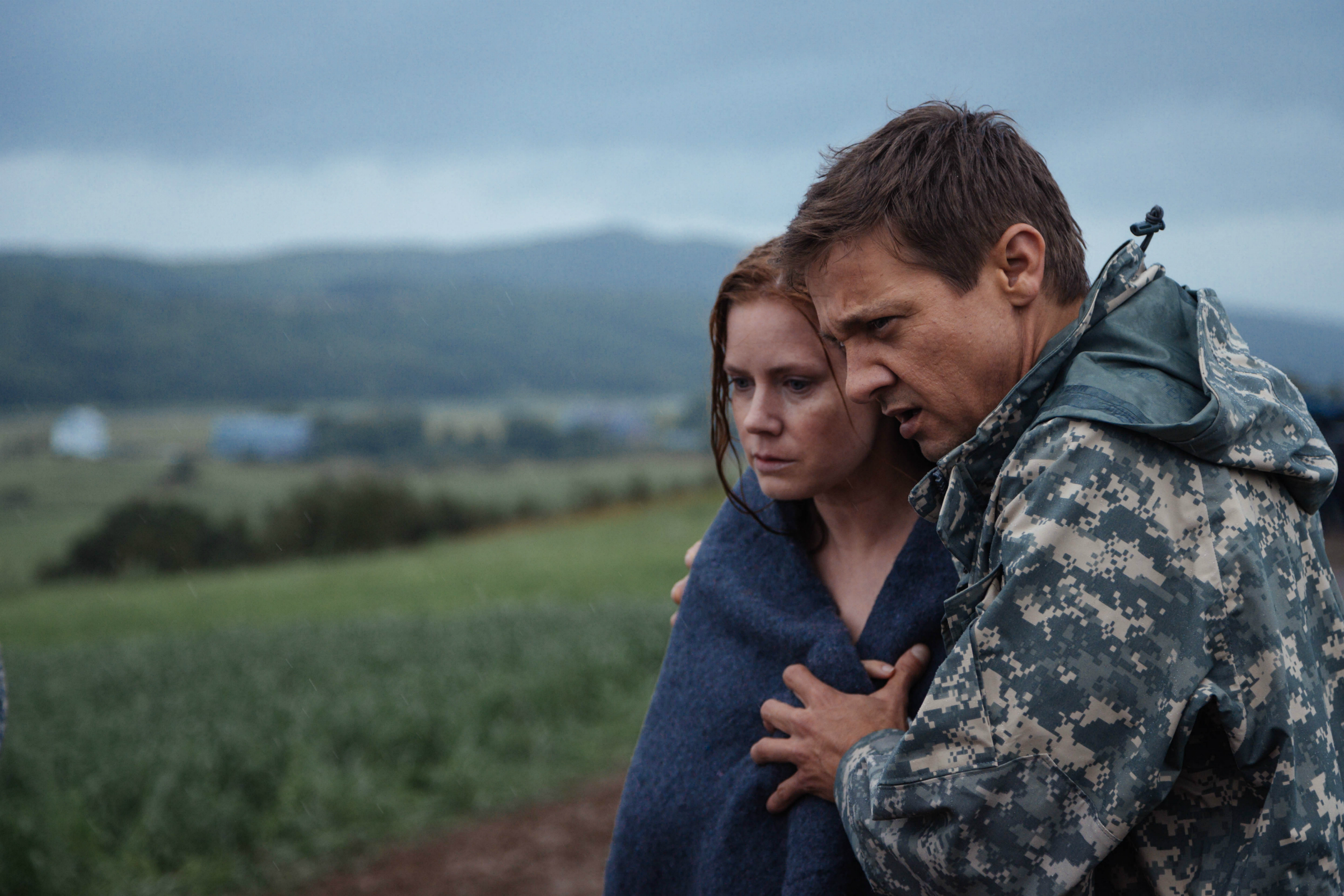
BEST SOUND EDITING: ARRIVAL

Image result for arrival

BEST ORIGINAL SONG: CITY OF STARS (LA LA LAND)

Related image

BEST ORIGINAL SCORE: LA LA LAND

Image result for la la land soundtrack

BEST ANIMATED SHORT: PIPER

Image result for piper pixar

BEST LIVE-ACTION SHORT: SING

(Disclaimer: Not to be confused with the animated film of the same name)

Image result for sing oscar short film

BEST DOCUMENTARY SHORT: THE WHITE HELMETS

Image result for white helmets documentary

BEST DOCUMENTARY: O.J.: MADE IN AMERICA

Image result for oj made in america

BEST FOREIGN LANGUAGE FILM: THE SALESMAN (from Iran)

Image result for the salesman

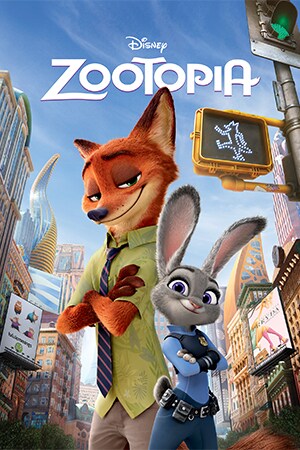
BEST ANIMATED FILM: ZOOTOPIA

Image result for zootopia

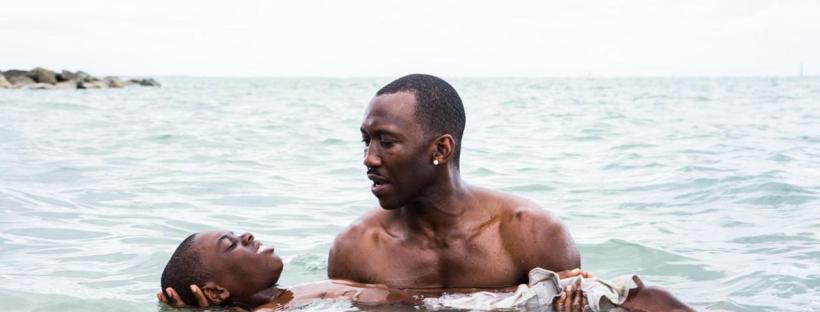
BEST ADAPTED SCREENPLAY: MOONLIGHT

Related image

BEST ORIGINAL SCREENPLAY: MANCHESTER BY THE SEA

Image result for manchester by the sea

BEST SUPPORTING ACTRESS: VIOLA DAVIS (FENCES)

Image result for viola davis fences oscars

BEST SUPPORTING ACTOR: MAHERSHALA ALI (MOONLIGHT)

Image result for mahershala ali moonlight oscars

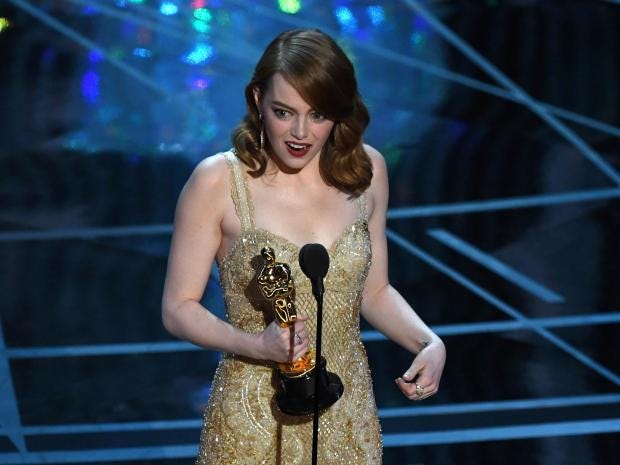
BEST ACTRESS: EMMA STONE (LA LA LAND)

Image result for emma stone la la land oscars

BEST ACTOR: CASEY AFFLECK (MANCHESTER BY THE SEA)

Image result for casey affleck manchester by the sea oscars

BEST DIRECTOR: DAMIEN CHAZELLE (LA LA LAND)

Image result for damien chazelle la la land oscars

BEST PICTURE: LA LA LAND… Wait, sorry, my mistake… MOONLIGHT

Image result for moonlight poster

THOUGHTS ON THE SHOW

Image result for jimmy kimmel oscars

Holy crap, that ending! Talk about one of the craziest endings in Oscars history! Anyway, I’ll get into that finale later. First, it’s time to talk about the show in general, and I must say, even with that crazy ending, this was a great ceremony. Now, as far as my experience with late-night talk shows is concerned, I’ll admit that I usually don’t watch them live. Like many, I tend to just watch a lot of these shows’ clips on YouTube when they’re posted the following day after a broadcast. The only one of these shows that I can say that I do watch live, on occasion, is Jimmy Kimmel Live! Jimmy Kimmel is an entertaining face in the current crop of late-night talk show hosts. He’s a likable TV personality and there are plenty of entertaining recurring segments on his show, including Mean Tweets and his legendary rivalry with a famous Hollywood star (who I won’t mention just yet…). Plus, seeing how he’s on a Disney-owned network, he almost always gets to debut the newest MCU trailer on his show. As for his turn as this year’s Oscar host, I thought that he did a great job. He got to use some of the classic segments from his show and he didn’t overload his monologues with political jokes, even when considering that this past year, in general, warranted a lot of material for those kinds of jokes. But, as he admitted in the opening monologue, he’s just not that kind of host. As for this year’s award results, I can’t complain with any of the winners. A lot of great films and performances got the recognition that they deserved.

And now it’s time for my favorite (and least favorite) moments from this year’s ceremony. And this year, I’m pleased to say that almost all these moments were great ones.

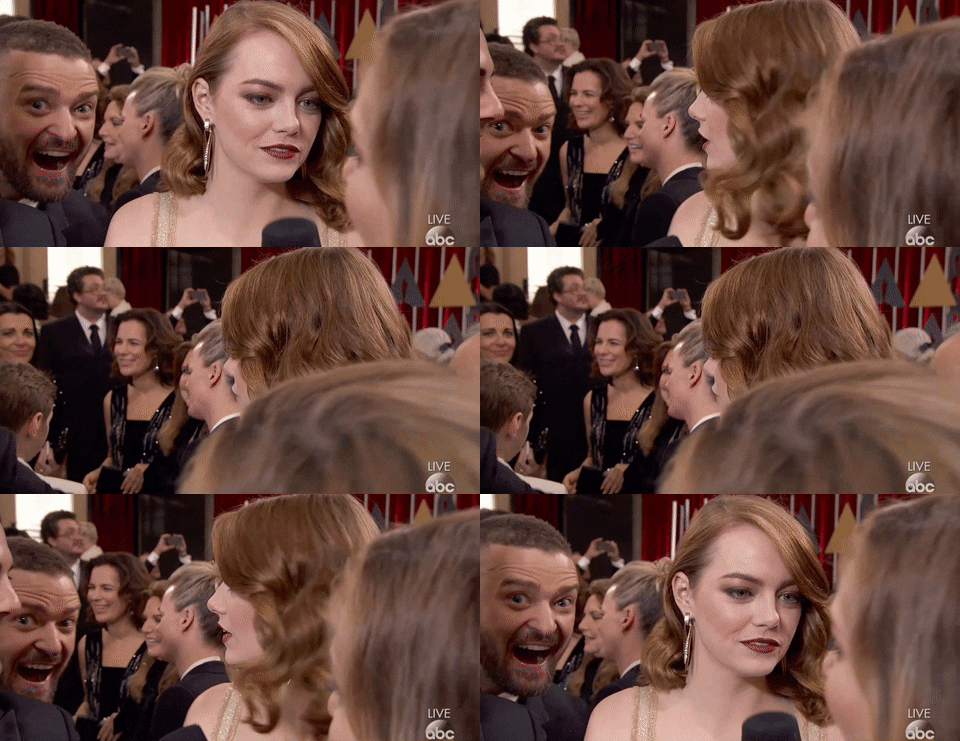
BEST: THIS PHOTOBOMB

Image result for justin timberlake photobomb

Justin Timberlake orchestrated the best photobomb of the night, which he did to Emma Stone during an interview on the red carpet.

BEST: THIS REACTION SHOT


I can’t explain why, but this shot of Mel Gibson eating a Red Vine after Jimmy Kimmel made a joke directed at him might just be one of my new favorite reaction shots ever.

HILARIOUS: WHEN SUICIDE SQUAD WON AN OSCAR

Image result for suicide squad oscars

Hands down, one of the biggest surprises of the night was when Suicide Squad beat Star Trek Beyond to win Best Makeup and Hairstyling. And, as I hinted at in my ‘Predictions’ post, this was a hilarious moment just because of the obvious reason that Suicide Squad was savaged by critics upon release. Of course, Twitter went nuts when this happened (one of my favorite tweets was one that said ‘Suicide Squad has more Oscars than you do’, and keep in mind, I’m saying this as someone who did like the film) but, like I said, at the very least, the makeup design for the film was one of its better aspects. I mean, it’s not like it won Best Picture or anything. The only real downside to this, if you ask me, is that DC fanboys are now going to use this win to belittle Marvel any chance that they get. Doctor Strange didn’t win Best Visual Effects, meaning that a DCEU film has won an Oscar before an MCU film. I’ll give you folks a minute to let that sink in…

BEST: GREAT MUSICAL PERFORMANCES

Image result for auli'i cravalho oscars

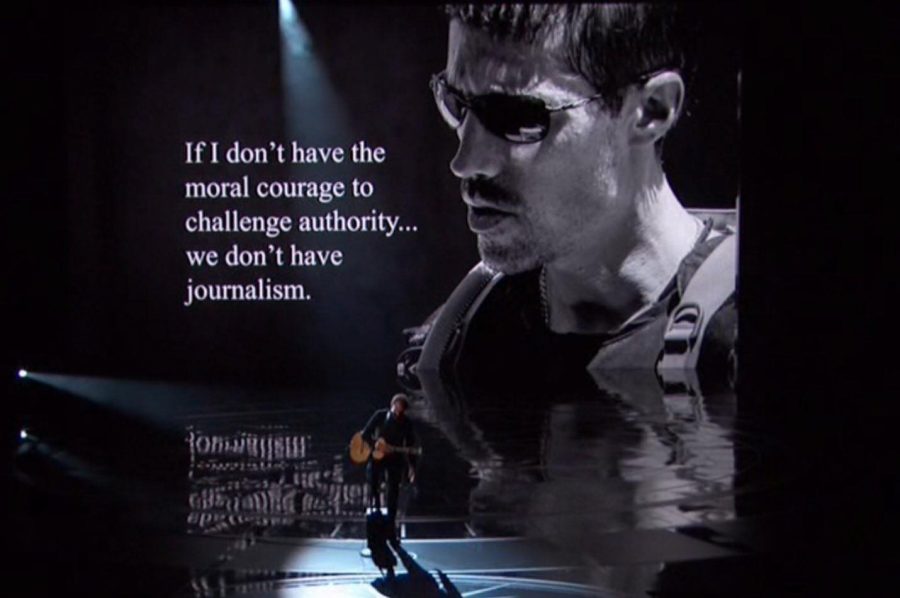
Surprisingly, the show started with one of the ‘Best Original Song’ performances right out the gate; Justin Timberlake performed his hit song ‘Can’t Stop the Feeling’ from the film Trolls, starting the night off on a great note. That was then followed by the performance of Lin-Manuel Miranda’s Oscar-nominated song from Moana, ‘How Far I’ll Go’, performed by Auli’i Cravalho. Her co-star, Dwayne ‘the Rock’ Johnson, came out to introduce the performance, even managing to get in a part of his own solo from the film, ‘You’re Welcome’ (The Academy Awards’ apparent response to it being performed in full; “Nah, we’re good!”). Before Cravalho, Lin-Manuel opened the performance with an original rap, once again asserting his status as the musical genius that he is. And then, Cravalho once again asserted herself as one of the industry’s newest shining stars with an excellent performance of the song. Also, kudos to her for handling the moment when one of the flag twirlers behind her accidentally hit her with a flag like a champ. You had one job, flag twirler! Then, Sting came out to perform his song ‘The Empty Chair’ from the documentary Jim: The James Foley Story. As I said in my ‘Predictions’ post, I think it’s a decent song. The best part of his performance, though, was the finale, when a final image of James Foley appeared on-screen with a great quote from him about the importance of journalism. Finally, John Legend performed a medley of the two nominated songs from La La Land; ‘City of Stars’ and ‘Audition (The Fools Who Dream)’. While he did do a great job with the performance, I’ll admit that I’m rather mixed on him being the one performing the songs. Why not just let Ryan Gosling and Emma Stone do them, instead of just having the two of them introduce him? Ah, well…

Image result for james foley oscars

BEST: AS USUAL, SOME GREAT SPEECHES

Image result for oscars 2017 speeches salesman

As always, there were some great speeches from this year’s award winners. Some were great because of how personal they were while others were great for their powerful political statements. In the case of the former, this included Mahershala Ali’s speech when he won Best Supporting Actor, in which he noted that he and his wife just had a baby a few days earlier (good for you, man!), Viola Davis’ amazing speech when she won Best Supporting Actress (“I became an artist, and thank god I did, because we are the only profession that celebrates what it means to live a life.”) and the speech by sound engineer Kevin O’Connell, who won for Best Sound Mixing for Hacksaw Ridge. In his speech, he thanked his mom, who helped him get his first job in the film industry. It’s also worth noting that this was his 21st Academy Award nomination… and his first win. He’s got more Oscar nominations than Meryl Streep. He was previously nominated for films like the first two Sam Raimi Spider-Man films, Transformers, and The Rock. As for the more political speeches, the most notable of the bunch was when The Salesman won for Best Foreign Film. Prior to the show, controversy arose when it was revealed that, due to Donald Trump’s controversial travel ban, director Asghar Farhadi would’ve been barred from entering the U.S., therefore being unable to attend the show. In response, Farhadi decided to skip out on attending; instead, when the film won the award, it was accepted by Anousheh Ansari, the first Iranian astronaut to go up into space, and Firouz Naderi, a former NASA employee who was involved in some of NASA’s most iconic robotic space missions. Ansari then proceeded to read a prepared speech from Farhadi, in which he honored those who, like him, were affected by the ban. In short, while he may not have been there to say it himself, Farhadi had one of the best speeches of the night. Speaking of Ol’ Don…

BEST: THIS JAB AT DONALD TRUMP

Image result for jimmy kimmel donald trump oscars

Obviously, a few jokes from last night’s ceremony were directed squarely at Donald Trump. For me, the funniest of these occurred about halfway through the show. Jimmy Kimmel pointed out that, at that point, Trump hadn’t made any inflammatory remarks on Twitter, as he, of course, is known to do. In response, Kimmel sent out a tweet asking Trump if he’s up; a tweet which, might I add, somehow appeared online BEFORE he ‘posted it’ during the show. And then, he proceeded to post another tweet with the hashtag #Merylsayshi, which of course references the backlash that Meryl Streep got from Trump and his fan-base when she made her big speech at the Golden Globes back in January condemning some of his actions during the election. In other words, the one that got called ‘overrated’ got the last laugh…

BEST: FREE CANDY!

Image result for oscars candy

During the 86th Academy Awards, host Ellen DeGeneres ordered pizza for the no-doubt very hungry Oscar crowd. Last year, host Chris Rock had a Girl Scout troop sell cookies in the audience. So, what did Jimmy Kimmel do this year to continue this apparent new tradition? He parachuted candy down from the theater roof, specifically Red Vines and Junior Mints. He did it again a second time, after doing a Lion King recreation with Sunny Pawar, who played young Saroo in Lion, sending down Lemonheads and Mike and Ike’s. This resulted in a rather hilarious ‘gif-able’ moment in which we see Casey Affleck looking up as the second batch of candy parachuted down. I was originally then going to say ‘someone get that man some candy, damn it!’, which was a reference to a tweet that the website The A.V. Club posted, but then I watched the footage on replay and noticed that Andrew Garfield tossed some candy over to him during the first round of candy dropping. And, finally, Kimmel gave the crowd something a little bit more ‘substantial’… cookies and donuts. Cue another hilarious crowd reaction, this time from Taraji P. Henson, which is fitting due to her playing a character named Cookie on Empire. You could see her urging her Hidden Figures co-star Octavia Spencer to share. In short, this was a fun little recurring segment which, to reference another tweet (this one by AMC Theaters), is something that I wouldn’t mind seeing happen in real life whenever we go to the theater. Just parachute down some Zours, Sour Patch, or Skittles and I’ll be a happy camper.


BEST: THE ‘HOLLYWOOD TOURISTS’

Image result for oscars tourists

I’ll admit that there was a possibility that this gag could’ve turned out to be a disaster but, thankfully, it didn’t. It started when Jimmy Kimmel announced that he had orchestrated a plan in which a bunch of tourists on one of those Hollywood tour buses were to be led into the theater during the show, under the guise of it being for an Oscar dress exhibit (“And, in a way, it’s true, they will see dresses and gowns but they will be on people.”). When they were led in, on the count of ‘3, 2, 1, Mahershala!’, I must say that it was a cool little moment, seeing regular tourists interact with Hollywood stars. Highlights from this segment included Denzel Washington acting as a faux priest for a soon-to-be-married couple (“It’s Denzel, so it’s legal!”) and each of the tourists getting to touch Mahershala Ali’s Oscar on the way out. The only real downside to this segment was that it admittedly was a bit overlong, though not to the point where it ruined the whole thing. 

BEST: THE ‘ACTORS/ACTRESSES WHO INSPIRED ME’ SEGMENTS

Image result for oscars charlize theron shirley maclaine

(Disclaimer: Not the actual title; it’s just the best that I could come up with)

Another neat recurring segment that they did for this year’s show were a series of videos in which an actor or actress was seen sitting in a theater, watching a classic film, and praising the work of one of the film’s stars. After the video concluded, we then saw those two come out on stage together to announce the next award. Charlize Theron presented the award for Best Foreign Film with Shirley MacLaine after praising her work in the 1960 classic The Apartment. Javier Bardem praised Meryl Streep for her work in 1995’s The Bridges of Madison County before coming out together to announce Best Cinematography. The other two videos… well, I’ll get to those in a bit. Again, I thought this was a nice addition to the show. I’ve seen some be a bit more critical on these videos for mainly being montage-based. However, the reason why I appreciated them was because they celebrated iconic performances through the eyes of actors and actresses who were inspired by them. In fact, I honestly wouldn’t mind if they brought this back every year. As for my favorite of this year’s bunch…

BEST MOMENT OF THE NIGHT: SETH ROGEN AND MARTY MCFLY

Image result for oscars seth rogen michael j fox

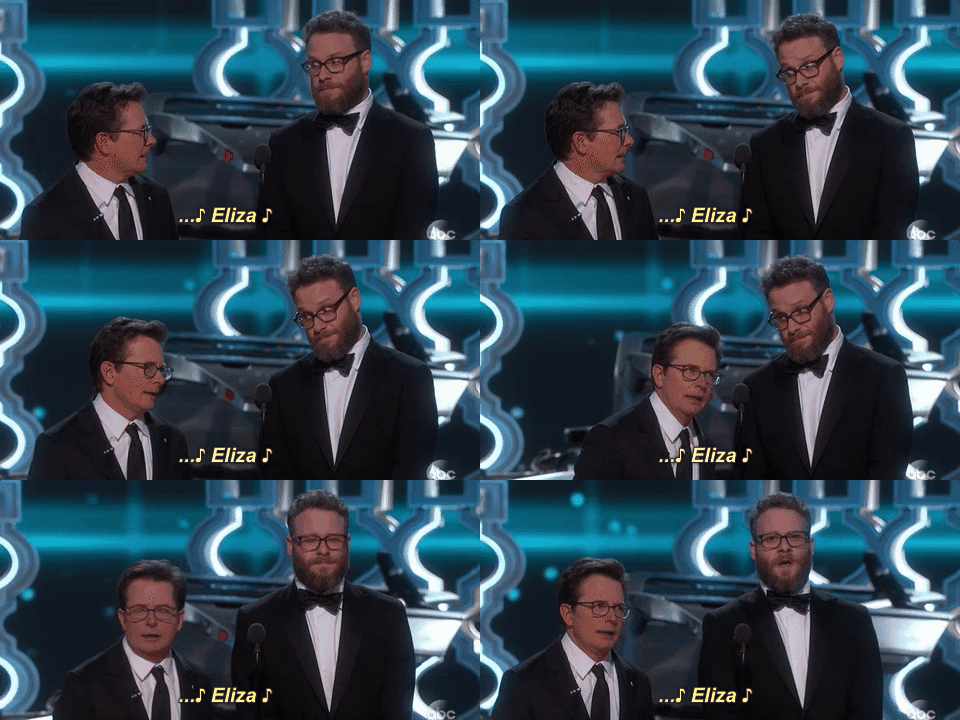
For his ‘Actors/Actresses who Inspired Me’ segment, Seth Rogen highlighted the 1985 classic, and my personal favorite film of all time, Back to the Future. Cut to him and Michael J. Fox stepping out of the DeLorean to announce the winner for Best Editing, complete with Rogen wearing the iconic self-tying shoes from Back to the Future Part II. As if that wasn’t awesome enough, Rogen then proceeded to do something else on his ‘bucket list’; sing a song from Hamilton onstage. He sang part of ‘The Schuyler Sisters’ while Michael J. Fox chimed in with the lyric ‘Eliza’. Cue the appropriate response from Lin-Manuel Miranda in the audience and you have one of the most awesome things that I’ve ever seen. And yes, I know I’m clearly biased because I love Back to the Future and have also been on a Hamilton binge recently.  


BEST/HILARIOUS: THE MEAN TWEETS

Image result for mean tweets oscars

Of course, being that this year’s show was hosted by Jimmy Kimmel, he got to use his popular ‘Mean Tweets’ gag, in which actors read trolling tweets from real-life Twitter users. As usual, it was hilarious to see some of the responses from the actors targeted by these mean tweets, as they were all clearly taking them like a champ. Some of my favorites include Natalie Portman responding to a tweet saying that she probably wouldn’t order an entrée at lunch by showing off her pregnant belly (which is why she didn’t attend the ceremony) and remarking “you’re wrong” to the user who sent that tweet, Jessica Chastain being confused (as I’m sure many of us were) by a user tweeting that they’d ‘white balance their TV on her chest’, and Robert De Niro responding to a tweet claiming that he’s “too old to be making gangster films” and should “start playing grandfather roles” by saying that he already does play grandfather roles and will soon be playing ‘great-grandfather roles’.  

BEST: IN MEMORIAM

Image result for oscars 2017 in memoriam

As usual, the saddest moment of the show was the ‘In Memoriam’ montage. This year’s montage was particularly rough given the large number of celebrity deaths that occurred since the last Oscars, including but not limited to; Gene Wilder, Anton Yelchin, and of course, Debbie Reynolds and Carrie Fisher. In fact, that same day, we were hit with yet another passing; that of Bill Paxton, who got mentioned by Jennifer Aniston during her introduction of the segment. During the segment, Sara Bareilles performed the song ‘Both Sides, Now’, providing a nice melody for the moment. And I know that this segment of the show always gets flak for excluding a few names here and there but at the end of the day, it’s still always the most emotional moment of the show and this year’s montage concluded on the perfect note with Carrie Fisher, as Leia, saying the iconic line “May the Force be With You”. The only real mistake of this year’s montage was when they honored Australian costume designer Janet Patterson… but used a photo of Australian producer Jan Chapman, who is still alive. Whoops...

BEST: JIMMY KIMMEL’S TROLLING OF MATT DAMON

Image result for oscars 2017 matt damon

If you’re familiar with Jimmy Kimmel, then you’ll know that he’s had a long-running feud with Matt Damon, which has resulted in some of his show’s most iconic moments. Obviously, that feud was brought up again during the Oscars; in fact, it even came up during the opening monologue. But, in this moment, Kimmel surprisingly complimented Damon, though obviously in a backhanded way, by noting that Damon was originally set to star in Manchester by the Sea before the role went to Casey Affleck… and then went on to star in the rather controversial The Great Wall (“Smooth move, dumbass!”). But, ultimately, Kimmel’s biggest joke on Damon came when he and Ben Affleck came out to announce the winner for Best Original Screenplay. Prior to them coming out, there was another one of the previously mentioned segments in which an actor/actress praises the work of another actor/actress in a classic film of theirs. In this case, however, it was Jimmy Kimmel who was featured in this segment as he talked about a film that ‘inspired’ him, the 2011 film that Damon starred in, We Bought a Zoo. After that segment, the show’s announcer announced the next two presenters as Ben Affleck… and guest. And then, to top it all off, the usual ‘send-off’ music that’s sometimes played during an award winner’s speech (which, might I add, thankfully didn’t happen at all during this year’s ceremony) began to play while Damon was talking. The camera then panned down to reveal that Kimmel was leading the orchestra at that moment (“Wrap it up, we want to go home!”). What can I say? It would’ve been a missed opportunity had Kimmel not pulled this kind of move.


Time to talk about the only negative moment of this year’s show, in my opinion. In fact, it has nothing to do with anything during the show itself.

WORST: SOME OF THE BACKLASH TOWARDS LA LA LAND

Image result for la la land

Now, let me be clear for a moment; this is not in regards to what happened at the end of the show (I’ll get into that momentarily). I’m happy that Moonlight won Best Picture, as it is a great film that earned all the praise it got. But, going back to what I said in my ‘Predictions’ post, I still don’t understand some of the backlash that was being directed towards La La Land in the weeks leading up to the Oscars. Obviously, part of that backlash was from those who weren’t too big on the film. And that’s fine; film is subjective, after all. The side of this backlash that I didn’t get was the fact that some said that it would’ve been a huge mistake if La La Land swept the awards. To that, I ask… HOW? Seriously, what the hell would’ve been so wrong with La La Land winning a good chunk of this year’s Oscars? Because it was a musical about Hollywood that starred a predominantly white cast? Sure, that’s what it is on a technical level but I feel like this backlash severely negates the positive themes of the film. At its core, La La Land was a story about dreamers and romance, while also not being totally romanticized in how it addressed both these themes. With that said, I am aware that the main reason why many wanted Moonlight to win was due to the importance of its story. Instead of being a tale dedicated to classic Hollywood, like La La Land was, Moonlight was a personal story about a young African-American man struggling with his sexuality and identity in a rough neighborhood. Not only that, this became the first Best Picture winner to have an all-African-American cast.

But here’s the thing... if Moonlight didn’t win Best Picture last night, and La La Land did, that wouldn’t have diminished the importance of the former’s story in any way. Hell, Moonlight won Best Adapted Screenplay which, if you ask me, is probably the next best thing for the film to win (after Best Picture, of course) in terms of its story. La La Land didn’t even win Best Original Screenplay; Manchester by the Sea did. Again, if some of you out there didn’t like La La Land, that’s fine. No one’s forcing you to like it. But I swear, some people out there acted like the frigging world was going to blow up if La La Land won the biggest award of the night. Talk about one of the most extreme cases of hyperbole that I’ve ever seen. You see, this, folks, is why I don’t like to get very political when it comes to talking about film, hence why I’m not going to address the other big backlash of this year’s ceremony, which was mainly in regards to Casey Affleck winning Best Actor in the wake of the two sexual harassment lawsuits he got caught up in back in 2010. Because like I said before, those two lawsuits had NOTHING to do with Manchester by the Sea. In conclusion, to quote Jimmy Kimmel during the closing monologue, “it’s just an awards show”. There is no right or wrong in terms of who wins.

WTF: THAT MIX-UP

Image result for la la land oscars

And now, here we are. We’ve finally come to what will forever be known as the definitive moment of the 89th Academy Awards; the mix-up of La La Land and Moonlight for the biggest award of the night. It all started when Warren Beatty and Faye Dunaway came out to announce Best Picture, with the two being paired together in honor of the 50th anniversary of their classic film, Bonnie and Clyde. When the envelope was opened, Beatty hesitated for a bit before giving it over to Dunaway, who announced that La La Land had won. The film’s crew came up to accept the award but while looking behind them while they were up on stage, you could see that something was up as a few Oscar crew members were scrambling around. And then La La Land producer Jordan Horowitz came to the mic, announcing that there was a mistake. Moonlight was the real winner for Best Picture, resulting in the Oscars equivalent of when Steve Harvey announced the wrong winner at the 2015 Miss Universe pageant. So, now the question is this, what the heck happened in that moment? Well, not too long after the Moonlight crew came up to accept the award, Beatty returned to the mic and stated that the envelope that he had read ‘Emma Stone, La La Land’, which was for when Stone won Best Actress, hence why he hesitated at first. When Emma Stone was later asked about the situation, she stated that she had been holding her ‘Best Actress’ envelope that whole time. But then how did Beatty have that same envelope? Finally, this incident was explained by PricewaterhouseCoopers, the U.K.-based accounting firm in charge of tallying votes. They had made two sets of envelopes for each of the 24 winners; these two sets were then placed at opposite sides of the stage. So, clearly, someone must’ve just given Beatty and Dunaway the wrong envelope.

And there you have it, one of the craziest moments in Oscars history. And overall, while it’s undoubtedly one of the most genuinely surprising moments in recent Oscars history, it’s also quite a crappy situation in regards to how it impacted everyone who was involved in it. One of these people was, of course, Warren Beatty, who I’m guessing is currently becoming the butt of many internet jokes and memes. To that, I say… knock it off, it wasn’t his fault. Again, he hesitated when he opened that envelope, so it’s not like this was intentional or anything; he knew something was up. Then, of course, this was definitely a crappy moment for the cast and crew of La La Land. Going back to what I said about the ‘backlash’ towards the film, if you didn’t like the film, that’s fine. But after what happened last night, can I ask those who didn’t like it to at least take it easy on them? Because I think that we can all agree that it sucks to go through what happened to them in that moment. Hell, just ask Ariadna Gutierrez (she was the one who was announced by Steve Harvey as the winner of Miss Universe by mistake). Not only that, it even had a negative impact on Moonlight because it wasn’t a clean victory for them. Had this mistake not occurred and the proper envelope was opened, we wouldn’t be here right now. Again, let me be clear, I have nothing against Moonlight winning Best Picture. It may have only been my #3 pick out of the 9 Best Picture nominees but it was truly a great film that genuinely earned that award. But I’m guessing that even the filmmakers are thinking to themselves, “That could’ve gone better…”


And those are my thoughts on this year’s Academy Awards. This sure was an eventful ceremony. With that in mind, be sure to sound off in the comments below with your thoughts on them, particularly the big mix-up.