Showing posts with label Chris Pine. Show all posts

Tuesday, December 29, 2020

Wonder Woman 1984 (2020) review

2017’s Wonder Woman doesn’t always get the credit that it deserves from the DC Extended Universe fandom for everything that it did for the franchise. At a time where most DCEU films were utterly savaged by critics, Wonder Woman was the franchise’s first genuinely well-received outing. In fact, it still stands as the best-reviewed DCEU film to date with a 93% rating on Rotten Tomatoes, and while certain parts of the DCEU fandom will feverishly try to deny it, the reason why it succeeded where films like Batman v Superman: Dawn of Justice didn’t was because it was very much the antithesis of the early DCEU films. Instead of being an overly dour and overstuffed superhero epic, Wonder Woman was a predominately lighthearted but still emotionally powerful superhero adventure that was fully bolstered by Gal Gadot’s fantastic performance in the title role. Sure, she had already made a great impression when she made her franchise debut in Batman v Superman but it wasn’t until her solo film when she was truly given the chance to shine in a film that fully understood the importance of character and story. Ultimately, though, much of what made the film work was thanks to its director, Patty Jenkins, who made history as the first female director of a superhero feature from a major studio. Thus, Jenkins was wisely brought back to helm a sequel, which takes Princess Diana of Themyscira from the trenches of World War I to the more high-tech landscape of the 80’s, hence the title Wonder Woman 1984. And while it ended up facing the same unfortunate struggles that other blockbusters have faced thanks to COVID (i.e. getting delayed multiple times), WW84 has finally managed to see the light of day via a simultaneous theatrical and streaming release that allows those who are unable to see it in theaters to watch it at home via Warner Bros.’ streaming service, HBO Max. But no matter where it’s seen, Wonder Woman 1984 is another top-notch outing from Patty Jenkins that, just like its predecessor, is a prime example of the DC Extended Universe at its best which, given all the franchise’s early struggles, is very much a good thing.


It is 1984, and in the bustling metropolis of Washington D.C., Amazonian demigoddess Diana Prince (Gal Gadot) continues to operate as Wonder Woman, albeit in a relatively secretive manner that doesn’t conflict with her public persona as an anthropologist working at the Smithsonian. One day, Diana and her coworker Barbara Minerva (Kristen Wiig) come across a mysterious artifact known as the ‘Dreamstone’ that can grant those who find it the one wish that they desire the most. And sure enough, Diana and Barbara both end up inadvertently utilizing the Dreamstone’s abilities. Whereas the introverted Barbara wishes to become as strong and confident as Diana, Diana’s greatest desire results in the return of the love of her life, pilot Steve Trevor (Chris Pine), who had heroically sacrificed himself during the events of the first film. Unfortunately, these life changing developments are soon upended by the arrival of a new threat in businessman Maxwell Lord (Pedro Pascal), who seeks out the Dreamstone so that he can become the powerful figure that he’s always dreamt of being. In doing so, Lord ends up becoming the physical embodiment of the Dreamstone, thus allowing him to grant anyone’s wish and take whatever he wants from them in return. Naturally, this results in an endless array of conflicts that span the entire world, resulting in Diana and Steve embarking on a quest to stop Lord from going overboard with power and destroying the world in the process. And as Diana, Barbara, and Max all soon discover, their greatest desires come with even greater consequences.


If there’s one thing that can be said about this film, it’s that the 1984 part of its title is a 100% accurate indicator of what it truly is. Wonder Woman 1984 may be a modern blockbuster, but in execution, it is the spitting image of an 80’s film from the intentionally gaudy but still incredibly vibrant color palette that it sports to the overly extravagant outfits that the characters wear (e.g. Chris Pine in parachute pants… need I say more?). This is also reflected by the film’s primarily lighthearted tone which is then matched by its unabashedly old-school superhero plot with clear-cut heroes and villains. And while those two aspects of the film have admittedly been a major source of contention amongst critics and audiences, I’d say that they’re the key reason why it works as well as it does. In other words, while some may find this film to be overly goofy and cliché, it could very well be argued that it perfectly encapsulates what most of the films and TV shows from the 80’s were like from a tonal perspective. It should also go without saying that Patty Jenkins excellently maintains the same strong atmosphere that made the first Wonder Woman film such a hit, resulting in a highly entertaining homage to classic 80’s adventure flicks that’s full of great bits of humor that never overshadow the story’s powerful emotional beats. And just like the first film, Wonder Woman 1984 also boasts a lot of great action sequences and a suitably epic score. Whereas the first film’s score was done by Hans Zimmer protégé Rupert Gregson-Williams, this film’s score was done by Zimmer himself who, of course, was largely responsible for bringing the title character’s iconic theme to life in Batman v Superman.


It’s been well-documented at this point that Gal Gadot has basically been the DC Extended Universe’s MVP as far as its ensemble cast is concerned. As Wonder Woman, she has consistently established herself as a wholly charismatic leading lady and an indisputably badass action heroine, and sure enough, all this is once again reinforced by this film. Here, she trades in the innocent fish out of water character arc that she went through in the first film for one where, despite being emotionally hardened by everything that’s happened to her since she left Themiscyra, she’s still very much the kind-hearted heroine that we know and love. As for the heavily talked-about return of her long lost love Steve Trevor, the film’s handling of this plot-line feels like a natural way of doing the ‘resurrection’ concept that has always been common in the world of comics. And just like the first film, Chris Pine does a great job of being just as charismatic as Gadot without ever overshadowing Diana’s status as the main protagonist. This then brings us to the film’s main antagonists, and if there’s one advantage that Wonder Woman 1984 has over its predecessor, it’s that it has much stronger villains. It all starts with Pedro Pascal, who is delightfully over-the-top as the charismatic con-man Maxwell Lord while still managing to make him a surprisingly sympathetic tragic figure. This also applies to the other antagonist of the feature, Kristen Wiig’s Barbara, who gradually evolves from a meek introvert into the “apex predator” that is Wonder Woman’s classic foe from the comics, Cheetah. And while her final transformation may be a bit lacking visually, Wiig does an outstanding job at being Diana’s foil since her wish to become just like her comes at the cost of the good-natured and all-around sociable personality that she had before she used the Dreamstone..


I won’t be going over what I’m about to mention too much as I finish up this review, but I will say that I find it fascinating that a film that was shaping up to be one of the best-reviewed films of 2020 about a week ago… has suddenly become one of the year’s most polarizing releases. Yes, Wonder Woman 1984 has attracted some, to put it as nicely as I can, intense reactions from both critics and audiences. Basically, from what I can gather, it’s gotten a lot of flak for its light-hearted tone to the point where it’s been accused of being way too goofy instead of being a more serious and darker sequel. And yet, as I noted earlier, I’d say that this makes it a perfect representation of the era in history in which it’s set; plus, as I’m sure that I’ve made it clear at this point, I tend to prefer the superhero films that aren’t trying to distance themselves from the medium’s typically lighthearted proceedings. Case in point, Wonder Woman 1984 is a highly entertaining addition to the genre that, just like its predecessor, is fully bolstered by its terrific ensemble cast and Patty Jenkins’ excellent direction. In short, it’s another example as to why the DC Extended Universe has been a lot better than how it was when it was first starting out when it remembers that, when it comes to this genre, strong characters and a good story are always more important than whatever ‘cool’ action sequences those characters partake in. Simply put, no one does DCEU films quite like Patty Jenkins, and if you ask me, it’s about damn time that the DCEU fandom gives her the credit that she deserves for all that she’s done for the franchise.


Rating: 5/5!

Saturday, March 10, 2018

A Wrinkle in Time (2018) review

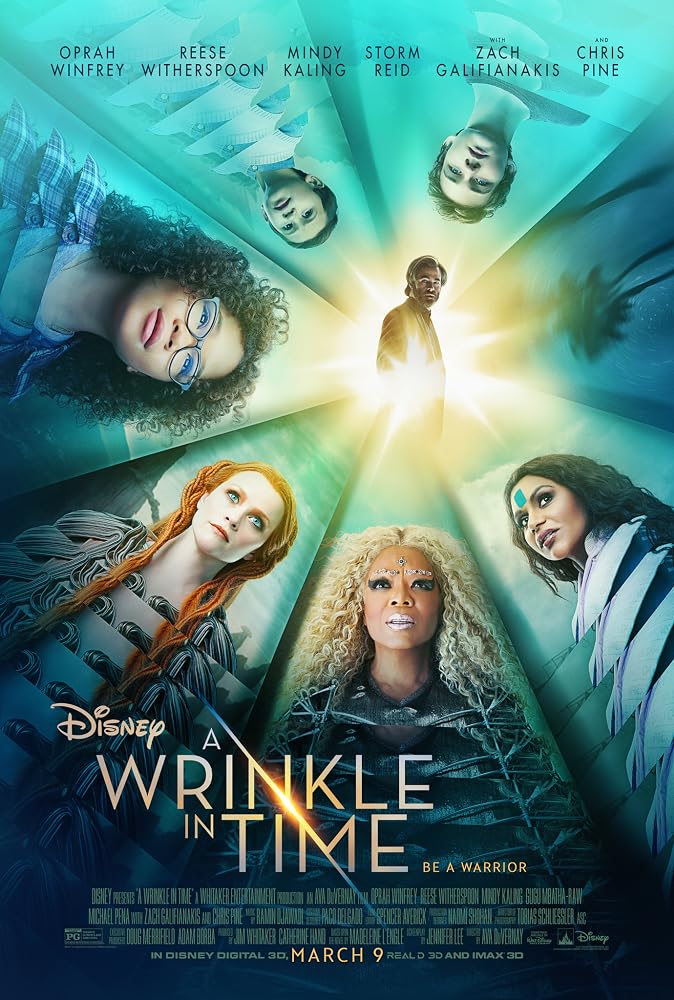
Reese Witherspoon, Oprah Winfrey, Mindy Kaling, Chris Pine, Storm Reid, Levi Miller, and Deric McCabe in A Wrinkle in Time (2018)

In 1962, author Madeleine L’Engle published a novel that would end up becoming her most famous piece of work, A Wrinkle in Time. Despite being initially turned down by at least 26 different publishers, the novel went on to become a watershed entry in the science-fiction fantasy genre and a staple of classrooms across the country. And now, more than five and a half decades after its release, it graces the big-screen for the first time ever in Disney’s new adaptation of this timeless story. However, this is not the first time that A Wrinkle in Time has been adapted to film; in fact, this isn’t even Disney’s first adaptation of it. Back in 2003, Disney produced a made-for-TV film adaptation that aired on ABC in May 2004. However, the film ended up receiving negative reviews from both critics and fans of the book; even L’Engle herself was highly critical of it. And yet, despite her passing in 2007, I bet that she might have been a little more positive towards this new adaptation of her book if she had seen it. This new version is brought to us by Ava DuVernay, who’s become a major critical darling these past few years thanks to her work on films like the 2014 Martin Luther King Jr. drama Selma and the 2016 Netflix documentary 13th. Along with being the first $100 million+ film directed by a female director of color, it also boasts a screenplay written by Jennifer Lee, writer/co-director of Disney’s 2013 smash hit Frozen, and features an all-star cast highlighted by the trio of Reese Witherspoon, Mindy Kaling, and the one and only Oprah Winfrey. And while it ultimately may not be a completely successful adaptation of its source material, DuVernay does manage to deliver a visually spectacular sci-fi fantasy adventure capable of delighting both young and old.

In an average American suburb, teenager Meg Murry (Storm Reid) struggles to fit in at school due to her abrasive personality. However, this recent behavior was mainly brought upon by the disappearance of her father, noted astrophysicist Dr. Alex Murry (Chris Pine), who sought to uncover a way to travel across dimensions with ease. Now that it’s been at least four years since his disappearance, Meg begins to lose hope that her father is still alive; that is until she is visited by three omnipotent beings capable of traveling to the places that her father had always dreamed of reaching. This trio of women consists of the wise and all-powerful Mrs. Which (Oprah Winfrey), Mrs. Who (Mindy Kaling), who often quotes several historical figures, and the cheerfully eccentric Mrs. Whatsit (Reese Witherspoon). Meg learns from the three Mrs. W’s that her father is, in fact, still alive, having successfully managed to transport himself to another dimension through the process known as ‘tessering’. However, in doing so, he’s also become trapped by a dark force known as ‘the It’, which is the cause of all negativity across the universe. Thus, Meg must embark on an adventure with her precocious little brother Charles Wallace (Deric McCabe) and her classmate Calvin O’Keefe (Levi Miller) across dimensions with the help of the three Mrs. W’s to find her father and rescue him from ‘the It’, an adventure that, per Mrs. Which, will test them ‘every step of the way’.

A common criticism of this film has been towards its plot, with some calling it ‘convoluted’. Personally, though, I didn’t find the plot to be that convoluted. Granted, there are times where the film throws a lot of important story beats at you, but never enough to the point where it’d leave audiences totally confused as to what’s going on. However, in terms of the narrative, there is one thing that hurts the film from time to time, and that is its surprisingly brisk pacing. Simply put, this film attempts to get a lot done in the span of its 109-minute runtime, and because of this, not everything in the story gets as much attention as it should. This includes everything from a lack of development for the main threat that is ‘the It’ to even glossing over some story beats in the first half hour or so that are meant to set up this universe and its characters. Still, DuVernay and Lee do manage to convey the emotional poignancy of this story of a young girl trying to find her father (along with showcasing the strength of family) quite well; maybe not to its fullest potential but still just enough to register the right sense of emotional catharsis. And as far as the film’s visuals are concerned, this is one of the best-looking films to come out in recent memory. Once Meg, Calvin, and Charles Wallace begin traveling across dimensions, the CGI work that is on display here is second to none, syncing up perfectly with the film’s vibrant cinematography. And just like how Peter Jackson used the beautiful landscapes of his home country of New Zealand to their fullest effect in the Lord of the Rings and Hobbit trilogies, DuVernay does the same for this film, which was partially shot there as well.

Ultimately, though, arguably the best aspect of this film is the stellar ensemble cast that DuVernay has assembled to play these iconic roles. It’s all headlined by the phenomenal lead trio of Oprah, Reese Witherspoon, and Mindy Kaling as the three Mrs. W’s. Oprah, as always, dignifiedly graces the role of Mrs. Which with the same kind of class that has helped to make her the icon that she is today, Reese Witherspoon gets a lot of the best lines due to Mrs. Whatsit’s dry wit, and Mindy Kaling is an equally delightful combination of the two. The interesting thing to note, though, is that while the three of them do receive top billing, they’re only in about a third of the film. As such, it relies more on its young leads, who are all quite excellent. Newcomer Storm Reid very much shines in the role of Meg, even managing to hold her own against the likes of Oprah and Reese Witherspoon, as does Deric McCabe as her gifted brother Charles Wallace. And while Calvin doesn’t get as much to work with material-wise compared to Meg, Levi Miller does work well off both Reid and McCabe. There are also plenty of great supporting roles in this film as well. Chris Pine and Gugu Mbatha-Raw bring much warmth to the film as Meg and Charles Wallace’s parents, especially in terms of the strong ‘parent-child’ bond that Reid shares with them both. Zach Galifianakis gets some great humorous scenes as the eccentric Happy Medium, who aids Meg and co. in their adventure, while Michael Pena is also a major highlight as Red, a sinister agent of ‘the It’ who seduces Charles Wallace to their side.

A Wrinkle in Time has long been referred to by many as one of the prime examples of an ‘unfilmable’ novel, with some feeling that it’d be impossible to fully bring Madeline L’Engle’s fantastical narrative to life on the big screen. But while it may not fully succeed at doing so, Ava DuVernay’s take on this timeless tale is quite the admirable attempt at it. Sure, it suffers quite a bit in terms of pacing, namely through its attempts to try and cram so much of the story into a rather light under two-hour runtime. But when it comes to its visual department, that is where this film truly shines. This is very much one of those films that’s worth checking out on the big-screen, where one can experience the true scale of its vivid imagery. And despite a few instances where the film somewhat glosses over important parts of the plot, it does manage to be an effectively emotional sci-fi fantasy adventure that’s buoyed by an excellent ensemble cast. In short, I can’t really say much about how this film compares to its source material as I’ll admit that I’ve never read A Wrinkle in Time. Seriously, the only experience that I had with this story prior to seeing this film was when I saw an ad for the previously mentioned made-for-TV film from 2003 on an old Disney DVD. Despite this, though, I bet that this adaptation of it could very well satisfy fans of the book; at the very least, more so than the previous film version.


Rating: 4.5/5

Saturday, June 3, 2017

Wonder Woman (2017) review


(I’ve been informed by my peers that today happens to be ‘Wonder Woman Day’, which marks the 75th anniversary of the iconic character’s debut. How fitting, then, that this occurs right at the time that her long-awaited feature film is about to have an epic opening weekend, hence why I made sure to get this review out on this big day. Enjoy!)

Admittedly, Warner Bros.’ attempts at creating a cinematic universe based around the characters of DC Comics, just like what Marvel Studios has been doing for the past decade with their Marvel Cinematic Universe, have had rather rocky results recently. It wasn’t that big of an issue at first when the series started in 2013 with the Superman reboot, Man of Steel. While the film did prove to be one of the most polarizing releases of that year, it was a solid commercial hit and effectively built up enough hype for future installments. But then, things got rough for Warner Bros. and DC in 2016. It’s a shame, really, because that was supposed to be a big year for them, as their two primary releases were some of the most anticipated films of the year. However, both these films, Batman v Superman: Dawn of Justice and Suicide Squad, ended up getting completely savaged by critics. And unlike Man of Steel, while both films did do well at the box-office, it seemed like those who didn’t like them outnumbered those that did this time around. It certainly didn’t help matters when it became clear that both films were subjected to questionable editing jobs in post-production, resulting in the necessity for alternate cuts when they were released to home media. Thus, this year is an important one for Warner Bros., DC, and the ‘DC Extended Universe’. Because if this year’s outings end up attracting the same critical vitriol as their 2016 slate, it puts the future of this entire cinematic universe in jeopardy. Thankfully, they’re starting off big this year with a film based around a character who’s been long overdue for a cinematic adaptation; the Amazonian demigoddess known as Wonder Woman.

When it comes to DC, Wonder Woman stands right alongside Batman and Superman to form ‘the Trinity’, the most iconic trio of superheroes in the DC lineup. Created by psychologist William Moulton Marston in 1941, Princess Diana of Themyscira would go on to become arguably the most famous superheroine in the history of comics. However, it took quite some time before she made her debut on the big-screen. Prior to this, her most famous onscreen adaptation was the TV series Wonder Woman, starring Lynda Carter in the title role and produced from 1975 to 1979. However, efforts since then to make a Wonder Woman feature film, even from the likes of filmmakers like Joss Whedon, have come and gone to no avail. Wonder Woman ultimately made her official film debut in last year’s Batman v Superman, played by Gal Gadot, in which she was considered one of the primary highlights of the film. Now, Gadot headlines her own solo film, Wonder Woman, which is very much a big deal. It’s the first big female-led superhero film of this current era of the superhero genre (disclaimer: by ‘current era’, I mean everything since the MCU started back in 2008), and it’s also the first major summer tent-pole film directed by a woman. In this instance, that director is Patty Jenkins, best known for directing 2003’s Monster. She almost directed Marvel Studios’ 2013 outing, Thor: The Dark World, but she ended up leaving that project due to creative differences. Here, though, through her terrific direction and Gal Gadot’s fantastic turn in the title role, DC’s iconic superheroine gets the terrific film adaptation that she very much deserves.

Long before she ever got involved with the likes of Batman and Superman, entrepreneur Diana Prince (Gal Gadot) was Princess Diana of the hidden Amazonian paradise known as Themyscira, ruled by her mother, Queen Hippolyta (Connie Nielsen). Against her mother’s wishes, she is trained by her aunt, General Antiope (Robin Wright), to become one of Themyscira’s Amazonian warriors. One day, a pilot named Steve Trevor (Chris Pine) somehow manages to enter Themyscira when his plane crashes into the ocean. Diana saves him and he explains to her and her people that he’s a spy working for the Allies in World War I. He’s just recently stolen valuable information from a German weapons facility, where General Erich Ludendorff (Danny Huston) and his top scientist Dr. Isabel Maru AKA Doctor Poison (Elena Anaya) are developing a new form of mustard gas that threatens to cause millions of casualties if it’s completed. Believing that the war is being caused by the Amazonians’ mortal enemy, Ares the God of War, Diana leaves the safety of her home to help Steve get the information that he’s collected to his superiors in London. Eventually, the two end up going straight into the action, as Diana seeks to hunt down whoever Ares is so that she can hopefully bring an end to this dreadful war.

One of the main criticisms of previous DCEU films have been towards their overall tone. Compared to the more light-hearted affairs of the MCU, the DCEU films have been more serious in tone. However, most critics have felt that the DCEU films have gone too far with this idea to the point of being incredibly dour, which they feel is not the right kind of atmosphere for superhero films of this nature. That is not the case with Wonder Woman. Even amidst the backdrop of the dreadful First World War, there are plenty of great bits of humorous dialogue here and there to lighten the mood, primarily whenever Diana attempts to ‘fit in’ amongst society (e.g. in one scene, she’s seen trying out some ‘inconspicuous’ clothing and proceeds to question its use in combat). At the same time, our main heroine is given a terrific arc, as we see her go from a naïve young woman who’s unaware of what goes on outside Themyscira to a confident leader in battle. But then, as a result, her perception of humanity is changed dramatically when she learns about the true horrors of the war, something that carries over into her characterization in Batman v. Superman. This arc is handled terrifically in the film, yielding some highly effective emotional moments. As for the rest of the film, Patty Jenkins’ direction is fantastic and she uses the WWI setting to great effect, thanks in part to the film’s excellent production design. This also carries over into the film’s incredible action sequences. Yes, some of them do use the slow-motion technique that fellow DCEU director Zack Snyder is well-known for (though I don’t think he’s really used it that much in his DCEU films), but they do elicit some great results.

As is common with any superhero casting in the genre, Gal Gadot’s casting as Wonder Woman has gotten a lot of flak from certain fans, from her previous background in acting (e.g. her supporting role as Gisele in the Fast and Furious films) to, unfortunately, sexist jabs at her weight and physical stature by those who don’t think that she was the right fit for DC’s most famous heroine. Hell, some have even mocked her tenure in the Israeli army when she was younger (Who does that?). However, when I went to a panel that she was at during last year’s Rhode Island Comic Con, I felt that, offscreen, she very much conveyed all the great traits that audiences have loved about the character ever since she was first introduced back in 1941. And this translates exceptionally well to this film; she’s charming, caring, and most of all, a total badass whenever she gets into the action. She is paired well with Chris Pine who, thankfully, never overshadows Wonder Woman in her own film. Instead, Steve Trevor is just a natural sidekick who does share some romantic chemistry with Diana but, at the same time, is not just a simple ‘love interest’. The two of them are backed by a highly entertaining collection of supporting characters via the team that Steve enlists to help them out on the battlefield; Saïd Taghmaoui as a flirtatious spy named Sameer, Ewen Bremmer as Charlie, a sharpshooter who’s already been through the horrors of war, and Eugene Brave Rock as Chief, a smuggler. As for the film’s villains… eh, they’re ok. I mean, they work within the context of the plot but at the end of the day, they’re still kind of the weakest links of the film.

Fear not, DCEU fans, for I will not be making any sort of derogatory statements towards the previous DCEU films in this review of what has been the franchise’s first well-received outing. After all, as I’ve made it clear in the past, I am a fan of both Man of Steel and Batman v. Superman; heck, I even liked the latter BEFORE the Ultimate Edition came out (Suicide Squad? Eh, I feel that I may have been a bit too positive on that one. I’ll know if this is the case when I see it again). I will say, though, that I’m glad to see that the franchise has finally managed to catch a lucky break after a rough 2016, as Wonder Woman is most certainly one of the best installments of the franchise. Gal Gadot absolutely shines in the lead role of Diana and the direction from Patty Jenkins is fantastic. Together, they give us a terrific female lead who’s given an equally terrific character arc in a film full of emotional depth that captures just the right kind of tone to suit this legendary character. It’s a satisfying win for the two, with Gadot very much proving the critics who doubted her in the role wrong and Jenkins having a much-deserved blockbuster hit after she was forced to back out of directing Thor: The Dark World due to differences with Marvel Studios’ [now disbanded] controversial creative committee. And thanks to these two, the DC Extended Universe’s future looks much brighter thanks to a film that, let’s be honest, was too important to fail as the first female-led superhero film of the modern era. 


Rating: 5/5!

Saturday, July 23, 2016

Star Trek Beyond (2016) review


As I’ve gone over quite a few times already these past few years, I am a huge fan of the J.J. Abrams-directed Star Trek films. The 2009 Star Trek ‘reboot’ not only introduced me to the franchise, as was the case with other franchise newcomers, but also ended up becoming one of my favorite films of all-time period. As a result, the sequel, Star Trek Into Darkness, was my most anticipated film of 2013. And while I personally really loved it, the same couldn’t be said for most long-time Star Trek fans. In fact, most Trek fans heavily despise the J.J. films for allegedly not staying true to the franchise’s roots and Into Darkness got a considerable amount of backlash for its re-imaginings of scenes from Star Trek II: The Wrath of Khan. So with all of that in mind, there was certainly a lot of pressure on the third of these J.J.-era (or should I say ‘Kelvin’ era as it’s recently been designated) films to adhere more to what made the franchise so popular in the first place. This time around, though, J.J. wasn’t available to direct due to his work on a certain other film that starts with the word ‘Star’. So in his place is Justin Lin and while a lot of Trek fans weren’t too pleased with the hiring of ‘another action director’, Lin’s work on the Fast and Furious films have made him one of the best action directors in the business. Plus, he made it clear that he was a Trek fan and with the addition of franchise star Simon Pegg as one of the film’s co-writers, it looked as if this new Trek film would fare much better with fans. And sure enough, Star Trek Beyond, the 13th installment of this iconic sci-fi franchise, is one heck of an exciting space adventure. For fans of the J.J. films like myself, this is just yet another super entertaining film that maintains all of the things that made the previous two films so great. But for more hardcore Trek fans, they’re probably going to like this one better.

At the end of Star Trek Into Darkness, the crew of the USS Enterprise, as led by Captain James Tiberius Kirk (Chris Pine), set off on a five-year journey into uncharted space. As this film begins, the Enterprise is three years into the voyage and while things have been going fairly smoothly for the crew, Kirk is considering applying for a promotion to the position of Vice Admiral due to him beginning to really feel the monotony of being a starship captain. After briefly stopping at Yorktown, an advanced Starbase, the crew are sent out on a rescue mission when an escape pod is found and its sole occupant, an alien named Kalara (Lydia Wilson), says that her ship got stranded in a nearby nebula. However, this ends up being a trap as the Enterprise is ambushed by a swarm of alien ships led by their fearsome alien commander Krall (Idris Elba), who is seeking a mysterious alien artifact that the Enterprise had recently found. The Enterprise is destroyed but the crew manages to abandon ship and they end up on a nearby planet. With no ship and no way of sending out a distress signal, Kirk, along with his fellow crewmates; first officer Spock (Zachary Quinto), medical officer Leonard ‘Bones’ McCoy (Karl Urban), communications officer Nyota Uhura (Zoe Saldana), engineer Montgomery Scott (Simon Pegg), helmsman Hikaru Sulu (John Cho), and navigator Pavel Chekov (Anton Yelchin), as well as a new ally in Jaylah (Sofia Boutella), a scavenger who’s been living on the planet for some time, race to stop Krall before he can collect the artifact and use it to attack the Federation.

As noted earlier, one of the main issues that ‘Trekkers’ have had with the J.J.-directed films is that they don’t really feel much like Trek films. While I personally disagree with that argument, I will admit that out of all of these recent Trek films, Beyond is certainly the most Trek-ish of the bunch. The whole plot of Kirk and crew stranded on an alien planet definitely feels like something you’d see on an episode of The Original Series. By comparison, the last two films were more focused on the origins of the Enterprise crew before they set off on their five-year mission. However, if we’re talking overall execution, Beyond very much maintains the same level of action as its two predecessors. So with that said, I’m not entirely sure if this will win over every Trek fan because it’s still very much an action-oriented film and not necessarily a ‘cerebral’ kind of story as I find that some fans were wanting out of these newer films. But as someone who actually does prefer the action-oriented style of the newer Trek films, this film was right up my alley and I loved every second of it. The action is excellent as are the visuals and Justin Lin’s direction is solid throughout. Plus, amidst all of the action, the film makes sure to spend time further developing its characters, namely by giving them some effectively emotional character moments. Now I’ll admit that I don’t think this film actually has as much emotional depth as the previous two films but even with that said, there are still plenty of emotional moments in this film, like Spock struggling to cope with the idea of mortality following a recent tragedy (the details of which I won’t reveal here as they’re kind of spoiler-y).   

I don’t really need to go over the main cast that much because this is the third film that they’ve been in. Simply put, they’re just as phenomenal as they’ve been in the last two films. One of my absolute favorite things about these new Trek films has been the camaraderie amongst the main ensemble and I’m happy to report that this is once again the case here, resulting in plenty of humorous banter amongst them. Though with that said, it’s also a little bittersweet knowing that this is the last we’ll see of Anton Yelchin in the role of Chekov, as Yelchin tragically passed away a month ago in a car accident. So instead of focusing on the main cast, let’s focus on the newcomers, specifically Sofia Boutella as Jaylah and Idris Elba as the film’s main villain Krall. Boutella made quite an excellent first impression in her first ‘major’ film role as Gazelle, the main henchwoman of Samuel L. Jackson’s Valentine in last year’s Kingsman: The Secret Service and she’s once again excellent here. Simply put, Jaylah’s a pretty badass female lead but is one that is also very layered as well as shown in her backstory and her motivation of getting off of the planet. As for Elba as Krall, I must say that these new Trek films have done a pretty excellent job with their villains. I can’t say at the moment if Krall is as good as or better than Nero (Trek ’09) or Khan (Into Darkness) but Elba certainly makes the character a very memorable and quite intimidating adversary for Kirk and company. Plus, his main motivation and backstory are quite well-developed.

As someone who absolutely loved J.J. Abrams’ two Star Trek films, Star Trek Beyond most certainly delivered on everything that I love about these newer Trek films. The action and visuals are excellent, the plot is solid, and the characters are excellently handled in terms of both the performances and strong camaraderie of the actors/actresses who play them as well as the excellent character development that they get to work with. However, I’m well-aware that this film has a lot to prove as most Trek purists weren’t too pleased with the last two films. And while I personally will defend both the 2009 Trek and Into Darkness come hell or high water, I have the feeling that they’re going to like this film a whole lot more. Because while it’s still very much the action-oriented style that the two J.J. films maintained, the plot is certainly much more Trek-y in terms of its overall execution. So in short, thanks to the solid direction from Justin Lin, who proves to be an excellent successor to J.J., as well as the solid writing from writers Simon Pegg and Doug Jung, Star Trek Beyond is yet another fantastic entry in this legendary franchise. And for someone like me who grew up not with the Original Series but with J.J.’s films, it’s just another home run hit for the franchise’s modern era and I can’t wait to see what happens next for my favorite Enterprise crew. In fact, we already know one key detail of what will happen next as it was recently confirmed that Chris Hemsworth, who had a minor role in the 2009 film, will be returning in the next film to reprise his role as Kirk’s father George. Could this potentially be the last of the J.J.-era Trek films? We don’t know for sure just yet but needless to say I’m super excited for the new Star Trek IV, in which Kirk’s overall arc of trying to live up to his father’s legacy will no doubt come full circle.


Rating: 5/5!

Wednesday, July 20, 2016

TREK WEEK: In Defense of the J.J. Abrams-directed 'Star Trek' films


As the second annual ‘Trek Week’ continues here on Rhode Island Movie Corner, I’ll be doing something a little bit different today; something sort of along the lines of a ‘thesis’ as I work to defend two of my favorite films of the last few years; J.J. Abrams’ Star Trek films. Despite what some fans may claim, these two films are very important to the franchise as they very much resurrected it after almost half a decade of no new major Star Trek media. And they’re also very important to me as not only are they some of my all-time favorite films (the 2009 Star Trek film is legitimately in my Top 10 favorite films of all-time) but they also helped me get into the Star Trek franchise in the first place, and the same can be said for other people who went into it not being very familiar with the franchise. However, when it comes to long-time fans of Trek, these films aren’t really as liked. In fact, they’re pretty much hated by them for various reasons and said backlash got even more vocal when the 2013 sequel, Star Trek Into Darkness, was released. Simply put, the big argument amongst this crowd is that the films ‘don’t carry the feel of the franchise’. As a result, there’s now a lot of pressure on director Justin Lin and writers Simon Pegg and Doug Jung to make sure that the upcoming Star Trek Beyond does a better job at appealing to the long-time fans. And I won’t lie… all of this backlash kind of frustrates me. Because I am not embarrassed to admit that I am a major fan of the J.J.-directed Trek films. In fact, I kind of prefer them to the older Trek films. And yeah… I know that this will be considered as complete ‘blasphemy’ amongst Trek fans. However, I’m about to go over why I will defend these films to the bitter end.  

But first, let’s put things into perspective. In the early 2000’s, the Star Trek franchise was pretty much at rock bottom. The most recent Trek film, Star Trek: Nemesis, the last film to star the cast of Star Trek: The Next Generation, was both a critical and commercial dud, just barely earning back its $60 million budget at the box-office. In fact, from a box-office perspective, it is the lowest-grossing film in the series worldwide. Meanwhile, on the TV front, things weren’t doing much better. The main Trek show at the time, the prequel series Enterprise, constantly suffered ratings-wise during its run and by 2005, the generally polarizing series was canceled after only four seasons. The following year, the franchise’s creative head, Rick Berman, was relieved of his duties. In short, the franchise was in one hell of a creative rut. As a result, the next few years saw numerous proposals for a potential resurrection of the franchise from various filmmakers including Bryan Singer and even Trek alums like Jonathan Frakes and William Shatner. Ultimately though, the honor to revive the franchise went to writers Roberto Orci and Alex Kurtzman, with J.J. Abrams, fresh off of his feature-length directorial debut, 2006’s Mission Impossible III, chosen to direct. And we all know how that turned out. On May 8th, 2009, Star Trek was released in theaters and it was a solid critical and commercial hit. It certainly proved to be a success for non-fans of the franchise and opened the door for a new generation of Trek fans like myself. However, the same couldn’t really be said for long-time fans. And based on every single criticism that I’ve heard directed towards these films over the past few years, there are two main issues that the ‘Trekkers’ have with these films.


The first was the new film’s bold decision to establish an ‘alternate universe’. This concept of a ‘multi-verse’ had been previously explored in episodes of the various Trek shows but this was pretty much the first time that the films had ever gone this route. As the result of a supernova being turned into a black hole, the Romulan ship Narada ended up going back over a century in time and its attack on the USS Kelvin paved the way for a different series of events that still revolved around the franchise’s classic characters, namely James T. Kirk. A similar situation occurred last year with Terminator: Genisys and as you’d expect, that film also got flak for going that route. However, I actually think that this is a great idea as it allows the franchise to tell new stories within their universes with their classic characters without having to adhere to canon. But at the same time, another argument that people bring up about this kind of plot development is that it results in classic moments from the series ‘being erased from existence’… and I’ll just cut to the chase and say that this is not true. I mean, okay, it’s true that the creation of a new timeline does do away with beloved moments from previous films. However, it’s not like those films don’t exist anymore. If you can still go to a place like Best Buy and are able to buy the original Trek films without issue, then I don’t see what the problem is with a franchise establishing a new alternate reality. The main characters are still the same characters as before, expect that now they are being developed in different, and technically speaking ‘more modern’, ways.


The character that benefits the most from this new timeline is Captain James Tiberius Kirk. Of course William Shatner will always be the original Kirk but if you ask me, Chris Pine’s Kirk is actually a much more layered character. With Shatner’s Kirk, things usually ended up going his way no matter how difficult the situation was. After all, as emphasized in a classic scene in The Wrath of Khan where he reveals that he cheated on the infamous Kobayashi Maru test, a moment which was finally witnessed in the 2009 film, Kirk does not believe in the no-win scenario despite being told that it a situation that every Starfleet captain will likely face at one point. There were only a few instances where things didn’t really go his way, with the biggest one being when Spock died at the end of Wrath of Khan. Chris Pine’s Kirk, on the other hand, immediately starts off on a rough path. He had to grow up with the burden of having his father be George Kirk, who sacrificed himself to save the lives of the crew of the USS Kelvin, including his wife Winona and their then-newborn son [him]. So as a result, he became a reckless and arrogant delinquent until he was approached by Christopher Pike to enlist in Starfleet, ‘daring him to do better’ than his dad. I feel that this helped make Pine’s Kirk a very relatable protagonist, someone who has a lot of pressure on him to succeed. As a result, it’s cool to see how he matures as a leader over the course of these films. Plus, this idea of Kirk being under his father’s shadow seems to once again be relevant in the upcoming Star Trek Beyond as the second trailer opens with Kirk recounting how ‘he joined Starfleet on a dare’ and Bones remarking that now Kirk is trying to figure out who he really is.


As for Kirk’s eventual first officer Spock, the film further explores the character’s half-human, half-Vulcan heritage. Right out of the gate, he is shown to be ostracized by his Vulcan peers solely due to his father Sarek being a ‘traitor’ for marrying ‘that human whore’ Amanda Grayson. This prejudice is later seen when the heads of the Vulcan Science Academy remark about how successful Spock has been despite the ‘disadvantage’ of having a human mother. This effectively leads him to reject the invitation to the Academy and instead enlist in Starfleet. And while Trek fans of course know that Kirk and Spock are always portrayed as friends, the 2009 film actually doesn’t start out that way. When Kirk pulls his little ‘stunt’ during his Kobayashi Maru test, he is immediately accused of cheating by Spock and the two end up in a major moral conflict for most of the film, with Spock maintaining a generally cold and logical persona throughout. His emotions aren’t fully brought out until Kirk provokes him by questioning why he doesn’t show any emotion over the recent death of his mother, resulting in him lashing out at Kirk and subsequently relinquishing command to him on account of being emotionally compromised. This is then followed by Sarek finally admitting to him that he didn’t marry his mother because it was ‘logical’ but because he truly loved her. As a result, Spock is able to gain better control of his emotions, allowing for him and Kirk to finally set aside their differences and work together to stop the Narada from destroying Earth. Later, he is convinced to stay with Starfleet and be Kirk’s first officer, being told to ‘put aside logic’ and ‘do what feels right’. By whom, you may ask? Why, by his older self, of course!


Yes, the 2009 film pulled a major coup by having Leonard Nimoy cameo as an older Spock. His Spock is shown to be the one from the original timeline and was partially responsible for the establishment of the new timeline. When his attempt to save the planet Romulus from a supernova failed, it led to the creation of the aforementioned black hole and he and the Narada were sent many years back in time. When Kirk is marooned on the ice planet Delta Vega by the younger Spock, ‘Spock Prime’ (his credited designation in these films) helps him get back onto the Enterprise though he doesn’t come along to help Kirk take command of the ship, claiming that he cannot come into contact with his younger self. However, the two Spocks do end up meeting at the end of the film and the older Spock admits that he ‘lied’, or as he puts it, ‘implied’ about the whole time paradox thing. This is easily one of the best cameos in recent memory, though I use the term ‘cameo’ loosely because Nimoy’s Spock actually has a major role in the film. Nimoy is just as excellent as he’s always been in the role. At the time, it had been a long while since he last played the part but he slips back into the role with ease and gives the film plenty of emotional gravitas. Now I am aware that there were also plans to have William Shatner do a cameo but that ultimately didn’t happen. And to be honest, I think it’s actually a good thing because I feel that having both Shatner and Nimoy appear might have been a detriment to Chris Pine and Zachary Quinto as the younger Kirk and Spock. By just having Nimoy appear, it allows for Pine and Quinto’s versions of the characters to stand on their own while still giving the film a means of connecting the new Trek with the old Trek. Nimoy would once again appear, this time truly in cameo form, in the sequel when the younger Spock contacts him requesting information about that film’s main villain (more on that character later). Sadly, this would be the last time that Nimoy ever played the part as he passed away in February of 2015.
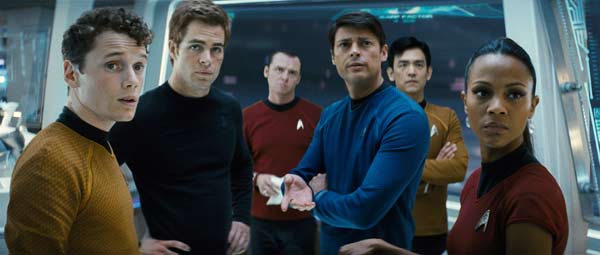

While Kirk and Spock are obviously the main protagonists, the film also does a great job in setting up all of the other main characters. Not all of them get as much to do as the lead duo but they at least have one scene each that establishes their importance to the crew. While Dr. Leonard ‘Bones’ McCoy has perennially been the third most important character of the series, the film actually promotes Lt. Nyota Uhura to that position. And sure, a sizable part of her role in the newer films does revolve around her romantic relationship with Spock but I actually don’t mind that as I feel that this relationship gives Spock a valuable human connection. Plus, I also liked how, early on, Uhura didn’t really get along with Kirk as a result of his generally brash demeanor. But of course the film doesn’t forget about the Enterprise’s reliable doctor, Bones, and of the entire cast, Karl Urban probably acts the closest to his predecessor, DeForest Kelley. Urban absolutely nails the character’s generally grumpy but still very much humane attitude, especially in scenes where he’s arguing with Spock (“Are you out of your Vulcan mind?”). Helmsman Hikaru Sulu (John Cho) gets to be part of a major action sequence when he and Kirk space-jump onto a Romulan drill, which harkens back to a famous moment from the episode ‘The Naked Time’ in which Sulu, while under the influence of a mysterious substance, brandishes a fencing foil (from the 2009 film: Kirk: “So what kind of combat training do you have?” Sulu: “Fencing.”). The sequel even hints at a potential future as a starship captain, something that did happen in the original timeline, when he becomes acting captain and threatens ‘John Harrison’ with the load of torpedoes at the Enterprise’s disposal (Bones: “Mr. Sulu… remind me never to piss you off.”).

As for ensign Pavel Chekov (played by the late Anton Yelchin, who tragically passed away recently meaning that the upcoming Beyond will serve as his final turn in the role), the film immediately sets him up as a young mathematical prodigy. Said talent comes in handy later on, especially in a scene in which he is able to beam up Kirk and Sulu when they fall off of the Narada’s drilling device. However arguably his best moment came in Into Darkness, during which he’s promoted to the role of Chief Engineer when Scotty decides to resign. Simply put, the look on his face when Kirk tells him to go put on a red shirt is priceless, showing that he clearly knows what happens to most redshirts in Star Trek. Thankfully that fate doesn’t end up happening to him. And of course we can’t forget about the Enterprise’s trusty engineer, Montgomery Scott, who is first introduced working at an outpost on Delta Vega before Kirk brings him onto the Enterprise as Chief Engineer. Like Urban, Simon Pegg absolutely nails the role from the accent to the mannerisms and the films certainly utilize Pegg’s comedic ability to great effect, from the scene in which he awkwardly remarks how exciting it is on the Enterprise after the whole ‘Kirk emotionally compromising Spock’ scene to the scene in Into Darkness in which he drunkenly argues with Kirk over coms while at a bar following his resignation. In short, every member of the Enterprise crew matters in the long run and these films do an absolutely fantastic job in establishing a phenomenal camaraderie amongst its cast of leads. 


But perhaps the biggest issue that most Trek fans have with the new films is the fact that it seemingly focuses more on action than the layered, cerebral plots that the franchise has perennially been known for. And while it’s true that the films definitely have a very action-heavy style, I don’t really see how that’s entirely a ‘bad thing’. Chris Pine was recently quoted as saying that it’s not really possible to do ‘cerebral’ Trek anymore in 2016, saying that “it just wouldn’t work in today’s marketplace” of big blockbusters… and you know what? He’s totally right! Like imagine if they ever decided to do something similar to Star Trek: The Motion Picture… that would be a colossal disaster from a box-office perspective. It’d do about as good as a Terrence Malick film. The other thing is that I’d argue that while the films do lean more towards being sci-fi action films, that doesn’t mean that they don’t have strong themes and character arcs in them. In the case of the 2009 film, there’s things like Kirk trying to deal with being in the shadow of his father and Spock struggling to deal with his emotions as well as dealing with his half-human/half-Vulcan heritage. Heck, Nero (Eric Bana) is actually a pretty decent villain as far as Star Trek villains go. He has an emotional backstory to him as he seeks vengeance against Spock (the older Spock, specifically, though this plot of revenge is later carried over to the younger Spock) for being unable to save his planet Romulus from destruction. So as payback, he makes Spock witness the destruction of Vulcan… and boy is that an emotional gut-punch of a scene, especially when Spock’s mother Amanda falls to her death right in front of her son. Heck this whole film is full of effective emotional moments, including the opening as Kirk’s father sacrifices himself right as his wife gives birth. What can I say? J.J. does a great job when it comes to scenes like this.


Speaking of the score, Michael Giacchino’s music for these newer Trek films are two of my all-time favorite film scores. In creating said score, Giacchino does something that David Arnold did when he did the music for the 2006 James Bond ‘prequel/reboot’ film, Casino Royale. And that is that he makes the smart decision to not primarily utilize the iconic Star Trek theme created by Alexander Courage. Instead, that piece is fittingly used during the end credits and I must say that Giacchino’s version of the theme is quite a rousing cover of it. But as for the rest of the film, Giacchino does an absolute fantastic job when it comes to creating motifs that can be either really emotional or invigoratingly thrilling during the film’s equally thrilling action sequences. In regards to the latter, this mainly comes in the form of this reboot series’ main motif (exemplified in this track, ‘Enterprising Young Men’). I absolutely adore this motif and I especially love how it can be used in both emotional scenes (e.g. ‘Warp Core Values’ from Into Darkness) and scenes of grand spectacle (e.g. the aforementioned ‘Enterprising Young Men’, during which we see the first look at the Enterprise, and ‘Sub Prime Directive’ from the opening of Into Darkness as the Enterprise rises out of the ocean). In the case of the former, just look at tracks like ‘Labor of Love’, which is played when Kirk’s father sacrifices himself while his wife gives birth, or ‘Buying the Space Farm’ from Into Darkness, when Kirk makes the same bold sacrifices that his father made and shares one last moment with Spock.


And yeah… let’s talk about Star Trek Into Darkness. This is one that I’ve been dying to stick up for these past few years because ever since it came out, it’s been subjected to much scrutiny from ‘Trekkers’. So much so that at a convention in Las Vegas that was held a few months after the film premiered, it was named the WORST film in franchise history, with one fan apparently claiming that the JJ films shouldn’t even recognized as Star Trek films… and boy does all of this piss me off. First off, Into Darkness is ‘worse’ than The Motion(less) Picture, the yawner that is Insurrection, or the actual near-franchise killer that was The Final Frontier? But the thing that really rubs me the wrong way is the statement about the films not belonging in the franchise. You know, the franchise that was pretty much dead and would still be dead if it wasn’t for the J.J. films? They seriously ranked a non-Trek film, 1999’s Galaxy Quest, higher than Into Darkness. That shouldn’t even count! UGH! So what is it about Into Darkness that Trek fans were so upset about? It was over the big bait-and-switch pulled by the filmmakers in which it was revealed that Benedict Cumberbatch’s villain character was in fact the legendary franchise antagonist Khan… except in the months leading up to the film’s release, everyone kept denying that he was Khan. And to make things more problematic, the film then proceeded to re-imagine some notable ‘moments’ from Star Trek II: The Wrath of Khan, namely the bold sacrifice by a main character to save the Enterprise from being destroyed and the vengeful screaming of Khan’s name. However, is the film as big of a ‘rehash’ of Wrath of Khan as Trekkers claim? The truth is… it really isn’t…


If Star Trek Into Darkness was about Khan trying to find a terraforming device capable of giving new life to a dead planet or destroying every living thing if used on a planet with life, then I’d probably be more susceptible to call the film a ‘rip-off’ of Wrath of Khan but that’s not what the film is about. Instead, it’s about Khan enacting revenge upon Starfleet for using him and holding the rest of his people hostage. And really, you want to know how many things the film ‘borrows’ from Wrath of Khan? Aside from having Khan being of the villain, of course, as well as introducing the character of Carol Marcus, who gave birth to Kirk’s son David in the original timeline, there’s really only two major sequences from that film that are redone here; the aforementioned sacrifice and KHANNNN! scenes. Seriously Star Trek Nemesis was a bigger ‘rehash’ of Wrath of Khan. I’m not joking; the final battle of Nemesis is almost note-for-note the exact same finale. Two ships captained by a Federation captain and his greatest ‘personal’ nemesis fighting in a part of the galaxy where they are unable to target each other to attack, ultimately culminating in the death of probably the most popular character of their respective casts. Now as far as the whole thing about the cast and crew denying Khan’s identity before the film’s release, I actually don’t blame them for trying to keep the whole thing a secret. In the digital age, it’s become much harder for studios to prevent leaks of spoiler-heavy material. In fact, I already knew that Cumberbatch was going to play Khan months in advance due to someone at Entertainment Weekly making the idiotic mistake of identifying him as Khan when they debuted a pair of magazine covers for the film, one with Kirk and Spock, the other with Kirk and Khan.

And speaking of Khan, Benedict Cumberbatch is fantastic in the role. He doesn’t try to be Ricardo Montalban’s version of the character and that was certainly a smart move… otherwise the film would’ve gotten even more flak from Trek purists. Cumberbatch brings a ‘Hannibal Lecter’ esque vibe to his performance, which of course is straight-up exemplified in scenes where Khan is held captive on the Enterprise. But perhaps the most interesting part about Cumberbatch’s take on the character is that this film’s Khan is in some ways a very sympathetic villain. When Khan reveals his true identity to Kirk and Spock, he then proceeds to recount his past history. His ship and crew were found adrift by Starfleet’s Commander-in-Chief, Admiral Marcus, who subsequently took Khan’s crew hostage in exchange for having him develop weapons and the Admiral’s new ship, the USS Vengeance. Ultimately this of course leads to Khan enacting revenge upon Starfleet when he is led to believe that Marcus had killed his crew. However, as we learn, he didn’t and instead had them placed in cryogenic freeze inside 72 of the advanced torpedoes that Khan had been developing. Marcus then proceeds to give said torpedoes to the Enterprise to use as leverage against him. Khan immediately recognizes this when Kirk and crew confront him on Kronos and he willingly surrenders. And boy is the scene in which Khan emotionally recounts how he was led to believe that Marcus killed his crew yet another emotional gut-punch of a scene, buoyed by Cumberbatch’s absolutely powerful performance as well as the final line of his ‘monologue’; “Is there anything you would not do for your family?”


Once again, the film does a fantastic job of portraying the relationship between Kirk and Spock, which hits another snag at the beginning of the film when Kirk violates the Prime Directive and lets the Enterprise be seen by a primitive race in order to save Spock from an active volcano. And because Spock is very much someone who goes ‘by the book’, he ends up reporting this to Admiral Pike and Kirk is relieved of his command as a result. Obviously Kirk is pissed and Spock’s general ‘lack of emotion’ once again proves to be an issue for him. It even strains his relationship with Uhura as a result of him seemingly embracing his death at her expense. The film also continues to focus on Kirk’s reckless behavior, as Pike comments that this kind of attitude could get everyone under his command killed. That ends up being Kirk’s arc in this film; learning to take better responsibility for his actions. Because when ‘John Harrison’ attacks Starfleet and Pike ends up being one of the casualties, it leads to him recklessly going after Harrison to avenge the death of the person who become the closest thing that Kirk ever had to a father figure in his life. And sure, while Spock is the one who is with Pike when he dies, Kirk’s reaction to his death is still pretty damn emotional as is the scene where Spock mind-melds with Pike before he dies. Ultimately by the end of the film, Kirk follows in his father’s footsteps by saving his ship at the cost of his life by entering the ship’s radioactive reactor chamber and realigning the warp core.


And folks, I won’t lie in saying that the scene in which Kirk and Spock share one final moment before Kirk dies from radiation poisoning brings me to tears every time that I watch it. And yes, I know that it’s almost exactly the same as that scene from Wrath of Khan but aside from one or two lines of dialogue that are lifted from the previous film (e.g. ‘ship out of danger’), the filmmakers actually do enough to differentiate this scene from its predecessor, namely in regards to context. In Wrath of Khan, this was pretty much the first time that Kirk truly has to deal with a ‘no-win’ scenario. In Into Darkness, this scene reaffirms the friendship between the two. All throughout the film Kirk tries to prove to Spock why he risked violating the Prime Directive to save Spock from the volcano and it is in this moment when Spock realizes why he did it; he wasn’t going to let his best friend die. And as for the once-again infamous ‘KHAANNN!’ scene, this time performed by Spock, yeah it’s ridiculous but the same could be said for when William Shatner did it in Wrath of Khan. With that said, some have argued that this scene is ‘pointless’ due to the fact that it wasn’t necessarily Khan’s fault for the Enterprise falling helplessly to Earth. And yet, like the argument that the film is a complete retread of Wrath of Khan, that’s not entirely true. Sure, most of the damage sustained to the ship was caused by the film’s other ‘villain’, Admiral Marcus, but Khan ended up taking control of Marcus’ ship, which then proceeded to further attack the Enterprise. So I’d argue that said further attack is what ultimately led to the ship falling to Earth. So yes, even if it’s only in a minor way, Khan WAS partially responsible.

And yeah… maybe I should talk about the big elephant in the room. And that is in regards to the film’s major McGuffin, Khan’s blood. As shown in the beginning of the film, Khan is able to blackmail a Starfleet officer into bombing a Starfleet facility by offering to help save the officer’s terminally ill daughter with the use of his blood. And as you might expect, Khan’s blood is what is ultimately used to save Kirk. Bones realizes this when a dead Tribble that he has been experimenting on suddenly comes back to life as a result of the blood. Is it ridiculous? Yes. Is the part with the Tribble rather blatant fan-service? Yes. Am I in any way bothered by this plot-point? No. Because believe me, the Star Trek franchise has seen plenty of silly plotlines over the years, like in Star Trek IV: The Voyage Home when the villain was a giant space log that was trying to talk to humpback whales. And yes, I think it’s pretty clear that this plotline of, to quote its critics, ‘magic blood’ probably isn’t going to brought up again in future films, which would effectively make this ‘new discovery’ that could fix a whole lot of problems rather pointless in the long run. But again, I’m not too bothered by that because at the end of the day, Into Darkness is just like its predecessor in being a very fun and action-packed adventure buoyed by effective emotional depth and terrific character development. Worst Star Trek film of all-time this is not… not by a long shot.

Now I will admit… I’m quite biased towards the J.J.-era films. I’ll admit that prior to 2009, I knew little about the Star Trek franchise but I was interested in seeing the 2009 film after hearing that it got really exceptional reviews from critics. So I went to go see it with my dad, loved it, and afterwards, I learned that he was a fan of the series. As a result, I started to get into the series more and more. But time and time again, I found myself coming back to the 2009 film, mainly after I bought it on iTunes (which was pretty much the first major film ‘home media purchase’ that I ever made) and then proceeded to watch it numerous times. So yeah… you could say that the 2009 film is a very personal one for me and because of that, it legitimately has become one of my Top 10 favorite films of all-time. As a result, Into Darkness became my most anticipated film of 2013. When I first saw the film, I gave it a 4.5/5 rating but then had to start dealing with the slowly increasing backlash towards the newer films, mainly brought on by Into Darkness, to the point where I wondered if I was being a bit too lenient towards it. But when I bought on Blu-Ray on the week it came out, I re-watched it and was thrilled to see that not only did I still love it, it was even better in my opinion the second time around. So I updated my rating to 5/5. I’m an unapologetic fan of the J.J.-era Trek film and feel that they are far better than what Trek purists constantly put them out to be. Sure they may appeal to non-fans more due to their more action-focused pacing but I argue that they still do enough to capture that Trek feel, namely through the great characterizations of its protagonists and its strong emotional depth.

You can bet that I’m very much excited for Star Trek Beyond, which clearly has a lot to prove. It certainly hasn’t been easy to appease to long-time Trek fans, especially considering that they hired another ‘action’ director, Justin Lin, to take over for J.J. Abrams, who of course was busy working on a different Star film that you may have heard of. However, I don’t see how that’s a ‘bad’ thing due to Lin being one of the best action directors in recent years thanks to his work on the recent Fast and Furious films. Plus, Lin has made it clear that he is a fan of Trek, which I guess you can say is better than what was the case with J.J., who admitted that he was a bigger fan of Star Wars (But I sure as hell ain’t holding him to that, mind you). The film surely will also benefit from having Scotty himself, Simon Pegg, handling script duties as Pegg’s sci-fi fandom background as well as his work on the Cornetto trilogy will no doubt provide the film a solid pedigree. However, when the film’s first trailer was released, the ‘too much action’ argument was brought up once again, with Pegg admitting that even he wasn’t a fan of how the action-oriented trailer was put together. Me personally, though, I thought the trailer was perfectly fine. I also didn’t really get the complaint about the use of ‘Sabotage’ by the Beastie Boys being out of place considering that this was part of a major sequence in the first film. However, thankfully the second trailer was received much more positively and based on all of the clips that I’ve seen from it, many of which once again showcase the amazing camaraderie amongst the new cast members, I’m confident that Star Trek Beyond will be yet another super fun sci-fi adventure. However, I’m also hoping that this one will fare better with Trek purists because, well, I’m getting sick of having to defend these newer films against them.

And that marks the end of my very, very long defense of J.J. Abrams’ Star Trek films. Anyone else share my thoughts towards the newer films? And if so, are you excited for Star Trek Beyond regardless of how long-time Trek fans might respond to it? Be sure to sound off in the comments below.


Next time: My review of Star Trek Beyond


Monday, February 1, 2016

The Finest Hours (2016) review


In February of 1952, members of the United States Coast Guard performed what has since been regarded as one of the most famous rescue missions in the organization’s history. In the midst of a particularly harsh ‘Nor’easter’ storm that had hit the East Coast, a four-man crew from the Coast Guard station in Chatham, Massachusetts braved the storm and the harsh waters of the Atlantic in order to help the crew of the SS Pendleton, a T2 tanker that had broken in half about 20 miles or so off of the Chatham coast. In fact, it was the second of two T2 tankers that suffered the same exact fate on the very same day, the other being the SS Fort Mercer. Ultimately, though, it was the Pendleton rescue that became known as the most famous small boat rescue in U.S. Coast Guard history and the story of this daring rescue mission is brought to life on the big-screen in Disney’s ‘The Finest Hours’, which is primarily based off of the book of the same name by Michael J. Tougias and Casey Sherman that chronicled the events of that day. ‘The Finest Hours’ is driven by some particularly stand-out performances from its two main leads, Chris Pine and Casey Affleck, and while the film is admittedly a bit straight-forward when it comes to its proceedings, it’s still a fittingly honorable and suitably thrilling take on this fascinating true story of the heroism of four men in some of the harshest conditions imaginable.    

The leader of the four-man crew was Boatswain’s Mate First Class Bernard ‘Bernie’ Webber (Chris Pine), who at that time was courting a local girl from the neighborhood named Miriam (Holliday Grainger) who worked as a telephone operator. But on February 18, 1952, T2 tanker SS Fort Mercer ends up getting split in half by the impending winter storm that is set to hit the Cape Cod area. And as fate would have it, another T2 tanker nearby, the SS Pendleton, breaks in half as well. But unlike the SS Fort Mercer, the SS Pendleton was unable to make a distress call for help due to a loss of radio capabilities as a result of the breakage. While another team heads out to help the crew of the SS Fort Mercer, Chatham station commander Daniel Cluff (Eric Bana) dispatches Bernie to help the Pendleton. Despite the severe risks that come from the storm and the fact that they would have to go over the extremely dangerous Chatham Bar to reach them, Bernie and his crew; Seaman Richard Livesey (Ben Foster), Engineman Third Class Andrew Fitzgerald (Kyle Gallner), and Seaman Ervin Maske (John Magaro), head out on Lifeboat CG-36500 to help the crew of the SS Pendleton. Meanwhile, on the Pendleton, Chief Engineer Ray Sybert (Casey Affleck) takes control of the crew, due to the fact that the Captain of the Pendleton was lost because he was on the other half of the ship, in order to keep the ship afloat as long as they possibly can in the hopes that they are rescued before the ship sinks.

‘The Finest Hours’ can be a bit straight-forward at times in terms of its plot. Then again, that’s sort of expected given that it’s a true story and you may or may not be generally aware of what happened and how it all ended going into it. But even with that in mind, the film is full of some genuinely thrilling moments as both Bernie and his crew and the crew of the SS Pendleton, as led by Ray Sybert, try to stay alive in some of the harshest conditions imaginable while out on the open sea. Those sequences set at sea, including the sequence where Bernie’s crew traverses over the aforementioned Chatham Bar, a sand bar that was capable of running ships aground even in lesser conditions compared to the storm that they had to go through that day, are definitely the major highlights of the film. They convey the right amount of tension and suspense and are benefitted by some solid visual effects work. However, there are some who have argued that the film doesn’t really do enough to convey the real emotional core of the story and, as a result, feels a bit too ‘workmanlike’ at times. But overall I think that the film did do a fine enough job in regards to showcasing the valor of its heroes simply by way of the remarkable nature of the situation that they’re put through.

In regards to the film’s cast, the biggest standouts are its two main leads, Chris Pine as Bernie Webber and Casey Affleck as Ray Sybert. As Webber, Pine once again shows off his strong charisma that was also present in many of his other performances like James T. Kirk in the ‘Star Trek’ films or as Cinderella’s Prince in ‘Into The Woods’, while also doing a great job of getting across Webber’s audacity and courage in the face of danger. As Sybert, Affleck is also terrific in the role of the one man who, despite the fact that a lot of the crew didn’t like him very much, took charge of them so that they could survive. The two are backed up by a solid supporting cast that includes, among others, Ben Foster, Kyle Gallner, and John Magaro as the other members of Bernie’s crew and Eric Bana as Webber’s commanding officer Cluff. Pine also has really solid chemistry with the film’s main female lead Holliday Grainger, resulting in some very charming and sweet romantic moments between them. However, Grainger ends up being rather underused in the role of Bernie’s girlfriend Miriam. While the trailer may have implied that she would have a fairly substantial role in the film, as primarily evident in the sequence in the trailer where she confronts Cluff over sending Bernie and his team out into the storm on what very much seems to be a ‘suicide mission’, that’s really all that she gets to do in this film. In other words, she’s basically stuck in a ‘50’s era housewife’ role. Though from what I hear, at the very least this is more than what her character actually did in real-life. In reality, Miriam was stuck at home with the flu while all of this was going on.

The consensus on Rotten Tomatoes notes that this film is ‘old-fashioned to a fault’ and I will say that this is a pretty accurate description of the film. For some, this may be just a bit too ‘old-fashioned’ for their taste. But as traditional as it may get from time to time, it’s still a very solid and exciting adventure that highlights one of the most fascinating rescue missions in U.S. Coast Guard history. To truly put this moment into perspective for you folks, Webber and his crew had to rescue a 33-man crew commandeering a 35-foot boat that could only hold 12 in the midst of an extremely harsh winter storm. And while some may argue the film is a bit too subdued in regards to how it handles its true story, overall I’d say that the film does do a fine job in conveying the heroism of its real-life subjects. And to top it all off, the film has a solid cast buoyed (no pun intended) by leads Chris Pine and Casey Affleck and some genuinely tense action sequences backed by solid visual effects. In short, it’s a neat little look into a fascinating true story that took place in the New England area. Being a local New Englander myself, I’ll admit that I’m always fascinated by true stories like this that took place in this area, with other notable examples being ‘Black Mass’ and, to some extent, ‘The Social Network’. ‘The Finest Hours’ is the latest of these films and overall I say that it’s very much worth checking out for those looking for a good-old fashioned rescue drama.


Rating: 4/5

Sunday, December 28, 2014

Post Christmas Double Feature Short Reviews: 2014

Well folks, for the third year in a row, me and my co-panelist on ‘The Feature Presentation’, Matthew Goudreau, embarked on a cinematic double-header as we did our third straight post-Christmas double feature, as we went to go see a pair of potential award contenders yesterday, which has basically been the case with every film we’ve seen in this fashion since we started doing this. In 2012, we went to go see the musical epic ‘Les Miserables’ and Quentin Tarantino’s latest film, ‘Django Unchained’. Last year, it was Martin Scorcese’s hilarious, and in some cases rather underrated, black comedy ‘The Wolf of Wall Street’ and ‘American Hustle’, the film that unfortunately I wasn’t as big a fan of compared to most critics; I was more in the line with the general reaction from most audiences. Like I did these last two years, I’m not going to do full reviews of these two films, only because I’m currently busy prepping my end-of-the-year ‘Best of’ list. So instead, I’m just doing a pair of quick short reviews for each of the two films that Matt and I watched yesterday. So, without further ado, let’s get started.

INTO THE WOODS


Disney has been known for some truly iconic movie musicals, from animated films like ‘The Lion King’ and ‘Frozen’ to live-action classics like ‘Mary Poppins’. Their latest musical, ‘Into the Woods’, certainly has quite the pedigree in terms of talent both behind and in front of the camera. It’s based off of the multi Tony Award winning musical of the same name by famous composer Stephen Sondheim and writer James Lapine. It’s directed by Rob Marshall, who helmed 2002’s Oscar-winning musical ‘Chicago’, and it’s got an all-star cast from top to bottom… and overall it’s a pretty damn good musical with stunning visuals and a nice light-hearted atmosphere that contrasts solidly with the darker turns of the second act. As some have joked, it’s sort of the fairytale equivalent of something like ‘The Avengers’ as it brings together many famous characters from classic fairytales, from Cinderella (Anna Kendrick) to Little Red Riding Hood (Lilla Crawford) to Jack from Jack and the Beanstalk (Daniel Huttlestone). It’s primarily focused around a Baker (James Corden) and his wife (Emily Blunt) who embark on a journey to lift a curse of infertility that was set upon the Baker’s family years ago by an old witch (Meryl Streep) by bringing her four items; “a cow as white as milk, a cape as red as blood, hair as yellow as corn, and a slipper as pure as gold”. And while they’re on this journey, they come across all of the aforementioned fairy tale characters who just so happen to have the items that they need.

There’s been much talk about whether or not Disney would ‘tone down’ some of the darker parts of the musical, like the sexual undertones of the scenes between Little Red Riding Hood and the Wolf (Johnny Depp, who I kid you not is literally in the film for only about five minutes). And it’s true that certain parts were definitely toned down to maintain a family friendly PG rating. But, for the most part, I think it’s for the better. While the story certainly does get dark near the end, this is, for the most part, a fairly light-hearted story with a lot of humor and some fairly over-the-top moments but it’s ‘over the top’ in a good way as it’s a fairly heightened reality being that it’s a fairy tale. The musical numbers are solid and the cast is spot on from top to bottom. A lot of people have been focusing on Meryl Streep as the Witch and while she is great in the role, I have to say the biggest standout of the cast would actually have to be Emily Blunt as the Baker’s Wife, as she provides a much more ‘down-to-earth’ persona compared to most of the other characters in the story. My only real complaint about the film is that sometimes it feels like the story rushes through some moments, like when Jack climbs the beanstalk. I mean, this was probably the case with the musical as well but I do kind of wish that we could’ve gotten to see some of these moments. Still, ‘Into the Woods’ is a solid musical and while I can’t really say how much it stays true to the original musical due to the fact that I haven’t seen it, I have the feeling that this film at least does it justice.

Rating: 4.5/5

THE IMITATION GAME


Then we have ‘The Imitation Game’, based on the true story of Alan Turing, the famous computer scientist who was one of the key figures in cracking the Enigma Code of Nazi Germany during the Second World War by developing a special deciphering machine known as the ‘bombe’ that could encrypt these secret messages much faster than any human can. This story is truly fascinating and in some cases fairly sad due to some key events that happen near the end. I mean, this was a man whose work saved countless lives during World War II and, as some have predicted, it shortened the length of the war by at least two years. And yet unfortunately, in 1952, he was prosecuted for being a homosexual, a way of life that was outlawed in the UK at the time. He died only two years later in 1954 on account of suicide, and it wasn’t until recently (just a year ago, in fact) when his work was finally given the proper recognition it truly deserves. With that in mind, this is without a doubt a must-see ‘true story’ film as Turing was a man who truly left a major impact on all of our lives. You know those devices that you and I use every day… computers? His work is what laid the groundwork for that technology and the fact that he was prosecuted just for being gay (which is just total BS) makes this film even more important in today’s society, where currently only 35 states in the U.S. (and the District of Columbia) allow same-sex marriage.

The main highlight of this film is easily Benedict Cumberbatch’s performance in the role of Turing. I can definitely see a bit of Cumberbatch’s version of Sherlock Holmes in this performance as both men have this sort of awkwardness to them. But while Sherlock is more confident in what he’s doing despite the fact that he seems awkward and strange to everyone around him, Turing is fairly shy in terms of his awkwardness, which makes sense due to the fact that he’s holding in a big secret from everyone around him. Keira Knightley is also superb here as well as Joan Clarke, a fellow code-breaker who Turing gets into a romantic relationship with before finally revealing his secret to her. Not only are the performances great, but the film is really captivating as we see Turing and his team in a race against time to break the Enigma Code as they only have a set amount of time each day to figure it out before it switches at the end of the day. All in all, ‘The Imitation Game’ is a well-acted and well-directed film that truly shines a light on a man who thankfully has begun to receive the recognition that he truly deserves and the struggles that he went through near the end of his life will certainly resonate for many people today.


Rating: 5/5!

Monday, December 1, 2014

Horrible Bosses 2 (2014) review


I’ve said it before and I’ll say it again; 2011, while not really the best year when it came to movies, did have both some surprises and some surprise hits. One that fell into the latter group was the comedy ‘Horrible Bosses’, in which Jason Bateman, Jason Sudeikis, and Charlie Day starred as a trio of friends who conspired to kill their titular ‘Horrible Bosses’ when they found that they were unsatisfied with their current job statuses. I didn’t see it when it first came out but I did end up getting it on Blu-Ray and I watched it before seeing the sequel. Overall I can’t say that it’s one of my all-time favorite comedies but it did have quite a good amount of laughs, which mostly stemmed from the fact that the three main characters were, to put it bluntly, a bunch of idiots. Korey Coleman from DoubleToasted.com (formerly Spill.com) said it best when he noted that this is pretty much the closest that we might ever get to a modern-day Three Stooges movie and sure enough that’s exactly what the first ‘Horrible Bosses’ was. So now we have ‘Horrible Bosses 2’, with the majority of the main cast from the first movie (save for one, whose identity I won’t spoil for those who haven’t seen the first film) returning albeit now under a different director, with Sean Anders taking over for Seth Gordon. And overall, while I can’t say that ‘Horrible Bosses 2’ is the absolute best comedy of this year, or that it’s even better than the first film, I will say that it does have a decent amount of laughs primarily thanks to the camaraderie of its cast.

After spending most of their careers working for terrible bosses, best friends Nick Hendricks (Jason Bateman), Dale Arbus (Charlie Day), and Kurt Buckman (Jason Sudekis) decide to start up their own business so that they can be their own bosses. They come up with an idea for a car wash inspired shower product which they call the ‘Shower Buddy’ and they agree to a manufacturing deal with investor Burt Hanson (Christoph Waltz). However, after the trio take out a business loan in order to produce the 500,000 units that were asked for in the deal, Burt suddenly backs out of their deal as he plans to take all of their inventory and sell it himself. Now facing a huge debt as a result of their loan, the trio look to find a way to save their company. After what they went through in the first movie trying to kill their old bosses, they decide to resort to kidnapping as they plan to kidnap Burt’s son Rex (Chris Pine) and hold him hostage for ransom. But after their first kidnap attempt, they suddenly find that Rex is very eager to help them get revenge on his dad because of the strained relationship they’ve currently been having. Though hesitant at first, they accept his help as they all plan to get back at Burt but as in the last movie, things really don’t end up going as well as they plan.

Now ‘Horrible Bosses 2’ does commit the same mistake that most comedy sequels do; instead of trying something different, it’s mostly just the same general beats from the first movie (what I’m guessing studios like to call what they think is a ‘tried and tested’ formula). There are some very, very minor differences like how in this one the trio is doing a kidnapping instead of murdering their adversaries and how one of their adversaries ends up helping them, but for the most part the film maintains a fairly similar structure to the first film in terms of its plot. Still, despite that, the film still has a fairly decent amount of laughs. I didn’t really think there was any major laugh-out-loud moment like there was in the first film (like when Dale tries to save one of the trio’s bosses when he is affected by a peanut allergy) but overall this sequel still had its fair share of laughs. Like the first film, it is due to the pure stupidity of the main characters of Nick, Kurt, and Dale. I mean when you really get down to it, these three just have no idea what they’re doing. And that’s really what makes these films so funny is how we see them constantly screw up in their plans, from forgetting to do something because they get distracted to revealing something that they didn’t want anyone else to know. As noted earlier, they’re the modern-day ‘Three Stooges’.

Once again, this film primarily succeeds thanks to the great camaraderie between the three leads; Bateman, Day, and Sudekis. They do work off each other incredibly well even if when these three characters are together you know they’re going to do a lot of really, really dumb things and also sometimes they ramble over each other to the point where sometimes you have no idea what they’re saying. Jennifer Aniston and Kevin Spacey also reprise their roles as Dale and Nick’s former bosses Dr. Julia Harris and Dave Harken, respectively, as does Jamie Foxx as Motherf***er Jones and they all have their own memorable moments in their fairly brief bits of screen-time. Of the new cast additions, the biggest standout is easily Chris Pine. Pine showcases some excellent comedic chops (which I do think we saw bits and pieces of from his work in the recent ‘Star Trek’ films) and he also works well off of the three leads just as much as they do with each other. Still, some of the new additions to the cast unfortunately are wasted in this, namely Christoph Waltz and Jonathan Banks (AKA Breaking Bad’s Mike Ehrmantraut), the latter of whom plays the detective working the ‘case’ of Rex’s kidnapping. That’s basically due to the fact that because the film focuses so much on the lead trio and Pine, Waltz and Banks don’t get much to work with here.

Like with many comedy sequels, ‘Horrible Bosses 2’ doesn’t really do much new when compared to the first film. It’s basically the same plot just with a slight few differences. Still, as far as the comedy sequels that do copy the same plot of their predecessors go, this is one of the better ones of that group even if it isn’t self-aware of this fact like ‘22 Jump Street’ was earlier this year. No, it’s not the funniest film of the year and I can’t even say it’s better than the first film. Still, it does manage to get by thanks to the whole scenario of the stupid actions committed by the three lead characters and the excellent camaraderie amongst the three main leads in Jason Bateman, Jason Sudekis, and Charlie Day. Ultimately, I feel that whether or not you do like this movie may depend on what you thought of the first film, seeing how this is basically the same general movie. It was a solid hit commercially but I am aware of some criticizing it for some mean-spirited (racist, homophobic, etc.) jokes and yeah there are definitely some jokes of that nature in both of these movies. Despite this, I did like the first ‘Horrible Bosses’ and ultimately I did like ‘Horrible Bosses 2’ even if this film does rehash a lot of bits from the first film. So if you did like the first film, I bet you’ll like this one too.

Rating: 3.5/5