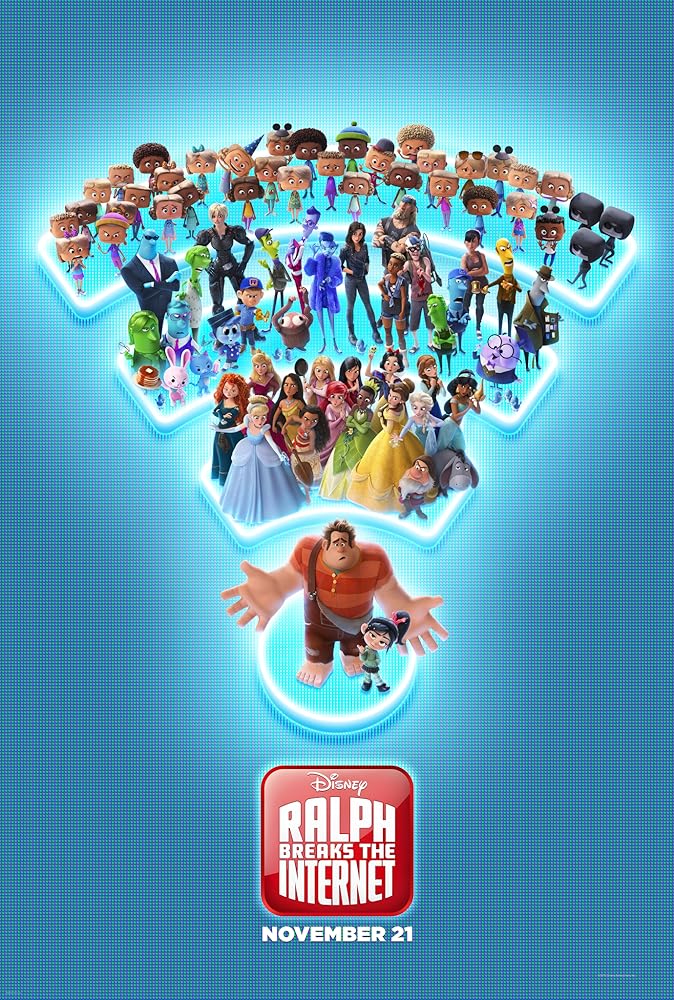
In 2012, Walt Disney Animation released their 52nd animated feature, Wreck-it Ralph. This tribute to both classic and modern video games centered on the titular Wreck-it Ralph, the main antagonist of a classic arcade game in a world where arcade characters can travel to other games and interact with each other via the power strip that their cabinets are plugged into. Having grown tired of being stuck in the role of ‘the bad guy’ for 30 years, Ralph embarked on a journey throughout other video games in the hopes of having his own ‘hero moment’. Upon its release, the film was a solid success with both critics and audiences, grossing over $471 million worldwide and serving as another contributor to Disney Animation’s recent revival when it came to the quality of their films. But perhaps the most notable thing that the film managed to accomplish was earning a genuine rarity when it comes to the studio’s filmography, a sequel. Oh sure, many of the classic Disney animated films have gotten sequels over the years, but they primarily came via the now-defunct direct-to-video division Disneytoon Studios and, to be perfectly blunt, usually weren’t of the same quality. Prior to this year, only two Disney animated films had officially gotten sequels that were given proper theatrical releases; The Rescuers (The Rescuers Down Under) and The Many Adventures of Winnie the Pooh (Winnie the Pooh). Plus, those two films came out several years after their predecessors, which makes this year’s Ralph Breaks the Internet (AKA Wreck-it Ralph 2) even more of a unique phenomenon given that it comes out just 6 years after the original and was made by the same development team. But fear not, folks, as this film manages to maintain the same heart and snappy writing of the original Wreck-it-Ralph even with a major shift in its setting from the ever-changing world of the classic video arcade to the equally ever-changing digital world that is the internet.
6 years since their previous adventure, things have been going quite well for Wreck-it Ralph (voiced by John C. Reilly), the main antagonist of the classic game Fix-it Felix Jr., and his best friend Vanellope von Schweetz (voiced by Sarah Silverman), the main protagonist of the popular racing game Sugar Rush, at their home, Litwak’s Family Fun Center and Arcade. However, when Vanellope begins to feel that her game is starting to get a little predictable, Ralph’s efforts to fix that unintentionally end up resulting in the machine’s steering wheel to break. And to make matters worse, because Sugar Rush’s developers went out of business years ago, the arcade’s owner Mr. Litwak (voiced by Ed O’Neill) has no choice but to unplug the game, rendering Vanellope and the rest of its residents without a home. Not wanting his best friend to lose her game forever, Ralph comes up with the idea to travel to the internet via the arcade’s newly installed wi-fi router to find a new steering wheel on eBay. But while Ralph and Vanellope successfully enter the world of the internet and find the wheel on eBay, they soon find themselves dealing with another issue when they find that they don’t have the money to buy it. Thus, they decide to respond to a clickbait ad that promises that they can earn money by playing video games and are told to collect a valuable car from the popular racing game Slaughter Race. While their efforts to take the car are ultimately unsuccessful, Vanellope’s racing skills end up attracting the attention of its owner Shank (voiced by Gal Gadot) and the two begin to form a friendship that gives Vanellope a new perspective on life to the point where she considers staying there instead of returning to the arcade. This, of course, ends up being an issue for Ralph, who embarks on his own quest to collect the money that they need by becoming a viral star on the video site BuzzzTube with the aid of its chief algorithm Yesss (voiced by Taraji P. Henson).
Like the first film, Ralph Breaks the Internet presents a story concept that admittedly runs the risk of dating itself given its subject matter. In the first film, that came courtesy of its various references to classic video games that would most likely fly over the heads of younger audiences (e.g. a scene where a character inputs the iconic ‘Konami Code’). And in the case of the sequel, it’s through its internet setting. Because the internet is always changing, trends that are relevant now could end up becoming stale in the future, and this film does have a few references to current internet culture that will probably elicit some groans from certain crowds during future viewings. But just like the first film, Ralph Breaks the Internet manages to work around this thanks to its strong story. For starters, it does treat its internet concept in a serious manner, showcasing both the good and the bad of the global network (e.g. the first rule of the internet, ‘don’t read the comments’). This is then tied excellently into the main plot of Ralph and Vanellope both dealing with forms of insecurity, which then highlights the concept of how friendships change over time once Vanellope begins to express interest in staying in Slaughter Race. As for the animation, this sequel maintains the same great aspect from the first film in terms of bringing the internet world to life in a highly creative manner just like its predecessor did with the arcade world. In this instance, it portrays internet users as Mii-like figures in a bustling metropolis that’s home to all the essential websites, and it’s clear that the writers/animators did their homework when it comes to accurately portraying what these websites are usually like, whether they’re real ones or ones that are satirizing the real ones.
The original quartet of the first film return to reprise their roles and are all great once again. As Ralph, John C. Reilly continues to be incredibly hilarious as the well-meaning but not always bright video game ‘antagonist’. The same goes for Sarah Silverman as the ever-endearing Vanellope, and while Ralph Breaks the Internet is more of a Vanellope story this time around, the film still gives the two of them balanced roles in the story. But as for Fix-it Felix (voiced by Jack McBrayer) and Sgt. Calhoun (voiced by Jane Lynch), fans of the original will be disappointed to hear that they don’t factor into this film as much as they did last time. They do not join Ralph and Vanellope on their journey into the internet and thus, only appear in the beginning and end. At the very least, the two get a decent little subplot in which they find themselves in a tricky situation when they agree to take care of the Sugar Rush racers after their game is unplugged. And while he’s playing a different character this time, Disney Animation’s newest lucky charm Alan Tudyk (whose run with Disney started with the original Wreck-it Ralph, where he played the main antagonist King Candy/Turbo) is yet another standout as the all-knowing search-bar expert KnowsMore. As for the new additions to the cast, the most prominent is Gal Gadot as Slaughter Race racer Shank, a role that allows Gadot to pay homage to her role as Gisele in the Fast and Furious franchise while also giving her some of the emotional gravitas that she excelled with in Wonder Woman. Taraji P. Henson also manages to get some highly memorable moments in as the trend-savvy video sharing site algorithm Yesss.
But of course, the most talked about aspect of this film is the sequence where Vanellope (who was revealed to be the ‘princess’ protagonist of Sugar Rush in the previous film) meets with all the Disney princesses. Every major member of Disney’s current Princess line (along with Anna and Elsa from Frozen and Moana from her titular 2016 film) makes an appearance in this sequence voiced by their current actresses (save for Snow White, who’s voiced by screenwriter Pamela Ribon). Now for some, this may seem like nothing more than the most blatant example of corporate pandering that Disney has ever put in one of their films. Heck, the sequence in question sees Vanellope travel to the popular Disney fan site Oh My Disney where there are even more cameos from the likes of Buzz Lightyear from Toy Story, Groot from Guardians of the Galaxy, and Eeyore from Winnie the Pooh… and yes, that’s just to name a few. Thankfully, though, this sequence is handled wonderfully, as it allows all these actresses to play off their characters’ common criticisms (and some of the admittedly dated aspects of their respective films/stories) while never betraying anything that made them so beloved in the first place. Plus, without spoiling anything, the scene seen in the marketing where Vanellope visits their ‘backstage area’ isn’t the only one that they appear in. And really, tell me that I’m not the only one who’s been genuinely curious at the idea of seeing all these princesses together in a feature film that’s not one of the Princess franchise’s direct-to-video projects. Because if this film proves anything, it’s that these ladies can indeed headline their own proper Disney film.
When this film’s premise was first revealed and then shown off in its first trailer, I’m sure that there were quite a few people out there who were fearful about Disney entering the same territory of another animated film, last year’s infamous release The Emoji Movie. After all, we’re talking about two films that are heavily based around the internet and feature several pop cultural references and instances of product placement. And in the case of this film, it would feature probably the most Disney-centric moment to ever be seen in a Disney film through the cameo appearances of its most famous female protagonists. Ultimately, though, without beating the dead horse that is the continued bashing of The Emoji Movie, Disney never stoops to ‘that low’ with Ralph Breaks the Internet. Co-directors Rich Moore and Phil Johnston and their writing team do an excellent job of maintaining an emphasis on the story rather than its setting, providing its characters with a unique spin on the concept of insecurity in a gorgeously animated and clever interpretation of the world wide web. In other words, this is not a film that relies solely on its pop cultural references or its Disney cameos; it’s just a well-written sequel that does manage to boast the same amount of heart as the original… possibly more, even. Yes, as is the case with any sequel that’s on par with the original, it’s currently up for debate online whether this is ‘better’ than the original Wreck-it Ralph. And while I personally can’t add to that argument just yet given that I’ve only seen this once, I can safely say that Ralph Breaks the Internet is another wonderful addition to Disney Animation’s current feature film hot streak.
Rating: 5/5!