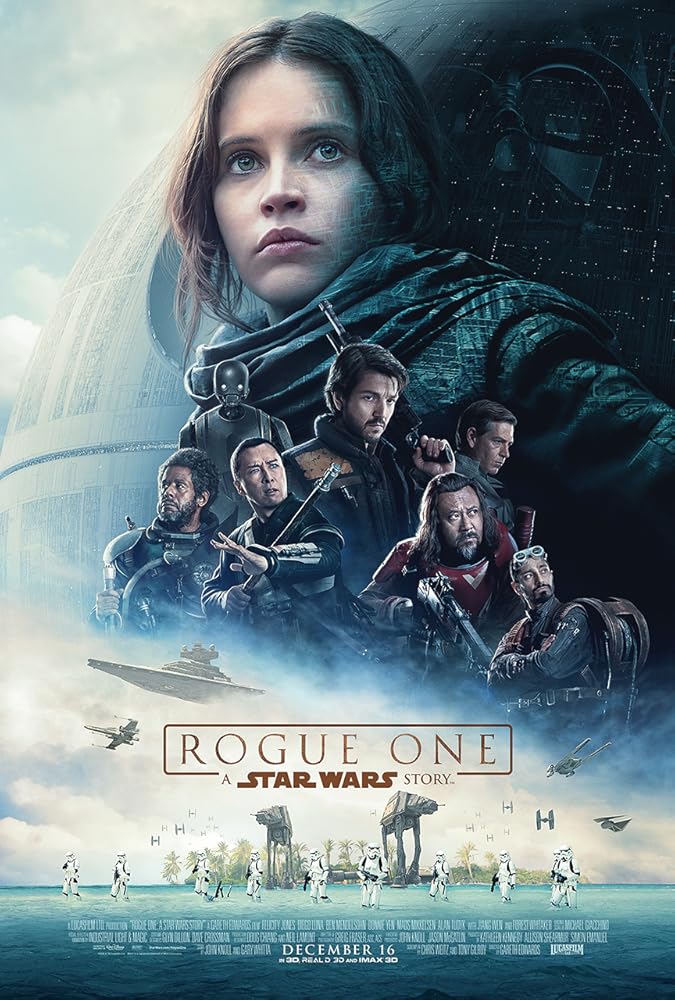
I think it’s safe to say that Star Wars is easily the most famous franchise in pop culture history. Ever since George Lucas released the first film, Episode IV: A New Hope, back in 1977, the series has gone on to become one of the biggest global phenomena of all-time. While not every film in the series was well-received by critics and, particularly, audiences (i.e. a certain ‘prequel’ trilogy), they have all been huge commercial hits at the box-office. And when Lucasfilm was purchased by Disney in 2012 for $4.05 billion, that effectively led to the announcement that we’d be getting more Star Wars films. We got our first taste of this new run of films last year with the one and only critically-acclaimed, $2 billion grossing Episode VII: The Force Awakens, which continued the story that originally concluded more than three decades earlier with Return of the Jedi. We’ll be getting the next installment of the main saga next December, but until then, this December sees the release of the first major ‘spin-off’ of the franchise (not counting the 2008 Clone Wars film), which will pave the way for new films set within the world of Star Wars that stray away from the usual proceedings of the saga films. The first of these ‘Star Wars ‘Stories’’, Rogue One, takes place in between the events of Episode III, Revenge of the Sith, and Episode IV, A New Hope. Under the direction of Gareth Edwards, director of the 2014 reboot of Godzilla, Rogue One focuses on the events that were listed in the opening crawl of A New Hope; how the Rebel Alliance managed to steal the plans to the Empire’s planet-destroying superweapon, the Death Star. What follows is another exciting adventure in the Star Wars series that also affirms the great potential of future spin-offs.
Being set between Episodes III and IV, Rogue One takes place in a time where the Jedi Order has been extinguished and the Empire is now reigning supreme across the galaxy. The Rebel Alliance, now the only major force left that can combat the Empire, learns that a defecting Empire pilot, Bodhi Rook (Riz Ahmed), has been given a message to deliver to them from weapons designer Galen Erso (Mads Mikkelsen), who had been forced into working for the Empire, about the development of a superweapon. As a means of tracking down Galen, the Rebellion enlists the aid of his distant daughter, Jyn (Felicity Jones), who has been spending the last few years fending for herself after escaping from the Empire when they came for her dad. And thus, Jyn, along with Rebel Officer Cassian Andor (Diego Luna), Andor’s droid assistant and reprogrammed Empire enforcer droid K-2SO (Alan Tudyk), Rook, mercenary Baze Malbus (Jiang Wen), and blind Force-warrior Chirrut Ȋmwe (Donnie Yen), head off on a mission to find Galen and learn more about this new weapon. Of course, as they all find out, this weapon is the Death Star, a fully-operational battle station capable of destroying an entire planet in one fell swoop. Recognizing the magnitude of what the space station can do, and learning about a secret in regards to its design that was implemented by Galen himself, Jyn and company take on the risky venture of trying to find the plans for the Death Star, all while dealing with the sizable threat of the Empire’s forces, particularly Imperial Director Orson Krennic (Ben Mendelsohn) who was an old acquaintance of Jyn’s father.
While Rogue One does start off on a rather slow note, it immediately begins to pick up once the main characters are brought together. What follows is the usual exciting action of Star Wars combined with the stylings of a war film, a genre that the filmmakers have been alluding to frequently in interviews when it came to describing the film. And you can see that with this, particularly in its epic third act battle on the paradise-like planet of Scarif. In fact, I’d argue that Rogue One has the best action sequences to date in regards to Disney’s new line of Star Wars films. The whole third act, in general, is practically worth the admission price alone. And while I would still give the edge to The Force Awakens when it comes to the overall story and characters, Rogue One also deserves some major credit when it comes to its overall execution. For being a ‘Star Wars prequel’ (stay with me, folks…), it does a much more conservative job of serving as that. Sure, there are references to A New Hope here and there but they’re definitely subtler in execution compared to the references made in the prequel trilogy. And, of course, the film deserves much credit for its effective recreation of the world of Star Wars (as seen in the original trilogy) through its production design. From using the appropriate Empire/Rebellion era outfits to the practically seamless replication of the Rebel Base on Yavin IV, you’d swear that this film was made around the exact same time as A New Hope.
Now given the fact that this does take place before A New Hope, Rogue One has the challenge of dealing with the potential predictability of its plot. I promise that I’m not going to spoil anything that happens in this film but let’s just say that if you’ve at least seen A New Hope, you probably have a good idea about how this all ends. But, even with that in mind, the film does succeed in establishing a solid amount of emotional depth through these characters. I wouldn’t say that it’s ‘as strong’ as Force Awakens in that department but it’s still solid. There were some legitimately effective emotional moments in this film and you really do see the commitment that the ‘Rogue One’ crew have when it comes to completing their mission. And part of this solid characterization does come courtesy of the excellent ensemble cast. As Jyn, Felicity Jones brings a great combination of the spunk that Daisy Ridley brought to the role of Rey and the roguish nature of Han Solo to the role, resulting in her becoming yet another great Star Wars lead heroine. She’s matched well with Diego Luna who, as Cassian, gets a solid arc in which we see how he contrasts with Jyn as a loyal soldier to the Rebellion. The rest of the film’s diverse cast is excellent as well, with major standouts including legendary Hong Kong action star Donnie Yen as the badass warrior Chirrut and Alan Tudyk, who provides the vocal/mo-cap performance for K-2SO, easily the most sarcastic droid that Star Wars has ever seen. And of course, I’d be remiss if I didn’t bring up the much talked about return of Darth Vader. He’s not in the film that much (probably about four minutes or so) but, without giving anything away, I assure you that we can now forget about the time when he once said that he didn’t like sand… or the time he screamed “NOOOOO!!!!!” after learning about the death of his wife.
I was excited by the announcement of Star Wars spin-offs because it meant that this would lead to new possibilities in terms of stories within the massive world of Star Wars. And Rogue One starts this new line of spin-offs on a high note. Obviously, there’s been a lot of talk about the film having to go through reshoots, apparently to primarily fix the ending. But, ultimately, this didn’t negatively affect the film in any way. Thanks to the solid direction of Gareth Edwards, Rogue One is a well-matched mix of the usual Star Wars escapades with the war film esque nature of its plot. It also manages to overcome its status as being a film set in-between Episodes III and IV with its solid handling of teases, cameos, and fan-service. Going into this film, anyone who’s at least seen Episode IV could probably guess the way in which this film’s story ends. Though, to the film’s credit, it does manage to elicit a solid amount of emotional depth, especially considering this story’s place in the overall Star Wars lore. All that, as well as a solid cast and incredible action sequences, shows that Rogue One: A Star Wars Story will no doubt pave the way for more great spin-offs in a galaxy far, far away. In short, for a film that is the most dreaded word amongst Star Wars fans, a ‘prequel’, it ends up being the best Star Wars prequel to date, though obviously for most Star Wars fans that is not saying much.
Rating: 4.5/5

