Showing posts with label Baseball. Show all posts

Sunday, September 3, 2017

Baseball Film Review Extravaganza: PART 2

Welcome back to Rhode Island Movie Corner’s Baseball Film Review Extravaganza, where I look at 20 of the most notable sports films of all-time centered around America’s Pastime, baseball. This is the second half of a two-part series, so if you want to check out my reviews of films like The Bad News Bears, Bull Durham, and The Sandlot, click the following link to be directed over to Part 1. But today, we’re discussing 10 more entries in the baseball film genre, including several of the genre’s most recent releases.

ANGELS IN THE OUTFIELD (1994)
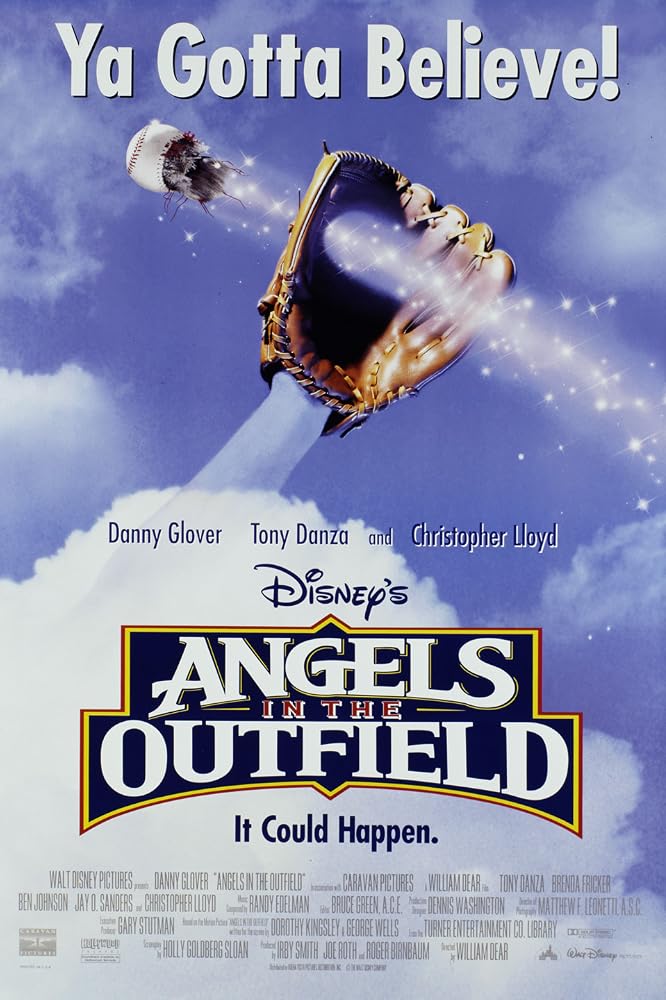


To start things off today, we have a film that I’m sure many folks of my generation will remember; Disney’s 1994 remake of Angels in the Outfield. Yes, this is a remake of a 1951 film of the same name starring Paul Douglas and Janet Leigh. That film centered around the hot-headed manager of the Pittsburgh Pirates, played by Douglas, who begins to hear the voice of an angel that promises to help his struggling team, effectively answering the prayers of a young orphan girl, if he promises to change his ways. The remake, fittingly enough, focuses on the Los Angeles Angels, who would ironically end up getting bought by Disney a few years later. It’s the same general story. A young Angels fan living in foster care prays to God wishing for the team, who are currently in last place, to win the pennant so that he can be reunited with his estranged father. His prayers are soon answered as he begins to see actual angels appear out of the sky to help the team win. Now, obviously, this premise is a bit ridiculous, especially considering that the original film only alluded to there being ‘angels’ while this one shows them for real. Still, maybe it’s just the nostalgia-happy kid in me, but I think that this film’s harmless. It’s got some great humor in it (e.g. when the fan takes a picture with the Angels’ stubborn manager and everyone else comments that it looks like a prison photo) and an enjoyable ensemble cast that includes Danny Glover as the Angels’ grumpy manager George Knox, Tony Danza as the team’s aging pitcher Mel Clark, and Christopher Lloyd as the ‘leader’ of the angels, Al. There are even some former up-and-comers in this as well, including Matthew McConaughey and Adrien Brody as some of the Angels players and Joseph Gordon-Levitt as the young fan, Roger. And it even ended up spawning two direct-to-video sequels; one titled Angels in the Endzone, which shifted the focus from baseball to football, and Angels in the Infield, which returned to baseball but focused solely on one player’s redemption instead of the whole team. But, like The Sandlot, this one still stands as the best of the bunch.  

Rating: 4/5

COBB (1994)

Image result for cobb poster

Six years after he gave us one of the greatest sports comedies of all-time, director Ron Shelton delved into the more dramatic side of baseball with Cobb, a biopic focusing on legendary ballplayer Ty Cobb. However, those going into this expecting a lot of baseball action will be disappointed as it’s more focused on Cobb’s life after baseball, specifically when he hires sportswriter Al Stump to write his biography. In fact, there’s only one major baseball sequence in the entire film, and it occurs early on in a flashback. Instead, we mainly follow Cobb and Stump on a journey of pure insanity as the latter is conflicted over portraying the former as either the legendary ballplayer that he was… or the grouchy, gun-toting racist that he’s become. Because that’s the thing about Ty Cobb… he’s been commonly regarded as one of the most aggressive players in the game’s history. And in terms of this film, this is translated into some scenes that are rather hard to watch. With that said, though, in the years since Stump’s biography was published, it has been widely deemed as sensationalized fiction, which also basically applies to this film as well given that it’s based on it. Still, even if the stuff that we’re seeing on-screen isn’t exactly true, I will admit that I found the film to be an engaging biopic that’s mainly bolstered by terrific performances from Tommy Lee Jones and Robert Wuhl as Cobb and Stump, respectively. Sure, like I said before, there are some scenes in this film that are quite dark; heck, downright uncomfortable to watch, even. That and I think that the film could’ve benefitted more from having a greater balance in terms of showcasing Cobb’s playing career and his time spent with Stump. Still, for a film that ended up being a box-office flop when it was released in theaters, I think that this is an underrated baseball film about one of the game’s most notorious players.

Rating: 3.5/5

LITTLE BIG LEAGUE (1994)

Image result for little big league poster

The last big ‘family-friendly’ baseball film on our list is Little Big League, which was released the same year as Angels in the Outfield. Both these films also happened to be released during a time when the Major Leagues were on strike, therefore providing audiences with baseball action that they weren’t getting in real-life. However, unlike Angels, this film didn’t do so well at the box-office, most likely because it got released around the same time as hits like The Lion King and Forrest Gump. But just like its fellow ‘family-friendly’ baseball films, this still is an enjoyable romp. It centers on Billy Heywood (Luke Edwards), the grandson of the owner of the Minnesota Twins. When the owner passes away, he appoints Billy as the new owner of the franchise. And through an odd turn of events, Billy also ends up becoming the team’s manager as he attempts to help them turn their season around. So, yeah, like Angels and Rookie of the Year, this film’s plot is rather ludicrous given that all three are about a kid who becomes a major force in a professional ballclub’s season. However, also like those films, it’s a good-natured story that can appeal to both kids and adults. I mean, in terms of the latter, I felt that this film had a lot of great humor, like when Billy swears at an umpire for blowing a call. His profanity gets censored by a loud bullhorn and it ends up resulting in his mom grounding/’suspending’ him. If I had any major complaints with this film, it’d be that the part where Billy gets overwhelmed by his responsibilities as a manager, a sequence that’s akin to other ‘low point’ sequences in films like this, was handled rather poorly, in my opinion. This is primarily because Billy becomes a bit too unlikeable during this stretch of the film. Thankfully, though, he eventually snaps out of it and the film gets back on track soon after. Thus, while I’ll admit that I’ve probably watched this film the least out of the three big ‘90’s kid-oriented baseball films’, I feel that Little Big League is just as entertaining as those other films.

Rating: 4/5

FOR LOVE OF THE GAME (1999)
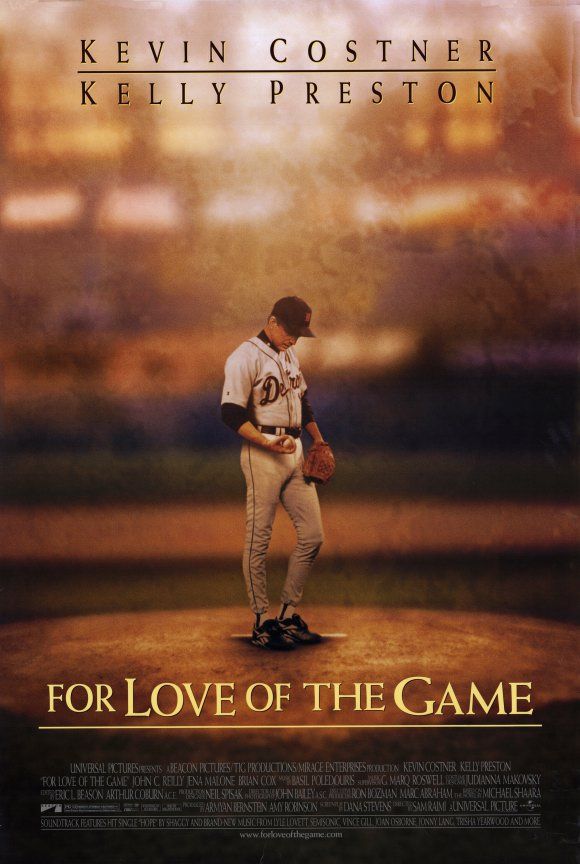

Next up, we have a baseball film directed by… Sam Raimi? Yes, the man who brought us the Evil Dead and original Spider-Man trilogies directed this film, an adaptation of Michael Shaara’s 1991 novel of the same name, centering around his hometown team, the Detroit Tigers. Kevin Costner stars in his third leading role in a baseball film as veteran pitcher Billy Chapel. As his team heads into Yankee Stadium for what is only a throwaway game for them against the Yankees, the aging pitcher finds himself on the verge of accomplishing a rare feat in baseball, a perfect game. Throughout the film, we also see flashbacks that focus on his on-again, off-again romance with writer Jane Aubrey, played by Kelly Preston. Now sure, these flashbacks can sometimes be a bit excessive to the point where they disrupt the film’s pacing, making it about as long as an actual game of baseball. And sure, some of the more serious moments in the film occasionally veer into melodramatic territory. Still, you do end up getting fully invested in Billy’s efforts to pitch the perfect game. Kevin Costner is solid in the lead role as is Kelly Preston, and the two have nice chemistry. They’re backed by a solid supporting cast that includes the likes of Jena Malone as Jane’s daughter Heather, John C. Reilly as Billy’s loyal catcher Gus, and J.K. Simmons as the Tigers’ gruff manager Frank. Plus, it’s clear that Raimi’s a big fan of baseball and, with this film, he’s giving us an old-fashioned story highlighting the greatest elements of America’s Pastime. Heck, I’ll even give this film credit for having arguably some of the best-filmed baseball sequences out of all the films that I’ve reviewed during this retrospective. Thus, while I’m not saying that it’s perfect, For Love of the Game is a solidly entertaining entry in the genre, brought to us by the most unlikely of baseball film directors.

Rating: 4.5/5

SUMMER CATCH (2001)

Image result for summer catch poster

Stepping away from the big leagues for a moment, we have a romantic comedy, Summer Catch. This film centers around what is arguably the most popular amateur summer league in the country, the Cape Cod Baseball League. Freddie Prinze Jr. stars as Ryan Dunne, a Cape Cod local who joins the Chatham Athletics hoping to do well enough to make it to the major leagues. And during the long summer season, he romances a girl named Tenley Parrish (Jessica Biel), the daughter of a wealthy family vacationing on the Cape. As for the film itself, it admittedly didn’t fare so well upon release. It was a flop at the box-office and it has an extremely low Rotten Tomatoes rating of 8%. However, I’ll admit that I found this to be a decently entertaining sports film. Sure, in terms of the film being a comedy, the humor is a bit hit-and-miss. However, I wouldn’t say that the film is completely devoid of funny dialogue. As for the romance part of the plot, it too suffers in a few areas. Though, in this case, it’s more because of some of the usual trappings of the romantic comedy genre, including not one but two big ‘misunderstanding’ moments. Still, Freddie Prinze Jr. and Jessica Biel do have nice chemistry with each other. And at the end of the day, it is cool to have a film like this that highlights a world of baseball that’s not often seen on the big screen; literally, the only instances where the CCBL has appeared on film are this and a 2003 documentary named Touching the Game. Thus, while it’s far from perfect, Summer Catch is a perfectly harmless romantic comedy that’s also a nice fit for the season that the first half of this film’s title takes its name from.

Rating: 3.5/5

MR. 3000 (2004)
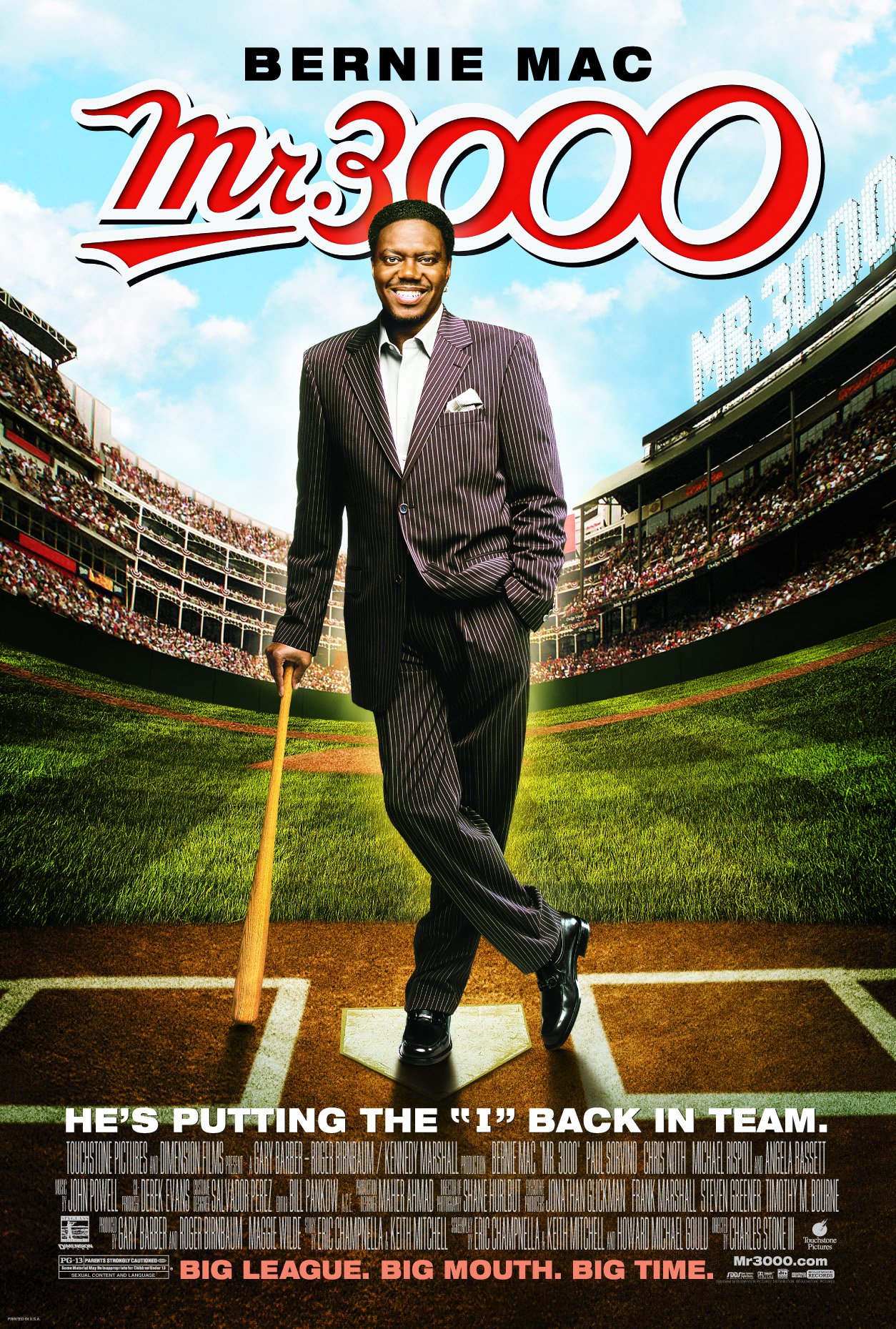
Image result for mr. 3000 poster

Next up, we have a baseball film centering around the ‘Brew Crew’ AKA the Milwaukee Brewers. In Mr. 3000, the late Bernie Mac stars as Stan Ross, who was a legendary albeit extremely arrogant player for the team who abruptly retired from the game after reaching the vaunted career milestone of 3,000 hits, effectively leaving his team without their star player in the middle of a pennant race. Years later, Ross has become a local entrepreneur who regularly banks on his nickname of ‘Mr. 3000’ (hence the title). However, he soon learns that, because of a statistical error that counted the hits in a postponed game twice, he only managed to amass 2,997 hits. Thus, he decides to make a comeback, despite his age, to try and legitimately reach 3,000 again and make it into the Hall of Fame. The sight of this older ballplayer trying to return to the game after being away for so many years does provide the film with some good humor, and this, overall, is what makes the film an entertaining, albeit a bit predictable, entry in its genre. Still, despite the occasional predictability of the plot, once the film finds its groove, it doesn’t stop. And it’s all backed by an excellent lead performance by Bernie Mac. Despite his character’s frequent egotistical boasts, Mac is a charismatic lead and has solid romantic chemistry with his co-star, Angela Bassett, who plays an old flame of his who now works for ESPN. Plus, Ross does get a nice arc in this as he learns to become more of a team player to help his team overcome their losing streak. Thus, Mr. 3000 manages to be another solid entry in the baseball film genre, thanks in no small part to its charismatic lead actor who was taken from us way too soon.

Rating: 3.5/5

FEVER PITCH (2005)
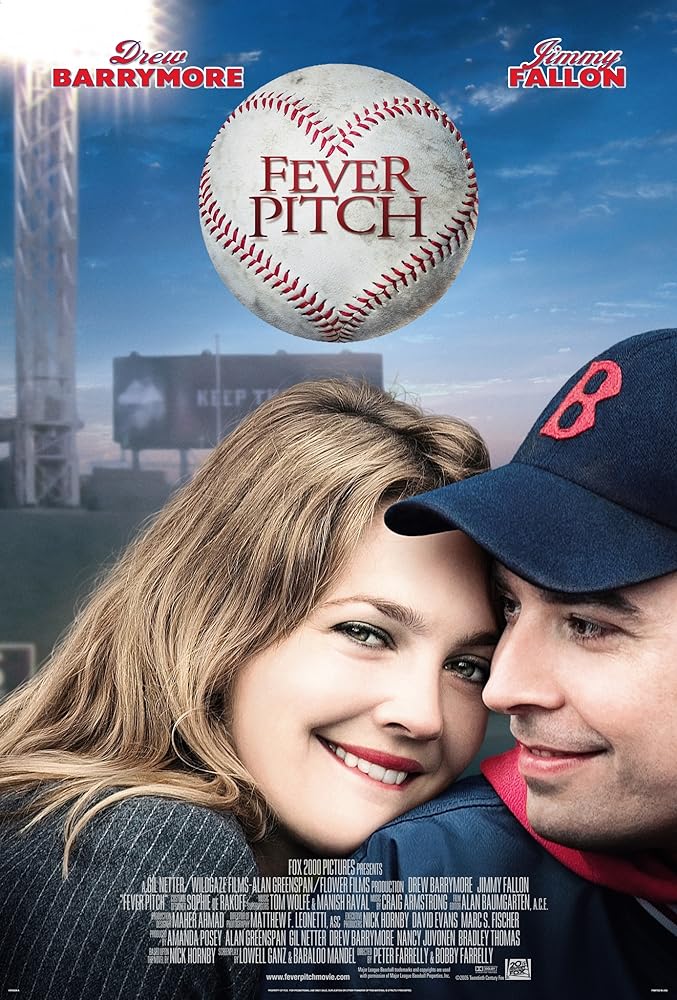


A baseball film for the New England faithful, Fever Pitch was a remake of a 1997 British film (which was about football (AKA soccer for us American folks)) and directed by the Farrelly brothers. In this film, a young boy named Ben becomes a massive Red Sox fan thanks to trips to Fenway Park with his uncle, who ends up passing down his season tickets to him after he dies. Years later, Ben (Jimmy Fallon) is a schoolteacher who falls in love with workaholic executive Lindsey Meeks (Drew Barrymore), who slowly but surely begins to understand his obsession with the Sox. And as you might have guessed, this obsession of Ben’s ends up putting a lot of stress on their relationship. Now, of course, being a Farrelly Brothers film, this does have a lot of their trademarks, including some bits of crude humor. However, it does feel like they toned that stuff down quite a bit compared to their other films, instead focusing more on the romance angle of the story. And for what it’s worth, this is a cute little baseball romantic comedy. The key to it all is Jimmy Fallon and Drew Barrymore, as they have genuinely sweet chemistry with each other. And while there are a few instances where the film falls into the usual trappings of the genre, the hit-miss ratio is solid and Fallon’s character does go through a solid arc as he learns to re-evaluate his ‘relationship’ with the Sox when it begins to affect his relationship with Lindsey. Plus, it’s also cool how this film ended up being in sync with the Red Sox breaking their 86-year drought in 2004 to win the World Series. Seriously, if they didn’t, then this film would’ve just ended with them losing again. So, in short, I’ll admit that I may be a bit biased towards this one given that I’m a native New Englander, but even if you’re not from the area, Fever Pitch is an appealing little rom-com.

Rating: 4/5

BAD NEWS BEARS (2005)
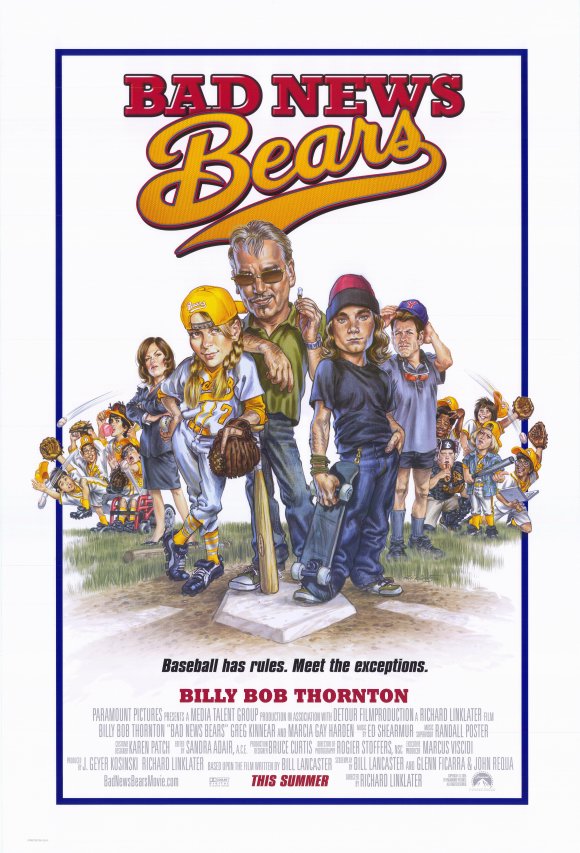


Wait a minute… didn’t I review this film back in Part 1? Yes, I did… this is the remake. Yes, in 2005, the baseball classic Bad News Bears was reimagined for a modern audience. It was directed by famous indie director Richard Linklater, the man behind classics like Dazed and Confused and School of Rock. But, even with those credentials, the film fared poorly with critics upon release, and to be perfectly frank… they weren’t too far off. Ultimately, the major issue with this remake is that it’s too faithful of a remake to the original film. It literally has the same exact plot, the same main characters, and even the same implementation of music from the opera Carmen as the original. The only major changes here are cosmetic at best, from Buttermaker being an exterminator instead of a pool cleaner to Toby Whitewood’s mother being the one who convinces the league to let the ‘lesser’ players participate instead of his father. And because of this, I can see why many have argued that this film lacks the heart of the original. Now, with that said, I don’t think that it’s ‘all bad’; there are some funny line deliveries here and there and Billy Bob Thornton is a solid pick for the role of Buttermaker. And heck, if anyone was going to remake Bad News Bears, Richard Linklater was at least a solid pick for that role. However, this just ends up being a mediocre remake. Now, I’m not going to question the necessity to remake the original Bad News Bears like I know a lot of others have done. Still, I must ask… if you are going to remake a film like this, why didn’t you ‘remake’ it? And by that, I mean to do something different without sacrificing the spirit of the original. Because aside from the few cosmetic changes that I mentioned earlier, this is practically like the 1998 remake of Psycho; nothing more than a carbon copy of its predecessor.

Rating: 1.5/5 (Also, I just noticed that this is the first time that I’ve given a negative review during this entire retrospective.)

MONEYBALL (2011)
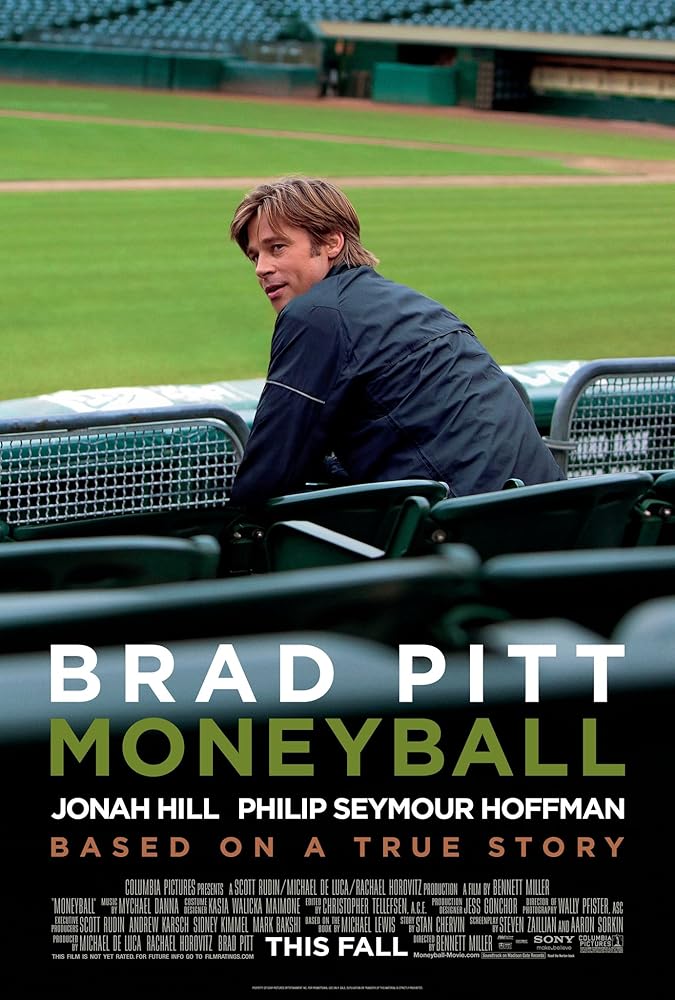
Image result for moneyball poster

Moneyball is a different kind of baseball film, as it focuses more on the behind-the-scenes action than it does the on-field play. Based on the 2003 best-selling book of the same name by Michael Lewis, Moneyball tells the true story of former Oakland Athletics general manager Billy Beane (Brad Pitt). In 2002, Beane is tasked with rebuilding the team after several of their biggest stars sign with other teams. Unfortunately, for the A’s, they have one of the worst budgets in the entire league, especially when compared to the big ballclubs like the Yankees who out-gross them by over $100 million. In other words, Beane and his team are unable to go after any big stars. However, with the aid of a newly recruited assistant from the Cleveland Indians, Beane decides to go after players with reliable stats instead of those who are big-name stars. Obviously, this idea, known as the ‘sabermetric’ approach (which was made famous by writer Bill James), is received horribly by several veteran scouts. However, it ends up working for the team that season, as mainly highlighted by an impressive 20-game win streak. And then, as the closing credits note, the Boston Red Sox would go on to win the World Series two years later by using the same approach (there’s even a scene where Beane is given the offer to become the Red Sox’s general manager). As for the film itself, as implied earlier, it’s more dialogue-based than it is about baseball. This may or may not turn some people off, especially considering the film’s hefty run-time of about two hours and ten minutes.

This was sort of the same situation with director Bennett Miller’s other big sports-themed film, 2014’s Foxcatcher. In both these films, Miller focuses more on the human aspect of their true stories than he does with the sports side of them. Thus, while I’ll admit that I found Moneyball to be a tad bit underwhelming the first time I saw it back in 2011, I can also say that I have warmed up to it to more upon re-watch. Miller and screenwriter Aaron Sorkin (yes, folks, this is also notably a Sorkin project as he was brought in to rewrite the screenplay) give the film a nice edge with its witty dialogue but also infuse it with a strong emotional core that’s based primarily around its layered main protagonist. Brad Pitt does an excellent job in the role of Billy Beane. He manages to perfectly convey Beane’s tenacity and his urge to win, the latter of which is well-reflected by flashbacks showcasing his unsuccessful playing career. Jonah Hill is also great in the role of Beane’s new assistant, the shy economics graduate Peter Brand, who’s a composite character based on Beane’s real assistant Paul DePodesta. The role ended up earning Hill his first ever Oscar nomination. These two are then backed by some excellent supporting roles from the likes of Phillip Seymour Hoffman as the A’s frustrated manager Art Howe, and Chris Pratt as the team’s newly repurposed first baseman Scott Hatteberg. All this, paired alongside gorgeous cinematography from longtime Christopher Nolan collaborator Wally Pfister, makes Moneyball a smart but all-around engaging baseball drama. Heck, I bet that this may even be one of those instances of a baseball film that can manage to win over those who aren’t big on ‘America’s Pastime’.

Rating: 4.5/5

42 (2013)

Image result for 42 poster

And finally, we conclude this epic review extravaganza with a biopic of not only one of the most famous players in the game’s history, but arguably the most important; yes, we’re talking about the one and only Jackie Robinson. In 1947, he became the first African-American to play in the Major Leagues when he signed with the Brooklyn Dodgers. Amidst all the racism and death threats that he received on a regular basis, he endured it all to become one of baseball’s greatest icons. There’s a good reason why his number, 42, is the only number that has been retired across the entire Major League. Notably, though, this isn’t the first time that a film about Jackie Robinson has been made; back in 1950, Robinson himself starred in a biopic titled The Jackie Robinson Story. As for 42, Chadwick Boseman stars in the role of Robinson, which is the first of what is currently three instances where Boseman has played a major African-American historical figure. The other two instances are 2014’s Get on Up, where he played the ‘Godfather of Soul’ himself, James Brown, and this year’s Marshall, where he’ll play Thurgood Marshall, the first African-American Supreme Court Justice. And he does a terrific job in this film as Jackie Robinson. He’s incredibly charismatic but also admirably courageous in the face of extreme prejudice. He’s backed by some excellent supporting roles from the likes of Harrison Ford (even if his performance does lean a bit on the campier side) as the Dodgers’ forward-thinking owner Branch Rickey, Andre Holland as one of Jackie’s key supporters, writer Wendell Smith, Lucas Black as one of Robinson’s most supportive teammates Pee Wee Reese, and Nicole Beharie as Jackie’s loving and supportive wife Rachel.

Technically speaking, the film is well-made. The cinematography by Don Burgess is excellent and the film handles its baseball scenes incredibly well. The only thing holding this film back, really, is that, as many others have pointed out, its overall approach to the story is a bit too safe. While some of the darker elements of Jackie’s struggle with the racism of the era are mentioned, like all the death threats that he and his family received, those are admittedly more like CliffsNotes to the larger story that is Jackie’s teammates gradually accepting him as one of their own. While I haven’t seen The Jackie Robinson Story, I have the feeling that it was much more focused on the grimmer aspects of Jackie’s story. Here, though, it’s more of a traditional Hollywood biopic with a few moments that can be a bit corny. Still, despite not fully delving into all the details of Jackie Robinson’s story, the film does still get its message across of how big of an impact Robinson had being the first African-American player in the Major Leagues. It does this primarily by showcasing how Robinson really had to stay composed in the face of all the racism directed his way. Because, after all, if he had ever lashed out against it, he would’ve been blamed instead of his aggressors. In short, yes 42 sometimes sugar coats aspects of its true story. And, yes, it could’ve benefitted heavily from focusing more on Robinson’s plights. Still, director Brian Helgeland does do a solid job of making us root for Robinson as he overcomes all his problems to become a hero to all the African-American players who soon followed in his footsteps.

Rating: 4.5/5


And that’s the end of Rhode Island Movie Corner’s two-part Baseball Film Review Extravaganza. I’d like to thank you, folks, for following along with me on this crazy journey through the various baseball films that we’ve gotten over the past few decades. Be sure to sound off in the comments section below with your own favorite baseball films. Also, if you’re wondering if I’ll ever do this again for another sport, like football or basketball… maybe… we’ll see… Until then, as the closing credits song of 42 proclaims, ‘life is a ball game’!

Friday, September 1, 2017

Baseball Film Review Extravaganza: PART 1

Related image

Right now, it’s baseball season in America! Long known as ‘America’s Pastime’, baseball is practically a staple of this country’s history. Sure, some may argue that the sport is becoming less popular in recent years… that and there’s also been the frequent amount of controversies surrounding players who have been using illegal substances (e.g. steroids). Despite this, though, I’ve been a fan of the sport ever since I was a kid, and I assure you that this mindset of mine won’t be changing anytime soon. And so, to celebrate the grand old game, I decided to do a big 2-part review extravaganza in which I discuss some of the most classic baseball films of all-time. It’s a two-parter because I have 20 films (yes, 20!) to talk about. I wanted to cover as many films as I possibly could, and I believe that I’ve managed to assemble a comprehensive list of 20 of the biggest baseball films of all-time. Now, for the record, I’m well-aware that by covering all these films, I probably will repeat myself on a few occasions because of the similarities that often do occur between a few of these films. However, I tried to avoid that, for the most part, by covering baseball films that span all sorts of genres and audiences, ranging from the more family-friendly affairs to those that are geared more towards adult audiences. With that in mind, grab your gloves and start whistling a classic baseball tune like ‘Sweet Caroline’ by Neil Diamond or ‘Centerfield’ by John Fogerty and join along with me as I review some of the biggest sports films of all-time that are all about America’s Pastime. Yes, to quote the classic song by Terry Cashman, “We’re Talking Baseball!” (or Softball if you’re referring to the version of the song that was made for the classic Simpsons episode ‘Homer at the Bat’).

Just to note, I will be covering these films in chronological order.

THE PRIDE OF THE YANKEES (1942)

Image result for pride of the yankees poster

We start things off today with the oldest film that we’ll be covering in this two-part retrospective. In fact, this film just celebrated its 75th anniversary; yes, we’re talking about The Pride of the Yankees, which tells the story of New York Yankees legend Lou Gehrig. During his tenure in the Bronx, he became well-known for his hitting prowess and impressive resilience, the latter of which helped him set a record for the most consecutive games played at 2,130, which was eventually surpassed years later by Cal Ripken Jr. Sadly, for Gehrig, both his streak and career ended prematurely when he learned that he was suffering from ALS. He died just a few years after his iconic speech that he made at Yankee Stadium in which he proclaimed himself to be the ‘luckiest man on the face of the Earth’. The film is basically a full-on biopic of Gehrig’s life; in other words, it admittedly focuses more on his personal life than his playing career. This is mainly because, prior to filming, some of the cast and crew weren’t too familiar with baseball. Thus, the film has gotten some criticism over the years for its overall handling of its baseball scenes. Plus, from a modern perspective, there are admittedly times where the film shows its age, namely through some moments that, nowadays, come off as being unintentionally funny. Still, this is a genuinely engaging look at the life of Lou Gehrig, who’s portrayed excellently by Gary Cooper. He has terrific chemistry with Teresa Wright, who does an equally fantastic job in the role of Gehrig’s wife, Eleanor. They even got Gehrig’s equally famous teammate, Babe Ruth, to play himself in the film. And really, at that point in history, who better to play Babe Ruth than Babe Ruth? In conclusion, while some parts of it haven’t exactly aged well, The Pride of the Yankees is still a solidly made biopic that even manages to hit a few effective emotional cords here and there once it begins to get into Gehrig’s ALS-based decline.

Rating: 4/5

THE BAD NEWS BEARS (1976)

Image result for the bad news bears poster

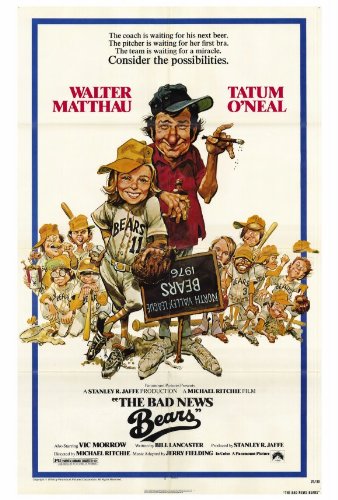
When it comes to films that are often regarded as some of the staples of their genre, The Bad News Bears is that film for the baseball film genre. This classic tale of a drunken coach of a Little League team made up entirely of misfits still holds up quite well today. Part of the reason why is simple; as a comedy, this film is an absolute riot. And a lot of the film’s best humor comes from the interactions between its child stars. Sure, the film’s adult stars get some great laughs too, headlined by Walter Matthau as the titular Bears’ boorish coach, Morris Buttermaker, but the kids are ultimately the stars of the show here. Director Michael Ritchie did an excellent job at casting the film’s young cast, headlined by a pair of rising stars in Tatum O’Neal, who plays the Bears’ sole female player, pitcher Amanda Whurlizer, and Jackie Earle Haley as the smoking, motorcycle-riding outfielder Kelly Leak. With that in mind, the other thing to note about this film is that even though it’s rated PG, it’s got quite the edge to it. The kids often swear as much as the adult characters do and there are admittedly a few mean-spirited moments here and there. Thus, it’s understandable as to why some may be drawn off by this film’s unfiltered nature. Still, amidst all the crass humor, the film still has a fair amount of heart to it. You’re fully behind the Bears as they rise from the bottom of the league to the top. And at the end of the day, the film’s crude sense of humor ends up helping it maintain a more natural atmosphere compared to other entries in the genre. Thus, The Bad News Bears still stands as one of the most classic baseball films of all-time. It’s easy to see why several of the baseball films that came after it clearly owe a lot to it and its tale of pint-sized ballplayers.

Rating: 4.5/5

The original Bad News Bears was one of the surprise hits of its year, grossing over $42 million at the box-office. Thus, it ended up getting a pair of sequels which were released the following two years, albeit without the involvement of Matthau and O’Neal. The first of these sequels was 1977’s The Bad News Bears in Breaking Training. The plot revolved around the Bears as they traveled to Houston to take on a local team known as the Toros in the Houston Astrodome. William Devane starred as the team’s new coach, who just so happened to be Kelly Leak’s estranged father Mike. It didn’t fare as well with critics compared to the original but it wasn’t outright panned, either. That distinction instead went to the 1978 ‘threequel’, The Bad News Bears Go to Japan. The title speaks for itself; the Bears head to Japan led by a promoter played by Tony Curtis. Only about half of the young cast that made up the original film’s Bears team returned for this film, which was basically a critical disaster. How bad was it, you ask? In a 2017 interview on Reddit, even Jackie Earle Haley called it the ‘worst film ever made’. That’s saying a lot considering that this came from one of the film’s main stars. Though I must admit, I watched this film first before the original. However, that’s only because I own a DVD of it… for some reason. Admittedly, it’s been years since I’ve seen the film and I don’t really plan on rewatching it anytime soon. Anyway, getting back on track, the franchise then moved to TV via a sitcom that lasted for two seasons on CBS from 1979-1980. Jack Warden starred as Buttermaker and a notable member of the cast was a young Corey Feldman as third baseman Regi Tower. Finally, the franchise was revived years later in 2005… but we’ll get into that one next time.

BULL DURHAM (1988)

Image result for bull durham poster

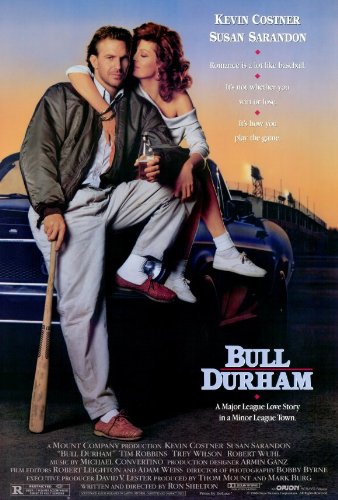
Next up, we have a film that is often considered to be one of the greatest baseball films of all-time. The first of two baseball films directed by Ron Shelton which will appear on this list, Bull Durham stars Tim Robbins and Kevin Costner as hot-shot rookie pitcher Ebby Calvin ‘Nuke’ LaLoosh and aging veteran catcher Crash Davis, respectively. These two players constantly butt heads with one another while they’re teammates on the minor-league ballclub known as the Durham Bulls (hence the title of the film). They even get caught in a love triangle with Bulls groupie Annie Savoy (Susan Sarandon), who has a tradition where she has an affair with one of the Bulls’ players every year to help them play better. But is Bull Durham truly as great as many say it is? Yeah, pretty much. One of the key reasons for this is thanks to the charismatic performances from Robbins, Costner, and Sarandon. All three work off each other extremely well, whether it’s Robbins and Costner interacting on the ballfield or when either of them romances Sarandon off-field. And the screenplay by Ron Shelton is full of hilarious bits of dialogue, like when an argument between LaLoosh and Davis on the pitcher’s mound soon gets other members of the team involved. This then leads to a quite random discussion about everything from the first baseman requesting a rooster sacrifice to break the supposed curse on his glove to what kind of gift to get their teammate, who’s about to get married. Ultimately, though, the screenplay manages to find a nice balance in terms of the film being both a baseball story and a romantic comedy. Thus, Bull Durham is a highly entertaining baseball rom-com thanks in no small part to its three leads and solid direction from Ron Shelton.

Rating: 4.5/5

EIGHT MEN OUT (1988)

Eight Men Out DVD cover.jpg

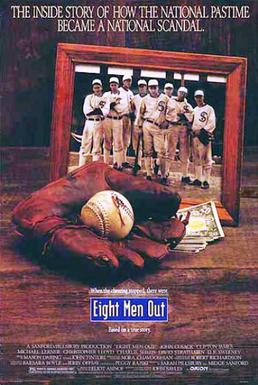
Eight Men Out tells the true story of one of the most infamous incidents in baseball history. It involved the 1919 Chicago White Sox, who were heavy favorites that year to win the World Series against the Cincinnati Reds. However, to the surprise of many, they ended up losing the series 5 games to 3. It wasn’t until afterward when it was discovered that several players had conspired with gamblers to throw the series for money; thus, newly appointed commissioner Kenesaw Mountain Landis banned the eight players who were tied to this plot from baseball for life. And through this film, these events were brought to life in a well-layered story that explored the humanity of the eight men caught up in the scheme. Because as it turns out, their actions were in protest of their owner’s cheapskate methods when it came to paying them despite their success on the field. Thus, despite the extremity of their actions, some of the players do prove to be rather sympathetic while still being reprimanded in the end for what they’ve done. Some players weren’t even ‘fully in’ on the fix. Third baseman Buck Weaver refused to take part in it while outfielder ‘Shoeless Joe’ Jackson, touted by many as one of the greatest ballplayers of all-time, was basically shoehorned into the plot due to his illiteracy. And these characters are portrayed excellently by a stacked ensemble cast, including John Cusack, Michael Rooker, Christopher Lloyd, David Strathairn, and Charlie Sheen. All this, paired with excellent direction by John Sayles, makes Eight Men Out a bona fide classic. Because while it may focus in on one of the darkest moments in the history of the sport, it manages to find the humanity within a bunch of players who became some of the most infamous names in baseball history.

Rating: 5/5!

FIELD OF DREAMS (1989)

Image result for field of dreams poster

I’m sure many of you will remember this one. The second major baseball film of Kevin Costner’s career is arguably just as iconic as Bull Durham. In it, Costner stars as a farmer from Iowa named Ray Kinsella who hears a mysterious voice one day while out in his corn field; “If you build it, he will come”. Ray ends up interpreting this as a sign to build a baseball field on his lot, which soon leads him on a journey of self-discovery as he continues to try and understand the mysterious voice’s demands. And this journey ends up producing one of the best baseball films of all-time. Now, I’m aware that some may find this film to be a bit too overly sentimental. And while I do understand where those people are coming from, I really appreciate this film’s earnest nature. It knows it’s sentimental, and it’s all built around an excellent story (which was adapted from the 1982 novel Shoeless Joe by W.P. Kinsella) of one man’s quest for emotional catharsis, which in turn is tied to the infamous ‘Black Sox Scandal’. Yes, this is the second film on this list (second in a row, even) that delves into this event after Eight Men Out. And it ultimately goes for a more light-hearted approach to the subject as we see the eight players, primarily Shoeless Joe Jackson (Ray Liotta), be given the chance to play again when they appear (as ghosts) to play on Ray’s field. The film is well-shot, well-directed, and features fantastic performances from the likes of Kevin Costner as Ray, Amy Madigan as Ray’s loving and supportive wife Annie, and James Earl Jones as a reclusive author named Terence Mann who ends up becoming connected to Ray’s adventure. Thus, while some may find Field of Dreams to be a bit too saccharine from a modern perspective, I’d say that it still stands as not only one of the best baseball films ever made, but also one of the best films ever made period. It’s easy to see why this film ended up earning three Oscar nominations the year of its release, including one for Best Picture.

Rating: 5/5!

MAJOR LEAGUE (1989)

Image result for Major League poster

And here we have another baseball comedy classic, Major League, which centers on the Cleveland Indians. The plot focuses on the efforts of their new owner, a former Vegas showgirl, to have the team perform so badly (or, in other words, worse than they’re already doing) that she can move them to Miami. Thus, she recruits an eccentric collection of misfits who soon end up banding together to turn things around. Like Bull Durham, this one’s full of great comedic dialogue, from the witty remarks by Indians’ broadcaster Harry Doyle, played by real-life Milwaukee Brewers broadcaster Bob Uecker, to the highly superstitious pre-game warm-ups by outfielder Pedro Cerrano (“It’s very bad to steal Jo-Bu’s rum!”) And to top it all off, the film boasts an excellent ensemble cast, highlighted by Charlie Sheen as hot-headed fastball pitcher Ricky ‘Wild Thing’ Vaughn, Tom Berenger as aging catcher Jake Taylor, and Wesley Snipes as the team’s fast-talking base stealer Willie Mays Hayes. In short, it’s clear to see why this highly entertaining screwball comedy was one of the most popular baseball films of its time, and it was soon followed by a pair of sequels. Most of the cast returned for the 1994 sequel, Major League 2, save for Snipes who was replaced by Omar Epps. The film even saw a change in studios as it was released by Warner Bros instead of Paramount. Then, in 1998, a third film was made, Major League: Back to the Minors; however, this one focused on the Minnesota Twins’ AAA ballclub and only featured a select few from the previous films’ ensembles. Thus, neither film ended up being as successful as the original, though I’d argue that Major League II ain’t that bad (3.5/5). As for Back to the Minors… I’ve only seen a small part of it. At the end of the day, it’s all about that original classic.

Rating: 4.5/5

THE BABE (1992)

The Babe Movie Poster

This next film’s title says it all; The Babe focuses on the baseball legend that is Babe Ruth. The film follows ‘the Sultan of Swat’ from his early years as an orphan in Baltimore to his brief tenure with the Red Sox all the way to the infamous trade that sent him to the New York Yankees, where he truly became a legend. However, the film itself has been subjected to some polarizing reviews from critics who weren’t big on the film’s overall portrayal of ‘the Colossus of Clout’. And, well, they’re kind of right. Now, for the record, John Goodman is a great fit in the role of Ruth, and the film at least does a good job of showcasing Ruth’s talent as a baseball player. As for his personal life, though, that’s another story. The film portrays Ruth as a person who is entirely lacking in social skills; a guy who constantly gets drunk and depressed while also being crude around his teammates, friends, and family. And from what I’ve read, this isn’t how the real Babe Ruth was at all; sure, he could be quite stubborn at times, but he loved life just as much as he loved the game. By comparison, the Babe Ruth in this film is… kind of pathetic. And while the film’s finale sees him slamming three home runs despite being past his prime, it basically concludes with him as a broken-down shell of his former self. Thus, the biopic that was intended to honor one of the game’s all-time greats ends up being a rather depressing affair. I mean, it’s filmed decently enough and I’ll admit that I usually do watch it any time that it comes on TV. Still, it’s hard to sympathize with the Babe Ruth that’s portrayed in this film.

Rating: 3/5

A LEAGUE OF THEIR OWN (1992)

Image result for a league of their own poster

Now here’s a classic! A League of their Own is director Penny Marshall’s take on the All-American Girls Professional Baseball League, formed during World War II when members of the major leagues were drafted into the army. The league was formed primarily to help keep baseball going in America during this time, and while the story in this film is a fictional one, it’s a great look back at this fascinating point in the history of the game where the ladies were the stars of the show. Case in point, the film boasts an excellent ensemble cast, highlighted by Geena Davis as main protagonist Dottie Hinson, arguably the league’s best player, and Lori Petty as Dottie’s sister Kit, who constantly finds herself under her sister’s shadow. This results in solid on-screen camaraderie between Davis and Petty, which ends up turning into an engaging rivalry once the latter is traded to another team. And, of course, there’s also Tom Hanks as Jimmy Dugan, the hard-drinking manager of the Rockford Peaches, the team that Dottie and Kit initially end up on. Hanks is great as the gruff manager/former ballplayer who’s down on his luck while also providing us with one of the greatest lines in film history; “There’s no crying in baseball!” But while there may not be any crying in baseball, this film is built around a solid emotional core. It all culminates in a satisfying ending where the surviving members of the AAGPBL revel in getting a brand-new exhibit at the Baseball Hall of Fame in Cooperstown, New York. Thus, with a great ensemble cast, excellent direction from Penny Marshall, and empowering themes that still hold strong today, A League of their Own is very much a timeless classic.

Rating: 4.5/5

ROOKIE OF THE YEAR (1993)

Image result for rookie of the year poster

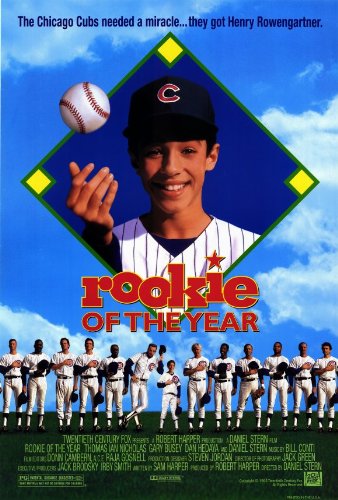
I’m sure most 90’s kids will remember this one; Rookie of the Year. Thomas Ian Nicholas (Kevin from the American Pie series) stars as Henry Rowengartner, a middle-schooler who suffers a devastating arm injury when trying to catch a fly ball. When his arm heals, though, he finds that he can now throw a baseball at the same velocity of an MLB pitcher. Thus, he ends up getting recruited by his hometown team, the Chicago Cubs, in the hopes of turning their season around. Like the other family-friendly baseball films of the time, the film is admittedly rather silly. In fact, I’d say that director Daniel Stern (AKA Marv from the first two Home Alone films) tries a bit too hard sometimes with the humor. And yet, also like those other family-friendly films, I’d argue that this film is still a charming little romp. Despite what I just said earlier about some of the film’s overt attempts at humor, there are some genuinely funny moments in this film, like when Henry is forced to go to bat, manages to get on base, and then proceeds to taunt the opposing pitcher (“Pitcher’s got a big butt! Pitcher’s got a big butt!”) Plus, the whole subplot involving Henry and his mother, who we learn is quite a badass herself, elicits some legitimately sweet results. Thus, Rookie of the Year is still an entertaining entry in this genre. Yeah, the premise is kind of ridiculous, but if you’re able to accept its surreal nature, you’ll find it to be an enjoyable family film. Plus, up until the Cubs finally won the World Series for the first time in over a century this past October, this was one of the few instances where the Cubs were ‘World Series Champions’… sure, it’s only on film but, hey, what are you going to do?

Rating: 4/5

THE SANDLOT (1993)

The Sandlot Movie Poster

Ah, The Sandlot… the all-American classic story of a bunch of kids and the many adventures that they had on a sandlot field in the summer of 1962. Though would you believe that this film didn’t do so well with critics when it was released in 1993? It only has a 58% rating on Rotten Tomatoes, and that’s crazy! This film is one of the genre’s greatest outings. Sure, maybe it’s ‘derivative’ in some places, as some of its biggest critics have said. Still, this film delivers on exactly what it wants to be; an affectionate and nostalgic tribute to Americana and life in the 60’s. The film has a lovable cast of main characters and is full to the brim with classic moments, from spectacled ‘Squints’ pulling a ‘savage’ move on his crush by feigning unconsciousness and kissing her as she does CPR on him to the boys making a dumb decision by using chewing tobacco, which then leads to them barfing on a carnival ride. And, of course, there’s also the classic third act of the film, in which the boys try to retrieve a valuable baseball (owned by main protagonist Scotty’s father and signed by the one and only Babe Ruth) from the backyard of the house behind the left-field fence, where a supposedly vicious dog named ‘The Beast’ resides. They try all sorts of plans that go nowhere until their leader, Benny ‘The Jet’ Rodriguez, braves the storm to collect the ball after being visited by the one and only Babe (“Heroes get remembered, but legends never die…”). It all ends with a great scene in which Benny and Scotty talk with the owner of the house, Mr. Myrtle, played by James Earl Jones in an excellent cameo, and realize that he isn’t such a ‘mean, old man’ as they were led to believe. And, really, what more can be said about this iconic film that hasn’t been said already? If you want to see one of the purest portrayals of ‘America’s Pastime’ on the big screen, The Sandlot is just the film for you.

Rating: 5/5!

Now, while I’m not reviewing them, I also wanted to briefly go over the two direct-to-video sequels to this film that were released in the early 2000’s. The first, The Sandlot 2, was released in 2005. It was once again directed by David Mickey Evans, who also served as the narrator for both films in which he played the older self of the main character, Scotty Smalls in the first and Johnnie Smalls in the second. However, it’s admittedly just the same general story as the first Sandlot. There’s a group of kids who play baseball on the local sandlot field, there’s a scene where they play a rival team, another scene where they go to the carnival and get into trouble there, and of course, a subplot in which they must retrieve something valuable from Mr. Myrtle’s yard, which is guarded by another big, scary dog. The only major differences here are that it takes place in the 70’s, the valuable object is a model of a space shuttle, and a few girls join the team. Other than that, it’s mostly just a clone of the first film; still, from what I remember, it was harmless enough. The other sequel, The Sandlot: Heading Home, was released in 2008. Directed by William Dear (who directed another baseball film which we’ll be discussing in Part 2), this film focuses on a hotshot major league ballplayer who gets hit by a wild pitch during batting practice, which knocks him out and results in him being ‘sent back in time’ to when he was a kid. So, at the very least, this film isn’t just a copy of the first film. Heck, I’d say that the whole character arc of the main protagonist, who goes from being a selfish prick to a more compassionate human being, was generally well-handled. They even manage to have a cameo from Chauncey Leopardi as Squints and an appearance by Benny ‘The Jet’ Rodriguez, albeit here he’s played by Danny Nucci this time around instead of Mike Vitar (or, given that it’s the older Benny, Mike’s brother Pablo, who played the part in the first film’s final scene set years later in Dodger Stadium).


And that’s the end of Part 1 of Rhode Island Movie Corner’s Baseball Film Review Extravaganza. Check back soon for Part 2, in which I’ll be delving into films like Angels in the Outfield, Fever Pitch, and Moneyball.

Monday, April 15, 2013

'42' (2013) review (100th post!!)


When it comes to baseball legends, there are players like Babe Ruth, Joe DiMaggio, and Ted Williams who have made their mark on the game of baseball. But, it can be argued that none have made quite an impact on not just the game but also the history of America quite like Jackie Robinson. It was in 1947 when Robinson, a shortstop first turned first baseman and later second baseman, made history by becoming the first African American player to play in Major League Baseball when he signed with the Brooklyn Dodgers. Even amidst all of the racism that he had to deal with, Robinson’s character and talent paved the way for future African American ballplayers and he played a key part in the Civil Rights movement. He has become such an icon that his number 42 was the first, and currently only, number to have been retired across the Major Leagues and every year on April 15th (the same day Robinson made his big-league debut) since 2004 Major League Baseball honors him by holding ‘Jackie Robinson Day’, where all players wear 42 in honor of him. ‘42’ the movie, while not the first Robinson biopic (there was also a 1950 film which Robinson himself starred in), mainly focuses on Robinson’s groundbreaking rookie season.

In 1945, Brooklyn Dodgers general manager Branch Rickey (Harrison Ford) makes the bold decision to sign an African-American player, the first in MLB history. He finds his man in Jackie Robinson (Chadwick Boseman), a shortstop from the Kansas City Monarchs of the Negro League. After a year with the Dodgers’ minor league affiliate, the Montreal Royals, Robinson makes history when he joins the Dodgers in 1947. Now faced with harsh racism from all over the country, from the other teams in the league to even some of his Dodger teammates, Robinson is instructed to keep his cool, because if he ever retaliated against it, then everyone would blame it on him and not those who provoked him. He would have to prove himself on the field to become the legend that we know him as today.

One of the best things that a filmmaker can do when making a biopic is to not glorify the person the movie is focused on. Recent films like ‘Lincoln’ and ‘My Week with Marilyn’ excelled at doing that, and for the most part this film also does a good job at doing that as well. However, while the respect towards Robinson is there, this leads to my sole problem with the film in that it plays it just a bit too safe. The movie doesn’t ignore the hostility that Robinson encountered and what it was like for any African American in this country during that time, but key aspects of Robinson’s struggles, which even included death threats directed towards Robinson and his wife (played here by Nicole Beharie), are mostly just glanced over. Really, the film just feels a bit too clean and would have benefitted from being a bit grittier, which probably means that Hollywood had a big hand in shaping the final product.

But that does not mean this is a bad movie; far from it in fact. While the movie doesn’t really do Robinson’s struggle full justice, it is a good ‘feel-good’ movie. It’s also one of the best-looking baseball films to date, with some top-notch cinematography and baseball action. The film also benefits from solid acting all around, most notably from Chadwick Boseman and Harrison Ford. Boseman, a relative newcomer when it comes to film, shines as Robinson, as he perfectly captures the attitude of the Dodgers’ star. As for Ford, he also does a fine job while chewing up the scenery as Branch Rickey. Overall, the acting is solid all-around, including Beharie as Rachel Robinson and Lucas Black as Pee-Wee Reese, who was perhaps the most supportive of Robinson’s teammates on the Dodgers.

In the end, ‘42’ is a really good baseball flick but as a biopic, it really doesn’t do Jackie Robinson full justice. The respect towards him is there, but the movie would have worked a whole lot better had the filmmakers done more in showing what Robinson really went through during his rookie year with the Dodgers because as is, it’s more of a ‘feel-good’ movie. One could only imagine what it was like for him, but this film really serves more of an introduction to Robinson. But while that may be the case, the movie is still a well-acted, well-shot, and overall well-made film that, for some, will serve as a good introduction as to who Jackie Robinson was and the impact that he made in the Major Leagues.

Rating: 4/5