Showing posts with label X-Men. Show all posts

Thursday, December 28, 2023

Top 15 Favorite Stan Lee Film Cameos

Greetings, true believers! Today’s post doesn’t need much of an introduction, and to be perfectly blunt, it’s going to be a refreshingly short one compared to the massive endeavor that was the Annual End of Summer Fan Poll’s Results Post. In honor of what would’ve been his 101st birthday, today we’re celebrating one of the biggest icons in the world of comics, Stan Lee. Along with other comic legends such as Jack Kirby and Steve Ditko, Lee helped co-create some of the most iconic heroes from the Marvel Comics universe, from everyone’s favorite webslinger Spider-Man to the Children of the Atom AKA the X-Men. But in later years, as he transitioned into being more of the public face of Marvel Comics, Lee also became known for his numerous cameos in the various films and TV shows based on his iconic creations, which were a staple of Marvel’s media productions up until his passing on November 12th, 2018 and a delight to look out for, both for fans of the man himself and the beloved properties that he helped to create. So today, I decided to make a ranked list of my personal favorite Stan Lee cinematic cameos. For today’s post, we’re going to focus solely on his film cameos, meaning that I won’t be covering the likes of his cameo in Insomniac’s 2018 AAA blockbuster video game Spider-Man and the subsequent in-universe tribute to him in its 2020 sequel Spider-Man: Miles Morales or any of his various cameos in Marvel’s numerous animated shows. And in this instance, I decided that a basic Top 10 list simply wasn’t enough for such a legendary figure. Nope, today we’re going to do a TOP 15 LIST to truly honor the legacy of the one and only Stan ‘The Man’ Lee. Excelsior!!

First up, let’s celebrate a few honorable mentions, which we’ll go through in the chronological order of their respective films’ releases. First up, from the 2005 adaptation of Fantastic Four, we have the first instance where Lee played a character that he created, Willie Lumpkin, the friendly mailman of the titular superhero quartet who greets them when they first enter their new base of operations, the Baxter Building.

Moving onto our first Marvel Cinematic Universe release in today’s post, we have his cameo in the first Thor film, where he and a bunch of residents from the town of Puente Antiguo, New Mexico try to lift the mysterious hammer that has landed in a nearby desert. Lee appears as a truck driver whose attempt to pull it out with his truck results in the truck’s cargo bed getting ripped off, resulting in him poking his head out of the window and asking “Did it work?”

Moving onto the other MCU film of 2011, Captain America: The First Avenger, Lee appears as a U.S. Army General attending an award ceremony for Captain America after his successful rescue of the 107th Infantry Regiment from HYDRA forces. But when the Star-Spangled Man with a Plan doesn’t show up and the Senator in charge of Cap’s promotional tour is informed of this by one of his associates, Lee’s character confuses the associate for Captain America and notes, “I thought he’d be taller!”.

Cut to 2014 and we’ve got the first Walt Disney Animation Studios production based on a Marvel property, Big Hero 6. While he may not have had a hand in this superhero squad’s creation, it would’ve quite frankly been a shock if Lee hadn’t cameoed in this film, where he plays the father of the team’s resident slacker (with a fire-breathing dragon suit for good measure), Fred. After originally just appearing via a photo cameo in Fred’s family mansion, where he implies that his parents are on vacation, Fred’s father finally appears onscreen in the film’s post-credit scene, in which his son comes across a secret lair full of superhero equipment. Lee would then go on to reprise his role in the first two seasons of the follow-up series Big Hero 6 – The Series, where he was revealed to be an in-universe superhero named Boss Awesome.

Going back to live-action, we have his appearance in 2016’s X-Men: Apocalypse. While it’s only a non-vocal cameo, in which he observes the sudden launch of all the world’s nukes as orchestrated by the titular antagonist Apocalypse, it’s notable in a heartwarming sense since it’s the only one where he got to star alongside his wife, Joan Lee. It was her first live-action cameo in a Marvel production after previously having voice roles in various Marvel TV productions from the 90’s… and her last on-screen appearance before her passing on July 6th, 2017.

Speaking of the X-Men universe, there’s his appearance in the 2017 short No Good Deed, a special teaser to 2018’s Deadpool 2 which gave audiences their first look into how the character was being handled under the direction of David Leitch. Lee only appears in the version of the short that was released online rather than the version seen in theaters in front of that year’s Logan, but it’s still an enjoyable cameo nevertheless as Lee praises Deadpool’s suit before the Merc with a Mouth tells him to zip it… and, of course, given Deadpool’s fourth-wall-breaking habits, he directly refers to Stan by name.

 Finally, let’s go over his final two appearances in an Avengers film. In 2018’s Avengers: Infinity War, he’s the bus driver for Peter Parker and his classmates who pokes fun at his passengers’ stunned reactions to the appearance of Thanos’ herald Ebony Maw’s ship above the skies of New York (“What’s the matter with you kids? You never seen a spaceship before?”).

 And finally, there’s his final cameo in a Marvel film, 2019’s Avengers: Endgame. In this film, Lee appears during the sequence where Iron Man and Captain America travel back in time to 1970 to collect the Tesseract AKA the Space Infinity Stone when their original attempt to do so in 2012 failed. Lee and his female companion (with Lee digitally de-aged to look like he did in 1970 and his companion modeled after his wife Joan) drive by the S.H.I.E.L.D. base at Camp Lehigh, New Jersey, with Lee shouting “Hey man, make love, not war!”. And on his car’s bumper sticker, we see one of his most iconic catchphrases, “Nuff Said!”

15. Chess-Playing New Yorker – The Avengers

As a bunch of news reports cover the Avengers’ successful defeat of Loki and the Chitauri, Lee appears as an interviewee who remarks “Superheroes in New York? Give Me a Break!”. He had a different yet equally delightful cameo that wound up on the cutting room floor where, during a scene where Captain America is at a diner and hit on by a waitress, he tells Cap to “ask for her number, you moron!”.

14. Fed-Ex Delivery Man – Captain America: Civil War

After the intense conflicts of the third Captain America film, and especially after a scene where Tony tries to help his pal Rhodey deal with the spinal injury that he suffered during the Avengers’ airport skirmish, Stan Lee gets to provide some much-needed levity when he appears as a Fed-Ex driver delivering a package to the Avengers’ compound… the only problem is that the name on the label was misspelled, resulting in him asking for a “Tony Stank”. Rhodey promptly and delightfully revels at this hilarious misnomer.

13. Sakaarian Barber – Thor: Ragnarök

We can thank good ol’ Stan for Thor’s new haircut in Thor: Ragnarök as he’s the Sakaarian barber who trims the God of Thunder’s blond locks before he’s sent off to compete in Sakaar’s Contest of Champions. A lot of great banter here between Lee and Chris Hemsworth (which is fitting since Lee has gone on record stating that Hemsworth was always one of his favorites to work with onscreen) as Thor boldly proclaims that the barber will never cut his hair… but then, after Stan turns on his haircutting device, Thor starts to get desperate and pleads with the “nice old man” not to cut his hair.

12. Graduation Guest – The Amazing Spider-Man 2

Peter Parker barely manages to make it to his high school graduation before his name is called. When he first gets there, he nearly goes onstage wearing his Spider-Man mask before he remembers to take that off… but not before Stan ‘The Man’ spots him and proclaims, “I think I know that guy!”. Lee would end up saying the exact same thing to Tom Holland’s Spider-Man as part of a series of commercials advertising ABC’s coverage of the NBA Finals around the time of Spider-Man: Homecoming’s release.

11. Not on the Guest List – Fantastic Four: Rise of the Silver Surfer

A great example of how a Stan Lee cameo could be done in a manner that feels quite relevant in the context of the comics is in the second 2000’s era Fantastic Four film, 2007’s Fantastic Four: Rise of the Silver Surfer, which saw Lee attending the wedding of Reed Richards and Sue Storm… only to get denied entry because he wasn’t on the guest list.

10. San Francisco Resident ­– Ant-Man and the Wasp

During the climax of Ant-Man and the Wasp, a Pym Particle disc hits a car, which causes it to shrink as the owner remarks “Well, the ’60s were fun, but now I’m paying for it!”. A basic cameo, admittedly, but one that is made even more memorable by the numerous alternate takes that can be seen in the film’s outtakes. For all we know, that man probably stole that car… either that, or he’s lucky that it was only a rental. But wait, did he leave his sandwich and/or coupons in there? Well, if anything, at least he was able to find a parking spot in San Francisco…

9. A Stan Lee Cameo in a DC Movie??? – Teen Titans Go to the Movies

Yes, as crazy as it may seem, Stan Lee made a prominent cameo in a film based on a DC Comics property; the film in question being the animated genre spoofer that was Teen Titans Go to the Movies. As the Teen Titans walk through the Warner Bros. studio lot, Lee, first seen sweeping in the background, shifts the focus over to him and proudly announces that he’s here for his “subtle cameo”. But then someone tells him that he’s in a DC film, promptly resulting in him leaving… before he returns during the climactic chase scene involving the Titans and the forces of their enemy Slade where he jumps on their golf cart and proclaims that he doesn’t mind the fact that he’s in a DC production. He just loves making cameos!

8. Mallrat Stan – Captain Marvel

2019’s Captain Marvel was the first MCU film released after Stan Lee’s death, and sure enough, Marvel Studios went all out to pay tribute to the man, the myth, the legend. In fact, it all starts at the very beginning of the film as the traditional character-filled Marvel Studios logo is replaced with photos and clips of the beloved Marvel icon. And at the end of this whole sequence, a simple yet poignant message appears on-screen; “Thank you Stan”. As for his in-film cameo, we have a moment that directly ties into Lee’s career given that the film is set in 1995. As Captain Marvel pursues a Skrull operative on an LA subway train, she takes note of an old man reading from a film script. When she pulls down his script, he flashes his lovably warm smile which she promptly reciprocates. A nice, sweet cameo all-around, but also a fun one for those in the film fan community since the script that Stan is reading from is Kevin Smith’s Mallrats, where he, of course, made one of his first notable cinematic cameos.

7. Drunk War Vet – Avengers: Age of Ultron

Another fan-favorite cameo of Lee’s sees him attending the Avengers’ party in Avengers Tower, where Thor brings out a flask of an ancient Asgardian ale. While he warns the partygoers that it isn’t meant for mortal men, one World War II vet is willing to give it a try. But sure enough, it leaves the old man flat-out drunk as two guys carry him out; as this happens, the veteran woozily utters a single word, “Excelsior!”

6. Smithsonian Security Guard – Captain America: The Winter Soldier

As the climax for Captain America’s second MCU solo film ramps up, the titular hero steals his original World War II-era uniform from the Smithsonian Museum’s Captain America exhibit before he and his allies begin their attack on the HYDRA-compromised S.H.I.E.L.D. We learn about this as a security guard notices its absence and laments “Oh man! I am so fired!”.

5. “You Look Great, Hef!” – Iron Man

Lee’s first cameo in a Marvel Cinematic Universe production is often cited as one of his best, and it’s easy to see why. It’s a simple yet hilarious cameo in which Tony Stark AKA Iron Man attends a charity event and passes by a man who he thinks is Playboy founder Hugh Hefner, only for the man to turn around and reveal himself to be our favorite Marvel icon. This approach for a Stan Lee cameo would be repeated in the sequel, 2010’s Iron Man 2, where he’s referred to as radio host Larry King by Tony’s chauffeur and bodyguard Happy Hogan as he and Tony travel through the crowd at the Stark Expo and converse with the latter’s fans.

4. Watcher Informant – Guardians of the Galaxy Vol. 2

The second cinematic outing for everyone’s favorite band of intergalactic a-holes gives us a definite answer on the nature of Stan Lee’s cameos in the MCU. As it turns out, he’s an informant for the all-knowing group of sentient cosmic beings known as the Watchers. First appearing in a scene where his conversation with them gets interrupted by Rocket, Baby Groot, Yondu, and Kraglin traveling through a bunch of hyperspace jumps to get to Ego’s planet, Lee’s informant then proceeds to talk about the time that he worked for FedEx. In the film’s final post-credit scene, the disinterested Watchers leave without giving their informant a lift home. Sure, this cameo may have instigated a bit of a continuity error since Guardians of the Galaxy Vol 2 is set before the events of Captain America: Civil War, but it still presents a delightful way of explaining Lee’s cameos that isn’t far off from what the common fan theory was at the time that suggested that he’d be revealed to be the most famous Watcher, Uatu.

3. Unaware Librarian – The Amazing Spider-Man

Andrew Garfield’s first outing as Spider-Man resulted in one of Stan Lee’s most hilarious cameos during the sequence where Spidey fights Dr. Connors AKA The Lizard in his high school. At one point, they rampage through the library all while the librarian on duty is just going about his business and listening to classical music on headphones, completely unaware of what’s going on behind him even when a table nearly gets thrown at him, which Spidey thankfully catches.

2. Man in Times Square – Spider-Man 3

Stan Lee’s first two cameos in Sam Raimi’s Spider-Man trilogy were the very definition of a basic cameo; in both instances, he appeared briefly as a citizen who pulls someone out of the way of falling debris during Spidey’s first fights with the Green Goblin and Doc Ock, respectively. But as revealed in the films’ bonus features, there were some alternate ideas as to how he’d appear in them. In the first Spider-Man from 2002, he almost appeared as a street vendor at the World Unity Fair selling sunglasses that, as he put it, were the kind “they wore in the X-Men”. In Spider-Man 2, he almost appears as an onlooker who remarks that Spider-Man stole a kid’s sneakers. Ultimately, his best Raimi trilogy cameo occurred in the final installment of the trilogy, 2007’s Spider-Man 3. After Spidey rescues Gwen Stacy from an incident with a faulty crane, he learns that he’s set to be honored by the city of New York from one of the news tickers in Times Square. A man standing next to him remarks “You know, I guess one person can make a difference. ‘Nuff Said!”. I think most will agree that this is easily one of Lee’s best cameos; in just a single line, the well-spoken Marvel icon makes a poignant observation about the importance of superheroes. And on that note…

1. Costume Shop Owner – Spider-Man: Into the Spider-Verse

We’ve covered plenty of great Stan Lee cameos today, many of them delightfully wacky comedic moments that perfectly matched Lee’s lovable on and offscreen persona. But for the Number 1 pick, I decided to go with the most poignant cameo of them all; the first proper Stan Lee cameo that was released after his death in the Phil Lord and Chris Miller-produced Spider-Man: Into the Spider-Verse. In the film, Lee plays the owner of a costume shop where new Spider-Man Miles Morales buys a Spider-Man costume in the wake of his universe’s Peter Parker’s death. When he brings the costume up to the register, the owner laments that he’s going to miss Spider-Man and notes that he was friends with the web-slinger. When Miles inquires about the possibility of having to return the costume if it doesn’t fit, the owner notes that “it always fits, eventually”, a seemingly sweet gesture… before the camera pans over to the sign behind him that states his no return policy.

I decided to go with this one because I think it perfectly sums up Lee’s legacy, especially since everyone’s favorite webslinger may quite arguably be his most famous creation. This scene between Lee and the new Spidey, Miles, sees the former have some of the most poignant dialogue that he’s ever delivered in a Marvel film before ending with a classic bit of Stan Lee humor. This touching tribute is then extended to the film’s credits, which pays tribute to both him and Spider-Man co-creator Steve Ditko, who had passed away that past June. The following quote, “That person who helps others simply because it should or must be done, and because it’s the right thing to do, is indeed without a doubt a real superhero”, appears over an image of a pair of familiar-looking glasses. Cut to the following statement, “Thank you, Stan Lee and Steve Ditko, for telling us we aren’t the only ones”.

And that concludes my list of my Top 15 personal favorite Stan Lee cinematic cameos. Thanks for following along and be sure to sound off in the comments below with your own personal favorites, including all those shows and video games that I didn’t tackle in today’s post.

Sunday, November 22, 2020

The New Mutants (2020) review


Over the years, there have been numerous instances where a film had to be pushed back from its originally intended release date. The reasons for this can often vary from film to film and range from scenarios such as the need for reshoots after poor test screenings or, on a more somber note, circumstances caused by outside forces that are completely beyond their control like, say, a global pandemic. But while this is often a natural thing for films to go through, today’s film, The New Mutants, is quite possibly one of the most infamous films in recent memory if only because of how utterly long it took for it to get released. To put all this into perspective, the latest installment of the X-Men franchise was filmed in the summer of 2017 and was originally set to come out on April 13th, 2018. It ultimately came out… on August 26th, 2020. How did this happen, you ask? Well, when its first delay was announced, it was reported that the film was set to undergo some reshoots that would allow it to further embrace its horror elements. However, by the time that the reshoots were set to happen, 20th Century Fox was purchased by Disney, which meant that the X-Men franchise was now under the control of Marvel Studios. Thus, this retroactively made The New Mutants the final installment of one of the superhero genre’s most prolific franchises as it awaits its inevitable reboot as part of the Marvel Cinematic Universe. And yet, after several months without any major developments, it was reported that the film was finally set to come out on April 3rd, 2020, with its director, Josh Boone (The Fault in Our Stars), revealing that the final cut of the film would largely be in line with his original vision… and then came COVID-19. Thus, like almost all the other blockbusters that were set to come out this year, the film was pushed back yet again before finally being set for an August 28th release, officially putting an end to its release schedule woes. And while it may not be the kind of film whose quality matches its highly publicized reputation, I will still give it credit for what it could potentially do for both the X-Men franchise and the superhero genre going forward.

After an incident involving a mysterious force that ravages the Native American reservation that she lives on, teenager Danielle ‘Dani’ Moonstar (Blu Hunt) finds herself in a hospital run by Dr. Cecilia Reyes (Alice Braga). Reyes informs Dani that she was the sole survivor of this attack and that she’s been brought to her facility because she’s part of the mutant race and must learn how to properly control her abilities. Dani soon meets the four other teenaged mutants at the facility, including Rahne Sinclair (Maisie Williams), who can transform into a wolf, sorceress Illyana Rasputin (Anya Taylor-Joy), Samuel Guthrie (Charlie Heaton), who can propel himself like a cannonball, and rich kid Roberto da Costa (Henry Zaga), who can manipulate solar energy. And just like her, they’ve all experienced moments in their lives where their abilities have resulted in unspeakable tragedies. Through their interactions with one another, the quintet begins to speculate that Reyes is preparing them to be transferred to Professor Charles Xavier’s School for Gifted Youngsters so that, naturally, they can join the X-Men. At the same time, though, they also start to get inundated with disturbing nightmares revolving around the inciting moments of their traumatic pasts. Because of this, they soon begin to realize that Dr. Reyes’ facility is not the mutant sanctuary that they were led to believe it was. Instead, they discover that Reyes is working for an organization that plans on using their abilities for sinister purposes. And as it turns out, they’re particularly interested in Dani because while she doesn’t quite know what her powers are, they may have something to do with whatever caused the destruction of her home.

One of the biggest selling points of The New Mutants is that it’s a horror-themed superhero film which, if we’re mainly talking about the films that have been released since 2008, is an approach that the superhero genre hasn’t really tackled, for the most part. Now, obviously, there have been plenty of horror-themed superhero projects over the years such as the ongoing Marvel Zombies series and the horror genre, in general, has been a major part of the comics industry for quite some time. However, when it comes to, specifically, films based on Marvel and DC characters, the last major horror-themed superhero films to come from either company were the Blade trilogy, 2005’s Constantine, and the Ghost Rider films starring Nicolas Cage… all of which were made in the time before the Marvel Cinematic Universe truly redefined the genre. With all this in mind, The New Mutants deserves quite a bit of credit for its willingness to tackle a genre that superhero films of the cinematic universe era haven’t really addressed yet. Obviously, one’s thoughts on how effective the film is at being a horror film may vary, but overall, it does deliver some solidly effective horror imagery, which isn’t too surprising given that its cinematographer, Peter Deming, has worked for the likes of Wes Craven and Sam Raimi. And while I’ve very much gone on record about how I’m not much of a comic reader, it seems like making a horror film with these particular characters is an appropriate enough route to take given the serious nature of the source material. This also means that this is a superhero film that intentionally doesn’t try to be a big-budget, action-oriented outing like most of the other films in the genre. As neat as this is, though, the film does suffer from being a bit undercooked in some places when it comes to its story. Nothing in here is ‘badly written’, for the record, but at the same time, those long-rumored reshoots probably would’ve smoothed out a bunch of its rough edges.

It’s also clear that this film was heavily influenced by the classic teen films that were made by John Hughes in the ’80s. Case in point, you very much get a Breakfast Club vibe from these proceedings straight down to it being about five main characters who overcome their differences as they confront their current predicament and the adult authority figure who oppresses them. Overall, it’s nice to see an X-Men film like this that’s based entirely from the perspective of younger characters (and no, not in the X-Men: First Class way), and sure enough, this film’s leads all do great jobs in their respective roles, with the biggest standout of the bunch being the story’s main protagonist, Blu Hunt as Dani Moonstar. Right from the get-go, Dani is immediately established as the most sympathetic protagonist of the bunch, a status that is then further exemplified by the touching romance that forms between her and Maisie Williams’ Rahne. In other words, these two are very much the heart of the film, which is good considering all the dark paths that are taken regarding the main characters’ tragic backstories. Stranger Things’ Charlie Heaton is another solid standout as Sam who, like Dani and Rahne, is one of the more sympathetic leads whereas the other two, Roberto and Illyana, start off by being rather vindictive towards Dani. Illyana is usually the more mean-spirited of the two although this is offset by her having the most disturbing backstory of them all… plus, she’s the one who gets to headline all the film’s big action sequences. And while Roberto (a character who was previously played by Adan Canto in X-Men: Days of Future Past as one of the young mutants in that film’s dystopian future) is arguably the least focused on member of the group, he still manages to provide some solid comic relief by way of his nonchalant persona. Finally, closing out the main cast is Alice Braga as Dr. Reyes, who does a wonderful job of effectively blurring the line between being a seemingly helpful mentor and the malevolent agent that she truly is.

At this point, it’s probably safe to say that The New Mutants will ultimately be known more for all the time that it spent off the release calendar rather than anything in the film itself. Reviews for it have been mediocre at best, but as can often be the case, its low score on Rotten Tomatoes doesn’t quite reflect its overall quality. Yes, I will agree that this is a rather average entry in the superhero genre, but that doesn’t mean that it’s ‘bad’, per se. It’s just that, in this instance, the reshoots that were planned for this film but ultimately never happened probably would’ve been quite helpful in expanding upon some underdeveloped plot-threads. And yes, I stand by that statement even though reshoots have been a controversial subject when it comes to recent Fox-produced Marvel films such as Dark Phoenix and, most infamously, Fan4stic due to how much they have impacted the quality of their films. For what it’s worth, though, The New Mutants benefits greatly from its solid cast and for its noble efforts to be one of the first big superhero horror films of the genre’s modern era. And so, with that in mind, the best thing that I can say about this film is that, while it’s far from perfect, it could very well serve as a great showcase for two potential ways in which the superhero genre can evolve going forward. For starters, I can only imagine the possibilities for future superhero films that embrace the horror genre, especially given the recent rise in quality that the horror genre, in general, has been experiencing. In fact, the MCU is already developing a horror-themed superhero film of their own by way of the upcoming Doctor Strange sequel right down to getting Sam Raimi, one of the most iconic horror film directors in the industry, to direct it. Another key aspect that could help influence future superhero films is the fact that this is a film that largely revolves around a younger cast. Granted, this technically isn’t something that’s new for the genre as it has been applied to films like Spider-Man: Homecoming and Shazam, but if we’re specifically talking about X-Men, I do think that this could be a unique way to redevelop the Children of the Atom for their future debut in the MCU. If anything, it could help remedy one of the most common criticisms that fans have had with the X-Men films in that they often focused on a select few characters (namely, Wolverine, Professor X, and Magneto) rather than emphasize the franchise’s team dynamic.

But on that note, I also want to point out that one of the most surreal aspects of this film is the fact that, as I noted earlier, it is, officially, the final installment of the X-Men franchise. Now, obviously, this isn’t that big of a surprise given that it was the last film in the series that was made before Disney purchased Fox, but it’s still quite fascinating that the final installment of one of the most prominent franchises in the history of the superhero film genre… is a relatively minor spin-off. And to be clear, it’s not like this film doesn’t try to connect itself to the franchise because it does even if its primary connections aren’t the things that drive the plot (i.e. while not directly mentioned in the film, Anya Taylor-Joy’s Illyana is, technically, the sister of X-Men mainstay Colossus). Still, you’d think that the distinction of being the last X-Men film of the franchise’s original run would go to a mainline entry like Dark Phoenix or, heck, even one of the Deadpool films given how successful they were. And yet, given that Dark Phoenix was also subjected to a largely negative reception, some have noted that how the series ultimately concluded mirrors the typically mixed results that it often yielded. In other words, this is a franchise that has had both the highest of highs (e.g. the Deadpool films, Days of Future Past, Logan, and X2: X-Men United) and the lowest of lows (e.g. Dark Phoenix (even though, as you may recall, I personally liked it), X-Men Origins: Wolverine, and X-Men: The Last Stand). Thus, as I alluded to earlier, we’re at a point now where most folks are just waiting to see how the Marvel Cinematic Universe adapts these characters after it had spent the last 12 years operating quite well without them. And yet, as much as I am looking forward to seeing the MCU incarnations of these classic characters, I must admit that the conclusion of the original X-Men franchise makes me rather sad. Sure, I only truly got into it during the latter half of its run, but films like First Class and Days of Future Past helped shape my love for the superhero genre just as much as the MCU films have done. And, of course, regardless of one’s thoughts on these films, they were essential to the process of shaping this great genre into what it is today.

Rating: 3.5/5

Thursday, June 27, 2019

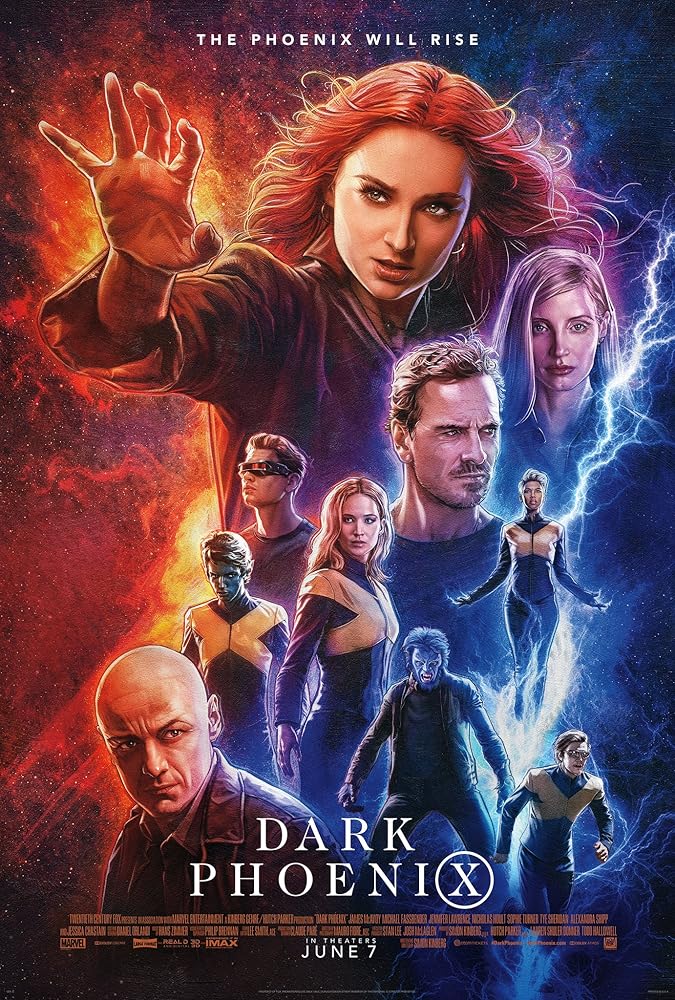
Dark Phoenix (2019) review


Nicholas Hoult, James McAvoy, Michael Fassbender, Evan Peters, Jessica Chastain, Jennifer Lawrence, Kodi Smit-McPhee, Alexandra Shipp, Sophie Turner, and Tye Sheridan in Dark Phoenix (2019)

In the early 2000s, the superhero film genre experienced a major resurgence thanks to three films that were all based on Marvel properties, which were also notably the first majorly successful live-action films that the company had ever produced after most of their previous efforts were underwhelming, to say the least. In fact, some of them were so disastrous that they didn’t even get a proper theatrical release (i.e. the infamous 1994 adaptation of The Fantastic Four). But then there was the trio of 1998’s Blade, Sam Raimi’s original Spider-Man in 2002, and the film that paved the way for today’s topic, X-Men, released in 2000 and directed by Bryan Singer. Despite both Singer and several of the film’s cast members admitting that they weren’t too familiar with the source material going in, the original X-Men was a solid critical and commercial success and helped the superhero genre evolve into the powerhouse that it still is today. Thus, the cast and crew returned for a sequel in 2003, X2: X-Men United, which was an even bigger hit and touted by many as a superior sequel. Not only that, but it ended on a note that teased a follow-up that would adapt one of the most famous X-Men storylines from the comics, The Dark Phoenix Saga, where X-Men member Jean Grey is corrupted by the full extent of her telepathic powers. However, as most of you know, this first adaptation turned out to be a bit of a disaster, mainly due to Singer backing out of the project to direct Superman Returns. Brett Ratner was hired in his place and the film that followed, 2006’s X-Men: The Last Stand, received a far more polarizing reaction from critics while being outright despised by fans for its handling of the Dark Phoenix storyline. This and the equally disastrous 2009 spin-off X-Men Origins: Wolverine effectively put the X-Men film franchise in a very rough spot for quite a few years.  

It wasn’t until 2011 when the series officially saw a comeback thanks to X-Men: First Class, a prequel/soft reboot directed by Matthew Vaughn that featured a cast of newcomers playing younger versions of the series’ established characters. And despite some initial skepticism from audiences, the film was a surprise critical and financial hit upon its release. This then paved the way for 2014’s X-Men: Days of Future Past, which saw Bryan Singer return to the franchise for the first time since X2 and combined the ensembles of both the original trilogy and First Class in a loose adaptation of the popular Days of Future Past storyline from the comics. The film also notably established a major bit of retconning by setting up an alternate continuity that ignored the events of The Last Stand. Because of this, writer/producer Simon Kinberg (who also wrote The Last Stand) hoped that this would pave the way for a more faithful Dark Phoenix adaptation in the future. And despite the generally mixed reaction towards the next installment of the franchise, 2016’s X-Men: Apocalypse, plans were officially set into motion for a new adaptation of the Dark Phoenix storyline. Not only that, but the film would also end up serving as Kinberg’s directorial debut after it was made clear that Apocalypse would be Singer’s last entry in the series. Thus, here we are now with the latest X-Men film, simply titled Dark Phoenix, and by all accounts, this will be the final installment of the main series (not counting the long-delayed New Mutants film that’s currently set for a 2020 release) following Disney’s purchase of 20th Century Fox earlier this year. And yet, despite this, reports of some extensive production issues, and an overall chilly reception, Dark Phoenix is ultimately another solid entry in the franchise even though I do agree that it still isn’t the proper Dark Phoenix Saga adaptation that it could’ve been.

It is 1992 and the relationship between humans and mutants has started to prosper thanks to the continued heroic efforts of telepath Charles Xavier (James McAvoy) and the X-Men. However, during a mission where the group rescues the crew of the space shuttle Endeavour, team member/telepath Jean Grey (Sophie Turner) endures the full force of a mysterious solar flare. Against all odds, Jean survives this event but her telepathic abilities end up getting amplified in the process, and to make matters worse, it also allows her to break a mental block that Charles had placed on her when she was younger to hide her memories of a car crash that she accidentally caused that resulted in the death of her mother. Thus, having realized that some of her most trusted allies have been keeping secrets from her, the more volatile aspects of Jean’s powers begin to take effect. This is then complicated further by the arrival of an alien race known as the D’Bari, led by the mysterious Vuk (Jessica Chastain), who seeks to harness Jean’s ‘Phoenix’ abilities for her own sinister purposes, resulting in the X-Men taking on their most perilous mission yet as they find themselves having to face one of their own. And if that wasn’t enough, Charles’ past efforts to ‘protect’ Jean end up causing a major divide amongst several members of the group, with the situation only being agitated further once the always unpredictable Erik Lehnsherr AKA Magneto (Michael Fassbender) gets involved.

As noted in the intro, one of the biggest issues that fans had with The Last Stand was its handling of the Dark Phoenix storyline, which was mainly due to it ultimately being a combination of two radically different storylines from the comics. The other storyline that was adapted for the film was Gifted, a six-part miniseries that was written by none other than Joss Whedon that focused on the introduction of a ‘mutant cure’, which meant that neither storyline got the proper attention that it should’ve since the film had to juggle them both at the same time. By comparison, this new film is technically a more faithful adaptation of the Dark Phoenix arc despite only having one major sequence that takes place in space and not including some of the storyline’s important characters. Namely, it doesn’t feature the Hellfire Club (although they did appear in First Class and were technically wiped out by the time Days of Future Past rolled around) and changes the prominently featured alien race from the Shi’ar to the D’Bari. However, a different issue then comes into play as the film doesn’t quite give this storyline the emotional poignancy that it could’ve had. It goes without saying that the transformation of Jean Grey from hero to villain proves to be devastating for the X-Men, especially her love interest Scott Summers AKA Cyclops (Tye Sheridan). But in the film, it’s treated like your standard hero/villain conflict, and thus, is quite lacking in terms of depth. At the very least, this film’s technical aspects fare a lot better. Despite this only being his first directorial effort, Simon Kinberg does a nice job with the action sequences and the whole film is backed by a suitably intense Hans Zimmer score.  

A lot has been said about how most of the main leads in this film who have been with the franchise for quite some time now are clearly not as enthusiastic about it as they were back then (that and a lot of jokes about how they still look as old as they did in First Class despite that being three films/in-universe decades ago). And yet, for what it’s worth, the returning leads of the franchise are still just as good as they’ve always been in these films, primarily because they continue to be the ones who get the most character development even though it does become a detriment to others. James McAvoy, for example, continues to shine as a more flawed Xavier compared to Patrick Stewart’s version of the character from the original trilogy, especially in this instance given that this whole plot is the result of his best intentions coming back to haunt him. Then there’s Michael Fassbender, who is still quite arguably the biggest standout of the First Class era ensemble as the emotionally charged Magneto. Jennifer Lawrence, meanwhile, continues to be solid as Mystique, who maintains the direction of her arc in Apocalypse by further embracing her leadership capabilities and being more protective of the younger members of the team. However, as some of this film’s trailers have implicated, her role in the plot is much smaller this time around. And finally, there’s Nicholas Hoult as Beast, who arguably gets the most prominent story arc that he’s ever had in this series due to his growing frustrations with Charles over his handling of Jean’s predicament and the devastating results that they yield.

Unfortunately, the newer members of the cast who had promising debuts in Apocalypse don’t get as much to work with this time around even though the First Class era films have done a lot better than the original trilogy when it comes to showing the X-Men working as a team. As alluded to earlier, Tye Sheridan doesn’t get any opportunities to truly delve into the emotional turmoil that Scott is going through over Jean’s actions even though he had one of the best emotional moments in Apocalypse when he learned about his brother Alex’s death. Alexandra Shipp also gets heavily underutilized as Storm, a fact that Shipp herself has openly acknowledged in recent interviews. Heck, we don’t even get a lot of fan-favorite Quicksilver (Evan Peters) this time around, which means that there’s sadly no new standout running sequence set to music like in the previous two films. At the very least, Sophie Turner does manage to do a solid job handling Jean’s psychological dilemma even if this film’s writing doesn’t exactly match her dedication to the role. But then we come to this film’s main antagonists, the D’Bari, who are, unfortunately, some of the weakest villains in the franchise’s history. Jessica Chastain does her best with what she’s given as their leader Vuk, but without much explanation of their backstory or their plans, they’re just a bunch of nameless thugs for the X-Men to fight. I will say, however, that the finale, where the X-Men fight the D’Bari on a train, is a solidly done action sequence, which is saying something considering that this was the biggest aspect of the film’s extensive reshoots due to the original ending supposedly being too similar to the likes of Captain Marvel and Captain America: Civil War.

At the time of this review’s publication, Dark Phoenix currently stands as the worst-received installment of the X-Men film franchise; yes, even more so than The Last Stand and X-Men Origins: Wolverine. And with a lackluster turn at the box-office (to the point where it will apparently be out of most theaters very soon), it’s clear that most audiences are just waiting for the series’ inevitable reboot into the Marvel Cinematic Universe. But is it really that bad? Well, not really. It’s competently made from a technical standpoint and everyone in it does a good job with the material that they’re given. However, while it’s far from being the disaster that many are saying it is, it’s still a sign that the X-Men franchise is running on fumes at this point. While it may technically be a more faithful adaptation of the Dark Phoenix Saga when compared to X-Men: The Last Stand, it never truly has the chance to delve into the psychological and emotional aspects of its storyline. In other words, as it is presented in this film, the conflict of Jean Grey going rogue has about as much urgency to it as Thor: The Dark World. With all this in mind, if this is truly meant to be the last installment of the X-Men film franchise as we’ve known it since the start of the new millennium, then I will openly admit that it’s probably for the best. And while I may be in the minority when it comes to liking this franchise, I do look forward to seeing how Kevin Feige and his team will incorporate these iconic characters into the MCU.

Rating: 4/5

Friday, December 14, 2018

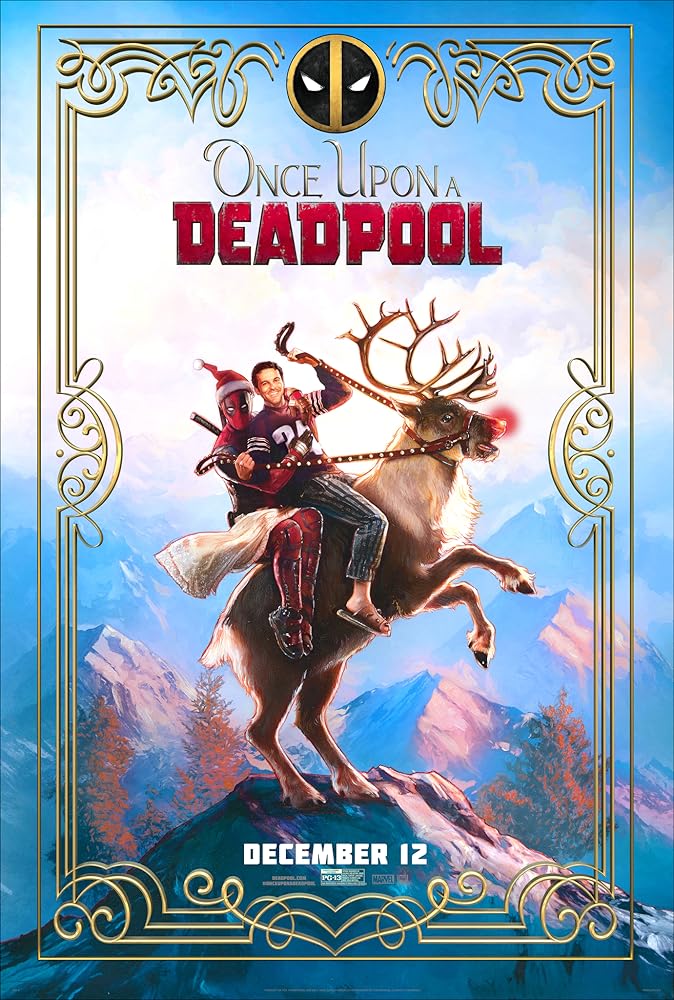
Once Upon a Deadpool - A Discussion

Fred Savage and Ryan Reynolds in Deadpool 2 (2018)

(DISCLAIMER: There will be spoilers regarding the plot of Deadpool 2 as I presume that most of you who are reading this have already seen the film. But in case you haven’t, the following link will direct you to my original non-spoiler review of the film from this past May.)

This holiday season, audiences are being treated to a unique kind of gift from the one and only Merc with a Mouth, Deadpool. Earlier this year, Wade Wilson returned to theaters with Deadpool 2, which saw him cross paths with the time-traveling soldier Cable, create the X-Force, and break the fourth wall further than he’s ever broken it before. And just like the original Deadpool, the film was a massive financial hit when it was released back in May. At the time that I’m writing this, it has grossed over $734 million worldwide, effectively making it the third highest-grossing entry in the X-Men film franchise as well as the third highest-grossing R-rated film of all-time. In terms of critical reception, the film ended up faring on par with the original, attracting a generally positive reaction from critics and audiences. There was some debate, however, as to whether the film was a ‘superior’ sequel. As for me, I’m part of the crowd who thinks that it is better than the first film. Despite a few awkward tonal shifts here and there, director David Leitch’s sequel took way more risks compared to the original. To be fair, though, the original Deadpool did do an admirable job working around the limitations of being the first major attempt at an R-rated superhero film post-Avengers. Ultimately, though, Deadpool 2 excels more thanks to more consistent humor, the wonderful additions of Josh Brolin as Cable and Zazie Beetz as Domino, and stronger emotional depth. But now we come to today’s topic, Once Upon a Deadpool, a new version of Deadpool 2 that promises to be the perfect holiday release for the whole family. Thus, instead of a traditional review (because I’ve already done that for this film), today’s post will be more of a discussion about this special re-release.  

Ryan Reynolds in Deadpool 2 (2018)

For all intent and purposes, Once Upon a Deadpool is indeed the PG-13 rated cut of Deadpool 2. It’s still the same story of Wade Wilson trying to protect a young mutant named Russell from Cable by forming his own superhero team, X-Force. And while most of his new team ends up being eradicated in a hilariously dark fashion, Deadpool ends up finding the one thing that he’s been missing all this time via the most important F-word of all, a family. After all, as he states in the opening sequence, Deadpool 2 is a family film, and Once Upon a Deadpool is easily its most ‘family-friendly’ version. While there are a few instances of heavier curse words, all F-bombs are either censored ‘TV-edit’ style or bleeped via Deadpool’s trusty censoring buzzer. Any instances of nudity (e.g. when Deadpool has his Basic Instinct moment after his legs start to regenerate) are blurred out. And finally, the most graphic bits of violence are obviously toned down. At the very least, most of the action sequences are kept intact, just without showing any blood spurts (e.g. Deadpool dodging Cable’s bullets on the prisoner convoy). But when it comes to the most graphic moments from the film, it does cut away before they happen, with the most prominent example being when Deadpool gets ripped in half by Juggernaut. All in all, the method in which this version of Deadpool 2 is toned down to a PG-13 rating is decently done, for the most part. I wouldn’t call it a complete success as there are a few instances where the censoring attempts are a bit more blatant than others but compared to other films that were originally R-rated but were then toned down to a PG-13 rating at the cost of hastily edited action sequences, it’s still an admirable attempt. And while I obviously don’t want every future R-rated film to have a toned-down PG-13 rated cut just so that they can appeal to a wider audience, it’s acceptable in this instance if only because of Deadpool’s potential appearances in future films.


But, of course, the most prominent addition to this cut of the film is its new framing device. In a homage to the 1987 classic The Princess Bride, Deadpool kidnaps (or, as he puts it, a case of ‘unsolicited location enhancement’) Fred Savage to tell him the story of Deadpool 2 in the same manner that Peter Falk told him the story of The Princess Bride all those years ago. Thus, just like in The Princess Bride, Savage pops up from time to time to comment on the current sequence, leading to some hilarious meta-commentary on everything from the film’s controversial fridging of Vanessa to the unexpected cameo by Brad Pitt as the Vanisher. And sure enough, these sequences are a brilliant addition. Even under the restrictions of the film’s new PG-13 rating, Deadpool’s comedic sensibilities are still on point throughout, which I’d argue is a testament to Ryan Reynolds’ own comedic talents and proves that, yes, Deadpool can indeed work well in a PG-13 environment. And, of course, Fred Savage also contributes heavily to these sequences’ success as his camaraderie with Reynolds is phenomenal. Really, the only disappointing thing about these sequences is that there aren’t more of them, as it would’ve been interesting to hear Savage’s thoughts on things like the abrupt deaths of the X-Force squad.        

Josh Brolin, Ryan Reynolds, Stefan Kapicic, Karan Soni, Julian Dennison, and Zazie Beetz in Deadpool 2 (2018)

In conclusion, Once Upon a Deadpool is admittedly a tough film to come up with an overall recommendation for. If the extreme blow-back to a 2016 petition requesting a PG-13 edit of the first Deadpool is any indication, a lot of fans aren’t exactly on board with the idea of the Merc with a Mouth being toned down to PG-13 material. And yet, with Disney’s impending purchase of Fox’s film division on the horizon, there’s a considerably high chance that it could happen. Granted, Disney CEO Bob Iger has stated that the plans are to maintain the franchise’s R-rating but given that the Marvel Cinematic Universe films are rated PG-13, I think it’s safe to say that Deadpool will be turned PG-13 whenever he makes a cameo in a non­-Deadpool film. As such, it can be argued that the main intent of Once Upon a Deadpool is to see if the character can work within the boundaries of a PG-13 rated superhero film. And as controversial of a claim as it’ll undoubtedly be for fans of the character, I think it works well. Now to be clear, I’m not saying that this is the definitive version of Deadpool 2. Clearly, the film was always intended to be R-rated, so if you want to see the film in its purest form, you’ll be better off watching the original theatrical cut or the ‘Super Duper $@%!#& Cut’ on Blu-Ray. However, the way in which this version of the film is cut down to meet PG-13 standards is, at the very least, better handled compared to other films that were forced down to the more family-friendly rating. Plus, the additional sequences involving Deadpool and Fred Savage are a delightful bonus. In short, as someone who isn’t religiously devoted to the belief that Deadpool should remain in an R-rated environment, I had as much fun with Once Upon a Deadpool as I did the original Deadpool 2. And while several critics have felt that this re-release was ‘unnecessary’, I’d argue that it isn’t because it’s not just a case of the filmmakers being forced to cut their film down just so that the studio can market it to a wider audience. Rather, this is ultimately a case of a film that is being toned down… but in this instance, the filmmakers are totally in on the joke.

Rating: My 4.5/5 rating from my original review of Deadpool 2 still stands even when considering what had to be cut from this version to make it PG-13, as the new scenes with Fred Savage do make up for what was taken out.


Ultimately, though, one of the biggest reasons to see Once Upon a Deadpool is for its final post-credit scene. I won’t spoil it for those who are planning on seeing it but believe me when I say that it’s practically worth the price of admission alone.


Thursday, May 24, 2018

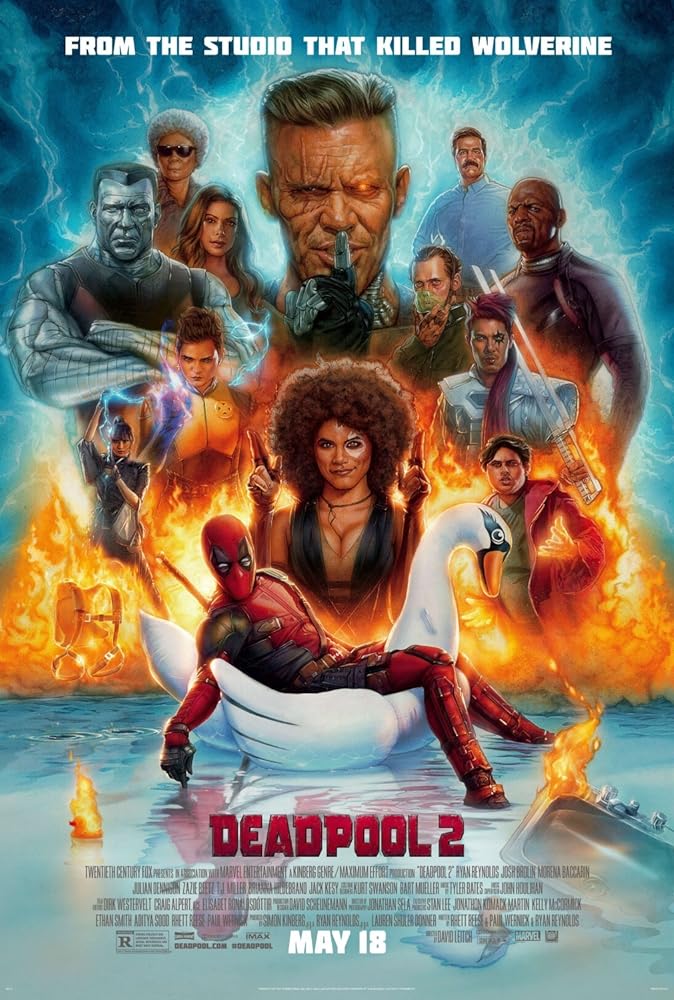
Deadpool 2 (2018) review

Brad Pitt, Josh Brolin, Ryan Reynolds, Terry Crews, Bill Skarsgård, Leslie Uggams, Morena Baccarin, Lewis Tan, Stefan Kapicic, Rob Delaney, Shioli Kutsuna, Julian Dennison, Zazie Beetz, and Brianna Hildebrand in Deadpool 2 (2018)

Calling the 2016 superhero film Deadpool a hit would be a massive understatement. Upon its release in February of that year, the X-Men spin-off broke all sorts of box-office records. Not only did it become the highest grossing X-Men film to date worldwide, but it also set various opening weekend records as A.) an R-rated superhero film B.) an R-rated film in general and C.) a film that was released in the supposedly ‘dead’ month of February, and that’s just to name a few. Simply put, audiences were delighted by this raunchy installment of the superhero genre, especially due to its more faithful take on the fan-favorite titular anti-hero after his infamous first live-action appearance in 2009’s X-Men Origins: Wolverine. And thus, everyone’s favorite fourth-wall breaking mutant is back in Deadpool 2 which, as promised in the previous film’s post-credits scene, sees the introduction of Deadpool’s most famous ally from the comics, Cable. This time around, though, former VFX artist Tim Miller is not back to direct after he backed out of the project early in its development due to creative conflicts with lead Ryan Reynolds over the direction that it was going in. Thankfully, a badass replacement was found rather quickly in long-time stunt coordinator David Leitch. Since 2014, Leitch has begun to transition into directing and has managed to make quite a name for himself in the process, having co-helmed the 2014 modern action classic John Wick alongside fellow stunt veteran Chad Stahelski and then making a solid solo directorial debut with last year’s action thriller Atomic Blonde. Ultimately, though, one question still stands. From the perspective of someone who admittedly ‘liked, but not loved’ the first Deadpool film, does this one manage to outshine its predecessor and truly live up to its mantle as an unrelenting, R-rated, meta-fueled superhero extravaganza?

Two years since he first started to operate as the mercenary Deadpool, cancer survivor Wade Wilson (Ryan Reynolds) continues to do what he does best; killing all the bad guys, constantly breaking the fourth wall (primarily to complain about how fellow mutant Wolverine always steals his thunder) and wooing his girlfriend Vanessa (Morena Baccarin). However, Deadpool soon finds himself crossing paths with Cable (Josh Brolin), a cybernetic soldier from the future. Having traveled back in time from his dystopian world, Cable is hellbent on eliminating a young mutant boy named Russell Collins (Julian Dennison), who calls himself ‘Firefist’ due to his ability to shoot fire from his hands, whom Deadpool ends up meeting during a ‘mission’ with his old X-Men ‘pals’ Colossus (Stefan Kapičić) and Negasonic Teenage Warhead (Brianna Hildebrand). As Deadpool soon learns, Cable’s primary reasoning for hunting Russell is that he will end up killing those who had abused him at a ‘Mutant Re-Education Center’ orphanage, which will then lead to him becoming a killer years later with Cable’s own future wife and daughter being two of his victims. And despite Cable proving to be a highly imposing threat, Deadpool, fueled by his desire to have a family of his own with Vanessa, decides to take on the responsibility of protecting Russell. To do so, he ends up forming a superhero team of his own known as X-Force, which includes the likes of EMP disrupter Bedlam (Terry Crews), acid-spewing Zeitgeist (Bill Skarsgård), and luck manipulator Domino (Zazie Beetz) to deal with the time-traveling warrior who looks a lot like the main antagonist from Avengers: Infinity War.

Despite a change in director, Deadpool 2 does not lose any of the spirit that helped make the first film such a worldwide phenomenon, as it still provides audiences with plenty of great fourth wall jokes that liven up the mood when paired against some of its graphically violent action sequences. But perhaps the best thing that this film does is that it truly lives up to its designation as an unfiltered, balls-to-the-wall (figuratively and literally with emphasis on the latter) R-rated superhero film when compared to the first Deadpool. As I noted a few years back in my review of the first film, while I did genuinely enjoy it thanks in large part to its well-handled humor, I didn’t quite see it as the ‘superhero genre game-changer’ that everyone regarded it as. Despite its various ways of subverting and poking fun at some of the genre’s most widely mocked tropes, its ‘origin story’ narrative ended up covering much of that ground anyway. Plus, the film’s lower budget compared to the likes of other films in the genre did end up rearing its ugly head at times, like during its obviously watered-down finale despite it being set on an MCU-style Helicarrier of all places. To be fair, though, this wasn’t technically the film’s fault as it was just a case of it being an ‘untested venture’ for the studio. Thankfully, that’s not as big of an issue with Deadpool 2, which sports a budget that’s almost double that of the first’s. Because of this, the film takes way more chances when it comes to satirizing the superhero genre that ends up leading to plenty of highly satisfying comedic payoffs. Really, the only thing holding it back is one key plot twist early on that affects some of the main characters. This twist, influenced by one of the genre’s most infamous tropes, ironically helps to give the film more of an emotional core than the first film while still robbing it of the most notable contribution to its predecessor’s most poignant moments while also causing a few instances of tonal inconsistency in the process.

Through it all, though, the film is undoubtedly bolstered by Ryan Reynolds’ phenomenal turn in the titular role, as his comedic timing is just as strong as it was in the first film. This is then balanced excellently with Josh Brolin in his second major role in a comic book film this year after he blew everyone away as Thanos in Avengers: Infinity War. While there are instances where Cable proves to be just as generally imposing as Thanos, here he is mostly used as the butt of several jokes from Deadpool, who of course is a constant thorn in his sides. Sadly, Morena Baccarin is once again heavily underused as Vanessa despite her genuinely wonderful chemistry with Reynolds. In fact, it’s quite frankly even worse here than in the first film (remember that ‘infamous trope’ I mentioned in the last paragraph? Yeah, it affects her the most…). Thankfully, this is ‘somewhat’ alleviated by the film’s other main female lead, Zazie Beetz as Domino. As soon as the character first appears on-screen, she is immediately established as a badass heroine (despite Deadpool’s claims that her ‘luck-based’ powers aren’t very cinematic) who more than manages to hold her own against Deadpool’s tomfoolery. Julian Dennison is also a major standout as the young mutant Russell as he unabashedly partakes in some of the film’s most risqué bits of humor. And because parts of the film have him utilized as an ‘antagonist’, that technically makes him a better villain than those from the previous film, especially when he partners up with [identity of the second villain in this film redacted due to spoilers; I will say, though, that just like how the first film redeemed Deadpool, this villain’s appearance in this film redeems his previous one]. Finally, you also have plenty of the great supporting roles returning from the first film, including the duo of Colossus and Negasonic Teenage Warhead (who don’t necessarily get as much to do this time around but still manage to have their own standout moments) and Karan Soni as Deadpool’s happy-go-lucky cab driver friend Dopinder.  

In conclusion, to answer the question that I laid out in the early parts of this review, I’m pleased to say that I did like Deadpool 2 more than the first film. Now again, this isn’t meant as a slight against the first Deadpool, which is still an enjoyable (and, most importantly, hilarious) entry in the superhero genre that allowed Ryan Reynolds the chance to give the titular character the proper film adaptation that he deserved. It’s just that, at the end of the day, Deadpool 2 doesn’t have to deal with the pressure of being an untested anomaly for both Fox and the superhero genre in general. After all, when the first Deadpool hit theaters in early 2016, it was at a time when R-rated superhero films weren’t yet considered as being ‘commercially viable’ ventures. But now that Fox has basically become the top purveyor of R-rated superhero films at this point thanks to both it and Logan, that means that Deadpool 2 is able to go above and beyond in terms of truly going ‘out there’ with its satirical takes on the genre, which it does with utter delight. This, in turn, allows Deadpool 2 to have some of the most consistently terrific humor to come out of a superhero film to the point where it even rivals the MCU’s trademark sense of humor. And just like the first film, this is then strengthened further by an excellent ensemble cast that’s headlined by Ryan Reynolds once again proving why his recent turns as the Merc with the Mouth have made him one of the genre’s most pitch-perfect casting decisions. With all this said, though, I’ll admit that I still don’t necessarily consider this to be the ‘best’ superhero film of the year as it does sort of suffer from a major plot twist that, from a narrative perspective, ironically also does a few good things in the process. But as far as being one of the most ‘fun’ installments of the genre, Deadpool 2 is certainly near the top of that list.


Rating: 4.5/5

Saturday, March 4, 2017

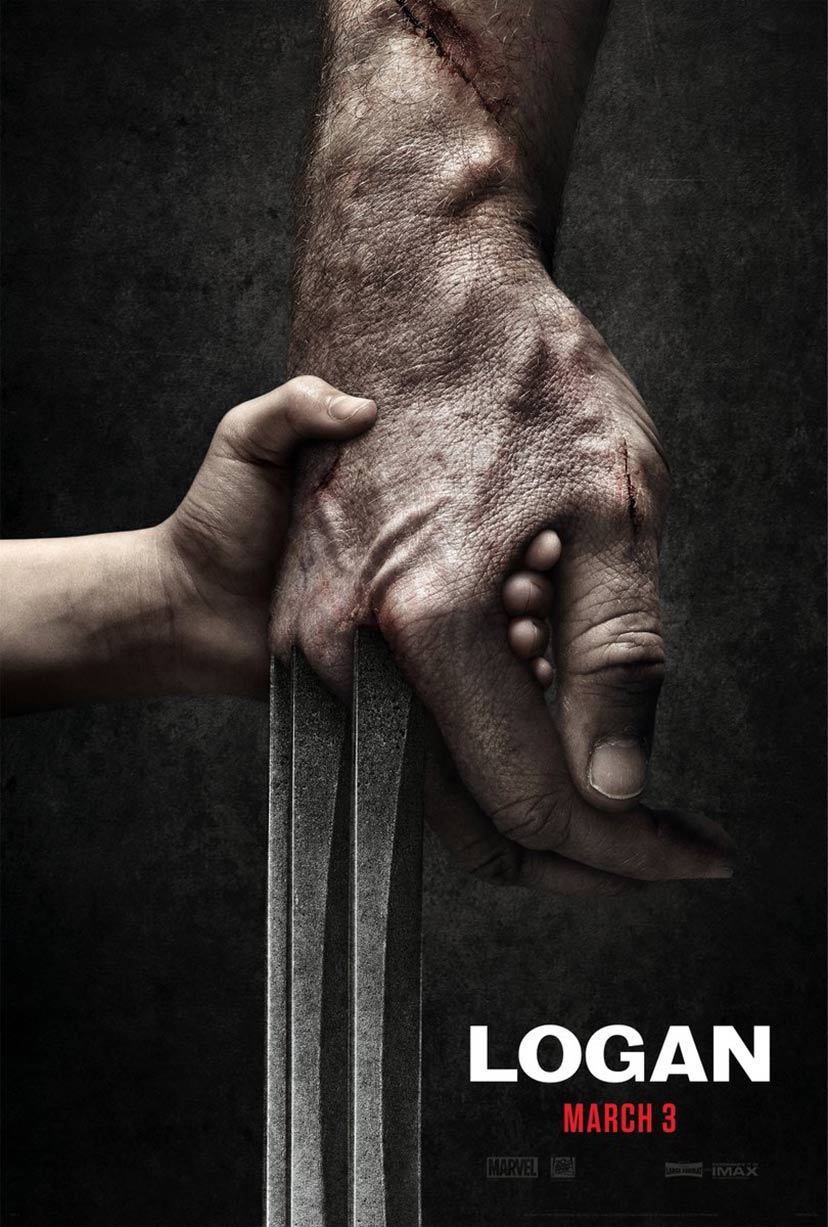
Logan (2017) review

Image result for logan poster

There have been many iconic superhero film casting choices over the years; Christopher Reeve as Superman, Robert Downey Jr. as Iron Man, the list goes on. But, easily, one of the most iconic casting choices of the entire genre, namely due to how long he’s been in the role, has been Hugh Jackman in the role of the clawed mutant James ‘Logan’ Howlett AKA Wolverine. Jackman was first cast in the role in Bryan Singer’s first X-Men film back in 2000, and while some may have taken issue with a 6’2’’ Broadway actor taking on the role of a character who is a full foot shorter by comparison in the comics, it would end up becoming the definitive role of Jackman’s career. He would then go on to reprise his role in almost every subsequent X-Men film, either in a leading role or an awesome cameo. The popularity of the character even resulted in a few spin-offs. However, the Wolverine spin-offs have been a bit more hit-and-miss. The first of these, 2009’s X-Men Origins: Wolverine, was savaged by both critics and audiences for its flawed screenplay, disastrous deviations from the comics (e.g. ‘Deadpool’, a term used loosely in this case), and for being overcrowded with other mutants. Even Jackman himself has admitted that it didn’t turn out as well as he had hoped. Thankfully, he managed to get Wolverine a much more satisfying spin-off in 2013 when he teamed up with director James Mangold (whom he had previously worked with on 2001’s Kate and Leopold) for The Wolverine, based off the popular 1982 limited series of the same name by Chris Claremont and Frank Miller. And while not perfect, it at least did better with critics and audiences compared to the previous film. However, the film truly shines with its unrated Extended Edition. Debuting with the film’s home media release, this was easily the superior cut of the film, partially because it gave fans some of the R-rated Wolverine action that they had been hoping for after many years of PG-13 rated Wolverine action in the previous films.

But, this year, fans of the character are finally getting what they’ve always wanted, as Mangold and Jackman team up once again for their second Wolverine solo film, this one simply titled Logan. Like The Wolverine, the film takes inspiration from a famous storyline in the comics; in this case, Old Man Logan, a 2008 mini-series by Mark Millar and Steve McNiven which centers on an aged Wolverine in an alternate future where supervillains have taken over the world. However, in this instance, the film is not a direct adaptation of the source material, probably because some of the key characters featured in that story are over at Marvel Studios. But, of course, most of the hype surrounding this film is due to one primary reason, and that is that it is set to be Hugh Jackman’s final outing in his career-defining role. As such, he and Mangold seek to give the iconic X-Men member a fitting onscreen send-off. And, thanks in part to the success of last year’s Deadpool, the two were given the chance to do what fans of the character have been demanding since Jackman first debuted in the role; an R-rated Wolverine film that wasn’t tied down by the limits of the PG-13 rating that was given to every other X-Men film to date (minus Deadpool, of course). Having now watched this film, I can safely say that it does live up to its status as a gritty and brutal R-rated Wolverine film. But, of course, now the big question remains; does this new film manage to not only be the best of the Wolverine films but also serve as a fitting send-off for one of the superhero genre’s greatest icons? The answer… is a resounding yes.

The year is 2029 and most of the mutant population has gone extinct. One of the last surviving mutants, Logan (Hugh Jackman) AKA Wolverine, now spends most of his days working as a chauffeur in Texas. He also looks after his increasingly senile friend, telepath Charles Xavier (Patrick Stewart), with the help of mutant tracker Caliban (Stephen Merchant) as it becomes clear that Logan himself is starting to age as well due to the diminishing nature of his healing powers as the result of poisoning caused by the adamantium in his body. One day, he is approached by a woman named Gabriela (Elizabeth Rodriguez) who asks for his help in escorting her and a young girl named Laura (Dafne Keen) to a place known as ‘Eden’ in North Dakota. Logan reluctantly accepts but Gabriela is soon murdered and he, Xavier, and Laura begin to be pursued by Donald Pierce (Boyd Holbrook), the ruthless, cybernetically-enhanced head of security of the company that Gabriela used to work for, Transigen. Logan learns that the company had been experimenting with mutant DNA on the children that they had been breeding. When the children were set to be killed following the completion of a different mutant project known as ‘X-24’, Gabriela helped several of the children escape, Laura being one of them. Not only that, but it’s revealed that Laura was bred with Wolverine’s DNA, resulting in her not only having the same abilities as him but also technically being his ‘daughter’. Now forced to go on the run, the trio embarks on a road trip across the country in hopes of finding the mythical ‘Eden’.

One of the coolest things about director James Mangold’s two entries in the superhero genre is that both films are more than just ‘superhero films’. The Wolverine, being set in Japan, utilized a lot of the elements that are commonly seen in samurai action films, especially from a stylistic perspective. And in the case of Logan, he basically made a superhero film that was a western, a genre that he’s certainly well-versed in having directed the 2007 remake of 3:10 to Yuma. It’s also worth noting that these last two Wolverine films don’t rely heavily on action sequences. Now, that’s not to say that they aren’t there because they are. But just keep in mind that this is a slow-moving film, especially considering that it’s over two hours long (admittedly, it may be just a tad bit overlong). But, that’s ultimately one of the key elements of the film’s narrative. The longer runtime allows you to become fully invested in the lead trio of Wolverine, Xavier, and Laura as they embark on their road-trip, so much so that even if you probably guessed in advance how it’s all going to end, the film ends on one of the best emotional notes in the history of the superhero genre. It also very much stands on its own compared to the other X-Men films; for one thing, they don’t tie it too much into the series’ overall continuity, which is probably for the best because it just would’ve sparked more debate over the series’ infamously convoluted canon. As for the action sequences, fans will be pleased to know that the film does live up to its status as an R-rated Wolverine film. These action sequences are intense and bloody and many of them will have you audibly saying ‘oh s***’ when they happen because of how brutal they are. Seriously, Mangold doesn’t hold back on them; not even Deadpool was this intense.

I’ve talked about how great Hugh Jackman has been in the role of Wolverine many, many times over the years (in fact, I just did so again the other day) so I’ll try not to repeat myself too much here. However, this may arguably be his greatest performance in the role to date and if so, it’s only fitting that it came from his last appearance as the character. Logan’s trademark hard-edged persona is still there, of course, but that’s well-mixed with the tragic nature of him being at a point in his life where he’s clearly past his prime. Patrick Stewart is also great as usual in the role of Xavier, whose role in the film is also one based in a tragic light as we sadly see the beloved telepath becoming more and more senile by the day. In fact, one of the darkest plot-points in the film establishes that Xavier inadvertently had a hand in the decimation of the mutant population due to the intense, seizure-induced psychic attacks that he now suffers from on a regular basis. Still, he works great off Logan, as always, and while the film does maintain a generally serious tone throughout, the R-rating does allow for some funny moments in which Stewart gets to be a bit cruder than he usually is in these films. The two are joined by newcomer Dafne Keen, who makes one hell of a great first impression in the role of the primarily mute but often quite volatile young girl who becomes the closest thing that Wolverine has ever had to a daughter. Stephen Merchant also has a memorable supporting role as Caliban, who had previously appeared in a much smaller role in X-Men: Apocalypse. As for the villains, they’re admittedly the weakest links of the film. Still, Boyd Holbrook proves to be an enjoyably despicable antagonist in the role of Donald Pierce, who’s shown to be quite a big fan of Ol’ Wolverine. The same can’t really be said, though, for Richard E. Grant, who plays Zander Rice, a scientist who is revealed to have an interesting personal connection to Wolverine. Despite this, he’s barely in the film.

Hugh Jackman has been in the role of Wolverine for nearly two decades. He was first cast in 1999 and has since appeared in all but one of the ten currently released films in the X-Men franchise. And with Logan, he and director James Mangold give the character the proper send-off that he deserves in a film that is pretty much the official finale of the original X-Men series. From an action perspective, this film delivers some of the most epic and brutal action sequences that the genre has ever seen. But, through all that bloodshed, stabbing, and numerous scenes of limbs being sliced off, the direction from Mangold is fantastic. This is an unrelentingly brutal but also fully emotional story in which the film’s [possibly] overlong runtime gives you plenty of time to care about the main characters in their endeavors. As such, if you’ve been a longtime fan of this franchise, it is practically guaranteed that you will get teary-eyed at one point or another while watching this film. Thus, not only is this the best Wolverine film, by far, but it’s one of the best installments of the entire X-Men series. Clearly, 2017’s lineup of live-action superhero films is off to a great start. And on that note, I’d like to salute the legend that is Hugh Jackman by saying thank you, Mr. Jackman, for all your contributions to both the X-Men franchise and the superhero genre in general. Because at the end of the day, the story of Weapon X ended on the best note possible.  
Rating: 5/5!

(P.S. When you go to see this film, be sure to get there in time before the film starts. Without giving anything away, there’s a special little clip that plays before the opening credits that’s sure to put a smile on your face.)