Showing posts with label David Leitch. Show all posts

Tuesday, August 27, 2019

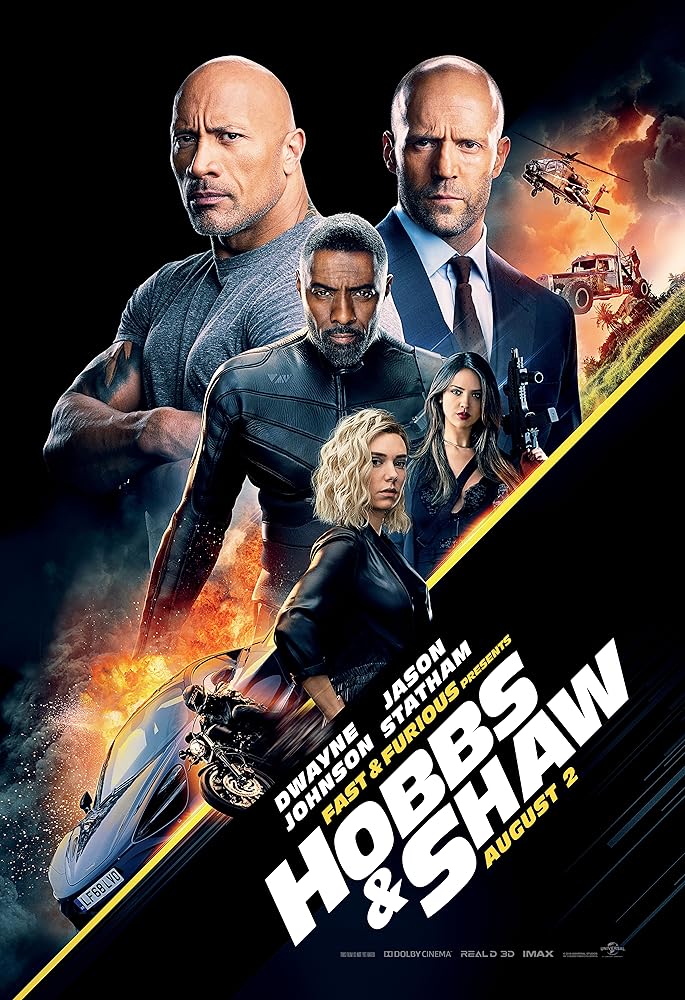
Fast and Furious Presents: Hobbs and Shaw (2019) review

Jason Statham, Idris Elba, Dwayne Johnson, Eiza González, and Vanessa Kirby in Fast & Furious Presents: Hobbs & Shaw (2019)

The Fast and the Furious franchise has undoubtedly been one of the biggest film franchises in recent memory. While it has been around since 2001, the series truly started to hit its stride with its fifth installment, 2011’s Fast Five, which surprised many by being the first entry of the series to attract generally positive reviews from critics. For many, this was largely due to a new addition to the cast in Dwayne Johnson’s Luke Hobbs, a burly, no-nonsense agent working for the Diplomatic Security Service. While initially established as somewhat of an antagonist for series lead Dominic Toretto and his gang, Hobbs ends up becoming one of their key allies for subsequent films. Another major standout for the series came in the form of Deckard Shaw, played by Jason Statham. First introduced in the mid-credit scene of 2013’s Fast and Furious 6, Shaw effectively became the main antagonist of 2015’s Furious 7 but would later transition into an anti-hero in 2017’s The Fate of the Furious. And while Shaw’s new characterization proved to be rather controversial amongst fans given that he was responsible for the death of Han, one of the series’ main protagonists, many agreed that the scenes between Johnson and Statham were the best part of the film. As such, we now come to a first for the Fast and Furious franchise via a spin-off centered on its two most popular characters, Hobbs and Shaw. For this film, directorial duties go to David Leitch, who’s fresh off last year’s superior follow-up to 2016’s superhero smash hit Deadpool. What follows is exactly what you’d expect from a Fast and Furious film; a completely ridiculous but all-around super fun popcorn flick.

During a mission to retrieve a deadly virus known as ‘Snowflake’ from the mysterious terrorist organization Eteon, a group of MI6 agents are attacked by Eteon’s top agent Brixton Lore (Idris Elba), a former MI6 agent who’s been turned into a cybernetically-enhanced super-soldier. Almost every member of the team is killed save for team leader Hattie Shaw (Vanessa Kirby), who injects herself with the virus to avoid it getting into Lore’s hands. Thus, Lore and Eteon manage to pin the whole incident on her, forcing her to go on the run. In their efforts to track her down, the CIA recruits two special operatives for the mission; DSS agent Luke Hobbs (Dwayne Johnson) and Hattie’s brother, former British Special Forces agent Deckard Shaw (Jason Statham), who also happens to have a considerable history with Lore. The only problem is that, as exemplified by their past encounters, Hobbs and Shaw do not get along in the slightest. However, given that the virus within Hattie will end up killing her in a few days and will then be unleashed upon the world to kill countless more, the two ‘frenemies’ are forced to work together just to ensure that none of this ends up happening. And because Brixton Lore and Eteon consistently prove to be a massive thorn in their side, the three realize that they’ll have to embrace their familial roots if they want to stand a chance against their enemies.    

Nowadays, the ongoing narrative surrounding the Fast and Furious films usually revolves around how incredibly over-the-top they’ve gotten. What was once a simple street-racing franchise has now evolved into a series of films where its characters pull off incredibly ludicrous stunts that defy every single law of physics, whether it’s jumping a car across tall skyscrapers or driving them out of an airplane. And because these films consistently continue to up the ante when it comes to their insane action sequences, it’s legitimately gotten to the point where fans have been speculating for years now if the franchise will ever head into space. As for Hobbs and Shaw, it’s basically a full-blown superhero film at this point since the plot revolves around the titular duo taking on a genetically enhanced soldier who’s so powerful that he straight-up boasts that he’s ‘Black Superman’. As such, this film is ultimately yet another example of what we’ve now come to expect from this franchise. Simply put, if you’re among those who aren’t even remotely fans of Fast and Furious, then you’re clearly not going to get anything out of this since it basically maintains every single one of the series’ long-standing tropes. In fact, you’ll probably just look at this and lament how this franchise keeps managing to get even sillier with each new installment. But if you are a fan of this franchise, this film does continue to feature everything that you love about it, from the cheesy comedic dialogue to the action sequences that, no matter how insane they get, are still a lot of fun to watch. And while it does occasionally feel like David Leitch is being forced to keep some of the fight sequences under the PG-13 rating, there are still plenty of cases where he gets to show off his knack for excellent stunt choreography.

But perhaps the most surprising aspect of this film is how effective it is at handling what is easily the franchise’s definitive theme, the importance of family. Yes, as fans of the franchise are undoubtedly aware, Fast and Furious has constantly prided itself on the strong camaraderie between its main characters. However, it does seem like this bond has been tested in recent years, especially after Vin Diesel and Dwayne Johnson’s heated feud on the set of The Fate of the Furious that, as it turns out, was partially due to the announcement of this spin-off. Still, there’s no denying that family has always been a key element of this franchise’s success, and Hobbs and Shaw is quite arguably one of the best entries in the series when it comes to conveying this since it directly defines the character arcs of its titular leads. Shaw’s involvement in the plot primarily stems around the need to protect his sister (who he’s been estranged from for several years) while Hobbs ends up returning to his home in Samoa and reuniting with his family, who play a major role in the film’s finale. Now to be clear, this is still Fast and Furious that we’re talking about so this is by no means an Oscar-winning script; and yet, it could be argued that this one handles the ‘family’ aspect a lot better than some other entries in the franchise. And as to be expected, Dwayne Johnson and Jason Statham continue to be excellent in the title roles thanks in large part to their excellent camaraderie and the hilarious banter that stems from it. They’re then backed by Vanessa Kirby’s equally excellent turn as new female lead Hattie Shaw, with Kirby more than holding her own against her two main co-stars when it comes to the action sequences. And to close out the main cast, Idris Elba is clearly having a lot of fun in the role of main antagonist Brixton Lore, who does prove to be a considerable threat to the main characters despite a few instances where his characterization feels a bit one-note in favor of setting up a new overarching series villain in the currently unknown director of Eteon.

While it is primarily a spin-off of the Fast and Furious series, the fact that Hobbs and Shaw revolves around the franchise’s two most popular characters ultimately resulted in a situation where many people were looking forward to this film more than the impending Fast and Furious 9, which is set for a May 2020 release. And if that wasn’t enough, it’s been confirmed that Johnson and Statham won’t be returning for the ninth film due to their commitment to this spin-off. As such, only time will tell if this will have any sort of impact on Fast and Furious 9, especially given how Johnson’s involvement with the franchise was one of the key factors behind its unexpected resurgence. But as for Hobbs and Shaw, it’s easy to see why this one attracted so much hype before its release. Bolstered by the terrific camaraderie of Dwayne Johnson and Jason Statham, this film once again reinforces why Luke Hobbs and Deckard Shaw have become one of the best mismatched buddy duos in film since Martin Riggs and Roger Murtagh. Sure, just like the other recent installments of the Fast and Furious franchise, Hobbs and Shaw doesn’t let up in the slightest when it comes to the increasingly ludicrous nature of both its plot and its action sequences. Because of this, it’s clear that those who aren’t already fans of the franchise probably won’t be swayed by this new installment. But, of course, when it comes to the franchise’s devoted fanbase, they will most likely find this to be another solid entry in the series thanks to its great cast, highly entertaining action sequences, and solid direction from David Leitch. It’s already grossed over $588 million worldwide, once again reaffirming the Fast and Furious franchise’s status as one of the most dominant film franchises around.

Rating: 4.5/5

And don’t forget that there’s still plenty of time to vote for your favorite film from the Summer of 2019 in Rhode Island Movie Corner’s annual ‘End of Summer’ Fan Poll. Just head to the following link (https://www.surveymonkey.com/r/NQ3FZN2) to make your selection. Voting ends this Saturday, August 31st; as Doctor Strange would say, “We’re in the endgame now…”

Friday, December 14, 2018

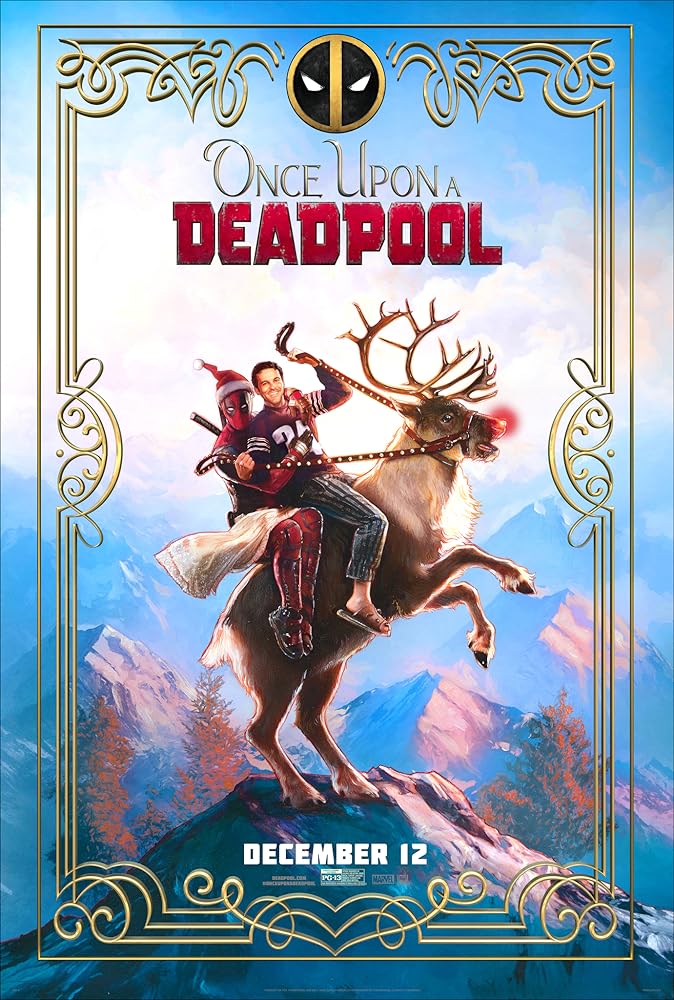
Once Upon a Deadpool - A Discussion

Fred Savage and Ryan Reynolds in Deadpool 2 (2018)

(DISCLAIMER: There will be spoilers regarding the plot of Deadpool 2 as I presume that most of you who are reading this have already seen the film. But in case you haven’t, the following link will direct you to my original non-spoiler review of the film from this past May.)

This holiday season, audiences are being treated to a unique kind of gift from the one and only Merc with a Mouth, Deadpool. Earlier this year, Wade Wilson returned to theaters with Deadpool 2, which saw him cross paths with the time-traveling soldier Cable, create the X-Force, and break the fourth wall further than he’s ever broken it before. And just like the original Deadpool, the film was a massive financial hit when it was released back in May. At the time that I’m writing this, it has grossed over $734 million worldwide, effectively making it the third highest-grossing entry in the X-Men film franchise as well as the third highest-grossing R-rated film of all-time. In terms of critical reception, the film ended up faring on par with the original, attracting a generally positive reaction from critics and audiences. There was some debate, however, as to whether the film was a ‘superior’ sequel. As for me, I’m part of the crowd who thinks that it is better than the first film. Despite a few awkward tonal shifts here and there, director David Leitch’s sequel took way more risks compared to the original. To be fair, though, the original Deadpool did do an admirable job working around the limitations of being the first major attempt at an R-rated superhero film post-Avengers. Ultimately, though, Deadpool 2 excels more thanks to more consistent humor, the wonderful additions of Josh Brolin as Cable and Zazie Beetz as Domino, and stronger emotional depth. But now we come to today’s topic, Once Upon a Deadpool, a new version of Deadpool 2 that promises to be the perfect holiday release for the whole family. Thus, instead of a traditional review (because I’ve already done that for this film), today’s post will be more of a discussion about this special re-release.  

Ryan Reynolds in Deadpool 2 (2018)

For all intent and purposes, Once Upon a Deadpool is indeed the PG-13 rated cut of Deadpool 2. It’s still the same story of Wade Wilson trying to protect a young mutant named Russell from Cable by forming his own superhero team, X-Force. And while most of his new team ends up being eradicated in a hilariously dark fashion, Deadpool ends up finding the one thing that he’s been missing all this time via the most important F-word of all, a family. After all, as he states in the opening sequence, Deadpool 2 is a family film, and Once Upon a Deadpool is easily its most ‘family-friendly’ version. While there are a few instances of heavier curse words, all F-bombs are either censored ‘TV-edit’ style or bleeped via Deadpool’s trusty censoring buzzer. Any instances of nudity (e.g. when Deadpool has his Basic Instinct moment after his legs start to regenerate) are blurred out. And finally, the most graphic bits of violence are obviously toned down. At the very least, most of the action sequences are kept intact, just without showing any blood spurts (e.g. Deadpool dodging Cable’s bullets on the prisoner convoy). But when it comes to the most graphic moments from the film, it does cut away before they happen, with the most prominent example being when Deadpool gets ripped in half by Juggernaut. All in all, the method in which this version of Deadpool 2 is toned down to a PG-13 rating is decently done, for the most part. I wouldn’t call it a complete success as there are a few instances where the censoring attempts are a bit more blatant than others but compared to other films that were originally R-rated but were then toned down to a PG-13 rating at the cost of hastily edited action sequences, it’s still an admirable attempt. And while I obviously don’t want every future R-rated film to have a toned-down PG-13 rated cut just so that they can appeal to a wider audience, it’s acceptable in this instance if only because of Deadpool’s potential appearances in future films.


But, of course, the most prominent addition to this cut of the film is its new framing device. In a homage to the 1987 classic The Princess Bride, Deadpool kidnaps (or, as he puts it, a case of ‘unsolicited location enhancement’) Fred Savage to tell him the story of Deadpool 2 in the same manner that Peter Falk told him the story of The Princess Bride all those years ago. Thus, just like in The Princess Bride, Savage pops up from time to time to comment on the current sequence, leading to some hilarious meta-commentary on everything from the film’s controversial fridging of Vanessa to the unexpected cameo by Brad Pitt as the Vanisher. And sure enough, these sequences are a brilliant addition. Even under the restrictions of the film’s new PG-13 rating, Deadpool’s comedic sensibilities are still on point throughout, which I’d argue is a testament to Ryan Reynolds’ own comedic talents and proves that, yes, Deadpool can indeed work well in a PG-13 environment. And, of course, Fred Savage also contributes heavily to these sequences’ success as his camaraderie with Reynolds is phenomenal. Really, the only disappointing thing about these sequences is that there aren’t more of them, as it would’ve been interesting to hear Savage’s thoughts on things like the abrupt deaths of the X-Force squad.        

Josh Brolin, Ryan Reynolds, Stefan Kapicic, Karan Soni, Julian Dennison, and Zazie Beetz in Deadpool 2 (2018)

In conclusion, Once Upon a Deadpool is admittedly a tough film to come up with an overall recommendation for. If the extreme blow-back to a 2016 petition requesting a PG-13 edit of the first Deadpool is any indication, a lot of fans aren’t exactly on board with the idea of the Merc with a Mouth being toned down to PG-13 material. And yet, with Disney’s impending purchase of Fox’s film division on the horizon, there’s a considerably high chance that it could happen. Granted, Disney CEO Bob Iger has stated that the plans are to maintain the franchise’s R-rating but given that the Marvel Cinematic Universe films are rated PG-13, I think it’s safe to say that Deadpool will be turned PG-13 whenever he makes a cameo in a non­-Deadpool film. As such, it can be argued that the main intent of Once Upon a Deadpool is to see if the character can work within the boundaries of a PG-13 rated superhero film. And as controversial of a claim as it’ll undoubtedly be for fans of the character, I think it works well. Now to be clear, I’m not saying that this is the definitive version of Deadpool 2. Clearly, the film was always intended to be R-rated, so if you want to see the film in its purest form, you’ll be better off watching the original theatrical cut or the ‘Super Duper $@%!#& Cut’ on Blu-Ray. However, the way in which this version of the film is cut down to meet PG-13 standards is, at the very least, better handled compared to other films that were forced down to the more family-friendly rating. Plus, the additional sequences involving Deadpool and Fred Savage are a delightful bonus. In short, as someone who isn’t religiously devoted to the belief that Deadpool should remain in an R-rated environment, I had as much fun with Once Upon a Deadpool as I did the original Deadpool 2. And while several critics have felt that this re-release was ‘unnecessary’, I’d argue that it isn’t because it’s not just a case of the filmmakers being forced to cut their film down just so that the studio can market it to a wider audience. Rather, this is ultimately a case of a film that is being toned down… but in this instance, the filmmakers are totally in on the joke.

Rating: My 4.5/5 rating from my original review of Deadpool 2 still stands even when considering what had to be cut from this version to make it PG-13, as the new scenes with Fred Savage do make up for what was taken out.


Ultimately, though, one of the biggest reasons to see Once Upon a Deadpool is for its final post-credit scene. I won’t spoil it for those who are planning on seeing it but believe me when I say that it’s practically worth the price of admission alone.


Thursday, May 24, 2018

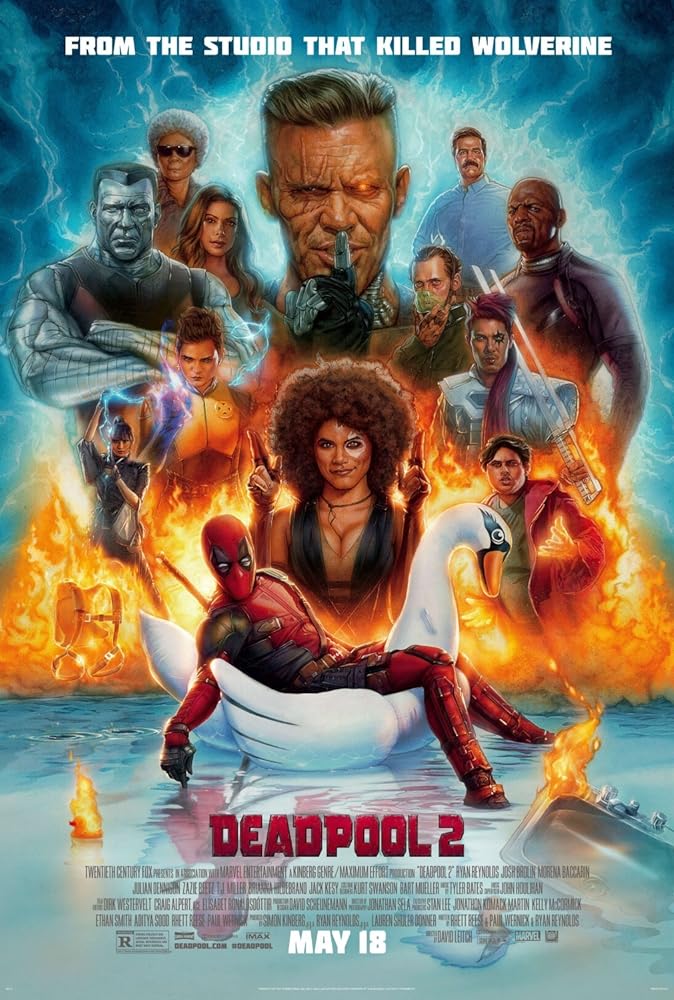
Deadpool 2 (2018) review

Brad Pitt, Josh Brolin, Ryan Reynolds, Terry Crews, Bill Skarsgård, Leslie Uggams, Morena Baccarin, Lewis Tan, Stefan Kapicic, Rob Delaney, Shioli Kutsuna, Julian Dennison, Zazie Beetz, and Brianna Hildebrand in Deadpool 2 (2018)

Calling the 2016 superhero film Deadpool a hit would be a massive understatement. Upon its release in February of that year, the X-Men spin-off broke all sorts of box-office records. Not only did it become the highest grossing X-Men film to date worldwide, but it also set various opening weekend records as A.) an R-rated superhero film B.) an R-rated film in general and C.) a film that was released in the supposedly ‘dead’ month of February, and that’s just to name a few. Simply put, audiences were delighted by this raunchy installment of the superhero genre, especially due to its more faithful take on the fan-favorite titular anti-hero after his infamous first live-action appearance in 2009’s X-Men Origins: Wolverine. And thus, everyone’s favorite fourth-wall breaking mutant is back in Deadpool 2 which, as promised in the previous film’s post-credits scene, sees the introduction of Deadpool’s most famous ally from the comics, Cable. This time around, though, former VFX artist Tim Miller is not back to direct after he backed out of the project early in its development due to creative conflicts with lead Ryan Reynolds over the direction that it was going in. Thankfully, a badass replacement was found rather quickly in long-time stunt coordinator David Leitch. Since 2014, Leitch has begun to transition into directing and has managed to make quite a name for himself in the process, having co-helmed the 2014 modern action classic John Wick alongside fellow stunt veteran Chad Stahelski and then making a solid solo directorial debut with last year’s action thriller Atomic Blonde. Ultimately, though, one question still stands. From the perspective of someone who admittedly ‘liked, but not loved’ the first Deadpool film, does this one manage to outshine its predecessor and truly live up to its mantle as an unrelenting, R-rated, meta-fueled superhero extravaganza?

Two years since he first started to operate as the mercenary Deadpool, cancer survivor Wade Wilson (Ryan Reynolds) continues to do what he does best; killing all the bad guys, constantly breaking the fourth wall (primarily to complain about how fellow mutant Wolverine always steals his thunder) and wooing his girlfriend Vanessa (Morena Baccarin). However, Deadpool soon finds himself crossing paths with Cable (Josh Brolin), a cybernetic soldier from the future. Having traveled back in time from his dystopian world, Cable is hellbent on eliminating a young mutant boy named Russell Collins (Julian Dennison), who calls himself ‘Firefist’ due to his ability to shoot fire from his hands, whom Deadpool ends up meeting during a ‘mission’ with his old X-Men ‘pals’ Colossus (Stefan Kapičić) and Negasonic Teenage Warhead (Brianna Hildebrand). As Deadpool soon learns, Cable’s primary reasoning for hunting Russell is that he will end up killing those who had abused him at a ‘Mutant Re-Education Center’ orphanage, which will then lead to him becoming a killer years later with Cable’s own future wife and daughter being two of his victims. And despite Cable proving to be a highly imposing threat, Deadpool, fueled by his desire to have a family of his own with Vanessa, decides to take on the responsibility of protecting Russell. To do so, he ends up forming a superhero team of his own known as X-Force, which includes the likes of EMP disrupter Bedlam (Terry Crews), acid-spewing Zeitgeist (Bill Skarsgård), and luck manipulator Domino (Zazie Beetz) to deal with the time-traveling warrior who looks a lot like the main antagonist from Avengers: Infinity War.

Despite a change in director, Deadpool 2 does not lose any of the spirit that helped make the first film such a worldwide phenomenon, as it still provides audiences with plenty of great fourth wall jokes that liven up the mood when paired against some of its graphically violent action sequences. But perhaps the best thing that this film does is that it truly lives up to its designation as an unfiltered, balls-to-the-wall (figuratively and literally with emphasis on the latter) R-rated superhero film when compared to the first Deadpool. As I noted a few years back in my review of the first film, while I did genuinely enjoy it thanks in large part to its well-handled humor, I didn’t quite see it as the ‘superhero genre game-changer’ that everyone regarded it as. Despite its various ways of subverting and poking fun at some of the genre’s most widely mocked tropes, its ‘origin story’ narrative ended up covering much of that ground anyway. Plus, the film’s lower budget compared to the likes of other films in the genre did end up rearing its ugly head at times, like during its obviously watered-down finale despite it being set on an MCU-style Helicarrier of all places. To be fair, though, this wasn’t technically the film’s fault as it was just a case of it being an ‘untested venture’ for the studio. Thankfully, that’s not as big of an issue with Deadpool 2, which sports a budget that’s almost double that of the first’s. Because of this, the film takes way more chances when it comes to satirizing the superhero genre that ends up leading to plenty of highly satisfying comedic payoffs. Really, the only thing holding it back is one key plot twist early on that affects some of the main characters. This twist, influenced by one of the genre’s most infamous tropes, ironically helps to give the film more of an emotional core than the first film while still robbing it of the most notable contribution to its predecessor’s most poignant moments while also causing a few instances of tonal inconsistency in the process.

Through it all, though, the film is undoubtedly bolstered by Ryan Reynolds’ phenomenal turn in the titular role, as his comedic timing is just as strong as it was in the first film. This is then balanced excellently with Josh Brolin in his second major role in a comic book film this year after he blew everyone away as Thanos in Avengers: Infinity War. While there are instances where Cable proves to be just as generally imposing as Thanos, here he is mostly used as the butt of several jokes from Deadpool, who of course is a constant thorn in his sides. Sadly, Morena Baccarin is once again heavily underused as Vanessa despite her genuinely wonderful chemistry with Reynolds. In fact, it’s quite frankly even worse here than in the first film (remember that ‘infamous trope’ I mentioned in the last paragraph? Yeah, it affects her the most…). Thankfully, this is ‘somewhat’ alleviated by the film’s other main female lead, Zazie Beetz as Domino. As soon as the character first appears on-screen, she is immediately established as a badass heroine (despite Deadpool’s claims that her ‘luck-based’ powers aren’t very cinematic) who more than manages to hold her own against Deadpool’s tomfoolery. Julian Dennison is also a major standout as the young mutant Russell as he unabashedly partakes in some of the film’s most risqué bits of humor. And because parts of the film have him utilized as an ‘antagonist’, that technically makes him a better villain than those from the previous film, especially when he partners up with [identity of the second villain in this film redacted due to spoilers; I will say, though, that just like how the first film redeemed Deadpool, this villain’s appearance in this film redeems his previous one]. Finally, you also have plenty of the great supporting roles returning from the first film, including the duo of Colossus and Negasonic Teenage Warhead (who don’t necessarily get as much to do this time around but still manage to have their own standout moments) and Karan Soni as Deadpool’s happy-go-lucky cab driver friend Dopinder.  

In conclusion, to answer the question that I laid out in the early parts of this review, I’m pleased to say that I did like Deadpool 2 more than the first film. Now again, this isn’t meant as a slight against the first Deadpool, which is still an enjoyable (and, most importantly, hilarious) entry in the superhero genre that allowed Ryan Reynolds the chance to give the titular character the proper film adaptation that he deserved. It’s just that, at the end of the day, Deadpool 2 doesn’t have to deal with the pressure of being an untested anomaly for both Fox and the superhero genre in general. After all, when the first Deadpool hit theaters in early 2016, it was at a time when R-rated superhero films weren’t yet considered as being ‘commercially viable’ ventures. But now that Fox has basically become the top purveyor of R-rated superhero films at this point thanks to both it and Logan, that means that Deadpool 2 is able to go above and beyond in terms of truly going ‘out there’ with its satirical takes on the genre, which it does with utter delight. This, in turn, allows Deadpool 2 to have some of the most consistently terrific humor to come out of a superhero film to the point where it even rivals the MCU’s trademark sense of humor. And just like the first film, this is then strengthened further by an excellent ensemble cast that’s headlined by Ryan Reynolds once again proving why his recent turns as the Merc with the Mouth have made him one of the genre’s most pitch-perfect casting decisions. With all this said, though, I’ll admit that I still don’t necessarily consider this to be the ‘best’ superhero film of the year as it does sort of suffer from a major plot twist that, from a narrative perspective, ironically also does a few good things in the process. But as far as being one of the most ‘fun’ installments of the genre, Deadpool 2 is certainly near the top of that list.


Rating: 4.5/5

Monday, July 31, 2017

Atomic Blonde (2017) review

Image result for Atomic Blonde poster

Atomic Blonde is an action film that’s headlined by two of the genre’s biggest rising stars. The first is its leading lady, Charlize Theron. Of course, prior to this, Theron’s already had a long career in the film industry. She’s starred in several critical hits over the years and she also won an Oscar for Best Actress for her role in 2003’s Monster. However, she’s recently begun to make a name for herself as an action star, thanks in part to her iconic turn as Imperator Furiosa in Mad Max: Fury Road. The other big name on this project is its director, David Leitch. Like Theron, Leitch has been in the film industry for a long time; for most of that time, though, he’s mainly been known for his work as a stuntman/stunt coordinator. Since 1995, he’s worked in the stunt department on several big-name films, including Fight Club, Serenity, and The Bourne Ultimatum just to name a few. Only recently has he moved into the field of directing. He made his official directorial debut in 2014 as the uncredited co-director alongside fellow stuntman Chad Stahelski on the modern action classic, John Wick. And while he didn’t return to direct this year’s sequel, John Wick: Chapter Two, he’s already been lined up to direct some major projects, including the highly anticipated sequel to 2016’s smash hit, Deadpool. But first, we have his official ‘solo’ debut, Atomic Blonde. The film is based on the 2012 graphic novel The Coldest City by Antony Johnston and Sam Hart. And thanks to the combined efforts of Theron and Leitch, Atomic Blonde is an edgy/badass action thriller that features the same kind of incredible action sequences that made Leitch’s other directorial claim to fame, John Wick, such a success.

In the year 1989, Lorraine Broughton (Charlize Theron) is a top-level agent working for MI6. Around the same time that the Berlin Wall is set to come down, she is approached by her superiors, Eric Gray (Toby Jones) and ‘Chief C’ (James Faulkner), with her latest mission. One of her fellow MI6 agents, James Gasciogne (Sam Hargrave), who Lorraine happens to have had a close relationship with, was just murdered in Berlin. Stolen from his body was ‘The List’, a bit of microfilm containing the identities of all undercover operatives who are currently stationed in the Soviet Union. To protect the identities of her fellow agents, Lorraine is dispatched to Berlin to not only retrieve the list but to also take out the double agent who betrayed Gasciogne in the first place known only as ‘Satchel’. Once there, she is joined by her main contact, agent David Percival (James McAvoy), while also engaging in a relationship with undercover French agent Delphine Lasalle (Sofia Boutella). But in her efforts to obtain the list and take out ‘Satchel’, Lorraine finds herself embroiled in an increasingly complicated game of cat and mouse as she’s forced to act fast before ‘Satchel’ puts a target on her back as well. And as she soon finds out, some of her closest allies may not be as trustworthy as they seem.

As implied in the intro, Atomic Blonde does share some similarities with John Wick… at least, more than just the fact that they share one of the same directors. Both films center around a badass main protagonist who fights their way through a non-stop barrage of thugs to achieve their mission. They also share admittedly simple plots that still manage to be effective enough leverage for the events that transpire in them. And in the case of Atomic Blonde, this is primarily through its retro setting of Berlin near the end of the Cold War, which does provide a neat backdrop for this film’s main plot. With that said, though, Atomic Blonde does take a little while to get going, partially because it spends a considerable amount of its first half just setting up the plot. And really, the plot in this is mainly just a simple ‘cat and mouse’ plot with some predictable twists and turns along the way, which unfortunately makes it the weakest aspect of the film. But once Atomic Blonde’s second half rolls around, that’s when it truly steps into high gear as a highly entertaining action thriller. Leitch’s experience working in both the stunt industry and on John Wick translates perfectly to this film’s action sequences. Just like in John Wick, they are fantastically shot and brilliantly choreographed. Thus, Atomic Blonde easily features some of the best action sequences of the year, including an epic long-take fight sequence (about nine minutes (!), to be precise) that’s set in an old apartment building. This, for the most part, does make up for some of the film’s narrative shortcomings.

As for the film’s cast, Charlize Theron is truly the star of the show here. She’s more than proven herself to be a badass action star in the past, and that very much shows in this film’s incredible action sequences. And even though the film’s main plot is a simple one, Lorraine Broughton is still a fascinating main character. Her standoffish, no-nonsense attitude provides us with some interesting glimpses into her overall characterization as well as some entertainingly blunt arguments with her main associate, James McAvoy’s David Percival. McAvoy ends up getting a lot of the film’s best humorous moments due in part to the character’s roguish playboy personality. Another standout of the cast is Sofia Boutella as the seductive French operative Delphine. She has terrific chemistry with Theron and their characters share a solid relationship that’s more than just sexual, as Broughton basically takes Delphine under her wing when it’s established that the latter hasn’t had much experience out in the field. As for the rest of the cast, their roles in the film are minor by comparison but they are all solid in their respective roles and they work well with Theron in the scenes that they share with her. This includes, among others, Eddie Marsan as a defecting Soviet officer codenamed ‘Spyglass’, Til Schweiger as an enigmatic MI6 ally known only as ‘the Watchmaker’, and John Goodman as CIA agent Emmett Kurzfeld.

Under the direction of one-half of the duo behind John Wick, Atomic Blonde is just as badass as that film in terms of its impressive action sequences. My friend/colleague Michael Kaye of Geeks+Gamers said it best; Leitch’s experience in the stunt industry makes him a perfect candidate for directing action films. Like John Wick, this film features incredible action sequences, especially in the second half of the film. With that said, though, there are a few instances where the first half of the film drags a bit, namely to delve into exposition regarding set-ups for some admittedly clear-cut plot twists. Granted, also like John Wick, the plot isn’t meant to be the focus of the film; thus, it’s okay that this film’s plot is just a simple spy story and not much more than that. Still, it’s because of the simplistic nature of the plot that I admittedly don’t consider Atomic Blonde to be ‘as good’ as John Wick. However, I can’t deny that this is a solidly entertaining action thriller. It’s got a nice edge to it and, of course, it’s all highlighted by Charlize Theron’s excellent performance in the lead role. Now, for the record, I haven’t read the graphic novel that this is based on, The Coldest City, so I can’t really comment on how effective this was at adapting the source material. Though, from what I’ve heard, the graphic novel was a bit more focused on the espionage aspect of the story than its action sequences. Still, on a weekend where the internet is getting a bit too obsessed with a film that has gotten universally negative reviews (you know EXACTLY what film I’m talking about), thankfully this film is around to give audiences a good time.


Rating: 4/5