Showing posts with label Ryan Gosling. Show all posts

Tuesday, September 29, 2020

Remember the Titans (2000) review (700th Post!)


Back in February, I posted a review of Miracle, the 2004 film adaptation of the legendary moment in Olympics history where the U.S. Men’s Hockey Team upset the Soviet Union Men’s Hockey Team at the 1980 Winter Olympics in Lake Placid, New York. I was even able to get it out on February 22nd, the exact date that marked the 40th anniversary of the iconic ‘Miracle on Ice’, which I felt was a more timely date for its publication rather than the film’s 15th anniversary back in 2019 which, granted, would’ve also been in February. However, Miracle is not the only Disney-produced sports film that’s based on a true story that I was planning on reviewing this year. For you see, this year marks the 20th anniversary of a film that is quite easily one of my favorite films of all-time. It’s a film that is very much in the running for holding the distinction of being the one film that I’ve watched the most in my life, which also makes it one of my top candidates when it comes to the most quotable films ever made. However, another big reason why it has left such a considerable impact on those who’ve watched it is because of its powerful messages of unity during divided times, which I feel makes it a very timeless film… and let’s be real, folks, 2020 has thoroughly reinforced that stance. A few months ago, the U.S. was rocked by multiple instances of police brutality against folks such as George Floyd and Breonna Taylor that, unfortunately, were only the most recent cases of police brutality towards members of the Black community. Because of this, the ongoing political/social movement that is Black Lives Matter has expanded significantly to combat this major facet of America’s long-standing problem with racism. But while today’s post isn’t going to be any kind of significant commentary on this situation (since I will fully admit that I’m in no way an expert on the matter), it will instead be a celebration of a film that I strongly believe is essential viewing during these difficult times. And so, without further ado, let’s delve into the masterpiece that is Walt Disney Pictures and Jerry Bruckheimer Films’ 2000 production, Remember the Titans.

It is 1971, and in the city of Alexandria, Virginia, the local high schools are consolidated into a single institution, T.C. Williams, to help desegregate Alexandria’s black and white communities. Naturally, this causes plenty of racial divide across the area and it only proceeds to get worse when, as part of this new initiative, Herman Boone (Denzel Washington) is hired to be the school’s new head football coach, replacing longtime playcaller Bill Yoast (Will Patton). But while Yoast initially plans to move on with his life and take a job somewhere else, he soon realizes that he’ll have to stick around when all the white players who have played under him threaten to quit the team rather than play for a black coach. Thus, Yoast agrees to be Boone’s defensive coordinator as Boone begins his efforts to coach a team made up of black and white players. Obviously, things start off on a rough note due to the clear racial tensions between them all, especially between Yoast’s defensive captain, linebacker Gerry Bertier (Ryan Hurst), and all-star defensive end Julius Campbell (Wood Harris), one of Boone’s key recruits. And if that wasn’t enough, Boone eventually learns that because the school board is highly doubtful that this little social experiment of theirs is going to work at all, they will not hesitate to fire him at the first sign of trouble (or, in other words, just a single loss). Thus, through both devastating hardships and uplifting moments of prosperity, the Titans slowly but surely begin to band together as they embark on a legendary season that will truly unite their divided city.

Now the first thing to note about this film is that, just like any film that’s based on a true story, it does admittedly take a few liberties with what really happened in Alexandria in 1971, like how the car crash that left Gerry Bertier paralyzed occurred after the State Championship rather than before it. Ultimately, though, the biggest difference between this film and the real-life events that inspired it is that, based on what I’ve read, the former intensified the racial tension that was going on in Alexandria when, in reality, a lot of it had cooled down by the time that the Titans embarked on their legendary season. And yet, regardless of whether some of the biggest moments in this film truly happened or not, that doesn’t take anything away from the emotional heft of this story and its universal themes such as love, brotherhood, and accepting people based on character rather than the color of their skin. Whether it’s a major subplot such as Yoast exposing a crooked referee conspiracy by the school board to sabotage their season or specific sequences such as members of the team being denied service at a restaurant for being black, this film is full of big emotional moments and it hits them all wonderfully. However, this film is also much more than just a drama as all its intense emotional moments are matched excellently with a lot of great humorous moments that stem from the banter between its characters, which is key to the whole ‘one of the most quotable films ever made’ aspect that I mentioned earlier. The film also sports a terrific soundtrack, and I’m not just referring to its selection of classic songs such as “Ain’t No Mountain High Enough” and “Spirit in the Sky”. There’s also Trevor Rabin’s phenomenal score that’s primarily represented by the track “Titans Spirit”, an epic 7-minute piece that runs the full gamut of moods from slow and serene to pulse-poundingly triumphant.

Another key aspect of this film’s success is its excellent ensemble cast, headlined, of course, by the one and only Denzel Washington as coach Herman Boone. Right out the gate, Boone is immediately established as being one hell of a strict coach who isn’t afraid to put his team through an incredibly tough training regimen to turn them into a winning team. But thanks to Washington’s natural charisma as a leading man, we’re still able to empathize with Boone given all the pressure that he’s under to set a good example for not only his family, but also his peers, his players, and the people of Alexandria. Washington is then naturally complemented by Will Patton as Coach Bill Yoast, who serves as a perfect foil to Boone as the Titans’ more calm and collected coach by comparison but one who’s still able to dish out some tough love when necessary. As for the rest of the cast, one of the most unique aspects of this film (when looking back at it nowadays) is how much of the cast is made up of actors and actresses who would go on to become major stars in their own right, such as Hayden Panettiere as Yoast’s football-loving daughter Sheryl. As for the Titans themselves, you have guys like Donald Faison, Ethan Suplee, and Ryan Gosling… and that’s just to name a few. And while I don’t want this review to turn into some kind of comparison piece, if there’s one big advantage that this film has over Miracle, it’s that it’s a lot more balanced when it comes to focusing on certain members of the team. While Wood Harris and Ryan Hurst clearly get the most attention out of all the team’s players given the rivalry between Julius Campbell and Gerry Bertier that evolves into a genuinely heartwarming brotherhood, the film makes a great effort to highlight as many players as possible. As such, we get a whole bunch of memorable characters such as lovable lineman Louie Lastik, who hopes to become the first in his family to go to college, California transfer Ronnie ‘Sunshine’ Bass, who rises up to become the team’s star quarterback, and sympathetic fast-talker Petey Jones, whose boastful nature often sees him getting directly chewed out by Coach Boone.

Now, before we conclude today’s review, I just wanted to delve into a quick personal story that will hopefully provide some more insight as to why this film is one of my all-time favorites. Even after all this time, I still remember going to see this film in theaters back when it first came out in 2000, and while I don’t necessarily remember the following detail, my folks have frequently told me that we went to go see it with the Woonsocket High School Football team. My dad was the team’s Head Coach at the time, and while he would eventually step down from the position to transition into education, he would still be heavily involved with the football team every year, especially once he became Woonsocket’s athletic director. Cut to 2009, and the team is now coached by one of my Dad’s best friends, who sadly suffered a personal tragedy that year when his older brother passed away in September. Not long after the team’s next game (which resulted in a loss), my dad decided to hold a film screening at the high school for them, and as you probably guessed, the film in question… was Remember the Titans. And to be perfectly blunt, I do believe that it gave the team the morale boost that it sorely needed. Not only would they end up winning the Rhode Island International League’s Division II-A Super Bowl that year, but in a run that quite arguably mirrored the perfect season that the Titans managed to pull off, they didn’t lose a single game after that previously mentioned loss. They even managed to achieve a bunch of big shutouts; several in a row, even. Thus, while I’m not saying that I believe that it was the key factor behind the team’s successful season, I can safely say that I’ve very much witnessed how this film can truly inspire those who watch it on a firsthand basis.

Like I said before, though, I know that this is far from being the most accurate ‘based on a true story’ sports film when compared to the real-life events that inspired it. It is, after all, a sentiment that has been shared with several members of the 1971 T.C. Williams Titans football team. In the film’s defense, however, this is just something that’s to be expected from any film that’s based on a true story. I can even imagine some folks arguing that, since this is a Disney production, it’s a heavily sanitized take on a story about the horrors of racism. And yet, even though I will openly admit that I wouldn’t necessarily consider this to be the absolute best film that has ever tackled the subject of racism, that doesn’t mean that it’s any ‘lesser’ by comparison for being a blockbuster that’s intentionally trying to appeal to as wide of an audience as possible. At the end of the day, this film is just as successful at being a heartwarming tale of solidarity in times of hardship as it is a wholly entertaining sports flick with a great soundtrack and an endless array of quotable lines. Plus, to be perfectly frank, folks, watching this in 2020 in the wake of all the crap we’ve endured this year (especially when it comes to the many incidents that have reinforced this country’s continuing issues with systemic racism) can be quite an experience. In other words, certain race-related moments in this film that were already tough to watch back when it first came out are arguably even harder to watch today because they can remind us that, even after all this time… we’ve still got a long way to go when it comes to combatting racism. And so, with all that in mind, I will simply reinforce the statement that I made at the beginning of this review where I strongly believe that Remember the Titans is a film that is the very definition of ‘essential viewing’. I know that I may be rather biased about this given how many times I’ve seen this film, but for all its imperfections, none of that even remotely prevents it from being not only one of the best sports films ever made… but also one of my favorite films of all-time.

Rating: 5/5!

https://blacklivesmatter.com/

Saturday, October 13, 2018

First Man (2018) review


While he’s only had three feature films under his belt prior to this year, Damien Chazelle has quickly become one of the most prominent filmmakers in the entire industry. The Rhode Island native first got his start in 2009 with a black-and-white romantic jazz musical called Guy and Madeline on a Park Bench, which received great reviews after its premiere at the Tribeca Film Festival. Then, when Chazelle’s plans to make an even more lavish musical ran into some issues in terms of getting a studio to finance it, he then helmed the 2014 drama Whiplash about a jazz drummer who found himself constantly getting harassed by his abusive instructor. Like Guy and Madeline, the film was a big hit with critics and ended up earning three Oscars at that year’s Academy Awards, where it was also nominated for Best Picture. And with all that success, Chazelle was finally given the opportunity to do his big musical, which eventually turned in 2016’s La La Land. This charming tribute to classic cinematic musicals proved to be another critical hit for the young director as well as being his most commercially successful outing to date. And while nowadays it’s known more as ‘the film that almost won Best Picture’ following the infamous gaffe at the end of that year’s Oscars ceremony, it also won six other Oscars that night, with Chazelle becoming the youngest director ever to win Best Director. But now Chazelle and La La Land’s leading man Ryan Gosling are back with their next big project, First Man, a film that explores the story behind one of the most iconic moments in American history, the 1969 spaceflight of Apollo 11, where astronauts Neil Armstrong and Buzz Aldrin became the first men ever to walk on the moon. Gosling takes on the lead role of Armstrong in this adaptation of author James R. Hansen’s best-selling biography from 2005. And with tension-filled spaceflight sequences and a script that takes an unfiltered look into the mindset of an American hero, First Man turns out to be yet another masterpiece from Chazelle.

It is the 1960’s in America, and at the National Aeronautics and Space Administration agency, there is one important situation at hand; staying on top of the Russians during the Space Race. The situation becomes even more imperative when Russian cosmonaut Yuri Gagarin becomes the first man to ever make it into space in 1961, with NASA chief Deke Slayton (Kyle Chandler) immediately establishing NASA’s new goal of landing a man on the moon. During this time, one of the most committed members of NASA’s crew of pilots is Neil Armstrong (Ryan Gosling), who makes the conscientious decision to stay committed to helping NASA land a man on the moon even after he and his wife Janet (Claire Foy) suffer an unspeakable family tragedy. However, as Neil and the rest of his fellow NASA coworkers soon find out, this endeavor proves to be a lot more challenging than they initially anticipated. During the test phase known as Project Gemini, Neil and his fellow astronauts are subjected to life-and-death situations on a constant basis. And even after NASA transitions into the Apollo program, the first Apollo mission ends up being an unprecedented disaster when an onboard fire kills all three of its crew members during, of all things, a pre-launch test. This, in turn, effectively casts a dark cloud over the company in the eyes of the public, who feel that the country is wasting a lot of money on a seemingly impossible venture. However, NASA soldiers on, and Neil soon finds himself selected to lead the first official mission to the moon as part of the crew of Apollo 11.

The tension that Chazelle manages to craft for this film is second to none, which is even more impressive given that it’s based on such an iconic moment in this country’s history that basically anyone going into it knows exactly how it ends. He does this primarily through the film’s numerous flight sequences. Instead of relying on shots of the rocket ships’ exteriors like many other films with this premise, the film instead gets up close and personal with the astronauts housed within their interiors. And to be clear, this isn’t just a case where these flight sequences are nothing more than non-stop shaky cam, as it does make them more intense by highlighting what it must’ve been like cramped within those command modules. However, this sense of confinement isn’t the case for every spaceflight sequence in the film. Once it finally gets to the Apollo 11 mission, that’s when Chazelle and his usual crew (cinematographer Linus Sandgren, editor Tom Cross, and composer Justin Hurwitz) utilize more exterior shots, resulting in a truly grand finale with beautiful cinematography, tight editing, and epic music. And yes, this is very much one of those films that’s worth seeing in IMAX, as all the sequences that were set on the moon’s surface were filmed with IMAX cameras. This is then bolstered further by the film’s decision to not glamorize any of the events that led to the Apollo 11 mission. It clearly establishes that a lot of trial and error had to occur for the mission to be successful, and unfortunately, all this trial and error did lead to some men losing their lives.

The other key aspect of this film’s narrative is how it ultimately tells the story of Neil Armstrong. The film makes it clear from the very beginning that, unlike many of his fellow astronauts, Neil Armstrong was not a very outgoing person. He often distanced himself from others, even his friends and family at times, so that he can stay fully committed to fulfilling NASA’s goal of landing a man on the moon. Thus, it can be said that the film doesn’t necessarily show too much about its main character, but by the end of the film, you will genuinely understand where he is on an emotional level, primarily thanks to one crucial moment during the finale where Neil has a moment of true emotional catharsis. And performance-wise, Ryan Gosling handles all of this excellently, perfectly conveying the stoic persona of someone who’s very much a reluctant hero. Gosling also works well alongside his primary co-star, Claire Foy as Neil’s wife Janet, who’s put through the emotional ringer via the same stress that several of her fellow astronaut wives have gone through when fearing for their husbands’ lives. And although she does support Neil through and through, you can tell that there are instances where this is put to the test. Finally, while Gosling and Foy have the most prominent roles in the story, the film also boasts an excellent supporting cast. This includes, among others, Kyle Chandler as NASA chief Deke Slayton, Jason Clarke as Neil and Janet’s neighbor Ed White, who was one of the tragic figures of the Apollo 1 fire, and Corey Stoll as fellow Apollo 11 crew member Buzz Aldrin.   

Once again, Damien Chazelle delivers another outstanding directorial effort. First Man is an intense and emotionally raw look into the life of an American icon, and it does this in a manner that’s drastically different than most other biopics. It doesn’t romanticize any of the work that went into getting Neil Armstrong and Buzz Aldrin on the moon’s surface. It shows that the mission to land a man on the moon was incredibly dangerous and threatened the lives of the men who directly participated in it. But in showing all the failures, this then makes the success that was the Apollo 11 mission incredibly satisfying to behold on film, and on a technical level, the transition from intense, claustrophobic, and often perilous flights to the magnificent launch of Apollo 11 is outstanding. This film also succeeds in conveying the emotional turmoil that Neil Armstrong went through during this time. Just like how the film doesn’t romanticize the process that put him on the moon, this take on the life of one of the most famous figures in American history is unfiltered in its overall execution to show how the Apollo 11 mission allowed him to overcome one of the darkest moments in his life. In short, as someone who obviously wasn’t around when all this went down, I feel that this film does a fantastic job of conveying the aura of what it must’ve felt like at the time to witness, as Armstrong himself famously stated, that ‘one small step for man, one giant leap for mankind’. And because of this, I’d say that First Man is one of the most culturally relevant films in recent memory and a must-see on the big screen.


Rating: 5/5!

Wednesday, October 11, 2017

Blade Runner 2049 (2017) review


In 1982, director Ridley Scott released the second big science fiction film of his career, Blade Runner. An adaptation of author Philip K. Dick’s 1968 novel Do Androids Dream of Electric Sheep, the film starred Harrison Ford in the role of Rick Deckard, a Los Angeles police officer tasked with hunting down humanoid robots known as Replicants in the year 2019. Upon release, the film didn’t do so well at the box-office and received a generally polarizing response from critics. A few years later, however, it started to attract a cult following that was paired with the release of different cuts of the film, which helped to provide new context to the narrative after the theatrical cut had been severely shuttered by studio-mandated cuts. Thus, this initially polarizing film has gone on to become one of the landmark entries in the sci-fi genre, and now, 35 years after the original, we finally return to the world of humans and Replicants with Blade Runner 2049. And as that long gap in time between these two films’ release dates suggest, this sequel was in development for many, many years. For a while, it seemed unclear if it would ever get made or if Scott and Ford would even be involved with it at all. But, ultimately, both are back for this highly-anticipated sequel, as Ford returns to the role of Deckard while Scott serves as the film’s executive producer. In the director’s chair this time around is Denis Villeneuve, who’s made quite a name for himself these past few years thanks to critically-acclaimed hits like 2015’s Sicario and 2016’s Arrival. And thanks to solid direction from Villeneuve, along with several of the things that made the original such a classic, fans of the original Blade Runner should be extremely satisfied with this long-awaited follow-up.

It’s admittedly rather hard to talk about this film’s plot as some of its elements delve into spoiler territory. Villeneuve even made a request to those who reviewed the film prior to its release to not reveal anything from the plot, and while this ‘embargo’ has technically been lifted now that it’s out, I’m still going to try and keep plot spoilers to a minimum in this synopsis. As the title suggests, this film takes place 30 years after the original Blade Runner in the year 2049. While the development of human-like robots known as Replicants has blossomed in the past few decades, several older models are still on the loose, requiring the continued need of special police officers known as Blade Runners to hunt them down and ‘retire’ them. One such officer is K (Ryan Gosling) who, after retiring a Replicant that’s been hiding out on a farm, stumbles across a fascinating discovery; the remains of a female Replicant who was pregnant despite it being theoretically impossible. Thus, K now finds himself on the search for this elusive child of the Replicant mother, who turns out to be none other than the former assistant of the original Replicant creator Dr. Eldon Tyrell, Rachael. This, of course, then leads to K crossing paths with Rachael’s lover, former Blade Runner Rick Deckard (Harrison Ford), who’s been missing for several years. And soon, the two find themselves hunted by the current leader in Replicant development, manufacturer Niander Wallace (Jared Leto), who seeks to use the child to further advance the process of creating Replicants.

Just like the original Blade Runner, one of the first things to stand out in this film is its impressive visual/production design. While visual effects have obviously come a long way since the original film, which had been made back when the art of CGI wasn’t fully realized yet, this film still manages to maintain the great atmospheric feel of the original while also utilizing its larger effects budget to its full potential. That and the always fantastic cinematography from the legendary Roger Deakins, along with the completely mesmerizing score by Hans Zimmer and Benjamin Wallfisch, help as well when it comes to fully immersing you within this futuristic world. As for the main plot of this film, it manages to be a natural follow-up to its predecessor without ever feeling like it’s just a direct carbon copy of it. With that said, though, as was the case with the original Blade Runner, this film does maintain a slow and methodical pace throughout with a sparse amount of action sequences. This may once again prove to be problematic for some audiences, especially given that this film boasts a far heftier runtime compared to its predecessor at nearly three hours long (I think it’s safe to say that we won’t need a Director’s Cut for this one, unlike the original). And while I do think that the film is perhaps just a tad bit overlong, it still benefits from having a generally engaging story based around a solid cast of characters.

While the film does see the return of Harrison Ford in the role of Rick Deckard, it should be noted that he doesn’t actually appear in it until after the halfway point. Still, the character is well-utilized in his limited amount of screen-time and Ford once again does an excellent job as the gruff but emotionally conflicted former police officer. Ultimately, the film mainly belongs to Ryan Gosling in the role of K, who embarks on a very similar emotional journey compared to Deckard’s that yields equally fascinating results. But as for the film’s biggest standouts, that honor goes to its two main female leads. As Joi, K’s loving A.I. companion, Ana de Armas brings much warmth to this generally somber sci-fi story. Plus, she has great chemistry with Gosling and is arguably the most interesting character in the entire film given their relationship, which is ultimately the main source of the film’s emotional depth. Sylvia Hoeks, who plays Niander Wallace’s Replicant assistant Luv, is also great in a role that blurs the line between diligent assistant and a stone-cold killer. But as for Wallace, played by Jared Leto, he’s, unfortunately, one of the weaker parts of the film. And for the record, no, it’s not because of Leto’s trademark eccentric performance which, for many people, would’ve been a situation similar to his recent turn as the Joker in Suicide Squad. Instead, it’s more because he’s not in the film all that much… which, ironically, was also the case with Suicide Squad. While he does get to have a few effectively unsettling moments whenever he’s on-screen, the character feels vastly underdeveloped. I promise that I’m not spoiling anything when I say that there is absolutely no resolution for the character whatsoever.

Well, like the original Blade Runner, there’s not much else that I need to say about this film, and that’s because most of the internet has already done that for me. Also, I’m not going to be delving into any sort of diatribe about mainstream audiences’ apparent rejection of this film given its rather lackluster opening weekend at the box-office. If it just wasn’t their cup of tea, then that’s perfectly fine. And besides, the exact same thing happened to the original back in 1982… and look how that one turned out. At the end of the day, I bet that this film will go on to have the same kind of legacy that its predecessor has when all is said and done, and that is because Blade Runner 2049 is very much one of the best films of the year. Director Denis Villeneuve does an excellent job in giving us a film that serves as a fitting follow-up to its predecessor without losing any of the stuff that made the original such a classic in the first place. And while it is just as much as an undeniably slow burn as its predecessor, it also has its same great sense of visual/production design, strong storytelling, and layered characters that help to make it all worthwhile. In short, if you were a fan of the original Blade Runner, then you’ll be pleased to know that this film did manage to live up to most of the hype surrounding it.


Rating: 5/5!

Tuesday, January 3, 2017

Post-Christmas Short Review Triple Feature: 2016 Edition

Hey, folks, it’s time for the first Rhode Island Movie Corner post of 2017. Right now, I’m currently working on my annual ‘Top 12 Films of the Year’ posts detailing my favorite films from 2016. That four-part series will be published sometime in the next few days but until then, it’s time for something that I usually do during this time; a quick post detailing some of the recent films that I’ve seen during the final stretch of the year. Every year after Christmas, I go on a double feature run with my good friend Matthew Goudreau, a writer for The Young Folks and The Nerd Stash. We’ve been doing it since 2012 and every year, we always end up seeing two of that year’s biggest award contenders. The first year we did it, it was Les Miserables and Django Unchained. In 2013, it was The Wolf of Wall Street and American Hustle. In 2014, it was Into the Woods and The Imitation Game. And last year, it was The Hateful Eight and The Big Short. So, when it comes to doing reviews of these films, I always do a ‘short review double feature’ post instead of doing full reviews for both, mainly due to me not really having the time to do so because of the ‘Top 12 of the Year’ lists. But, it should be noted that in the case of our 2015 ‘double feature run’, it didn’t occur until New Year’s Day 2016 due to our busy schedules. Thus, I ended up seeing three films in two days. The third film was the annual film that I see on New Year’s Eve with my family (in this case, that film was Joy). Thus, that ‘double feature’ post ended up being a ‘triple feature’ post. And this year, it’s the same situation. I saw one film with my family on New Year’s Eve and then I did my ‘Double Feature’ run with Matt the following day; January 1st, 2017. Another one of my pals, Alex Corey (who just started his own film review blog at alexcoreyfilm.blogspot.com and is also my co-host on our podcast Sabers, Phasers, and Lasers, Oh My!), even joined us this time around. Thus, it’s time for the second annual post-Christmas ‘Short Review Triple Feature’ post, in which I discuss the last three films that I’ve seen in theaters.

To kick things off, we have the film that I saw on New Year’s Eve. It was the last 2016 release that I saw in the year 2016.

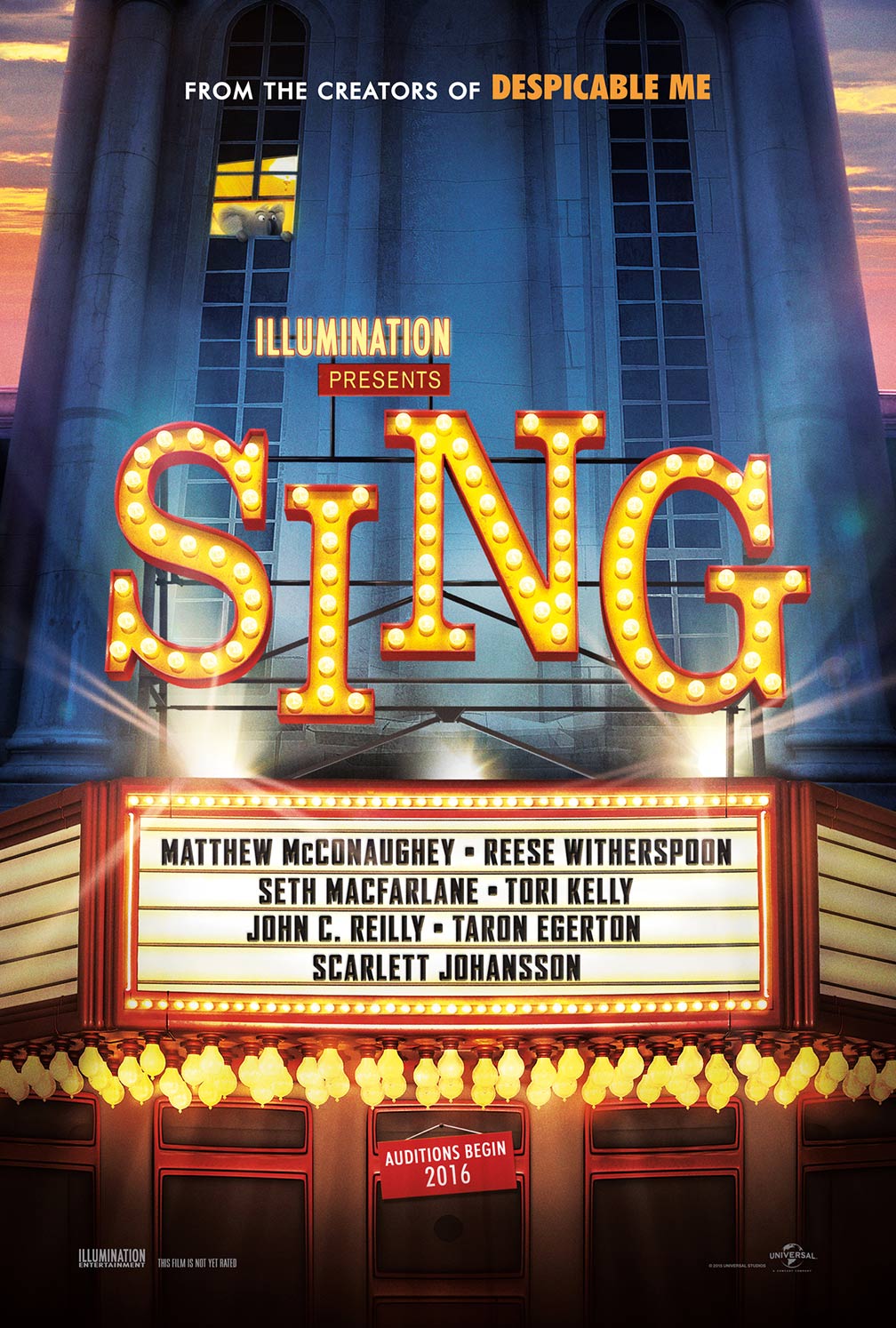
SING

Image result for sing poster

Sing is the latest film from Illumination Entertainment and their second of 2016 after their smash summer hit The Secret Life of Pets. It centers on a group of ‘misfit’ animals who enter a singing competition held by a koala named Buster Moon (Matthew McConaughey), the owner of an old theater who hopes that it’ll give him the profit he needs to save his property. What follows is a charming animated film full of performances of new and classic songs, including ‘Don’t You Worry ‘bout a Thing’ by Stevie Wonder and ‘I’m Still Standing’ by Elton John. After all, this film is called Sing and the best part about it is the musical performances, all of which are performed very well by a solid voice cast that includes the likes of Reese Witherspoon, Scarlett Johansson, Seth MacFarlane, and Taron Egerton. For the most part, this does make up for the fact that the story is a straight-forward affair. This ‘save the theater’ storyline is quite predictable in both plot-points and in terms of its characterizations (e.g. an overworked mother, the son of a gang leader who looks to get out of the family business, a shy teenager looking to overcome stage fright, etc.). Still, despite this, I will give the film credit as there were some emotional moments that were quite effective, mainly in regards to Buster and his connection to the theater. Plus, most of, though not all, of the main characters are likable. In short, Sing is by no means a particularly groundbreaking entry in the animated film genre. Still, despite its standard plot, it does deliver when it comes to the one thing that it’s named for; singing performances. That at least makes it an enjoyable family flick.

Rating: 3.5/5

And now, onto the double-feature run that I did with Matt and Alex.

FENCES

Image result for fences poster

Fences is the third directorial effort from A-list superstar Denzel Washington, following 2002’s Antwone Fisher and 2007’s The Great Debaters. The film is based off the award-winning (Pulitzer Prize-winning, to be specific) play of the same name by playwright August Wilson and is part of his series of Pittsburgh-based plays known as The Pittsburgh Cycle that encompasses all decades of the 20th century. This one, set in the 50’s, shares a few similarities with another famous play, Death of a Salesman, in that it centers on an aging family man who struggles to provide for his family. Washington stars in the lead role of Troy Maxson, former Negro league baseball player turned garbage man, while Viola Davis stars as his long-suffering wife Rose. Both Washington and Davis starred in the 2010 Broadway production of the play and here they give terrific, emotionally-charged, and all-around Oscar-worthy performances in what is very much an actors’ showcase. And these strong performances do, for the most part, make up for some of the film’s flaws. Now, don’t get me wrong, the film is very well-directed by Denzel. But, at the same time, admittedly there are times where you do feel the length of the film’s hefty 139-minute runtime. Also, sometimes it does have a ‘stage’-like quality to it, namely because it all takes place within one primary location, the Maxson household, for most of the film. But, like I said before, it’s a solid emotional drama telling the tale of a dying American Dream. It may be hard to sit through (in fact, a lot of it is quite uncomfortable to watch) but it is worth it for the strong direction by Denzel Washington and the excellent performances from him and Viola Davis. And while I can’t go as far as to call this a ‘front-runner’ for Best Picture, it’s still a well-made film regardless.

Rating: 4/5

LA LA LAND

Image result for la la land poster

Finally, we have director Damien Chazelle’s highly anticipated follow-up to his critically acclaimed 2014 effort, Whiplash. La La Land, an original musical, is an affectionate love letter to old Hollywood and stars Emma Stone and Ryan Gosling as an aspiring actress and jazz musician, respectively, who meet and fall in love all while they both aspire to achieve their dreams in the City of Angels. What follows is an excellent and charming love story set against the great backdrop of Hollywood. Yes, folks, all the positive reviews that this film has gotten are accurate; this truly is one of the best films of the year. For one thing, it’s a technical marvel, thanks primarily to the constant use of long takes. The musical numbers are great from top to bottom and Emma Stone and Ryan Gosling are both excellent in their respective roles. This is the third film in which they’ve starred as a couple after 2011’s Crazy, Stupid, Love and 2013’s Gangster Squad and all three films showcase the strong chemistry between them. And finally, there’s the ending. Without giving anything away, it’s easily one of the best parts of the film. Simply put, it gives you a happy ending but then does something new with the idea that quite frankly ends up making the whole film. And because of all this, to reference the comments that were made by an older couple sitting behind me once it ended, I do believe that this film will become a classic down the road. It’s a charming original story that results in one of the best musical films to date while also showcasing the talents of everyone involved, particularly its director.


Rating: 5/5!

Monday, January 4, 2016

Short Review Triple Feature

Greetings ladies and gentlemen! As I noted a few days ago in my Quentin Tarantino directorial retrospective, I’ve been spending a lot of time developing my ‘Top 12 Favorite Films of 2015’ posts for you folks, which I can confirm for you all will start being published on this blog on January 6th. Until then, as a result of me being primarily focused on those posts, I haven’t had much time to do full reviews for the films that I usually see around this time of the year; in other words, anything I see during the last few days of 2015. As I’ve established before, I’ve been partaking in an annual post-Christmas tradition in the form of a double feature run that I have been doing with my good friend Matthew Goudreau, who’s currently working as an Entertainment Staff Writer with ‘The Young Folks’, every year since 2012. But due to the both of us being rather busy, we actually weren’t able to do it until the first day of 2016 but even if it wasn’t 2015 anymore, this should still be considered as our 2015 run. In 2012, it was ‘Les Miserables’ and ‘Django Unchained’. In 2013 it was ‘The Wolf of Wall Street’ and ‘American Hustle’. And last year, it was ‘Into the Woods’ and ‘The Imitation Game’. So today, as one last post before the big ‘Best Films of the Year’ posts, I’ll be doing a pair of quick reviews of the two films that we saw back-to-back this time around. But this time, however, I’ll be adding in an additional review of a film that I saw the day before I did the double feature screening with Matt on the last day of 2015.  

First up on the list is the film that I saw on December 31st, 2015, New Year’s Eve. It was the last ‘new’ 2015 release that I watched in 2015.

JOY


David O. Russell and Jennifer Lawrence have become one of the biggest director-actor duos in recent years. The two first collaborated on 2012’s ‘Silver Linings Playbook’. That film not only landed Lawrence her second Oscar nomination for Best Actress, after her breakout turn in 2010’s ‘Winter’s Bone’, but also her first win. The two teamed up again the following year, along with her ‘Silver Linings’ co-stars Bradley Cooper and Robert De Niro, for ‘American Hustle’. While only in a supporting role this time around, Lawrence once again got major award buzz for her performance as the unstable wife of Christian Bale’s character and earned her third (and second straight) Oscar nomination, this time for Best Supporting Actress. And while Lupita Nyong’o ended up winning that award that year for her turn in ‘Twelve Years a Slave’, Lawrence was still regarded as being one of the best parts of ‘American Hustle’. This year the duo of Lawrence and O. Russell are at it again, along with Bradley Cooper and Robert De Niro, again, for ‘Joy’. This time Lawrence is the true star of the show in this semi true story about Joy Mangano, a divorced mother from Long Island who became famous in the 90’s for her invention of the Miracle Mop, a self-wringing mop that kept users from having to touch the wet mop head as they would have to have done if they used a regular mop. Her invention was a huge success and Mangano became a highly successful entrepreneur for the Home Shopping Network. She’s been developing new inventions for the network ever since.   

I say ‘semi’ true story because O. Russell has gone on record saying that the film is not entirely based around Mangano’s life. Instead, the screenplay is based around several different stories of women who dared to change their lives around. So while the film may not delve into the full story of Mangano’s rise to fame, it’s still a solidly-executed story of a young woman with the weight of the entire world on her shoulders who manages to overcome all of that through both her perseverance and her ingenious invention. Her life struggles make her easy to sympathize with and relate to and Jennifer Lawrence is superb as always in the role of Joy, as are Robert De Niro as Joy’s father Rudy, who gets quite a lot of humorous lines of dialogue (If you recall my review of ‘American Hustle’, I questioned why that film was being regarded as a comedy when it really wasn’t. ‘Joy’, on the other hand, does a much better job when it comes to comedic dialogue), and Bradley Cooper in the role of an executive from QVC who helps Joy sell her product on the network. Admittedly the film takes a little while to get going and there is quite a bit of uncomfortableness that comes from Joy’s mother’s (Virginia Madsen) role in the film, a woman who spends all of her time watching soap operas and never leaving her room. But once Joy starts to produce and sell her new invention, that’s where the film really starts to shine. Many of you are aware that even though I really liked ‘Silver Linings Playbook’, I wasn’t too big on ‘American Hustle’ and thought that it was one of the more ‘overrated’ films of that year. ‘Joy’, on the other hand, is a film that I’m happy to say that I’m much more positive towards. This one has been more polarizing with critics but at the very least I feel that Lawrence should at least get another Oscar nomination for her work on this film.

Rating: 4/5

And now we move onto the two films that I saw with Matt on January 1st, New Year’s Day.

THE HATEFUL EIGHT


Good ol’ Quentin Tarantino is back with yet another balls-to-the-wall cinematic experience with his eighth feature film, fittingly titled ‘The Hateful Eight’. A western set in post-Civil War Wyoming, the film centers around a group of eight strangers who end up stuck together in a Haberdashery due to a harsh blizzard. These people include bounty hunter John Ruth (Kurt Russell), known as ‘The Hangman’ due to his insistence on making sure his bounties hang, his current prisoner/bounty Daisy Domergue (Jennifer Jason Leigh), fellow bounty hunter Major Marquis Warren (Samuel L. Jackson), ‘new sheriff’ Chris Mannix (Walton Goggins), the haberdashery’s caretaker Bob (Demian Bichir), ‘hangman’ Oswaldo Mobray (Tim Roth), cow-puncher Joe Gage (Michael Madsen), and former Confederate general Sanford Smithers (Bruce Dern). The major selling point of the film was that it was shot in Ultra Panavision 70, a format that hadn’t been used since the 60’s with films like ‘Ben-Hur’ and ‘It’s a Mad, Mad, Mad, Mad World’. Ever the film buff, Tarantino prepared a special ‘roadshow’ release of the film, complete with an overture, intermission, and special booklet, that was 20 minutes longer than the version that would be released nationwide and would be screened in any theaters that still had 70 mm projectors. Of the roughly 100 theaters that screened this special version of the film, the closest to me was the Providence Place Cinema. However, I saw the film in Lincoln so, yes, I only saw the film in its ‘digital release’ form and not in the way that Tarantino had intended. I will see if I can get to see the film’s roadshow release while it’s still running.

But even though I didn’t see the film in the 70 mm format, it is still a beautifully-shot film in terms of its vast landscapes and fresh color palette. As for the film itself, it’s exactly what you’d expect from a Tarantino film. The first half of the film is mostly build-up and exposition between characters but Tarantino is easily one of the best in the business in terms of establishing tension that keeps the audience guessing as to what’s going to happen next and, perhaps most importantly, who’s going to be on the end of another person’s bullet by the end. Admittedly the film is a bit flawed. It loses some momentum in the second half, you do feel the film’s hefty 160+ minute runtime in places, and admittedly Tarantino’s violent action sequences are starting to get a little ridiculous, from heads exploding to people coughing up tons of blood after they drink poisoned coffee. But at the same time, as noted earlier, Tarantino’s direction in terms of establishing suspense and tension is once again superb and the film’s ensemble cast is superb as well. If I had to name the biggest standouts of the film, I would have to go with the three that most people are talking about. Those three are Samuel L. Jackson, of course (this is a Tarantino film after all), as the badass Major Warren, Walton Goggins as arguably the most charismatic of the bunch (even though you really wouldn’t use that word to describe any of these characters) as Mannix, and Jennifer Jason Leigh as, to put it as nicely as I possibly can, the extremely feral Domergue. For Tarantino fans, ‘The Hateful Eight’ will deliver on everything you come to expect from the legendary filmmaker. It’s by no means his best work but still a must-see in every sense of the word.

Rating: 4/5

THE BIG SHORT

Big Short, The Poster

Finally, we have ‘The Big Short’, an interesting against-type project for director Adam McKay. Known for his numerous collaborations with Will Ferrell on comedies like ‘Anchorman’ and ‘Talladega Nights’, ‘The Big Short’, based on the book of the same name by ‘Moneyball’ author Michael Lewis, is more of a drama that focuses on the financial crisis of 2007-2010 that came as a result of the fall of the housing market and build-up of the credit bubble. The film primarily follows the stories of three separate parties; hedge fund manager Michael Burry (Christian Bale), who is the first to notice the impending collapse of the market, another hedge fund manager Mark Baum (Steve Carell) who is notified of this by trader Jared Vennett (Ryan Gosling) and uncovers the fraudulent practices of collateralized debt obligations (CDOs), and up-and-coming investors Charlie Geller (John Magaro) and Jamie Shipley (Finn Wittrock), who get involved with the credit default swap market with their help of their friend, retired banker Ben Rickert (Brad Pitt). All of these characters spend their time in the film working to take advantage of the practice of credit default swap that would bet against the housing market. And despite the fact that obviously this ends up working in their favor, they pretty much all come to the conclusion that in doing so, they’re profiting at the expense of pretty much everyone else in the world except for the banks, resulting in the question of how are they any better than the banks for doing this.

So yeah, sounds like a pretty downer story, right? Well, that’s where McKay’s comedic talents come in as the film manages to have a lot of comedic dialogue that for the most part sort of makes up for the more depressing elements of the story. A lot of the humor comes from Ryan Gosling, whose character Jared Vennett serves as the film’s narrator and Gosling brings a charismatic and also quite boisterous attitude to the role. Now I’ll admit that I know very little about all of this stuff about the housing market and the credit bubble and so on and so forth. And that’s okay because the film is totally aware about that too. It knows that a lot of us aren’t economics majors. So what it does in order to at least make more sense for people like me who don’t know anything about all of this is by cutting to random cameos where celebrities like Margot Robbie and Selena Gomez address the audience and give us a better understanding of all of this trading business, from Robbie talking about loans while in a bathtub to chef Anthony Bourdain talking about CDOs. I’ll admit that there’s sort of a surreal nature to these scenes but thanks to McKay’s direction, a superb cast (if I had to pick a standout I’d go with Gosling for his aforementioned narration work), and an actually solid mix of comedy and drama, ‘The Big Short’ is a fascinating look into one of the biggest incidents in the recent history of this country while also pointing out all of the BS that was responsible from it; BS that, as Brad Pitt put it, hasn’t gone away.


Rating: 4.5/5