Showing posts with label Corey Stoll. Show all posts

Saturday, October 13, 2018

First Man (2018) review


While he’s only had three feature films under his belt prior to this year, Damien Chazelle has quickly become one of the most prominent filmmakers in the entire industry. The Rhode Island native first got his start in 2009 with a black-and-white romantic jazz musical called Guy and Madeline on a Park Bench, which received great reviews after its premiere at the Tribeca Film Festival. Then, when Chazelle’s plans to make an even more lavish musical ran into some issues in terms of getting a studio to finance it, he then helmed the 2014 drama Whiplash about a jazz drummer who found himself constantly getting harassed by his abusive instructor. Like Guy and Madeline, the film was a big hit with critics and ended up earning three Oscars at that year’s Academy Awards, where it was also nominated for Best Picture. And with all that success, Chazelle was finally given the opportunity to do his big musical, which eventually turned in 2016’s La La Land. This charming tribute to classic cinematic musicals proved to be another critical hit for the young director as well as being his most commercially successful outing to date. And while nowadays it’s known more as ‘the film that almost won Best Picture’ following the infamous gaffe at the end of that year’s Oscars ceremony, it also won six other Oscars that night, with Chazelle becoming the youngest director ever to win Best Director. But now Chazelle and La La Land’s leading man Ryan Gosling are back with their next big project, First Man, a film that explores the story behind one of the most iconic moments in American history, the 1969 spaceflight of Apollo 11, where astronauts Neil Armstrong and Buzz Aldrin became the first men ever to walk on the moon. Gosling takes on the lead role of Armstrong in this adaptation of author James R. Hansen’s best-selling biography from 2005. And with tension-filled spaceflight sequences and a script that takes an unfiltered look into the mindset of an American hero, First Man turns out to be yet another masterpiece from Chazelle.

It is the 1960’s in America, and at the National Aeronautics and Space Administration agency, there is one important situation at hand; staying on top of the Russians during the Space Race. The situation becomes even more imperative when Russian cosmonaut Yuri Gagarin becomes the first man to ever make it into space in 1961, with NASA chief Deke Slayton (Kyle Chandler) immediately establishing NASA’s new goal of landing a man on the moon. During this time, one of the most committed members of NASA’s crew of pilots is Neil Armstrong (Ryan Gosling), who makes the conscientious decision to stay committed to helping NASA land a man on the moon even after he and his wife Janet (Claire Foy) suffer an unspeakable family tragedy. However, as Neil and the rest of his fellow NASA coworkers soon find out, this endeavor proves to be a lot more challenging than they initially anticipated. During the test phase known as Project Gemini, Neil and his fellow astronauts are subjected to life-and-death situations on a constant basis. And even after NASA transitions into the Apollo program, the first Apollo mission ends up being an unprecedented disaster when an onboard fire kills all three of its crew members during, of all things, a pre-launch test. This, in turn, effectively casts a dark cloud over the company in the eyes of the public, who feel that the country is wasting a lot of money on a seemingly impossible venture. However, NASA soldiers on, and Neil soon finds himself selected to lead the first official mission to the moon as part of the crew of Apollo 11.

The tension that Chazelle manages to craft for this film is second to none, which is even more impressive given that it’s based on such an iconic moment in this country’s history that basically anyone going into it knows exactly how it ends. He does this primarily through the film’s numerous flight sequences. Instead of relying on shots of the rocket ships’ exteriors like many other films with this premise, the film instead gets up close and personal with the astronauts housed within their interiors. And to be clear, this isn’t just a case where these flight sequences are nothing more than non-stop shaky cam, as it does make them more intense by highlighting what it must’ve been like cramped within those command modules. However, this sense of confinement isn’t the case for every spaceflight sequence in the film. Once it finally gets to the Apollo 11 mission, that’s when Chazelle and his usual crew (cinematographer Linus Sandgren, editor Tom Cross, and composer Justin Hurwitz) utilize more exterior shots, resulting in a truly grand finale with beautiful cinematography, tight editing, and epic music. And yes, this is very much one of those films that’s worth seeing in IMAX, as all the sequences that were set on the moon’s surface were filmed with IMAX cameras. This is then bolstered further by the film’s decision to not glamorize any of the events that led to the Apollo 11 mission. It clearly establishes that a lot of trial and error had to occur for the mission to be successful, and unfortunately, all this trial and error did lead to some men losing their lives.

The other key aspect of this film’s narrative is how it ultimately tells the story of Neil Armstrong. The film makes it clear from the very beginning that, unlike many of his fellow astronauts, Neil Armstrong was not a very outgoing person. He often distanced himself from others, even his friends and family at times, so that he can stay fully committed to fulfilling NASA’s goal of landing a man on the moon. Thus, it can be said that the film doesn’t necessarily show too much about its main character, but by the end of the film, you will genuinely understand where he is on an emotional level, primarily thanks to one crucial moment during the finale where Neil has a moment of true emotional catharsis. And performance-wise, Ryan Gosling handles all of this excellently, perfectly conveying the stoic persona of someone who’s very much a reluctant hero. Gosling also works well alongside his primary co-star, Claire Foy as Neil’s wife Janet, who’s put through the emotional ringer via the same stress that several of her fellow astronaut wives have gone through when fearing for their husbands’ lives. And although she does support Neil through and through, you can tell that there are instances where this is put to the test. Finally, while Gosling and Foy have the most prominent roles in the story, the film also boasts an excellent supporting cast. This includes, among others, Kyle Chandler as NASA chief Deke Slayton, Jason Clarke as Neil and Janet’s neighbor Ed White, who was one of the tragic figures of the Apollo 1 fire, and Corey Stoll as fellow Apollo 11 crew member Buzz Aldrin.   

Once again, Damien Chazelle delivers another outstanding directorial effort. First Man is an intense and emotionally raw look into the life of an American icon, and it does this in a manner that’s drastically different than most other biopics. It doesn’t romanticize any of the work that went into getting Neil Armstrong and Buzz Aldrin on the moon’s surface. It shows that the mission to land a man on the moon was incredibly dangerous and threatened the lives of the men who directly participated in it. But in showing all the failures, this then makes the success that was the Apollo 11 mission incredibly satisfying to behold on film, and on a technical level, the transition from intense, claustrophobic, and often perilous flights to the magnificent launch of Apollo 11 is outstanding. This film also succeeds in conveying the emotional turmoil that Neil Armstrong went through during this time. Just like how the film doesn’t romanticize the process that put him on the moon, this take on the life of one of the most famous figures in American history is unfiltered in its overall execution to show how the Apollo 11 mission allowed him to overcome one of the darkest moments in his life. In short, as someone who obviously wasn’t around when all this went down, I feel that this film does a fantastic job of conveying the aura of what it must’ve felt like at the time to witness, as Armstrong himself famously stated, that ‘one small step for man, one giant leap for mankind’. And because of this, I’d say that First Man is one of the most culturally relevant films in recent memory and a must-see on the big screen.


Rating: 5/5!

Sunday, September 20, 2015

Black Mass (2015) review


Contrary to what recent critical and commercial buzz may suggest, Johnny Depp is technically still one of the biggest stars in Hollywood. Consistently one of the highest-paid actors in the industry, he’s the star of Disney’s biggest live-action film franchise, ‘Pirates of the Caribbean’, with the series’ fifth installment set to come out in 2017. Not only that, but he has also had some solid critical/commercial hits over the years as well, many of which came with his most frequent collaborator Tim Burton. It’s just that in recent years, Depp has hit a bit of a rough patch as he has been a part of some highly notorious box-office bombs, including ‘The Lone Ranger’ and this past January’s ‘Mortdecai’. Because of this, his newest film, ‘Black Mass’, is being hailed by many as a ‘return to form’ for Depp. In it he plays, as the trailers promote, ‘one of the most notorious gangsters in U.S. history’, former South Boston crime boss James ‘Whitey’ Bulger. The film covers the story of how Bulger ended up becoming a key informant of the FBI through the workings of one of his old friends, agent John Connolly, resulting in an ‘unholy alliance’ that lasted for nearly two whole decades. Depp is most definitely the star of the show here in this highly engaging crime thriller that may not reinvent the wheel when it comes to the crime film genre but is still a well-made biopic about one of the most infamous criminals that America has ever had to deal with.

In 1975, James ‘Whitey’ Bulger (Johnny Depp) is in charge of all organized crime in South Boston as the head of the Winter Hill Gang while his younger brother William ‘Billy’ Bulger (Benedict Cumberbatch) is a member of the Massachusetts Senate. However, Bulger constantly faces opposition from the Angiulo Brothers, who run crime up in the North End and are intent on taking over his turf. Around the same time, John Connolly (Joel Edgerton), an old childhood friend of the Bulger brothers, returns to Boston having now become an agent with the FBI. Looking to take down the Angiulos as well, Connolly approaches Bulger with the idea of him becoming an informant for the FBI. That way, not only can the FBI finally take down the North End gang, who have been frequently flying under their radar for years, but Whitey will also be able to get rid of his North End rivals once and for all. Whitey agrees to the deal but is instructed by Connolly and the FBI to not commit any crimes or murder anybody. But, as things turn out, Bulger does not follow these orders as all as he continues his business as usual, expanding his empire while Connolly keeps the FBI off his tail. Soon enough, Whitey’s increasingly violent actions start to put their relationship in hot water once the FBI finally starts looking into their corrupt affairs.

‘Black Mass’ primarily focuses on Bulger’s ‘alliance’ with the FBI from 1975 to 1990. This film doesn’t cover anything about his time as a ‘fugitive’ after he got exposed by the media. Instead, his eventual fate of finally being apprehended in 2011 is relegated to the film’s final moments. But that’s totally fine because ‘Black Mass’ is still a very compelling crime drama even if it doesn’t tell ‘the whole story’. And ultimately the main reason why this film is so captivating is due to how fascinating of a character Whitey Bulger was. As noted in the film’s opening narration, despite all that he did over the years as the ‘kingpin’ of crime in South Boston, he was also a beloved figure in his neighborhood. Cold and quiet but also menacing and ferocious, you can never take your eyes off of him whenever he’s on screen, especially in scenes where he’s threatening someone. Admittedly, the film is a rather straight-forward effort as far as the gangster genre is concerned, not really pulling a lot of ‘major’ punches in terms of its story. But at the end of the day, I don’t hold this against the film that much because this is truly meant to be an acting showcase. As a director, Scott Cooper definitely knows how to get great performances out of his cast.  

As it has been advertised, Johnny Depp is absolutely fantastic in this as Whitey Bulger. While I personally feel that Depp’s been doing fine as an actor in recent years in terms of his performances, even when taking into account all of the very eccentric roles that he has played, I will concur that this is one of the best performances of his career. Not only does he completely disappear into the role of Bulger, but he also perfectly captures Bulger’s intimidating demeanor to the point where he legitimately does become quite scary at times. But while Depp has been getting the most attention for his turn as Bulger, Joel Edgerton is equally outstanding as John Connolly. Whereas Bulger is cold and intimidating, Connolly is more conniving and corrupt, loyal to the Bulger brothers but willing to break the law to help them out. The film actually does a really nice job of balancing out the roles of these two men and Edgerton more than holds his own against Depp. As for the rest of the cast, they’re just as excellent with their roles in the film ranging from major, like Cumberbatch as Billy Bulger and Rory Cochrane and Jesse Plemons as two of Bulger’s associates in the Winter Hill Gang, to minor, like Corey Stoll as the FBI agent who heads the investigation into Bulger’s criminal activities and Dakota Johnson as Bulger’s first wife, who’s only in the film for about five minutes or so, disappearing altogether after a crucial scene in which their son ends up dying from Reye Syndrome.

‘Black Mass’ is definitely one of those films that makes me want to read more into the true story that inspired it; in this case, the tale of Whitey Bulger and his time as an FBI informant. And to be perfectly frank, considering that I’m from New England, this does make the story even more intriguing to me given how big of a deal this must have been back in the day. Of course the main selling point of the film is Johnny Depp’s transformational and ferocious performance as the infamous New England mob boss. It’s easily one of the best performances of his career but another career-best performance comes from Joel Edgerton as the man who allowed the ‘alliance’ between Bulger and the FBI to happen in the first place, John Connolly. At this moment, they’ve become some of the biggest frontrunners for Best Actor and Best Supporting Actor, respectively, at next year’s Oscars. Heck, if we’re talking ensemble awards, this film also features an excellent ensemble cast as well. I can’t really go as far as say that ‘Black Mass’ is one of the all-time greatest gangster flicks, nor is it one of my absolute favorite films of the year, but it’s definitely a solid film that held my interest from beginning to end that, above all, proves that Johnny Depp isn’t just a one-trick pony as some may feel that he is nowadays given his recent films.


Rating: 4.5/5

Monday, July 27, 2015

Ant-Man: SPOILER POST

WARNING!!!
The following post contains spoilers for the film ‘Ant-Man’. If you have not yet seen the film, please instead refer to my Spoiler-Free review (the link will be provided below) as I will be talking about some of the major points of this film in spoiler-y detail.


In the days leading up to the release of ‘Ant-Man’, I’ll admit that I wasn’t really sure if I was going to do a Spoiler Post for this particular installment of the Marvel Cinematic Universe. This is because at the time I figured that after the epic events of ‘The Avengers: Age of Ultron’, there probably wouldn’t really be that much to talk about in regards to this film, sort of like 2013’s ‘Thor: The Dark World’ compared to the other MCU film of that year, ‘Iron Man 3’. But, in the end, there actually is quite a few noteworthy things to talk about in this, the final installment of the MCU’s Phase Two. Namely this is in regards to some major implications towards the future of the franchise. And of course I’m happy to see that ‘Ant-Man’ turned out as successful as it did with critics and audiences given all of the unfortunate bad publicity that it got following the whole Edgar Wright incident when he dropped out of directing the film, which he had worked on since 2006, due to creative differences with Marvel. Hopefully at the end of the day this film managed to make a good chunk of its biggest critics eat their words because it turned out just fine even without the fan-favorite Wright directing it. So now that I got that intro out of the way, let’s start talking about some of the biggest elements to Marvel Studios’ latest superhero adventure that I just couldn’t delve into that much in my original spoiler-free review.

FAVORITE MOMENTS

I guess you can say that this is becoming a recurring topic in these MCU Spoiler Posts of mine. I’ve always praised the MCU for perfectly establishing a fun and light-hearted atmosphere while also perfectly balancing the epic action with humor and heart and ‘Ant-Man’ is no exception. So today it’s time to highlight some of my favorite moments from ‘Ant-Man’;


*As noted in my original review, Michael Pena is easily the biggest standout of the entire film as he has many of the best lines in the film. Of course there are the montages where he talks about how he came across major tip-offs in which he provides the dubbing for any major character in those scenes (including good old Stan Lee in his usual cameo). But then you also have some other hilarious moments involving his character Luis, like when he helps save a guard (who he had knocked out earlier) from the Pym Technologies building before it explodes and his first scene in the film where he tells Scott Lang that even though “his girlfriend left him, his mom died, and his dad got deported”, at least he got to “keep the van”. I’ve heard quite a few people now complain that the character is nothing more than a stereotype but I think the character is much more than that. I mentioned the whole ‘dragging a guy out of a building before it explodes’ thing, right? I don't care what anyone says... Luis is awesome!


*Scott’s daughter Cassie (Abby Ryder Fortson) also gets some highly memorable bits of funny dialogue. The first is when her father visits her at her birthday party and she goes to tell her mom, Scott’s ex-wife Maggie (Judy Greer). Cassie then tells her dad that her mom “was so happy, she choked on her drink.” The other funny line from her is when she’s with her mom and her new stepdad Paxton (Bobby Cannavale) after Scott uses the Ant-Man suit to break out of jail. She asks Paxton if “he’s looking for her dad”, to which he responds by saying yes and that he’s just trying to keep Scott safe. She then tells him that she hopes that he doesn’t catch him. Epic Burn!!!


*Of course you can’t go wrong with a training montage and ‘Ant-Man’ has a pretty memorable one, from Scott getting freaked out by ants resulting in him quickly reverting back to normal size and getting stuck in the backyard (this happens twice by the way (“That was much more frightening a few seconds ago”)) to the famous scene from the trailer where Hope van Dyne teaches Scott how to punch… by punching him in the face (“Were you aiming for the hand?”). What else can be said but, “That’s how you punch”?


*When Hope and Hank got out of Pym Technologies with the help of Hank’s ‘keychain’.


*During the first major action sequence between Ant-Man and Yellowjacket in a helicopter, the two of them end up getting stuck in a briefcase as it plummets down to Earth. Yellowjacket declares “I’m going to disintegrate you” but before this, Ant-Man accidentally activates Siri on Darren Cross’ IPhone, who translates that into “Playing ‘Disintegration’ by The Cure”. Cue epic fight scene backed by ‘Plainsong’.


*Speaking of epic action sequences, the film’s climax is definitely one of the most unique climaxes in the entire MCU… and it takes place within Cassie’s room. This of course leads to many hilarious moments in which the action sequences that look epic at ant-sized scale aren’t really that major when viewed from a distance. This includes the famous shot from the trailer when Yellowjacket is run over by Thomas the Tank Engine. Thomas is then later blown up to gigantic size by one of Ant-Man’s ‘Pym Particle discs’ and crashes through the house. One of Scott’s ant allies also gets hit by one of the discs and by the end of the film, Cassie apparently adopted it as a pet.

There are still a few more moments that I didn’t mention here, but we’ll move on for now so that this doesn’t go on forever…

SCOTT LANG/ANT-MAN


One of the major reasons why I was really looking forward to this film was how it was going to give us a different kind of superhero lead compared to the others that we’ve seen over the years, like Thor or Spider-Man. Scott Lang doesn’t have any special superpowers; he’s just a regular guy who at the beginning of the film is down on his luck having just been released from prison as he now tries to turn his life around so that he can be there for his daughter Cassie, whom he can see only if he can provide child support according to Maggie and Paxton. But obviously, due to his criminal background, he has difficulty keeping any jobs… he even gets fired from Baskin-Robbins (because “Baskin-Robbins always Finds Out!”) This is also the first major MCU film to place emphasis on a ‘father-daughter’ relationship (two in fact… we’ll get to the other one in a second). Sure, Cassie doesn’t actually play that big a role in the film but that doesn’t mean that she isn’t vital to Scott’s character arc. His motivation to be with his daughter again legitimately helps him become better at using the Ant-Man technology, primarily in regards to effectively communicating with his ant allies. Because of all this, Scott ends up being one of the most relatable leads of the MCU to date and Paul Rudd does a terrific job in the lead role.

HOPE VAN DYNE AND HANK PYM


The second, and most prominent, ‘father-daughter’ relationship in the film is between Hope van Dyne and her father Hank Pym. Early on, there’s shown to be some major tension between the two, especially after the loss of Hope’s mother (more on her later). Hank reveals to Scott that when he was kicked out of his company by Darren Cross, Hope was ‘the deciding vote’, though she came back to him later on after realizing the sinister intentions of Cross in his effort to re-create her father’s ‘Ant-Man technology’. But the most important aspect of their relationship in this film is how it addresses Hank’s reluctance to have Hope take on the mantle of Ant-Man. In the beginning, it is clearly established that Hope is more than capable, definitely more so than Scott, of being a superhero, having trained in karate (a little while after her mom ‘died’) and being much more familiar with Pym Technologies due to her being Darren Cross’ primary business partner. But as the film progresses, we eventually do learn of the major reason why Hank doesn’t let Hope wear the suit. And it is actually a pretty damn legit reason as Hank doesn’t want ‘the same thing’ that happened to her mother (I’ll delve more into that later on) happening to Hope. As I stated in my original review for the film, Evangeline Lilly may not have gotten that much to do in terms of action but that doesn’t mean that her character is wasted in this film. In fact, from what I’ve heard online, Hope’s role in the film would’ve been much less significant if the film did end up getting directed by Wright. So yes, there’s actually a major positive to Wright not directing ‘Ant-Man’; a much more substantial role for Hope van Dyne.

YELLOWJACKET


Boy those poor MCU villains can never catch a break when it comes to critics and fans negatively comparing them to everyone’s favorite, Loki. Earlier this summer, I did a post in which I ranked the MCU’s first eight major villains and ultimately defended the majority of them as being better than what most critics put them out to be. But as for Darren Cross, the main villain of ‘Ant-Man’, I unfortunately have to side more with the critics on this one. Cross admittedly is a rather one-note villain despite the interesting enough set-up of him looking to enact revenge against his former mentor, Hank Pym, for keeping the Ant-Man technology away from him, leaving him to have to try and recreate it himself. I mainly tribute Cross’ shortcomings as a villain to the fact that he’s not really in the film that much to be that much of a ‘threat’. He’s in the film but most of the runtime is instead focused on the protagonists. But as I’ve stated in the past, I really don’t mind that at all because I do think that one of the biggest strengths of the MCU is that their main characters have always been so well-developed to the point where these films don’t always need a ‘Loki-esque’ villain. But despite all of this, that doesn’t mean that I think that Cross is a ‘terrible’ villain.

Going off of what I said in that previous ‘Ranking the MCU villains’ post, one of the main reasons why I feel that most of the non-Loki MCU villains are better than people give them credit for is because at least the majority of them still manage to have a solid enough screen presence that I feel manages to at least make up for any other shortcomings that they might have. The only instance in which this didn’t work was Malekith from ‘Thor 2’, who was not only a majorly underdeveloped villain but also one that had absolutely no screen presence whatsoever. Despite the fact that Cross ends up being a fairly one-note villain, Corey Stoll at least has a solid villainous screen presence in the role. He does actually manage to be rather intimidating whenever he’s talking to one of the main characters, whether it be Scott, Hope, or Hank. And yes, that Yellowjacket suit is pretty damn badass. Sure, Cross doesn’t put it on until the finale but once he does, that’s definitely one of the film’s biggest highlights. So in conclusion, while Darren Cross AKA Yellowjacket may not be the absolute MCU villain of all-time, he is also by no means the worst. If I had to rank him alongside the other MCU villains based on my original rankings from earlier this year (which would now obviously include Ultron, who would be #2 by the way, following ‘Age of Ultron’), he would be ranked somewhere around 7 or 8.

FALCON


Taking the honor of being one of the best cameos of 2015 is everyone’s favorite ‘wingman’, Falcon (Anthony Mackie). Sam Wilson also made an appearance in ‘Age of Ultron’ but it was a very minor cameo as he only appeared in two scenes, the first being an brief appearance at the Avengers’ party in Stark Tower and the other occurring right at the end as he becomes one of the newest members of the Avengers. Thankfully he gets a much more substantial role in ‘Ant-Man’ as he partakes in one of the best action sequences in the entire film; a fight between him and Scott. Before the big heist on Pym Industries, Hank and Hope have Scott break into an old Stark Industries facility in order to find a Signal Decoy device that will help them out in their mission. But when Scott finally gets there, they all realize that it has since become the new headquarters for the Avengers, which we the audience first saw in ‘Age of Ultron’. Despite Hank and Hope repeatedly telling him to get out of there, Scott sticks to the plan and almost immediately crosses paths with Falcon. The two of them get into a brief fight but Scott manages to beat Falcon by sabotaging his wingsuit. As he leaves, Falcon embarrassingly tells whoever he’s talking to on the radio to not tell Cap about this. But this isn’t the last we see of Falcon in this film, as he later appears at the end of the film as part of one of Luis’ famous ‘tip-off montages’ in which Scott learns that Wilson is offering him a chance to join the Avengers.

JANET VAN DYNE


One of the major questions brought up by fans in the months leading up to the film’s release is whether or not Hank Pym’s wife Janet van Dyne AKA ‘The Wasp’ would be making an appearance in the film. While she ultimately doesn’t play a major role in the film, the story of what happened to her is a key scene in the film and arguably the most emotionally impactful as well. As stated earlier, this is why Hank doesn’t let Hope take on the mantle of Ant-Man despite the fact that she’s clearly more qualified than Scott. Hank eventually tells both Scott and Hope what really happened to her mother. Back in 1987 when Hank took on missions in the Ant-Man costume alongside his wife, she had sacrificed herself in order to stop a Soviet missile by going subatomic and disappearing into a quantum realm. So obviously, Hank doesn’t want to lose Hope like he lost Janet. It’s definitely a touching moment, allowing both Hank and Hope to reach an emotional catharsis after a considerable amount of time at odds with one another and I’ll even admit that I got a little teary-eyed during this scene… even if Scott ends up ruining the moment a few moments later by remarking how the two of them are re-connecting.

But did Janet van Dyne really die in the Quantum Realm? This is put into question during the film’s finale after Scott also goes subatomic in order to sabotage Yellowjacket’s suit to defeat him. He ends up in the same Quantum Realm and while he doesn’t come across Janet while he’s there, he does manage to get out by reversing his suit’s shrinking mechanism, allowing him to return to normal size. This of course leads to Hank beginning to wonder if Janet may still be alive, which given the fact that Scott managed to survive the Quantum Realm seems very, very possible. And quite frankly, I do think that Janet is still alive and that we’ll be seeing her sometime in the future. I may not be that much of a comic-book reader but I can definitely tell that the Wasp is a fan-favorite character amongst Marvel fans so I know that fans have been eager to see her make an appearance in the MCU. Plus, in the comics, she was also one of the founding members of the Avengers. Obviously the same distinction does not apply in the MCU but Kevin Feige has stated that there are plans to have her appear in future films. But while we may not yet know is Janet is still alive, we do know what will happen next for ‘the Wasp’. This of course leads me to the final topic of today’s Spoiler Post…

THOSE POST-CREDITS SEQUENCES
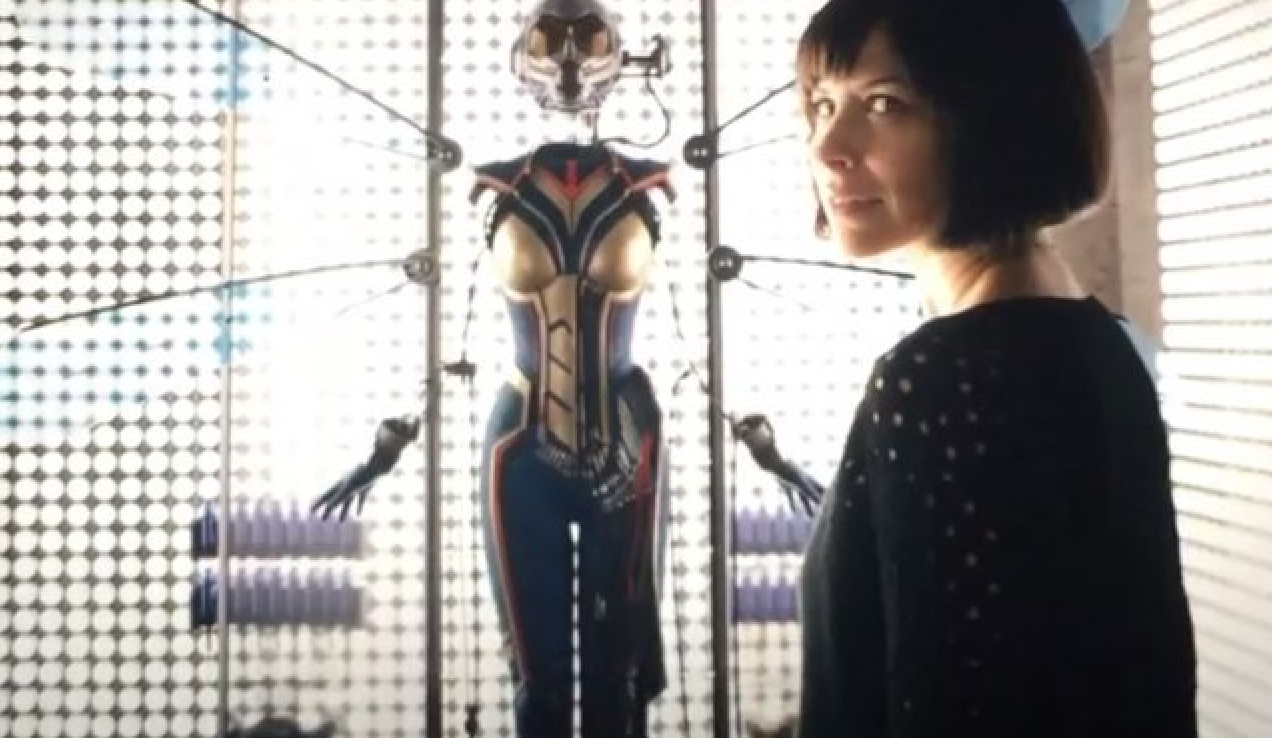

If we’re talking MCU post-credits scenes, then ‘Ant-Man’ arguably has two of the most important sequences in franchise history as both lay the groundwork for future events in the MCU. Going back to what I just talked about in regards to ‘the Wasp’, the mid-credits scene shows Hank giving Hope a prototype Wasp suit that was developed by both him and Janet, showing that he’s finally able to accept Hope taking on a superhero mantle after showing much hesitation earlier in the film. As stated earlier, Hope did not have much to do in the film in terms of action but that was fine because she was still just as important to the story, primarily in regards to her trying to reconnect with her father. But with that said, it’s definitely very cool that she’s now going to get to be a superhero as well in future MCU films. Though according to Kevin Feige, she won’t be appearing in the next MCU film, ‘Civil War’, because the character was cut from the story so that they “wouldn’t do her a disservice”. Yeah it’s a little disappointing, especially considering that Scott Lang will be in the film, but then again ‘Civil War’ does have a pretty big ensemble cast to the point where it can now pretty much be considered as an ‘Avengers’ film so it’s not really that big of a deal. So now I’m guessing that she’ll at least be in ‘Infinity War’. Either way, to quote Hope in this mid-credits scene, “it’s about damn time”.


Speaking of ‘Civil War’, finally there’s the post-credits scene, which was directed by the Russo brothers and will apparently be seen again in ‘Civil War’. The scene consists of Captain America and Falcon having finally found Bucky, which was their goal at the end of ‘Captain America: The Winter Soldier’, and debating what to do next. Both of them point out that they’re unable to contact Tony Stark due to ‘the Accords’, obviously foreshadowing the future conflict between Cap and Iron Man in ‘Civil War’. But of course because Falcon was part of a major action sequence in this film and at the end was shown to be looking for Scott Lang to ‘recruit’ him into the Avengers, he tells Steve that ‘he knows a guy’. So while we don’t yet know when this scene will occur in the next film, it definitely sets the stakes for what will be surely be another epic superhero film when ‘Captain America: Civil War’ hits theaters on May 6, 2016 to kick Phase Three of this grand Marvel Cinematic Universe. But for now, this sequence, and the entire film in general, closes out Phase Two of the MCU. Sure there may have been quite a bit of controversy surrounding this stage of the MCU from the Mandarin fake-out to the whole Edgar Wright incident but ultimately it ended up delivering some of the franchise’s greatest films to date.

IN CONCLUSION


Whenever I update my rankings list of the MCU, I don’t add in the newest film until after I’ve at least seen it twice. So now, having seen ‘Ant-Man’ twice in theaters, here are my updated rankings for the first twelve films of the Marvel Cinematic Universe;

12. Iron Man 2

11. The Incredible Hulk

10. Thor: The Dark World

9. Thor

8. Iron Man

7. Iron Man 3

6. ANT-MAN

5. Captain America: The First Avenger

4. Captain America: The Winter Soldier

3. The Avengers: Age of Ultron

2. The Avengers

1. Guardians of the Galaxy


Ultimately there are two main reasons why I can’t really put ‘Ant-Man’ in the Top 5. The first, as noted earlier, is that the main villain is rather one-note but as I also noted earlier, this has never bothered me as much as other people and I don’t even think that Yellowjacket is a ‘terrible’ villain. Like I’ve said in the past, I don’t hold the MCU villains to the ridiculously high standards of the internet in the wake of Loki’s turn as the villain in ‘The Avengers’. The only other problem that I have with ‘Ant-Man’ is that it starts off rather slow but thankfully gets moving once Scott first puts on the Ant-Man suit. All in all, ‘Ant-Man’ is another excellent entry in the MCU film. It’s sad that this film had to be overshadowed by the internet’s unwillingness to get over the departure of Edgar Wright, and unfortunately I have seen some people negatively compare the film to ‘what could have been’ with Wright, which is straight-up BS. But at the end of the day, ‘Ant-Man’ did not end up being the disaster that some predicted it to be. Marvel managed to move on from this initial setback and director Peyton Reed more than proves to be a solid enough replacement for Wright. As a result, ‘Ant-Man’ is another highly entertaining installment of this highly entertaining franchise and is definitely one of the most unique MCU films to date. Like I said in my original review, at this point it is foolish to have any sort of doubt about Marvel Studios because they obviously know what they’re doing. 

Saturday, July 18, 2015

Ant-Man (2015) review


7 years and 12 films in, it’s ridiculous to think that people are still doubting Marvel Studios even after all they have done in creating the Marvel Cinematic Universe and bringing us into the Golden Age of Superhero films. I’ve said it before and I’ll say it again, Marvel has yet to make a ‘bad’ film and despite all of the talk from Marvel’s biggest critics about how the studio is very strict in terms of forcing their directors to stick to their creative demands, all of their productions have gone by pretty smoothly save for the initial trouble over the search for a director for ‘Thor: The Dark World’. But as for their newest film ‘Ant-Man’, this has easily been the studio’s most difficult production yet. For you see, while ‘Ant-Man’ is now being released as the final installment of Phase Two of the MCU (originally it was going to be the first ‘Phase Three’ film but that honor will instead go to ‘Captain America: Civil War’), it was actually one of the very first projects ever developed for Marvel Studios back in 2006 before the first ‘Iron Man’ film was even released. It was to be written and directed by Edgar Wright, who nowadays is well known as the director behind some of the greatest comedies of the last few years, namely the three films of the ‘Cornetto Trilogy’ in ‘Shaun of the Dead’, ‘Hot Fuzz’, and ‘The World’s End’. Despite the need for some re-writes in order for the film to fit better into the canon of the MCU, everything seemed to be going well for Wright and Marvel Studios as the film began pre-production with filming set to start in the Summer of 2014.

But then, in May of that year, a major bombshell was dropped as it was announced that Wright would be leaving the project due to ‘creative differences’ with Marvel. And let me tell you folks, I have never seen a greater shift in general perception towards any film quite like what occurred with ‘Ant-Man’. Despite the fact that Marvel managed to move on from this fairly quickly and get production back on track, with director Peyton Reed (‘Bring it On’, ‘Yes Man’) taking over for Wright and Adam McKay and lead Paul Rudd both stepping in to help work on the screenplay, Wright’s departure from the project had a highly negative effect on the film in regards to the general reaction amongst film fans across the internet. Now there were many people who were starting to predict that the film would be a disaster, a first for Marvel Studios. It didn’t help that Ant-Man is generally considered to be one of the more odd characters in the Marvel Universe and keep in mind that this was all before ‘Guardians of the Galaxy’ came out and proved that Marvel Studios was more than capable of producing top-quality superhero films based around some of their lesser-known characters (which for the record is pretty much what they’ve been doing since the beginning). Well now that this film has finally come out, it’s safe to say that all of that backlash towards this film solely due to Wright’s departure was completely unfounded as ‘Ant-Man’ proves to be yet another fun and exciting installment of this grand Cinematic Universe and arguably its most unique yet.    

Paul Rudd stars as Scott Lang, an ex-con who struggles to find a stable job after he is released from prison in the hopes of providing child support for his daughter Cassie (Abby Ryder Fortson) after his ex-wife Maggie (Judy Greer) re-marries. But because his criminal past continually prevents him from finding a full-time job, Scott ultimately ends up taking on another sting op with his ex-cellmate Luis (Michael Pena) and their new partners Kurt (David Dastmalchian) and Dave (‘T.I.’). However, instead of a ‘proper score’, Scott only ends up finding an ‘old motorcycle suit’ but soon learns that this suit allows him to shrink down to the size of an insect. Scott is then approached by the creator of the suit, scientist Hank Pym (Michael Douglas), who offers him ‘a chance at redemption’. Scott learns that Hank had developed this special technology through the use of subatomic particles but hid it away from the world, even resigning from S.H.I.E.L.D. when he learned that they were trying to replicate his technology, as he feared that it was too dangerous. But when he learns that his former protégé, and current head of his company, Darren Cross (Corey Stoll), is on the verge of developing his own form of the Ant-Man technology in the form of the Yellowjacket suit, Hank, along with his daughter Hope van Dyne (Evangeline Lilly) recruit Scott into their plan to break into Pym Technologies and steal Cross’ technology before it is unleashed upon the world.

By now you’ve probably heard a good chunk of the unfortunately growing backlash against superhero films, with one major argument from these critics being that they’re ‘all the same’. And sure in the grand scheme of things, all of these films are fairly similar in terms of story structure and plot. But I feel that these critics are ignoring the true ‘variety’ of these films in terms of all of the unique characters that Marvel has brought to the big-screen. Ant-Man is no exception as his powers of shrinking and the ability to communicate with ants result in some very cool and unique action sequences, including arguably one of the best finales in any MCU film to date… and it all takes place in Scott’s daughter’s room. At the same time, Marvel once again delivers yet another very fun and entertaining superhero film with everything you can now come to expect from the MCU; excellent visuals (which in the case of this film given Ant-Man’s abilities are very much on display), solid pacing, exciting action sequences, and a screenplay full of hilarious bits of dialogue. And after the bigger-scale exploits of ‘The Avengers: Age of Ultron’, ‘Ant-Man’ proves to be a nice change of pace as a much smaller-scaled superhero flick. Like I’ve said in the past, I disagree with any of the complaints about why the Avengers weren’t called in to deal with some of the incidents that took place in these films or that films like this don’t really matter that much in the grand scheme of the MCU because that’s not true. Not every superhero film needs to be an ‘Avengers’ film. Solo-based superhero films can be just as exciting and epic as team-based superhero films and thanks to Marvel’s reliance on the former, their lead characters have been fleshed out very well because of that.

One of the other great things about the Marvel Cinematic Universe is how they’ve been able to implement different film genres into their films, from 1970s spy thrillers (‘Winter Soldier’) to ‘Star Wars’ esque sci-fi epics (‘Guardians of the Galaxy’). In the case of ‘Ant-Man’, it’s a heist film a la ‘Ocean’s Eleven’ and it’s executed very well. Without saying ANYTHING at all about what this film may have been like under Edgar Wright, Peyton Reed does an excellent job in Wright’s place as he does a great job at handling the film’s humor and action sequences. It just goes to show that nowadays comedy directors can do just as great, and arguably better, jobs than most action directors when it comes to directing films like this. The same occurred last year with the Russo brothers and James Gunn for their respective MCU films. But it’s not all just about the action and visuals; this film also has a lot of heart as well, namely in the two major father-daughter relationships in this particular story, something that hasn’t really been explored that much in the MCU films. Of course there’s the touching relationship between Scott and his daughter Cassie which is the main driving force for Scott in his path of redemption. But the major father-daughter relationship in the film is between Hope and Hank. It’s established very early on that Hope could have easily taken on the mantle of ‘Ant-Man’ but the reasoning for Hank’s objection to this idea, which mainly stems from a tragedy in their lives, makes the arc of their relationship all the more powerful.   

The character of Scott Lang could’ve been a rather tough character to get right on-screen given his criminal background. But thanks to the character’s motive of turning his life around for his daughter and the fact that he’s a superhero without any actual powers compared to someone like Thor or Captain America, he manages to be a very relatable lead and Paul Rudd does a great job in exuding nothing but charisma in the role. Backing him up is Evangeline Lilly, who’s also excellent as Hope Van Dyne. She may not get to do much in terms of action compared to Rudd but that doesn’t mean her role in the film is lessened because of that. Hope’s relationship with her father and the arcs that both of them go through in the film more than make up for it. In fact, I’ve heard that her role was actually expanded on after the whole Wright incident. Speaking of Hank Pym, who better to play the role of the ‘original’ Ant-Man than a Hollywood legend like Michael Douglas? He works excellently alongside Rudd and Lilly and brings a whole bunch of class to this fun superhero adventure. And like with every MCU film, there’s definitely some major scene-stealers in this film’s stellar ensemble cast. In this case, that honor belongs to Scott Lang’s heist partners; David Dastmalchian, T.I., and most notably, Michael Pena, who’s easily the biggest scene-stealer in the entire film. Many of the film’s best comedic moments come from him and I also loved how, in the scenes in which he is talking about how he came across key pieces of information from his acquaintances, all of the characters in that scene talk in his voice.

Now let’s move onto to the one major element of the Marvel Cinematic Universe that always gets the worst rep from critics; the villains. And based on reviews, it doesn’t seem like Darren Cross is going to buck this trend. While I’m usually much more positive about most of the MCU villains than the rest of the internet, unfortunately this is one instance where I’m admittedly a bit more in line with the critics on this one. At the end of the day, Cross is a fairly one-note villain. Heck, he’s not really in the film that much to stand out anyway and he doesn’t even get into the Yellowjacket suit until the film’s finale. But does that mean he’s a ‘terrible’ villain? Actually, the answer is no. Despite his ‘one-note villain’ status, Corey Stoll manages to carry a pretty darn intimidating and villainous presence that, if anything, makes him a much memorable villain than someone like Malekith from ‘Thor: The Dark World’. And that Yellowjacket suit is still a pretty damn cool visual. It’s basically like a much more threatening version of the Iron Man suit. Again, he may not be in the film that much but I’ve always felt that this hasn’t ever been that big of an issue in the MCU films because it allows us to spend more time with our main characters. Not every MCU villain has to be as good as Loki.

At this point in time, it is completely absurd to have any shred of doubt in regards to Marvel Studios because time and time again they have proven their critics wrong and have successfully pulled off projects that many felt were major risks going in. ‘Ant-Man’ is no exception, especially after the whole incident involving Edgar Wright’s departure from the project. Yes it’s sad that Wright ultimately didn’t get the chance to direct this dream project of his and it is even sadder when considering the fact that he spent around eight years working on this film before he left. But while we ultimately didn’t get to see Wright’s take on ‘Ant-Man’, that doesn’t mean that this film is the disaster that some predicted it to be. It’s a MCU film; it’s fun, it’s light-hearted, it’s entertaining, it’s got a great cast, and it’s got awesome visuals and action sequences. It is exactly the kind of top-quality entertainment that you can always expect from Marvel Studios. Is it the absolute best MCU film to date? No, not really but that is by no means a bad thing considering all of the other great superhero films that Marvel Studios has produced since 2008. And with that, ‘Ant-Man’ concludes Phase Two of the Marvel Cinematic Universe. Sure, there have been some controversy from time to time but at the end of the day, I’d argue that Phase Two actually managed to outdo Phase One and I can’t wait to see what’s in store for us with Phase Three.


Rating: 4.5/5

Tuesday, September 23, 2014

This is Where I Leave You (2014) review


Dysfunctional families have been a key element of a lot of films. Last year, there was the multiple award-nominated film ‘August: Osage County’ and it has also been prevalent in films like ‘The Fighter’ and ‘Little Miss Sunshine’. This concept has also been a part of multiple TV shows. In fact, it’s pretty much a given that almost every major TV sitcom, whether it be live-action or animated, will center on a dysfunctional family as it has been proven by shows like ‘The Simpsons’, ‘Arrested Development’, and ‘Family Guy’. And of course, the dysfunctional family plotline is the key focus of ‘This is Where I Leave You’, directed by Shawn Levy (with a film that is a definite change of pace for him as it is his first R-rated film after working on multiple family-friendly films like the ‘Night at the Museum’ movies) and based off of the 2009 book of the same name by Jonathan Tropper. The family of this film is very much a dysfunctional family so if you’re not a fan of a whole heck of a lot of arguing, this film is probably not for you. But ‘This is Where I Leave You’ does manage to provide a really solid amount of laughs primarily thanks to its great ensemble cast. But what’s even better is how this movie manages to find a good balance of comedy and drama, something that’s not exactly that easy to do. But this film manages to do it and do it pretty well.

On the day of his 3rd wedding anniversary, Judd Altman (Jason Bateman) unfortunately finds out the hard way that his wife Quinn (Abigail Spencer) is having an affair with his boss Wade (Dax Shepard) when he walks in on them having sex in their apartment. As if things couldn’t get any worse, a few weeks later he gets a call from his sister Wendy (Tina Fey) who tells him that their father has just died. They then return to their hometown where they reunite with their mother Hilary (Jane Fonda) and their two brothers, Paul (Corey Stoll) and Phillip (Adam Driver). After the funeral, they learn that as his last request, their father wanted them to mourn him through the Jewish tradition of Shiva, in which the family of the deceased gather and sit for a period of seven days in mourning. Even though the family isn’t actually Jewish, the siblings find themselves forced into doing it anyway when their mom ends up grounding them. So now that they’re all stuck under the same roof again having to honor the period of Shiva, the dysfunctional siblings end up starting to reconnect with one another as each member finds themselves having to deal with not only the loss of their father but also the current conflicts in their lives.

As is common in any dysfunctional family story, there is quite a lot of bickering amongst the Altman siblings and most of the film’s humor comes from the awkward moments that usually occur during these scenes. Overall, the film does have a pretty solid amount of humor though of course like with every comedy not all of the jokes hit. In the case of this film, it’s mostly in regards to the ‘gross-out’ moments in the film, like this one recurring gag in which the young son of one of the siblings keeps going to the bathroom in this little portable toilet that he always carries around. Thankfully, these moments don’t dominate the film’s humor. But ultimately the film’s greatest strength is that even amidst all of the arguing and gross-out moments, it plays things seriously when it needs to be. After all, this is a ‘dramedy’ about a family coping with the death of a loved one, a subject that isn’t and never will be funny. Thankfully this is not where the film’s humor comes from and the film manages to find a good balance of the humor and the drama, something that isn’t always easy to do when it comes to dramedies. Even though there are quite a lot of scenes where the Altman family is arguing with each other, there are also plenty of scenes in which they bond and these scenes are actually really touching and sweet.

Of course, this is mostly thanks to the film’s terrific ensemble cast. Their camaraderie with one another is superb and their relationships with each other feel genuine, hence why the scenes of them bonding are as strong as they are. Bateman and Fey’s more straight-faced attitudes help bring a nice balance to the crazier characters in the film, like Phillip for instance. Driver is easily one of the biggest standouts of the film in the role of the youngest of the Altman siblings which of course means that he doesn’t always act mature and Driver has quite a lot of charisma in the role. Fonda is also one of the film’s major standouts; most of her material is in relation to her character’s recent boob job which of course is a recurring joke throughout the film. But she also brings the proper motherly instinct that the role requires. As for the rest of the cast, some admittedly could’ve been given larger roles in the film, like Rose Byrne, who has really proven himself to be an excellent comedic talent earlier this year in ‘Neighbors’, as Judd’s former love interest from high school (Byrne and Bateman do have really nice chemistry) and even Corey Stoll, who kind of makes the smallest impression compared to his three sibling co-stars, but overall the cast is superb from top to bottom.

‘This is Where I Leave You’ can be quite wacky at times, as one would expect from a film centered on a dysfunctional family. But when it needs to, the film smartly tones down the craziness and as for this film being a dramedy, it’s one of the better ones that I’ve seen because it does do a really great job at balancing the humorous moments with the more serious moments. And those serious moments when the usually bickering Altmans start to reconnect with one another provide the heart of the film. Of course, this is primarily thanks to the film’s terrific ensemble cast. Not only do they have great camaraderie with one another but that also makes the relationships between their characters feel very much genuine from an emotional standpoint. Despite the occasional immature or gross-out moment, this is easily one of director Shawn Levy’s most mature films to date, if not the most. I haven’t read the book this was based on so I can’t say much about how faithful it is to the book (although I have heard about a scene from the book that got cut involving a cake that seems like a really funny situation but sadly it’s not in the film) but overall ‘This is Where I Leave You’ is a nice solid piece of entertainment that not only has a good amount of laughs but also a really good amount of heart as well.

Rating: 4/5