Showing posts with label Quentin Tarantino. Show all posts

Thursday, August 8, 2019

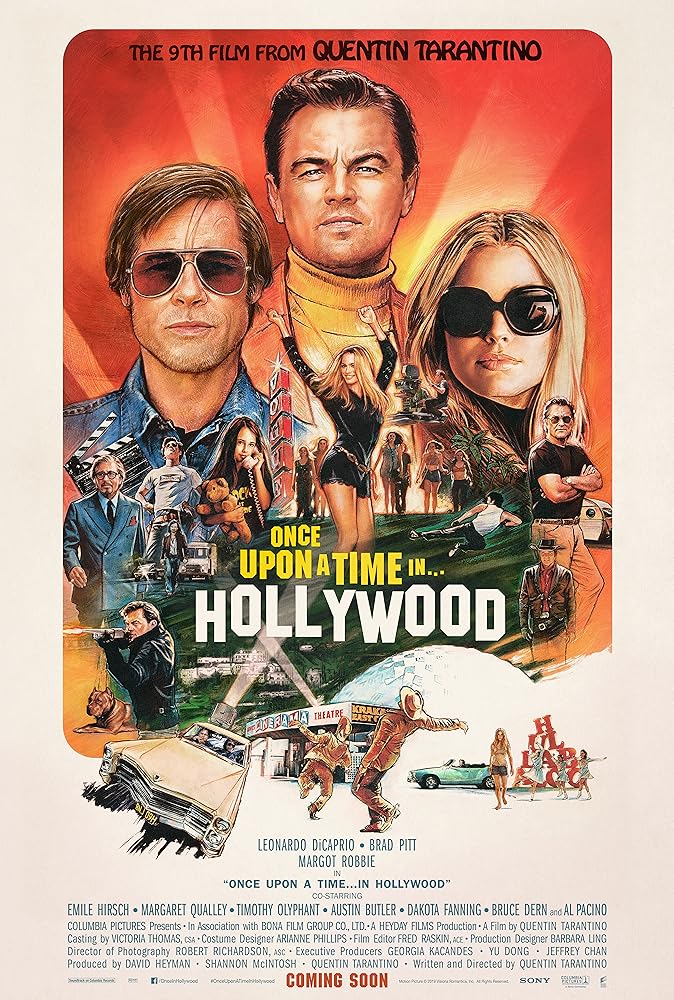
Once Upon a Time in Hollywood (2019) review

Once Upon a Time ... in Hollywood (2019)

It’s easy to point out some of the most notable trademarks of director Quentin Tarantino, whether it’s his knack for snappy dialogue or how he often goes against traditional storytelling conventions (e.g. the non-linear narrative of his 1994 classic Pulp Fiction). And yet, it can be argued that perhaps his most famous directorial trademark is his extensive knowledge of film thanks to an entire lifetime spent watching them. Because of this, every Quentin Tarantino film to date is chock-full of references to other films, whether it’s a homage to a specific genre (e.g. the Kung-Fu, spaghetti western, and revenge thriller films that inspired Kill Bill) or if they’re just simply brought up during conversations between characters. And while this aspect of Tarantino’s work has proven to be a bit more controversial in recent years, it’s still undoubtedly one of the main reasons why he continues to be one of the most prolific filmmakers in the industry, which is especially apparent in his newest film, Once Upon a Time in Hollywood. Serving as Tarantino’s ninth directorial effort (and, per his own words, his second-to-last film before he plans on retiring), Once Upon a Time in Hollywood truly is a love letter to the Golden Age of Hollywood as it’s set in its final days before the New Wave took over in the ’70s and ’80s. In the process, it also covers one of the most infamous events from that time, the rise of the sinister cult known as the Manson Family. However, when it comes to effectively combining its two main storylines into one cohesive narrative, that’s where the film admittedly starts to stumble.

The year is 1969 and the film industry has begun to undergo some radical changes. Of the various stars living in Los Angeles, none are arguably affected by this more than Rick Dalton (Leonardo DiCaprio). For years, Rick was the star of the popular Western TV series Bounty Law, but ever since the show’s cancellation (due in large part to his growing addiction to alcohol), he’s now been limited to less fulfilling villain roles on other shows like Lancer and F.B.I. And if that wasn’t enough, Rick soon discovers that his new neighbors are prominent film director Roman Polanski (Rafal Zawierucha) and his wife, rising starlet Sharon Tate (Margot Robbie). Thus, having recognized that he’s quickly becoming a has-been, Rick sets his sights on ways to rejuvenate his career, which sees him rely heavily on the support of his longtime stunt double Cliff Booth (Brad Pitt). Instead of just following the advice of casting agent Marvin Schwarz (Al Pacino) and going to shoot Spaghetti westerns in Italy, Rick plans on getting acquainted with Polanski, who’s fresh off his 1968 directorial effort Rosemary’s Baby. However, things become rather complicated when Rick and Cliff end up having a run-in with a group of hippies who have been living at an old Hollywood ranch with their ‘leader’, Charles Manson (Damon Herriman).

Once Upon a Time in Hollywood is ultimately two stories in one. One is the story of an actor struggling to resuscitate his career in an ever-changing industry while the other focuses on the dangerous Manson family and their infamous crime that was the 1969 murder of an eight-month pregnant Sharon Tate and four other witnesses. And to be perfectly blunt… these stories do not gel well in the slightest. The film ultimately focuses more on Rick Dalton’s attempts at relaunching his career, which would’ve worked perfectly as its own film. But because of this, the whole subplot involving the Manson family feels incredibly tacked on. There are only about one or two major sequences involving the Manson family in this nearly three-hour film and Charles Manson himself is literally only in one scene. This especially comes into play during the film’s finale, which has undoubtedly been its most polarizing aspect. Obviously, I won’t spoil anything from it here for those who haven’t seen the film yet, but I do understand why it’s so controversial because of the real-life context behind it and how the overall limited use of the Manson family arguably cheapens its impact. And yet, despite the film’s often inconsistent narrative, it still gives us exactly what we’ve come to expect from a Quentin Tarantino film. He still gives us plenty of great dialogue-based sequences, with many of them doing a phenomenal job when it comes to building up suspense that ultimately results in a solid bit of payoff. If anything, it’s clear that Tarantino hasn’t lost his stride when it comes to his sharp dialogue, which makes it unfortunate that the rest of the film isn’t quite as tightly focused by comparison.

Like any Tarantino film, Once Upon a Time in Hollywood is a premier case of an actors’ showcase, and it’s all highlighted by the dynamic lead duo of Leonardo DiCaprio and Brad Pitt. While this may only be the first time that these two legendary stars have worked together, their camaraderie is superb, thus perfectly conveying their characters’ tight-knit friendship. DiCaprio brilliantly handles Rick Dalton’s ‘fall from grace’ arc and is also given a bunch of opportunities to flex his comedic abilities thanks to Tarantino’s knack for dark humor. Pitt, meanwhile, brings the same cool aura that he often brings to a lot of his performances as Cliff Booth, who also has an enigmatic vibe to him thanks to a subplot (that, admittedly, feels like it doesn’t get as much attention as it should) revolving around a long-standing rumor about him. Closing out the film’s trio of leads is Margot Robbie in the role of Sharon Tate. Robbie fully commits to the role of Tate, excellently encapsulating the late starlet’s mannerisms and effervescent spirit. Unfortunately, her role in the film ends up being one of the worst cases of underutilizing an actress in recent memory as she’s barely in it, effectively serving as another example of why everything with the Manson family ends up feeling incredibly extraneous. The rest of the film’s stacked ensemble cast is basically a who’s who of recognizable faces, from Tarantino regulars like Kurt Russell and Bruce Dern to reliable supporting players like Al Pacino and Luke Perry in what is ultimately his final film role. Admittedly, most of them are just in it for a single scene apiece, but at the very least, they do make the most out of their limited screen-time.

For film fandom, a Quentin Tarantino film is practically the very definition of an ‘event film’. Whenever one’s released, it’s practically guaranteed to be one of the most anticipated films of its year and, in turn, usually ends up being one of the best-reviewed films of that year. This is certainly the case this year with Once Upon a Time in Hollywood… which makes things rather awkward for me since, unfortunately, I found it to be rather underwhelming. Now before any of you film buffs get on my butt about this, let me be clear; this doesn’t mean that I think that the film was ‘terrible’ because it’s not even close to being that. When the film presents a scene that’s classic Tarantino, it’s handled just as brilliantly as some of the most iconic moments in previous Tarantino films. However, while Once Upon a Time in Hollywood may have all the hallmarks of a classic Tarantino film, it’s fatally undermined by an unfocused script that can’t decide on which story it wants to tell. Simply put, this should’ve just been the story of an actor who’s past his prime and trying to cope with the end of Hollywood’s Golden Age. But instead of just focusing on one storyline, it also tries to incorporate another in the form of the Manson family and their murder of Sharon Tate. However, this is ultimately done in a rather haphazard manner as the Manson family subplot is extremely underdeveloped, which certainly isn’t helped by the limited screen-time of Tate despite a phenomenal turn from Margot Robbie in the role. As such, while I’m aware that I will ultimately be in the minority on this, Once Upon a Time in Hollywood ends up being one of the weaker outings of Quentin Tarantino’s career as it lacks both the punch and soul of the various classics that have defined his career. Sure, it’s generally well-made and features an excellent cast, but at the end of the day, it just feels… empty…

Rating: 2.5/5

Monday, January 4, 2016

Short Review Triple Feature

Greetings ladies and gentlemen! As I noted a few days ago in my Quentin Tarantino directorial retrospective, I’ve been spending a lot of time developing my ‘Top 12 Favorite Films of 2015’ posts for you folks, which I can confirm for you all will start being published on this blog on January 6th. Until then, as a result of me being primarily focused on those posts, I haven’t had much time to do full reviews for the films that I usually see around this time of the year; in other words, anything I see during the last few days of 2015. As I’ve established before, I’ve been partaking in an annual post-Christmas tradition in the form of a double feature run that I have been doing with my good friend Matthew Goudreau, who’s currently working as an Entertainment Staff Writer with ‘The Young Folks’, every year since 2012. But due to the both of us being rather busy, we actually weren’t able to do it until the first day of 2016 but even if it wasn’t 2015 anymore, this should still be considered as our 2015 run. In 2012, it was ‘Les Miserables’ and ‘Django Unchained’. In 2013 it was ‘The Wolf of Wall Street’ and ‘American Hustle’. And last year, it was ‘Into the Woods’ and ‘The Imitation Game’. So today, as one last post before the big ‘Best Films of the Year’ posts, I’ll be doing a pair of quick reviews of the two films that we saw back-to-back this time around. But this time, however, I’ll be adding in an additional review of a film that I saw the day before I did the double feature screening with Matt on the last day of 2015.  

First up on the list is the film that I saw on December 31st, 2015, New Year’s Eve. It was the last ‘new’ 2015 release that I watched in 2015.

JOY


David O. Russell and Jennifer Lawrence have become one of the biggest director-actor duos in recent years. The two first collaborated on 2012’s ‘Silver Linings Playbook’. That film not only landed Lawrence her second Oscar nomination for Best Actress, after her breakout turn in 2010’s ‘Winter’s Bone’, but also her first win. The two teamed up again the following year, along with her ‘Silver Linings’ co-stars Bradley Cooper and Robert De Niro, for ‘American Hustle’. While only in a supporting role this time around, Lawrence once again got major award buzz for her performance as the unstable wife of Christian Bale’s character and earned her third (and second straight) Oscar nomination, this time for Best Supporting Actress. And while Lupita Nyong’o ended up winning that award that year for her turn in ‘Twelve Years a Slave’, Lawrence was still regarded as being one of the best parts of ‘American Hustle’. This year the duo of Lawrence and O. Russell are at it again, along with Bradley Cooper and Robert De Niro, again, for ‘Joy’. This time Lawrence is the true star of the show in this semi true story about Joy Mangano, a divorced mother from Long Island who became famous in the 90’s for her invention of the Miracle Mop, a self-wringing mop that kept users from having to touch the wet mop head as they would have to have done if they used a regular mop. Her invention was a huge success and Mangano became a highly successful entrepreneur for the Home Shopping Network. She’s been developing new inventions for the network ever since.   

I say ‘semi’ true story because O. Russell has gone on record saying that the film is not entirely based around Mangano’s life. Instead, the screenplay is based around several different stories of women who dared to change their lives around. So while the film may not delve into the full story of Mangano’s rise to fame, it’s still a solidly-executed story of a young woman with the weight of the entire world on her shoulders who manages to overcome all of that through both her perseverance and her ingenious invention. Her life struggles make her easy to sympathize with and relate to and Jennifer Lawrence is superb as always in the role of Joy, as are Robert De Niro as Joy’s father Rudy, who gets quite a lot of humorous lines of dialogue (If you recall my review of ‘American Hustle’, I questioned why that film was being regarded as a comedy when it really wasn’t. ‘Joy’, on the other hand, does a much better job when it comes to comedic dialogue), and Bradley Cooper in the role of an executive from QVC who helps Joy sell her product on the network. Admittedly the film takes a little while to get going and there is quite a bit of uncomfortableness that comes from Joy’s mother’s (Virginia Madsen) role in the film, a woman who spends all of her time watching soap operas and never leaving her room. But once Joy starts to produce and sell her new invention, that’s where the film really starts to shine. Many of you are aware that even though I really liked ‘Silver Linings Playbook’, I wasn’t too big on ‘American Hustle’ and thought that it was one of the more ‘overrated’ films of that year. ‘Joy’, on the other hand, is a film that I’m happy to say that I’m much more positive towards. This one has been more polarizing with critics but at the very least I feel that Lawrence should at least get another Oscar nomination for her work on this film.

Rating: 4/5

And now we move onto the two films that I saw with Matt on January 1st, New Year’s Day.

THE HATEFUL EIGHT


Good ol’ Quentin Tarantino is back with yet another balls-to-the-wall cinematic experience with his eighth feature film, fittingly titled ‘The Hateful Eight’. A western set in post-Civil War Wyoming, the film centers around a group of eight strangers who end up stuck together in a Haberdashery due to a harsh blizzard. These people include bounty hunter John Ruth (Kurt Russell), known as ‘The Hangman’ due to his insistence on making sure his bounties hang, his current prisoner/bounty Daisy Domergue (Jennifer Jason Leigh), fellow bounty hunter Major Marquis Warren (Samuel L. Jackson), ‘new sheriff’ Chris Mannix (Walton Goggins), the haberdashery’s caretaker Bob (Demian Bichir), ‘hangman’ Oswaldo Mobray (Tim Roth), cow-puncher Joe Gage (Michael Madsen), and former Confederate general Sanford Smithers (Bruce Dern). The major selling point of the film was that it was shot in Ultra Panavision 70, a format that hadn’t been used since the 60’s with films like ‘Ben-Hur’ and ‘It’s a Mad, Mad, Mad, Mad World’. Ever the film buff, Tarantino prepared a special ‘roadshow’ release of the film, complete with an overture, intermission, and special booklet, that was 20 minutes longer than the version that would be released nationwide and would be screened in any theaters that still had 70 mm projectors. Of the roughly 100 theaters that screened this special version of the film, the closest to me was the Providence Place Cinema. However, I saw the film in Lincoln so, yes, I only saw the film in its ‘digital release’ form and not in the way that Tarantino had intended. I will see if I can get to see the film’s roadshow release while it’s still running.

But even though I didn’t see the film in the 70 mm format, it is still a beautifully-shot film in terms of its vast landscapes and fresh color palette. As for the film itself, it’s exactly what you’d expect from a Tarantino film. The first half of the film is mostly build-up and exposition between characters but Tarantino is easily one of the best in the business in terms of establishing tension that keeps the audience guessing as to what’s going to happen next and, perhaps most importantly, who’s going to be on the end of another person’s bullet by the end. Admittedly the film is a bit flawed. It loses some momentum in the second half, you do feel the film’s hefty 160+ minute runtime in places, and admittedly Tarantino’s violent action sequences are starting to get a little ridiculous, from heads exploding to people coughing up tons of blood after they drink poisoned coffee. But at the same time, as noted earlier, Tarantino’s direction in terms of establishing suspense and tension is once again superb and the film’s ensemble cast is superb as well. If I had to name the biggest standouts of the film, I would have to go with the three that most people are talking about. Those three are Samuel L. Jackson, of course (this is a Tarantino film after all), as the badass Major Warren, Walton Goggins as arguably the most charismatic of the bunch (even though you really wouldn’t use that word to describe any of these characters) as Mannix, and Jennifer Jason Leigh as, to put it as nicely as I possibly can, the extremely feral Domergue. For Tarantino fans, ‘The Hateful Eight’ will deliver on everything you come to expect from the legendary filmmaker. It’s by no means his best work but still a must-see in every sense of the word.

Rating: 4/5

THE BIG SHORT

Big Short, The Poster

Finally, we have ‘The Big Short’, an interesting against-type project for director Adam McKay. Known for his numerous collaborations with Will Ferrell on comedies like ‘Anchorman’ and ‘Talladega Nights’, ‘The Big Short’, based on the book of the same name by ‘Moneyball’ author Michael Lewis, is more of a drama that focuses on the financial crisis of 2007-2010 that came as a result of the fall of the housing market and build-up of the credit bubble. The film primarily follows the stories of three separate parties; hedge fund manager Michael Burry (Christian Bale), who is the first to notice the impending collapse of the market, another hedge fund manager Mark Baum (Steve Carell) who is notified of this by trader Jared Vennett (Ryan Gosling) and uncovers the fraudulent practices of collateralized debt obligations (CDOs), and up-and-coming investors Charlie Geller (John Magaro) and Jamie Shipley (Finn Wittrock), who get involved with the credit default swap market with their help of their friend, retired banker Ben Rickert (Brad Pitt). All of these characters spend their time in the film working to take advantage of the practice of credit default swap that would bet against the housing market. And despite the fact that obviously this ends up working in their favor, they pretty much all come to the conclusion that in doing so, they’re profiting at the expense of pretty much everyone else in the world except for the banks, resulting in the question of how are they any better than the banks for doing this.

So yeah, sounds like a pretty downer story, right? Well, that’s where McKay’s comedic talents come in as the film manages to have a lot of comedic dialogue that for the most part sort of makes up for the more depressing elements of the story. A lot of the humor comes from Ryan Gosling, whose character Jared Vennett serves as the film’s narrator and Gosling brings a charismatic and also quite boisterous attitude to the role. Now I’ll admit that I know very little about all of this stuff about the housing market and the credit bubble and so on and so forth. And that’s okay because the film is totally aware about that too. It knows that a lot of us aren’t economics majors. So what it does in order to at least make more sense for people like me who don’t know anything about all of this is by cutting to random cameos where celebrities like Margot Robbie and Selena Gomez address the audience and give us a better understanding of all of this trading business, from Robbie talking about loans while in a bathtub to chef Anthony Bourdain talking about CDOs. I’ll admit that there’s sort of a surreal nature to these scenes but thanks to McKay’s direction, a superb cast (if I had to pick a standout I’d go with Gosling for his aforementioned narration work), and an actually solid mix of comedy and drama, ‘The Big Short’ is a fascinating look into one of the biggest incidents in the recent history of this country while also pointing out all of the BS that was responsible from it; BS that, as Brad Pitt put it, hasn’t gone away.


Rating: 4.5/5

Saturday, January 2, 2016

Directorial Retrospective: Quentin Tarantino

(Happy New Year Everybody! Right now I am hard at work on my 'Top 12 Favorite Films of 2015' list but until those are finished, here's a brand new directorial retrospective focusing on film fan favorite, Quentin Tarantino, just in time for the release of his new film 'The Hateful Eight'. A quick review of that along with 'Joy' and 'The Big Short' will be posted in the next few days followed by the 'Top 12 Favorite Films of 2015' posts.)


It’s been a while since I did my last directorial retrospective, heck over a whole year in fact. The last time I did this kind of post was for the filmography of Christopher Nolan leading up to the release of ‘Interstellar’ back in November of last year. But today it’s time for a new one with today’s subject being the film buff fan favorite, Quentin Tarantino. His new film ‘The Hateful Eight’, which fittingly enough is his eighth feature film (not counting his 2007 collaboration with Robert Rodriguez, ‘Grindhouse’, which we will also be covering today… well, just Tarantino’s contribution to be precise), will be hitting theaters soon and is certain to attract a lot of buzz from the buffs who adore his films. Tarantino has also proven to be quite the film buff himself with both his past experience as a video store clerk, his adoration for non-digital film formats (‘Hateful Eight’ is being heavily promoted as a 70mm release) and the many, many film references that have been made in his films over the years. And while he’s certainly been a controversial figure over the years as well due to things like his bold and brash off-screen personality and his constant use of racial epithets in his films, film fans can’t get enough of the stories, characters, and most importantly the dialogue that he creates for his films. So today we’re celebrating the filmography of one of film’s most electric directors from ‘Reservoir Dogs’ to ‘Django Unchained’. These are the films of director Quentin Tarantino.

Also, on a side note, today we’ll only be focusing on the films he directed and not the ones that he only wrote like ‘True Romance’ and ‘Natural Born Killers’.

RESERVOIR DOGS (1992)


QT officially started his directorial career with ‘Reservoir Dogs’, a story that was inspired by Stanley Kubrick’s 1956 noir flick ‘The Killing’. And while it could be argued that this film is sometimes overshadowed by its immediate successor, it’s still one hell of a start for Mr. Tarantino. ‘Reservoir Dogs’ is a heist film without the heist. In other words, the majority of the film takes place after the planned heist of a diamond wholesaler that majorly goes awry. The main conflict comes from the main characters trying to figure out who was the one who ratted them out. All of this gives the film quite a nice feeling of tension, which is even more impressive given the fact that we don’t see the heist and most of the action takes place in a single location. Of course this film introduced many of the trademarks that would define Tarantino’s directorial style; the hard violence, the snappy profane and pop culture-laced dialogue, and a non-linear method of storytelling. As noted, the film skips over the heist and also pulls a few flashbacks at times that expand upon the story. And the film of course has a tremendous cast highlighted by Harvey Keitel, Tim Roth, Steve Buscemi, and Michael Madsen. And as a crucial scene in the film proves, you don’t want to be stuck in a warehouse with a guy like Mr. Blonde (Madsen) when the song ‘Stuck in the Middle with You’ is playing on ‘K-Billy’s Super Sounds of the Seventies Weekend’. Simply put, ‘Reservoir Dogs’ is a low-budget masterpiece that started out Tarantino’s career on the best note possible.

Rating: 5/5!

PULP FICTION (1994)


This is definitely one of those films where I don’t have to go into too much detail about because it’s already been done by pretty much everyone else. We all know how famous this film is; how it became one of the most celebrated films of all-time, how it reignited the careers of people like John Travolta and Bruce Willis and made Samuel L. Jackson a key player in almost every subsequent Tarantino film, etc., etc. Any way you look at it, this film is a true cinematic masterpiece. Tarantino’s dialogue is as terrific as ever, the cast is superb from Samuel L. Jackson as the cool and philosophical Jules Winfield to Uma Thurman as gangster Marsellus Wallace’s coke-addicted wife Mia, and the film is full to the brim with memorable moments. There’s Jules’ confrontation with a bunch of crooks where he recites ‘Ezekiel 25:17’ (technically not the actual scripture but who cares?), there’s the scene where Vincent Vega (Travolta) and Mia dance the twist, the scene immediately after that where Vincent has to revive Mia with adrenaline when she accidentally snorts some heroin, and so on and so on. If I had to choose a favorite moment from the film, I think it would have to be the segment titled ‘The Bonnie Situation’. Somehow Tarantino managed to make a sequence in which one of the main characters accidentally shoots someone in the head (“Oh man I shot Marvin in the face.”) hilarious. I really don’t need to go on any further than that. I don’t even think I ever came across someone who didn’t like this film.  

Rating: 5/5!

JACKIE BROWN (1997)


‘Jackie Brown’ tends to be the one entry in Tarantino’s filmography that’s the most forgotten. This adaptation of Elmore Leonard’s novel ‘Rum Punch’ is Tarantino’s least successful film financially post-‘Pulp Fiction’, which is a shame because it’s arguably just as good as his other films. It seems like the reason for this was because the film was more dialogue-driven than it was action-driven. But of course, it’s Tarantino so the dialogue is as sharp as ever in this homage to the Blaxploitation films of the 1970’s, right down to the casting of Blaxploitation starlet Pam Grier in the title role. Grier of course is excellent as the no-nonsense Jackie Brown, a flight attendant who smuggles money across the border for a black-market dealer but is sharp-witted and willing to double-cross anyone she comes across in order to acquire a large amount of money. And of course like any Tarantino film, ‘Jackie Brown’ features a wide array of memorable characters, from Samuel L. Jackson as the aforementioned black-market dealer Ordell to Robert De Niro as Louis, an associate of Ordell’s who is clearly in over his head to the point where after he bungles a money exchange, he shoots Ordell’s roommate Melanie (Bridget Fonda) in the parking lot of a mall when she starts to get on his nerves. In conclusion, ‘Jackie Brown’ definitely stands as one of the most underrated films of its time. It may not have been the Tarantino film that some were expecting but it still deliver plenty of the things that make his films so entertaining to watch.

Rating: 4/5

KILL BILL: VOL. 1 (2003) AND VOL. 2 (2004)

(Note: This following section will pair up both ‘Kill Bill’ films in order to respect its original form of being a four-hour film. However, I will still be giving separate ratings/reviews for each of the two films.)


For Tarantino’s first major project in the 21st century, he reunited with his ‘Pulp Fiction’ leading lady Uma Thurman for what would ultimately become a two-part stylized ‘revenge flick’ inspired by martial arts films like ‘Lady Snowblood’. Thurman stars as a woman named Beatrix Kiddo AKA ‘The Bride’ AKA ‘Black Mamba’ AKA ‘Kiddo’ (she’s got a lot of nicknames) who embarks on a personal vendetta against her former squad, the Deadly Viper Assassination Squad led by her boss and former lover, the titular Bill (David Carradine), when they try to kill her during her wedding. Originally the project was slated to be one single 4-hour film and was originally presented that way at the 2003 Cannes Film Festival. However, Tarantino and Harvey Weinstein agreed to have the film split into two parts to maintain a more respectable run-time for each film and so in 2003, ‘Kill Bill Vol. 1’ was released, followed by its sequel, ‘Kill Bill Vol. 2’, in 2004. Both films feature excellent action sequences, Tarantino’s trademark non-linear style of storytelling, a beautiful visual style that pays homage to both the martial arts and western genres (including an excellent anime sequence in ‘Vol. 1’ that goes into the backstory of one of the Bride’s main targets), and one of the best female action heroines of all-time in ‘The Bride’, with Uma Thurman giving a career-best performance in the role.


The interesting part about these two films is that most of the action takes place during ‘Vol. 1’ while ‘Vol. 2’ is more dialogue-driven. I say it’s ‘interesting’ because a lot of recent ‘two-part’ films like ‘Harry Potter and the Deathly Hallows’ and ‘The Hunger Games: Mockingjay’ do it the other way around; the first film is set-up while the second film focuses on the action. Anyway, ‘Vol. 1’ focuses on the Bride’s pursuit of Yakuza leader O-Ren Ishii (Lucy Liu) and Vernita Green (Vivica A. Fox). Very much the ‘martial arts’ half of the story, ‘Vol. 1’ features one of the best fight sequences in film history as the Bride takes on the ‘Crazy 88s’, O-Ren, and the rest of her associates at the House of Blue Leaves. As for ‘Vol. 2’, which feels more like a western right down to the use of music from Ennio Morricone, it may not have as much action as ‘Vol. 1’ but it still has some very memorable sequences, including the Bride’s training with renowned martial artist Pai Mei, her fight with fellow Pai Mei student Elle Driver (Daryl Hannah), and her climactic mostly verbal confrontation with Bill, complete with a monologue about comic book superheroes and their secret identities. And while ‘Vol. 2’ may have benefitted from a few more action sequences, Tarantino’s direction is still excellent and his dialogue is still superbly witty. As a whole, this is one hell of a tale of revenge, showcasing the strong director-actor relationship that is Quentin Tarantino and Uma Thurman. Will these two reunite for a ‘Vol. 3’, as a lot of people have been speculating? We’ll just have to wait and see.

Ratings: Part 1: 4.5/5, Part 2: 4/5 (As a whole: 4.5/5)

DEATH PROOF (2007)


‘Death Proof’ was Quentin Tarantino’s contribution to his 2007 collaboration with his friend Robert Rodriguez, ‘Grindhouse’, a double feature paying tribute to the days of ‘grindhouses’, theaters that showed B-movies and exploitation films. Rodriguez’s contribution, not counting his ‘fake’ trailer to what would eventually become 2010’s ‘Machete’, was the zombie flick ‘Planet Terror’ but today we’ll solely be focusing on Tarantino’s car chase flick ‘Death Proof’, in which a psychotic stunt man (Kurt Russell) stalks and kills young women with his ‘death proof’ car, hence the title of the film. This film is often regarded as Tarantino’s weakest film, even by Tarantino himself. Ultimately I do have to agree with that. In fact, I can’t even say that it’s ‘good’. Tarantino’s dialogue isn’t as strong this time around, basically due to the fact that the film is mostly just scenes of dialogue and exposition. It does get pretty dull at times. Though with that said, there are still some good things in it. Kurt Russell is pretty darn good in the lead role of the crazy ‘Stuntman Mike’ and the final car chase involving ‘Stuntman Mike’ and a group of stuntwomen, which involves Zoe Bell riding on the hood of a car, is definitely one of the best car chases in recent years. But at the end of the day, this is a Tarantino film for the biggest Tarantino fans only… and even then you probably won’t like it.

Rating: 1.5/5

INGLOURIOUS BASTERDS (2009)


Tarantino changed up history quite a bit with his next film, ‘Inglourious Basterds’. Set in Germany during World War II, the film follows the titular group known as ‘the Basterds’, a group of Jewish-American soldiers who terrorize German soldiers by killing and scalping their victims and carving swastikas into the foreheads of those they let live. But while Tarantino’s alternate history war film is very much compelling just like his previous films, it can be a bit flawed at times. The main reason for this is the writing’s occasional veering into uneven territory. Despite being called ‘Inglourious Basterds’, the Basterds aren’t actually in the film that much. Instead, the main focus of the film is Jewish survivor Shosanna Dreyfus, who plots revenge against the German command after her family is killed by a German patrol. Now I don’t mind too much that the film takes this route, nor do I mind the occasional out-of-place reference that could understandably frustrate others. However, as a result of this, shall we say, ‘bait and switch’, the story doesn’t really have the same connective feel as something like ‘Pulp Fiction’ due to the Basterds not having ‘that much’ effect on the big finale, when Shoshanna enacts her revenge against the Germans by burning down her theater, leading to the deaths of Hitler and his associates.

Despite this, Tarantino’s direction is still excellent, especially in the way he sets up sequences and creates tension through the build-up towards the action. The pop cultural references aren’t really as strong here due to the fact that this film takes place in the 40’s, meaning that younger audiences probably will not get any of the references to the films of that time, but the screenplay is still full of some memorable bits of dialogue, mostly from Basterd leader Aldo Raine (“We ain’t in the prisoner-taking business, we’re in the killing Nazis business!”). When the film does get to the action, there are definitely some stand-out moments, including the aforementioned finale in the burning theater. And despite one weak link in the cast (Eli Roth, who, like Tarantino, definitely isn’t much of an actor), the film is full of excellent performances from the likes of Brad Pitt as Aldo Raine, Melanie Laurent as Shosanna, and a wide array of bit roles from stars like Michael Fassbender, B.J. Novak, Diane Kruger, and Daniel Bruhl. And of course we can’t forget about the film’s biggest scene-stealer, Christoph Waltz, who rightfully won an Oscar for his turn as the despicable yet charming ‘Jew Hunter’, Colonel Hans Landa. And ultimately, despite its shortcomings, ‘Inglorious Basterds’ is still another solid example of Tarantino’s talents as a director.

Rating: 4/5

DJANGO UNCHAINED (2012)


Tarantino once again took a hammer to history with his Southern revenge flick ‘Django Unchained’. Set in the Deep South two years before the Civil War, the film follows slave turned free man turned bounty hunter Django as he joins fellow bounty hunter Dr. King Schultz in hunting outlaws while also looking to free his wife Broomhilda from her current slave owner Calvin Candie. And boy is it one hell of a ride from start to finish. I had previously done a review of this film back in December 2012 when I first saw it in theaters with my friend Matt Goudreau. In fact, this was basically the first Tarantino film that I’d ever watched. I had watched a bit of the opening to ‘Inglourious Basterds’ a few years before but that was as far as I got with the film at that time. As for ‘Django’, however, due to the fact that I was also developing my ‘Best of the Year’ list at the same time, I only gave it a short review alongside a short review of the other film Matt and I had seen that day, ‘Les Miserables’. And even though I did list it at the #8 spot on my ‘Best of the Year’ list, I don’t feel that I really gave it a proper review there either because I basically just rehashed the same points I brought up in my original ‘review’. So with that said, consider this to be a more proper review of ‘Django Unchained’.

I completely understand if some are offended by certain elements of the film, namely the frequent use of the n-word. Tarantino has consistently used the word in his scripts but as for ‘Django Unchained’, the film sets a record with 116 uses of the word. Seriously go on YouTube and search for supercut videos of every use of it in the film. You’d swear you were watching something out of a rap video. But aside from that, there has also been a lot of people who weren’t too big on the film’s handling of the topic of slavery. Whereas something like ’13 Years a Slave’ definitely captured the extreme cruelty that came from this terrible practice, ‘Django Unchained’ takes more of a ‘spaghetti western’ approach to it. Like I said, I understand if certain people were bothered by this film. But as for me, this is my favorite Tarantino film after the duo of ‘Reservoir Dogs’ and ‘Pulp Fiction’, and no it’s not just because this was my first Tarantino film. Even with the route the film takes in its portrayal of slavery and the constant use of the n-word, this is perhaps Tarantino’s best screenplay in years. There aren’t as many pop cultural references this time around but it does produce quite a lot of memorable, and sometimes hilarious, moments, like when ‘Big Daddy’ (Don Johnson) and his friends attack Django and Schultz but first get into an argument over their bag masks (“I think we all think the bags was a nice idea. But not to point any fingers… they could’ve been done better.”). And as for the big shootout at Calvin Candie’s estate Candyland, it’s definitely one hell of a shootout.

Christoph Waltz returns for his second straight Tarantino film, this time in the ‘good guy’ role of Dr. King Schultz. And once again, Waltz is phenomenal as the charismatic and badass bounty hunter. Waltz took home a second Oscar for Best Supporting Actor for the role, but for many people, the true star of the film is Leonardo DiCaprio in the role of Calvin Candie. Simply put, Candie is one evil SOB. And yet somehow DiCaprio still manages to bring on the charm when he’s not doing something awful. He even hurt his hand for real during a scene where he smashes on a table and cuts himself on a piece of glass. Sadly, DiCaprio got snubbed at the Oscars that year and even though it’s nice that Waltz won for his role in the film, it definitely would’ve been nice to see DiCaprio get some attention as well. These two characters are so excellent that sometimes they do sort of overshadow Django, the main character. However, Jamie Foxx is just as excellent in the role of the smooth and badass Django. These three are also backed up by Kerry Washington as Django’s wife Broomhilda and, of course, Samuel L. Jackson as Candie’s extremely intimidating servant Stephen. And while the film is perhaps just a bit overlong, serving as Tarantino’s longest film to date when not counting ‘Kill Bill’ when viewed as one film and the yet-to-be-released ‘Hateful Eight’ ‘Django Unchained’ is one of the most entertaining films that Tarantino has ever made.

Rating: 5/5!
Thursday, December 27, 2012

Short Reviews Double Feature


Mainly because I am in the middle of preparing my 'Best Films of the Year' list, here are a pair of short reviews for two films that I saw back-to-back today. One of which is an adaptation of a famous musical which is in turn based off of a classic novel and the other is the latest from an acclaimed director.


LES MISÉRABLES (2012)


While there have been many film adaptations of Victor Hugo's classic 1862 novel of the same name, director Tom Hooper's take on the story is the first 'Les Misérables' movie to be primarily based off of the highly successful musical that debuted back in 1980 and while I may not have seen any of the other 'Les Misérables' films, this version will probably end up as being one of the best. It certainly is the best film musical in many years and this all comes from the great cast. Hugh Jackman gives a real Oscar-worthy performance as Jean Valjean and Anne Hathaway is also terrific as Fantine, and she's only in the film for about 10 minutes or so. The whole new technique that the filmmakers used to record the music, consisting of having the actors sing live instead of lip-synching to pre-recorded songs, gives the movie a uniqueness, allowing the actors to do something different with this music. All in all, it certainly is one of the year's best films.


Rating: 4.5/5


DJANGO UNCHAINED (2012)


I'm just going to say it straight up; it's a Quentin Tarantino movie. If you're a fan of his work, you are not going to be disappointed with Tarantino's take on the spaghetti western genre set in 1860's America. It's a bold and bloody (emphasis on the latter) movie that shows that Tarantino isn't afraid to do things that most filmmakers wouldn't dare to do. It also has a pretty funny screenplay with some great lines here and there. Like with Les Misérables, the cast is excellent but this time there is one big standout; Leonardo DiCaprio as the main antagonist Calvin Candie, a plantation owner who owns the main character Django's wife, prompting Django (Jamie Foxx) and bounty hunter Dr. King Schultz (Christoph Waltz) to go and rescue her. DiCaprio just steals the show, and I'll be shocked if he's not nominated for an Oscar. Tarantino delivers once again.


Rating: 4.5/5