Showing posts with label 2004. Show all posts

Monday, July 6, 2020

National Treasure: A Duology Retrospective


In recognition of the annual holiday that is the Fourth of July weekend, I figured that now would be the perfect time to tackle a franchise that I’ve always wanted to cover on this site. And the thing is… the idea of doing this post and having it come out around this time is something that I’ve wanted to do for a few years now, and yet, I never got around to doing it. In fact, it could’ve been a perfect time to do it last year seeing how 2019 was the 15th anniversary of the first film’s release. But even though I do own both these films on Blu-Ray, this has been the one post that has always eluded me… until now. Yes, fueled in large part by my most recent viewings of these films on Disney+ and the fact that it feels appropriate to do this little retrospective on two American-themed adventure films on Independence Day, the time has finally come for me to tackle a pair of films that were some of my absolute favorites growing up. These two films in question came courtesy of Hollywood mega-producer Jerry Bruckheimer (just one year after he had helped launch the massive franchise that is Disney’s Pirates of the Caribbean) and veteran director Jon Turteltaub, who was very much a studio regular at that point having directed films such as 1993’s Cool Runnings and 1996’s Phenomenon. Both films proved to be big hits at the box-office even if they weren’t exactly as successful with critics for reasons that, yes, we will get into. Nevertheless, they’ve continued to be some of the most notable films that came from Disney’s live-action filmography in the early 2000s, and after many years of speculation, it seems like this franchise will finally be getting a third installment sometime soon. Until then, its time to celebrate a highly entertaining pair of films that, let’s face it, is mainly known nowadays as that series where, in one film, Nicolas Cage boldly proclaims that he’s “gonna steal the Declaration of Independence” and, in another film, “kidnap the President of the United States”. That’s right, folks, today we’ll be looking back at the National Treasure films.

Now before we begin, I should point out that this will be a far different kind of retrospective compared to all the other ones that I’ve done over the years. If you’ve been following this site for a while, you’ll know that when it comes to retrospectives, I usually just go through all the films that are a part of whatever franchise I’m looking at (or, in some cases, a director’s filmography) in the chronological order of their release. But when it comes to National Treasure, I realized that I had to switch things up a bit for this one since these two films have quite a lot in common. Both films revolve around treasure hunter Benjamin Gates (Nicolas Cage) as he searches for a fabled treasure with the help of his father Patrick (Jon Voight), his best friend and tech expert Riley Poole (Justin Bartha), and his girlfriend Abigail Chase (Diane Kruger). In both films, Ben’s quest for the treasure sees him having to pull off a daring heist that immediately puts him in hot water with the FBI, specifically agent Peter Sadusky (Harvey Keitel). And in both films, Ben and company end up in a race against time with a rival treasure hunter who’s willing to use whatever means necessary to find the treasure before they do, although there are points where they’re forced to work together to find the next clues and overcome dangerous obstacles. Really, the only major differences between these two films are the treasures themselves and the locations that Ben and the gang travel to. With all this in mind, I decided that, for today’s post (and today’s post only, unless I come across another case of a sequel that’s a lot like its predecessor), I’ll be abandoning the traditional format that I do for these retrospective posts and discuss these two films simultaneously rather than separately. Personally, I feel that if I did it the other way around, there’s a good chance that I wouldn’t have had enough material to talk about by the time that I’d get to the second film due to the potential risk of repeating myself, and I fear that this would’ve severely impacted the quality of the post as a result. In other words, this whole situation can best be summed up by one of the most notable clues from the second film.

“These twins stand resolute…”


The first National Treasure, released on November 19th, 2004, opens with a young Benjamin Gates being told the story of a legendary treasure by his grandfather John (Christopher Plummer). The treasure in question is a vast collection of relics from various empires that was discovered by the Knights Templar. They would then go on to form another brotherhood known as the Freemasons which, by the time of the Revolutionary War, included several key figures from America’s founding fathers who swore to keep it out of the hands of the British empire. As for the Gates family, their involvement with the legend of the Templar treasure began when Ben’s ancestor Thomas received one of the sole clues of its existence from Charles Carroll, the last surviving signer of the Declaration of Independence (“The secret lies with Charlotte”). Years later, Ben finally locates the Charlotte, a ship that ended up stuck in the Arctic, with the help of tech expert Riley Poole and entrepreneur Ian Howe (Sean Bean). And while the treasure isn’t contained within the ship’s confines, they do find their next clue, which suggests that a hidden map is located on the back of the Declaration of Independence. However, tensions between Ben and Ian develop when the latter suggests that they steal it. Ben naturally opposes the idea, resulting in Ian and his henchmen heading off on their own accord to find the treasure first. And unfortunately for Ben and Riley, they fail to convince anyone of Ian’s plans and the existence of a map on the back of the Declaration, including National Archives archivist Abigail Chase. Thus, Ben realizes that, since Ian will most likely destroy the Declaration after finding the map, the only way to protect the most important document in American history is to steal it himself.


For the sequel, National Treasure: Book of Secrets (released on December 21st, 2007), Ben and his father Patrick find themselves facing a troubling dilemma when black market antiquities dealer Mitch Wilkinson (Ed Harris) comes forward with one of the mythical lost pages from the diary of President Abraham Lincoln’s assassinator, John Wilkes Booth. When it’s revealed that Ben’s great-great-grandfather Thomas Gates’ name is on the page, Wilkinson suggests that Thomas was the true mastermind behind Lincoln’s assassination since he’s listed as ‘Artifex’ (the Latin term for 'architect'). And yet, since this all contrasts heavily with the Gates family’s long-standing story of Thomas being a heroic figure who gave his life to keep Confederate sympathizers from discovering a mythical treasure, Ben immediately sets out to clear his ancestor’s name. In doing so, Ben, Abigail, Riley, and Patrick discover that the treasure that Booth and his followers were looking for was the ancient Native American city of gold, Cibola. But as their investigation continues, Ben and company soon realize that they’ll need to find the mysterious ‘Book of Secrets’ that contains a wide array of Presidential documents that provide the truths behind some of the most notable moments in American history like the JFK assassination, Watergate, and the mystery of Area 51. The only problem, though, is that the book is exclusively reserved for Presidents, resulting in Ben suggesting the only solution that he can think of; kidnap the President (Bruce Greenwood) to learn about the book’s location.

I should probably start things off by pointing out the obvious… yes, these films can get incredibly ridiculous when it comes to their plots. Whether it’s the first film’s set-up of the Founding Fathers orchestrating the safeguarding of a vast treasure or the reveal in the second film that Cibola is hidden beneath Mount Rushmore, it’s safe to say that these films are far from being the most historically accurate when it comes to their interpretations of U.S. history. And sure enough, this was the main reason why neither film was that big of a hit with critics as they felt that they were just way too goofy to be taken seriously. However, to paraphrase the Rotten Tomatoes consensus for the first film, if you’re willing to accept all the ludicrous lengths that these films often go to, you’ll find them to be solidly entertaining action-adventure flicks that manage to overcome this potentially catastrophic shortcoming because of how well-directed they are. Thanks to the top-notch direction from Jon Turteltaub, these films fully succeed at maintaining the kind of fun and light-hearted atmosphere that has often defined the classics of the action-adventure genre, including, of course, the one franchise that I’m sure many have compared these films to over the years, the Indiana Jones series. They also benefit from some genuinely terrific pacing, which means that there’s never a dull moment that would give you enough time to poke holes in its logic, even if it’s during a scene where the characters are simply talking rather than partaking in one of their elaborate schemes. There’s just something about these characters gradually figuring out their next objective or the meaning behind the newest clue that they’ve found that’s utterly satisfying, and because of this, the moments where they finally find the fabled treasures more than deliver on the feeling of true emotional catharsis.


Obviously, a lot of this stems from what the discovery of these treasures means for Ben and his family. In the case of the first film, his quest to find the Templar treasure ends up proving all his family’s dissenters wrong who, for years, had thoroughly believed that it was one of history’s greatest myths. And as for Book of Secrets, the discovery of Cibola is the evidence that both he and his father needed to prove that Thomas Gates wasn’t the one who orchestrated Lincoln’s assassination. With that said, while I’m not going to spend too much time comparing these two films, especially due to the obvious reason of how similar they are, I will say that Book of Secrets arguably has a few slight advantages over its predecessor. Namely, the factor of the quest to clear Thomas Gates’ name makes the film’s stakes feel more personal. It’s also arguably a bit better-shot than the original, but I attribute that more to the natural evolution that most sequels go through rather than the fact that there was a notable change in cinematographers, with the first film being shot by Caleb Deschanel and the sequel handled by the duo of John Schwartzman and Amir Mokri. Really, though, at the end of the day, these two films are quite on par with each other when it comes to their overall quality. Both feature some excellent action set-pieces and they also benefit greatly from being largely shot on-location. Obviously, the big finales of both films were filmed on sets (which, to be fair, are great in their own right), but many of the key scenes were filmed at the proper historical landmarks, such as the National Archives, Mount Rushmore, and Mt. Vernon. And through it all, these two films are properly anchored by their great collection of likable protagonists portrayed by the franchise’s excellent ensemble cast.


It all begins, of course, with Nicolas Cage who, despite his usual reputation on the internet as one of the most over-the-top actors in the industry, delivers one of the more subdued performances of his career as Ben Gates. Sure, the sequel does give him a few instances where he delightfully chews the scenery (most notably in the sequence where he and Abigail ‘make a scene’ at Buckingham Palace), but overall, these films serve as a good example of how that reputation he’s garnered is perhaps a bit unwarranted. Diane Kruger is equally excellent as Abigail Chase who, despite some instances in the first film where she’s the damsel in distress, is almost immediately established as being Ben’s equal on an intellectual level. Naturally, this means that Kruger and Cage have wonderful chemistry, and while Book of Secrets does open with the two of them in an estranged relationship, the fact that it stems from Abigail wanting Ben to take her opinion more seriously does feel like a narratively appropriate conflict for these characters. And to close out the main trio, there’s Justin Bartha as the Gates family’s always reliable tech man Riley Poole, who also serves as the franchise’s biggest source of comic relief. Sure enough, he more than succeeds in that capacity as Ben’s lovably dorky sidekick (e.g. when the gang finally finds the treasure in the first film and Riley primarily takes pleasure… in finding the exit (“Look… stairs!”)). But at the same time, a lot of what makes Riley’s status as the comic relief work as well as it does is the terrific rapport that Bartha has with Cage, which really sells their characters’ friendship and how truly loyal Riley is to Ben’s endeavors regardless of whatever crazy scheme he comes up with. Riley also gets to have a great standout moment in the sequel where he gets to be the one to reveal the existence of the President’s ‘Book of Secrets’ thanks to his recently published book on the Templar treasure and other famous myths, especially once all his research is ultimately proven right when the gang finds it in the Library of Congress.


Moving over to the franchise’s supporting cast, the biggest standout of the bunch is Jon Voight as Ben’s father Patrick. Admittedly, he doesn’t factor into the first film that much up until the end where Ian and his crew take him hostage, but there is a real satisfaction to seeing Ben’s dad go from a guy who never believed in the treasure’s existence to someone more than happy to have been proven wrong and then proceeds to thoroughly relish in its discovery with his son. This then results in him having a more prominent role in the sequel where he has greater stakes in the quest to clear Thomas Gates’ name. After all, the story of Thomas’ sacrifice is one that had been directly passed down to him by his grandfather, Thomas’ son Charles, who had to witness the death of his father firsthand as seen in Book of Secrets’ opening scene. Another great standout is Harvey Keitel as FBI agent Peter Sadusky. While Sadusky’s primary role in the series is to be the one who pursues Ben whenever he commits a federal crime, he also forms a friendly rapport with Ben and is shown to have a natural understanding of the importance of the Templar treasure as evident from the reveal at the end of the first film that he’s a part of the Freemasons. The sequel also brings in some fun new additions to the cast, namely Helen Mirren as Ben’s mom (and Patrick’s estranged ex-wife) Emily and Bruce Greenwood as the President of the United States, who Ben, of course, ‘kidnaps’ to find out the location of the Book of Secrets. Their roles in the film are admittedly rather minor (even though Mirren does end up participating in the finale, where she and Voight prove to have some solid chemistry as Patrick and Emily begin to reconcile), but they’re both still very much welcome additions to the franchise.

Finally, we come to the main antagonists of this franchise, Ian Howe in the first film and Mitch Wilkinson in Book of Secrets, who are quite arguably the prime examples of how truly similar these two films are. Both characters are well-to-do businessmen with shady backgrounds who are always accompanied by a group of henchmen in their efforts to consistently stay on Ben and company’s tail. However, like I noted earlier, there does come a point near the end of each film where the two sides are forced to partake in an uneasy alliance to continue the hunt for the treasure, which ultimately doesn’t end well for the antagonists (in different ways that I’ll elaborate on later). Now, if I were to compare these two villains, it can be argued that Ian plays a more pivotal role in the first film’s plot than Mitch does in the sequel’s. In other words, almost every key sequence in the first film sees Ben, Abigail, and Riley being pursued by Ian and his team, which helps make them feel like more of a consistent threat. By comparison, despite the moment where they break into Patrick’s house and clone his phone to track their calls, there’s only one major sequence in Book of Secrets where Ben and company are directly chased by Mitch’s crew. And while they do end up taking Emily hostage in a moment that directly mirrors Ian’s move of kidnapping Patrick in the first film, they don’t cross paths again until after Ben has both ‘kidnapped’ the President and found the Book of Secrets. Ian also has the advantage over Mitch when it comes to having the more memorable set of henchmen, whereas Mitch’s henchmen are so one-note that they don’t even partake in the finale. Although to be fair, the first film did see one of Ian’s goons fall to his death so, if anything, Mitch’s crew did manage to dodge a bullet on that one. Ultimately, though, both Sean Bean and Ed Harris fully succeed at being solidly charismatic foils to Nicolas Cage. And despite everything that I’ve just said that would potentially imply that Mitch isn’t as good of a villain as Ian is, he does get the more interesting finale to his character arc when he nobly decides to stay behind to let Ben and his family escape from the flooding city of gold. It does result in his death, but Ben proceeds to honor this sacrifice by ensuring that Mitch is properly credited for Cibola’s discovery. By comparison, the first film simply concludes with Ian and his crew being arrested by the FBI.


But now we come to the biggest question surrounding the current state of this franchise… will there ever be a third National Treasure film? This is something that has seemingly been in the cards for more than a decade at this point since plans for a potential follow-up were, in fact, announced in 2008 not long after the release of Book of Secrets. But then, for the next few years, nothing really came out of this development apart from a few comments from the filmmakers that claimed that it was in the works. Part of this situation can arguably be attributed to the fact that, in 2014, Jerry Bruckheimer and Disney decided that they weren’t going to renew the first-look picture deal that Bruckheimer’s production company had with the studio. This was all during a time where Bruckheimer’s non-Pirates films weren’t doing so well financially, such as 2010's The Sorcerer’s Apprentice and, perhaps most infamously, 2013’s The Lone Ranger. Since then, the only film that Bruckheimer has made with Disney was the fifth Pirates of the Caribbean film, Dead Men Tell No Tales, which, to its credit, was a reasonably successful hit at the box-office back in 2017. But now let’s flash forward to this year which, for Bruckheimer, began on a great note with the long-awaited third installment of the Bad Boys franchise, Bad Boys for Life, which still stands as the highest-grossing film of the year. And if that wasn’t enough, another highly anticipated follow-up to a Bruckheimer production that’s been in the works for quite some time, Top Gun: Maverick, is set to come out this December. But for the purpose of our current discussion, our focus shifts to the opening weekend for Bad Boys for Life, when it was announced that the film’s writer, Chris Bremner, was being brought on to become National Treasure 3’s new writer. Not only that, but back in May, Bruckheimer also announced that a National Treasure TV series was in the works for Disney+. And while it has been reported that this new show will be focusing on a different and younger cast, those same reports have also noted that the show itself will retain the same overall concept of its cinematic counterparts.
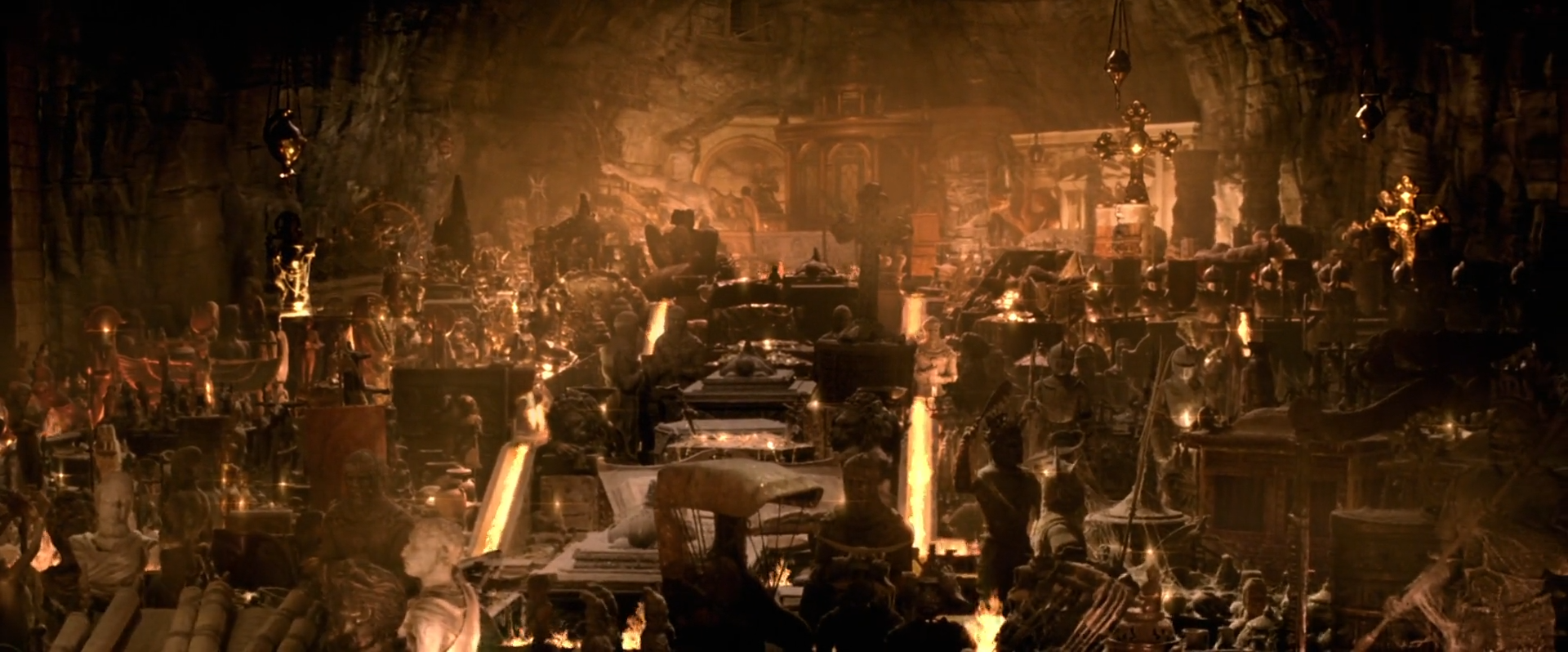

And so, I think it’s safe to say that after more than a decade of uncertainty, the long-proposed third installment of the National Treasure series will finally be seeing the light of day sometime in the future, which is a development that I’m more than excited about. While I’ll admit that my most recent viewings of these two films were the first time that I’d seen either of them in several years, I was immediately reminded as to why they were some of my favorite films growing up. In fact, I even still remember going to see them both in theaters when they first came out (the second film even came packaged with a Goofy short, How to Hook Up Your Home Theater). Simply put, for a franchise that some could describe as being Disney’s attempt at trying to have their own Indiana Jones-style franchise (you know, before they acquired the Indy rights themselves…), I’d argue that they do succeed in that regard. Thanks to an excellent cast and solid direction from Jon Turteltaub, these films are incredibly entertaining popcorn flicks. Now, like I said before, I do recognize that these films can get incredibly silly when it comes to some of their big plot-threads. As such, I admittedly wouldn’t recommend that anyone use these films as a reference guide when it comes to U.S. history even though there are some legitimate historical facts (e.g. the letters that Benjamin Franklin wrote using the pseudonym ‘Silence Dogood’) that are peppered in alongside all the… well, not-so-true ones. But once again, I’d argue that Turteltaub’s stalwart direction is what ultimately kept these two productions from being undone by all that, and because of this, I think that the National Treasure films are some of the best examples of why you don’t always need a ‘smart’ script to deliver a great film.

As for ratings, I gladly give both the original National Treasure and National Treasure: Book of Secrets a 5/5! rating!

Saturday, February 22, 2020

Miracle (2004) review


Eddie Cahill in Miracle (2004)

Today on Rhode Island Movie Corner, we’re celebrating the 40th anniversary of one of the most iconic moments in not only the history of sports but also the history of the entire United States. On February 22nd, 1980, the U.S. Men’s Hockey Team played against the Soviet Union Men’s Hockey Team at the 13th Winter Olympics in Lake Placid, New York. At the time, the Soviet Union squad was one of the most dominant forces in Olympic history and had taken the Gold Medal in 5 of the last 6 Olympic Games. But against all odds, coach Herb Brooks’ squad of amateur/college players pulled off the impossible and defeated the supposedly unbeatable Russians 4-3 on route to a historic Gold Medal run. This moment in history would forever become known as the ‘Miracle on Ice’ and provided a jolt of national pride that America was arguably quite lacking at the time. But now this brings us to the 2004 film adaptation of this historic event, simply titled Miracle. Released by Disney and directed by Gavin O’Connor, the film was a solid success both critically and commercially upon its release. It grossed over $64 million worldwide and scored good reviews with critics, and even nowadays, I find that many people still regard this as one of the best sports films of all-time. Unlike the actual Miracle on Ice, 2020 doesn’t connect to any specific anniversary for this film, but it did celebrate its 15th anniversary last year. Thus, I figured that now is the perfect time to celebrate an undisputed classic of the sports film genre; a film that flawlessly works around its genre’s predictability to perfectly capture the spirit and emotion of the legendary game that it’s based around.

In the summer of 1969, University of Minnesota Ice Hockey coach Herb Brooks (Kurt Russell) is hired as the new head coach of the U.S. Men’s Hockey Team. Brooks, who had previously played on the 1960 squad but was cut right before their Gold Medal run at the Olympics that year, proposes that the only way they can defeat the unstoppable force that is the Soviet Union’s hockey team is by changing their strategies and the ways that they practice. However, Brooks’ radical ideas are initially met with skepticism by the members of the United States Olympic Committee, especially after he ends up selecting the initial 26-man roster on the first day of what was meant to be a week-long tryout session. Nevertheless, Brooks sticks to his guns and selects a team made up of amateur and college players, including players from Boston University and several who had previously played for Brooks at the University of Minnesota. The only problem, however, is that Boston and Minnesota are responsible for one of the fiercest rivalries in college hockey, and sure enough, that hostility starts to become an issue once the team gets on the ice. However, Brooks manages to work around this by implementing a strict training regime that pushes the players to their limits so that he can properly instill in them the values of playing hockey for the United States of America. And in the process, the team starts to come together as they head to Lake Placid, where they find themselves becoming the catalysts behind a newfound sense of national pride as they brace themselves for the inevitable battle with the Soviets.    

As I alluded to in the intro, sports films can often get dinged for having predictable plots that usually revolve around a team that’s established as being major underdogs but end up winning the most important game of the season against their biggest rivals. This is especially the case for films that are based on true stories since there’s a very likely chance that audiences are well-aware about the history of events that they’re based on going into them. But while Miracle is quite arguably one of the most blatant examples of the latter since, let’s face it, we all know what happened on that fateful February day 40 years ago, this never hurts the film in any significant manner. A lot of this is thanks to how director Gavin O’Connor perfectly conveys the tumultuous atmosphere of everything that was going on in America at the time without ever shifting focus away from Herb Brooks and his team. Whether it’s the opening credits montage that covers events like the Three Mile Island incident and Watergate or a sequence where Herb’s wife Patti (Patricia Clarkson) diverts his attention to news on the developing hostage crisis in Iran, the film never shies away from how American morale was arguably at an all-time low. But just like in real life, the film does a wonderful job of building up to the climactic game against the Soviets and showing just how big of a deal it ended up being for the U.S. In fact, the attention to detail when it came to recreating this game is so authentic that legendary sportscaster Al Michaels didn’t even bother to re-record his iconic final words from the original broadcast (“DO YOU BELIEVE IN MIRACLES? YES!”). Why? Well, it was quite simply because he knew that he couldn’t even remotely come close to replicating the pure, unbridled emotion of that moment.

But, of course, the best aspect of this entire film is Kurt Russell’s phenomenal lead performance in the role of Herb Brooks. Russell fully commands the screen as the legendary hockey coach who pushed his team 24/7 to be the best that they can be. And yet, as much as the film focuses on the instances where he dishes out tough love to them like no one’s business, it also makes an effort to emphasize his humanity amidst all the pressure that he was clearly under to lead his team to victory. Much of this comes through in the scenes that he shares with Patricia Clarkson as Herb’s wife Patti who, despite her admittedly limited role as the generally passive ‘supporting wife’, does get to have a few instances where she keeps her husband in line when he starts to become too focused on his coaching responsibilities. After that, they’re backed by solid supporting players like Gavin O’Connor regular Noah Emmerich as Herb’s assistant coach Craig Patrick and Sean McCann as Walter Bush, the team’s general manager who also serves as Herb’s liaison when it comes to defending his actions to the U.S. Olympic Committee. As for the 20 men who made up the 1980 U.S. Men’s Hockey Team, the filmmakers primarily relied on casting actual hockey players in the roles. And while the film does tend to focus on some players more than others (namely, the quartet of goalie Jim Craig (Eddie Cahill), team captain Mike Eruzione (Patrick O’Brien Dempsey), defenseman Jack O’Callahan (Michael Mantenuto), and forward Rob McClanahan (Nathan West)), their overall camaraderie is outstanding.  

I still remember going to see this film in theaters back in 2004 when my family and I were on vacation in New Hampshire. I also remember a time in 2008 when, due to various reasons that range from having to do a school project on the ‘Miracle on Ice’ to just casually watching it at home on DVD, I ended up re-watching this film at least 3 or 4 times in the span of a month. In other words, just like another classic Disney sports film of the era, 2000’s Remember the Titans, Miracle is a film that I have quite a lot of history with, and upon re-watching it for this review, it’s easy to see why. Sure, it can be just as predictable as other films in the sports genre from a story perspective, but to be fair, this is the ‘Miracle on Ice’ we’re talking about. Thus, in this instance, it’s not a big deal that you already know the outcome of the film going into it because that’s not the point of it all. Instead, Miracle succeeds immensely thanks to excellent direction from Gavin O’Connor that perfectly conveys the historical importance of this legendary game and an unforgettable performance from Kurt Russell in the lead role of head coach Herb Brooks. I may not have been alive to witness the ‘Miracle on Ice’ in person, but this film more than does its job when it comes to authentically recreating such a spectacle on the big screen. And really, it doesn’t matter how many times you re-watch the actual game itself or this film’s interpretation of it as the climactic medal round matchup between the United States and the Soviet Union still stands as one of the most exhilarating finales in the history of sports films.   

Rating: 5/5!

Friday, January 13, 2017

Lemony Snicket's A Series of Unfortunate Events (2004) review

Image result for a series of unfortunate events movie poster

I regret to inform you that the review that you’re about to read is for a dreadfully grim film in which terrible things happen to young children. If you wish to instead read a review for a family film with a much more light-hearted plot, feel free to browse one of the many other reviews on this site for films like Moana or The BFG… okay, I’m not going to do that narration for the entire review. But, today, we are talking about A Series of Unfortunate Events. Written by author Daniel Handler under the pen name Lemony Snicket, who serves as the series’ in-universe narrator, this 13-book series has been a major commercial success ever since it first debuted in 1999, selling over 65 million copies worldwide. I used to read these books quite often when I was younger. That’s because even though these books do live up to their namesake by being a series of stories in which bad things constantly happen to the main protagonists, they were engaging reads thanks in large part to Handler/Snicket’s descriptive writing and their entertainingly dark sense of humor (e.g. the routine running gag in which Snicket constantly warns the reader not to read the books). A new adaptation of the series makes its debut on Netflix this weekend by way of a TV series. But, before that, let’s look back at the franchise’s arguably now forgotten film adaptation from 2004, which was produced by Nickelodeon Movies, directed by Brad Silberling (Casper), and starred Jim Carrey in the role of the villainous Count Olaf. As someone who grew up with the books, I watched this film numerous times when I was younger. And although it had been years since I’d last seen it, the debut of the new Netflix series made me want to watch it again. And, upon re-watch, I found that I still enjoyed it a lot. Because for a film that ended up being a failed attempt at spawning a franchise in the era of Harry Potter, I’d argue that it’s quite underrated.

The film is based off the first three installments of the series; The Bad Beginning, The Reptile Room, and The Wide Window. It centers on the three Baudelaire children; 14-year old inventor extraordinaire Violet (Emily Browning), 12-year-old bookworm Klaus (Liam Aiken), and their infant sister Sunny (played by twins Kara and Shelby Hoffman), who loves to bite things with her sharp teeth. One day, while at the beach, the children learn from their family’s banker, Mr. Poe (Timothy Spall), that their parents have died in a severe fire that had destroyed their house. As the Baudelaires now find themselves orphaned, Mr. Poe immediately puts them into the care of their distant relative, Count Olaf (Jim Carrey), the leader of a theatre troupe who’s supposedly their ‘third cousin four times removed’ (or ‘fourth cousin three times removed’). However, the children quickly learn that Olaf is secretly plotting to inherit the Baudelaires’ vast fortune, which they themselves will inherit when Violet turns 18. Thus, he begins to treat them horribly and even tries to kill them from time to time so that he can inherit the fortune. With no one to help them, the Baudelaire orphans are forced to rely on their own strengths to thwart Olaf’s dastardly schemes. But, even after they manage to have Olaf removed from the position of being their guardian, he continues to pursue them wherever they go, coming up with new ways to get rid of them and donning disguises that manage to fool their subsequent guardians, including herpetologist ‘Monty’ Montgomery (Billy Connolly) and timid widow Josephine Anwhistle (Meryl Streep), but not the children. Along the way, the children also begin to learn some secrets regarding their parents, including a secret organization that they were once a part of.

The best thing about this film is that it does an excellent job of recreating the vivid and stylish world of the books on the big-screen. For a film that was shot entirely on sound stages, the production/set design is fantastic. It’s also backed by some solid cinematography from Emmanuel Lubezki, who of course would go on to win three straight Oscars about a decade later for his work on films like Gravity and The Revenant. The overall success that the film has in terms of visually staying faithful to the books also translates quite well when it comes to the overall story. Save for a few cosmetic changes here and there, the film is a generally faithful adaptation of the first three books. The only major narrative change is that the ending of The Bad Beginning, in which Olaf attempts to legally marry Violet to get the fortune under the guise of it being part of his new play, is repurposed to the end of the film, after the events of The Wide Window. Thus, the ‘ending’ of the first act instead sees the Baudelaires trying to escape from a trap set by Count Olaf in which they’re about to be hit by a train. I’ll admit that when I was younger, initially I used to hate this change solely for the fact that it was made. But, looking back at it now, I get the reason why this change was necessary. The ending of The Bad Beginning is a ‘finale’ that’s more suited for the end of the film instead of being the first act finale about half an hour in. Really, the biggest downfall of the film is the fact that, nowadays, it’s considerably hindered by it not getting a sequel. It’s clear that, while watching this film, there were plans to do a follow-up as the plot has quite a few mysteries that either end up unsolved or are vaguely explained. And not only did these mysteries ‘not’ end up being answered in regards to this specific iteration of the series, it also ends up being a problem for those who haven’t read the books because, again, they’re given little explanation, meaning that some moments may come off as being rather confusing to newcomers.  

In the role of Count Olaf, Jim Carrey is, to put it simply, absolutely hamming it up as the main villain. It’s been noted that the film avoids going down some of the darker routes of the books, namely in regards to Olaf himself. The more disturbing tendencies of Olaf were basically replaced by Carrey’s comedic banter. However, I’d say that Carrey still did a good job in the role. Yes, he’s over-acting like crazy but I’d argue that this is part of the character; Olaf is an actor, after all. Sure, as I just noted, it’s not really his defining trait in the books, but when you have someone like Jim Carrey in the role, you know that he’s going to bring a humorous slant to it, which he does, namely through moments that surely must’ve been unscripted and the ways in which Olaf disguises himself; first as an ‘Italian’ herpetologist named Stephano and then as a peg-legged sailor named Captain Sham, though, sadly, he doesn’t get much screen-time while disguised as the latter. In short, while film Olaf may come off as being more humorous than sinister, I think that Carrey’s take on the character is rather iconic. For the record, that’s nothing against his successor in the role, Neil Patrick Harris, but with that said, Harris does have quite a bit to live up to. As for the Baudelaire children, specifically, Violet and Klaus seeing how Sunny is only a baby, both Emily Browning and Liam Aiken do solid jobs in their respective roles. One of the key aspects of the series, in general, is the fact that, through it all, the Baudelaires are always portrayed as an endearing trio. No matter what happens to them, they’re always likable and you root for them to triumph against Olaf. This is handled perfectly in the film, making the scenes where they succeed in foiling Olaf’s plans satisfying and the more heartwarming scenes involving them effectively emotional (e.g. the scene at the end where they finally receive a letter that their parents had written them while they were in Europe). Aside from Olaf and the kids, this film has quite an impressive supporting ensemble full of recognizable faces, from Billy Connolly to Meryl Streep to Catherine O’Hara, and they all do solid jobs in providing the film with an eccentric cast of characters.

While I haven’t read the books in quite some time, I am looking forward to this new adaptation of A Series of Unfortunate Events. For one thing, it could finally result in a complete adaptation of the series, something that the 2004 film was sadly never able to achieve. While the film did do well with critics and audiences, and even though there were plans for a sequel, it ultimately didn’t get one, mainly due in part to the fact that it was taking too long to make and the young leads were getting too old for their roles. Heck, they even considered making an animated film at one point before deciding on doing a series on Netflix. Still, it’s a shame that the original film didn’t go anywhere because I’d argue that it’s rather underrated. Sure, it’s not necessarily a ‘perfect adaptation’ of the source material but it still does just enough to capture the spirit of the books, particularly in terms of the set and production design. And while it can be argued that Jim Carrey is perhaps over-doing it in the role of Olaf, he still manages to provide us with plenty of humorous moments out of his maniacal performance. There’s also some funny moments that stem from the film’s numerous fake-outs, including the opening, which makes you think that you’re watching a different film, and a scene where it seems like the Baudelaires are about to be attacked by a snake but then we cut back to Lemony Snicket (played in the film by Jude Law) having to fix his typewriter because the ribbon jammed, then culminating in the reveal that the snake wasn’t harmful. Sure, this is another thing that contributes to the film’s more humorous tone compared to the more serious nature of the books but, at the same time, it also correlates perfectly to the series’ trademark dark humor. With all this in mind, the original adaptation of A Series of Unfortunate Events is an entertaining little adventure that is sure to bring back nostalgic memories for those who grew up with it. I know I did; heck, I even went to go see it on New Years’ Eve back in 2004. So, yeah, you could say that I have a strong personal connection to this film.


Rating: 4.5/5

Thursday, February 5, 2015

The SpongeBob SquarePants Movie (2004) review


It’s interesting to note that when the first major film adaptation of ‘SpongeBob SquarePants’ was being made, it was originally intended to be the official series finale. This was because series creator Stephen Hillenburg didn’t want the show to ‘jump the shark’, the case where a TV show begins to drop in quality as a result of an incredibly gimmicky moment (the most infamous example being the classic series ‘Happy Days’ when the main character Fonzie literally jumped over a shark, hence the phrase ‘jumping the shark’). But, because of the film’s success both critically and commercially, Nickelodeon decided to renew the series for another season and the show is still on today, currently in its ninth season. Though of course as we all know, the show ultimately has declined in quality ever since the film was released so in hindsight maybe it wasn’t such a good idea for Nick to renew the series after all. Thankfully that’s not the case with ‘The SpongeBob SquarePants Movie’. Like the three seasons of the show that came before it, this film maintains the same great comedic writing and surrealist nature that the series was known for while also effectively transitioning the show to the big screen. This results in a solid animated film that’s not only full of excellent animation but also a lot of heart as well to the point where it could arguably stand toe-to-toe with the likes of Disney and Pixar.

The film begins as SpongeBob (Tom Kenny) eagerly awaits the opening of the new Krusty Krab restaurant (simply titled the ‘Krusty Krab 2’) in the hopes that his boss Mr. Krabs (Clancy Brown) will appoint him as the new restaurant’s manager given his stellar track record as an employee of the original Krusty Krab. However, on the day of the grand opening ceremony, Mr. Krabs ends up giving the job to Squidward (Rodger Bumpass) instead due to the fact that SpongeBob is ‘just a kid’. Meanwhile, Mr. Krabs’ long-time business rival Plankton (Mr. Lawrence) comes up with a new plan to steal the formula to the Krabby Patty. He steals the crown of King Neptune (Jeffrey Tambor), has it sent far away to the mysterious ‘Shell City’, and has Mr. Krabs framed for the theft. When Neptune plans to execute Mr. Krabs for the crime, SpongeBob intervenes and offers to go to Shell City to get the crown back. So with the help of Neptune’s daughter Mindy (Scarlett Johansson), SpongeBob and Patrick (Bill Fagerbakke) head out for Shell City as they face many obstacles, including a hit man named Dennis (Alec Baldwin) hired by Plankton to stop them from completing their mission and a giant Cyclops (in reality a human diver), on their quest to get back the crown and return it to King Neptune in six days so that they can save Mr. Krabs, all the while Plankton begins to take complete control of Bikini Bottom now that he has finally acquired the secret formula.

Fans of the show will no doubt appreciate that this film retains the same overall style of the show, especially in terms of its surreal nature. Simply put, ‘SpongeBob SquarePants’… is a very weird show and the film is just as bizarre. How weird, you ask? Well there’s one scene where SpongeBob and Patrick are on dry land and they meet none other than David Hasselhoff, who ends up transporting them back to Bikini Bottom as he literally turns into a human speedboat. So yes, this film, like the show itself, is fairly weird but if you can accept that then you’ll enjoy this film fine enough. The animation is pretty top-notch, which makes sense given the fact that the animators had more time to work on the animation for this film as opposed to the much more limited timeframe they had while working on the show. And of course, the comedic writing is as spot-on as it was during the first three seasons of the show, resulting in a film that is full of memorable moments, from SpongeBob and Patrick trying to steal the key to their car back from a biker bar to the aforementioned scene with Hasselhoff. Not only that, but the film also has a good amount of heart as well, with a strong message about being yourself, as shown through SpongeBob’s overall character arc here as he tries to prove to everyone that he’s not ‘a kid’ but eventually that it’s okay to be ‘a kid’ at times.

The main members of the series’ voice cast all return to reprise their roles in the film, and they all do a great job here. Unlike later episodes of the series, the script doesn’t try to over-emphasize their own unique character traits to an annoying degree. SpongeBob may be naïve and childish and Patrick is just plain stupid but the writing doesn’t over-play those characteristics in any way here and they are both very endearing characters as a result. By comparison, more recently the show has over-played these traits, making SpongeBob very annoying and, in some cases, rather creepy and Patrick so dumb to the point where a lot of times he’s a total prick to everyone around him, even his ‘best friend’ SpongeBob at times. So nowadays this movie serves as a great example of when the writing was smarter compared to what we see on the show today. The new additions to the voice cast are excellent as well. Alec Baldwin is clearly having a lot of fun camping it up in the role of Dennis, Scarlett Johansson provides a sweet persona to the role of Mindy, who’s clearly shown to be nicer and in many cases smarter than her father, and Jeffrey Tambor is perfectly cast in the role of King Neptune, with the majority of the character’s humor coming from his struggle to hide the fact that he’s balding. I don’t even care that the Neptune in this film looks nothing like the Neptune in the show. The scene where Neptune reveals his ‘thinning’ hairline, which results in everyone yelling ‘Bald! Bald! Bald!’ (even one guy’s eyes start to burn), is one of the funniest moments in the entire film.

While Stephen Hillenburg didn’t want ‘SpongeBob SquarePants’ to ‘jump the shark’, in a way its first film adaptation actually does kind of serve as its ‘jumping the shark’ moment because at the moment it is currently the last really great thing to come out of this franchise. So because of this, it probably would’ve been better for this film to be the series finale so that it would go out on a high note instead of a low one, which given the current track record of the series it’s highly likely to be. Still, ‘The SpongeBob SquarePants Movie’ is not only a well-done animated film adaptation of this once-great show but it also now serves as a solid piece of nostalgia for anyone who grew up with this show like I did. Like the original first three seasons, the movie maintains the series’ trademark style of humor, its tone, and its admittedly weird and bizarre atmosphere. Again, only in this series would you see something like David Hasselhoff turning into a speedboat. But what also makes this movie so great is its heart and its strong message to kids about being yourself. ‘The SpongeBob SquarePants Movie’ is easily one of the best non-Pixar animated films of the last decade or so and even though the show in recent years hasn’t been up to par in terms of it quality, I’m hopeful that the upcoming sequel film, ‘Sponge Out of Water’, will at least be a step up from the show’s run as of late.


Rating: 4.5/5