Thursday, September 12, 2019

It: Chapter Two (2019) review

Bill Skarsgård in It Chapter Two (2019)

Of the many novels that Stephen King has published during his career, one of his most popular has been his 1986 novel It, which followed a group of outcasted best friends from the town of Derry, Maine known as the Losers’ Club as they band together to fight a terrifying creature that usually inhabits the form of an evil clown named Pennywise. In 1990, the novel was adapted into a two-part miniseries that aired on ABC, and while several parts of the miniseries have dated considerably, it’s still fondly remembered by many of those who grew up with it thanks in large part to Tim Curry’s scene-stealing turn as Pennywise. But then, 27 years later (a fitting time-gap given that, in-universe, Pennywise is unleashed every 27 years), director Andy Muschietti was brought in to direct a new film adaptation of the novel. And instead of just cramming the 1,138-page novel into a single film, it was decided to split the story in half with the first of what would ultimately be two films focusing on the Losers’ Club when they’re kids. Upon its release, 2017’s It: Chapter One was a massive critical and commercial hit. Critics and audiences considered it to be one of the best adaptations of Stephen King’s work to date and it grossed over $700 million worldwide, effectively making it the highest-grossing horror film of all-time. But now the time has come to finish the story of the Losers’ Club’s encounters with Pennywise with It: Chapter Two. This time, the focus shifts onto the adult incarnations of our favorite Losers as they return to Derry to finish what they started, and despite facing the pressure of having to follow in the footsteps of one of the biggest horror films of recent years, It: Chapter Two is a highly satisfying and emotionally cathartic finale to its endearing tale of love, friendship… and a killer clown.  

It has been 27 years since the Losers’ Club managed to ward off the monstrous creature known as Pennywise the Dancing Clown (Bill Skarsgård) during the Summer of 1989. However, knowing that Pennywise probably wasn’t destroyed for good, they then proceed to make a blood oath where they promise to return to their hometown of Derry and confront him again if he ever came back. Sure enough, 27 years later in 2016, a new series of murders begin to occur all over Derry. Recognizing that this is all clearly Pennywise’s doing, Mike Hanlon (Isaiah Mustafa as an adult, Chosen Jacobs as a kid), the only member of the Losers’ Club to stay in Derry, gets back in touch with his old friends; Bill Denbrough (James McAvoy as an adult, Jaeden Martell (formerly Lieberher) as a kid), Beverly Marsh (Jessica Chastain as an adult, Sophia Lillis as a kid), Ben Hanscom (Jay Ryan as an adult, Jeremy Ray Taylor as a kid), Richie Tozier (Bill Hader as an adult, Finn Wolfhard as a kid),  Eddie Kaspbrak (James Ransone as an adult, Jack Dylan Grazer as a kid), and Stanley Uris (Andy Bean as an adult, Wyatt Oleff as a kid). And although many of them are hesitant to return home and deal with the most traumatizing part of their childhoods, the Losers’ Club eventually finds itself reunited after all these years. Once they’re back in Derry, the group quickly learns that it will take a lot more effort to defeat Pennywise this time, which includes them reflecting on pivotal moments from that fateful summer that they had somehow forgotten about after they had grown up and left Derry.

A lot has been said about It: Chapter Two’s runtime, which is fair considering that this film is nearly three hours long. Yes, they pack a lot into the second half of It, but this has proven to be the most polarizing aspect of the film amongst critics, and in some cases, I can see why. While the film doesn’t really drag at any point, there are a few instances here and there where they probably could’ve trimmed down certain parts that are potentially extraneous. Plus, the middle section of the film does tend to abide by a very specific formula. Namely, it keeps shifting around to almost every member of the Losers’ Club as they reflect upon a moment from their childhood when they were attacked by Pennywise before returning to the present where they experience yet another encounter with the Dancing Clown. Ultimately, though, these aren’t really that big of an issue since it all still revolves around a well-written and lovable collection of main characters in a film that dutifully retains the same great atmosphere of its predecessor. Unlike the 1990 miniseries, which had to cut certain bits out to appease network censors, the It films aren’t limited in any way when it comes to showcasing some of the most brutal and intense moments from the novel. Granted, it can be debated how truly effective these It films are when it comes to scares, but director Andy Muschietti does succeed in creating some truly suspenseful sequences whenever Pennywise attacks the Losers’ Club. Muschietti also deserves a lot of credit for his great comedic sensibilities as, just like its predecessor, It: Chapter Two boasts a great mix of lighthearted humor that helps to lighten up the mood and hilariously morbid dark comedy via Pennywise (e.g. a brilliant use of the Juice Newton cover of ‘Angel of the Morning’)   

And yet, perhaps the most important aspect of this film is its cast. For many people, one of the biggest shortcomings of the 1990 miniseries was its second half that followed the grown-up versions of the Losers’ Club. Despite having folks like John Ritter and Tim Reid in the ensemble, the adults never even came close to having the same solid camaraderie that their younger counterparts (played by the likes of Seth Green and Jonathan Brandis) had from the first half. Thus, you’ll be pleased to hear that this isn’t the case with It: Chapter Two. Right from the moment where they finally reunite, the adult members of the Losers’ Club achieve the same great camaraderie as their younger counterparts. And while it could be argued that, just like the first film, some get focused on more than others (namely, James McAvoy and Jessica Chastain as Bill and Beverly), it can also be argued that this film balances their roles in the plot a little better than last time. This time around, the two biggest standouts would have to be Bill Hader as Richie who, as to be expected, is the primary source of the film’s humor, and James Ransone as Eddie, who’s quite arguably the most pitch-perfect bit of casting when compared to his younger counterpart in what is already a flawlessly casted group of leads. But fear not, folks, as you still get plenty of scenes with the first film’s phenomenal group of young leads thanks to the many flashbacks that are in this half of the story. And, of course, there’s still Bill Skarsgård as these films’ delightfully unhinged version of Pennywise that provides a far more serious but still darkly comic take on the character compared to Tim Curry’s Pennywise from the miniseries.
   
If you’ve been following this site for a while, you’ll know that I’ve never been a big fan of horror films. However, at the very least, these past few years have given me some excellent horror films to help me become more accustomed to the genre, and it all started with It: Chapter One, which notably became the first horror film to grace my annual Top 12 Favorite Films of the Year list. Overall, I still stand by what I’ve said about it and how it is not only a great horror film but a great film in general thanks to its phenomenal emotional poignancy, excellent direction, and strong performances from its cast, and sure enough, that is also the case with It: Chapter Two. Now with that said, I will admit that I do understand why some feel that this isn’t exactly ‘as good’ as its predecessor. Namely, there are times where you do feel the weight of its hefty three-hour runtime and the occasional uniformity of its narrative. And yet, at the same time, the film still maintains all the great emotional beats that made its predecessor so fantastic. As I’ve said plenty of times these past few years, I’m at a point now with horror films where I’m more interested in their characters than the frightening situations that they end up in. And unlike the 90’s miniseries, this adaptation of It doesn’t underwhelm in the slightest when it comes to the adult incarnations of the Losers’ Club as they’re the same lovable bunch that they were when they were kids in the first film. Because of all this, the saga that is Andy Muschietti’s adaptation of It is now, collectively, my new favorite horror film of all-time. For those of you like me who aren’t too big on the horror genre, I’d say that these two films are a perfect place to start if you’re eager to get into horror films as they’re proof of how great films of this genre can truly be.  

Rating: 5/5!

Thursday, September 5, 2019

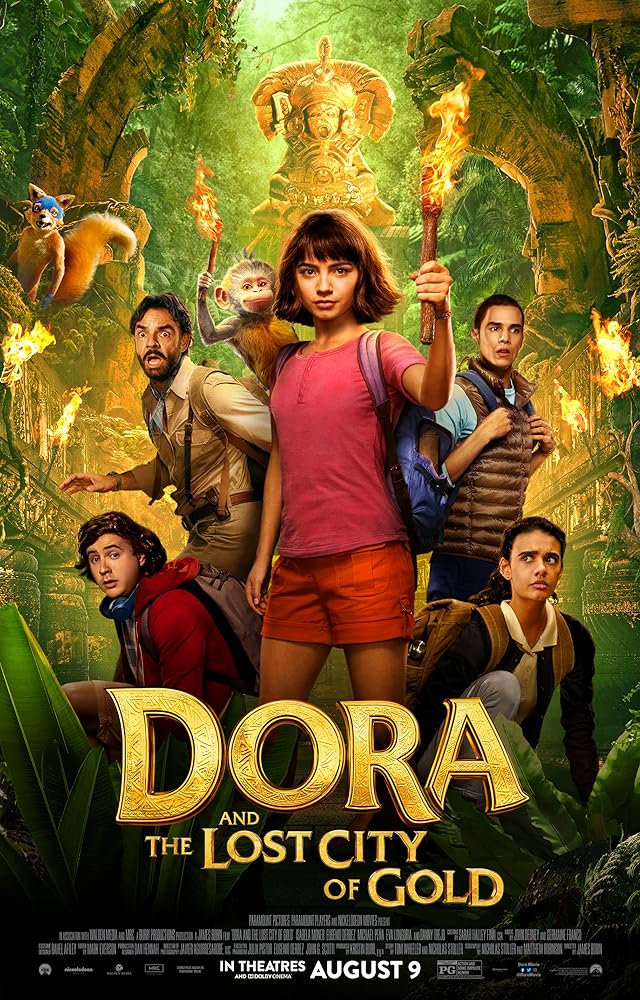
Dora and the Lost City of Gold (2019) review

Eugenio Derbez and Isabela Moner in Dora and the Lost City of Gold (2019)

This is one of those films that some of you might look at and think, “Is he seriously reviewing this one?”. Well, to that, I’d say “Yes, yes I am!” and the reason why I went to go see this one is quite simple, really; like many kids of my generation, the franchise that this film is a part of was a big part of my childhood. I’m, of course, referring to the highly successful children’s TV series Dora the Explorer. Ever since it first debuted on Nickelodeon’s Nick Jr. programming block in 2000, Dora the Explorer has gone on to become one of the network’s most popular shows geared towards younger children. It even stands as the longest-running Nick Jr. series of all-time with around 178 episodes produced over eight seasons. In other words, the adventures of a young Latina girl named Dora and her best friend, a talking monkey named Boots, have clearly made a considerable impact on the generations of kids who have grown up with them while also helping them learn some rudimentary Spanish along the way. And now, nearly two decades after her initial debut, Nick Jr.’s most famous heroine makes her live-action debut (not counting that fake trailer produced by CollegeHumor) in Dora and the Lost City of Gold. However, instead of just being a direct adaptation of the TV series, this film jumps ahead in time to when Dora is a teenager, with Isabela Moner taking on the title role. Meanwhile, directorial duties go to James Bobin while the script was co-written by Nicholas Stoller, who had previously collaborated with Bobin on Disney’s recent Muppets films. And while this is very much one of those films whose very existence has been utterly derided by most of the film fan community, it surprisingly manages to be a genuinely earnest and heartfelt adaptation of its source material.

For practically her whole life, Dora (Isabela Moner) has lived in the jungle with her explorer parents Cole (Michael Pena) and Elena (Eva Longoria), where she goes on all sorts of adventures with her best friend Boots the Monkey (voiced by Danny Trejo) while her parents search for the mythical Inca city of Parapata. They eventually manage to pinpoint the city’s location, but while Dora fully expects to join them on their adventure, they ultimately end up sending her to school in America so that she can start interacting with other kids her age. But while her trip to America does allow her to reunite with her cousin Diego (Jeff Wahlberg), Dora quickly discovers that high school is a much different world compared to the jungle. However, during a field trip to a local museum, Dora ends up getting cornered by a group of mercenaries, who proceed to kidnap her, Diego, geek Randy (Nicholas Coombe), and know-it-all Sammy (Madeleine Madden) and fly them all to Peru. Once there, Dora and company end up getting rescued by a man named Alejandro (Eugenio Derbez), who tells them that he’s a friend of Dora’s parents and that they went missing several weeks ago, with the mercenaries now on the hunt for them so that they can reach Parapata and steal its treasures. And so, Dora rallies Diego and their new friends to join her on her quest to find her parents and, in turn, the city of Parapata before the mercenaries do.

One of the most surprising aspects of Dora and the Lost City of Gold is how it manages to be very faithful to its source material. While the film doesn’t maintain the more fantastical atmosphere of the original series since it’s immediately established that the adventures Dora used to go on as a kid were the result of her imagination, it’s still full of various nods and Easter Eggs ranging from notable cameos to an intro that recreates the show’s opening title sequence. However, there are a few times where the film is rather inconsistent when it comes to adapting certain elements of the series, namely via its handling of Dora’s notorious nemesis Swiper the Fox (voiced by Benicio Del Toro). Unlike the other animal characters from the series (even Boots, who only speaks in one scene that’s fully implied to be another case where Dora’s imagining things), Swiper is portrayed as being real and working with the mercenaries, with only one major instance where other characters comment on this weird phenomenon of a talking fox. Ultimately, though, these occasional logic gaps are a minimal issue at best, because while the film does have a generally straight-forward adventure plot, it also boasts a pleasantly light-hearted atmosphere. While there are several instances where the film satirizes some of the more eccentric aspects of the show (namely, Dora’s tendency to talk directly to the camera whenever she’s talking to viewers), it never does so in a mean-spirited manner. Plus, as one might probably expect from a film that’s based on a series from Nick Jr., it also promotes some nice messages for kids, including the value of teamwork and confidently embracing one’s unique quirks.

But when it comes to the biggest highlight of the film, that honor goes to its lead actress, Isabela Moner. Simply put, Dora is one of those roles where whoever’s cast in it must truly commit to a character who talks directly to the camera, hangs out with animals more than she does with humans, and consistently maintains an unabashedly chipper persona no matter the situation. Sure enough, that is exactly what Moner does, perfectly maintaining Dora’s innately endearing persona that’s very much the heart of the film. As for Dora’s friends who get dragged along on her adventure, their character arcs are a lot simpler by comparison, from know-it-all Sammy gradually shedding her uptight persona to Diego rekindling his relationship with his cousin, who he hasn’t seen in years. Still, for what it’s worth, the film impressively manages to balance their roles in the plot incredibly well. Obviously, Dora’s still the main protagonist at the end of the day, but there’s never a point where any of the others feel like extraneous characters and the camaraderie amongst them is genuinely solid. After that, there’s plenty of reliable support from their adult co-stars, namely Eugenio Derbez as their quirky ally Alejandro and Michael Pena and Eva Longoria as Dora’s parents, whose roles in the film have been expanded upon considerably compared to the show. But if there’s one anomaly in this cast it’s, ironically, Swiper. Despite being one of the most prominent characters from the series, Swiper’s role in the film is quite limited, which then makes you wonder why they even brought in Benicio Del Toro for what ends up being a generally thankless role instead of Swiper’s usual voice actor Marc Weiner.

It goes without saying that this was one of those films that attracted tons of skepticism before its release. For most people, it seemed like an odd idea to take something like Dora the Explorer and do a live-action version of it where the character is now a teenager, especially after the trailers came out and gave off the impression that Dora would be turned into the next Lara Croft. I mean, to put this all into perspective, it was long-rumored that none other than Michael Bay was going to produce this before he confirmed that the initial report of his involvement wasn’t true. Ultimately, though, Dora and the Lost City of Gold turns out to be a solid family film. Now don’t get me wrong, even someone like me knows that this is the kind of film that really shouldn’t work at all, and yet, the film manages to avoid such a fate thanks to its uncynical tone and its surprisingly faithful adherence to the original TV series. As such, it’s very much a ‘win-win’ scenario for all involved. For director James Bobin, it’s a nice little bit of career resurgence for him after his last film, 2016’s Alice Through the Looking Glass, was both a critical and commercial disappointment. For co-writer Nicholas Stoller, this film serves as further proof that while he’s primarily known for directing raunchy R-rated comedies, he’s also managed to amass a respectable resume when it comes to writing family films thanks to the likes of this, Bobin’s Muppets films, and Captain Underpants. And for star Isabela Moner, this is easily the breakout performance of her career thanks to her pitch-perfect portrayal of the title character. Because of all this, the live-action Dora the Explorer film defies all expectations to deliver a good-natured family flick that effectively appeals to not only its target audience of young kids but also the generation that helped make Dora the pop-cultural phenomenon that she still is today.

Rating: 4/5

Tuesday, August 27, 2019

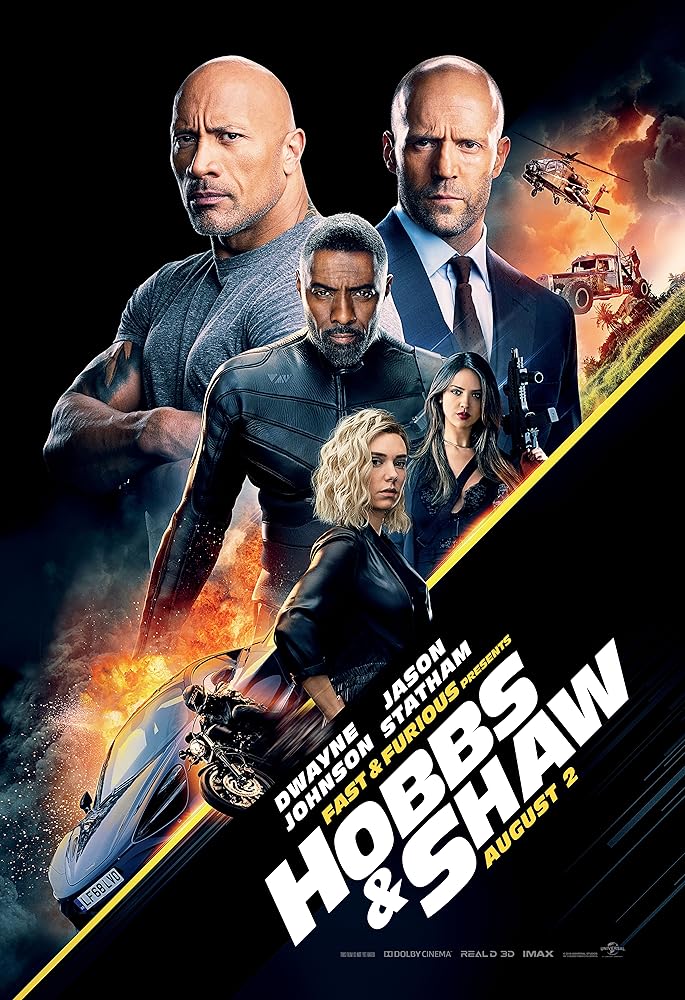
Fast and Furious Presents: Hobbs and Shaw (2019) review

Jason Statham, Idris Elba, Dwayne Johnson, Eiza González, and Vanessa Kirby in Fast & Furious Presents: Hobbs & Shaw (2019)

The Fast and the Furious franchise has undoubtedly been one of the biggest film franchises in recent memory. While it has been around since 2001, the series truly started to hit its stride with its fifth installment, 2011’s Fast Five, which surprised many by being the first entry of the series to attract generally positive reviews from critics. For many, this was largely due to a new addition to the cast in Dwayne Johnson’s Luke Hobbs, a burly, no-nonsense agent working for the Diplomatic Security Service. While initially established as somewhat of an antagonist for series lead Dominic Toretto and his gang, Hobbs ends up becoming one of their key allies for subsequent films. Another major standout for the series came in the form of Deckard Shaw, played by Jason Statham. First introduced in the mid-credit scene of 2013’s Fast and Furious 6, Shaw effectively became the main antagonist of 2015’s Furious 7 but would later transition into an anti-hero in 2017’s The Fate of the Furious. And while Shaw’s new characterization proved to be rather controversial amongst fans given that he was responsible for the death of Han, one of the series’ main protagonists, many agreed that the scenes between Johnson and Statham were the best part of the film. As such, we now come to a first for the Fast and Furious franchise via a spin-off centered on its two most popular characters, Hobbs and Shaw. For this film, directorial duties go to David Leitch, who’s fresh off last year’s superior follow-up to 2016’s superhero smash hit Deadpool. What follows is exactly what you’d expect from a Fast and Furious film; a completely ridiculous but all-around super fun popcorn flick.

During a mission to retrieve a deadly virus known as ‘Snowflake’ from the mysterious terrorist organization Eteon, a group of MI6 agents are attacked by Eteon’s top agent Brixton Lore (Idris Elba), a former MI6 agent who’s been turned into a cybernetically-enhanced super-soldier. Almost every member of the team is killed save for team leader Hattie Shaw (Vanessa Kirby), who injects herself with the virus to avoid it getting into Lore’s hands. Thus, Lore and Eteon manage to pin the whole incident on her, forcing her to go on the run. In their efforts to track her down, the CIA recruits two special operatives for the mission; DSS agent Luke Hobbs (Dwayne Johnson) and Hattie’s brother, former British Special Forces agent Deckard Shaw (Jason Statham), who also happens to have a considerable history with Lore. The only problem is that, as exemplified by their past encounters, Hobbs and Shaw do not get along in the slightest. However, given that the virus within Hattie will end up killing her in a few days and will then be unleashed upon the world to kill countless more, the two ‘frenemies’ are forced to work together just to ensure that none of this ends up happening. And because Brixton Lore and Eteon consistently prove to be a massive thorn in their side, the three realize that they’ll have to embrace their familial roots if they want to stand a chance against their enemies.    

Nowadays, the ongoing narrative surrounding the Fast and Furious films usually revolves around how incredibly over-the-top they’ve gotten. What was once a simple street-racing franchise has now evolved into a series of films where its characters pull off incredibly ludicrous stunts that defy every single law of physics, whether it’s jumping a car across tall skyscrapers or driving them out of an airplane. And because these films consistently continue to up the ante when it comes to their insane action sequences, it’s legitimately gotten to the point where fans have been speculating for years now if the franchise will ever head into space. As for Hobbs and Shaw, it’s basically a full-blown superhero film at this point since the plot revolves around the titular duo taking on a genetically enhanced soldier who’s so powerful that he straight-up boasts that he’s ‘Black Superman’. As such, this film is ultimately yet another example of what we’ve now come to expect from this franchise. Simply put, if you’re among those who aren’t even remotely fans of Fast and Furious, then you’re clearly not going to get anything out of this since it basically maintains every single one of the series’ long-standing tropes. In fact, you’ll probably just look at this and lament how this franchise keeps managing to get even sillier with each new installment. But if you are a fan of this franchise, this film does continue to feature everything that you love about it, from the cheesy comedic dialogue to the action sequences that, no matter how insane they get, are still a lot of fun to watch. And while it does occasionally feel like David Leitch is being forced to keep some of the fight sequences under the PG-13 rating, there are still plenty of cases where he gets to show off his knack for excellent stunt choreography.

But perhaps the most surprising aspect of this film is how effective it is at handling what is easily the franchise’s definitive theme, the importance of family. Yes, as fans of the franchise are undoubtedly aware, Fast and Furious has constantly prided itself on the strong camaraderie between its main characters. However, it does seem like this bond has been tested in recent years, especially after Vin Diesel and Dwayne Johnson’s heated feud on the set of The Fate of the Furious that, as it turns out, was partially due to the announcement of this spin-off. Still, there’s no denying that family has always been a key element of this franchise’s success, and Hobbs and Shaw is quite arguably one of the best entries in the series when it comes to conveying this since it directly defines the character arcs of its titular leads. Shaw’s involvement in the plot primarily stems around the need to protect his sister (who he’s been estranged from for several years) while Hobbs ends up returning to his home in Samoa and reuniting with his family, who play a major role in the film’s finale. Now to be clear, this is still Fast and Furious that we’re talking about so this is by no means an Oscar-winning script; and yet, it could be argued that this one handles the ‘family’ aspect a lot better than some other entries in the franchise. And as to be expected, Dwayne Johnson and Jason Statham continue to be excellent in the title roles thanks in large part to their excellent camaraderie and the hilarious banter that stems from it. They’re then backed by Vanessa Kirby’s equally excellent turn as new female lead Hattie Shaw, with Kirby more than holding her own against her two main co-stars when it comes to the action sequences. And to close out the main cast, Idris Elba is clearly having a lot of fun in the role of main antagonist Brixton Lore, who does prove to be a considerable threat to the main characters despite a few instances where his characterization feels a bit one-note in favor of setting up a new overarching series villain in the currently unknown director of Eteon.

While it is primarily a spin-off of the Fast and Furious series, the fact that Hobbs and Shaw revolves around the franchise’s two most popular characters ultimately resulted in a situation where many people were looking forward to this film more than the impending Fast and Furious 9, which is set for a May 2020 release. And if that wasn’t enough, it’s been confirmed that Johnson and Statham won’t be returning for the ninth film due to their commitment to this spin-off. As such, only time will tell if this will have any sort of impact on Fast and Furious 9, especially given how Johnson’s involvement with the franchise was one of the key factors behind its unexpected resurgence. But as for Hobbs and Shaw, it’s easy to see why this one attracted so much hype before its release. Bolstered by the terrific camaraderie of Dwayne Johnson and Jason Statham, this film once again reinforces why Luke Hobbs and Deckard Shaw have become one of the best mismatched buddy duos in film since Martin Riggs and Roger Murtagh. Sure, just like the other recent installments of the Fast and Furious franchise, Hobbs and Shaw doesn’t let up in the slightest when it comes to the increasingly ludicrous nature of both its plot and its action sequences. Because of this, it’s clear that those who aren’t already fans of the franchise probably won’t be swayed by this new installment. But, of course, when it comes to the franchise’s devoted fanbase, they will most likely find this to be another solid entry in the series thanks to its great cast, highly entertaining action sequences, and solid direction from David Leitch. It’s already grossed over $588 million worldwide, once again reaffirming the Fast and Furious franchise’s status as one of the most dominant film franchises around.

Rating: 4.5/5

And don’t forget that there’s still plenty of time to vote for your favorite film from the Summer of 2019 in Rhode Island Movie Corner’s annual ‘End of Summer’ Fan Poll. Just head to the following link (https://www.surveymonkey.com/r/NQ3FZN2) to make your selection. Voting ends this Saturday, August 31st; as Doctor Strange would say, “We’re in the endgame now…”

Sunday, August 11, 2019

RIMC's 6th Annual 'End of Summer' Fan Vote


The summer season is quickly coming to an end, and here on Rhode Island Movie Corner, that means exactly one thing. That’s right, folks, the time has come yet again for RIMC’s annual ‘End of Summer’ Fan Poll. For those who are new to this site, this is something that I’ve been doing every August since 2014 where I poll you, the readers, to get a general idea of what have been some of the most popular films of the summer. Obviously, there’ll be the expected contenders like the MCU films and Pixar’s latest masterpiece, but because my follow-up post covers every single film that gets a vote, this poll also allows for some lesser talked-about films to share in the spotlight. Here’s how it all goes down. Right below this paragraph will be a link that will direct you to a poll that I’ve created on the surveying website SurveyMonkey. This poll has one simple question; what was your favorite film that you saw during this past Summer? And just as a quick forewarning, there are a ton of options to choose from since I basically include every major wide release from the past three months. Despite this, however, not every notable release from this year made it into this group, but fear not, a write-in section is also included as an option for you to mention anything that I may have missed. Voting officially starts today, August 11th, and will last three weeks, concluding on the last day of this month, August 31st. After that, a follow-up post will be published sometime in the following week or two that will, as I noted earlier, cover EVERY film that got a vote. As always, I look forward to your answers so that we can see what 2019 release will be crowned as your favorite film from this past Summer.  


But before we conclude today’s proceedings, it’s only fitting that we honor tradition by looking back upon previous installments of this poll to highlight all the past winners. This is…

THE OFFICIAL RHODE ISLAND MOVIE CORNER ‘END OF SUMMER’ FAN POLL HALL OF FAME


*The inaugural edition of this poll in 2014 ended with an exciting 3-way tie which saw the top honors go to The Fault in Our Stars, the popular film adaptation of author John Green’s best-selling novel, 22 Jump Street, the hilarious follow-up to Phil Lord and Chris Miller’s equally hilarious 21 Jump Street from 2012, and Guardians of the Galaxy, which took some of the most obscure characters in the Marvel Universe and turned them into MCU superstars.

Tom Hardy in Mad Max: Fury Road (2015)

*In 2015, there was barely even a contest as film buffs across the world were completely enthralled by writer/director George Miller’s triumphant return to his legendary franchise, Mad Max. Touted as one of the best action films of all-time, Mad Max: Fury Road ended up taking home 6 Oscars at that year’s ceremony and had, at most, double the votes of any other contender from that year’s poll.


*2016 saw an interesting tie for first place. On one side, you had an obvious winner in Captain America: Civil War, Marvel Studios’ thrilling start to Phase 3 of the MCU and a superior adaptation of the controversial storyline from the comics that shares its name. On the other side, there was an unexpected fan favorite in the form of Bad Moms, a raunchy comedy starring Mila Kunis, Kristen Bell, and Kathryn Hahn as a trio of overworked mothers who decide that they’ve been long overdue for a much-deserved break from their parental responsibilities.

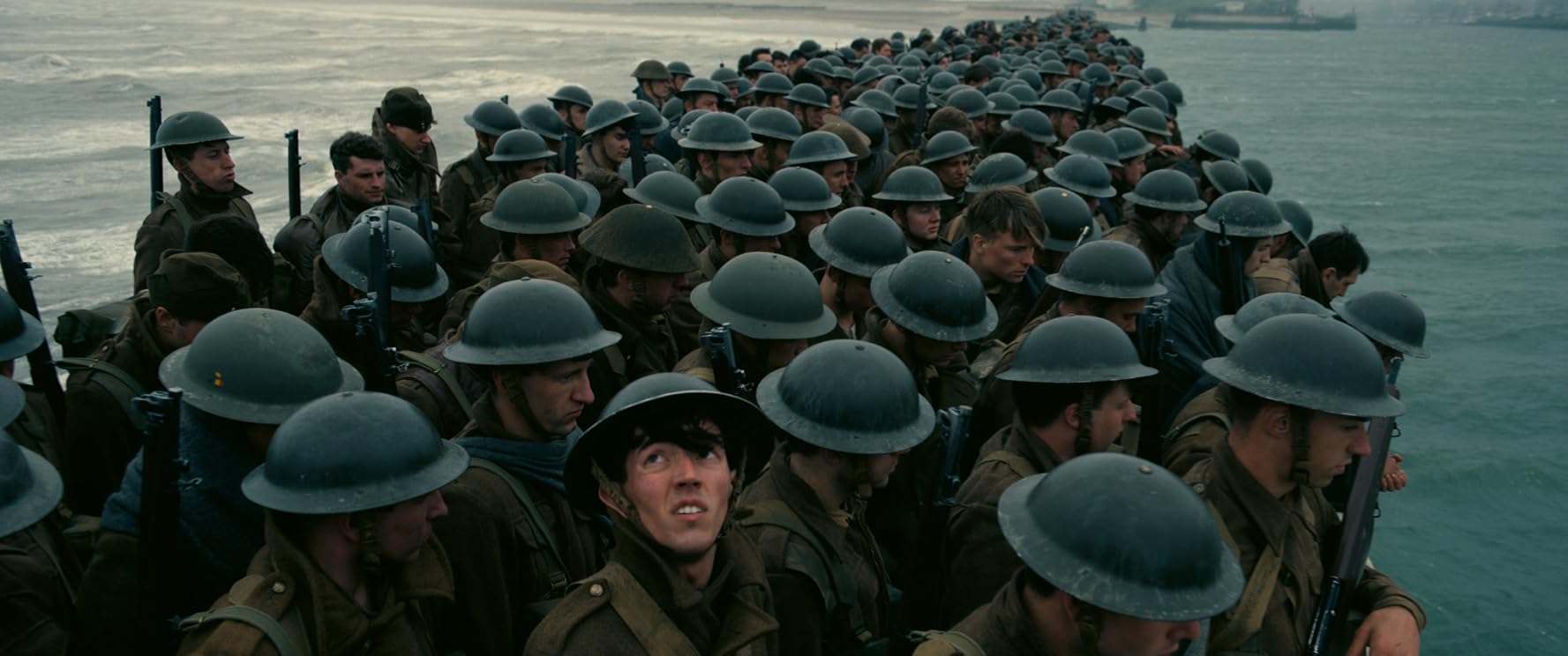
Dunkirk (2017)

*Two Warner Bros. releases ended up vying for the top spot in 2017’s poll. While some may have expected fan-favorite Wonder Woman to take top honors given how successful it was as the first well-received outing of the DC Extended Universe, it was ultimately Christopher Nolan’s intense war flick Dunkirk, based on the real-life evacuations of Allied soldiers from the titular city’s beaches, that landed at the Number 1 spot.

John David Washington and Laura Harrier in BlacKkKlansman (2018)

*Finally, when it comes to last year’s poll, some of you may be surprised to know that Marvel Studios’ epic ensemble piece Avengers: Infinity War was not the top-voted film. Instead, that honor went to writer/director Spike Lee’s critically acclaimed BlacKkKlansman. This true story about an African American police officer who managed to covertly infiltrate the ranks of the Ku Klux Klan ended up setting an event record when it comes to overall votes.

And now, we’re left to speculate about 2019’s impending selection. Will Avengers: Endgame give the MCU its first undisputed champion for this annual poll? Or will something like Quentin Tarantino’s newest effort Once Upon a Time in Hollywood give it a run for its money? Tune back in during the early weeks of September to find out…

Thursday, August 8, 2019

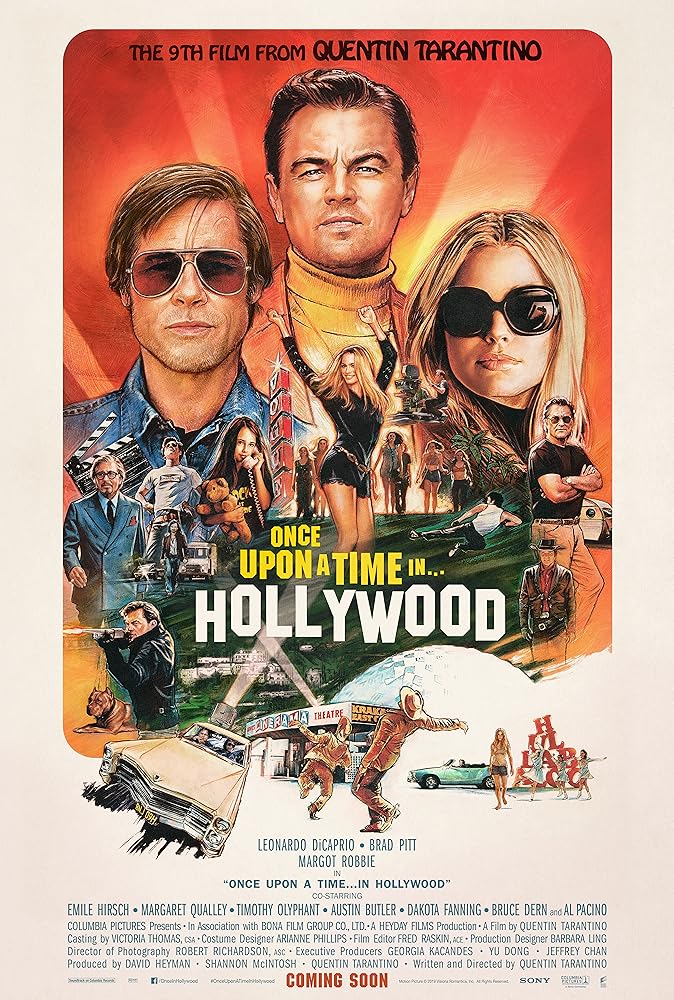
Once Upon a Time in Hollywood (2019) review

Once Upon a Time ... in Hollywood (2019)

It’s easy to point out some of the most notable trademarks of director Quentin Tarantino, whether it’s his knack for snappy dialogue or how he often goes against traditional storytelling conventions (e.g. the non-linear narrative of his 1994 classic Pulp Fiction). And yet, it can be argued that perhaps his most famous directorial trademark is his extensive knowledge of film thanks to an entire lifetime spent watching them. Because of this, every Quentin Tarantino film to date is chock-full of references to other films, whether it’s a homage to a specific genre (e.g. the Kung-Fu, spaghetti western, and revenge thriller films that inspired Kill Bill) or if they’re just simply brought up during conversations between characters. And while this aspect of Tarantino’s work has proven to be a bit more controversial in recent years, it’s still undoubtedly one of the main reasons why he continues to be one of the most prolific filmmakers in the industry, which is especially apparent in his newest film, Once Upon a Time in Hollywood. Serving as Tarantino’s ninth directorial effort (and, per his own words, his second-to-last film before he plans on retiring), Once Upon a Time in Hollywood truly is a love letter to the Golden Age of Hollywood as it’s set in its final days before the New Wave took over in the ’70s and ’80s. In the process, it also covers one of the most infamous events from that time, the rise of the sinister cult known as the Manson Family. However, when it comes to effectively combining its two main storylines into one cohesive narrative, that’s where the film admittedly starts to stumble.

The year is 1969 and the film industry has begun to undergo some radical changes. Of the various stars living in Los Angeles, none are arguably affected by this more than Rick Dalton (Leonardo DiCaprio). For years, Rick was the star of the popular Western TV series Bounty Law, but ever since the show’s cancellation (due in large part to his growing addiction to alcohol), he’s now been limited to less fulfilling villain roles on other shows like Lancer and F.B.I. And if that wasn’t enough, Rick soon discovers that his new neighbors are prominent film director Roman Polanski (Rafal Zawierucha) and his wife, rising starlet Sharon Tate (Margot Robbie). Thus, having recognized that he’s quickly becoming a has-been, Rick sets his sights on ways to rejuvenate his career, which sees him rely heavily on the support of his longtime stunt double Cliff Booth (Brad Pitt). Instead of just following the advice of casting agent Marvin Schwarz (Al Pacino) and going to shoot Spaghetti westerns in Italy, Rick plans on getting acquainted with Polanski, who’s fresh off his 1968 directorial effort Rosemary’s Baby. However, things become rather complicated when Rick and Cliff end up having a run-in with a group of hippies who have been living at an old Hollywood ranch with their ‘leader’, Charles Manson (Damon Herriman).

Once Upon a Time in Hollywood is ultimately two stories in one. One is the story of an actor struggling to resuscitate his career in an ever-changing industry while the other focuses on the dangerous Manson family and their infamous crime that was the 1969 murder of an eight-month pregnant Sharon Tate and four other witnesses. And to be perfectly blunt… these stories do not gel well in the slightest. The film ultimately focuses more on Rick Dalton’s attempts at relaunching his career, which would’ve worked perfectly as its own film. But because of this, the whole subplot involving the Manson family feels incredibly tacked on. There are only about one or two major sequences involving the Manson family in this nearly three-hour film and Charles Manson himself is literally only in one scene. This especially comes into play during the film’s finale, which has undoubtedly been its most polarizing aspect. Obviously, I won’t spoil anything from it here for those who haven’t seen the film yet, but I do understand why it’s so controversial because of the real-life context behind it and how the overall limited use of the Manson family arguably cheapens its impact. And yet, despite the film’s often inconsistent narrative, it still gives us exactly what we’ve come to expect from a Quentin Tarantino film. He still gives us plenty of great dialogue-based sequences, with many of them doing a phenomenal job when it comes to building up suspense that ultimately results in a solid bit of payoff. If anything, it’s clear that Tarantino hasn’t lost his stride when it comes to his sharp dialogue, which makes it unfortunate that the rest of the film isn’t quite as tightly focused by comparison.

Like any Tarantino film, Once Upon a Time in Hollywood is a premier case of an actors’ showcase, and it’s all highlighted by the dynamic lead duo of Leonardo DiCaprio and Brad Pitt. While this may only be the first time that these two legendary stars have worked together, their camaraderie is superb, thus perfectly conveying their characters’ tight-knit friendship. DiCaprio brilliantly handles Rick Dalton’s ‘fall from grace’ arc and is also given a bunch of opportunities to flex his comedic abilities thanks to Tarantino’s knack for dark humor. Pitt, meanwhile, brings the same cool aura that he often brings to a lot of his performances as Cliff Booth, who also has an enigmatic vibe to him thanks to a subplot (that, admittedly, feels like it doesn’t get as much attention as it should) revolving around a long-standing rumor about him. Closing out the film’s trio of leads is Margot Robbie in the role of Sharon Tate. Robbie fully commits to the role of Tate, excellently encapsulating the late starlet’s mannerisms and effervescent spirit. Unfortunately, her role in the film ends up being one of the worst cases of underutilizing an actress in recent memory as she’s barely in it, effectively serving as another example of why everything with the Manson family ends up feeling incredibly extraneous. The rest of the film’s stacked ensemble cast is basically a who’s who of recognizable faces, from Tarantino regulars like Kurt Russell and Bruce Dern to reliable supporting players like Al Pacino and Luke Perry in what is ultimately his final film role. Admittedly, most of them are just in it for a single scene apiece, but at the very least, they do make the most out of their limited screen-time.

For film fandom, a Quentin Tarantino film is practically the very definition of an ‘event film’. Whenever one’s released, it’s practically guaranteed to be one of the most anticipated films of its year and, in turn, usually ends up being one of the best-reviewed films of that year. This is certainly the case this year with Once Upon a Time in Hollywood… which makes things rather awkward for me since, unfortunately, I found it to be rather underwhelming. Now before any of you film buffs get on my butt about this, let me be clear; this doesn’t mean that I think that the film was ‘terrible’ because it’s not even close to being that. When the film presents a scene that’s classic Tarantino, it’s handled just as brilliantly as some of the most iconic moments in previous Tarantino films. However, while Once Upon a Time in Hollywood may have all the hallmarks of a classic Tarantino film, it’s fatally undermined by an unfocused script that can’t decide on which story it wants to tell. Simply put, this should’ve just been the story of an actor who’s past his prime and trying to cope with the end of Hollywood’s Golden Age. But instead of just focusing on one storyline, it also tries to incorporate another in the form of the Manson family and their murder of Sharon Tate. However, this is ultimately done in a rather haphazard manner as the Manson family subplot is extremely underdeveloped, which certainly isn’t helped by the limited screen-time of Tate despite a phenomenal turn from Margot Robbie in the role. As such, while I’m aware that I will ultimately be in the minority on this, Once Upon a Time in Hollywood ends up being one of the weaker outings of Quentin Tarantino’s career as it lacks both the punch and soul of the various classics that have defined his career. Sure, it’s generally well-made and features an excellent cast, but at the end of the day, it just feels… empty…

Rating: 2.5/5