Showing posts with label James Bobin. Show all posts

Thursday, September 5, 2019

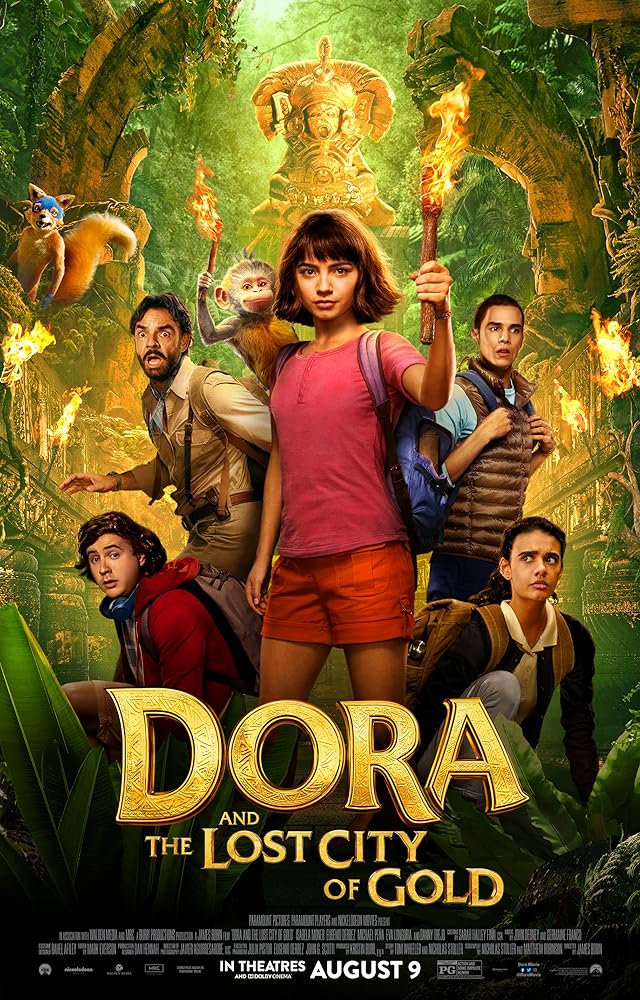
Dora and the Lost City of Gold (2019) review

Eugenio Derbez and Isabela Moner in Dora and the Lost City of Gold (2019)

This is one of those films that some of you might look at and think, “Is he seriously reviewing this one?”. Well, to that, I’d say “Yes, yes I am!” and the reason why I went to go see this one is quite simple, really; like many kids of my generation, the franchise that this film is a part of was a big part of my childhood. I’m, of course, referring to the highly successful children’s TV series Dora the Explorer. Ever since it first debuted on Nickelodeon’s Nick Jr. programming block in 2000, Dora the Explorer has gone on to become one of the network’s most popular shows geared towards younger children. It even stands as the longest-running Nick Jr. series of all-time with around 178 episodes produced over eight seasons. In other words, the adventures of a young Latina girl named Dora and her best friend, a talking monkey named Boots, have clearly made a considerable impact on the generations of kids who have grown up with them while also helping them learn some rudimentary Spanish along the way. And now, nearly two decades after her initial debut, Nick Jr.’s most famous heroine makes her live-action debut (not counting that fake trailer produced by CollegeHumor) in Dora and the Lost City of Gold. However, instead of just being a direct adaptation of the TV series, this film jumps ahead in time to when Dora is a teenager, with Isabela Moner taking on the title role. Meanwhile, directorial duties go to James Bobin while the script was co-written by Nicholas Stoller, who had previously collaborated with Bobin on Disney’s recent Muppets films. And while this is very much one of those films whose very existence has been utterly derided by most of the film fan community, it surprisingly manages to be a genuinely earnest and heartfelt adaptation of its source material.

For practically her whole life, Dora (Isabela Moner) has lived in the jungle with her explorer parents Cole (Michael Pena) and Elena (Eva Longoria), where she goes on all sorts of adventures with her best friend Boots the Monkey (voiced by Danny Trejo) while her parents search for the mythical Inca city of Parapata. They eventually manage to pinpoint the city’s location, but while Dora fully expects to join them on their adventure, they ultimately end up sending her to school in America so that she can start interacting with other kids her age. But while her trip to America does allow her to reunite with her cousin Diego (Jeff Wahlberg), Dora quickly discovers that high school is a much different world compared to the jungle. However, during a field trip to a local museum, Dora ends up getting cornered by a group of mercenaries, who proceed to kidnap her, Diego, geek Randy (Nicholas Coombe), and know-it-all Sammy (Madeleine Madden) and fly them all to Peru. Once there, Dora and company end up getting rescued by a man named Alejandro (Eugenio Derbez), who tells them that he’s a friend of Dora’s parents and that they went missing several weeks ago, with the mercenaries now on the hunt for them so that they can reach Parapata and steal its treasures. And so, Dora rallies Diego and their new friends to join her on her quest to find her parents and, in turn, the city of Parapata before the mercenaries do.

One of the most surprising aspects of Dora and the Lost City of Gold is how it manages to be very faithful to its source material. While the film doesn’t maintain the more fantastical atmosphere of the original series since it’s immediately established that the adventures Dora used to go on as a kid were the result of her imagination, it’s still full of various nods and Easter Eggs ranging from notable cameos to an intro that recreates the show’s opening title sequence. However, there are a few times where the film is rather inconsistent when it comes to adapting certain elements of the series, namely via its handling of Dora’s notorious nemesis Swiper the Fox (voiced by Benicio Del Toro). Unlike the other animal characters from the series (even Boots, who only speaks in one scene that’s fully implied to be another case where Dora’s imagining things), Swiper is portrayed as being real and working with the mercenaries, with only one major instance where other characters comment on this weird phenomenon of a talking fox. Ultimately, though, these occasional logic gaps are a minimal issue at best, because while the film does have a generally straight-forward adventure plot, it also boasts a pleasantly light-hearted atmosphere. While there are several instances where the film satirizes some of the more eccentric aspects of the show (namely, Dora’s tendency to talk directly to the camera whenever she’s talking to viewers), it never does so in a mean-spirited manner. Plus, as one might probably expect from a film that’s based on a series from Nick Jr., it also promotes some nice messages for kids, including the value of teamwork and confidently embracing one’s unique quirks.

But when it comes to the biggest highlight of the film, that honor goes to its lead actress, Isabela Moner. Simply put, Dora is one of those roles where whoever’s cast in it must truly commit to a character who talks directly to the camera, hangs out with animals more than she does with humans, and consistently maintains an unabashedly chipper persona no matter the situation. Sure enough, that is exactly what Moner does, perfectly maintaining Dora’s innately endearing persona that’s very much the heart of the film. As for Dora’s friends who get dragged along on her adventure, their character arcs are a lot simpler by comparison, from know-it-all Sammy gradually shedding her uptight persona to Diego rekindling his relationship with his cousin, who he hasn’t seen in years. Still, for what it’s worth, the film impressively manages to balance their roles in the plot incredibly well. Obviously, Dora’s still the main protagonist at the end of the day, but there’s never a point where any of the others feel like extraneous characters and the camaraderie amongst them is genuinely solid. After that, there’s plenty of reliable support from their adult co-stars, namely Eugenio Derbez as their quirky ally Alejandro and Michael Pena and Eva Longoria as Dora’s parents, whose roles in the film have been expanded upon considerably compared to the show. But if there’s one anomaly in this cast it’s, ironically, Swiper. Despite being one of the most prominent characters from the series, Swiper’s role in the film is quite limited, which then makes you wonder why they even brought in Benicio Del Toro for what ends up being a generally thankless role instead of Swiper’s usual voice actor Marc Weiner.

It goes without saying that this was one of those films that attracted tons of skepticism before its release. For most people, it seemed like an odd idea to take something like Dora the Explorer and do a live-action version of it where the character is now a teenager, especially after the trailers came out and gave off the impression that Dora would be turned into the next Lara Croft. I mean, to put this all into perspective, it was long-rumored that none other than Michael Bay was going to produce this before he confirmed that the initial report of his involvement wasn’t true. Ultimately, though, Dora and the Lost City of Gold turns out to be a solid family film. Now don’t get me wrong, even someone like me knows that this is the kind of film that really shouldn’t work at all, and yet, the film manages to avoid such a fate thanks to its uncynical tone and its surprisingly faithful adherence to the original TV series. As such, it’s very much a ‘win-win’ scenario for all involved. For director James Bobin, it’s a nice little bit of career resurgence for him after his last film, 2016’s Alice Through the Looking Glass, was both a critical and commercial disappointment. For co-writer Nicholas Stoller, this film serves as further proof that while he’s primarily known for directing raunchy R-rated comedies, he’s also managed to amass a respectable resume when it comes to writing family films thanks to the likes of this, Bobin’s Muppets films, and Captain Underpants. And for star Isabela Moner, this is easily the breakout performance of her career thanks to her pitch-perfect portrayal of the title character. Because of all this, the live-action Dora the Explorer film defies all expectations to deliver a good-natured family flick that effectively appeals to not only its target audience of young kids but also the generation that helped make Dora the pop-cultural phenomenon that she still is today.

Rating: 4/5

Wednesday, June 1, 2016

Alice Through the Looking Glass (2016) review

(Disclaimer: The following review of Alice Through the Looking Glass will not be addressing the recent domestic abuse scandal surrounding its star Johnny Depp. Just like the sexual abuse lawsuits that Bryan Singer dealt with prior to the release of X-Men: Days of Future Past, Depp’s domestic issues are not connected to this film in any way.)


In 2010, Disney released what would become their first big ‘live-action reimagining’ of one of their classic animated films; Alice in Wonderland. Directed by Tim Burton, the film was a ‘sequel’ to the original story of the same name written by Lewis Carroll (which of course served as the basis for Disney’s 1951 animated classic) and followed a teenaged Alice as she returned to the world of Wonderland, or to be more specific, ‘Underland’, as it’s referred to in the film. Upon its initial release, the film received mixed reviews, attracting praise for its visual style but also criticism for its writing. But when it comes to its box-office performance, that’s another story because the film actually managed to join the billion-dollar club. I’m still in shock that it was able to do so given its extremely polarizing reception, though from what I hear this was primarily due to the fact that A.) since it was released in March, there wasn’t much competition in terms of family-friendly releases and B.) it was also released in 3-D, which was still a big deal at the time thanks to James Cameron’s Avatar unlike nowadays where it rarely gets attention anymore. So because of it, we now have a sequel in the form of Alice Through the Looking Glass, though like the previous film, this film is only loosely inspired by the story that shares its name (in this case, Carroll’s 1871 sequel, Through the Looking Glass). Tim Burton isn’t in the director’s chair this time around, however. Instead, in his place is James Bobin, who most recently helmed Disney’s last two Muppets films; 2011’s The Muppets and 2014’s Muppets Most Wanted. And like the first Alice, this film has been subjected to generally mixed to negative reviews from critics. It’s clear that when it comes to these films, people either really love them or really hate them. As for me, I’ll admit I lean more towards the former. Because while the film definitely isn’t perfect, there are still some genuinely good things about it that make it worth seeing.

The film opens up three years after the events of the previous film, which ended with young Alice Kingsleigh (Mia Wasikowska) taking up her late father’s business in overseas trade. However, when she returns home to London, she learns that her ‘former’ fiancĂ©, Hamish Ascot (Leo Bill), has taken over his father’s company and plans on buying her father’s ship. Amidst all of this, Alice soon finds herself summoned back to the world of Underland to help deal with a pressing matter regarding the Mad Hatter (Johnny Depp). She learns that the Hatter has been in a funk recently, claiming that the rest of his family, who supposedly died during the Jabberwocky attack (as seen in the previous film), is still alive. With his health slowly deteriorating, Alice, following the suggestion of Mirana the White Queen (Anne Hathaway), travels to the castle of the physical manifestation of Time itself (Sacha Baron Cohen) in order for her to travel back in time with the use of his ‘Chronosphere’ device, which powers all of the time in Underland. In doing so, she finds herself traveling through time, back to when the Hatter, the White Queen, and the rest of their Underland friends were young, in order to save the Hatter’s family from their supposed doom. But in doing so, Alice not only runs amok of Time himself but also finds herself once again crossing paths with Iracebeth the Red Queen (Helena Bonham Carter), who seeks to use the Chronosphere herself in order to change a certain event in her past that caused her to become the big-headed (figuratively and literally) tyrant that she is today.

Like the first film, this film definitely deserves recognition for its visuals and overall visual style. Clearly a lot of time went into making all of the film’s intricate visual effects and they do look really nice. With that said, however, like the first film, some might find all of the film’s CGI, which was pretty much done in the same way that the Star Wars prequels were by having the majority of Underland done in CG save for the human cast members, to be a bit overkill at times. And admittedly the writing is about the same as it was in the first film, tending to be rather messy and sometimes even a bit meandering at times in terms of its plot. However, even with that in mind, the film does at least have one major advantage over its predecessor and that is that it carries a much more pleasant color scheme in terms of its visuals. Whereas the previous film was very much a Tim Burton film with all of its gothic designs, this film has a much more vibrant look to it as a whole, which is definitely an upgrade if you ask me. Plus, the film doesn’t pull any of the rather extreme punches that the original did that did make you question if it was right to be rated PG, namely infamous scenes in which the Dormouse takes out one of the Bandersnatch’s eyes and another scene where Alice crosses the Red Queen’s moat on the heads of her unfortunate victims. So because of that, this film will definitely be easier for kids to handle than the first film. And at the very least, regardless of the film’s scriptural flaws, there really are some good messages for younger audiences, like being true to yourself and your friends and the fact that it’s okay to be a little weird sometimes. There’s actually even a few rather effective heartfelt moments.

A good chunk of the film’s heart and strong messages are exemplified by its main female lead Alice. While in the first film she spent a considerable amount of time questioning the fact that she was in Underland, resulting in her being a bit too passive of a protagonist at times, this film’s Alice is much more assertive and as a result actually becomes a pretty great ‘role model’ for young women. There’s a really great sense of confidence to her, not only in how the character is portrayed this time around but also in Wasikowska’s performance. As for Johnny Depp as the Hatter, it’s exactly what you would come to expect nowadays from Johnny Depp whenever he steps into a role that allows him to don quirky costumes, makeup, and/or accents. At this point you’re either fine with it or you’re really sick of it; me I don’t mind it. Plus, the Hatter is much more toned down this time around, though admittedly that’s primarily because he does spend most of the first half of the film in a muted state. In fact, this film definitely feels a bit more toned down in terms of how campy some of the performances are compared to the original. Though with that said, Helena Bonham Carter still relishes her role as the Red Queen, camping it up whenever she’s onscreen. The same goes for Sacha Baron Cohen as Time, although not as much as Carter. In short, I can say that, at the very least, the ensemble cast is a bit stronger this time around, mostly as a result of Bobin not cranking these characters’ personalities up to 11, which is sort of what Burton did with the previous film.

So here’s the deal with these live-action Alice films. As both of their critical receptions clearly suggest, these two films very much have their critics and quite a few of those critics have been very vocal in expressing their dislike of them. However, at the same time, it’s also clear that these films actually do have a pretty decently sized fan-base. This really can partially explain why the first film did as well as it did at the box-office and while this film hasn’t been doing anywhere near as good as the first film did from a commercial standpoint, I can tell that there will still be quite a lot of people who are going to like this film. And as someone who did like the first film, I can see why. Yes, the film does share some of its predecessor’s issues, namely in terms of the writing. Plus, like before, critics of CGI are no doubt going to take issue with the film’s very extravagant use of CG. However, this film really isn’t as bad as its low 30% rating on Rotten Tomatoes may suggest. Because despite its flaws, the film definitely deserves merit for its impressive visuals. Visually speaking, this is easily one of the best-looking films of the year. And in some ways the film actually does improve on its predecessor, namely in regards to a much brighter color scheme and a much more confident lead performance courtesy of Mia Wasikowska as Alice. So in short, if you weren’t a fan of the first film, then suffice it to say this film ain’t gonna win you over because it’s very much a sequel to Burton’s original film and fans of the books in particular are most certainly not going to be pleased with how the world and its characters are being portrayed. But if you’re someone who was a fan of the first film, then I’m sure you’re going to like this film just as much.


Rating: 3.5/5

(Closing Note: On a sad note, this film serves as the final performance of Alan Rickman, who reprises his role from the previous film as Absolem the Caterpillar (now a Butterfly). The reason why I didn't bring him up in the review is because, well, he actually isn't in the film that much. He only appears in the scene in which Alice first returns to Underland.)