Showing posts with label Nicole Kidman. Show all posts

Wednesday, December 16, 2020

The Prom (2020) review (Netflix)


On November 15th, 2018, a new musical titled The Prom officially opened on Broadway at the Longacre Theatre. With music by Matthew Sklar, lyrics by Chad Beguelin, and a script by Beguelin and Bob Martin based off an original concept by Jack Viertel, The Prom tells the story of a young lesbian student who is banned from attending her high-school prom but is helped in her efforts to fight back against this ruling by a group of Broadway stars. The musical was largely inspired by a similar incident that happened to Constance McMillen in 2010 when she was a senior at Itawamba Agricultural High School in Fulton, Mississippi, which attracted a bunch of supportive responses from celebrities. And upon its debut, the show proved to be a solid hit with critics. It was the first musical of that Broadway season to earn a Critics Pick honor from the New York Times, and while it didn’t win any Tony Awards, it earned 7 nominations including one for Best Musical. It also attracted plenty of attention at the 2018 Macy’s Thanksgiving Day Parade when stars Caitlin Kinnunen and Isabelle McCalla partook in the first LGBTQ kiss in the parade’s history. And now, in 2020, it’s been brought to life on film in a star-studded adaptation directed by Ryan Murphy. While it’s only his fourth feature-length directorial effort, Murphy has been touted as one of the most prominent creative forces in television having created hit shows like Glee and American Horror Story while also being a champion for the cause of greater inclusion within the film and television industry. The Prom serves as one of the first major projects that Murphy has developed for Netflix via the lucrative $300 million deal that they signed him to in 2018, and with a delightful cast and a great execution of its source material’s timely themes, we have ourselves a truly heartwarming musical extravaganza.  

In the conservative-minded town of Edgewater, Indiana, high-school student Emma Nolan (Jo Ellen Pellman) finds herself in an utterly devastating situation when her desire to attend her high-school prom with her girlfriend Alyssa Greene (Ariana DeBose) results in the local Parent-Teacher Association canceling it entirely, thus turning her into a full-blown social pariah. And if that wasn’t enough, the head of the PTA happens to be Alyssa’s mother (Kerry Washington), who is completely unaware of her daughter’s relationship with Emma. However, when all seems lost, Emma finds herself blessed with the most unexpected showing of support in the form of a quartet of actors from Broadway; specifically, self-centered stars Dee Dee Allen (Meryl Streep) and Barry Glickman (James Corden), long-time chorus girl Angie Dickinson (Nicole Kidman), and Julliard alum Trent Oliver (Andrew Rannells). In the immediate wake of a disastrous opening night for their latest Broadway production that results in them being labeled as a pair of narcissists by various critics, Dee Dee and Barry learn of Emma’s predicament and, along with Angie and Trent, decide to head to Edgewater on her behalf. But while they’re initially in it solely for the intent of salvaging their reputations by partaking in ‘a cause’, the group genuinely begins to bond with Emma and, with the help of her highly supportive principal Mr. Hawkins (Keegan-Michael Key), begin working tirelessly to make her prom dreams come true.  

Right off the bat, the best thing that I can say about this film is that it truly delivers on its strong themes that couldn’t be any more relevant given everything that’s been happening in the world recently. Obviously, one’s thoughts on how effective content like this is in highlighting the LGBTQ community may vary, but in this instance, I do believe that The Prom (which I would personally describe as a ‘modern-day version of Footloose’) is very much genuine in its themes of love and acceptance. And when paired with a filmmaker like Ryan Murphy who, as noted earlier, is big on inclusion, you get an adaptation that hits all the right emotional beats from the cathartically heartwarming to the utterly devastating. Admittedly, I can’t say much about how effective the film is as an adaptation of the musical since I haven’t seen the latter, but aside from expanding upon some plotlines such as Barry Glickman’s own struggles as a gay man and how it impacted his relationship with his parents, it seems like the film is as faithful to its source material as it could possibly be. Sure, it probably could’ve benefitted from some tighter editing here and there to make up for any parts of the film that start to drag a bit, but as a musical, it goes without saying that this is where The Prom shines the most. Matthew Sklar and Chad Beguelin’s songs are undeniable earworms and are a great mix of grand showstoppers and emotionally powerful melodies. And under Ryan Murphy’s solid direction, we get a film that, simply put, is just a highly entertaining musical comedy anchored by its lovable bunch of main protagonists.

That said, though, while the film does sport a star-studded ensemble cast, said cast has admittedly garnered some controversy from fans of the musical over the decision to have A-listers play the lead roles rather than Broadway stars. There are some Broadway alumni in this, to be fair, such as Andrew Rannells and Ariana DeBose, but it’s primarily headlined by those who have more experience in film than they do in theater. Still, for what it’s worth, practically everyone involved is clearly having a lot of fun in their respective roles. Whether it’s Meryl Streep being her usual scene-stealing self or Keegan-Michael Key serving as the straight man to all the shenanigans that the Broadway stars get into, you can’t fault this film for having an incredibly fun ensemble. However, when it comes to the film’s biggest standout, that honor goes to its biggest newcomer, Jo Ellen Pellman. It is almost entirely because of her that we care about Emma and her endeavors because she makes her a wholly sympathetic heroine right off the bat. In other words, she’s very much the heart of the film. But now we must address the elephant in the room that is the biggest source of controversy that this film has been attracting in the wake of its release; the casting of James Corden as the gay leading man of Broadway, Barry Glickman. Simply put, unlike Barry, Corden is not a gay man whereas the other LGBTQ characters in this story are more accurately cast (ironically, one of Corden’s main co-stars is Andrew Rannells and he’s playing a character whose sexuality is never made explicit). Now I’m not going to get into this whole situation that much since, as I’ve noted in the past, I usually don’t like to talk about sociopolitical matters such as this in these reviews. So instead, I’ll just say that while I’m not defending Corden’s performance in this, I’d argue that the rest of the cast makes up for any shortcomings that directly stem from him. Was he the ideal pick for the part? No, not at all, but at the same time, I also wouldn’t call this a case where his performance derails the film entirely even though Barry is arguably the most prominently featured member of the Broadway quartet.

I’ll admit that I don’t have a lot of experience with the world of Broadway, which could largely be attributed to the fact that I don’t live in New York where, at least before COVID became a thing, I would have a lot more opportunities to see Broadway shows regularly rather than just occasionally seeing a touring production of a popular show at my local theatres. And yet, as some of the past reviews that I’ve done for this site have arguably proven, I’m a big fan of the musical genre and have liked a fair share of adaptations of Broadway musicals such as the ever-enduring classic Grease and Tim Burton’s delightfully twisted take on Sweeney Todd. As such, it should probably go without saying that I thoroughly enjoyed the film adaptation of The Prom. While I admittedly haven’t seen the original show at the time of this review’s publication, the fact that all three of the key figures behind it (Matthew Sklar, Chad Beguelin, and Bob Martin) were involved in the film’s production makes it clear that this adaptation was in the right hands, and because of this, The Prom is the very definition of a feel-good film. With powerful themes, undeniably catchy tunes, and a great cast, The Prom is a film that very much wears its heart on its sleeve. I mean, there’s really nothing more that I can say about this film other than the fact that it’s a highly entertaining musical that excellently represents the wonderfully diverse nature of our ever-expanding pop cultural landscape. And to be perfectly blunt, folks, in the utterly terrible year that has been 2020, I’d argue that this is one of the best examples of a film that I can easily recommend to anyone out there who’s in desperate need of a pick-me-up.  

Rating: 5/5!

Friday, January 18, 2019

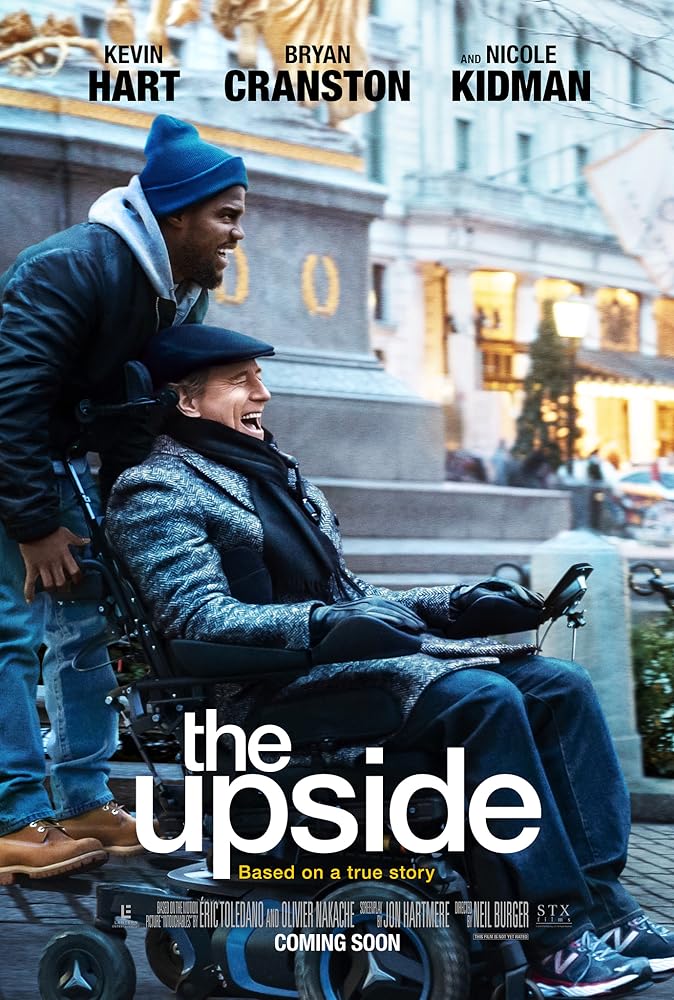
The Upside (2019) review

Bryan Cranston and Kevin Hart in The Upside (2017)

(Howdy, folks! This one’s going to be a little shorter than the usual review only because I’m currently working on my End of the Year lists.)

Today’s film, The Upside, is an interesting one to talk about mainly because of its source material. In 2011, French filmmakers Olivier Nakache and Eric Toledano released their latest project, The Intouchables. The film starred Omar Sy as a man who, after being released from prison, ends up getting hired to be the caretaker for a quadriplegic millionaire, played by François Cluzet. Inspired by the real-life story of businessman Philippe Pozzo di Borgo and his caretaker Abdel Sellou, the film did quite well with critics upon its release and Sy ended up winning the Cesar Award (AKA the French Oscars) for Best Actor. However, it was an even bigger hit from a financial perspective, grossing the equivalent of $412.9 million at the worldwide box-office and becoming the second highest-grossing French film of all-time behind 2008’s Welcome to the Sticks. Since its release, a few remakes have been produced by other countries, including a 2015 Indian remake, Oopiri, a 2016 Argentinian remake, Inseparables, and an impending Bollywood adaptation. As for an American adaptation, directorial duties ultimately went to Neil Burger, whose filmography includes the 2006 romantic period piece The Illusionist, 2011’s sci-fi thriller Limitless, and the first installment of the Divergent series, with Kevin Hart and Bryan Cranston taking on the lead roles. And although the film spent a few years in limbo due to a shift in distributors, it’s now seen the light of day as one of the first releases of 2019 and an enjoyable little crowd-pleaser that benefits heavily from its excellent lead duo.

At the time that I’m writing this, I have not seen the original Intouchables, though I was at least made aware of it back when it was released because of its financial success. Even with this in mind, however, it’s clear that this new film isn’t that different from the original, as it still follows the same plot of a recently paroled man (Kevin Hart) who inadvertently becomes the caretaker of a recently paralyzed millionaire (Bryan Cranston). As such, the film’s plot is admittedly very predictable. It’s your standard buddy comedy about two mismatched characters who gradually learn to get along and help each other better themselves in life in the process, and thus, it’s quite easy to tell where it’s going to go narratively. Still, for what it’s worth, the film does a nice job when it comes to balancing its comedy with its drama. The humor in this is solid, for the most part, and there are also some very effective emotional moments peppered in as well. Ultimately, though, this film mainly succeeds because of the excellent camaraderie of Kevin Hart and Bryan Cranston. While the film does give him the chance to do some solid dramatic work, Hart is his usual animated self here and this is matched nicely with Cranston’s dry wit. And while most of her role in the film consists of her reacting to Hart’s shenanigans, Nicole Kidman makes the most out of her supporting role as Yvonne, the loyal assistant of Cranston’s character Phillip. In conclusion, The Upside certainly fits the bill when it comes to a January release. It’s not going to win any major awards, but if you’re just looking for a decent little dramedy, then the dynamic lead duo of Kevin Hart and Bryan Cranston does make this one worth checking out.


Rating: 3.5/5

Thursday, January 10, 2019

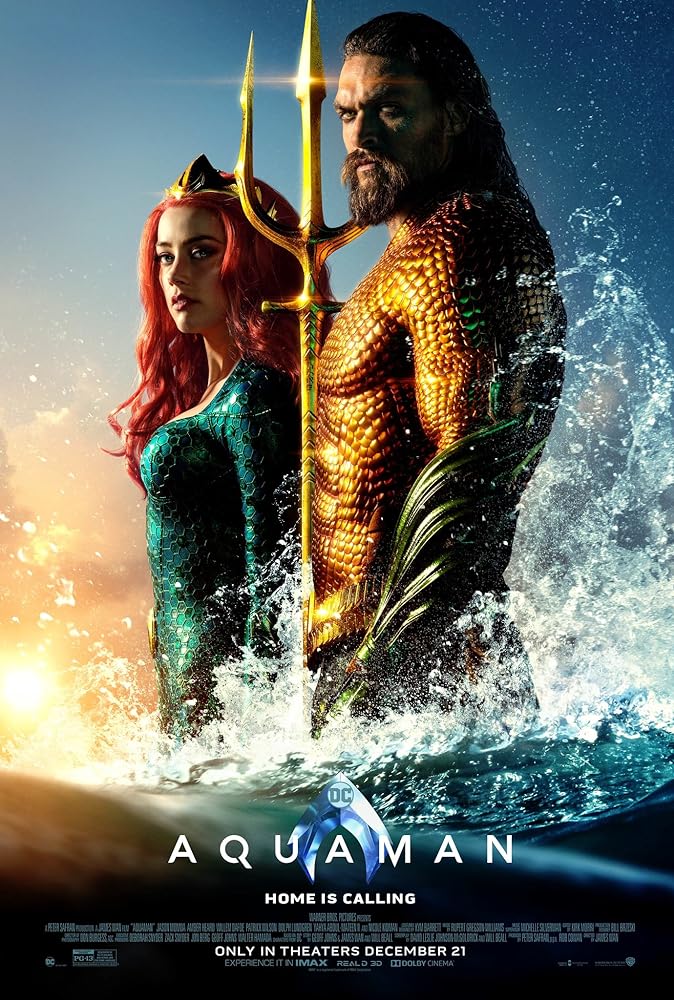
Aquaman (2018) review

Jason Momoa and Amber Heard in Aquaman (2018)

In 1941, writer Mort Weisinger and artist Paul Norris created the character of Aquaman, the king of the underwater kingdom of Atlantis with the ability to communicate with the various creatures of the sea. Over the next few decades, Aquaman’s role in the DC Comics universe began to grow significantly to the point where he became one of the seven founding members of the Justice League, and he has continued to be one of DC’s most prominent superheroes ever since. But as for his overall reception amongst audiences… well, that one’s a bit more complicated because, despite his long history in the world of comics, Aquaman has been deemed ‘a joke’ in the pop cultural zeitgeist for supposedly being nothing more than ‘the guy who talks to fish’. This was mainly brought on by the character’s roles in his titular animated series from 1967 and the Hanna-Barbera produced Super Friends series that ran from 1973 to 1986. And despite DC’s efforts to work around this image through various reboots and such, shows like Robot Chicken and The Big Bang Theory continue to enforce this long-standing view on DC’s aquatic superhero. As for getting the King of Atlantis on the big-screen, that journey has been just as bumpy. Simply put, it’s truly saying something when the most prominent on-screen appearance of Aquaman prior to 2016… was the in-universe feature film directed by James Cameron in HBO’s hit series Entourage where he was played by the series’ main protagonist Vincent Chase.

But things finally changed when DC began to develop its own cinematic universe a la Marvel. Game of Thrones alum Jason Momoa was cast in the role of Arthur Curry AKA Aquaman and made his first appearance in the DC Extended Universe via a cameo in 2016’s Batman v Superman: Dawn of Justice. There, he first appeared alongside Ezra Miller’s Flash and Ray Fisher’s Cyborg in a series of videos that Batman had uncovered (and were then subsequently viewed by Wonder Woman) from the files of Lex Luthor’s company LexCorp on their investigations into the presence of ‘metahumans’ AKA the franchise’s term for super-heroes. Momoa was then promoted to one of the lead roles in the 2017 follow-up Justice League, and while neither film fared very well with critics, Momoa did manage to work well alongside his co-stars. But now The King of the Seven Seas finally gets the chance to grace his own solo film with the sixth installment of the DC Extended Universe, Aquaman. Horror veteran James Wan steps in to direct a film that certainly has quite a lot of baggage behind it going in. For starters, like Wonder Woman, it finds itself tasked with getting the franchise back on track after the considerably disappointing critical and financial performance of Justice League. But, of course, as it’s been made clear in this intro, possibly its biggest hurdle is proving that one of the most widely-mocked superheroes of all-time can be taken seriously. And with strong visuals and a well-balanced tone and atmosphere, it can be argued that Wan did succeed in that regard.

Arthur Curry (Jason Momoa) was born as a child of two worlds. This became the case when his father Thomas (Temuera Morrison), a lighthouse keeper from Maine, rescued a woman from a violent storm in 1985. Little did he know that the woman, Atlanna (Nicole Kidman), is the queen of the underwater kingdom of Atlantis. And as she later tells their son Arthur, he’ll eventually grow up to become the one who will unite their two worlds. However, after she ends up leaving both him and his father to return to Atlantis, Arthur ends up ignoring his Atlantean heritage over the years as he becomes the legendary warrior of the sea, Aquaman. Eventually, though, Arthur finds himself having to finally face his destiny when Mera (Amber Heard), princess of the Atlantean kingdom of Xebel, comes to him and warns about his half-brother Orm (Patrick Wilson), the current ruler of Atlantis who plans on initiating a war against the surface world. Specifically, Orm seeks to gain the support of at least four of the other kingdoms of Atlantis so that he can have a grand army and be granted the title of ‘Ocean Master’. And when it becomes clear that Arthur isn’t exactly prepared to take down Orm with his mother’s trident as his only weapon, he and Mera end up on an adventure around the world to find the trident that belonged to King Atlan (Graham McTavish), the original king of Atlantis. Because as it’s established by Arthur’s mentor Nuidis Vulko (Willem Dafoe), Atlantis’ royal advisor, Atlan’s trident is Arthur’s only hope of reclaiming his birthright as the true king of Atlantis.

Aquaman is truly an ambitious entry in the superhero genre as far as its action set-pieces are concerned. This film is full of incredibly elaborate action sequences that feature everything from sweeping camera movements to some very impressive long-takes. And while quite a lot of these action sequences are filled to the brim with CGI creatures in what is usually an equally CG-based environment, the visual effects team clearly brought their A-game to this project. When these effects are combined with Don Burgess’ solid cinematography, it results in some of the most incredibly striking visuals to ever grace a superhero film. Plus, as was the case when the Russo brothers first started to direct MCU films or when Christopher Nolan went from Batman Begins to The Dark Knight, this film’s action sequences show the growth that James Wan has clearly made as an action director after his previous foray into the genre, 2015’s Furious 7. And as far as this film’s tone is concerned, those who were put off by the dour proceedings of Zack Snyder’s DCEU films will be pleased to know that this film is ultimately more in line with the much more successful Wonder Woman in that department. While it does treat the storyline of Aquaman uniting the kingdoms of Atlantis as seriously as possible, the film maintains a fun, light-hearted atmosphere throughout that harkens back to classics like the Indiana Jones films, especially during Arthur and Mera’s journey around the world to find King Atlan’s trident.  

From what I’ve gathered, it seems like Jason Momoa’s first major DCEU appearance in Justice League was decently well-received. Some may have been a bit turned off by Momoa giving the character a ‘surfer bro’ personality, but he managed to do his best with the limited material that he was given. Thankfully, though, as was the case with Gal Gadot when she got her own solo film as Wonder Woman, Momoa fares a lot better in his own solo film, as the character development that he didn’t get in Justice League is finally put in here with the conflict of him being a child of two worlds and how he ends up becoming the reluctant hero of Atlantis. All of this is handled very well and it’s clear that Momoa is having a lot more fun this time around as his comedic banter is much stronger here than it was in Justice League. In fact, it even gets to the point where the character’s controversial ‘surfer bro’ persona feels much more natural when compared to his previous appearances in the franchise. Amber Heard also thankfully gets a much more fruitful role here than she did in Justice League as Mera. In that film, she was a blank slate in what was literally her only scene in the damn film when Steppenwolf attacked Atlantis to collect one of the Mother Boxes. Here, she’s a confident, no-nonsense badass who is repeatedly shown to be much more adept than Arthur at practically everything while also getting a nice little arc in which their adventure allows her to gain a greater appreciation for the human world. And thanks to their characters’ strong back-and-forth dynamic, Heard and Momoa have excellent chemistry. They’re then backed by a solid supporting cast that includes Willem Dafoe as Arthur’s loyal mentor Nuidis Vulko, Nicole Kidman as Arthur’s mother Atlanna, whose role in the film is thankfully not just a brief cameo limited to flashbacks to Arthur’s youth, and Dolph Lundgren in another solid turn this year after Creed II as Mera’s father, King Nereus of Xebel.  

And then you have the film’s two main villains… who, sadly, are the weakest links in the film despite good performances from their respective actors. First, there’s Aquaman’s most famous enemy from the comics, mercenary David Kane AKA Black Manta (Yahya Abdul-Mateen II). And to the character’s credit, the film does set up Kane incredibly well, with his conflict with Aquaman ultimately defined by one gutsy move that Arthur makes during their first encounter that heavily affects Kane on an emotional level. After that, once Kane puts on his signature suit, it leads to one heck of a confrontation with Aquaman and Mera in what is easily one of the film’s best action sequences… a shame, then, that this is the only key scene in the film with him in the suit. In other words, if you’ve seen any of the trailers for this film, then you’ve seen the bulk of Black Manta’s role in it. Thus, the honor of being the film’s main antagonist instead goes to Aquaman’s half-brother Orm AKA the ‘Ocean Master’. Overall, James Wan regular Patrick Wilson is solid in the role even if it is just him spending most of the time unabashedly hamming it up. Plus, the rivalry that the two Atlantean siblings have due to their shared heritage does provide Orm with some decent character development. The issue with him, however, is that while he does have a more substantial role in the plot than Black Manta, said role still feels very limited due to the film focusing more on Aquaman and Mera. And because of this, Orm ends up being the kind of villain who talks a big game instead of legitimately having one.

Well, with a decent RT score and a box-office total that’s undoubtedly going to go past $1 billion soon, it’s clear that Aquaman has been one of the better-received installments of the DC Extended Universe. And while I wouldn’t necessarily call it the ‘best’ DCEU film to date, it’s still a very welcome breath of fresh air after the highly disappointing affair that was Justice League. Simply put, director James Wan does manage to succeed, for the most part, when it comes to taking one of the most widely mocked characters in pop culture history and giving him a film adaptation that treats him respectfully. After all, in a time where the superhero genre has given us films that feature talking raccoons and heroes who can shrink to the size of insects, I think it’s safe to say that the idea of an ocean-based superhero who talks to marine life isn’t such a ridiculous concept anymore. And his first solo film achieves this by being, to be perfectly blunt, the kind of film that Warner Bros. and DC should’ve been making all along instead of just trying to copy what Christopher Nolan did with the Dark Knight trilogy. Instead of an overly dark and dour drama a la Batman v Superman, Aquaman is a bright and colorful superhero epic with impressive visuals and action sequences that are paired nicely with a solid tone that skillfully balances effective drama with genre-friendly humor. And just like Wonder Woman, this film gives its title character (and his leading lady) the proper character development that they didn’t get in previous DCEU films where they were just one part of a larger ensemble. In short, if there’s one thing that films like Wonder Woman and Aquaman prove, it is that the DC Extended Universe is truly at its best when it isn’t trying to take itself so seriously.


Rating: 4.5/5