Showing posts with label Yahya Abdul-Mateen II. Show all posts

Thursday, February 10, 2022

The Matrix Resurrections (2021) review

Calling The Matrix a staple of the sci-fi genre would be the very definition of an understatement. Upon its release in the spring of 1999, this highly ambitious sci-fi action flick directed by sisters Lilly and Lana Wachowski immediately became one of the most iconic films of its time. Not only was it a massive critical and commercial success, earning over $466 million worldwide, much critical acclaim, and four Oscars, but it also inspired numerous films that would come after it with its groundbreaking visual effects and extensive use of wire-fu stunt choreography. It would then pave the way for a wide array of media in 2003 to turn it into a full-blown franchise, including two theatrically released sequels, The Matrix Reloaded and The Matrix Revolutions. And while neither film was as necessarily well-received as the original, they did their job in helping to maintain the franchise’s strong position within the pop cultural zeitgeist in the early 2000s. However, following their release, that was mostly it for the franchise as far as theatrical releases were concerned. Lana and Lilly promptly moved on to other projects and repeatedly rejected ideas for follow-ups to the point where Warner Bros. brought in screenwriter Zak Penn to develop a potential prequel or sequel without them. Ultimately, though, Lana Wachowski returned to the franchise in 2019 as the prospect of bringing back main protagonists Neo and Trinity, who had both died in Revolutions, allowed her a chance to cope with the recent loss of her and Lilly’s parents and a close friend. And while the loss of their parents was the reason Lilly Wachowski didn’t return, instead opting to take a hiatus from the film industry, Lana’s return to the franchise that made her and her sister some of the most famous filmmakers around provides us with an emotionally poignant, visually stunning, and very much self-aware sequel.

Despite all the success that he’s achieved thanks to his greatest creation, a trilogy of games known as The Matrix, video game designer Thomas Anderson (Keanu Reeves) has recently been struggling to cope with the dreams that he’s been having that suggest that his reality isn’t what it seems. And while his therapist (Neil Patrick Harris) attempts to help him by prescribing him blue pills, the situation only proceeds to get more complicated with each passing day, especially whenever Thomas crosses paths with a married woman named Tiffany (Carrie-Anne Moss), whom he seems to have some sort of unclear history with. It is only through interactions with a woman named Bugs (Jessica Henwick) and her AI acquaintance Morpheus (Yahya Abdul-Mateen II) that Thomas takes the figurative and literal red pill and finally remembers who he truly is; the mythical heroic figure known as Neo AKA ‘The One’. It has been more than 60 years since Neo was able to successfully save humanity from the machines that had turned the world into a post-apocalyptic wasteland by harvesting humans for energy while keeping them locked within a virtual world known as the Matrix. And while said victory had originally thought to have come at the cost of Neo’s life, it is revealed that the machines have resurrected not only him but also the love of his life Trinity… who now lives within the Matrix as Tiffany. Thus, when Neo learns that he and Trinity were vital to the Matrix’s current operation and that his awakening has now put her in danger of being killed by a system reboot, Neo joins forces with Bugs and the crew of her ship, the Mnemosyne, to rescue Trinity before that can happen.

With The Matrix Resurrections, Lana Wachowski and co-writers David Mitchell and Aleksandar Hermon craft a story that’s very much self-aware of its status as not only the fourth installment of a well-established franchise but also as a follow-up released several years after what was initially perceived to be the franchise’s finale. As such, this film is full of meta-commentary on sequels and the process of rehashing old franchises, and while said commentary may get a bit over-the-top at times in the ways that have made some Wachowski films rather infamous, the writers do an excellent job when it comes to ‘how’ they go about continuing the franchise’s plot. In other words, instead of just making your standard ‘legacy sequel’ that sets up a new ‘human vs. machine’ conflict with new characters mixed in with the older characters, The Matrix Resurrections is, simply put, a story about Neo and Trinity, the franchise’s definitive couple, reuniting with each other. As I alluded to earlier, this was the exact reason why Lana Wachowski ended up returning to the franchise after all this time, and because of this act of unabashed wish fulfillment, The Matrix Resurrections has what is easily the best emotional hook out of any installment of the franchise. And overall, I’d say that this helps the film overcome the fact that, admittedly, it doesn’t boast the same kind of brilliantly choreographed action sequences that the original trilogy had, especially since this is more of a story-driven plot than an action-driven one.

As it has often been with the Matrix films, The Matrix Resurrections largely revolves around the lead duo of Neo and Trinity, and Keanu Reeves and Carrie-Anne Moss slip back into their iconic roles with ease. Admittedly, Trinity’s role in the film isn’t as big as Neo’s since the whole plot revolves around the process of rescuing her from the Matrix, but without spoiling anything, the route that they take with her character at the end of it all is one that I personally think longtime fans of the franchise will probably find incredibly satisfying. As for the other major characters in this film, they very much fall in line with what I noted earlier about ‘legacy’ sequels that combine new characters with the returning ones. Series regulars such as Jada Pinkett Smith’s no-nonsense captain turned resistance leader Niobe and Lambert Wilson’s infamously snooty Merovingian are largely relegated to supporting/cameo roles while more time is spent with newer characters such as Bugs and the crew of her ship, the Mnemosyne. Sure, most of the ship’s crew members don’t get a lot to work with but Jessica Henwick does headline this new group of characters quite nicely as she adopts the kind of ‘audience surrogate’ role that Neo had in the first film. Apart from all that, arguably the most notable development with this cast was the recasting of two significant roles; Yahya Abdul-Mateen II as an A.I. version of Morpheus (who’s established to have died prior to the events of this film) and Jonathan Groff as the reincarnation of Neo’s arch-nemesis, Smith. Neither of these two admittedly factor into the film’s proceedings as much as you’d think, but at the very least, they both do a solid job following in the footsteps of their respective predecessors, Laurence Fishburne and Hugo Weaving.

As was the case with The Matrix Reloaded and The Matrix Revolutions, it’s clear that The Matrix Resurrections has been an incredibly polarizing release in the eyes of both critics and audiences. In fact, one could say that, in this instance, it’s a lot like a certain installment of another big sci-fi franchise, Star Wars: The Last Jedi, since, from what I can gather, there’s been a lot of discussion about this not being the kind of film that Matrix fans were expecting. Instead of being an action-packed sci-fi extravaganza like the previous three films were, Resurrections is a more introspective and personal story driven almost entirely by the enduring romance between its two main protagonists… and yet, that’s why it works so well. It may not possess the exact level of visual finesse as its predecessors, but it more than makes up for that with its solidly engaging premise and strong emotional poignancy. And because of how effective it is as a source of meta-commentary on narrative sequels, it’s clear that Lana Wachowski went above and beyond to make a Matrix film that was more than just your standard cinematic sequel. That level of ambition has obviously defined much of the Wachowskis’ filmography, and while not every project of theirs has been as successful as The Matrix (longtime visitors of this site may recall that I wasn’t too big on Cloud Atlas and Jupiter Ascending), you can never fault them for trying.

Rating: 5/5!

Thursday, January 10, 2019

Aquaman (2018) review

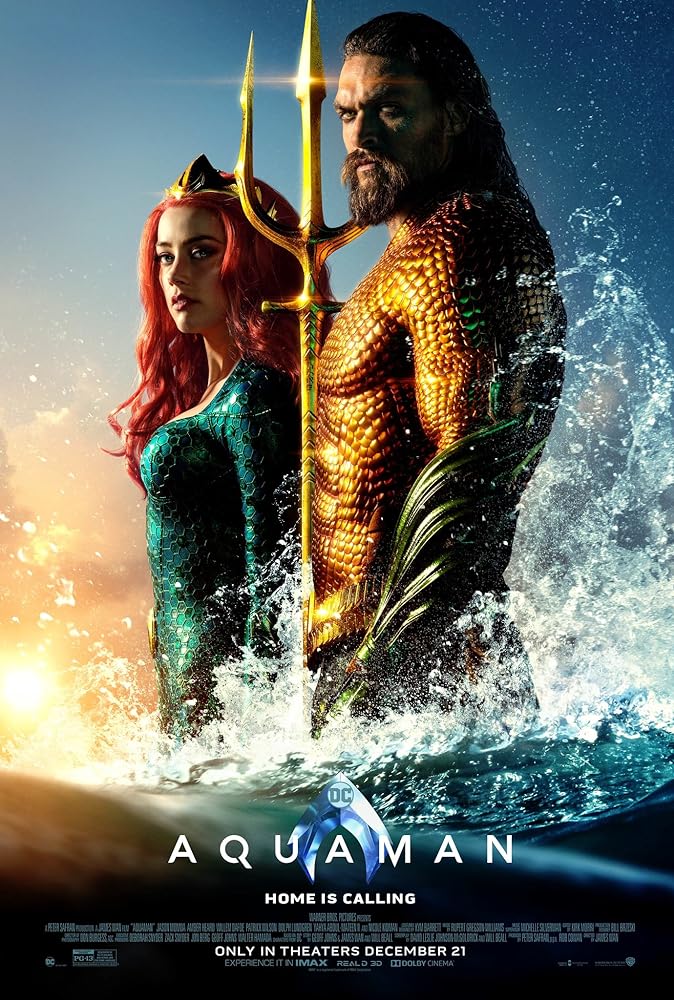
Jason Momoa and Amber Heard in Aquaman (2018)

In 1941, writer Mort Weisinger and artist Paul Norris created the character of Aquaman, the king of the underwater kingdom of Atlantis with the ability to communicate with the various creatures of the sea. Over the next few decades, Aquaman’s role in the DC Comics universe began to grow significantly to the point where he became one of the seven founding members of the Justice League, and he has continued to be one of DC’s most prominent superheroes ever since. But as for his overall reception amongst audiences… well, that one’s a bit more complicated because, despite his long history in the world of comics, Aquaman has been deemed ‘a joke’ in the pop cultural zeitgeist for supposedly being nothing more than ‘the guy who talks to fish’. This was mainly brought on by the character’s roles in his titular animated series from 1967 and the Hanna-Barbera produced Super Friends series that ran from 1973 to 1986. And despite DC’s efforts to work around this image through various reboots and such, shows like Robot Chicken and The Big Bang Theory continue to enforce this long-standing view on DC’s aquatic superhero. As for getting the King of Atlantis on the big-screen, that journey has been just as bumpy. Simply put, it’s truly saying something when the most prominent on-screen appearance of Aquaman prior to 2016… was the in-universe feature film directed by James Cameron in HBO’s hit series Entourage where he was played by the series’ main protagonist Vincent Chase.

But things finally changed when DC began to develop its own cinematic universe a la Marvel. Game of Thrones alum Jason Momoa was cast in the role of Arthur Curry AKA Aquaman and made his first appearance in the DC Extended Universe via a cameo in 2016’s Batman v Superman: Dawn of Justice. There, he first appeared alongside Ezra Miller’s Flash and Ray Fisher’s Cyborg in a series of videos that Batman had uncovered (and were then subsequently viewed by Wonder Woman) from the files of Lex Luthor’s company LexCorp on their investigations into the presence of ‘metahumans’ AKA the franchise’s term for super-heroes. Momoa was then promoted to one of the lead roles in the 2017 follow-up Justice League, and while neither film fared very well with critics, Momoa did manage to work well alongside his co-stars. But now The King of the Seven Seas finally gets the chance to grace his own solo film with the sixth installment of the DC Extended Universe, Aquaman. Horror veteran James Wan steps in to direct a film that certainly has quite a lot of baggage behind it going in. For starters, like Wonder Woman, it finds itself tasked with getting the franchise back on track after the considerably disappointing critical and financial performance of Justice League. But, of course, as it’s been made clear in this intro, possibly its biggest hurdle is proving that one of the most widely-mocked superheroes of all-time can be taken seriously. And with strong visuals and a well-balanced tone and atmosphere, it can be argued that Wan did succeed in that regard.

Arthur Curry (Jason Momoa) was born as a child of two worlds. This became the case when his father Thomas (Temuera Morrison), a lighthouse keeper from Maine, rescued a woman from a violent storm in 1985. Little did he know that the woman, Atlanna (Nicole Kidman), is the queen of the underwater kingdom of Atlantis. And as she later tells their son Arthur, he’ll eventually grow up to become the one who will unite their two worlds. However, after she ends up leaving both him and his father to return to Atlantis, Arthur ends up ignoring his Atlantean heritage over the years as he becomes the legendary warrior of the sea, Aquaman. Eventually, though, Arthur finds himself having to finally face his destiny when Mera (Amber Heard), princess of the Atlantean kingdom of Xebel, comes to him and warns about his half-brother Orm (Patrick Wilson), the current ruler of Atlantis who plans on initiating a war against the surface world. Specifically, Orm seeks to gain the support of at least four of the other kingdoms of Atlantis so that he can have a grand army and be granted the title of ‘Ocean Master’. And when it becomes clear that Arthur isn’t exactly prepared to take down Orm with his mother’s trident as his only weapon, he and Mera end up on an adventure around the world to find the trident that belonged to King Atlan (Graham McTavish), the original king of Atlantis. Because as it’s established by Arthur’s mentor Nuidis Vulko (Willem Dafoe), Atlantis’ royal advisor, Atlan’s trident is Arthur’s only hope of reclaiming his birthright as the true king of Atlantis.

Aquaman is truly an ambitious entry in the superhero genre as far as its action set-pieces are concerned. This film is full of incredibly elaborate action sequences that feature everything from sweeping camera movements to some very impressive long-takes. And while quite a lot of these action sequences are filled to the brim with CGI creatures in what is usually an equally CG-based environment, the visual effects team clearly brought their A-game to this project. When these effects are combined with Don Burgess’ solid cinematography, it results in some of the most incredibly striking visuals to ever grace a superhero film. Plus, as was the case when the Russo brothers first started to direct MCU films or when Christopher Nolan went from Batman Begins to The Dark Knight, this film’s action sequences show the growth that James Wan has clearly made as an action director after his previous foray into the genre, 2015’s Furious 7. And as far as this film’s tone is concerned, those who were put off by the dour proceedings of Zack Snyder’s DCEU films will be pleased to know that this film is ultimately more in line with the much more successful Wonder Woman in that department. While it does treat the storyline of Aquaman uniting the kingdoms of Atlantis as seriously as possible, the film maintains a fun, light-hearted atmosphere throughout that harkens back to classics like the Indiana Jones films, especially during Arthur and Mera’s journey around the world to find King Atlan’s trident.  

From what I’ve gathered, it seems like Jason Momoa’s first major DCEU appearance in Justice League was decently well-received. Some may have been a bit turned off by Momoa giving the character a ‘surfer bro’ personality, but he managed to do his best with the limited material that he was given. Thankfully, though, as was the case with Gal Gadot when she got her own solo film as Wonder Woman, Momoa fares a lot better in his own solo film, as the character development that he didn’t get in Justice League is finally put in here with the conflict of him being a child of two worlds and how he ends up becoming the reluctant hero of Atlantis. All of this is handled very well and it’s clear that Momoa is having a lot more fun this time around as his comedic banter is much stronger here than it was in Justice League. In fact, it even gets to the point where the character’s controversial ‘surfer bro’ persona feels much more natural when compared to his previous appearances in the franchise. Amber Heard also thankfully gets a much more fruitful role here than she did in Justice League as Mera. In that film, she was a blank slate in what was literally her only scene in the damn film when Steppenwolf attacked Atlantis to collect one of the Mother Boxes. Here, she’s a confident, no-nonsense badass who is repeatedly shown to be much more adept than Arthur at practically everything while also getting a nice little arc in which their adventure allows her to gain a greater appreciation for the human world. And thanks to their characters’ strong back-and-forth dynamic, Heard and Momoa have excellent chemistry. They’re then backed by a solid supporting cast that includes Willem Dafoe as Arthur’s loyal mentor Nuidis Vulko, Nicole Kidman as Arthur’s mother Atlanna, whose role in the film is thankfully not just a brief cameo limited to flashbacks to Arthur’s youth, and Dolph Lundgren in another solid turn this year after Creed II as Mera’s father, King Nereus of Xebel.  

And then you have the film’s two main villains… who, sadly, are the weakest links in the film despite good performances from their respective actors. First, there’s Aquaman’s most famous enemy from the comics, mercenary David Kane AKA Black Manta (Yahya Abdul-Mateen II). And to the character’s credit, the film does set up Kane incredibly well, with his conflict with Aquaman ultimately defined by one gutsy move that Arthur makes during their first encounter that heavily affects Kane on an emotional level. After that, once Kane puts on his signature suit, it leads to one heck of a confrontation with Aquaman and Mera in what is easily one of the film’s best action sequences… a shame, then, that this is the only key scene in the film with him in the suit. In other words, if you’ve seen any of the trailers for this film, then you’ve seen the bulk of Black Manta’s role in it. Thus, the honor of being the film’s main antagonist instead goes to Aquaman’s half-brother Orm AKA the ‘Ocean Master’. Overall, James Wan regular Patrick Wilson is solid in the role even if it is just him spending most of the time unabashedly hamming it up. Plus, the rivalry that the two Atlantean siblings have due to their shared heritage does provide Orm with some decent character development. The issue with him, however, is that while he does have a more substantial role in the plot than Black Manta, said role still feels very limited due to the film focusing more on Aquaman and Mera. And because of this, Orm ends up being the kind of villain who talks a big game instead of legitimately having one.

Well, with a decent RT score and a box-office total that’s undoubtedly going to go past $1 billion soon, it’s clear that Aquaman has been one of the better-received installments of the DC Extended Universe. And while I wouldn’t necessarily call it the ‘best’ DCEU film to date, it’s still a very welcome breath of fresh air after the highly disappointing affair that was Justice League. Simply put, director James Wan does manage to succeed, for the most part, when it comes to taking one of the most widely mocked characters in pop culture history and giving him a film adaptation that treats him respectfully. After all, in a time where the superhero genre has given us films that feature talking raccoons and heroes who can shrink to the size of insects, I think it’s safe to say that the idea of an ocean-based superhero who talks to marine life isn’t such a ridiculous concept anymore. And his first solo film achieves this by being, to be perfectly blunt, the kind of film that Warner Bros. and DC should’ve been making all along instead of just trying to copy what Christopher Nolan did with the Dark Knight trilogy. Instead of an overly dark and dour drama a la Batman v Superman, Aquaman is a bright and colorful superhero epic with impressive visuals and action sequences that are paired nicely with a solid tone that skillfully balances effective drama with genre-friendly humor. And just like Wonder Woman, this film gives its title character (and his leading lady) the proper character development that they didn’t get in previous DCEU films where they were just one part of a larger ensemble. In short, if there’s one thing that films like Wonder Woman and Aquaman prove, it is that the DC Extended Universe is truly at its best when it isn’t trying to take itself so seriously.


Rating: 4.5/5