Showing posts with label Keegan-Michael Key. Show all posts

Wednesday, December 16, 2020

The Prom (2020) review (Netflix)


On November 15th, 2018, a new musical titled The Prom officially opened on Broadway at the Longacre Theatre. With music by Matthew Sklar, lyrics by Chad Beguelin, and a script by Beguelin and Bob Martin based off an original concept by Jack Viertel, The Prom tells the story of a young lesbian student who is banned from attending her high-school prom but is helped in her efforts to fight back against this ruling by a group of Broadway stars. The musical was largely inspired by a similar incident that happened to Constance McMillen in 2010 when she was a senior at Itawamba Agricultural High School in Fulton, Mississippi, which attracted a bunch of supportive responses from celebrities. And upon its debut, the show proved to be a solid hit with critics. It was the first musical of that Broadway season to earn a Critics Pick honor from the New York Times, and while it didn’t win any Tony Awards, it earned 7 nominations including one for Best Musical. It also attracted plenty of attention at the 2018 Macy’s Thanksgiving Day Parade when stars Caitlin Kinnunen and Isabelle McCalla partook in the first LGBTQ kiss in the parade’s history. And now, in 2020, it’s been brought to life on film in a star-studded adaptation directed by Ryan Murphy. While it’s only his fourth feature-length directorial effort, Murphy has been touted as one of the most prominent creative forces in television having created hit shows like Glee and American Horror Story while also being a champion for the cause of greater inclusion within the film and television industry. The Prom serves as one of the first major projects that Murphy has developed for Netflix via the lucrative $300 million deal that they signed him to in 2018, and with a delightful cast and a great execution of its source material’s timely themes, we have ourselves a truly heartwarming musical extravaganza.  

In the conservative-minded town of Edgewater, Indiana, high-school student Emma Nolan (Jo Ellen Pellman) finds herself in an utterly devastating situation when her desire to attend her high-school prom with her girlfriend Alyssa Greene (Ariana DeBose) results in the local Parent-Teacher Association canceling it entirely, thus turning her into a full-blown social pariah. And if that wasn’t enough, the head of the PTA happens to be Alyssa’s mother (Kerry Washington), who is completely unaware of her daughter’s relationship with Emma. However, when all seems lost, Emma finds herself blessed with the most unexpected showing of support in the form of a quartet of actors from Broadway; specifically, self-centered stars Dee Dee Allen (Meryl Streep) and Barry Glickman (James Corden), long-time chorus girl Angie Dickinson (Nicole Kidman), and Julliard alum Trent Oliver (Andrew Rannells). In the immediate wake of a disastrous opening night for their latest Broadway production that results in them being labeled as a pair of narcissists by various critics, Dee Dee and Barry learn of Emma’s predicament and, along with Angie and Trent, decide to head to Edgewater on her behalf. But while they’re initially in it solely for the intent of salvaging their reputations by partaking in ‘a cause’, the group genuinely begins to bond with Emma and, with the help of her highly supportive principal Mr. Hawkins (Keegan-Michael Key), begin working tirelessly to make her prom dreams come true.  

Right off the bat, the best thing that I can say about this film is that it truly delivers on its strong themes that couldn’t be any more relevant given everything that’s been happening in the world recently. Obviously, one’s thoughts on how effective content like this is in highlighting the LGBTQ community may vary, but in this instance, I do believe that The Prom (which I would personally describe as a ‘modern-day version of Footloose’) is very much genuine in its themes of love and acceptance. And when paired with a filmmaker like Ryan Murphy who, as noted earlier, is big on inclusion, you get an adaptation that hits all the right emotional beats from the cathartically heartwarming to the utterly devastating. Admittedly, I can’t say much about how effective the film is as an adaptation of the musical since I haven’t seen the latter, but aside from expanding upon some plotlines such as Barry Glickman’s own struggles as a gay man and how it impacted his relationship with his parents, it seems like the film is as faithful to its source material as it could possibly be. Sure, it probably could’ve benefitted from some tighter editing here and there to make up for any parts of the film that start to drag a bit, but as a musical, it goes without saying that this is where The Prom shines the most. Matthew Sklar and Chad Beguelin’s songs are undeniable earworms and are a great mix of grand showstoppers and emotionally powerful melodies. And under Ryan Murphy’s solid direction, we get a film that, simply put, is just a highly entertaining musical comedy anchored by its lovable bunch of main protagonists.

That said, though, while the film does sport a star-studded ensemble cast, said cast has admittedly garnered some controversy from fans of the musical over the decision to have A-listers play the lead roles rather than Broadway stars. There are some Broadway alumni in this, to be fair, such as Andrew Rannells and Ariana DeBose, but it’s primarily headlined by those who have more experience in film than they do in theater. Still, for what it’s worth, practically everyone involved is clearly having a lot of fun in their respective roles. Whether it’s Meryl Streep being her usual scene-stealing self or Keegan-Michael Key serving as the straight man to all the shenanigans that the Broadway stars get into, you can’t fault this film for having an incredibly fun ensemble. However, when it comes to the film’s biggest standout, that honor goes to its biggest newcomer, Jo Ellen Pellman. It is almost entirely because of her that we care about Emma and her endeavors because she makes her a wholly sympathetic heroine right off the bat. In other words, she’s very much the heart of the film. But now we must address the elephant in the room that is the biggest source of controversy that this film has been attracting in the wake of its release; the casting of James Corden as the gay leading man of Broadway, Barry Glickman. Simply put, unlike Barry, Corden is not a gay man whereas the other LGBTQ characters in this story are more accurately cast (ironically, one of Corden’s main co-stars is Andrew Rannells and he’s playing a character whose sexuality is never made explicit). Now I’m not going to get into this whole situation that much since, as I’ve noted in the past, I usually don’t like to talk about sociopolitical matters such as this in these reviews. So instead, I’ll just say that while I’m not defending Corden’s performance in this, I’d argue that the rest of the cast makes up for any shortcomings that directly stem from him. Was he the ideal pick for the part? No, not at all, but at the same time, I also wouldn’t call this a case where his performance derails the film entirely even though Barry is arguably the most prominently featured member of the Broadway quartet.

I’ll admit that I don’t have a lot of experience with the world of Broadway, which could largely be attributed to the fact that I don’t live in New York where, at least before COVID became a thing, I would have a lot more opportunities to see Broadway shows regularly rather than just occasionally seeing a touring production of a popular show at my local theatres. And yet, as some of the past reviews that I’ve done for this site have arguably proven, I’m a big fan of the musical genre and have liked a fair share of adaptations of Broadway musicals such as the ever-enduring classic Grease and Tim Burton’s delightfully twisted take on Sweeney Todd. As such, it should probably go without saying that I thoroughly enjoyed the film adaptation of The Prom. While I admittedly haven’t seen the original show at the time of this review’s publication, the fact that all three of the key figures behind it (Matthew Sklar, Chad Beguelin, and Bob Martin) were involved in the film’s production makes it clear that this adaptation was in the right hands, and because of this, The Prom is the very definition of a feel-good film. With powerful themes, undeniably catchy tunes, and a great cast, The Prom is a film that very much wears its heart on its sleeve. I mean, there’s really nothing more that I can say about this film other than the fact that it’s a highly entertaining musical that excellently represents the wonderfully diverse nature of our ever-expanding pop cultural landscape. And to be perfectly blunt, folks, in the utterly terrible year that has been 2020, I’d argue that this is one of the best examples of a film that I can easily recommend to anyone out there who’s in desperate need of a pick-me-up.  

Rating: 5/5!

Saturday, July 27, 2019

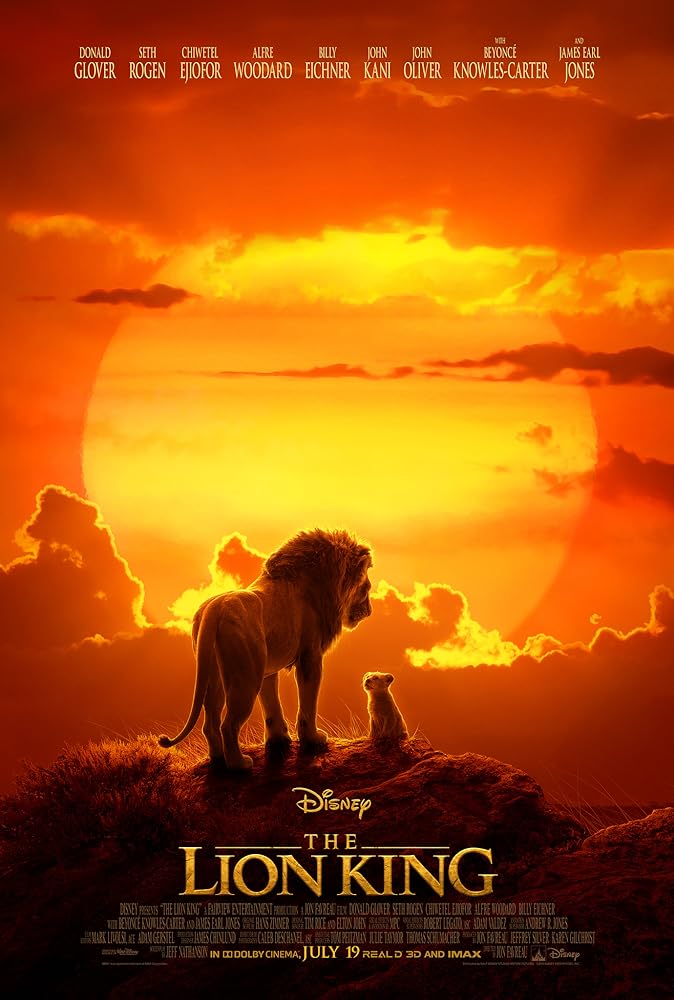
The Lion King (2019) review


James Earl Jones and JD McCrary in The Lion King (2019)

In 1991, Walt Disney Animation began production on two different films that would be the studio’s next big projects after the one-two punch of that year’s Beauty and the Beast and Aladdin the following year. Of the two films, the one that the studio ended up placing most of its focus on was an adaptation of the story of the Native American woman known as Pocahontas, and because it ended up attracting most of Disney’s prominent animators, the other film was primarily developed by the studio’s ‘B-Team’. Ironically, though, the B-Team would end up producing the more critically acclaimed affair; we, of course, know their project… as The Lion King. When it was released in the summer of 1994, The Lion King quickly became one of the biggest films of its time. It currently stands as the highest-grossing traditionally animated film of all-time at over $968 million worldwide, which also means that it was Disney Animation’s highest-grossing film for nearly two decades until it was ultimately out-grossed by Frozen in 2013. It’s also notably the best-selling VHS title of all-time with over 32 million copies sold. But now it’s joined the ranks of other Disney classics as the latest in Disney’s line of live-action remakes… however, calling this one ‘live-action’ would technically be false. Instead, this new version of The Lion King is a CGI remake of the original as it mirrors the style of the 2016 remake of The Jungle Book through its use of photorealistic environments and characters. The two films even share the same director in Jon Favreau AKA the man who effectively launched the MCU with the original Iron Man and is also responsible for modern classics like Elf and Chef. And while this one is sure to be a controversial release because of how it ultimately ‘remakes’ its predecessor, fans of the original Lion King will still probably find this to be an incredibly fun and gorgeously animated interpretation of an all-time Disney classic.

In the vast kingdom that is the Pride Lands of Africa, Mufasa, the King of Pride Rock (voiced by James Earl Jones) and his queen Sarabi (voiced by Alfre Woodard) celebrate the birth of their son, Simba. As he begins to grow up, Simba (voiced as a child by JD McCrary and as an adult by Donald Glover) eagerly anticipates the day when he will take his father’s place as King. However, unbeknownst to Simba, his uncle Scar (voiced by Chiwetel Ejiofor) secretly plots to get rid of both him and his father so that he can take over the Pride Lands. To do so, Scar puts Simba in increasingly terrifying situations that eventually results in a devastating tragedy, and when Scar has Simba fooled into thinking that the accident was his fault, Simba ends up running away from his home. After a while, he meets the happy-go-lucky duo of Timon the Meerkat (voiced by Billy Eichner) and Pumbaa the Warthog (voiced by Seth Rogen), who end up taking him in and showing him the benefits of their carefree lifestyle. But as Simba matures into adulthood, his childhood friend Nala (voiced as a child by Shahadi Wright Joseph and as an adult by BeyoncĂ©) comes back into his life to warn him that Scar’s takeover of the Pride Lands has led it to ruin. Thus, Simba must now overcome the demons of his past to save his home from his diabolical uncle and to properly take his place as the new king of Pride Rock.

This new take on The Lion King is easily the closest that any of the recent Disney remakes have gotten when it comes to closely replicating their original counterparts. This isn’t a case like Maleficent, which retold the story of Sleeping Beauty from the titular villain’s perspective, or Pete’s Dragon, which nixed the original’s musical numbers in favor of a more traditional narrative. For all intent and purposes, this is the same exact story from the 1994 film with the same exact outcome. The only major differences from a narrative perspective come from minor deviations in dialogue and a different intro for Nala after she’s become an adult. As such, this could quite arguably be the most controversial Disney remake yet because of how tightly it adheres to the original film without really doing anything differently. And yet, at the same time, because it’s still The Lion King, it could potentially be argued that, at the very least, the film does maintain the original’s strong script and hits the biggest emotional moments just as effectively (i.e. that one scene that we always remember from this story). Nothing significant from the story is lost and nothing is added in that would drastically change anything. Ultimately, though, the biggest selling point of this film is its visuals. As noted in the intro, this film carries over the same method that Favreau used on The Jungle Book in which everything in it (save for Mowgli) was digitally created. And while some may take issue with the fact that the overall drive for realism results in certain moments from the original being toned down, it’s still an impressive feat of VFX work from the same team that won an Oscar for their work on Jungle Book.

Another key aspect of this film is its voice cast, as Jon Favreau selected a top-notch voice cast to portray these iconic characters. JD McCrary and Donald Glover (who have notably worked together before) headline the project excellently as Simba as a young cub and adult lion, respectively, thanks in large part to the terrific camaraderie/chemistry that they have with their co-stars. McCrary and Shahadi Wright Joseph are phenomenal together as young Simba and Nala, and while adult Nala’s role in the story isn’t really expanded upon too much when compared to the original film, BeyoncĂ© does do a solid job in the role. Meanwhile, Chiwetel Ejiofor is a damn good replacement for Jeremy Irons in the role of Scar as he perfectly maintains that same, great sinister persona that was pivotal in making Scar such an iconic Disney villain. But as for Mufasa, the filmmakers clearly knew that there was no way you could replace the legendary voice that portrayed the character in the original film. Yes, James Earl Jones is back once again to reprise his role as the King of Pride Rock, and he is still just as commanding and awesome as he was in the original film. And to close out the main cast, we have Billy Eichner and Seth Rogen, who serve as phenomenal replacements for Nathan Lane and Ernie Sabella in the roles of Timon and Pumbaa. As many others have noted, they’re the biggest standouts of the film and their riffing is the primary source of the remake’s new material, whether it’s an entertaining fourth-wall gag or a downright brilliant homage to another Disney classic.

I have the feeling that this is the one Disney remake that some people were expecting me to be completely against. After all, the original Lion King still stands as my favorite Disney animated film of all-time. Well, to that I say… you’ve read my reviews of the other recent Disney remakes, right? If I haven’t made it clear before, I’m perfectly fine with this new trend of live-action remakes of classic Disney films (even though this one technically isn’t ‘live-action’) because I recognize that the old films will still be there when all’s said and done. More importantly, their legacies won’t be tarnished by a ‘lousy’ remake because they’re quite frankly better than they’re often given credit for. However, even with that said, I fully recognize that I won’t even remotely be able to convince any of the ‘live-action remake’ critics that this one is worthwhile because it’s almost literally the same as its traditionally-animated counterpart save for a CGI makeover. And because the CG is highly intent on maintaining a sense of realism, this means that this version of The Lion King is a lot more grounded compared to its predecessor (e.g. don’t expect Timon to don a hula skirt and ask some hyenas if they’re “aching for some bacon”). Despite this, Jon Favreau does do an excellent job of maintaining the same spirit of the original even with a different visual aesthetic. And at the end of the day, that visual aesthetic is the main reason to watch this film because it’s clear that the visual effects team went above and beyond to create an impressively photorealistic-looking film to the point where it could potentially pass as some kind of nature documentary. As such, while some may view this as the most pointless Disney remake yet, there’s no denying that it’s one of the best-looking films of 2019.

Rating: 5/5!

Tuesday, July 9, 2019

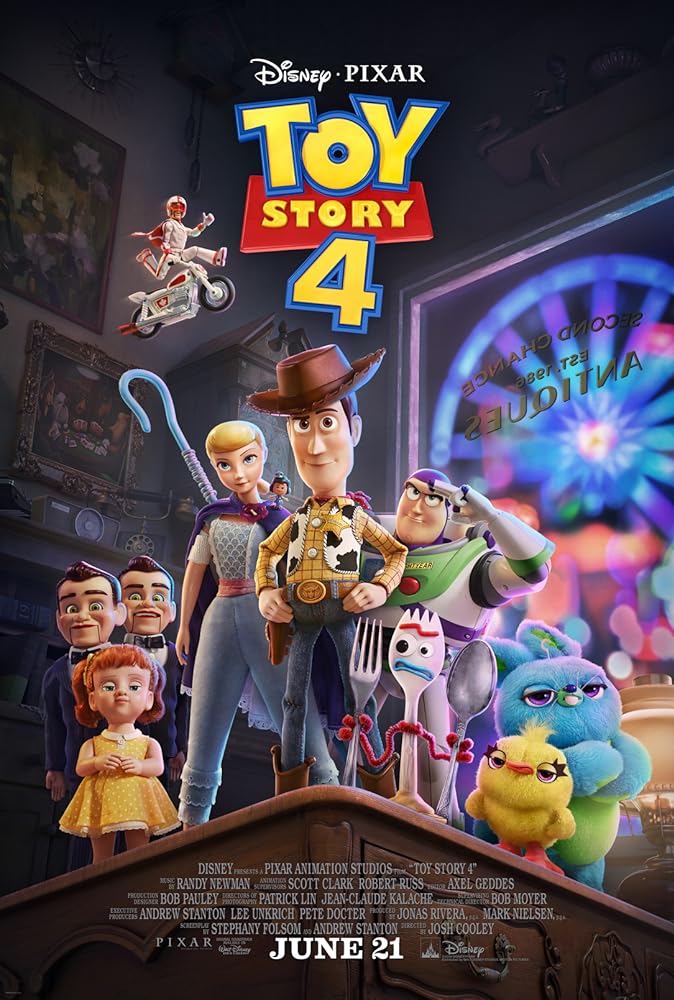
Toy Story 4 (2019) review


Tom Hanks, Keanu Reeves, Tim Allen, Annie Potts, Tony Hale, Christina Hendricks, Keegan-Michael Key, Ally Maki, and Jordan Peele in Toy Story 4 (2019)

In 1979, George Lucas’ production company Lucasfilm launched a new division that specialized in computer graphics known as The Graphics Group. This division would go on to be responsible for developing some of the groundbreaking visual effects work for films like Star Trek II: The Wrath of Khan and Young Sherlock Holmes, though it was ultimately spun out into its own separate corporation in 1986. Now named after its revolutionary computer system known as the Pixar Image Computer, Pixar would begin to create a bunch of computer-animated short films that earned them much critical acclaim. This included the likes of Luxo Jr. and Tin Toy, and in 1995, what was originally conceived as a made-for-TV special/sequel for the latter ended up becoming Pixar’s first-ever feature-length film, Toy Story, and it goes without saying that the film was a massive hit upon its release. Critics loved it, audiences loved it, and it effectively jumpstarted Pixar’s legacy as one of the top animation studios in the industry. This tale of toys who come to life when their owners aren’t around would end up getting two follow-ups; Toy Story 2 in 1999 and Toy Story 3 in 2010. And against all odds, both sequels ended up attracting just as much critical acclaim as the original, with the latter providing fans of the franchise an emotionally cathartic finale to the adventures of their favorite toys. It also grossed over $1 billion worldwide and became the third animated film in history to earn a Best Picture nomination at that year’s Oscars. As it turns out, however, this wouldn’t be the end of the adventures of Sheriff Woody, Space Ranger Buzz Lightyear, and their friends. In 2014, Pixar announced that a fourth film was in development and despite much skepticism from fans of the original trilogy, this new film ends up being yet another masterpiece full of emotional poignancy and lovable characters.

It has been two years since Andy Davis gave away his beloved toys to a young girl named Bonnie Anderson (voiced by Madeleine McGraw), and ever since, the toys have happily readjusted to their new lives. When Bonnie begins Kindergarten, Woody (voiced by Tom Hanks) sneaks into her backpack to try and help her deal with the overwhelming stress of the situation, which eventually results in her crafting a handmade toy during arts and crafts that she names ‘Forky’. But to Woody’s surprise, Forky (voiced by Tony Hale) ends up coming to life and immediately starts attempting to get thrown away since he believes that he’s only trash. Thus, when Bonnie and her family end up going on a road trip, Woody now finds himself tasked with ensuring that nothing bad happens to Forky since he’s quickly become Bonnie’s new favorite toy. Eventually, though, Forky manages to jump out of the family’s RV, resulting in Woody having to leap out as well to get him back. And when the two find themselves in an antique store, they are confronted by Gabby Gabby (voiced by Christina Hendricks), a 1950s pull-string doll (like Woody) who looks to obtain Woody’s voice box since hers broke several years ago, thus preventing her from getting a new owner. She and her ventriloquist dummy allies then proceed to take Forky captive, effectively putting Woody and Buzz Lightyear (voiced by Tim Allen) in a race against time to get him back before Bonnie’s family leaves without them. In the process, the two even reunite with their old friend Bo Peep (voiced by Annie Potts), who had left the gang several years prior when the Davis family gave her away. And thanks to Bo’s newfound outlook on life, Woody soon finds himself re-evaluating the idea of what it truly means to be a toy.

Every Toy Story film has had a well-layered plot with strong themes, from the jealousy that Woody experiences when Buzz starts to steal his thunder in the first film to the simple fact that nothing lasts forever as exemplified in the second and third films (especially the latter given its rather infamous near-ending in an incinerator). The same can be said for Toy Story 4, which mainly grapples with the concept of finding one’s purpose in life. Whether it’s Forky trying to understand why he’s even alive in the first place or Bo Peep’s new characterization where she’s much more open to the ‘lost toy’ lifestyle, the film effectively continues the franchise’s brilliant knack of deftly finding the humanity within its various toy characters. And, of course, as one would normally expect from a Pixar film, Toy Story 4 more than delivers when it comes to its emotional gravitas. It’s quite arguably up there with Toy Story 3 when it comes to being one of the most emotional installments of the franchise, right down to an ending that shook both Tom Hanks and Tim Allen to the core. And yet, as is always the case with these films, all these great emotional moments are primarily meant to bolster what is already a delightfully charming animated adventure complete with Pixar’s always excellent animation. In fact, given that Toy Story is the franchise that made Pixar what it is today, these films serve as perfect benchmarks that truly highlight how much their animation style has evolved since 1995.

Now if there’s one aspect of this film that may disappoint fans of the franchise, it’s that most of the Toy Story gang ends up getting limited to minor supporting roles. Simply put, this film primarily focuses on Woody, Buzz, Bo Peep, and Forky, meaning that the rest of Andy/Bonnie’s toys spend most of their time with Bonnie and her family in their RV. They’re not outright ignored, for the record, but because of their limited screen-time, that means that you don’t get a lot of Jessie (voiced by Joan Cusack), Hamm (voiced by Pixar’s lucky charm John Ratzenberger), Mr. Potato Head (voiced by the late Don Rickles via archival recordings), etc. For what it’s worth, though, Tom Hanks and Tim Allen are just as fantastic as they’ve always been in these films and their wonderful camaraderie continues to make Woody and Buzz one of the best lead duos in recent film history. The two also get some great new material to work with in this one, with Woody having to overcome his frustrations of being neglected by Bonnie to ensure that nothing happens to Forky and Buzz trying (and somewhat struggling) to understand what it means to ‘listen to his inner voice’. Annie Potts, meanwhile, makes a very welcome return to the franchise as Bo Peep, who hasn’t played a major role in these films since Toy Story 2 two decades ago. And while Bo’s great new characterization does allow her to play a more proactive role in the plot this time, she still maintains the same sweet persona (not to mention her great chemistry with Woody) that made her such a lovable member of the gang in the previous films.

As has always been the case with these films, Toy Story 4 also introduces plenty of great new characters, many of whom help make this one of the funniest installments of the series. I mean, to be fair, would you expect anything less when you have two characters voiced by Keegan-Michael Key and Jordan Peele in their first big collaboration together in at least three years? They play Ducky and Bunny, respectively, a pair of plush toys who get into a minor scuffle with Buzz when he inadvertently takes their spot as the top prize of a carnival game. Other major standouts include Ally Maki as Bo’s chipper new sidekick Giggle McDimples and the one and only Keanu Reeves as Duke Caboom, “Canada’s greatest stuntman” and a pitch-perfect personification of everything that has made Reeves the breathtaking figure that he is today. But at the end of the day, it’s ultimately Tony Hale who ends up stealing the whole show as Forky since the surreal existential crisis that this new toy goes through provides the film with plenty of its best humorous moments. At the same time, though, Hale also succeeds immensely in making Forky an instantly lovable character due in large part to his endearingly innocent nature. And lastly, the film also boasts an excellent foil to the main protagonists in its main antagonist, Christina Hendricks’ Gabby Gabby. Without giving anything away when it comes to how her role in the story pans out, she ends up being the most sympathetic of the franchise’s villains to the point where she even becomes involved in some of the film’s biggest emotional moments.

When this film was first announced, it goes without saying that the internet didn’t exactly react too positively towards it. Simply put, many felt that this was an outright terrible idea as Toy Story 3 provided a satisfying conclusion to the original trilogy, and if my past reviews of Pixar films weren’t enough of an indication, Pixar fans can be very strict when it comes to the idea of the studio doing sequels to their previous films. But lo and behold, Pixar ultimately manages to deliver yet another masterpiece that continues to emphasize why Toy Story is undoubtedly their definitive franchise. Just like the three films that came before it, Toy Story 4 boasts a phenomenal script that provides great new material for its wide array of characters, from those who we’ve followed for years to those who haven’t been seen for a while to the new characters that quickly become excellent additions to this legendary franchise. And through it all, the film maintains the same great sense of emotional poignancy that the franchise has always had, resulting in yet another animated adventure that’s 100% guaranteed to hit you with the feels. Case in point, this film’s ending does imply that it will truly be the final installment of the series (at least in terms of films, as a few spin-offs are in the works for Disney+). While it may have seemed like this was set to be the start of a new bunch of Toy Story films, its ending suggests otherwise, and all in all, it’s genuinely a wonderful place to end things. Whereas Toy Story 3’s ending concluded the story of the toys’ relationship with their original owner Andy, Toy Story 4 is ultimately the last hurrah for these characters that we’ve known and loved since 1995. And thanks to the four amazing films that they’ve appeared in, there’s no denying that the Toy Story films will forever stand the test of time or, to quote the franchise itself, ‘to infinity and beyond’.

Rating: 5/5!

Sunday, September 16, 2018

The Predator (2018) review

The Predator (2018)

When it comes to classic 80’s action films, one of the most widely praised of that era is Predator. While initially receiving a mixed reaction upon its release, director John McTiernan’s sci-fi action flick, which follows a bunch of commandos who find themselves hunted by a mysterious alien creature who hunts for sport, has gone on to become one of the definitive films of both the action and sci-fi genres. And after undergoing a pivotal change in design halfway through shooting, the Predator now stands as one of the most iconic alien creatures of all-time up there with the Xenomorphs from Alien. However, unlike the Alien films, the Predator series hasn’t seen as many appearances on the big screen. It got a sequel, Predator 2, in 1990, but outside of the poorly-received crossovers that it did with the Alien franchise in the early 2000’s, it didn’t see an official sequel until 2010’s Predators. And even then, neither film was as well-regarded as the original. But now the Predator series is back with the fourth installment of the main series, simply titled The Predator. The film serves as the latest directorial outing for Shane Black, whose career in the film industry needs no introduction having penned classics like Lethal Weapon and directing critically-acclaimed films such as Kiss Kiss Bang Bang and The Nice Guys along with the criminally underrated Iron Man 3. And in the case of The Predator, Black’s had quite a history with this franchise as he had played the character of Hawkins in the original film. This new film also sees a reunion between Black and co-writer Fred Dekker, who had previously worked together on the 1987 cult classic The Monster Squad. But as for their newest collaboration, they deliver an entertaining sci-fi action flick that isn’t quite as good as the original film but is still easily the best follow-up that the franchise has gotten up to this point.

When a mysterious ship crash-lands in the middle of a Mexican jungle, a team of Army Rangers led by Quinn McKenna (Boyd Holbrook) investigates the crash site and come across one of the terrifying creatures known as ‘Predators’. Quinn ends up being the only survivor of the group but manages to find some of the creature’s technology, which he sends back home to his ex-wife Emily (Yvonne Strahovski) and their autistic son Rory (Jacob Tremblay) in Georgia to keep it hidden from the government. However, Quinn soon ends up getting apprehended by the government and deemed ‘crazy’ due to most people not believing his story of his run-in with the Predator. Meanwhile, Rory ends up opening his father’s package when it arrives and starts to fiddle with its contents, unintentionally sending out a signal that attracts the attention of a much larger ‘Super Predator’ that had been hunting the smaller Predator that Quinn and his team had encountered. At the same time, that Predator, which has since been detained by the government at a secret facility, breaks out of its confinement and heads off to collect its gear by any means necessary. Thus, with two different Predators heading towards his family, Quinn teams up with a bunch of fellow ‘crazy’ soldiers, including ex-Marine Nebraska Williams (Trevante Rhodes) and the wise-cracking Coyle (Keegan-Michael Key), plus biologist Casey Bracket (Olivia Munn), to stop the two alien creatures before they can cause some major damage.       

The first thing to note about this film is that being a Shane Black film, it, of course, features his most definitive trait as a filmmaker, his knack for snappy dialogue. This dialogue is all throughout the film and results in consistent humor throughout, especially whenever the main characters interact with each other. The film also benefits from having some solid pacing, at least when in contrast to the slower build-up of some of the franchise’s previous installments. In other words, this film gets going right out the gate and is non-stop with its action. However, that doesn’t mean that this is entirely a good thing. Because the film goes by so fast, it doesn’t really have much time to stop and take a breather, and because of this, it does result in some pivotal plot lines (e.g. the demise of certain characters) and even a few bits of the humorous dialogue being glossed over. This ends up being the case all the way through to the ending, culminating in a finale that hasn’t been received very well by a lot of critics. And to make this situation even more ironic, that ending was the one major thing that Black and his crew reshot after the original ending didn’t go over very well with test audiences. In other words, it does kind of feel like a few problems emerged during the editing process. It was reported that some parts of the film were trimmed down (to the point where a character played by Edward James Olmos was cut out entirely) so that it wouldn’t be negatively affected by a hefty run-time. And yet, in this instance, it probably would’ve helped the film to have a longer run-time, even if it meant that this would’ve been the first Predator film to be over two hours long, because it ends up sporting a rather bare-bones plot due in part to its frenetic pacing.  

Admittedly character development has never really been the Predator franchise’s strongest suit. Even the original 1987 film, when it was first released, was criticized for not spending a lot of time developing its characters. This trend does continue with the new film, but at the very least, it does benefit from having the best ensemble cast since the original film (and yes, I know I just said that about the Predators cast a few days back in the Predator series retrospective…). Not only do all the main stars do a great job with Black’s trademark dialogue, but they also have phenomenal camaraderie together. The film does admittedly go the same route as Predators by giving us a bunch of characters who aren’t exactly the most likable in the world, but they’re a lot more entertaining to watch by comparison. Boyd Holbrook is solid in the lead role of Quinn as is Jacob Tremblay as his son Rory. The team that Quinn ‘assembles’ in the film also has some notable standouts as well, like Keegan-Michael Key and Thomas Jane as Coyle and the PTSD-ridden Baxley, respectively, who bicker constantly throughout the film (e.g. Coyle hurls a lot of ‘your mama’ jokes at Baxley). Some are a bit underutilized, however, like Alfie Allen as ex-marine Lynch and even Olivia Munn as main female protagonist Casey Bracket. But arguably the one who gets it the worst is Sterling K. Brown as Will Traeger, the agent who runs the government facility that the smaller Predator is initially held at and then leads the operation to hunt both Predators down. Without spoiling anything major, the screenplay decides to have him serve as an antagonist towards Quinn and company for no real reason. Brown is great in the role, but he’s ultimately just as waylaid by the erratic editing/pacing as everyone else.

Now to be clear, I’m not saying that this film is ‘as good’ as the original Predator… but what I can say is that, despite everything that I’ve said in this review, it’s easily the best of the series’ sequels. Under the direction of someone who is clearly quite familiar with the franchise (i.e. one of the original film’s cast members), The Predator is a thrilling sci-fi B-movie thanks to its decent (albeit extremely frenetic) pacing and a strong ensemble cast that works phenomenally with Shane Black and Fred Dekker’s dialogue. With that said, though, that doesn’t mean that this film is flawless. While its rapid-fire pace is welcome after the tepid pacing of 2010’s Predators, it also means that the film basically rushes through everything, and this does really affect things in the long run, resulting in a film that doesn’t have much of a plot to it and characters that, despite being entertaining to watch, don’t have a lot to work with in terms of character development. From the looks of it, something must’ve happened during the editing process that led to all these issues, apparently due to the necessity to not have the film be overlong. Ultimately, though, I’d say that your enjoyment of this film will depend on whether you’re okay with it not really spending a lot of time with things like plot and characters. In other words, I do agree with everyone else in stating that this film is quite a big mess from both a narrative and technical perspective and that it is far from being Shane Black’s best film as a director. But at the same time, that doesn’t mean that it isn’t an entertaining big mess.


Rating: 3.5/5