Showing posts with label Anne Hathaway. Show all posts

Wednesday, November 4, 2020

The Witches (2020) review (HBO Max)


When it comes to some of the most prominent authors in literary history, one whose work has consistently stood the test of time is Roald Dahl. From 1942 up until his death in 1990, Dahl was responsible for penning a whole bunch of classics such as Charlie and the Chocolate Factory, James and the Giant Peach, and Matilda. To date, his various novels and short stories have sold over 250 million copies worldwide and are widely touted for their creative imagery and their unabashed knack for dark humor to contrast with their primarily whimsical nature. Many of his works have been adapted to the big screen over the years although it is worth noting that, when he was alive, Dahl was usually quite critical about them for the various changes that were made to his stories. This included the last adaptation that was released before his death, 1990’s The Witches, which was directed by Nicolas Roeg and notably produced by none other than Jim Henson. Dahl, however, was not too pleased with this adaptation of his 1983 novel, namely due to its drastically different ending. Nevertheless, the film was well-received by critics and while it wasn’t exactly a box-office hit, it has since gone on to become a cult classic of its time. But now there’s a new adaptation of The Witches upon us, and just like the 1990 film, this one is star-studded on both sides of the camera. For starters, the cast is headlined by a pair of Oscar winners in Anne Hathaway and Octavia Spencer. And as for the behind-the-scenes crew, the film serves as the latest outing from director Robert Zemeckis, AKA the man who’s given us films like Who Framed Roger Rabbit, Forrest Gump, and this reviewer’s favorite film of all-time, Back to the Future. However, Zemeckis isn’t the only big-name filmmaker attached to this project as it was originally proposed as a stop-motion film directed by Guillermo Del Toro, who instead serves as a producer alongside his good friend Alfonso Cuaron while also being one of the credited screenwriters alongside Zemeckis and Black-ish creator Kenya Barris. And while it may be far from being the best project that any of these men have ever worked on, it still manages to be a decently charming family flick that delivers a solid new take on Roald Dahl’s classic story.

In 1968, a young boy (Jahzir Kadeem Bruno) loses both of his parents in a car crash. He’s then sent to live with his grandmother (Octavia Spencer) in Alabama, and while it does take a while, she does help him start to overcome his grief. However, their idyllic lifestyle is soon threatened when the young boy has his first encounter with a witch. And since his grandmother is quite familiar with witches after seeing one when she was a child, she tells him everything that he needs to know about them; namely, that witches are really demonic creatures and are notorious for hating children and doing anything they can to get rid of them. Thus, to avoid any further witch-based encounters, the young boy and his grandmother promptly decide to take a vacation and stay at a prestigious hotel. Unfortunately, they end up arriving at the exact same time as a whole group of witches led by the most powerful witch in the world, the Grand High Witch (Anne Hathaway). The young boy ends up eavesdropping on their meeting, where the Grand High Witch reveals her newest scheme to get rid of all the children in the world by using a special potion to turn them into mice. And to make matters worse, the young boy is then discovered by the Grand High Witch, who immediately uses her potion to turn him into a mouse. Now stuck in mouse form, the young boy crosses paths with two other kids that were recently turned into mice, food-loving Bruno (Codie-Lei Eastick) and a girl named Mary (voiced by Kristin Chenoweth), who is revealed to be the mouse that the young boy had been keeping as a pet for the past few months. With both their help and his grandmother’s, the young boy now finds himself in a time-sensitive situation as he and his friends work to stop the Grand High Witch’s sinister plan before anyone else ends up suffering the same fate as them.

While it may be easy to simply call this film a ‘remake’ of its 1990 counterpart, this new version of The Witches does manage to avoid being a straight-forward retelling of its classic story, whether it’s by having African-American protagonists or revealing that the kid’s pet mouse was a transformed kid as well. Plus, if there’s one advantage that this film has over the previous film, it’s that its ending is a lot more faithful to the book since, as noted earlier, Dahl took significant issue with the 1990 film for having a more traditional ‘happy ending’. Granted, the changes that this film makes does mean that it takes a lot more liberties with its source material than even the 1990 film did, but at the very least, this isn’t a case like Artemis Fowl where the changes that were made significantly alter the story beyond recognition. At the end of the day, most of these changes are simply from a cosmetic standpoint, and for the most part, the film does an excellent job of maintaining Roald Dahl’s whimsical style that delivers a good-natured adventure where the kids are the heroes but is still allowed to have the delightfully twisted dark humor that Dahl was well-known for. And while I’m aware that the film has gotten some criticism for supposedly being ‘too scary for children’, I’d argue that it’s relatively tame compared to all the other family-friendly films over the years that have gained notoriety for their darker moments (and yes, this includes the 1990 adaptation of The Witches). All this makes up for the fact that the film ends up feeling like a routine affair for the filmmakers who are attached to it, especially Robert Zemeckis. It’s not that the film is ‘bad’ or anything since, if Zemeckis’ past work wasn’t enough of an indication, he’s not that kind of director. It’s just that, like what happened when Tim Burton made his remake of Planet of the Apes in 2001, this is one of those instances where, if you didn’t know that this was directed by the guy who made Back to the Future, you probably wouldn’t have figured that out until the credits because it could’ve been done by anybody.

For many people, one of the best aspects of the 1990 film was Angelica Huston’s standout turn as the Grand High Witch. But while that may have been an undeniably tough act to follow, Anne Hathaway proves that she’s more than capable of taking on that daunting task. With an over-exaggerated accent that’s matched by an equally over-the-top performance, Hathaway is clearly having a lot of fun as the main antagonist. And sure, it’s completely understandable if some may find her performance to be a bit too campy at times, but at the end of the day, she’s still one of the best parts of this film. This strong performance from Hathaway is then perfectly matched by Octavia Spencer’s equally terrific turn as the main protagonist’s grandmother. Spencer has always been well-known for playing characters like this who are very much good-natured protagonists but can still dish out some tough love when necessary, usually through some delightfully spunky snark. And while he’s not in the film too much, we also get the always-reliable Stanley Tucci as the manager of the hotel that all the main characters end up at who mostly spends his time trying to deal with the eccentric gestures of the Grand High Witch. Finally, to close out the main cast, we have newcomer Jahzir Kadeem Bruno as the main protagonist who, just like in the original novel (and not the 1990 film where he was named Luke), is unnamed. He is credited as ‘Hero Boy’, however, which is rather ironic because that makes him the second main character in a Robert Zemeckis film to be called that since that’s also what the main protagonist of The Polar Express was credited as. Nevertheless, while this may only be his first leading role in a film (that and his character is a mouse for half of it), Bruno instantly makes a strong first impression with some solid charisma for his age.

While it’s admittedly been a while since I’ve done so, I did read The Witches when I was younger. It was one of many Roald Dahl books that I read growing up alongside other classics such as Matilda and Charlie and the Chocolate Factory. However, you may be surprised to learn that I never watched its 1990 film adaptation. Simply put, it was just one of those films that was never on my radar back then. As such, it goes without saying that I don’t have the kind of connection to it that many others from my generation have, which has clearly had a major influence on folks’ thoughts towards this new adaptation. I mean, if the usual reception towards Disney’s recent string of live-action remakes wasn’t enough of an indication, folks are always a lot stricter when it comes to remakes. And yet, from the perspective of someone who hasn’t seen the 1990 adaptation of The Witches, I’d argue that this new version of the story is a genuinely harmless affair. It avoids being a direct carbon copy of its predecessor and even manages to deliver a more faithful take on the novel’s ending… even if the changes that it makes everywhere else are more prominent than those from the 1990 film. Really, at the end of the day, the worst thing that I can say about this film is that it’s arguably the most by-the-numbers feature that Robert Zemeckis has ever directed. To be fair, his direction is solid as always, but at the same time, I will admit that I’m curious about how this film would’ve turned out had it been the Guillermo Del Toro-directed stop-motion film that it was originally planned to be. Ultimately, though, the film does manage to be a nice showcase of Roald Dahl’s brilliant storytelling and could very well serve as a gateway for younger generations to experience the rest of his work.

Rating: 3.5/5

Tuesday, June 12, 2018

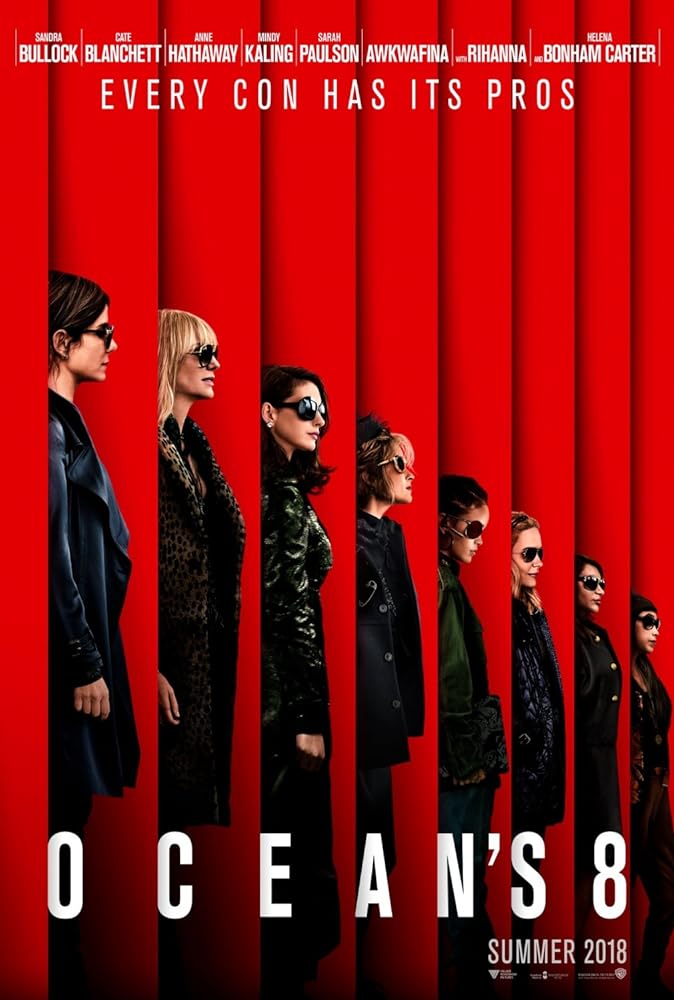
Ocean's 8 (2018) review

Sandra Bullock, Helena Bonham Carter, Cate Blanchett, Anne Hathaway, Sarah Paulson, Mindy Kaling, Rihanna, and Awkwafina in Ocean's Eight (2018)

In 1960, Warner Bros. released Ocean’s 11, a heist film set in Las Vegas that was directed by two-time Oscar-winning director Lewis Milestone. The film was notable for featuring a star-studded cast that was headlined by the five men who made up one of the entertainment industry’s most notable ‘groups’, the Rat Pack; Frank Sinatra, Dean Martin, Sammy Davis Jr., Peter Lawford, and Joey Bishop. And while the film itself wasn’t exactly a big hit with critics, it did do solidly at the box-office and is still considered as one of the group’s most iconic projects. Four decades later, the film was remade by auteur director Steven Soderbergh; like the original, it also featured a star-studded ensemble cast, including George Clooney, Brad Pitt, Matt Damon, and Julia Roberts, just to name a few. Upon its release in 2001, the film was a massive commercial hit that was followed by two sequels, Ocean’s Twelve in 2004 and Ocean’s Thirteen in 2007. All three films were commercially successful though critical reception towards them was varied (i.e. many consider Ocean’s Twelve to be the worst installment of the trilogy). One thing for certain, though, was that following the passing of Bernie Mac (who played con-man Frank Catton) in 2008, both Soderbergh and Clooney made it clear that there would not be a fourth Ocean’s film with the original cast. So instead, it was decided about a decade later to take the series in a different direction; thus, here we are now with Ocean’s 8, a female-led spin-off that, true to the franchise’s roots, features an all-star cast headlined by the likes of Sandra Bullock, Cate Blanchett, and Anne Hathaway… and again, that’s just to name a few. This time around, veteran writer/director Gary Ross is behind the camera for this spin-off, though Soderbergh is still involved as a producer. And as crazy as it might seem, Ross somehow manages to surpass several of the highs from Soderbergh’s trilogy even though his film does tend to abide by quite a few of the franchise’s usual trappings.

Following in the footsteps of her late brother Danny, professional thief Debbie Ocean (Sandra Bullock) is released on parole after spending the last five years (and eight months) in prison. As soon as she gets out, she reunites with her best friend and partner-in-crime Lou (Cate Blanchett) with her next planned heist already in the works. Said heist revolves around one of the most famous events in New York, the Metropolitan Museum of Art’s annual Met Gala, which several of the most famous people in the world attend. However, instead of just robbing the Gala itself, Debbie plans on stealing a valuable necklace known as the Touissant that is owned by the famous jeweler Cartier and is valued at around $150 million. To accomplish this heist, Debbie and Lou recruit a group of specialists, including down-on-her-luck fashion designer Rose Weil (Helena Bonham Carter), jewelry maker Amita (Mindy Kaling), profiteer Tammy (Sarah Paulson), street hustler Constance (Awkwafina), and tech genius ‘Nine Ball’ (Rihanna). Together, they plan on switching out the necklace for a fake one, with famous actress Daphne Kluger (Anne Hathaway) serving as their unsuspecting mule. However, things get a little more complicated once the group learns that one of the main reasons why Debbie has planned this heist is so that she can get revenge against her ex-boyfriend, art dealer Claude Becker (Richard Armitage), who was the one who sent her to prison in the first place.

Now admittedly, it’s safe to say that the plot of Ocean’s 8 has a lot in common with the Ocean’s 11 remake. Both start out with the main protagonist being released from jail and immediately meeting up with their best friend, both have montages where the two recruit their fellow crew members for the heist, and both heists end up getting complicated when it’s revealed that the main protagonist has quite the personal stake in it. Ultimately, though, if there’s one major advantage that Ocean’s 8 has over its three predecessors, it’s that it arguably carries a greater sense of confidence to it when compared to the original trilogy. Now, for the record, I’m not just saying this because this one is headlined by an all-female cast… though with that said, it does sort of play a factor into this (more on that in a bit…). After all, it’s worth noting that Ocean’s 8 ends up sharing a lot more in common with its predecessors than just similar plot-lines. While the film doesn’t necessarily maintain the same exact tight pacing of Soderbergh’s films, its primary heist is carried out in the same effortless manner that defined the heists of the previous films without any major source of conflict to undermine it, something that Debbie even assures her crewmates of before they do it. In other words, Ocean’s 8 does manage to maintain the same type of glitzy aesthetic that the previous films had even with the change in directors. With that said, though, it could be argued that the film loses just a little bit of the visual panache that Soderbergh brought to the table with his three films. And yet, in a way that I just can’t explain, this film ends up flowing a lot smoother than the previous films, and director Gary Ross does a good job of maintaining that flow throughout in this solidly-shot heist flick.   

One of the most common criticisms directed towards the Ocean’s trilogy is that while they do feature a terrific ensemble cast, some have argued that this gave the films an incredibly smug tone that ended up being a major turn-off for some audiences. Thankfully, that isn’t even remotely an issue here, as the terrific chemistry between its collection of female leads is arguably the best aspect of Ocean’s 8. This isn’t a case where one of the actresses tries to hog the limelight from their co-stars or, as John Mulaney pointed out in one of his stand-up routines, two characters go off on their own to ‘talk s***’ about their partners behind their backs. All these women work extremely well together, and just like the Avengers films, every member of the group gets to have her own standout moment, whether its screen veterans like Sandra Bullock and Cate Blanchett or reliable supporting players like Helena Bonham Carter and Mindy Kaling. Because of this, the successes that their characters have during the heist end up being a lot more satisfying when compared to the previous films, and it also helps that the film allows us to connect more with these characters in general when compared to Danny Ocean’s crew. Now, granted, character development in this film is sort of on par with the previous films, where the heist itself is emphasized over everything else. And yet, this film still manages to outdo its predecessors by having a more generally likable group of protagonists who have sympathetic reasons to partake in the heist, whether it’s Debbie’s goal of getting revenge against her ex for deceiving her or Rose and Amita just looking to get out of their dead-end careers.

As I noted in my retrospective of the original trilogy a few months back, I thoroughly enjoyed Steven Soderbergh’s remake of Ocean’s 11 even if I didn’t necessarily see it as one of the best films of its genre. Overall, it was a decently entertaining ‘popcorn flick’; nothing more, nothing less. Unfortunately, I, like many, found Ocean’s 12 to be a vastly disappointing follow-up. While I do recognize why it’s Soderbergh’s personal favorite due to him being able to experiment as a director, it’s ultimately a prime example of what happens when said directorial experimentation goes a bit too far. Thus, Ocean’s 13 ended up going ‘back to basics’, and I was pleasantly surprised to find that it was my personal favorite of the trilogy due to it having some of the franchise’s best writing and pacing. But as for Ocean’s 8, it may just be my new favorite installment of the Ocean’s franchise. Oh sure, in a lot of ways, it borrows heavily from Ocean’s 11, like having a similarly structured plot that doesn’t necessarily give the main protagonists a lot of opposition during their heist. However, it just ends up working a lot better than what we saw from the previous Ocean’s films, and while I usually don’t try to get into any sort of politically-based discussions when writing these reviews, it’s hard to deny that the fact that this film stars an all-female cast of leads is ultimately one of the biggest contributors to its overall success. The chemistry that these ladies have is far superior to what we got from the predominantly male cast of the original trilogy, and while the film still doesn’t rely too much on character development, these characters are ultimately a more likable group of protagonists by comparison. Thus, while I wouldn’t necessarily call this the ‘best-directed’ or the most ‘well-made’ installment of the Ocean’s franchise, it is quite easily the series’ most satisfying entry to date.  


Rating: 4.5/5

Wednesday, June 1, 2016

Alice Through the Looking Glass (2016) review

(Disclaimer: The following review of Alice Through the Looking Glass will not be addressing the recent domestic abuse scandal surrounding its star Johnny Depp. Just like the sexual abuse lawsuits that Bryan Singer dealt with prior to the release of X-Men: Days of Future Past, Depp’s domestic issues are not connected to this film in any way.)


In 2010, Disney released what would become their first big ‘live-action reimagining’ of one of their classic animated films; Alice in Wonderland. Directed by Tim Burton, the film was a ‘sequel’ to the original story of the same name written by Lewis Carroll (which of course served as the basis for Disney’s 1951 animated classic) and followed a teenaged Alice as she returned to the world of Wonderland, or to be more specific, ‘Underland’, as it’s referred to in the film. Upon its initial release, the film received mixed reviews, attracting praise for its visual style but also criticism for its writing. But when it comes to its box-office performance, that’s another story because the film actually managed to join the billion-dollar club. I’m still in shock that it was able to do so given its extremely polarizing reception, though from what I hear this was primarily due to the fact that A.) since it was released in March, there wasn’t much competition in terms of family-friendly releases and B.) it was also released in 3-D, which was still a big deal at the time thanks to James Cameron’s Avatar unlike nowadays where it rarely gets attention anymore. So because of it, we now have a sequel in the form of Alice Through the Looking Glass, though like the previous film, this film is only loosely inspired by the story that shares its name (in this case, Carroll’s 1871 sequel, Through the Looking Glass). Tim Burton isn’t in the director’s chair this time around, however. Instead, in his place is James Bobin, who most recently helmed Disney’s last two Muppets films; 2011’s The Muppets and 2014’s Muppets Most Wanted. And like the first Alice, this film has been subjected to generally mixed to negative reviews from critics. It’s clear that when it comes to these films, people either really love them or really hate them. As for me, I’ll admit I lean more towards the former. Because while the film definitely isn’t perfect, there are still some genuinely good things about it that make it worth seeing.

The film opens up three years after the events of the previous film, which ended with young Alice Kingsleigh (Mia Wasikowska) taking up her late father’s business in overseas trade. However, when she returns home to London, she learns that her ‘former’ fiancĂ©, Hamish Ascot (Leo Bill), has taken over his father’s company and plans on buying her father’s ship. Amidst all of this, Alice soon finds herself summoned back to the world of Underland to help deal with a pressing matter regarding the Mad Hatter (Johnny Depp). She learns that the Hatter has been in a funk recently, claiming that the rest of his family, who supposedly died during the Jabberwocky attack (as seen in the previous film), is still alive. With his health slowly deteriorating, Alice, following the suggestion of Mirana the White Queen (Anne Hathaway), travels to the castle of the physical manifestation of Time itself (Sacha Baron Cohen) in order for her to travel back in time with the use of his ‘Chronosphere’ device, which powers all of the time in Underland. In doing so, she finds herself traveling through time, back to when the Hatter, the White Queen, and the rest of their Underland friends were young, in order to save the Hatter’s family from their supposed doom. But in doing so, Alice not only runs amok of Time himself but also finds herself once again crossing paths with Iracebeth the Red Queen (Helena Bonham Carter), who seeks to use the Chronosphere herself in order to change a certain event in her past that caused her to become the big-headed (figuratively and literally) tyrant that she is today.

Like the first film, this film definitely deserves recognition for its visuals and overall visual style. Clearly a lot of time went into making all of the film’s intricate visual effects and they do look really nice. With that said, however, like the first film, some might find all of the film’s CGI, which was pretty much done in the same way that the Star Wars prequels were by having the majority of Underland done in CG save for the human cast members, to be a bit overkill at times. And admittedly the writing is about the same as it was in the first film, tending to be rather messy and sometimes even a bit meandering at times in terms of its plot. However, even with that in mind, the film does at least have one major advantage over its predecessor and that is that it carries a much more pleasant color scheme in terms of its visuals. Whereas the previous film was very much a Tim Burton film with all of its gothic designs, this film has a much more vibrant look to it as a whole, which is definitely an upgrade if you ask me. Plus, the film doesn’t pull any of the rather extreme punches that the original did that did make you question if it was right to be rated PG, namely infamous scenes in which the Dormouse takes out one of the Bandersnatch’s eyes and another scene where Alice crosses the Red Queen’s moat on the heads of her unfortunate victims. So because of that, this film will definitely be easier for kids to handle than the first film. And at the very least, regardless of the film’s scriptural flaws, there really are some good messages for younger audiences, like being true to yourself and your friends and the fact that it’s okay to be a little weird sometimes. There’s actually even a few rather effective heartfelt moments.

A good chunk of the film’s heart and strong messages are exemplified by its main female lead Alice. While in the first film she spent a considerable amount of time questioning the fact that she was in Underland, resulting in her being a bit too passive of a protagonist at times, this film’s Alice is much more assertive and as a result actually becomes a pretty great ‘role model’ for young women. There’s a really great sense of confidence to her, not only in how the character is portrayed this time around but also in Wasikowska’s performance. As for Johnny Depp as the Hatter, it’s exactly what you would come to expect nowadays from Johnny Depp whenever he steps into a role that allows him to don quirky costumes, makeup, and/or accents. At this point you’re either fine with it or you’re really sick of it; me I don’t mind it. Plus, the Hatter is much more toned down this time around, though admittedly that’s primarily because he does spend most of the first half of the film in a muted state. In fact, this film definitely feels a bit more toned down in terms of how campy some of the performances are compared to the original. Though with that said, Helena Bonham Carter still relishes her role as the Red Queen, camping it up whenever she’s onscreen. The same goes for Sacha Baron Cohen as Time, although not as much as Carter. In short, I can say that, at the very least, the ensemble cast is a bit stronger this time around, mostly as a result of Bobin not cranking these characters’ personalities up to 11, which is sort of what Burton did with the previous film.

So here’s the deal with these live-action Alice films. As both of their critical receptions clearly suggest, these two films very much have their critics and quite a few of those critics have been very vocal in expressing their dislike of them. However, at the same time, it’s also clear that these films actually do have a pretty decently sized fan-base. This really can partially explain why the first film did as well as it did at the box-office and while this film hasn’t been doing anywhere near as good as the first film did from a commercial standpoint, I can tell that there will still be quite a lot of people who are going to like this film. And as someone who did like the first film, I can see why. Yes, the film does share some of its predecessor’s issues, namely in terms of the writing. Plus, like before, critics of CGI are no doubt going to take issue with the film’s very extravagant use of CG. However, this film really isn’t as bad as its low 30% rating on Rotten Tomatoes may suggest. Because despite its flaws, the film definitely deserves merit for its impressive visuals. Visually speaking, this is easily one of the best-looking films of the year. And in some ways the film actually does improve on its predecessor, namely in regards to a much brighter color scheme and a much more confident lead performance courtesy of Mia Wasikowska as Alice. So in short, if you weren’t a fan of the first film, then suffice it to say this film ain’t gonna win you over because it’s very much a sequel to Burton’s original film and fans of the books in particular are most certainly not going to be pleased with how the world and its characters are being portrayed. But if you’re someone who was a fan of the first film, then I’m sure you’re going to like this film just as much.


Rating: 3.5/5

(Closing Note: On a sad note, this film serves as the final performance of Alan Rickman, who reprises his role from the previous film as Absolem the Caterpillar (now a Butterfly). The reason why I didn't bring him up in the review is because, well, he actually isn't in the film that much. He only appears in the scene in which Alice first returns to Underland.)

Monday, November 17, 2014

Interstellar: SPOILER Post

WARNING!!!

The following post contains spoilers for the film ‘Interstellar’. If you have not seen the film yet, avoid going any further for I will be discussing key plot-points of the film in great detail. If you don’t want to be spoiled, please refer to my spoiler-free review of the film (the link will be provided below)… and then go see the film because it’s really a one-of-a-kind cinematic experience that should not be missed.


I’ve been doing spoiler posts since 2013 but have mostly done them just for superhero films. I did do one for ‘Star Trek Into Darkness’, which focused on the big ‘villain identity’ reveal but aside from ‘Thor: The Dark World’ (because I felt that there wasn’t much to talk about with that film) and ‘Man of Steel’ (which, well, I guess you can say I just forgot to do), I’ve done spoiler posts for every major comic book film since ‘Iron Man 3’. But now having seen director Christopher Nolan’s latest film, ‘Interstellar’, I feel that it’s time for me to do another one. ‘Interstellar’ is a film that has certainly attracted a very polarizing reaction from both critics and audiences. As you remember from my review, I gave it a 5/5, meaning that I really loved the film but overall the general response that I’ve heard from people who did like it is that it was just ‘good, not great’. The big topic of debate amongst everyone is about the film’s ambitious scale and scope and whether or not it’s a little too ambitious… but I’m not really going to get into that. Instead, I’m just to going to talk about key parts of the film from the visual design to the performances from the cast to a certain cameo in the latter half of the film. Having now seen this film twice, I will note that while I don’t think it’s ‘perfect’, I still think it’s a fantastic sci-fi epic that not only features incredible visuals but also some great emotional resonance to back it all up. As I noted in my original review, even if you end up not liking the film as much as I did, I implore you all to see this film in theaters as it truly is a must-see film, regardless of what your opinion of it ends up being. So without further ado, let’s dive into Christopher Nolan’s newest sci-fi epic, ‘Interstellar’.  

THE VISUALS


Whether or not you actually liked the film, you can’t deny that the visuals are absolutely fantastic. Nolan has an eye for visuals, especially when it comes to practical visual effects as was previously exemplified in films like the ‘Dark Knight Trilogy’ and even ‘Inception’. And of course, that also applies to ‘Interstellar’ as well. Those dust storms on Earth? They actually created real dust storms that weren’t just added in later via CGI. The new planets that the crew of the Endurance travel to were all practical locations, resulting in incredibly striking visuals like a planet completely covered by water and an icy planet, which was filmed in Iceland. Then of course you have the visuals in space, especially when the characters travel through the wormhole, resulting in some of the most eye-popping visuals that I’ve ever seen in a movie. And from what I’ve heard, a lot of this was achieved by having the visual effects done beforehand and then displaying them for the actors so that they didn’t have to do anything against a green screen. Simply put, for a movie where the majority of the effects could’ve just been done with CGI, Nolan thankfully did not go that route resulting in some incredibly nice practical effects. It’ll be a legitimate travesty if this doesn’t earn this film an Oscar nomination for Best Visual Effects because they’re some of the best visual effects of the year.

PERFORMANCES


Nolan has always been good when it comes to the casts of his films and this one is no exception. While the whole ensemble cast is excellent, two performances in particular really stand out amongst the rest. The first is Matthew McConaughey in the lead role of Cooper. I’ll go into a little more depth about his character and his daughter’s arc in a little bit, but simply put, McConaughey has a great screen presence here and a very likable persona. The other major standout is Jessica Chastain in the role of Cooper’s daughter Murph, and on that note, I’d also like to highlight Mackenzie Foy who plays young Murph. Both do a phenomenal job at conveying the emotional turmoil/heartbreak that the character goes through in regards to Cooper leaving her at a young age (primarily in the case of Foy) and the belief that, after learning from Professor Brand (Michael Caine, in his usual top form) that the whole Endurance mission (‘Plan A’ compared to ‘Plan B’, which would have involved establishing a new colony via frozen embryos) wasn’t going to succeed and that the likelihood of humanity ever escaping Earth was slim, that her father may have known about it (which he didn’t, for the record) and left her and her brother behind to die on Earth.

A lot of Nolan’s detractors point out that he hasn’t done so well when it comes to writing female characters save for Selina Kyle in ‘The Dark Knight Rises’. I’d argue that Murph is actually one of the better female leads in a Christopher Nolan film to date along with Selina. Not only is her character pretty relatable given the circumstances of what happens to her in regards to her dad leaving her, but I also admire her dedication and commitment to trying to help figure out a way to save the human race. I can definitely see a bit of Jessica Chastain’s character Maya from ‘Zero Dark Thirty’ in Murph and while I’ll admit I wasn’t the hugest fan of that film, both this and ‘Zero Dark Thirty’ truly benefitted from Chastain’s performances. Anne Hathaway does a very good job as well as Professor Brand’s daughter Amelia, though she is kind of overshadowed by Chastain. As for rest of the cast, most of them don’t really get as much to work with as McConaughey and Chastain (save for Bill Irwin in a scene-stealing turn as one of the robots, TARS, who goes up into space with Cooper and his team), like Casey Affleck as Coop’s grown-up son Tom or Wes Bentley as Doyle, one of Cooper and Brand’s fellow astronauts. Still, it’s another great cast from top to bottom which once again highlights how Christopher Nolan is a fantastic actor-director.

EMOTIONAL DEPTH


Nolan has both huge fans and huge detractors and one of the main things that the latter group always points out when it comes to his films is that they’re more focused on the story than they are with the characters. Now I do see where they’re coming from but I’d also argue that they’re not entirely devoid of emotional depth and resonance. It’s just that, after re-watching his films, I realize that the emotional beats of his films are primarily focused around the main characters while the other supporting characters don’t get as much to work with. The main example I’d use for this would be ‘Inception’, where most of the dramatic moments in the film were based around Dom’s perspective whereas the other characters were really just there to fill out the cast. The same can kind of be said here as Cooper and Murph are the ones who get the bulk of ‘Interstellar’s more emotional moments. Still, I felt that it was done to great effect in regards to both of these characters. You really see how both are affected by Cooper’s decision to go into space; in the case of Cooper, it is how he’s forced to leave his kids behind and for Murph, it’s dealing with him leaving. The scene where Cooper tries to patch things up with Murph right before he leaves got me very emotional as we really see how pain both of them are going through on an emotional level.

However, there is one moment in particular that really stands out for me in regards to having great emotional resonance and that is the scene where Cooper and Brand return from Planet Miller to discover that 23 years have passed since they first left for the planet due to the fact that the planet is right next to a big black hole named Gargantua. Cooper goes through all of the messages sent to him by his kids, most of which are Tom telling him about everything that has happened since he’s been gone from how he got married to the death of grandpa Donald, moments that I’m pretty sure Coop wanted to be there for as shown through McConaughey’s emotional and heartbreaking reaction to all of this news. Then, he watches the first video sent to him by Murph, who’s now grown-up and who just so happens to be sending him on a message on the day of her birthday where she is now as old as he was when he first left and earlier in the scene where they were talking before he left, he told her that he might be back by this point but of course as we now know, he wasn’t able to get back in time for this. This scene once again shows the distress that Murph has gone through as a result of her dad leaving her for all of this time. Thankfully, the two do finally reunite at the end of the film, albeit when Murph is now an old woman (now played by Ellen Burstyn), and it is a very satisfying moment where father and daughter finally reunite after all these years. Say what you will about Nolan’s films lacking emotional development, but if you ask me, this film really delivers on emotional resonance in just the right way and at just the right moments in time.

THE SCORE


‘Interstellar’ serves as the fifth collaboration between Nolan and Hans Zimmer after his work on the ‘Dark Knight Trilogy’ and ‘Inception’ and as I stated in my original review, those who are worried that the score for ‘Interstellar’ will be similar to those films won’t have to worry because that is not the case here at all. I really loved Zimmer’s work on ‘Interstellar’ with some truly stand-out musical motifs throughout the film. The emotional and dramatic melodies were incredibly effective during the more emotional moments in the film along with the more tense melodies during the more intense sequences in the film. I’ve heard some people say that the score is too ‘bombastic’ (similar to what some have said with Zimmer’s other scores to Nolan films) but I’d argue that’s not actually the problem with it. Really, the downside to this brilliant score is that it results in what is unfortunately a major issue of the film, which is…

THE SOUND DESIGN


As many of you have already probably learned by now, the sound design for ‘Interstellar’ is, well, kind of piss-poor in some areas. This is primarily in regards to some of the more intense moments of the film. During these moments, the sound effects and, as noted, even the score can be overpowering to the point where you actually can’t hear any of the dialogue. And this isn’t just one single solitary instance in the film… there are at least three-four separate instances where this happens, like when the Endurance nears Gargantua or when Cooper and his kids are driving through a cornfield in pursuit of a surveillance drone. At first I thought it was just IMAX but after seeing it again in a regular theater, the same issue still occurred. Both times I saw this film, I saw it on, well, film so I’m wondering if the same issue occurs when it was projected digitally. If any of you have seen it this way, sound off in the comment section if the same problem with the sound design occurred while you were watching it. I know that Nolan and his crew were making a major effort to work on the sound design for the film but ultimately it ends up being rather problematic when it comes to some of the biggest moments in the film.

For my next point, I’d like to open with a ‘Team America: World Police’ quote…


MATT DAMON!!!


As many of you already know by now, the key cameo of the film is none other than Matt Damon in the role of Dr. Mann, a renowned member of NASA who had gone up into space during the Lazarus missions where he was sent to survey one of the planets in the galaxy that he and the other astronauts came to after going through the wormhole. However, as it turns out, Mann’s planet (the ice planet I mentioned earlier), isn’t hospitable for humanity in the slightest and that he was only faking the belief that the planet could sustain life just so that he could be rescued. Contrary to some critics, I actually found this part of the film to be incredibly fascinating even though I can see where some are coming from when they say that it felt like it felt like the story was taking a detour when they got to his part. I felt that it was incredibly interesting to have a character like Mann who had become heavily affected by the fact that he was all alone in a mysterious world, so much so to the point where he didn’t even set up a time to wake himself up when he went into hyper-sleep. Before this, Mann is frequently described as being ‘one of the best’ who inspired many and when he finally appears, we see that being up in space for so long has had a very negative effect on him to the point where he attempts to sabotage everything just so that he could be rescued. Ultimately, Cooper puts it best; Mann was a ‘f***ing coward’. I did like this aspect of the film and it was also nice to see Damon in a not-so-heroic role that contrasts quite a bit with a lot of the other roles that he has played over the years.   

THE CLIMAX


So now let’s talk about the climax of the film. After Mann reveals his true colors, he tries to escape but ends up getting killed when his ship imperfectly docks with the Endurance, which also results in it sustaining major damage. Coop and Brand manage to get it under control but find themselves with very little fuel so they decide to try and slingshot the ship around the black hole Gargantua so that they can reach the third planet, Edmunds. In order to lessen the ship’s weight, both TARS and Cooper detach from Endurance and they both fall into the black hole. They end up in a mysterious dimension where Cooper finds that he’s able to view Murph’s bedroom from her childhood at various points in time. Earlier there was discussion about who may have created the wormhole, possibly fifth-dimensional beings. Once in the black hole, Cooper realizes that he is in this ‘fifth-dimension’ and that these mysterious beings are actually humans from the future that are able to ‘communicate’ with others in the past. Cooper does this with Murph, effectively becoming the ‘Ghost’ that she thought she was hearing back when she was a kid, and years later when she’s all grown up, Cooper then relays the data that TARS had collected to her through Morse code, resulting in her figuring out the solution to save humanity and get them off of the dying Earth. Before leaving this ‘tesseract’, he also serves as the ‘being’ that Brand apparently comes into contact with when the crew of the Endurance first go through the wormhole.

Of course, because I’m no film scholar, I’m not going to try and analyze this sequence too much but I will say that, like with much of the movie, I found it to be incredibly fascinating. From a visual perspective it’s brilliant (obviously) but I also found it to be a unique plot-point and like the emotional satisfaction I felt when Cooper finally reunited with Murph at the end of the film, I found it very heart-warming and emotionally satisfying when it was revealed that Cooper was Murph’s ‘ghost’ allowing him to reconnect with her after all these years after they had parted on bad terms when he first went off into space. Not only does Coop reconnect with Murph but she is also able to finally figure out the problem that she has been trying to solve for a long time and she does so while also finally coming to terms with her emotions over her father leaving her. Now with that said, I do have to partially agree with something that YouTube movie critic Chris Stuckmann noted in his ‘Revisited’ review of the film (I’ll provide the link to it below) that this scene maybe would’ve worked a little better had this reveal not be primarily conveyed through exposition by Cooper and TARS instead of imagery, allowing the audience to figure out what is happening on their own. Now for the record, I’m not too bothered by the exposition, but I definitely see where he’s coming from and that this change would’ve made the scene a little more impactful which if you ask me it still very much is regardless of this.

IMAX AND 70/35 MM


Finally, I’d like to talk about what I believe is the best way to experience this movie; in IMAX. Nolan of course got the ball rolling for feature films to utilize IMAX cameras when he shot ‘The Dark Knight’ though I unfortunately never got the chance to see either that, ‘Dark Knight Rises’, or even last year’s big sci-fi hit ‘Gravity’ in IMAX. But this time I really made an effort to see this film in IMAX and boy does it deliver. Even with the problematic sound design, the film is truly a cinematic experience on the big IMAX screens. The already mentioned outstanding visuals stand out even more on the screen and while reading into the film’s production, it’s pretty cool how Nolan and cinematographer Hoyte van Hoytema utilized IMAX cameras for this film, reworking them so that they can be used in a handheld manner while shooting interior scenes. Also, if you get the chance, check out the film in the 70 or 35 mm formats as opposed to the new standard of digital projectors. Watching this film, both times in the film format, gave me quite a bit of nostalgic memories because I swear I can’t even remember the last time I saw a film in theaters that wasn’t projected digitally. And while I know that some movie theaters were really against having to project it the old-fashioned way, I’d say it actually looks much better on film. I don’t care if I sound an old man for saying that… it just does. Heck, I got a kick out of seeing those old cue marks (or as ‘Fight Club’ puts it, ‘cigarette burns’) to signify to the projectionist to change reels. I know that this old-school style of film projection is unfortunately becoming a dying art so kudos to filmmakers like Christopher Nolan, Quentin Tarantino, and J.J. Abrams who are still all activists in regards to this format.

Chris Stuckmann’s ‘REVISITED’ review of ‘Interstellar’


Sunday, November 9, 2014

Interstellar (2014) review


Christopher Nolan is a director who just makes excellent movies. He’s one of those directors who, in my opinion, has yet to make a bad film. Of course, many people will primarily recognize him as the man who revived the ‘Batman’ film franchise with the ‘Dark Knight’ trilogy which ran from 2005 to 2012. Those three films not only returned the series to its much darker roots but also differentiated themselves from other superhero movies by opting for a much more grounded tone. Not only is it the best superhero film trilogy ever made, but it’s also one of the best film trilogies period. But those aren’t the only great films that Nolan has made. He’s also helmed projects like ‘Memento’, ‘The Prestige’, and ‘Inception’, which were all very well-written films that didn’t talk down to the audience like some films admittedly do. That trend continues with Nolan’s newest film, and his first following the conclusion of the ‘Dark Knight’ trilogy, ‘Interstellar’. This is easily Nolan’s most ambitious film to date in regards to the film’s overall scope and scale. Heck, it’s even its longest film to date at 169 minutes, which beats his previous film, ‘The Dark Knight Rises’, by just four minutes. However, under his usual great direction, ‘Interstellar’ turns out to be a truly one-of-a-kind motion picture experience, especially in IMAX which is pretty much the best way to see this movie.

The film takes place in the near future, where the Earth’s resources are slowly but surely starting to diminish, mostly due to blight and dust storms. During this time of crisis, NASA seeks a way to try and save humanity and seemingly find a solution when they discover a wormhole near Saturn. They set up a mission to send a ship into space to go through the wormhole, following a series of similarly manned spacecraft which were all sent up some time ago, and survey new planets in order to find a suitable new home. To lead the mission, NASA recruits one of their former test pilots, Cooper (Matthew McConaughey), a widowed engineer who currently lives as a farmer with his father-in-law Donald (John Lithgow) and his two kids; his son Tom (TimothĂ©e Chalamet, later played by Casey Affleck) and his daughter Murph (Mackenzie Foy, later played by Jessica Chastain). Though he is rather reluctant to go at first due to the fact that he would be leaving his kids behind for an uncertain amount of time, Cooper agrees to lead the mission and heads up into space along with his fellow crew members, including Amelia Brand (Anne Hathaway), the daughter of one of NASA’s key professors (Michael Caine), Doyle (Wes Bentley), Romilly (David Gyasi), and robots TARS and CASE (voiced by Bill Irwin and Josh Stewart, respectively) in the hopes of finding a new habitable planet in order to save the human race.

‘Interstellar’ drew me in from the very beginning and I was hooked from beginning to end. From a technical perspective, the film is pretty much near-perfect. The visuals are outstanding, especially in the sequences that take place during space and when the characters go into the black hole, as is the cinematography in the first film since Nolan’s directorial debut to not be shot by Wally Pfister. As a director, Nolan has been known for using as much practical effects as possible and it seems like this is also the case, for the most part, in this film as well. The soundtrack by Hans Zimmer is also fantastic and those who are worried about the score sounding too similar to Zimmer’s work on Nolan’s other films will be pleased to know that this isn’t the case here. Now I did say ‘near-perfect’ earlier, and that is because the sound design for the film can be rather problematic at times. Sometimes the audio is so loud, due to either the film’s sound effects or sometimes even the score, that it’s hard to hear the dialogue. But ultimately, the best way to see this film is in IMAX. The visuals are even more eye-catching on the big screen and despite some issues with the sound design, sometimes you can even feel the theater shake during certain sequences like when the spaceships are launching. I also saw it in the 70 mm format which served as a nice bit of nostalgia for me seeing how this is probably the first film that I’ve seen in quite some time (geez, I sound old…) that wasn’t projected digitally. You could actually hear the projector running during moments of in-space silence.

One thing about Nolan’s films that his critics frequently bring up is that when it comes to his writing, he’s more focused on story than he is with characters. While I do certainly see where they’re coming from, I’d argue that his films aren’t entirely devoid of character and substance. It’s just that most of the emotional depth of his films mostly come from the arcs of the main characters while most of the side characters don’t get as much to work with in that regard, and this is sort of the case here with Cooper. However, the emotional resonance of his storyline, primarily his relationship with Murph and the conflict that he faces in regards to having to decide to leave his family in order to save the world, is actually really spot-on and I’ll admit that even I got a little emotional at times because of it. McConaughey of course has been on a big career comeback recently and this film is no exception as he gives one of the best performances of his career in this movie. And while it is true that McConaughey’s role does kind of overshadow every other character in the film, Nolan once again proves to be one of the best ‘actor’ directors in the business thanks to great performances from all involved including Anne Hathaway, Jessica Chastain, Bill Irwin (even though he’s just voicing a robot), and Michael Caine. There’s even a neat little cameo by someone you will no doubt recognize in the latter half of the film. Now despite Nolan’s knack for secrecy, you’ve probably already know who it is given the extremely spoiler-ific nature of the internet. Even I’ll admit I knew about it going in. Still, for anybody who doesn’t know about it already, I won’t spoil it here.

‘Interstellar’… is truly an outstanding film. While Nolan’s critics hate to hear the comparisons made between him and Stanley Kubrick, ‘Interstellar’ is very much inspired by Kubrick (namely his own sci-fi epic ‘2001: A Space Odyssey’) and it’s safe to say that this is Nolan’s ‘2001’. Its visuals are outstanding matched by the film’s overall scale and scope. It’s also certainly Nolan’s most ambitious film to date and while some may argue that the film bites off more than it can chew, I do feel that the film does manage to succeed in that regard more than it may fail. Not only that, but the movie does have enough emotional resonance through the arc of the character of Cooper thanks to both the writing and McConaughey’s excellent leading performance. Now I do realize that this is, at the moment, becoming one of the more polarizing films of the year and while I haven’t seen that many negative reviews, most of the positive reviews I’ve heard are describing the film as ‘good but not great’. I for one think it’s one of the best films of the year so far, but regardless of whether or not you end up liking the film, one thing’s for certain; it’s still very much a must-see in theaters, especially in IMAX and if you do have the opportunity to do so, preferably in 70 mm. It’s a film that truly delivers on spectacle and does manage to be more than just that.


Rating: 5/5!