Showing posts with label Cate Blanchett. Show all posts

Thursday, February 1, 2024

How to Train Your Dragon - Series Retrospective (DreamWorks Animation Retrospective #4)

Welcome back to another installment of Rhode Island Movie Corner’s series of retrospectives on the numerous animated films produced by DreamWorks Animation. As my way of not having to do a massive singular post covering the 45+ films that the studio has produced since 1998, I’ve been dividing its filmography up into multiple parts, starting with their biggest franchises. And today, we’ve finally come to the DreamWorks franchise that I’ve been anticipating covering the most. Sure, Shrek may have been the franchise that made DreamWorks the household name that it is today, but if you want to talk about the franchise that almost single-handedly reshaped the idea of what a DreamWorks Animation film could be, look no further than the How to Train Your Dragon trilogy. Loosely based on the best-selling book series by author Cressida Cowell, this is a franchise that has yielded some of the most critically acclaimed animated films from the past decade and a half and has widely been cited as the prime example of how DreamWorks has very much come a long way since the days when their filmography was seen by many as being nothing more than a bunch of pop-culture dependent kiddie flicks. And on a personal level, today I finally get to rectify the fact… that I’ve never seen any of these films before. Yeah, yeah, I know, I know; to make a long story short, the first How to Train Your Dragon had the unfortunate distinction of being the first DreamWorks film that I didn’t see in theaters since anything that came out before Shrek, and seeing how it’s only 1% away from having the mythical perfect 100% rating on Rotten Tomatoes, it’s safe to say that I clearly missed out on something special. But now I’m finally ready to see why this series has become such a beloved staple of the current pop cultural zeitgeist; thus, without further ado, it’s time to take a journey to the magical land of Berk as we look at the How to Train Your Dragon trilogy.

(Disclaimer: *Insert your standard ‘I’m only covering the films’ ground rule here. Please refer to previous DreamWorks Retrospectives for further instructions*)

HOW TO TRAIN YOUR DRAGON (2010)

In 2003, author Cressida Cowell published How to Train Your Dragon, a children’s novel that expanded upon the world from Hiccup the Viking Who Was Seasick, a picture book that she wrote in 2000. Set in a world full of Vikings and the mythical dragons that many of them own, it followed the previous book’s titular protagonist Hiccup Horrendous Haddock the Third as he looked to prove himself to both his father, Stoick the Vast, and their village of Berk along with his dragon companion Toothless. Upon its release, the book would go on to spawn Cowell’s first official franchise of novels as an author, with eleven subsequent novels published up until 2015 that have collectively sold over 7 million copies worldwide. Just one year after the original novel’s release, the series caught the attention of DreamWorks Animation, with animation veteran Bonnie Arnold spearheading the potential film adaptation as its main producer. While the original script for the film was a largely faithful adaptation of its source material, this would change under the direction of the duo of Chris Sanders and Dean DeBlois, who had made their mark in the industry back in 2002 with the most successful release of Disney Animation’s post-Renaissance era, Lilo and Stitch. Instead of the original premise of Vikings living in harmony with dragons, which Sanders and DeBlois found to be overly whimsical and geared too heavily towards younger audiences, the film reimagines the plot into one where the Vikings have been hunting dragons for years. Thus, instead of just simply looking to prove himself to his doubtful father and peers, Hiccup also finds himself having to undo years of animosity between humans and dragons after befriending the rarest dragon of all, a Night Fury, which he names Toothless.

Upon its release, How to Train Your Dragon quickly became one of DreamWorks’ biggest hits of all time. It earned over $494 million worldwide, with a $217 million domestic haul that made it the highest-grossing DreamWorks film in the U.S. outside of the Shrek series, a record that it still holds today. But perhaps most importantly, the film was a runaway success with critics, securing a near-perfect 99% rating on Rotten Tomatoes, the best score that any DreamWorks film has ever secured on that site. And yet, as I noted in the intro, this was the first DreamWorks film that I had missed out on seeing in theaters in about a decade… and boy, did I miss out! How to Train Your Dragon is very much an animated masterpiece with some of the best animation to ever come out of a DreamWorks film up to that point. Part of this is thanks to the filmmakers utilizing the assistance of legendary cinematographer Roger Deakins as a visual consultant to, as they put it, give the film a uniquely live-action feel, which is certainly on display throughout, especially in the spectacular flying sequences that many have argued are on par with and possibly even better than the flying sequences from what was quickly becoming the biggest film of all-time, Avatar. In previous DreamWorks Retrospectives, I noted that I didn’t see a lot of the studio’s films at this time in 3-D even though many have said that they were amongst the best in the industry to utilize the format at a time when the market was getting oversaturated with films that were both hastily and poorly converted into 3-D. Case in point, How to Train Your Dragon may just be the most prominently lauded of them all when it comes to its use of the 3-D format.

But aside from all its visual splendor, the film is also buoyed by its thoroughly charming underdog story led by an endearing main protagonist in Hiccup, excellently voiced by Jay Baruchel, and his lovable dragon pal Toothless. That said, it is interesting to note that one of the biggest deviations from the book was the portrayal of Toothless since, in the book, Toothless was a more narcissistic and abrasive character rather than the adorably loyal kitty cat-like companion that he is in the films. They’re then joined by a top-notch supporting cast that includes Gerard Butler as Hiccup’s over-demanding father Stoick, America Ferrara as Hiccup’s training rival turned love interest Astrid, and Craig Ferguson as Stoick’s best friend (and dragon-hunting teacher) Gobber, along with the likes of Jonah Hill, Christopher Mintz-Plasse, and Kristen Wiig as Hiccup and Astrid’s fellow dragon-hunting trainees. And so, with all this in mind, it’s easy to see why the first How to Train Your Dragon went on to become one of the most acclaimed films that DreamWorks Animation had ever made up to that point. Rather than the unabashedly irreverent comedic endeavors that they were long known for at the time, this film appropriately goes for a more dramatic narrative approach that, nevertheless, still delivers a bunch of great comedic moments amidst its solid emotional and character beats. In short, even if this was the same year that Pixar’s Toy Story 3 became only the third animated film in history to garner a Best Picture nomination along with its expected Best Animated Feature win, How to Train Your Dragon genuinely gives it a run for its money as one of the best films of 2010.

Rating: 5/5!

HOW TO TRAIN YOUR DRAGON 2 (2014)

Given the immense success of the original How to Train Your Dragon, it’s no surprise that a sequel was immediately announced just one month after its release. It would ultimately come out in 2014 and retained most of its predecessor’s core cast and crew members; the only major loss in that regard was co-director Chris Sanders due to his commitment to DreamWorks’ 2013 release The Croods. Thankfully, though, he stuck around as an executive producer while his co-director Dean DeBlois officially took over as the franchise’s main director. Set five years after the events of the first film, How to Train Your Dragon 2 sees Hiccup, Toothless, and their friends confronted by their most dangerous adversary yet; Drago Bludvist (voiced by Djimon Hounsou), a vicious dragon-hunting warlord who seeks to assemble a dragon army and take over the world. And if that wasn’t enough, Hiccup also ends up reuniting with his long-lost mother Valka (voiced by Cate Blanchett), who has been protecting dragons from Drago for years. Upon its release, How to Train Your Dragon 2 did even better than its predecessor at the box office, earning over $621 million worldwide, currently standing as the 7th highest-grossing DreamWorks film of all-time and the franchise’s highest-grossing installment. And while it lost that year’s Oscar for Best Animated Feature to Disney’s Big Hero 6, it gamely followed in its predecessor’s footsteps by maintaining a strong critical reception.

Sure enough, How to Train Your Dragon 2 is exactly the kind of excellent sequel that you’d want to see in the sense that it naturally improves upon its already fantastic predecessor in plenty of ways. Once again utilizing the assistance of Roger Deakins (who, at this point, had also served as a visual consultant on other DreamWorks films such as Puss in Boots and Rise of the Guardians), this film boasts even greater visuals and action sequences than its predecessor, arguably thanks in large part to a brighter color palette that’s used to its fullest effect. And sure, maybe the film’s main antagonist Drago isn’t as strong of a villain as he could’ve been in part due to a limited screentime, but the addition of Hiccup’s mother Valka (and her subsequent reunion with both her son and her husband Stoick) provides a strong emotional hook that carries throughout the entire film. Add in some other strong emotional beats such as the devastating death of one of the main characters and the continued efforts to strengthen the bond between Hiccup and Toothless and it’s easy to see why director Dean DeBlois cited The Empire Strikes Back as a primary source of inspiration for this sequel. Just like that film, How to Train Your Dragon 2 effectively raises the narrative stakes in a thematically darker film (which, admittedly, was a source of contention amongst some audiences) that nevertheless doesn’t lose sight of its family-friendly appeal, its endearing main protagonists, and its penchant for spectacular visuals.

Rating: 5/5!

HOW TO TRAIN YOUR DRAGON: THE HIDDEN WORLD (2019)

Before we conclude today’s retrospective, I’d like to point out an interesting bit of trivia about this series that I ended up coming across while working on this post, and that is the fact that the How to Train Your Dragon trilogy has the unique distinction of having every installment released under a different distributor. The original How to Train Your Dragon, released in 2010, came out near the tail-end of DreamWorks’ almost decade-long distribution deal with Paramount that had started back in 2006. After that, DreamWorks signed a distribution deal with 20th Century Fox, with 2014’s How to Train Your Dragon 2 being the studio’s most commercially successful release of that era. Finally, the trilogy’s grand finale, 2019’s How to Train Your Dragon: The Hidden World, had the honor of being the first DreamWorks film to be released through their current distributor, Universal. As the title suggests, the film sees Hiccup and company embark on a journey to try and find the mythical ‘Hidden World’, the perfect sanctuary for dragons, when they realize that Berk is no longer safe for their dragon companions due to the increasing number of dragon hunters that have come after them such as their latest foe Grimmel (voiced by F. Murray Abraham), who has singlehandedly killed nearly every Night Fury in the world except for Toothless. And yet, at the same time, Toothless finally comes across one of his own when he meets and falls in love with a female counterpart AKA a ‘Light Fury’.

Like its two predecessors, How to Train Your Dragon: The Hidden World was a bona fide success with both critics and audiences. While it may not have matched How to Train Your Dragon 2’s franchise-best run at the box office, it did achieve the franchise’s second-best worldwide total as it grossed over $525 million worldwide. And even when faced with the inevitably intense expectations of being a threequel given the typically mixed reception that most franchise threequels tend to get (which is something that DreamWorks is quite familiar with), the film was yet another runaway hit with critics. However, even with that said, it seems like this one ended up being a bit more polarizing amongst fans of the franchise specifically because of its ending. Now, for the sake of those who haven’t yet seen these films, I won’t spoil the full details of this ending, but to make a long story short, some felt that it went against a lot of the key themes that the franchise had established over its run and the whole premise of Hiccup and company’s efforts to prove that humans and dragons can peacefully co-exist with each other. And yet, while I do genuinely see where they’re coming from in some cases, the way that this film concludes its saga of humans and dragons is done in a way where, despite the devastating decision that’s made and what it means for both parties, it still presents a positive outlook on the potential of the two of them living in harmony without any sort of threat to the latter.

In other words, from a narrative standpoint, I do believe that The Hidden World is a top-notch conclusion to this phenomenal trilogy… especially since I’d argue that this is one of the rare instances of a trilogy where each subsequent installment is better than the last. First, to get the obvious superlatives out of the way, because of all the technical improvements that have come with each new film (case in point, it has been well-documented that DreamWorks had to update a lot of their animation software to achieve all their visual aspirations for this film), The Hidden World boasts the franchise’s most stunning visuals and epically thrilling action sequences. And whereas the previous film’s antagonist Drago was an admittedly lackluster villain, The Hidden World features the series’ best antagonist in Grimmel, excellently voiced by F. Murray Abraham and an all-around sinister foe who’s properly established as a legitimate threat to our heroes right from the beginning. Finally, given its status as a, well, ‘finale’, it goes without saying that this film delivers the franchise’s best emotional beats, such as whenever it focuses on the blissfully sweet budding romance between Toothless and the Light Fury or, as I noted earlier, its powerful gut-punch of an ending that, like it or not, does feel emotionally justified. In short, what more can I say about this franchise that I haven’t already said here today? While all three films are phenomenal in their own way, The Hidden World ultimately stands out amongst them all as it sends off this beloved franchise on the best note possible, firmly asserting its status as a trilogy that has always matched its grand visual splendor with its wholly heartfelt storytelling.

Rating: 5/5!

And that concludes the latest installment of Rhode Island Movie Corner’s series of DreamWorks Retrospectives. Simply put, it was a lot of fun to finally see what this franchise was all about after years of never getting around to seeing these films despite being fully aware of how beloved they were. And while The Hidden World may have marked the end of the franchise in terms of animated films, that doesn’t mean that this is the end of Hiccup and Toothless’ adventures as a live-action adaptation of the first film is currently in the works for a June 2025 release. Sure, this announcement undoubtedly frustrated those who, just like all the recent live-action remakes of Disney’s animated classics, question the need to make a live-action version of an animated masterpiece, but at the very least, this new film will benefit from the return of series director Dean DeBlois in the director’s chair. As for its casting, Mason Thames, breakout star of Scott Derrickson’s 2022 hit The Black Phone, headlines the film as Hiccup while Nico Parker, fresh off her acclaimed turn as Joel’s daughter Sarah in the HBO adaptation of The Last of Us, will star as Astrid. Edgar Wright regular Nick Frost takes on the role of Gobber while Gerard Butler returns to reprise his role from the animated films as Hiccup’s father Stoick. And if that wasn’t enough, 2025 will be a big year for the franchise in general as it’s set to serve as one of the five lands in Universal Orlando Resort’s upcoming fourth theme park, Epic Universe.

As for our next endeavor in the DreamWorks Retrospective series, this is where things get interesting. As I’ve said before, my goal with this series was to start out by tackling DreamWorks’ biggest franchises; more specifically, any franchise that has elicited, at the very least, a trilogy of films. With that in mind, when I first started this series back in 2022, How to Train Your Dragon was the most recent DreamWorks franchise to achieve this feat; thus, my plan at the time was to then do a quick detour and tackle the studio’s brief foray into traditionally animated features before moving on to the rest of their filmography. However, by the time that this post has been published, another DreamWorks franchise has recently achieved the trilogy mark. And so, for our next DreamWorks Retrospective, we’ll be tackling what has arguably become DreamWorks’ flagship franchise as of late, the Trolls franchise.

Wednesday, September 26, 2018

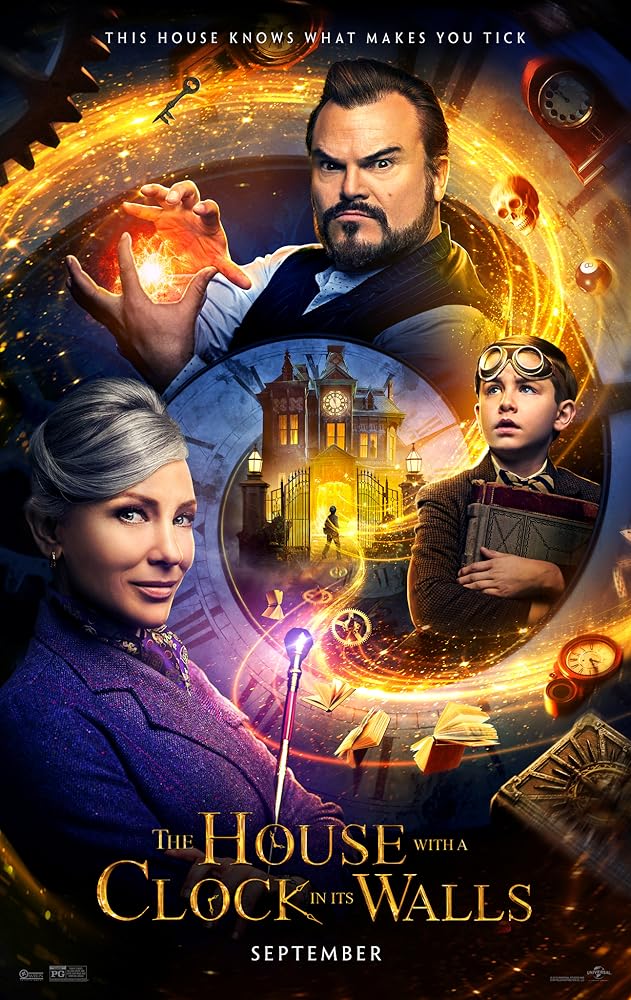
The House with a Clock in Its Walls (2018) review

Cate Blanchett, Jack Black, and Owen Vaccaro in The House with a Clock in Its Walls (2018)

The House with a Clock in Its Walls, an adaptation of author John Bellairs’ best-selling novel of the same name from 1973, is one of those films that is quite fascinating primarily because of who’s directing it. Sometimes you have a film that is directed by someone who isn’t usually known for making films that are either from a specific genre or geared towards a specific audience. Some notable examples of this include 2011’s Hugo, a rare family-friendly affair from the legendary Martin Scorsese, or when the Russo Brothers effectively transitioned from comedies to the superhero genre when they were hired to direct Captain America: The Winter Soldier. And that is very much the case with this film, which is the first PG-rated directorial effort from Eli Roth. For the past decade, the New England native director has mainly been known for his work on horror films that more than deserve their R rating. In fact, films like 2005’s Hostel, its 2007 sequel Hostel: Part II, and 2015’s The Green Inferno have been noted as playing a huge part in the development of the rather infamous genre of horror films that have colloquially been referred to as ‘torture porn’. With that in mind, it’s admittedly rather weird to now see him working on a film that’s geared towards the type of crowd who really shouldn’t be watching any of his other films. But to his credit, Roth does manage to craft an enjoyable family-friendly fantasy horror flick that benefits greatly from its three leads and shows that he can certainly be more than just a director who’s known for graphically violent horror films.
  
Following the death of his parents in a car crash, ten-year-old bookworm Lewis Barnavelt (Owen Vaccaro) is sent to live with his friendly uncle Jonathan (Jack Black) in a small town in Michigan. Once there, he is brought to Jonathan’s ‘ancient’ house where he also meets his uncle’s eccentric neighbor, Florence Zimmerman (Cate Blanchett). Soon enough, Lewis starts noticing a few oddities about his uncle’s house. Despite claims from his neighbors and classmates that the house is haunted, Lewis eventually learns that Jonathan is a warlock AKA a practitioner of magic. After some coaxing, Jonathan agrees to train his nephew with the help of Florence, who’s also quite skilled in magic as a witch, and to their surprise, Lewis quickly manages to become quite adept at casting spells. Along the way, though, Lewis also learns about the darkest secret behind his uncle’s house. Specifically, he learns that the house was previously owned by a more sinister warlock, Isaac Izard (Kyle MacLachlan), who happened to be an old friend/partner of Jonathan’s. One night, Isaac cast a powerful spell that ended up killing him but also created a mysterious ticking clock that was hidden somewhere within the house itself. Unsure of what will happen when the clock’s ticking counts down to one, Lewis, Jonathan, and Florence must band together to ensure that whatever Isaac planned won’t come to fruition.

All in all, Roth does quite a solid job when it comes to his first film geared towards younger audiences. It allows him to play with a lot of the horror elements that he’s familiar with while never delving into any of the more extreme parts of his other films. This results in a breezily paced fantasy flick that boasts a lot of quirky gothic visuals and a nice light-hearted tone that produces a lot of solid humor amidst only a few bits of juvenile family film humor. And while the writing does have a few narrative cracks here and there (e.g. a finale that’s a tad bit anticlimactic), the story is still solid despite it being rather predictable. Ultimately, though, the biggest selling point of this film is its trio of leads. General newcomer Owen Vaccaro (though, really, calling him a ‘newcomer’ is a bit of a stretch given that he did star as one of Will Ferrell/Mark Wahlberg’s kids in Daddy’s Home and its sequel) does an excellent job in the lead role of Lewis, working quite well off his more experienced co-stars. On that note, Jack Black and Cate Blanchett are also quite excellent, especially in terms of their comedic banter. Black, of course, brings his usual youthful enthusiasm to the table while Blanchett works as a great foil for him as the more sarcastic Florence, who gets one of the more interesting character arcs in the film revolving around an incident from her past that has effectively hindered her magic. As for Kyle MacLachlan as the main antagonist Isaac Izard, admittedly his screen-time is mostly limited to the third act, but he does make the most out of it. Unfortunately, the other villain in the film, Isaac’s wife Selena (Renee Elise Goldsberry), is heavily underutilized. Not only is Goldsberry dealt with the same situation as MacLachlan by having most of her screen-time limited to the finale, but her character isn’t even properly introduced until that very point.  

Ultimately, though, this film is a prime example of how just because a director is known for doing one kind of film doesn’t mean that they can’t step out of their wheelhouse to do something different. Despite a few narrative shortcomings, The House with a Clock in Its Walls is a nice addition to the genre of family-friendly fantasy horror films that has spawned numerous classics such as The Nightmare Before Christmas, Beetlejuice, and Gremlins. In fact, Gremlins is an appropriate reference in this case because one thing that I forgot to mention in the intro was that this was produced by Steven Spielberg’s production company, Amblin Entertainment. With that in mind, this does come off as the kind of family film that Spielberg was well-known for in the 80’s, right down to it having a kid as the main protagonist who goes on a fantastical adventure in a seemingly normal town. And while this may not reach the same heights as the films that have inspired it, it does work well thanks in large part to its delightful visual style and the terrific lead trio of Owen Vaccaro, Jack Black, and Cate Blanchett. As such, I wouldn’t mind seeing a follow-up with the same main characters involved. This is, after all, a film that was based on the first installment of a series that went on to have 11 more novels. Obviously, this film isn’t going to go on to have that many follow-ups regardless if a sequel ever gets made but, I don’t know, maybe one or two sequels if everyone involved was open to returning.


Rating: 3.5/5

Tuesday, June 12, 2018

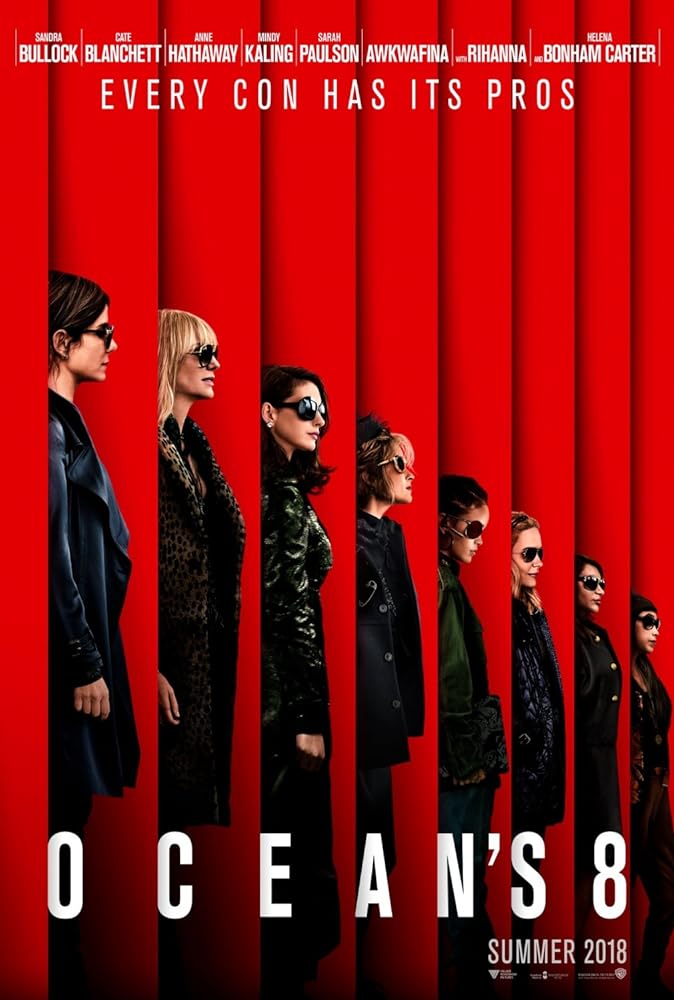
Ocean's 8 (2018) review

Sandra Bullock, Helena Bonham Carter, Cate Blanchett, Anne Hathaway, Sarah Paulson, Mindy Kaling, Rihanna, and Awkwafina in Ocean's Eight (2018)

In 1960, Warner Bros. released Ocean’s 11, a heist film set in Las Vegas that was directed by two-time Oscar-winning director Lewis Milestone. The film was notable for featuring a star-studded cast that was headlined by the five men who made up one of the entertainment industry’s most notable ‘groups’, the Rat Pack; Frank Sinatra, Dean Martin, Sammy Davis Jr., Peter Lawford, and Joey Bishop. And while the film itself wasn’t exactly a big hit with critics, it did do solidly at the box-office and is still considered as one of the group’s most iconic projects. Four decades later, the film was remade by auteur director Steven Soderbergh; like the original, it also featured a star-studded ensemble cast, including George Clooney, Brad Pitt, Matt Damon, and Julia Roberts, just to name a few. Upon its release in 2001, the film was a massive commercial hit that was followed by two sequels, Ocean’s Twelve in 2004 and Ocean’s Thirteen in 2007. All three films were commercially successful though critical reception towards them was varied (i.e. many consider Ocean’s Twelve to be the worst installment of the trilogy). One thing for certain, though, was that following the passing of Bernie Mac (who played con-man Frank Catton) in 2008, both Soderbergh and Clooney made it clear that there would not be a fourth Ocean’s film with the original cast. So instead, it was decided about a decade later to take the series in a different direction; thus, here we are now with Ocean’s 8, a female-led spin-off that, true to the franchise’s roots, features an all-star cast headlined by the likes of Sandra Bullock, Cate Blanchett, and Anne Hathaway… and again, that’s just to name a few. This time around, veteran writer/director Gary Ross is behind the camera for this spin-off, though Soderbergh is still involved as a producer. And as crazy as it might seem, Ross somehow manages to surpass several of the highs from Soderbergh’s trilogy even though his film does tend to abide by quite a few of the franchise’s usual trappings.

Following in the footsteps of her late brother Danny, professional thief Debbie Ocean (Sandra Bullock) is released on parole after spending the last five years (and eight months) in prison. As soon as she gets out, she reunites with her best friend and partner-in-crime Lou (Cate Blanchett) with her next planned heist already in the works. Said heist revolves around one of the most famous events in New York, the Metropolitan Museum of Art’s annual Met Gala, which several of the most famous people in the world attend. However, instead of just robbing the Gala itself, Debbie plans on stealing a valuable necklace known as the Touissant that is owned by the famous jeweler Cartier and is valued at around $150 million. To accomplish this heist, Debbie and Lou recruit a group of specialists, including down-on-her-luck fashion designer Rose Weil (Helena Bonham Carter), jewelry maker Amita (Mindy Kaling), profiteer Tammy (Sarah Paulson), street hustler Constance (Awkwafina), and tech genius ‘Nine Ball’ (Rihanna). Together, they plan on switching out the necklace for a fake one, with famous actress Daphne Kluger (Anne Hathaway) serving as their unsuspecting mule. However, things get a little more complicated once the group learns that one of the main reasons why Debbie has planned this heist is so that she can get revenge against her ex-boyfriend, art dealer Claude Becker (Richard Armitage), who was the one who sent her to prison in the first place.

Now admittedly, it’s safe to say that the plot of Ocean’s 8 has a lot in common with the Ocean’s 11 remake. Both start out with the main protagonist being released from jail and immediately meeting up with their best friend, both have montages where the two recruit their fellow crew members for the heist, and both heists end up getting complicated when it’s revealed that the main protagonist has quite the personal stake in it. Ultimately, though, if there’s one major advantage that Ocean’s 8 has over its three predecessors, it’s that it arguably carries a greater sense of confidence to it when compared to the original trilogy. Now, for the record, I’m not just saying this because this one is headlined by an all-female cast… though with that said, it does sort of play a factor into this (more on that in a bit…). After all, it’s worth noting that Ocean’s 8 ends up sharing a lot more in common with its predecessors than just similar plot-lines. While the film doesn’t necessarily maintain the same exact tight pacing of Soderbergh’s films, its primary heist is carried out in the same effortless manner that defined the heists of the previous films without any major source of conflict to undermine it, something that Debbie even assures her crewmates of before they do it. In other words, Ocean’s 8 does manage to maintain the same type of glitzy aesthetic that the previous films had even with the change in directors. With that said, though, it could be argued that the film loses just a little bit of the visual panache that Soderbergh brought to the table with his three films. And yet, in a way that I just can’t explain, this film ends up flowing a lot smoother than the previous films, and director Gary Ross does a good job of maintaining that flow throughout in this solidly-shot heist flick.   

One of the most common criticisms directed towards the Ocean’s trilogy is that while they do feature a terrific ensemble cast, some have argued that this gave the films an incredibly smug tone that ended up being a major turn-off for some audiences. Thankfully, that isn’t even remotely an issue here, as the terrific chemistry between its collection of female leads is arguably the best aspect of Ocean’s 8. This isn’t a case where one of the actresses tries to hog the limelight from their co-stars or, as John Mulaney pointed out in one of his stand-up routines, two characters go off on their own to ‘talk s***’ about their partners behind their backs. All these women work extremely well together, and just like the Avengers films, every member of the group gets to have her own standout moment, whether its screen veterans like Sandra Bullock and Cate Blanchett or reliable supporting players like Helena Bonham Carter and Mindy Kaling. Because of this, the successes that their characters have during the heist end up being a lot more satisfying when compared to the previous films, and it also helps that the film allows us to connect more with these characters in general when compared to Danny Ocean’s crew. Now, granted, character development in this film is sort of on par with the previous films, where the heist itself is emphasized over everything else. And yet, this film still manages to outdo its predecessors by having a more generally likable group of protagonists who have sympathetic reasons to partake in the heist, whether it’s Debbie’s goal of getting revenge against her ex for deceiving her or Rose and Amita just looking to get out of their dead-end careers.

As I noted in my retrospective of the original trilogy a few months back, I thoroughly enjoyed Steven Soderbergh’s remake of Ocean’s 11 even if I didn’t necessarily see it as one of the best films of its genre. Overall, it was a decently entertaining ‘popcorn flick’; nothing more, nothing less. Unfortunately, I, like many, found Ocean’s 12 to be a vastly disappointing follow-up. While I do recognize why it’s Soderbergh’s personal favorite due to him being able to experiment as a director, it’s ultimately a prime example of what happens when said directorial experimentation goes a bit too far. Thus, Ocean’s 13 ended up going ‘back to basics’, and I was pleasantly surprised to find that it was my personal favorite of the trilogy due to it having some of the franchise’s best writing and pacing. But as for Ocean’s 8, it may just be my new favorite installment of the Ocean’s franchise. Oh sure, in a lot of ways, it borrows heavily from Ocean’s 11, like having a similarly structured plot that doesn’t necessarily give the main protagonists a lot of opposition during their heist. However, it just ends up working a lot better than what we saw from the previous Ocean’s films, and while I usually don’t try to get into any sort of politically-based discussions when writing these reviews, it’s hard to deny that the fact that this film stars an all-female cast of leads is ultimately one of the biggest contributors to its overall success. The chemistry that these ladies have is far superior to what we got from the predominantly male cast of the original trilogy, and while the film still doesn’t rely too much on character development, these characters are ultimately a more likable group of protagonists by comparison. Thus, while I wouldn’t necessarily call this the ‘best-directed’ or the most ‘well-made’ installment of the Ocean’s franchise, it is quite easily the series’ most satisfying entry to date.  


Rating: 4.5/5

Monday, November 6, 2017

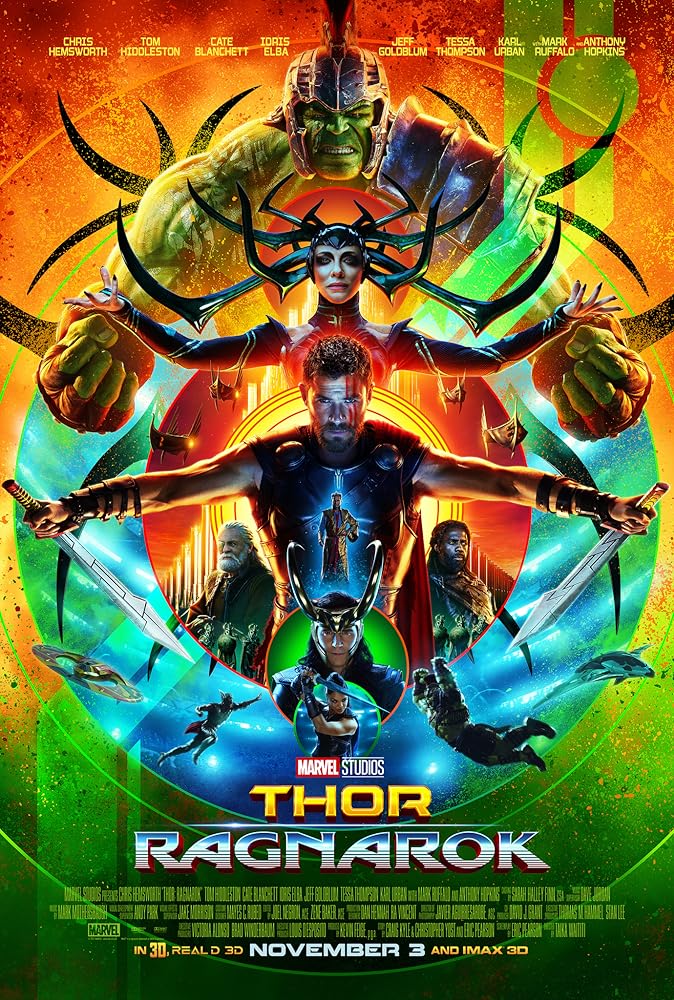
Thor: Ragnarok (2017) review


Thor Odinson AKA the Asgardian God of Thunder has been a vital member of the Marvel Cinematic Universe and its core superhero team, the Avengers. Despite this, however, many have viewed the character’s solo outings as being some of the weakest installments of the MCU. Now, to be fair, this wasn’t always the case; namely, back when the first Thor film came out in 2011. If anything, that film was arguably Marvel Studios’ first big ‘risky’ project, as it was the first MCU film to focus on a character who didn’t primarily reside on Earth. As such, there was a considerable possibility that this tale of god-like beings could’ve ended up being incredibly cheesy. However, thanks to the Shakespearean influence from director Kenneth Branagh, the film did manage to make its arguably ludicrous setting feel believable. But while the film did do solidly with both critics and audiences, I think it’s safe to say that, nowadays, you don’t see it brought up too often when people discuss their favorite MCU films. The same can be said for the 2013 sequel, Thor: The Dark World. While not technically a critical/commercial failure, many consider it to be one of the weakest installments of the entire MCU if not the absolute ‘worst’. And while I don’t think that it’s as bad as some people have put it out to be, it’s undeniably one of the prime examples of an MCU film that was heavily influenced by the studio’s infamous (and now thankfully disbanded) creative committee. After all, if it wasn’t for some highly publicized creative differences, the film could’ve been directed by Patty Jenkins who, thankfully, would go on to direct a far more successful superhero film four years later with DC’s Wonder Woman.

So with all this in mind, it’s safe to say that there’s been a lot of pressure on Thor’s third solo outing to, shall we say, ‘redeem’ the franchise. And thus, here we are now with Thor: Ragnarok. Fans of the comics, as well as those familiar with Norse mythology, will no doubt recognize the subtitle for this film as the plot is based around the fabled apocalyptic event known as Ragnarok. In both Norse mythology and the comics, this was a major event in which the kingdom of Asgard was destroyed and several of its most notable inhabitants were killed. But while the film does focus on the prophesized destruction of its main protagonist’s home-world, do not expect a huge and serious fantasy epic going in. Instead, Thor: Ragnarok can arguably be described as an 80’s-inspired ‘road trip comedy’ starring not only Thor but also the Incredible Hulk, whose plotline takes influence from the character’s popular Planet Hulk storyline from the comics. In the director’s chair is Taika Waititi, who is arguably the biggest ‘out of left field’ director that Marvel Studios has ever hired… which, for them, is saying a lot. Over the past few years, the New Zealand native has become well-known for his work on several critically acclaimed films. This includes 2014’s mockumentary horror comedy What We Do in the Shadows, 2016’s adventure dramedy Hunt for the Wilderpeople, and a few episodes of the hit HBO comedy series Flight of the Concords. And as for Thor: Ragnarok, his first big-budget feature, he proceeds to give us a highly entertaining film that not only stands as the best Thor film yet but also one of the best MCU films to date as well.

At the end of Avengers: Age of Ultron, Thor Odinson AKA the God of Thunder (Chris Hemsworth) left Earth to embark on a quest to try and find the mystical objects known as Infinity Stones that he had seen in the visions that he had during the film. As this film begins, it has been two years since then and Thor has not had much success with this current endeavor. To make matters worse, when he returns to Asgard he learns that his treacherous adopted brother Loki AKA the God of Mischief (Tom Hiddleston), who had been presumed dead during the events of Thor: The Dark World, has been impersonating their father Odin (Anthony Hopkins), ruler of Asgard. And then if that wasn’t enough, Thor and Loki soon find themselves dealing with a new threat in the form of Odin’s firstborn, Hela the Goddess of Death (Cate Blanchett). After being imprisoned for several eons due to her ever-growing ambition, Hela has now returned and is hell-bent on conquering the Nine Realms. When Thor tries to stop her, she ends up destroying his hammer, Mjolnir, and he ends up getting stranded on the planet of Sakaar. There, he becomes a prisoner of the planet’s eccentric ruler, the Grandmaster (Jeff Goldblum), and is forced to fight in a gladiatorial arena where his opponent is his old Avenger ally (and ‘friend from work’) Dr. Bruce Banner AKA the monstrous creature known as the Hulk (Mark Ruffalo).  And thus, Thor now finds himself in a race against time to return home to Asgard and stop Hela before the kingdom’s prophesized destruction, AKA Ragnarok, can occur.

So yes, as it’s been well-documented by several critics, Thor: Ragnarok is easily one of the most comedic outings of the Marvel Cinematic Universe… which, to be fair, is something that the MCU has always been known for anyway. Right from the get-go, this film is jam-packed with humorous bits of dialogue and funny sight gags. This, however, has proven to be a rather controversial development for some fans due to the fact that, in the comics, the Ragnarok storyline of which this film takes its name from was more serious in tone. Ultimately, though, this doesn’t prove to be as big of a problem as those fans may have feared, because while Thor: Ragnarok is undeniably one of the funniest MCU films to date, that doesn’t mean that this is all that it has going for it. When the story delves into the whole Ragnarok prophecy and Hela’s takeover of Asgard, the film does take these events seriously. Plus, for a film that is part of the allegedly so-called ‘kiddie’ franchise that has been the Marvel Cinematic Universe, it isn’t afraid to pull a few punches here and there to once again prove that long-standing argument wrong. Simply put, while the film is an absolute riot when it comes to its humor, director Taika Waititi establishes a solid tone that does, in fact, manage to keep it from just being a straight-forward comedy. And don’t even get me started on all of the great minor touches that he adds to the film to make it all the more memorable, from the implementation of the scores from the previous two Thor films to a scene that, no joke, pays homage to the infamous tunnel scene from Willy Wonka and the Chocolate Factory.

As noted earlier, Thor: Ragnarok mainly revolves around the duo of Thor and Hulk, a crossover that excited many due in no small part to some of the great interactions between the two of them in the Avengers films (e.g. the scene in the first Avengers where Hulk abruptly punches Thor off-screen after an intense battle… need I say more?). It’s also quite good that these two were paired together for this film seeing how, as far as the MCU films are concerned, we haven’t seen either of these two in more than two years. Not counting Thor’s cameo during the mid-credits scene of Doctor Strange (a sequence that is expanded upon here with Benedict Cumberbatch returning, of course, as the titular Sorcerer in a brief cameo), these two haven’t had a major role in an MCU film since Age of Ultron. But even after all this time, Chris Hemsworth and Mark Ruffalo both do excellent jobs once again in their respective roles as the film allows the two of them to utilize their comedic timing to its full potential. This, in turn, results in some of their best performances as Thor and Hulk (definitely Hemsworth’s best and arguably Ruffalo’s best). Another major returning player to the MCU is Loki, and heck, he hasn’t been seen for longer than Thor and Hulk combined. His last appearance was in Thor: The Dark World… all the way back in 2013. He almost appeared in Age of Ultron but his scenes ended up getting cut. Still, just like Hemsworth and Ruffalo, Tom Hiddleston is still great as always as the cunning but deeply-layered God of Mischief who continues to maintain a strenuous relationship with his brother.

Moving on to the new characters that are introduced in this film, first there’s Tessa Thompson as one of the Grandmaster’s assistants who, as we learn, is an Asgardian who was once a member of the kingdom’s elite Valkyrie squadron. However, we also learn that she is the only survivor of the group following a devastating battle with Hela long ago, which gives the character a solid backstory and character arc as a hard-drinking warrior turned scrapper who’s trying to escape her past. Plus, Thompson works excellently alongside Hemsworth, Ruffalo, and Hiddleston and proves to be a great new badass addition to the MCU’s lineup of female leads. As for Jeff Goldblum as the Grandmaster… well, he’s the Jeff Goldblum that we all know and love, simple as that. Finally, we come to the main villain of the film, Hela AKA the first lead villainess of the MCU films. And while I admittedly wouldn’t call her one of the ‘best’ MCU villains to date, Cate Blanchett certainly kills it in the role. Sure, the final conflict between her and Thor’s team sort of concludes rather quickly but, as noted before, the film does treat her as a serious threat throughout. She also gets a great henchman in the form of Skurge (Karl Urban), an Asgardian warrior who allies with her when it gives him an opportunity for the attention that he has long yearned for. And he ends up getting a surprisingly layered character arc as a result, effectively making him one of the MCU’s greatest henchman characters.

For many years, Marvel Studios tended to get a lot of flak from critics who argued that they often limited the creative visions of the directors that they’ve hired, resulting in a few ‘copy and paste’ installments. And while I don’t fully agree with that argument, I think it’s safe to say that this hasn’t been as much of an issue since the studio’s controversial creative committee was disbanded. Case in point, Thor: Ragnarok gives us one of the most creatively visionary installments in the entire Marvel Cinematic Universe. While the previous two Thor films stumbled a bit when it came to their overall tone, this film decided to just fully embrace the silliness of its cosmic-based premise. Because of this, Thor: Ragnarok is yet another highly entertaining installment of the Marvel Cinematic Universe thanks in large part to it being one of the funniest entries of the franchise. With that said, though, the film’s primarily comedic tone may throw some people off given the generally serious nature of the Ragnarok story arc from the comics. However… that’s the whole point! Director Taika Waititi did state that his overall intention with this film was to make a ‘fun’ superhero adventure, and that is exactly what he did. Sure, maybe it doesn’t have the best overall plot of these MCU films, but seriously… what’s so wrong about a ‘fun’ superhero flick?


Rating: 5/5! (And yes, I’m well-aware that I’ve given this rating to every major superhero film that has been released this year. Now it’s time to see if Justice League will also earn that rating and officially confirm 2017’s status as one of the genre’s greatest years ever… though, to be perfectly frank, this will still be the case even if Justice League doesn’t turn out that good (though, of course, hopefully, it IS good!))

Sunday, March 15, 2015

Cinderella (2015) Review (300th Post!!)


While Disney’s recent live-action fantasy films have gotten a generally mixed reception from critics, they’ve definitely been much more successful with audiences which if you ask me is what matters the most at the end of the day. I for one have generally liked them. I’ll admit I wasn’t the biggest fan of ‘Alice in Wonderland’ but on the other hand I absolutely loved ‘Oz the Great and Powerful’, to the point where I even listed it as my favorite film of that year. Last year gave us ‘Maleficent’, a retelling of ‘Sleeping Beauty’ from the perspective of its main antagonist. While some may have issues with the fact that the film portrays her more as the protagonist, I did still enjoy it, mainly for Angelina Jolie’s outstanding performance in the role of Maleficent. And now Disney returns with their latest re-imagining, this time revisiting one of the most iconic films in their lineup, ‘Cinderella’. Unlike the previous three major fantasy films, which were a sequel, prequel, and re-telling, respectively, this new ‘Cinderella’, directed by Kenneth Branagh (‘Thor’), instead opts to basically just tell the same story as its animated predecessor. Some may find this to be unnecessary but ultimately this new ‘Cinderella’ does end up being an excellent adaptation of this classic story. That is thanks to not only beautiful production design, classy direction, and a top-notch cast, but also a clear sense of appreciation for the original film while in some ways also updating it for a new generation.

After the death of her mother (Hayley Atwell), young Ella’s (Lily James) father (Ben Chaplin) remarries to Lady Tremaine (Cate Blanchett), who also has been recently widowed after the death of her husband, who was an old friend of Ella’s father. Unfortunately, not long after this, he dies while on a business trip, leaving Ella in the care of her new stepmother, who ends up revealing her true wicked nature as Ella becomes a horribly mistreated servant to both her stepmother and stepsisters, Anastasia (Holliday Grainger) and Drizella (Sophie McShera), who nickname her ‘Cinderella’ due to the fact that her face was covered in soot one morning after sleeping by the fireplace. One day, while riding in the woods, Ella comes across a nice young man (Richard Madden) named ‘Kit’ who claims to be an apprentice living in the nearby kingdom. In reality, however, he is actually the Prince, who’s being pressured by his dying father (Derek Jacobi) to find a bride, specifically a princess, at an upcoming ball. But because ‘Kit’ is so entranced by Ella, he convinces his father to allow every maiden in the kingdom to attend in the hopes of seeing her again. On the night of the ball, Ella is eager to go but is forbidden by her stepmother to do so because she doesn’t want her to ‘disgrace’ her and her daughters. But with the help of her Fairy Godmother (Helena Bonham Carter), Ella’s fortunes soon begin to change.

This basically is the same general story as the original ‘Cinderella’, save for a few differences that actually do kind of improve on certain elements of that film. For one thing, Cinderella and the Prince do meet before the ball so it isn’t as ‘rushed’ of a romance as it was in the original film. We see Ella with her original parents more than we did in the original and while we don’t get the full details of it all, we even get a little more insight into Lady Tremaine’s back-story, giving us an idea as to why she acts the way she does towards Cinderella. Ultimately though, this film really benefits from just having an overall positive tone. After all, the film begins with Cinderella’s mother giving her the advice to ‘have courage and be kind’ and let’s be honest folks, in the cynical world that we live in today, that is some genuinely good advice to follow. From a technical standpoint, this film is an absolute visual delight thanks to the terrific production design, from the incredible costume design by Sandy Powell to the visually splendid set design. But at the same time, this film also has quite a lot of heart to it as well due to the aforementioned feel-good atmosphere. Branagh’s solid direction shows nothing but respect to the original film while also doing just enough to make it so that it isn’t just a ‘carbon copy’ of the original, which admittedly hasn’t aged very well in some aspects, namely in regards to the main character.

I mean I think it’s safe to say that Cinderella is a rather controversial member of the Disney Princess lineup. This is mainly due to the fact that in the original film, she is viewed by some people as being a rather passive protagonist who doesn’t really do much until she’s rescued in the end by the Prince. However, at the same time, she should be also given a lot of credit for her inner strength, positive attitude and perhaps most of all her ability to put up with all of the s*** that she’s put through by her Stepmother and Stepsister. This new film in some ways may follow the same route as the original but I don’t think that this Cinderella is passive at all. Her kindness really shines through the toughest of times and at one point she even tells Lady Tremaine that she’ll do whatever she can to ‘protect’ the prince, even if it comes at her expense. This results in, in my opinion, a very strong female heroine who is defined not by her actions but because of her overall character and Lily James does a phenomenal job in conveying Ella’s charm, likability, and most importantly, her inner strength and beauty. Because the relationship between Ella and the Prince is expanded upon here, their chemistry feels very genuine and Richard Madden definitely brings the right amount of, for lack of a better term, charm to the role. And of course, Cate Blanchett absolutely owns the role of Lady Tremaine, who’s definitely one of the greatest Disney villains of all time due to how she manages to gain so much control over Cinderella’s life without any special powers, while Helena Bonham Carter is a definite scene-stealer as Cinderella’s Fairy Godmother.

‘Cinderella’ may be one of the most iconic Disney films of all time but at the same time it may not exactly be the most ‘pro-feminist’ story out there. And while the same could be argued about this new version of the story as well in certain areas, I don’t think that it’s as prevalent here as it may have been in the original film. The Cinderella in this is not just some damsel in distress who doesn’t do much. This one is more involved in determining her own fate and even if she may still not be the most proactive female protagonist ever, her likability and sweet persona more than make up for it. All in all, director Kenneth Branagh’s ‘Cinderella’ really stands out amongst Disney’s recent fantasy re-imaginings, even if it’s not doing much different when compared to the original animated film. The production design is worth the ticket price alone but the film also succeeds in terms of its heart, showing much appreciation towards its animated predecessor while also maintaining an overall ‘feel-good’ atmosphere even with all that Cinderella goes through while living with her stepfamily. And really, as someone who’s finding that he’s really starting to favor films like this over ones that are much bleaker in tone, I really believe that this film is a must-see, especially if you’re someone who is looking to cheer themselves up. I guarantee you that this film really will put a genuine smile on your face by the end of it. There’s no better way of saying it; this film is pure cinematic magic (pun totally intended) that is absolutely gorgeous both inside and out.

Rating: 5/5!


(P.S. This film is paired in its theatrical release with the short film ‘Frozen Fever’, a follow-up to Disney’s hit animated film ‘Frozen’. Because it’s just a short film, I’m not going to go into too much detail about it. However, what I will say is that if you are a fan of ‘Frozen’ (I know I am), then you’re definitely going to love this short as it brings back all of your favorite characters as well as yet another catchy song a la ‘Let it Go’ in the form of ‘Making Today a Perfect Day’.)