Showing posts with label Neil Patrick Harris. Show all posts

Thursday, February 10, 2022

The Matrix Resurrections (2021) review

Calling The Matrix a staple of the sci-fi genre would be the very definition of an understatement. Upon its release in the spring of 1999, this highly ambitious sci-fi action flick directed by sisters Lilly and Lana Wachowski immediately became one of the most iconic films of its time. Not only was it a massive critical and commercial success, earning over $466 million worldwide, much critical acclaim, and four Oscars, but it also inspired numerous films that would come after it with its groundbreaking visual effects and extensive use of wire-fu stunt choreography. It would then pave the way for a wide array of media in 2003 to turn it into a full-blown franchise, including two theatrically released sequels, The Matrix Reloaded and The Matrix Revolutions. And while neither film was as necessarily well-received as the original, they did their job in helping to maintain the franchise’s strong position within the pop cultural zeitgeist in the early 2000s. However, following their release, that was mostly it for the franchise as far as theatrical releases were concerned. Lana and Lilly promptly moved on to other projects and repeatedly rejected ideas for follow-ups to the point where Warner Bros. brought in screenwriter Zak Penn to develop a potential prequel or sequel without them. Ultimately, though, Lana Wachowski returned to the franchise in 2019 as the prospect of bringing back main protagonists Neo and Trinity, who had both died in Revolutions, allowed her a chance to cope with the recent loss of her and Lilly’s parents and a close friend. And while the loss of their parents was the reason Lilly Wachowski didn’t return, instead opting to take a hiatus from the film industry, Lana’s return to the franchise that made her and her sister some of the most famous filmmakers around provides us with an emotionally poignant, visually stunning, and very much self-aware sequel.

Despite all the success that he’s achieved thanks to his greatest creation, a trilogy of games known as The Matrix, video game designer Thomas Anderson (Keanu Reeves) has recently been struggling to cope with the dreams that he’s been having that suggest that his reality isn’t what it seems. And while his therapist (Neil Patrick Harris) attempts to help him by prescribing him blue pills, the situation only proceeds to get more complicated with each passing day, especially whenever Thomas crosses paths with a married woman named Tiffany (Carrie-Anne Moss), whom he seems to have some sort of unclear history with. It is only through interactions with a woman named Bugs (Jessica Henwick) and her AI acquaintance Morpheus (Yahya Abdul-Mateen II) that Thomas takes the figurative and literal red pill and finally remembers who he truly is; the mythical heroic figure known as Neo AKA ‘The One’. It has been more than 60 years since Neo was able to successfully save humanity from the machines that had turned the world into a post-apocalyptic wasteland by harvesting humans for energy while keeping them locked within a virtual world known as the Matrix. And while said victory had originally thought to have come at the cost of Neo’s life, it is revealed that the machines have resurrected not only him but also the love of his life Trinity… who now lives within the Matrix as Tiffany. Thus, when Neo learns that he and Trinity were vital to the Matrix’s current operation and that his awakening has now put her in danger of being killed by a system reboot, Neo joins forces with Bugs and the crew of her ship, the Mnemosyne, to rescue Trinity before that can happen.

With The Matrix Resurrections, Lana Wachowski and co-writers David Mitchell and Aleksandar Hermon craft a story that’s very much self-aware of its status as not only the fourth installment of a well-established franchise but also as a follow-up released several years after what was initially perceived to be the franchise’s finale. As such, this film is full of meta-commentary on sequels and the process of rehashing old franchises, and while said commentary may get a bit over-the-top at times in the ways that have made some Wachowski films rather infamous, the writers do an excellent job when it comes to ‘how’ they go about continuing the franchise’s plot. In other words, instead of just making your standard ‘legacy sequel’ that sets up a new ‘human vs. machine’ conflict with new characters mixed in with the older characters, The Matrix Resurrections is, simply put, a story about Neo and Trinity, the franchise’s definitive couple, reuniting with each other. As I alluded to earlier, this was the exact reason why Lana Wachowski ended up returning to the franchise after all this time, and because of this act of unabashed wish fulfillment, The Matrix Resurrections has what is easily the best emotional hook out of any installment of the franchise. And overall, I’d say that this helps the film overcome the fact that, admittedly, it doesn’t boast the same kind of brilliantly choreographed action sequences that the original trilogy had, especially since this is more of a story-driven plot than an action-driven one.

As it has often been with the Matrix films, The Matrix Resurrections largely revolves around the lead duo of Neo and Trinity, and Keanu Reeves and Carrie-Anne Moss slip back into their iconic roles with ease. Admittedly, Trinity’s role in the film isn’t as big as Neo’s since the whole plot revolves around the process of rescuing her from the Matrix, but without spoiling anything, the route that they take with her character at the end of it all is one that I personally think longtime fans of the franchise will probably find incredibly satisfying. As for the other major characters in this film, they very much fall in line with what I noted earlier about ‘legacy’ sequels that combine new characters with the returning ones. Series regulars such as Jada Pinkett Smith’s no-nonsense captain turned resistance leader Niobe and Lambert Wilson’s infamously snooty Merovingian are largely relegated to supporting/cameo roles while more time is spent with newer characters such as Bugs and the crew of her ship, the Mnemosyne. Sure, most of the ship’s crew members don’t get a lot to work with but Jessica Henwick does headline this new group of characters quite nicely as she adopts the kind of ‘audience surrogate’ role that Neo had in the first film. Apart from all that, arguably the most notable development with this cast was the recasting of two significant roles; Yahya Abdul-Mateen II as an A.I. version of Morpheus (who’s established to have died prior to the events of this film) and Jonathan Groff as the reincarnation of Neo’s arch-nemesis, Smith. Neither of these two admittedly factor into the film’s proceedings as much as you’d think, but at the very least, they both do a solid job following in the footsteps of their respective predecessors, Laurence Fishburne and Hugo Weaving.

As was the case with The Matrix Reloaded and The Matrix Revolutions, it’s clear that The Matrix Resurrections has been an incredibly polarizing release in the eyes of both critics and audiences. In fact, one could say that, in this instance, it’s a lot like a certain installment of another big sci-fi franchise, Star Wars: The Last Jedi, since, from what I can gather, there’s been a lot of discussion about this not being the kind of film that Matrix fans were expecting. Instead of being an action-packed sci-fi extravaganza like the previous three films were, Resurrections is a more introspective and personal story driven almost entirely by the enduring romance between its two main protagonists… and yet, that’s why it works so well. It may not possess the exact level of visual finesse as its predecessors, but it more than makes up for that with its solidly engaging premise and strong emotional poignancy. And because of how effective it is as a source of meta-commentary on narrative sequels, it’s clear that Lana Wachowski went above and beyond to make a Matrix film that was more than just your standard cinematic sequel. That level of ambition has obviously defined much of the Wachowskis’ filmography, and while not every project of theirs has been as successful as The Matrix (longtime visitors of this site may recall that I wasn’t too big on Cloud Atlas and Jupiter Ascending), you can never fault them for trying.

Rating: 5/5!

Tuesday, January 24, 2017

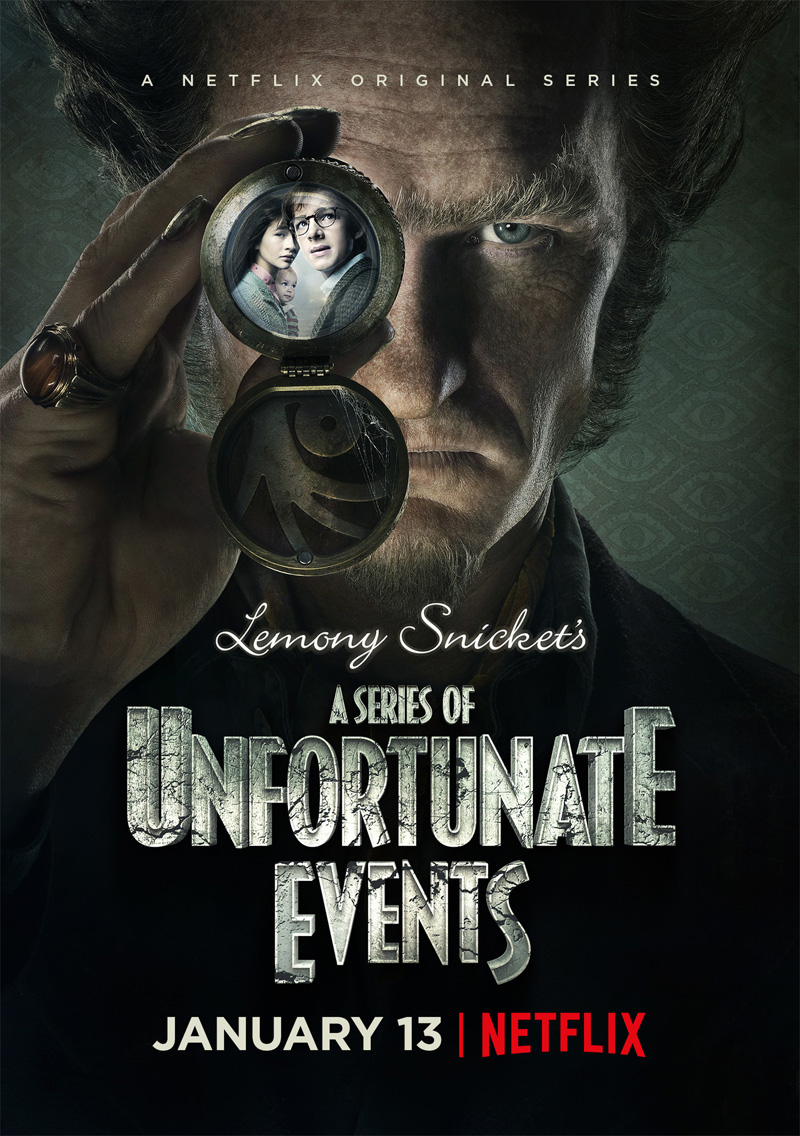
A Series of Unfortunate Events (2017) Season 1 Review

Image result for a series of unfortunate events netflix poster

(Disclaimer: Save for a brief spoiler section at the very end of the review, this post does not contain any major spoilers regarding anything that happens during this season.)

There are plenty of kids’ shows on the streaming service Netflix that can provide kids with fun and exciting content to watch. For example, there’s the Guillermo Del Toro-produced show Trollhunters or the show from DreamWorks’ How to Train Your Dragon franchise. The following ‘family-friendly’ TV show, however, does not contain fun and exciting content. It is a series about a bunch of children who are subjected to all sorts of terrible and, in some cases, even deadly incidents as they’re pursued by a wicked man who looks to steal their money. Hehe, okay, again, I’m not going to do the whole ‘Lemony Snicket’-style narration for the whole review. It’s just that this gives me a fun way to open these posts. Yes, A Series of Unfortunate Events sees new light in the form of being the latest Netflix original series. This is the second live-action adaptation of author Daniel Handler’s (AKA Lemony Snicket) highly successful book series, following the 2004 film adaptation starring Jim Carrey as Count Olaf. And while I’ve argued that the film is a highly-underrated adaptation that’s hindered from being a forgotten relic of the era of Harry Potter-esque films, it ultimately never got a sequel, namely just because it took too long to make. But, now, we have a new version supervised by Barry Sonnenfeld, who was an executive producer on the original film and was apparently set to direct initially before backing out for unknown reasons, along with Handler himself, who wrote the teleplays for most of the episodes in this first season, which consists of eight episodes overall. And while the show’s theme song (sung by series star Neil Patrick Harris) may warn you to ‘look away, look away’, this new adaptation of the popular series is a charming and highly enjoyable watch that does manage to outdo its predecessor in quite a few areas.

There’s really no need to go into the story that much seeing how I already went over it in my review of the 2004 film. It’s the same scenario; the three Baudelaire children (inventing prodigy Violet (Malina Weissman), well-spoken, avid book reader Klaus (Louis Hynes), and their infant sister Sunny (Presley Smith, with vocals provided by Tara Strong)) learn that their parents have died in a fire. Their parents’ kind-hearted but oblivious banker, Mr. Poe (K. Todd Freeman), puts them in the care of their ‘closest relative’ (though in this case, the term is used loosely), actor and theatre troupe leader Count Olaf (Neil Patrick Harris), who is really looking to steal their massive fortune, which they will inherit when Violet comes of age. And even after they manage to ‘get away’ from him and are placed in the care of other guardians, Olaf keeps coming back with new villainous schemes and disguises that only seem to fool the adults. Being that this is basically a ‘reboot’ of the franchise, it starts out with the same three stories that the film covered; The Bad Beginning, The Reptile Room, and The Wide Window. However, unlike the film, it also includes a story that hasn’t been done in live-action before; The Miserable Mill. Thus, thanks to this new show, there’s a considerably high possibility that we will finally be able to have a ‘complete’ adaptation of the books in live-action. And because this show doesn’t have the constraints of having to cover multiple books in a short amount of time like the film had to do, it allows for more faithful adaptations of the books, with each entry getting two episodes a piece. Yeah, after I posted my review of the film, I realized that it probably wasn’t as ‘faithful’ as I claimed it was due to it having to condense the events of three books into one film. I still think that the film did do a decent job of retelling the main story under these conditions but, by comparison, the show does get more to work with.

There are still some new additions to the plot here and there but they do fit naturally into the series’ lore. This includes scenes where members of the secret organization V.F.D. try to help the Baudelaires, while usually finding themselves ‘held captive’ by Olaf and his henchmen, and a scene which explains a question that I bet a lot of us have been wondering for years; why did the Baudelaires end up under Count Olaf’s care in the first place? The answer, to put it simply, is one that is both hilarious and, at the same time, makes a lot of sense given how negligent most of the adults in this series tend to be. There is even an added ‘plotline’ which involves two characters played by Cobie Smulders and Will Arnett trying to escape various perilous predicaments (that mainly occur during the final few moments of each episode) to get back to their home. Without giving the full extent of this ‘plotline’ away, at first this seemed like a major deviation from the books, one that I feel would’ve gone against the entire premise of the series had it been the case. But, by the end of the season, it turns out to be a major bait-and-switch that, whether you like it or not, is very much in line with the overall tone of the series (I’ll talk about this more in the ‘spoiler section’). And like the film, the TV series does a phenomenal job in terms of capturing the spirit and visual style of the books. Despite the obvious fact that this is a series in which the main characters are constantly subjected to many terrible things, there’s quite a lot of humor in this show, whether it’s due to the many examples in which the adults are shown to be completely oblivious to everything that’s going on or the comedic banter of the main villains. The production/set design perfectly captures the gothic and, in some cases, retro nature of the story, something that the 2004 film did an excellent job of as well.

Related image

Neil Patrick Harris is our new Count Olaf. I’m not going to make any major comparisons between him and Jim Carrey but I will say that Harris does do a phenomenal job in the role. He’s hilarious but, at the same time, is much more toned down compared to Carrey, which I’m sure is much more in line with how the character is portrayed in the books. It’s also a nice ‘against-type’ performance for Harris seeing how he usually doesn’t do villain roles. The series also allows for greater amounts of screen-time for Olaf’s henchmen, whereas in the film, the henchmen were downplayed in favor of Olaf, despite being played by some very recognizable stars like Craig Ferguson and Luis Guzman. Of the group, Usman Ally is a major standout as the hook-handed man, though the other henchmen cast members do have their great moments as well. Patrick Warburton stars in the role of Lemony Snicket, who of course narrates the proceedings, sometimes even popping up in a scene completely unnoticed by everyone else. Not only does he do a great job of providing the series with Snicket’s trademark narration (we are talking about one of the best voice actors in the industry) but he also does it in a way that effectively captures the sadness that is always conveyed by the character given his ‘connection’ to the whole story (e.g. his beloved ‘Beatrice’). Like the 2004 film, there are also plenty of major guest stars featured in supporting roles; Aasif Mandvi as Uncle Monty, Alfre Woodard as Aunt Josephine, Joan Cusack as Justice Strauss, Catherine O’Hara (who played Justice Strauss in the 2004 film) as the villainous optometrist Dr. Orwell (who, in this series, is set up as Olaf’s ex-girlfriend which, if you ask me, is perfect), and Don Johnson as Lucky Smells Lumbermill owner Sir, just to name a few. And through it all, just like the film, the Baudelaire orphans are just as endearing as ever. Malina Weissman and Louis Hynes do excellent jobs as Violet and Klaus, respectively, and I also appreciate the fact that they kept a good amount of the edge that came from Sunny’s translated baby-talk, something that was utilized a lot in the film. Because, after all, while Sunny may be a baby and, as such, can only speak in baby gibberish, she’s very much aware of what’s going on. Heck, she straight up tells Mr. Poe that he’s an embarrassment to his profession; probably one of the most hilarious moments in the entire series.

As I noted a few weeks ago, I am a huge fan of the original A Series of Unfortunate Events film. Yes, the fact that I grew up with it is one of the main reasons why but I still feel that, despite some of its flaws, the film is a solidly entertaining adaptation of the books. However, I will also say that I’m happy that this new TV series exists because it could finally mean that we will have a full ‘screen adaptation’ of the story of the Baudelaires. And while I initially tried not to make too many comparisons between the two adaptations in this review, especially when compared to other reviews of the show, I’ll admit that there are quite a few things that this does better than the film; namely, the fact that the TV series format allows for a more thorough adaptation of the books instead of having to cram three books into one film. If I had to pick a favorite episode out of the bunch and, for the record, I’m referring to the pairs of episodes that make up each of the books adapted in this season instead of just one, it’d be a toss-up between The Bad Beginning and The Reptile Room. Ultimately, though, all eight episodes are highly enjoyable to watch thanks to their lovely production design and an excellent ensemble highlighted by Neil Patrick Harris’ unforgettable turn as Count Olaf. But again, hopefully, this won’t be a case like last time where it takes too long for Season 2 to get made and they decide to can it like they did the film sequel. Because the final episode of the season concludes by going directly into the beginning of the events that took place in the fifth book, The Austere Academy. The potential to go on is very much there. Thankfully, it’s recently been confirmed by Daniel Handler that the show has been renewed for a second season. This next season will consist of 10 episodes which adapt books 5 through 9 and will hopefully be followed by a third season that covers the last four books.

Season 1 Rating: 4.5/5


DISCLAIMER: The following is a brief ‘Spoiler Section’ regarding the new ‘plot-line’ added in for this season. If you haven’t seen this series in full yet, don’t read on any further.


So, as I noted before, most episodes this season end with a sequence involving two characters, played by Cobie Smulders and Will Arnett, as they try and get out of various predicaments (e.g. getting stuck in Peru, having to fight off a bunch of goons at a bar, etc.) so that they can return to their children. With that in mind, initially, it’s assumed that these are the Baudelaires’ parents, implicating that they didn’t die in the fire that destroyed their home. And like I said before, I feel that this would’ve been a major betrayal of the story had this been the route that the show was going to take. Because, after all, it kind of defeats the purpose of having the Baudelaires go through all the crap that they endure if we know that their parents are still alive. Not only that, but fans of the series are aware that the main connection that ties Lemony Snicket to the story is the fact that he used to be an old flame of the Baudelaires’ mother, hence why each book (and, therefore, first episode of each of the show’s two-parters) opens with a dedication to Beatrice. Granted, maybe that should’ve been a dead give-away as to how this all plays out but, still, at first it seemed like these were the Baudelaire parents. And I won’t lie, this kind of hindered my overall enjoyment of the show during the first half of the season. But, at the end of the first half of The Miserable Mill, it’s revealed that this was all building up to a major fake-out. We see the Baudelaires head over to the ‘visiting area’ of the Lumbermill when told that they have visitors. During this time, we see the two parents arrive at a door resembling the one in the mill’s visiting area, implying that the Baudelaires are about to reunite with their parents. But, it’s instead revealed that the two are the parents of the Quagmire triplets; Isadora, Duncan, and Quigley, who become major allies of the Baudelaires in future installments. The real ‘visitors’ that the Baudelaires were notified of are Dr. Orwell and Count Olaf, the latter of whom is disguised as Orwell’s new receptionist Shirley, who give Klaus a new pair of glasses that put him into a hypnotic trance. Yeah, it’s arguably kind of a major buzzkill in regards to it not resulting in a happy ending for the Baudelaires but this is A Series of Unfortunate Events, after all. And as the first season concludes, we see that the Baudelaire and Quagmire children are about to cross paths as it’s shown that two of the latter family are heading to the same boarding school as the Baudelaires after experiencing the same exact tragedy of having a fire destroy their home. 

Thursday, October 9, 2014

Gone Girl (2014) review


David Fincher is one of the absolute best directors currently working today in Hollywood. Sure, his career may not have gotten off to a good start when he was hired to direct ‘Alien 3’ but that movie isn’t his fault. He was stuck in a terrible situation working on a movie with an infamously hellish production where the studio vetoed every major decision he had. It was such a disaster for Fincher that it’s completely understandable why he doesn’t view that film as ‘his film’. Fortunately that wasn’t the end of his career as since then, he has yet to make a bad film; ‘Se7en’, ‘Fight Club’, ‘The Social Network’, the list goes on and on. For his newest film, Fincher takes on his second straight book-to-film adaptation in a row (after 2011’s ‘The Girl with the Dragon Tattoo’) with ‘Gone Girl’, based off of the best-selling novel of the same name by Gillian Flynn, who also wrote the film’s screenplay. With ‘Gone Girl’, Fincher delivers what may just be his darkest film to date. After all, if there’s one thing he is known for, it’s for making incredibly dark and pessimistic films and this film is no exception. But it’s also an incredibly compelling and sometimes darkly comic mystery thriller that features a terrific cast headlined by its two leads. This makes ‘Gone Girl’ yet another great entry in Fincher’s prestigious post ‘Alien 3’ filmography… even though it is quite messed-up at times.

Nick Dunne (Ben Affleck) and Amy Elliott (Rosamund Pike) first meet a party and almost immediately develop a romantic connection. They soon marry and two years later, they move from New York to Nick’s hometown in Missouri when his mom is stricken with cancer. On the day of their fifth wedding anniversary, Nick returns home after work to find Amy missing as well as signs of an apparent struggle. The police immediately start investigating into the disappearance and possible kidnapping as the case makes headlines nationwide due to the fact that Amy is the inspiration for the best-selling book series ‘Amazing Amy’ written by her parents. However, as the days go on with no sign of Amy, things suddenly take a dark turn for Nick when certain evidence starts to paint him as a possible suspect, revealing that his marriage wasn’t as happy as it looked. As he slowly becomes ‘the most hated man in America’, Nick must find a way to prove to everyone that he didn’t kill his wife. And really, that’s as far as I can go in terms of the film’s plot because otherwise I would be giving away key plot-points. 

Pretty much as soon as the film started, I was immediately hooked by the film. That’s usually the case with Fincher’s films; even when they are nearly three hours long, they always hold your interest from beginning to end. This one in particular really shines because… well, of how messed up it is. With that said, I want to note that I went into this film having not read the book so I didn’t have any idea of how this story was going to play out and as a result, the film was much darker than I expected. Then again, this is a David Fincher movie so that’s not too surprising. But at the same time, as it is also expected from a Fincher film, the story is incredibly compelling and the film is incredibly well-shot. It’s also darkly comic at times and is a biting satire of various aspects of our lives, like how the media interprets certain events without knowing everything about what’s really going on (as shown via the character of Ellen Abbott (Missi Pyle), a TV host who paints Nick out to be a ‘sociopath’ given his behavior regarding the whole case) and how we as an audience are influenced by this or how the economy can have an effect on a marriage, as at one point Nick and Amy argue over Nick’s spending habits after they both lose their jobs. This all makes ‘Gone Girl’ one of the best written screenplays of this year so far. As for how faithful this film is to the book, from the perspective of someone who hasn’t read the book, it seems pretty faithful right down to the fact that it retains the controversial ending of the book that was allegedly changed by Flynn herself so that it wouldn’t be spoiled.

The film’s cast is pitch-perfect, particularly in regards to its two leads. As Nick, Ben Affleck is perfectly cast in the role of a man who becomes highly scrutinized by the media, which of course is something that Affleck experienced quite a lot in not only the years before his big comeback in 2007 but even recently after he was cast in ‘Batman v. Superman’. Here he gives the best performance of his career. But ultimately this movie belongs to Rosamund Pike as Amy. Like I said before, I hadn’t read the book going in and I didn’t realize how complicated of a character Amy really was. Going in, I thought she was just going to be the innocent victim but, without really giving anyway here, it turns out that she’s not as innocent as we thought. Amy’s transformation over the course of the story is fascinating and Pike absolutely owns the role. I’ll be genuinely shocked if she’s not nominated for Best Actress at this year’s Oscars because this is one of the best performances that I’ve seen this year. Affleck and Pike lead a talented cast which also includes Neil Patrick Harris in a very much against type role as one of Amy’s ex-boyfriends, Tyler Perry as Nick’s attorney, Carrie Coon as Nick’s twin sister, and Kim Dickens and Patrick Fugit as the two lead cops in the case of Amy’s disappearance.

‘Gone Girl’ is, in many ways, a very messed-up movie and yet it manages to be an incredibly compelling mystery story which of course, as a director, is where Fincher is truly at his best as proven through films like ‘Se7en’ and ‘Zodiac’. But in all seriousness, I legitimately did not expect some of the dark turns that the story took, particularly in regards to Amy and the journey her character takes in this film. The marketing thankfully hasn’t given any of this away so those who go in who haven’t read the book will certainly be surprised by the dark turns that this story takes. As for those who have read, it seems like it stays true to the book, even featuring the same ending and while I may be in the minority on this, I kind of admire the ending for being just as messed up as the story; in other words, I think it actually fits rather perfectly with the tone of the film. In short, ‘Gone Girl’ features great direction from David Fincher, a terrific cast headlined by Ben Affleck and Rosamund Pike giving the best performances of their careers, and a smartly-written dark and satirical screenplay by author Gillian Flynn. Is this Fincher’s best film? That may be up for debate at the moment but one thing is for certain; Fincher’s hot streak following his initial mishap of ‘Alien 3’ continues with yet another outstanding film.


Rating: 5/5!

Sunday, June 1, 2014

A Million Ways to Die in the West (2014) review


After establishing his own animation empire with ‘Family Guy’, which continues to run after surviving not one but two cancellations, ‘American Dad!’, and ‘The Cleveland Show’, Seth MacFarlane transitioned into film with his directorial debut, ‘Ted’, and the film was a pretty big hit when it released in June 2012. Not only did it receive generally solid reviews from critics, but it also ended up becoming the highest grossing original comedy of all time with nearly $550 million worldwide at the box office. A few months later, MacFarlane was selected to host the 85th Academy Awards and while he, as usual, attracted a lot of controversy due to his trademark style of humor, I was one of those who thought that he did a really good job and felt that his turn as host was a breath of fresh air for the annual awards ceremony. But now he’s back with his next directorial effort, ‘A Million Ways to Die in the West’, and this time instead of just portraying a motion capture character as he did in ‘Ted’, he makes his live-action debut in the lead role. So how does this film hold up? Well, ultimately I can’t say that it was as good as ‘Ted’ for a few glaring reasons but overall it still provided a decent amount of laughs though how it will fare with audiences could ultimately depend on whether or not you’re a fan of MacFarlane’s work.

The film centers on Albert Stark (Seth MacFarlane), a cowardly sheep farmer in Arizona who constantly complains about how awful the Wild West in 1882 is, and that’s mostly because there are multiple ways (‘a million’ to be specific) to die there; disease, outlaws, animals, the doctor, etc. His lack of courage ends up resulting in him losing his girlfriend Louise (Amanda Seyfried) to the town’s moustache shop owner Foy (Neil Patrick Harris) after he withdraws from a duel. Albert then decides to leave for San Francisco, but ends up staying when a mysterious woman named Anna (Charlize Theron) moves into town. As she and Albert start to become friends, he starts to gain a bit more confidence as he attempts to win back the heart of Louise. But soon he finds himself having to stand his ground not against Foy, but against Anna’s husband, the notorious outlaw Clinch Leatherwood (Liam Neeson), when he arrives in town seeking revenge on Stark after he started to develop a relationship with Anna. In order to deal with this, Anna helps Albert by teaching him how to shoot better so that Albert can stand a chance against the most vicious gunslinger in the territory.

This film’s humor is exactly what you would expect from MacFarlane given his line of work; fairly crass and juvenile. If you’re someone who likes that kind of humor, you’ll probably enjoy this movie and overall there are a solid amount of funny moments in this film. I’ve heard some people say that the best stuff is in the trailer and for the most part they’re fairly right but there were still a few good funny moments peppered in here and there that weren’t featured in the trailers. However, the big problem here is that there are a few instances where there’s no humor at all. And you know some comedies do have moments where the humor doesn’t fly well but that’s not the case here because there are a few instances where nothing funny is happening for a good 10 to 15 minutes. A lot of critics have said that this film is ‘overlong’, and I have to say that I do agree with that. This film may only be about 10 minutes longer than ‘Ted’, but that film’s humor was much more consistent and ultimately had enough material to justify its runtime. This film, sadly, doesn’t have enough material to be nearly two hours long. In fact, the whole plot involving Liam Neeson’s character… is actually more or less just the subplot for the third act. Seriously, most of the movie’s buildup revolves around a duel between Albert and Foy, not with Albert and Clinch as the trailers are indicating.

But still, this film does benefit from a pretty solid cast even if they don’t always have enough good material to work with. In his first major live-action leading role, MacFarlane does a pretty good job and his chemistry with Theron, who’s really good here as well, is also really good. It always helps in a movie like this when the chemistry between the two leads is really good though remember what I said about those instances that had a severe lack of humor? That’s because those scenes are mainly focused on developing the relationship between the two and though it really is a nice little romance that these two develop, this film sort of focuses on that relationship a bit too much. All of the other major members of the cast, including Seyfried, Harris, Giovanni Ribisi, who plays Albert’s best friend Edward, and Sarah Silverman, who plays Edward’s fiancé Ruth, have their own moments to shine here as well. Unfortunately though, Liam Neeson doesn’t get much to do here; his character is pretty one-note, which is a shame after his hilarious turn as Bad Cop/Good Cop in ‘The LEGO Movie’. As for the multiple cameos in this movie (another thing you can expect from a MacFarlane production), there a few really noteworthy cameos here that produce some quality laughs though one cameo unfortunately had to be involved in probably the weakest post-credits scene ever. It’s a fairly brief scene and the cameo itself was pretty cool but quite frankly it just isn’t worth it after waiting through the entire credits.

I don’t think ‘A Million Ways to Die in the West’ is that bad; I feel that it’s better than a lot of comedies that are coming out these days and at the end of the day there are a good decent amount of laughs to be had here. However, as far as MacFarlane’s directorial efforts go, ‘Ted’ was the funnier film. This film just doesn’t have enough material to justify a near two-hour runtime. There are at least two or three instances where no humor is occurring for at least 10-15 minutes and while those scenes are setting up a nice little romance between MacFarlane and Theron’s characters, that romance is focused on just a bit too much. Still, the cast is pretty game for the material, there are a few really fun cameos here, and overall if you’re a fan of MacFarlane’s work you’ll probably like this. If you’re not a fan, well, obviously you’re probably not going to like this film. But really, if you haven’t seen ‘Neighbors’ yet, I’d recommend that film over this one because at the end of the day that is still the best comedy of this year so far. Again, I don’t think this film was that bad, but it’s a rather disappointing follow-up to ‘Ted’ and it could have been a lot funnier.


Rating: 3/5