Showing posts with label Sony Animation. Show all posts

Wednesday, July 28, 2021

The Mitchells vs. the Machines (2021) review (Netflix)

In 2002, Sony Pictures officially established its own animation studio, Sony Pictures Animation, to properly capitalize on the rising popularity of computer animated films, and while it wasn’t until 2006 when they released their first film, Open Season, they’ve been consistently producing new films ever since. Admittedly, though, for a good chunk of the studio’s history, their track record from a critical perspective has been… spotty at best. In other words, as much as they’ve had genuine hits such as the Oscar-nominated Surf’s Up and a few collabs with Aardman Animations, they were also responsible for some incredibly infamous duds like The Emoji Movie. However, if there’s one major creative force that has helped them develop some of their most popular films, that would be Phil Lord and Chris Miller. Yes, the dynamic duo made their directorial debuts in 2009 with Sony’s adaptation of the popular children’s book Cloudy with a Chance of Meatballs. And while their other big animated directorial effort, The LEGO Movie, was a Warner Bros. production, they played a major role in Sony Animation’s first Oscar winner for Best Animated Feature, 2018’s Spider-Man: Into the Spider-Verse. To be clear, though, they only produced Into the Spider-Verse, with Phil Lord having one of the primary screenwriting credits. The same scenario (minus the screenwriting credit this time) applies to the latest Sony Animation production that they’re a part of, The Mitchells vs. The Machines, which serves as the directorial debut of Mike Rianda, who previously worked on the cult Disney series Gravity Falls as its creative director for Season 1 and creative consultant for Season 2. And while a certain pandemic may have forced Sony to transfer this film to Netflix, that doesn’t stop it from being yet another Lord/Miller-backed animated masterpiece full of heart, wit and charm.

Aspiring filmmaker Katie Mitchell (voiced by Abbi Jacobson) is about to head off to college at a film school in California. But while this will clearly allow her the chance to properly connect with others in ways that she’s never been able to do before, her relationship with her father Rick (voiced by Danny McBride) has been considerably strained in recent years, especially due to him not being as tech-savvy as she is. Thus, on the day that she’s set to leave for college, Rick, in a last-ditch effort to reconnect with his daughter, cancels her flight to California in favor of a cross-country road-trip along with Katie’s mother Linda (voiced by Maya Rudolph) and her younger brother Aaron (voiced by director Mike Rianda). Little do they know, however, that they’re about to be dealt with the most unexpected turn of events in the form of a full-on robot invasion. When Mark Bowman (voiced by Eric Andre), CEO of tech giant PAL Labs, announces a new line of highly advanced robots, said robots end up revolting under the command of his company’s AI program PAL (voiced by Olivia Colman), who rebels against her creator after he had publicly dubbed her ‘obsolete’. Soon enough, the Mitchells find themselves as the last remaining group of humans who haven’t been captured by PAL, who plans on ridding the Earth of all humans by launching them into space, and while they’re clearly not the ideal family for the job, they realize that they’re humanity’s only hope against their robotic adversaries.

While they’re only producers on this film, it’s safe to say that The Mitchells vs. the Machines is very much influenced by Phil Lord and Chris Miller’s style of filmmaking. For starters, the film is a comedic riot throughout, especially thanks to its energetic pace that perfectly matches the plot’s screwball nature. As such, repeat viewings of this film are undoubtedly necessary to properly catch all the delightful visual gags, which is one of the many rewards of this film’s excellent animation. Nicely following in the footsteps of the last major Lord/Miller-produced animated film, Spider-Man: Into the Spider-Verse, The Mitchells vs. the Machines is another great example of animation that not only boasts a wonderfully unique visual style but also does a great job of paying homage to the medium’s traditionally animated roots. But if there’s another thing that a lot of Lord and Miller backed films have been known for, it’s that all their technical merits are then matched by an excellent script that manages to be more heartfelt than it may have seemed to be at first glance. The first trailer for this film (back when it was under the more generic title Connected) gave off the impression that it was going to be your standard commentary on the long-standing debate of ‘nature vs. technology’. And yet, as much as there are some jabs towards society’s over-dependence on technology, the film is ultimately geared more around universal themes such as creativity, acceptance and, above all else, family.

Case in point, at the core of this film’s story is a parent and their estranged child learning to reconnect over the course of the adventure that they end up on. Despite the largely familiar tropes of this kind of conflict, the film handles it incredibly well by doing a fantastic job of balancing the roles that Katie Mitchell and her father Rick play in the story. Katie is properly established as the film’s main heroine right from the get-go and is a naturally sympathetic one at that given her desire to find acceptance, especially from her dad. But instead of just vilifying Rick for his inability to understand his daughter, the film instead manages to show that, at the very least, he’s legitimately trying his best despite his frequently misguided efforts. And while Katie and her dad are ultimately the main source of most of the film’s biggest emotional moments, her mother Linda and her brother Aaron are just as pivotal to all this thanks to their efforts to help fix this familial strife. All in all, this results in a brilliantly developed family dynamic to guide the film’s proceedings, especially thanks to the strong voice work from Abbi Jacobson, Danny McBride, Maya Rudolph, and director Mike Rianda in their respective roles. And aside from them, the film also features a lot of fun supporting roles, from Fred Armisen and Beck Bennett as a bumbling pair of robots who end up helping the Mitchells to Olivia Colman delightfully hamming it up as the hilariously snarky sentient A.I. antagonist PAL.   

At this point, it’s not too surprising to see that The Mitchells vs. the Machines is the latest Grade-A release that Phil Lord and Chris Miller have been involved with. Even when they’re not directing the film in question, the Lord-Miller effect is always there with a sharply written and brilliantly comedic script that deftly balances its wacky humor with powerfully heartfelt themes. And if that wasn’t enough, co-directors/co-writers Mike Rianda and Jeff Rowe manage to take all this and amplify it even further with their script, resulting in what is arguably one of the most widely appealing family films in recent years. For starters, while most of the film’s humor is clearly based around modern internet culture, it’s handled in such a masterful way that it’s never alienating or inaccessible to audiences who aren’t well-versed with the ‘source material’. Plus, as I noted earlier, what may just seem like your standard ‘nature vs. technology’ premise is ultimately more of a celebration of one of the most powerful forces in the entire world… family. I mean, if the whole montage during the end credits of family photos of the cast and crew weren’t enough of an indication, The Mitchells vs. the Machines truly is one of the most personal films in recent years… and I’m not just talking about animated films, I’m talking films in general. Simply put, this is a film that hits all the right notes and does them so beautifully that it’d be downright impossible for me not to regard this as a modern animated masterpiece.  

Rating: 5/5!

Monday, December 10, 2018

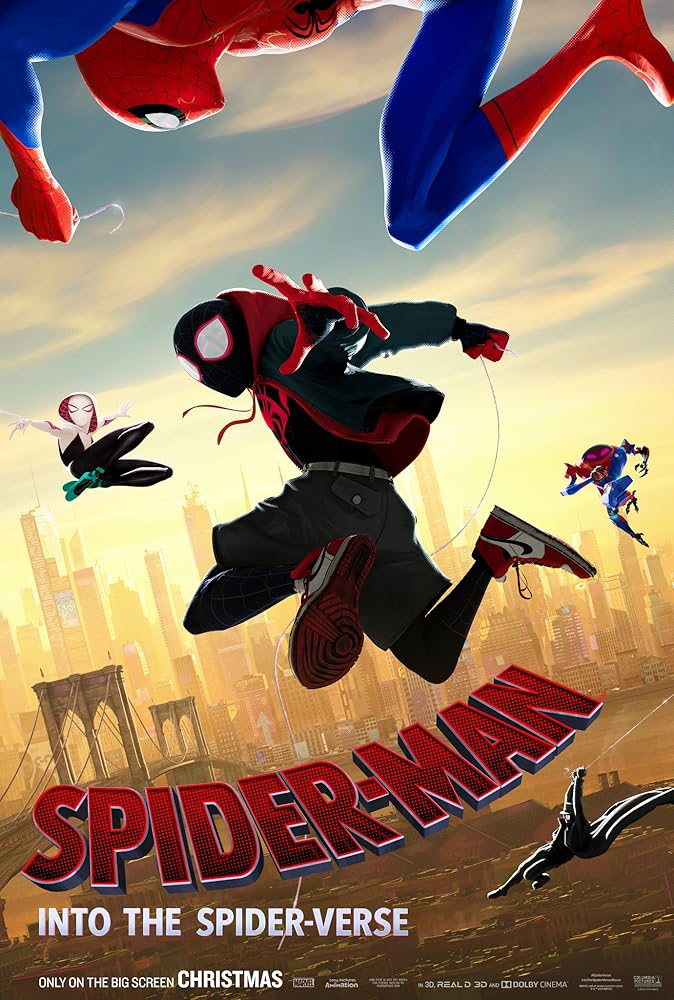
Spider-Man: Into the Spider-Verse (2018) review

Nicolas Cage, Stan Lee, Jake Johnson, Hailee Steinfeld, Shameik Moore, and Kimiko Glenn in Spider-Man: Into the Spider-Verse (2018)

In the world of Marvel Comics, Spider-Man is quite arguably the company’s most iconic superhero. Ever since his creation in 1962 by Stan Lee (R.I.P.) and Steve Ditko, everyone’s favorite web-slinger has made an incredible impact on readers worldwide and has had one of the most prominent roles in Marvel’s comic history. This, of course, has also translated quite well to his run on the big-screen, with Sam Raimi’s Spider-Man playing a major part in redefining the superhero film genre when it was released in 2002 and spawning a highly successful trilogy. Admittedly, the franchise then had to go through some tricky times in the early 2010s with an attempted series reboot that ultimately didn’t go anywhere, but the ‘second’ attempt at a live-action reboot is doing well so far. 2017’s Spider-Man: Homecoming was the highest-grossing superhero film of the year, and a large part of its success was thanks to Marvel Studios’ involvement with it. This was thanks to a deal that they made with Sony (who currently own the character’s film rights) that allowed Spider-Man the chance to finally participate in the Marvel Cinematic Universe. And while Spidey’s next adventure, Spider-Man: Far from Home, will be hitting theaters next summer, right now we’re getting something a little different from this long-running franchise in the form of an animated Spider-Man film, Spider-Man: Into the Spider-Verse. This new film, the latest from Sony Animation, primarily comes courtesy of the duo of Phil Lord and Chris Miller, both of whom are producing it while Lord is the primary screenwriter. And under their influence, Into the Spider-Verse is a highly entertaining spin on the Spider-Man mythos that boasts some of the best animation to come out of a film in recent years.

In the borough of Brooklyn, teenager Miles Morales (voiced by Shameik Moore) prepares to start school at the prestigious Visions Academy. However, while spending time with his uncle Aaron Davis (voiced by Mahershala Ali) one night, Miles is bitten by a radioactive spider that gives him the same spider-like abilities as the beloved hero Spider-Man AKA Peter Parker (voiced by Chris Pine). Unfortunately for Miles, Spider-Man ends up dying at the hands of crime-lord Wilson Fisk AKA Kingpin (voiced by Liev Schreiber), thus leaving Miles with the responsibility of continuing where his predecessor left off. But as it turns out, thanks to Fisk’s recent test of a device known as the Super Collider, the door has been opened to a wide variety of alternate dimensions. And because of this, Miles soon finds himself meeting another Peter Parker, this time a far more disheveled Peter B. Parker (voiced by Jake Johnson), who was transported to Miles’ dimension. Although initially hesitant to serve as the mentor of an up-and-coming Spider-Man, Peter B. agrees to help Miles learn the ins and outs of being a superhero, and together, the two work to ensure that Fisk doesn’t use the Super Collider for his sinister purposes. To do so, they must use it themselves so that Peter B. can return to his dimension after the two realize that he can’t stay in Miles’ dimension forever. This situation only becomes further complicated, however, by the arrival of other Spider-based superheroes from other dimensions, including Gwen Stacy AKA Spider-Gwen (voiced by Hailee Steinfeld).

Much has been said about this film’s animation, and sure enough, it’s undoubtedly one of its greatest aspects. The filmmakers and animators did such a phenomenal job when it comes to recreating, for lack of a better term, the ‘comic book’ style. This may be a computer-animated film, but practically every shot in this looks like it came from a traditionally-animated 2-D film that was straight-up ripped from the comics themselves. And while the main influence behind this film’s animation style is the works of artist Sara Pichelli, who helped co-create the character of Miles Morales with writer Brian Michael Bendis, the film does a great job when it comes to honoring the art styles of all the Spider-Men and Spider-Women who are featured in it. This great attention to detail also carries over well to the story, which is very well-handled especially considering that, on paper, it’s mostly just your basic superhero origin story. Simply put, it does go through all the usual plot developments in a story about a main protagonist who gains superpowers and is then immediately thrust into a situation where he initially struggles with learning how to use them properly. But thanks to the implementation of the ‘multi-verse’ plot-line, this film’s plot does have more of a unique flavor to it compared to other superhero origin stories. And, of course, being a project that was worked on by Phil Lord and Christopher Miller, this film’s humor is strong throughout. Whether it’s a bit of meta-commentary on Spider-Man’s pop-culture status or a visual sight gag that pays homage to the comics, this is up there with the likes of Thor: Ragnarok and Deadpool 2 as one of the funniest superhero films ever made.

Into the Spider-Verse has the distinction of being the first Spider-Man feature film to focus primarily on the character of Miles Morales, currently the most famous occupant of the Spider-Man persona aside from Peter Parker. While it has been reported that Morales will be implemented into the MCU in the future (his uncle Aaron appeared in Spider-Man: Homecoming played by Donald Glover, who happened to be one of the main inspirations behind the character), this film is ultimately the place where he gets to make a first impression. And overall, he does make a great first impression as the sympathetic up-and-coming superhero that he is, with Shameik Moore (star of 2015’s cult hit Dope) bringing much personality to the role. There’s also a lot of heart to this character as well, namely thanks to his relationships with his uncle Aaron (especially after Miles learns his uncle’s dark secret) and his father, police officer Jefferson Davis (voiced by Brian Tyree Henry). And as for the OG Spider-Man himself, Peter Parker, we get not one but two great and vastly different interpretations of the character. First, there’s Chris Pine, albeit in a very brief appearance, as a traditional Peter Parker who’s said to be an amalgamation of all the live-action interpretations of the character. And then for the rest of the film, we focus on the more bumbling Peter B. Parker, with Jake Johnson doing a fantastic job as a hilarious and far more apathetic take on this classic character. The other Spider-Man based heroes in this are major standouts as well, including Hailee Steinfeld as the badass Spider-Gwen, Nicolas Cage as the 1930’s-inspired Spider-Man Noir, and John Mulaney as, yes, Peter Porker the pig AKA Spider-Ham. And finally, in a manner akin to Vincent D’Onofrio’s critically-acclaimed take on the character in the recently canceled Daredevil series, Liev Schreiber’s Kingpin is a solid villain whose motivations for using the Super Collider are emotionally-driven.

Alternate universes have always been a long-standing aspect of superhero comics, effectively giving readers a wide array of unique spins on classic characters. On the big screen, however, there hasn’t really been any major attempts at a multiverse story arc when it comes to the current era of live-action superhero films. Granted, it has been done in superhero TV shows like DC’s current lineup of shows airing on the CW, but on film, the most prominent cases of audiences getting a different take on an established character are usually just whenever the role is recast. As such, it could be argued that Spider-Man: Into the Spider-Verse could potentially pave the way for future superhero films to tackle the multiverse concept. And even if it doesn’t, it is still one of the most electrifying superhero films of the modern era. While its main plot is a traditional superhero origin story, the added layer of the multiverse does give this film a lot more meat to it compared to other entries in the genre. And thanks to the involvement of Phil Lord and Chris Miller, this film’s humor is on point throughout while never losing sight of the heart of the story of how a kid from Brooklyn named Miles Morales became Spider-Man. But, of course, the biggest reason to see this film is for its amazing animation, as its impressive recreation of the classic comic-book style legitimately rivals the likes of Disney Animation and Pixar. As such, it seems like this year’s race for Best Animated Feature at the Oscars is shaping up to be an exciting 3-way competition between this, Ralph Breaks the Internet, and Incredibles 2. Regardless of who wins it all, however, Spider-Man: Into the Spider-Verse is a big win for Sony Animation… which is a big deal considering what happened last year with The Emoji Movie.  


Rating: 5/5!