Showing posts with label Jeremy Irons. Show all posts

Thursday, March 8, 2018

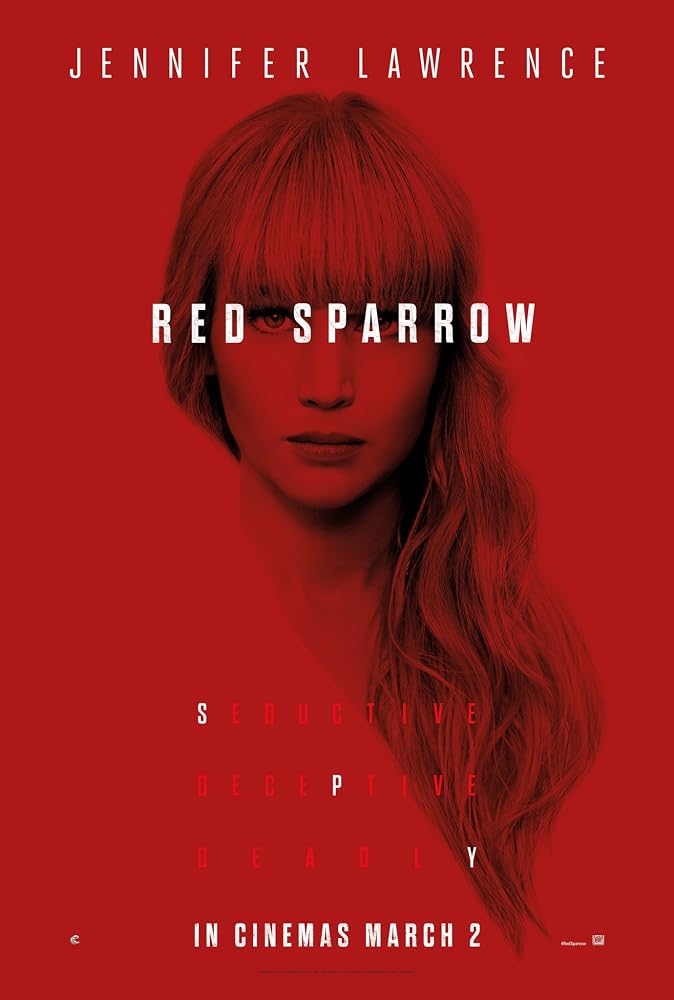
Red Sparrow (2018) review

Jennifer Lawrence in Red Sparrow (2018)

For Jennifer Lawrence, 2011 was very much a breakout year for her. First, she earned an Oscar nomination for her role in the rural drama Winter’s Bone. After that, she appeared as Mystique in the surprisingly successful reboot of the X-Men franchise, X-Men: First Class. And then, that same year, she was cast in the lead role of Katniss Everdeen in The Hunger Games. The first adaptation of author Suzanne Collins’ best-selling book series hit theaters the following year and was a major critical and commercial success. This success for both Lawrence and the Hunger Games franchise continued the following year with the even more critically/commercially successful Catching Fire, which was the first of the series to be directed by Francis Lawrence (who, for the record, is unrelated to his lead actress). At the time, Lawrence was mainly known for his work in music videos. Some of his most famous videos included Aerosmith’s theme from Armageddon ‘I Don’t Want to Miss a Thing’, Shakira’s first big hit in the United States ‘Whenever, Wherever’, and the iconic video for Lady Gaga’s ‘Bad Romance’. Alongside that, he also directed the 2007 blockbuster hit I Am Legend and the 2005 film adaptation of DC Comics’ demon-hunting anti-hero, Constantine. And as for The Hunger Games, his work on Catching Fire led to him being brought back to direct the franchise’s two-part finale, Mockingjay. But now the two Lawrence’s are back for a new film, Red Sparrow. Based on the 2013 novel of the same name by former CIA operative Jason Matthews, the film sees Lawrence star as a seductive Russian agent. And while both Lawrence’s do their best with the material, it ultimately isn’t enough to make up for the film’s lackluster narrative and sluggish pacing.

As the film begins, Russian ballerina Dominika Egorova (Jennifer Lawrence) suffers a devastating career-ending leg injury during her latest performance. With no way of supporting herself and her sick mother Nina (Joely Richardson), Dominika agrees to a job offered to her by her uncle Ivan (Matthias Schoenaerts), who’s a top-ranking member of Russian Intelligence. Dominika is tasked with seducing a corrupt Russian politician to extort information from him; however, the job ends up going south when the politician is murdered by an assassin. After learning that this was part of Ivan’s plan all along, Dominika is then coerced into a new proposition; be executed so that there are no witnesses to the murder or become a member of Russian intelligence. Dominika agrees to the offer and is sent to a remote school where she is trained to become a ‘Sparrow’, agents capable of extracting information from their targets through seduction. When Dominika proves to generally excel in her training, she is sent to Budapest to investigate into a suspected Russian mole codenamed ‘Marble’. To figure out the mole’s identity, Dominika must meet and earn the trust of a CIA operative named Nate Nash (Joel Edgerton) who is also stationed there who was reportedly the last known person to work with ‘Marble’. But as Dominika begins to find ‘Marble’, she also finds herself locked into a game of cat and mouse where the threat of execution from her superiors is always imminent.

To the film’s credit, it starts off on a solid note. After a tension-filled intro that effectively sets up its two main leads, the build-up in this film is quite excellent in terms of the situation that Dominika ends up getting into. In other words, this film does have a legitimately engaging story at first. However, this ultimately ends up getting ruined by two things. The first is the film’s hefty runtime of nearly two and a half hours. Now, to be clear, this is very much one of those ‘slow burn’ kind of stories AKA the ones that are more dialogue-driven than action-driven. Despite this, though, it does feel like a half hour or so of the film could’ve been trimmed out without even losing anything important from the story. The other thing that hurts this film is that the story itself, unfortunately, falls apart by the end. Despite a few reports that stated that the ending of the film was changed from what occurred in the novel to give it a stronger feminist tone, the ending ends up being incredibly banal. Without even spoiling anything about what happens at the end, let me just say that you’ve seen how this one is going to play out before in other films. You know, the kind of ending where the main protagonist makes a critical power move that ensures her the best option for survival? That is exactly what happens at the end of this film. I mean, at the very least, the film itself isn’t poorly made on a technical level. Francis Lawrence reteamed with a lot of his Hunger Games collaborators for this film and they once again produce a film that’s well-shot and features some solid fight sequences.

And as far as the film’s cast is concerned, they’re all solid in their respective roles. It all begins, of course, with Jennifer Lawrence who, as always, is giving it her all here. She does do an excellent job in terms of conveying her character’s ability to seduce her targets while also showing her vulnerable side when put through the story’s most emotionally taxing moments (which, to be perfectly frank, are quite frequent in this film). In other words, she possesses an effective magnetic screen presence in this film despite all its narrative issues. Her role in the film is also very well-balanced with Joel Edgerton’s character; obviously, Dominika is still the focus of the story, but the film does just enough to set up the character of Nate Nash without having Edgerton overshadow Lawrence at any point. Plus, it also helps that the two have solid enough chemistry when it comes to their romantic scenes. But as for everyone else in the film, while they all do fine in their roles, these roles are quite limited when compared to Dominika and Nate. Jeremy Irons is great as always as enigmatic Russian general Vladimir Korchnoi as is Charlotte Rampling as ‘Matron’, the imposing headmistress of the school that Dominika goes to as part of her ‘Sparrow’ training’. Matthias Schoenaerts walks a fine line between charismatic and sinister as Dominika’s uncle Ivan while Mary Louise Parker manages to slip in a few humorous jokes into this generally solemn narrative as an American chief of state that Dominika interrogates as part of her investigation. Ultimately, though, a lot of these side characters end up being incredibly one-note, often getting sidelined in favor of our main protagonists.

It’s a shame, really. I really wanted to like this film as much as I did Francis Lawrence’s three Hunger Games films (I even warmed up to Mockingjay Part 2 a bit more upon my most recent re-watch of it). Ultimately, though, Red Sparrow is unfortunately waylaid by its incredibly bland narrative. While it does start off solid enough, it then loses steam at the end with a ‘been there, done that’ ending that serves as a mediocre conclusion to a story that has been going on for way too long. Thus, as much as I don’t like to compare films that boast similar plots in my reviews, this film does feel like a weaker clone of what we got last summer in David Leitch’s action-thriller Atomic Blonde. But while Atomic Blonde also had an admittedly simple plot, it just had a lot more ‘oomph’ to it compared to Red Sparrow. Sure, the film is decently shot, and Jennifer Lawrence is great as always in the lead role, but that doesn’t really make up for this film ultimately leaving not that much of an impression. It legitimately makes me curious as to how the ending played out in the novel. Heck, I bet that even if that ending was just as conventional as the one that they went with for this film, it still would’ve been a lot more substantial than what we ultimately ended up getting. Thus, while far from being the worst film that Jennifer Lawrence has been in (and no, I’m not going to mention that ‘other’ film here; let’s be honest, folks, you know exactly which one I’m talking about…), Red Sparrow is an unfortunately disappointing outing for this talented director-actress duo.


Rating: 2/5

Monday, April 24, 2017

Assassin's Creed (2016) review

Image result for assassin's creed poster

Film and video games; two of the most dominant forms of media in the world of pop culture. But when it comes to the many attempts to combine the two, the results have been less than satisfactory. Video games that are directly based on films or TV shows generally turn out to be mediocre titles that were clearly rushed out to profit off their source material. And as for films based on video games, well, it really says something when the best ‘video game films’ are films like Tron and Scott Pilgrim vs. The World that are NOT based on a pre-existing video game. From early efforts like Super Mario Bros. and Street Fighter to more recent disasters like the many, many abominable efforts from the infamous Uwe Boll, video game based films have had quite a rotten run when it comes to critical and audience reception. Will this bad luck ever change? Well, there were some who felt that last year, 2016, could’ve been the year that might have potentially turned the tide, as there were not one but two big-budget blockbusters based on popular video games that came out that year. The first was Duncan Jones’ Warcraft, based on Blizzard Entertainment’s worldwide phenomenon of a franchise. But while the film did well at the international box-office and seemingly pleased fans of the franchise, it was, as perhaps to be expected, savaged by critics. Thus, all eyes turned to the other big video game film adaptation of the year, Assassin’s Creed, based on the popular franchise of the same name from Ubisoft. Like Warcraft, there were some big names attached to it. Michael Fassbender starred in the lead role alongside Marion Cotillard, and the film was to be directed by Justin Kurzel, who Fassbender and Cotillard previously worked with on the 2015 remake of Macbeth. But, alas, upon release, the film got savaged by critics just like the many other films in its genre. So, the question is this; from the perspective of someone who was genuinely looking forward to this film, is it as bad as the critics say? Well… they’re not entirely wrong.

In the present day, prisoner Callum Lynch (Michael Fassbender) is slated for death via lethal injection on the charge of murder. However, instead of being executed, he is brought to a mysterious facility in Madrid, Spain. There, he learns from the head scientist in charge, Dr. Sofia Rikkin (Marion Cotillard), that he’s been selected by the organization that she works for, the Abstergo Foundation, to assist them in finding the fabled artifact known as the Apple of Eden, which has the power to control the free will of all humanity. To do so, Callum is put into a device known as the Animus that allows the user to relive the memories of their ancestors on a genetic level. In Callum’s case, he is inundated with the memories of his ancestor Aguilar de Nerha (also played by Fassbender), who lived during the Spanish Inquisition in 1492 and was a member of the brotherhood known as the Assassin’s Creed. And as Callum soon finds out, Abstergo is the present-day front for the Assassins’ greatest enemies, the Knights Templar, who plan on using the Apple to wipe out the entire brotherhood. Thus, as Callum is forced to cooperate with Abstergo (and therefore, the Templars) to find the Apple of Eden, due to Aguilar being one of the last known people to have had it in his possession, he begins to further embrace his Assassin roots as he soon leads his fellow Assassin prisoners in a revolt against their oppressors to prevent the Templars from eradicating their entire society.  

To the film’s credit, it looks decent enough from a visual standpoint. For the record, though, the film does utilize a considerable amount of CGI. Not only that, but it also goes for an odd visual aesthetic of having a lot of the action surrounded by a foggy haze. Still, it looks fine enough, at least when compared to a few other entries in the genre. Plus, when the film does go back in time to 1492 Spain, the action sequences do manage to capture the overall feel of the Assassin’s Creed games. Most notably, the big chase scene in the middle of the film is, if you ask me, ‘pure Assassin’s Creed’ and was single-handedly responsible for keeping me from giving this any lower of a rating than I ultimately did. With that in mind, the film does do a solid job at staying generally faithful to the overall lore of the series. Aside from changing the main protagonists around and doing an admittedly cool redesign to the Animus, in which the subject is lifted into the air instead of being restricted to a chair and is seen directly imitating their ancestor’s actions as they happen, this basically follows the same general plot of the first AC game. So, what could possibly go wrong? Well, sadly, there is one big problem with the film and it ends up being the same one that affected the 2015 reboot of Fantastic Four (which ironically, or unironically depending on who you ask, was made by the same studio). For some odd reason, the overall tone of the film is a dreary one. From having it open with a young Callum witnessing the death of his mother at his father’s hands to the already mentioned ‘foggy haze’ that surrounds the action sequences, the film is overly dark for no good reason. What should’ve been a fun action-adventure set across time ends up being a dreary tale that lacks any sort of emotional depth.

Thus, this weak story also ends up affecting its characters as well, all of whom are generally bland and underdeveloped. Callum Lynch is a rather generic protagonist who isn’t helped at all by the fact that, apparently, he killed someone. Yes, technically speaking, our main protagonist is a murderer. Not only that, this plotline is only brought up a few times during the film and is never fully delved into. His father Joseph’s (Brendan Gleeson, with a younger Joseph being portrayed by his son Brian Gleeson) murder of his mother gets more attention than the murder he was tied to, ironically making Joseph the most developed character in the entire film. His ancestor, Aguilar, gets even less character development. He’s the literal definition of the term ‘avatar’, which is basically one of the main concepts of the entire franchise but that’s still no excuse. He doesn’t get much screen-time either, as the film primarily focuses on Callum’s story. So, simply put, Ezio Auditore (the main protagonist of Assassin’s Creed II, Brotherhood, and Revelations) he is not. It’s a shame, really, because the film does feature a solid ensemble cast that includes the likes of Michael Fassbender, Marion Cotillard, and Jeremy Irons (who plays Sofia’s power-hungry father, Alan), just to name a few. All of them are fine enough in their respective roles but, as noted, none of them get anything substantial to work with.

As I noted in the intro, I was genuinely looking forward to this film. That is because, unlike Warcraft, I was much more familiar with the Assassin’s Creed franchise going in. At the time that I’m writing this, I have played through and completed the first four games in the series. Thus, I was hopeful that this could’ve been the film that was responsible for breaking the long-running curse of video game based films. Sadly… that ‘curse’ still stands. While I don’t think that it’s as bad as the film that I primarily compared it to in this review, the 2015 Fantastic Four reboot, it does make the same general mistakes as that film. Namely, it goes the odd route of maintaining a generally dour tone throughout. And while the Assassin’s Creed games aren’t exactly ‘light-hearted’ affairs, none of them (or, at least, the ones that I’ve played, as I just noted) went ‘this’ serious. Literally, the fact that the film, at the very least, stayed as faithful as it possibly could to the source material was the only thing that kept me from giving this the same rating that I gave the 2015 Fantastic Four reboot, 1/5. Still, I won’t lie, I was feeling rather empty by the time this film ended on a cliffhanger that was clearly meant to set up a sequel that will probably never come. And, thus, we’re still waiting for the first ‘truly good’ video game based film. Could it possibly happen? Well, I hate to say it but it might not ever come because, at this point in the genre’s history, Assassin’s Creed was basically the ‘make it or break it’ entry after the countless critical failures that came before. And with a dismal 17% on Rotten Tomatoes, it arguably sealed the genre’s fate for good.

Rating: 2.5/5