Showing posts with label J.J. Abrams. Show all posts

Sunday, June 20, 2021

Super 8 (2011 - 10th Anniversary) Review


I don’t always get the chance to do a special ‘Anniversary’ review for a film, but for this year, there was one that I knew that I wanted to do since the film in question is one of my favorite films of all-time from one of my favorite directors. Said film came out on June 10th, 2011, a little less than a year before I officially started this site in May of 2012. Thus, my original review for that film was on my old Rotten Tomatoes account and the only instances where I’ve ever addressed it on this site were A.) whenever I mention it as a part of its director’s filmography and B.) an incredibly old and thoroughly outdated post that I did in 2013 where I listed my Top 10 Favorite Films of 2011. But today, in honor of the 10th anniversary of its release, it’s time for us to take a proper look at the 2011 sci-fi/monster adventure, Super 8. Super 8 was the third feature-length directorial outing from J.J. Abrams and was an original project that he made in-between the two Star Trek films that he directed, the franchise’s titular 2009 reboot and its 2013 sequel, Star Trek Into Darkness. Much of the film was inspired by Abrams’ experiences making Super 8 films when he was younger, including a notable run-in with none other than the legendary Steven Spielberg, who had once hired him to repair some of his old Super 8 reels. And if that wasn’t enough, Super 8 is produced by Spielberg via his production company, Amblin Entertainment. So, in other words, Super 8 can very much be described as a modern-day Spielberg film albeit one that wasn’t directed by the man himself. And while some have argued that its attempts at paying homage to the films that inspired it may have been a bit too much (which, ironically, wouldn’t be the only time that this argument has been applied to a J.J. Abrams film), it’s also one of the main reasons why this film has thoroughly stuck with me after all these years.

In 1979 in the town of Lillian, Ohio, teenager Joe Lamb (Joel Courtney) suffers a devastating tragedy when his mother Elizabeth (Caitriona Balfe) is killed in a steel factory accident. Several months later, Joe begins to help his best friend Charles Kaznyk (Riley Griffiths) produce a zombie film for a local Super 8 film competition along with their friends Cary McCarthy (Ryan Lee), Martin Reed (Gabriel Basso), and Zach Mills (Preston Scott). Charles also recruits the help of their classmate Alice Dainard (Elle Fanning) despite the intense animosity between her father Louis (Ron Eldard) and Joe’s father Jack (Kyle Chandler), the town’s Deputy Sheriff, for the former’s inadvertent role in Elizabeth’s death. While filming at a train station one night, they witness an Air Force train get into a head-on collision with a truck, and while they barely manage to survive the experience, something mysterious breaks free from the train that begins to cause a series of strange incidents all over town with multiple people disappearing. Eventually, the gang realizes that they managed to get a glimpse of whatever broke out of the train on film, thus leading them on a journey to try and find it before the Air Force ends up destroying it.

When people say that this is basically J.J. Abrams’ ‘Spielberg film’, it’s admittedly quite easy to see why and not just because Spielberg himself produced it. From a narrative standpoint, Super 8 thoroughly maintains a lot of the story beats that defined many of Spielberg’s most iconic films, especially when it comes to the overall concept of kids from a quiet town going through a truly otherworldly experience as seen in films like E.T. and The Goonies (even though Spielberg technically didn’t direct the latter). And while I know that some critics gave Abrams some major flak for how overt his homages to Spielberg’s work were, I think that he handles this aspect of the film excellently, thus giving Super 8 a pleasantly nostalgic vibe but one that’s done under a modern aesthetic. Really, the only ‘Spielberg trope’ that he didn’t need to utilize here was the decision to not overtly show this film’s alien creature for most of the run-time. Sure, it worked with the shark in Jaws but that was back in the ’70s and was a result of Spielberg overcoming the problems that stemmed from the mechanical sharks that were used during the production which, as you can probably guess, is something that usually isn’t an issue nowadays in an age where most visual effects are CGI-based. And yet, this doesn’t prevent the film from being a wholly engaging story that also excellently hits its biggest emotional beats. I’ve always felt that one of J.J. Abrams’ best traits as a director is his strong handling of a story’s most important emotional moments and Super 8 is another prime example of that as it explores how both the Lamb and Dainard families have struggled to cope with the accident that has forever tied them together.

It also goes without saying that one of the biggest ways in which this film pays tribute to the Spielberg aesthetic is how it largely relies on a cast that’s primarily made up of kids. Back when Super 8 first came out, almost all its young leads were genuine newcomers, and while several of them have gone on to be in other projects since then, Elle Fanning was basically the only one of them who had any sort of experience in the industry at that time. Despite this, however, they all do a fantastic job in their respective roles. Their camaraderie is top-notch and while the story does mainly focus on its two main protagonists, Joe and Alice, the other members of the group do get to have their standout moments, from Charles getting a lot of the best comedic lines (which helps to make up for his admittedly abrasive personality) and Cary’s overt obsession with fireworks that other characters find concerning. Ultimately, though, the biggest stars of the show are Joel Courtney and Elle Fanning. Fanning is arguably the biggest standout of the entire film, showcasing some impressive maturity for her age, and while Courtney’s performance is more subdued by comparison, it still very much feels right in line with other similarly aged Spielberg-esque protagonists such as Elliott from E.T. Finally, to close out the main cast, we have a solid trio of performances from the film’s adult leads; Kyle Chandler as Joe’s father Jack, who struggles to reconnect with his son, Ron Eldard as Alice’s drunk but emotionally traumatized father Louis, and Noah Emmerich, who’s appropriately sinister as Nelec, the Air Force colonel who’s revealed to have a history with the alien creature that has been unleashed on the town.  

I still fondly remember the anticipation that I had for this film’s release, which all started when its first trailer ran in front of Iron Man 2 all the way back in 2010. Since this was right around the time that J.J. Abrams’ first Star Trek film was quickly becoming one of my favorite films of all time, I was very much hyped to see his next film, especially since it was going to be produced by the one and only Steven Spielberg. And while I wouldn’t properly play it until many years after both it and the film’s release, it’s also cool to note how Super 8 was promoted by one of the most popular video games of the year, Portal 2, which featured an ‘interactive trailer’ for the film that put players on the Air Force train that carries the alien creature as it gets into its big crash. Basically, to make a long story short, Super 8 was a prime example of J.J. Abrams’ ‘mystery box’ approach to marketing his films so that he could avoid the leak of major spoilers. Granted, this trademark of his ended up attracting a mostly negative reaction from both critics and audiences due to its debatable effectiveness, especially in the wake of Star Trek Into Darkness’ big reveal surrounding its take on the character Khan Noonien Singh. That said, though, I do think that he deserves credit for what I view as a noble attempt at pulling all this off in an age where film-related spoilers and leaks are practically commonplace. Now, with all that in mind, I can freely admit that I don’t necessarily consider Super 8 to be J.J.’s best film, mostly due to a few plot elements here and there that could’ve benefitted from some additional development.  

Ultimately, though, it’s safe to say that the biggest talking point surrounding this film was its status as Abrams’ tribute to the filmography of Steven Spielberg, a move that attracted both its fans… and its critics. In other words, the discourse surrounding this film isn’t that far off from the ongoing debate that film fandom has had these past few years about nostalgia in general and how it’s heavily defined a lot of recent media. Case in point, as I alluded to back in the intro, this was not the first time (nor was it the last, for that matter) that a J.J. Abrams film attracted a bunch of attention over its nostalgic elements; just look at how a nagging nitpick about The Force Awakens ended up becoming the defining criticism of The Rise of Skywalker. And yet, as someone who considers himself to have a neutral stance on the whole nostalgia debate (in other words, someone who’s totally fine with it but not to the point where it’d cloud my judgment on anything), I believe that J.J. Abrams very much succeeded in making this his ‘Spielberg film’. In fact, I’d even bet that anyone who goes into this completely unaware of the fact that J.J. Abrams directed it wouldn’t have guessed that it wasn’t a Steven Spielberg directed film until the end credits. In short, while I may not have been alive during the era in which this film takes place, it wholly succeeds in bringing you back to a time where Steven Spielberg gave us some of the greatest films of all-time, effectively making Super 8 the second J.J. Abrams directed film after 2009’s Star Trek that will always have its place as one of my favorite films of all time.

Rating: 5/5!

Monday, December 30, 2019

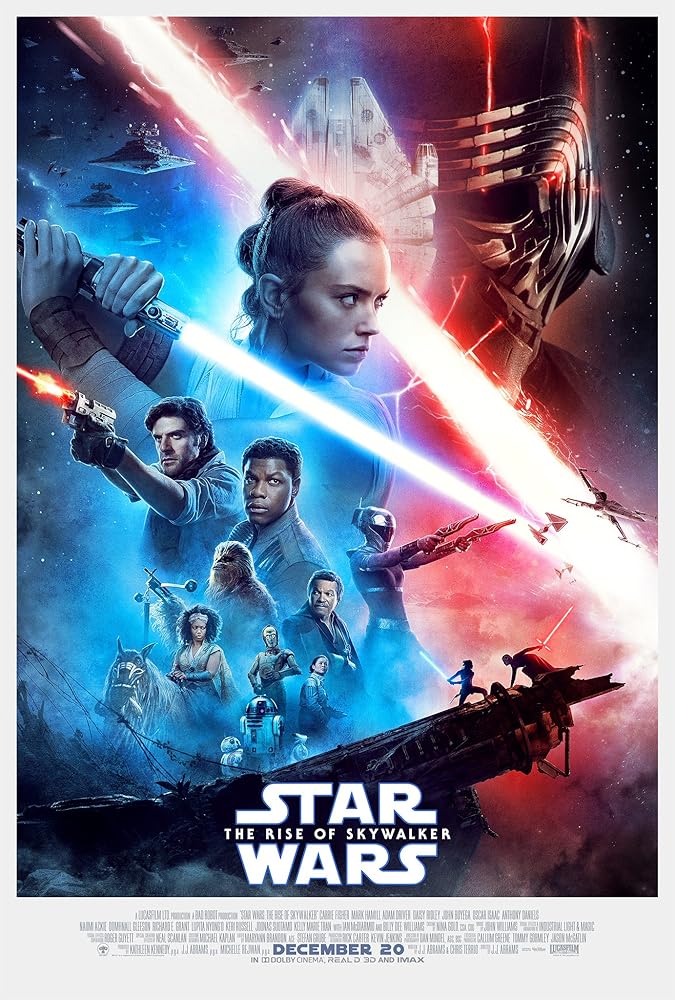
Star Wars: The Rise of Skywalker (2019) review


Anthony Daniels, Carrie Fisher, Billy Dee Williams, Keri Russell, Oscar Isaac, Jimmy Vee, Adam Driver, John Boyega, Kelly Marie Tran, Daisy Ridley, and Naomi Ackie in Star Wars: Episode IX - The Rise of Skywalker (2019)

I must admit that I went into Star Wars: The Rise of Skywalker feeling rather hesitant, a genuine first for me when it comes to Star Wars. Now, to be clear, this had nothing to do with the film itself since I had full faith in the amazing cast and crew who has brought this sequel trilogy to life and, of course, J.J. Abrams, who returns to the director’s chair after getting this whole trilogy started with 2015’s The Force Awakens. What I didn’t have faith in… was the Star Wars fandom. It’s been well-documented at this point that the Star Wars fandom has been in quite the volatile state these past few years after the release of 2017’s The Last Jedi, which has easily become one of the most polarizing films of all-time. While some found it to be quite arguably the best Star Wars film to date for its willingness to take risks when it comes to its writing, others thoroughly hated it for that exact reason. And because of this, the film spawned a small but incredibly vocal faction of critics who have taken it upon themselves to declare war against Disney, Lucasfilm, and the latter’s president Kathleen Kennedy for their allegedly piss-poor handling of the franchise. As such, J.J. Abrams now finds himself having to deal with perhaps the worst set of expectations ever thrust upon a Star Wars film; trying to appease those who despised The Last Jedi while simultaneously trying not to piss off those who preferred that film’s method of storytelling. It’s a complicated task that’s clearly been reflected in the film’s overall reception, but J.J. manages to pull through to deliver a satisfying finale to the Skywalker Saga.

In the year since the events of The Last Jedi, the severely limited forces of the Resistance have struggled against the might of the First Order, now led by Supreme Leader Kylo Ren (Adam Driver). And if that wasn’t enough, the whole galaxy receives an unexpected broadcast from none other than Emperor Palpatine (Ian McDiarmid), who supposedly met his end during the Battle of Endor as seen in Return of the Jedi. When Ren confronts the Sith Lord, Palpatine reveals that he has an armada of powerful Star Destroyers that will serve as the ‘Final Order’ and destroy the galaxy once and for all. The only one who could possibly stand in their way is Rey (Daisy Ridley), the Force-sensitive scavenger turned Jedi from Jakku who had trained with the late Jedi Master Luke Skywalker (Mark Hamill) and is now guided by Luke’s sister, General Leia Organa (Carrie Fisher). Rey and her friends, former First Order stormtrooper Finn (John Boyega) and Resistance commander/pilot Poe Dameron (Oscar Isaac), soon learn that Palpatine is hiding out on the uncharted planet of Exegol. And because of its elusive status, the only way to reach it is by finding a device known as a Sith Wayfinder that will give them the planet’s coordinates. Thus, Rey, Finn, and Poe find themselves in a race against time to find the Wayfinder and reach Exegol, all while being endlessly pursued by Ren and the First Order, before Palpatine can unleash the ‘Final Order’. In the process, Rey continues to struggle with the growing connection that she has with Kylo Ren and finally begins to uncover the secrets behind who she really is, which effectively poses some major ramifications for the galaxy.

Despite its immense success with both critics and audiences, J.J. Abrams’ last Star Wars film, The Force Awakens, received quite a bit of flak for allegedly being a ‘carbon copy’ of the original Star Wars film, A New Hope. This, in turn, can explain why a lot of attention was made about Rian Johnson’s efforts to ‘freshen things up’ with The Last Jedi… even though one could argue that it too could be described as a mirror of its original trilogy equivalent, The Empire Strikes Back. As for Rise of Skywalker, the argument of ‘been there, done that’ has once again become a source of contention amongst critics, especially due to the return of Emperor Palpatine as the main antagonist despite the previous film’s concerted efforts to “let the past die”. But just like the whole ‘it’s just A New Hope again’ debate that now dominates the conversation when it comes to The Force Awakens, I’d argue that this isn’t as big of a deal as it’s been made out to be. Sure, all three films in the sequel trilogy do share some similarities with Episodes IV through VI, but it’s not like they’re downright ripping off the plots of those films. Instead, these parallels only help to strengthen the sequel trilogy’s narrative while also providing some nice callbacks and solid conclusions to some of the series’ longest-running plotlines. And because these newer films have done a phenomenal job when it comes to developing their main characters, this paves the way for some incredibly powerful emotional moments. In other words, J.J. Abrams once again proves that he’s a natural when it comes to crafting that classic Star Wars atmosphere. And while The Last Jedi ended up providing some of the most gorgeous cinematography that the series has ever had, J.J. and his long-time cinematographer Dan Mindel continue to prove that they can deliver visuals and action sequences that are just as amazing by comparison.  

One interesting thing to note about Rise of Skywalker is that it’s the first entry of the sequel trilogy where the lead trio of Rey, Finn and Poe are all together for a good chunk of the run-time whereas the previous two films had them separated in various ways. This wasn’t a bad thing, for the record, but it is nice that this film finally gives these three a chance to work together and Daisy Ridley, John Boyega, and Oscar Isaac are all fantastic once again in their respective roles. Rise of Skywalker also does a wonderful job when it comes to furthering their overall character development, whether it’s Poe continuing to grow as a leader for the Resistance or Rey learning about her heritage and what that could potentially mean for the galaxy. All this great character development from the protagonists is matched perfectly by their foil, Kylo Ren, as Adam Driver continues to shine as the emotionally volatile Dark Side user whose complex character arc reaches its cathartic conclusion in this film. The four leads are then excellently backed by several of the sequel trilogy’s great supporting players, including Domhnall Gleeson as General Hux and Kelly Marie Tran as Rose Tico, although fans of the latter will be disappointed by her severely limited screen-time. After that, the film adds in some fun new characters including Keri Russell as Zorii Bliss, an old acquaintance of Poe’s, Richard E. Grant as First Order General Pryde, who slowly works his way into becoming Kylo Ren’s sinister second-in-command, and Naomi Ackie as Jannah, who is revealed to be a former First Order stormtrooper just like Finn.

Moving over to the series veterans who notably make a return in this film, the biggest of the bunch is, of course, Ian McDiarmid as Emperor Palpatine. Regardless of how one feels about the decision to bring the character back, McDiarmid is once again terrific as the imposing Sith Lord, especially since he opts for the generally more subdued version of the character from the original trilogy instead of the cartoonishly over-the-top iteration from Revenge of the Sith. Another welcome return comes via Billy Dee Williams’ suave smuggler Lando Calrissian, who promptly continues to be one of the most charismatic figures in the entire Star Wars galaxy. But easily the most notable element of this film’s cast is how Leia ultimately factors into everything. While it was originally planned to give her a prominent role a la Han Solo in The Force Awakens and Luke in The Last Jedi, those plans ended up falling by the wayside after Carrie Fisher’s untimely passing in 2016 after she had finished working on The Last Jedi. However, instead of just giving Leia an unceremonious off-screen death as a lot of films tend to do whenever an actor/actress doesn’t return to reprise their role, J.J. manages to work her in via the use of unused footage from The Force Awakens. The overall implementation of this footage into the film is a truly fascinating feat to behold given how much work clearly must’ve been done to make it all possible. Nevertheless, it does its job beautifully and effectively gives the most iconic heroine in the Star Wars saga the emotionally fitting send-off that she damn well deserves.

I’m well aware that everything that I’ve said in this review isn’t going to fly well with certain audiences. Just like The Last Jedi, The Rise of Skywalker has been an incredibly polarizing affair to the point where even critics are just as mixed towards it as audiences are. As alluded to earlier, while The Force Awakens may have managed to scoot by without getting dinged too hard for supposedly being ‘too much like A New Hope’, it’s clear that critics weren’t as forgiving towards Rise of Skywalker for doing the same thing. And yet, as someone who has been a fan of the sequel trilogy ever since the first teaser for The Force Awakens was released, I found Rise of Skywalker to be a perfect finale for this trilogy. As a film that’s truly grand in both scale and emotional depth, Star Wars: The Rise of Skywalker provides a wholly satisfying conclusion to both the sequel trilogy and the entire Skywalker Saga as a whole. Sure, some have argued that it attempts to undo a lot of the controversial plot-points from The Last Jedi, but the ways in which J.J. Abrams and co-writer Chris Terrio conclude the story of Rey, Finn, Poe Dameron, and Kylo Ren still feels consistent with what we’ve seen from the previous two films. And through it all, J.J. and his crew continue to go above and beyond when it comes to the film’s incredible action sequences and breathtaking visuals. Sadly, though, it seems like The Rise of Skywalker will end up being regarded as a ‘failure’ even though I’d argue that it isn’t the film’s fault. Instead, I’d attribute it more to the period in which it was released where the Star Wars fandom proved to be in a state of total disarray, thoroughly compromised by its utterly ambiguous expectations.

Rating: 5/5!

Wednesday, November 14, 2018

Overlord (2018) review

Pilou Asbæk in Overlord (2018)

For the past few years, J.J. Abrams has become one of the most prominent filmmakers in the industry. As a director, he played a major role in reviving not one, not two, but three incredibly prominent franchises through his work on 2006’s Mission Impossible III, 2009’s Star Trek, and 2015’s Star Wars: The Force Awakens. And after that, he then proceeded to get further involved with each franchise as a producer, paving the way for incredibly strong outings like Mission Impossible – Fallout, Star Trek Beyond, and Star Wars: The Last Jedi. But, of course, this isn’t all that J.J.’s known for as a producer, as easily the most notable franchise to come from his own production company, Bad Robot, has been the Cloverfield series. What started as the titular 2008 found footage monster film directed by Matt Reeves ended up spawning a new anthology series where the films were connected more by their narratives than their genre. Things got off to a great start with 2016’s 10 Cloverfield Lane, but then the franchise admittedly stumbled a bit this year with the Netflix-released The Cloverfield Paradox. And if you’re wondering, the only reason why I’m bringing up Cloverfield right now is because today’s film, Overlord, was initially reported as being the fourth installment of this steadily growing franchise. However, J.J. Abrams would later state that the film ultimately wasn’t going to be tied to Cloverfield. Instead, Overlord, directed by Australian filmmaker Julius Avery, is its own thing; a stylish, well-made World War II-era horror film featuring zombies… and not just any zombies, Nazi zombies!

It is December 5th, 1944, just a few hours before the Allies are set to land on the beaches of Normandy and begin their liberation of German-occupied France in what would become known as D-Day. In the skies above, a squad of paratroopers is tasked with destroying a radio tower in a nearby village to aid the incoming troops. However, their plane ends up getting shot down and only a few of the troopers end up surviving the crash; seasoned veteran Corporal Ford (Wyatt Russell), Private Ed Boyce (Jovan Adepo), sniper Tibbet (John Magaro), and photographer Chase (Iain De Caestecker). Now stuck behind enemy lines, the quartet find themselves under immense time pressure to destroy the radio tower before their fellow troops land on the beach, a task that quickly becomes even more daunting given that they’re just four men against a sizable Nazi army. However, as they soon find out, that’s not the only issue that they have to deal with. When Boyce ends up getting stuck inside the Nazi base where the tower is located, he is shocked to find a series of experiments utilizing dead bodies. These experiments come to fruition with a special serum that, although managing to revive the dead, ends up turning them into terrifying creatures with inhuman strength. Now facing a threat that’s unlike anything they’ve ever seen before, the paratroopers, with the help of a local woman named Chloe (Mathilde Ollivier), must now ensure that these horrifying trials never see the light of day.

Now to answer your first question… no, this is NOT a Cloverfield film. Obviously, one of the most prominent aspects of films (and TV shows, for that matter) that are produced by J.J. Abrams is that their marketing campaigns make a considerable effort to be light on spoilers. Granted, this hasn’t always worked for them (e.g. the fiasco of the Khan twist in Star Trek Into Darkness), but I’d say that this ‘mystery box’ tactic does do its job at keeping audiences guessing. But in the case of Overlord, J.J.’s claim that the film wouldn’t be tied to the Cloverfield franchise is 100% accurate, thus allowing it to be its own entity. Plus, it also manages to be two films in one given its premise. As it starts, it fully succeeds at sucking you into its war-time setting, partially because the opening sequence where the paratroopers’ plane gets shot down is a figurative and literal explosion of audio and visuals, easily making it one of the most intense openings to any film in recent years. After that, the film works quite well as a small-scaled war film, hitting just the right notes in terms of setting up the main conflict and the primary characters who get involved in it. The same can be said for how it gradually builds up its plot to get to the big reveal of the Nazi experiments that turn its unwilling subjects into zombie-like creatures. However, the zombie element of this story isn’t as prominent as the marketing implies. Sure, it’s there, thus paving the way for plenty of gory moments to satisfy fans of the genre, but on a whole, it plays more of a secondary role in the plot. In other words, this is still primarily a war film at the end of the day, but one with the added element of the undead.  

Unlike some war films, Overlord only focuses on a small cast of characters instead of a wider ensemble. But while this does prevent a situation where you end up forgetting who’s who, the film is still quite light on character development. Every main character in this film is a typical archetypal protagonist that one would usually see in a war film. There’s the ‘audience avatar’ who’s set up as being so innocent that he wouldn’t hurt a mouse (literally), the hardened veteran who stresses that things be done by the book, the inexperienced soldier who’s clearly out of his depth, the wise-ass who’s there for comic relief, etc. Despite this, though, this film’s cast of generally rising stars do a solid job with the limited material that they’re given. Most of the film sees us following Pvt. Boyce and Cpl. Ford, and Jovan Adepo and Wyatt Russell do a nice job when it comes to conveying how these two serve as foils for each other given their vastly different ideologies. To back them up, there are also solid performances from John Magaro and Agents of S.H.I.E.L.D.’s Iain de Caestecker as Tibbet and Chase, respectively, and newcomer Mathilde Ollivier as the film’s main female lead Chloe. As for the villains, they too are simply characterized, but there is one major standout in Pilou AsbĂŚk as Captain Wafner, a truly sinister Nazi commander who frequently crosses paths with the paratroopers. AsbĂŚk very much channels Christoph Waltz’s iconic performance as Colonel Hans Landa (AKA ‘the Jew Hunter’) in Quentin Tarantino’s Inglorious Basterds here, resulting in a highly intimidating antagonist.

Over the past few months, I’ve covered quite a few horror films and have repeatedly mentioned what I feel is one of the most important elements to a great horror film, creating characters that we truly care about as they deal with all sorts of horrific obstacles. That doesn’t really apply to Overlord, though, because while this film does sport a good cast, the character development beats that they’re given are as basic as you can get for a film like this. But to be fair, you don’t always need to have fully sympathetic characters to be a great horror film, and Overlord ultimately manages to succeed despite this shortcoming because of how well-made it is. For what is only his second directorial feature ever, director Julius Avery crafts a highly engaging thriller with a solid visual style that works as both a war film (thanks in large part to its incredible opening sequence) and a zombie film. Granted, the zombie element of this film isn’t as prominent as one might think given the marketing, but there are just enough practical zombie effects in this to satisfy fans who’ve witnessed the likes of George A. Romero’s Dead films. And while I’ll openly admit that part of me would’ve been genuinely interested in seeing what this film would’ve been like had it been tied to the Cloverfield franchise, it’s nice that it ultimately wasn’t. Because of this, Overlord is a very entertaining war film with horror elements that serves as another shining example of the high quality of films produced by Bad Robot Productions.


Rating: 4/5

Thursday, February 8, 2018

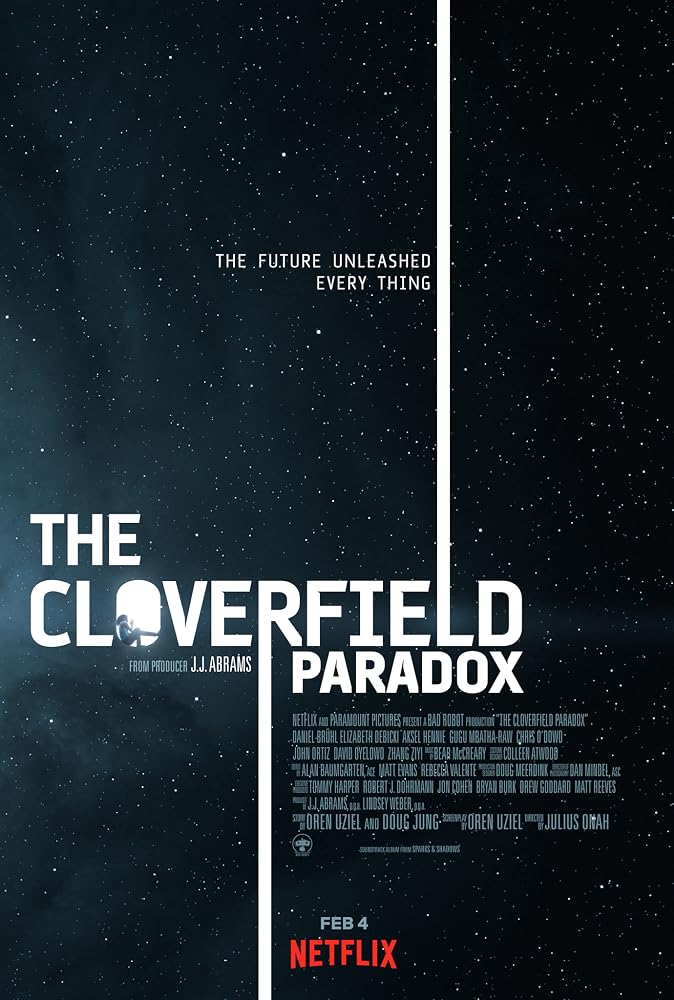
The Cloverfield Paradox (2018) review

The Cloverfield Paradox (2018)

In January 2008, audiences were treated to a new sci-fi monster flick known as Cloverfield. Produced by ‘franchise savior’ J.J. Abrams, written by Joss Whedon veteran Drew Goddard, and directed by ‘pre-Planet of the Apes’ Matt Reeves, the film was a major critical/commercial hit while also proving to be somewhat of a landmark entry in the ‘found footage’ genre. After that, though, it was unclear for a while if there would be a follow-up despite Abrams, Goddard, and Reeves all claiming that they were planning on making one. It wasn’t until 2016 when audiences learned that the series was set to continue, as 10 Cloverfield Lane was announced just two months prior to its March 2016 release. But despite this short time-span between its initial announcement and release, the film was another major critical/commercial hit that effectively paved the way for a fascinating new franchise that was intent on being reminiscent of the classic anthology series, The Twilight Zone. And now, this brings us to film #3 in the franchise, The Cloverfield Paradox. Initially named God Particle, this film was confirmed to be part of the Cloverfield franchise not long after 10 Cloverfield Lane’s release. However, the film’s initial fall 2017 release date ended up getting scrapped. Plus, like any major J.J. Abrams production, details about it were scarce for the following few months… that is, until this past Sunday when its first promo aired during the Super Bowl. Even more surprising, the promo revealed that the film would debut that very night on Netflix in lieu of a theatrical release. Thus, without further ado, let’s delve into the third installment of the Cloverfield franchise, which claims that it’ll uncover some backstory regarding the events of the original film that started it all.

In a not too distant future, the planet Earth is on the verge of a worldwide war due to an impending energy crisis. To fix this problem, all the major space programs of the world launch the Cloverfield Station, which is outfitted with a particle accelerator known as ‘the Shepard’ that will hopefully provide the planet with a new source of energy. However, the experiment ends up failing numerous times, resulting in the station’s crew being forced to prolong their stay up in space for at least two years as they must figure out why the Shepard keeps malfunctioning so that they can get it to work in time before a war breaks out back home on Earth. Eventually, the crew manages to achieve what appears to be a successful test, but in the process, they then find themselves in a troubling situation as the Earth mysteriously disappears from existence. This predicament is then further compounded by the unexpected arrival of a woman named Mina Jensen (Elizabeth Debicki), who claims to be a member of the crew and the best friend of crew member Ava Hamilton (Gugu-Mbatha Raw). In other words, the crew of Cloverfield Station soon come to realize that they’ve somehow ended up in an alternate dimension, which they must escape from before the damages to the station that were caused by the particle accelerator become too severe. Little do they know, though, that they must soon deal with the various dangers of this strange new world while, unbeknownst to them, the Earth of their dimension is dealing with a dangerous new threat of its own.  

While the potential was very much there for an interesting sci-fi story that further developed the universe of Cloverfield, this potential is ultimately wasted due to the film’s biggest issue of having a generally undercooked plot. Not only that, but it’s also quite derivative of several classic sci-fi films. Now I won’t be naming some of the biggest films that are clearly this film’s primary influences here because I fear that they would lead to some spoiler-y discussion about the events that happen in this film and I want to keep this review as spoiler-free as possible. Still, I’m 99.9% confident that you’ll know EXACTLY what films I’m talking about when you see this because, sadly, the similarities that The Cloverfield Paradox shares with those other sci-fi films are quite blatant. Now to the film’s credit, it does live up to its promise of delving into the mythos of its franchise, specifically by providing an answer to one of the key mysteries that was laid out in the ending of the original Cloverfield. Still, its attempts at connecting everything in the Cloverfield franchise ultimately feel just as underdeveloped as its main plot because it never really explores any of the story ideas that it introduces, especially the one that establishes the concept of alternate dimensions. And it’s a shame, really, because, from a technical perspective, the film is at least decently made. For a film that was originally meant to be released in IMAX but was ultimately relegated to being released on Netflix instead, it looks fine enough thanks to the solid cinematography from Bad Robot Productions regular Dan Mindel, who also did the cinematography for J.J. Abrams’ two Star Trek films and Star Wars: The Force Awakens. And just like the previous Cloverfield film, 10 Cloverfield Lane, this film sports an excellent score courtesy of the legendary Bear McCreary.

Alas, though, the various story issues of this film also end up affecting its cast of characters AKA the crew of Cloverfield Station. These characters are just as generic as the plot itself, with most of them getting little to no character development only to serve as a collection of stock horror film protagonists. Thankfully, this doesn’t apply to ‘all’ of them; specifically, Gugu Mbatha-Raw as main protagonist Ava Hamilton, who is easily the most well-developed character of the entire group. Obviously, that’s not really saying much given the lack of character development for everyone else but, to the film’s credit, her overall role in the story (which is all tied to an immensely devastating tragedy from her past) does yield its most effective moments of emotional poignancy. And this is only strengthened further by Mbatha-Raw’s excellent performance in the role; in other words, she’s easily the best part of the film. As for the rest of the cast, while they don’t get as much to work with by comparison, at the very least they’re all fine in their respective roles. Daniel BrĂźhl is another major standout as Schmidt, who ends up being one of the more enigmatic members of the station’s crew, as is Chris O’Dowd as Mundy, who’s basically the film’s main ‘comic relief’ character. But again, without any decent bits of character development to work with, the two of them along with fellow co-stars David Oyelowo, John Ortiz, Zhang Ziyi, Aksel Hennie, and Elizabeth Debicki end up being just as stranded as their characters are in their current predicament.

From what I’ve read, it seems as if The Cloverfield Paradox’s fate as a Netflix release was due to Paramount, the franchise’s main studio, being uneasy about the final product and its potential profitability given its franchise-high budget of $45 million. J.J. Abrams himself was keen on trying to salvage the film in post-production but was ultimately unable to do so when he signed on to direct Star Wars: Episode IX. And overall, this does basically sum up this film in a nutshell. While it’s not outright ‘terrible’ (if anything, it’s not necessarily as bad as its abysmal 19% rating on Rotten Tomatoes suggests), it’s still a tragically underwhelming continuation of the Cloverfield franchise. Despite the potential for some interesting plot-lines, the film ultimately wastes them all due to its woefully generic sci-fi horror story that does little to further explore the franchise’s lore. This, in turn, wastes a perfectly good ensemble cast (save for Gugu Mbatha-Raw) that ends up being restricted to a bunch of stereotypical sci-fi horror roles. Ultimately, though, I will admit that I wasn’t ‘bored’ by this film at any point despite it being a clear hodge-podge of other films in its genre. Thus, if you are a fan of the Cloverfield franchise, then there’s a chance that you might like this film okay even if it’s nowhere near as good as its two predecessors. And despite this film’s disastrous critical reception, I don’t believe that this will be the end of the Cloverfield franchise. After all, there’s yet another Cloverfield film coming out later this year in October in the form of a WWII-set supernatural horror film called Overlord. Of course, it’ll probably get renamed soon so that it’ll have Cloverfield in the title, as was the case with 10 Cloverfield Lane (originally The Cellar) and this (originally God Particle). But thankfully, it’s been recently announced that it, along with other potential future installments of the franchise, will be theatrical releases instead of what happened here.


Rating: 2.5/5

Friday, September 15, 2017

Star Wars Episode IX - Colin Trevorrow Out, J.J. Abrams Back In

Image result for Star WArs Episode 9

Well, we’ve got yet another directorial shake-up on our hands in the Star Wars universe. Just a few months after Phil Lord and Christopher Miller were booted from the Han Solo spin-off film and replaced by Ron Howard, the same has now happened with the ninth installment of the main series, Episode IX. Originally, the film was set to be directed by Colin Trevorrow, who was fresh off 2015’s worldwide smash hit Jurassic World… and this year’s critically derided Book of Henry (more on that in a bit). However, like Lord and Miller, it was recently announced that Trevorrow had backed out of directing the film due to, what else, creative differences with Lucasfilm. But, once again, the search for a new director did not last long, and in this case, it was an old familiar face who stepped in to finish the job. Yes, folks, J.J. Abrams, the man, myth, and legend who kick-started the new Star Wars trilogy on the right note with The Force Awakens is coming back to write and direct Episode IX. Given the critical/commercial success of TFA, it seems like this would be a well-received decision, right? Well, not exactly… Yes, folks, the Star Wars franchise has been in quite a state of flux as of late due to several of the recent developments surrounding its upcoming films. This is the second time in a row now that a Star Wars director has been ‘fired’ from the job due to creative differences with the studio and producer Kathleen Kennedy (three if you count the time when Josh Trank stepped down from helming a spin-off film presumably due to his behavior during the disastrous production of the 2015 reboot of Fantastic Four). This has, unfortunately, put Kennedy in a tough situation as she’s been subjected to tons of flak that, dare I say, verges a bit on sexism. I’ve gone over this before when I discussed the Han Solo incident so I won’t repeat myself too much here other than the fact that, given her prestigious career in the industry, Ms. Kennedy doesn’t deserve all this criticism over something that could happen to any film producer.

I mean, I’ve said it before and I’ll say it again; film productions don’t always go perfectly. There will be times where a film will be affected by problems that may often require something along the lines of reshoots, script rewrites, and so on and so forth. However, just because a film has a troubled production doesn’t automatically mean that it’s doomed to failure. Seriously, it’s because of incidents like this that I’m extremely happy that social media wasn’t around in the time of films like Jaws and the original Star Wars; good lord, we would’ve never heard the end of those films’ production woes had that been the case. And in terms of what’s going on right now with Episode IX, at least this wasn’t like what happened with the Han Solo film where the director switcheroo occurred more than halfway through filming. Episode IX, on the other hand, hasn’t even started production yet. In fact, not long after J.J.’s hiring was confirmed, it was also announced that the film had been pushed back to the franchise’s preferred release month of December 2019, which effectively gives J.J. more time to prepare for it instead of rushing through it so that it’d be out by its original May 2019 release date. Now, granted, I am aware that these recent bits of production turmoil have been somewhat of a common occurrence as of late with the Disney-owned era Star Wars films. Aside from these recent directorial hiccups, there was also, of course, the dilemma that Rogue One faced when it had to go through reshoots, namely to rework its third act. Ultimately, though, all the hubbub surrounding these events is just a consequence of an age where we can practically know anything about a film’s production.

Image result for colin trevorrow

With that said, though, let me make something clear; unless proven otherwise, I’m 100% confident that Trevorrow wasn’t kicked off Episode IX because of the negative reception towards The Book of Henry. I’ve talked before about how the internet over-reacted quite a bit when the film came out to the point where several articles posed the same exact question; ‘Is Episode IX in trouble?’… even though the film wasn’t even in production yet. Heck, even the polarizing reaction to Jurassic World played a factor into the hesitation surrounding Trevorrow’s hiring. It got to the point where, apparently, some people were ‘happy’ when the news broke of his departure. This ties into something that I’ve always questioned about the online film fan community and that is its tendency to focus more on films that they dislike rather than those that they did like. I mean, seriously, if Trevorrow had truly gotten canned just because of Book of Henry, then J.J. Abrams could’ve been denied from directing The Force Awakens just because of the blowback that he got over Star Trek Into Darkness’ use of elements from Star Trek II: The Wrath of Khan. Heck, imagine if this mentality was implemented with the Marvel Cinematic Universe films; I guarantee you that NONE of the MCU directors would’ve even been hired if judged solely for their misfires. I mean, after all, the director of the Guardians of the Galaxy films did write the live-action Scooby-Doo films. Or remember when the directors of Captain America: The Winter Soldier, Captain America: Civil War, and the upcoming Avengers: Infinity War directed You, Me, and Dupree? Bottom line, the validity of a director’s qualifications for a certain project shouldn’t be judged solely because of one bad film that they made. Case in point, even though Trevorrow attracted a lot of flak for Jurassic World and Book of Henry, he did also direct 2012’s indie hit Safety Not Guaranteed.  

Thus, prior to these recent turn of events, I was optimistic about Trevorrow’s hiring and confident in his ability to make an entertaining Star Wars film. But, of course, that isn’t happening anymore so now we get to look forward to another J.J. Abrams-directed Star Wars film. Hurrah! However, as noted in the intro, the news of J.J.’s return hasn’t really gone over well with everybody and the main reason why is that some feel that he’s too ‘safe’ of a choice to direct the film. That might have something to do with the one thing that I’m sure many of you have already guessed about when I said the word ‘safe’. Yep, it’s the common criticism of The Force Awakens’ shared similarities with Star Wars Episode IV: A New Hope. Really, there’s not much more that I can bring to this discussion other than my belief that the internet’s just beating a dead horse at this point. Heck, even Ron Howard’s hiring for the Han Solo film was deemed as a ‘safe’ pick to replace Phil Lord and Chris Miller. All this just goes to show the increasing pressure that the franchise has been under recently from fans who have been demanding that they enlist more ‘auteur’ directors who can bring something ‘new’ to the franchise. And while I’m not against that, for the record, from what I can gather, the main reason why Lord, Miller, and even Trevorrow were let go was that their directorial personalities clashed with Lucasfilm’s vision for the franchise. And as controversial as it will undoubtedly sound to some of you, I think that this was ultimately for the best. Again, I’m all for new takes on the Star Wars franchise. However, the amount of creative clout that a director is given on a film can sometimes end up having a severely negative effect on it (e.g. Batman Returns, Sucker Punch). Heck, this has even happened before with this franchise; just look at when the prequels came out.


And it’s a shame, really, that these recent ‘studio vs. director’ controversies have had a negative impact on J.J. Abrams’ return to the franchise. Given the ever-present ‘it’s just a rehash of A New Hope’ argument, it feels like the internet’s collective opinion of The Force Awakens has changed quite drastically since it came out. It’s legitimately at the point now where I’m beginning to wonder if it and Rogue One were truly the critical/commercial hits that they were. Oh sure, they both did well with critics and have collectively grossed over $3 billion at the box-office, a total which will surely increase by another $1-2 billion once The Last Jedi comes out. But in an age where shows like Honest Trailers and Cinemasins are becoming more and more prominent, it’s becoming a lot harder for films to maintain the positive reputation that they had upon their initial release. It also just goes to show how Star Wars is easily the most scrutinized film franchise of all-time, as the expectations for it are bigger than the Marvel and DC Cinematic Universes, Harry Potter, and Lord of the Rings franchises combined. Even when it’s doing well, there are always plenty of naysayers out there who will try and bring it down. And given these recent turn of events, it feels like this is all just putting more overt pressure on Rian Johnson to truly deliver with The Last Jedi. However, despite all the behind-the-scenes drama that’s been going on as of late, I’m still looking forward to these next few Star Wars films. Because if they do turn out great, then all the pre-judgmental backlash directed against them will have just been utterly pointless. And while I know that I’m undoubtedly biased because he’s one of my favorite directors working today, the announcement of J.J. Abrams’ return for Episode IX just makes me even more excited for it because of how much I loved The Force Awakens. In other words, to quote the classic hashtag created by popular Star Wars Youtuber HelloGreedo, #InJJWeTrust.


And, just for the hell of it, it’s time for the return of a classic meme that I created prior to the release of The Force Awakens. Feel free to use it as you see fit.


Saturday, July 23, 2016

Star Trek Beyond (2016) review


As I’ve gone over quite a few times already these past few years, I am a huge fan of the J.J. Abrams-directed Star Trek films. The 2009 Star Trek ‘reboot’ not only introduced me to the franchise, as was the case with other franchise newcomers, but also ended up becoming one of my favorite films of all-time period. As a result, the sequel, Star Trek Into Darkness, was my most anticipated film of 2013. And while I personally really loved it, the same couldn’t be said for most long-time Star Trek fans. In fact, most Trek fans heavily despise the J.J. films for allegedly not staying true to the franchise’s roots and Into Darkness got a considerable amount of backlash for its re-imaginings of scenes from Star Trek II: The Wrath of Khan. So with all of that in mind, there was certainly a lot of pressure on the third of these J.J.-era (or should I say ‘Kelvin’ era as it’s recently been designated) films to adhere more to what made the franchise so popular in the first place. This time around, though, J.J. wasn’t available to direct due to his work on a certain other film that starts with the word ‘Star’. So in his place is Justin Lin and while a lot of Trek fans weren’t too pleased with the hiring of ‘another action director’, Lin’s work on the Fast and Furious films have made him one of the best action directors in the business. Plus, he made it clear that he was a Trek fan and with the addition of franchise star Simon Pegg as one of the film’s co-writers, it looked as if this new Trek film would fare much better with fans. And sure enough, Star Trek Beyond, the 13th installment of this iconic sci-fi franchise, is one heck of an exciting space adventure. For fans of the J.J. films like myself, this is just yet another super entertaining film that maintains all of the things that made the previous two films so great. But for more hardcore Trek fans, they’re probably going to like this one better.

At the end of Star Trek Into Darkness, the crew of the USS Enterprise, as led by Captain James Tiberius Kirk (Chris Pine), set off on a five-year journey into uncharted space. As this film begins, the Enterprise is three years into the voyage and while things have been going fairly smoothly for the crew, Kirk is considering applying for a promotion to the position of Vice Admiral due to him beginning to really feel the monotony of being a starship captain. After briefly stopping at Yorktown, an advanced Starbase, the crew are sent out on a rescue mission when an escape pod is found and its sole occupant, an alien named Kalara (Lydia Wilson), says that her ship got stranded in a nearby nebula. However, this ends up being a trap as the Enterprise is ambushed by a swarm of alien ships led by their fearsome alien commander Krall (Idris Elba), who is seeking a mysterious alien artifact that the Enterprise had recently found. The Enterprise is destroyed but the crew manages to abandon ship and they end up on a nearby planet. With no ship and no way of sending out a distress signal, Kirk, along with his fellow crewmates; first officer Spock (Zachary Quinto), medical officer Leonard ‘Bones’ McCoy (Karl Urban), communications officer Nyota Uhura (Zoe Saldana), engineer Montgomery Scott (Simon Pegg), helmsman Hikaru Sulu (John Cho), and navigator Pavel Chekov (Anton Yelchin), as well as a new ally in Jaylah (Sofia Boutella), a scavenger who’s been living on the planet for some time, race to stop Krall before he can collect the artifact and use it to attack the Federation.

As noted earlier, one of the main issues that ‘Trekkers’ have had with the J.J.-directed films is that they don’t really feel much like Trek films. While I personally disagree with that argument, I will admit that out of all of these recent Trek films, Beyond is certainly the most Trek-ish of the bunch. The whole plot of Kirk and crew stranded on an alien planet definitely feels like something you’d see on an episode of The Original Series. By comparison, the last two films were more focused on the origins of the Enterprise crew before they set off on their five-year mission. However, if we’re talking overall execution, Beyond very much maintains the same level of action as its two predecessors. So with that said, I’m not entirely sure if this will win over every Trek fan because it’s still very much an action-oriented film and not necessarily a ‘cerebral’ kind of story as I find that some fans were wanting out of these newer films. But as someone who actually does prefer the action-oriented style of the newer Trek films, this film was right up my alley and I loved every second of it. The action is excellent as are the visuals and Justin Lin’s direction is solid throughout. Plus, amidst all of the action, the film makes sure to spend time further developing its characters, namely by giving them some effectively emotional character moments. Now I’ll admit that I don’t think this film actually has as much emotional depth as the previous two films but even with that said, there are still plenty of emotional moments in this film, like Spock struggling to cope with the idea of mortality following a recent tragedy (the details of which I won’t reveal here as they’re kind of spoiler-y).   

I don’t really need to go over the main cast that much because this is the third film that they’ve been in. Simply put, they’re just as phenomenal as they’ve been in the last two films. One of my absolute favorite things about these new Trek films has been the camaraderie amongst the main ensemble and I’m happy to report that this is once again the case here, resulting in plenty of humorous banter amongst them. Though with that said, it’s also a little bittersweet knowing that this is the last we’ll see of Anton Yelchin in the role of Chekov, as Yelchin tragically passed away a month ago in a car accident. So instead of focusing on the main cast, let’s focus on the newcomers, specifically Sofia Boutella as Jaylah and Idris Elba as the film’s main villain Krall. Boutella made quite an excellent first impression in her first ‘major’ film role as Gazelle, the main henchwoman of Samuel L. Jackson’s Valentine in last year’s Kingsman: The Secret Service and she’s once again excellent here. Simply put, Jaylah’s a pretty badass female lead but is one that is also very layered as well as shown in her backstory and her motivation of getting off of the planet. As for Elba as Krall, I must say that these new Trek films have done a pretty excellent job with their villains. I can’t say at the moment if Krall is as good as or better than Nero (Trek ’09) or Khan (Into Darkness) but Elba certainly makes the character a very memorable and quite intimidating adversary for Kirk and company. Plus, his main motivation and backstory are quite well-developed.

As someone who absolutely loved J.J. Abrams’ two Star Trek films, Star Trek Beyond most certainly delivered on everything that I love about these newer Trek films. The action and visuals are excellent, the plot is solid, and the characters are excellently handled in terms of both the performances and strong camaraderie of the actors/actresses who play them as well as the excellent character development that they get to work with. However, I’m well-aware that this film has a lot to prove as most Trek purists weren’t too pleased with the last two films. And while I personally will defend both the 2009 Trek and Into Darkness come hell or high water, I have the feeling that they’re going to like this film a whole lot more. Because while it’s still very much the action-oriented style that the two J.J. films maintained, the plot is certainly much more Trek-y in terms of its overall execution. So in short, thanks to the solid direction from Justin Lin, who proves to be an excellent successor to J.J., as well as the solid writing from writers Simon Pegg and Doug Jung, Star Trek Beyond is yet another fantastic entry in this legendary franchise. And for someone like me who grew up not with the Original Series but with J.J.’s films, it’s just another home run hit for the franchise’s modern era and I can’t wait to see what happens next for my favorite Enterprise crew. In fact, we already know one key detail of what will happen next as it was recently confirmed that Chris Hemsworth, who had a minor role in the 2009 film, will be returning in the next film to reprise his role as Kirk’s father George. Could this potentially be the last of the J.J.-era Trek films? We don’t know for sure just yet but needless to say I’m super excited for the new Star Trek IV, in which Kirk’s overall arc of trying to live up to his father’s legacy will no doubt come full circle.


Rating: 5/5!

Wednesday, July 20, 2016

TREK WEEK: In Defense of the J.J. Abrams-directed 'Star Trek' films


As the second annual ‘Trek Week’ continues here on Rhode Island Movie Corner, I’ll be doing something a little bit different today; something sort of along the lines of a ‘thesis’ as I work to defend two of my favorite films of the last few years; J.J. Abrams’ Star Trek films. Despite what some fans may claim, these two films are very important to the franchise as they very much resurrected it after almost half a decade of no new major Star Trek media. And they’re also very important to me as not only are they some of my all-time favorite films (the 2009 Star Trek film is legitimately in my Top 10 favorite films of all-time) but they also helped me get into the Star Trek franchise in the first place, and the same can be said for other people who went into it not being very familiar with the franchise. However, when it comes to long-time fans of Trek, these films aren’t really as liked. In fact, they’re pretty much hated by them for various reasons and said backlash got even more vocal when the 2013 sequel, Star Trek Into Darkness, was released. Simply put, the big argument amongst this crowd is that the films ‘don’t carry the feel of the franchise’. As a result, there’s now a lot of pressure on director Justin Lin and writers Simon Pegg and Doug Jung to make sure that the upcoming Star Trek Beyond does a better job at appealing to the long-time fans. And I won’t lie… all of this backlash kind of frustrates me. Because I am not embarrassed to admit that I am a major fan of the J.J.-directed Trek films. In fact, I kind of prefer them to the older Trek films. And yeah… I know that this will be considered as complete ‘blasphemy’ amongst Trek fans. However, I’m about to go over why I will defend these films to the bitter end.  

But first, let’s put things into perspective. In the early 2000’s, the Star Trek franchise was pretty much at rock bottom. The most recent Trek film, Star Trek: Nemesis, the last film to star the cast of Star Trek: The Next Generation, was both a critical and commercial dud, just barely earning back its $60 million budget at the box-office. In fact, from a box-office perspective, it is the lowest-grossing film in the series worldwide. Meanwhile, on the TV front, things weren’t doing much better. The main Trek show at the time, the prequel series Enterprise, constantly suffered ratings-wise during its run and by 2005, the generally polarizing series was canceled after only four seasons. The following year, the franchise’s creative head, Rick Berman, was relieved of his duties. In short, the franchise was in one hell of a creative rut. As a result, the next few years saw numerous proposals for a potential resurrection of the franchise from various filmmakers including Bryan Singer and even Trek alums like Jonathan Frakes and William Shatner. Ultimately though, the honor to revive the franchise went to writers Roberto Orci and Alex Kurtzman, with J.J. Abrams, fresh off of his feature-length directorial debut, 2006’s Mission Impossible III, chosen to direct. And we all know how that turned out. On May 8th, 2009, Star Trek was released in theaters and it was a solid critical and commercial hit. It certainly proved to be a success for non-fans of the franchise and opened the door for a new generation of Trek fans like myself. However, the same couldn’t really be said for long-time fans. And based on every single criticism that I’ve heard directed towards these films over the past few years, there are two main issues that the ‘Trekkers’ have with these films.


The first was the new film’s bold decision to establish an ‘alternate universe’. This concept of a ‘multi-verse’ had been previously explored in episodes of the various Trek shows but this was pretty much the first time that the films had ever gone this route. As the result of a supernova being turned into a black hole, the Romulan ship Narada ended up going back over a century in time and its attack on the USS Kelvin paved the way for a different series of events that still revolved around the franchise’s classic characters, namely James T. Kirk. A similar situation occurred last year with Terminator: Genisys and as you’d expect, that film also got flak for going that route. However, I actually think that this is a great idea as it allows the franchise to tell new stories within their universes with their classic characters without having to adhere to canon. But at the same time, another argument that people bring up about this kind of plot development is that it results in classic moments from the series ‘being erased from existence’… and I’ll just cut to the chase and say that this is not true. I mean, okay, it’s true that the creation of a new timeline does do away with beloved moments from previous films. However, it’s not like those films don’t exist anymore. If you can still go to a place like Best Buy and are able to buy the original Trek films without issue, then I don’t see what the problem is with a franchise establishing a new alternate reality. The main characters are still the same characters as before, expect that now they are being developed in different, and technically speaking ‘more modern’, ways.


The character that benefits the most from this new timeline is Captain James Tiberius Kirk. Of course William Shatner will always be the original Kirk but if you ask me, Chris Pine’s Kirk is actually a much more layered character. With Shatner’s Kirk, things usually ended up going his way no matter how difficult the situation was. After all, as emphasized in a classic scene in The Wrath of Khan where he reveals that he cheated on the infamous Kobayashi Maru test, a moment which was finally witnessed in the 2009 film, Kirk does not believe in the no-win scenario despite being told that it a situation that every Starfleet captain will likely face at one point. There were only a few instances where things didn’t really go his way, with the biggest one being when Spock died at the end of Wrath of Khan. Chris Pine’s Kirk, on the other hand, immediately starts off on a rough path. He had to grow up with the burden of having his father be George Kirk, who sacrificed himself to save the lives of the crew of the USS Kelvin, including his wife Winona and their then-newborn son [him]. So as a result, he became a reckless and arrogant delinquent until he was approached by Christopher Pike to enlist in Starfleet, ‘daring him to do better’ than his dad. I feel that this helped make Pine’s Kirk a very relatable protagonist, someone who has a lot of pressure on him to succeed. As a result, it’s cool to see how he matures as a leader over the course of these films. Plus, this idea of Kirk being under his father’s shadow seems to once again be relevant in the upcoming Star Trek Beyond as the second trailer opens with Kirk recounting how ‘he joined Starfleet on a dare’ and Bones remarking that now Kirk is trying to figure out who he really is.


As for Kirk’s eventual first officer Spock, the film further explores the character’s half-human, half-Vulcan heritage. Right out of the gate, he is shown to be ostracized by his Vulcan peers solely due to his father Sarek being a ‘traitor’ for marrying ‘that human whore’ Amanda Grayson. This prejudice is later seen when the heads of the Vulcan Science Academy remark about how successful Spock has been despite the ‘disadvantage’ of having a human mother. This effectively leads him to reject the invitation to the Academy and instead enlist in Starfleet. And while Trek fans of course know that Kirk and Spock are always portrayed as friends, the 2009 film actually doesn’t start out that way. When Kirk pulls his little ‘stunt’ during his Kobayashi Maru test, he is immediately accused of cheating by Spock and the two end up in a major moral conflict for most of the film, with Spock maintaining a generally cold and logical persona throughout. His emotions aren’t fully brought out until Kirk provokes him by questioning why he doesn’t show any emotion over the recent death of his mother, resulting in him lashing out at Kirk and subsequently relinquishing command to him on account of being emotionally compromised. This is then followed by Sarek finally admitting to him that he didn’t marry his mother because it was ‘logical’ but because he truly loved her. As a result, Spock is able to gain better control of his emotions, allowing for him and Kirk to finally set aside their differences and work together to stop the Narada from destroying Earth. Later, he is convinced to stay with Starfleet and be Kirk’s first officer, being told to ‘put aside logic’ and ‘do what feels right’. By whom, you may ask? Why, by his older self, of course!


Yes, the 2009 film pulled a major coup by having Leonard Nimoy cameo as an older Spock. His Spock is shown to be the one from the original timeline and was partially responsible for the establishment of the new timeline. When his attempt to save the planet Romulus from a supernova failed, it led to the creation of the aforementioned black hole and he and the Narada were sent many years back in time. When Kirk is marooned on the ice planet Delta Vega by the younger Spock, ‘Spock Prime’ (his credited designation in these films) helps him get back onto the Enterprise though he doesn’t come along to help Kirk take command of the ship, claiming that he cannot come into contact with his younger self. However, the two Spocks do end up meeting at the end of the film and the older Spock admits that he ‘lied’, or as he puts it, ‘implied’ about the whole time paradox thing. This is easily one of the best cameos in recent memory, though I use the term ‘cameo’ loosely because Nimoy’s Spock actually has a major role in the film. Nimoy is just as excellent as he’s always been in the role. At the time, it had been a long while since he last played the part but he slips back into the role with ease and gives the film plenty of emotional gravitas. Now I am aware that there were also plans to have William Shatner do a cameo but that ultimately didn’t happen. And to be honest, I think it’s actually a good thing because I feel that having both Shatner and Nimoy appear might have been a detriment to Chris Pine and Zachary Quinto as the younger Kirk and Spock. By just having Nimoy appear, it allows for Pine and Quinto’s versions of the characters to stand on their own while still giving the film a means of connecting the new Trek with the old Trek. Nimoy would once again appear, this time truly in cameo form, in the sequel when the younger Spock contacts him requesting information about that film’s main villain (more on that character later). Sadly, this would be the last time that Nimoy ever played the part as he passed away in February of 2015.
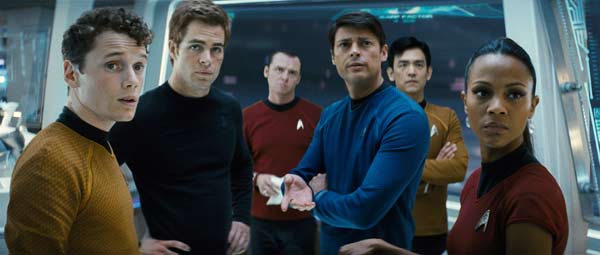

While Kirk and Spock are obviously the main protagonists, the film also does a great job in setting up all of the other main characters. Not all of them get as much to do as the lead duo but they at least have one scene each that establishes their importance to the crew. While Dr. Leonard ‘Bones’ McCoy has perennially been the third most important character of the series, the film actually promotes Lt. Nyota Uhura to that position. And sure, a sizable part of her role in the newer films does revolve around her romantic relationship with Spock but I actually don’t mind that as I feel that this relationship gives Spock a valuable human connection. Plus, I also liked how, early on, Uhura didn’t really get along with Kirk as a result of his generally brash demeanor. But of course the film doesn’t forget about the Enterprise’s reliable doctor, Bones, and of the entire cast, Karl Urban probably acts the closest to his predecessor, DeForest Kelley. Urban absolutely nails the character’s generally grumpy but still very much humane attitude, especially in scenes where he’s arguing with Spock (“Are you out of your Vulcan mind?”). Helmsman Hikaru Sulu (John Cho) gets to be part of a major action sequence when he and Kirk space-jump onto a Romulan drill, which harkens back to a famous moment from the episode ‘The Naked Time’ in which Sulu, while under the influence of a mysterious substance, brandishes a fencing foil (from the 2009 film: Kirk: “So what kind of combat training do you have?” Sulu: “Fencing.”). The sequel even hints at a potential future as a starship captain, something that did happen in the original timeline, when he becomes acting captain and threatens ‘John Harrison’ with the load of torpedoes at the Enterprise’s disposal (Bones: “Mr. Sulu… remind me never to piss you off.”).

As for ensign Pavel Chekov (played by the late Anton Yelchin, who tragically passed away recently meaning that the upcoming Beyond will serve as his final turn in the role), the film immediately sets him up as a young mathematical prodigy. Said talent comes in handy later on, especially in a scene in which he is able to beam up Kirk and Sulu when they fall off of the Narada’s drilling device. However arguably his best moment came in Into Darkness, during which he’s promoted to the role of Chief Engineer when Scotty decides to resign. Simply put, the look on his face when Kirk tells him to go put on a red shirt is priceless, showing that he clearly knows what happens to most redshirts in Star Trek. Thankfully that fate doesn’t end up happening to him. And of course we can’t forget about the Enterprise’s trusty engineer, Montgomery Scott, who is first introduced working at an outpost on Delta Vega before Kirk brings him onto the Enterprise as Chief Engineer. Like Urban, Simon Pegg absolutely nails the role from the accent to the mannerisms and the films certainly utilize Pegg’s comedic ability to great effect, from the scene in which he awkwardly remarks how exciting it is on the Enterprise after the whole ‘Kirk emotionally compromising Spock’ scene to the scene in Into Darkness in which he drunkenly argues with Kirk over coms while at a bar following his resignation. In short, every member of the Enterprise crew matters in the long run and these films do an absolutely fantastic job in establishing a phenomenal camaraderie amongst its cast of leads. 


But perhaps the biggest issue that most Trek fans have with the new films is the fact that it seemingly focuses more on action than the layered, cerebral plots that the franchise has perennially been known for. And while it’s true that the films definitely have a very action-heavy style, I don’t really see how that’s entirely a ‘bad thing’. Chris Pine was recently quoted as saying that it’s not really possible to do ‘cerebral’ Trek anymore in 2016, saying that “it just wouldn’t work in today’s marketplace” of big blockbusters… and you know what? He’s totally right! Like imagine if they ever decided to do something similar to Star Trek: The Motion Picture… that would be a colossal disaster from a box-office perspective. It’d do about as good as a Terrence Malick film. The other thing is that I’d argue that while the films do lean more towards being sci-fi action films, that doesn’t mean that they don’t have strong themes and character arcs in them. In the case of the 2009 film, there’s things like Kirk trying to deal with being in the shadow of his father and Spock struggling to deal with his emotions as well as dealing with his half-human/half-Vulcan heritage. Heck, Nero (Eric Bana) is actually a pretty decent villain as far as Star Trek villains go. He has an emotional backstory to him as he seeks vengeance against Spock (the older Spock, specifically, though this plot of revenge is later carried over to the younger Spock) for being unable to save his planet Romulus from destruction. So as payback, he makes Spock witness the destruction of Vulcan… and boy is that an emotional gut-punch of a scene, especially when Spock’s mother Amanda falls to her death right in front of her son. Heck this whole film is full of effective emotional moments, including the opening as Kirk’s father sacrifices himself right as his wife gives birth. What can I say? J.J. does a great job when it comes to scenes like this.


Speaking of the score, Michael Giacchino’s music for these newer Trek films are two of my all-time favorite film scores. In creating said score, Giacchino does something that David Arnold did when he did the music for the 2006 James Bond ‘prequel/reboot’ film, Casino Royale. And that is that he makes the smart decision to not primarily utilize the iconic Star Trek theme created by Alexander Courage. Instead, that piece is fittingly used during the end credits and I must say that Giacchino’s version of the theme is quite a rousing cover of it. But as for the rest of the film, Giacchino does an absolute fantastic job when it comes to creating motifs that can be either really emotional or invigoratingly thrilling during the film’s equally thrilling action sequences. In regards to the latter, this mainly comes in the form of this reboot series’ main motif (exemplified in this track, ‘Enterprising Young Men’). I absolutely adore this motif and I especially love how it can be used in both emotional scenes (e.g. ‘Warp Core Values’ from Into Darkness) and scenes of grand spectacle (e.g. the aforementioned ‘Enterprising Young Men’, during which we see the first look at the Enterprise, and ‘Sub Prime Directive’ from the opening of Into Darkness as the Enterprise rises out of the ocean). In the case of the former, just look at tracks like ‘Labor of Love’, which is played when Kirk’s father sacrifices himself while his wife gives birth, or ‘Buying the Space Farm’ from Into Darkness, when Kirk makes the same bold sacrifices that his father made and shares one last moment with Spock.


And yeah… let’s talk about Star Trek Into Darkness. This is one that I’ve been dying to stick up for these past few years because ever since it came out, it’s been subjected to much scrutiny from ‘Trekkers’. So much so that at a convention in Las Vegas that was held a few months after the film premiered, it was named the WORST film in franchise history, with one fan apparently claiming that the JJ films shouldn’t even recognized as Star Trek films… and boy does all of this piss me off. First off, Into Darkness is ‘worse’ than The Motion(less) Picture, the yawner that is Insurrection, or the actual near-franchise killer that was The Final Frontier? But the thing that really rubs me the wrong way is the statement about the films not belonging in the franchise. You know, the franchise that was pretty much dead and would still be dead if it wasn’t for the J.J. films? They seriously ranked a non-Trek film, 1999’s Galaxy Quest, higher than Into Darkness. That shouldn’t even count! UGH! So what is it about Into Darkness that Trek fans were so upset about? It was over the big bait-and-switch pulled by the filmmakers in which it was revealed that Benedict Cumberbatch’s villain character was in fact the legendary franchise antagonist Khan… except in the months leading up to the film’s release, everyone kept denying that he was Khan. And to make things more problematic, the film then proceeded to re-imagine some notable ‘moments’ from Star Trek II: The Wrath of Khan, namely the bold sacrifice by a main character to save the Enterprise from being destroyed and the vengeful screaming of Khan’s name. However, is the film as big of a ‘rehash’ of Wrath of Khan as Trekkers claim? The truth is… it really isn’t…


If Star Trek Into Darkness was about Khan trying to find a terraforming device capable of giving new life to a dead planet or destroying every living thing if used on a planet with life, then I’d probably be more susceptible to call the film a ‘rip-off’ of Wrath of Khan but that’s not what the film is about. Instead, it’s about Khan enacting revenge upon Starfleet for using him and holding the rest of his people hostage. And really, you want to know how many things the film ‘borrows’ from Wrath of Khan? Aside from having Khan being of the villain, of course, as well as introducing the character of Carol Marcus, who gave birth to Kirk’s son David in the original timeline, there’s really only two major sequences from that film that are redone here; the aforementioned sacrifice and KHANNNN! scenes. Seriously Star Trek Nemesis was a bigger ‘rehash’ of Wrath of Khan. I’m not joking; the final battle of Nemesis is almost note-for-note the exact same finale. Two ships captained by a Federation captain and his greatest ‘personal’ nemesis fighting in a part of the galaxy where they are unable to target each other to attack, ultimately culminating in the death of probably the most popular character of their respective casts. Now as far as the whole thing about the cast and crew denying Khan’s identity before the film’s release, I actually don’t blame them for trying to keep the whole thing a secret. In the digital age, it’s become much harder for studios to prevent leaks of spoiler-heavy material. In fact, I already knew that Cumberbatch was going to play Khan months in advance due to someone at Entertainment Weekly making the idiotic mistake of identifying him as Khan when they debuted a pair of magazine covers for the film, one with Kirk and Spock, the other with Kirk and Khan.

And speaking of Khan, Benedict Cumberbatch is fantastic in the role. He doesn’t try to be Ricardo Montalban’s version of the character and that was certainly a smart move… otherwise the film would’ve gotten even more flak from Trek purists. Cumberbatch brings a ‘Hannibal Lecter’ esque vibe to his performance, which of course is straight-up exemplified in scenes where Khan is held captive on the Enterprise. But perhaps the most interesting part about Cumberbatch’s take on the character is that this film’s Khan is in some ways a very sympathetic villain. When Khan reveals his true identity to Kirk and Spock, he then proceeds to recount his past history. His ship and crew were found adrift by Starfleet’s Commander-in-Chief, Admiral Marcus, who subsequently took Khan’s crew hostage in exchange for having him develop weapons and the Admiral’s new ship, the USS Vengeance. Ultimately this of course leads to Khan enacting revenge upon Starfleet when he is led to believe that Marcus had killed his crew. However, as we learn, he didn’t and instead had them placed in cryogenic freeze inside 72 of the advanced torpedoes that Khan had been developing. Marcus then proceeds to give said torpedoes to the Enterprise to use as leverage against him. Khan immediately recognizes this when Kirk and crew confront him on Kronos and he willingly surrenders. And boy is the scene in which Khan emotionally recounts how he was led to believe that Marcus killed his crew yet another emotional gut-punch of a scene, buoyed by Cumberbatch’s absolutely powerful performance as well as the final line of his ‘monologue’; “Is there anything you would not do for your family?”


Once again, the film does a fantastic job of portraying the relationship between Kirk and Spock, which hits another snag at the beginning of the film when Kirk violates the Prime Directive and lets the Enterprise be seen by a primitive race in order to save Spock from an active volcano. And because Spock is very much someone who goes ‘by the book’, he ends up reporting this to Admiral Pike and Kirk is relieved of his command as a result. Obviously Kirk is pissed and Spock’s general ‘lack of emotion’ once again proves to be an issue for him. It even strains his relationship with Uhura as a result of him seemingly embracing his death at her expense. The film also continues to focus on Kirk’s reckless behavior, as Pike comments that this kind of attitude could get everyone under his command killed. That ends up being Kirk’s arc in this film; learning to take better responsibility for his actions. Because when ‘John Harrison’ attacks Starfleet and Pike ends up being one of the casualties, it leads to him recklessly going after Harrison to avenge the death of the person who become the closest thing that Kirk ever had to a father figure in his life. And sure, while Spock is the one who is with Pike when he dies, Kirk’s reaction to his death is still pretty damn emotional as is the scene where Spock mind-melds with Pike before he dies. Ultimately by the end of the film, Kirk follows in his father’s footsteps by saving his ship at the cost of his life by entering the ship’s radioactive reactor chamber and realigning the warp core.


And folks, I won’t lie in saying that the scene in which Kirk and Spock share one final moment before Kirk dies from radiation poisoning brings me to tears every time that I watch it. And yes, I know that it’s almost exactly the same as that scene from Wrath of Khan but aside from one or two lines of dialogue that are lifted from the previous film (e.g. ‘ship out of danger’), the filmmakers actually do enough to differentiate this scene from its predecessor, namely in regards to context. In Wrath of Khan, this was pretty much the first time that Kirk truly has to deal with a ‘no-win’ scenario. In Into Darkness, this scene reaffirms the friendship between the two. All throughout the film Kirk tries to prove to Spock why he risked violating the Prime Directive to save Spock from the volcano and it is in this moment when Spock realizes why he did it; he wasn’t going to let his best friend die. And as for the once-again infamous ‘KHAANNN!’ scene, this time performed by Spock, yeah it’s ridiculous but the same could be said for when William Shatner did it in Wrath of Khan. With that said, some have argued that this scene is ‘pointless’ due to the fact that it wasn’t necessarily Khan’s fault for the Enterprise falling helplessly to Earth. And yet, like the argument that the film is a complete retread of Wrath of Khan, that’s not entirely true. Sure, most of the damage sustained to the ship was caused by the film’s other ‘villain’, Admiral Marcus, but Khan ended up taking control of Marcus’ ship, which then proceeded to further attack the Enterprise. So I’d argue that said further attack is what ultimately led to the ship falling to Earth. So yes, even if it’s only in a minor way, Khan WAS partially responsible.

And yeah… maybe I should talk about the big elephant in the room. And that is in regards to the film’s major McGuffin, Khan’s blood. As shown in the beginning of the film, Khan is able to blackmail a Starfleet officer into bombing a Starfleet facility by offering to help save the officer’s terminally ill daughter with the use of his blood. And as you might expect, Khan’s blood is what is ultimately used to save Kirk. Bones realizes this when a dead Tribble that he has been experimenting on suddenly comes back to life as a result of the blood. Is it ridiculous? Yes. Is the part with the Tribble rather blatant fan-service? Yes. Am I in any way bothered by this plot-point? No. Because believe me, the Star Trek franchise has seen plenty of silly plotlines over the years, like in Star Trek IV: The Voyage Home when the villain was a giant space log that was trying to talk to humpback whales. And yes, I think it’s pretty clear that this plotline of, to quote its critics, ‘magic blood’ probably isn’t going to brought up again in future films, which would effectively make this ‘new discovery’ that could fix a whole lot of problems rather pointless in the long run. But again, I’m not too bothered by that because at the end of the day, Into Darkness is just like its predecessor in being a very fun and action-packed adventure buoyed by effective emotional depth and terrific character development. Worst Star Trek film of all-time this is not… not by a long shot.

Now I will admit… I’m quite biased towards the J.J.-era films. I’ll admit that prior to 2009, I knew little about the Star Trek franchise but I was interested in seeing the 2009 film after hearing that it got really exceptional reviews from critics. So I went to go see it with my dad, loved it, and afterwards, I learned that he was a fan of the series. As a result, I started to get into the series more and more. But time and time again, I found myself coming back to the 2009 film, mainly after I bought it on iTunes (which was pretty much the first major film ‘home media purchase’ that I ever made) and then proceeded to watch it numerous times. So yeah… you could say that the 2009 film is a very personal one for me and because of that, it legitimately has become one of my Top 10 favorite films of all-time. As a result, Into Darkness became my most anticipated film of 2013. When I first saw the film, I gave it a 4.5/5 rating but then had to start dealing with the slowly increasing backlash towards the newer films, mainly brought on by Into Darkness, to the point where I wondered if I was being a bit too lenient towards it. But when I bought on Blu-Ray on the week it came out, I re-watched it and was thrilled to see that not only did I still love it, it was even better in my opinion the second time around. So I updated my rating to 5/5. I’m an unapologetic fan of the J.J.-era Trek film and feel that they are far better than what Trek purists constantly put them out to be. Sure they may appeal to non-fans more due to their more action-focused pacing but I argue that they still do enough to capture that Trek feel, namely through the great characterizations of its protagonists and its strong emotional depth.

You can bet that I’m very much excited for Star Trek Beyond, which clearly has a lot to prove. It certainly hasn’t been easy to appease to long-time Trek fans, especially considering that they hired another ‘action’ director, Justin Lin, to take over for J.J. Abrams, who of course was busy working on a different Star film that you may have heard of. However, I don’t see how that’s a ‘bad’ thing due to Lin being one of the best action directors in recent years thanks to his work on the recent Fast and Furious films. Plus, Lin has made it clear that he is a fan of Trek, which I guess you can say is better than what was the case with J.J., who admitted that he was a bigger fan of Star Wars (But I sure as hell ain’t holding him to that, mind you). The film surely will also benefit from having Scotty himself, Simon Pegg, handling script duties as Pegg’s sci-fi fandom background as well as his work on the Cornetto trilogy will no doubt provide the film a solid pedigree. However, when the film’s first trailer was released, the ‘too much action’ argument was brought up once again, with Pegg admitting that even he wasn’t a fan of how the action-oriented trailer was put together. Me personally, though, I thought the trailer was perfectly fine. I also didn’t really get the complaint about the use of ‘Sabotage’ by the Beastie Boys being out of place considering that this was part of a major sequence in the first film. However, thankfully the second trailer was received much more positively and based on all of the clips that I’ve seen from it, many of which once again showcase the amazing camaraderie amongst the new cast members, I’m confident that Star Trek Beyond will be yet another super fun sci-fi adventure. However, I’m also hoping that this one will fare better with Trek purists because, well, I’m getting sick of having to defend these newer films against them.

And that marks the end of my very, very long defense of J.J. Abrams’ Star Trek films. Anyone else share my thoughts towards the newer films? And if so, are you excited for Star Trek Beyond regardless of how long-time Trek fans might respond to it? Be sure to sound off in the comments below.


Next time: My review of Star Trek Beyond