Wednesday, December 13, 2017

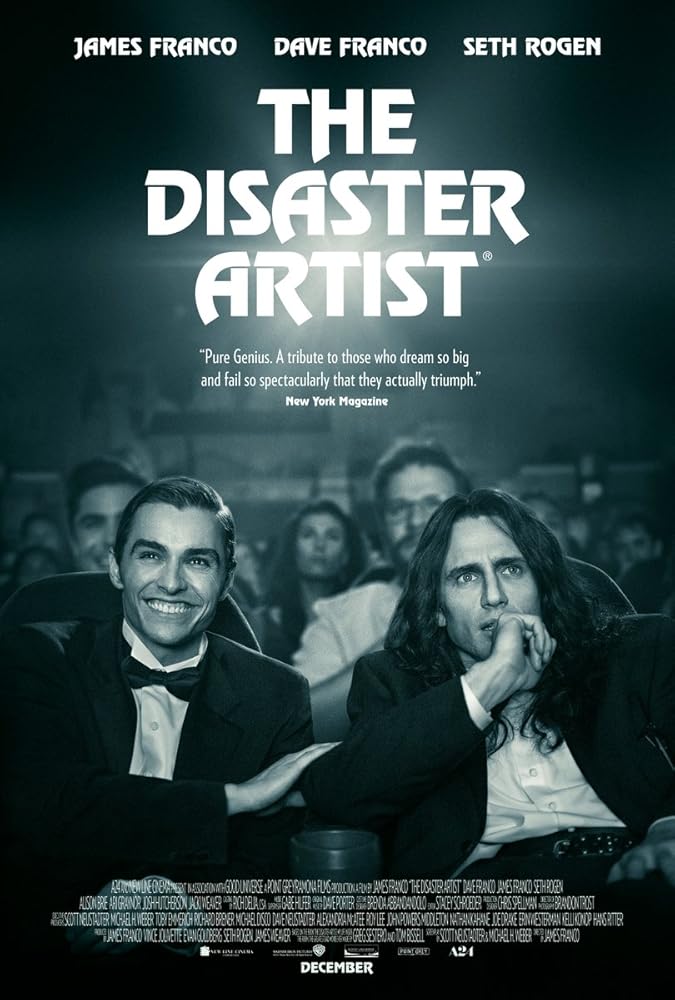
The Disaster Artist (2017) review


There have been plenty of films that have fallen into the ‘so bad, it’s good’ category, a term used to describe a film that many consider to be entertaining to watch while still acknowledging that it’s not that great of a film. And in 2003, one film ended up becoming arguably the most famous ‘so bad, it’s good’ film of all-time; I’m referring, of course, to The Room, a passion project from writer/director Tommy Wiseau who also starred in the film as the main protagonist Johnny. Upon its initial release, the film was brutally savaged by critics for its incoherent narrative and stilted acting, especially from Wiseau himself. However, in the years since, the film has gained a massive cult following because of all of its strange gaffes. This has mainly been thanks to its numerous midnight screenings in which audiences interact with it a la Rocky Horror Picture Show. But for the uninitiated, one question remains; how exactly did a film like this get made? Well, now we’re getting a firsthand look into all this madness with The Disaster Artist. The film is based primarily off the 2013 autobiography of the same name from Wiseau’s co-star/friend Greg Sestero, as we get to see how these two ended up forming one hell of a bizarre friendship that would end up spawning the film that would define both of their careers. As for the film itself, James Franco directs this look back into the production of the so-called ‘worst film ever made’ while also starring in it as the man, myth, and legend that is Tommy Wiseau alongside his brother Dave in the role of Sestero. What follows is an entertaining and all-around earnest tribute to one of the most notorious films that have ever been made.

In 1998, actor Greg Sestero (Dave Franco) dreams of making it big in Hollywood despite his often failed attempts at landing any major acting gigs. His life soon begins to change, however, when he meets a mysterious man named Tommy Wiseau (James Franco) at an acting class in San Francisco. Despite Greg learning little about Tommy’s background, the two of them begin to connect over their shared dreams of stardom to the point where Greg even moves in with Tommy at his apartment in Los Angeles. However, over the next few years, the two continue to struggle when it comes to finding any work. In response to this, Tommy suggests that they make their own film, an idea which culminates in him writing a screenplay for The Room. In light of several folks in the industry believing that he’s better-suited for villain roles, Tommy casts himself as the main protagonist Johnny. He then proceeds to offer the role of Mark, Johnny’s best friend, to Greg as the two begin to prepare to shoot the film that they hope will be the one to effectively launch their careers. However, as Greg and the rest of the cast and crew of The Room soon find out, Tommy proves to be an extremely abrasive director on set while also making an endless array of questionable filmmaking decisions. And as we all know, this ultimately resulted in a film that, whether they liked it or not, truly did go on to define all of their careers.

At the risk of making a comparison that I know several people have made already, The Disaster Artist is quite similar to Tim Burton’s 1994 biopic Ed Wood. Both films tell the stories of filmmakers who were responsible for what many consider to be some of the worst films ever made. And yet, despite this, they don’t outright demonize their main subject; instead, they celebrate their passion for filmmaking regardless of the quality of the films that they produced. Now, to be clear, this film fully acknowledges how bizarre of a person Tommy Wiseau is. For a film that is quite consistent with its humor, Wiseau’s eccentric lifestyle is where a lot of the film’s best humor comes from. Still, despite both this and the instances where we witness Tommy’s often callous on-set behavior, there are moments in the film where you do genuinely sympathize with him. To his credit, he did manage to get this film made against all odds and away from the studio system (even though it’s still unclear as to how the heck he managed to amass a $6 million budget for the production). Now, granted, I haven’t read The Disaster Artist prior to seeing this film; and from what I’ve heard from those who have read it, the film sort of glosses over some aspects of the production (e.g. some of the more extreme instances of Wiseau’s tyrannical on-set behavior). Still, despite the lack of certain moments from the book, the film still succeeds at being a heartfelt look into everything that went down during The Room’s production. And while it’s not a major focus of this film, the re-creations of classic moments from The Room (e.g. “You’re tearing me apart, Lisa!”) are damn near shot-for-shot.

The Disaster Artist is notably the first instance in which brothers James and Dave Franco have appeared together in a film, and the two do work well together on-screen as they very much succeed in capturing the strange but genuinely loyal friendship that Wiseau and Sestero have. As the film’s director, James Franco does a nice job of maintaining a solid tone throughout that perfectly mixes the film’s humorous moments with its more serious ones. And in the role of Tommy Wiseau, he does a fantastic job of conveying all of Wiseau’s odd behavioral traits; his laugh, his strange accent, etc. Meanwhile, Dave Franco also shines in the role of Greg, who serves as the audience avatar (the film is based on Sestero’s autobiography, after all) while also proving to be quite sympathetic when it comes to his own aspirations as an actor. And as we see in the film, these aspirations of his often affected his friendship with Tommy. Closing out the film’s lead trio is Seth Rogen as Sandy Schklair, the script supervisor (and alleged ‘real director’, but that’s another story…) of The Room. While Greg does often serve as the ‘straight man’ to Tommy’s shenanigans, Schklair serves that purpose in an even greater capacity during the production of The Room, where it’s clear that he was one of the more sensible crew members on set. In other words, this film gives Rogen one of the best ‘straight man’ roles of his career, which he handles excellently.

Now I’ll admit that when it comes to The Room, I wouldn’t really consider myself as being part of its cult fan base. To be clear, prior to seeing this film, I was well-aware of The Room and its wide array of oddities thanks to Doug Walker AKA the Nostalgia Critic’s famous review of it back in 2010. However, it wasn’t until recently when I finally saw the film for myself; and yes, the film is a comedic gold mine despite being such an incoherent mess. But the cool thing about The Disaster Artist is that even if you’re not too familiar with The Room, it’s still a highly appealing film that honors the cult following of its subject matter without relying solely on in-jokes that only fans of the film will recognize. At its core, the film is a heartfelt look into one filmmaker’s struggle to make it big in the film industry, and while it certainly addresses the fact that this filmmaker is a strange person who acted in an extremely oppressive manner during his film’s production, it doesn’t paint him in an entirely negative light. A lot of this is thanks to the strong direction from James Franco, who also does a fantastic job in the role of Tommy Wiseau alongside his brother Dave as Greg Sestero. In short, as noted in this film’s epilogue, when The Room was first released in 2003, Tommy Wiseau paid to have the film stay in theaters for at least two weeks so that it could qualify for that year’s Oscars ceremony. Obviously, it never even came close to that distinction, but now it may finally become a part of Oscars history thanks to The Disaster Artist, a film that many are touting as one of the best films of the year.  


Rating: 4.5/5

Monday, December 4, 2017

The Man Who Invented Christmas (2017) review


From time to time, there have been instances where we end up getting two different films that have identical premises released over the course of a single year. For example, in 1998, we got two films that were focused on asteroid-based doomsdays, Michael Bay’s Armageddon and Mimi Leder’s Deep Impact. That same year, Pixar and DreamWorks got into a huge feud over their closely similar insect-oriented films, with DreamWorks Animation’s Antz being released just one month prior to the release of Pixar’s A Bug’s Life. This year it seems like this trend has been applied to a pair of films that focus on the genesis of classic literary works. A few months back, there was the historical biopic Goodbye Christopher Robin, which focused on author A.A. Milne and the creation of his iconic book series, Winnie the Pooh. And now, just in time for the holiday season, we have The Man Who Invented Christmas, which delves into the backstory behind arguably the most famous Christmas story of all-time, Charles Dickens’ A Christmas Carol. Ever since its initial release in 1843, the story of the mean old miser Scrooge and his journey of self-transformation has become a staple of the holiday season; for one thing, it’s been adapted to both the big and small screen numerous times over the years. So with that in mind, what’s so different about this film then? Well, as noted earlier, it mainly delves into the events that led to author Charles Dickens creating this timeless tale, with the film itself being based off a 2008 novel of the same name by author Les Standiford. And under the solid direction of British director Bharat Nalluri, the film ends up being an enjoyable, albeit imperfect, take on this fascinating true story.

In 1843 London, England, author Charles Dickens (Dan Stevens) finds himself struggling with a severe case of writer’s block. To make matters worse, his last three books have been critical/commercial flops, thus making his publishers extremely wary about doing further business with him. This begins to put Charles in a serious case of financial debt right around the time when he learns that his wife Kate (Morfydd Clark) is pregnant with their fifth child. Eventually, though, he begins to come up with an idea for a new novel; upon witnessing his new maid Tara (Anna Murphy) recount a tale of ghostly spirits to his children, he begins to craft a story about a miserable miser who’s visited by three spirits on Christmas Eve. And, soon enough, he comes up with the name for his story’s cold-hearted main character, Ebenezer Scrooge. It even gets to the point where Scrooge (Christopher Plummer) and the other characters of the novel begin to come to life in Charles’ mind, as he proceeds to interact with them during the writing process. However, Charles soon finds himself under an immense amount of pressure to have the book independently published in just six weeks so that it’ll be out in time for Christmas. The stress of finishing the book even starts to have a negative impact on his relationships with his friends and family, especially when he struggles to figure out the perfect ending for it.

Admittedly, this review is going to be a short one because there’s not really that much to talk about when it comes to this film. Simply put, The Man Who Invented Christmas is a decently entertaining spin on the story of how Charles Dickens wrote A Christmas Carol. Instead of just being a standard retelling of how Dickens wrote what is arguably his most famous story, we also get to see how his personal life (namely his often troubled relationship with his father John (Jonathan Pryce)) served as a direct influence on Scrooge’s journey of redemption. In the process, the film even ends up doing its own take on A Christmas Carol; sure, we’ve already gotten plenty of takes on this story in the past, but the pairing of it with all the reveals that surround Dickens’ troubled past does, at least, give this version of the story a unique spin to it. Plus, the film is bolstered by a solid pair of performances from leads Dan Stevens and Christopher Plummer. As Dickens, Stevens elicits solid charisma that is effectively paired with the author’s more eccentric qualities, while Plummer excels at handling Scrooge’s classic redemption arc even though he technically isn’t the main character this time around. In short, while it’s far from perfect, The Man Who Invented Christmas is an interesting look into the making of an iconic holiday staple. And while the numerous adaptations of A Christmas Carol that have come before it may ultimately overshadow it in the long run, it’s still worth checking out just to see where it all began.


Rating: 3.5/5

Wednesday, November 29, 2017

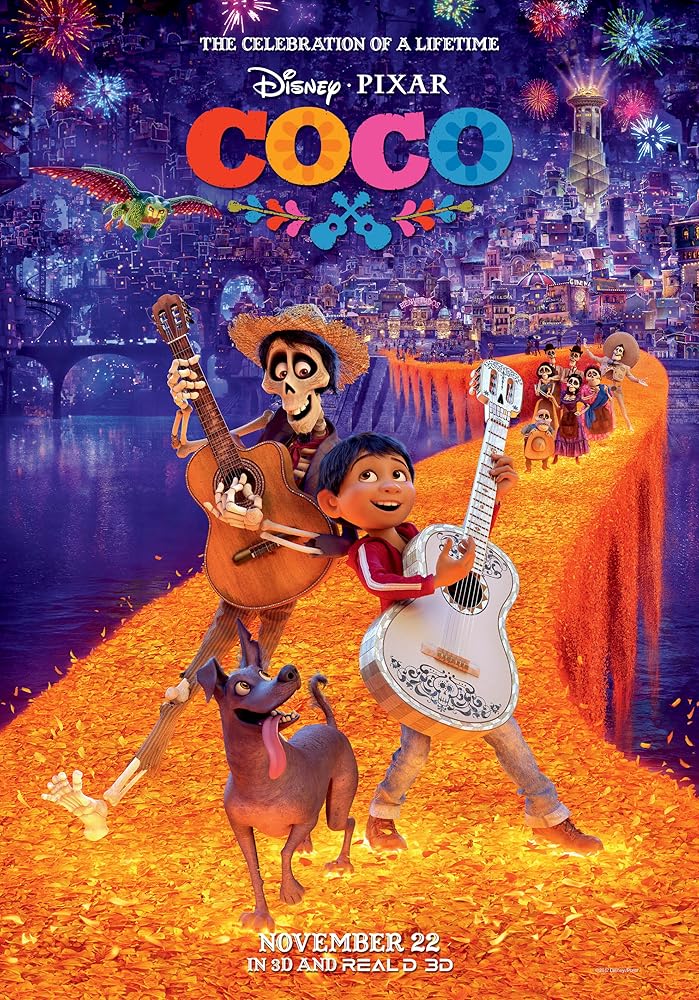
Coco (2017) review + Olaf's Frozen Adventure (2017) review


The time has come once again, folks, for the newest effort from the legendary animation studio, Pixar. Pixar, of course, needs no introduction. Since 1995, they’ve given us an endless array of animated masterpieces that have helped to make them pioneering forces in the art of computer animation, from the early classics like the Toy Story films and The Incredibles (which is finally getting a sequel next year) to recent gems like Up and Inside Out. And now, they’re back again with their second 2017 outing (after Cars 3 was released earlier this summer) in the form of Coco. With Coco, Pixar takes us on a fantastical journey inspired by the most famous Mexican holiday, Día de Muertos AKA the Day of the Dead, where families come together to honor their fallen loved ones. In the director’s chair for this one is Lee Unkrich, who’s been a mainstay at Pixar ever since they started producing their own feature films. Initially, he was an editor for films like Toy Story and A Bug’s Life before he started to work as a co-director on projects like Monsters Inc. and Finding Nemo. Then, in 2010, he finally got promoted to the role of lead director for the third installment of the Toy Story franchise, and to call Toy Story 3 a success would be a massive understatement. It grossed over $1 billion worldwide and was only the third animated film ever to be nominated for Best Picture at the Academy Awards, and while it didn’t end up winning that award, it did win the Oscar that year for Best Animated Feature. And as for his latest outing, Unkrich proceeds to give us yet another gorgeously animated and heartfelt Pixar adventure that treats its subject matter with the full respect that it deserves.

In a peaceful little Mexican village, a young boy named Miguel (Anthony Gonzalez) finds himself in a troubling situation over one of his family’s longtime traditions. While he yearns to become a musician like his idol, the late Ernesto de la Cruz (Benjamin Bratt), his family has regularly enforced a ban on music ever since Miguel’s great-great-grandfather left the family to embark on a musical career. Miguel’s passion for music is only fueled further, however, when an old family photo implicates that his great-great-grandfather was, in fact, Ernesto de la Cruz. Thus, on Día de Muertos, Miguel sneaks into the local mausoleum dedicated to de la Cruz and proceeds to take his guitar in the hopes of performing in a local talent contest. In the process, though, he ends up being transported to the Land of the Dead, where the deceased reside until they return to the land of the living every year on this day to visit their living relatives. While there, Miguel is reunited with all of his ancestors who must now try and get him back home before sunrise; otherwise, he would become a skeleton and be stuck in the Land of the Dead forever. But when his ancestors demand that he give up his dreams of becoming a musician as a condition of the return process, Miguel decides to try and find his great-great-grandfather so that he can return home without having to give up on his dream. And so, Miguel teams up with a charismatic con man named Hector (Gael Garcia Bernal), who allegedly knows de la Cruz, to find him in the hopes of proving to his family that this is who he’s meant to be.

Prior to this film’s release, it did attract some skepticism early on from those who were fearful of how Pixar would handle a story that was based on such an important aspect of Mexican culture, especially after an incident in 2015 in which Disney tried to trademark the phrase ‘Día de Los Muertos’. And, of course, there was a lot of tumultuous uproar made by those who accused the film of being a rip-off of the 2014 animated film The Book of Life, even though its director, Jorge R. Gutierrez, clearly denied this multiple times. Well, fear not, folks, as Pixar does treat this staple of Mexican tradition with the respect that it deserves. While Coco does focus a lot on Miguel trying to follow his dreams of becoming a musician, its plot is ultimately steeped in the one thing that the Day of the Dead celebrations are all about, and that is the importance of family. During his journey, there are several instances in which Miguel tries to distance himself from his family when they discourage him from being a musician. At the same time, though, Miguel also begins to realize how much his family truly means to him when he starts to learn the truth behind the events that caused them to carry out their ban on music in the first place. This paves the way for a great plot twist in the third act that further strengthens the emotional poignancy of the story. Yes, just like all the great Pixar films, this film is sure to hit you with the feels at certain points, especially near the end (don’t worry, no spoilers…). 

As for the animation… well, it’s Pixar, what do you expect? It’s bright, crisp, and colorful, and just like the plot itself, it utilizes its Mexican roots to their full effect, effectively giving us a great visual world to explore in its version of the ‘Land of the Dead’. The great animation also ties in well to another key element of this film, its music. Yes, Coco is quite arguably the first major musical that Pixar has ever done, and the music, written in part by Frozen songwriters Robert and Kristen-Anderson Lopez and backed by the usual great score by Michael Giacchino, is excellent. And of course, like any great Pixar film, it boasts an excellent cast of characters. They’re so solid, in fact, that because the story is so well-handled, even the characters that initially come off as being rather stern become more sympathetic once we get to know them better. This includes the likes of Miguel’s great-great-grandmother Imelda (Alanna Ulbach), who was the first to initiate their family’s music ban after her musician husband left her all those years ago, and Miguel’s grandmother Elena (Renee Victor), who continues to enforce it to this day. But, of course, it’s ultimately the lead duo of Miguel and Hector who are the true emotional core of the story. As the film’s likable young protagonist, newcomer Anthony Gonzalez shines in what will surely be a breakout role for him, while Gael Garcia Bernal gets to work with a great redemption arc that slowly but surely begins to reveal more of the charismatic Hector’s background.

I’ve talked before about the internet’s extremely severe attitude towards Pixar in recent years that has mainly come as a result of some of the strictest expectations that have ever been seen from the film fan community. This has especially been the case ever since 2011’s Cars 2 ended up being the first project of theirs to attract primarily negative reviews. And thus, nowadays, I find that the current internet mentality towards Pixar films is that if a film of theirs isn’t a straight-up masterpiece effort of storytelling, then it is effectively deemed as a ‘failure’. This has been a fate that has sadly affected perfectly decent films like Monsters University, The Good Dinosaur, and Brave, just to name a few. Thankfully, though, that has not been the case with Pixar’s latest outing, as Coco is being regarded by many as one of the studio’s best films yet. And quite frankly, it’s easy to see why, as the film is a heartfelt tribute to arguably the most famous holiday in Mexican culture. Not only does it handle the concept of death and the afterlife in a smart manner, but it also ties it all together perfectly with a poignant story that’s focused on the most important element of Día de Muertos, family. Add in a great cast of layered characters and a toe-tapping soundtrack of songs and you have what is easily one of the best animated films of the year, if not the best. Simply put, Pixar has done it again!  

Rating: 5/5!

OLAF’S FROZEN ADVENTURE – SHORT REVIEW


Now as many of you know, in lieu of the traditional Pixar short that plays before every new Pixar film, Coco was paired with a 21-minute featurette from Walt Disney Animation Studios, Olaf’s Frozen Adventure. This is the first time since 1990 (when The Prince and the Pauper ran in front of The Rescuers Down Under) that a short film of this length has been shown in front of a Disney film. And in this instance, it comes in the form of the continuing adventures of sisters Anna and Elsa and all of their friends from Disney’s 2013 global phenomenon, Frozen. In this new short, the lovable snowman Olaf (Josh Gad) embarks on a quest to find a new holiday tradition for Princess Anna (Kristen Bell) and Queen Elsa (Idina Menzel) when the latter realizes that, because of all the time that she’s spent secluded from society, she and Anna don’t really have a family tradition of their own. As for the short itself… well, if you’re one of those people who are 100% sick to death of ‘Frozen mania’ at this point, then clearly this isn’t going to do anything for you just like when Frozen Fever ran in front of the live-action remake of Cinderella back in 2015. For the record, I still think that Frozen Fever got way too much flak from the internet, but that’s another story at the moment because… damn! This new short is clearly turning out to be far more controversial compared to its immediate predecessor just because it was paired with Coco instead of airing on TV as was originally intended. It’s been so controversial, in fact, that Mexican theaters straight-up pulled it in favor of just showing Coco. And to be perfectly frank, it isn’t doing much better here in the states…

But for those who still love the original film and its endearing cast of characters, then I’m pleased to say that this new short will provide you with even more great moments with them that will hopefully hold you over until the release of the impending sequel in 2019. Now, granted, that doesn’t mean that I think that this is as good as the original film. I do agree with a common argument that’s being brought up in that it sort of rushes through its track list of songs (which, for the record, weren’t done by Robert and Kristen-Anderson Lopez this time around). Still, the characters are just as lovable as ever and while the songs in this short probably won’t become as popular as the ones from the original film, the final song ‘When We’re Together’ is an undeniably sweet melody. Plus, I won’t lie… the ending is so damn heartwarming in terms of its ultimate resolution, and it serves as yet another perfect representation of the heartfelt narratives that have made up this entire franchise. In short, those who are absolutely dreading the thought of having to sit through this new entry in the Frozen franchise shouldn’t fret too much about it, because from what I’ve heard, this is only going to be running in front of Coco for a limited time. So if you’re this upset about it, just wait a while before you go to see Coco… it’s that easy. But in all seriousness, Olaf’s Frozen Adventure isn’t even remotely as bad as the internet is currently putting it out to be. I mean, really, is it ‘that’ hard to just sit through a 21-minute short film?

Rating: 4/5

UPDATE: It has just been recently announced that Olaf's Frozen Adventure will be pulled from theaters starting on December 8th, presumably in the wake of all of the backlash that it has received from audiences ever since it debuted in front of Coco. And yet, I still don't think that it's as bad as the internet says it is. I mean, seriously, I've seen several online articles recently that have accused the short of being 'offensive' to Pixar fans and for harming the reputation of Coco by overshadowing it. Well, I'm a Pixar fan... and yet I can safely say that I wasn't the least bit 'offended' by this short. Heck, if you ask me, this whole backlash towards an innocent holiday short is far more harmful to Coco's reputation than the short itself. Why? Because THAT, folks, is how Pixar's latest masterpiece is being overshadowed; not directly by the short that precedes it, but because people are truly making a mountain out of a molehill. Once again, I must ask; is it really THAT hard to sit through a 21-minute short that precedes an animated film that's just under two hours?

Monday, November 20, 2017

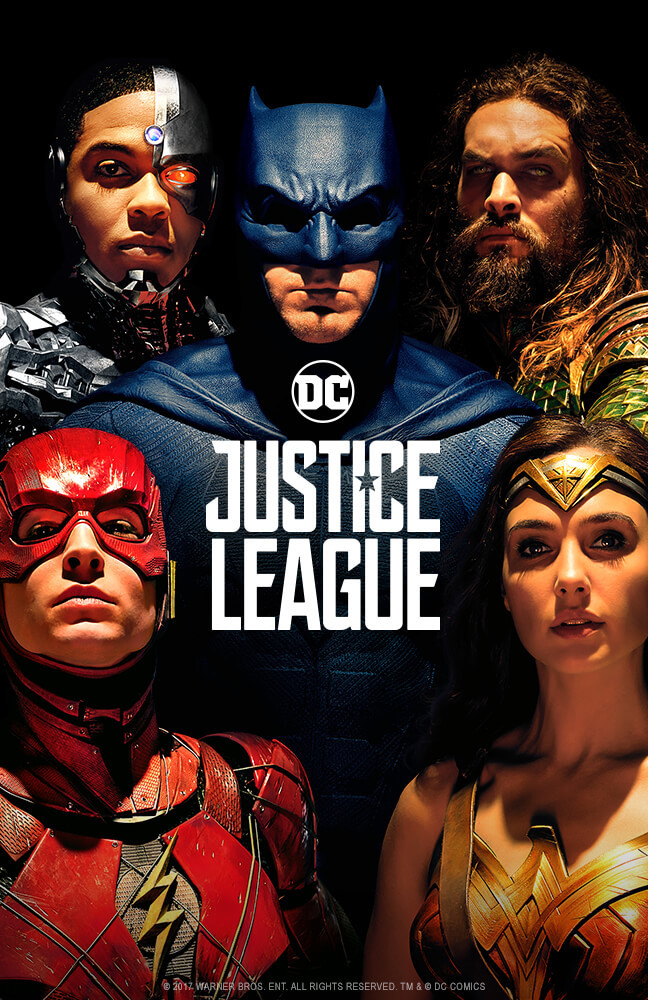
Justice League (2017) review


For the past decade, Marvel Studios has dominated the superhero film genre thanks to the Marvel Cinematic Universe, which was an unprecedented success story as nothing like it had ever been done before in the context of live-action films. After starting out strong with a series of solo outings that slowly but surely began to lay down the foundation for a larger universe, the MCU truly hit it big in 2012 when it brought all of its main heroes together in what ultimately became one of the landmark entries of the genre, The Avengers. But while the Avengers have undoubtedly become one of the most famous squads in the world of film, there is another superhero team that is arguably more iconic than them. I’m, of course, referring to DC Comics’ own legendary superhero group, the Justice League. Ever since the group’s initial creation in 1960 as a revamp of DC’s Justice Society of America, the Justice League, made up of several of the company’s most legendary heroes including the Holy Trinity of Superman, Batman, and Wonder Woman, has become a staple of the DC universe. Aside from their various runs in the comics, the team has also left its mark on other facets of pop culture, including several video games (e.g. the Injustice fighting games) and a bunch of hit TV shows, most notably the Justice League cartoons from the early 2000’s that were created by the team behind the iconic Batman: The Animated Series. And now almost six decades after their initial comic debut, the Justice League has finally hit the big-screen in DC’s highly-anticipated crossover event.

However, the journey that this film has gone on to make it to this point has been rather rocky, to say the least. A full decade prior to its release, a different iteration of Justice League was in the works under the direction of Mad Max creator George Miller. Ultimately, though, this version ended up falling by the wayside due in large part to the 2007-08 Writers’ Strike. It wouldn’t be until after Warner Bros and DC managed to successfully resurrect the Superman franchise in 2013 with Zack Snyder’s Man of Steel that the idea of a Justice League film was once again put into motion. And thus, the DC Extended Universe, DC and Warner Bros.’ answer to the MCU, was born; but again, things haven’t exactly gone smoothly for this franchise since its inception. While both Man of Steel and its 2016 follow-up Batman v. Superman: Dawn of Justice (which introduced Ben Affleck’s rendition of the titular Dark Knight) did perform solidly at the box-office, they also yielded an extremely polarizing response from both critics and audiences. Simply put, these films have had as many extremely devoted fans as they’ve had their extremely vocal critics. Thankfully, though, the franchise did manage to rebound a bit this year thanks to the long-awaited solo outing for DC’s legendary heroine, Wonder Woman, a well-deserved success story for everyone involved on that production, especially director Patty Jenkins and lead actress Gal Gadot. But now we turn our attention to director Zack Snyder’s third entry in the DCEU, Justice League, which… is once again proving to be quite controversial amongst critics. And to be perfectly blunt… this time I can see exactly where they’re coming from when it comes to this film’s biggest issues.

At the end of Batman v. Superman, Bruce Wayne AKA the Gotham City vigilante Batman (Ben Affleck) saw his faith in humanity restored following the noble sacrifice of his ‘nemesis’ turned ally Superman (Henry Cavill) against the monstrous creature known as Doomsday. Despite this, however, the world finds itself plunging into greater chaos following Superman’s death, effectively leaving it open for an invasion by the god-like being known as Steppenwolf (portrayed by Ciaran Hinds via motion-capture). Backed by his army of extraterrestrial creatures known as Parademons, Steppenwolf seeks to reclaim the three mysterious devices hidden on Earth known as ‘Mother Boxes’ that grant unparalleled power to those that use them. To deal with the invasion, Bruce and Diana Prince AKA the Amazonian warrior Wonder Woman (Gal Gadot) begin to recruit those who are just like them (referred to in the DC universe as ‘metahumans’) in order to form a team that’s powerful enough to take on Steppenwolf and his army in light of Superman’s absence. In the process, the two end up recruiting Arthur Curry AKA Aquaman, the ruler of the undersea kingdom of Atlantis (Jason Momoa), college student Barry Allen AKA the speedster known as ‘the Flash’ (Ezra Miller), and Victor Stone (Ray Fisher), a former football star who was turned into a cyborg after a near-fatal car accident.

Simply put, when this film focuses on what audiences came to see (namely, the Justice League in action), it does deliver on that front. There are tons of great character moments here and there to satisfy the DC Comics faithful who have been waiting to see these characters together onscreen for years. However... that doesn’t mean that this film is devoid of some major flaws. For one thing, it’s all over the place when it comes to its tone. This aspect of the DCEU has been a primary source of contention amongst critics as both Man of Steel and Batman v. Superman were heavily criticized for being too dour. Thankfully with this film, an attempt was at least made for it to be more light-hearted compared to its predecessors; and yet, despite this, its attempts at humor are hit and miss at best. It also tries to balance said humor with some of the more serious aspects of the plot, something that it doesn’t necessarily succeed at doing. Overall, it seems as if a lot of this film’s tonal issues were a direct result of the biggest moment that occurred during its production, when Snyder was forced to step away from the film due to the death of his daughter and Joss Whedon (who, of course, is no stranger to this genre) was brought in to oversee rewrites and reshoots. However, while watching this film, it becomes abundantly clear that Whedon was forcibly rushed when it came to the process of finishing it, resulting in not only those aforementioned tonal issues but also some dodgy CGI as well (e.g. the now-infamous attempts that were made to digitally remove the mustache that Henry Cavill had grown prior to reshoots that he had to keep for the upcoming Mission Impossible 6).

Among other things, this film is primarily tasked with serving as the proper ‘introduction’ of three new main characters to the DCEU; Flash, Aquaman, and Cyborg. Although the three of them had already technically been introduced in Batman v Superman via a series of brief cameos, this film serves as the first instance where they were each given a lead role. And overall, the film does do a decent job of establishing the DCEU’s iterations of these classic characters, as each main protagonist (both new and returning) does manage to get his or her own standout moment. Despite what I said before about the film’s humor being rather spotty, Ezra Miller’s Flash does get a lot of the best lines in the film as the inexperienced rookie who’s brought in to help deal with a daunting ‘save the world’ scenario. As for Aquaman, while it seems like a lot of his character development is being saved for his upcoming solo film next year, Jason Momoa does, at least, make a good first impression as DC’s often mocked aquatic-based superhero. Finally, with Cyborg, Ray Fisher does a good job of conveying the character’s inner turmoil given his tragic backstory. As for the returning heroes, both Gal Gadot and Ben Affleck are solid once again as Wonder Woman and Batman, respectively. Gadot continues to shine as the DCEU’s best protagonist, even amidst all of this film’s shortcomings, and Affleck still stands strong as the DCEU’s grizzled interpretation of the Dark Knight. And for those who weren’t too big on how Batman was portrayed in BvS, namely via his tendency to kill bad guys, you’ll be pleased to know that they do dial back on that characterization here.

Now, at the risk of delving into spoiler territory (though, really, everyone basically knew this already going in)… yes, Superman returns in this film after the character’s death in BvS. I won’t be getting into the exact specifics of how he’s brought back but I will say that, with this film, Henry Cavill has thankfully been given the chance to, shall we say, ‘act’ like Superman. Granted, I did think that he did a solid job in the previous two films that he appeared in but, at the same time, those films didn’t exactly give him the best material to work with, either. With Justice League, though, we finally get a Superman reminiscent of Christopher Reeve’s iconic iteration of the character from the original Superman films. But while all of the main leads get a solid amount of material to work with in this film, the same can’t be said for its supporting characters as they are all basically limited to ‘cameo’ appearances a la Flash, Aquaman, and Cyborg in BvS. This applies to not only returning DCEU players like Amy Adams as Lois Lane and Connie Nielsen as Diana’s mother Queen Hippolyta but also newcomers like Mera, Queen of Atlantis (Amber Heard), and J.K. Simmons’ version of Commissioner Jim Gordon, characters that are clearly being intended to have more substantial roles in future films. And as for the main villain, Steppenwolf… he’s practically a non-existent threat. Despite Ciaran Hinds’ best efforts in the role, the character gets nothing of value to work with here; no backstory, no sense of what he’s trying to accomplish, no indication of his relationship to another famous DC comics antagonist (and future big bad of the DCEU) Darkseid, etc.  In other words, he’s one of the genre’s weakest villains ever.

So before any of the hardcore DCEU fans out there get on my case because of what I’ve said in this review, let me be perfectly clear; I didn’t outright ‘dislike’ Justice League. As I said before, when it focuses on its titular squad of superheroes, it does lead to some great character moments between them. At the same time, though, the overall execution is quite sloppy. While I do appreciate the efforts that were made by Zack Snyder and company to avoid delving into the dour tone that many felt plagued Batman v Superman, the film still suffers from having a rather inconsistent tone. And while the main leads are all solid in their respective roles, the plot is basic, the humor is hit or miss, and the main villain is pathetically weak. In short, a lot of this feels rushed, which arguably isn’t that surprising seeing how this came out only one year after Batman v Superman. And while both Snyder and Joss Whedon tried their best to fix some of the most glaring issues that people have had with previous DCEU installments (save for Wonder Woman), it just wasn’t enough to overcome the immense time crunch that they were both clearly under. With that said, though, if you’re a long-time fan of DC and these characters, I bet that you’ll probably be satisfied with this long-awaited live-action adaptation of arguably the most famous superhero team in all of pop culture… who, quite frankly, deserved a hell of a lot better than what is practically the DC equivalent of Fan4stic. I wish I was kidding about that comparison, but I’m not; granted, it’s nowhere near as bad as Fan4stic, but it too is a case of a studio trying to salvage a reportedly disastrous cut of their tent-pole release only to make things worse in the process.


Rating: 2.5/5 (So yeah, my streak of giving every major superhero film this year a 5/5 rating officially ends here. Still, despite my issues with Justice League, this has been one of the genre’s greatest years ever, which is something that will certainly be emphasized in my impending ‘Best Films of the Year’ list. But as for this film… well, as much as I hate to say it, it is most likely going to end up appearing on… the other list…)

Wednesday, November 15, 2017

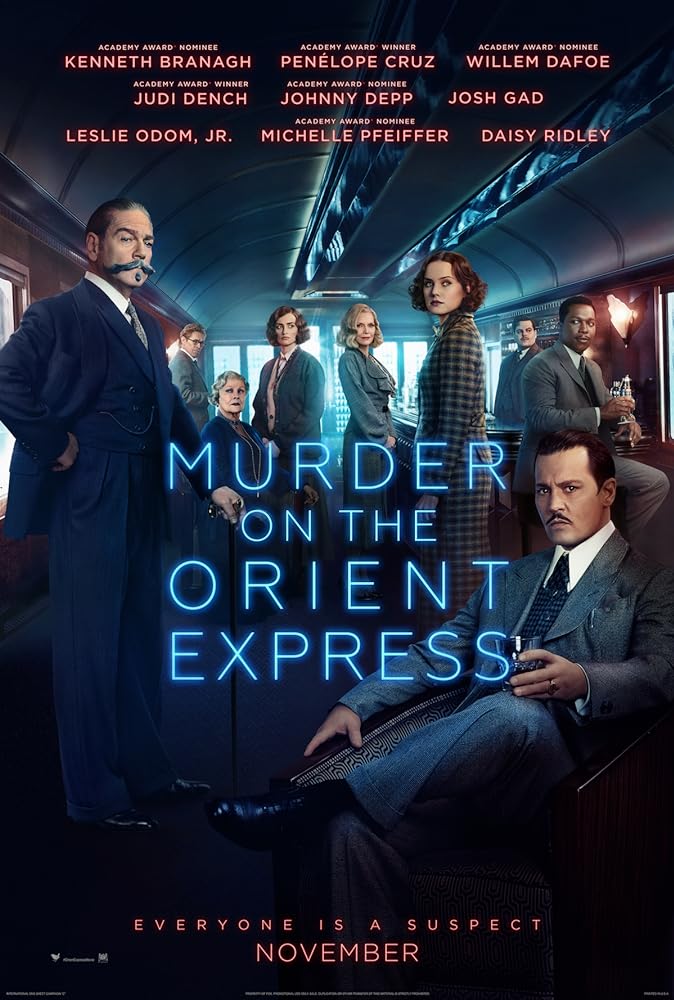
Murder on the Orient Express (2017) review


When it comes to some of the most famous authors of all time, Agatha Christie is undoubtedly one of the most legendary in that field. Over the span of several decades, the late English author was well-known for writing several classic mystery stories, so much so that she currently holds the record as the best-selling novelist of all time with over 2 billion copies of her work sold. And in her first novel, 1920’s The Mysterious Affair at Styles, readers were introduced to arguably her most famous creation, the Belgian detective known as Hercule Poirot. Poirot went on to appear in 33 of Christie’s novels, her 1930 play Black Coffee, and over 50 of her short stories. But as for the most famous story that he ever appeared in, that honor goes to Christie’s 1934 novel Murder on the Orient Express, in which the detective with the well-groomed mustache found himself dealing with, as the title suggests, a murder mystery onboard the titular Orient Express. This particular Christie story has already been adapted to the screen several times over the years, including a star-studded 1974 film adaptation directed by Sidney Lumet and an episode of the long-running British TV series Agatha Christie’s Poirot. But now Poirot is back on the big-screen once again in a brand new take on this iconic story, with Sir Kenneth Branagh taking on the role of the legendary detective. He also serves as the director of this new film which, like the 1974 adaptation, also features a star-studded cast. And overall, despite some of its shortcomings, this new version of Murder on the Orient Express does manage to be a solid adaptation of its source material.

As the film begins, we are introduced to the man himself, Hercule Poirot (Kenneth Branagh), the most famous detective in the world. The year is 1933 and despite Poirot’s plans to go on holiday after his most recent case in Jerusalem, he receives a telegram demanding that he return to London to take on a new case. To get there, Poirot’s friend Bouc (Tom Bateman) offers him a compartment on the luxurious Orient Express, which Bouc has just been appointed the director of. Whilst onboard, Poirot is joined by an eclectic group of passengers, including young governess Mary Debenham (Daisy Ridley), American socialite Caroline Hubbard (Michelle Pfeiffer), and immoral businessman Samuel Ratchett (Johnny Depp). Ratchett ends up approaching Poirot and asks him to be his bodyguard as he fears that he’s in danger. Poirot refuses but, soon enough, Ratchett is found dead in his cabin from several stab wounds. When the Orient Express is forced to make an unscheduled pit stop due to an avalanche, Poirot quickly begins to investigate the cause of Ratchett’s death. Deducing that one of their fellow passengers was responsible for the crime, Poirot works tirelessly in order to figure out which one of them is the murderer. And as he soon finds out, this case ends up having some noticeable connections to a highly public kidnapping/murder case that had occurred a few years back.

Now, just a quick disclaimer; at the time that I’m writing this, I have not read the original Murder on the Orient Express novel. I also haven’t watched any of the previous adaptations of this story, which of course includes the last major feature film adaptation from 1974. And from what I’ve read online, comparisons between this film and its various predecessors have been quite common. Thus, given what I just said about my general unfamiliarity with the source material, unfortunately, I can’t really add much to that discussion. What I will say, though, is that Branagh does do a good job in making this film an engaging murder mystery, and because I didn’t really know anything about the plot before seeing it, it allowed me to go into the film without already knowing the final outcome. With that in mind, however, I am aware that some have been rather mixed on the ending, not because it changes anything (from what I’ve read, it seems like Branagh stayed generally faithful to the source material) but more in the case of how Branagh handles it as director. Some have felt that the ending diminishes the impact of the final reveal by way of how Poirot ultimately responds to it. And despite this being my first major experience with this classic murder mystery story, I will admit that I did find that the ending didn’t quite have the impact that it wanted to leave on the audience. Still, at the very least, the build-up to the final reveal is well-handled and the film is well-made on a technical level, benefitting especially from some great cinematography from Branagh regular Haris Zambarloukos that was shot on 65 mm film a la Dunkirk.

As noted earlier, the 1974 adaptation of Murder on the Orient Express featured an all-star cast that included the likes of Albert Finney in the role of Poirot, Lauren Bacall, John Gielgud, and Sean Connery just to name a few. The same applies to this new version as well, with names like Penelope Cruz, Willem Dafoe, Josh Gad, Judi Dench, and Johnny Depp… and again, that’s just to name a few. And, of course, Kenneth Branagh not only directs the film but stars in it as well as the one and only Hercule Poirot. Branagh does a great job in the role, excellently conveying both Poirot’s wisdom and eccentric nature, two traits that very much help him when it comes to solving cases. As for the rest of the cast, they’re all great as well but they admittedly don’t have as much to work with compared to Branagh. Now, to be fair, it can be argued that this is just a consequence of being a story in which there are 12 primary suspects. Still, aside from a select few like Gad and Ridley’s characters, most of their roles in the film are basically just limited to one or two major scenes that they share with Poirot, who interrogates them all one at a time. Ultimately, though, if I had to pick the biggest standouts of the supporting cast, that would include Michelle Pfeiffer as the headstrong Mrs. Hubbard, Judi Dench as the pushy Princess Dragomiroff, and Leslie Odom Jr. as the often put-upon Dr. Arbuthnot.

So as I’ve made it clear, this film basically served as my introduction to Agatha Christie’s Murder on the Orient Express. As such, I can’t really say much about how this version of the story compares to other adaptations of it because simply put, I haven’t seen any of them. With that said, though, I am aware that some have been critical of this adaptation for not really doing anything new with the source material. And, of course, some have also taken issue with the ending, which I’ll admit is an argument that I do sort of agree with in terms of how it kind of lessens the final resolution of the main conflict. Still, for the most part, I found this to be a solidly made mystery thriller. While the plot does maintain a ‘slow burn’ style of pacing throughout, there is never a dull moment in this film. And like many of Branagh’s films (e.g. his remake of Cinderella and the first Thor film), this film does benefit from some solid production value, namely in regards to the cinematography, and an excellent ensemble cast. In short, if you’re like me and you’re not too familiar with the original source material going in, at the very least this film serves as a nice way of introducing newcomers to Christie’s work. And given that the film ends with a nod to another Poirot story, the potential is there for a sequel or two adapting other classic Christie novels. But if you are familiar with this story and the previous adaptations of it, this adaptation may seem a bit more questionable given everything that’s come before it. Overall, though, this film does succeed when it comes to being an entertaining popcorn flick that’s worth checking out on the big screen.


Rating: 4/5