(Disclaimer: Save for a brief spoiler section at the very end of the review, this post does not contain any major spoilers regarding anything that happens during this season.)
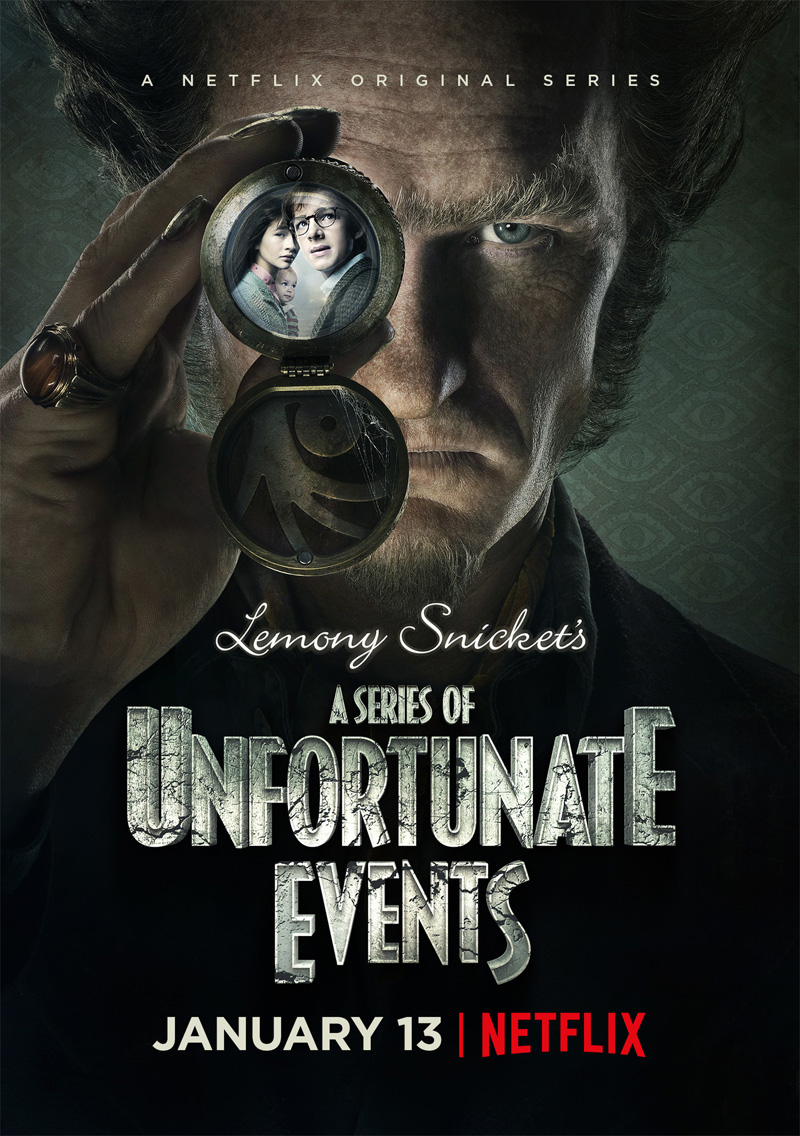
There are plenty of kids’ shows on the streaming service Netflix that can provide kids with fun and exciting content to watch. For example, there’s the Guillermo Del Toro-produced show Trollhunters or the show from DreamWorks’ How to Train Your Dragon franchise. The following ‘family-friendly’ TV show, however, does not contain fun and exciting content. It is a series about a bunch of children who are subjected to all sorts of terrible and, in some cases, even deadly incidents as they’re pursued by a wicked man who looks to steal their money. Hehe, okay, again, I’m not going to do the whole ‘Lemony Snicket’-style narration for the whole review. It’s just that this gives me a fun way to open these posts. Yes, A Series of Unfortunate Events sees new light in the form of being the latest Netflix original series. This is the second live-action adaptation of author Daniel Handler’s (AKA Lemony Snicket) highly successful book series, following the 2004 film adaptation starring Jim Carrey as Count Olaf. And while I’ve argued that the film is a highly-underrated adaptation that’s hindered from being a forgotten relic of the era of Harry Potter-esque films, it ultimately never got a sequel, namely just because it took too long to make. But, now, we have a new version supervised by Barry Sonnenfeld, who was an executive producer on the original film and was apparently set to direct initially before backing out for unknown reasons, along with Handler himself, who wrote the teleplays for most of the episodes in this first season, which consists of eight episodes overall. And while the show’s theme song (sung by series star Neil Patrick Harris) may warn you to ‘look away, look away’, this new adaptation of the popular series is a charming and highly enjoyable watch that does manage to outdo its predecessor in quite a few areas.
There’s really no need to go into the story that much seeing how I already went over it in my review of the 2004 film. It’s the same scenario; the three Baudelaire children (inventing prodigy Violet (Malina Weissman), well-spoken, avid book reader Klaus (Louis Hynes), and their infant sister Sunny (Presley Smith, with vocals provided by Tara Strong)) learn that their parents have died in a fire. Their parents’ kind-hearted but oblivious banker, Mr. Poe (K. Todd Freeman), puts them in the care of their ‘closest relative’ (though in this case, the term is used loosely), actor and theatre troupe leader Count Olaf (Neil Patrick Harris), who is really looking to steal their massive fortune, which they will inherit when Violet comes of age. And even after they manage to ‘get away’ from him and are placed in the care of other guardians, Olaf keeps coming back with new villainous schemes and disguises that only seem to fool the adults. Being that this is basically a ‘reboot’ of the franchise, it starts out with the same three stories that the film covered; The Bad Beginning, The Reptile Room, and The Wide Window. However, unlike the film, it also includes a story that hasn’t been done in live-action before; The Miserable Mill. Thus, thanks to this new show, there’s a considerably high possibility that we will finally be able to have a ‘complete’ adaptation of the books in live-action. And because this show doesn’t have the constraints of having to cover multiple books in a short amount of time like the film had to do, it allows for more faithful adaptations of the books, with each entry getting two episodes a piece. Yeah, after I posted my review of the film, I realized that it probably wasn’t as ‘faithful’ as I claimed it was due to it having to condense the events of three books into one film. I still think that the film did do a decent job of retelling the main story under these conditions but, by comparison, the show does get more to work with.
There are still some new additions to the plot here and there but they do fit naturally into the series’ lore. This includes scenes where members of the secret organization V.F.D. try to help the Baudelaires, while usually finding themselves ‘held captive’ by Olaf and his henchmen, and a scene which explains a question that I bet a lot of us have been wondering for years; why did the Baudelaires end up under Count Olaf’s care in the first place? The answer, to put it simply, is one that is both hilarious and, at the same time, makes a lot of sense given how negligent most of the adults in this series tend to be. There is even an added ‘plotline’ which involves two characters played by Cobie Smulders and Will Arnett trying to escape various perilous predicaments (that mainly occur during the final few moments of each episode) to get back to their home. Without giving the full extent of this ‘plotline’ away, at first this seemed like a major deviation from the books, one that I feel would’ve gone against the entire premise of the series had it been the case. But, by the end of the season, it turns out to be a major bait-and-switch that, whether you like it or not, is very much in line with the overall tone of the series (I’ll talk about this more in the ‘spoiler section’). And like the film, the TV series does a phenomenal job in terms of capturing the spirit and visual style of the books. Despite the obvious fact that this is a series in which the main characters are constantly subjected to many terrible things, there’s quite a lot of humor in this show, whether it’s due to the many examples in which the adults are shown to be completely oblivious to everything that’s going on or the comedic banter of the main villains. The production/set design perfectly captures the gothic and, in some cases, retro nature of the story, something that the 2004 film did an excellent job of as well.

Neil Patrick Harris is our new Count Olaf. I’m not going to make any major comparisons between him and Jim Carrey but I will say that Harris does do a phenomenal job in the role. He’s hilarious but, at the same time, is much more toned down compared to Carrey, which I’m sure is much more in line with how the character is portrayed in the books. It’s also a nice ‘against-type’ performance for Harris seeing how he usually doesn’t do villain roles. The series also allows for greater amounts of screen-time for Olaf’s henchmen, whereas in the film, the henchmen were downplayed in favor of Olaf, despite being played by some very recognizable stars like Craig Ferguson and Luis Guzman. Of the group, Usman Ally is a major standout as the hook-handed man, though the other henchmen cast members do have their great moments as well. Patrick Warburton stars in the role of Lemony Snicket, who of course narrates the proceedings, sometimes even popping up in a scene completely unnoticed by everyone else. Not only does he do a great job of providing the series with Snicket’s trademark narration (we are talking about one of the best voice actors in the industry) but he also does it in a way that effectively captures the sadness that is always conveyed by the character given his ‘connection’ to the whole story (e.g. his beloved ‘Beatrice’). Like the 2004 film, there are also plenty of major guest stars featured in supporting roles; Aasif Mandvi as Uncle Monty, Alfre Woodard as Aunt Josephine, Joan Cusack as Justice Strauss, Catherine O’Hara (who played Justice Strauss in the 2004 film) as the villainous optometrist Dr. Orwell (who, in this series, is set up as Olaf’s ex-girlfriend which, if you ask me, is perfect), and Don Johnson as Lucky Smells Lumbermill owner Sir, just to name a few. And through it all, just like the film, the Baudelaire orphans are just as endearing as ever. Malina Weissman and Louis Hynes do excellent jobs as Violet and Klaus, respectively, and I also appreciate the fact that they kept a good amount of the edge that came from Sunny’s translated baby-talk, something that was utilized a lot in the film. Because, after all, while Sunny may be a baby and, as such, can only speak in baby gibberish, she’s very much aware of what’s going on. Heck, she straight up tells Mr. Poe that he’s an embarrassment to his profession; probably one of the most hilarious moments in the entire series.
As I noted a few weeks ago, I am a huge fan of the original A Series of Unfortunate Events film. Yes, the fact that I grew up with it is one of the main reasons why but I still feel that, despite some of its flaws, the film is a solidly entertaining adaptation of the books. However, I will also say that I’m happy that this new TV series exists because it could finally mean that we will have a full ‘screen adaptation’ of the story of the Baudelaires. And while I initially tried not to make too many comparisons between the two adaptations in this review, especially when compared to other reviews of the show, I’ll admit that there are quite a few things that this does better than the film; namely, the fact that the TV series format allows for a more thorough adaptation of the books instead of having to cram three books into one film. If I had to pick a favorite episode out of the bunch and, for the record, I’m referring to the pairs of episodes that make up each of the books adapted in this season instead of just one, it’d be a toss-up between The Bad Beginning and The Reptile Room. Ultimately, though, all eight episodes are highly enjoyable to watch thanks to their lovely production design and an excellent ensemble highlighted by Neil Patrick Harris’ unforgettable turn as Count Olaf. But again, hopefully, this won’t be a case like last time where it takes too long for Season 2 to get made and they decide to can it like they did the film sequel. Because the final episode of the season concludes by going directly into the beginning of the events that took place in the fifth book, The Austere Academy. The potential to go on is very much there. Thankfully, it’s recently been confirmed by Daniel Handler that the show has been renewed for a second season. This next season will consist of 10 episodes which adapt books 5 through 9 and will hopefully be followed by a third season that covers the last four books.
Season 1 Rating: 4.5/5
DISCLAIMER: The following is a brief ‘Spoiler Section’ regarding the new ‘plot-line’ added in for this season. If you haven’t seen this series in full yet, don’t read on any further.
So, as I noted before, most episodes this season end with a sequence involving two characters, played by Cobie Smulders and Will Arnett, as they try and get out of various predicaments (e.g. getting stuck in Peru, having to fight off a bunch of goons at a bar, etc.) so that they can return to their children. With that in mind, initially, it’s assumed that these are the Baudelaires’ parents, implicating that they didn’t die in the fire that destroyed their home. And like I said before, I feel that this would’ve been a major betrayal of the story had this been the route that the show was going to take. Because, after all, it kind of defeats the purpose of having the Baudelaires go through all the crap that they endure if we know that their parents are still alive. Not only that, but fans of the series are aware that the main connection that ties Lemony Snicket to the story is the fact that he used to be an old flame of the Baudelaires’ mother, hence why each book (and, therefore, first episode of each of the show’s two-parters) opens with a dedication to Beatrice. Granted, maybe that should’ve been a dead give-away as to how this all plays out but, still, at first it seemed like these were the Baudelaire parents. And I won’t lie, this kind of hindered my overall enjoyment of the show during the first half of the season. But, at the end of the first half of The Miserable Mill, it’s revealed that this was all building up to a major fake-out. We see the Baudelaires head over to the ‘visiting area’ of the Lumbermill when told that they have visitors. During this time, we see the two parents arrive at a door resembling the one in the mill’s visiting area, implying that the Baudelaires are about to reunite with their parents. But, it’s instead revealed that the two are the parents of the Quagmire triplets; Isadora, Duncan, and Quigley, who become major allies of the Baudelaires in future installments. The real ‘visitors’ that the Baudelaires were notified of are Dr. Orwell and Count Olaf, the latter of whom is disguised as Orwell’s new receptionist Shirley, who give Klaus a new pair of glasses that put him into a hypnotic trance. Yeah, it’s arguably kind of a major buzzkill in regards to it not resulting in a happy ending for the Baudelaires but this is A Series of Unfortunate Events, after all. And as the first season concludes, we see that the Baudelaire and Quagmire children are about to cross paths as it’s shown that two of the latter family are heading to the same boarding school as the Baudelaires after experiencing the same exact tragedy of having a fire destroy their home.

