Showing posts with label Jack Black. Show all posts

Tuesday, March 26, 2024

Kung Fu Panda 4 (2024) review

In 2008, DreamWorks Animation released two films. One of these was a sequel to the studio’s 2005 hit Madagascar, Madagascar: Escape 2 Africa. As for the other, it would be the studio’s original project for that year; a martial arts comedy titled Kung Fu Panda. Starring Jack Black as the titular panda, Po, the film followed this avid kung-fu fanatic who, despite zero training, is chosen to be the ‘Dragon Warrior’, a kung-fu master who’s destined to save his home, the Valley of Peace, from evildoers. The original Kung Fu Panda is very much one of the prime examples of the classic adage ‘don’t judge a book by its cover’. In the months leading up to its release, it’s safe to assume that most people probably saw it as nothing more than a joke, especially with a title as admittedly goofy as Kung Fu Panda. It also didn’t help that, around this time, DreamWorks Animation had garnered something of a reputation for their reliance on pop cultural references, which dominated a lot of their work and arguably had an impact on their overall reception when compared to some of their industry rivals such as Pixar. As such, it’s safe to say that a film and premise like Kung Fu Panda didn’t seem like it was going to change anyone’s mind when it came to what a DreamWorks film could be. But, when the film finally came out, both critics and audiences were genuinely taken by surprise as Kung Fu Panda proved to be an incredibly well-crafted animated film with spectacularly choreographed action sequences, mature storytelling, and above all, an undeniable sense of respect for the Chinese culture that inspired it.

This, as a result, gave DreamWorks its latest hit franchise as the film would go on to spawn several spin-offs. On the big screen, the adventures of Po the Dragon Warrior would continue in 2011’s Kung Fu Panda 2 and 2016’s Kung Fu Panda 3. Both films managed to match the original in terms of both critical and commercial success while also achieving some historical significance for their director, Jennifer Yuh Nelson, who was the original film’s head of story and became the first solo female director of a mainstream animated film with Kung Fu Panda 2. That film would go on to become the highest-grossing animated film solely directed by a woman, and while she did have a co-director in fellow DreamWorks mainstay Alessandro Carloni for Kung Fu Panda 3, it was clear that Jennifer Yuh Nelson was the strongest driving force behind what was quickly becoming another one of DreamWorks’ flagship franchises. After Kung Fu Panda 3, though, that would largely be it for the Dragon Warrior on the big screen as DreamWorks began to focus more on the franchise’s TV spin-offs. But then, in 2022, it was announced that the cinematic adventures of Po and company would continue with Kung Fu Panda 4. This time, directorial duties went to Mike Mitchell, a longtime veteran of DreamWorks who had worked with them as far back as their first film, 1998’s Antz, while also directing the likes of 2016’s Trolls and, ironically, another DreamWorks fourthquel in 2010’s Shrek Forever After. And just like that latter film in many ways, what we ultimately have here is a solidly enjoyable addition to the Kung Fu Panda franchise that may not necessarily reach the exact same wondrous heights as its predecessors but still manages to exude much of the franchise’s charm and appeal.

For Po the Dragon Warrior (voiced by Jack Black), things couldn’t be better for him as the Valley of Peace’s greatest protector, especially after the events of Kung Fu Panda 3 in which the late Master Oogway gave him a powerful staff that can link the mortal world with the Spirit Realm. However, Po is taken by surprise when his mentor, Master Shifu (voiced by Dustin Hoffman), informs him that the time has come for him to find his successor as the Dragon Warrior since he’s now destined to take on the role of the Valley of Peace’s spiritual leader. And if that wasn’t enough, all sorts of disturbances start to occur across the Valley caused by, of all people, Tai Lung (voiced by Ian McShane), Po’s nemesis from his early days as the Dragon Warrior who was seemingly vanquished and sent to the Spirit Realm. Upon further investigation, Po discovers that this is the work of a sinister shape-shifting sorceress known as the Chameleon (voiced by Viola Davis), who seeks to acquire Po’s Staff of Wisdom and use it to collect the kung-fu abilities of all the greatest warriors from the Spirit Realm. Thus, with the aid of a wily bandit named Zhen (voiced by Awkwafina), Po travels to the Chameleon’s headquarters in Juniper City to take on his latest arch-nemesis before she can become the most unstoppable kung-fu master the world has ever seen.

As has always been the case with this series, Kung Fu Panda 4 more than delivers on its spectacularly choreographed and beautifully animated action sequences. While I’m well aware that some were disappointed at this film’s more traditional style of animation compared to some of the more stylized and experimental bits of animation seen in some of DreamWorks’ recent films such as Puss in Boots: The Last Wish, Kung Fu Panda 4 is still just as vibrant and colorful as the films that came before it. Much of this helps to alleviate the fact that, admittedly, this film doesn’t have the same kind of strong emotional hooks that dominated the original trilogy. All three of the previous Kung Fu Panda films benefitted immensely from some strong bits of emotional poignancy that helped them narratively stand out compared to a lot of other DreamWorks films at the time, whether it was the first film’s reveal that the main antagonist Tai Lung was once the beloved adopted son of Master Shifu or how the second film revolved around Po learning about his past and the tragic events that led to him being separated from his birth parents. This film, on the other hand, is unfortunately lacking in that regard and it doesn’t help that there are some clearly missed opportunities for it to have those sorts of moments, such as a possible reunion between Tai Lung and Shifu given the former’s prominent role in this story. Instead, the film opts to be more of a straightforward adventure plot for Po and company that ultimately relies more on the franchise’s trademark sense of humor revolving around Po’s unconventional means of being a kung-fu warrior. To be fair, though, this series has never truly faltered with its sense of humor, and because this film thoroughly maintains that streak, it’s not necessarily a bad thing that it’s primarily just a light-hearted comedic romp.

Much of this is thanks to, as always, its entertaining cast of characters, headlined, of course, by everyone’s favorite comedic rockstar Jack Black in what has easily become one of the definitive roles of his career, Po the Dragon Warrior. As he’s always done in this role, Black doesn’t skip a beat maintaining Po’s hilariously bumbling yet wholly endearing persona. Now, as for the franchise’s other recurring characters… well, Kung Fu Panda fans will most likely be disappointed to know that Po’s fellow kung fu masters, the Furious 5, are almost entirely absent from this and, as has been the case with every Kung Fu Panda sequel, Master Shifu is largely uninvolved with the main plot even though this one sees the return of his first protégé Tai Lung. Still, Dustin Hoffman continues to provide plenty of great humorous beats as Po’s perpetually grumpy master while James Hong and Bryan Cranston, returning as Po’s adoptive father Mr. Ping and biological father Li Shan, respectively, also prove to be a major source of the film’s best comedic moments as Po’s two dads are turned into a delightfully wacky odd couple who head out on their own accord to help their son. As for the new additions to the cast (specifically, Po’s new morally grey ally Zhen and the film’s main antagonist, the Chameleon), they are, admittedly, the biggest victims of this film’s more basic narrative approach, with the Chameleon being a far more standard villain than any of her franchise counterparts. But for what it’s worth, Awkwafina has excellent comedic rapport with Jack Black as Zhen (complete with a few moments where she gets to flex her dramatic chops) while Viola Davis’ trademark fierceness shines through as Chameleon, thus resulting in the character still managing to be an effectively sinister villain.

At the end of the day, Kung Fu Panda 4 surprisingly ends up having quite a lot in common with director Mike Mitchell’s other DreamWorks fourthquel, Shrek Forever After. In both instances, we have films that, while far from being their respective franchise’s best installments, are still solidly enjoyable additions to them that don’t do anything that would’ve drastically harmed their legacy in any way. In Kung Fu Panda 4’s case, the only thing that truly keeps it from being just as great as its predecessors is the fact that it lacks the emotional throughline that, back when this franchise was first starting out, proved that DreamWorks films could be more than just pop-cultural dependent kiddie flicks. Without that, this film is more of a straightforward martial arts adventure that doesn’t do much to set up the new additions to its cast even though it simultaneously doesn’t rely as much on the franchise’s well-established ensemble as its predecessors did. But like I said earlier, I don’t necessarily feel that this is all a bad thing. Despite its narrative shortcomings, Kung Fu Panda 4 dutifully maintains a lot of the franchise’s hallmarks, such as its well-crafted action sequences or by consistently preserving Po’s status as one of the most endearing protagonists in all of animation. As such, if you’re just looking to go on another fun adventure with Po, which we haven’t gotten on the big screen in nearly a decade, then this film will give you exactly what you’re looking for. Skadoosh!!   

Rating: 4/5

Monday, April 24, 2023

Kung Fu Panda - Series Retrospective (DreamWorks Animation Retrospective #3)

Expectations can be an extremely fickle thing when it comes to film. Sometimes there are films that folks are incredibly eager to see but ultimately end up disappointing them. Conversely, there are films that many people don’t expect a lot out of going in but, to their surprise, end up being way better than they anticipated. Case in point, as Rhode Island Movie Corner continues its series of retrospectives on the various films produced by DreamWorks Animation, today we’re tackling a franchise that is quite arguably one of the best examples of how you should never judge a book by its cover, the Kung Fu Panda trilogy. While it’s been nearly one and a half decades since the release of the original Kung Fu Panda in 2008, I still vaguely remember the overall uncertainty surrounding its release, especially since, in retrospect, this was right around the time when DreamWorks’ reputation for relying heavily on pop culture references was very much in full effect. But when it finally hit theaters, it did incredibly well with both critics and audiences to the point where it could very well be argued that it was one of the initial catalysts behind DreamWorks’ efforts to evolve as an animation studio. Thus, Kung Fu Panda promptly became another one of DreamWorks’ major franchises, with its three films collectively grossing nearly $2 billion worldwide; and as fate would have it, a fourth installment was recently confirmed for a 2024 release. So, with that in mind, let’s tag along with Po, the Mighty Dragon Warrior, and the Furious Five as we tackle the Kung Fu Panda trilogy. Skadoosh!

(Disclaimer: New verse, same as the first! For those who haven’t checked out my previous DreamWorks retrospectives, I’m only covering DreamWorks’ feature film output and won’t be going over any of the non-theatrical projects that their franchises have spawned; specifically, their numerous TV series spin-offs. In today’s case, this includes the franchise’s most recent installment, Kung Fu Panda: The Dragon Knight, which debuted on Netflix this past summer and saw the one and only Jack Black reprise his role as the series’ main protagonist Po, which is notable because this was the first Kung Fu Panda TV series that Black was directly involved with (in the franchise’s previous televised outings, Kung Fu Panda: Legends of Awesomeness and Kung Fu Panda: The Paws of Destiny, Po was voiced by voice actor Mick Wingert).)

KUNG FU PANDA (2008)

As noted in the intro, the original Kung Fu Panda was something that caught quite a lot of people by surprise back when it first came out in 2008. With a title that, admittedly, sounds incredibly goofy on paper and the fact that, at that time, a good chunk of DreamWorks films outside of the first two Shrek films weren’t doing too well with critics, it’s not that hard to imagine that a lot of folks probably figured that this would end up being another underwhelming release from the studio. And yet, when it came out, it was quite arguably DreamWorks’ most successful in-house release (not counting their collaborations with Aardman, which earned them a second Oscar for Best Animated Feature in 2005 thanks to Wallace & Gromit: The Curse of the Were-Rabbit) since Shrek 2. The reviews for it were excellent, it scored over $631 million at the worldwide box-office, and despite some controversy over claims of alleged vote rigging, it even managed to upset Pixar’s critically acclaimed Wall-E by winning that year’s Annie Award for Best Animated Film. Simply put, it was a hit, and when you watch the film even after all these years, it’s easy to see why. For starters, co-directors John Stevenson and Mark Osborne and their team clearly went above and beyond to honor the Chinese roots that thoroughly shaped this film’s premise in practically every possible aspect of its production. From some beautifully animated segments that pay homage to the staples of Chinese artistry (i.e., shadow puppetry) to the utterly incredible action sequences that were seen as a game-changer when it came to staging fight choreography in Western Animation, Kung Fu Panda is an animated film that visually and artistically holds its own against some of the most iconic live-action martial arts films of all-time.  

But it also helps that the film is buoyed by a familiar yet effective underdog story in which main protagonist Po must prove himself to everyone who doesn’t believe that he is the mythical ‘Dragon Warrior’, the most powerful kung-fu master in the land. Po, as excellently voiced by everyone’s favorite fun-loving rockstar Jack Black, is a naturally sympathetic protagonist, thus making his classic hero’s journey a satisfying one to watch. In fact, Black’s casting even helped to steer Po away from the more jerkish persona that he was originally given during the early stages of production. Black is then joined by a considerably star-studded supporting cast, including Dustin Hoffman as the stern Master Shifu, who’s begrudgingly forced to try and teach Po kung-fu, Ian McShane as Shifu’s former protégé turned arch nemesis Tai Lung, and the quintet of Angelina Jolie (Tigress), Lucy Liu (Viper), Seth Rogen (Mantis), David Cross (Crane), and Jackie Chan (Monkey) as Shifu’s students, the famous Furious Five. With all this in mind, let’s return to what I said before about how a title like Kung Fu Panda may have seemed like a completely ridiculous idea when you first hear it because, at the end of the day, this film’s greatest accomplishment is that it proves to be far more than what its title suggests. In other words, as much as it does maintain the usual comedic sensibilities of a DreamWorks film, it also takes its plot seriously and neatly mixes in some highly effective emotional moments amidst all the wacky antics of a panda learning the art of kung-fu. It was, in a way, the antithesis of what a lot of DreamWorks films were like at the time, thus signaling a bold new era for the studio.

Rating: 4.5/5

KUNG FU PANDA 2 (2011)

The second installment of the Kung Fu Panda series proved to be a considerably significant release as a result of who was directing it. For this film, directorial duties shifted to the original film’s head of story (and director of its opening 2-D sequence), Jennifer Yuh Nelson. In doing so, Nelson became the first female director to have sole directorial credit on an animated film for a major studio and the first Asian-American to do so as well. And thanks to Kung Fu Panda 2 being another financial hit for DreamWorks, managing to surpass the first film’s worldwide total by earning over $665 million worldwide, that made it the highest-grossing film directed by a woman at that time. Sure, this record would be surpassed just two years later by Frozen earning over $1 billion, but since Disney Animation’s Chief Creative Officer Jennifer Lee shared directorial duties with Chris Buck on that film, Nelson would retain the record as a solo director for a few more years until 2017 when Patty Jenkins directed Wonder Woman ($822 million). But perhaps most notably of all, while Kung Fu Panda 2 technically has a lower score than its predecessor on Rotten Tomatoes (an 80% compared to the original’s 87%), I have seen many people proclaim this to be yet another example of a superior DreamWorks sequel following in the footsteps of Shrek 2 and the second and third Madagascar films. And while this may have been the first time that I’ve ever seen this film… I must say that I would have to agree.

Like the original, Kung Fu Panda 2 boasts incredible action sequences, and thanks in large part to the fast-break style that DreamWorks was beginning to adopt at that time as evident from films like Madagascar 3, that gives this film’s action sequences an even greater kinetic energy. But aside from maintaining the original’s brilliantly choreographed action and solid sense of humor, Kung Fu Panda 2 also delivers on some terrific emotional poignancy, arguably more so than the first film. As part of the main plot of Po and the Furious Five taking on the sinister peacock warlord Lord Shen, the film also begins to delve into Po’s backstory, showing that he was seemingly the only survivor of a full-on massacre of pandas initiated by Shen, who was told that he would be defeated by ‘a warrior of black of white’. Thus, Po was separated from his parents (both of whom presumed dead) and taken in by kindly noodle shop owner Mr. Ping. In short, because of Shen’s pivotal role in this turn of events (as well as his collection of powerful cannons that can straight-up kill off kung-fu masters), the wannabe despot, as excellently voiced by Gary Oldman, is a truly formidable and intimidating main antagonist. And so, with all that in mind, it’s easy to see why Kung Fu Panda 2 is, indeed, considered by many to be a superior sequel as it takes everything that was great about its predecessor and amplifies it all even further, thus resulting in an all-around crowd pleaser that cemented its franchise’s premier status.    

Rating: 5/5!

KUNG FU PANDA 3 (2016)

At the end of Kung Fu Panda 2, it is revealed that Po’s real father, Li Shan, did, in fact, survive Lord Shen’s massacre. Thus, in Kung Fu Panda 3, Po finally reunites with his long-lost dad (originally voiced by Fred Tatasciore in the second film but now voiced by Bryan Cranston in what is ironically his second-straight appearance in a DreamWorks threequel after Madagascar 3), who has been residing in a secret village full of pandas ever since that fateful day. At the same time, though, Po and company now find themselves dealing with their most dangerous opponent yet; Kai (voiced by J.K. Simmons), a warrior from the Spirit Realm and former colleague of the late Master Oogway who has been hunting the masters of kung-fu for their chi as revenge against Oogway for sending him to the Spirit Realm a long time ago. Jennifer Yuh Nelson returned to direct this third installment, but to help ensure that it would be finished on time, she did have a co-director in longtime DreamWorks animator/story artist Alessandro Carloni. This was also one of the many DreamWorks projects at that time that the one and only Guillermo Del Toro was involved with, as he also had producing credits on films like Puss in Boots and Rise of the Guardians and would go on to create the Tales of Arcadia trilogy of TV shows that DreamWorks developed for Netflix. And as you might have guessed, Kung Fu Panda 3 was another critical and commercial success; while it may not have made over $600 million worldwide like both of its predecessors, it still did quite well for itself with over $521 million.

Critically, the film had the franchise’s second highest rating on Rotten Tomatoes with an 86% score though, from what I’ve seen, there have been some who feel that it doesn’t quite reach the same exact highs of Kung Fu Panda 2, which most likely stems from one key development. Tonally speaking, Kung Fu Panda 3 is, surprisingly, a much different kind of film compared to its predecessors as it is by far the most comedic-driven entry in the franchise. Whether it’s the running gag of Kai getting frustrated by the fact that no one knows who he is or the various side characters that Po meets at the secret panda village (each of whom has their own little quirk that comes into play during the final battle), Kung Fu Panda 3 explicitly relies more on its humor than any of its dramatic moments. As such, one could arguably describe this as the animated equivalent of a Marvel Cinematic Universe film, especially because of how the MCU has often been called out for how it has consistently maintained that narrative approach throughout its run. And yet, as anyone familiar with my love of the MCU may have guessed, it goes without saying that I don’t have any major issues with this film’s decision to take that same kind of route. After all, as I’ve often argued with MCU films, just because a film is primarily comedic in nature doesn’t mean that it can’t deliver any high-quality emotional moments, and thanks in large part to the whole plot of Po reuniting with his father, Kung Fu Panda 3 still delivers some solid bits of emotional poignancy while also boasting the best animation out of any film in the series with its beautiful landscapes, vibrant color palette, and sharp and fluent character animation. Thus, while I do understand why some may find this film’s more lighthearted nature to be something of a step back for this franchise, that doesn’t stop Kung Fu Panda 3 from being another charming and entertaining animated film that presents an all-around satisfying conclusion to the trilogy.

Rating: 4.5/5

And so, that concludes Rhode Island Movie Corner’s Retrospective on the Kung Fu Panda trilogy. Next time on the DreamWorks Retrospective series, we finally come to the franchise that I’m sure a lot of you folks have been waiting for, How to Train Your Dragon.

Tuesday, December 24, 2019

Jumanji: The Next Level (2019) review


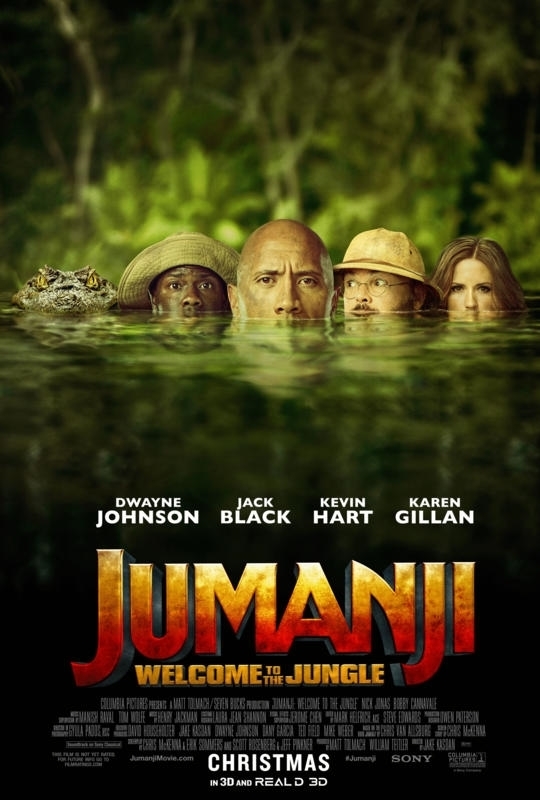
Jack Black, Kevin Hart, Dwayne Johnson, and Karen Gillan in Jumanji: The Next Level (2019)

Of the many classic children’s books that author Chris Van Allsburg has written, one of his most famous is 1981’s Jumanji. The story follows two kids named Judy and Peter as they come across a magical jungle-themed board game named Jumanji that forces them to endure realistic versions of the various obstacles that they come across in the game. Upon publication, the book was so successful that it earned Van Allsburg his first Caldecott Medal for being the year’s ‘most distinguished American picture book for children’. In 1995, the book was adapted into a feature film by former VFX artist turned director Joe Johnston that starred Robin Williams in the role of a man who ends up trapped inside the game for 26 years. And while the film didn’t necessarily do too hot with critics, it was a sizable hit at the box-office and is still very much regarded as a beloved 90’s classic. Thus, it was that legacy that made fans quite skeptical towards the announcement that a new take on Jumanji was in the works, especially since it was first announced only a year after Williams’ tragic death in 2014. And yet, instead of being a straight-forward remake of the original, 2017’s Jumanji: Welcome to the Jungle was a sequel that re-imagined the world of Jumanji as a video game that the film’s main protagonists get sucked into. Upon its release, the film surprised many by doing solidly with critics and managing some impressive staying power at the box-office as it grossed nearly $1 billion worldwide. And because of this, a sequel was promptly put into development once again directed by veteran comedy director Jake Kasdan and headlined by the quartet of Dwayne Johnson, Kevin Hart, Jack Black, and Karen Gillan. Sure enough, all this talent in front of and behind the camera results in yet another highly entertaining popcorn flick even if it does retread a lot of familiar territories.

It has been three years since high school students Spencer Gilpin (Alex Wolff), Martha Kaply (Morgan Turner), Anthony ‘Fridge’ Johnson (Ser’Darius Blain), and Bethany Walker (Madison Iseman) were sucked into the dangerous world of the video game Jumanji and turned into the game’s eclectic group of playable avatars. The four teens ultimately managed to escape their predicament by coming together as a group, which effectively changed their lives for the better once they got out. However, while his friends have all managed to move on with their lives, Spencer finds himself having a lot more trouble when it comes to re-adjusting back to life in the real world. Thus, Martha, Fridge and Bethany soon discover that Spencer ended up ‘fixing’ the game (which they had destroyed at the end of the previous film) and has gone back into it, forcing them to go back in as well to rescue him. Upon their return, however, they quickly realize that things are a bit different this time in the world of Jumanji. While Martha reprises her role as dance-fighting commando Ruby Roundhouse (Karen Gillan), Fridge ends up switching to the role of cartographer/curvy genius Professor Shelly Oberon (Jack Black). And instead of having Spencer and Bethany by their side out the starting gate, the two learn that Spencer’s crotchety grandfather Eddie (Danny DeVito) and his estranged friend Milo Walker (Danny Glover) have been sucked into the game as well. Now Eddie inhabits the role of Dr. Smolder Bravestone (Dwayne Johnson), the strong, muscular archeologist with the power of smoldering intensity, while Milo becomes Bravestone’s ‘backpack guy’, zoologist/weapons specialist Franklin ‘Mouse’ Finbar (Kevin Hart). And so, Martha and Fridge are now forced to adjust to the personalities of their new comrades as they set out to find Spencer and Bethany, which involves them embarking on another adventure to save Jumanji from an imposing new threat.   

Jumanji: The Next Level is admittedly one of those cases of a sequel that doesn’t try to deviate too far from the things that made its predecessor the massive hit that it was. Namely, it retains almost the exact same general plot structure of its predecessor right down to its main conflict of the group trying to stop a bad guy who stole a mythical jewel. And just like Welcome to the Jungle, most of this film’s humor is still based around how the main characters’ personalities are translated to their video game avatars. That said, though, the best aspect of Jumanji: Welcome to the Jungle was its humor, which means that The Next Level is just as much of a top-notch comedic riot throughout. It also helps that this film properly retains the solid character development that the lead quartet of Spencer, Martha, Fridge, and Bethany gained in the previous film. Whereas the pre-game sequences of Welcome to the Jungle were some of the weakest moments in that film, those same moments flow a lot better in this film (as does the humor in those parts) because of the main characters’ vastly improved camaraderie. In other words, if there are two things that The Next Level does better than its predecessor, it’s that the humor is a lot more consistent this time around and the main characters get to start out as the endearing quartet that they were at the end of the previous film. And while that technically means that the new character development that they get in this film isn’t necessarily as substantial as what they had in the previous film, it still results in another entertaining adventure with a feel-good ending. Plus, despite its adherence to the previous film’s formula, The Next Level does switch things up in the best way that it possibly can by trading the previous film’s jungle setting for fun, new action set-pieces in both the desert and the wintry mountains.

It goes without saying that one of the best aspects of Welcome to the Jungle was getting to see the lead quartet of Dwayne Johnson, Jack Black, Kevin Hart, and Karen Gillan take on the personas of their real-world counterparts, whether it was Dwayne Johnson acting like an easily scared nerd or Jack Black embodying a self-absorbed teenaged girl. Sure enough, this concept is once again handled brilliantly in The Next Level as each member of the quartet gets to take on a new personality over the course of their latest adventure. The hilarious results that stem from this are so delightful, in fact, that I can’t even mention them all here (outside of Johnson and Hart’s spot-on impressions of Danny DeVito and Danny Glover, respectively) because I’d be delving into spoiler territory. But just like before, these four have an utterly phenomenal camaraderie that’s also well-reflected by their real-world counterparts as Alex Wolff, Morgan Turner, Ser’Darius Blain, and Madison Iseman all benefit greatly from the solid character development that they got from the previous film. Meanwhile, Danny DeVito and Danny Glover are a fun pair of additions to the ensemble (in their admittedly minor roles outside of the time their characters spend in Jumanji) as is Awkwafina as the game’s newest avatar, thief Ming Lightfoot.  Unfortunately, as was the case with the previous film, The Next Level’s biggest shortcoming is its villain, warlord Jurgen the Brutal. Sure, it’s revealed that Jurgen was the one who killed Dr. Smolder Bravestone’s parents in a ‘cut-scene’ flashback, but just like with Bobby Cannavale’s Van Pelt from Welcome to the Jungle, Jurgen is adversely affected by his generally limited role in the plot despite Game of Thrones alum Rory ‘The Hound’ McCann’s best efforts in the role.

Jumanji: Welcome to the Jungle was easily one of the most entertaining films of 2017. Sure, it may not have been the most thought-provoking film to come out of the action-adventure genre, but the phenomenal comedic performances from Dwayne Johnson, Jack Black, Kevin Hart, and Karen Gillan effectively made it a good, old-fashioned crowd-pleaser. Thus, while it doesn’t exactly reinvent the wheel when it comes to its writing, Jumanji: The Next Level dutifully retains everything that made its predecessor such a big hit, resulting in an arguably superior follow-up. Even though it does repeat practically every major story beat from its predecessor, The Next Level does have the advantage when it comes to not having to deal with the more awkward bits of set-up from Welcome to the Jungle. And because of this, the whole film flows a lot better when it comes to its humor, pacing, and overall camaraderie between its main characters. This, in turn, also helps when it comes to the film maintaining the simple but effectively heartwarming emotional beats that have always been an element of these films, like in the original Jumanji when Alan Parrish learned about how much things changed when he got sucked into the game. Because of all this, Jumanji: The Next Level is another solid entry in this growing franchise, although I will say that if they end up doing another one, they should probably try to do something a little different story-wise. One way could involve the incorporation of elements from the original book’s 2002 follow-up Zathura, which had a pair of brothers go through a similar scenario but with a space-themed board game. That book got an enjoyable albeit commercially underrated film adaptation in 2005 via director Jon Favreau, and while Favreau did try to distance it from the original Jumanji film since he wasn’t a fan of it, it could be fun to see a new spin on Zathura that’s in line with what we’ve gotten from these last two Jumanji films.

Rating: 4.5/5

Wednesday, September 26, 2018

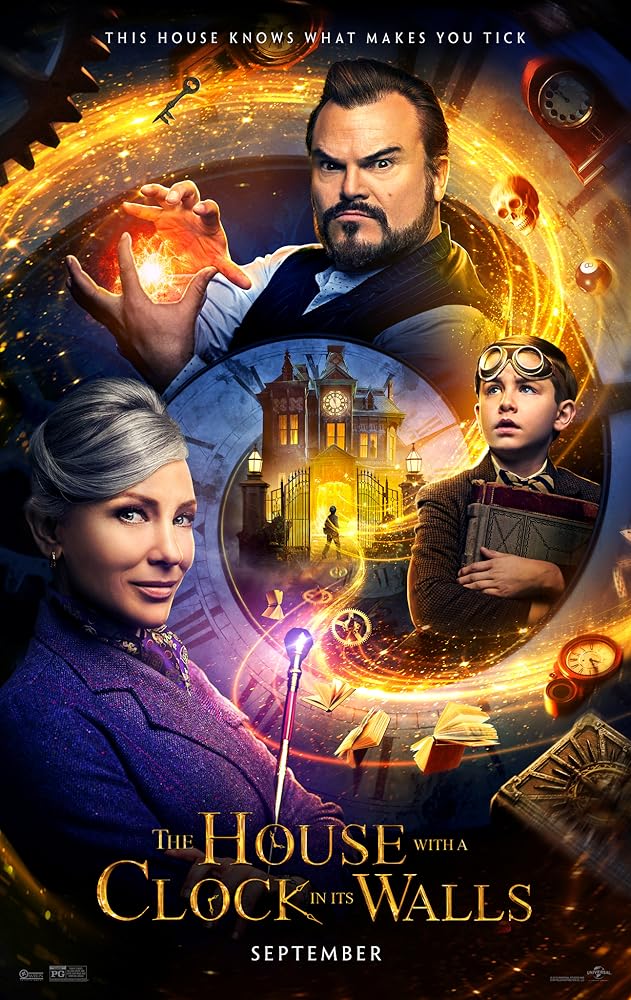
The House with a Clock in Its Walls (2018) review

Cate Blanchett, Jack Black, and Owen Vaccaro in The House with a Clock in Its Walls (2018)

The House with a Clock in Its Walls, an adaptation of author John Bellairs’ best-selling novel of the same name from 1973, is one of those films that is quite fascinating primarily because of who’s directing it. Sometimes you have a film that is directed by someone who isn’t usually known for making films that are either from a specific genre or geared towards a specific audience. Some notable examples of this include 2011’s Hugo, a rare family-friendly affair from the legendary Martin Scorsese, or when the Russo Brothers effectively transitioned from comedies to the superhero genre when they were hired to direct Captain America: The Winter Soldier. And that is very much the case with this film, which is the first PG-rated directorial effort from Eli Roth. For the past decade, the New England native director has mainly been known for his work on horror films that more than deserve their R rating. In fact, films like 2005’s Hostel, its 2007 sequel Hostel: Part II, and 2015’s The Green Inferno have been noted as playing a huge part in the development of the rather infamous genre of horror films that have colloquially been referred to as ‘torture porn’. With that in mind, it’s admittedly rather weird to now see him working on a film that’s geared towards the type of crowd who really shouldn’t be watching any of his other films. But to his credit, Roth does manage to craft an enjoyable family-friendly fantasy horror flick that benefits greatly from its three leads and shows that he can certainly be more than just a director who’s known for graphically violent horror films.
  
Following the death of his parents in a car crash, ten-year-old bookworm Lewis Barnavelt (Owen Vaccaro) is sent to live with his friendly uncle Jonathan (Jack Black) in a small town in Michigan. Once there, he is brought to Jonathan’s ‘ancient’ house where he also meets his uncle’s eccentric neighbor, Florence Zimmerman (Cate Blanchett). Soon enough, Lewis starts noticing a few oddities about his uncle’s house. Despite claims from his neighbors and classmates that the house is haunted, Lewis eventually learns that Jonathan is a warlock AKA a practitioner of magic. After some coaxing, Jonathan agrees to train his nephew with the help of Florence, who’s also quite skilled in magic as a witch, and to their surprise, Lewis quickly manages to become quite adept at casting spells. Along the way, though, Lewis also learns about the darkest secret behind his uncle’s house. Specifically, he learns that the house was previously owned by a more sinister warlock, Isaac Izard (Kyle MacLachlan), who happened to be an old friend/partner of Jonathan’s. One night, Isaac cast a powerful spell that ended up killing him but also created a mysterious ticking clock that was hidden somewhere within the house itself. Unsure of what will happen when the clock’s ticking counts down to one, Lewis, Jonathan, and Florence must band together to ensure that whatever Isaac planned won’t come to fruition.

All in all, Roth does quite a solid job when it comes to his first film geared towards younger audiences. It allows him to play with a lot of the horror elements that he’s familiar with while never delving into any of the more extreme parts of his other films. This results in a breezily paced fantasy flick that boasts a lot of quirky gothic visuals and a nice light-hearted tone that produces a lot of solid humor amidst only a few bits of juvenile family film humor. And while the writing does have a few narrative cracks here and there (e.g. a finale that’s a tad bit anticlimactic), the story is still solid despite it being rather predictable. Ultimately, though, the biggest selling point of this film is its trio of leads. General newcomer Owen Vaccaro (though, really, calling him a ‘newcomer’ is a bit of a stretch given that he did star as one of Will Ferrell/Mark Wahlberg’s kids in Daddy’s Home and its sequel) does an excellent job in the lead role of Lewis, working quite well off his more experienced co-stars. On that note, Jack Black and Cate Blanchett are also quite excellent, especially in terms of their comedic banter. Black, of course, brings his usual youthful enthusiasm to the table while Blanchett works as a great foil for him as the more sarcastic Florence, who gets one of the more interesting character arcs in the film revolving around an incident from her past that has effectively hindered her magic. As for Kyle MacLachlan as the main antagonist Isaac Izard, admittedly his screen-time is mostly limited to the third act, but he does make the most out of it. Unfortunately, the other villain in the film, Isaac’s wife Selena (Renee Elise Goldsberry), is heavily underutilized. Not only is Goldsberry dealt with the same situation as MacLachlan by having most of her screen-time limited to the finale, but her character isn’t even properly introduced until that very point.  

Ultimately, though, this film is a prime example of how just because a director is known for doing one kind of film doesn’t mean that they can’t step out of their wheelhouse to do something different. Despite a few narrative shortcomings, The House with a Clock in Its Walls is a nice addition to the genre of family-friendly fantasy horror films that has spawned numerous classics such as The Nightmare Before Christmas, Beetlejuice, and Gremlins. In fact, Gremlins is an appropriate reference in this case because one thing that I forgot to mention in the intro was that this was produced by Steven Spielberg’s production company, Amblin Entertainment. With that in mind, this does come off as the kind of family film that Spielberg was well-known for in the 80’s, right down to it having a kid as the main protagonist who goes on a fantastical adventure in a seemingly normal town. And while this may not reach the same heights as the films that have inspired it, it does work well thanks in large part to its delightful visual style and the terrific lead trio of Owen Vaccaro, Jack Black, and Cate Blanchett. As such, I wouldn’t mind seeing a follow-up with the same main characters involved. This is, after all, a film that was based on the first installment of a series that went on to have 11 more novels. Obviously, this film isn’t going to go on to have that many follow-ups regardless if a sequel ever gets made but, I don’t know, maybe one or two sequels if everyone involved was open to returning.


Rating: 3.5/5

Wednesday, December 27, 2017

Jumanji: Welcome to the Jungle (2017) review


In 1981, author Chris Van Allsburg published Jumanji, a fantasy picture book about a pair of siblings who come across a mysterious jungle-themed board game. What they soon learn, though, is that the various dangers that they encounter in the game end up coming to life and will not go away until the game is finished. 14 years later in 1995, Allsburg and veteran director Joe Johnston brought Jumanji to life on the big-screen, headlined by the one and only Robin Williams in the role of a man named Alan Parrish who ends up getting trapped within the game for several decades. While the film wasn’t much of a hit with critics, it did do quite well at the box-office as it grossed over $262 million worldwide. Thus, the film has very much become a staple of its time when it comes to 90’s cult classics. But now, the time has come to return to the world of the jungle via a sequel, Jumanji: Welcome to the Jungle. This time around, the premise shifts from Jumanji being a board game that comes to life to a video game that directly sucks its players into its world. Comedy director Jake Kasdan (Walk Hard: The Dewey Cox Story, Bad Teacher) directs this new take on a classic IP with an ensemble cast headlined by big comedic stars like Dwayne ‘The Rock’ Johnson, Kevin Hart, and Jack Black. But for many fans of the original Jumanji, they’ve been wondering if this new film will manage to live up to the legacy of its predecessor. Well, I’m pleased to report that it does do so, for the most part.

On an average school day, teenagers Spencer Gilpin (Alex Wolff), Bethany Walker (Madison Iseman), Anthony ‘Fridge’ Johnson (Ser’Darius Blain), and Martha Kaply (Morgan Turner) end up in detention for various reasons. While serving out their punishment of cleaning out the school basement, the four come across a mysterious video game titled Jumanji. After selecting their avatars from the available roster of characters, they suddenly find themselves sucked into the game, where they’re transformed into the avatars that they’ve selected. The nerdy Spencer becomes the group’s muscular and charismatic leader Dr. Smolder Bravestone (Dwayne Johnson) while football jock Fridge is demoted to the role of Bravestone’s weapons valet Franklin ‘Mouse’ Finbar (Kevin Hart). Bookworm Martha becomes the badass commando Ruby Roundhouse (Karen Gillan) and pretty girl Bethany faces a severe case of culture shock when she becomes the ‘overweight, middle-aged’ male cartographer Professor Shelly Oberon (Jack Black). The group soon learns that they each have three lives and must finish the game without losing them all in order to escape it. Thus, they embark on a perilous journey through the jungle in order to lift a powerful curse that has been placed upon the game world by Bravestone’s old associate, an explorer by the name of Van Pelt (Bobby Cannavale).

The first question that a lot of people had when this film was first announced was in regards to how it would be connected to the original Jumanji. Although it was initially announced as a ‘remake’, the film is ultimately more of a sequel. While it is set several years after the original film, a connection is still established with it thanks to a major nod to Robin Williams’ character Alan Parrish. And while it is understandable if some may scoff at the idea of how the film re-imagines Jumanji as a video game, it does, at least, make sense for a modern take on this story. With that in mind, the film does manage to be a solid follow-up to its predecessor. Given that it mainly takes place within a video game, the film throws in plenty of fun gaming references; everything from the backstory-spewing cut-scenes to the NPCs (non-player characters) that always spout the same bits of dialogue over and over again. And on that note, Jumanji sports a solid hit-miss ratio when it comes to its humor. Now, granted, this is mainly after the main characters get sucked into the game, as most of the humor that occurs in the real world does admittedly fall a bit flat. But even with that in mind, along with the fact that the plot is a fairly simple one in which four teens go through a transformative experience that ends up changing their lives for the better, the film is quite consistent with its humor during the stretches of it that are set within the game world. Plus, for his first major foray into the action genre, director Jake Kasdan does a solid job with the film’s various action sequences.  

Ultimately though, the biggest highlight of this film is seeing the four main leads go out of their comfort zones to portray teenaged characters who find themselves transferred into the bodies of their in-game avatars. While both Dwayne Johnson and Karen Gillan have had plenty of experience when it comes to action films (in Johnson’s case, the numerous action films that he’s starred in, and in Gillan’s case, her turn as Nebula in the Marvel Cinematic Universe), the sight of them acting like shy and nerdy teenagers paves the way for plenty of great comedic moments. The same scenario applies to the other two leads as well; Kevin Hart as the football jock turned practically useless* (in terms of combat) weapons valet and Jack Black acting like a teenage girl. In short, the four leads are easily the best part of the film, as they all have great comedic timing and work incredibly well off each other. The other big name in the cast that’s worth noting is Nick Jonas in the role of the game’s fifth playable avatar, pilot Seaplane McDonough. Jonas works great alongside the other four leads in a role that, without giving anything major away, shares quite a few similarities with one of the original film’s main characters. But whereas all of the film’s main leads are solid, the same can’t exactly be said for the main villain Van Pelt. To his credit, Bobby Cannavale does bring the right amount of creep factor to the role, namely in regards to the character being possessed by a jewel that allows him to control animals. However, Van Pelt is just ‘there’ for the most part, unlike the previous film where the character of Van Pelt (played by Jonathan Hyde) had a far more substantial role in the plot.

When this film was first announced, there was quite a lot of backlash towards it (as is quite frankly the case with any major revival of an old IP nowadays) from fans of the original, especially given the fact that the initial reveal occurred just one year after the death of Robin Williams. I will admit, though, that I wasn’t too bothered by this development because, to be perfectly frank, I don’t necessarily view the original Jumanji as one of the best films of the 90’s. Don’t get me wrong, I do still like the film, but that doesn’t mean that I think that it’s a masterpiece or anything. It’s just a fun and simple fantasy adventure bolstered by the always terrific Robin Williams. This same mindset applies to the sequel as well; it’s by no means perfect but, at its core, it’s not trying to be. At the end of the day, it serves its purpose of being an entertaining action-adventure comedy that does a solid job of reworking the original concept of Jumanji in a new direction without disrespecting any of the stuff that came before it. Sure, the plot is a simple one and not every joke hits, but a lot of the film’s humor does work thanks to the excellent lead quartet of Dwayne ‘The Rock’ Johnson, Kevin Hart, Jack Black, and Karen Gillan. Simply put, these four are the main reason why this film is worth checking out. And for those who still uncertain about it, fear not because it treats the original Jumanji, along with all the work that the late Robin Williams put into it, with genuinely wholehearted reverence.


Rating: 4/5

Friday, March 10, 2017

King Kong Retrospective (1933, 1976, and 2005)

Image result for King Kong 1933

In the world of cinema, one ape stands above the rest as one of the most iconic creatures in film history; King Kong. In 1933, filmmakers Merian C. Cooper (who also became known as one of the primary figures in the development of the Cinerama projection technique) and Ernest B. Schoedsack co-directed a monster film about a giant ape who lives on a mysterious island known as ‘Skull Island’. There, he is discovered by a filmmaking crew that journeys there and is subsequently brought to New York, where he rampages around for a bit before climbing the Empire State Building, where he is finally shot down by fighter planes. This beloved tale of ‘beauty killed the beast’, in which the ape also falls in love with a young woman who is ‘sacrificed’ to him, still stands as one of the most famous films of all time. But over the years, the ‘Eighth Wonder of the World’ has gone through numerous onscreen interpretations. The latest of these, Kong: Skull Island, hits theaters this weekend and in anticipation of that, today I’ll be reviewing the King Kong films. Now, to be specific, I’m not covering every single film that is part of the official franchise. I’m only reviewing the 1933 original, the 1976 ‘re-imagining’, and the 2005 remake. Plus, I’ll also be looking at a 1962 crossover between Kong and Godzilla, which is being included solely because the new Kong film is part of the same franchise as the 2014 Godzilla reboot and a new version of this crossover is set to come out in 2020. Thus, I will not be reviewing Son of Kong, the sequel to the 1933 Kong that was released just nine months after the original (in the same year, no less), King Kong Escapes, a Toho-produced film that was, believe it or not, co-produced by Rankin/Bass (yes, THAT Rankin/Bass) as a live-action remake of a TV show they produced titled The King Kong Show, and King Kong Lives, a sequel to the 1976 Kong which, from what I hear… is just godawful.

KING KONG (1933)

Related image

We start things off, of course, with the original classic produced by RKO from 1933. By next year, this film will be 85 years old… and from the perspective of someone who watched it for the first time ever just a few days ago, it still holds up quite well. Sure, there are obviously some parts of the film that are now dated (e.g. some potentially racist stereotypes) but it’s still a highly enjoyable adventure story with a solid lead cast that includes Fay Wray as the charming leading lady Ann Darrow, Bruce Cabot as the rugged first mate Jack Driscoll who later falls in love with her, and Robert Armstrong as the eccentric filmmaker Carl Denham who leads the expedition to Skull Island. But, of course, the main draw of the film is its ground-breaking special effects that still look great today. Seriously, a lot of effort went into developing the visuals for this film. Most of the creatures in the film, especially Kong, were created via stop-motion animation by special effects pioneer Willis O’Brien. But then there were some other interesting things that they did to integrate live-action footage into the scene, like having a full-sized model of Kong’s head whenever he puts someone in his mouth, having the actors perform in front of a rear projection system, and having shots of actors composited in with shots of the stop-motion animation. And, again, as dated as some of these effects may have become, it’s still quite an impressive feat for a film that was made nearly nine decades ago. Obviously, Kong has seen a lot of other interpretations over the years but, no matter what, the original King Kong is still one of the most iconic films of all-time.

Rating: 5/5!

KING KONG VS. GODZILLA (1962)

Image result for king kong vs godzilla poster

(Disclaimer: As is common with a lot of the Godzilla films, there were different versions of this film that were made for the regions that it was released in. The following review is for the original 97-minute Japanese version and not the 91-minute version released in the U.S.)

There’s quite a lot of history surrounding this film. Arguably the first of its kind in terms of monster crossover films, King Kong vs. Godzilla was also the first film in which both monsters appeared in color. But early on in its development, it was almost going to be about King Kong going up against an enlarged version of Dr. Frankenstein’s monster, the original idea conceived by Willis O’Brien in 1960. Once the film was picked up by Toho, the studio behind the Godzilla films, it was reworked into a crossover between Kong and Godzilla, the latter of whom made a triumphant return to the big-screen after the climactic ending in 1955’s Godzilla Raids Again in which he’s buried in ice. Likewise, this was Kong’s first feature film since the original King Kong back in 1933. What follows is exactly what you’d expect from a Godzilla film; you’re not really in it for the plot, which sees a pharmaceutical company attempt to orchestrate a publicity stunt involving Kong, which eventually leads into a battle with Godzilla. Instead, it’s all about the fight between these two iconic monsters in the cheesy but entertaining definitive style of the Godzilla films; in other words, having two guys in rubber suits duking it out. Admittedly, though, this final battle is only at the very end of the film. Aside from that, there’s a brief confrontation between the two and there’s also a scene in which Kong fights a giant octopus that attacks the village on the island which he initially resides on. As such, some parts of the film do drag a bit. However, it’s ultimately worth it for the Kong-Godzilla fights. With that in mind, it’s easy to see why this has been one of the most popular films in the Godzilla series and I do look forward to the upcoming ‘remake’ in 2020 which, of course, is the main reason why this film was included in this retrospective.

Rating: 3/5

KING KONG (1976)

Image result for king kong 1976 poster

The first big ‘remake’ of King Kong came about in 1976, produced for Paramount by legendary producer Dino De Laurentiis and directed by John Guillermin. From what I’ve read, there was a lot of anticipation surrounding the film upon release. However, it only ended up being a commercial success, as it got a mixed to negative response from critics. So, with that in mind, is this take on the Eighth Wonder of the World as bad as some of the critics said it was? Well, not really; in some aspects, it’s even a little underrated. At the very least, the film is well-made on a technical level; cinematography, location/set design, etc. The key selling point of the film, like the original, is its visuals. In this iteration, Kong was portrayed by legendary makeup artist Rick Baker in an ape suit, and while Baker has stated that he wasn’t pleased with the final design, it does look great on-screen. There’s even one scene in which they have a full-scale, 40-foot-tall Kong animatronic, which was designed by special effects artist Carlo Rambaldi, who also worked on films like E.T. and Alien. Sadly, it didn’t end up working right and, thus, was only used for one scene; the scene in which Kong breaks free from his chains in New York. The only visuals that haven’t aged well, though, are the green-screen effects, specifically whenever Kong is holding someone in his hand. I watched this film on VUDU at the highest quality, HDX, and they just didn’t look good. The best way I can describe it is that it’s obvious whenever a green-screen is being used. Thankfully, most of the other visuals in the film are better by comparison, hence why the film ended up winning the Oscar for Best Visual Effects that year.

But while most of the film’s visuals are great, resulting in some great monster action sequences, the story isn’t as successful. Now, for the record, I don’t mind the changes that were made to differentiate the film from the original. Instead of the premise being about a film crew that goes to shoot at Skull Island, this film instead focuses on an oil tycoon named Fred Wilson who journeys to the island in search of oil. Once Kong is found, he’s taken back to New York and is used as a marketing gimmick for his company. And instead of climbing the Empire State Building, he climbs the towers of the World Trade Center in yet another equally memorable Kong finale. Again, I’m fine with these changes, but the film has an overall campy tone that I don’t think works very well. The acting’s hit-or-miss, too. Jeff Bridges is fine in the Jack Driscoll role (re-imagined here as Jack Prescott, a paleontologist) and Charles Grodin is enjoyably over-the-top in the role of Fred Wilson. Jessica Lange, on the other hand, is the big weak link of the film as she’s just too ditzy in the role of the Ann Darrow equivalent, Dwan. Thankfully, this didn’t immediately kill her career because, as we all know, she has done better in other projects. So, in conclusion, what do I think about this arguably infamous remake? Well, I don’t hate it, but I don’t necessarily love it either. It is well-made for its time and has some nice creature effects thanks to the legendary duo of Rick Baker and Carlo Rambaldi. Not only that, but the film did leave its mark on pop culture as evident from two former attractions at Universal Studios parks; the iconic King Kong Encounter from Universal Studios Hollywood’s Studio Tour and Kongfrontation at Universal Studios Orlando. Still, it just didn’t have the same awe factor of the original. Thus, as far as Kong remakes go, I prefer the following remake over this one.

Rating: 3/5

KING KONG (2005)


And, finally, we have the latest ‘remake’ of the original film; from 2005, Universal’s King Kong, directed by Peter Jackson in what was his first major project after the Lord of the Rings trilogy. Like the ’76 film, there was a lot of hype surrounding it, but unlike that film, this one fared much better with critics and audiences. Sure enough, it’s an excellent new take on the classic story of ‘Beauty Killed the Beast’. The story is more in line with the original and Jackson’s affection for the 1933 film is apparent throughout (e.g. using classic lines, featuring snippets of the original film’s score, etc.). At the same time, though, he does just enough to make his take on the story his own, like giving Ann Darrow more drive in this version than previous incarnations of the character. By comparison, Fay Wray’s take on the character in the ’33 film, while still undeniably great and iconic, was mostly just a damsel-in-distress that didn’t have much of an emotional connection with Kong. This Ann, on the other hand, stands her own ground against Kong and has a much more personal bond with him up until the very end. On that note, Naomi Watts does a fantastic job in the role of Ann and while Jack Black and Adrien Brody have gotten less positive responses as Carl Denham and Jack Driscoll, respectively (in Brody’s case, for being too bland, and in Black’s case, for being too over-the-top), I thought that they were both fine. The other big star of the cast? Andy Serkis, the king of motion-capture. Via the same process that turned him into Gollum in the Lord of the Rings films, he took on the role of Kong in this film, and the motion-capture effects for Kong are fantastic. Heck, a lot of the film’s effects are excellent. Sure, most of them are primarily CG-based this time around but they do their job in creating the world of Skull Island and the creatures that inhabit it.

There’s only one thing that really holds this film back, and it’s the one thing that everyone has said about the film; it’s too damn long. Clocking in at a staggering 187 minutes (and, for the record, that’s only the Theatrical Cut; the ‘Extended Edition’, released on DVD, buffs up the already hefty runtime by 20 minutes), the film takes its sweet time to tell the story and while I wasn’t necessarily ‘bored’ at any part in the film, at the same time I will admit that sometimes it can be a chore to get through. By comparison, the 1933 film was far better paced at a brisk 100 minutes (or 104 minutes if you add in the overture). Heck, even the 1976 film, which also had a slower pace to it, wasn’t as long; it was just a little over two hours. Simply put, there are quite a few parts in this film that would’ve benefitted greatly from some cuts, especially during the long, long, LONG trip to Skull Island. But, despite the arguably problematic runtime, it’s undeniably clear that Jackson was the best choice to do a new version of King Kong and he succeeds in doing so with this film. Now, I’ll admit that I watched this version first before the original. Like the 2009 Star Trek film, I had purchased it on iTunes and originally watched it on my iPod (and before any of you ask, yes, I managed to get through the whole three-hour film while watching it on an iPod). And while I now regard the original as the best version of the story (because, obviously…), I still have highly positive feelings towards the 2005 film, one of the best remakes of all-time.  


Rating: 4.5/5

Tuesday, October 27, 2015

Goosebumps (2015) review


If you’re a 90’s kid, then you’ll probably remember the classic horror franchise ‘Goosebumps’. Created in 1992 by R.L. Stine, ‘the Stephen King of children’s literature’, ‘Goosebumps’ both delighted and terrified audiences with its kid-friendly scary stories and surreal nature. As some would put it, it was sort of like a kid-friendly version of ‘Tales from the Crypt’ and of course it became a phenomenon, selling over 350 million books worldwide and even spawning a successful TV series that ran for 4 seasons from 1995 to 1998. And now in 2015, the characters of R.L. Stine’s books come to the big screen in a brand new ‘Goosebumps’ film. Given the anthology nature of the series, it did raise some questions about what kind of approach the filmmakers would take in translating the series to the big screen. Would this be a case of them adapting a single storyline at a time, resulting in a new horror film franchise? Ultimately the answer to that question is no because the route that they do take ends up being more meta in execution; one in which Stine himself is an actual character in the plot. And to the surprise of many, this film has actually been doing pretty well with critics, which I guess primarily stems from the fact that the last film the duo of director Rob Letterman and lead Jack Black worked on was 2010’s infamous remake of ‘Gulliver’s Travels’. But at the end of the day, their third film collaboration actually ends up being a pretty fun family horror film with a wide array of zany monsters and a surprising amount of heart.

The film begins as teenager Zach Cooper (Dylan Minnette) and his mother Gale (Amy Ryan) move from New York to the town of Madison, Delaware when his mother is hired to be the new vice-principal at the local high school. After they move in, Zach immediately befriends his next-door neighbor Hannah (Odeya Rush) but is warned by her mysterious father ‘Mr. Shivers’ (Jack Black) to stay away from her. One night when he hears her screaming, Zach and his new friend Champ (Ryan Lee) sneak into her house to try and find her. There they are surprised to come across numerous manuscripts of ‘Goosebumps’ stories but when they end up opening one of them, the monster of that story is released straight from the pages of the book. Zach and Champ soon learn that ‘Mr. Shivers’ is actually R.L. Stine himself and that the monsters that he had created in his stories had come to life when he was younger and had been trapped within the manuscripts so that they wouldn’t cause any trouble. But as a result of Zach and Champ’s interference, Stine’s other creations, led by the villainous wooden dummy Slappy (voiced by Black, who also voices the Invisible Boy), break out of their books as well with the intent on terrorizing the neighborhood and getting revenge upon Stine for trapping them within their manuscripts for so long, leaving Zach, Hannah, Stine, and Champ to try and defeat all of the author’s crazy creations.

Old-school ‘Goosebumps’ fans will most certainly appreciate the numerous amount of references and call-backs that are made to classic ‘Goosebumps’ stories. As noted earlier, because this is not just a case where one single ‘Goosebumps’ story is being adapted to film, this film basically features every major monster/creature from the original book series. Though with that said, because there are so many featured, some do get more attention than others, namely Slappy being that he’s basically the main villain of the film and it wouldn’t really be a ‘Goosebumps’ film without him. As for younger audiences who may not be that familiar with the series or are 100% newcomers to the franchise, the film will still manage to hold their interest with its large array of crazy monsters, likable lead characters, and its overall light-hearted tone. The film admittedly suffers at times due to how rushed it is due to the pacing but that also means that the film never really drags at any point either, although I will say that the film doesn’t really get going until the monsters start getting released from their books. I also can’t really go as far as to say that it’s the ‘scariest’ PG-rated horror film ever made as the film is more action/effects oriented, though this may also just be due to the fact that I’m older and have seen more adult-oriented horror films.

One of the things that surprised me the most about this film was that it had a surprising amount of heart. A lot of this comes from the two main leads, Zach and Hannah. Both Dylan Minnette and Odeya Rush do excellent jobs here; they have strong romantic chemistry and the romance between their characters is actually really sweet as far as teen romances are concerned. The two also end up having their own personal emotional arcs throughout the film. In the case of Zach, it’s him coping with the loss of his father, which is really conveyed well in a particularly touching scene near the beginning in which he looks at old footage of him and his dad. As for Hannah, it involves a particular plot point that I won’t spoil here but needless to say it’s a neatly executed twist that pays homage to a classic ‘Goosebumps’ story. Ryan Lee (AKA the fireworks-loving Cary from ‘Super 8’) is a major standout as well as the hopeless romantic but loyal friend Champ. The fact that I’m highlighting the kid actors first shows that despite having top billing, Jack Black as R.L. Stine actually isn’t the main character of the film. But even with that in mind, Black still does a really good job in the role and has his fair share of humorous lines, like a scene in which Stine makes a jab at Stephen King after being goaded into it by Zach. Black also does a nice job in providing the voice for Slappy and it should also be noted that the film version of Slappy is clearly modeled after Black as Stine.

As noted earlier, ‘Goosebumps’ is basically one of the big film ‘surprises’ of the year. That is because I have the feeling that many people weren’t expecting that much out of a film based off of a book series that has been around since the 90’s. But at the end of the day, ‘Goosebumps’ actually does avoid being nothing more than a cynical cash grab by instead being a fun little horror adventure that may not be the scariest family horror film of all-time but one that I think that both kids and adults can both enjoy. In the case of kids, it’s getting to see all of the fun and zany monsters while those who grew up with the ‘Goosebumps’ books and TV series will get a good dose of nostalgia. You’ll also be surprised to see that the film actually has a lot of charm and heart to it as well, which primarily stems from the genuinely sweet teen romance between the two main leads. I’ll admit that I’m not a ‘mega fan’ of this series despite being a part of the generation that grew up with it. I have read a few of the books and have watched multiple episodes of the TV series but it’s been a while since I’ve done either so I went into this film with a more casual perspective. And with that in mind I will say that this film is generally accessible to anyone whether they’re a fan of the series or not. If this ends up warranting a sequel then that gives Sony two big family-friendly horror-themed film franchises that they can work with, the other being the ‘Hotel Transylvania’ films.


Rating: 3.5/5