Showing posts with label Peter Jackson. Show all posts

Friday, March 10, 2017

King Kong Retrospective (1933, 1976, and 2005)

Image result for King Kong 1933

In the world of cinema, one ape stands above the rest as one of the most iconic creatures in film history; King Kong. In 1933, filmmakers Merian C. Cooper (who also became known as one of the primary figures in the development of the Cinerama projection technique) and Ernest B. Schoedsack co-directed a monster film about a giant ape who lives on a mysterious island known as ‘Skull Island’. There, he is discovered by a filmmaking crew that journeys there and is subsequently brought to New York, where he rampages around for a bit before climbing the Empire State Building, where he is finally shot down by fighter planes. This beloved tale of ‘beauty killed the beast’, in which the ape also falls in love with a young woman who is ‘sacrificed’ to him, still stands as one of the most famous films of all time. But over the years, the ‘Eighth Wonder of the World’ has gone through numerous onscreen interpretations. The latest of these, Kong: Skull Island, hits theaters this weekend and in anticipation of that, today I’ll be reviewing the King Kong films. Now, to be specific, I’m not covering every single film that is part of the official franchise. I’m only reviewing the 1933 original, the 1976 ‘re-imagining’, and the 2005 remake. Plus, I’ll also be looking at a 1962 crossover between Kong and Godzilla, which is being included solely because the new Kong film is part of the same franchise as the 2014 Godzilla reboot and a new version of this crossover is set to come out in 2020. Thus, I will not be reviewing Son of Kong, the sequel to the 1933 Kong that was released just nine months after the original (in the same year, no less), King Kong Escapes, a Toho-produced film that was, believe it or not, co-produced by Rankin/Bass (yes, THAT Rankin/Bass) as a live-action remake of a TV show they produced titled The King Kong Show, and King Kong Lives, a sequel to the 1976 Kong which, from what I hear… is just godawful.

KING KONG (1933)

Related image

We start things off, of course, with the original classic produced by RKO from 1933. By next year, this film will be 85 years old… and from the perspective of someone who watched it for the first time ever just a few days ago, it still holds up quite well. Sure, there are obviously some parts of the film that are now dated (e.g. some potentially racist stereotypes) but it’s still a highly enjoyable adventure story with a solid lead cast that includes Fay Wray as the charming leading lady Ann Darrow, Bruce Cabot as the rugged first mate Jack Driscoll who later falls in love with her, and Robert Armstrong as the eccentric filmmaker Carl Denham who leads the expedition to Skull Island. But, of course, the main draw of the film is its ground-breaking special effects that still look great today. Seriously, a lot of effort went into developing the visuals for this film. Most of the creatures in the film, especially Kong, were created via stop-motion animation by special effects pioneer Willis O’Brien. But then there were some other interesting things that they did to integrate live-action footage into the scene, like having a full-sized model of Kong’s head whenever he puts someone in his mouth, having the actors perform in front of a rear projection system, and having shots of actors composited in with shots of the stop-motion animation. And, again, as dated as some of these effects may have become, it’s still quite an impressive feat for a film that was made nearly nine decades ago. Obviously, Kong has seen a lot of other interpretations over the years but, no matter what, the original King Kong is still one of the most iconic films of all-time.

Rating: 5/5!

KING KONG VS. GODZILLA (1962)
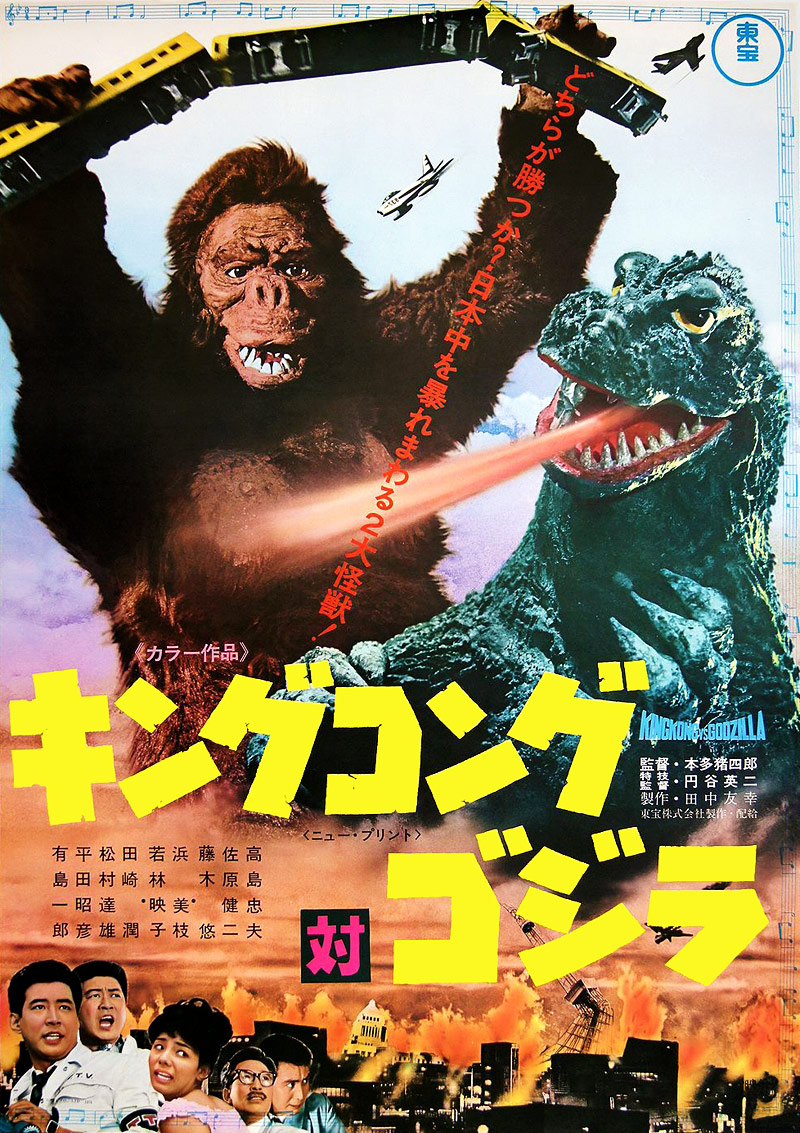
Image result for king kong vs godzilla poster

(Disclaimer: As is common with a lot of the Godzilla films, there were different versions of this film that were made for the regions that it was released in. The following review is for the original 97-minute Japanese version and not the 91-minute version released in the U.S.)

There’s quite a lot of history surrounding this film. Arguably the first of its kind in terms of monster crossover films, King Kong vs. Godzilla was also the first film in which both monsters appeared in color. But early on in its development, it was almost going to be about King Kong going up against an enlarged version of Dr. Frankenstein’s monster, the original idea conceived by Willis O’Brien in 1960. Once the film was picked up by Toho, the studio behind the Godzilla films, it was reworked into a crossover between Kong and Godzilla, the latter of whom made a triumphant return to the big-screen after the climactic ending in 1955’s Godzilla Raids Again in which he’s buried in ice. Likewise, this was Kong’s first feature film since the original King Kong back in 1933. What follows is exactly what you’d expect from a Godzilla film; you’re not really in it for the plot, which sees a pharmaceutical company attempt to orchestrate a publicity stunt involving Kong, which eventually leads into a battle with Godzilla. Instead, it’s all about the fight between these two iconic monsters in the cheesy but entertaining definitive style of the Godzilla films; in other words, having two guys in rubber suits duking it out. Admittedly, though, this final battle is only at the very end of the film. Aside from that, there’s a brief confrontation between the two and there’s also a scene in which Kong fights a giant octopus that attacks the village on the island which he initially resides on. As such, some parts of the film do drag a bit. However, it’s ultimately worth it for the Kong-Godzilla fights. With that in mind, it’s easy to see why this has been one of the most popular films in the Godzilla series and I do look forward to the upcoming ‘remake’ in 2020 which, of course, is the main reason why this film was included in this retrospective.

Rating: 3/5

KING KONG (1976)

Image result for king kong 1976 poster

The first big ‘remake’ of King Kong came about in 1976, produced for Paramount by legendary producer Dino De Laurentiis and directed by John Guillermin. From what I’ve read, there was a lot of anticipation surrounding the film upon release. However, it only ended up being a commercial success, as it got a mixed to negative response from critics. So, with that in mind, is this take on the Eighth Wonder of the World as bad as some of the critics said it was? Well, not really; in some aspects, it’s even a little underrated. At the very least, the film is well-made on a technical level; cinematography, location/set design, etc. The key selling point of the film, like the original, is its visuals. In this iteration, Kong was portrayed by legendary makeup artist Rick Baker in an ape suit, and while Baker has stated that he wasn’t pleased with the final design, it does look great on-screen. There’s even one scene in which they have a full-scale, 40-foot-tall Kong animatronic, which was designed by special effects artist Carlo Rambaldi, who also worked on films like E.T. and Alien. Sadly, it didn’t end up working right and, thus, was only used for one scene; the scene in which Kong breaks free from his chains in New York. The only visuals that haven’t aged well, though, are the green-screen effects, specifically whenever Kong is holding someone in his hand. I watched this film on VUDU at the highest quality, HDX, and they just didn’t look good. The best way I can describe it is that it’s obvious whenever a green-screen is being used. Thankfully, most of the other visuals in the film are better by comparison, hence why the film ended up winning the Oscar for Best Visual Effects that year.

But while most of the film’s visuals are great, resulting in some great monster action sequences, the story isn’t as successful. Now, for the record, I don’t mind the changes that were made to differentiate the film from the original. Instead of the premise being about a film crew that goes to shoot at Skull Island, this film instead focuses on an oil tycoon named Fred Wilson who journeys to the island in search of oil. Once Kong is found, he’s taken back to New York and is used as a marketing gimmick for his company. And instead of climbing the Empire State Building, he climbs the towers of the World Trade Center in yet another equally memorable Kong finale. Again, I’m fine with these changes, but the film has an overall campy tone that I don’t think works very well. The acting’s hit-or-miss, too. Jeff Bridges is fine in the Jack Driscoll role (re-imagined here as Jack Prescott, a paleontologist) and Charles Grodin is enjoyably over-the-top in the role of Fred Wilson. Jessica Lange, on the other hand, is the big weak link of the film as she’s just too ditzy in the role of the Ann Darrow equivalent, Dwan. Thankfully, this didn’t immediately kill her career because, as we all know, she has done better in other projects. So, in conclusion, what do I think about this arguably infamous remake? Well, I don’t hate it, but I don’t necessarily love it either. It is well-made for its time and has some nice creature effects thanks to the legendary duo of Rick Baker and Carlo Rambaldi. Not only that, but the film did leave its mark on pop culture as evident from two former attractions at Universal Studios parks; the iconic King Kong Encounter from Universal Studios Hollywood’s Studio Tour and Kongfrontation at Universal Studios Orlando. Still, it just didn’t have the same awe factor of the original. Thus, as far as Kong remakes go, I prefer the following remake over this one.

Rating: 3/5

KING KONG (2005)


And, finally, we have the latest ‘remake’ of the original film; from 2005, Universal’s King Kong, directed by Peter Jackson in what was his first major project after the Lord of the Rings trilogy. Like the ’76 film, there was a lot of hype surrounding it, but unlike that film, this one fared much better with critics and audiences. Sure enough, it’s an excellent new take on the classic story of ‘Beauty Killed the Beast’. The story is more in line with the original and Jackson’s affection for the 1933 film is apparent throughout (e.g. using classic lines, featuring snippets of the original film’s score, etc.). At the same time, though, he does just enough to make his take on the story his own, like giving Ann Darrow more drive in this version than previous incarnations of the character. By comparison, Fay Wray’s take on the character in the ’33 film, while still undeniably great and iconic, was mostly just a damsel-in-distress that didn’t have much of an emotional connection with Kong. This Ann, on the other hand, stands her own ground against Kong and has a much more personal bond with him up until the very end. On that note, Naomi Watts does a fantastic job in the role of Ann and while Jack Black and Adrien Brody have gotten less positive responses as Carl Denham and Jack Driscoll, respectively (in Brody’s case, for being too bland, and in Black’s case, for being too over-the-top), I thought that they were both fine. The other big star of the cast? Andy Serkis, the king of motion-capture. Via the same process that turned him into Gollum in the Lord of the Rings films, he took on the role of Kong in this film, and the motion-capture effects for Kong are fantastic. Heck, a lot of the film’s effects are excellent. Sure, most of them are primarily CG-based this time around but they do their job in creating the world of Skull Island and the creatures that inhabit it.

There’s only one thing that really holds this film back, and it’s the one thing that everyone has said about the film; it’s too damn long. Clocking in at a staggering 187 minutes (and, for the record, that’s only the Theatrical Cut; the ‘Extended Edition’, released on DVD, buffs up the already hefty runtime by 20 minutes), the film takes its sweet time to tell the story and while I wasn’t necessarily ‘bored’ at any part in the film, at the same time I will admit that sometimes it can be a chore to get through. By comparison, the 1933 film was far better paced at a brisk 100 minutes (or 104 minutes if you add in the overture). Heck, even the 1976 film, which also had a slower pace to it, wasn’t as long; it was just a little over two hours. Simply put, there are quite a few parts in this film that would’ve benefitted greatly from some cuts, especially during the long, long, LONG trip to Skull Island. But, despite the arguably problematic runtime, it’s undeniably clear that Jackson was the best choice to do a new version of King Kong and he succeeds in doing so with this film. Now, I’ll admit that I watched this version first before the original. Like the 2009 Star Trek film, I had purchased it on iTunes and originally watched it on my iPod (and before any of you ask, yes, I managed to get through the whole three-hour film while watching it on an iPod). And while I now regard the original as the best version of the story (because, obviously…), I still have highly positive feelings towards the 2005 film, one of the best remakes of all-time.  


Rating: 4.5/5

Sunday, December 21, 2014

The Hobbit: The Battle of the Five Armies (2014) review


This may be a controversial statement in the minds of some people given the general reaction to this series, but I’ve been a fairly big fan of the ‘Hobbit’ movies. Do I think they’re as good as director Peter Jackson’s previous Middle-Earth trilogy, ‘The Lord of the Rings’? No, not really, but I do think that they’re better than what many people have put them out to be. Of course, the controversy surrounding this adaptation of the classic story of the same name from author J.R.R. Tolkien has mostly stemmed from the decision to split the book into three separate films which many felt was very unnecessary given that the book is only about 300 pages long whereas the ‘Lord of the Rings’ trilogy was based on three separate 300 page books. And sure, some of the problems that would’ve clearly emerged from padding the story out to three films have been present in the previous two films, such as a rather slow pace to start out the story in ‘An Unexpected Journey’ and sometimes feeling rather stuffed as far as characters and plotlines are concerned like in ‘The Desolation of Smaug’. Still, I do feel that these films have maintained the same great atmosphere and sense of adventure that ‘Lord of the Rings’ had, so much so that I can generally ignore a lot of the ‘downfalls’ of the previous two films. But now, the story of ‘The Hobbit’ finally comes to a close on film with ‘The Battle of the Five Armies’ and after seeing this final film, I can safely say that it is without a doubt the best film in the entire trilogy.

At the end of ‘The Desolation of Smaug’, Thorin Oakenshield (Richard Armitage) and his company of Dwarves, with the help of hobbit Bilbo Baggins (Martin Freeman) and wizard Gandalf the Grey (Ian McKellen), had finally reached their homeland of Erebor within the Lonely Mountain, which had been stolen from them years earlier by the vicious dragon Smaug (portrayed through motion-capture by Benedict Cumberbatch). The group tries to kill Smaug by burying him alive in molten gold but that plan ends up failing and Smaug escapes from the mountain in order to enact his revenge on the people of the nearby Lake-town for assisting the Dwarves in their quest while Bilbo and the Dwarves can only watch from afar. As ‘The Battle of the Five Armies’ begins, Smaug begins his attack on Lake-town and while he is ultimately defeated by bowman Bard (Luke Evans, and for the record don’t worry folks this is not a spoiler as it’s literally the opening sequence of the film), who manages to hit him with a powerful black arrow in the one weak spot in his armor, most of the town is effectively destroyed, leaving the surviving residents of Lake-town homeless.

After the surviving residents of the town elect him as their new leader, Bard travels to the Lonely Mountain to talk with Thorin about him and his company holding up their part of the deal that he had made with the people of Lake-town before they had left for the mountain; that they would give them a part of the Mountain’s vast collection of treasure, which would be really helpful for Bard’s group at the moment given the situation that they’re currently in. But Thorin, who has begun to fall to the same ‘sickness of greed’ that had affected his grandfather in the years before Smaug’s initial attack on the Lonely Mountain as he desperately searches for his family’s heir-loom, the Arkenstone (which unbeknownst to him has already been found by Bilbo, who has been hiding it from him due to his change in attitude), refuses to give up any of the gold. As a result, Bard forges an alliance with the Wood-Elves of Mirkwood, led by their king Thranduil (Lee Pace), who is also looking for a part of the Dwarves’ treasure, as they plan an assault on the Lonely Mountain while Thorin’s group prepares for this impending attack. But little do they all know that some other armies are on their way to the Lonely Mountain to seek control of it for their master, who of course was revealed at the end of ‘Desolation’ to be the Dark Lord himself, Sauron (also portrayed by Cumberbatch through motion-capture).

As many of you may have guessed from the film’s title, this is clearly the entry in the ‘Hobbit’ film series where the most action in the story occurs, which is perfectly summed up by the fact that the titular ‘Battle of the Five Armies’ is a 45-minute long sequence and boy is it quite a sequence (and no, I don’t care if this was just one chapter in the book… I’ll get into the whole ‘three films’ thing later on). As far as scale and scope is concerned this is easily the biggest out of all of Jackson’s Middle-Earth films and it truly delivers on the spectacle with some of the best action sequences of the entire series (even when counting what we saw in ‘Lord of the Rings’). But at the same time, the film still holds your attention from beginning to end thanks to solid pacing, meaning the film never really drags at any point. As the final film in this epic story, you can really see how everything has been building up to what happens in this film and in some cases how this trilogy will ultimately lead into ‘Lord of the Rings’. Having only seen those films once, I can’t really say how effectively ‘Battle of the Five Armies’ leads into the previous trilogy as a whole but from the perspective of a general newcomer to the world of Middle-Earth as it has been portrayed in film, to me it seems that it did do a pretty good job in paving the way to its successor trilogy with key references to ‘Lord of the Rings’ showing how things became the way they were. This is a prequel, after all.

But amidst all of the action, Jackson still manages to find enough time for character development, particularly with Thorin and Bilbo. This film is easily Thorin’s story as we see his descent into madness as he obsesses over finding the Arkenstone, succumbing to the same sickness of the mind that his grandfather was stricken with as we saw from the prologue of ‘An Unexpected Journey’. It’s a fascinating look into the psyche of this character who’ve we been with since the beginning of the trilogy and Richard Armitage is easily the biggest standout of this entry in the trilogy. But of course, as it has always been since the first ‘Lord of the Rings’ film all the way back in 2001, the cast is pitch-perfect from top to bottom. Martin Freeman provides a great amount of wit, charm, and also an everyman-like persona in the role of Bilbo, Ian McKellen is his usual badass self in the role of the equally badass wizard Gandalf the Grey, and while only a few of the members of the company of Dwarves, not counting Thorin (e.g. Fili, Kili, Dwalin, and Balin), get any major material to work with, they have a great sense of camaraderie amongst them. That’s been the case since the first film so in the scene where Thorin asks them if they will follow him ‘one last time’, you too are with them because you really felt that you were along for the ride with them. There may be a few characters from ‘Lord of the Rings’ featured here that may not have been in the original book, like Galadriel (Cate Blanchett) and Legolas (Orlando Bloom), but they are a welcome addition here, helping these films feel even more like a crucial part of Jackson’s Middle-Earth universe.

In 2001, Peter Jackson, who at that point was mostly known for splatter films and horror comedies, began a journey into the fictional land of Middle-Earth with ‘The Lord of the Rings’, a trilogy of films that became some of the most highly regarded films of the last few years. A decade later, he returned to Middle-Earth for another trilogy, this time based on the prequel to ‘Lord of the Rings’, ‘The Hobbit’. Some may argue that this second trip to Middle-Earth wasn’t as good as the first one due to the fact that they expanded a rather small book into three big films and in some cases that may be true. But thanks to great direction, a great cast, great visuals, and overall a great atmosphere, I do feel that the same magic that ‘Lord of the Rings’ had is once again present in ‘The Hobbit’, once again showing why Jackson was the perfect man to helm all of these Middle-Earth movies. That is again shown in the final ‘Hobbit’ film, ‘The Battle of the Five Armies’, which is easily the best film in the entire trilogy. Everything has been building up to this finale and it truly delivers in terms of the payoff and the overall spectacle as it is arguably the biggest Middle-Earth movie to date. At this point, it seems like this is the last film for Jackson and his crew in the world of Middle-Earth. Some may feel that this is a good thing given the more mixed reactions to ‘The Hobbit’ compared to ‘Lord of the Rings’, but me personally I’d like to say this to Mr. Jackson; thank you, thank you, thank you for all of the work that you’ve put into your six Middle-Earth movies. It was truly a once-in-a-lifetime cinematic experience that we may never experience again.

Rating: 5/5!

REVIEW EPILOGUE

(Because hey, if Peter Jackson can have multiple endings in ‘Return of the King’, I can have an extra ending to my review of the final ‘Hobbit’ film).


Now before I go, I’m just going to give my final thoughts on the one crucial point of debate in regards to this series ever since the fateful decision to split the story into three films; at the end of the day, was it a good idea? For some people, it wasn’t and I’ll admit that when it was first announced, I too was rather hesitant about it. But now, after seeing all three ‘Hobbit’ movies, I am now actually in full support of this decision, for a few reasons. The big reason why many felt that doing a trilogy of films was a bad idea was that ‘The Hobbit’ is only a 300-page book. However, ‘The Hobbit’ is not as simple a story as some may claim it to be. A lot of things do happen in the story; the characters are introduced, they go off on their journey, they encounter various obstacles along the way, Bilbo acquires ‘the Ring’, they reach Erebor, they face off with Smaug, Smaug escapes, attacks Lake-town, and is killed by Bard, and then multiple armies duke it out over control of the Lonely Mountain before Bilbo finally returns home to the Shire. And that isn’t even all of what happens in this story. Simply put, it can’t really be done in just one film. I know that some people feel that this should’ve been the case with these films but you know what would happen if we just had one ‘Hobbit’ film? Then we’d all be here complaining about how that one film rushed through the entire story. Sure, maybe it could’ve been done in just two movies (that was the original plan, after all) but as for me I’m glad that they didn’t just cram the ‘Battle of Five Armies’ into the second film like I heard some reports claim that it was going to be.

And besides, if anyone was worried about this story being padded out into three three-hour long movies like the ‘Lord of the Rings’ movies were, that wasn’t the case at all. Because while the ‘Lord of the Rings’ movies got longer with each new film, it was the other way around with ‘The Hobbit’ as the films continued to get shorter and shorter, with ‘Battle of the Five Armies’ being the shortest Middle-Earth movie of them all at only 144 minutes. But if the runtime wasn’t the issue for people, it was probably the fact that these movies were rather overloaded with characters and admittedly that is fairly true. There are a lot of characters in this story and while we are primarily following Bilbo and a company of 13 dwarves, only a few of them (not counting Thorin because he’s clearly the most important out of all of them) get any major bits of character development. But you know something? From what I hear, that was a problem in the book as well. In fact, in some cases the book is even more problematic in how it handles its characters, some of whom are barely in it, like Bard the Bowman. From what I hear, in the book he doesn’t appear until his big moment when he kills Smaug, so kudos to the filmmakers for actually giving him a much more substantial role in the film. And on that note I do like the addition of Tauriel in the movies, even if most of her role in the story revolves around her romance with Kili, mainly because it does add some much needed diversity to a pre-dominantly male cast (something that was the case in both ‘Middle-Earth’ trilogies).


In short, I feel that Peter Jackson and his crew were actually aware of the tricky situation they were in when adapting ‘The Hobbit’ to film. I think they knew that the book had some issues with pacing and character development so, as controversial as it may be for some people, I am in full support of the decision to split it up into three separate films. Because while ‘The Hobbit’ is technically a children’s book, it’s not as simple as people think it is. A lot of things do happen in the story so while many people might complain about these movies being over-long (which isn’t actually that much of a problem because they’ve been getting shorter with every film), I’d much rather spend nine hours in Middle-Earth getting to know these characters than just spending about three hours there not really getting to know them at all because the film would be going at an incredibly fast pace. And sure, not all of the characters get that much to do in these films, like most of the company of Dwarves, but while I haven’t read ‘The Hobbit’, from what I can tell the same problem occurs in the book as well and if anything, I think that Jackson should be applauded for expanding on certain characters’ roles in the story, like Bard the Bowman and Thranduil, and I also don’t mind the additions of Tauriel and other characters from ‘Lord of the Rings’ because in the case of the former, these films gain a solid female character in what is a pre-dominantly male cast and in the case of the latter, the appearances of characters like Legolas, Galadriel, and Saruman help this movie feel even more connected to the ‘Lord of the Rings’ films. I feel that Jackson actually did a really solid job at adapting a story that, like it or not, isn’t exactly perfect.

Monday, December 16, 2013

The Hobbit: The Desolation of Smaug (2013) review


In regards to the original ‘Lord of the Rings’ film trilogy, the hardest one to make would have to have been ‘The Two Towers’, basically because it was the ‘middle chapter’ of the story; it didn’t have a proper beginning or end. In fact, when Peter Jackson first pitched his adaptation of the story to Miramax (before the project was picked up by New Line Cinema), it was originally supposed to be two films, which then turned into only one due to budgetary concerns. But overall, ‘The Two Towers’ ended up being my personal favorite of the trilogy. It did manage to work around its ‘middle chapter’ status, it had some incredible action sequences, and it was the film that introduced audiences to Andy Serkis’ incredible interpretation of the creature Gollum (why the Oscars have never recognized Serkis for his work, we’ll never know). But anyway, as Peter Jackson continues the story of ‘The Hobbit’ with the second entry in this trilogy, ‘The Desolation of Smaug’, can Jackson deliver another satisfying ‘middle chapter’ like he did 11 years ago? Or, to be more precise, can this film improve on its predecessor’s major weakness; its pacing?

At the end of ‘The Hobbit: An Unexpected Journey’, Bilbo Baggins (Martin Freeman), Gandalf the Grey (Ian McKellen), and the company of dwarves led by Thorin Oakenshield (Richard Armitage) had escaped from both the Goblin tunnels and the pack of Orcs led by the hunter Azog with the help of the Great Eagles. As this film begins, the group continues their journey towards the Lonely Mountain AKA Erebor, the dwarves’ former homeland, in their quest to take back the mountain from the dragon Smaug (portrayed through motion-capture by Benedict Cumberbatch). While on their quest they come by new allies, including the elf warriors Legolas (Orlando Bloom, reprising his role from the ‘LOTR’ trilogy) and Tauriel (Evangeline Lilly), and the archer Bard (Luke Evans), who help them along the way. Meanwhile, Gandalf investigates the hill Dol Guldur, where a mysterious Necromancer (also portrayed by Cumberbatch) could potentially spell doom for Middle-Earth and this string of events ultimately might have something to do with that mysterious ring that Bilbo found back in the Goblin tunnels.

As I’ve said before, the biggest problem of ‘An Unexpected Journey’ was its length and pacing. Yes, it was the film that was supposed to set up the story but as a whole it just felt too long, like we were already watching the Extended Edition of the film when it wasn’t supposed to be (and ironically there is a special Extended Edition now). Then again, this trilogy is based off of a book that is only about 300 pages long compared to ‘The Lord of the Rings’, a trilogy of books that were each at least 400 pages long so they did have to add plenty of stuff in to make it a trilogy (I’ll get into that more in a bit). Thankfully, this film fixes those issues to a certain extent. The film is still very long but the pacing is much faster, allowing us to get more engrossed in the adventure at hand now that the story and its characters been effectively established. Sure, you do still kind of feel the film’s length at times, but not really as much as the previous film. This one is far more exciting with a far greater scale.

However, perhaps the film is… too big. Again, this is going back to the whole idea of making a trilogy out of such little material to work with. So in order to deal with this situation, Jackson and the writers add in plenty of new characters, some of which were not in the book (like Legolas) and one of whom, Tauriel, is a completely original character. It is sort of like the previous trilogy in that there is a whole boatload of characters in this film, so much so that admittedly they start to overtake the movie. In fact, for a movie that is titled ‘The Hobbit’, the actual Hobbit himself, Bilbo, sort of becomes a minor character in fact for most of the movie. Not only are there starting to be far too many characters, there is perhaps too much going on in this film. For the record, I’m not saying that’s entirely a bad thing because it allows the film to have much better pacing than its predecessor, but that also means the film doesn’t really stop that much in the whole span of its 160+ minute runtime… and I must add, this film kind of ends rather abruptly. Still, considering all that goes on in this film, that was probably the best place they could’ve reasonably ended it at.

Like the last film, the acting is very good from all who are involved. The returning cast from the previous film (including Martin Freeman, Ian McKellen, Richard Armitage, and the others who make up the company of dwarves) are excellent once again and the new additions for this film like Evangeline Lilly and Luke Evans are welcome additions as well. While his character may not have been in the book, the return of Legolas to the story is nice and I think Orlando Bloom has gotten a bit of a bad rep as far as these movies are concerned. He was perfectly cast in the role in the original trilogy and while he is sort of overshadowed by his fellow cast members in both trilogies, he still does a very good job in the role. The same can be said for Evangeline Lilly as Tauriel, who’s given a pretty good dose of character development, especially when considering that she’s an original character.

But then you have one of the most standout aspects of the entire film; the dragon Smaug. Not only is this dragon incredibly menacing and well-designed, but then you have the character portrayed by Benedict Cumberbatch, who is excellent as always. I’m impressed with how they were able to do a motion capture performance for a dragon, which is something that I did not think was even possible considering how most of the characters created through motion-capture are mostly human in form (e.g. pretty much character Middle-Earth alum Andy Serkis plays). There are quite a few times throughout this movie where you can certainly see Cumberbatch’s facial features in Smaug’s design, and you really have to hand it to the effects team for creating one of the best dragons ever to be put on film. Like the ‘Riddles in the Dark’ scene from the last film with Gollum, the scenes involving him are the best scenes in this movie, whether they’re just with Bilbo or with both Bilbo and the dwarves.

‘The Hobbit: The Desolation of Smaug’ is a major improvement over its predecessor; a film which, for the record, I did like save for the fact that it was a bit too long. This film might be as long, but it does fix the pacing problem that plagued ‘An Unexpected Journey’. On the other hand, I’m now kind of worried that this trilogy is going a bit too far in terms of the number of characters/plotlines/action sequences that occur in this film. In fact, I’d argue that there’s enough in this movie that there could have actually been another whole movie considering how much is going on in this film. Still, this is another fine entry in Peter Jackson’s Middle-Earth film series as was the last film. Sure, they’re not really as good as the trilogy of films that came before them, but at the very least it’s just nice to be back in Middle-Earth. I eagerly await (though with some caution) to see how this series will come to an end next December with ‘The Hobbit: There and Back Again’.

Rating: 4.5/5

Monday, December 17, 2012

The Hobbit: An Unexpected Journey (2012) review


Almost a decade after the release of 'Return of the King', the final film of the Lord of the Rings trilogy, director Peter Jackson returns to the land of Middle-Earth with 'The Hobbit: An Unexpected Journey', the first in a new trilogy of films based off of author J.R.R. Tolkien's legendary novel, 'The Hobbit', the prequel to 'Lord of the Rings'. It will be followed by 'The Desolation of Smaug' in 2013 and will conclude with 'There and Back Again' in 2014. The question is whether or not Jackson can deliver on a grand fantasy epic the same way he did years ago with 'The Lord of the Rings'. The answer to that is a resounding yes as this new film continues many of the grand traditions that made the original trilogy so great in the first place.


Taking place 60 years before the events of 'The Lord of the Rings', the film follows Bilbo Baggins (Martin Freeman, with Ian Holm reprising his role from the previous trilogy in a brief cameo), a Hobbit from the Shire who is approached by the wizard Gandalf (Ian McKellen), who offers him a chance to go on an adventure. Bilbo learns that he has been recruited into a company of dwarves, led by Thorin Oakenshield (Richard Armitage), the grandson of a Dwarf King, who look to reclaim their Kingdom of Erebor, which was overtaken by the dragon Smaug (who will be portrayed through motion capture by Benedict Cumberbatch). Bilbo joins the company on the quest, which takes them through the Mountains, while on the run from a pack of Orcs. Meanwhile, Bilbo comes across a mysterious ring that will change the world of Middle-Earth forever.


The first thing to note about this film is its obvious change in tone from the previous trilogy. While there are some very intense moments throughout the film (decapitations, epic warfare, etc...), 'The Hobbit' is actually a children's novel and as such, the movie is mostly a lighthearted adventure with a lot more humorous moments than before, mostly coming from the Dwarves. Still, Jackson delivers in bringing us an fun and epic adventure. Really, the only one problem I have with this first entry is that, in regards to pacing, the movie is rather slow in some parts and it feels just a bit too long, even by franchise standards. There were just some scenes that felt like they should have just been on the Extended Edition. In this case, I'm not even sure if a Extended Edition is even a good idea.


So next let's delve into the other big part of this film; the dwarves. Unlike the first trilogy which only focused around one dwarf, this film follows thirteen dwarves. Sure, some dwarves are more focused on than others, and really it's a challenge just to remember all of their names, but if there's one thing I can take out of this movie, it is how fun they made the adventure as a whole. You get a clear sense of their dedication and loyalty to each other and you feel like part of the group just like Bilbo. The same could be said for the original trilogy with the Fellowship, and Jackson keeps that idea with this new trilogy of films.


Like the previous trilogy, the acting is phenomenal all-around, and there are three notable standouts here. Martin Freeman is spot-on as the young Bilbo Baggins, very much channeling Ian Holm. Ian McKellen is once again terrific as Gandalf, who of course is still a bad-ass. Finally, Richard Armitage does a fantastic job as the stern but dedicated leader Thorin. Of course, I can't go through with this review without mentioning the return of Gollum, who is once again played brilliantly by Andy Serkis. His scene with Bilbo around the middle of the film is easily the best moment of the film. Seriously, somebody give this guy an Oscar, because this is one of the standout performances of the year. So what if he's hidden under CGI?


So, is this first entry in 'The Hobbit' trilogy as good as 'The Lord of the Rings' films? Maybe, maybe not. The sole problem I have with this first film is how it is rather slow in some areas and also because it felt a bit too long. To be blunt, I was rather nervous about Jackson splitting what was once only two films into a full trilogy. Sure, the appendices that J.RR. Tolkien wrote do create vast potential for Jackson to explore Middle-Earth, but to me it seems like 'The Desolation of Smaug' seems like it will revolve around Bilbo, Gandalf, and the Dwarves fighting Smaug the Dragon, and therefore resulting in the dwarves taking back Erebor and completing the dwarves' story. So where will 'There and Back Again' go after that? But you know what, I'll be there eagerly awaiting those next two films because as this film shows, no one knows Middle-Earth better than Peter Jackson.
 
Rating: 4/5

Wednesday, December 12, 2012

The Lord of the Rings Trilogy (2001-2003) review


As we near the release of 'The Hobbit: An Unexpected Journey', the first in a new trilogy of films based off of J.R.R. Tolkien's famous novel 'The Hobbit', it's the perfect to take a look back on the other trilogy that was based off of Tolkien's other iconic story, the 'Lord of the Rings' trilogy. While there were earlier adaptations of the trilogy, including a 1978 animated film by Ralph Bakshi and a 1980 TV special from Rankin-Bass based on the third entry, 'Return of the King', what is certainly the most famous adaptation to date of The Lord of the Rings is the live-action film trilogy directed by Peter Jackson which came out from 2001 to 2003. Now, I was originally planning on reviewing each film one at a time but I realized that I would be just saying the same thing over and over again.


First off, a little run-through of the plot. The series begins with the creation of the One Ring of Power by the Dark Lord Sauron in the land of Mordor. It is a ring so powerful that it corrupts the mind of whoever wears it and it could be used to conquer Middle-Earth. However, in battle against a last alliance of men and elves, Sauron is defeated by Isildur, son of the King of Gondor, and he takes the ring for himself. When he is later ambushed and killed, the Ring is lost for over 2000 years until it is found by the creature known as Gollum (portrayed through motion capture by Andy Serkis). He eventually loses the Ring as well, which he refers to as 'his precious', and it is found by Bilbo Baggins (Ian Holm), a Hobbit from the Shire.


When he reaches his 111th birthday, Bilbo leaves the Ring to his nephew Frodo (Elijah Wood). When Bilbo's wizard friend Gandalf the Grey (Ian McKellen) realizes that the Ring once belonged to Sauron, he instructs Frodo to take it away from the Shire, as Sauron's forces are now on their way to retrieve the Ring. Along with his friends Samwise Gamgee (Sean Astin), Meriadoc 'Merry' Brandybuck (Dominic Monaghan), and Peregrin 'Pippin' Took (Billy Boyd), Frodo sets off on a journey to destroy the Ring in the fires of Mount Doom, the very same place where Sauron first crafted the Ring. Along the way, they are joined by the ranger Aragorn (Viggo Mortensen), who is also heir to the throne of Gondor, elf archer Legolas (Orlando Bloom), and dwarf warrior Gimli (John Rhys-Davies) who join them on their journey to take down Sauron and his army once and for all.


To put it simply, Jackson's Lord of the Rings trilogy is one of the best film trilogies of all time, as all three films are exceptional fantasy epics. I'll openly admit, as embarrassing as it is, that it was only recently when I finally saw these films for the first time and the reason why that is was that I feared I could never get into them, being that I have always been a Harry Potter fan. But, that's part of the beauty of these films in that they immediately draw you in. You become immersed in this universe and the characters' journey to destroy the Ring. Sure, each movie may be at least three hours long (don't even get me started on the 'Extended Editions') but they are never boring. Even if you never read the books, like me, they are actually really easy to get into.


On top of that, the film is perfectly cast with a compelling set of characters to follow, from Ian McKellen as the bad-ass wizard Gandalf the Grey (later Gandalf the White in 'The Two Towers' and 'The Return of the King') to Viggo Mortensen as Aragorn, the Ranger conflicted with his destiny of becoming the future king of Middle-Earth. But the winner for the best character in the series would have to be Gollum, the mysterious creature that offers his help to Frodo and Sam when they first meet him in 'The Two Towers', but is conflicted by his lust for the Ring. The motion capture visuals are so great that sometimes you forget he's mostly just a visual effect and the scene where he is contemplating whether he should kill Frodo and Sam is probably one of the best film moments of the last few years because of how it is shot and edited.

So which one is the best of the three films? Well, to answer that I'll have to go with 'The Two Towers', primarily for the introduction of Gollum and the final battle at Helms' Deep. This gives it a slight edge over 'The Fellowship of the Ring', which is still great for how it sets up the story and characters. As for 'Return of the King', I do have one problem with it in that the ending goes on for a bit too long. I understand that this is the way it is so that everything could be wrapped up, but they could have wrapped it up just a bit faster because when they destroy the Ring for good, there is still about half an hour left in the film. Still, there's no arguing against this grand finale to the trilogy, which has the best fight scenes in the entire trilogy. These three movies are a must-see, not just for fantasy buffs but for any film fan in general. Quite frankly, if you haven't seen them yet, I suggest you do so right away.


RATINGS:

Fellowship of the Ring: 5/5!

The Two Towers: 5/5!

Return of the King: 4.5/5