Showing posts with label Luke Evans. Show all posts

Saturday, March 18, 2017

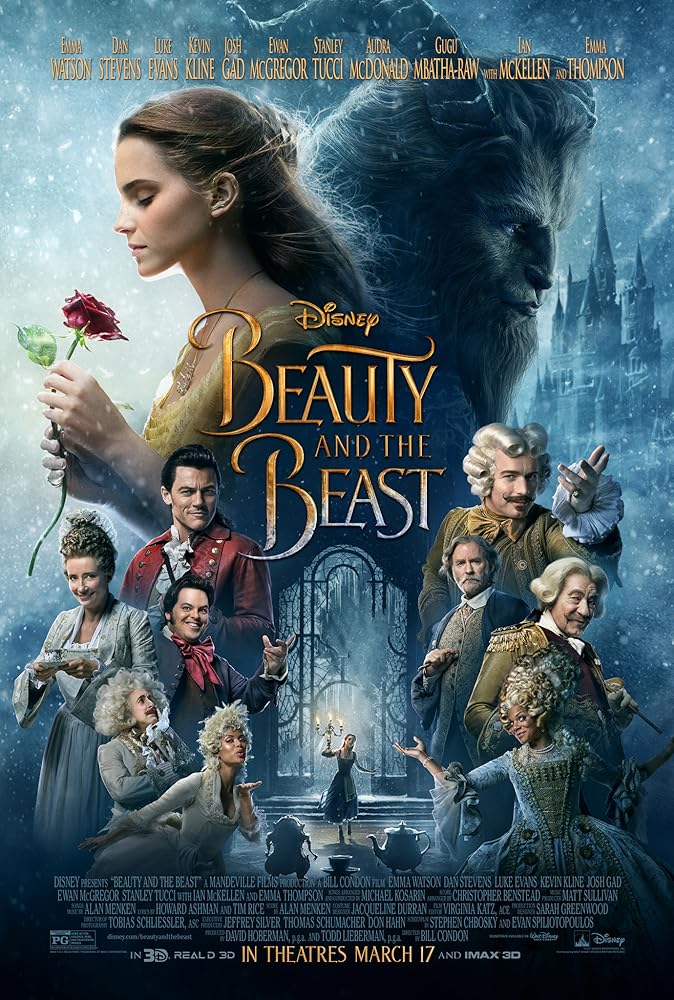
Beauty and the Beast (2017) review


Disney’s been on a roll as of late with their live-action reimaginings of their classic animated films. Granted, this current trend of theirs isn't going over well with ‘everybody’, as I pointed out last time, but, for the most part, films like Cinderella and The Jungle Book have been major successes on both a critical and commercial level instead of just on a commercial one as was initially the case with these films. And for their latest endeavor on this front, Disney revives one of its most beloved stories for a new generation; Beauty and the Beast. The studio’s original animated take on the classic fairytale of the same name from 1756 was the second smash hit of the ‘Disney Renaissance’ era when it was released in 1991. In fact, it was so universally adored that it ended up being the first animated film ever to be nominated for Best Picture at the Academy Awards, a feat that has only been accomplished 2 other times since then by, fittingly enough, a pair of Pixar films; 2009’s Up and 2010’s Toy Story 3, which, of course, were released under the Disney banner. So, yeah, one could say that there was a lot of pressure on this new take on the ‘Tale as Old as Time’, directed by Bill Condon, who's no stranger to musicals having written the screenplay for 2002’s Best Picture winner, Chicago (not to mention directing 2006’s Dreamgirls, which won 2 Oscars), and features an all-star ensemble cast. After all, we’re talking about one of the most famous Disney stories of all time, meaning that this new film has a hell of a lot to live up to. Thankfully, Condon does do justice to this beloved masterpiece of a story with a highly enjoyable new take on Beauty and the Beast that respects its predecessor without being a direct carbon copy of it.

In a quaint little town in France, a young woman named Belle (Emma Watson) is a complete mystery to the rest of the people living there. Never once conforming to the expectations that life tries to set upon her, Belle spends most of her days reading, inventing things, and ignoring the advances of the town’s popular but egotistical local hunter, Gaston (Luke Evans), while also hoping to someday leave the confines of her ‘poor, provincial’ town. That day ends up coming sooner than anticipated when she goes to rescue her father Maurice (Kevin Kline), who had been taken prisoner by a monstrous Beast (Dan Stevens) that resides within a forgotten castle not far from town. To save her father, Belle ends up taking his place as the Beast’s prisoner. But, soon after, she begins to learn the big secret behind the castle and, more importantly, its mysterious owner. As it turns out, years ago, the Beast was a selfish and vain human prince who was cursed by an Enchantress after he had rejected her pleas for shelter. Turning him into a Beast, as well as turning his servants into enchanted household objects, she puts the Prince under the pressure of having to find true love in time before the last petal of the red rose that she initially offered him falls. And, thus, as Belle begins to become more and more accepted by the Beast and his servants, she does begin to fall in love with him, which soon causes problems once Gaston learns of the situation.

Now, admittedly, as far as Disney’s remakes go, this is more like Cinderella than The Jungle Book. By that, I mean that you shouldn't go into this expecting a lot of differences between this new version and the original. It's the same exact story with the same primary plot points. So, with that said, I know what some of you will inevitably say; “Why the hell remake a masterpiece then?” But I'm going to ignore that debate for now because, to me, it all comes down to execution, and I'm pleased to say that this film is very well-made in every possible way. Sure, it's still the same story as the original but I'd say that there are just enough new elements in here, as minor as some may be, that help differentiate it from the original (e.g. a new plotline that reveals why Maurice and Belle stayed in their provincial town for all these years). Visually, this film is a top contender for next year’s Oscar for Best Visual Effects, Production Design, and basically every other major technical award at that ceremony. Yes, a lot of the visuals in this are CG but they are done excellently. And as for the songs, well, what more needs to be said about them? They're the classic songs written by Alan Menken, Howard Ashman, and Tim Rice and are all handled brilliantly in live-action. You'll be tapping your foot along to the beat of ‘Gaston’, marvel at the grandeur of ‘Be Our Guest’, and awe at the beauty (no pun intended) of the title song, ‘Beauty and the Beast’. There's also some great new songs as well, including the sweet recurring melody ‘How Does a Moment Last Forever’, which is sung three times in the film (this includes the end-credits version sung by Celine Dion who, of course, sung the title song during the end credits of the animated film) and the Beast’s new big solo, ‘Evermore’.

One of the best things about the film, though, is its ensemble cast. Because, damn, does this film have one of the most impressive ensembles in recent history. Of course, it's all led by Emma Watson, who does a phenomenal job in the role of Belle. Simply put, she does justice to one of Disney’s most beloved heroines while also doing just enough to provide some nice little updates to the character here and there without ever going against everything that made her great in the first place. And I know that she’s gotten some flak for her vocal performance during the musical numbers but I thought she was fine in that department. Dan Stevens is also fantastic as the Beast, perfectly conveying everything that goes into the character's great redemption arc. As for the villains of the film, both Luke Evans and Josh Gad are clearly having a lot of fun in the roles of Gaston and LeFou, respectively. They ham it up in the best way possible, as Evans perfectly encapsulates our favorite manly but shallow villain while Gad brings new depth to the role of Gaston’s loyal lackey. Kevin Kline is great as well in the role of Maurice, as he portrays the character in a much more toned down manner compared to the original that fits very well with the new plotline that shows why he’s been so protective of Belle all this time. And of course, we can't forget about the Beast’s servants and man did they get a great cast for these iconic supporting roles; Ewan McGregor as Lumière, Ian McKellen as Cogsworth, Emma Thompson as Mrs. Potts, Gugu Mbatha-Raw as Plumette (Fifi in the original film), Audra McDonald as Madame de Garderobe the Wardrobe, and Stanley Tucci as new character Maestro Cadenza the Harpsichord.

And thus, Disney is now 4 for 4 with their recent live-action remakes. I mean, admittedly I don't think I can go as far as to say that it's the ‘best’ of these remakes but I can tell you one thing; it's a hell of a lot better than its current 71% score on Rotten Tomatoes suggests. Thankfully, that's still considered a ‘fresh’ rating but I have the feeling that some of the more negative reviews that the film has been getting have been a lot more stringent on comparisons between the two versions of this story. Like I said before, I can see why this is happening. Because this one is arguably the closest to its animated counterpart out of all the Disney remakes released to date, the word ‘unnecessary’ has undeniably been thrown around a lot. Maybe it is… but I don't care. I love the original (it is, after all, my 3rd favorite Disney animated film of all-time) but I also love this new take on it, as its heart is very much in the right place. Plus, it is a genuinely well-made film in terms of its production design and visuals, not to mention having a fantastic ensemble cast to portray this story’s collection of iconic roles. Simply put, it's just an incredibly satisfying ‘feel good’ film and in this current time, this is exactly the kind of film that we need right now. Just ignore all the negativity in the world for a few hours (especially the negativity directed towards a certain element of this film; more on that in a bit) and enjoy a charming new take on a classic that we all know and love. On that note, to those who aren't big on these Disney remakes, don't worry, for the original animated film is still as perfect as it ever was. This new version is ultimately just like the remakes of Cinderella, The Jungle Book, and Pete’s Dragon; it's a nice complement to the original source.

Rating: 5/5!


(P.S. Well, I should probably address the big controversy surrounding this film because… oh boy. So, as many of you are aware, the film has been getting some flak recently from some audiences after an announcement that stated that it would have Disney’s first ‘exclusively gay’ moment involving the character of LeFou. Because of this, there's been quite a bit of heavy blowback from various parties; some countries banned the film unless cuts were made, a theater in Alabama refused to show it, and in Russia, it was given an adult rating. Yes, in Russia, this film is considered nearly as mature as, say, Logan. To all this, I say… this is one of the stupidest and most overblown controversies in recent memory. This moment that everyone keeps talking about is just one SMALL moment at the end of the film. Heck, if it hadn't been pointed out beforehand, I bet most of us wouldn't have even noticed it because the film’s quite subtle about it. Bottom line, Disney isn't trying to force an LGBT agenda down our throats; they're just trying to represent a wider audience. What the hell is wrong with that? Also, this backlash totally goes against the great positive messages of this film, namely, you know, accepting people for who they really are on the inside. So, yeah… this backlash is frigging stupid.)

Sunday, December 21, 2014

The Hobbit: The Battle of the Five Armies (2014) review


This may be a controversial statement in the minds of some people given the general reaction to this series, but I’ve been a fairly big fan of the ‘Hobbit’ movies. Do I think they’re as good as director Peter Jackson’s previous Middle-Earth trilogy, ‘The Lord of the Rings’? No, not really, but I do think that they’re better than what many people have put them out to be. Of course, the controversy surrounding this adaptation of the classic story of the same name from author J.R.R. Tolkien has mostly stemmed from the decision to split the book into three separate films which many felt was very unnecessary given that the book is only about 300 pages long whereas the ‘Lord of the Rings’ trilogy was based on three separate 300 page books. And sure, some of the problems that would’ve clearly emerged from padding the story out to three films have been present in the previous two films, such as a rather slow pace to start out the story in ‘An Unexpected Journey’ and sometimes feeling rather stuffed as far as characters and plotlines are concerned like in ‘The Desolation of Smaug’. Still, I do feel that these films have maintained the same great atmosphere and sense of adventure that ‘Lord of the Rings’ had, so much so that I can generally ignore a lot of the ‘downfalls’ of the previous two films. But now, the story of ‘The Hobbit’ finally comes to a close on film with ‘The Battle of the Five Armies’ and after seeing this final film, I can safely say that it is without a doubt the best film in the entire trilogy.

At the end of ‘The Desolation of Smaug’, Thorin Oakenshield (Richard Armitage) and his company of Dwarves, with the help of hobbit Bilbo Baggins (Martin Freeman) and wizard Gandalf the Grey (Ian McKellen), had finally reached their homeland of Erebor within the Lonely Mountain, which had been stolen from them years earlier by the vicious dragon Smaug (portrayed through motion-capture by Benedict Cumberbatch). The group tries to kill Smaug by burying him alive in molten gold but that plan ends up failing and Smaug escapes from the mountain in order to enact his revenge on the people of the nearby Lake-town for assisting the Dwarves in their quest while Bilbo and the Dwarves can only watch from afar. As ‘The Battle of the Five Armies’ begins, Smaug begins his attack on Lake-town and while he is ultimately defeated by bowman Bard (Luke Evans, and for the record don’t worry folks this is not a spoiler as it’s literally the opening sequence of the film), who manages to hit him with a powerful black arrow in the one weak spot in his armor, most of the town is effectively destroyed, leaving the surviving residents of Lake-town homeless.

After the surviving residents of the town elect him as their new leader, Bard travels to the Lonely Mountain to talk with Thorin about him and his company holding up their part of the deal that he had made with the people of Lake-town before they had left for the mountain; that they would give them a part of the Mountain’s vast collection of treasure, which would be really helpful for Bard’s group at the moment given the situation that they’re currently in. But Thorin, who has begun to fall to the same ‘sickness of greed’ that had affected his grandfather in the years before Smaug’s initial attack on the Lonely Mountain as he desperately searches for his family’s heir-loom, the Arkenstone (which unbeknownst to him has already been found by Bilbo, who has been hiding it from him due to his change in attitude), refuses to give up any of the gold. As a result, Bard forges an alliance with the Wood-Elves of Mirkwood, led by their king Thranduil (Lee Pace), who is also looking for a part of the Dwarves’ treasure, as they plan an assault on the Lonely Mountain while Thorin’s group prepares for this impending attack. But little do they all know that some other armies are on their way to the Lonely Mountain to seek control of it for their master, who of course was revealed at the end of ‘Desolation’ to be the Dark Lord himself, Sauron (also portrayed by Cumberbatch through motion-capture).

As many of you may have guessed from the film’s title, this is clearly the entry in the ‘Hobbit’ film series where the most action in the story occurs, which is perfectly summed up by the fact that the titular ‘Battle of the Five Armies’ is a 45-minute long sequence and boy is it quite a sequence (and no, I don’t care if this was just one chapter in the book… I’ll get into the whole ‘three films’ thing later on). As far as scale and scope is concerned this is easily the biggest out of all of Jackson’s Middle-Earth films and it truly delivers on the spectacle with some of the best action sequences of the entire series (even when counting what we saw in ‘Lord of the Rings’). But at the same time, the film still holds your attention from beginning to end thanks to solid pacing, meaning the film never really drags at any point. As the final film in this epic story, you can really see how everything has been building up to what happens in this film and in some cases how this trilogy will ultimately lead into ‘Lord of the Rings’. Having only seen those films once, I can’t really say how effectively ‘Battle of the Five Armies’ leads into the previous trilogy as a whole but from the perspective of a general newcomer to the world of Middle-Earth as it has been portrayed in film, to me it seems that it did do a pretty good job in paving the way to its successor trilogy with key references to ‘Lord of the Rings’ showing how things became the way they were. This is a prequel, after all.

But amidst all of the action, Jackson still manages to find enough time for character development, particularly with Thorin and Bilbo. This film is easily Thorin’s story as we see his descent into madness as he obsesses over finding the Arkenstone, succumbing to the same sickness of the mind that his grandfather was stricken with as we saw from the prologue of ‘An Unexpected Journey’. It’s a fascinating look into the psyche of this character who’ve we been with since the beginning of the trilogy and Richard Armitage is easily the biggest standout of this entry in the trilogy. But of course, as it has always been since the first ‘Lord of the Rings’ film all the way back in 2001, the cast is pitch-perfect from top to bottom. Martin Freeman provides a great amount of wit, charm, and also an everyman-like persona in the role of Bilbo, Ian McKellen is his usual badass self in the role of the equally badass wizard Gandalf the Grey, and while only a few of the members of the company of Dwarves, not counting Thorin (e.g. Fili, Kili, Dwalin, and Balin), get any major material to work with, they have a great sense of camaraderie amongst them. That’s been the case since the first film so in the scene where Thorin asks them if they will follow him ‘one last time’, you too are with them because you really felt that you were along for the ride with them. There may be a few characters from ‘Lord of the Rings’ featured here that may not have been in the original book, like Galadriel (Cate Blanchett) and Legolas (Orlando Bloom), but they are a welcome addition here, helping these films feel even more like a crucial part of Jackson’s Middle-Earth universe.

In 2001, Peter Jackson, who at that point was mostly known for splatter films and horror comedies, began a journey into the fictional land of Middle-Earth with ‘The Lord of the Rings’, a trilogy of films that became some of the most highly regarded films of the last few years. A decade later, he returned to Middle-Earth for another trilogy, this time based on the prequel to ‘Lord of the Rings’, ‘The Hobbit’. Some may argue that this second trip to Middle-Earth wasn’t as good as the first one due to the fact that they expanded a rather small book into three big films and in some cases that may be true. But thanks to great direction, a great cast, great visuals, and overall a great atmosphere, I do feel that the same magic that ‘Lord of the Rings’ had is once again present in ‘The Hobbit’, once again showing why Jackson was the perfect man to helm all of these Middle-Earth movies. That is again shown in the final ‘Hobbit’ film, ‘The Battle of the Five Armies’, which is easily the best film in the entire trilogy. Everything has been building up to this finale and it truly delivers in terms of the payoff and the overall spectacle as it is arguably the biggest Middle-Earth movie to date. At this point, it seems like this is the last film for Jackson and his crew in the world of Middle-Earth. Some may feel that this is a good thing given the more mixed reactions to ‘The Hobbit’ compared to ‘Lord of the Rings’, but me personally I’d like to say this to Mr. Jackson; thank you, thank you, thank you for all of the work that you’ve put into your six Middle-Earth movies. It was truly a once-in-a-lifetime cinematic experience that we may never experience again.

Rating: 5/5!

REVIEW EPILOGUE

(Because hey, if Peter Jackson can have multiple endings in ‘Return of the King’, I can have an extra ending to my review of the final ‘Hobbit’ film).


Now before I go, I’m just going to give my final thoughts on the one crucial point of debate in regards to this series ever since the fateful decision to split the story into three films; at the end of the day, was it a good idea? For some people, it wasn’t and I’ll admit that when it was first announced, I too was rather hesitant about it. But now, after seeing all three ‘Hobbit’ movies, I am now actually in full support of this decision, for a few reasons. The big reason why many felt that doing a trilogy of films was a bad idea was that ‘The Hobbit’ is only a 300-page book. However, ‘The Hobbit’ is not as simple a story as some may claim it to be. A lot of things do happen in the story; the characters are introduced, they go off on their journey, they encounter various obstacles along the way, Bilbo acquires ‘the Ring’, they reach Erebor, they face off with Smaug, Smaug escapes, attacks Lake-town, and is killed by Bard, and then multiple armies duke it out over control of the Lonely Mountain before Bilbo finally returns home to the Shire. And that isn’t even all of what happens in this story. Simply put, it can’t really be done in just one film. I know that some people feel that this should’ve been the case with these films but you know what would happen if we just had one ‘Hobbit’ film? Then we’d all be here complaining about how that one film rushed through the entire story. Sure, maybe it could’ve been done in just two movies (that was the original plan, after all) but as for me I’m glad that they didn’t just cram the ‘Battle of Five Armies’ into the second film like I heard some reports claim that it was going to be.

And besides, if anyone was worried about this story being padded out into three three-hour long movies like the ‘Lord of the Rings’ movies were, that wasn’t the case at all. Because while the ‘Lord of the Rings’ movies got longer with each new film, it was the other way around with ‘The Hobbit’ as the films continued to get shorter and shorter, with ‘Battle of the Five Armies’ being the shortest Middle-Earth movie of them all at only 144 minutes. But if the runtime wasn’t the issue for people, it was probably the fact that these movies were rather overloaded with characters and admittedly that is fairly true. There are a lot of characters in this story and while we are primarily following Bilbo and a company of 13 dwarves, only a few of them (not counting Thorin because he’s clearly the most important out of all of them) get any major bits of character development. But you know something? From what I hear, that was a problem in the book as well. In fact, in some cases the book is even more problematic in how it handles its characters, some of whom are barely in it, like Bard the Bowman. From what I hear, in the book he doesn’t appear until his big moment when he kills Smaug, so kudos to the filmmakers for actually giving him a much more substantial role in the film. And on that note I do like the addition of Tauriel in the movies, even if most of her role in the story revolves around her romance with Kili, mainly because it does add some much needed diversity to a pre-dominantly male cast (something that was the case in both ‘Middle-Earth’ trilogies).


In short, I feel that Peter Jackson and his crew were actually aware of the tricky situation they were in when adapting ‘The Hobbit’ to film. I think they knew that the book had some issues with pacing and character development so, as controversial as it may be for some people, I am in full support of the decision to split it up into three separate films. Because while ‘The Hobbit’ is technically a children’s book, it’s not as simple as people think it is. A lot of things do happen in the story so while many people might complain about these movies being over-long (which isn’t actually that much of a problem because they’ve been getting shorter with every film), I’d much rather spend nine hours in Middle-Earth getting to know these characters than just spending about three hours there not really getting to know them at all because the film would be going at an incredibly fast pace. And sure, not all of the characters get that much to do in these films, like most of the company of Dwarves, but while I haven’t read ‘The Hobbit’, from what I can tell the same problem occurs in the book as well and if anything, I think that Jackson should be applauded for expanding on certain characters’ roles in the story, like Bard the Bowman and Thranduil, and I also don’t mind the additions of Tauriel and other characters from ‘Lord of the Rings’ because in the case of the former, these films gain a solid female character in what is a pre-dominantly male cast and in the case of the latter, the appearances of characters like Legolas, Galadriel, and Saruman help this movie feel even more connected to the ‘Lord of the Rings’ films. I feel that Jackson actually did a really solid job at adapting a story that, like it or not, isn’t exactly perfect.