Welcome back to Rhode Island Movie Corner’s end-of-the-year
‘Top 12 Favorite Films list’. This is Part 2 of 4 and today I’ll be listing my
#9, 8, and 7 picks. So let’s not waste any time and get right back to the list…
Three years ago (or four if you want to be specific), a film
came out that no one was really expecting to be any good and to our surprise,
it actually was. Then came its sequel, which then proceeded to blow that first
film out of the water.
9. DAWN OF THE PLANET OF THE APES

I have the feeling that not many people were expecting
2011’s ‘Rise of the Planet of the Apes’ to be any good but to our pleasant
surprise, it was because while it did feature some excellent action sequences
and visuals, it also had a lot of emotional depth as we truly did care about
the main characters, specifically the ape Caesar, brilliantly portrayed via
motion capture by the king of motion capture, Andy Serkis. Serkis returns as Caesar
for the sequel, ‘Dawn of the Planet of the Apes’, now directed by Matt Reeves.
This film takes place ten years after the events of the first film, where at
the end of it the ALZ-113 virus that was developed by the bio-tech company
Gen-Sys was unleashed onto the world, resulting in most of the human race being
wiped out. While all of this is going on Caesar leads a group of apes in the
Muir Woods, safe from the humans that once tried to harm them. When the ape
civilization comes into contact with a group of human survivors that are
currently stationed in San Francisco, the two sides try to get along while the
humans try and find a new power source; a dam that just so happens to be
located right next to the ape community. But soon that brief time of peace
comes to an end as both sides’ hostility towards each other soon escalates into
all-out war.
The main praises that I gave to ‘Rise’ are once again on
display here. The action sequences are superb (including the much talked about
scene where the apes attack the humans while on horseback, which includes one
of the apes attacking a tank as the camera pans around it… a phenomenal action
sequence) as are the visuals but at the same time this is also a summer
blockbuster that’s full of emotional depth. We care about the characters… admittedly
more for the apes than the humans for the most part but that’s beside the
point. And characters that on the surface may seem like your basic character
archetypes, like Gary Oldman’s character Dreyfus, have much more depth to them
than one might expect. The writing is superb showcasing both sides of this
conflict who may try their best to prevent any war but ultimately are just doomed
to face it anyway due to fear and prejudice. The direction from Matt Reeves is
superb and it’s clear that he is a huge fan of this franchise (he’s very much
that clear in interviews). That’s a really great thing that could happen to any
film franchise when a director that loves it helms one of its films as it’s
clear that that director will do their best to try and do the series justice
and that really shows here.
And of course, Andy Serkis is once again phenomenal in the
role of Caesar. It’s been said many times before but I’ll say it again… this
man deserves a frigging Oscar. While many doubt the authenticity of a
motion-capture performance given that it’s a character created by computers,
Serkis continues to prove that there’s much more to it than just that. The man
consistently gives outstanding performances and has a terrific screen presence
and dare I say it, his turn as Caesar is even better than his already fantastic
turn as Gollum in ‘Lord of the Rings’ and ‘The Hobbit’. Equally terrific here
in terms of motion-capture performances is Toby Kebbell in the role of Koba,
Caesar’s second-in-command who later turns against him due to his general
distrust of humans for what they did to him when he was a test subject like
Caesar, which we also saw in ‘Rise’. Koba is quite a multi-layered villain and
Kebbell’s performance shows that Serkis isn’t the only person who can deliver a
superb motion-capture performance. And the performances from the human cast is
superb as well, including Jason Clarke (one of the most underrated actors
working today) in the role of Malcolm, one of the leaders of the human
survivors who forms a strong bond with Caesar, Keri Russell as Malcolm’s wife
Ellie, and Gary Oldman in the role of Dreyfus who, as I noted earlier, has much
more to him than one might expect. In short, ‘Dawn of the Planet of the Apes’
is a superior sequel to an already great sci-fi film and I can’t wait to see
where this franchise goes next.
Time to get controversial folks. My Number 8 film is without
a doubt the black sheep of the four superhero films that came out this year
given its middling reaction from both critics and audiences. I may be in the
minority on it, the extreme minority even, but I loved…
8. THE AMAZING SPIDER-MAN 2
If you ignore ‘The Amazing Spider-Man 2’ for the moment,
2014 quite frankly was the best year yet for superhero films as we had a trio
of awesome films that, SPOILERS, will all appear later on this list. And then
you have ‘The Amazing Spider-Man 2’, which is the only superhero film of the
year to not get stellar reviews from critics and audiences. At first, the
reaction was very polarizing from both critics and audiences, pretty much
making it the 2014 equivalent of ‘Man of Steel’. But now… that opinion has
swayed negative and the film is now collectively regarded amongst the people of
the internet as a major disappointment. So I guarantee that I’m probably one of
the only people in the entire world who will be putting this film in my Top 10
list because I genuinely loved this film. I’ve noted before that, like many
others, I was very hesitant about Sony rebooting the ‘Spider-Man’ franchise
just five years after the last Raimi film was released. But, to my pleasant
surprise, I really liked 2012’s ‘The Amazing Spider-Man’, so much so that it’s
now my personal favorite film in the series. While it will never escape the
fact that it’s a fairly rushed reboot that basically just re-did the whole
origin story that we saw in the first Raimi ‘Spider-Man’ film, I felt that in
some ways the film actually improved on certain elements of the Raimi trilogy,
namely that I actually cared more about the characters this time around and
that Andrew Garfield and Emma Stone were far superior leads.
‘The Amazing Spider-Man 2’ was my most anticipated film of
this past year and while some may question why it was this over something like
‘X-Men: Days of Future Past’ or ‘Guardians of the Galaxy’, the simple reasons
were that A.) I was a bigger fan of Spider-Man than X-Men and B.) We hadn’t
seen any real footage from ‘Guardians’ at the time that I first posted my Top
10 Most Anticipated Films of 2014 list back in September 2013. In short, my
excitement for the film was primarily based on my love of the previous film.
But like I said, this film was immediately met with a polarizing response from
most people. The biggest reason for this was because, like with the other
polarizing Spider-Man film, ‘Spider-Man 3’, this film also featured three
villains in just one film, showing that the filmmakers hadn’t learned from the
one major issue with ‘Spider-Man 3’ (and no it wasn’t the Emo Peter thing…
thankfully this series hasn’t gone that route yet)… that having three villains
in just one film was just way too much. And while it’s true that both films are
crowded when it comes to the villains, I actually think that ‘Spider-Man 3’ is
still the bigger mess when it comes to its villains and plotlines compared to
‘The Amazing Spider-Man 2’. Now let me be clear, while I don’t necessarily
‘love it’, I don’t think ‘Spider-Man 3’ is as bad as the internet has put it
out to be. Still, it’s not without its flaws, namely in its villains. While one
may argue that the villains in ‘Spider-Man 3’ were slightly better written than
in ‘ASM2’, I still, to this day, cannot figure out just who the main villain
was supposed to be as all of them (Sandman, New Goblin, and Venom) tried to hog
the spotlight to the point where none of them really stood out.
‘The Amazing Spider-Man 2’, on the other hand, at least
makes it clear that while there are three villains in the film, Electro is the
main villain; simple as that. Sure, Harry Osborn (AKA Green Goblin) is a major
player in the story and in a sense could technically be the main villain of the
film but he’s only on-screen as the Goblin for a few minutes so I don’t really
consider him to be the main villain. The same goes for Paul Giamatti as Rhino,
and while I’ve heard many complain about giving such minimal screen-time to
such a great actor like Giamatti, the fact that it seemed like he would be back
for future films (more on that ‘future films’ thing later) was ultimately why I
wasn’t really bothered by it. Now not only did many feel that the film was
overstuffed with characters, but they also felt that it was a crowded narrative
with too many plot-points to keep track of in just one film. That’s where I
disagree with most people. It may just be me, but I never really felt that this
film was as overcrowded as people have said. Sure, some characters barely get
any major screen-time (like Felicity Jones’ Felicia (AKA Black Cat from the
comics) and B.J. Novak as Alistair Smythe, who in the comics creates a series
of robots known as the ‘Spider-Slayers’) but overall, like I said, the film at
least managed to keep track of who its main villain was and also maintained proper
focus on Peter and Gwen. And I didn’t even feel that there were too many
plotlines in the film either; I felt the story was fairly self-contained though
the idea of this film serving as a gateway to expand this series’ universe
ultimately results in the only major gripe I have about this film (again, more
on that later).
I’m not trying to compare these two films or anything, but
‘The Amazing Spider-Man 2’, to me, reminds me of ‘The Dark Knight’ in how
director Marc Webb’s direction for this film was much more confident than it
was in the first film, similar to how Christopher Nolan improved on the biggest
faults of ‘Begins’ in ‘The Dark Knight’, namely the action sequences. The
action in ‘Amazing Spider-Man 2’ is far better as is the design of Spider-Man’s
suit and the visuals are superb. Say what you will about the narrative but I
feel that Webb progressed further as an action director. I’m not saying the
action in the first ‘Amazing Spider-Man’ was bad but there was definitely room
for improvement and I think that gave Marc Webb some much needed experience
that very well paid off with the sequel. Andrew Garfield and Emma Stone are
once again fantastic in the roles of Peter and Gwen, respectively. Garfield
once again proves why he’s the best film Peter/Spider-Man showing off the
smart-alecky attitude that the character is known for, which is something that
Tobey Maguire just never had. At the same time, he also perfectly captures Spider-Man’s
devotion to the people of New York with his likable persona, the main reason
why Spider-Man has been many people’s, including myself, favorite comic book
superhero. Stone is just as radiant and charming as ever as Gwen with the two
having phenomenal chemistry that is miles above anything we saw from Tobey Maguire
and Kirsten Dunst in the Raimi trilogy. And they’re backed up by a solid
supporting cast that includes the likes of Sally Field, who’s just been
fantastic in these movies as Aunt May (the scene where she tells Peter that
he’s ‘her boy’ is one of the best damn scenes in the entire movie) and Campbell
Scott as Peter’s father Richard.
But now let’s move onto the villains. First up, there’s
Electro and I’m really glad that the writers decided to go with a new villain
for this film instead of rehashing an old villain (and yes I say that even though
Green Goblin’s in this; I was referring to the ‘main villain’). Now in a way
Jamie Foxx was arguably a little miscast in the role in regards to the scenes before
his character Max Dillon becomes Electro. In this film, Dillon has a lot in
common to Jim Carrey’s Edward Nygma (pre-Riddler) from ‘Batman Forever’ (and
yes, many have made comparisons to Schumacher’s ‘Batman’ films and let me tell
you folks, for as campy as some lines in this movie are, nothing will ever top
the campiness of Schumacher’s ‘Batman’) in terms of his awkward persona. Still,
I actually think Foxx did a decent job with what he had to work with and up
until he truly becomes the villain (admittedly in a rather rushed manner in
regards to how he starts to hate Spider-Man after initially being his biggest
fan but we’ll forget that for now) he does do a great job at being very
sympathetic as a man who only wants the world to notice him as he has spent
most of his life invisible to those around him. It isn’t until he truly becomes
Electro when he finally starts to get noticed. By the way, the design of the
character (which is very much in line with the ‘Ultimate Spider-Man’ version of
the character, which makes sense considering that this film series is heavily
inspired by that comic series) was terrific. I know that some people were
hoping to see the original design implanted for the character instead but…
 |
| Yeah... I don't see this translating to film very well... moving on... |
Then we have Harry Osborn and Dane DeHaan does an excellent job
here, giving us a much more sinister take on the character than what we ever
saw from James Franco in the role. What else can I say? DeHaan just has a knack
for playing sinister-looking characters as proven by his excellent turn in 2012’s
‘Chronicle’, and really he does them well. What’s even better is that while his
character is clearly being set up as one of the main villains, he also managed
to make us sympathize with him at times (again, like he did in ‘Chronicle’), as
shown through his desperation in terms of finding a cure for the illness that
he inherited from his father Norman (Chris Cooper, in a very brief cameo but
from what I hear he may have been brought back in future films given the fact
that there was apparently a post-credits scene that got cut where we saw his
head cryogenically frozen). Scenes like that did actually make me feel sorry
for him at times. True we don’t really see him interacting with Peter that much
before he starts being a threat to him but even in that brief span of time I
could still sense the friendship between them thanks to the solid camaraderie
between Garfield and DeHaan. Finally, with Paul Giamatti, even in his very,
very brief appearance in the film, it’s clear that he’s having a lot of fun
here as he very much hams it up (in a good way) as Rhino. Sure, he could’ve
benefitted from having some damn subtitles for his dialogue as it was pretty
hard to understand anything that he was saying but given the fact that he’s
only in the film for about a few minutes, again I’m not too bothered by that
either.
Now let’s talk about the ending. I’m just going to say it,
regardless of your opinion on this film, you cannot deny the fact that the
climax scene where Gwen tragically dies despite Peter’s best attempts to save
her was not only one of the best scenes in the entire movie but one of the best
and most emotionally heartbreaking scenes of any film this year. True, it might
not 100% stay true to how the scene played out in the comics, where she fell
from a bridge whereas here she falls from the top of a clock tower, but that’s
okay because this sequence was technically already done (albeit under different
circumstances) in the first Raimi ‘Spider-Man’ film and the emotions conveyed
by Garfield in this scene are absolutely superb. Also, I liked the ending too,
despite some people feeling that it was a rather awkward and rushed transition
coming off of Gwen’s death. I disagree though because if you ask me, the emotional
weight of this tragic event are still perfectly conveyed even in a brief period
of time. I also don’t mind that it ends on a much happier note as Peter returns
to being Spider-Man after giving it up for a few months after Gwen’s death. And
sure, it could’ve been rather cool for the filmmakers to take the gutsy
approach and not end on a happy note but this is a Spider-Man film for crying
out loud, not a Batman film. I’d much rather have a Spider-Man movie end on a
positive note than a negative one (I’m looking at you, Spider-Man 3).
But now let’s get back to that one thing that I said was my
only major gripe about this film. Like I said, I felt that the story was
actually fairly self-contained despite the fact that this film was being pegged
as being the film that was to set up the developing cinematic universe a la
Marvel. But ultimately, this film doesn’t do much to set all of that up apart
from a brief exchange at the end of the film between Harry and the mysterious
‘man in the shadows’ from the first film, revealed to be a man named Gustav Fiers
(known as ‘The Gentleman’ in the comics). It’s been clear that Sony is looking
to do a Sinister Six movie and quite frankly I really want to see that one get
made. I really am intrigued by the idea of a film based around six of
Spider-Man’s villains and not primarily centered around Spider-Man but Sony, if
you want to set up your own cinematic universe, you have to actually do enough
to set it up and you don’t do that here. This also shows that after two films,
Sony really needs to get their butts out of the editing room because both
‘Amazing’ films have shown proof that some crucial material in both films
clearly ended up on the cutting room floor like the stuff with Peter’s parents
in the first film. In the case of this film, there are plenty of scenes that
were for some reason cut out of the final product; some, as many have pointed
out, were even featured in the trailer which was also criticized for giving
away too much, namely Gwen’s death and the final shot of Spidey fighting Rhino.
This whole scene between Harry and Fiers feels like it was just added in at the
last minute as a result of Sony trying to find a way to tie this film into
future films and really this was probably the only place they could add
anything in. Even Andrew Garfield has admitted that Sony made a lot of edits to
the story and that the original version of the screenplay was much better so
there’s no excuse, Sony.
And seeing how this film has been both a commercial and
critical disappointment, it’s looking like very soon Spider-Man’s rights will
be returning to Marvel Studios and really, I’m now at the point where I’ve
accepted this and I also feel that it is a good move. Because it’s much better
for Spider-Man to be with a studio that has clearly shown that they know what
they’re doing than a studio that at the moment is reeling after the whole
‘hacking/The Interview’ debacle. I’m not one of those people who think that
Sony butchered the character with these reboot films. Instead, I think the
problem was that because Sony didn’t want to give up the rights to the
character, they just decided to throw a whole bunch of things together to see
if it would all stick (just like DC… hi-yo!!!!!). But in the end, I will defend
both ‘Amazing Spider-Man’ movies as being better than what people are giving
them credit for, especially ‘The Amazing Spider-Man 2’ because I’ve heard some
even say that this is the worst superhero movie of all time which, I’m sorry,
is just a load of BS. I can understand if you didn’t like this film as much as
I did but it is FAR from being the worst superhero film of all time when I can
name plenty of superhero films that are far worse than this one, like ‘Batman
and Robin’, ‘Catwoman’, ‘Superman IV: The Quest for Peace’, and ‘X-Men Origins:
Wolverine’ just to name a few. Bottom line, I still love this film. Do I think
it’s perfect? No, but quite frankly I’m at the point where I actually prefer
these movies to Raimi’s trilogy. Don’t get me wrong, I still like the Raimi
trilogy, but it’s very far from being a perfect trilogy whereas I feel that
Webb’s films have at least managed to improve on some of the previous trilogy’s
biggest flaws even if these new films aren’t that perfect either.
This year, a three-part journey finally came to an end and
while many have been rather mixed about it due to a fateful decision to split
it up into three parts, I’m not one of them. Ranking the highest on one of my
year-end ‘Best of’ lists out of all three films in the series is…
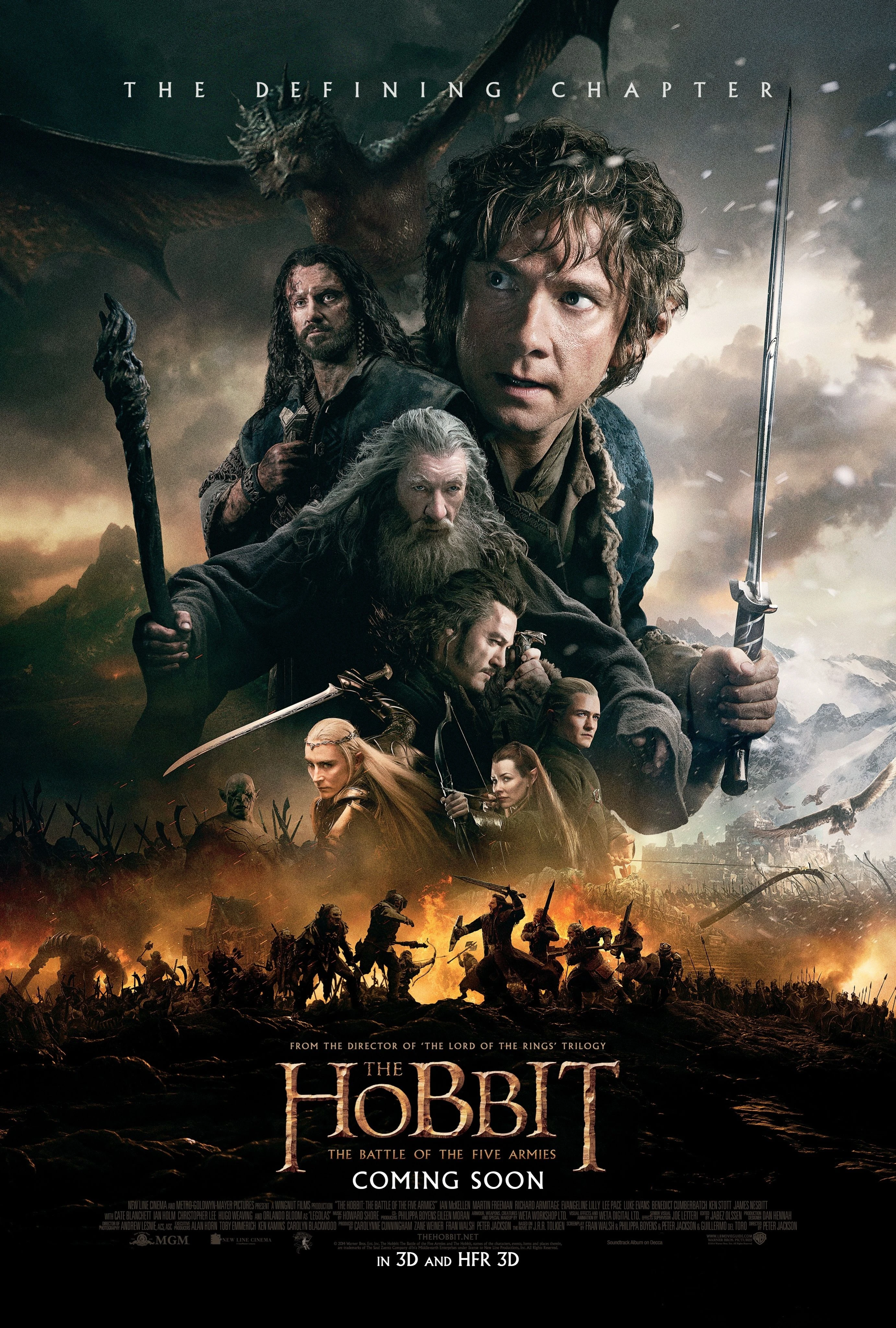
7. THE HOBBIT: THE BATTLE OF THE FIVE ARMIES
Having now seen all three ‘Hobbit’ films, I can safely say
that I am now in full support of the controversial decision to split up the
‘Hobbit’ into three films (the second instance this year where I’m in support
of a controversial split, by the way, the other one being ‘Hunger Games’). Most
have felt that ‘The Hobbit’ should’ve just been one film and in a sense it
probably could be one film… but then we’d all be here complaining about how it
rushed through everything. That’s because when you really get down to it, while
many claim that ‘The Hobbit’ is just a simple kids book, it’s not really ‘as
simple’ as they say it is. A lot of things do happen in ‘The Hobbit’; we’re
introduced to the characters, they start off on their quest, Bilbo comes across
the One Ring, they come across a whole bunch of obstacles like Goblins, Spiders,
Elves, etc., they try to kill Smaug, etc., etc. And after Smaug is finally
killed, we still have the whole ‘Battle of the Five Armies’ to get through
whereas in another children’s book, the story would have ended after the dragon
is defeated. Bottom line, you can’t do ‘The Hobbit’ in one film; otherwise,
you’d just rush through everything without giving much time for us to care
about any of the characters because we wouldn’t know that much about them.
Maybe it could’ve just been done in two movies (that was the original plan,
after all) but quite frankly I’d much rather spend more time in Middle-Earth
getting to know these characters more rather than just spending about three
hours not knowing any of them because the film would be going by at a breakneck
speed.
But if it wasn’t the fact that this story was stretched out
into three films was the main reason why many have been so mixed about these
films, then there’s also the argument about how the films are overloaded with
characters, with some, like most of the Company of Dwarves, not getting much to
do. And that’s actually true… but from what I can tell, it’s the same in the
book as well and in some cases, it’s even worse there. Certain characters like
Bard and Thranduil only have brief appearances in the book and it seems like
the only role of the Company of Dwarves in the story is to not really do
anything and constantly getting captured, resulting in Bilbo always having to
save their asses. In other words, I actually applaud Peter Jackson and his crew
for fixing these problems by A.) Giving characters like Bard and Thranduil more
substantial roles in the story, B.) Adding in a female character, Tauriel, to
the ‘dick-fest’ that is Middle-Earth (sorry to be so literal about it, but it’s
true… the casts in both Middle-Earth trilogies were predominantly male) and C.)
Making it so that the dwarves didn’t seem so incompetent. So in conclusion, I
support ‘The Hobbit’ being split into three films because ‘The Hobbit’ is not a
perfect story. It has problems and I feel that Jackson and his crew were aware
of this so they tried their best to expand the story, which of course was done
through three films. Sure, some problems did occur when it was translated to
film but that’s what happens when you adapt a story where the main group consists
of 13 frigging dwarves despite the fact that only about 4 of them (not counting
Thorin because he’s obviously the most important one of the group) get anything
major to do.
Okay, rant over, now onto the actual film. ‘The Battle of
the Five Armies’ is without a doubt the best film in the entire trilogy.
Everything’s been building up to this climactic battle and it doesn’t
disappoint. It’s the biggest Middle-Earth film to date in terms of its scale
and scope. The action sequences are awesome and the visuals are superb, but in
between it all, they still give time for calmer character moments, particularly
in regards to the relationship between Bilbo and Thorin. Thorin in particular
is the true star of this entry in the trilogy (and as such, Richard Armitage is
the major standout of this already superb cast in this film) as we see him slowly
descend into madness as he desperately searches for his family’s heir-loom, the
Arkenstone, which unbeknownst to him has already been found by Bilbo who has
been keeping it from him because he recognizes Thorin’s change in attitude.
When they’re on the brink of war with Bard and Thranduil’s forces, Bilbo gives
them the Arkenstone so that they can use it as a bargaining chip against
Thorin. Of course, when Thorin finds out that Bilbo gave it to them, obviously
he doesn’t take it very well and banishes him (in fact he even tries to kill
him at first before he’s stopped by Gandalf). It isn’t until after the battle
when Thorin is on his deathbed that he finally makes peace with Bilbo, which is
easily one of the strongest scenes in the entire movie.
This has truly been one hell of a journey that we’ve been on
and while we may not have gotten to know all of the dwarves in Thorin’s
company, their strong camaraderie really helped make it feel that we too were
on the journey with them. So in the middle of this film when Thorin asks them
if they will follow him ‘one last time’ and they run out into battle, I’m not
going to lie, I got goose-bumps watching that scene. You can’t go wrong with a
tagline like ‘one last time’ now, can you? And it all ends with the best
end-credits song of the entire franchise, ‘The Last Goodbye’, performed by none
other than Peregrin Took himself, Billy Boyd. All I have to say about it is
this… it better get a damn Oscar nomination for ‘Best Original Song’ because
this is easily one of the best film songs this year, if not the best. I’m not
going to lie, I got a little emotional watching this film knowing that it was
all coming to an end. And in my honest opinion, the journey was worth it. Yes,
there are still those who feel that ‘The Hobbit’ shouldn’t have been a trilogy
of films based around such a small book but if you ask me, giving that there’s
more to it than people think there is, it was actually a really smart decision
as it allowed the filmmakers to expand more upon this story which like it or
not isn’t necessarily perfect. In short, ‘The Hobbit: The Battle of the Five
Armies’ is a fitting conclusion to a trilogy of films that are much better than
the internet has put them out to be (damn I’m saying that a lot in this list,
aren’t I?).
Check back tomorrow
for Part 3, where I lists films #6-4…


