Monday, October 12, 2015

The Walk (2015) review


In a way, this film sort of has a bit of a chip on its shoulder as it is a film released in the post-9/11 era that is based almost entirely around the Twin Towers of the World Trade Center. But hopefully that doesn’t completely turn people away from this film because it actually focuses on a true story of the Twin Towers that was magnificent instead of tragic. When the towers were first built in 1973, the initial reaction towards them was generally negative amongst New Yorkers, many of whom referred to them as being ‘ugly’ and ‘oversized’. But on August 7th, 1974, that all changed when French high-wire artist Philippe Petit ‘humanized’ the Towers by tightrope walking between them, situated at least 1,350 feet up in the air. This unique part of history had previously been explored in the 2008 documentary ‘Man on Wire’, which won the Oscar for Best Documentary that year. This year sees the release of a new adaptation of Petit’s story in the form of ‘The Walk’, directed by Robert Zemeckis, director of numerous film classics including ‘Forrest Gump’, ‘Who Framed Roger Rabbit’, and my all-time favorite film trilogy, ‘Back to the Future’. With ‘The Walk’, Zemeckis achieves a pure cinematic achievement by giving us a film that is not only visually stunning but also one that is full of heart that will hopefully inspire others to follow their dreams, however impossible they may seem.

As he narrates throughout the film while stationed on the torch of the Statue of Liberty, we are introduced to Philippe Petit (Joseph Gordon-Levitt), who in 1973 was a juggler/wire-walker who performed daily in the streets of France having been inspired to become a performer after a trip to the circus when he was younger. One day, after a minor incident during a performance requires a trip to the dentist, he learns about the Twin Towers that are currently under construction in New York City from a magazine. Inspired to tight-rope across the towers before they are completed, Petit starts to train in the art of high-wire walking under former circus performer Papa Rudy (Ben Kingsley) and begins to plan his coup to walk across the Twin Towers with the help of his girlfriend Annie (Charlotte Le Bon) and a few other ‘accomplices’ as well, including photographer Jean-Louis (Clement Sibomy) and algebra teacher Jeff (César Domboy). Once in New York, Petit comes across additional help as well in Barry Greenhouse (Steve Valentine), a life-insurance agent who works at the Towers, French speaking local New Yorker Jean-Pierre (James Badge Dale), a second photographer named Albert (Ben Schwartz), and stoner David (Benedict Samuel), who all help Petit as he undertakes the illegal operation of rigging his wire from the observation decks of what were, at the time, the tallest buildings in the world.

Obviously the biggest selling point of the film is the 20-minute sequence at the end in which Petit performs his famous high-wire act between the towers. Zemeckis has stated that he wanted the audience to get an idea of what the view was like for Petit on the high-wire instead of just looking at it from the audience’s usual perspective down below and he definitely succeeds in that regard. This was a film that was made for IMAX 3D, effectively making you feel like you’re on the high-wire along with Petit. Though with that said, it has been reported that some audiences ended up getting sick during this part when the film first premiered in New York. So if you’re scared of heights, this definitely isn’t your kind of film. But hopefully that doesn’t completely discourage some of you from seeing this film because the high-wire walk really is one of the best film moments of the year and even though you know what’s going to happen, you’re still on the edge of your seat throughout this entire sequence. The buildup to it is really great as well. Again, while we may know how everything turns out, it’s actually really fun to watch Petit and his team undertake their obviously illegal operation. We see how Petit comes across his ‘accomplices’, how he and his team figure out how to rig the wire to the towers, and see them overcome certain obstacles and issues. It’s all done at a brisk pace that makes the film compelling throughout.

One of Robert Zemeckis’ greatest strengths as a director is that he really knows how to find the heart and characters within an unbelievable story. And one of the reasons why this film works as well as it does is because while it is definitely a visually beautiful film, it also has a great amount of heart to it as well. It’s an awe-inspiring tale of the strength of the human spirit and how one man was able to make a seemingly impossible dream of his possible, which in turn can hopefully inspire others to make their own dreams a reality. A lot of this is due to Joseph Gordon-Levitt’s phenomenal lead performance as Petit. Not only does Levitt get the French accent down very well but he also exudes a ton of charisma, which is obviously a key thing for anyone who is a performer. Levitt is backed up by a very nice supporting cast of characters headlined by Ben Kingsley as Petit’s wise mentor Papa Rudy and Charlotte Le Bon as his lovingly supportive girlfriend Annie. But then there are a few other members of Petit’s band of accomplices that also stand out as well, particularly James Badge Dale as the French speaking New York native Jean-Pierre and César Domboy as Jeff, an algebra instructor who has to overcome a fear of heights in order to help Petit achieve his dream. While some of the members of the team are introduced perhaps just a bit too late into the film to get any real chance to stand out amongst their peers, namely the secondary photographer and the stoner, most of the other members of the group do at least get their own moments to shine during a film that ultimately belongs to Joseph Gordon-Levitt.  

I legitimately have no idea why this film isn’t doing so well at the box-office despite getting great reviews. Is it because of the ‘post-9/11’ thing or the fact that some people got sick watching this film’s climax? Whatever the reason is, I sincerely hope that this doesn’t become this year’s next ‘Tomorrowland’, especially when considering that both films wear their hearts on their sleeves and honor the dreamers of the world. I’ve said it before and I’ll say it again; we need more films like this that promote positive messages of hope and perseverance that will hopefully inspire future generations to dream big. Obviously the biggest aspect of the film is the scene in which Petit walks across the towers, a visually stunning sequence that makes the film an absolute must-see in IMAX as well as the best 3D film that I’ve seen this year. Hopefully 9/11 isn’t one of the reasons why this film isn’t doing so well commercially because even with all that happened on that day in mind, this film is actually a very touching tribute to the Twin Towers in how it honors a joyous moment in the history of the Towers that were originally built as a symbol of hope. I’d also like to point out that this film ends on a particularly poignant note that doesn’t actually bring up 9/11 but does clearly allude to it, resulting in a pretty darn powerful conclusion to what is easily one of my favorite films of this year.


Rating: 5/5!

Saturday, October 10, 2015

Pan (2015) review


In 1904, author J.M. Barrie wrote the play ‘Peter Pan, or the Boy Who Wouldn’t Grow Up’, which was later published as a novel in 1911. The play/novel centered on the titular Peter Pan, a young boy who, as indicated by the title of the story, ‘never grew up’ and can fly as he has numerous adventures in the fantastical world of Neverland. Numerous stage productions of Barrie’s play have been put on over the years and the character of Peter Pan has also been brought to the big-screen multiple times. Most of you are probably familiar with the 1953 animated film from Disney but there were some other adaptations after that, including a 1991 sequel in director Steven Spielberg’s ‘Hook’ and a 2003 adaptation of the original story that many consider to be highly underrated as it was an underperformer at the box office when it was first released in theaters. This year sees the release of another take on the character of Peter Pan in the form of ‘Pan’, directed by Joe Wright, a director known for classical romance films like ‘Pride and Prejudice’ and ‘Anna Karenina’. As for ‘Pan’, it takes a different route from previous adaptations by serving as a prequel to the original story, showcasing how a young Peter first came to Neverland and how he first met the man who would later become his most notable adversary, Captain James Hook. But ultimately this new take on Peter Pan ends up majorly suffering from the curse of ‘prequelitis’ despite having a genuinely creative vision of this world.

The film begins as a young Peter is left at a London orphanage by his mother Mary (Amanda Seyfried). 12 years later, in the midst of World War II and the Blitz, Peter (Levi Miller) lives his average life in the orphanage, frequently getting into trouble with his caretakers while also yearning for the day when his mother will finally return for him. But then everything starts to change when, one night, Peter and some of the other orphans are taken from their beds by pirates in a flying pirate ship, which then takes them to the world of Neverland. There they are forced into being slaves for the ruthless pirate Blackbeard (Hugh Jackman), who has them mining all-day for the substance known as fairy dust so that he can stay young forever. Peter soon learns that he may just be the boy talked about in an ancient prophecy established by the natives of Neverland; the offspring of a human mother and a fairy father who can fly that will one day lead the native people of Neverland in an uprising against Blackbeard. This leads to him teaming up with fellow miner James Hook (Garrett Hedlund), and later warrior princess Tiger Lily (Rooney Mara), in order to stop Blackbeard before he ends up finding the secret fairy kingdom of Neverland.

There’s no denying that Joe Wright definitely put a lot of effort into bringing his vision of Peter Pan and the world of Neverland to life. This film’s biggest strength is easily its art/production design, which produces quite a lot of interesting visuals as well as some pretty fun action sequences, from a scene early on where a pirate ship flies through London while being chased by fighter pilots to a scene in which Hook and one of the natives fight on a bunch of trampolines. With that said, yes there is quite a lot of CGI in this film but unlike a lot of other critics, that is not my biggest issue with it. Ultimately the main issue comes with the writing. From a prequel standpoint, this film suffers from the same issue that plagued the ‘Star Wars’ prequels in that the references made to the original story, from the alligator that would go on to chase Hook to, of course, Tinker Bell, generally lack subtlety. Not only that, but the plot also feels a bit rushed, getting through key scenes quickly at the expense of character development. Obviously a key part to this story is the relationship between Peter and Hook but the film never once explores how the two end up becoming rivals, basically leaving that door open for a sequel that will probably never happen.

As far as the cast is concerned, Wright definitely selected a nice ensemble to fill out the main roles. As Peter Pan, Levi Miller brings the right amount of childlike innocence and charisma to the role. The same, save for the childlike innocence part, can be said for Garrett Hedlund as Hook. Clearly modeled after Han Solo (in fact, the main trio of Peter, Hook, and Tiger Lily are basically just Luke, Han, and Leia), Hedlund is very charismatic and energetic in the role and provides some of the film’s best comedic relief. The casting of Rooney Mara as Tiger Lily attracted quite a bit of controversy due to the fact that a Caucasian actress was cast in the role of a Native-American character. Not paying that any mind due to the fact that I never like to talk about race here, I will say that Mara is actually the biggest standout of the film, as she provides a much more serious and down-to-earth performance that actually contrasts pretty well with all of the chaos that goes on in this film. And then we come to Hugh Jackman as the main villain, Blackbeard… and as much as I hate to say it he’s the weakest link of the film. For the record, Jackman does bring the same level of enthusiasm and energy that he brings to a lot of his other roles and it’s clear that he’s really having fun in what is a rare villainous turn for him. I get that the character of Blackbeard was meant to be a fairly exaggerated villain and Jackman’s over-the-top performance matches up pretty well with the overall tone of the film but sometimes it’s just a bit too much, like when he and his lackeys start singing Nirvana’s ‘Smells Like Teen Spirit’ and Ramones’ ‘Blitzkrieg Bop’.

I really wanted to love ‘Pan’, I really did. I do remember watching the Disney film growing up and recently I’ve been really big on there being more PG-rated family films in an industry that’s lately been dominated with films that are rated PG-13 and up. But ultimately ‘Pan’ just ended up giving off a vibe similar to that of the ‘Star Wars’ prequels… and keep in mind that I don’t ‘hate’ those films like the majority of the internet does. Now I can’t fault this film for its creative vision because it is there. The film does carry the right spirit of adventure that’s necessary for this kind of story and the film’s unique production/art design does result in some fun moments from time to time. But at the end of the day ‘Pan’ is a prime case of a prequel that legitimately suffers from the curse of ‘prequelitis’, mostly due to a story that is rushed and references to the original source material that aren’t at all subtle. No it’s not the worst film that I’ve seen this year, heck it’s not even as bad as the 22% rating on RT currently suggests. But at the same time it wasn’t really a film that I was a big fan of either. It genuinely had good intentions to be a fun family film so for families, I actually do sort of recommend it even after all that I’ve just said about it. I have the feeling kids may like it. Ultimately though for me, it ended up being a rather muddled and misguided take on the classic story of Peter Pan even though its heart was in the right place. Dare I ask… why couldn’t this just be done by Disney?


Rating: 2/5

Friday, October 9, 2015

BOND MONTH: Top 10 Title Sequences

There are two key elements to almost every Bond film’s credits sequence; the main theme, the best of which we’ll be addressing next week, and the title sequence that accompanies both it and the credits. Since the James Bond series first began in 1962, there have been three main people, and one company, that have been responsible for all the title sequences of every Eon produced Bond film. First there was Maurice Binder, who not only created the opening titles for 14 of the first 16 Bond films but also the iconic gun barrel sequence that opens almost every Bond film, save for the Craig films in which they appear later on or before the credits. The two title sequences that Binder did not produce, ‘From Russia With Love’ and ‘Goldfinger’, were instead developed by graphic designer Robert Brownjohn, who implemented what would become one of the main staples of Bond title sequences; scantily-clad women. Following Binder’s death in 1991, Daniel Kleinman took over as the series’ main opening titles artist. The only Bond title sequence he didn’t create was ‘Quantum of Solace’, which was instead done by animation company MK12, who had worked with director Marc Forster on some of his previous films like ‘Stranger than Fiction’. But Kleinman did return to do the opening titles for ‘Skyfall’ and will of course be creating the opening titles for ‘Spectre’. So today, continuing on with Rhode Island Movie Corner’s second annual Bond Month, I’ll be listing my Top 10 personal favorite Opening Title Sequences from the past 23 Bond films. But first, I’ll start with my Top 5 Least Favorites.

5. DIE ANOTHER DAY


I don’t necessarily fault Daniel Kleinman for this film’s less-than-stellar opening credits sequence because for what it’s worth, his contributions to it are actually pretty solid. I do like the contrasting use of fire and ice, even though fire never really plays a major part in the film compared to the ice (e.g. Gustav Graves’ ice palace). But the one major downfall to these titles is that it doesn’t feel like Kleinman was able to have full control over it, as his visuals are set over scenes of Bond being tortured while he is held captive in Korea after the events of the pre-credits sequence. Obviously it helps to move the story along but it truly does feel like Kleinman was limited in what he could do when it came to designing the sequence because he had to work around the footage. There’s literally no other Bond film that’s like this when it comes to actually having the titles play over a scene from the film. The closest that these films ever came to having something similar to this was in ‘Goldfinger’ and ‘On Her Majesty’s Secret Service’ but in both of these sequences it was the clips from the film, or ‘films’ in the case of the latter, that were implemented in and not the other way around. So ultimately this title sequence just becomes one of the many weaknesses of ‘Die Another Day’, the film that effectively resulted in the series being rebooted four years later. 

4. FOR YOUR EYES ONLY


This sequence was notable for being the first Bond title sequence to actually implement the singer of the main title song, in this case Sheena Easton, into the sequence itself. But ultimately I don’t think that this is a particularly stand-out sequence as far as Bond Opening Titles are concerned. The same thing could actually be said for the film ‘For Your Eyes Only’ in general as it was a rather ‘middle-of-the-road’ entry in the series; not bad but not particularly great either. Prepare to hear this next point a lot during this post, but this sequence ends up utilizing the same old motifs of silhouetted women and watery backgrounds that were basically the basis for almost all of Roger Moore’s Bond films’ title sequences and, suffice it to say, it got old after a while. And part of me kind of feels that the use of Easton in this sequence is rather awkwardly executed. Even Easton has admitted that shooting the sequence was a rather unpleasant experience, to the point where Maurice Binder had to attach her to a chair so that she wouldn’t move when the camera zoomed into her lips. All in all, I don’t think that this is a ‘terrible’ title sequence but I think it could’ve turned out better.

3. MOONRAKER AND 2. THE LIVING DAYLIGHTS


I’m pairing these two title sequences together because ultimately I can’t really say that much about either of them. The only real thing I can say about them is that the reason why they’re in the ‘Bottom 5’ is the same argument that I made earlier with ‘For Your Eyes Only’. These two are prime examples of when the standard motifs of the franchise’s title sequences started to get old. The titles for ‘Moonraker’ don’t even have a lot of references to the film’s theme of space save for a few shots of the moon, the earth, and the night sky. But with that said, those shots that are in there keep ‘Moonraker’ from being ranked lower than ‘The Living Daylights’. That film’s title sequence is as standard as you can get when talking about James Bond title sequences. It’s nothing but the same old motifs of scantily-clad women floating in water and that’s really about it. There’s an interesting motif of having a man and woman standing side by side holding guns but the thing is, that doesn’t actually connect that much to the film because while I do think that Kara was a solid Bond girl, she doesn’t actually do much in the film and is really just along for the ride with Bond. So because of this, ‘The Living Daylights’ has a much blander title sequence compared to ‘Moonraker’. But at least it looks better than my pick for the series’ worst title sequence.

1. THE MAN WITH THE GOLDEN GUN


Not only is the ‘same old stuff’ argument once again in effect here for ‘The Man with the Golden Gun’s title sequence, but another big issue with it is that it feels kind of cheap, especially when watching this film in HD on Blu-Ray. Obviously this was just 1974 and it was a long time before the crisper visuals of the Kleinman era but even at this point in time, it feels very low-tech even by the franchise’s standards at the time. This sequence is really nothing more than just the usual motif of scantily-clad women distorted by rippling water. And quite frankly, it’s primarily because of how water is implemented into this sequence that makes it look as bad as it does. It both distorts all of the imagery in the sequence and contributes to the cheapness of it all. Other Bond title sequences that have primarily revolved around women and water have turned out much better due to how better balanced they were compared to this sequence. And this is ultimately why ‘The Man with the Golden Gun’ has the worst title sequence in franchise history. With no disrespect towards the phenomenal work that Maurice Binder has done for the James Bond series, this sequence feels like he wasn’t really giving his all and given the fact that ‘The Man with the Golden Gun’ was one of the series’ weakest installments, that’s not really surprising.

And now for the Top 10…

10. LIVE AND LET DIE


Kicking off the top 10 is a fiery credits sequence, both figuratively and literally, that partners well with the upbeat rock tune that is the title song of ‘Live and Let Die’ performed by Paul McCartney and Wings. The credits sequence features quite a lot of native elements in it, which perfectly connects to the film given the fact that most of the action takes place in the Caribbean, and tons of striking visuals, including faces turning into skulls whenever the main beat of the song kicks in. The overall pacing of the sequence is also well-connected to the song as well, starting off slow and peaceful and then becoming fast and bombastic. Admittedly some of the elements of this title sequence haven’t aged very well, like the use of fiber optics after the line ‘you gotta give the other fellow hell’, but it’s still a highly memorable title sequence nevertheless as ‘Live and Let Die’ the film helped start Roger Moore’s Bond career on a solid note.

9. A VIEW TO A KILL


The title sequence of ‘A View to a Kill’ is very similar to the one in ‘Live and Let Die’. Both emphasize the use of fire as part of their visuals and both are backed by more upbeat Bond songs. But ultimately I rank this sequence higher than the one in ‘Live and Let Die’ because I think it has aged a bit better. The sight of women covered with luminous paint is quite a unique and striking visual. And of course, it’s paired perfectly with the title song by Duran Duran. While I do sort of question the use of Bond in this sequence due to the fact that it’s the younger Roger Moore Bond that was used in the title sequence for ‘The Spy Who Loved Me’, though ultimately I guess it is better than having old Moore from ‘A View to a Kill’ featured instead, my least favorite Bond film in the entire series does get the benefit of having a really kick-ass title sequence.

8. FROM RUSSIA WITH LOVE/GOLDFINGER


I’m pairing the two Bond title sequences done by Robert Brownjohn, ‘From Russia With Love’ and ‘Goldfinger’, together because they’re basically the same thing save for a few cosmetic differences. They utilize the same technique of projecting the titles onto the models. The major difference is in regards to ‘what’ is projected in each of these sequences. In the case of ‘From Russia With Love’, the credits are projected over belly-dancers. Admittedly, sometimes this results in the credits being rather unreadable but it’s still a unique aesthetic. ‘Goldfinger’ actually features clips from the film itself and even a few clips from the previous two Bond films. That and, keeping with the theme of the film, they’re all projected onto a gold-painted woman just like how in the film Jill Masterson is found dead covered with gold paint from head to toe. If I had to pick one over the other, I’d probably give the edge to ‘From Russia With Love’ because I think it looks just a bit nicer but I decided to honor them both here. They’re both simpler title sequences in terms of execution but the end results provides us with a pair of title sequences that are arguably just as memorable as the more complex title sequences that would come later.

 7. THUNDERBALL


‘Thunderball’ was another landmark entry in the franchise when it came to its title sequences. This was the first to effectively combine two elements that would result in a prime combination that would define Bond title sequences for years to come; scantily-clad women and water. As I noted earlier, admittedly this led to some less-than-stellar Bond title sequences, like the ‘run-of-the-mill’ opening credits of ‘The Living Daylights’ or the very low-quality looking titles of ‘The Man with the Golden Gun’, due to the fact that they started to blur together due to how similar they looked. But as for ‘Thunderball’, being that it was the one that started this whole trend, it still stands as one of the series’ best title sequences. Vibrantly colorful, it also connects perfectly to the film’s emphasis on underwater sequences. So whereas later Bond films tried to copy the same visual cues of ‘Thunderball’s title sequence, nothing could ever beat the original. 
   
6. THE SPY WHO LOVED ME


The title sequence for ‘The Spy Who Loved Me’ is perfectly executed, which is quite something considering that the visuals are arguably a bit standard as far as the franchise is concerned. For the record, I’m not saying that this is a bad thing. It’s just more impressive that this sequence manages to stand out so much for basically being ‘business as usual’ as far as Bond title sequences are concerned. But the rise in quality going from the titles of ‘The Man with the Golden Gun’ to the titles of ‘The Spy Who Loved Me’, which also perfectly correlates with the overall quality of both films, is so staggering that it’s very much clear that the three-year gap between these two films was highly beneficial to everyone who worked on ‘The Spy Who Loved Me’, and that definitely included Maurice Binder. This is also without a doubt one of the best marriages of title sequence and theme song with one of the all-time greatest Bond themes, ‘Nobody Does It Better’. What more can be said about what is pretty much a near-perfect James Bond title sequence from a near-perfect Bond film?

5. TOMORROW NEVER DIES


Okay, full disclaimer; these Top 5 are all from the Kleinman era. No offense to Maurice Binder but these 5 sequences are easily some of the most visually appealing title sequences in the entire franchise. Kicking off the Top 5 is the title sequence of Pierce Brosnan’s second Bond film, and coincidentally Kleinman’s second Bond title sequence, ‘Tomorrow Never Dies’. While I do have some issues with the title song (more on that next week), I really love the sequence as a whole. The use of technology and computers as visuals ties in nicely to the main villain, media mogul Elliot Carver, and it was definitely fitting for someone like Kleinman to work on this sequence given his love of technology. I love the smashing of screens, the women formed out of circuitry, and the diamonds around a woman’s neck becoming ‘satellites’ in the night sky. In fact, apparently there was a deleted line from the screenplay in which Carver remarked about something similar to this but of course it got cut, which is another sign that the film’s production wasn’t a smooth one. Still, ‘Tomorrow Never Dies’ was another solid success as far as Kleinman’s titles were concerned. And as we’ll soon see, they would only get better and better. On that note…

4. THE WORLD IS NOT ENOUGH


Yes, we now move to the next immediate Bond film after ‘Tomorrow Never Dies’, ‘The World is Not Enough’. The word I’d use to describe the titles for this Bond film would be luscious. Like its immediate predecessor, this title sequence does a great job of connecting to one of the main themes of the film, in this case oil. I loved the use of oil as a key part of the visuals, from the women disappearing into oil to shots of oil pumpjacks, which of course ties to the film’s main villain; oil heiress Elektra. All in all, it produces a nice array of layered visuals, hence why it’s definitely one of my favorite opening title sequences in the entire franchise. This sequence notably doesn’t appear until 14 minutes into the film after the series’ longest pre-credits sequence but it’s still a nice start to a Bond film that may be a mixed bag but it still very enjoyable to watch. And of course it’s paired perfectly with one of the best Bond title songs ever by Garbage… but again more on that next week. Though ultimately, as far as the Pierce Brosnan era Bond title sequences are concerned, nothing was better than, fittingly enough, what came from his first outing as 007.

3. GOLDENEYE


Daniel Kleinman made his official debut as the creator of the Bond title sequences in one of my absolute favorite entries in the entire series, ‘GoldenEye’. Seriously, the jump in visual quality between the opening titles of 1989’s ‘Licence to Kill’ and 1995’s ‘GoldenEye’, is stunning. Kleinman basically added in a whole new dimension to the series’ opening titles sequence while also placing greater emphasis on the backgrounds whereas Binder usually just set all of his title sequences against a black background. But even with all of the new tools that Kleinman had at his disposal, ‘GoldenEye’s opening titles still very much have the Bond feel to them. And just like how the visuals have a more modern feel to them, the sequence itself is aided by the fact that ‘GoldenEye’ resurrected the series as it entered the post-Cold War era. You can definitely see that through a good chunk of the visuals in this sequence like falling hammers and sickles, collapsing statues of Communist leaders like Stalin, and women destroying both the statues and the hammers and sickles. Starting and ending with a contrasting view of the classic gunbarrel sequence and full of absolutely gorgeous visuals, it was just another reason to love the film in general.

2. CASINO ROYALE


‘Casino Royale’ marked a new beginning for the Bond franchise as it showed Bond before he truly became Bond. And as such, the film’s title sequence has the feel of ‘starting fresh’. For one thing, there’s no scantily-clad silhouetted women. But these titles didn’t need that because they work so well in producing amazing visuals that not only connect to the themes of ‘Casino Royale’, but also feel very much fitting for the new era that was set to start with Daniel Craig in the role of Bond. Most specifically, this sequence highlights the film’s more hard-edged and violent style of action. Instead of the usual silhouetted women cavorting around the screen, we instead see Bond take out numerous goons and when they ‘die’, they then turn into the various suits found on playing cards. And it ends quite nicely as the camera zooms in onto Craig’s face, which I think was a prime example that Craig was about to prove his biggest critics wrong. The Bond title sequences were only getting more and more advanced with each new entry. So with that said, that leads into what is, yes, my #1 favorite Bond title sequence out of all of the 23 films in the franchise… and they come from the most recent Bond film.

1. SKYFALL


I would go as far as to argue that ‘Skyfall’ has the most visually cinematic opening titles in the entire franchise. I loved how much layers there are to the sequence and how there is so much vibrant imagery in each and every frame. This is one of those credit sequences that requires additional views in order to catch everything that appears in frame and I don’t mind that at all. Some may not like that these titles foreshadow events in the film, like showing Bond’s old home Skyfall or even placing Judi Dench’s credit in front of a tombstone which of course signify the end of her tenure with the franchise. But I didn’t mind that at all as I feel that it makes these particular titles the best in the series if solely in terms of being closely tied to the film. Other elements of this sequence that I like include the appearance of Silva as one of Bond’s shadows, the ‘Rorschach test’ style visuals near the end, and Silva’s, shall we say, ‘insignia’ of a red skull. With no disrespect towards MK12, the opening titles for ‘Quantum of Solace’, while kind of cool, were also rather lackluster, like the film itself. Simply put, ‘Skyfall’ definitely benefitted from Daniel Kleinman’s return to the franchise and doing what he does best; producing amazing Bond opening titles and as far as his best, I’d say that honor goes to his most recent endeavor; the opening titles for ‘Skyfall’.


NEXT WEEK: I list my Top 10 Favorite James Bond themes

Monday, October 5, 2015

The Martian (2015) review

The Martian

Ridley Scott is without a doubt one of the most prolific directors working today in Hollywood. He’s directed numerous cinematic classics over the span of nearly four decades, from a pair of critically acclaimed sci-fi films in 1979’s ‘Alien’ and 1982’s ‘Blade Runner’ to 2000’s Best Picture-winning swords-and-sandals epic ‘Gladiator’. But in recent years, some may argue that Scott’s filmography has experienced a decline in terms of quality. His 2010 collaboration with his ‘Gladiator’ star Russell Crowe, ‘Robin Hood’, ended up being a critical/commercial disappointment upon release. He fared better, for the most part, in 2012 with ‘Prometheus’, a ‘prequel’ to the ‘Alien’ franchise that he had originally kick-started, but the film has since become one of the most polarizing films of the last few years. After that, his next two films, 2013’s ‘The Counselor’ and last year’s ‘Exodus: Gods and Kings’, both ended up getting generally trashed by critics. This year, however, it looks like Scott has a major success on his hands with his newest film, ‘The Martian’. Based off of the 2011 novel of the same name by Andy Weir, ‘The Martian’ centers on an astronaut who must survive on Mars after he gets left behind by his crew. What follows is a highly engaging and smartly written story of survival highlighted by a terrific lead performance.

The film opens up with the crew of the Ares III while they are in the middle of a manned mission on Mars. When an intense dust storm hits their area, they are forced to evacuate. However, during the return to their ship, astronaut Mark Watney (Matt Damon) is separated from the group when he gets knocked away by debris. Presumed dead, the rest of his crew, led by Ares III commander Melissa Lewis (Jessica Chastain), end up leaving the planet without him. But, unbeknownst to both them and NASA, Watney actually did survive and is now trapped on the Red Planet. With no way of contacting NASA and being forced to deal with the limited resources of his crew’s artificial habitat, which wasn’t designed to last for the amount of time it would take for another NASA mission to return for him, Watney is tasked with finding a way to grow food ‘on a planet where nothing grows’. Being an experienced botanist, Watney begins to ‘science the s*** out of the situation’ while also working to get back into contact with NASA. Once he manages to achieve both of these goals, the staff at NASA, as well as Watney’s crew, begin working on a way to get Watney home safe and sound.

This film has been getting a lot of attention for being ‘scientifically accurate’, from the way that Watney is able to produce water while on Mars to a scene in which he has to patch up his helmet when it cracks. And while it’s undoubtedly a very smart film, it never tries to overcomplicate matters. Some of the film’s scientific elements may fly over the heads of some people but at the same time it never talks down to them. Also, for a film that’s, at its core, a story of survival against all odds in one of the harshest environments imaginable, it’s actually not that intense, at least when compared to 2013’s big space survival film ‘Gravity’. Yes the main character is in a difficult situation and there are definitely some tense moments layered throughout the film but it ultimately maintains a generally light-hearted tone throughout, which is primarily due to Watney’s optimistic attitude, his witty video logs, and his clear disdain for Commander Lewis’ library of disco music. All of this results in a film that’s actually quite funny at times, which is something that one wouldn’t normally expect from director Ridley Scott as most of his other films are much more serious in tone.  

Obviously the key to the entire film is Matt Damon’s performance in the lead role of Watney and Damon more than succeeds in that regard. Damon of course is on his own for the majority of the film’s run-time and pretty much single-handedly carries the entire film on his back. As Watney, he’s very likable, even when he acts rather cocky, and you genuinely do root for him to succeed. Damon’s so good in this that the film’s ‘weakest’ points are basically the instances where he’s not on-screen. Now, for the record, I’m not completely criticizing the scenes of the film that focus on either some of the major employees at NASA, including NASA head Teddy Sanders (Jeff Daniels) and engineer Vincent Kapoor (Chiwetel Ejiofor), or the other members of Watney’s crew (Chastain, Kate Mara, Michael Pena, Sebastian Stan, and Aksel Hennie). The ensemble cast is great all around but perhaps there are just a bit too many characters to keep track of. Sure the film actually does manage to credit all of the major supporting characters in the film but at the end of the day, it is Watney who gets the most amount of character development. Again I’m not holding that against the film too much but admittedly the best scenes are with Watney and when he’s not on-screen, that’s when this almost two-and-a-half hour film tends to drag.

‘The Martian’ is a science-fiction film that very much emphasizes science over fiction. It’s a very smartly-written story that conveys its science in a way that’s easily accessible to the audience without ever becoming too convoluted. The film is consistently compelling throughout its hefty 141-minute runtime and is even rather humorous due to its light-hearted tone and witty screenplay courtesy of Drew Goddard. But at its core, it carries the simple themes of optimism, ingenuity, and the will of the human spirit to overcome adversity even when the odds are stacked against them. And as I’ve stated earlier this year in my review of ‘Tomorrowland’, we definitely need more sci-fi films like that; ones that convey messages/themes of hope and optimism over fear of the apocalypse. Matt Damon absolutely shines in the lead role of Mark Watney and is backed up by an excellent ensemble cast, even if at the end of the day he’s the one that gets the most attention and scenes without him tend to drag a little. Simply put, ‘The Martian’ is easily the best film that Ridley Scott has made in years; a very well-crafted sci-fi adventure/survival film that might even compel future generations to take up an interest in space.

Rating: 4.5/5


(P.S. This film has one of the most perfect end-credit songs ever!)

Friday, October 2, 2015

BOND MONTH: Top 10 Favorite Bond Henchmen

Over the years, the James Bond series has had quite a lot of memorable villains, from Auric Goldfinger to Scaramanga to Le Chiffre to Raoul Silva. But a lot of times, these villains have also had some truly unforgettable henchmen, many of which have been some of the toughest opponents that Bond has ever faced due to either how evenly matched or overpowered they are compared to him. Any way you look at it, Bond henchmen are just as equally essential to the Bond formula as the villains they serve under. Now even with that said, the series has actually gone a rather long time without seeing a really iconic main henchmen, especially since Daniel Craig first took on the role of Bond in 2006. It’s gotten to the point where two of the main villains of the Craig era, Le Chiffre and Silva, didn’t even have a major henchman and the one who did… well, I’ll get to that in a second. Thankfully it looks like this will all change with the next Bond film ‘Spectre’ and the character of Mr. Hinx, played by Dave Bautista, fresh off of his amazing turn as Drax in ‘Guardians of the Galaxy’. But for now, to start off Rhode Island Movie Corner’s second annual Bond Month, I’ll be listing my Top 10 personal favorite Bond henchmen. But before we get to the official list, I’ll be starting off with my two Dishonorable Mentions and one Honorable Mention.

DISHONORABLE MENTIONS

ELVIS – QUANTUM OF SOLACE


Pop quiz… do any of you even remember this henchman of Dominic Greene in ‘Quantum of Solace’? If you don’t then don’t worry because I’m right there with you. Dominic Greene was already an incredibly bland villain in the rather lackluster follow-up to ‘Casino Royale’ to begin with, but his main henchman Elvis was even worse. Literally there’s nothing noteworthy about this henchman at all except for the fact that he has a bowl-cut and that it’s also apparently a toupee because it falls off when he gets tripped by Agent Fields on the stairs during Greene’s party in Bolivia. And he doesn’t even have a ‘memorable’ death either; he just gets blown up during the finale at the desert hotel and that’s it. Heck, it even goes by rather quickly due to the film’s rather piss-poor editing. I’ve heard that Mathieu Almaric (Greene) and Anatole Taubman (Elvis) came up with a ‘backstory’ for the character in which he’s Greene’s cousin but nothing like that, if it was even how the character was written at all (which it probably wasn’t), is ever brought up in the film. It’s because of this that Elvis might just be the absolute worst Bond henchman of all-time because he fails to make any sort of impression whatsoever. My other Dishonorable Mention is more memorable than he is. Speaking of which…
 
KRONSTEEN- FROM RUSSIA WITH LOVE


It may seem a bit weird that I put the one character from ‘From Russia With Love’ that came up with the main villain plot of the film in the Dishonorable Mentions category but when you get down to it, Kronsteen doesn’t actually really do anything in the film other than that. All he really does is play chess in his first scene and then comes up with the plan to have Bond steal the Lektor for SPECTRE (I just realized that rhymed) so that they can avenge the death of Dr. No. But after this scene, Kronsteen is not seen again until near the end of the film, after Bond and Tatiana have escaped from Istanbul and have basically foiled Kronsteen’s plan altogether. Because of this, Blofeld has him killed via a poison-spiked shoe tip because ‘SPECTRE doesn’t tolerate failure’. I know that Kronsteen was in the original Ian Fleming novel that this film was based on but it could’ve easily gotten away without using this character at all and just have Rosa Klebb be the one who comes up with the plan. In fact, that’s pretty much the case with the 2005 video game adaptation of ‘From Russia with Love’ as Kronsteen never appears once in that game. Now for the record, SPECTRE wasn’t in the game either due to Eon’s legal issues with Kevin McClory but that’s beside the point. All in all, I know that Kronsteen is sort of a ‘classic henchman’ but when you really look at his role in the film, he’s greatly overshadowed by Rosa Klebb and Red Grant.

HONORABLE MENTION

GOBINDA- OCTOPUSSY


Gobinda is one of those classic ‘Oddjob/Jaws’ kind of Bond henchmen; a big and intimidating brute. Admittedly I wouldn’t go as far as to list him amongst the Top 10 because I do think these next ten henchmen are more memorable than him. However, he does get the Honorable Mention spot solely because of one hilarious moment during the finale of ‘Octopussy’ when Bond is pursuing Gobinda and Khan after the two have captured Octopussy and are escaping via plane. Just barely clinging onto the plane, Bond starts to disable one of the engines, prompting Khan to order Gobinda to go out and stop him, to which Gobinda replies ‘Out there?’ Up until now, Gobinda has been blindly loyal to his boss, like most Bond henchmen, but going out onto the top of an airplane as it is hundreds of miles in the air is something that he clearly did not want to do. But his boss commands him to do it so he just does what he’s told. And as a result, he subsequently falls to his death in the process. Gobinda may not be the absolute best of the ‘brute’ Bond henchmen, but the lead-in to his demise is easily one of the funniest moments in the highly entertaining 13th Bond film.

10. NECROS- THE LIVING DAYLIGHTS


The one major downfall for Timothy Dalton’s first Bond film, ‘The Living Daylights’, was that it had what were, in my opinion, the series’ worst villains to date. I mean it’s bad enough to have one lousy villain but this film had two and General Koskov and Brad Whitaker were both terrible antagonists, neither of whom made any sort of impression whatsoever. Thankfully the film’s main henchman, Necros (Andreas Wisniewski), sort of makes up for this by being the most memorable Bond adversary of the film. A silent and straight-faced assassin, Necros is usually seen with a Walkman, which he sometimes uses as a strangulation device to kill some of his targets, listening to ‘Where Has Everybody Gone’ by the Pretenders, which was even implemented a bit into John Barry’s score. Quite simply he was quite the foe for Bond to face, and he even made things a bit personal when he killed Bond’s ally Saunders. But Bond ends up defeating him in the end during a pretty entertaining action sequence where the two of them are hanging off of the holding net of a cargo plane while it’s up in the air, sort of just like the finale of ‘Octopussy’. Bond ends up defeating Necros by cutting off the laces of his boot, which results in the henchman falling to his death while still holding onto the boot (“He got the boot!”).

9. MR. WINT AND MR. KIDD- DIAMONDS ARE FOREVER


Sean Connery’s last official Bond film ‘Diamonds Are Forever’ is by no means my favorite Bond film. In fact, it’s pretty much near the bottom for me when it comes to ranking all of Eon’s Bond films, but it did have a memorable duo of henchmen in the form of Mr. Wint (Bruce Glover) and Mr. Kidd (jazz musician Putter Smith). It wasn’t until after I saw ‘Diamonds Are Forever’ for the first time that I realized that these two were the inspiration for the duo of Mr. Wink and Mr. Fibb from one of my favorite shows growing up, ‘Codename: Kids Next Door’. But anyway, these two are perhaps the biggest standouts of the film, delightfully quirky and capable of eliminating their targets in quite a number of unique ways, from scorpions to time bombs to sealing Bond in a coffin and sending it to the crematorium. These two also have solid camaraderie with one another, as they constantly trade quips after each kill. After all, in both the novel and the film, they’re implied to be lovers. Just look at when Kidd remarks at how Tiffany Case is attractive but then also says ‘for a lady’ after Wint gives him a dirty look. ‘Diamonds are Forever’ is a Bond film that just cannot be taken seriously but in the end, these two end up being one of the high points of a mediocre Bond film. On that note…

8. MAY DAY- A VIEW TO A KILL


After two viewings, ‘A View to a Kill’ is easily my least favorite Bond film out of all of the 23 films in the official series. Roger Moore’s way too old for the role of Bond, Stacy Sutton is easily the worst Bond girl in franchise history, and the film blatantly uses a lot of stunt doubles, especially during the action sequences. But then again what do you expect when your lead actor is 57 at the time of shooting? But on the bright side, the film does benefit from having a solid pair of main villains. Max Zorin is a fun over-the-top villain played by the king of over-the-top performances, Christopher Walken. And then there’s Zorin’s equally over-the-top henchwoman, May Day, played by Grace Jones. Seriously, May Day is one crazy henchwoman and remember what I said earlier about Moore being way too old at this point to be Bond? Well that leads into one of the most awkward seduction scenes of all-time involving Bond and May Day. But May Day also has the distinction of changing sides at the end after Zorin betrays her by leaving her to die when he floods his mine as part of his plan to destroy Silicon Valley. After helping Bond remove one of Zorin’s explosives, May Day nobly sacrifices herself by pushing the bomb out of the mine where it then detonates. It’s one of the best moments of the film and, like Wint and Kidd in ‘Diamonds are Forever’, May Day is one of the few great parts of what is, in my opinion, the worst of the Bond films.

7. RED GRANT (FROM RUSSIA WITH LOVE)


During the last Bond Month, I labeled Red Grant as a ‘main villain’ when I listed my Top 5 favorite Bond villains, where I had Rosa Klebb and him ranked at the Number 4 spot. Admittedly now I recognize that he ultimately is the ‘main henchman’ of the film and so that is why he lands a spot in this list. He was the first major ‘true equal’ to Bond in terms of physicality and immediately proves it in the pre-credits sequence where you think he kills Bond but then we learn that it was only a ‘test’ and that the person he killed was just a double. We then proceed to see him tail Bond all around Istanbul for the first half of the film while actually serving as a ‘protector’ for Bond so that he can acquire the Lektor without much incident. Once he and Bond truly come across each other, that’s when he really shines. The fight sequence between the two of them on the train is easily one of the most iconic moments in franchise history. And it’s built up pretty well as Grant initially poses as an ally of Bond before finally revealing his true intentions; to kill Bond and deliver the Lektor to SPECTRE (again, that rhymed). The Bond series has seen plenty of memorable henchman over the years but Red Grant will always be the original archetype that inspired many of those other classic adversaries.

6. IRMA BUNT (ON HER MAJESTY’S SECRET SERVICE)


Irma Bunt killed Tracy Bond… seriously, I don’t need to go any further than that... and that is why Blofeld’s Assistant from one of my Top 5 favorite Bond films lands the Number 6 spot on this list.

5. FIONA VOLPE (THUNDERBALL)


Not only is Luciana Paluzzi’s Fiona Volpe one of the most gorgeous Bond girls in franchise history, but she is also arguably the best part of ‘Thunderball’, an admittedly rather lackluster follow-up to Sean Connery’s first 3 Bond films. Aside from a prolonged run-time, which was primarily due to the film’s overtly dragged-out underwater sequences, one of the biggest downfalls of the film was its main antagonist. Emilio Largo was a pretty mediocre main villain and he didn’t have any notable henchman outside of Volpe. Seriously, the only thing his other ‘main’ henchman Vargas was noteworthy for was his death via spear gun to which Bond quips, “I think he got the point” But as for Volpe, she was the series’ first true femme fatale and absolutely lit up the screen whenever she appeared. She’s a badass henchwoman with a badass missile-launching motorcycle to boot. While she does kidnap Bond at one point, Bond does manage to get out of the situation by escaping to a local nightclub during Junkanoo and directing her into the path of a bullet fired by her own henchman while they’re in the middle of a slow-dance. It’s one hell of a way to go for not only one of the most beautiful Bond girls of all-time but also the biggest standout of ‘Thunderball’, which is more than I can say for the other villains in the film.

4. KANANGA’S HENCHMEN (LIVE AND LET DIE)


Okay I’m kind of cheating here with these next two spots as I couldn’t just pick one henchmen from each of these next two films as I feel that these are two of the series’ best villain ensembles. First up is Roger Moore’s first Bond film, ‘Live and Let Die’. Admittedly, this film can be rather awkward to watch sometimes from a modern perspective as it’s basically a Bond Blaxploitation film complete with racial epithets and stereotyping. But despite this, the film does manage to have a pretty damn memorable cast of villains led by drug lord Kananga. While the reveal that Kananga has a second identity as gangster Mr. Big is pretty darn obvious, Yaphet Kotto does a great job in making Kananga a pretty darn intimidating villain and he has a great set of henchmen to back him up. There’s the pincer-handed Tee Hee, played by Julius Harris, who’s an equally intimidating enforcer for Kananga who isn’t defeated until the end of the film when Bond throws him out of a train window. And then there’s arguably everyone’s favorite character from the film, Baron Samedi, played by Geoffrey Holder. Samedi is both cool and mysterious, being tied to the Voodoo occult while also appearing to be a very supernatural and seemingly immortal being. While it does seem that he is killed by Bond during the finale by being thrown into a coffin full of snakes, the film ends with him riding on the front of the train that Bond and Solitaire are on, a strange ending to a classic Bond film filled with a classic group of villains.

3. ALEC TREVELYAN’S HENCHMEN (GOLDENEYE)


But if I were to pick the best villain ensemble in the franchise, I’d argue that this honor would go to ‘GoldenEye’ because damn does this film has an amazing group of villains. They’re all led by one of Bond’s best main villains, Alec Trevelyan, a very personal villain for Bond given the fact that he was once his friend and fellow MI6 agent 006. But after seemingly being killed in 1986, Trevelyan suddenly pops up again nine years later and is revealed to be the mysterious head of the Janus crime syndicate. Like Kananga, he also has a highly memorable group of henchmen. There’s the ‘original’ main villain General Ouromov, who I’ll concur with YouTube Bond reviewer Calvin Dyson in that he’s a pretty damn underrated henchman as Gottfried John more than holds his own against the other villains in the film. There’s also Alan Cumming as programmer Boris Grishenko. Sure Boris is a pretty damn goofy character but in a fun way. And who can forget his classic catchphrase ‘I Am Invincible!’ whenever something goes right for him? Though ultimately he isn’t invincible at all as he gets frozen by liquid nitrogen following the destruction of the Cuban satellite dish controlling the GoldenEye satellite.
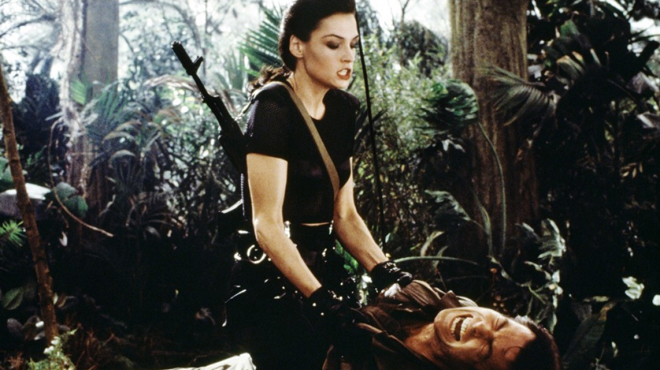

And of course, there’s arguably the best character in the entire film; Xenia Onatopp, played by Famke Janssen. Like May Day, Onatopp is a crazy henchwoman. Seriously she’s borderline psychotic. She kills people while having sex with them by suffocating them to death with her thighs. It’s clear that not only is she a major sadist, but that she also gets extreme sexual satisfaction out of killing people. Just look at the scene where she kills a bunch of workers at Severnaya and starts breathing heavily afterwards. The look on Ouromov’s face when the film cuts back to him is priceless. Well, it’s like Bond says, ‘she always did enjoy a good squeeze’ and quite frankly Xenia is the last major Bond femme fatale, that wasn’t a main villain for the record (in this case Elektra from ‘The World is Not Enough’ doesn’t count), and even arguably the last great Bond henchman to date. All in all, ‘GoldenEye’ had a terrific ensemble cast in general from Pierce Brosnan to Izabella Scorupco to Judi Dench. And of course, it had one hell of a villain ensemble, highlighted by main villain Trevelyan and his insane main henchwoman Xenia. But that doesn’t mean we should forget about the other henchman in the film, Ouromov and Boris. That’s one of the many reasons why ‘GoldenEye’, the first Bond film that I ever watched, is still one of my all-time favorite entries in the entire series. You can’t go wrong with this quartet of villains.

2. JAWS- THE SPY WHO LOVED ME/MOONRAKER


Okay I’ll admit it… these next two picks are going to be completely obvious to anyone who is a fan of this series. But really, can you blame me? Because these next two truly are the series’ most iconic henchmen. So with that said, why is Jaws, who may arguably be the most famous henchman in franchise history, only Number 2 on this list? Well, ultimately that’s because of the fact that his role in his second film, ‘Moonraker’, isn’t as strong as his first appearance in ‘The Spy Who Loved Me’. In ‘Spy Who Loved Me’, Jaws immediately established himself as a truly intimidating and even rather scary villain with his set of metal teeth and hulking stature. While originally killed off in the initial script for the film, producer Albert ‘Cubby’ Broccoli suggested that Jaws survive the finale because he felt that the character would end up becoming very popular. Sure enough, test audiences loved this ending when it was first screened for them and Jaws was brought back again for ‘Moonraker’. Though in this case, this might not have been the best route the filmmakers could’ve taken.

‘Moonraker’ was already a pretty darn silly Bond film as far as the franchise is concerned. After all, it is the one that sends Bond into space and was clearly made just to cash in on the success of films like ‘Star Wars’. But Jaws just made the film even sillier because he wasn’t really as intimidating as he was before. Now he was just played for laughs, like having him crashing into various things and getting out of them without even a scratch on him. They give him a girlfriend, Dolly, and he even ends up becoming a good guy by the end of the film. Now I don’t really mind the ideas of Jaws having a girlfriend and becoming a good guy but because the film is so damn goofy, these scenes just come off as being very weird. The first time Jaws and Dolly meet is punctuated by that Tchaikovsky music you always hear in movies and TV shows whenever two characters fall in love. And at the end, Jaws even speaks for the first and only time in the series. It’s strange but I will admit that it’s still fun to see the character return. He may have been turned into a goofball in ‘Moonraker’ but that doesn’t mean that he still wasn’t memorable. Besides, at the end of the day, we’ll always remember him as the truly intimidating brute from ‘The Spy Who Loved Me’.

1. ODDJOB- GOLDFINGER


Ultimately it was due to the fact that Oddjob didn’t appear in a second film and wasn’t goofed up as a result that he ends up at the top of this list. The mute henchman of Auric Goldfinger is one bad guy you do not want to mess with. That’s because by just throwing his razor-edged hat at you, you’re pretty much dead if it hits you. As shown during one of the most iconic moments in franchise history, Oddjob is so strong that his hat can decapitate a stone statue, and even though the Mythbusters proved that this wasn’t possible in real life, it’s still a pretty badass scene. It was also very fitting to have a wrestler, Harold Sakata, take on this iconic role and he does a great job in capturing the character’s silent but vicious ferocity. The final fight scene between him and Bond in Fort Knox is as classic of a fight sequence as you can get from this franchise, ultimately resulting in Bond killing Oddjob by using a loose sparking wire to electrocute him when he is trying to grab his hat after it gets stuck between a pair of metal bars. Because of his strength, his unique weapon of choice, and the final fight sequence between him and Bond, Oddjob is easily the series’ all-time greatest henchman. Just remember not to choose him as a playable character in ‘GoldenEye’ for the N64 because otherwise your friends are going to get very, very angry at you.


NEXT WEEK: I list my Top 10 favorite James Bond opening title sequences.