Showing posts with label Split. Show all posts

Wednesday, January 23, 2019

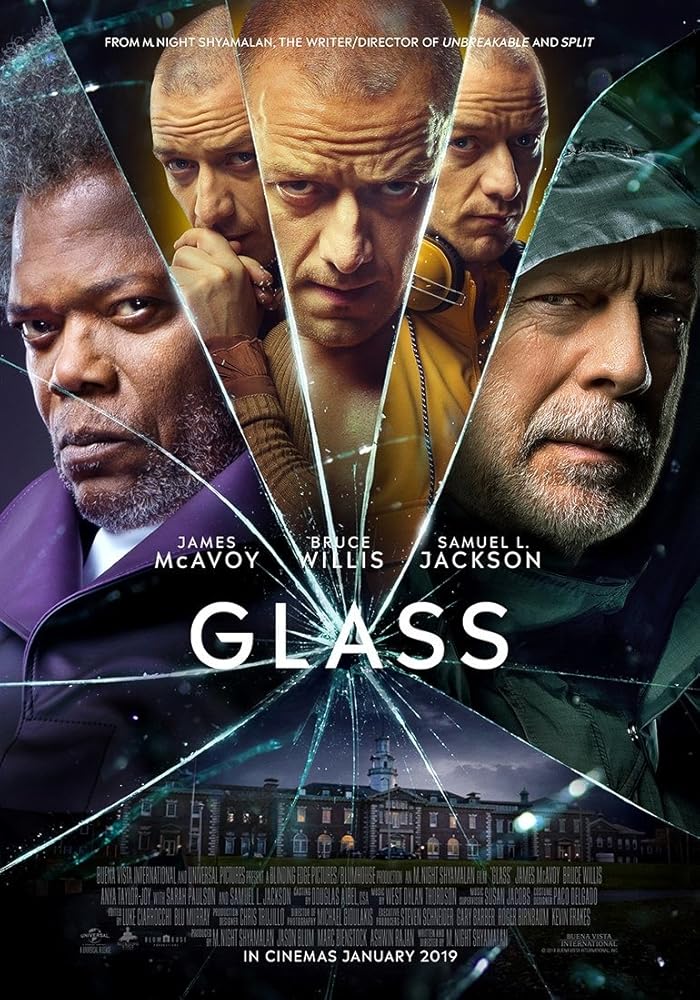
Glass (2019) review

Samuel L. Jackson, Bruce Willis, and James McAvoy in Glass (2019)

One year after making it big with The Sixth Sense, writer/director M. Night Shyamalan released his next directorial effort, Unbreakable. Serving as a deconstruction of the superhero genre, the film followed a seemingly average man who ponders if he’s a superhero himself after miraculously surviving a devastating tragedy. Upon its release, the film didn’t quite do as good with critics and audiences as The Sixth Sense, but it has gone on to arguably surpass it as Shyamalan’s most popular film. And yet, because it wasn’t that big of a hit, plans for a sequel were put on hold for the next decade and a half. It wasn’t until 2017 when the idea of continuing the series was put into play thanks to Shyamalan’s then-latest effort, Split, which had continued his recent career resurgence after a string of critical flops in the 2000s. But while the film may have seemed like a simple small-scale thriller about a group of girls who found themselves kidnapped by a man with multiple identities, audiences were surprised to discover that the film was the long-awaited Unbreakable sequel thanks to a cameo by the previous film’s protagonist. And thus, the plans were set for a third film that would bring together the main characters of both films and provide a conclusive finale to what is now being referred to by fans as the Eastrail 177 trilogy, named after the train that started this whole ordeal. Taking its name from the first film’s main antagonist, Glass once again brings audiences into a world of real-life super-heroes and real-life super-villains. And while some may be put off by the ways in which it continues the story of Unbreakable, it’s still a highly engaging thriller with captivating performances.  

19 years ago, security guard David Dunn (Bruce Willis) was the sole survivor of a devastating train crash in the city of Philadelphia. After learning that he somehow managed to survive the crash without any injuries, David proceeds to undergo a journey where he starts to test himself to see if he’s a real-life superhero, a notion that’s encouraged by comic enthusiast Elijah Price (Samuel L. Jackson), a man who suffers from brittle bone disease. However, David eventually learns that Price was the one responsible for the train crash, having decided that his purpose in life was to be David’s arch-enemy, Mr. Glass, resulting in David alerting the authorities and Price being placed in a mental institution. Since then, David has continued to operate as the vigilante known as ‘The Overseer’, which leads him to a confrontation with Kevin Wendell Crumb (James McAvoy), an infamous kidnapper/murderer who has dissociative identity disorder and 24 distinct identities fighting for control of his mind, thus earning him the nickname ‘The Horde’. Their ensuing clash ends up with them both being arrested and sent to the Raven Hill Psychiatric Hospital where, as fate would have it, Price is being held as well. Whilst there, the three become the subjects of Dr. Ellie Staple (Sarah Paulson), who specializes in dealing with patients who have delusions of grandeur, specifically the idea that they possess super-powers. But as the three men find themselves subjected to intense psychological evaluations that put their abilities into question, the ever-devious Elijah begins planning his next criminal scheme that he promises will prove to the world once and for all that super-powered beings truly exist.

When it comes to this unexpected trilogy of films, Glass is a combination of the best elements of its two predecessors. Since Split wasn’t technically revealed as a sequel to Unbreakable until its ending, Glass is ultimately more in line with the first film when it comes to its structure and purpose as a commentary on the concept of comic-book superheroes. At the same time, though, Glass also carries over the psychological ideologies of Split’s plot to further strengthen its commentary. With that in mind, it should be noted that this isn’t meant to be a big-budget superhero flick with large-scale action sequences a la something out of the Marvel Cinematic Universe. Instead, Glass’ big action sequences are reserved for its first act and finale, with the rest of the film focusing on its main characters’ time spent in the mental institution. And overall, the film manages to maintain an engaging narrative throughout because of its layered characters and effective moments of emotional poignancy that come from taking the idea of super-powered beings and grounding it in realism. But just like any Shyamalan film, this story ends up leading to some major twists that, in this instance, seem to be a major source of contention amongst this film’s critics, and to be perfectly frank, in some ways it’s easy to see why this is. Without spoiling any of these twists, the biggest of the bunch could’ve benefitted from being built up a bit more because as is, it sort of feels like it came out of nowhere. And yet, despite this, the film then immediately course corrects itself with another twist that works a lot better because it manages to provide a thorough conclusion to the arcs of its main characters.

On that note, one of the biggest draws to this film is getting to see the three main leads of the franchise together in one big ‘crossover’. Starting with the cast from Unbreakable, Bruce Willis is excellent once again as main protagonist David Dunn. Instead of being one of Willis’ more recent outings where many have felt that he’s just ‘phoning it in’, he provides the film with several of its best emotional moments in his second go-around as the reluctant hero who’s been put through the emotional wringer more often than most. But, of course, you can’t have a hero without a villain, and that’s where Samuel L. Jackson comes in as Elijah Price AKA Mr. Glass. Now fully embracing his role as ‘the mastermind’, Jackson commands the screen as this series’ fascinating antagonist with the tragic backstory of a life that’s been considerably hindered by his condition. And yet, arguably the biggest standout of them all is James McAvoy reprising his role from Split as Kevin Wendell Crumb and his 24 unique identities. Just like in the previous film, the ways in which McAvoy slips in and out of each identity, whether it’s the innocent 9-year old Hedwig or a Southerner named Luke who has the tendency to spoil films, is a sight to behold in terms of all the physical and mental transformations that he undergoes. The three are then joined by a variety of returning players from the other films, including Spencer Treat Clark as David’s son Joseph and Anya Taylor-Joy as Casey, the sole survivor of Kevin’s rampage in Split, and they’re all good as well despite not having as much to do as Willis, Jackson, and McAvoy. Sarah Paulson then closes out the ensemble as this film’s primary new addition, Dr. Staple, and she shines as well as the film’s most mysterious character with an unclear agenda.  

With Glass, M. Night Shyamalan has been granted something that he hasn’t had in years, hype. While it may not have been as big of a hit as The Sixth Sense was upon its initial release, Unbreakable has since gone on to be regarded by many as his best film. As such, when it was revealed that his 2017 outing Split was the unexpected follow-up to Unbreakable, the anticipation began to mount for the concluding installment of the Eastrail 177 trilogy. Despite this, however, Glass is proving to be quite the polarizing affair amongst critics and audiences, with several feeling that it just didn’t live up to the hype and was a lackluster conclusion to this promising trilogy. And to be perfectly fair, there are certain aspects of this film that won’t exactly go over well with everyone when it comes to the ways in which it concludes the trilogy and, more importantly, the overall arcs of its main characters. Ultimately, though, I did find Glass to be a genuinely satisfying finale to this trilogy, as it combines the best elements of Unbreakable and Split to produce yet another highly engaging thriller. It may not boast the usual structure of a ‘superhero flick’ but the story is solidly written and the film benefits from an excellent collection of layered characters headlined by the phenomenal lead trio of James McAvoy, Bruce Willis, and Samuel L. Jackson. In short, it’s nice to see that after all these years, M. Night Shyamalan was finally able to return to the world of heroes and villains that he had initially created with Unbreakable to spawn a truly unique trilogy of superhero films.     


Rating: 4.5/5

Tuesday, February 7, 2017

Split (2017) review

Image result for split poster

As a director, M. Night Shyamalan has had quite a varied career in the film industry in terms of how his films have been received by critics and audiences. After starting out with a few small indie films that didn’t get much attention, Shyamalan truly made a name for himself in 1999 with The Sixth Sense. The supernatural horror-thriller ended up being the second highest-grossing film of the year, behind only Star Wars Episode I: The Phantom Menace. It was also nominated for 6 Oscars, including Best Picture, Best Director, and Best Original Screenplay. Shyamalan then followed that up with two solid critical and commercial hits in the form of 2000’s Unbreakable and 2002’s Signs. But then, Shyamalan’s career started to take a severe nosedive immediately thereafter. Throughout the early 2000’s, his films were subjected to increasingly harsh reviews from critics while audiences began to get more and more frustrated with his trademark twist endings. Thus, films like The Village, Lady in the Water, The Happening, The Last Airbender, and After Earth ended up turning the filmmaker who was once touted by Newsweek as ‘the next Steven Spielberg’ into the butt of many jokes (“What a Twist!” – Robot Chicken). But, it seems like he’s recently started to turn his career around, thanks in part to his smaller-budgeted collaborations with horror producer Jason Blum. Two years ago, they first teamed up to make The Visit, which was Shyamalan’s first well-received directorial effort in more than a decade. This year, that streak continues with Shyamalan and Blum’s second collaboration, Split. And thanks to strong lead performances and an excellently crafted/suspenseful atmosphere, Split is very much one of Shyamalan’s best directorial efforts.

As the film begins, three teenaged girls; best friends Claire (Haley Lu Richardson) and Marcia (Jessica Sula) and loner Casey (Anya Taylor-Joy), the latter of whom joins them when she finds herself without a ride home, are kidnapped by a mysterious man in their car following a day at the mall. When the three girls come to after being knocked out, they find themselves locked in a reinforced, windowless room. Soon after, they are truly introduced to their captor, Kevin (James McAvoy), a man who suffers from dissociative identity disorder. To be more specific, 23 distinct identities reside within Kevin’s mind. These identities range from a 9-year old boy named ‘Hedwig’ to a prim English woman named ‘Patricia’, complete with a red dress and high heels, to the ‘one’ who kidnapped them in the first place, ‘Dennis’. While in these various identities, Kevin warns the three girls that ‘someone’s coming for them’. As it turns out, this ‘someone’ is a 24th identity referred to only as ‘The Beast’, as Kevin notes that the three girls are set to be sacrificed to it once it arrives. With no one else around to help them, Casey, Claire, and Marcia begin to seek a way out of their current predicament before Kevin can truly unleash ‘The Beast’ upon them. Their solution? Try and turn Kevin’s different identities against one another.

While I’ve not yet seen The Visit, it’s clear that the transition from bigger-budgeted blockbusters, like The Last Airbender and After Earth, to the smaller-budgeted affairs that his last two films have been, is something that has very much helped Shyamalan in terms of his screenplays. Much of the action in this film is restricted to one primary location, Kevin’s hideout, and as such, Shyamalan creates an excellent amount of tension throughout as we are left waiting for Kevin’s ‘24th identity’ to emerge. And because Kevin can slip in and out of his various identities in an instant, you can never quite tell what he’s going to do next. Thus, when the finale does roll around, it results in a very suspenseful, as well as effectively minimal, climax to what has been a very effective ‘bottle episode’, sort of like what 10 Cloverfield Lane did last year. As for Shyamalan’s trademark knack for twist endings, without giving anything away, the twist in this film is solidly implemented into the story. It doesn’t reach the ridiculous lengths of some of Shyamalan’s most infamous twists (e.g. aliens being vulnerable to water despite coming to a planet that’s primarily covered in water (Signs)). It just fits naturally into the story. Plus, the twist, as well as the potential that it brings to the table, is sure to satisfy fans of another Shyamalan film, which I won’t name here to avoid giving any major details about this film’s twist away. Really, my only major negative towards the film is that it’s arguably a bit overlong. Split is Shyamalan’s longest film to date at just under two hours and it could’ve used a bit of trimming here and there, namely during some of the more slower moments.  

Of course, the main draw of this film is seeing the main villain, Kevin, go through his different identities. Admittedly, the film doesn’t go through all 23 of them (though, to be fair, that’d be a lot of ground to cover in the given runtime) but, nevertheless, James McAvoy does a fantastic job in the role. He slips into each distinct identity with ease while also conveying the right amount of creepiness with each one. ‘9-year-old Hedwig’ is easily the biggest standout in terms of his identities as he provides the film with some of its more humorous moments while also being arguably the most sympathetic of Kevin’s identities, as it’s established that he sometimes gets bullied by some of the other identities. McAvoy also works quite well in scenes with Betty Buckley, who does a great job in the role of Kevin’s psychiatrist, Dr. Karen Fletcher, while also managing to overcome the status of being ‘the crazy old woman from The Happening (you know, the one that made Mark Wahlberg respond to a question with “What? No!”). As for the three main girls, admittedly only one of them truly matters in the long run; Casey, played by Anya-Taylor Joy, who’s kind of become a big star in the horror genre thanks to films like this and 2016’s The Witch. She does a great job here and her character is a well-layered protagonist. All throughout the film, we see flashbacks of her traumatic past, which not only makes her a sympathetic lead but also comes into effect later in the film. But like I said, she’s really the only one of the main trio of girls who gets any major screen-time. Both Claire and Marcia come off as being extraneous to the plot, especially considering that both disappear for sizable chunks of the runtime after they anger Kevin and are put in separate ‘cells’. I mean, yes, they are generally essential to the plot seeing how they’re the reason why Casey is kidnapped along with them, but they’re still the most underdeveloped of the main cast of characters.  

Okay, so I’ll admit that I was rather behind in terms of seeing this one as it’s already been out for a few weeks. However, I do want to note that there was quite a packed crowd at my screening, and again, keep in mind, this is three weeks into the film’s theatrical run. Clearly, Split has been a big hit with critics and audiences (in January, no less!) and it’s great to see Shyamalan have a critical/commercial hit again after all his misfires in the 2000’s. Of course, part of that comes from the fact that Split truly is one of his best efforts in recent years. It’s a well-tuned and suspenseful thriller that also benefits greatly from terrific performances from leads James McAvoy and Anya Taylor-Joy. Not being a big fan of the horror genre, I can’t really say much about whether this film delivers on scares or not, but I can say that there’s a good chance that you’ll be left on the edge of your seat by the end of it all.  Of course, as one would expect from a Shyamalan film, there are twists in this story but they do work well here, right down to the one that reveals the full extent of the universe in which this story takes place. And, again, it’s just good to see that Shyamalan has gotten his career back on track. I’ll admit that, prior to this, I’ve only seen two of his other films and, unfortunately, those two happen to be some of his most notorious ‘stinkers’, The Last Airbender and After Earth. So, at this moment, this film can claim the title of being the best Shyamalan film that I’ve seen to date. Admittedly, that’s not saying much considering that this is only the 3rd Shyamalan film that I’ve seen, but I will get around to seeing his other films in the future, especially the one that is tied to this film’s big reveal.

Rating: 4/5