Showing posts with label Mary Elizabeth Winstead. Show all posts

Thursday, October 29, 2020

Final Destination - Series Retrospective

Every October, I try to do a horror-themed post in recognition of the Halloween season. However, for reasons that even I don’t really understand, I wasn’t able to do one last year. There were only three posts that were published on this site last October and they were all reviews for films that weren’t even close to being a part of the horror genre. With that in mind, I wanted to make up for the lack of horror content last year by making sure that I do have something horror-related for you guys this year. Technically speaking, I already sort of did one a few weeks back with my retrospective on The Addams Family films since, as I noted in that post, the live-action Addams Family films from the ’90s have become staples of the Halloween programming blocks for several networks. However, since that’s more of a family-friendly franchise, I also wanted to do a post that would cover a horror franchise for the older demographic. Back in 2018, I did a retrospective on one of the most iconic horror franchises of all-time, Halloween, just in time for its latest installment. Naturally, this could have potentially led to me doing a retrospective on another classic horror franchise such as Friday the 13th or A Nightmare on Elm Street. However, when it comes to those franchises in particular, there’s a bit of a complication that fans of both franchises will undoubtedly recognize; the fact that their iconic antagonists had a full-blown crossover film that was released in 2003, Freddy vs. Jason. Because of this, I feel that if I was ever going to discuss those franchises, I’d have to do both so that I can cover them in their entirety, and at this point, I really don’t have any time to do something like that for this year’s Halloween. After all, we are talking about a pair of franchises that have at least 8 or more films to their name. So instead, I decided to cover a franchise that has a much smaller amount of films to cover. Plus, the franchise in question is one that I’m a lot more familiar with as it was one of the first big horror franchises that I ever watched. And so, with that in mind, for this year’s Halloween post on Rhode Island Movie Corner, I’ll be tackling the Final Destination franchise.

As I’ve noted plenty of times over the past few years, it was only until recently that I started to gain a greater affection for the horror genre. Nevertheless, I did watch a few of the big-name horror films in the early 2010s when I was first truly getting into the field of film criticism, and if you were to ask me which horror franchises were the ones that officially kicked things off for me, there were two in particular. First, there were the Scream films, which is a franchise that I covered on this site way back in 2014, and then there’s the topic of today’s post, the Final Destination series. This is a franchise that is based around a simple but effective hook. In each installment, a group of characters ends up surviving a fatal accident such as a plane crash or highway pile-up because one of them has a premonition where they witness it happen. But while they manage to survive that initial brush with Death, they’re eventually picked off one by one in a series of elaborately staged accidents. This premise is what bolstered the franchise for its initial five-film run from 2000 to 2011, and while none of the films were necessarily big hits with critics, they did do quite well with audiences. In other words, all five films were solid hits at the box-office, collectively grossing over $665 million worldwide, and while it’s been nearly a decade since the franchise’s most recent outing, there have been talks of a potential follow-up. It’s also been reported that this new film will shift things up a bit by focusing on first responders who, unlike the traditional protagonists of these films, experience death regularly. But until then, we have the first five films of this series which, as we’ll soon find out, end up varying quite a bit when it comes to their overall quality. With all that in mind, be mindful that death could be around any corner (and yes, I fully recognize that saying that is tragically ironic given our current worldwide predicament…) and remember that, “In death, there are no accidents, no coincidences, no mishaps, and no escapes…” as we look at the Final Destination films.

FINAL DESTINATION (2000)

It all begins, of course, with the original Final Destination from 2000, which was spawned from a script that writer Jeffrey Reddick had written for a potential episode of The X-Files. Said script was then reworked by director James Wong and producer Glen Morgan into the film that we know today. It’s a film that certainly fits the bill of being a ‘franchise-starter’ since it effectively sets up many of this franchise’s definitive aspects, such as its main premise (represented in this instance by a group of high-school students (plus one of their teachers) surviving a plane crash) and its elaborate Rube Goldberg-esque kills. Admittedly, it’s far from perfect, mostly due to some undercooked plot-threads (e.g. the main protagonist being hounded by a pair of FBI agents) and director James Wong’s habit of relying a bit too heavily on foreshadowing. But in the case of the former, it seems like this was mostly due to poor test screenings that resulted in some plot-points being cut and, most notably, a fully reshot finale that, to its credit, is superior to the film’s original ending. With that in mind, the film works quite well as a horror-thriller with some excellent death-centric set pieces that still manage to stand out even when compared to some of the most iconic and FAR more graphic moments from the sequels. It also has one of the better ensembles of the franchise as led by Devon Sawa as Alex Browning, this film’s main protagonist whose deadly premonition is what kicks everything into motion, and Ali Larter as Alex’s fellow survivor and eventual love interest Clear Rivers. There’s also a key appearance by horror icon Tony Todd (AKA ‘The Candyman’) as William Bludworth, an enigmatic mortician who offers Alex and Clear some cryptic insights on Death’s grand design. And so, in conclusion, the best thing that I can say about the first Final Destination is that when compared to its sequels, its admirably straightforward in its approach. While I wouldn’t necessarily call this the ‘best’ installment of the franchise, it’s still a generally well-polished film that, as noted before, effectively got the ball rolling for one of the most prominent horror franchises of the 2000s.

Rating: 4/5

FINAL DESTINATION 2 (2003)

With both director James Wong and writer/producer Glen Morgan occupied with other projects, Final Destination 2 underwent a notable change in direction. Directorial duties were taken over by the late David R. Ellis, a long-time stunt coordinator/second unit director who would then go on to direct 2006’s internet sensation, Snakes on a Plane. Sure enough, Ellis’ background in stunts contributes greatly to this film’s set-pieces, with many of them being some of the best in the entire franchise. For one thing, it certainly helps that they were largely done with practical effects, especially since the same cannot be said for some of the kills in the sequels. However, the best of the bunch is this film’s big accident sequence, which comes in the form of a massive highway pile-up. The film also does a nice job of feeling like a natural continuation of the franchise, whether it’s the reveal that the events of the first film spared the lives of this film’s group of survivors or by having Ali Larter return as Clear, the sole survivor of the first film’s main protagonists. Larter’s return makes up for the film having some of the weaker main characters of the series, although this is technically more of a script issue rather than anything having to do with the actors playing them. Nevertheless, while Final Destination 2 was, ironically, the lowest-grossing installment of the series (it’s the only entry that didn’t gross over $100 million worldwide), it’s widely regarded by fans as a superior sequel, and really, it’s easy to see why. Not only does it feature some of the best examples of what these films are mainly known for (i.e. their kills) but its efforts to expand upon the franchise’s lore results in a film that is arguably a lot more narratively consistent than its predecessor. And because of this, it is easily one of the franchise’s best installments, especially when compared to the next few films.

Rating: 4/5

FINAL DESTINATION 3 (2006)

After being unavailable for the second film, co-writers James Wong and Glen Morgan returned for the third Final Destination film in their respective roles of director and producer. But while Final Destination 2 successfully managed to be a natural follow-up to the first film, Wong and Morgan elected to have the third film adopt a ‘back to basics’ approach. Because of this, Final Destination 3 largely feels like it’s taking a step backward as far as this series’ progression is concerned. In other words, while Wong and Morgan do succeed in making it feel more in line with the first film, that also means that it carries over the same issues from that film which, for the most part, had been fixed in the second film. So once again, some plotlines don’t get the attention that they probably should’ve while James Wong’s over-reliance on foreshadowing is even more apparent here than it was in the first film. And if that wasn’t enough, this is where the one thing that is arguably the biggest problem with some of the later Final Destination films officially starts coming into play; the fact that most of its characters are wholly unlikable and are just there to be killed off. However, if there’s one exception to this, it would be this film’s main protagonist, Wendy Christensen, played by Mary Elizabeth Winstead in her first leading role. Winstead does a terrific job in making Wendy one of the more sympathetic protagonists of the franchise, especially since the same cannot be said for all the other characters in this film. Plus, to the film’s credit, it does have its fair share of memorable set-pieces, whether it’s a fiery pair of kills that occur at a tanning salon or this installment’s big accident sequence on a high-speed roller-coaster (occasional gaps in logic notwithstanding). Thus, while I’ll admit that there may be a bit of bias in the following statement since this was the first of the series that I ever watched, I’d say that Final Destination 3 is a decent albeit forgettable entry in the franchise. While it certainly boasts many of the issues that would end up becoming even worse in the next film, it manages to do just enough to avoid being a total disaster. It’s by no means the best film in the series… but it’s also far from being its worst.

Rating: 3/5

THE FINAL DESTINATION (2009)

When it was first released, it was reported that The Final Destination was going to be, fittingly enough, the final installment of the franchise… although this only lasted about a year or so once it was confirmed that a fifth film was in the works. It may have had something to do with the fact that this ended up being the highest-grossing installment of the franchise, especially since it was filmed and presented in 3-D right in the midst of the medium’s resurgence. At the same time, though, it was downright savaged by critics… and they weren’t wrong about this one. Like Final Destination 3, this film is largely undone by how frustratingly by-the-numbers it is. Without any noteworthy attempts at expanding upon this well-established premise, it’s nothing but a rehash of the previous films with some of the most mediocre set-pieces in the franchise’s history. Aside from only a few exceptions, none of them even come close to being as memorable as the ones from previous films (not even this film’s big accident sequence, which is just a simple auto race crash). It also doesn’t help that a lot of them were CG-based with effects that, to be perfectly blunt, didn’t even look good at the time. But just like Final Destination 3, this film’s biggest shortcoming is that you don’t give a single crap about any of the characters. Apart from Mykelti Williamson as a good-natured security guard named George with a tragic backstory, the rest of the characters in this film are way too one-dimensional and, in some cases, not particularly well-acted. Because of all this, it goes without saying that The Final Destination is easily the worst installment of the franchise. Sure, it may have seen the return of Final Destination 2 director David R. Ellis, but overall, it’s basically the antithesis of everything that worked in that film.

Rating: 0.5/5

(And before you ask, I didn’t see this film (or the next one, for that matter…) in 3-D, which means that, just like Jaws 3-D, watching this in 2-D means that we’re left with a film that tries a bit too hard to go all-out with its 3-D effects).

FINAL DESTINATION 5 (2011)

And so, as noted earlier, the commercial success of The Final Destination paved the way for the fifth film in 2011, but for this one, there was another big change in direction. Instead of just maintaining the directorial pattern of shifting between James Wong and David R. Ellis, this film served as the directorial debut of Steven Quale, who was previously known for his work as a second-unit director, most notably on James Cameron’s Titanic and Avatar. And because of this pivotal change in direction, Final Destination 5 is a massive improvement over the franchise’s last two outings in every possible way. For starters, it boasts a whole bunch of terrific set-pieces, including, of course, its big accident sequence involving a bridge collapse. And yes, a few of these are still a bit CG-heavy, but unlike the last film, there is, at the very least, a better balance between practical and digital effects. But perhaps the biggest improvement here is that, after two films that were full of utterly detestable characters who were nothing more than kill fodder, this film features some of the franchise’s better characters. Sure, there are still quite a few one-note meat bags here and there, but the film makes up for this with two of the franchise’s most sympathetic leads, main protagonist Sam (Nicholas D’Agosto) and his girlfriend Molly (Emma Bell). Plus, there’s also a solid human antagonist in Sam’s best friend Peter (Miles Fisher), who’s so affected by these proceedings that he ends up taking some truly drastic measures, and we even get Tony Todd returning for another cameo as Bludworth the mortician. The latter development is especially significant since the character didn’t appear in the last two films (although Todd did make a notable voice cameo in 3). And then, to top it all off, there’s this film’s excellent final twist, which I won’t spoil here for those who haven’t seen it but will note that it does a fantastic job of connecting this film to the rest of the franchise. With all this in mind, Final Destination 5 is, in every way imaginable, the best installment of the franchise. Like Final Destination 2, it successfully manages to be a natural follow-up to its predecessors but it’s also arguably the most polished entry of the bunch thanks to the solid direction from Steven Quale, its great set-pieces, and one of the franchise’s best ensemble casts. Plus, until the long-rumored sixth film comes out, this one allowed the franchise’s original run to end on a great note rather than a terrible one.

Rating: 4.5/5

Thursday, February 27, 2020

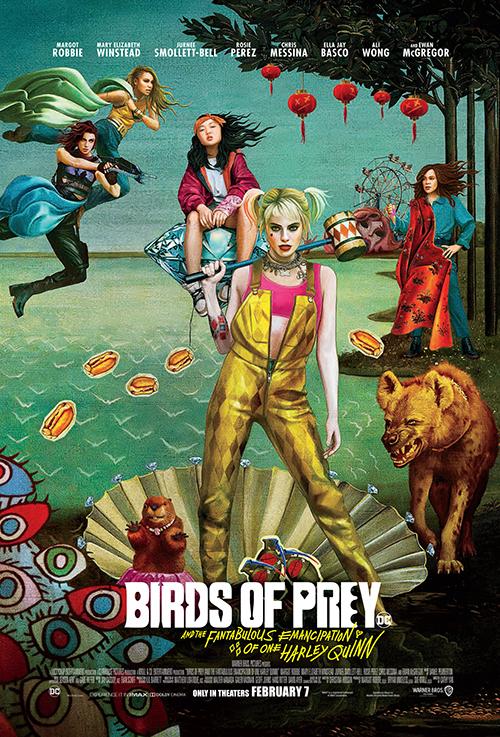
Birds of Prey (and the Fantabulous Emancipation of One Harley Quinn) (2020) review


Rosie Perez, Jurnee Smollett-Bell, Mary Elizabeth Winstead, Margot Robbie, and Ella Jay Basco in Birds of Prey: And the Fantabulous Emancipation of One Harley Quinn (2020)

On September 5th, 1992, Batman: The Animated Series made its official debut on the Fox Kids programming block and would go on to span 85 episodes throughout four seasons that would later pave the way for various spin-offs set in the same universe. Since then, the show has gone on to become one of the most beloved interpretations of the Dark Knight, garnering much acclaim for its dark and mature writing, noir-inspired animation, and strongly layered characters. This, of course, includes the show’s iconic interpretations of Batman’s legendary Rogues gallery headlined as always by his archnemesis, the Joker (voiced by Mark Hamill). However, this series would also see the debut of a villain who quickly turned out to be a fan favorite, Harley Quinn, a former psychiatrist at Arkham Asylum who fell in love with the Clown Prince of Crime and promptly became his fiercely loyal second-in-command. The character was largely inspired by her original voice actress Arleen Sorkin, a college friend of the series’ co-creator Paul Dini who once appeared in a jester outfit on the classic soap opera Days of Our Lives, which would influence Harley’s iconic harlequin look. After making her official debut in Episode 22 of the series, “Joker’s Favor”, Harley became such a popular character amongst fans of the show that she was then properly implemented into the comics. And in 2016, she would make her live-action cinematic debut in the DC Extended Universe’s Suicide Squad, where she was played by Margot Robbie. While the film proved to be a dud with critics, Robbie’s portrayal of the iconic villainess turned occasional antihero was considered one of its biggest highlights.

Because of this, plans were then set into motion for several potential spin-offs featuring Robbie’s take on the character, including one that focused solely on her and the Joker and another that would be based around the squad of her, Poison Ivy, and Catwoman known as the Gotham City Sirens. Ultimately, though, the first official Harley Quinn spin-off would end up being one proposed by Robbie herself based on a different all-female squad known as the Birds of Prey. The Birds of Prey were originally introduced in the mid-’90s by writer Chuck Dixon and former DC Comics editor Jordan B. Gorfinkel and, in the context of the DC Universe, was spawned from a partnership between Black Canary and former Batgirl Barbara Gordon who, at the time, had become known as ‘Oracle’ following the controversial events of The Killing Joke. Since then, other superheroines have been featured on the group’s roster over the years including Batwoman, Hawkgirl, and Power Girl. Outside of the comics, there was a Birds of Prey TV series that aired on the WB from 2002-2003 but sadly only lasted one season due to poor ratings (said series also notably featured a version of Harley Quinn played by Mia Sara). But now the Birds of Prey have been given their own film which, as alluded to earlier, primarily came to fruition thanks to Margot Robbie, who initially proposed it during the production of Suicide Squad. Along with headlining the film in her second official outing as Harley Quinn, Robbie is its primary producer via her production company, LuckyChap Entertainment, and prioritized a female-led crew that includes screenwriter Christina Hodson and director Cathy Yan. Thus, we now have a film that boasts the legendary title of Birds of Prey (and the Fantabulous Emancipation of One Harley Quinn), and sure enough, that elaborate title gives you an exact idea of the unabashedly chaotic and highly entertaining comic book flick that it ultimately is.

(Disclaimer: To avoid having to constantly repeat that long title, any future use of it in this review will consist solely of the Birds of Prey part of it and not the Fantabulous Emancipation of one Harley Quinn subtitle)

Sometime after the events of Suicide Squad, former Arkham Asylum psychiatrist turned crazed henchwoman Harley Quinn (Margot Robbie) breaks off her relationship with her longtime boss/lover, the Joker. But while Harley is more than ready to move on with her life, she quickly learns that this now puts her on the hit list of every criminal in Gotham City that she had previously wronged but was always protected from due to her ties with the Joker. At the top of that list is crime boss Roman Sionis AKA Black Mask (Ewan McGregor), who is currently after a diamond that’s embedded with information regarding the elusive fortune of the former Bertinelli crime family. But while he and his right-hand man Victor Zsasz (Chris Messina) end up finding the diamond, it’s then promptly stolen from them by young pickpocket Cassandra Cain (Ella Jay Basco). To save herself from his wrath, Harley offers to retrieve the diamond for Roman but ultimately ends up taking the young girl under her wing instead. In the process, the two also end up crossing paths with a bunch of other women who are tied to their current predicament. This includes Dinah Lance AKA Black Canary (Jurnee Smollett-Bell), Roman’s club singer turned driver who can project hypersonic screams, Gotham City police detective Renee Montoya (Rosie Perez), who’s looking to build a case against Roman, and Helena Bertinelli AKA Huntress (Mary Elizabeth Winstead), the sole survivor of the Bertinelli family who grew up to become a crossbow-wielding vigilante. Recognizing that they all share a common enemy, Harley proposes that they work together to protect Cassandra from the army of goons that are headed their way.

Much has been said about how Suicide Squad ended up being yet another example of the DCEU’s early installments being hindered tremendously by executive meddling, thus paving the way for its mediocre reception. One of the biggest criticisms directed towards it was that despite its marketing campaign’s promise of being one of the flashiest installments of the superhero genre, a lot of the final film was downright ugly when it came to its visuals. Thankfully, that is not the case with Birds of Prey as director Cathy Yan never shies away from the bright visual aesthetic that has commonly defined the character of Harley Quinn. And instead of the arguably quite cynical tone that defined much of Suicide Squad, Birds of Prey achieves a great mix of wacky hi-jinx and solid emotional drama. This is, after all, a film where Harley Quinn finally breaks off her long-standing relationship with the Joker which, despite being one of the most famous relationships in all of comics… is also one of the most toxic relationships in the history of media. In other words, Birds of Prey deserves a lot of credit for being thoroughly committed to producing a female-led superhero film that takes a full-on sledgehammer to toxic masculinity, and if you ask me, it handles this all very well. Sure, the plot can be a little jumbled at times due to all the story elements that it’s trying to juggle alongside the primary storyline with Harley (more on that in a little bit), but the film still flows at a very nice pace throughout. Plus, it also sports some excellent action sequences, with any sequence that was done during reshoots notably being handled by none other than John Wick director Chad Stahelski.   

Prior to the film’s release, there was some concern from fans that despite being titled Birds of Prey, it would end up being more focused on Harley Quinn given that the marketing primarily revolved around her, and to be perfectly blunt… that’s exactly what the film is. Birds of Prey is very much a Harley Quinn film and the titular squad doesn’t properly come together until the final act. However, I wouldn’t necessarily call this a bad thing in this instance since the film properly follows in the footsteps of Wonder Woman and Aquaman by giving its main character quality material that fully matches her commitment to the role. Margot Robbie was already a fantastic pick for Harley Quinn as evident by her performance in Suicide Squad, but just like Gal Gadot and Jason Momoa before her, it’s ultimately Harley’s ‘solo film’ (even though I do use that term loosely in this case) where she’s truly allowed to shine. And while this does mean that the other female leads in the film don’t get as much focus compared to Robbie, they’re all just as phenomenal in their respective roles. Jurnee Smollett-Bell brings a lot of humanity to the role of Black Canary (who’s arguably the most grounded of the group despite her metahuman abilities), Rosie Perez brings the right fiery tenacity to the role of Renee Montoya, and Mary Elizabeth Winstead’s Huntress is a great combination of badass action heroics and solid humor that pokes fun at her overly serious persona. And as for newcomer Ella Jay Basco as Cassandra Cain, she has wonderful camaraderie with Margot Robbie, whom she primarily shares the screen with given everything that goes down plot-wise. Finally, to close out this film’s excellent ensemble, we have our main antagonists Black Mask and Victor Zsasz. Ewan McGregor kills it in the role of Black Mask, fully succeeding at making him a down-right sleazebag of a villain (with some solid dark humor mixed in as well). And while Chris Messina doesn’t exactly get as much to work with as Zsasz, the partner dynamic that he forms with McGregor is top-notch.

Back when Suicide Squad came out in 2016, I was amongst those who thought that it wasn’t too bad; heck, I even gave it a 4/5 in my initial review of it. It wasn’t until recently, however, when I finally re-watched it, and while I will admit that I’m not exactly as positive towards it as I was back then, I don’t ‘dislike’ it. It is, however, still a prime example of an era of the DC Extended Universe that is thankfully over. Thanks to films like Wonder Woman and Shazam, it’s clear that this franchise has now realized that it’s better to develop its characters first before putting them all together in one film, and sure enough, Birds of Prey nobly continues that trend. Sure, at the end of the day, it’s a Harley Quinn film first and a Birds of Prey film second, but the clearly dedicated effort from producer/star Margot Robbie to highlight some lesser-known heroines in the DC Universe is incredibly admirable. In other words, one of the best things about this film is that it shows the incredible potential for future adventures with the squad of superheroines that it sets up. At the same time, it allows Margot Robbie the chance to firmly establish herself as the definitive live-action interpretation of one of DC’s most popular characters, and if that wasn’t enough, this won’t be the last we see of Harley in the DCEU as Robbie is already set to return in next year’s Suicide Squad sequel. And while I know that there are some out there questioning why Suicide Squad demanded a sequel given how it turned out, I can answer that question in two words… James Gunn. Yes, the man who brought us two of the greatest superhero films of the past few years is in charge this time around, and I’m fully confident that he will give us a superior sequel. But in conclusion, let’s also thank Cathy Yan for starting off 2020’s slate of superhero films on a high note with the delightfully madcap adventure that is Birds of Prey.

Rating: 4.5/5

Wednesday, October 23, 2019

Gemini Man (2019) review


Will Smith in Gemini Man (2019)

For the past few decades, Ang Lee has consistently been one of the most prevalent filmmakers in the industry. After making it big in his native country of Taiwan with a pseudo-trilogy of films known as the Father Knows Best trilogy that explored the clashing of generational ideals, Lee transitioned to Hollywood and would go on to helm several critically acclaimed films. This includes, among others, the Emma Thompson-penned adaptation of Jane Austen’s Sense and Sensibility, the groundbreaking martial arts flick Crouching Tiger, Hidden Dragon, and the emotionally devastating romantic drama Brokeback Mountain. However, in recent years, Lee’s films have become defined by their attempts at breaking new ground in the medium of film. This arguably all began with his 2012 outing Life of Pi, which was one of the biggest hits of that year and touted for its impressive visual effects. Four years later, Lee took on his next project, Billy Lynn’s Long Halftime Walk, which became notable for being the first film shot at a frame rate of 120 frames per second, five times more than the industry standard of 24 frames per second. However, this method proved to be difficult to present in theaters, which meant that only a select few could present it in its intended format (120fps in 3D at a 4K resolution). But now Lee’s back with his newest attempt at a film shot at such an astoundingly high frame rate, Gemini Man, and while its script doesn’t exactly match the aspirations of its technical aspects, it still manages to be a decent little action flick that also serves as a fascinating experiment for its technology.    

After years of being one of the top assassins in his field, Defense Intelligence Agency operative Henry Brogan (Will Smith) decides that the time has finally come for him to retire. However, not long after leaving his old life behind, Henry learns from his old colleague Jack Willis (Douglas Hodge) that his last target wasn’t a global terrorist as he was originally led to believe. Instead, he was a scientist who was working on a secret black-ops project known as ‘Gemini’, and as a result, Henry learns that he’s become marked for death by his superiors, specifically Gemini’s director Clayton Varris (Clive Owen). This, in turn, forces him to go on the run with fellow DIA agent Dani Zakarweski (Mary Elizabeth Winstead), who also becomes a target due to her interactions with Henry. Eventually, Henry finds himself pursued by Gemini’s top asset and is surprised to find that this mysterious agent acts a lot like him while out in the field. Sure enough, Henry ultimately discovers that this agent, named Junior (also played by Smith), is his younger clone and has been raised by Varris to be the ultimate assassin without any of the emotional baggage that had led to his retirement. Thus, as Henry and Dani fight to stay alive against Varris’ forces, they must also try to convince Junior of the ulterior truth behind his existence.

The first thing to talk about when it comes to this film is its ambitious 120fps format since I was lucky enough to be at a theater that could present it as such, albeit at a 2K resolution instead of 4K. Sure enough, that difference in frame rate is noticeable as soon as the film begins… which also means that it’s quite distracting at first when you’re seeing images that move much faster than what you’re normally used to when watching a film. As such, I can see why some feel that this format hinders the classic cinematic feel and makes films look like soap operas in the process, especially whenever an in-camera transition like a zoom-in/zoom-out is used. At the same time, though, it does live up to its claim of producing a highly crisp image quality that, in turn, also lends itself nicely to 3-D. This is especially apparent in the film’s action sequences, which are enhanced considerably by their crystal-clear cinematography. However, this primarily applies to any action sequence set during the day since, aside from the finale, most of the nighttime action sequences are severely hindered by some incredibly hasty editing. As for the film itself, there’s admittedly not much to talk about as this is very much one of those middle-of-the-road action flicks with a decent enough premise but also minimal plot and character development. After all, it is worth noting that this film has been in the works since 1997, with the likes of Joe Carnahan and the late Tony Scott attached to direct it and stars like Harrison Ford, Tom Cruise, Mel Gibson, and even Sean Connery being approached to headline it.

Ultimately, Will Smith ended up being the one to headline this film, and despite its shortcomings, he’s easily its biggest highlight thanks to his solid turn in the dual role of Henry and Junior. Of course, to have Smith properly portray the latter, the film goes the same route as several recent Marvel Studios films by de-aging him with CG and motion-capture technology, and for the most part, the visual effects for Junior are solid. It also helps that Smith manages to establish a solid distinction between the two, with Henry being the disenchanted veteran forever hardened by his experiences in the field and Junior being the wet-behind-the-ears rookie who gradually begins to experience moments of pure emotional turmoil despite being a clone. Everyone else in the cast is solid as well even if they don’t have as much to work with by comparison. Mary Elizabeth Winstead, for example, is a solid foil to Smith as female lead Dani, who thankfully isn’t just limited to a straight-forward ‘love interest/damsel in distress’ role since she does get to partake in several of the film’s action sequences. Backing the two of them up is Benedict Wong as Baron, an old ally of Henry’s; sure, the role is your standard best friend archetype, but Wong makes the most out of what he’s given. The same applies to Clive Owen as main antagonist Clayton Varris; it’s as basic of a villain role as you can get but at the same time, the character does manage to form a fascinating father-son relationship with Junior.

Gemini Man notably served as my first major experience of seeing a theatrically released film that was shot and presented at a high frame rate. As you might have guessed, I didn’t see Billy Lynn’s Long Halftime Walk in theaters, and even if I did, odds are that it wouldn’t have been at the full 120fps format since only a few theaters in the country could present it as such. However, I still remember when Peter Jackson did something similar a few years back when he filmed the Hobbit trilogy at 48fps, double the industry standard. Plus, unlike Billy Lynn, I was near a theater that could show these films in their intended format. And yet, while I did have the opportunity to see the first Hobbit film, An Unexpected Journey, in the 48fps style, I only ended up seeing it via the traditional 24fps format in IMAX 3D. Regardless, the film’s use of a high-frame-rate proved to be highly controversial, and as a result, this experiment arguably fell by the wayside once The Desolation of Smaug and Battle of the Five Armies rolled around as their 48fps screenings came and went with little to no fanfare. Thus, while I’m not going to outright dismiss the concept entirely, it’s still very much an inherently flawed method of filmmaking as it provides some of the most crystal-clear images ever put on film… while also making films look rather cheap in the worst possible ways. And yet, the irony of Gemini Man is that this whole discussion behind its ambitious high-frame-rate is far more interesting than the film itself. Sure, Will Smith is genuinely excellent in his dual leading roles and, at the very least, the film is a decent little popcorn flick, but at the end of the day, that’s all that Gemini Man has going for it, really.

Rating: 3/5

Saturday, July 9, 2016

Swiss Army Man (2016) review


Folks, I won’t lie… this is probably the strangest film that I’ve ever reviewed in the six-plus years that I’ve been writing film reviews and believe me I’ve seen plenty of weird films in that time. For those who haven’t heard of this film, here’s the basic premise. This is a film about a man stuck on an island who gets into all sorts of adventures with the help of a ‘magical’ farting corpse as he tries to get back home. If that premise weirded any of you out, then don’t worry because that wouldn’t have been an uncommon response. When the film premiered at the 2016 Sundance Film Festival this past January, it did result in a few walk-outs by people who were clearly turned off by the film’s odd premise and its large amount of body humor. However, as strange as it may sound, Swiss Army Man is a film that’s actually worth checking out. Written and directed by the duo of Daniel Scheinert and Daniel Kwan, who are collectively known as ‘Daniels’ (with their new film coincidentally also starring a ‘Daniel’, Daniel Radcliffe) and have been mostly known for directing music videos for bands like Tenacious D and Foster the People, this is certainly a strange film to get into. But if you’re able to get past all of the farting, discussions about masturbation, and boners that serve as compasses (don’t ask…), this actually turns out to be an extremely charming film that actually carries a lot of emotion and character depth… and yes, we’re still talking about the ‘farting corpse’ film.

As the film begins, a man named Hank (Paul Dano) finds himself stranded on a desert island. Having become very despondent as a result of him being unable to get any help, he plans on taking his own life. However, before he is able to hang himself, he ends up spotting a dead body that washes up on the beach nearby. To Hank’s surprise, the corpse continually farts and is actually able to move through the water as a result. Hank manages to use that to his advantage and gets back to the mainland by riding the body across the ocean ‘like a jet-ski’. However, even when he does get back to the mainland, he still has quite a long way to go before he reaches civilization. So he begins to travel through the forest while carrying the corpse, whom he names Manny (Daniel Radcliffe), along the way. During their trek, Hank learns that Manny is somehow still able to speak and even has a few ‘magical’ powers, including being able to act somewhat like a compass by means of his erections (again, don’t ask…) and being capable of being used like a multi-purpose tool for hunting and survival purposes. Utilizing these abilities to the fullest, Hank and Manny set out on the long trek home getting into all sorts of interesting scenarios. Along the way, Manny slowly but surely starts to regain traces of his humanity and the most unlikely of friendships develops between the two.

So yeah… this film is very, very weird. Over the course of 97 minutes, we as an audience follow Hank and Manny as they travel through the forest, with Hank utilizing Manny’s various talents to help him get back home. What follows is an adventure full of farts, spontaneous boners, sexual innuendo, and the crazy ways in which Manny is used like a Swiss Army Knife, which explains the title of the film. And yet the great thing about this film is that it is clearly aware of how ridiculous it is. As a result, it just rolls with it and the film ends up being one of the funniest films of the year as it is full of hilarious moments, especially in scenes where Hank tries to explain various aspects of life (e.g. pooping, sex, masturbation, etc.) to Manny. All of this is paired well with some very nice forest cinematography and a killer soundtrack made primarily of acapella tunes, including an epic montage tune, that’s literally called ‘Montage’, that was featured in the trailer and a hilarious rendition of the theme from Jurassic Park. But even with all of the film’s humor based off of its bizarre nature in mind, it actually does manage to be a pretty charming film on its own merits. Amidst all of the farting and other various bodily functions, there are actually a lot of strong themes in this film, namely in regards to friendship, love, and appreciating life as a whole. As a result, the duo of Hank and Manny end up becoming a very endearing duo.  

Obviously Hank and Manny are the only ‘major’ characters in the entire film. There are a few supporting characters that appear at the end, most notably Mary Elizabeth Winstead as a woman on Hank’s phone who Manny ends up falling in love with (the details surrounding the connection between the three I won’t spoil here but they’re interesting to say the least), but Paul Dano and Daniel Radcliffe are basically on their own for most of the film and both are absolutely fantastic. They work off of each other very well, which in turn provides the film with a lot of its humor. Dano plays the ‘straight man’ in the situation… at least, as much as he can due to the fact that he’s working off of a ‘corpse’. And yes, sometimes the film does imply that he may just be hallucinating all of this. Regardless, Dano is excellent and the arc that Hank goes through in the film is quite fascinating, with him basically becoming a ‘redemptive soul’ who gains a new lease on life after the incident that stranded him on that island in the first place. As for Daniel Radcliffe, he of course spends most of the film just lying around as a farting corpse. But as the film goes on, we slowly begin to see Manny regain his humanity and it’s another fascinating arc to witness. Going back to the film’s use of humor for a moment, a good chunk of it comes from the fact that Manny can sometimes be rather unfiltered when he speaks, which of course leads to some very, very awkward conversations between the two.

Swiss Army Man is certainly one of the most original films to come out in recent years. It’s also obviously one of the weirdest in recent memory but it’s aware of that and if you’re able to get past the fact that this film mainly revolves around a magical farting corpse that is used like a machine gun, axe, and other various tools, then I have the feeling that you’ll probably be genuinely surprised by this film. Because amidst all of the arguably very crude humor involving bodily functions, the film is actually very deep in regards to its themes of friendship and life and as a result, has quite a lot of emotional depth. The duo of Hank and Manny (who are portrayed excellent by Paul Dano and Daniel Radcliffe, respectively) is a strange one for sure but the two of them end up becoming very endearing protagonists as we follow them on their weird adventure. This film serves as the directorial debut for the duo of ‘Daniels’ Scheinert and Kwan and as a result, the two music-video directors make quite an excellent first impression, completely unfazed by how people might respond to a film about a magical farting corpse. With that said, it’s obvious that this film won’t appeal to everyone; it did, after all, instigate a few walk-outs at its world premiere at Sundance. But as stated earlier, if you’re able to get past all of the farts, boners, and talk of masturbation, then you’ll find a well-written, well-directed, and well-acted film that’s strangely beautiful in its own unique way.   


Rating: 5/5!

Sunday, March 27, 2016

10 Cloverfield Lane (2016) review


(Note: While the film has been out for at least two weeks now, I’m still going to maintain a ‘no spoilers’ mandate for this review in case some of you haven’t seen it yet.)

In 2007, J.J. Abrams, before he became known as the director who was responsible for reviving not one but three separate franchises (Mission Impossible, Star Trek, and Star Wars), debuted a secret trailer that ran before screenings of Michael Bay’s first Transformers film. This trailer, which centered around a going-away party in New York that was interrupted by a mysterious event occurring in the city, was noteworthy for not initially revealing the title for the film. It only listed J.J.’s producing credit and its impending release date of 1-18-08. It wasn’t until later when the film’s official title, Cloverfield, and the fact that it was a monster film was made clear. And when it was released that following January, it proved to be a pretty sizable hit, attracting solid reviews and a nice box-office haul on just a $25 million budget. The success of the film led to much talk about a possible sequel, with director Matt Reeves stating that there were many possibilities for follow-ups due to the fact that the events of the film probably weren’t the only ‘filmed’ events from that night. Ultimately though, for a few years it seemed like there wasn’t going to be a sequel due to both Reeves and Abrams moving onto other projects. However, just less than two months ago, Abrams pulled a fast one on us by unveiling a special teaser before, fittingly enough, another Michael Bay film; in this case, 13 Hours: The Secret Soldiers of Benghazi. As it turned out, this ‘mystery film’ was pretty much the long-awaited Cloverfield sequel that fans have been waiting for; 10 Cloverfield Lane. However, as J.J. soon made it clear, this was only a ‘blood relative’ to that film and looking at it now, that’s definitely true. This is not meant to be a straightforward sequel to the original film. But even with that said, and save for some unanswered questions that come from the ending, 10 Cloverfield Lane is a very thrilling story that showcases the potential for where this series can go from here.

As the film begins, a young woman named Michelle (Mary Elizabeth Winstead) leaves her New Orleans home after getting into an argument with her fiancé Ben (who’s notably played, in voice only, by Bradley Cooper). But while driving through Louisiana, she suddenly ends up in a severe car accident. When she comes to, she finds herself chained to the wall in a small concrete room. She soon learns that she’s been brought to an underground bunker that is also being inhabited by Emmett Dewitt (John Gallagher, Jr.), a fellow ‘survivor’, and the owner of the bunker, Howard Stambler (John Goodman). Howard tells her that he brought her to the bunker following her crash because of an unspecified attack that has made the air outside toxic and has pretty much killed off everyone else save for them. With nowhere else to go, Michelle is forced to adapt to living within Howard’s bunker. But as time goes on, both Michelle and Emmett start to grow suspicious of Howard and fear that, despite his seemingly generous nature in regards to letting them stay in the bunker, he’s actually going to become a threat to them. As a result, the two begin working on an escape plan, which ultimately leads them to have to confront whatever the heck is going on up on the surface.

Back in January, I did a post on the trailer for this film and posed the question of just how much is it meant to connect to the original Cloverfield. Well, having now seen the film, I can firmly say that it actually doesn’t relate to it that much. In other words, this is not a ‘follow-up’ to the events of the first film. The monster from the first film does not appear at any point and this film is shot traditionally instead of in the ‘found-footage’ style that defined the first film. But at the same time, I do still see how this film is meant to be a ‘blood relative’ of Cloverfield. Both films are, at their very roots, stories of strange ‘events’ happening and how certain people respond to it. And whereas the first film was a ‘monster/horror’ film, this film is more of a claustrophobic thriller as it is almost entirely set within the confines of Howard’s bunker. And overall it does deliver on being a very tense thriller throughout, with the audience left in the dark just as much as Michelle is in regards to what’s going on. And because of it, you’re very much invested in wanting to know more just like Michelle. The film also benefits from a terrific trio of leads. John Gallagher, Jr., AKA the ‘general unknown’ of the three, is solid even when considering that his character Emmett is basically the least important of the three. Mary Elizabeth Winstead’s Michelle is a smart and likable ‘avatar’ for the audience and it’s really cool how a good chunk of the film revolves around her and her attempts to escape, whether it’s using an IV rod in order to reach her phone or her starting a fire in the ventilation system. But the real star of the show is John Goodman in the role of Howard. Walking a fine line between intimidating and creepy, as well as seeming like he’s ‘not all there’ at times, Howard is a complete enigma throughout and this film reaffirms the fact that Goodman is quite simply one of the best character actors in the business.  

But while I was immediately hooked with the plot and was curious to see where this film was going to go, I’ll admit that I felt a little let-down by the ending. Now again, I won’t spoil what happens for anyone who hasn’t seen the film yet and for the record, it’s not like this ending was completely out of left field or anything, as I’ve heard some people claim. There are some allusions early on about what’s actually happening and of course whatever it is was responsible for what then led to Howard, Michelle, and Emmett being stuck in the bunker. And the conflict that emerges between Howard and Michelle is also clearly defined in regards to the former’s true intentions. However, in regards to “what’s coming”, as the marketing keeps stating, the film doesn’t really do much to explain it. Now I’m not entirely faulting the film for deciding not to delve too much into this ‘entity’ but at the same time, it would’ve been nice to learn just a little bit more about who this is and what they’re doing here. Also, there’s not much of a finality to Howard’s overall story arc. I’ve read about the film’s original ending and, obviously without giving anything major away, I do feel that this version would’ve resulted in a more conclusive ending to the conflict between Howard and Michelle. This ending also doesn’t feature the ‘entity’ so I’m guessing that part of the film was added in later, supposedly in reshoots. Either way, though, neither version really does much to explain what actually happened. At the end of the day, it’s more about what happens inside the bunker than what’s happening on the outside. 

Now despite my issues with the ending, I did still thoroughly enjoy 10 Cloverfield Lane. Because ultimately the most important element of the film isn’t ‘what’s out there’ but instead the characters within the bunker and everything that goes on while they’re in there. The first two-thirds of the film do an excellent job in regards to setting these characters up and establishing a terrifically suspenseful atmosphere within its ‘cozy’ confines, especially thanks to John Goodman’s outstanding performance as the incredibly eerie Howard. As someone who admittedly isn’t a ‘big, big fan’ of the original Cloverfield, I actually didn’t mind that this film wasn’t a 100% ‘direct sequel’ to it. There has been some debate over the overall decision to connect this film to the original Cloverfield, with some arguing that this was nothing more than Paramount cashing in on the Cloverfield name due to the fact that this film was originally known as The Cellar before Bad Robot took over the film’s production and connected it to the 2008 film. But overall I do very much get how this film can be seen as a ‘blood relative’ to the original Cloverfield because both films do share a similarly structured plot based around ‘strange occurrences’. This film also helps showcase the potential of what is apparently meant to be the beginning of a new ‘anthology’ series and a pretty interesting one at that, if you ask me. After all, as this film’s tagline states, ‘Monsters Come in Many Forms’, so it’ll be interesting to see what kind of ‘monsters’ J.J. Abrams and his team come up with down the road. Until then, I will say that 10 Cloverfield Lane is a well-made thriller with a great trio of leads and an interesting premise that keep me interested throughout even if it kind of unraveled by the end.


Rating: 4/5