Showing posts with label Simon Pegg. Show all posts

Thursday, August 2, 2018

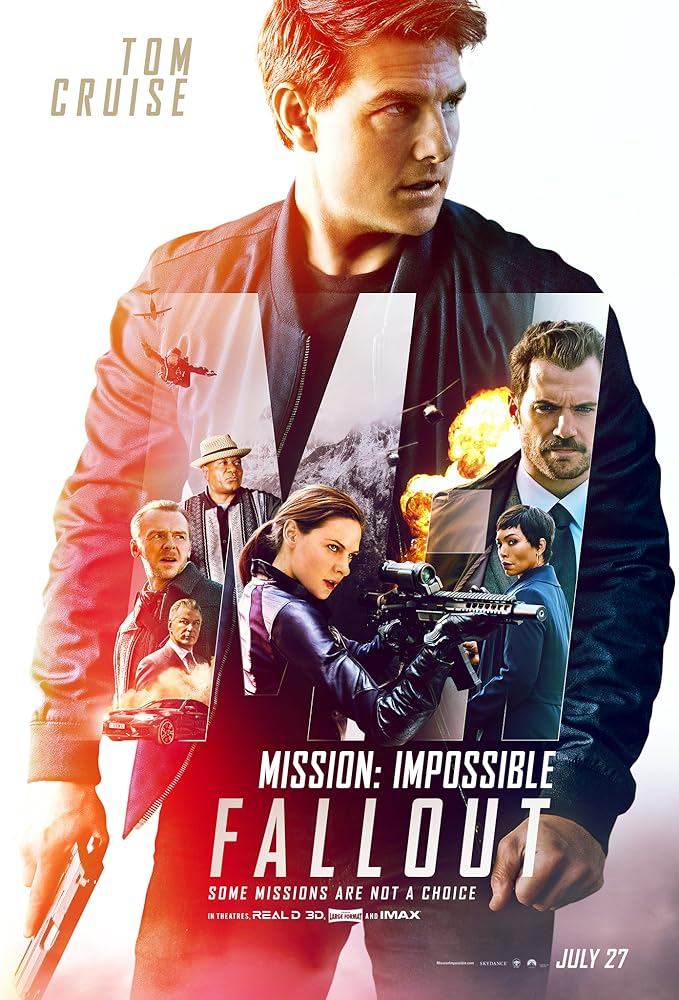
Mission Impossible - Fallout (2018) review

Tom Cruise, Alec Baldwin, Angela Bassett, Ving Rhames, Henry Cavill, Rebecca Ferguson, and Simon Pegg in Mission: Impossible - Fallout (2018)

Over the years, we’ve seen quite a few franchises experience an unexpected resurgence, resulting in the truly rare occasions where their sequels end up being their greatest installments. This has certainly been the case with the Mission Impossible franchise, which has now been running for more than two decades. It all started, of course, with the original film adaptation of the hit TV series of the same name from the 60’s/70’s (plus a short-lived revival in the 80’s) that was released in 1996 starring Tom Cruise in the lead role of Ethan Hunt, an agent of the International Missions Force AKA the IMF. The film also served as Cruise’s official debut as a producer, as he had launched his own production company three years prior with his former casting agent Paula Wagner. Upon its release, the film was one of the highest-grossing films of the year, and this commercial success continued over the course of the series’ initial trilogy of films. The third entry of that trilogy, 2006’s Mission Impossible III, served as the directorial debut of a longtime writer/producer named J.J. Abrams, who then joined the franchise as one of its main producers alongside Cruise starting with the sequel, 2011’s Mission Impossible – Ghost Protocol. And under the direction of Brad Bird in his live-action filmmaking debut, Ghost Protocol became the series’ most critically acclaimed and highest-grossing installment to date. Plus, it also helped to revitalize Cruise’s career after some of the, for lack of a better term, tumultuous incidents that he got involved in around the time of MI:3 (e.g. jumping on Oprah’s couch).

Four years later, the series returned with its fifth installment, Mission Impossible – Rogue Nation. Going off the ending tag from Ghost Protocol, the film’s plot took direct inspiration from the TV series by introducing one of its most recurring elements in the form of a terrorist organization known as the Syndicate. And keeping in line with the series’ habit of picking new directors for each new installment, Rogue Nation was directed by Christopher McQuarrie, who got his big break in the film industry by writing 1995’s The Usual Suspects, which earned him an Oscar for Best Screenplay. But in this case, he was most notable for being one of Tom Cruise’s most common collaborators, having worked together on films like Valkyrie, Edge of Tomorrow, and Jack Reacher (which he directed). And upon its release, the film continued the series’ recent hot streak with both critics and audiences to the point where the question of whether Ghost Protocol or Rogue Nation was the series’ best up to that point was quite the legitimate debate. But the biggest thing to come from Rogue Nation’s success was that McQuarrie ultimately ended up becoming the first director who was brought back to helm another Mission Impossible film. And thus, here we are now with the sixth installment of this premier action franchise, Mission Impossible – Fallout. With McQuarrie back behind the camera along with Cruise and the other returning cast members from past installments, things are certainly looking up for a series that has gotten better with each new film. Sure enough, Fallout may just be the series’ greatest outing to date thanks to its thrilling action set-pieces and McQuarrie’s phenomenal direction.

It has been two years since IMF agent Ethan Hunt (Tom Cruise) and his team successfully managed to capture Solomon Lane (Sean Harris), the ruthless leader of a rogue terrorist group known as ‘the Syndicate’. Since then, the surviving members of the Syndicate have formed a new faction known as ‘the Apostles’ led by a mysterious fundamentalist named John Lark. And to make matters worse, Ethan and his team end up botching a mission in Berlin, resulting in the Apostles acquiring three plutonium cores that they plan on using to further their plans to disrupt the current World Order. Thus, to prevent the devastating results of a potential nuclear attack, IMF secretary Alan Hunley (Alec Baldwin) sends Ethan to Paris to hunt down Lark, where he’s set to collect the cores from an arms dealer known as the ‘White Widow’ (Vanessa Kirby). And due to Ethan’s misstep in Berlin, he is also put under the watch of the CIA, specifically director Erica Sloane (Angela Bassett) and her top field agent August Walker (Henry Cavill), the latter of whom joins along on the mission to ensure that Ethan and his team can get the job done. But as the mission goes on, Ethan soon finds himself forced to go down quite a few dark roads, one of which even involves him having to assist the Apostles in breaking Solomon Lane out of custody. And if that wasn’t enough, Ethan’s actions soon lead to Walker beginning to suspect that he is really John Lark, putting more pressure on Ethan to figure out Lark’s identity.

With a subtitle like Fallout, one could only imagine how effective this film is in creating tension. While the series has always done a nice job when it comes to handling this aspect, it’s arguably at its finest here because of how truly high the stakes end up being. Sure enough, this is only strengthened further by the film’s amazing action sequences. Not only are they shot and edited perfectly, but they’re even more visually stunning when viewed in IMAX, continuing the franchise’s trend of utilizing the format to great effect ever since Brad Bird got the ball rolling with Ghost Protocol (sadly, I never got around to seeing Rogue Nation in IMAX). It all culminates in the film’s epic finale, which is quite arguably one of the most intense finales in recent cinematic history given the grand scale of the stunts involved (which, of course, are done practically by Tom Cruise himself, headlined this time by him piloting a helicopter by himself), and the consequences of what would happen if Ethan and his team fail. Simply put, arguably this film’s biggest strength is how finely tuned it is in almost every aspect of its production, resulting in what is truly a beast of an action film. And the same could be said for Rogue Nation as well, meaning that as far as Christopher McQuarrie’s contributions to this franchise are concerned, he’s given us some of the sharpest writing and most kinetic action set-pieces that we’ve ever seen from it. This also extends nicely to the film’s collection of layered characters.

As I’ve stated before, one of the reasons why Ghost Protocol was such a game-changer for the franchise was because it was the first entry in the series to truly capture one of the definitive aspects of its source material, its team dynamic. In other words, whereas the previous three films were directly focused on Ethan Hunt, Ghost Protocol was the first to ensure that his teammates were just as well-developed as he was. As such, the only thing that held Rogue Nation back was that it somewhat reversed course from this; granted, it’s not like there wasn’t any of it in the film to begin with, but it also kept half of the team away from the action for about half the runtime. With Fallout, though, I’m pleased to say that it goes about this more like Ghost Protocol. Sure, Ethan Hunt is still the main character as always (in fact, this film gives Tom Cruise some of the best bits of character development that he’s ever gotten from this franchise), but McQuarrie also does an excellent job of giving his teammates quality amounts of screen-time by comparison. Rebecca Ferguson shines once again as the enigmatic Ilsa Faust (AKA the series’ best female protagonist by far) while Simon Pegg and Ving Rhames once again provide reliable support as Benji Dunn and Luther Stickell, respectively. And as for the villains, Sean Harris continues to be intimidating as all hell as the soft-spoken madman Solomon Lane. Finally, with the newcomers to this franchise, the biggest standout of them all is easily Henry Cavill. Not only does Cavill prove to be just as dedicated as Cruise is when it comes to doing the action sequences, but Walker also ends up being quite the excellent foil to Ethan Hunt given their roles in the story.

When Rogue Nation came out, I was part of the crowd that still preferred Ghost Protocol even through the former was practically almost just as good by comparison. In other words, while Rogue Nation does feature a superior villain, Ghost Protocol was better at balancing its main characters. But as for Fallout, this time I’ll fully admit that I’m siding with the consensus this time when I say that this is the best installment yet of the Mission Impossible franchise. And for those keeping track, yes, we’re talking about the sixth installment of what is currently one of the longest-running film franchises in recent memory. Simply put, this is one of those franchises that has genuinely managed to improve itself with each new installment. With Rogue Nation, writer/director Christopher McQuarrie produced some of the series’ most dynamic action sequences to date, and with Fallout, he somehow manages to refine them even more. The result is a true action spectacle that once again highlights why Tom Cruise is one of the definitive stars of the film industry. Like in every other installment of this series, it’s really him doing all the big stunts, and this series doesn’t shy away from upping the scale of them with each new installment (and yes, that’s even after Rogue Nation literally had him hanging off the side of a plane). And through it all, Cruise is backed by a phenomenal supporting cast who benefit greatly from this film’s excellent handling of the series’ iconic team dynamic. In short, this is a must-see in theaters, especially if you’re able to see it on the biggest screens possible, IMAX. Simply put, this is up there with the likes of its predecessor Ghost Protocol (plus Rogue Nation, I’m sure…), The Walk, and many of Christopher Nolan’s recent films as one of the prime examples of why IMAX is truly one of the best ways to see a film in our current age of cinema.


Rating: 5/5!

Friday, March 30, 2018

Ready Player One (2018) review

Ben Mendelsohn, Simon Pegg, Mark Rylance, Lena Waithe, Win Morisaki, Tye Sheridan, Olivia Cooke, and Philip Zhao in Ready Player One (2018)

There’s no denying the fact that Steven Spielberg is one of the most legendary filmmakers in the history of cinema. Since his career first took off in the early 70’s, he’s given us an endless array of cinematic classics. He’s directed everything from iconic blockbusters like Jaws, E.T., and the Indiana Jones series to critically-acclaimed dramas like Schindler’s List, The Color Purple, and Saving Private Ryan. With that in mind, one could say that it’s only fitting that he’d be the one to direct a film that honors the current era of geekdom that he had a major hand in creating. And thus, here we are now with his latest directorial effort, Ready Player One, a film adaptation of author Ernest Cline’s best-selling novel of the same name from 2011. Upon its release in August of that year, this story of a teenager who embarks on an epic journey within the expansive world of a virtual reality game received solid reviews from critics and ended up becoming a New York Times bestseller. But in the years since, however, the novel has started to attract a steadily growing backlash from those who weren’t too keen on its over-reliance on pop cultural references. Nevertheless, seven years after its release, Cline’s novel now comes to the big screen under the direction of the one man who was undeniably one of Cline’s biggest influences. And because that man is Steven Spielberg, he manages to avoid making this film nothing but an endless barrage of Easter eggs (in this case, pun intended…) and instead gives us an entertaining sci-fi fantasy adventure that fully immerses us within its fantastical world.

In the year 2045, most of humanity finds itself living in slum-like communities due to everything from overpopulation to polluting. This includes teenager Wade Watts (Tye Sheridan), who lives in ‘The Stacks’ (named for its collection of trailer homes stacked on top of each other) in Columbus, Ohio. Like everyone else, Wade escapes the gloom of reality by immersing himself within the virtual world of a computer simulation known as ‘the OASIS’. Within the OASIS, one can do anything, go anywhere, and be whoever they want to be from the world of pop culture. However, things get a little more interesting when OASIS users learn of a quest set up by the service’s creator, the late James Halliday (Mark Rylance). Whoever manages to complete this quest, made up of three challenges tied directly to Halliday’s favorite aspects of pop culture, and find the secret ‘Easter egg’ that Halliday has hidden within the OASIS will earn Halliday’s shares of his company along with complete control of the OASIS. Wade, who adopts the username of ‘Parzival’, soon finds himself performing well in Halliday’s challenges thanks to his extensive knowledge of Halliday’s life. However, this also begins to put him in direct competition with Innovative Online Industries (IOI), led by CEO Nolan Sorrento (Ben Mendelsohn), who is also seeking the Egg to take over the OASIS by any means necessary. Thus, with the future of the OASIS on the line, Wade teams up with several other Gunters (‘Egg Hunters’), including Samantha Cook AKA Art3mis (Olivia Cooke) and his best friend Helen AKA Aech (Lena Waithe), to complete the challenges so that they can collect the Egg first.

Well, there’s really no way of beating around the bush on this one; one of the most definitive aspects of Ready Player One is its wide array of cameos and bits of dialogue that reference almost everything from the world of pop culture. There is so much of that in this film that it’ll legitimately require multiple viewings just to spot them all. At the same time, though, doing so would allow you to marvel at this film’s impressive visual effects. Obviously, everything within the OASIS is CGI, but thanks to the excellent work by the legendary Industrial Light and Magic, this film boasts some of the crispest CGI in recent memory. But fear not, as this film is much more than just a bunch of pretty visuals. Now, of course, this film does emphasize all the various cultural references that it has to offer; everything from Wade/Parzival riding a Back to the Future DeLorean in the OASIS to him using the ‘Holy Hand Grenade’ from Monty Python and the Holy Grail in combat. Despite this, though, Spielberg’s great direction makes it so that it ends up being more about the story and its characters than whatever figure from a popular video game or film happen to pop up on screen from time to time. After all, Spielberg, well-aware of how big of an impact he made on pop culture in the 80’s, purposefully decided to not directly use anything from the films that he directed so that this wouldn’t become an extreme case of vanity. And while the film does celebrate pop culture, it also offers some commentary on the instances where that love can go a bit too far. While Halliday’s challenges are primarily influenced by his favorite bits of media, Wade and company soon realize that another key influence behind them all are some of Halliday’s biggest regrets in life that occurred due to his overall lifestyle. This, along with several other aspects of the plot, helps to give the narrative a solid amount of heart which, given some of his previous films, is something that Spielberg is quite good at doing.

This entertaining adventure is further backed by its excellent ensemble cast. In the lead role of Wade/Parzival, Tye Sheridan exhibits solid charisma while also having some excellent chemistry with Olivia Cooke as Samantha/Art3mis. And while Wade is the main character of the story, Samantha is just as well-versed as he is when it comes to the OASIS and Halliday’s tendencies while also being the one who keeps him out of trouble with IOI, making her much more than just a typical ‘love interest’. Speaking of IOI, CEO Nolan Sorrento proves to be a solid villain thanks in large part due to Ben Mendelsohn being given plenty of time to interact with Wade and company; in other words, he isn’t as underused from a narrative perspective as he [sort of] was in Rogue One. Finally, closing out the film’s core group of leads is Lena Waithe in what will surely be a breakout role for her as Helen/Aech, who has a strong camaraderie with Sheridan while also playing a major part in some of the best moments in the film (i.e. a sequence that involves their group going through a recreation of a classic film that she hasn’t seen). And while these four characters do end up getting the most attention plot-wise, meaning that some of the supporting characters end up being a little underutilized as a result, there are still plenty of memorable supporting roles in this film aside from them. Mark Rylance (who, given his roles in both Bridge of Spies and The BFG, is quickly becoming a new Spielberg regular) makes the most out of his brief role as Halliday and his OASIS avatar Anorak as does Simon Pegg as Halliday’s former business partner, Ogden Morrow. And while the two of them end up being the least focused on of the main group, who are known as the ‘High Five’ due to their shared success at beating Halliday’s challenges, brothers Akihide/Sho (Philip Zhao) and Toshiro/Daito (Win Morisaki) do get to partake in some of the film’s most standout moments.

Now for the record, I am very much well-aware of some of the main reasons why Ernest Cline’s original novel has been getting a considerably substantial amount of backlash in the years since its release. The main reason why is simple, as some have taken issue with Ready Player One’s heavy emphasis on nostalgia and the various facets of pop culture that society has been treated to over the years, especially things that came from the 80’s. But because I’ll admit to not having read the novel beforehand, I didn’t really care about that going in. I mean, sure, in basic terms, this film is an amalgamation of numerous bits of pop culture; everything from The Iron Giant and Akira to Overwatch and Minecraft. But if there’s one person who could make all that work without going overboard on all the pop cultural references, it’d be the man who served as a direct influence on the original story itself, Steven Spielberg. Under the confident direction of one of the industry’s quintessential filmmakers, the film adaptation of Ready Player One is a delightful cinematic adventure that boasts some of the most stunning visuals in recent memory along with a fantastic ensemble cast headlined by the terrific lead duo of Tye Sheridan and Olivia Cooke along with memorable supporting turns from the likes of Lena Waithe and Ben Mendelsohn. In other words, under the eye of a ‘lesser director’, this probably could’ve turned out exactly like its critics thought it would be based on their overall thoughts on the book. But if there’s one thing that I hope we all can agree on, it is that Steven Spielberg is not ‘a lesser director’.

Rating: 5/5!

Wednesday, June 28, 2017

Directorial Retrospective: Edgar Wright

Image result for ‪edgar wright‏‬‏

Welcome back to another installment of Rhode Island Movie Corner’s ‘Directorial Retrospective’ series. This is where I look at the filmography of any given director in the film industry. Through this series, we’ve covered an eclectic bunch of filmmakers, from blockbuster giants like Michael Bay and Tim Burton to award-winning favorites like David Fincher and Quentin Tarantino. And today, we’re looking at the filmography of a major fan favorite amongst film buffs; Edgar Wright. His newest film, Baby Driver, hits theaters this weekend and in honor of its release, today we’ll be looking at the films that have made him such a popular director. He’s best-known for his somewhat unintentional trilogy of comedy films known as the Three Flavours Cornetto trilogy. The reason why I say that this trilogy is ‘somewhat unintentional’ is because the primary connection between these three completely different films (the first being a zombie film, the second a buddy cop action film, and the third film being a sci-fi thriller) is the appearance of Cornetto brand ice cream. Yes, folks, these films became a trilogy because of a running gag that was brought up during the second film’s promotional tour. However, these three films have gone on to become some of the most popular comedies in recent years. And today, I’ll be reviewing all three of them plus Wright’s other major directorial effort, Scott Pilgrim vs. the World. Just a quick disclaimer, though; there’s one film of his that I can’t include here because it’s not easily available online. The film in question is the 1995 western parody A Fistful of Fingers, which was his directorial debut. It did have a midnight re-release a few years ago in Los Angeles, but I wasn’t there for that so I can’t review it today. But to make it up to you folks, I’ll also go over the other big thing that Wright and frequent collaborators Simon Pegg and Nick Frost are known for; the short-lived TV series Spaced. How’s that for a slice of fried gold?

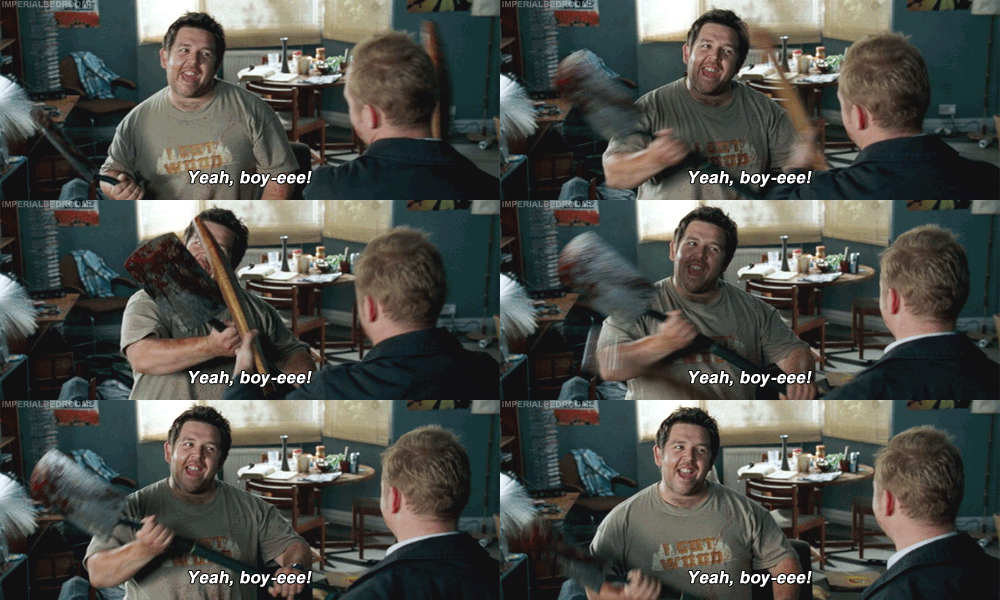
Image result for shaun of the dead yeah boy

SPACED: THE TV SERIES (1999-2001)

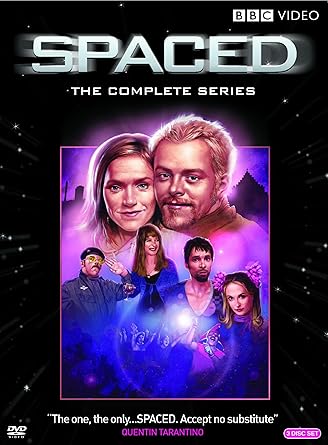
Image result for spaced tv series

Wright, Pegg, and Frost first became known via the short-lived, cult classic TV series Spaced. Wright directed all 14 episodes of the series, which ran for two seasons and was created by Pegg and Jessica Hynes, both of whom Wright had previously worked with on another short-lived series, Asylum. In Spaced, Pegg and Hynes star as Tim and Daisy, a pair of twenty-somethings who bond over their struggles to find new living arrangements. They manage to find a flat that’s going for a cheap price but are forced to act as a couple so that they meet the landlady’s requirements. And thus, one of the most underrated shows of all-time was born; seriously, this show is awesome. For one thing, it’s chock-full of hilarious pop culture references, from Tim’s never-ending disdain for The Phantom Menace to a zombie-fighting sequence that practically served as the genesis for Shaun of the Dead. It also served as an early showcase for Wright’s talents as a director when it came to visual comedy and tight editing (e.g. an argument between Tim and Daisy is intercut perfectly with gameplay from Tekken 2). But amidst all the great dialogue and wacky geek-related imagery, Tim and Daisy prove to be an extremely likable duo. Both Pegg and Hynes are fantastic in their respective roles, and they have terrific chemistry with each other without their characters ever getting into a fully ‘romantic’ relationship. They’re also backed by some highly memorable supporting characters, including Nick Frost (of course) as Tim’s military-loving best friend Mike and Mark Heap as Tim and Daisy’s ‘eccentric’ artist flat-mate, Brian. In conclusion, while it only lasted two seasons, Spaced proved to be an excellent show thanks to the efforts of Wright, writers/leads Pegg and Hynes, and its terrific ensemble cast. If you’re a fan of geek culture and you want to see how the Cornetto team got their start, give this show a watch; I bet you’ll love it.

Series Rating: 5/5!

SHAUN OF THE DEAD (2004)

Image result for shaun of the dead poster

While Spaced only lasted two seasons, Wright, Pegg, and Frost officially made a name for themselves in 2004 with a parody of George Romero’s classic …of the Dead franchise; Shaun of the Dead. This film is many things; obviously, it’s primarily a zombie film but at the same time, it’s also a romantic comedy/drama. A good chunk of the plot revolves around main protagonist Shaun (Pegg) attempting to rebuild the relationships that he has with his girlfriend Liz, his mum Barbara and stepdad Phil (“Don’t forget to kill Phillip!”), and so on and so forth. And it’s also a buddy film; of all the films in the Cornetto trilogy, this one arguably has Simon Pegg and Nick Frost’s best overall duo (in terms of their comedic camaraderie) via Shaun and his lazy but loyal best friend, Ed. Of course, all of this is happening right around the same time… as a zombie apocalypse. Stuff like this, along with all the fun horror-based visual/dialogue cues that will require multiple viewings to truly comprehend them all, truly goes to show how well-written the screenplay by Pegg and Wright was, as was the latter’s knack for great visual humor. Now, I’ll admit that, of the three Cornetto films, this is probably my least favorite of the three. Let me be clear, though, this is in no way a criticism towards Shaun of the Dead. It’s an excellently-written comedy that serves as a loving homage to the various horror films that it parodies, while also giving us likable main characters and basing it around a simple story of a guy just trying to find meaning in his life… again, during a zombie apocalypse. At the end of the day, though, I guess it’s just because, as I’ve stated before, I’m not that big a fan of the horror genre, hence why I do prefer the other installments of this trilogy. Still, this film is a total blast from beginning to end and it’s easy to see why it became such a cult classic.

Rating: 5/5!

HOT FUZZ (2007)


After hitting it big with Shaun of the Dead, Wright, Pegg, and Frost teamed up again three years later for another hilarious comedy that paid loving homage to another genre of film. In this instance, Hot Fuzz lampoons the many classic films of the action genre, from Lethal Weapon to Point Break and even Bad Boys II. And it does so to brilliant effect, once again thanks to Wright and Pegg’s fantastic writing and their knack for a keen attention to detail. Wright even manages to make ‘non-action’ moments feel like they’re epic and intense sequences through concise editing, like when Pegg’s character, the no-nonsense Sgt. Nicholas Angel, first travels to the peaceful little town of Sandford, where he’s been re-assigned simply because he’s so good at his job that he makes all his fellow officers look bad in the process. But soon, various deaths start occurring all over town, and while initially viewed as nothing more than accidents, Nicholas figures out that there’s more to the story. And without giving it away, the big reveal surrounding this whole ordeal is brilliant and the climax is full of epically hilarious action sequences that revel in all the iconic clichés of the genre. Pegg, of course, is great as Angel alongside Nick Frost as the overly eager officer Danny Butterman, Angel’s new partner who is a big fan of all the classic action films. And, of course, there are also some great cameos as well from the likes of Jim Broadbent as Danny’s father Frank, Sandford’s Police Inspector, Timothy Dalton as the seemingly sinister grocery store owner Simon Skinner, and much, much more. Bottom line; this film is a modern-day comedy classic. If you haven’t seen it before, what the heck is wrong with you? Watch it now! Come on, it’s all for the greater good! (“The Greater Good!!”)

Rating: 5/5!

Also...

Image result for hot fuzz swan

SCOTT PILGRIM VS. THE WORLD (2010)

Image result for scott pilgrim vs the world poster

In between the second and third Cornetto films, Edgar Wright took on his first big ‘adaptation’ in 2010; in this instance, the source material was the best-selling graphic novel series Scott Pilgrim by author Bryan Lee O’Malley. Wright and O’Malley worked closely on the adaptation, as the film was first announced after the release of the first graphic novel, Scott Pilgrim’s Precious Little Life, in 2004. This was right around the time that Edgar Wright was brought on to direct after he had finished work on Shaun of the Dead. This close collaboration resulted in a solidly faithful adaptation of the series, as subsequent entries were released during the film’s long development period. However, the final graphic novel, Scott Pilgrim’s Finest Hour, wasn’t released until after the end of the film’s production, thus having some minor differences while also including some elements from the film itself. Sadly, upon release, the film did poorly at the box-office as it wasn’t able to make back its reported $85 million budget… which is a shame because it’s an awesome film that, like Wright’s other films, is full to the brim with great homages to various facets of pop culture. In the case of Scott Pilgrim, that mainly comes from video games. The whole plot of the film, in which the titular character finds himself having to fight his new girlfriend’s seven ‘evil ex-boyfriends’, feels exactly like something you’d see in a video game, and the film is indeed structured as such. You don’t even need to be a gamer to appreciate this film’s many references, as they lend themselves excellently to terrific bits of visual and dialogue-based humor thanks to the, as expected, excellent screenplay by Wright and Michael Bacall (who also co-wrote the Jump Street films).

Now, with that said, I’ll admit that parts of this film could come off as being rather weird to those who aren’t really part of the gaming/geek community. Even as someone who is a gamer, this film is steeped so far into geek culture that I feel that some may potentially be drawn off by it. Plus, it does take a little while to get going and Scott isn’t always a likable main character, as mainly evident through how he handles his relationship with his previous girlfriend, Knives. However, once Scott finally starts to fight the Evil Exes, the film kicks into high gear to become an awesome mix of action and comedy just like Hot Fuzz, and it features some of the best fight sequences in recent years. And it’s all backed by an entertaining ensemble cast; Michael Cera is great in the title role as is Mary Elizabeth Winstead as Scott’s new girlfriend Ramona. Ultimately, though, the real stand-outs of the film come from Ramona’s Evil Exes, including but not limited to Chris Evans as a ‘pretty good’ action film star, Brandon Routh as a bass player who also has superpowers because he’s vegan, and Jason Schwartzman as the leader of the Evil Exes. Again, there are a lot of weird things in this film, downright goofy even. Thus, it does sometimes feel like the film teeters on the edge of being more style than substance. However, I’d argue that the film is most certainly more than just a series of flashy video-game inspired action sequences. If you’re able to accept all the crazy stuff in this film, you’ll find it to be one of the most highly entertaining films in recent memory. In fact, it's arguably the best ‘video game based’ film ever made… and it isn’t even based on a video game! (well, not primarily, at least)

Rating: 4.5/5

THE WORLD’S END (2013)

Image result for the world's end poster

As noted before, the Cornetto trilogy didn’t officially become a thing until after the release of Hot Fuzz, mainly due to an unintentional running gag. During the promotional tour for Hot Fuzz, one interviewer pointed out the appearance of Cornetto Ice Cream in both it and Shaun of the Dead. Wright, who had put it in Shaun of the Dead as an effective hangover cure for the character Ed and then used it again in Hot Fuzz as a homage to its appearance in the previous film, joked that this was the plan all along as a homage to Krzysztof Kieslowski’s Three Colours trilogy. Those films, which were released from 1993 to 1994, were named after the three colors of the French flag; Blue, White, and Red. Each film was then themed around the primary ideals of the French Republic; liberty, equality, and fraternity. But as for Wright and Pegg’s trilogy, while the Cornetto reference was initially just joked about, the two eventually decided to tie it all together. As such, the Cornettos that appear in each film tie directly into their respective themes. A red strawberry Cornetto appears in Shaun of the Dead to signify the film’s bloody horror elements while a blue ‘original’ Cornetto appears in Hot Fuzz to allude to its police themes. And in 2013, this newly designated trilogy concluded with The World’s End, featuring the green mint chocolate chip Cornetto to signify its status as a science fiction story. And while I wouldn’t say that The World’s End is the ‘funniest’ of the three films, it’s arguably the best-written. Of course, being a film written by Wright and Pegg, it’s full of great visual gags, hilarious bits of dialogue, and a sharp attention to detail. For one thing, the opening narration from Pegg’s character, Gary King, directly alludes to future events in the plot, something that also occurred in Shaun of the Dead via one of Ed’s monologues. They even connect the events of the film to the names of the pubs that the main characters visit.

But at the same time, this is arguably the most well-layered script of the entire trilogy. It’s a story about a bunch of friends who attempted to do a legendary pub crawl in their hometown known as ‘The Golden Mile’ when they were younger. Unfortunately for them, they were unable to complete it. Years later, Gary reunites them all, even though the other four have clearly all moved on in their lives, to do it again, as he plans on seeing things through this time to the bitter end (“or lager end!”). Also, did I forget to mention that during this second go-around, they learn that their hometown has been invaded by robots that they refer to as ‘blanks’ or ‘smashy-smashy egg men’? It’s just like Shaun of the Dead, where a rom-com story was based around a zombie apocalypse. In this instance, we have a tale of best friends and a hometown pub crawl that’s set during an alien invasion. Ultimately, though, the whole thing about the main characters redoing something from their past ties directly into the overarching theme of the film. Gary is a person who craves for the more free-spirited adventures of his youth despite the inevitability of growing up. Thus, when he tries to do the pub crawl again as an adult, he soon realizes that things have changed quite a bit since he was younger, both in terms of how his friends have grown compared to him and how much their town has changed since the last time they were there (i.e. invaded by robots). Meanwhile, he’s still stuck in the past and it’s clear that he’s made a mess of his life because of it. By the end of the film, he admits to his best friend, Andy Knightley (Frost), that the reason why he’s still determined to finish the Golden Mile is that, in his eyes, it’s all that he’s got at this point.

This overall theme of growth is also reflected in an effective role-reversal for Pegg and Frost. This time around, Pegg is playing the immature man-child while Frost is the sensible one that tries (and often fails) to get his former best friend to grow up, whereas in Shaun of the Dead and Hot Fuzz it was the other way around. And while their characters spend most of the film at odds with each other over an incident from their past, sort of like how Tim and Mike’s friendship from Spaced was impacted by an incident when they were younger, their comedic camaraderie is still just as great as ever, resulting in two of the best performances of their careers and arguably their best from this whole trilogy. And just like the other Cornetto films, they’re backed by an excellent supporting cast, which includes Martin Freeman, Paddy Considine, and Eddie Marsan as the other friends in their group (Oliver, Steven, and Peter, respectively) and Rosamund Pike as Oliver’s sister Sam, who happens to be an old flame of Gary’s. Thus, The World’s End is an incredibly satisfying conclusion to this trilogy of films that Edgar Wright, Simon Pegg, and Nick Frost collaborated on over the course of a decade. Again, it may not be the ‘funniest’ of the three Cornetto films (that honor goes to Hot Fuzz) but it may just be my personal favorite of the bunch because it’s a perfect representation of Wright and Pegg’s overall growth as filmmakers. This results in a film that is surprisingly full of emotional depth amidst all the cheeky British humor.  

Rating: 5/5!

Image result for edgar wright ant man

Now, of course, if things had turned out differently, Wright’s next film would’ve been Ant-Man, a project that he’d been working on ever since the early days of the Marvel Cinematic Universe in 2006. Sadly, he ended up leaving the project in 2014 due to creative differences with Marvel Studios’ now-disbanded Creative Committee. It is indeed a shame that he had to leave on that note on a film that he’d been working on for nearly a decade. Thankfully, though, Peyton Reed managed to do an excellent job in Wright’s place and made sure that the film wasn’t going to turn out as disastrous as the internet expected it to be. And to be honest, Wright was much better off working on a ‘true Edgar Wright’ film like Baby Driver instead of a film where he was clearly going to be limited by the influence of a Creative Committee (which, again, has thankfully been disbanded). Heck, right now we’re dealing with a similar situation with the Han Solo spin-off film. Its original directors, Phil Lord and Chris Miller, left the project due to creative differences with Lucasfilm, and while they’ve already tapped Ron Howard to take over for Lord and Miller, the internet’s already anticipating a disaster because, of course, it’s the internet. But as I noted last time, I’m sure that it will turn out just fine given the franchise’s recent track record… and by that, I mean everything since Lucasfilm was bought by Disney. Because, after all, Disney’s other big subsidiary franchise, the MCU, managed to do just fine with Ant-Man even after all its scandalous pre-production hubbub. And on that note, if there are still people out there who haven’t gotten over Wright’s Ant-Man departure yet… just remember that everyone involved in that production has clearly moved on from the whole ordeal with little issue.

And that concludes this Directorial Retrospective on the almost-complete filmography of Edgar Wright. Thanks for following along and be sure to sound off in the comments below with your own thoughts on the Cornetto trilogy and Scott Pilgrim vs. The World. Also, you can expect a review of Wright’s newest film, Baby Driver, sometime this week. Until then… 

https://www.youtube.com/watch?v=63V-ZNDPChU

Saturday, July 23, 2016

Star Trek Beyond (2016) review


As I’ve gone over quite a few times already these past few years, I am a huge fan of the J.J. Abrams-directed Star Trek films. The 2009 Star Trek ‘reboot’ not only introduced me to the franchise, as was the case with other franchise newcomers, but also ended up becoming one of my favorite films of all-time period. As a result, the sequel, Star Trek Into Darkness, was my most anticipated film of 2013. And while I personally really loved it, the same couldn’t be said for most long-time Star Trek fans. In fact, most Trek fans heavily despise the J.J. films for allegedly not staying true to the franchise’s roots and Into Darkness got a considerable amount of backlash for its re-imaginings of scenes from Star Trek II: The Wrath of Khan. So with all of that in mind, there was certainly a lot of pressure on the third of these J.J.-era (or should I say ‘Kelvin’ era as it’s recently been designated) films to adhere more to what made the franchise so popular in the first place. This time around, though, J.J. wasn’t available to direct due to his work on a certain other film that starts with the word ‘Star’. So in his place is Justin Lin and while a lot of Trek fans weren’t too pleased with the hiring of ‘another action director’, Lin’s work on the Fast and Furious films have made him one of the best action directors in the business. Plus, he made it clear that he was a Trek fan and with the addition of franchise star Simon Pegg as one of the film’s co-writers, it looked as if this new Trek film would fare much better with fans. And sure enough, Star Trek Beyond, the 13th installment of this iconic sci-fi franchise, is one heck of an exciting space adventure. For fans of the J.J. films like myself, this is just yet another super entertaining film that maintains all of the things that made the previous two films so great. But for more hardcore Trek fans, they’re probably going to like this one better.

At the end of Star Trek Into Darkness, the crew of the USS Enterprise, as led by Captain James Tiberius Kirk (Chris Pine), set off on a five-year journey into uncharted space. As this film begins, the Enterprise is three years into the voyage and while things have been going fairly smoothly for the crew, Kirk is considering applying for a promotion to the position of Vice Admiral due to him beginning to really feel the monotony of being a starship captain. After briefly stopping at Yorktown, an advanced Starbase, the crew are sent out on a rescue mission when an escape pod is found and its sole occupant, an alien named Kalara (Lydia Wilson), says that her ship got stranded in a nearby nebula. However, this ends up being a trap as the Enterprise is ambushed by a swarm of alien ships led by their fearsome alien commander Krall (Idris Elba), who is seeking a mysterious alien artifact that the Enterprise had recently found. The Enterprise is destroyed but the crew manages to abandon ship and they end up on a nearby planet. With no ship and no way of sending out a distress signal, Kirk, along with his fellow crewmates; first officer Spock (Zachary Quinto), medical officer Leonard ‘Bones’ McCoy (Karl Urban), communications officer Nyota Uhura (Zoe Saldana), engineer Montgomery Scott (Simon Pegg), helmsman Hikaru Sulu (John Cho), and navigator Pavel Chekov (Anton Yelchin), as well as a new ally in Jaylah (Sofia Boutella), a scavenger who’s been living on the planet for some time, race to stop Krall before he can collect the artifact and use it to attack the Federation.

As noted earlier, one of the main issues that ‘Trekkers’ have had with the J.J.-directed films is that they don’t really feel much like Trek films. While I personally disagree with that argument, I will admit that out of all of these recent Trek films, Beyond is certainly the most Trek-ish of the bunch. The whole plot of Kirk and crew stranded on an alien planet definitely feels like something you’d see on an episode of The Original Series. By comparison, the last two films were more focused on the origins of the Enterprise crew before they set off on their five-year mission. However, if we’re talking overall execution, Beyond very much maintains the same level of action as its two predecessors. So with that said, I’m not entirely sure if this will win over every Trek fan because it’s still very much an action-oriented film and not necessarily a ‘cerebral’ kind of story as I find that some fans were wanting out of these newer films. But as someone who actually does prefer the action-oriented style of the newer Trek films, this film was right up my alley and I loved every second of it. The action is excellent as are the visuals and Justin Lin’s direction is solid throughout. Plus, amidst all of the action, the film makes sure to spend time further developing its characters, namely by giving them some effectively emotional character moments. Now I’ll admit that I don’t think this film actually has as much emotional depth as the previous two films but even with that said, there are still plenty of emotional moments in this film, like Spock struggling to cope with the idea of mortality following a recent tragedy (the details of which I won’t reveal here as they’re kind of spoiler-y).   

I don’t really need to go over the main cast that much because this is the third film that they’ve been in. Simply put, they’re just as phenomenal as they’ve been in the last two films. One of my absolute favorite things about these new Trek films has been the camaraderie amongst the main ensemble and I’m happy to report that this is once again the case here, resulting in plenty of humorous banter amongst them. Though with that said, it’s also a little bittersweet knowing that this is the last we’ll see of Anton Yelchin in the role of Chekov, as Yelchin tragically passed away a month ago in a car accident. So instead of focusing on the main cast, let’s focus on the newcomers, specifically Sofia Boutella as Jaylah and Idris Elba as the film’s main villain Krall. Boutella made quite an excellent first impression in her first ‘major’ film role as Gazelle, the main henchwoman of Samuel L. Jackson’s Valentine in last year’s Kingsman: The Secret Service and she’s once again excellent here. Simply put, Jaylah’s a pretty badass female lead but is one that is also very layered as well as shown in her backstory and her motivation of getting off of the planet. As for Elba as Krall, I must say that these new Trek films have done a pretty excellent job with their villains. I can’t say at the moment if Krall is as good as or better than Nero (Trek ’09) or Khan (Into Darkness) but Elba certainly makes the character a very memorable and quite intimidating adversary for Kirk and company. Plus, his main motivation and backstory are quite well-developed.

As someone who absolutely loved J.J. Abrams’ two Star Trek films, Star Trek Beyond most certainly delivered on everything that I love about these newer Trek films. The action and visuals are excellent, the plot is solid, and the characters are excellently handled in terms of both the performances and strong camaraderie of the actors/actresses who play them as well as the excellent character development that they get to work with. However, I’m well-aware that this film has a lot to prove as most Trek purists weren’t too pleased with the last two films. And while I personally will defend both the 2009 Trek and Into Darkness come hell or high water, I have the feeling that they’re going to like this film a whole lot more. Because while it’s still very much the action-oriented style that the two J.J. films maintained, the plot is certainly much more Trek-y in terms of its overall execution. So in short, thanks to the solid direction from Justin Lin, who proves to be an excellent successor to J.J., as well as the solid writing from writers Simon Pegg and Doug Jung, Star Trek Beyond is yet another fantastic entry in this legendary franchise. And for someone like me who grew up not with the Original Series but with J.J.’s films, it’s just another home run hit for the franchise’s modern era and I can’t wait to see what happens next for my favorite Enterprise crew. In fact, we already know one key detail of what will happen next as it was recently confirmed that Chris Hemsworth, who had a minor role in the 2009 film, will be returning in the next film to reprise his role as Kirk’s father George. Could this potentially be the last of the J.J.-era Trek films? We don’t know for sure just yet but needless to say I’m super excited for the new Star Trek IV, in which Kirk’s overall arc of trying to live up to his father’s legacy will no doubt come full circle.


Rating: 5/5!

Wednesday, July 20, 2016

TREK WEEK: In Defense of the J.J. Abrams-directed 'Star Trek' films


As the second annual ‘Trek Week’ continues here on Rhode Island Movie Corner, I’ll be doing something a little bit different today; something sort of along the lines of a ‘thesis’ as I work to defend two of my favorite films of the last few years; J.J. Abrams’ Star Trek films. Despite what some fans may claim, these two films are very important to the franchise as they very much resurrected it after almost half a decade of no new major Star Trek media. And they’re also very important to me as not only are they some of my all-time favorite films (the 2009 Star Trek film is legitimately in my Top 10 favorite films of all-time) but they also helped me get into the Star Trek franchise in the first place, and the same can be said for other people who went into it not being very familiar with the franchise. However, when it comes to long-time fans of Trek, these films aren’t really as liked. In fact, they’re pretty much hated by them for various reasons and said backlash got even more vocal when the 2013 sequel, Star Trek Into Darkness, was released. Simply put, the big argument amongst this crowd is that the films ‘don’t carry the feel of the franchise’. As a result, there’s now a lot of pressure on director Justin Lin and writers Simon Pegg and Doug Jung to make sure that the upcoming Star Trek Beyond does a better job at appealing to the long-time fans. And I won’t lie… all of this backlash kind of frustrates me. Because I am not embarrassed to admit that I am a major fan of the J.J.-directed Trek films. In fact, I kind of prefer them to the older Trek films. And yeah… I know that this will be considered as complete ‘blasphemy’ amongst Trek fans. However, I’m about to go over why I will defend these films to the bitter end.  

But first, let’s put things into perspective. In the early 2000’s, the Star Trek franchise was pretty much at rock bottom. The most recent Trek film, Star Trek: Nemesis, the last film to star the cast of Star Trek: The Next Generation, was both a critical and commercial dud, just barely earning back its $60 million budget at the box-office. In fact, from a box-office perspective, it is the lowest-grossing film in the series worldwide. Meanwhile, on the TV front, things weren’t doing much better. The main Trek show at the time, the prequel series Enterprise, constantly suffered ratings-wise during its run and by 2005, the generally polarizing series was canceled after only four seasons. The following year, the franchise’s creative head, Rick Berman, was relieved of his duties. In short, the franchise was in one hell of a creative rut. As a result, the next few years saw numerous proposals for a potential resurrection of the franchise from various filmmakers including Bryan Singer and even Trek alums like Jonathan Frakes and William Shatner. Ultimately though, the honor to revive the franchise went to writers Roberto Orci and Alex Kurtzman, with J.J. Abrams, fresh off of his feature-length directorial debut, 2006’s Mission Impossible III, chosen to direct. And we all know how that turned out. On May 8th, 2009, Star Trek was released in theaters and it was a solid critical and commercial hit. It certainly proved to be a success for non-fans of the franchise and opened the door for a new generation of Trek fans like myself. However, the same couldn’t really be said for long-time fans. And based on every single criticism that I’ve heard directed towards these films over the past few years, there are two main issues that the ‘Trekkers’ have with these films.
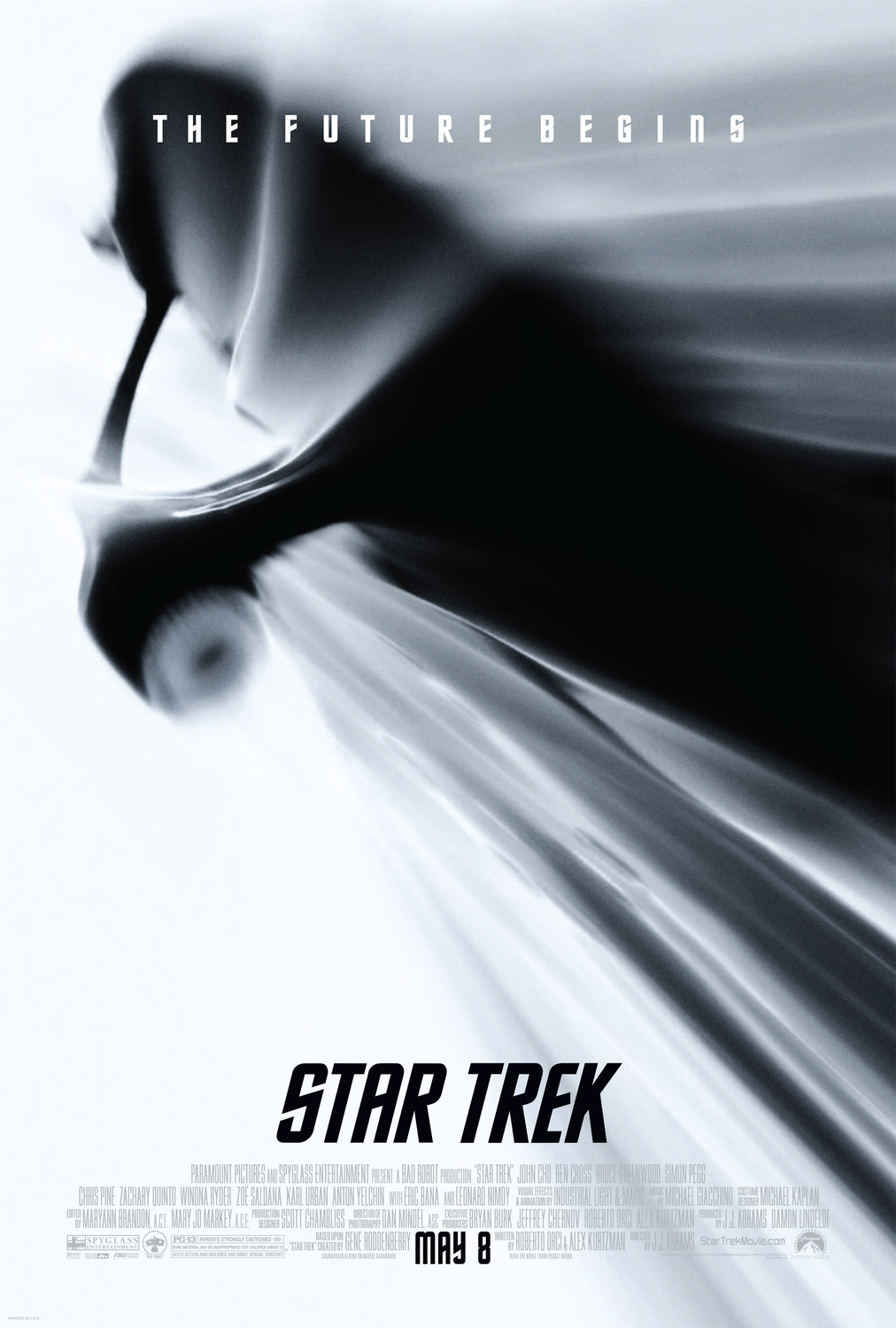

The first was the new film’s bold decision to establish an ‘alternate universe’. This concept of a ‘multi-verse’ had been previously explored in episodes of the various Trek shows but this was pretty much the first time that the films had ever gone this route. As the result of a supernova being turned into a black hole, the Romulan ship Narada ended up going back over a century in time and its attack on the USS Kelvin paved the way for a different series of events that still revolved around the franchise’s classic characters, namely James T. Kirk. A similar situation occurred last year with Terminator: Genisys and as you’d expect, that film also got flak for going that route. However, I actually think that this is a great idea as it allows the franchise to tell new stories within their universes with their classic characters without having to adhere to canon. But at the same time, another argument that people bring up about this kind of plot development is that it results in classic moments from the series ‘being erased from existence’… and I’ll just cut to the chase and say that this is not true. I mean, okay, it’s true that the creation of a new timeline does do away with beloved moments from previous films. However, it’s not like those films don’t exist anymore. If you can still go to a place like Best Buy and are able to buy the original Trek films without issue, then I don’t see what the problem is with a franchise establishing a new alternate reality. The main characters are still the same characters as before, expect that now they are being developed in different, and technically speaking ‘more modern’, ways.


The character that benefits the most from this new timeline is Captain James Tiberius Kirk. Of course William Shatner will always be the original Kirk but if you ask me, Chris Pine’s Kirk is actually a much more layered character. With Shatner’s Kirk, things usually ended up going his way no matter how difficult the situation was. After all, as emphasized in a classic scene in The Wrath of Khan where he reveals that he cheated on the infamous Kobayashi Maru test, a moment which was finally witnessed in the 2009 film, Kirk does not believe in the no-win scenario despite being told that it a situation that every Starfleet captain will likely face at one point. There were only a few instances where things didn’t really go his way, with the biggest one being when Spock died at the end of Wrath of Khan. Chris Pine’s Kirk, on the other hand, immediately starts off on a rough path. He had to grow up with the burden of having his father be George Kirk, who sacrificed himself to save the lives of the crew of the USS Kelvin, including his wife Winona and their then-newborn son [him]. So as a result, he became a reckless and arrogant delinquent until he was approached by Christopher Pike to enlist in Starfleet, ‘daring him to do better’ than his dad. I feel that this helped make Pine’s Kirk a very relatable protagonist, someone who has a lot of pressure on him to succeed. As a result, it’s cool to see how he matures as a leader over the course of these films. Plus, this idea of Kirk being under his father’s shadow seems to once again be relevant in the upcoming Star Trek Beyond as the second trailer opens with Kirk recounting how ‘he joined Starfleet on a dare’ and Bones remarking that now Kirk is trying to figure out who he really is.


As for Kirk’s eventual first officer Spock, the film further explores the character’s half-human, half-Vulcan heritage. Right out of the gate, he is shown to be ostracized by his Vulcan peers solely due to his father Sarek being a ‘traitor’ for marrying ‘that human whore’ Amanda Grayson. This prejudice is later seen when the heads of the Vulcan Science Academy remark about how successful Spock has been despite the ‘disadvantage’ of having a human mother. This effectively leads him to reject the invitation to the Academy and instead enlist in Starfleet. And while Trek fans of course know that Kirk and Spock are always portrayed as friends, the 2009 film actually doesn’t start out that way. When Kirk pulls his little ‘stunt’ during his Kobayashi Maru test, he is immediately accused of cheating by Spock and the two end up in a major moral conflict for most of the film, with Spock maintaining a generally cold and logical persona throughout. His emotions aren’t fully brought out until Kirk provokes him by questioning why he doesn’t show any emotion over the recent death of his mother, resulting in him lashing out at Kirk and subsequently relinquishing command to him on account of being emotionally compromised. This is then followed by Sarek finally admitting to him that he didn’t marry his mother because it was ‘logical’ but because he truly loved her. As a result, Spock is able to gain better control of his emotions, allowing for him and Kirk to finally set aside their differences and work together to stop the Narada from destroying Earth. Later, he is convinced to stay with Starfleet and be Kirk’s first officer, being told to ‘put aside logic’ and ‘do what feels right’. By whom, you may ask? Why, by his older self, of course!
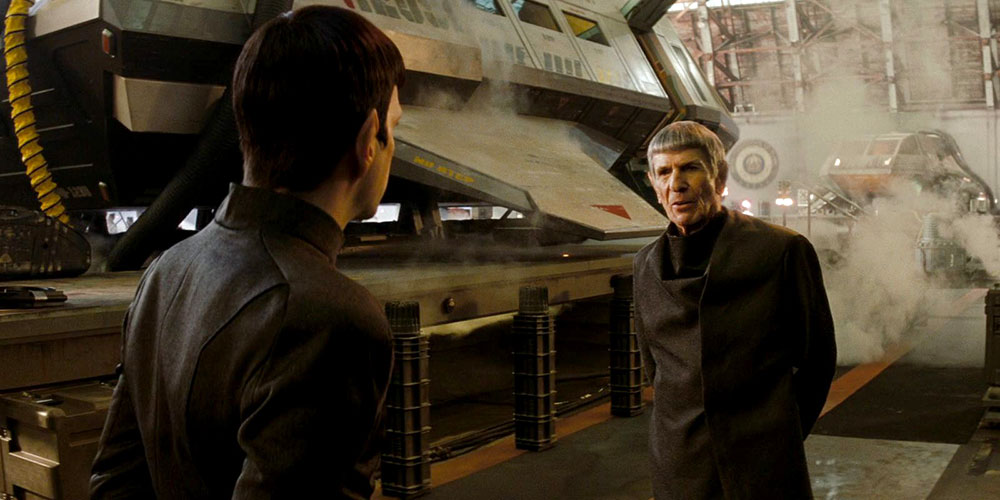

Yes, the 2009 film pulled a major coup by having Leonard Nimoy cameo as an older Spock. His Spock is shown to be the one from the original timeline and was partially responsible for the establishment of the new timeline. When his attempt to save the planet Romulus from a supernova failed, it led to the creation of the aforementioned black hole and he and the Narada were sent many years back in time. When Kirk is marooned on the ice planet Delta Vega by the younger Spock, ‘Spock Prime’ (his credited designation in these films) helps him get back onto the Enterprise though he doesn’t come along to help Kirk take command of the ship, claiming that he cannot come into contact with his younger self. However, the two Spocks do end up meeting at the end of the film and the older Spock admits that he ‘lied’, or as he puts it, ‘implied’ about the whole time paradox thing. This is easily one of the best cameos in recent memory, though I use the term ‘cameo’ loosely because Nimoy’s Spock actually has a major role in the film. Nimoy is just as excellent as he’s always been in the role. At the time, it had been a long while since he last played the part but he slips back into the role with ease and gives the film plenty of emotional gravitas. Now I am aware that there were also plans to have William Shatner do a cameo but that ultimately didn’t happen. And to be honest, I think it’s actually a good thing because I feel that having both Shatner and Nimoy appear might have been a detriment to Chris Pine and Zachary Quinto as the younger Kirk and Spock. By just having Nimoy appear, it allows for Pine and Quinto’s versions of the characters to stand on their own while still giving the film a means of connecting the new Trek with the old Trek. Nimoy would once again appear, this time truly in cameo form, in the sequel when the younger Spock contacts him requesting information about that film’s main villain (more on that character later). Sadly, this would be the last time that Nimoy ever played the part as he passed away in February of 2015.
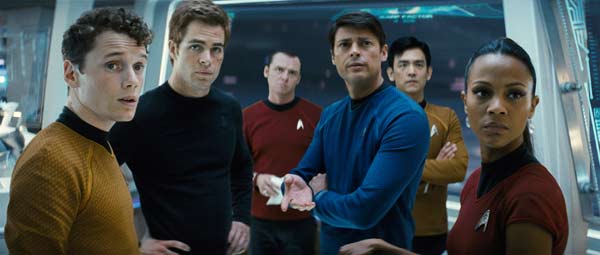

While Kirk and Spock are obviously the main protagonists, the film also does a great job in setting up all of the other main characters. Not all of them get as much to do as the lead duo but they at least have one scene each that establishes their importance to the crew. While Dr. Leonard ‘Bones’ McCoy has perennially been the third most important character of the series, the film actually promotes Lt. Nyota Uhura to that position. And sure, a sizable part of her role in the newer films does revolve around her romantic relationship with Spock but I actually don’t mind that as I feel that this relationship gives Spock a valuable human connection. Plus, I also liked how, early on, Uhura didn’t really get along with Kirk as a result of his generally brash demeanor. But of course the film doesn’t forget about the Enterprise’s reliable doctor, Bones, and of the entire cast, Karl Urban probably acts the closest to his predecessor, DeForest Kelley. Urban absolutely nails the character’s generally grumpy but still very much humane attitude, especially in scenes where he’s arguing with Spock (“Are you out of your Vulcan mind?”). Helmsman Hikaru Sulu (John Cho) gets to be part of a major action sequence when he and Kirk space-jump onto a Romulan drill, which harkens back to a famous moment from the episode ‘The Naked Time’ in which Sulu, while under the influence of a mysterious substance, brandishes a fencing foil (from the 2009 film: Kirk: “So what kind of combat training do you have?” Sulu: “Fencing.”). The sequel even hints at a potential future as a starship captain, something that did happen in the original timeline, when he becomes acting captain and threatens ‘John Harrison’ with the load of torpedoes at the Enterprise’s disposal (Bones: “Mr. Sulu… remind me never to piss you off.”).

As for ensign Pavel Chekov (played by the late Anton Yelchin, who tragically passed away recently meaning that the upcoming Beyond will serve as his final turn in the role), the film immediately sets him up as a young mathematical prodigy. Said talent comes in handy later on, especially in a scene in which he is able to beam up Kirk and Sulu when they fall off of the Narada’s drilling device. However arguably his best moment came in Into Darkness, during which he’s promoted to the role of Chief Engineer when Scotty decides to resign. Simply put, the look on his face when Kirk tells him to go put on a red shirt is priceless, showing that he clearly knows what happens to most redshirts in Star Trek. Thankfully that fate doesn’t end up happening to him. And of course we can’t forget about the Enterprise’s trusty engineer, Montgomery Scott, who is first introduced working at an outpost on Delta Vega before Kirk brings him onto the Enterprise as Chief Engineer. Like Urban, Simon Pegg absolutely nails the role from the accent to the mannerisms and the films certainly utilize Pegg’s comedic ability to great effect, from the scene in which he awkwardly remarks how exciting it is on the Enterprise after the whole ‘Kirk emotionally compromising Spock’ scene to the scene in Into Darkness in which he drunkenly argues with Kirk over coms while at a bar following his resignation. In short, every member of the Enterprise crew matters in the long run and these films do an absolutely fantastic job in establishing a phenomenal camaraderie amongst its cast of leads. 
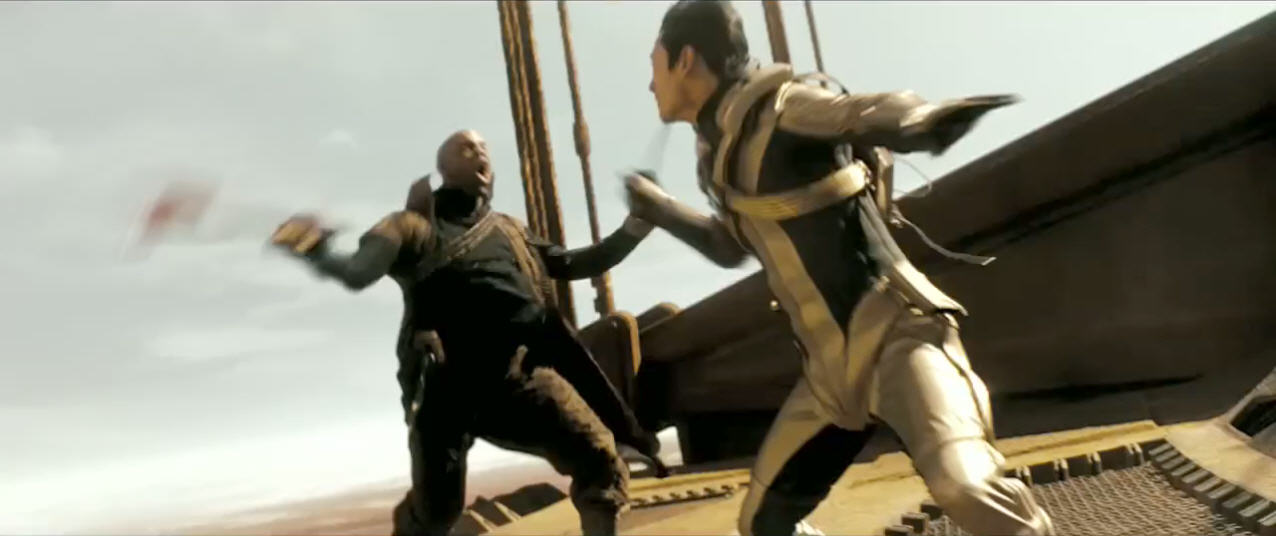

But perhaps the biggest issue that most Trek fans have with the new films is the fact that it seemingly focuses more on action than the layered, cerebral plots that the franchise has perennially been known for. And while it’s true that the films definitely have a very action-heavy style, I don’t really see how that’s entirely a ‘bad thing’. Chris Pine was recently quoted as saying that it’s not really possible to do ‘cerebral’ Trek anymore in 2016, saying that “it just wouldn’t work in today’s marketplace” of big blockbusters… and you know what? He’s totally right! Like imagine if they ever decided to do something similar to Star Trek: The Motion Picture… that would be a colossal disaster from a box-office perspective. It’d do about as good as a Terrence Malick film. The other thing is that I’d argue that while the films do lean more towards being sci-fi action films, that doesn’t mean that they don’t have strong themes and character arcs in them. In the case of the 2009 film, there’s things like Kirk trying to deal with being in the shadow of his father and Spock struggling to deal with his emotions as well as dealing with his half-human/half-Vulcan heritage. Heck, Nero (Eric Bana) is actually a pretty decent villain as far as Star Trek villains go. He has an emotional backstory to him as he seeks vengeance against Spock (the older Spock, specifically, though this plot of revenge is later carried over to the younger Spock) for being unable to save his planet Romulus from destruction. So as payback, he makes Spock witness the destruction of Vulcan… and boy is that an emotional gut-punch of a scene, especially when Spock’s mother Amanda falls to her death right in front of her son. Heck this whole film is full of effective emotional moments, including the opening as Kirk’s father sacrifices himself right as his wife gives birth. What can I say? J.J. does a great job when it comes to scenes like this.


Speaking of the score, Michael Giacchino’s music for these newer Trek films are two of my all-time favorite film scores. In creating said score, Giacchino does something that David Arnold did when he did the music for the 2006 James Bond ‘prequel/reboot’ film, Casino Royale. And that is that he makes the smart decision to not primarily utilize the iconic Star Trek theme created by Alexander Courage. Instead, that piece is fittingly used during the end credits and I must say that Giacchino’s version of the theme is quite a rousing cover of it. But as for the rest of the film, Giacchino does an absolute fantastic job when it comes to creating motifs that can be either really emotional or invigoratingly thrilling during the film’s equally thrilling action sequences. In regards to the latter, this mainly comes in the form of this reboot series’ main motif (exemplified in this track, ‘Enterprising Young Men’). I absolutely adore this motif and I especially love how it can be used in both emotional scenes (e.g. ‘Warp Core Values’ from Into Darkness) and scenes of grand spectacle (e.g. the aforementioned ‘Enterprising Young Men’, during which we see the first look at the Enterprise, and ‘Sub Prime Directive’ from the opening of Into Darkness as the Enterprise rises out of the ocean). In the case of the former, just look at tracks like ‘Labor of Love’, which is played when Kirk’s father sacrifices himself while his wife gives birth, or ‘Buying the Space Farm’ from Into Darkness, when Kirk makes the same bold sacrifices that his father made and shares one last moment with Spock.


And yeah… let’s talk about Star Trek Into Darkness. This is one that I’ve been dying to stick up for these past few years because ever since it came out, it’s been subjected to much scrutiny from ‘Trekkers’. So much so that at a convention in Las Vegas that was held a few months after the film premiered, it was named the WORST film in franchise history, with one fan apparently claiming that the JJ films shouldn’t even recognized as Star Trek films… and boy does all of this piss me off. First off, Into Darkness is ‘worse’ than The Motion(less) Picture, the yawner that is Insurrection, or the actual near-franchise killer that was The Final Frontier? But the thing that really rubs me the wrong way is the statement about the films not belonging in the franchise. You know, the franchise that was pretty much dead and would still be dead if it wasn’t for the J.J. films? They seriously ranked a non-Trek film, 1999’s Galaxy Quest, higher than Into Darkness. That shouldn’t even count! UGH! So what is it about Into Darkness that Trek fans were so upset about? It was over the big bait-and-switch pulled by the filmmakers in which it was revealed that Benedict Cumberbatch’s villain character was in fact the legendary franchise antagonist Khan… except in the months leading up to the film’s release, everyone kept denying that he was Khan. And to make things more problematic, the film then proceeded to re-imagine some notable ‘moments’ from Star Trek II: The Wrath of Khan, namely the bold sacrifice by a main character to save the Enterprise from being destroyed and the vengeful screaming of Khan’s name. However, is the film as big of a ‘rehash’ of Wrath of Khan as Trekkers claim? The truth is… it really isn’t…


If Star Trek Into Darkness was about Khan trying to find a terraforming device capable of giving new life to a dead planet or destroying every living thing if used on a planet with life, then I’d probably be more susceptible to call the film a ‘rip-off’ of Wrath of Khan but that’s not what the film is about. Instead, it’s about Khan enacting revenge upon Starfleet for using him and holding the rest of his people hostage. And really, you want to know how many things the film ‘borrows’ from Wrath of Khan? Aside from having Khan being of the villain, of course, as well as introducing the character of Carol Marcus, who gave birth to Kirk’s son David in the original timeline, there’s really only two major sequences from that film that are redone here; the aforementioned sacrifice and KHANNNN! scenes. Seriously Star Trek Nemesis was a bigger ‘rehash’ of Wrath of Khan. I’m not joking; the final battle of Nemesis is almost note-for-note the exact same finale. Two ships captained by a Federation captain and his greatest ‘personal’ nemesis fighting in a part of the galaxy where they are unable to target each other to attack, ultimately culminating in the death of probably the most popular character of their respective casts. Now as far as the whole thing about the cast and crew denying Khan’s identity before the film’s release, I actually don’t blame them for trying to keep the whole thing a secret. In the digital age, it’s become much harder for studios to prevent leaks of spoiler-heavy material. In fact, I already knew that Cumberbatch was going to play Khan months in advance due to someone at Entertainment Weekly making the idiotic mistake of identifying him as Khan when they debuted a pair of magazine covers for the film, one with Kirk and Spock, the other with Kirk and Khan.

And speaking of Khan, Benedict Cumberbatch is fantastic in the role. He doesn’t try to be Ricardo Montalban’s version of the character and that was certainly a smart move… otherwise the film would’ve gotten even more flak from Trek purists. Cumberbatch brings a ‘Hannibal Lecter’ esque vibe to his performance, which of course is straight-up exemplified in scenes where Khan is held captive on the Enterprise. But perhaps the most interesting part about Cumberbatch’s take on the character is that this film’s Khan is in some ways a very sympathetic villain. When Khan reveals his true identity to Kirk and Spock, he then proceeds to recount his past history. His ship and crew were found adrift by Starfleet’s Commander-in-Chief, Admiral Marcus, who subsequently took Khan’s crew hostage in exchange for having him develop weapons and the Admiral’s new ship, the USS Vengeance. Ultimately this of course leads to Khan enacting revenge upon Starfleet when he is led to believe that Marcus had killed his crew. However, as we learn, he didn’t and instead had them placed in cryogenic freeze inside 72 of the advanced torpedoes that Khan had been developing. Marcus then proceeds to give said torpedoes to the Enterprise to use as leverage against him. Khan immediately recognizes this when Kirk and crew confront him on Kronos and he willingly surrenders. And boy is the scene in which Khan emotionally recounts how he was led to believe that Marcus killed his crew yet another emotional gut-punch of a scene, buoyed by Cumberbatch’s absolutely powerful performance as well as the final line of his ‘monologue’; “Is there anything you would not do for your family?”


Once again, the film does a fantastic job of portraying the relationship between Kirk and Spock, which hits another snag at the beginning of the film when Kirk violates the Prime Directive and lets the Enterprise be seen by a primitive race in order to save Spock from an active volcano. And because Spock is very much someone who goes ‘by the book’, he ends up reporting this to Admiral Pike and Kirk is relieved of his command as a result. Obviously Kirk is pissed and Spock’s general ‘lack of emotion’ once again proves to be an issue for him. It even strains his relationship with Uhura as a result of him seemingly embracing his death at her expense. The film also continues to focus on Kirk’s reckless behavior, as Pike comments that this kind of attitude could get everyone under his command killed. That ends up being Kirk’s arc in this film; learning to take better responsibility for his actions. Because when ‘John Harrison’ attacks Starfleet and Pike ends up being one of the casualties, it leads to him recklessly going after Harrison to avenge the death of the person who become the closest thing that Kirk ever had to a father figure in his life. And sure, while Spock is the one who is with Pike when he dies, Kirk’s reaction to his death is still pretty damn emotional as is the scene where Spock mind-melds with Pike before he dies. Ultimately by the end of the film, Kirk follows in his father’s footsteps by saving his ship at the cost of his life by entering the ship’s radioactive reactor chamber and realigning the warp core.


And folks, I won’t lie in saying that the scene in which Kirk and Spock share one final moment before Kirk dies from radiation poisoning brings me to tears every time that I watch it. And yes, I know that it’s almost exactly the same as that scene from Wrath of Khan but aside from one or two lines of dialogue that are lifted from the previous film (e.g. ‘ship out of danger’), the filmmakers actually do enough to differentiate this scene from its predecessor, namely in regards to context. In Wrath of Khan, this was pretty much the first time that Kirk truly has to deal with a ‘no-win’ scenario. In Into Darkness, this scene reaffirms the friendship between the two. All throughout the film Kirk tries to prove to Spock why he risked violating the Prime Directive to save Spock from the volcano and it is in this moment when Spock realizes why he did it; he wasn’t going to let his best friend die. And as for the once-again infamous ‘KHAANNN!’ scene, this time performed by Spock, yeah it’s ridiculous but the same could be said for when William Shatner did it in Wrath of Khan. With that said, some have argued that this scene is ‘pointless’ due to the fact that it wasn’t necessarily Khan’s fault for the Enterprise falling helplessly to Earth. And yet, like the argument that the film is a complete retread of Wrath of Khan, that’s not entirely true. Sure, most of the damage sustained to the ship was caused by the film’s other ‘villain’, Admiral Marcus, but Khan ended up taking control of Marcus’ ship, which then proceeded to further attack the Enterprise. So I’d argue that said further attack is what ultimately led to the ship falling to Earth. So yes, even if it’s only in a minor way, Khan WAS partially responsible.

And yeah… maybe I should talk about the big elephant in the room. And that is in regards to the film’s major McGuffin, Khan’s blood. As shown in the beginning of the film, Khan is able to blackmail a Starfleet officer into bombing a Starfleet facility by offering to help save the officer’s terminally ill daughter with the use of his blood. And as you might expect, Khan’s blood is what is ultimately used to save Kirk. Bones realizes this when a dead Tribble that he has been experimenting on suddenly comes back to life as a result of the blood. Is it ridiculous? Yes. Is the part with the Tribble rather blatant fan-service? Yes. Am I in any way bothered by this plot-point? No. Because believe me, the Star Trek franchise has seen plenty of silly plotlines over the years, like in Star Trek IV: The Voyage Home when the villain was a giant space log that was trying to talk to humpback whales. And yes, I think it’s pretty clear that this plotline of, to quote its critics, ‘magic blood’ probably isn’t going to brought up again in future films, which would effectively make this ‘new discovery’ that could fix a whole lot of problems rather pointless in the long run. But again, I’m not too bothered by that because at the end of the day, Into Darkness is just like its predecessor in being a very fun and action-packed adventure buoyed by effective emotional depth and terrific character development. Worst Star Trek film of all-time this is not… not by a long shot.

Now I will admit… I’m quite biased towards the J.J.-era films. I’ll admit that prior to 2009, I knew little about the Star Trek franchise but I was interested in seeing the 2009 film after hearing that it got really exceptional reviews from critics. So I went to go see it with my dad, loved it, and afterwards, I learned that he was a fan of the series. As a result, I started to get into the series more and more. But time and time again, I found myself coming back to the 2009 film, mainly after I bought it on iTunes (which was pretty much the first major film ‘home media purchase’ that I ever made) and then proceeded to watch it numerous times. So yeah… you could say that the 2009 film is a very personal one for me and because of that, it legitimately has become one of my Top 10 favorite films of all-time. As a result, Into Darkness became my most anticipated film of 2013. When I first saw the film, I gave it a 4.5/5 rating but then had to start dealing with the slowly increasing backlash towards the newer films, mainly brought on by Into Darkness, to the point where I wondered if I was being a bit too lenient towards it. But when I bought on Blu-Ray on the week it came out, I re-watched it and was thrilled to see that not only did I still love it, it was even better in my opinion the second time around. So I updated my rating to 5/5. I’m an unapologetic fan of the J.J.-era Trek film and feel that they are far better than what Trek purists constantly put them out to be. Sure they may appeal to non-fans more due to their more action-focused pacing but I argue that they still do enough to capture that Trek feel, namely through the great characterizations of its protagonists and its strong emotional depth.

You can bet that I’m very much excited for Star Trek Beyond, which clearly has a lot to prove. It certainly hasn’t been easy to appease to long-time Trek fans, especially considering that they hired another ‘action’ director, Justin Lin, to take over for J.J. Abrams, who of course was busy working on a different Star film that you may have heard of. However, I don’t see how that’s a ‘bad’ thing due to Lin being one of the best action directors in recent years thanks to his work on the recent Fast and Furious films. Plus, Lin has made it clear that he is a fan of Trek, which I guess you can say is better than what was the case with J.J., who admitted that he was a bigger fan of Star Wars (But I sure as hell ain’t holding him to that, mind you). The film surely will also benefit from having Scotty himself, Simon Pegg, handling script duties as Pegg’s sci-fi fandom background as well as his work on the Cornetto trilogy will no doubt provide the film a solid pedigree. However, when the film’s first trailer was released, the ‘too much action’ argument was brought up once again, with Pegg admitting that even he wasn’t a fan of how the action-oriented trailer was put together. Me personally, though, I thought the trailer was perfectly fine. I also didn’t really get the complaint about the use of ‘Sabotage’ by the Beastie Boys being out of place considering that this was part of a major sequence in the first film. However, thankfully the second trailer was received much more positively and based on all of the clips that I’ve seen from it, many of which once again showcase the amazing camaraderie amongst the new cast members, I’m confident that Star Trek Beyond will be yet another super fun sci-fi adventure. However, I’m also hoping that this one will fare better with Trek purists because, well, I’m getting sick of having to defend these newer films against them.

And that marks the end of my very, very long defense of J.J. Abrams’ Star Trek films. Anyone else share my thoughts towards the newer films? And if so, are you excited for Star Trek Beyond regardless of how long-time Trek fans might respond to it? Be sure to sound off in the comments below.


Next time: My review of Star Trek Beyond

Tuesday, August 4, 2015

Mission Impossible: Rogue Nation (2015) review


The ‘Mission Impossible’ franchise has been one of the rare film franchises that has actually gotten better and better as the series has gone on. It started off solidly enough in 1996 with the Brian De Palma-directed ‘Mission Impossible’, which still holds up quite well even after almost two decades. But then the series took a major stumble in 2000 with John Woo’s ‘Mission Impossible II’, as Woo, despite being one of the most famous action directors in the world at the time, proved to be the wrong choice for director, making the film feel more like a Bond film than a ‘Mission Impossible’ film. Thankfully, ‘franchise savior’ J.J. Abrams redeemed the franchise when he made his directorial debut with the third ‘Mission Impossible’ film in 2006 as he brought back the series’ fast-paced tone that had been severely lacking in the second film. But little did we know that the series would get even better in 2011 when Brad Bird made his live-action directorial debut with ‘Mission Impossible: Ghost Protocol’. Not only did that film feature some of the series’ best action sequences to date but it also greatly excelled in placing greater emphasis on the one major aspect of the franchise that had defined it since its days as a TV series in the 60’s; the team dynamic of the main IMF team. Whereas earlier films placed more emphasis on Tom Cruise’s character Ethan Hunt, sometimes to the detriment of his co-stars, ‘Ghost Protocol’ did a far greater job at balancing out the roles of Ethan’s teammates and giving them solid character development, resulting in the series’ best group of leads to date.

For the fifth film in the franchise, ‘Mission Impossible: Rogue Nation’, directing duties go to Christopher McQuarrie, who also wrote the screenplay for the film and co-wrote the story with Drew Pearce. While McQuarrie’s directorial resume has been fairly short prior to directing this film, with only two films to his name, he does have the benefit of being one of Tom Cruise’s most frequent collaborators in recent years, having worked on the screenplays for ‘Valkyrie’ and ‘Edge of Tomorrow’ and directing Cruise in 2012’s ‘Jack Reacher’ (he also wrote the highly-acclaimed crime drama ‘The Usual Suspects’ for Bryan Singer, who would go on to direct Cruise in ‘Valkyrie’, in 1995). So clearly McQuarrie was a solid choice to take on a ‘Mission Impossible’ film and because of it, ‘Rogue Nation’ is another Grade-A entry in this long-running franchise that has now been around for almost two whole decades. While I don’t know if I can go as far as say that it is ‘better’ than ‘Ghost Protocol’, namely due to it going back a bit on one of the best aspects of its predecessor, ‘Rogue Nation’ delivers exactly what you’ve come to expect from this franchise; impressive, tension-filled action sequences and a fast-paced story that is full of twists and turns. All of this results in what is easily one of the best blockbusters of the year that continues the resurgence of the ‘Mission Impossible’ franchise.

At the end of ‘Mission Impossible: Ghost Protocol’, IMF agent Ethan Hunt (Tom Cruise) received a mission brief about ‘the Syndicate’, a rogue organization full of trained operatives, like the IMF, that have been behind a series of attacks all over the world. As ‘Rogue Nation’ begins, Ethan has been spending the last year trying to prove the Syndicate’s existence with little success. To make matters worse, as a result of all of the IMF’s actions in previous films, the government has the IMF disbanded. Around this time, Ethan finally gets a lead on the Syndicate when he has a run-in with the organization’s leader, Solomon Lane (Sean Harris). But due to the IMF’s disbandment and him being branded as a fugitive by the CIA, Ethan is forced to go rogue, along with his IMF teammates Benji Dunn (Simon Pegg), William Brandt (Jeremy Renner), and Luther Stickell (Ving Rhames), as well as a new ally in Ilsa Faust (Rebecca Ferguson), a disavowed MI6 agent working with the Syndicate, in order to take down Solomon Lane and the Syndicate before they can take down the IMF. 

Just like with previous entries in the franchise, ‘Mission Impossible: Rogue Nation’ greatly delivers in terms of its action sequences. Of course there is the famous moment featured in the trailer, which actually serves as the opening sequence of the film, where Ethan Hunt hangs onto the side of a military aircraft as it takes off. But then you also have some other exceptional action sequences, from Ethan’s dive into a secure underwater server without the use of any oxygen tanks to a tense fight sequence inside a Vienna Opera House. And of course these sequences are even more effective due to their practical execution that once again shows that Tom Cruise is quite the badass due to him always doing his own stunts. Each ‘Mission Impossible’ director has brought something different to the franchise, from Brad Bird’s comic sensibilities to J.J. Abrams’ modern-day action aesthetic. In the case of McQuarrie, I’d say his biggest strength as director is in regards to how well he stages the film’s action sequences that in turn result in solid build-up, with the aforementioned Opera House sequence being the prime example of this. Like Brad Bird before him, McQuarrie does an excellent job in establishing solid suspense through both the action sequences and the overall plot. And because of both the latter and the film’s solid screenplay full of the usual twists and turns that one would expect from a film of this genre, I was fully invested in this film from beginning to end.

However, there is one thing about this film that is a little disappointing to me coming off of ‘Ghost Protocol’ and that is that it backtracks a bit on one of the greatest things about its immediate predecessor; the team dynamic. Despite being series regulars, Brandt and Luther are mostly ignored for the first half of the film, sidelined away from the action while the film focuses more on Ethan Hunt. While the film does attempt to further develop Ethan as a character through what could’ve been an interesting plot-point of him possibly being deranged in thinking that the Syndicate is real, at the end of the day it doesn’t really go anywhere and is actually rather pointless given the fact that he is ultimately shown to be right. Thankfully Simon Pegg isn’t underused early on like Renner and Rhames as Benji is right there with Ethan for most of the film’s first half. Plus, Brandt and Luther eventually end up rejoining them for the second half of the film so it’s not like ‘Mission Impossible II’ where Rhames and John Polson were completely underused due to a greater focus on Ethan Hunt. And when the four are all together, their camaraderie with one another is just as strong as it was in previous films. But then you have the biggest standout of the entire film in Rebecca Ferguson as female lead Ilsa. Described by some as the ‘female Ethan Hunt’ of the film, Ferguson more than holds her own against Cruise and is quite frankly the most interesting character in the entire film, an agent forced to work for the Syndicate so that she wouldn’t risk being killed by them.  

When it comes to villains, the ‘Mission Impossible’ films have admittedly had some lackluster foes for Ethan Hunt and his team to face. The most notorious case of this has been with ‘Ghost Protocol’. It may be a masterpiece but its single downfall is that it had the series’ weakest villain to date, but like with most of the MCU films, I didn’t think it was that big of an issue due to how well-written the main characters were. Before this film’s release, the series’ greatest villain had been Philip Seymour Hoffman’s Owen Davian from ‘Mission Impossible III’. But even then that was more due to Hoffman’s excellent performance in the role and not because of the writing. In other words, he was more of an intimidating foe than he was a well-written one as a result of that film’s action-heavy pacing. So as far as ‘Mission Impossible’ villains are concerned, Sean Harris’ Solomon Lane is the series’ best villain to date in terms of the writing. Compared to Hendricks, the villain from ‘Ghost Protocol’, Lane has a much more substantial role in the film as the main villain and has a greater presence that can be felt throughout the entire film. He proves to be a solid foil to Ethan Hunt and is sort of like the Joker in how he always manages to be one step ahead of Ethan and his team. And for the record this is all without him ever really partaking in any of the film’s action sequences.

I’ll admit that I’m a little disappointed that the team dynamic that had been handled to such great effect in ‘Ghost Protocol’ wasn’t managed as well here to the point where two of the main leads don’t get anything major to do until the film’s second half. That’s why at the end of the day I feel that ‘Ghost Protocol’ is still the best film in the series, even if this film does have the advantage of having a much stronger villain. But that doesn’t mean that ‘Rogue Nation’ is a bad film… far from it. It still very much succeeds in delivering on what you have come to expect from this franchise; amazing action sequences, solid tension (primarily thanks to the action sequences), and an overall fast-paced tone. Director Christopher McQuarrie does an excellent job as director, primarily due to how well he sets up the film’s action sequences. So thanks to McQuarrie’s solid direction, an excellent ensemble cast, and a solid screenplay/story that kept me engrossed from beginning to end, ‘Mission Impossible: Rogue Nation’ is another excellent installment of a franchise that has only gotten better and better over the years. It really is quite impressive how far this series has come from its early days, especially after the second film could’ve potentially killed the franchise due to it being, well, pretty damn mediocre. But thanks to its last three films, the ‘Mission Impossible’ franchise has now become one of the best, if not the best, action film franchises around.  


Rating: 4.5/5