Showing posts with label J.K. Simmons. Show all posts

Monday, April 24, 2023

Kung Fu Panda - Series Retrospective (DreamWorks Animation Retrospective #3)

Expectations can be an extremely fickle thing when it comes to film. Sometimes there are films that folks are incredibly eager to see but ultimately end up disappointing them. Conversely, there are films that many people don’t expect a lot out of going in but, to their surprise, end up being way better than they anticipated. Case in point, as Rhode Island Movie Corner continues its series of retrospectives on the various films produced by DreamWorks Animation, today we’re tackling a franchise that is quite arguably one of the best examples of how you should never judge a book by its cover, the Kung Fu Panda trilogy. While it’s been nearly one and a half decades since the release of the original Kung Fu Panda in 2008, I still vaguely remember the overall uncertainty surrounding its release, especially since, in retrospect, this was right around the time when DreamWorks’ reputation for relying heavily on pop culture references was very much in full effect. But when it finally hit theaters, it did incredibly well with both critics and audiences to the point where it could very well be argued that it was one of the initial catalysts behind DreamWorks’ efforts to evolve as an animation studio. Thus, Kung Fu Panda promptly became another one of DreamWorks’ major franchises, with its three films collectively grossing nearly $2 billion worldwide; and as fate would have it, a fourth installment was recently confirmed for a 2024 release. So, with that in mind, let’s tag along with Po, the Mighty Dragon Warrior, and the Furious Five as we tackle the Kung Fu Panda trilogy. Skadoosh!

(Disclaimer: New verse, same as the first! For those who haven’t checked out my previous DreamWorks retrospectives, I’m only covering DreamWorks’ feature film output and won’t be going over any of the non-theatrical projects that their franchises have spawned; specifically, their numerous TV series spin-offs. In today’s case, this includes the franchise’s most recent installment, Kung Fu Panda: The Dragon Knight, which debuted on Netflix this past summer and saw the one and only Jack Black reprise his role as the series’ main protagonist Po, which is notable because this was the first Kung Fu Panda TV series that Black was directly involved with (in the franchise’s previous televised outings, Kung Fu Panda: Legends of Awesomeness and Kung Fu Panda: The Paws of Destiny, Po was voiced by voice actor Mick Wingert).)

KUNG FU PANDA (2008)

As noted in the intro, the original Kung Fu Panda was something that caught quite a lot of people by surprise back when it first came out in 2008. With a title that, admittedly, sounds incredibly goofy on paper and the fact that, at that time, a good chunk of DreamWorks films outside of the first two Shrek films weren’t doing too well with critics, it’s not that hard to imagine that a lot of folks probably figured that this would end up being another underwhelming release from the studio. And yet, when it came out, it was quite arguably DreamWorks’ most successful in-house release (not counting their collaborations with Aardman, which earned them a second Oscar for Best Animated Feature in 2005 thanks to Wallace & Gromit: The Curse of the Were-Rabbit) since Shrek 2. The reviews for it were excellent, it scored over $631 million at the worldwide box-office, and despite some controversy over claims of alleged vote rigging, it even managed to upset Pixar’s critically acclaimed Wall-E by winning that year’s Annie Award for Best Animated Film. Simply put, it was a hit, and when you watch the film even after all these years, it’s easy to see why. For starters, co-directors John Stevenson and Mark Osborne and their team clearly went above and beyond to honor the Chinese roots that thoroughly shaped this film’s premise in practically every possible aspect of its production. From some beautifully animated segments that pay homage to the staples of Chinese artistry (i.e., shadow puppetry) to the utterly incredible action sequences that were seen as a game-changer when it came to staging fight choreography in Western Animation, Kung Fu Panda is an animated film that visually and artistically holds its own against some of the most iconic live-action martial arts films of all-time.  

But it also helps that the film is buoyed by a familiar yet effective underdog story in which main protagonist Po must prove himself to everyone who doesn’t believe that he is the mythical ‘Dragon Warrior’, the most powerful kung-fu master in the land. Po, as excellently voiced by everyone’s favorite fun-loving rockstar Jack Black, is a naturally sympathetic protagonist, thus making his classic hero’s journey a satisfying one to watch. In fact, Black’s casting even helped to steer Po away from the more jerkish persona that he was originally given during the early stages of production. Black is then joined by a considerably star-studded supporting cast, including Dustin Hoffman as the stern Master Shifu, who’s begrudgingly forced to try and teach Po kung-fu, Ian McShane as Shifu’s former protégé turned arch nemesis Tai Lung, and the quintet of Angelina Jolie (Tigress), Lucy Liu (Viper), Seth Rogen (Mantis), David Cross (Crane), and Jackie Chan (Monkey) as Shifu’s students, the famous Furious Five. With all this in mind, let’s return to what I said before about how a title like Kung Fu Panda may have seemed like a completely ridiculous idea when you first hear it because, at the end of the day, this film’s greatest accomplishment is that it proves to be far more than what its title suggests. In other words, as much as it does maintain the usual comedic sensibilities of a DreamWorks film, it also takes its plot seriously and neatly mixes in some highly effective emotional moments amidst all the wacky antics of a panda learning the art of kung-fu. It was, in a way, the antithesis of what a lot of DreamWorks films were like at the time, thus signaling a bold new era for the studio.

Rating: 4.5/5

KUNG FU PANDA 2 (2011)

The second installment of the Kung Fu Panda series proved to be a considerably significant release as a result of who was directing it. For this film, directorial duties shifted to the original film’s head of story (and director of its opening 2-D sequence), Jennifer Yuh Nelson. In doing so, Nelson became the first female director to have sole directorial credit on an animated film for a major studio and the first Asian-American to do so as well. And thanks to Kung Fu Panda 2 being another financial hit for DreamWorks, managing to surpass the first film’s worldwide total by earning over $665 million worldwide, that made it the highest-grossing film directed by a woman at that time. Sure, this record would be surpassed just two years later by Frozen earning over $1 billion, but since Disney Animation’s Chief Creative Officer Jennifer Lee shared directorial duties with Chris Buck on that film, Nelson would retain the record as a solo director for a few more years until 2017 when Patty Jenkins directed Wonder Woman ($822 million). But perhaps most notably of all, while Kung Fu Panda 2 technically has a lower score than its predecessor on Rotten Tomatoes (an 80% compared to the original’s 87%), I have seen many people proclaim this to be yet another example of a superior DreamWorks sequel following in the footsteps of Shrek 2 and the second and third Madagascar films. And while this may have been the first time that I’ve ever seen this film… I must say that I would have to agree.

Like the original, Kung Fu Panda 2 boasts incredible action sequences, and thanks in large part to the fast-break style that DreamWorks was beginning to adopt at that time as evident from films like Madagascar 3, that gives this film’s action sequences an even greater kinetic energy. But aside from maintaining the original’s brilliantly choreographed action and solid sense of humor, Kung Fu Panda 2 also delivers on some terrific emotional poignancy, arguably more so than the first film. As part of the main plot of Po and the Furious Five taking on the sinister peacock warlord Lord Shen, the film also begins to delve into Po’s backstory, showing that he was seemingly the only survivor of a full-on massacre of pandas initiated by Shen, who was told that he would be defeated by ‘a warrior of black of white’. Thus, Po was separated from his parents (both of whom presumed dead) and taken in by kindly noodle shop owner Mr. Ping. In short, because of Shen’s pivotal role in this turn of events (as well as his collection of powerful cannons that can straight-up kill off kung-fu masters), the wannabe despot, as excellently voiced by Gary Oldman, is a truly formidable and intimidating main antagonist. And so, with all that in mind, it’s easy to see why Kung Fu Panda 2 is, indeed, considered by many to be a superior sequel as it takes everything that was great about its predecessor and amplifies it all even further, thus resulting in an all-around crowd pleaser that cemented its franchise’s premier status.    

Rating: 5/5!

KUNG FU PANDA 3 (2016)

At the end of Kung Fu Panda 2, it is revealed that Po’s real father, Li Shan, did, in fact, survive Lord Shen’s massacre. Thus, in Kung Fu Panda 3, Po finally reunites with his long-lost dad (originally voiced by Fred Tatasciore in the second film but now voiced by Bryan Cranston in what is ironically his second-straight appearance in a DreamWorks threequel after Madagascar 3), who has been residing in a secret village full of pandas ever since that fateful day. At the same time, though, Po and company now find themselves dealing with their most dangerous opponent yet; Kai (voiced by J.K. Simmons), a warrior from the Spirit Realm and former colleague of the late Master Oogway who has been hunting the masters of kung-fu for their chi as revenge against Oogway for sending him to the Spirit Realm a long time ago. Jennifer Yuh Nelson returned to direct this third installment, but to help ensure that it would be finished on time, she did have a co-director in longtime DreamWorks animator/story artist Alessandro Carloni. This was also one of the many DreamWorks projects at that time that the one and only Guillermo Del Toro was involved with, as he also had producing credits on films like Puss in Boots and Rise of the Guardians and would go on to create the Tales of Arcadia trilogy of TV shows that DreamWorks developed for Netflix. And as you might have guessed, Kung Fu Panda 3 was another critical and commercial success; while it may not have made over $600 million worldwide like both of its predecessors, it still did quite well for itself with over $521 million.

Critically, the film had the franchise’s second highest rating on Rotten Tomatoes with an 86% score though, from what I’ve seen, there have been some who feel that it doesn’t quite reach the same exact highs of Kung Fu Panda 2, which most likely stems from one key development. Tonally speaking, Kung Fu Panda 3 is, surprisingly, a much different kind of film compared to its predecessors as it is by far the most comedic-driven entry in the franchise. Whether it’s the running gag of Kai getting frustrated by the fact that no one knows who he is or the various side characters that Po meets at the secret panda village (each of whom has their own little quirk that comes into play during the final battle), Kung Fu Panda 3 explicitly relies more on its humor than any of its dramatic moments. As such, one could arguably describe this as the animated equivalent of a Marvel Cinematic Universe film, especially because of how the MCU has often been called out for how it has consistently maintained that narrative approach throughout its run. And yet, as anyone familiar with my love of the MCU may have guessed, it goes without saying that I don’t have any major issues with this film’s decision to take that same kind of route. After all, as I’ve often argued with MCU films, just because a film is primarily comedic in nature doesn’t mean that it can’t deliver any high-quality emotional moments, and thanks in large part to the whole plot of Po reuniting with his father, Kung Fu Panda 3 still delivers some solid bits of emotional poignancy while also boasting the best animation out of any film in the series with its beautiful landscapes, vibrant color palette, and sharp and fluent character animation. Thus, while I do understand why some may find this film’s more lighthearted nature to be something of a step back for this franchise, that doesn’t stop Kung Fu Panda 3 from being another charming and entertaining animated film that presents an all-around satisfying conclusion to the trilogy.

Rating: 4.5/5

And so, that concludes Rhode Island Movie Corner’s Retrospective on the Kung Fu Panda trilogy. Next time on the DreamWorks Retrospective series, we finally come to the franchise that I’m sure a lot of you folks have been waiting for, How to Train Your Dragon.

Sunday, January 22, 2017

Patriots Day (2016) review

File:Patriots Day (film).png

Since 2013, director Peter Berg and star Mark Wahlberg have become one of the film industry’s most notable actor-director duos thanks to the three films that they’ve worked on together up to this point. The primary common factor in these films is that all of them have been based on true stories in which real-life heroes found themselves coping with tragic and often life-threatening scenarios. Their first collaboration was 2013’s Lone Survivor, the true story of the 2005 joint military operation known as Operation Red Wings, where Navy SEALS found themselves stuck in enemy territory after the operation went south. And just a few months ago, we saw their second team-up in the form of Deepwater Horizon. That film focused on the 2010 explosion and subsequent oil spill (though, admittedly, it focused more on the former) that occurred on the BP-owned rig of the same name. For their third ‘true story’ team-up, and their second of 2016, Berg and Wahlberg tackle an event that is forever stuck in the minds of New Englanders like myself; the 2013 Boston Marathon bombings. Patriots Day, which of course takes its name from the day on which the Marathon takes place, tells the true story of the day when brothers Dzhokhar and Tamerlan Tsarnaev detonated two bombs near the Boston Marathon finish line and the following four days in which the city of Boston embarked on a manhunt to bring the two bombers to justice. As you might have already guessed, this film is an emotional heavy-hitter, especially if you come into it as a New England native. But, at the same time, it’s also a film that very much succeeds in terms of highlighting the heroism of those who were involved in the manhunt and the sense of unity that came in the wake of a dark day in U.S. history.

April 15th, 2013 was a day that started out like any other day. More specifically, it was the day of the 117th running of the Boston Marathon, the most popular sporting event in the New England area occurring, as always, on Patriots’ Day, the third Monday of April in the state of Massachusetts. But, at 2:49 PM, this day of celebration ended up turning into a tragic one when brothers Dzhokhar (Alex Wolff) and Tamerlan (Themo Melikidze) Tsarnaev detonated two pressure cooker bombs near the finish line on Boylston Street. Three people are killed and several others (around 264, per an official estimate) are injured in the blasts. Amidst all the chaos, FBI Special Agent Richard DesLauriers (Kevin Bacon) is brought in to supervise the investigation of this terrorist attack alongside Boston Police Commissioner Ed Davis (John Goodman). During this time, Sergeant Tommy Saunders (Mark Wahlberg, playing a ‘composite’ character), who was working the security detail at the finish line when the attack occurred, also helps with the investigation. And once the FBI manages to identify the two brothers, they soon find themselves in a race against time to capture the two before they can leave the city and escape to New York, where they plan on committing another attack. And thus, all over the city, an intensive manhunt is spawned; one that is hellbent on bringing the Tsarnaevs to justice.

While director Peter Berg is primarily known for directing action films, Patriots Day is thankfully not just ‘an action film’. Really, the only major ‘action sequence’ in the entire film is the scene where the Tsarnaev brothers engage police officers on a suburban street in Watertown, Massachusetts. The rest of the film is focused solely on the manhunt for the two and Berg establishes a great amount of suspense throughout, even though most of us already know how it all plays out. From the build-up leading to the attack to the scene where a young student named Dun Meng (Jimmy O. Yang) gets carjacked by the Tsarnaevs and is forced to ride along with them as they try and get out of the city, you’re genuinely left on the edge of your seat throughout, something that is very much a recurring element of these Berg-Wahlberg films. At the same time, Berg is also sure to be highly respectful of those who ended up as victims of the bombings. Just like what he did with Lone Survivor and Deepwater Horizon, the film starts out by setting up some of the main players prior to the incident (e.g. couple Jessica Kensky (Rachel Brosnahan) and Patrick Downes (Christopher O’Shea), who both lost a leg from the bombings and were initially placed in separate hospitals). Moments like these are simple but effective bits of character development that do just enough to fully endear us to these people before the big tragedy occurs. And, of course, with that in mind, this film is chock-full of emotional moments. There are gut-wrenching moments where characters break down due to what they just went through. And then there are heartwarming moments where characters reunite with each other after being separated during the bombings. In other words, it’s pretty much guaranteed that there aren’t going to be any dry eyes around when watching this.

As I noted earlier when I went through the plot synopsis, Mark Wahlberg’s character in this film is technically fictional, which is a first for his series of collaborations with Peter Berg after playing Marcus Luttrell in Lone Survivor and Mike Williams in Deepwater Horizon. The filmmakers have made it clear that Tommy Saunders is not a real person. Instead, he is an amalgamation of various police officers who were involved in the manhunt for the Tsarnaevs. Doing so allowed the filmmakers to highlight the heroism of all these officers without focusing directly on just one or two of them. Sure, maybe it does get a bit too darn coincidental that Saunders ends up being around for ‘every’ major incident during these four days but, for the most part, this was a respectable move and Wahlberg does do an excellent job in the role, very much fitting considering that he is a New England native. His collaborations with Berg have easily resulted in some of the best performances of his career and this film is no exception. As for the film’s equally great supporting cast, most of them primarily appear in bit roles throughout, including J.K. Simmons as Sgt. Jeffrey Pugilese, Watertown’s local police Sergeant who tackled Tamerlan Tsarnaev during the Watertown shootout, and Michelle Monaghan as Saunders’ wife Carol who, obviously given the scenario with Wahlberg’s role, is also a fictional character. Aside from Wahlberg, the two other ‘main characters’ in the film are Richard DesLauriers and Ed Davis, the primary two people who were overseeing the investigation. Both Kevin Bacon and John Goodman do stellar jobs in their respective roles and work off each other incredibly well, like in the scene where the two are arguing over the decision to publicly release the identities of the bombers when they learn that Fox News is about to do so first.

One of the key things to note about Peter Berg and Mark Wahlberg’s three ‘true story’ films is that all of them are intense in some way. Lone Survivor was a war film that featured some particularly brutal action sequences. Deepwater Horizon, while rated PG-13, pushed its rating quite a bit with its intense scenes of destruction. And as for Patriots Day, well, you could tell where its intensity comes from. Obviously, this is not an easy watch, especially if you’re like me and you come from New England. But, through it all, Berg handles the story gracefully, highlighting the true heroism of those who worked countless hours to bring the marathon bombers to justice. And keep in mind, Berg is not a native New Englander. It really goes to show that one of his greatest strengths as a director is that whenever he does a ‘true story’ of this nature, he always handles it with class, so to that, on behalf of my fellow New Englanders, I salute you, Mr. Berg, for your terrific handling of this story. And in this case, it also helps that he has Mark Wahlberg, who is a native of the area, to work with. While Wahlberg is technically playing a ‘fictional’ character, he still does a great job in the role, especially when it comes to encompassing the heroism of all those who were involved in the manhunt that he is representing through this character. So, in conclusion, while my viewing of the film was partially hindered by some of the worst examples of ‘annoying filmgoers’ that I’ve ever endured (I’ll explain more in an upcoming post), Patriots Day is another success for the team of Peter Berg and Mark Wahlberg. It’s an emotional and powerful film that runs the full gamut of emotions that you’ll be feeling while watching it. From the dread of waiting for the bombs to go off to the horror of their devastation to the determination of the entire city to bring the Tsarnaevs to justice and finally the satisfaction of seeing Dzhokhar captured after the city-wide lockdown, this film is the very definition of the term ‘emotional roller-coaster’.


Rating: 5/5!

Tuesday, October 18, 2016

The Accountant (2016) review

Image result for the accountant poster

Recently Ben Affleck has been attracting quite a lot of buzz for his turn as Batman in the DC Extended Universe. Obviously when he was first cast, there was a fair amount of controversy surrounding the announcement as many felt that Affleck just wasn’t suited for the role of the legendary DC Comics superhero, especially after his arguably disastrous previous turn in the superhero film genre with 2003’s Daredevil. However, while the first DC film that he starred in, this year’s Batman v Superman: Dawn of Justice, proved to be quite polarizing amongst critics and audiences, Affleck did receive rave reviews for his performance as an older and grizzled version of the Dark Knight. Thus, it’s safe to say that no matter how things turn out for the DCEU, Affleck certainly managed to prove many of the critics that initially doubted him wrong. So why am I bringing up Affleck’s recent work as Batman, you ask? Well that’s because his newest film, The Accountant, has him in a role that, in some ways, is kind of like Batman as he plays a character who could sort of be described as a ‘vigilante’ of some sorts. The film is brought to us by Gavin O’Connor, who in the past few years has been known for directing a pair of well-received sports films in 2004’s Miracle and 2011’s Warrior. And in this film, Affleck does deliver a very fascinating performance as a seemingly unassuming accountant with a background in military training. However, while Affleck does do a solid job in the lead role, the film ultimately hinders his performance due to its sluggishly slow pace.  

Christian Wolff (Ben Affleck) is a seemingly modest accountant operating a small accounting firm just outside of Chicago. However, for quite some time he has been pursued by the U.S. Federal Treasury, namely director of financial crimes Raymond King (J.K. Simmons) who ends up putting up-and-coming analyst Marybeth Medina (Cynthia Addai-Robinson) on the case (under threat of him exposing her criminal past) as he is about to retire, for getting involved with some of the biggest criminals in the world. As it turns out, Christian was diagnosed with autism as a child and was subsequently combat-trained for many years, primarily thanks to his father being a member of the military. Nowadays he spends much of his time operating as a forensic accountant for various criminal enterprises, with his assignments coming courtesy of a mysterious figure who he frequently communicates with known only as ‘The Voice’. One day, Christian takes on a legitimate accounting job for Living Robotics, a major robotics corporation run by CEO Lamar Blackburn (John Lithgow), and is tasked with investigating a supposed discrepancy in the company’s records. Christian, a math genius, figures out the problem almost immediately but this then puts him in big trouble as he must now go on the run along with Dana Cummings (Anna Kendrick), who was an in-house accountant for the company and the one who first discovered the discrepancy, from a group of assassins led by a mysterious figure named Braxton (Jon Bernthal) while also uncovering more of Living Robotics’ secrets.

From a technical perspective, The Accountant is, at the very least, a well-made film. The cinematography by Seamus McGarvey (Godzilla, The Avengers) is solid as is the editing during the action sequences. Plus, the score by Mark Isham, a frequent collaborator with director Gavin O’Connor, provides a suitably suspenseful aura throughout. However, the main thing that holds this film back is its overall pacing. Contrary to what the marketing might suggest, this is not an action-packed thriller. Sure, there are plenty of action sequences in this film but ultimately it’s more of a slow burn thriller as there are quite a lot of dialogue-heavy scenes. Because of this, it’s more of a character study than it is an action thriller and for the record that’s perfectly fine if this was the route that O’Connor and writer Bill Dubuque were trying to go with in terms of the story. Ultimately, though, I feel that the ‘character study’ elements were perhaps just a tad bit overdone here. There are just some scenes that drag on for way too long, like this one big monologue from J.K. Simmons’ character over his connection to Christian Wolff. Scenes like this slow the film down in the worst possible way to the point where it sometimes even hinders the emotional complexity of certain character moments. And while the plot itself is admittedly a simplistic one, some parts of it just aren’t handled very well, like the whole thing about Medina having a criminal past, which poses a huge risk to her career with the government because she lied about it on her resume; a felony offense. This should be a major bit of character development for her but it ultimately never gets brought up again after the first scene between her and King. In other words, it becomes entirely pointless in the grand scheme of things.

Because this is centered on an autistic main character, I’ve heard that some may find the film to be rather offensive in terms of its portrayal of autism because it implies that this makes people who have autism the ‘perfect candidates’ for becoming assassins. So, if you’re offended by the film because of this implication, that’s totally understandable. However, I think that the film does do a pretty decent job in terms of handling the main character’s struggle with autism whenever it’s away from the action. At the very least, the film does succeed in regards to making Christian a sympathetic character, a trained badass for sure but one who finds that it’s difficult to make a lot of human connections. Overall, Affleck is solid in the lead role and he’s easily the film’s greatest strength. The rest of the cast is solid as well, though their roles in the film are minor at best when compared to Affleck. Anna Kendrick’s character is basically just along for the ride once she gets dragged into Christian’s situation. Still, Kendrick does work well with Affleck whenever they’re on-screen together. Jon Bernthal is also great as the character Braxton, who we learn has a major connection to Christian. It could very well be argued that said connection is a rather predictable plot twist but I will say that it is one of the ‘better handled’ plot-points of the story overall. Everyone else… is basically just there; J.K. Simmons, John Lithgow, Jeffrey Tambor (who plays another criminally-tied accountant that Christian befriends while the two of them are in prison at one point), etc.

In short, don’t go into The Accountant expecting to see an action-packed thriller. Instead, it’s more of a ‘slow burn’ character study that focuses in on Affleck’s character and how he struggles with his autism. But while that part of the film is done well outside of the action sequences, especially thanks to Affleck’s solid performance in the role, the ‘slow burn’ pacing does prove to be quite a bit of a problem. Because the film is more dialogue-based than it is action-based, some scenes drag on for way too long, sometimes even to the point of hindering whatever emotions the plot was trying to convey. Bottom line, this film didn’t need to be over two hours long and could’ve benefitted from some tighter editing. Now again, if the intention was to make this film more of a character study than an action thriller, that’s fine. This could’ve been a nice subversion of the ‘action thriller’ genre. And from a technical standpoint, the film is at the very least well-made in terms of the action, music, direction, etc. Sadly, though, this turned out to be quite a disappointing affair, especially considering the talent involved both in front of and behind the camera.


Rating: 2.5/5

Sunday, March 6, 2016

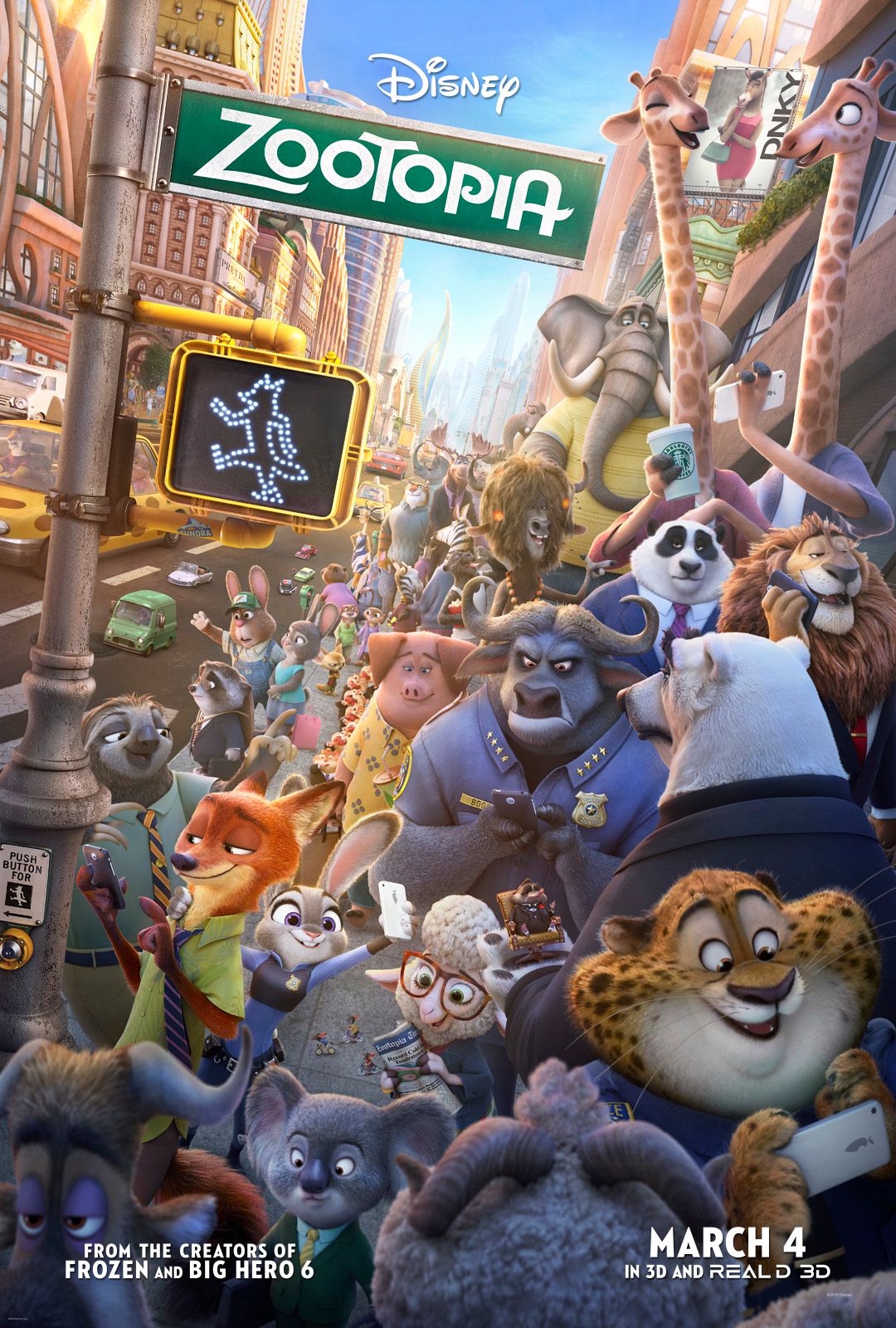
Zootopia (2016) review


You’ve heard me say it a bunch of times these past few years but I’ll say it again; Walt Disney Animation is currently in the middle of what can be referred to as either their second ‘Renaissance’ period or their ‘Revival’ period, the latter term I’ve recently come across online. After a string of lesser-received films from both a critical and commercial standpoint following the conclusion of the first ‘Disney Renaissance’, the studio finally started to get back on its feet once the duo of Pixar’s Ed Catmull and John Lasseter were brought in as the studio’s new President and Chief Creative Officer, respectively. Under their supervision, the studio has regained a lot of the creative clout that had been missing from some of their early 2000’s films and as a result, they have achieved much more success thanks to films like Tangled, Wreck-it Ralph, Big Hero 6, and of course their $1.2 billion behemoth Frozen. So what’s next for the House of Mouse? Well, this year will see them coming out with not one but two new animated features, a first for the studio since 2002. But as Inside Out and The Good Dinosaur proved last year, one film usually ends up getting more attention than the other early on. And in the case of Disney Animation’s 2016 releases, that film was Moana, their South Pacific-themed fantasy adventure that will come out this November. But, as me and my pal Kyle over at Kyle’s Animated World would argue, hopefully that didn’t take too much away from the first of Disney Animation’s films this year, Zootopia. And seeing how this film currently graces an impressive 98% on Rotten Tomatoes, which at the moment makes it the best-reviewed film of the year, suddenly Zootopia isn’t looking like the ‘lesser’ film anymore (which, for the record, is nothing against Moana. I’m sure that will be terrific too). And rightfully so as Zootopia is not only a well-made and well-animated entry in the Disney canon, as per usual, but also a strongly written tale with a timely message that we can all take note from.

In the world of Zootopia, those who are usually predators and those who are usually preyed upon live together in peace having evolved from following their natural instincts in order to coexist with one another. It is in this metropolis that rabbit Judy Hopps (Ginnifer Goodwin) from the town of Bunnyborrow dreams of becoming a police officer. But even after she is instated as the first rabbit officer in a force full of ‘predator’ animals, she is disappointed when her superior Chief Bogo (Idris Elba) assigns her to the mere position of meter maid. While all of this is going on, the police are investigating into a series of disappearances all over the city. And while she is kept off of the investigation at first, Judy manages to get the opportunity to ‘be a real cop’ for once when she volunteers to help find the husband of Mrs. Otterton (Octavia Spencer), one of the missing animals, on the grounds that she resigns from the force if she doesn’t solve the case in 48 hours. In order to find Mr. Otterton, Judy is forced to team up with fox Nick Wilde (Jason Bateman), a con artist who not only gypped her previously but is part of the species that is meant to be the ‘enemy’ of rabbits like Judy. However, Nick also happens to be one of the last to see Otterton before he disappeared, hence why Judy ends up having to enlist his help in order to find her missing person. Soon though, the two uncover a devious plot involving animals reverting back to their savage nature that poses a severe threat to the harmonious nature of the city of Zootopia.

Being a Disney animated film, the animation is of course terrific and very well-detailed as exemplified by the various districts of Zootopia, from the frozen landscapes of Tundratown to the district of Little Rodentia in which the main characters are giant-sized compared to the residents of that area. The film also maintains a solid energetic pace throughout and is full of hilarious moments, including the now famous scene from the trailer where Nick and Judy get the ID for a plate number at the DMV (‘Department of Mammal Vehicles’), where all of the employees are super slow sloths (a perfect analogy to real life as I’m sure many of us would agree). But what really makes Zootopia stand out is its writing. This is arguably Disney Animation’s most maturely-written script in years. It’s already great enough that the film is a fun and zany buddy cop comedy but then the film goes the extra mile by tackling issues like race relations (or ‘species relations’ in this case), prejudice, and bigotry. Right from the very beginning, the film establishes what will become a major point of conflict in regards to Judy and Nick’s relationship by showcasing the bigotry that rabbits have towards foxes, right down to Judy being given anti-fox spray (in other words, mace) by her parents. And all throughout the film, we see several instances where characters’ prejudices and bigoted attitudes come into play, with the primary example being, obviously, the ‘relationship’ between predators and prey. As a result, the character who is established as the villain of the story, who I won’t reveal here to keep this review spoiler-free, is a pretty darn well established villain in terms of their motives and the overall conspiracy that they’re master-minding. In short, everything in the plot comes together perfectly for a well-constructed tale of acceptance and how even the nicest people around can sometimes resort to stereotyping.  

Aside from its excellent writing, Zootopia is also full of great characters backed by a superb voice cast. Originally, Nick Wilde was meant to be the main character of the film before the filmmakers decided to shift focus to Judy, the small-town bunny who moves into the big city. Judy is a terrific protagonist whose optimism and ‘never give up’ attitude make her a very endearing character to root for, all of which is perfectly imbued through Ginnifer Goodwin’s performance in the role. Equally terrific is Jason Bateman in the role as Nick as the wild con man’s fast talking nature excellently matches Bateman’s comedic style. And while at first Wilde may seem like a no-good con man only looking out for himself, a key scene in which he reveals to Judy a crucial moment from his past that made him what he is today produces one of the most emotional moments in the entire film. And of course the two have excellent camaraderie which helps make their partnership work as well as it does. They’re backed up by an excellent supporting cast of memorable side characters where pretty much every character is matched perfectly with their voice actor. This includes Idris Elba as Judy’s tough-as-nails police chief Bogo, J.K. Simmons as the noble but occasionally ferocious mayor of Zootopia Lionheart, new Disney regular Alan Tudyk as small-time crook Duke Weaselton (an obvious play on his character from Frozen’s often mispronounced name (“Weselton!”)), and Shakira as Zootopia’s most famous pop star Gazelle, performer of the film’s catchy theme ‘Try Everything’.

It’s one thing to be a well-animated, well-voice acted, and very entertaining animated film. But that’s not all that Zootopia has to offer. Sure, all of those aforementioned aspects on their own would’ve easily made this a highly recommendable film worth checking out. But then this film ends up going above and beyond by imbuing its story with themes that are very much timely for the time of its release. What starts out as a fun buddy cop comedy ends up becoming a fable that combats racism and prejudice, notions that admittedly are still prevalent in today’s society. As a result, this film encourages us all to be more accepting of others and to not let the stereotyping of society cloud our judgement. And because of this, Zootopia is easily one of Walt Disney Animation Studios’ finest efforts. After all, one of the main reasons why Disney’s animated films became the classics that they are today was because they managed to overcome their own ‘stereotype’ of being seen as nothing more than ‘films for kids’ by managing to appeal to both kids and adults with their great and colorful animation, their superb storytelling, and the classic characters that inhabited these stories. That’s why the classics of the studio’s early days (e.g. Pinocchio, Cinderella) still very much hold up today and why their more recent films (e.g. Frozen, Big Hero 6) have allowed the studio to once again establish itself as one of the best animation studios in the film industry. And as a result, Zootopia is yet another excellent addition to the Disney canon.   


Rating: 5/5!

Saturday, July 4, 2015

Terminator: Genisys (2015) Review

Terminator Genisys (2015) Poster

What started out as a $6.4 million sci-fi film directed by a then unknown James Cameron has gone on to become one of the most iconic film franchises in pop culture history; the ‘Terminator’ franchise. With 1984’s ‘The Terminator’ and its even greater follow-up, 1991’s ‘Terminator 2: Judgment Day’, James Cameron gave us two of the most beloved sci-fi films of all-time. The second film in particular ended on a perfect note, tying up all loose ends so that there wouldn’t be any need to continue the franchise… but of course, as we all know, that wasn’t the end of the ‘Terminator’ franchise. Hollywood decided that they could continue the franchise despite the fact that ‘Terminator 2’ made it pretty hard for there to be any way to move on from its ending. But Hollywood found a way, resulting in 2003’s ‘Terminator 3: Rise of the Machines’ and 2009’s ‘Terminator Salvation’, neither of which achieved the same critical/commercial acclaim as the first two films. And now the franchise is back again with ‘Terminator: Genisys’… and yes, the subtitle is intentionally spelled that way. Like its immediate two predecessors, this film has been getting slammed by critics… but as for me, this is one of those cases where I seriously disagree with the general critical reception. Now let me be clear; this is by no means the best film in the series. But that doesn’t mean that it’s the ‘disaster’ that most of the internet believed it was going to be. Instead, ‘Terminator: Genisys’ ends up being a pretty darn entertaining summer popcorn flick that respects the lineage of Cameron’s films while going down a bold new route which will shape the franchise for years to come.

In the year 2029, the human resistance, led by John Connor (Jason Clarke), is at war with the self-aware A.I system known as Skynet, which wiped out most of humanity on what become known as Judgment Day; August 29, 1997 (note: the ‘original’ Judgment Day date and not the pushed-back July 25, 2004 date as was portrayed in ‘Terminator 3’ and ‘Salvation’). During an all-out ‘final offensive’ on Skynet, Connor and his soldiers learn of a plot by Skynet to send one of their humanoid robots, known as ‘Terminators’, back in time to the year 1984 to kill John’s mother Sarah, thereby erasing John from existence. John’s right-hand man, Kyle Reese (Jai Courtney), volunteers to go back in time to protect Sarah. But once he arrives in the year 1984, he is surprised to find that things are much more different than he expected. Most notably, Sarah (Emilia Clarke) is not the scared and vulnerable woman that he thought she was going to be based on what he was told about her by John in the future. Instead, Sarah is a trained warrior who, ever since she was a child, has been looked after by a reprogrammed T-800 Model 101 Terminator (Arnold Schwarzenegger) who was sent back in time to protect her. Now in a new timeline, Sarah, Kyle, and the Terminator travel into the future, 2017, in which Judgment Day has not yet happened, in an attempt to prevent Skynet (which in this timeline is under the guise of an advanced global operating system called ‘Genisys’ (hence the title of the film)), from taking over.

‘Terminator: Genisys’ basically pulls a ‘2009 Star Trek’ by resetting the original franchise timeline resulting in a brand new alternate timeline. And just like with ‘Star Trek’, I’m perfectly fine with this new idea as I think that it’ll be interesting to see where the franchise goes now without being tied down by the original timeline canon, like whether or not Sarah Connor and Kyle Reese will get together as they did in the original timeline, which of course resulted in the birth of John Connor. As for the film itself, ‘Genisys’ is, to put it quite simply, a very entertaining sci-fi action flick with a solid balance of humor and action. The action sequences, especially the fight between the old T-800 and the young T-800 in a sequence mirroring the original opening of ‘The Terminator’, and the visuals are both superb and just like what Colin Trevorrow did with ‘Jurassic World’, director Alan Taylor does an excellent job when it comes to respecting the two ‘Terminator’ films by James Cameron (in other words, this film basically ignores the events of ‘Rise of the Machines’ and ‘Salvation’ which, given the general reception of those two films, is for the best) through the film’s various callbacks. Now in terms of plot, yes it does get quite a bit overcomplicated at times, especially when it comes to the development of the new alternate universe that the characters now find themselves in. But as we all know, that’s something that just happens whenever you do a story based around time-travel.

For the first time since ‘Terminator 3’, Arnold Schwarzenegger returns to the role that basically made him the action icon that he is known as today; the T-800. And quite frankly, his return couldn’t be more welcome as even at the age of 67, he still manages to kick major ass. Equally kicking major ass in this film is Emilia Clarke, who confidently steps into the role of Sarah Connor, who once again stands out as one of the best female action heroines of all-time. As for Jai Courtney as Kyle Reese, while I can’t say that he’s the absolute best to have ever been in the role, he does a pretty good job here, mainly due to his strong camaraderie with both Clarke and Schwarzenegger once the three of them get together. Now normally I try to keep my main reviews spoiler-free but as many of you know, the second trailer for this film already revealed one of the main plot-points of the film so I guess it’s not that big of a deal in this scenario. And this particular plot-line is the reveal that John Connor has been turned into a Terminator by Skynet. And as controversial and a bit of a stretch as it may be, I’m totally fine with it, which may primarily be because I’m glad to see that Jason Clarke, who is easily one of the most underrated actors currently working today, in a much more substantial role than I thought he was going to have based solely on the first trailer. And to top it all off, there’s also a few noteworthy supporting turns, primarily J.K. Simmons as a police detective who ends up crossing paths with the main group in both 1984 and 2017 (note: the character is not played by Simmons in 1984) and Matt Smith as a character that, unlike the previously noted John Connor reveal, I won’t spoil the identity of here but suffice it to say will definitely be playing a major role in future installments.

Contrary to the 27% and 39% ratings that the film currently has on Rotten Tomatoes and Metacritic, respectively, I surprisingly really enjoyed ‘Terminator: Genisys’. It may be because I went into the film not knowing what to expect, especially given the polarizing reaction that the film had been getting from the internet in the months leading up to its release. But ultimately ‘Terminator: Genisys’ is by no means as bad as the internet is putting it out to be. Sure, the plot gets a little messy sometimes in regards to the establishing of the franchise’s new ‘alternate universe’. But it more than makes up for it with its great balance of action and humor, a solid group of leads, and for respectfully paying tribute to the first two films in the series while also managing to be different from those two films. Is it the best installment of the ‘Terminator’ franchise? Definitely not, but what do you expect when the first two films were such hard acts to follow? Ultimately though, ‘Genisys’ is easily the best ‘Terminator’ film since ‘Terminator 2’ and as controversial as it may be, I’m definitely interested to see where this franchise goes next now that it has gone the route of the ‘Star Trek’ franchise and can now go in new story directions without having to adhere to the original canon. But given the general reaction to ‘Genisys’ at the moment, hopefully the filmmakers do get that chance.


Rating: 4.5/5