Showing posts with label Bryan Cranston. Show all posts

Tuesday, March 26, 2024

Kung Fu Panda 4 (2024) review

In 2008, DreamWorks Animation released two films. One of these was a sequel to the studio’s 2005 hit Madagascar, Madagascar: Escape 2 Africa. As for the other, it would be the studio’s original project for that year; a martial arts comedy titled Kung Fu Panda. Starring Jack Black as the titular panda, Po, the film followed this avid kung-fu fanatic who, despite zero training, is chosen to be the ‘Dragon Warrior’, a kung-fu master who’s destined to save his home, the Valley of Peace, from evildoers. The original Kung Fu Panda is very much one of the prime examples of the classic adage ‘don’t judge a book by its cover’. In the months leading up to its release, it’s safe to assume that most people probably saw it as nothing more than a joke, especially with a title as admittedly goofy as Kung Fu Panda. It also didn’t help that, around this time, DreamWorks Animation had garnered something of a reputation for their reliance on pop cultural references, which dominated a lot of their work and arguably had an impact on their overall reception when compared to some of their industry rivals such as Pixar. As such, it’s safe to say that a film and premise like Kung Fu Panda didn’t seem like it was going to change anyone’s mind when it came to what a DreamWorks film could be. But, when the film finally came out, both critics and audiences were genuinely taken by surprise as Kung Fu Panda proved to be an incredibly well-crafted animated film with spectacularly choreographed action sequences, mature storytelling, and above all, an undeniable sense of respect for the Chinese culture that inspired it.

This, as a result, gave DreamWorks its latest hit franchise as the film would go on to spawn several spin-offs. On the big screen, the adventures of Po the Dragon Warrior would continue in 2011’s Kung Fu Panda 2 and 2016’s Kung Fu Panda 3. Both films managed to match the original in terms of both critical and commercial success while also achieving some historical significance for their director, Jennifer Yuh Nelson, who was the original film’s head of story and became the first solo female director of a mainstream animated film with Kung Fu Panda 2. That film would go on to become the highest-grossing animated film solely directed by a woman, and while she did have a co-director in fellow DreamWorks mainstay Alessandro Carloni for Kung Fu Panda 3, it was clear that Jennifer Yuh Nelson was the strongest driving force behind what was quickly becoming another one of DreamWorks’ flagship franchises. After Kung Fu Panda 3, though, that would largely be it for the Dragon Warrior on the big screen as DreamWorks began to focus more on the franchise’s TV spin-offs. But then, in 2022, it was announced that the cinematic adventures of Po and company would continue with Kung Fu Panda 4. This time, directorial duties went to Mike Mitchell, a longtime veteran of DreamWorks who had worked with them as far back as their first film, 1998’s Antz, while also directing the likes of 2016’s Trolls and, ironically, another DreamWorks fourthquel in 2010’s Shrek Forever After. And just like that latter film in many ways, what we ultimately have here is a solidly enjoyable addition to the Kung Fu Panda franchise that may not necessarily reach the exact same wondrous heights as its predecessors but still manages to exude much of the franchise’s charm and appeal.

For Po the Dragon Warrior (voiced by Jack Black), things couldn’t be better for him as the Valley of Peace’s greatest protector, especially after the events of Kung Fu Panda 3 in which the late Master Oogway gave him a powerful staff that can link the mortal world with the Spirit Realm. However, Po is taken by surprise when his mentor, Master Shifu (voiced by Dustin Hoffman), informs him that the time has come for him to find his successor as the Dragon Warrior since he’s now destined to take on the role of the Valley of Peace’s spiritual leader. And if that wasn’t enough, all sorts of disturbances start to occur across the Valley caused by, of all people, Tai Lung (voiced by Ian McShane), Po’s nemesis from his early days as the Dragon Warrior who was seemingly vanquished and sent to the Spirit Realm. Upon further investigation, Po discovers that this is the work of a sinister shape-shifting sorceress known as the Chameleon (voiced by Viola Davis), who seeks to acquire Po’s Staff of Wisdom and use it to collect the kung-fu abilities of all the greatest warriors from the Spirit Realm. Thus, with the aid of a wily bandit named Zhen (voiced by Awkwafina), Po travels to the Chameleon’s headquarters in Juniper City to take on his latest arch-nemesis before she can become the most unstoppable kung-fu master the world has ever seen.

As has always been the case with this series, Kung Fu Panda 4 more than delivers on its spectacularly choreographed and beautifully animated action sequences. While I’m well aware that some were disappointed at this film’s more traditional style of animation compared to some of the more stylized and experimental bits of animation seen in some of DreamWorks’ recent films such as Puss in Boots: The Last Wish, Kung Fu Panda 4 is still just as vibrant and colorful as the films that came before it. Much of this helps to alleviate the fact that, admittedly, this film doesn’t have the same kind of strong emotional hooks that dominated the original trilogy. All three of the previous Kung Fu Panda films benefitted immensely from some strong bits of emotional poignancy that helped them narratively stand out compared to a lot of other DreamWorks films at the time, whether it was the first film’s reveal that the main antagonist Tai Lung was once the beloved adopted son of Master Shifu or how the second film revolved around Po learning about his past and the tragic events that led to him being separated from his birth parents. This film, on the other hand, is unfortunately lacking in that regard and it doesn’t help that there are some clearly missed opportunities for it to have those sorts of moments, such as a possible reunion between Tai Lung and Shifu given the former’s prominent role in this story. Instead, the film opts to be more of a straightforward adventure plot for Po and company that ultimately relies more on the franchise’s trademark sense of humor revolving around Po’s unconventional means of being a kung-fu warrior. To be fair, though, this series has never truly faltered with its sense of humor, and because this film thoroughly maintains that streak, it’s not necessarily a bad thing that it’s primarily just a light-hearted comedic romp.

Much of this is thanks to, as always, its entertaining cast of characters, headlined, of course, by everyone’s favorite comedic rockstar Jack Black in what has easily become one of the definitive roles of his career, Po the Dragon Warrior. As he’s always done in this role, Black doesn’t skip a beat maintaining Po’s hilariously bumbling yet wholly endearing persona. Now, as for the franchise’s other recurring characters… well, Kung Fu Panda fans will most likely be disappointed to know that Po’s fellow kung fu masters, the Furious 5, are almost entirely absent from this and, as has been the case with every Kung Fu Panda sequel, Master Shifu is largely uninvolved with the main plot even though this one sees the return of his first protégé Tai Lung. Still, Dustin Hoffman continues to provide plenty of great humorous beats as Po’s perpetually grumpy master while James Hong and Bryan Cranston, returning as Po’s adoptive father Mr. Ping and biological father Li Shan, respectively, also prove to be a major source of the film’s best comedic moments as Po’s two dads are turned into a delightfully wacky odd couple who head out on their own accord to help their son. As for the new additions to the cast (specifically, Po’s new morally grey ally Zhen and the film’s main antagonist, the Chameleon), they are, admittedly, the biggest victims of this film’s more basic narrative approach, with the Chameleon being a far more standard villain than any of her franchise counterparts. But for what it’s worth, Awkwafina has excellent comedic rapport with Jack Black as Zhen (complete with a few moments where she gets to flex her dramatic chops) while Viola Davis’ trademark fierceness shines through as Chameleon, thus resulting in the character still managing to be an effectively sinister villain.

At the end of the day, Kung Fu Panda 4 surprisingly ends up having quite a lot in common with director Mike Mitchell’s other DreamWorks fourthquel, Shrek Forever After. In both instances, we have films that, while far from being their respective franchise’s best installments, are still solidly enjoyable additions to them that don’t do anything that would’ve drastically harmed their legacy in any way. In Kung Fu Panda 4’s case, the only thing that truly keeps it from being just as great as its predecessors is the fact that it lacks the emotional throughline that, back when this franchise was first starting out, proved that DreamWorks films could be more than just pop-cultural dependent kiddie flicks. Without that, this film is more of a straightforward martial arts adventure that doesn’t do much to set up the new additions to its cast even though it simultaneously doesn’t rely as much on the franchise’s well-established ensemble as its predecessors did. But like I said earlier, I don’t necessarily feel that this is all a bad thing. Despite its narrative shortcomings, Kung Fu Panda 4 dutifully maintains a lot of the franchise’s hallmarks, such as its well-crafted action sequences or by consistently preserving Po’s status as one of the most endearing protagonists in all of animation. As such, if you’re just looking to go on another fun adventure with Po, which we haven’t gotten on the big screen in nearly a decade, then this film will give you exactly what you’re looking for. Skadoosh!!   

Rating: 4/5

Monday, April 24, 2023

Kung Fu Panda - Series Retrospective (DreamWorks Animation Retrospective #3)

Expectations can be an extremely fickle thing when it comes to film. Sometimes there are films that folks are incredibly eager to see but ultimately end up disappointing them. Conversely, there are films that many people don’t expect a lot out of going in but, to their surprise, end up being way better than they anticipated. Case in point, as Rhode Island Movie Corner continues its series of retrospectives on the various films produced by DreamWorks Animation, today we’re tackling a franchise that is quite arguably one of the best examples of how you should never judge a book by its cover, the Kung Fu Panda trilogy. While it’s been nearly one and a half decades since the release of the original Kung Fu Panda in 2008, I still vaguely remember the overall uncertainty surrounding its release, especially since, in retrospect, this was right around the time when DreamWorks’ reputation for relying heavily on pop culture references was very much in full effect. But when it finally hit theaters, it did incredibly well with both critics and audiences to the point where it could very well be argued that it was one of the initial catalysts behind DreamWorks’ efforts to evolve as an animation studio. Thus, Kung Fu Panda promptly became another one of DreamWorks’ major franchises, with its three films collectively grossing nearly $2 billion worldwide; and as fate would have it, a fourth installment was recently confirmed for a 2024 release. So, with that in mind, let’s tag along with Po, the Mighty Dragon Warrior, and the Furious Five as we tackle the Kung Fu Panda trilogy. Skadoosh!

(Disclaimer: New verse, same as the first! For those who haven’t checked out my previous DreamWorks retrospectives, I’m only covering DreamWorks’ feature film output and won’t be going over any of the non-theatrical projects that their franchises have spawned; specifically, their numerous TV series spin-offs. In today’s case, this includes the franchise’s most recent installment, Kung Fu Panda: The Dragon Knight, which debuted on Netflix this past summer and saw the one and only Jack Black reprise his role as the series’ main protagonist Po, which is notable because this was the first Kung Fu Panda TV series that Black was directly involved with (in the franchise’s previous televised outings, Kung Fu Panda: Legends of Awesomeness and Kung Fu Panda: The Paws of Destiny, Po was voiced by voice actor Mick Wingert).)

KUNG FU PANDA (2008)

As noted in the intro, the original Kung Fu Panda was something that caught quite a lot of people by surprise back when it first came out in 2008. With a title that, admittedly, sounds incredibly goofy on paper and the fact that, at that time, a good chunk of DreamWorks films outside of the first two Shrek films weren’t doing too well with critics, it’s not that hard to imagine that a lot of folks probably figured that this would end up being another underwhelming release from the studio. And yet, when it came out, it was quite arguably DreamWorks’ most successful in-house release (not counting their collaborations with Aardman, which earned them a second Oscar for Best Animated Feature in 2005 thanks to Wallace & Gromit: The Curse of the Were-Rabbit) since Shrek 2. The reviews for it were excellent, it scored over $631 million at the worldwide box-office, and despite some controversy over claims of alleged vote rigging, it even managed to upset Pixar’s critically acclaimed Wall-E by winning that year’s Annie Award for Best Animated Film. Simply put, it was a hit, and when you watch the film even after all these years, it’s easy to see why. For starters, co-directors John Stevenson and Mark Osborne and their team clearly went above and beyond to honor the Chinese roots that thoroughly shaped this film’s premise in practically every possible aspect of its production. From some beautifully animated segments that pay homage to the staples of Chinese artistry (i.e., shadow puppetry) to the utterly incredible action sequences that were seen as a game-changer when it came to staging fight choreography in Western Animation, Kung Fu Panda is an animated film that visually and artistically holds its own against some of the most iconic live-action martial arts films of all-time.  

But it also helps that the film is buoyed by a familiar yet effective underdog story in which main protagonist Po must prove himself to everyone who doesn’t believe that he is the mythical ‘Dragon Warrior’, the most powerful kung-fu master in the land. Po, as excellently voiced by everyone’s favorite fun-loving rockstar Jack Black, is a naturally sympathetic protagonist, thus making his classic hero’s journey a satisfying one to watch. In fact, Black’s casting even helped to steer Po away from the more jerkish persona that he was originally given during the early stages of production. Black is then joined by a considerably star-studded supporting cast, including Dustin Hoffman as the stern Master Shifu, who’s begrudgingly forced to try and teach Po kung-fu, Ian McShane as Shifu’s former protégé turned arch nemesis Tai Lung, and the quintet of Angelina Jolie (Tigress), Lucy Liu (Viper), Seth Rogen (Mantis), David Cross (Crane), and Jackie Chan (Monkey) as Shifu’s students, the famous Furious Five. With all this in mind, let’s return to what I said before about how a title like Kung Fu Panda may have seemed like a completely ridiculous idea when you first hear it because, at the end of the day, this film’s greatest accomplishment is that it proves to be far more than what its title suggests. In other words, as much as it does maintain the usual comedic sensibilities of a DreamWorks film, it also takes its plot seriously and neatly mixes in some highly effective emotional moments amidst all the wacky antics of a panda learning the art of kung-fu. It was, in a way, the antithesis of what a lot of DreamWorks films were like at the time, thus signaling a bold new era for the studio.

Rating: 4.5/5

KUNG FU PANDA 2 (2011)

The second installment of the Kung Fu Panda series proved to be a considerably significant release as a result of who was directing it. For this film, directorial duties shifted to the original film’s head of story (and director of its opening 2-D sequence), Jennifer Yuh Nelson. In doing so, Nelson became the first female director to have sole directorial credit on an animated film for a major studio and the first Asian-American to do so as well. And thanks to Kung Fu Panda 2 being another financial hit for DreamWorks, managing to surpass the first film’s worldwide total by earning over $665 million worldwide, that made it the highest-grossing film directed by a woman at that time. Sure, this record would be surpassed just two years later by Frozen earning over $1 billion, but since Disney Animation’s Chief Creative Officer Jennifer Lee shared directorial duties with Chris Buck on that film, Nelson would retain the record as a solo director for a few more years until 2017 when Patty Jenkins directed Wonder Woman ($822 million). But perhaps most notably of all, while Kung Fu Panda 2 technically has a lower score than its predecessor on Rotten Tomatoes (an 80% compared to the original’s 87%), I have seen many people proclaim this to be yet another example of a superior DreamWorks sequel following in the footsteps of Shrek 2 and the second and third Madagascar films. And while this may have been the first time that I’ve ever seen this film… I must say that I would have to agree.

Like the original, Kung Fu Panda 2 boasts incredible action sequences, and thanks in large part to the fast-break style that DreamWorks was beginning to adopt at that time as evident from films like Madagascar 3, that gives this film’s action sequences an even greater kinetic energy. But aside from maintaining the original’s brilliantly choreographed action and solid sense of humor, Kung Fu Panda 2 also delivers on some terrific emotional poignancy, arguably more so than the first film. As part of the main plot of Po and the Furious Five taking on the sinister peacock warlord Lord Shen, the film also begins to delve into Po’s backstory, showing that he was seemingly the only survivor of a full-on massacre of pandas initiated by Shen, who was told that he would be defeated by ‘a warrior of black of white’. Thus, Po was separated from his parents (both of whom presumed dead) and taken in by kindly noodle shop owner Mr. Ping. In short, because of Shen’s pivotal role in this turn of events (as well as his collection of powerful cannons that can straight-up kill off kung-fu masters), the wannabe despot, as excellently voiced by Gary Oldman, is a truly formidable and intimidating main antagonist. And so, with all that in mind, it’s easy to see why Kung Fu Panda 2 is, indeed, considered by many to be a superior sequel as it takes everything that was great about its predecessor and amplifies it all even further, thus resulting in an all-around crowd pleaser that cemented its franchise’s premier status.    

Rating: 5/5!

KUNG FU PANDA 3 (2016)

At the end of Kung Fu Panda 2, it is revealed that Po’s real father, Li Shan, did, in fact, survive Lord Shen’s massacre. Thus, in Kung Fu Panda 3, Po finally reunites with his long-lost dad (originally voiced by Fred Tatasciore in the second film but now voiced by Bryan Cranston in what is ironically his second-straight appearance in a DreamWorks threequel after Madagascar 3), who has been residing in a secret village full of pandas ever since that fateful day. At the same time, though, Po and company now find themselves dealing with their most dangerous opponent yet; Kai (voiced by J.K. Simmons), a warrior from the Spirit Realm and former colleague of the late Master Oogway who has been hunting the masters of kung-fu for their chi as revenge against Oogway for sending him to the Spirit Realm a long time ago. Jennifer Yuh Nelson returned to direct this third installment, but to help ensure that it would be finished on time, she did have a co-director in longtime DreamWorks animator/story artist Alessandro Carloni. This was also one of the many DreamWorks projects at that time that the one and only Guillermo Del Toro was involved with, as he also had producing credits on films like Puss in Boots and Rise of the Guardians and would go on to create the Tales of Arcadia trilogy of TV shows that DreamWorks developed for Netflix. And as you might have guessed, Kung Fu Panda 3 was another critical and commercial success; while it may not have made over $600 million worldwide like both of its predecessors, it still did quite well for itself with over $521 million.

Critically, the film had the franchise’s second highest rating on Rotten Tomatoes with an 86% score though, from what I’ve seen, there have been some who feel that it doesn’t quite reach the same exact highs of Kung Fu Panda 2, which most likely stems from one key development. Tonally speaking, Kung Fu Panda 3 is, surprisingly, a much different kind of film compared to its predecessors as it is by far the most comedic-driven entry in the franchise. Whether it’s the running gag of Kai getting frustrated by the fact that no one knows who he is or the various side characters that Po meets at the secret panda village (each of whom has their own little quirk that comes into play during the final battle), Kung Fu Panda 3 explicitly relies more on its humor than any of its dramatic moments. As such, one could arguably describe this as the animated equivalent of a Marvel Cinematic Universe film, especially because of how the MCU has often been called out for how it has consistently maintained that narrative approach throughout its run. And yet, as anyone familiar with my love of the MCU may have guessed, it goes without saying that I don’t have any major issues with this film’s decision to take that same kind of route. After all, as I’ve often argued with MCU films, just because a film is primarily comedic in nature doesn’t mean that it can’t deliver any high-quality emotional moments, and thanks in large part to the whole plot of Po reuniting with his father, Kung Fu Panda 3 still delivers some solid bits of emotional poignancy while also boasting the best animation out of any film in the series with its beautiful landscapes, vibrant color palette, and sharp and fluent character animation. Thus, while I do understand why some may find this film’s more lighthearted nature to be something of a step back for this franchise, that doesn’t stop Kung Fu Panda 3 from being another charming and entertaining animated film that presents an all-around satisfying conclusion to the trilogy.

Rating: 4.5/5

And so, that concludes Rhode Island Movie Corner’s Retrospective on the Kung Fu Panda trilogy. Next time on the DreamWorks Retrospective series, we finally come to the franchise that I’m sure a lot of you folks have been waiting for, How to Train Your Dragon.

Wednesday, September 2, 2020

The One and Only Ivan (2020) review (Disney+)

 The One and Only Ivan (2020)

In our ever-continuing series on films that got royally screwed over by the COVID-19 pandemic, we have a film that was originally intended for a proper theatrical release about a week ago before obvious circumstances forced it to shift over to Disney+ as the streaming service’s latest original release. The film in question is The One and Only Ivan, an adaptation of the 2012 children’s novel of the same name by author K.A. Applegate. Upon its publication, the book, which was based on the true story of a clever gorilla named Ivan, immediately became a big hit with its target audience and would end up winning the 2013 Newbery Medal, the most prestigious award for children’s literature in the United States. In other words, it was simply another bona fide success for K.A. Applegate, who’s had a respectably lengthy career as a writer. While The One and Only Ivan may be one of her more recent books, folks of my generation will most likely be familiar with one of her most famous works, the Animorphs series from the ’90s, which she co-wrote with her husband Michael Grant. Not only that but the film adaptation of The One and Only Ivan isn’t the first time that she’s worked with Disney since she also notably wrote several literary spin-offs for both Aladdin and The Little Mermaid. But now this brings us to the film adaptation of The One and Only Ivan, which is directed by Thea Sharrock (who had made her directorial debut in 2016 with the romantic drama Me Before You) off a screenplay by veteran screenwriter Mike White (School of Rock). And thanks to both their combined efforts and a solid cast that’s headlined by an impressively stacked voice cast, it’s easy to see why The One and Only Ivan more than succeeds at being an immensely charming family flick.

For the past several years, Ivan the silverback gorilla (voiced by Sam Rockwell) has been the headlining attraction of a daily circus show held at the Big Top Mall in Florida that’s run by his owner Mack (Bryan Cranston), who had raised Ivan since he was a baby. But while Ivan and his fellow performers such as his best friend Stella the elephant (voiced by Angelina Jolie) are more than content with their lives, Mack soon finds himself having to deal with the increasingly likely prospect of dwindling crowds. Luckily for them, Mack ends up finding a new star attraction in Ruby (voiced by Brooklynn Prince), a baby elephant that he purchases from a fledgling circus in New Jersey. And while Ivan is initially displeased with Ruby immediately stealing his thunder as the show’s newest ‘headliner’, her arrival proves to be exactly what they needed to draw in more crowds and he does legitimately begin to grow fond of the young pachyderm. However, despite all the newfound success that their show has managed to achieve, Ruby begins to learn more about the outside world from Stella and what it’s like to truly be ‘free’. Not wanting her to live the rest of her life in captivity in their small enclosure at the mall, Stella personally asks Ivan to take care of Ruby and to ensure that, someday, she’ll be able to be free. And while Ivan is initially unsure if he could even remotely make this happen, Mack’s increasingly inconsiderate behavior towards them is what ultimately convinces him to go through with it for Ruby’s sake. Thus, with the help of the other animals, the circus’ janitor George (Ramón Rodriguez), and George’s daughter Julia (Ariana Greenblatt), Ivan begins to utilize the artistic talents that he’s had since childhood so that the rest of the world can understand their current predicament.

The One and Only Ivan is the very definition of a good-natured family film. It has a pleasantly relaxing pace throughout and is fully anchored by a lovable collection of main characters. And while I’m aware that many have noted that the film tones down some of the darker elements of its source material (i.e. it lessens the severity of Mack’s harsher actions towards his animals, thus making him more of a decent albeit incredibly short-sighted owner rather than a traditionally cruel antagonist), it still hits its big emotional beats quite well. Much of this is due to the film’s excellent cast, both in terms of its human characters and its animal voice actors. When it comes to the former, Bryan Cranston headlines the film nicely as Mack who, as noted earlier, isn’t the same villainous character that he is in the book but still plays a huge role in how many of the story’s most poignant moments pan out. And as for the latter, Sam Rockwell delivers an incredibly earnest and charismatic performance in the title role of Ivan. He’s then backed by a great supporting voice cast that’s full of big names such as Danny DeVito, who plays a stray dog named Bob who isn’t a part of the show but regularly hangs out with Ivan, Angelina Jolie as the wise old Stella, and Helen Mirren as the show’s actual dog performer, Snickers the poodle. Admittedly, most of the other animals don’t get that much to do in the grand scheme of things since the film primarily focuses on the quartet of Ivan, Stella, Ruby, and Bob, but at the very least, it does seem like everyone involved had a great time working on the project. And so, because of all this, The One and Only Ivan is an incredibly sweet and well-made family film that very much wears its heart on its sleeve. It may not be the most groundbreaking or thought-provoking film ever made, but its largely uncynical nature and terrific handling of its pertinent themes makes it easy to see why its source material has become a staple of children’s literature.

Rating: 4/5

Friday, January 18, 2019

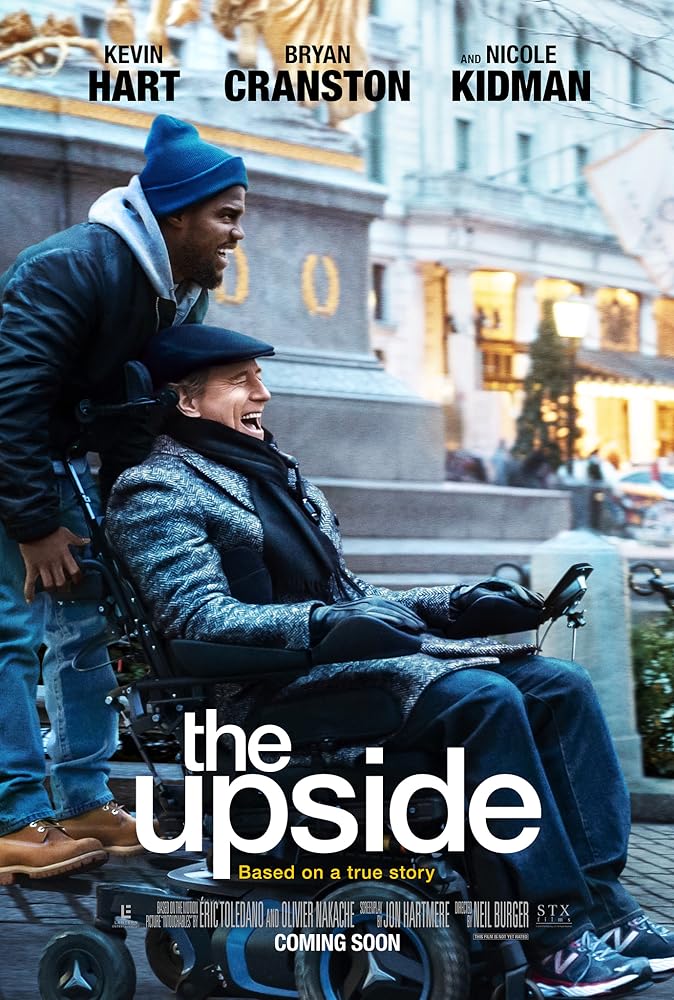
The Upside (2019) review

Bryan Cranston and Kevin Hart in The Upside (2017)

(Howdy, folks! This one’s going to be a little shorter than the usual review only because I’m currently working on my End of the Year lists.)

Today’s film, The Upside, is an interesting one to talk about mainly because of its source material. In 2011, French filmmakers Olivier Nakache and Eric Toledano released their latest project, The Intouchables. The film starred Omar Sy as a man who, after being released from prison, ends up getting hired to be the caretaker for a quadriplegic millionaire, played by François Cluzet. Inspired by the real-life story of businessman Philippe Pozzo di Borgo and his caretaker Abdel Sellou, the film did quite well with critics upon its release and Sy ended up winning the Cesar Award (AKA the French Oscars) for Best Actor. However, it was an even bigger hit from a financial perspective, grossing the equivalent of $412.9 million at the worldwide box-office and becoming the second highest-grossing French film of all-time behind 2008’s Welcome to the Sticks. Since its release, a few remakes have been produced by other countries, including a 2015 Indian remake, Oopiri, a 2016 Argentinian remake, Inseparables, and an impending Bollywood adaptation. As for an American adaptation, directorial duties ultimately went to Neil Burger, whose filmography includes the 2006 romantic period piece The Illusionist, 2011’s sci-fi thriller Limitless, and the first installment of the Divergent series, with Kevin Hart and Bryan Cranston taking on the lead roles. And although the film spent a few years in limbo due to a shift in distributors, it’s now seen the light of day as one of the first releases of 2019 and an enjoyable little crowd-pleaser that benefits heavily from its excellent lead duo.

At the time that I’m writing this, I have not seen the original Intouchables, though I was at least made aware of it back when it was released because of its financial success. Even with this in mind, however, it’s clear that this new film isn’t that different from the original, as it still follows the same plot of a recently paroled man (Kevin Hart) who inadvertently becomes the caretaker of a recently paralyzed millionaire (Bryan Cranston). As such, the film’s plot is admittedly very predictable. It’s your standard buddy comedy about two mismatched characters who gradually learn to get along and help each other better themselves in life in the process, and thus, it’s quite easy to tell where it’s going to go narratively. Still, for what it’s worth, the film does a nice job when it comes to balancing its comedy with its drama. The humor in this is solid, for the most part, and there are also some very effective emotional moments peppered in as well. Ultimately, though, this film mainly succeeds because of the excellent camaraderie of Kevin Hart and Bryan Cranston. While the film does give him the chance to do some solid dramatic work, Hart is his usual animated self here and this is matched nicely with Cranston’s dry wit. And while most of her role in the film consists of her reacting to Hart’s shenanigans, Nicole Kidman makes the most out of her supporting role as Yvonne, the loyal assistant of Cranston’s character Phillip. In conclusion, The Upside certainly fits the bill when it comes to a January release. It’s not going to win any major awards, but if you’re just looking for a decent little dramedy, then the dynamic lead duo of Kevin Hart and Bryan Cranston does make this one worth checking out.


Rating: 3.5/5

Sunday, March 26, 2017

Power Rangers (2017) review

Image result for power rangers poster

While I was only around for half of the decade, I do consider myself to be a ‘90’s kid’. And with that said, many ‘90’s kids’ will agree that one of the definitive shows of their childhoods was Mighty Morphin Power Rangers. Developed by TV theme song composers Haim Saban and Shuki Levy, the series, which utilized stock footage from Toei’s Super Sentai franchise and repurposed it around an American cast, became a worldwide phenomenon when it debuted in 1993. Nearly 25 years later, the series is still going strong today with new themed iterations debuting every year, and while nowadays some feel that the original series has not aged well because of its cheesy nature, it’s still very much a landmark show of its era. I’ll admit, though, that I wasn’t really a Power Rangers fan growing up, mainly just because the original Mighty Morphin series was already over before I was even a year old. However, because it’s so directly tied to my generation, I was at least interested in seeing the new film reboot of this legendary franchise. And thus, here we are with Power Rangers, the third Power Rangers film released to date after 1995’s Mighty Morphin Power Rangers: The Movie and 1997’s Turbo: A Power Rangers Movie. As stated earlier, it serves as a reboot of the original Mighty Morphin series, with a new cast taking on the roles of the original Ranger team. It’s also easily the biggest Power Rangers film to date in terms of its budget and scale. But, of course, this now leads to one big question; will this succeed in appealing to fans of the franchise while also serving as an effective introduction for the uninitiated? Well, for the most part, director Dean Israelite (Project Almanac) does succeed in redefining this franchise for a new generation.  

In the town of Angel Grove, suspended high school quarterback Jason Lee Scott (Dacre Montgomery), autistic nerd Billy Cranston (RJ Cyler), and ousted cheerleader Kimberly Hart (Naomi Scott) begin to bond while being forced to spend time in detention for various incidents that they were involved in at school. One night, the three end up at the local mines where they, along with truant Zack Taylor (Ludi Lin) and new student Trini Kwan (Becky G), come across five mysterious coin-like artifacts trapped within the rocks. After taking them, the five begin to find themselves imbued with new powers, namely superhuman strength. When they return to where they found the coins, they end up in an ancient spaceship buried deep underground. There, they come across Zordon (Bryan Cranston), an ancient being whose consciousness was uploaded into the ship’s matrix by his android assistant Alpha 5 (Bill Hader). Zordon tells them that they have been chosen by the Power Coins that they’ve found to become the Power Rangers, a group of warriors who protect the Earth from those who seek the Zeo Crystal, the source of their power. And, sure enough, one of those threats, former Green Ranger Rita Repulsa (Elizabeth Banks), awakens from her long slumber and plans on rebuilding her monster, Goldar, to find the Zeo Crystal, which Zordon (the former Red Ranger) had buried deep underground millions of years ago when she betrayed their team. With little time to spare before she unleashes her army of monsters upon Angel Grove, the five teens find themselves tasked with trying to band together to become the Rangers and use all their abilities to save their home and their world.  

Overall, this new Power Rangers film does away with many of the campier elements of the original series. Now, for the record, there are still some silly moments here and there (e.g. brace yourself for one ludicrous bit of product placement that literally ends up becoming a major part of the plot) but, overall, the plot is taken more seriously than previous iterations of the franchise. And while this may result in some tonal inconsistencies here and there, like whenever Rita attacks someone in a rather intense manner, the film still manages to capture the feel of the franchise without going completely campy. Plus, with the addition of various nods to the series for eagle-eyed fans to point out, some of which I’m sure I didn’t notice the first time being only a casual fan of the franchise, I think longtime fans will enjoy this new film quite fine. Based on what I’ve seen from the original series, it doesn’t seem like it pulls any major deviations from the source material, aside from new characterizations for the protagonists, that would betray what made the franchise popular in the first place. The big question, though, is how it appeals to newcomers of the franchise. It does so by way of an ‘origin story’. And, yes, I know that this phrase has sort of become a ‘bad word’ amongst filmgoers but here, it is done quite well because it’s about the five teens learning to become the Rangers instead of just being instantly able to do so like in the show. Thus, it ends up sharing a similar aspect with 1997’s Turbo: A Power Rangers Movie in that the teens don’t fully morph into the Rangers until the finale. But in this case, it does work because of their journey beforehand to become the Rangers, instead of just sidelining them in their own film like Turbo did. And once they do get into the suits, the action, which, obviously, is primarily CG-based this time around with an undeniably Transformers vibe to it, is solid.  

As fans of the show know, one of its trademark lines was ‘Teenagers with Attitude’, a phrase uttered by Zordon in the opening credits (though not the show itself) to describe the team. However, in the show, the Rangers were always portrayed as good students and, thus, more like role models and not really ‘teenagers with attitude’. Here, though, they very much emphasize the ‘attitude’ part, showcasing a group of misfits who must come together to become the heroes they’re meant to be. And, like I said before, while the show had them capable of morphing into the Rangers right out the gate, I do like how, in this film, they must work to get to that level. Also, to the filmmakers’ credit, they did pick an excellent group of leads to take on these iconic roles. Granted, some get more attention than others (namely Jason, Kimberly, and Billy, who are the first to be introduced in the film; Zack and Trini don’t come in until they get the Power Coins) but they do have fantastic chemistry with each other. Not bad for a group that’s mostly made up of general newcomers; just goes to show that perhaps Dean Israelite’s greatest strength as a director is working with younger actors/actresses. As for their supporting cast, Bryan Cranston (who notably provided villain voices for the original series and was even the inspiration for the Blue Ranger’s name, Billy Cranston) brings the proper dignified nature to the role of Zordon while Bill Hader provides some enjoyable comic relief in the role of Alpha 5 (“Ai yi yi!”). Finally, there’s Elizabeth Banks as main villain Rita Repulsa; she’s quite over-the-top here, keeping very much in line with the Rita of the original series. It’ll either work for you or it won’t. Personally, it didn’t bother me but maybe that’s because she’s not really in the film that much, as the focus is primarily on the Rangers, which is a good thing.

So, as I stated before, I didn’t grow up with Power Rangers. I did watch some episodes of the show before watching this film (as well as the previous films) and, like I said last time, I probably would’ve loved the show had I watched it as a kid. But, overall, going into this I was a newcomer to the franchise that had gradually become a casual fan once I finally watched some episodes of it. And overall, as a ‘casual fan’ of Power Rangers, I rather enjoyed this new film. I wouldn’t go as far as to say that it’s groundbreaking or anything but as a new iteration of a popular franchise, it manages to appeal to both longtime fans and those like me who come into it generally new to the series. In the case of the former, it does this through solid but respectful homages to the franchise while the latter will find a surprisingly engrossing origin story with solid characters portrayed by an excellent group of leads. Now, with that said, admittedly if you weren’t already big on the series to begin with, you probably won’t get much out of this. Despite the change in tone, it’s still the same generally silly premise of teens fighting aliens in giant robots. But, if you are a fan of the show, it is a nice new addition to the franchise. It’s basically the original Mighty Morphin series but with the budget and scale that it just didn’t have back when it was on. Thus, I think longtime fans will enjoy this just fine; I can tell that just from my own theater experience. When the Power Rangers theme came on, there was applause. Thus, I think it’s safe to say that Power Rangers will be a definite crowd-pleaser for fans young and old.


Rating: 4/5

Monday, May 19, 2014

Godzilla (2014) review


Almost two decades ago in 1998, TriStar made the first major attempt at an American-produced ‘Godzilla’ film (not counting the American-produced cuts to a few of Toho’s original films)… and as we all know, that one didn’t turn out that well and it is pretty much universally despised. While I’m not as critical on it as a lot of people are (probably because I’m not that big of a Godzilla fan, having only seen the original film (after seeing the 1998 film first, for the record)), I too agree that quite frankly, it just wasn’t a ‘Godzilla’ film. Even Toho knew that the creature in that film wasn’t Godzilla and renamed it ‘Zilla’ when it was featured in 2004’s ‘Godzilla: Final Wars’, where the real Godzilla easily kicked its butt. That film was, at the time, the last Godzilla film… until a decade later. Now all eyes are on this new ‘Godzilla’ film, directed by Gareth Edwards, who had previously directed the independent flick ‘Monsters’. I haven’t seen that film, but with a title like that, Edwards definitely sounds like a good choice to helm this new ‘Godzilla’… and overall, he definitely delivers one heck of a monster film. I’m not going to say that it’s ‘perfect’, but at the end of the day, it’s easily miles above the 1998 film.

In 1999, seismic activity starts to occur at the Janjira nuclear plant near Tokyo, Japan resulting in the entire facility falling into ruin. While reports claim that this was caused by an earthquake, the plant’s former supervisor Joe Brody (Bryan Cranston), who lost his wife Sandra (Juliette Binoche) during the accident, believes that something else was the cause of it and 15 years later, he and his son Ford (Aaron Taylor-Johnson), an explosive ordinance disposal officer with the U.S. Navy, return to the area to investigate further into the matter. There, they discover that the real cause for the accident wasn’t an earthquake, but a giant winged creature referred to as a ‘Massive Unidentified Terrestrial Organism’ (MUTO for short). The MUTO ends up escaping, along with a second MUTO, resulting in the military trying to figure out a way to destroy the creatures before they completely ravage the United States. But they soon find out that something else is hunting the MUTOs and this creature could possibly be the only thing that can stop them, and that creature is… Godzilla!

Fans of the franchise might be a little disappointed that Godzilla doesn’t show up until an hour in and that the film itself focuses more on the human characters (more on that in a bit). But overall, Edwards really delivers when it comes to monster vs. monster action… though I wish that during the first few fights between Godzilla and the MUTOs, the film wouldn’t cut away from it. Seriously, there are at least two different times during this film when a fight between Godzilla and the MUTOs is about to occur… and then it cuts away. That scene in the trailer where Godzilla is roaring as a shelter’s doors are about to close? Well, in the film, the doors close during an actual fight. Thankfully, that’s not a problem during the later fights and with that in mind the action was excellent and was pretty solidly-lit considering that most of the fights do take place at night. Overall this film’s Godzilla certainly fits the description of the character quite well and even though it is all CGI… damn that CGI is really good. As for the other monsters, the MUTOs, they look good too but they’re kind of lackluster compared to the other monsters in the Godzilla film franchise and I wish the filmmakers would’ve pitted him against something like Mothra or Rodan.

I’m finding that the general consensus for this film is similar to that of ‘Pacific Rim’ last year; great action but lackluster character development. Well, just like with that film, I ask this… why is that necessarily a problem? Because, again like that film, this film delivers on what it promises; Godzilla and monster fights. In fact, while I haven’t seen any of the other Godzilla film aside from the original, from what I can gather… that’s sort of the point with these films in the first place… though like I said earlier, this one sort of focuses more on the human characters. To the writers’ credit, they at least gave a decent amount of character development… nothing really noteworthy, mind you, but it’s not like this film is completely ‘devoid’ of character. For that matter, the cast is fairly solid; some unfortunately don’t get much to do, like the two main actresses, Elizabeth Olsen and Sally Hawkins (especially in Olsen’s case as the wife of Ford Brody), but there’s also some really good performances from Ken Watanabe and Bryan Cranston. For the record though, Cranston’s only in the film for about 10-15 minutes but even then he does make the most out of his short screen-time. The movie instead focuses on his son, Ford, and while I will agree that he’s not the most compelling lead, Aaron Taylor-Johnson does a fair job here.

If you’re still having bad memories of the 1998 American ‘Godzilla’ film, I believe you’re going to be more satisfied with this take on the character. It certainly is far more fitting to bear the title ‘Godzilla’ than that other film. Godzilla himself looks fantastic, he definitely has the qualities that the character is known for, and the film itself certainly delivers on some fantastic monster action. My only complaint though would be that the film cuts away from the fights quite a lot early on, which wouldn’t be a problem if it was just done once but it’s actually done a few times. But even with that in mind, this is definitely a pretty solid addition to the Godzilla franchise and I’m definitely looking forward to a sequel (they just announced one, so it looks like it is happening). If so, I hope that this next one gives us more monster action and heck, maybe another one of Godzilla’s famous fellow monsters (there’s a pretty neat Mothra reference in here so it’s possible). Also, maybe Toho can be a bit more involved in this one seeing how they are the company responsible for this franchise in the first place? Still, overall, this film serves as a really nice, and much deserved, return to form for the ‘King of the Monsters’.


Rating: 4/5