Showing posts with label Dreamworks. Show all posts

Monday, April 24, 2023

Kung Fu Panda - Series Retrospective (DreamWorks Animation Retrospective #3)

Expectations can be an extremely fickle thing when it comes to film. Sometimes there are films that folks are incredibly eager to see but ultimately end up disappointing them. Conversely, there are films that many people don’t expect a lot out of going in but, to their surprise, end up being way better than they anticipated. Case in point, as Rhode Island Movie Corner continues its series of retrospectives on the various films produced by DreamWorks Animation, today we’re tackling a franchise that is quite arguably one of the best examples of how you should never judge a book by its cover, the Kung Fu Panda trilogy. While it’s been nearly one and a half decades since the release of the original Kung Fu Panda in 2008, I still vaguely remember the overall uncertainty surrounding its release, especially since, in retrospect, this was right around the time when DreamWorks’ reputation for relying heavily on pop culture references was very much in full effect. But when it finally hit theaters, it did incredibly well with both critics and audiences to the point where it could very well be argued that it was one of the initial catalysts behind DreamWorks’ efforts to evolve as an animation studio. Thus, Kung Fu Panda promptly became another one of DreamWorks’ major franchises, with its three films collectively grossing nearly $2 billion worldwide; and as fate would have it, a fourth installment was recently confirmed for a 2024 release. So, with that in mind, let’s tag along with Po, the Mighty Dragon Warrior, and the Furious Five as we tackle the Kung Fu Panda trilogy. Skadoosh!

(Disclaimer: New verse, same as the first! For those who haven’t checked out my previous DreamWorks retrospectives, I’m only covering DreamWorks’ feature film output and won’t be going over any of the non-theatrical projects that their franchises have spawned; specifically, their numerous TV series spin-offs. In today’s case, this includes the franchise’s most recent installment, Kung Fu Panda: The Dragon Knight, which debuted on Netflix this past summer and saw the one and only Jack Black reprise his role as the series’ main protagonist Po, which is notable because this was the first Kung Fu Panda TV series that Black was directly involved with (in the franchise’s previous televised outings, Kung Fu Panda: Legends of Awesomeness and Kung Fu Panda: The Paws of Destiny, Po was voiced by voice actor Mick Wingert).)

KUNG FU PANDA (2008)

As noted in the intro, the original Kung Fu Panda was something that caught quite a lot of people by surprise back when it first came out in 2008. With a title that, admittedly, sounds incredibly goofy on paper and the fact that, at that time, a good chunk of DreamWorks films outside of the first two Shrek films weren’t doing too well with critics, it’s not that hard to imagine that a lot of folks probably figured that this would end up being another underwhelming release from the studio. And yet, when it came out, it was quite arguably DreamWorks’ most successful in-house release (not counting their collaborations with Aardman, which earned them a second Oscar for Best Animated Feature in 2005 thanks to Wallace & Gromit: The Curse of the Were-Rabbit) since Shrek 2. The reviews for it were excellent, it scored over $631 million at the worldwide box-office, and despite some controversy over claims of alleged vote rigging, it even managed to upset Pixar’s critically acclaimed Wall-E by winning that year’s Annie Award for Best Animated Film. Simply put, it was a hit, and when you watch the film even after all these years, it’s easy to see why. For starters, co-directors John Stevenson and Mark Osborne and their team clearly went above and beyond to honor the Chinese roots that thoroughly shaped this film’s premise in practically every possible aspect of its production. From some beautifully animated segments that pay homage to the staples of Chinese artistry (i.e., shadow puppetry) to the utterly incredible action sequences that were seen as a game-changer when it came to staging fight choreography in Western Animation, Kung Fu Panda is an animated film that visually and artistically holds its own against some of the most iconic live-action martial arts films of all-time.  

But it also helps that the film is buoyed by a familiar yet effective underdog story in which main protagonist Po must prove himself to everyone who doesn’t believe that he is the mythical ‘Dragon Warrior’, the most powerful kung-fu master in the land. Po, as excellently voiced by everyone’s favorite fun-loving rockstar Jack Black, is a naturally sympathetic protagonist, thus making his classic hero’s journey a satisfying one to watch. In fact, Black’s casting even helped to steer Po away from the more jerkish persona that he was originally given during the early stages of production. Black is then joined by a considerably star-studded supporting cast, including Dustin Hoffman as the stern Master Shifu, who’s begrudgingly forced to try and teach Po kung-fu, Ian McShane as Shifu’s former protégé turned arch nemesis Tai Lung, and the quintet of Angelina Jolie (Tigress), Lucy Liu (Viper), Seth Rogen (Mantis), David Cross (Crane), and Jackie Chan (Monkey) as Shifu’s students, the famous Furious Five. With all this in mind, let’s return to what I said before about how a title like Kung Fu Panda may have seemed like a completely ridiculous idea when you first hear it because, at the end of the day, this film’s greatest accomplishment is that it proves to be far more than what its title suggests. In other words, as much as it does maintain the usual comedic sensibilities of a DreamWorks film, it also takes its plot seriously and neatly mixes in some highly effective emotional moments amidst all the wacky antics of a panda learning the art of kung-fu. It was, in a way, the antithesis of what a lot of DreamWorks films were like at the time, thus signaling a bold new era for the studio.

Rating: 4.5/5

KUNG FU PANDA 2 (2011)

The second installment of the Kung Fu Panda series proved to be a considerably significant release as a result of who was directing it. For this film, directorial duties shifted to the original film’s head of story (and director of its opening 2-D sequence), Jennifer Yuh Nelson. In doing so, Nelson became the first female director to have sole directorial credit on an animated film for a major studio and the first Asian-American to do so as well. And thanks to Kung Fu Panda 2 being another financial hit for DreamWorks, managing to surpass the first film’s worldwide total by earning over $665 million worldwide, that made it the highest-grossing film directed by a woman at that time. Sure, this record would be surpassed just two years later by Frozen earning over $1 billion, but since Disney Animation’s Chief Creative Officer Jennifer Lee shared directorial duties with Chris Buck on that film, Nelson would retain the record as a solo director for a few more years until 2017 when Patty Jenkins directed Wonder Woman ($822 million). But perhaps most notably of all, while Kung Fu Panda 2 technically has a lower score than its predecessor on Rotten Tomatoes (an 80% compared to the original’s 87%), I have seen many people proclaim this to be yet another example of a superior DreamWorks sequel following in the footsteps of Shrek 2 and the second and third Madagascar films. And while this may have been the first time that I’ve ever seen this film… I must say that I would have to agree.

Like the original, Kung Fu Panda 2 boasts incredible action sequences, and thanks in large part to the fast-break style that DreamWorks was beginning to adopt at that time as evident from films like Madagascar 3, that gives this film’s action sequences an even greater kinetic energy. But aside from maintaining the original’s brilliantly choreographed action and solid sense of humor, Kung Fu Panda 2 also delivers on some terrific emotional poignancy, arguably more so than the first film. As part of the main plot of Po and the Furious Five taking on the sinister peacock warlord Lord Shen, the film also begins to delve into Po’s backstory, showing that he was seemingly the only survivor of a full-on massacre of pandas initiated by Shen, who was told that he would be defeated by ‘a warrior of black of white’. Thus, Po was separated from his parents (both of whom presumed dead) and taken in by kindly noodle shop owner Mr. Ping. In short, because of Shen’s pivotal role in this turn of events (as well as his collection of powerful cannons that can straight-up kill off kung-fu masters), the wannabe despot, as excellently voiced by Gary Oldman, is a truly formidable and intimidating main antagonist. And so, with all that in mind, it’s easy to see why Kung Fu Panda 2 is, indeed, considered by many to be a superior sequel as it takes everything that was great about its predecessor and amplifies it all even further, thus resulting in an all-around crowd pleaser that cemented its franchise’s premier status.    

Rating: 5/5!

KUNG FU PANDA 3 (2016)

At the end of Kung Fu Panda 2, it is revealed that Po’s real father, Li Shan, did, in fact, survive Lord Shen’s massacre. Thus, in Kung Fu Panda 3, Po finally reunites with his long-lost dad (originally voiced by Fred Tatasciore in the second film but now voiced by Bryan Cranston in what is ironically his second-straight appearance in a DreamWorks threequel after Madagascar 3), who has been residing in a secret village full of pandas ever since that fateful day. At the same time, though, Po and company now find themselves dealing with their most dangerous opponent yet; Kai (voiced by J.K. Simmons), a warrior from the Spirit Realm and former colleague of the late Master Oogway who has been hunting the masters of kung-fu for their chi as revenge against Oogway for sending him to the Spirit Realm a long time ago. Jennifer Yuh Nelson returned to direct this third installment, but to help ensure that it would be finished on time, she did have a co-director in longtime DreamWorks animator/story artist Alessandro Carloni. This was also one of the many DreamWorks projects at that time that the one and only Guillermo Del Toro was involved with, as he also had producing credits on films like Puss in Boots and Rise of the Guardians and would go on to create the Tales of Arcadia trilogy of TV shows that DreamWorks developed for Netflix. And as you might have guessed, Kung Fu Panda 3 was another critical and commercial success; while it may not have made over $600 million worldwide like both of its predecessors, it still did quite well for itself with over $521 million.

Critically, the film had the franchise’s second highest rating on Rotten Tomatoes with an 86% score though, from what I’ve seen, there have been some who feel that it doesn’t quite reach the same exact highs of Kung Fu Panda 2, which most likely stems from one key development. Tonally speaking, Kung Fu Panda 3 is, surprisingly, a much different kind of film compared to its predecessors as it is by far the most comedic-driven entry in the franchise. Whether it’s the running gag of Kai getting frustrated by the fact that no one knows who he is or the various side characters that Po meets at the secret panda village (each of whom has their own little quirk that comes into play during the final battle), Kung Fu Panda 3 explicitly relies more on its humor than any of its dramatic moments. As such, one could arguably describe this as the animated equivalent of a Marvel Cinematic Universe film, especially because of how the MCU has often been called out for how it has consistently maintained that narrative approach throughout its run. And yet, as anyone familiar with my love of the MCU may have guessed, it goes without saying that I don’t have any major issues with this film’s decision to take that same kind of route. After all, as I’ve often argued with MCU films, just because a film is primarily comedic in nature doesn’t mean that it can’t deliver any high-quality emotional moments, and thanks in large part to the whole plot of Po reuniting with his father, Kung Fu Panda 3 still delivers some solid bits of emotional poignancy while also boasting the best animation out of any film in the series with its beautiful landscapes, vibrant color palette, and sharp and fluent character animation. Thus, while I do understand why some may find this film’s more lighthearted nature to be something of a step back for this franchise, that doesn’t stop Kung Fu Panda 3 from being another charming and entertaining animated film that presents an all-around satisfying conclusion to the trilogy.

Rating: 4.5/5

And so, that concludes Rhode Island Movie Corner’s Retrospective on the Kung Fu Panda trilogy. Next time on the DreamWorks Retrospective series, we finally come to the franchise that I’m sure a lot of you folks have been waiting for, How to Train Your Dragon.

Thursday, June 23, 2022

DreamWorks' Shrek - A Franchise Retrospective (DreamWorks Animation Retrospective #1)

I’ve done plenty of retrospectives over the years ranging from ones that cover a director’s filmography to the more traditional franchise retrospectives that I often do whenever a franchise’s newest release comes out. I’ve also done a few animation-centric retrospectives such as the one that I did on Aardman Animations back in 2018 and what is easily one of the biggest projects that I’ve ever done on this site, a full series of retrospectives detailing the numerous classics made by Walt Disney Animation Studios. However, there’s one retrospective project that I’ve been dying to do for years now and that is covering the filmography of another one of the most prominent animation studios in the industry, DreamWorks Animation. While it goes without saying that Disney is (and will usually be) the key source behind my favorite bits of media, especially when it comes to animated films, DreamWorks’ animated films were just as much of a prominent staple of my childhood. Granted, I stopped watching them regularly in theaters by the start of the 2010s, but back then, I always went to see the newest DreamWorks film just like with all of Disney Animation and Pixar’s new releases. However, when it comes to doing a retrospective on DreamWorks, there’s one slight problem that’s been the reason why it’s taken me so long to get around to doing this. At the time that I’m writing this, the studio has produced forty-two official films since 1998, and to put it simply, it would be downright impossible for me to cover all those films in a single post without it being far too massive.

So instead, I decided that the best solution was to take this one step at a time and divvy these films up into a series of posts just like my Disney Animation retrospectives. But whereas the Disney retrospectives were divided by decades, I decided to start off this new series of DreamWorks retrospectives by first tackling their biggest franchises; specifically, the ones that have had at least three cinematic installments to date. After that, I’ll do a quick run-through of DreamWorks’ brief foray into the world of traditionally animated films before covering any of the studio’s one-off releases and those that have started to spawn their own franchises but not necessarily to the lengths that DreamWorks’ most famous franchises have reached. And, of course, it all begins with the franchise that singlehandedly turned DreamWorks into the animation juggernaut that it is today. Sure, this year will mark the first time that this franchise has seen a theatrical release in more than a decade, but there’s no denying the impact that it’s had on both animation and pop culture in general. Heck, even if I didn’t have the franchise’s name in the title of this post, I’m confident that most of you reading this know exactly what I’m talking about; none other than the adventures of the crude but lovable green ogre… named Shrek. Originally adapted from the 1990 picture book of the same name by author William Steig, Shrek is easily one of the most famous film franchises of all time. To date, it is the second-highest-grossing animated franchise of all time with over $3.5 billion worldwide, a total that’s only been bested by the more recent global phenomenon that is the Despicable Me franchise.

Now, I must admit that this was one of the most daunting retrospectives that I’ve done on this site. To be clear, this isn’t a case of me being nervous about tackling the franchise’s lesser-received outings or anything; instead, this is mainly because of the franchise’s current role in the pop-cultural zeitgeist. As I noted earlier, Shrek still stands as one of the most famous franchises of all time; speaking from experience, it truly was a major staple of my generation and I assure you that it’s still fondly remembered by many of those who grew up with it. But nowadays, when it comes to Shrek, most people are probably more familiar with its status as one of the most prominent icons of internet culture and, more specifically, internet meme culture. Simply put, Shrek has an extensive history when it comes to internet memes, but I won’t be covering any of that here because… well, to be perfectly frank, that’s one rabbit hole that I do NOT want to dive into. Plus, I don’t want y’all getting mad at me if you end up looking some of these up because of how… messed up they can get. Let’s put it this way; as much as I hate the following term because of how hyperbolic and false it is 99.9% of the time, I do sort of feel that some Shrek memes out there could legitimately result in a case of ‘ruined childhoods’. So, with all that out of the way, it’s time to be reminded why ogres are just like onions (that’s right, it’s all because of those layers) as we tackle the fantastical adventures of an indisputable cinematic all-star.

(Also, as a quick disclaimer, I’ll only be focusing on the Shrek films, which means that I won’t go over any of its non-theatrical spin-offs; TV specials, TV shows, the Shrek 4-D attraction that operated at multiple Universal Studios parks for many years, etc. And yes, this same mandate will also be applied to future installments of these DreamWorks retrospectives…)

SHREK (2001)

This past year marked the 20th anniversary of the original Shrek, a film that was a full-on decade in the making. Plans for a Shrek film go back as far as 1991 when Steven Spielberg bought the film rights to William Steig’s book with the intent of making a traditionally animated film with Bill Murray as the voice of the title character and Steve Martin voicing his sidekick Donkey. It wasn’t until 1995 when the film was finally put into development at the newly formed studio that Spielberg co-founded with former Walt Disney Studios chairman Jeffrey Katzenberg and business magnate David Geffen, DreamWorks SKG. After an initial attempt at a live-action/CGI hybrid that utilized motion-capture (which, on a fascinating note, was developed by a team of animators that included none other than J.J. Abrams) failed to impress, Shrek was finally turned into a fully computer-animated film developed by Pacific Data Images. Another interesting development came about with the process of casting the title role. At first, SNL breakout star Chris Farley was cast as Shrek; sadly, Farley passed away in 1997 before he was able to complete his work on the film. Farley’s SNL co-star Mike Myers was then cast in his place and, after recording a newly rewritten script, requested to re-record all his dialogue in a Scottish accent. A bold move like this and all the various directions that the film went through to get made ultimately worked out in the end as Shrek promptly became a cultural phenomenon upon its release. It grossed over $484 million worldwide (the fourth-highest total of 2001), won the inaugural Oscar for Best Animated Feature and, of course, effectively turned DreamWorks into the first genuine rival to Pixar when it comes to computer-animated films.

All that said, though, the discourse surrounding Shrek nowadays mostly comes from the debate as to how well it holds up after all these years, especially given the varying quality of its sequels and its overall status as not only a parody of fairytales but also a direct potshot at Disney given Jeffrey Katzenberg’s notoriously unpleasant departure from the studio in 1994. And, of course, there’s everything that has to do with all the… ‘internet shenanigans’ that Shrek has gotten into in recent years that have painted this entire franchise in a new light. But as someone who’s very much a part of the generation that grew up with this series (and yet, for the record, didn’t partake in the fandom’s descent into meme culture) and still remembers going to see this film at his local drive-in theater, I’d argue that much of the first Shrek still holds up quite well, especially when it comes to its writing. Say what you will about the extensive use of pop-cultural references that would up end up defining a lot of DreamWorks films at the time or if the film’s jabs at Disney are a bit too mean-spirited nowadays, but for the most part, a lot of Shrek’s humor and comedic banter is excellent throughout. And, of course, as many have noted over the years, this film deserves quite a lot of credit for somehow managing to be a family-friendly fantasy adventure that isn’t afraid to drop in some subtle (or, in some cases, unsubtle) bits of adult humor that undoubtedly went over the heads of kids like me who watched this back in the day.

It also helps that the film is anchored by an incredibly lovable group of protagonists in the trio of Shrek, Donkey, and Princess Fiona, who are then contrasted by the film’s hilariously self-obsessed antagonist Lord Farquaad (who may or may not have been based on former Disney CEO Michael Eisner), all of whom are excellently voiced by the quartet of Mike Myers, Eddie Murphy, Cameron Diaz, and John Lithgow, respectively. And so, with all this in mind, to answer the question that I had set up earlier about whether the original Shrek still holds up… overall, I’d say that it does. Now, if you go back to some of my earliest posts on this site, I once listed this as one of my Top 10 Favorite Films of all-time way back in September 2012. Admittedly, I don’t know if it has maintained a spot on that list since then but, suffice it to say, this has always been a personal favorite of mine. Outside of the usual case of it being an early-era computer-animated film that’s obviously been outdone in animation quality by the medium’s subsequent releases, Shrek hits that sweet spot as a nostalgic animated classic for all ages. Case in point, as utterly irreverent and crass as its humor can be at times, it can also hit you with the feels at just the right moments. For better or worse, Shrek truly was a landmark release for animated films and it’s hard to imagine what the world of animation would be like without that old smelly ogre.

Rating: 5/5!

SHREK 2 (2004)

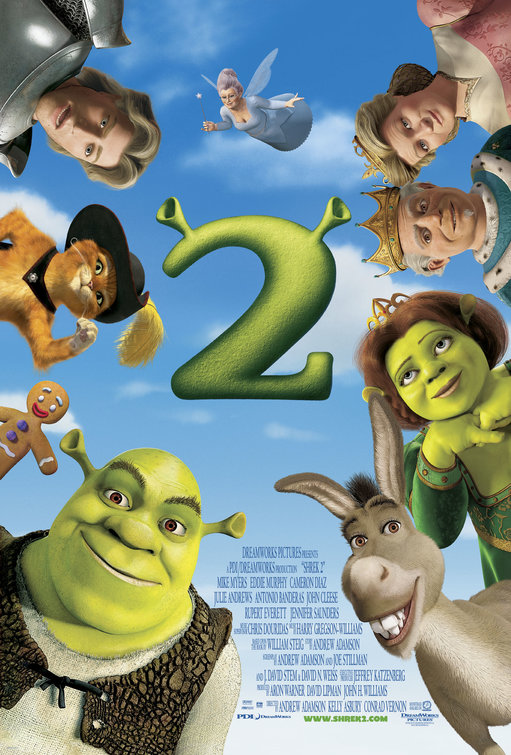
The success of the original Shrek naturally resulted in the announcement of a follow-up not long after its release, and if you needed any further indication as to why this franchise became such a pop-cultural juggernaut in the early 2000s, just look at what 2004’s Shrek 2 managed to pull off. Simply put, Shrek 2 was one of the biggest critical and financial hits of its time; it earned over $928 million worldwide, easily making it the highest-grossing film of 2004 and besting the likes of well-proven franchises like Spider-Man and Harry Potter. This also made it the highest-grossing animated film at that time, which was a record that it maintained for 6 years until Pixar’s Toy Story 3 became the first animated film to gross over $1 billion worldwide. And while it may not have won that year’s Oscar for Best Animated Feature, its overall critical reception was very much on par with the original, with some even arguing that Shrek 2 was a rare case of a ‘superior’ sequel. With almost all the core cast and crew members returning from the original, Shrek 2 dutifully maintains the original’s brilliant mix of kid-friendly humor and adult gags that its target audience won’t truly understand until they’re older and then proceeds to one-up its predecessor on the overall timing and delivery of said jokes to result in a more consistently funny film. And since this film’s animation has aged a lot better, by comparison, there’s a lot of fun to be had finding all the little Easter Eggs and visual gags that are peppered throughout.

Shrek 2 also benefits greatly from all the fun new characters that it introduces. Jennifer Saunders’ Fairy Godmother is a delightfully over-the-top and highly memorable main antagonist right down to her quite arguably iconic cover of ‘Holding Out for a Hero’ that runs over the film’s finale. And, of course, Shrek 2 is also notable for turning the original’s trio of heroes into a full-on quartet with the introduction of Antonio Banderas’ scene-stealing interpretation of the fierce feline swordsman Puss in Boots, who may just be the franchise’s most famous character given that he’s since gone on to headline not one but two feature-length spin-offs and a six-season series on Netflix. In short, it’s easy to see why Shrek 2 is the beloved classic that it is; nevertheless, there has been some debate over the years over its long-held reputation as a ‘superior’ sequel. In other words, while you’re probably more likely to see most people say that Shrek 2 is the franchise’s best film, there are some folks out there who still prefer the first Shrek. As for me, I’d say that I’m somewhere in the middle of this debate where the first Shrek is, as I mentioned earlier, my ‘personal favorite’ of the bunch… but at the same time, it’s hard to deny that Shrek 2 is, indeed, a superior sequel to what was already a damn great first installment.

Rating: 5/5!

SHREK THE THIRD (2007)

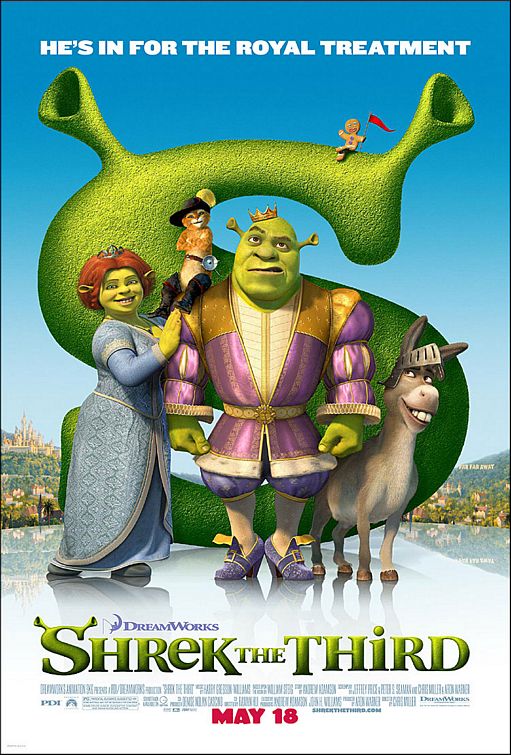
With a pair of highly acclaimed and hugely popular films under its belt, it’s safe to say that the Shrek franchise was still seen in high regard as it prepared for the release of its third installment, Shrek the Third. Sure, the production had to undergo a notable change in direction due to Shrek and Shrek 2 director Andrew Adamson’s commitment to Disney’s The Chronicles of Narnia franchise, but at the very least, Shrek the Third was under the direction of a familiar face in Shrek story artist and Shrek 2’s head of story Chris Miller, AKA the voice of the Magic Mirror. And upon its release, Shrek the Third did continue the franchise’s success at the box office with a nice $813.4 million run that included a then record-setting opening weekend for an animated film that was also the third highest-grossing opening weekend of any film at that time. But as for its critical reception… well, that was another story. Unlike the first two films, Shrek the Third did poorly with critics as it undoubtedly fell victim to the dreaded threequel curse where the third installment of a popular franchise ends up being seen as its weakest. And when it comes to Shrek, some have argued that this film’s poor reception may have hurt the franchise a lot more than you might think. At a time when several studios were trying (and, in most cases, failing) to capitalize on the concept of satirical retellings of classic fairy tales, Shrek the Third’s middling reception is what may have been responsible for ultimately killing audience interest in the genre, and since this is the very franchise that kickstarted that whole trend… that’s saying something.

Even I’ll admit that back when this film came out, I wasn’t too big on it despite being a huge fan of the previous two films. Admittedly, some of this was probably due to me starting to branch out at the time and watch more than just the newest Disney, Pixar, or DreamWorks releases, but while I did get this film on DVD as a holiday gift, I didn’t rewatch it as much as I did the first two films. In fact, when it comes to both this and the next two films, these most recent viewings of them are either the first time I’ve seen them in years… or at all. And once I rewatched this film, I found that my stance towards it hasn’t changed that much. Shrek the Third undoubtedly suffers from a lesser script when compared to the first two films as it's a lot more reliant on its pop-cultural references which, as I noted earlier, were a common (and often criticized) aspect of DreamWorks’ early 2000’s works. As a result, the humor is a lot less consistent and outside of the development that Shrek and Fiona have triplets, there’s little to no character development for any of the main protagonists outside of Shrek’s fears about becoming a parent. Instead, more time is spent focusing on the flimsy premise of Shrek and company seeking out the heir to Far Far Away’s throne, Arthur Pendragon, and dealing with the return of Shrek 2’s secondary antagonist Prince Charming who, despite being promoted to the role of the main antagonist, arguably works better as a supporting villain rather than the main one like his mother, the Fairy Godmother. And as for the new addition of Arthur (as voiced by Justin Timberlake), he ended up being the very definition of a one-off character since this is the only film that he’s appeared in.

But despite these shortcomings, there are some enjoyable parts of this film, such as a superfluous but amusing subplot in which a spell from the wizard Merlin causes Donkey and Puss in Boots to switch bodies or the part where Fiona rallies her fellow princesses (Snow White, Cinderella, and Sleeping Beauty) to fight back against Charming’s forces. And barring a few iffy visual designs here and there, these Shrek films have, at least, consistently improved their animation quality with each subsequent release. In conclusion, since this film’s release, I’ve seen plenty of folks online label it as one of the worst animated films of all time, with some even arguing that, because it’s so bad, it even ruins the previous two films by proxy… but if you ask me, this film doesn’t deserve such an infamously harsh reputation. No, I’m not saying that this is any sort of masterpiece or anything, especially when compared to the first two films, but on its own, it’s a relatively harmless family flick that, at its worst, is simply a subpar installment of the Shrek franchise that lacks a lot of its trademark spunk. To be clear, I don’t attribute any of this to the change in direction that I mentioned earlier since Chris Miller has been involved with the franchise since the beginning; plus, as we’ll soon see, he did go on to redeem himself as a director thanks to the franchise’s first spin-off. At the end of the day, I’d argue that this is simply a straightforward case of diminishing returns that, admittedly, ended up hurting the franchise overall as it marked a clear turning point for this once seemingly unstoppable phenomenon.

Rating: 2.5/5

SHREK FOREVER AFTER (2010)

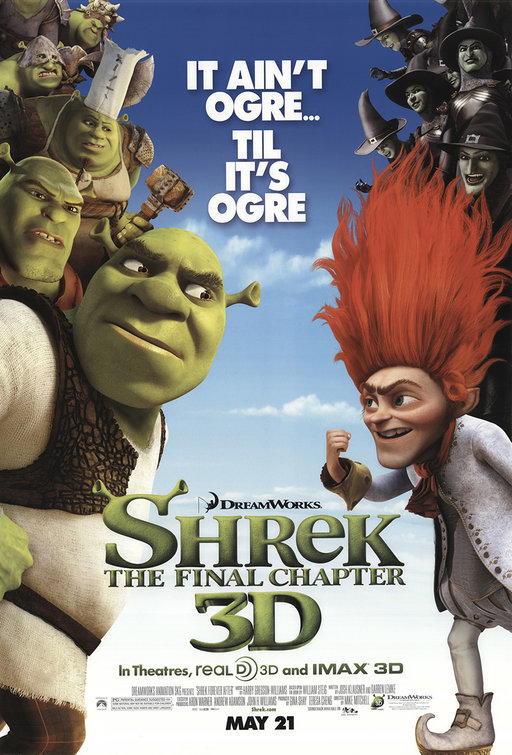
Around the time that Shrek 2 came out, it was reported that DreamWorks was planning to make at least three more Shrek films after that (not counting the Puss in Boots spin-off), with the fifth set to be the series’ last. And yet, while I’m not saying that the mediocre reception toward Shrek the Third was solely responsible for the following development, I also wouldn’t be surprised if it was, indeed, ‘a part’ of the reason that the proposed fifth film was ultimately nixed. Thus, the fourth film, directed by Mike Mitchell (director of films like the 2005 cult classic Sky High and the LEGO Movie sequel that didn’t deserve to be a box-office flop) and originally titled Shrek Goes Fourth, was renamed Shrek Forever After and officially repurposed into being the franchise’s final mainline installment. Opting for an It’s a Wonderful Life-style story, the film sees Shrek, having recently become disillusioned with his current life, agreeing to a deal with Rumpelstiltskin (who, funnily enough, was in Shrek the Third as a part of Prince Charming’s crew and had a completely different character design) that will let him have a full day where he can be a true ogre again. But of course, as anyone familiar with the classic fairy tale can probably guess, the sneaky imp double-crosses Shrek by placing him in an alternate reality where he was never born, thus allowing Rumpel to become the ruler of Far, Far Away.

Given what I just said about the plot following the well-established premise made famous by It’s a Wonderful Life in which the main protagonist sees how the lives of their friends and family are considerably worse if they never existed, Shrek Forever After’s plot is, admittedly, quite predictable in its execution. However, the film makes up for this with two things that, in retrospect, were severely lacking in Shrek the Third… heart and legitimate emotional stakes. Looking back, it seems as if Shrek the Third was more focused on replicating Shrek 2’s ‘joke-a-minute’ vibe, thus making it a film that aimed to be more of a comedic romp… but in doing so, lacked the emotional beats that were just as prevalent in the first two films as their wacky senses of humor. Shrek Forever After, on the other hand, admittedly may not be as much of a comedic riot as the first two films were but it’s far more character-driven than its immediate predecessor. Shrek’s complete devotion to Fiona and their children is what drives him to set things right after his foolhardy attempt at reliving the glory days and the film utilizes Fiona, Donkey, and Puss in Boots a lot better than Shrek the Third did. It also sports a solidly entertaining bad guy in Rumpelstiltskin (voiced by the film’s head of story, Walt Dohrn), who does manage to rival Lord Farquaad and the Fairy Godmother as both a hilarious and downright sinister antagonist.

As I noted with Shrek the Third, Shrek Forever After maintains the franchise’s track record of consistently improved animation with each new installment. Forever After was also notably released in 3-D since this was around the time when the format was making a comeback and DreamWorks Animation had been using it regularly since 2009. I didn’t see this in 3-D when it was in theaters since I saw it at a drive-in (the same drive-in where I saw the first film, in fact…), but from what I’ve heard, DreamWorks Animation always managed to do quite well with implementing 3-D into their films, especially when compared to films that were hastily converted into the format in post-production to capitalize on its then-recent resurgence. And so, with all that in mind, for a film that I haven’t seen since it first came out 12 years ago… Shrek Forever After surprisingly holds up quite well. While I can’t say that it’s as good as the first two Shrek films, it does give the franchise a much-needed bit of course correction by bringing back a lot of the aspects that made it great but were sadly missing in Shrek the Third. In other words, the best way that I can describe this film is that, when compared to its predecessor, this one feels a lot more in line with what we’ve come to expect from the Shrek franchise. And while it’s still unclear yet if there’s going to be a fifth Shrek film as it’s been in the works for years now, Forever After does succeed in its initial goal of being a fitting send-off for this iconic franchise.

Rating: 4/5

PUSS IN BOOTS (2011)

Shrek Forever After may have been the narrative finale to the Shrek franchise but it wouldn’t end up being the franchise’s last hurrah on the big screen. From the moment he made his franchise debut in Shrek 2, it was clear to DreamWorks that Puss in Boots was going to be an indisputable breakout character, and so, Shrek 2’s head of story Chris Miller pushed heavily for a spin-off centered on the suave swashbuckling feline. And while said film was originally conceived as a direct-to-video release that would’ve come out in 2008, one year after Miller’s directorial debut with Shrek the Third, it was eventually repurposed as a theatrical release once DreamWorks eventually realized the character’s full potential for cinematic adventures. Chris Miller soon signed on to direct, thus making Puss in Boots his second directorial outing for the franchise, and thankfully for Miller, Puss in Boots was not a critical dud like Shrek the Third was. The film opened to solid reviews from critics, earned an Oscar nomination for Best Animated Feature, and amassed a highly respectable $555 million run at the box office. As a result, what started out as a spin-off of a hugely successful DreamWorks franchise ended up turning into its own hugely successful DreamWorks franchise. In 2015, it spawned a Netflix series, The Adventures of Puss in Boots, which lasted for six seasons, and this December, Puss in Boots will make his triumphant return to the big screen in Puss in Boots: The Last Wish.

But for now, our focus is on Puss’ first solo outing. Set long before his first encounter with Shrek and Donkey, the film explores Puss’ backstory and how an incident involving him and his childhood friend Humpty Dumpty resulted in him becoming a fugitive of the law in the town that he was raised in, San Ricardo, which is a status that he’s been trying to undo for quite some time. This eventually leads to him reuniting with Humpty Dumpty who, along with fellow feline adventurer Kitty Softpaws, recruits Puss for a quest to find the magic beans that will grow the giant beanstalk that will lead them to the Giant’s Castle where they will find the mythical golden-egg laying goose. As I alluded to earlier, this is the one Shrek-related film that I did not see when it first came out. That said, though, since this was around the time that I was starting to truly get into film criticism and was paying greater attention to how films were faring with critics and audiences, I was at least aware of this film’s generally positive reception and how many saw it as a surprisingly solid release, especially given that this was clearly at a time where the Shrek franchise’s popularity had started to dwindle. Having now finally watched this film for the first time, it isn’t that hard to see why it proved to be such a big hit. For starters, the film more than manages to stand on its own as a spin-off of the Shrek franchise without having to rely on any major nods to the previous films outside of the title character’s classic visual cues.

Barring a relatively straightforward plot with some rather predictable plot twists, Puss in Boots is a rollicking swashbuckling adventure that feels right in line with the many classics that that genre has spawned, including the ones that Antonio Banderas has been in like 1998’s The Mask of Zorro. Banderas, of course, is charismatic and great as always in his fourth outing as Puss in Boots and the film pairs him with one of his most iconic leading ladies from outside of the world of animation as Salma Hayek delivers an equally terrific performance as femme fatale Kitty Softpaws. Meanwhile, Zack Galifianakis is a terrific addition to the ensemble as well as Humpty Dumpty, who constantly blurs the line between being Puss’ friend and Puss’ foe to serve as a great foil to him without being a completely irredeemable antagonist. With all this and a lot of great animation (which, just like Shrek Forever After, must’ve made this a fun one to watch in 3-D), Puss in Boots is a highly entertaining spin-off that more than holds its own against the franchise from which it was spawned. Simply put, Puss in Boots, as brilliantly performed by Antonio Banderas, has easily been one of the Shrek franchise’s best characters, and thanks to a film like this, it’s clear that he can be just as great of a main protagonist as he is a loyal sidekick.

Rating: 4.5/5

BONUS REVIEW: SHREK THE MUSICAL (Home Video Release - 2013)

Before we conclude today’s retrospective, I figured that it’d be fun to cover the following release which, while not a theatrical release like the main Shrek films, has been included in some of the franchise’s recent Blu-Ray and DVD boxsets. Sure, reviewing Broadway productions isn’t really my thing, but if I can do something like this for the filmed production of Hamilton back in 2020, I can certainly cover the Shrek franchise’s transition from the big screen to the Great White Way. In 2008, a musical adaptation of the original Shrek film made its official Broadway debut at the historic Broadway Theatre. This was a project that had been in the works since 2002, just one year after the original film’s release, with the stage play written by Pulitzer Prize-winning playwright David Lindsay-Abaire and music by Tony Award-winning composer Jeanine Tesori with Lindsay-Abaire writing the lyrics. Originally, the production did not use any of the songs from the film, but by 2009, “I’m a Believer”, which was initially just played as background music after the final curtain, was added to the show’s finale. While the show ultimately closed in 2010 without managing to make its initial investment back, it did nab a bunch of Tony Award nominations at the 63rd annual ceremony, including a nomination for Best Musical and acting nods for three of the production’s four main leads, and ended up winning for its costuming. And in 2013, an assembled cut of multiple filmed performances of the show by RadicalMedia (the same team behind the filmed production of Hamilton) was released on home media.

Given that this is based solely on the first film with a few minor nods to Shrek 2 (e.g. a non-speaking cameo from Puss in Boots), it goes without saying that Shrek the Musical benefits greatly from it being based on one of the franchise’s best outings. And overall, David Lindsay-Abaire does a great job of adapting the original film’s story into a musical format, with only a few cuts here and there and some new narrative additions like opening a la William Steig’s original book with a sequence where Shrek’s parents send him off on his own and a plot twist that reveals that Lord Farquaad is the son of the seven dwarves’ Grumpy. While some have argued that the latter twist contradicts the series’ message of embracing who you are (which, ironically, is an argument that goes back as far as the first film’s release given its recurring gag of Shrek and company making fun of Farquaad’s short stature), the musical still maintains the film’s heartfelt themes quite well. Set and costuming design is quite good throughout as they do a solid job of replicating the overall visual aesthetic of the films; makeup design, on the other hand, is a lot more hit-or-miss due to the unsettling looks that some of the characters are given. As for the music, it too is solid throughout with favorites of mine being Fiona’s two solos; ‘I Know It’s Today’, which covers her backstory locked in the dragon’s tower, and ‘Morning Person’, which serves as an extension of the scene in the first film where she goes off on her own and causes a bird to explode by singing in one of Shrek’s many classic bits of dark humor.

But just like how the original film sold itself on its lead quartet of Mike Myers, Eddie Murphy, Cameron Diaz, and John Lithgow, the original Broadway production of Shrek the Musical is fully bolstered by its lead quartet. Revered Broadway icon Brian D’Arcy James does a phenomenal job in the title role, not at all hindered by the extensive makeup work done to turn him into Shrek and nailing the character’s gruff yet sympathetic demeanor. Daniel Breaker, meanwhile, flawlessly mirrors the madcap, mile-a-minute style of comedy that Eddie Murphy brought to the role of Donkey even if the musical focuses on Shrek’s best friend and noble steed considerably less than the film did. However, the biggest standouts of the cast (especially from a comedic standpoint) are Sutton Foster as Princess Fiona and Christopher Sieber as Lord Farquaad. Foster happily revels in playing a more manic and slightly unhinged version of Fiona who, as evident from her first solo “I Know It’s Today”, was clearly affected by her prolonged imprisonment but, nevertheless, is still very much the same spunky and badass heroine that she is in the films. Sieber, meanwhile, brings all the laughs as Farquaad who, in the musical, is still the same nefarious wannabe despot that he was in the film but way more over the top in execution when compared to John Lithgow’s far more sinister take on the character.

I didn’t see Shrek the Musical back when it made its Broadway debut. While I did visit New York quite often on annual vacations with my family when I was younger, none of those trips tended to include a trip to the theater. In fact, outside of any instances where I went to see a show’s touring production at the historic Providence Performing Arts Center, I don’t think that I ever saw an actual Broadway show directly in New York City until a High School Chorus trip in 2011. Plus, as I noted earlier, this was around the time when I was starting to move away from solely watching films like Shrek; ergo, despite being a huge fan of the franchise, this show, to put it quite simply, didn’t really attract my interest back then. Having now since seen it a few times thanks to its home media release (which, like RadicalMedia’s presentation of Hamilton, is a relatively solid production that’s impressively seamless given that it’s a compilation of multiple performances), I believe that I probably would’ve enjoyed it quite a bit if I had seen it as a kid. As crazy as the idea of a Broadway adaptation of the first Shrek film may seem (especially to some of the franchise’s biggest critics), Shrek the Musical is just as much of an undeniable crowd-pleaser as its beloved source material. This classic story of a grumpy yet lovable ogre is excellently reimagined for the stage without losing any of the original screenplay’s charm, especially thanks to its lovable main protagonists (and main antagonist that you love to hate) being portrayed by some of the most talented stars in all of Broadway. And as a result, it’s another prime example of how DreamWorks’ most prominent franchises have managed to successfully expand their horizons far beyond their humble beginnings on the big screen.

Rating: 4.5/5

And that concludes this retrospective on the franchise that made DreamWorks Animation a household name, Shrek. Thanks for following along and be sure to sound off in the comments below with your own personal memories of this franchise… though, if you’ll grant me one request, let’s keep these conversations restricted solely to the films and any other official franchise spin-offs (video games, TV specials, Shrek 4-D, etc.) and refrain from bringing up any of that messed up internet content that I referred to back in this post’s intro. On that note, as I also mentioned in that intro, this will be the first installment of a new series of retrospectives here on Rhode Island Movie Corner that will cover the numerous feature films produced by DreamWorks Animation. To be clear, there is no definite timetable as to when the next DreamWorks retrospective will be published, but in keeping with my plan of starting things out by focusing on DreamWorks’ biggest franchises in the order of their debuts, the next DreamWorks Retrospective will cover the Madagascar series.

Tuesday, June 6, 2017

Captain Underpants: The First Epic Movie (2017) review

Image result for captain underpants movie poster

Now, I know what some of you might be thinking; why the heck am I reviewing a film called Captain Underpants? Seems ridiculous, doesn’t it? Well, it isn’t that ridiculous to me, and that’s because, like many kids of my generation, I grew up with this film’s source material. Yes, what we have here is a film that’s based off a popular book series of the same name by author Dav Pilkey. The Adventures of Captain Underpants: The First Epic Novel, a story about a pair of elementary school students who unintentionally turn their principal into a superhero, was first published in 1997 and was a major best-seller. It would ultimately go on to spawn a full-blown series, with the most recent (and final) entry, book #12, released back in 2015. At the same time, though, the books have often been banned in school libraries due to their [admittedly] juvenile humor. Still, they’ve been a big hit with their target audience, having sold over 70 million copies worldwide. And now, the famous superhero who’s ‘faster than a speeding waistband, more powerful than boxer shorts, and able to leap tall buildings without getting a wedgie’ stars in his own feature film; Captain Underpants: The First Epic Movie. This new film comes courtesy of DreamWorks Animation and is notably their last feature film released through their current distributor, 20th Century Fox, before they begin their new partnership with Universal in 2019. And as surprising as it may seem, this adaptation of a book series about a principal who turns into an underwear-themed superhero every time someone snaps their fingers and is only reverted to normal when doused with water… is one of the most faithful book-to-film adaptations in recent memory.

Like the books that they’re based on, the film follows the adventures of fourth graders George Beard (Kevin Hart) and Harold Hutchins (Thomas Middleditch). These two best friends spend most of their time creating their own comics and causing all sorts of pranks at their elementary school, Jerome Horwitz Elementary, to provide their classmates with a temporary reprieve from the grim goings-on that occur there daily. However, this soon ends up attracting the attention of their mean principal, Mr. Krupp (Ed Helms), who threatens to put the two boys in separate classrooms if they get caught again. To prevent this from happening, George and Harold try to hypnotize him with a ‘3-D Hypno-Ring’ that George got from a cereal box. To their surprise, the ring does indeed work, allowing them to make Mr. Krupp do whatever they want. This culminates in them commanding Mr. Krupp to act like the main protagonist from their comics, Captain Underpants, a superhero who literally only wears his underpants along with a red cape. However, this joke soon turns into a serious dilemma when Mr. Krupp begins to go around the city acting like a superhero… even though he doesn’t have any real superpowers. As such, this forces George and Harold to keep an eye on him so that he doesn’t hurt himself. And things get even more complicated when a scientist named Professor Poopypants (Nick Kroll; and yes, that’s his name, Professor Poopypants) comes to town intent on ridding humanity of the part of the brain that causes them to laugh as revenge for the years of ridicule that’s he endured over his ridiculous name.

Even though it’s been a while since I’ve read these books (I stopped reading them during the time when the series was on a temporary hiatus due to author Dav Pilkey taking time off to care for his father, who died in 2008), I found this film to be a highly faithful adaptation of its source material. The plot is, basically, a combination of elements from various installments. In other words, while the main plot generally follows the same structure of the first book, the film’s main villain, Professor Poopypants, first debuted in the fourth book, Captain Underpants and The Perilous Plot of Professor Poopypants, the evil sentient toilets from the second book, Captain Underpants and the Attack of the Talking Toilets, make an appearance, and there are several Easter eggs throughout that tie into various other entries of the series. Ultimately, though, the film does a fantastic job of capturing the overall feel and tone of the books. It never takes itself too seriously and it maintains the same general style of self-aware humor. Heck, they even managed to incorporate the iconic ‘Flip-O-Rama’ sections from the books, in which readers flipped pages back and forth to simulate action scenes, into the narrative. On that note, the screenplay by Nicholas Stoller is full of hilarious bits of dialogue. I mean, admittedly, I wouldn’t say that this film is an absolute comedic riot. And, yes, the humor is often just as juvenile as it was in the books so it won’t go over well with everyone. Still, there are plenty of great jokes as well as some hilarious visual gags throughout that satirize the superhero genre. At the same time, there’s also some surprisingly heartfelt moments in this as well, namely through the friendship of the main characters.

Unlike most DreamWorks Animation films, this film’s animation was handled by a different studio, Mikros Image. This allowed the film to have a cheaper budget compared to DreamWorks’ other projects in the wake of some of their more recent efforts underperforming at the box-office. And, overall, the animation in this film is solid. It’s very reminiscent of what Blue Sky Studios did on The Peanuts Movie, managing to establish a 2-Dish feel in this computer animated film. And just like The Peanuts Movie, this is a great way to pay homage to the original source material as, in this instance, it feels like a comic book coming to life. Heck, they even have a whole sequence done with sock puppets. As for the voice cast, the film assembles a solid group of voices to fit each role. It may seem a bit weird at first to hear famous voices like Kevin Hart and Thomas Middleditch portraying fourth graders, but they both do excellent jobs in the roles of George and Harold, respectively. But perhaps most importantly, the two have phenomenal camaraderie, doing justice to the friendship of these two classic characters which, as mentioned earlier, is ultimately the heart of the film. Meanwhile, Ed Helms is a nice pick for the dual role of Mr. Krupp AKA Captain Underpants. He provides the right amount of diabolicalness for when Krupp’s his normal self but then switches seamlessly into a charismatic persona when he’s the friendly but admittedly dimwitted superhero, Captain Underpants. And, finally, Nick Kroll gets some great bits of humor as well in the role of the main villain Professor Poopypants, mainly due to the exact reason that you’re thinking about (i.e. his name). I mean, between this and Sausage Party, Kroll does quite a great job when it comes to animated villain roles.

I cannot believe that I’m saying this but… Captain Underpants: The First Epic Movie is one of the most satisfying adaptations that I’ve ever seen. I mean, let’s face it, you don’t often get a film like this that is THIS faithful to the source material. And yet this film very much succeeds in capturing the spirit of the Captain Underpants books, right down to the implementation of their iconic running gags like ‘Flip-O-Rama’. Seriously, even though it’s been years since I’ve read these books, watching this film legitimately made me feel like a kid again, reading through these books and going on these wacky adventures with George and Harold. But, aside from that, the film’s just a fun superhero adventure through and through. The animation’s nice and colorful, excellently representing the visual style of the books, and the screenplay by Nicholas Stoller is full to the brim with great humor. At the same time, though, there’s also some unexpectedly heartfelt moments in this as well, primarily through the great friendship of George and Harold. Ultimately, it’s just a great feel-good film that celebrates imagination through the crazy antics that George, Harold, and Captain Underpants get into. Thus, to make a long story short (See what I did there? It’s a nod to the books, which always had one chapter that tied up all loose ends in just one sentence, hence why they’re always titled ‘To Make a Long Story Short…”), who would’ve guessed that an adaptation of a book series that has, no joke, been around for two whole decades now (Feel old yet?) would turn out this good? 


Rating: This may seem crazy, but… 5/5!

Monday, July 1, 2013

2013 Preview: July

2013 is now halfway over, but there’s still six months of movies left to go before 2014. Welcome back to Rhode Island Movie Corner’s year-long preview of the films coming out during 2013. This is Part 7 and today we’ll be looking at the films that will hit theaters during the month of July, which include a couple of sequels and some big blockbusters.

JULY 3- A pair of blockbusters hit theaters during Fourth of July Weekend, both of which will be opening early on the Wednesday before July 4th.

*The first major release of the month is ‘Despicable Me 2’, the sequel to 2010’s surprise hit ‘Despicable Me’, which followed a super-villain named Gru (Steve Carell) who adopted three girls (Miranda Cosgrove, Dana Gaier, and Elsie Fisher). These four return for the sequel, which sees Gru recruited by the Anti-Villain League to help deal with a powerful new super-villain. The rest of the voice cast includes Kristen Wiig (in a different role than the one she played in the previous film), Benjamin Bratt (who replaced Al Pacino, who left the project due to creative differences), and Steve Coogan.

*The other release that week is ‘The Lone Ranger’, the newest film from ‘Pirates of the Caribbean’ director Gore Verbinski and producer Jerry Bruckheimer. The project was plagued by budget concerns but is now finally set to come out this week after being pushed back from a 2012 release. Armie Hammer stars in the main role of John Reid, a Texas Ranger who survives an ambush from a bunch of outlaws and takes on the new identity of ‘The Lone Ranger’, fighting crime alongside an Indian warrior named Tonto (Johnny Depp).

JULY 12- This weekend sees an Adam Sandler comedy and a big-budget sci-fi film from Guillermo Del Toro coming out.

*The follow-up to 2010’s ‘Grown-Ups’, ‘Grown-Ups 2’, will hit theaters this weekend. The majority of the main cast from the previous film (save for Rob Schneider) and director Dennis Dugan return for this new film, which sees Adam Sandler’s Lenny move back to his old hometown with his wife and their kids. Some new members of the cast include Andy Samberg, Taylor Lautner, ‘Stone Cold’ Steve Austin, and Shaquille O’Neal.


*The latest film from director Guillermo Del Toro, ‘Pacific Rim’, is the other major release of the week. This film takes place in the near future, where giant monsters known as ‘Kaiju’ emerge from a ‘portal’ in the Pacific Ocean and begin to wreak havoc on the planet. Charlie Hunnam, Idris Elba, and Rinko Kikuchi star as members of a Defense Corporation that builds giant robots called Jaegars to take on the invading Kaiju.

JULY 17- While there are quite a couple of films coming out only 2 days later, one film will hit theaters early on the Wednesday before July 19th.


*After grossing more than 576 million worldwide with ‘The Croods’, DreamWorks will release their second major release of the year, ‘Turbo’. Ryan Reynolds (who also starred in ‘Croods’) stars as the titular ‘Turbo’, a garden snail who dreams of becoming a famous racer. This dream starts to come true after a freak accident gives him super speed. This movie will soon be followed by a TV series, Turbo F.A.S.T. (Fast Action Stunt Team) that will debut exclusively on Netflix in December.

JULY 19- Not including Turbo, a staggering 4 films will hit theaters this weekend (plus one for those in the U.K.).


*Speaking of Ryan Reynolds, another movie of his, R.I.P.D., will hit theaters two days after ‘Turbo’.  This film, based off of the Dark Horse comic ‘Rest in Peace Department’ by Peter M. Lenkov, follows a cop (Reynolds) who is killed in action and is then ‘enlisted’ in a ‘dead’ police department known as the R.I.P.D. He is then partnered with Roy (Jeff Bridges) and the two officers team up in order to take on evil spirits. The film is directed by Robert Schwentke (‘Red’) and also stars Mary Louise Parker and Kevin Bacon.


*Meanwhile, Schwentke’s 2010 action comedy ‘Red’ will get a sequel in ‘Red 2’, which hits theaters the same weekend. Dean Parisot (Galaxy Quest) takes over for Schwentke behind the camera for this film, which finds ex-CIA agent Frank Moses (Bruce Willis) on the run from Interpol. John Malkovich, Mary-Louise Parker, Helen Mirren, and Brian Cox reprise their roles from the previous film alongside newcomers Catherine Zeta Jones, Lee Byung-hun, and Anthony Hopkins.


*For the horror crowd, ‘The Conjuring’ hits theaters this weekend. The film is directed by James Wan (‘Saw’, ‘Insidious’, and the latter’s sequel, which comes out in September) and stars Patrick Wilson and Vera Farmiga as a pair of paranormal investigators that try to help a family deal with a dark presence that is in their farmhouse.


*Finally, in the U.S. (in a more limited release), there’s ‘Only God Forgives’, which reunites Ryan Gosling with ‘Drive’ director Nicholas Winding Refn. In this film, Gosling plays a drug smuggler in Bangkok, Thailand who is compelled to find out who is responsible for the death of his brother. The film was previously screened at Cannes, where it was actually booed by the Festival audience.


*For those in the U.K., ‘The World’s End’ will be released this weekend. The final film in Edgar Wright’s ‘Cornetto Trilogy’ will be released later in the U.S. in August (more on the film next month).

JULY 26- This weekend, there’s one release in the U.S. and another in the U.K.


*Hugh Jackman will reprise his role as Wolverine in two movies that are set to come out; 2014’s ‘X-Men: Days of Future Past’ and ‘The Wolverine’; the latter hitting theaters this year. Based off of the 1982 limited series ‘Wolverine’ by Chris Claremont and Frank Miller, the film follows Wolverine as he travels to Japan, where he comes across a mysterious figure from his past and ends up losing his immortality. James Mangold (the 2007 remake of ‘3:10 to Yuma’) directs this film, which is set after the events of ‘X-Men: The Last Stand’.


*The latest adaptation of Shakespeare’s ‘Romeo and Juliet’ will be released in the U.K. this weekend. The first since Baz Luhrmann’s modern day remake in 1996, this version is a traditional take on the story (similar to Franco Zeffirelli’s 1968 film adaptation). Hailee Steinfeld (2010’s ‘True Grit’) and Douglas Booth star as Romeo and Juliet, along with Damian Lewis (Homeland) as Lord Capulet, Paul Giamatti as Friar Laurence, and Kodi Smit-McPhee (‘Let Me In’, ‘Paranorman’) as Benvolio.

JULY 31- The final release of the month is another early Wednesday release, two days before the first releases of August.


*Two years after 2011’s ‘The Smurfs’ grossed over 500 million worldwide, the miniature blue creatures return for a sequel, ‘The Smurfs 2’. The main cast from the previous film returns for this film along with director Raja Gosnell. In this film, the Smurfs’ nemesis Gargamel kidnaps Smurfette after creating two ‘evil’ Smurfs called the Naughties.

And that’s the lineup of films hitting theaters during July. Check back next month for Part 8, where we’ll be looking at the film lineup for August.

Wednesday, April 3, 2013

The 'Copycat Films' Trend in Hollywood

These days, in Hollywood, it seems like most things come in two. What do I mean by that? Well, there has been a recent trend in the film industry where two films come out the same year and both of these films share similar plots. The only major difference between the two films, aside from the crews working on them, is usually just the overall tone and presentation of the films. Of course, only one can do better than the other, maybe either because it was the first film to come out that year or because that first film did not fare well with audiences while the second film had a much better result. That is why today, on Rhode Island Movie Corner, I'll be looking at six of the most notable pairs of what I like to call 'dueling films' that have hit theaters in the last few years. I will also be discussing which film ended as the 'winner' of the year, though I use that term very loosely because really you could say there will never be a winner. That's up for the audiences to decide.


1997: DANTE'S PEAK VS. VOLCANO

Apparently in the 90's, disaster movies seemed to be all the rage. One example of this was in 1997, a year that saw not only the romance/disaster film that would ultimately become the highest-grossing movie of all time (until 2009's 'Avatar') in James Cameron's 'Titanic', but two films based around volcanic eruptions. The first big volcano film of the year was 'Dante's Peak', which starred Pierce Brosnan as a volcanologist who is sent to the titular town of Dante's Peak, Washington to investigate volcanic activity, as the town is located right next to a dormant volcano. When the volcano does end up erupting, he must find a way out of the town along with the mayor (played by Linda Hamilton) and her two kids. Two months later, another volcano film, simply titled 'Volcano', hit theaters. This film starred Tommy Lee Jones as the head of a crisis agency who attempts to divert the path of flowing lava when a volcano erupts in downtown Los Angeles.

The Winner:

Neither film fared particularly well with critics. According to Rotten Tomatoes, Volcano's Tomatometer stands at 44% while Dante's Peak ended up with a lower score of 27%. Despite the fact that it got worse reviews, 'Dante's Peak' has been credited as being more accurate and it was the film that fared better at the box office, grossing over 178 million while 'Volcano' grossed only 122 million. The fact that Dante's Peak did star the current James Bond at the time probably helped.


1998: DEEP IMPACT VS. ARMAGEDDON


While 1997 was the year of the volcano, 1998 was the year for asteroids. The first asteroid related film to hit theaters that year was 'Deep Impact', which hit theaters in May. This film starred an ensemble cast, including Elijah Wood, Morgan Freeman, and Robert Duvall. The other major asteroid film of the year was Armageddon, the July blockbuster from director Michael Bay ('Transformers, 'The Rock'). Like 'Deep Impact', it featured an ensemble cast, including Bruce Willis, Ben Affleck, and Steve Buscemi. Both films focused on efforts to stop a dangerous asteroid before it hit Earth and both movies had a team pilot a spacecraft to travel to the asteroid in order to destroy it. The crew of Deep Impact used nuclear weapons to destroy the asteroid while a team of drillers were sent up in Armageddon.


The Winner:

Like with the volcano films, neither film was a huge critical hit. Deep Impact was credited as being the more scientifically accurate film. While 'Armageddon' received worse reviews (as common in the majority of Michael Bay's filmography), it fared better at the box office (again, like most Michael Bay films do). In fact, it was the highest grossing film of 1998, even ahead of Steven Spielberg's 'Saving Private Ryan'. Armageddon grossed over half a billion dollars worldwide while Deep Impact only grossed about 350 million.


1998: ANTZ VS. A BUG'S LIFE


If disaster films weren't your thing, then 1998 also saw the release of two animated films from what are arguably the most well-known computer-animation studios working today, Pixar and Dreamworks. However, these two competing films have probably the most controversy surrounding them because it is believed that one of these films, both of which revolving around ants, was made after the idea was 'stolen' from the company that worked on the other film. Here's how the story goes. After Jeffrey Katzenberg left Disney and formed Dreamworks, his new company bought Pacific Data Images and their first project together would be the company's first computer animated film, 'Antz'. The only problem was that Pixar, fresh off of the success of the first 'Toy Story' film, was also working on a ant-related film, 'A Bug's Life'. So did Katzenberg really steal the idea from John Lasseter? According to Katzenberg, 'Antz' evolved from a 1991 story pitch by writer Tim Johnson (who was also the director of the film) so really, who knows?


The Winner:

Antz may have hit theaters first, but in the end, 'A Bug's Life' performed better at the box office, grossing over 360 million while Antz only grossed about 171 million. This may have been because 'Antz' was more adult-oriented than the more kid-friendly 'A Bug's Life'. Plus, while 'A Bug's Life' was Pixar's second film, 'Antz' was just Dreamworks' first. However, according to Rotten Tomatoes at least, Antz has received stronger ratings, though both films have been received pretty well by critics. This was just the beginning of the competition between Pixar and Dreamworks when it came to their work in computer-animated films.


2012: MIRROR MIRROR VS SNOW WHITE AND THE HUNTSMAN


2012 saw a battle between two films based on the Brothers Grimm's classic fairy tale, Snow White. The first Snow White film of the year was 'Mirror Mirror', a family film from visual director Tarsem Singh which came out in March. The film starred Lily Collins as Snow White and Julia Roberts as the Evil Queen. A much more mature Snow White film, 'Snow White and the Huntsman', hit theaters during the summer in June. This film starred Kristen Stewart (fresh off of her role as Bella Swan in the 'Twilight' franchise) as Snow White and Charlize Theron as the Evil Queen. It also starred Chris Hemsworth ('Thor') in the role of the Huntsman and a pretty notable cast of dwarves, played by actors like Bob Hoskins, Ian McShane, and Nick Frost. The dwarves in 'Mirror Mirror', on the other hand, were played by relatively unknown actors.


The Winner:

Both films received similar mixed reception from critics (according to Rotten Tomatoes, 'Mirror Mirror' has the slight edge at 50% while 'Snow White and the Huntsman' only stands at 48%). However, the winner at the box office was 'Snow White and the Huntsman', which grossed nearly 400 million at the box office and a sequel is currently in the works. Having the stars of 'Twilight' and 'Thor' in Stewart and Hemsworth, respectively, certainly must have helped along with its Summer release date. 'Mirror Mirror', on the other hand, only grossed about twice its reported 80 million dollar budget.


2012: ABRAHAM LINCOLN: VAMPIRE HUNTER VS. LINCOLN


2012 also saw two films that were both based on our 16th President, Abraham Lincoln. The first of these films, 'Abraham Lincoln: Vampire Hunter', was a film that, as the title suggests, obviously wasn't really that historically accurate. Based on the 2010 mash-up novel of the same name by author Seth Grahame-Smith and produced by Tim Burton, this fantasy film followed Lincoln (played by Benjamin Walker) as he fought vampires who, in this universe, were slave owners where they utilized their workers as a food source. If you were looking for a much more historically accurate take on Lincoln, then later that year we saw the release of 'Lincoln', directed by Steven Spielberg and starring Daniel Day-Lewis as the President. This film took place during the final months of Lincoln's life as he worked to get the Thirteenth Amendment signed before the end of the Civil War. The ensemble cast also included Sally Field as First Lady Mary Todd Lincoln and Tommy Lee Jones as Radical Republican leader Thaddeus Stevens.


The Winner:

'Abraham Lincoln: Vampire Hunter' received mixed to negative reviews from critics and only grossed about 116 million worldwide. 'Lincoln', on the other hand, is another story. It received critical acclaim from critics and grossed more than 263 million worldwide. It also received 12 Academy Award nominations (the most that any film got that year), even though it only ended up with two awards; one for Best Production Design and the other a Best Actor win for Day-Lewis, who has also won pretty much every single major acting award for his performance as Lincoln.


2013: OLYMPUS HAS FALLEN VS. WHITE HOUSE DOWN


This year sees the release of two films with plots revolving around takeovers of the White House. One of these films has already come out, 'Olympus Has Fallen'. That film, directed by Antoine Fuqua ('Training Day') stars Gerald Butler as a Secret Service agent who must rescue the President (played by Aaron Eckhart) when Korean guerrilla forces take over the White House. Later this year, we'll be seeing 'White House Down', another White House takeover film. This film is directed by Roland Chimeric ('Independence Day') and stars Channing Tatum in the lead role of a Capitol Policeman who also gets caught up in a takeover of the White House, done here by a group of paramilitary invaders led by Jason Clarke's character Stenz. Jamie Foxx plays the President in this film which, according to the trailer, will delve into our nation's 'darkest secrets'.


The Winner:

Well, we can't determine that just yet because 'White House Down' isn't out yet. We can only judge the performance of 'Olympus Has Fallen'. The film received mixed reviews but has actually performed pretty well at the box office. In its first weekend, it grossed over 30 million domestically. So now the pressure is on for Tatum and Emmerich to deliver with 'White House Down'.


And those are just a few of the many pairs of 'competing films' that have come out over the past few years. This is a trend that has certainly been big in recent years and will most likely still be happening in the future.