Showing posts with label Tom Hardy. Show all posts

Tuesday, October 19, 2021

Venom: Let There Be Carnage (2021) review

2018’s Venom is easily one of the most fascinating films to come out of the superhero genre in recent years, mainly due to its overall reception. The film was primarily intended to be a more faithful take on the titular fan-favorite Spider-Man villain turned anti-hero after his live-action debut in 2007’s Spider-Man 3 (where he was forced in by executive meddling against director Sam Raimi’s wishes) left most fans underwhelmed. It was also poised to be the start of a new superhero cinematic universe based around characters from the Spider-Man mythos without having to solely rely on Spider-Man himself, especially since the current incarnation of the character as played by Tom Holland was primarily operating within the Marvel Cinematic Universe. However, upon the original Venom’s release, it didn’t do so hot with critics, many of whom found it to be a tonal mess that was severely hindered by the lack of a proper connection to Spider-Man. And yet, it managed to fare a lot better with audiences, who notably latched on to the unique relationship between the film’s main characters; reporter Eddie Brock and the alien symbiote that he becomes bonded to, Venom. As a result, the film earned an impressive $856 million worldwide, allowing it to become the seventh highest-grossing film of that year.

Thus, a sequel was promptly announced not long after, and thanks to the first film’s mid-credit scene that introduced the character of serial killer Cletus Kassidy (as played by Woody Harrelson), it was confirmed that the sequel would focus on another fan-favorite Spider-Man antagonist, Carnage. Created by writer David Michelinie and artist Mark Bagley, Carnage first debuted in issue #361 of The Amazing Spider-Man in 1992 as the symbiotic ‘offspring’ of Venom. Like its parent, Carnage quickly became a popular new addition to Spider-Man’s rogue gallery and proved to be such a dangerous threat for the web-slinger that he was forced to team up with Venom to stop it on numerous occasions, including the famous 1993 story arc Maximum Carnage. As for the new film, subtitled Let There Be Carnage, a notable change in directors had to occur since Ruben Fleischer was busy working on the long-awaited follow-up to his 2009 film Zombieland, 2019’s Zombieland: Double Tap. Thus, directorial duties were taken up by none other than the widely proclaimed king of motion capture performance work, Andy Serkis. Yes, the man known for his critically acclaimed roles such as Gollum in Peter Jackson’s Middle-Earth films and Caesar in the Planet of the Apes reboot trilogy has recently started to establish himself as a director, having previously helmed the Robin Cavendish biopic Breathe and his decidedly non-Disney esque Jungle Book adaptation, Mowgli: Legend of the Jungle. And under his solid direction, Venom: Let There Be Carnage wholeheartedly embraces its predecessor’s most popular elements to deliver an all-around wackier sequel that may not win over the original’s biggest critics but, at the very least, is a lot more consistent from a tonal and visual perspective.

It has been about a little over a year since investigative journalist Eddie Brock (Tom Hardy) became the [somewhat unwilling] host of Venom (voiced by Hardy), an alien symbiote from a far-away planet. Since then, Eddie has struggled to keep his ‘new friend’ hidden from the rest of the world, especially given Venom’s unstoppable urge to eat people. As part of his efforts to revive his journalism career, Eddie takes on the assignment of interviewing imprisoned serial killer Cletus Kassidy (Woody Harrelson), who has mysteriously agreed to talk to him and nobody else. Through their talks with each other, Eddie (with the help of Venom) manages to figure out the location of the bodies of Kassidy’s many victims, thus resulting in Kassidy being handed an immediate death sentence. Before his execution, however, Kassidy ends up acquiring a sample of Venom during a heated confrontation with Eddie that allows him to survive his destined demise as he becomes the host of the red-colored symbiotic ‘offspring’ Carnage (voiced by Harrelson). After escaping from prison, Kassidy and Carnage promptly embark on a rampage across San Francisco as the former searches for the love of his life, Frances Barrison AKA Shriek (Naomie Harris), whom he was separated from at an early age when Frances was dragged off to the local mental asylum. Thus, Eddie and Venom quickly find themselves having to work around their growing differences so that they can stop their most dangerous adversary yet.

Venom: Let There Be Carnage is very much a sequel that’s fully aware of what it was about its predecessor that made it so popular and uses that information as the primary influence behind its overall direction. In this instance, director Andy Serkis and his team clearly recognized that fans of the first Venom primarily dug the delightfully twisted dark humor that stemmed from the uniquely ‘odd couple’-style relationship between Eddie Brock and Venom. Because of this, Let There Be Carnage opts to be much more comedic-oriented than its predecessor which, by comparison, attempted to find a greater balance between its humorous moments and its primarily dramatic plot beats. And while your overall mileage may vary on how effective it is as a comedy, especially given some of the incredibly ludicrous lengths that it goes to when crafting the scenarios that Eddie and Venom end up in, this does ultimately result in a far more tonally consistent sequel. It also manages to one-up its predecessor from a visual perspective as Serkis goes all-in with some incredibly eye-catching gothic imagery that improves upon the first film’s knack for sterile laboratory environments. Despite all this, however, Let There Be Carnage still has the same narrative shortcomings of the first film; in other words, a very generic plot that trades out the previous film’s straight-forward ‘stop the evil businessman’ premise for an equally straight-forward ‘stop the murderous psychopath’ plot. Part of this may be due to the film having a short 97-minute runtime which, at this point, is practically an anomaly for the superhero genre. To be clear, though, it’s not like there’s anything inherently wrong about this film having a short run-time as it helps give it consistently smooth pacing that prevents it from dragging at any point; it’s just that, narratively, it also could’ve done a lot more with certain plot-threads.

Nevertheless, Let There Be Carnage’s biggest selling point continues to be the humorous interactions between its two main protagonists, and Tom Hardy truly deserves a lot of credit for how utterly committed he is to the dual role that he plays in these films. He very much succeeds in making Eddie Brock and Venom perfect foils for one another, with Eddie being the good-natured but rather pathetic straight man who must consistently put up with the antics of the incredibly overeager Venom who, let’s face it, gets all the best lines (“NO ONE LIKES YOU, DAN!”). Their dynamic relationship is then perfectly complemented by Woody Harrelson’s own dual role as Cletus Kassidy and his alien symbiote partner, Carnage. Sure, the minimal plotting ends up making Kassidy your routine psychopath (with Carnage itself nearly being a non-entity, narratively speaking), but Harrelson’s appropriately creepy performance makes him and Carnage a much stronger pair of antagonists than Carlton Drake and the alien symbiote Riot from the previous film. Speaking of antagonists, there’s also Naomie Harris in an equally standout role as Frances Barrison AKA Shriek, whose sonic scream abilities provide a uniquely complicated layer to her romantic relationship with Kassidy given that symbiotes like Venom and Carnage are notoriously weak to loud noises. Unfortunately, Harris ends up being a bit underused here, and the same can be said for a returning Michelle Williams and Reid Scott as Eddie’s ex-fiancé Anne Weying and her new fiancé Dan Lewis. Granted, they aren’t completely ignored here as they do help Eddie and Venom out like they did in the first film, but in Williams’ case specifically, it does feel like a noticeable step backward for these films’ main female lead.

Back in 2018, I gave the first Venom a decently positive 3.5/5 review, and overall, my thoughts on the film haven’t changed that much since then. While I’ll fully concede that it’s far from being one of the superhero genre’s best outings, the strong humor that spawned from the interactions between Eddie Brock and Venom helped the film overcome some of its biggest shortcomings such as a mediocre villain and its mixed attempts at balancing its humor with its serious moments. And while I’m about to give its sequel, Venom: Let There Be Carnage, the same exact rating, this is ultimately a case of a superior sequel. Unlike the first film, Let There Be Carnage doesn’t try to take itself too seriously and fully embraces all the wackiness that ensues from what is arguably the superhero genre’s most notorious odd couple. And thanks to solid direction from Andy Serkis, the film not only flows a lot better than its predecessor but also looks a lot better as well with some delightfully twisted gothic visuals that, speaking as someone who doesn’t read a lot of comics, feel very much appropriate for a story based around its titular symbiotes. All that said, though, this sequel does suffer from some of the same narrative issues that plagued its predecessor, and while it never overstays its welcome thanks to a shorter run-time, it still feels a bit rudimentary when compared to some of the other films from this genre. In short, Let There Be Carnage is just as much of an enjoyable popcorn flick as its predecessor was, and while Sony’s plans to develop their own cinematic universe a la the MCU have arguably yielded mixed results so far, I’ll admit that I’m still genuinely curious to see what comes next, especially given this film’s post-credit scene which, without spoiling anything, is a big one.

Rating: 3.5/5

Saturday, October 6, 2018

Venom (2018) review

Tom Hardy, Michelle Williams, and Riz Ahmed in Venom (2018)

When it comes to classic comic book villains, many will agree that Batman boasts the greatest collection of what has since earned the affectionate fandom term of a ‘Rogues’ Gallery’. Foes like the Joker, Two-Face, and Harley Quinn are only just a select few of the Dark Knight’s legendary antagonists. As for the best rogues’ gallery from Marvel, many would give that honor to everyone’s favorite web-slinger, Spider-Man, and for the most part, his villains have gotten solid portrayals courtesy of the web-slinger’s many cinematic outings. One of his most famous foes, however, didn’t quite get that the first time out, and that character is the sentient alien creature known as Venom. The character first appeared in issue #252 of The Amazing Spider-Man as an alien symbiote who bonds with human hosts. Spider-Man himself is temporarily subjected into being the symbiote’s host, which ends up having a negative influence on his personality. But while he manages to reject the symbiote, it ends up latching onto a new host in issue #300, reporter Eddie Brock, turning him into the monstrous creature known as Venom. And this character proved to be quite popular with fans, later making notable appearances in other forms of media including the 90’s Spider-Man animated series and hit games like the PS1 Spider-Man in 2000 and 2005’s Ultimate Spider-Man. The character would end up making his first live-action appearance in the third installment of Sam Raimi’s Spider-Man trilogy that was released in 2007. However, to call this move a ‘disaster’ would be a bit of an understatement…

Originally, Venom wasn’t even meant to be in Spider-Man 3. However, Raimi was, for lack of a better term, forced to put the character in by producer Avi Arad to please the fans. Raimi obliged… resulting in the character having a limited screen-time and Topher Grace (who played Eddie Brock) considered as one of the worst casting decisions in the history of the superhero genre. This proved to be one of the major contributors behind Spider-Man 3’s less-than-stellar reception and Raimi’s eventual departure from the series given his creative conflicts with the studio. With his departure, the original Spider-Man series concluded and plans for a Venom spin-off were canned. This spin-off was put into development again, however, when Sony rebooted the series with the Amazing Spider-Man films, with Star Trek/Transformers writer Alex Kurtzman slated to direct. But, like the Raimi trilogy, the Amazing Spider-Man series ended up getting canned as well following the mediocre reaction to Amazing Spider-Man 2 and Sony making a deal with Marvel Studios to let Spider-Man appear in the Marvel Cinematic Universe. Thus, with another franchise reboot underway, the Venom spin-off was put to rest once more… until 2017, when it was revived yet again. And this time, despite conflicting reports over it having any connections with the MCU, the film has successfully managed to avoid another cancellation, with Zombieland director Ruben Fleischer behind the camera and Tom Hardy in the title role. But with a lot of hesitation surrounding its production, the biggest question, ultimately, is whether the film manages to live up to the expectations surrounding it. Well, while it doesn’t quite reach the exact heights that it wants to achieve, that doesn’t mean that it’s terrible.

In the city of San Francisco, Eddie Brock (Tom Hardy) is an investigative journalist with a habit for bringing down corrupt individuals through his titular TV show, The Eddie Brock Report. However, when he lands an interview with Carlton Drake (Riz Ahmed), the CEO of the bioengineering corporation known as the Life Foundation, he gets into serious trouble when he starts to question the company’s disreputable practices. This, in turn, causes him to get fired from his job while also destroying his relationship with his fiancé, lawyer Anne Weying (Michelle Williams), after he used some of her classified information in the interview, effectively leading to her being fired from her job as well. Six months later, Brock once again investigates into the company’s practices with the help of Dr. Dora Skirth (Jenny Slate), who has been against Drake’s plans for quite some time. Through Skirth, Eddie learns that Drake intends to use alien lifeforms known as symbiotes as a means of ensuring the survival of humanity by testing their ability to bond with a human host. While investigating the company’s headquarters, Eddie comes across one of the symbiotes, which immediately bonds with him. And unlike Drake’s various test subjects, Eddie manages to withstand all the weird tendencies of the symbiote, which refers to itself as ‘Venom’. Thus, with Drake and his subjugates now directly on his tail, Eddie is forced into an uneasy partnership with Venom to ensure that they will both survive.  

Let me just start by saying that if you’re going into this film expecting a serious/dramatic take on this classic comic book antagonist, then you might be a little disappointed because this is not that kind of film. Despite it not having any major connections to the MCU (to answer your biggest question, no, Tom Holland’s Spider-Man does not cameo in this film), tonally it is in line with those films. A lot of its action is undercut with MCU-style humor, primarily through Eddie’s relationship with the symbiote. And for me, this did ultimately help to make the film a decently entertaining entry in the superhero genre. That said, though, this doesn’t mean that the film is ‘perfect’. For starters, some of the action sequences suffer from some extremely choppy editing. And to be clear, this is regardless of rumors about how the film was originally intended to be rated R before it had to be toned down to a PG-13 rating to allow for crossovers with Spider-Man, while other reports say that it was always going to be PG-13. Whatever story ends up being true, the erratic editing ends up affecting quite a few, though not all, of the action sequences. And as for the plot, it’s your basic ‘stop the evil businessman’ plot that a lot of people have critiqued some of the MCU films for having only without the emotional gravitas that helped those MCU films’ plots be more than just that. But for what its worth, the film manages to overcome a rather slow start and truly shines once the symbiote bonds itself to Eddie.

Venom serves as Tom Hardy’s second major foray into the superhero genre after portraying Batman’s classic adversary Bane in 2012’s The Dark Knight Rises. And in the context of what this film ultimately is from a tonal perspective, he does do an excellent job in the title role. Along with playing the sympathetic, down-on-his-luck Eddie Brock, of course, Hardy also provides the voice of the Venom symbiote, whose comedic banter with Eddie is the primary source of the film’s comedy. Everyone else in the cast is fine as well, though admittedly they don’t necessarily have as much to work with compared to Hardy. One who does manage to overcome this, for the most part, is Michelle Williams who, between this and The Greatest Showman, is clearly starting to try some new things when it comes to the films that she’s been appearing in. She has nice chemistry with Hardy, even in the scenes after Anne and Eddie break up, and while she doesn’t necessarily get a lot to do in the film, she’s no damsel in distress, either. Plus, there’s one moment in the film that I’m sure will satisfy comics fans given its allusion to one notable aspect of her character from the comics. And as for Riz Ahmed as the main antagonist Carlton Drake, he at least manages to work decently with the material that he’s been given. To be clear, though, there isn’t that much to the role, even after they have him bond with another symbiote known as Riot who isn’t that different in design when compared to Venom. And yes, this does become a bit of a problem when the two start to fight, partially due to the previously mentioned editing issues. Thus, at the end of the day, Drake’s just your basic ‘corrupt businessman’ stereotype.  

Well, it seems like I’m going to be part of the minority on this one. Call me crazy, but I rather enjoyed Venom. To be clear, though, I’m not saying that it is the best superhero film to come out this year, nor is it one of the genre’s all-time best. It does suffer from having some frenetically-edited action sequences and the plot’s nothing to write home about. As such, I do understand why this film isn’t exactly getting a lot of good reviews from critics and how some have viewed it as one of the genre’s weakest outings in recent years. However, I’ve also seen some folks compare this to the last big superhero ‘disaster’, 2015’s Fan4stic… and that is rather unfair if you ask me because this film is not ‘that bad’. At least Venom remembers to have more than one major action sequence while also showing some genuine signs of brilliance along the way without being affected by blatantly obvious reshoots. Ultimately, though, the biggest question is if this film does justice to the title character… and that, I will admit, is rather debatable. Given this film’s status as an MCU-style comedy, this will probably be a major turn-off for those who were hoping for a darker R-rated take on the classic Spider-Man antagonist. And to put it quite simply, you’re not going to get that with this film. But for what its worth, I had a lot of fun with this film and it is worth seeing primarily for Tom Hardy’s excellent performance in the lead role.


Rating: 3.5/5

Friday, July 28, 2017

Dunkirk (2017) review

Image result for dunkirk poster

Ever since his feature-length directorial debut, Following, in 1998, Christopher Nolan has consistently proven himself to be one of the best directors in the business. His second feature film, 2000’s Memento, ended up earning him major critical attention, including an Oscar nomination for Best Original Screenplay. Ultimately, though, he really made a name for himself in 2005 when he resurrected the Batman film franchise after a nearly decade-long hiatus with Batman Begins. Effectively returning the series to its darker roots, he would then follow that up with a pair of billion-dollar grossers in the form of its two sequels, 2008’s The Dark Knight and 2012’s The Dark Knight Rises. The former of the two not only became a landmark of the superhero film genre but it also ended up being one of the most critically-acclaimed films of its time. And while Nolan has since moved on from the world of superheroes, he’s continued to produce top-quality films that have been defined by his reliance on old-school filmmaking techniques. For one thing, Nolan is a director who has been keen on the perseveration of the practice that is shooting on film, which has become less and less prevalent in the increasingly digital age. As a way of keeping the art of filmmaking alive, Nolan’s 2014 release, Interstellar, saw an early release where it was screened on 70 mm film in IMAX theaters. And he continues this practice again with his latest film, Dunkirk. This World War II epic tells the true story of ‘Operation Dynamo’, a full-blown evacuation of Allied soldiers from the beaches of Dunkirk, France. Dunkirk is very much a Christopher Nolan film and, sure enough, it’s a technical marvel that fully warrants a watch on the big-screen, especially if it’s in IMAX and via Nolan’s preferred method of film projection.

In late May of 1940, over 400,000 Allied soldiers find themselves stranded on the beaches of Dunkirk, France. Driven there by the German regime during the Invasion of France, the soldiers anxiously await to be evacuated back home across the English Channel before enemy forces can close in on them. However, due to the enemy’s heavy presence in the area, the chances of survival seem to grow less likely with each passing moment. The film mainly focuses around three separate parties, all of whom endure the wide range of incidents that occur during this period. On land, young soldiers Tommy (Fionn Whitehead), Gibson (Aneurin Barnard), and Alex (Harry Styles) frequently attempt to get off the beach on whatever ship they can get on to varying degrees of success. Things get a bit more complicated, however, when the primarily silent Gibson is questioned over his true allegiance. Meanwhile, as the Royal Navy commissions civilian boats to help evacuate the soldiers, one mariner named Mr. Dawson (Mark Rylance), along with his son Peter (Tom Glynn-Carney) and assistant George (Barry Keoghan), heads out on his own accord to aid in the evacuation. Along the way, they manage to rescue a soldier (Cillian Murphy) who has just survived a devastating U-boat attack, although this then proceeds to cause some problems for them as they attempt to reach Dunkirk. Finally, in the skies above, Royal Air Force Pilots Farrier (Tom Hardy) and Collins (Jack Lowden) provide air support for the troops in their Spitfire aircraft.  

Dunkirk primarily focuses around three main storylines that are set on land, at sea, and in the air, respectively. The land storyline takes place over the course of the week that the event occurred. Meanwhile, the sea storyline encompasses a single day of that week while the air storyline only covers a single hour of the entire stretch of time. Nolan, true to form, combines these three storylines together in a non-linear narrative. And while it may be a bit confusing at times when the film jumps between storylines that don’t always share the same timeframe, there’s never really a point where you’re lost completely as to what’s going on. There are instances where the characters from different story lines interact with each other, which helps to showcase how they’re all connected to the larger plot that is the overall evacuation. But at the end of the day, the key to the whole film is that Nolan does succeed in crafting a suspenseful war film without ever going overboard with violent action. Whether it’s thanks to things like Hans Zimmer’s pulse-pounding score or scenes that are set within claustrophobic locales (e.g. a sinking ship that’s being fired upon by the Germans), this film will have you on the edge of your seat throughout. Not only that, but Nolan also manages to achieve this without ever showing a single German soldier. Well, okay, some do appear at the very end, but for the most part, the enemy is primarily unseen. And even though you never see them, their presence is always felt, making the situation even more stressful given that they’re inching closer and closer to the beaches of Dunkirk. Of course, the film also benefits from another thing that you can always expect from a Nolan film, high-level production value. Real ships and fighter planes, some of which were even from the actual event, were used to recreate these intense war situations, and these sequences are filmed excellently by Nolan’s cinematographer on Interstellar, Hoyte van Hoytema. These shots look even better when seen on a giant IMAX screen, especially those that showcase wide landscapes out on the open sea.

The other thing to note about Dunkirk is that it relies more on visual story-telling than plot or dialogue. Thus, you shouldn’t go into this expecting a lot of character development. That’s not to say that the characters are bland and underdeveloped, but at the same time, they’re mostly just a bunch of faces in the larger crowd. Ultimately, though, it was perhaps for the best that this part of the writing was minimal. Because after all, setting up backstories for a select few out of the 400,000 soldiers on the Dunkirk beach probably would’ve bogged the film down considerably. Instead, we just get tiny but effective glimpses at the varying dynamics between the characters who make up each of the three storylines. Still, as is the case with Nolan’s other films, Nolan did manage to assemble a solid ensemble cast made up of both recognizable faces and general newcomers to give reliably good performances. Those that make up the former category, like Mark Rylance, Kenneth Branagh, Cillian Murphy, and Tom Hardy, take on supporting roles in the larger narrative but they’re all solid as usual. Of the film’s main ensemble, newcomer Fionn Whitehead arguably gets the most screen-time, and overall, Whitehead does make a solid first impression as a young soldier who, like his fellow men, is just trying to survive. On that note, I should probably address the elephant in the room that is the casting of One Direction singer Harry Styles in one of the lead roles. Given that Styles is obviously known more for his musical career (this is his first major starring role, after all), some have questioned Nolan’s decision to cast him. However, I thought that he did a solid job in the role that he was given. Granted, this isn’t a film where the performances are meant to be the focus, but Styles does slip naturally into his role as one of the many soldiers stranded on the Dunkirk beaches.

There was a bit of controversy prior to this film’s release for one main reason; its PG-13 rating. Despite Nolan’s insistence that the film was more about the tension than the violent side of war, the announcement that Dunkirk would be rated PG-13 didn’t go over well with some people given that most war films tend to be rated R, thereby highlighting the true horrors of war. However, at the end of the day, Nolan did, in fact, succeed at making a war film that didn’t rely on gruesome violence. Instead, he crafts a story that’s minimalistic in nature but is still full to the brim with tension. This also translates well to the film’s narrative, one that doesn’t stop to focus in on a few main characters in the larger story; instead, it just puts them through the same kind of grim and intense situations that their fellow soldiers are going through. In other words, this is more of an ‘experience’ than it is a ‘story’. But, through it all, that never once takes anything away from the film’s greatest strengths. After all, Nolan truly is one of the best in the business when it comes to a film’s technical aspects. With all this in mind, Dunkirk is an absolute must-see in theaters. And if you can, see it in IMAX in 70 mm. At the risk of sounding like an old goat, this already great-looking film looks even better when projected in its classic format. Nolan’s persistence on keeping this style of filmmaking alive has provided modern audiences with some great cinematic experiences that help prove why big films like this are worth seeing in theaters. And if you ask me, IMAX is quite arguably the best outlet for screening films this way. 


Rating: 4.5/5

Friday, May 20, 2016

Mad Max (1979-2015) Series Retrospective


So as I’ve made it clear quite a few times already in the past year, I wasn’t really a ‘big’ fan of Mad Max: Fury Road when I first saw it in theaters. As I’ve also stated numerous times before, that doesn’t mean that I ‘hated’ the film. I just felt that the internet had severely overhyped the film for me prior to its release; that can happen sometimes and it’s also happened to me for films like Edge of Tomorrow and Deadpool. Obviously, though, not being a ‘huge’ fan of the film basically meant that I was in the minority as the internet went nuts over this film… though maybe a bit too much. You see, the internet has become much more critical in recent years towards film over certain practices like heavy CGI use and a deluge of sequels, reboots, and remakes. So whenever it comes across a film that a lot of film fans really, really love, it’s endorsed like it’s the only film worth watching that year. That’s exactly what happened when the new Mad Max was released and that actually kind of pissed me off because as soon as Fury Road came out, all I heard for weeks were people saying that it was the best film of the summer and that nothing else compared to it. And to put all of this into perspective, this was in May; the summer season had barely started and yet already a lot of people were acting like it was already done just because of one single film. As a result, I started to get rather mad (pun not intended) at the film for stealing the thunder of some of the other great summer films of 2015, including my favorite from not only that stretch but the whole year in general, Tomorrowland, which was released a week later and yet was completely overshadowed by the Mad Max hype train. Really the only advantage that Tomorrowland had over it was the fact that it did beat Mad Max at the box office that weekend… and then proceeded to gross more than $100 million less worldwide. How ironic that a film that promoted a more optimistic outlook on the future and challenged the craze of the post-apocalyptic genre got overrun by a film from the exact same genre it was addressing.

Well anyway, it’s been more than a year since the release of Fury Road and I’ll admit that I’ve calmed down in regards to me being angry at it for overshadowing its competition. While I may not have been a big fan of it like the rest of the internet, I did acknowledge some of its biggest strengths that made up for the issues that I had with the film, for the most part. But ultimately I vowed that I would give the film a second chance to see if I would warm up to it after a second viewing. This time, however, I decided to approach this situation differently compared to when I first watched it. When I first saw it, I hadn’t seen any of the previous Mad Max films beforehand. And while some did claim that watching the previous films first wasn’t necessary in order to enjoy Fury Road, I do feel that not doing so put me at a disadvantage going in because at that time I had never seen any of them and was generally unfamiliar with the franchise. So this time around, I’m doing this in a much more proper manner and watching all three of the original Mad Max films, starring Mel Gibson in the title role that was later taken on by Tom Hardy in Fury Road, before I do my second run-through of the newest film. So with that said, grab your flame-throwing guitars, your silver spray paint that makes you all shiny and chrome, and proclaim “Oh what a day! What a Lovely Day!” and join me as I look back upon the Mad Max film franchise, from the original 1979 classic that started it all to its even more beloved sequel to its not as beloved sequel and finally culminating with Fury Road.

MAD MAX (1979)


We begin in 1979 with the original film that started it all, Mad Max. It was the feature film debut of director George Miller, who prior to working on this film was a medical doctor in Sydney. This experience in the hospital would actually play a major part in the development of Mad Max as the injuries sustained by characters in the film were directly influenced by what Miller witnessed while on the job. As for the film itself, it’s a highly engrossing tale of revenge in which police officer Max Rockatansky (Mel Gibson) goes up against a vicious biker gang when they threaten both him and his friends and family. For a film that was shot on a low budget of under half a million dollars (and for the record, this is in terms of 1970’s Australian currency), it is very well-shot as it is full of great action sequences and also boasts an excellent production design based around its dystopian setting, something which of course would become a staple for the franchise. The landscapes of Australia also help serve as a perfect backdrop for all of this film’s chaotic action. Mel Gibson, in what was easily his break-out role, shines in the role of Max while Hugh Keays-Byrne, who of course would return to the franchise years later in another famous villain role, gives the film an excellent main villain in the form of the biker gang’s leader Toecutter. All in all, even though this film would eventually become fairly overshadowed in terms of scale by its follow-ups, it’s still an excellently directed, well-acted, and well-shot action thriller that fully immerses you into this world of madness.

Rating: 4.5/5

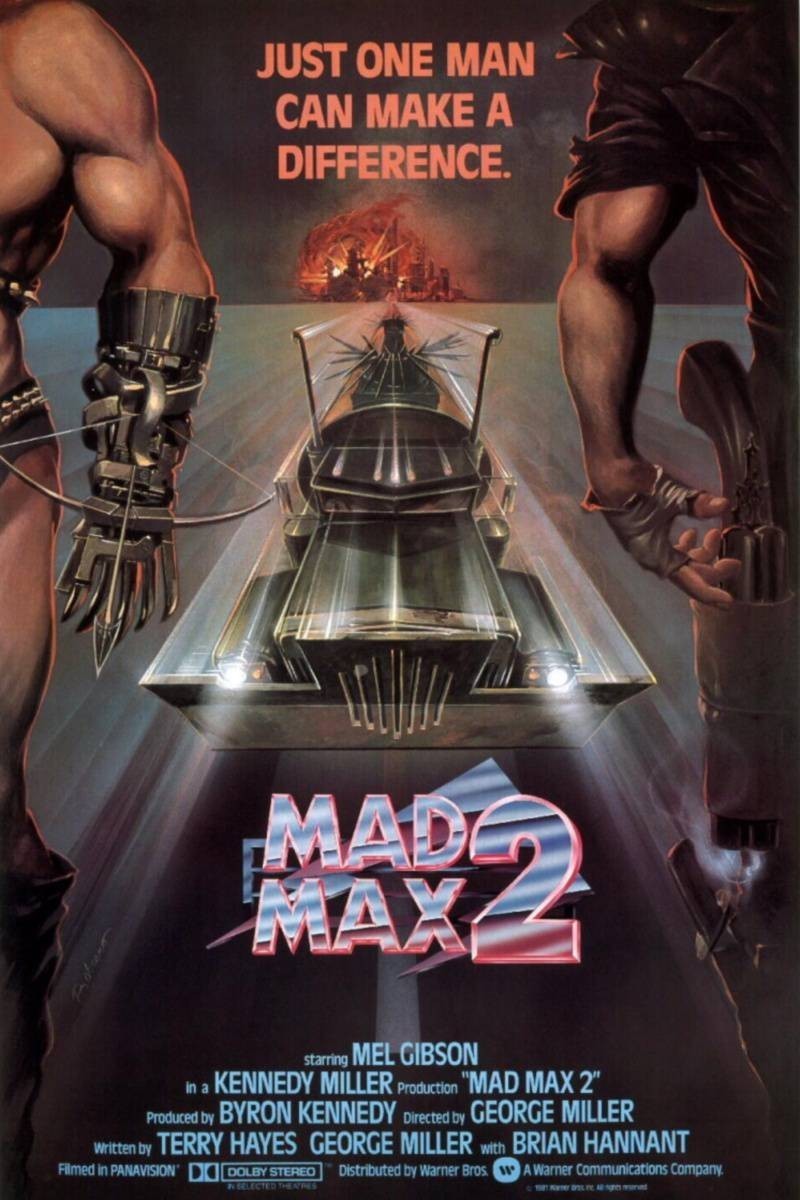
MAD MAX 2: THE ROAD WARRIOR (1981)


Although the original Mad Max proved to be a worldwide critical/commercial success, it actually wasn’t that big of a hit here in the U.S., at least from a commercial standpoint, due to its distributor, American International Pictures, going through ownership changes at the time. It may have also had something to do with a disastrous ‘American dub’ that was instigated because the distributor supposedly feared that audiences wouldn’t understand the cast’s Australian accents. So as a result, when the sequel was released two years later, it was renamed to The Road Warrior and its connections to the previous film were underplayed in the marketing. Regardless, the film did perform much better domestically this time around, which is deservedly so because like its predecessor it is another excellent post-apocalyptic action flick. In a way, this is the same great visceral and sharply constructed storytelling of the original but now with the added benefit of a larger budget. Like before, the action is terrific, especially the big chase at the end. I can definitely see how much of an influence this had on Fury Road, not just through the similarities of their ‘chases’ but also because the film relies a lot more on visual storytelling than dialogue. Mel Gibson is once again excellent as Max and the film has its fair share of memorable side characters, from Max’s ally the Gyro Captain (Bruce Spence) to the imposing gang leader Lord Humungus (Kjell Nilsson) to Humungus’ highly intimidating and vicious lieutenant Wez (Vernon Wells). It could be said that The Road Warrior was the film that really catapulted the Mad Max franchise into its prime spot in pop culture history and I can definitely see why. This is one of those rare sequels that is not only as good as its predecessor but may arguably be better.

Rating: 4.5/5

MAD MAX: BEYOND THUNDERDOME (1985)


To put it bluntly, Mad Max: Beyond Thunderdome is generally considered to be the weakest installment of the franchise. Part of it may have something to do with the fact that this wasn’t fully directed by George Miller, who instead shared co-directing duties with George Ogilvie, who had starred in the 1983 miniseries The Dismisssal that he produced, following the death of Miller’s producing partner Byron Kennedy in a plane crash in 1983. Miller ultimately ended up only directing the film’s action sequences. But the major reason why this film is generally not as well-received as the previous two films (as well as its subsequent sequel) is due to its second half. For the record, the film starts out pretty much exactly like what you would expect from a Mad Max film with its excellent production design and visceral proceedings, as Max finds himself in the sordid community of Bartertown. But then things change when Max ends up getting exiled from the town by its ruler, Aunty Entity (Tina Turner). He ends up coming across a group of children who believe that he was their ‘flight captain’ who was meant to take them to ‘civilization’. As many have pointed out, these kids are sort of like the ‘Lost Boys’ from Peter Pan and as a result of this, the film ends up taking on a much more kid-friendly tone. Now I’m not saying that I ‘hated’ this part of the film but the shift from the franchise’s traditional hardcore action to a more light-hearted and goofier adventure is still rather jarring. I should probably also mention that this is the only entry in the series to be rated PG-13.

But that doesn’t mean that there aren’t any ‘good things’ in this film. Gibson is of course excellent once again as Max and Tina Turner is actually pretty darn good in the ‘main villain’ role of Aunty Entity, even though the character is absent for a good chunk of the second half due to the change in plot. Of course there’s also a few noteworthy side characters as well, most notably the duo that is ‘Master Blaster’. Heck, even the kids do a pretty fine job acting-wise. The action is still pretty darn good as is the production design, with this film in particular having some pretty nice cinematography. As Doug Walker (AKA the ‘Nostalgia Critic’) pointed out in his review of Fury Road, this film may arguably even be the most quotable of the entire series, from Aunty Entity repeatedly calling Max a ‘raggedy man’ to the iconic ‘Two Men Enter, One Man Leaves’ rule of Bartertown’s Thunderdome arena. However, at the end of the day I do have to agree with the general consensus in that this is definitely the ‘weakest’ installment of the series. Don’t get me wrong I still think it’s a pretty darn good film on its own merits but as a Mad Max film it’s a bit underwhelming as a result of its jarring shift halfway through that introduces a plotline that doesn’t really mix with the whole storyline of Bartertown. Ultimately Beyond Thunderdome would end up being the final Mad Max film to feature Mel Gibson and it would be quite a while, three decades to be precise, before the series finally made its return to the big screen.

Rating: 3.5/5

And on that note, here’s the big one…

MAD MAX: FURY ROAD (2015) - SECOND OPINION


And finally here we are at the latest installment of the Mad Max series, Fury Road. This was the first time that I had watched it since seeing it in theaters last May. And of course, as I’ve already mentioned, the first time I saw the film… I wasn’t ‘too big’ on it. I did like it and gave it a 4/5 rating in my original review but in some ways I felt that the internet had severely overhyped it. So for months I was left wondering why this film was being treated like it was the second coming of Christ. It got to the point where I admittedly was this close to using that scary word that I hate to use… ‘overrated’. But after waiting until last year’s awards circuit was over, I finally made sure to give it another chance. And fear not, internet folk… I warmed up to it the second time around. Granted, I still have some issues with it but I cannot deny the great things about this film. The action, predominantly done with practical effects in the modern age of CGI, is incredible and the production design is just as great as you would expect from a Mad Max film. This film also sports one hell of an amazing color palette as everything is bright and vibrant, very much different compared to most films in the post-apocalyptic genre. Charlize Theron is ‘Sigourney Weaver in Aliens’ level fantastic in the role of Furiosa, the ‘true’ main character of the film. But actually my favorite character in the film ended up being Nux, played by Nicholas Hoult. I thought Nux had the most interesting arc of them all; at first he’s a loyal War Boy of the Immortan who aspires to die historically on the Fury Road knowing that he’ll be ‘awaited in Valhalla’. But by the end, he ends up helping Max, Furiosa, and the Wives escape from Immortan Joe and I won’t lie… his death at the end of the film is a pretty damn emotional one.


But like I said, there are still a few minor issues that I have with the film and, like I said in my previous reviews of the film, they mainly stem from the writing. Now let me be clear, I’m not saying that this film needed a very complex plot. Not every film needs that and this film more than works without it because that’s obviously not the main intent of the film; instead it’s a visceral and kinetic action extravaganza and it very much succeeds in that regard. However, at the end of the day, this really is just ‘get from Point A to Point B… and then back to Point A again’ and Furiosa and Nux are the only major characters in the film that get any sort of major character development. While it’s really cool that Miller doesn’t make the Wives characters ‘damsels in distress’, to the point where even Splendid (Rosie Huntington-Whiteley), the pregnant Wife, gets in on the action and is even killed off halfway through (got to give the filmmakers credit for having the guts to pull off a ballsy move like that), only a few of them get much to work with, namely Splendid and Capable (Riley Keough), the latter of whom ends up having a sweet little ‘romance’ with Nux. And as for Immortan Joe, while he may be quite the badass-looking villain, I wouldn’t really say that he’s a badass ‘villain’. Sure he’s got a great intimidation factor, primarily emphasized by both his menacing look and his ability to lead his army of devoted War Boys, but at the end of the day he really doesn’t do much in the film other than drive around, make some speeches, and have what is admittedly a pretty awesome and gnarly death scene. As far as the villains that Hugh Keays-Byrne has played in the Mad Max series are concerned, I think the better of the two is still Toecutter from the original Mad Max.

And then there’s Tom Hardy as Max and… I still think he’s quite underused in this. Now like The Road Warrior, Max is more of an ‘outsider’ in the plot. Furiosa really is the main character of the film and that’s a great thing. While there have unfortunately been some fanboys who have been rather critical of this, the film deserves a whole lot of kudos for its strong feminist themes. However, the film really should’ve just been called Furiosa: Fury Road because Max really doesn’t factor at all into much of this. And while I am a fan of Tom Hardy and I do think that he does a good job with what he had to work with, ultimately I prefer Mel Gibson’s Max as I feel that there was more to his version of the character, particularly in the first film. Hardy’s Max is more of a blank, and arguably even a bit emotionless, slate. But despite the issues that I just laid out, I’ll fully admit it… I did warm up to Mad Max: Fury Road upon re-watch. It really is one of those films that gets better with repeat viewings. George Miller was in his late 60’s when he made this; one of the most insanely awesome action films of all-time. That’s amazing. And even though I do have some minor issues with the writing, this film truly delivers when it comes to the action and production design. Simply put, it is a finely-tuned and gorgeous looking action thrill ride.

Rating: …Yeah, I’ll bump my original rating up to a 4.5/5

So to finish this post, here are my rankings of the four films.

4. MAD MAX: BEYOND THUNDERDOME

3. MAD MAX 2: THE ROAD WARRIOR

2. MAD MAX: FURY ROAD

1. MAD MAX


Be sure to sound off in the comments below with your own rankings of this iconic post-apocalyptic action franchise.

Sunday, February 21, 2016

The Revenant (2015) review


Over the past few years, Leonardo DiCaprio has established himself as one of the best actors in the business, with plenty of great performances in films like ‘Inception’, ‘Django Unchained’, and his numerous collaborations with director Martin Scorsese in films like ‘The Departed’ and ‘The Wolf of Wall Street’. However, all of that success has yet to earn him a win at the biggest award circuit in the industry; the Academy Awards. He’s been nominated four times in the past, once for Best Supporting Actor for 1993’s ‘What’s Eating Gilbert Grape’ and three times for Best Actor for 2004’s ‘The Aviator’, 2006’s ‘Blood Diamond’, and ‘Wolf of Wall Street’ in 2013, but has come up empty-handed every time. Leo’s unlucky streak at the Oscars has practically become a running gag amongst film fans on the internet to the point where some have joked that it’s more likely that someone else is going to get an Oscar for playing Leo in a film than Leo actually winning one himself. But this year could finally end Leo’s Oscar drought with his latest performance in ‘The Revenant’, inspired by the real-life experiences of frontiersman Hugh Glass in 1823 in the Great Plains. It certainly has the team behind it, as the film is directed by Alejandro G. Inarritu, who’s fresh off of winning the Oscar for Best Director for his work on last year’s Best Picture winner ‘Birdman or (The Unexpected Virtue of Ignorance)’. And while I can’t really say that this is the best of this year’s Best Picture nominees, primarily due to the film occasionally straying far from the actual story of Hugh Glass, DiCaprio truly does shine in this intense but beautifully shot tale of survival.

In 1823, frontiersman Hugh Glass (DiCaprio) is part of a team of trappers led by Captain Andrew Henry (Domhnall Gleeson) hunting for pelts in the unorganized U.S. territory that would eventually go on to become the Dakotas. When the party is suddenly attacked and forced to flee downriver from a group of Arikara Natives, Glass recommends that the party return to their outpost, Fort Kiowa, on foot, which they do at the expense of having to ditch the pelts that they’ve acquired. But while scouting ahead, Glass is suddenly attacked and viciously mauled by a grizzly bear. Near-death and after being transported on stretcher by the party for a little while, he is left behind along with fellow trappers John Fitzgerald (Tom Hardy) and Jim Bridger (Will Poulter) and Glass’ half-native son Hawk (Forrest Goodluck) when Fitzgerald suggests that Glass won’t survive his injuries. But that only results in Fitzgerald trying to kill Glass himself, which then leads to him killing Hawk and lying to Bridger in order to help him bury Glass alive by telling him that the natives are nearby and that they must leave him there. Left for dead, the severely wounded Glass now finds himself on his own in the harsh forest landscape as he must now embark on a perilous journey in order to get back to his party and, more importantly, enact his revenge on Fitzgerald for both leaving him to die and for killing his son.

‘The Revenant’ is easily one of the most beautifully-shot films of the year. From the gorgeous landscape shots to the long takes that were a key part of Inarritu and cinematographer Emmanuel Lubezki’s last film ‘Birdman’ to the fact that the two decided to almost entirely shoot the film with natural lighting, this is one great-looking film. And while it meant that the film ended up being quite an arduous shoot that also went quite a bit over-budget, at the end of the day it was most definitely worth it if solely for this outstanding cinematography. This also results in a film that can obviously be very brutal at times in terms of its action, from the infamous scene where Glass is attacked by the bear to the climactic fight at the end which I won’t spoil the details of for anyone who hasn’t seen the film yet. These sequences are well-shot and put you right in the center of the action. Admittedly, though, for as well-shot as the film is, it does lack a bit in terms of emotional depth. Now don’t get me wrong, the film’s themes of survival are very prevalent throughout, which is most definitely admirable. But at the same time, the whole thing about Glass seeking revenge on Fitzgerald isn’t as strong, namely in regards to him avenging the death of his son at Fitzgerald’s hands. Spoiler Alert, the whole thing with the son is purely fictional. From what we know, Hugh Glass didn’t have a son or a wife, he was just pissed at Fitzgerald and Bridger for leaving him to die. So as a result, that part of the story feels pretty darn hollow because of the fact that it was 100% fabricated.

Leonardo DiCaprio has gone on record saying that this was ‘the hardest performance of his career’ and considering what happens in this film, I don’t blame him. After all, in this film his character goes through all sorts of hell and considering how rough the shoot must have been at times, the same could be said for what DiCaprio had to do while in the role. At one point he even had to eat raw bison meat while being a vegetarian in real life. This performance is no easy task and to put it simply, DiCaprio does endure to deliver an excellent performance as you’d expect from him nowadays. Equally excellent here is Tom Hardy in the role of Fitzgerald, who in a lot of ways is actually a much more layered character than one may think. While he may serve the role as this film’s antagonist given the fact that he’s the one who orchestrated Glass’ abandonment and was responsible for killing his fictional son, you actually do get where he’s coming from, as strange as that may sound. He clearly realized that the party wasn’t going to get very far carrying the critically wounded Glass through this harsh environment with a bunch of natives on their tail. So he did what he felt was the right thing to do; leave him on the grounds that he would probably soon succumb to his injuries in order to prevent the possibility of him and Bridger being killed by the pursuing natives. Because of this, Fitzgerald is more than just a straight-forward baddie and Tom Hardy handles this complex character perfectly. 

I’ll admit I didn’t actually read into the ‘true story’ behind this film until after seeing it and quite frankly, it’s a little disappointing that the film didn’t go all the way with it. Instead, the film adds in a fabricated story involving Glass and his fictional son which doesn’t really elicit as much emotional drama as it wants to. I for one feel that it would’ve be far more interesting for the film to be more focused on the true aspects of the story, especially in regards to how this conflict between Glass and Fitzgerald ultimately turned out. It’s different in the film and as cool as the conclusion of that conflict is between the two, I think the actual conclusion would’ve been much more thought-provoking, as it would’ve strengthened the moral predicament of Fitzgerald having to do what he did primarily due to the hostile environment that they were in while also showing that Glass never really did enact his revenge on Fitzgerald for leaving him to die. But on the bright side, ‘The Revenant’ does benefit from some amazing cinematography, solid direction from Inarritu, and terrific performances from its two leads, DiCaprio and Hardy. So in short, ‘The Revenant’ isn’t really my favorite of this year’s Best Picture nominees, mainly due to its issues in terms of its story. But at the very least, the film is still one of the best-looking films of the year so it does definitely deserve some Oscar attention from a technical standpoint. And who knows… this could finally be the film that breaks Leo’s cold streak at the Oscars. Seems like this year is the best opportunity for him to finally win that coveted golden man.

Rating: 4/5


Sunday, May 17, 2015

Mad Max: Fury Road (2015) review


2015 is shaping up to be a year full of iconic franchises returning to the big screen after a considerable amount of time. And while of course you have your ‘Star Wars’ and your ‘Jurassic Parks’, there’s another franchise that’s making a big return this year; ‘Mad Max’. What started out in 1979 as a low-budget Australian film from director George Miller soon turned into a film franchise with some of the most acclaimed action films of all-time. This includes the original ‘Mad Max’, which also became one of the most profitable films of all-time, and its sequel ‘The Road Warrior’, which was even more well-received than its predecessor in regards to critical reception. The third film, ‘Beyond Thunderdome’, wasn’t as well-received as the first two films but still did solid enough with critics, though fans were a little more critical. Now, 30 years since the release of ‘Beyond Thunderdome’, director George Miller returns to his post-apocalyptic franchise with ‘Mad Max: Fury Road’, though it’s the first entry in the series to not star Mel Gibson in the title role of ‘Mad’ Max Rockatansky. Instead, Tom Hardy takes over the role, joined by Charlize Theron in an equally important role as far as this film’s story is concerned. And like its predecessors, it’s been getting rave reviews from critics. Hell, to be perfectly frank, it’s probably the most critically-acclaimed summer blockbuster in a long time. But in the end, while, let me be clear, I did like the film, ultimately I can’t say that it’s an absolute ‘masterpiece’ compared to what, well, everyone else is saying.

In a post-apocalyptic world that is dominated by desert, drifter Max Rockatansky (Tom Hardy) is taken captive by ‘the War Boys’, a cult army led by the tyrant Immortan Joe (Hugh Keays-Byrne, who had previously played the villain Toecutter in the original ‘Mad Max’). Soon after this, one of Joe’s lieutenants, Imperator Furiosa (Charlize Theron), starts to head off-course while on a job to collect gasoline. Joe quickly discovers that she is actually escaping with his Five Wives; Splendid, Capable, Toast, Dag, and Cheedo (Rosie Huntington-Whiteley, Riley Keough, Zoe Kravitz, Abbey Lee, and Courtney Eaton, respectively), five young women who were chosen specifically for breeding in the hopes of him being blessed with a new heir. Joe immediately sends out his army after her, with Max being dragged along due to the fact that he’s currently serving as a blood donor for one of the War Boys, Nux (Nicholas Hoult). Max soon catches up with Furiosa and agrees to help her bring the Wives to safety. So, with a whole army on their tail in this post-apocalyptic wasteland, Max and Furiosa try to get the Wives to ‘the Green Place’, a location that Furiosa states that she originally came from where they can be free from Immortan Joe’s clutches.

This film is worth seeing just for its action sequences and visuals. According to Miller, 90% of the stunts in the film were practically done, which is a very impressive feat in this modern age of visuals effects/CGI. Because of this, all of the stunts in this film are awesome as are the visuals. There’s literally one guy in Joe’s army who’s on a truck that has a bunch of drummers on the back of it playing a flame-spewing guitar. That alone should give you an idea of how crazy the production design is for this movie. And really, the film definitely lives up to the ‘Mad’ part of its title, showcasing a chaotic post-apocalyptic world that is almost entirely devoid of sanity. But while the film definitely delivers on a technical level, the same can’t really be said for its writing. Now with that said, because this film is primarily one big chase scene, I do recognize that the filmmakers were probably more focused on the action/visuals than they were with the story and characters. I’m not saying that’s a bad thing as the action and visuals are incredible. It’s just that the film is focused so much on the chase that there are only a few scenes where the action slows down and we get some bits of character development. I wish that the film spent just a little more time developing its characters because aside from like two of them, most of the characters are fairly underdeveloped. This includes the main villain Immortan Joe, who’s more intimidating in presence than he is in actually doing anything in this film, and, I hate to say it, even Max himself.

The film may be called ‘Mad Max: Fury Road’, but Mad Max isn’t the main character of the film… and because of it, Tom Hardy is quite frankly underused. He’s a fine choice for the role and does a good job based on what he has to work with. But as far as the story is concerned, he really doesn’t play that integral of a part in the overall story. It’s just a case where he was dragged into a situation that he didn’t initially cause in the first place. In reality, Furiosa is the main character of the film whereas Max, dare I say it, is rather forgettable. But on the bright side, Furiosa is the main character of the film. Charlize Theron absolutely owns it in the role of what is easily the best female character in an action film since Ellen Ripley in ‘Aliens’. Furiosa is just a total badass who’s able to hold her own in combat alongside Max and Theron’s so good in this that I’d be perfectly fine with her getting nominated for an Oscar for Best Actress. That’s how great she is in this. All of the Five Wives are pretty good as well, especially due to the fact that they’re not just ‘objects’ for the heroes and villains to fight over. They get down and dirty in the chase just as much as Max and Furiosa. Finally, the other big standout is Nicholas Hoult as Nux. Like Theron, Hoult really owns his role of the insane but also rather innocent War Boy, a description perfectly summed up by the scene in which he, while driving through a raging sandstorm that’s already taken out a few of his allies, shouts “Oh what a day! What a Lovely Day!”

I went into this film with a completely fresh point of view as I have not actually seen any of the previous ‘Mad Max’ movies. With that in mind, if anyone is worried about not seeing any of the other films before this one, you don’t need to worry about that too much because this is ‘technically’ a series reboot that doesn’t really tie back too much to the previous films. But ultimately, I was not as big a fan of ‘Fury Road’ compared to, basically, the rest of the internet. And let me be clear; I didn’t hate the film. The action sequences, which of course were pre-dominantly done with practical effects/stunt-work, are impressive and the film has some amazing visuals, primarily thanks to the film’s eye-popping production design. Not only that, but Charlize Theron really shines as Furiosa, one of the best female action film leads of all time. But at the end of the day, I wish that the filmmakers had spent a little more time developing the story and characters. I recognize that this probably wasn’t what they were going for but it would’ve been nice to have a little more story/character development for any character that is not named Furiosa or Nux. And while this film may have been called ‘Mad Max’, Max is arguably the most forgettable main character in the film. So yes, I only ‘liked’ the film; I didn’t ‘love’ it. I recognize that I’m pretty much in the minority on that one. But if you loved this film more than I did, then the more power to you. It’s just that, not having seen any of the other ‘Mad Max’ films, this wasn’t really one of my most anticipated films of the year. And while I made sure not to let that influence my opinion on the film, ultimately I just wasn’t as blown away by it as everyone else.

Rating: 4/5