Showing posts with label Ethan Hawke. Show all posts

Sunday, October 23, 2016

The Purge - Trilogy Retrospective

Image result for The Purge

While they are technically classified as horror films, admittedly it’s hard to describe the Purge films as just that, ‘horror films’. That’s because they’re more along the lines of a series of action-thrillers, particularly in regards to the two sequels. Still, this franchise of low-budget action-thrillers, directed by longtime screenwriter James DeMonaco and co-produced by Jason Blum and Michael Bay through their respective production companies, has been a considerably large hit for Universal since it debuted back in 2013. The premise is simple; every year on one night in March, all crime, including murder, is legal for twelve hours. This means that it’s every person for themselves without any sort of assistance from the police, fire department, or emergency services. And whereas the first Purge was primarily set within the confines of a single home, the two sequels expanded upon this universe and began to explore just what happens out there on the streets during ‘Purge Night’. Ultimately, though, the Purge films have been more of a commercial success than they have been a critical success, with all three films being criticized for not fully living up to their potential in regards to the potential social commentary/satire that comes from their premise. Now, as someone who’s not a big horror fan (despite what I just said about these films not being horror films), I didn’t see any of these films in theaters. However, I did start to get curious when I learned that the third film, Election Year, was filmed in Woonsocket, Rhode Island, very close to where I live. And while, again, I ultimately didn’t see the film in theaters, I did recently get a free rental of it as part of a rewards program that I’m a member of. So, I decided to rent the other two films and do a trilogy retrospective on this smash hit of a franchise. So, without further ado, put on your scary masks and prepare for a night of unabashed craziness as I look back upon the Purge trilogy.

THE PURGE (2013)

Image result for The Purge 1 poster

As noted in the intro, despite the overarching ‘all crime is legal’ premise, the first Purge film is primarily set within the confines of a regular suburban home. And ultimately that does prove to be the film’s biggest problem. For one thing, it obviously limits the mayhem that goes on during Purge Night because it just focuses in on one gang terrorizing one family just because the latter let in one of their targets for protection. But then there’s also the fact that most of the film takes place within a darkened house because the gang cuts the family’s power. This results in a pretty dull ‘claustrophobic thriller’ that tries to be way too serious despite various bits of over-the-top goofiness courtesy of the gang members. And this is made even worse by the fact that you don’t give a crap about any of the main characters; main characters who, might I add, make some very terrible decisions that defy all logic. Yes, ‘logic’ isn’t a primary concern in this film. It’s the first film of the series and it doesn’t do much to explain the logistics behind Purge night, something that many agree seems totally unrealistic for various reasons, other than the fact that ‘it just works’. Sure, Ethan Hawke and Lena Headey do fine enough jobs in the lead roles and Rhys Wakefield does steal the show as the gang leader but overall The Purge is a pretty lousy attempt at being a ‘horror’ film, complete with one of the most anti-climactic endings that I’ve ever seen. Thankfully, things would only get better from here by way of the sequels.

Rating: 2/5

THE PURGE: ANARCHY (2014)
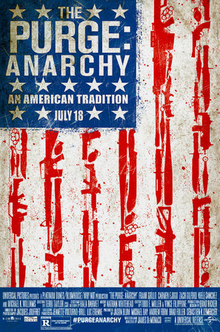
Image result for The Purge 1 poster

Thankfully with the first Purge sequel, The Purge: Anarchy, director James DeMonaco moves the action and craziness that comes from Purge Night away from a single house and out onto the streets, in this case the streets of downtown Los Angeles. Even better, the film gives us a much more compelling lead in the form of Frank Grillo’s Sergeant Leo Barnes (Disclaimer: his full name isn’t revealed until the next film), a man who goes out on Purge Night to avenge the death of his son but ends up taking on the responsibility of protecting other people that are stuck out on Purge Night; Eva and Cali, a mother and daughter who were forced out of their home by a paramilitary squad, and Shane and Liz, a couple whose car broke down before they could get home and escape a biker gang that had been pursuing them. Sure, the characters still make some dumb decisions from time to time but overall these aren’t as prevalent as they were in the last film. And while it’s still a low-budget film overall, the costume design and action set-pieces are much stronger than those in the first film. In short, Anarchy is a definite improvement over the original Purge because it benefits from a bigger budget and the freedom to go outside onto the streets. It still doesn’t reach the full potential of its premise but at the very least, this one does hold your interest more. Because even if you still don’t buy the whole premise of a night where all crime is legal, at least this one explores more of this world of, for lack of a better term, anarchy.

Rating: 3.5/5

THE PURGE: ELECTION YEAR (2016)

Image result for The Purge 1 poster

And finally, there’s The Purge: Election Year, a fitting title considering that it was just released earlier this year. Frank Grillo returns as Leo Barnes as he now serves as the head of security for Senator Charlie Roan (Elizabeth Mitchell), who’s running for President on the platform of getting rid of the Purge once and for all. But that gets much more difficult on Purge Night when her political opponents, the New Founding Fathers of America AKA the ones who created the Purge in the first place, try to get rid of her by forcing the two of them out onto the streets. And while Election Year does still have some of the story problems of its two predecessors, this ends up being my favorite of the whole bunch. And no, it’s not just because this was filmed near where I live. To me, this one is the most consistent in terms of tone. Whereas the previous two films had a more serious vibe to them, this one is now fully embracing the completely over-the-top nature of its premise. Sure, there are some very questionable bits of dialogue in this entry (most of which come courtesy of shop owner Joe Dixon, played by Mykelti Williamson (simply put, “Goodnight, Blue Cheese!”)), more so than the previous two films, and the characters do still make some questionable decisions here and there. But even if it’s not saying much, this film has the best (or at least the most ‘likable’) group of main characters of any film in the entire series, once again led by Grillo’s badass lead. And once again, I must give credit to the fact that these films keep upping the ante when it comes to costume design and action set-pieces, with this film delivering some of the series’ most truly messed up imagery. Again, when you get down to it, there’s a lot of stupid parts of this premise but this one recognizes it the most out of any Purge film. Thus, it’s arguably the most entertaining of them all.

Rating: 4/5


And that’s the end of my retrospective on the Purge films. For those who are newcomers to the franchise, I can safely say that you can honestly skip the first film because nothing in that film carries over to the other films. Just stick to the superior sequels, Anarchy and Election Year.

Saturday, September 24, 2016

The Magnificent Seven (2016) review

Image result for the magnificent seven poster 2016

In 1954, Akira Kurosawa, one of the most famous directors in the history of cinema, directed an historical epic titled Seven Samurai. The film centered on a group of Ronin (samurai without masters) who are hired by the residents of a farming village in order to protect them from a group of bandits that are terrorizing the town. The film is often regarded by many critics as one of the greatest and most influential films ever made, so much so that in 2010, Empire magazine put it at #1 in their list of the “Top 100 Best Films of World Cinema”. It also had a huge influence on numerous films in the years after its initial release, including Pixar’s A Bug’s Life and even Star Wars. And in 1960, it ended up getting an Americanized remake titled The Magnificent Seven, which re-imagined it as a western and featured an all-star cast that included the likes of Steve McQueen, Yul Brynner, and Charles Bronson. It is this version of the story that gets a remake this year courtesy of Antoine Fuqua, director of Training Day and The Equalizer. I named those two films in particular because both starred Denzel Washington, who won an Oscar for Best Actor for his performance in the former. Sure enough, Washington leads an, as expected, all-star ensemble cast in Fuqua’s new re-imagining of this classic story. Now to some, it may seem like an impossible task to try and live up to the high standards of both the original Magnificent Seven (even though that film is itself a remake) and Seven Samurai. And while this new film ultimately may not necessarily live up to those exact standards, it’s still a very enjoyable old-school Western on its own merits, especially thanks to solid direction and a well-rounded cast.

Set a little over a decade after the end of the Civil War, the film begins as the residents of the small mining town of Rose Creek find themselves under attack from a corrupt industrialist named Bartholomew Bogue (Peter Sarsgaard), who states that he and his army will return in three weeks to take everything that the residents have. Knowing that the town has no real way of dealing with Bogue and his men, recently widowed Emma Cullen (Haley Bennett), whose husband Matthew (Matt Bomer) had been killed by Bogue during the attack, and her friend Teddy Q (Luke Grimes) head out to find someone who could possibly help them. Eventually they do end up finding their man in warrant officer/bounty hunter Sam Chisolm (Denzel Washington). Once he agrees to help the two of them, Chisolm then proceeds to recruit a group of gunslingers to help him combat Bogue and his forces. These 6 other men include gambler Josh Faraday (Chris Pratt), sharpshooter Goodnight Robicheux (Ethan Hawke), Robicheux’s partner/knife-wielding assassin Billy Rocks (Byung-hun Lee), tracker Jack Horne (Vincent D’Onofrio), Mexican outlaw Vazquez (Manuel Garcia-Rulfo), and Comanche warrior Red Harvest (Martin Sensmeier). Recognizing that the seven of them are very much outmatched against Bogue and his army, the group begins to train the townspeople of Rose Creek so that they can all stand a chance against the massive army that is about to come their way.

If you’ve seen either Seven Samurai and/or the original Magnificent Seven, you’ll no doubt notice some major similarities between these three films in terms of plot. As a result, the film admittedly can be a bit predictable at times. But even with this in mind, the film still is a very solid and entertaining entry in the Western genre. Fuqua’s direction is solid and as one can probably expect from a Western, it’s certainly well-shot (e.g. landscape shots). And while the plot (a bad guy tries to take over a town and a bunch of rogue gunslingers join forces in order to stop him) is fairly simplistic, at the end of the day the simplicity of the story might actually be for the best. This isn’t a ‘revisionist’ Western that tries to craft a new spin on the typical Western tropes. It’s just paying homage to the classic Westerns of old, including the 1960 classic that shares its name. At its core, the most important part of the film is in its title, the Magnificent Seven, and overall it does do its job in regards to focusing in on this gang. I also really like how the story sees the group working with and training the people of Rose Creek so that they too can deal with Bogue and his men. Granted, the titular Seven are still the main focus of the film but it’s still a pretty cool spin on the typical Western story. And as for the action sequences, they’re definitely a major highlight, especially the two big shootouts in the film, one of which of course being the final battle between the Seven/people of Rose Creek and Bogue’s men. Sure these are basically the two biggest action sequences in a film that’s fairly long (two hours and 13 minutes to be exact) and definitely has its fair share of ‘slow burn’ moments that are commonly seen in Western films. But even with that said, they are set up pretty well and are fittingly lengthy battles.

As for the titular Seven themselves, admittedly they don’t get that much to work with in terms of character development. Granted, the film gets away pretty fine without having to really develop any of them but their character traits, motivations, and backstories are still very simplistic. Perhaps the one member of the cast that gets the most in terms of character development is Ethan Hawke, as it’s established that despite his talents as a sharpshooter, Robicheux is haunted by everything that happened during the Civil War, which ends up affecting him during gunfights. But even with the slim characterizations in mind, the main cast of leads certainly do a terrific job. Clearly they had a lot of fun making this film and it definitely shows through their excellent camaraderie with each other. It’s also quite a diverse cast of characters. Denzel Washington is his usual badass self in the lead role of Chisolm while Chris Pratt displays his ‘Star Lord’ esque swagger in the role of Faraday. Ethan Hawke, as noted earlier, arguably gets the most pathos out of the group as Robicheux while Byung-hun Lee is great as the badass silent assassin Billy Rocks. As for Vincent D’Onofrio’s character, tracker Jack Horne, when it comes to the action let’s just say that his turn as Wilson Fisk in Daredevil is a primary indication of just what kind of a warrior his character is. Last but not least there’s general newcomers Martin Sensmeier as Red Harvest, a pretty badass Comanche marksman, and Manuel Garcia-Rulfo as Vazquez, who admittedly is the least-focused on member of the Seven but is still a key part of the team when it matters. And really that’s the key thing to take note of when it comes this group of seven badass gunslingers as every member is essential to their overall success as a unit.

Now I’ll admit that going into this film, I haven’t seen either Seven Samurai or the original Magnificent Seven. As a result, I can’t really compare this new adaptation of the story to those two films (and even then I wouldn’t really do so anyway if I had seen them). But with that said, I can definitely tell that this new film probably won’t be as well-remembered in the long run as its two predecessors. It is a fairly simplistic Western execution-wise, which is evident by both the occasionally predictable plot and the slim character development. Still, on its own merit, it’s definitely a very entertaining crowd-pleaser. Fuqua’s direction is solid and the film’s action sequences, particularly its two big shootouts which are built up quite excellently, are fantastic. And of course, the cast is fantastic as well; heck they’re the biggest selling point of the whole film. Denzel Washington, Chris Pratt, Ethan Hawke, Byung-hun Lee, Vincent D’Onofrio, Martin Sensmeier, and Manuel Garcia-Rulfo clearly had a blast working together and it shows because they have excellent camaraderie with each other and the film makes doubly sure that this diverse cast of characters are a well-rounded team. In short, this new Magnificent Seven isn’t really going to re-invent the wheel when it comes to the Western genre but at the same time it’s not trying to do that either. It’s just trying to pay homage to the Western films of old, which of course include the films that it’s directly inspired by, and ultimately it does succeed in that regard.


Rating: 3.5/5