Showing posts with label Angela Bassett. Show all posts

Wednesday, January 6, 2021

Soul (2020) review (Disney+)

If there was even remotely a downside to the wondrous prospect of getting two Pixar films in a single year, it would be the fact that the more well-received entry of the two always ends up overshadowing the other. To be fair, though, this is never the films’ fault as it’s just the natural consequence of the consistently competitive nature of the film industry. Still, there’s no denying that this scenario has very much happened before whenever Pixar releases multiple films in a year. Whereas 2015’s Inside Out was their biggest hit in years, The Good Dinosaur was their first major commercial flop. And in 2017, all eyes were on the two-time Oscar winner that was Coco, thus leaving the decent Cars 3, a genuinely superior follow-up to what ended up being Pixar’s first critical dud (2011’s Cars 2), in the dust. Sure enough, this is something that will probably happen this year as well, which began with the release of Dan Scanlon’s Onward, a film that, despite being royally screwed over by COVID from a financial perspective did solidly with critics but not quite as well as Soul has fared with them. To reiterate, though, everything that I’ve said in this intro is not meant to be a dig against Soul; I mean, seriously, how could I when it’s the latest outing from one of Pixar’s most prolific directors, Pete Docter. Simply put, Pixar’s newly appointed Chief Creative Officer has been responsible for some of their most critically acclaimed releases such as the previously mentioned Inside Out, his directorial debut from 2001, Monsters Inc, and 2009’s Up AKA the second-ever animated film in history to be nominated for Best Picture at the Oscars after Beauty and the Beast. And sure enough, he delivers yet another beautifully animated and emotionally poignant masterpiece with Soul.

Joe Gardner (voiced by Jamie Foxx) is a part-time music teacher in New York City who, despite being offered a full-time teaching gig, primarily aspires to become a jazz musician just like his late father. Luckily for him, he manages to earn an opportunity to achieve that dream when he impresses legendary jazz performer Dorothea Williams (voiced by Angela Bassett) enough for her to invite him to perform with her band. Unfortunately for Joe, his big break is then immediately upended when he ends up in an accident that puts him on a one-way ticket to the Great Beyond. However, Joe’s insistence that it isn’t his time results in him escaping into the exact opposite dimension, the Great Before, where all new human souls are molded into the personalities that they’ll become once they arrive on Earth. It is there that Joe meets 22 (voiced by Tina Fey), a soul who has been stuck in the Great Before for quite some time because of her cynical outlook on life on Earth that has kept her from finding the ‘spark’ that completes a soul’s identity. And once he figures out that he’s still alive on Earth, Joe teams up with 22 to try and get him back into his body so that his life won’t end up being a complete waste of his potential; in the process, Joe even begins to convince 22 of all the great things that life has to offer.

While it’s probably easy to compare this film to Pete Docter’s last project, Inside Out, it should be noted that Soul is far from being a ‘clone’ of that film. Instead, I’d describe it as a ‘spiritual companion’ piece since both films focus on the things that make us humans tick, albeit through different methods. In the case of Inside Out, this was, of course, by way of it exploring the concept of one’s emotions, thus showcasing the importance of all facets of the emotional spectrum rather than just a single emotional trait. As for Soul… well, the title speaks for itself as Docter and co-director Kemp Powers do a fantastic job of tackling themes such as finding one’s purpose in life and the unique things that folks are passionate about. This naturally results in a lot of great emotional moments which, to be fair, is something that you can always expect to see in a Pixar film but are arguably even more powerful here given the subject matter and how it encourages us all to live our lives to the fullest. And as to be expected from a Pixar film, Soul sports some terrific animation, especially when it comes to the wonderfully abstract landscape that is the Great Before where the counselors who oversee everything are presented as if they’re two-dimensional beings in this computer-animated feature. Plus, the entire film is bolstered by a great collection of delightful jazz tunes from the Late Show with Stephen Colbert’s Jon Batiste.

One long-standing Pixar tradition that Soul dutifully maintains is the well-layered lead duo that headlines the story; in this instance, we have Joe Gardner and Soul #22, who easily take their place alongside other classic Pixar duos such as Woody and Buzz Lightyear from the Toy Story series and Mike and Sulley from Monsters Inc. As Joe, Jamie Foxx does a great job in making the aspiring jazz musician a solidly likable protagonist even with all the instances where his lofty aspirations end up clouding his judgment to the point where he makes some selfish decisions. And as 22, Tina Fey is a natural fit for the role of Joe’s hilariously snarky sidekick who ends up getting just as many great emotional beats as he does since her sarcastic persona is revealed to be masking an incredibly sympathetic backstory. Soul also has plenty of another Pixar staple, memorable supporting characters, and while I do think that this is another instance like Onward where the story largely focuses more on Joe and 22 than anyone else, that doesn’t mean that we don’t get a bunch of fun side characters. U.K. talk-show host Graham Norton, for example, is an utter delight as Moonwind, an eccentric sign twirler on Earth who also helps save lost souls in the Great Before. There’s also plenty of reliable supporting players such as Rachel House as Terry, the official soul counter of the Great Beyond who tries to locate Joe when he goes missing, Alice Braga and Richard Ayoade as two of the Counselors in the Great Before (who, for the record, are all named Jerry), and Phylicia Rashad as Joe’s overbearing mother Libba.

I realize that what I’m about to say will probably be one of the most cliched and obvious statements that I’ve ever made as a film critic, but at the same time, it’s ironically an incredibly apt way of conveying exactly what kind of film this is. In other words, the one word that I would use to describe Pete Docter’s Soul is that it’s… soulful. With gorgeous animation and a top-notch story that tackles incredibly relevant concepts, Soul is arguably one of the best examples of an animated film that flawlessly appeals to both kids and adults. It covers some of the most thematically deep and mature themes that have ever been featured in a Pixar film and, in true Pixar fashion, pulls off an emotionally cathartic tale that, above all, ends up being a heartwarming celebration of life, thus making this an incredibly timely release in the age of COVID-19. Sure, COVID may have been the reason why Soul was forced to forego its theatrical release in favor of debuting on Disney+, but that doesn’t stop it from being another one of Pixar’s modern masterpieces. To be fair, though, that’s basically what’s to be expected at this point when it comes to the Pixar films that are directed by Pete Docter, and while this is probably going to be his last directorial effort for a while as he transitions into the role of Pixar’s Chief Creative Officer, it’s safe to say that this will attract a lot of attention during awards season.

Rating: 5/5!

Wednesday, December 12, 2018

Bumblebee (2018) review

John Cena and Hailee Steinfeld in Bumblebee (2018)

There were several hit franchises that dominated 80’s pop culture, with most of them defined by their merchandising and popular animated TV show adaptations. One of these franchises was Transformers, which followed the adventures of the titular autonomous robotic organisms who were embroiled in a war between two rival factions known as the Autobots and Decepticons. The toy line was developed by Hasbro and Takara Tomy and served as a rebranding of the latter’s Diaclone toy line, and in turn, it was the inspiration for the popular animated series The Transformers, which ran from 1984 to 1987. The franchise would then continue over the years with new themes, shows, and even a feature film adaptation in 1986. And in 2007, the series made its live-action debut via director Michael Bay’s Transformers, which was a major commercial hit upon its release amidst decent but overall polarizing reviews. This reception quickly changed, however, once the film starting to get sequels. While they continued to be hits at the box office, critical reception only got worse with each new film, with most critics deeming them as some of the worst films of their respective years of release. But now, for the first time since the live-action series started more than a decade ago, there’s a new Transformers film hitting theaters that wasn’t directed by Michael Bay (who’s still involved as a producer). Instead, directorial duties go to Travis Knight, CEO of the stop-motion animation company Laika who recently made his directorial debut in 2016 with the critically-acclaimed Kubo and the Two Strings. And for his Transformers film, Knight goes back to basics with a prequel/spin-off centered on arguably the most popular Transformer of the series after Autobot leader Optimus Prime, the adorable yellow scout Bumblebee. What follows is a film that could very well win back those who were extremely unsatisfied by the previous Transformers films as Knight’s take on this long-running franchise is quite arguably far more respectable to its source material.

The year is 1986 and teenager Charlie Watson (Hailee Steinfeld) has just turned 18. Frustrated with her current predicament of not having a car, she ends up coming across a yellow Volkswagen beetle at a garage owned by her friend Hank (Len Cariou), who lets her have it on account of it being her birthday. However, as Charlie soon discovers, this is not just an ordinary car. Instead, it is an Autobot scout, B-127, who she ends up naming Bumblebee (initially voiced by Dylan O’Brien before reverting to the character’s film series trademark of communicating via the radio). As the two begin to bond, Bumblebee struggles to cope with a damaged memory core that was sustained following his arrival on Earth, and soon enough, Charlie ends up being roped into the mission that had brought Bumblebee to the planet in the first place. Specifically, a pair of Decepticons named Shatter (voiced by Angela Bassett) and Dropkick (voiced by Justin Theroux) arrive on Earth looking for Bumblebee, who supposedly has information about the current plans of his superior, Autobot leader Optimus Prime (voiced by Peter Cullen). Having speculated that the Autobots plan on establishing a new base of operations on Earth, the two form an ‘alliance’ with the government group known as Sector 7 to track down their target, claiming that the Autobots are the ones who will pose a threat to humanity. Thus, Charlie and Bumblebee now find themselves pursued by both the government and the Decepticons as the latter works to follow Optimus’ orders and protect Earth from this new alien threat.

One of the most common criticisms about the Transformers films has been their writing, usually due to instances where they try to over-complicate their plots. That isn’t the case with Bumblebee, though, as it opts for a far more simplified plot that pays clear homage to films like E.T. and The Iron Giant. There aren’t any ancient transformers or crazy government conspiracies to be found in this film; instead, it’s just a story about a girl who comes across an alien robot and the situations that they get into, several of which involve the government. Now with all this said, it should be noted that there are instances where this film is perhaps a bit ‘too’ simple. Its plot is as basic as you can get for a film like this and it’s also rather light on action sequences, with the biggest action set-pieces reserved for the climax. At the end of the day, though, the ‘back to basics’ approach that Travis Knight takes here is one that’s truly worth appreciating. For all intent and purposes, his style of direction arguably serves as a course correction for almost all the major issues that audiences have had with the Michael Bay-directed Transformers films. This film’s action sequences are a lot easier to comprehend and it isn’t overstuffed with Transformer characters. There are only a few in this film and the ones that are there aren’t just giant, grey-colored robots that all look the same. Plus, given that this is set in the ’80s, the character designs are primarily based on those from the era that Transformers fans refer to as ‘Generation 1’ AKA the earliest and perhaps most beloved incarnations of these characters. As such, for those who grew up with the original Transformers toys and their subsequent animated TV series adaptation, you’ll be pleased to know that these classic designs are well-executed in live-action form.

But while the film, in general, does dial back on almost all the extremes of Bay’s Transformers films, it’s still very limited in terms of character development. Simply put, the only two major characters in this film that get any attention are Charlie and Bumblebee. But for what it’s worth, the relationship that these two form over the course of the film is arguably its greatest strength. And while this may seem outlandish to some people given the previous films, it does, in fact, result in a Transformers film with actual heart that’s not just a case of ‘style over substance’. A lot of this is thanks to Hailee Steinfeld, who’s quite excellent as easily the best human lead to come from this series. Not only does she work well off the CG-created Bumblebee, but despite what was said earlier about the film being rather lacking in character development, she does get to work with the majority of what’s there. Most specifically, it’s established that following the recent passing of her father, she’s become quite emotionally distant from the rest of her family, especially after her mother Sally (Pamela Adlon) quickly remarried. And it is through her relationship with Bumblebee that Charlie manages to rebound from her recent loss, an arc that Steinfeld handles very well. As for the rest of the cast, they’re good in their respective roles despite not having as much to work with compared to Steinfeld. Perhaps the most prominent example of this is John Cena as Sector 7 agent John Burns. While Cena’s certainly proven himself as a solid actor in recent years, Burns only serves as an obstacle for Charlie and Bumblebee who had some previous experience with the latter as seen in the opening.

As I’ve noted numerous times in the past, I’m an unabashed fan of the live-action Transformers films. I still have highly positive feelings towards the original 2007 film and I’ve never ‘disliked’ any of the sequels even though I’m fully aware that I’m in the minority on that one. And with all this in mind, while it’s not necessarily my favorite entry in the series, I will agree that Bumblebee is undoubtedly the most well-made of the bunch. Under the confident direction of Travis Knight, almost all the major issues that fans have had with Michael Bay’s Transformers films are practically non-existent here. The action sequences are far more coherent from a filmmaking perspective and the plot isn’t overstuffed with overly complicated plot-lines, disposable characters, and awkward bits of humor (e.g. there are no pot-consuming mothers who wonder if their kids were masturbating in their bedrooms). And while the plot itself is easily the series’ most simplified to date… given the reception of the previous films, it’s safe to say that most audiences will not mind in the slightest. In other words, Bumblebee is a Transformers film made for Transformers fans by a Transformers fan. Not only does it base itself around the most popular era of the franchise, Generation 1, but thanks to a strong lead performance from Hailee Steinfeld, this film does boast the heartfelt narrative that many felt was severely lacking in the previous Transformers films. And while it’s currently unclear right now as to where the film series will be heading next following the underperformance of The Last Knight, if future films are anything like this one, then it’s safe to say that Transformers fans will be in for a real treat.

Rating: 4/5 

Thursday, August 2, 2018

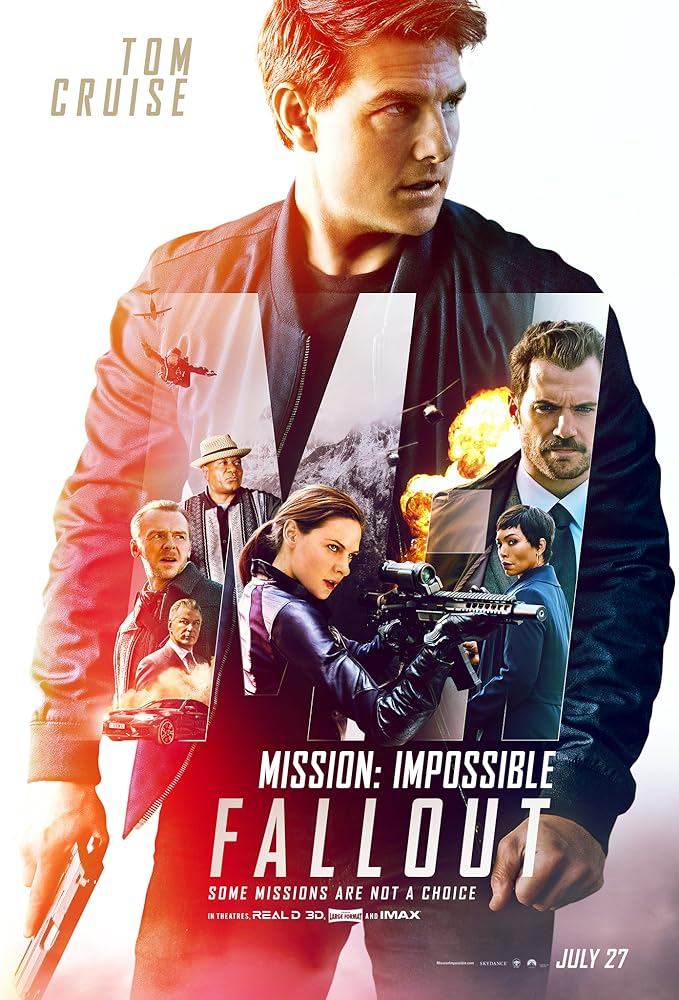
Mission Impossible - Fallout (2018) review

Tom Cruise, Alec Baldwin, Angela Bassett, Ving Rhames, Henry Cavill, Rebecca Ferguson, and Simon Pegg in Mission: Impossible - Fallout (2018)

Over the years, we’ve seen quite a few franchises experience an unexpected resurgence, resulting in the truly rare occasions where their sequels end up being their greatest installments. This has certainly been the case with the Mission Impossible franchise, which has now been running for more than two decades. It all started, of course, with the original film adaptation of the hit TV series of the same name from the 60’s/70’s (plus a short-lived revival in the 80’s) that was released in 1996 starring Tom Cruise in the lead role of Ethan Hunt, an agent of the International Missions Force AKA the IMF. The film also served as Cruise’s official debut as a producer, as he had launched his own production company three years prior with his former casting agent Paula Wagner. Upon its release, the film was one of the highest-grossing films of the year, and this commercial success continued over the course of the series’ initial trilogy of films. The third entry of that trilogy, 2006’s Mission Impossible III, served as the directorial debut of a longtime writer/producer named J.J. Abrams, who then joined the franchise as one of its main producers alongside Cruise starting with the sequel, 2011’s Mission Impossible – Ghost Protocol. And under the direction of Brad Bird in his live-action filmmaking debut, Ghost Protocol became the series’ most critically acclaimed and highest-grossing installment to date. Plus, it also helped to revitalize Cruise’s career after some of the, for lack of a better term, tumultuous incidents that he got involved in around the time of MI:3 (e.g. jumping on Oprah’s couch).

Four years later, the series returned with its fifth installment, Mission Impossible – Rogue Nation. Going off the ending tag from Ghost Protocol, the film’s plot took direct inspiration from the TV series by introducing one of its most recurring elements in the form of a terrorist organization known as the Syndicate. And keeping in line with the series’ habit of picking new directors for each new installment, Rogue Nation was directed by Christopher McQuarrie, who got his big break in the film industry by writing 1995’s The Usual Suspects, which earned him an Oscar for Best Screenplay. But in this case, he was most notable for being one of Tom Cruise’s most common collaborators, having worked together on films like Valkyrie, Edge of Tomorrow, and Jack Reacher (which he directed). And upon its release, the film continued the series’ recent hot streak with both critics and audiences to the point where the question of whether Ghost Protocol or Rogue Nation was the series’ best up to that point was quite the legitimate debate. But the biggest thing to come from Rogue Nation’s success was that McQuarrie ultimately ended up becoming the first director who was brought back to helm another Mission Impossible film. And thus, here we are now with the sixth installment of this premier action franchise, Mission Impossible – Fallout. With McQuarrie back behind the camera along with Cruise and the other returning cast members from past installments, things are certainly looking up for a series that has gotten better with each new film. Sure enough, Fallout may just be the series’ greatest outing to date thanks to its thrilling action set-pieces and McQuarrie’s phenomenal direction.

It has been two years since IMF agent Ethan Hunt (Tom Cruise) and his team successfully managed to capture Solomon Lane (Sean Harris), the ruthless leader of a rogue terrorist group known as ‘the Syndicate’. Since then, the surviving members of the Syndicate have formed a new faction known as ‘the Apostles’ led by a mysterious fundamentalist named John Lark. And to make matters worse, Ethan and his team end up botching a mission in Berlin, resulting in the Apostles acquiring three plutonium cores that they plan on using to further their plans to disrupt the current World Order. Thus, to prevent the devastating results of a potential nuclear attack, IMF secretary Alan Hunley (Alec Baldwin) sends Ethan to Paris to hunt down Lark, where he’s set to collect the cores from an arms dealer known as the ‘White Widow’ (Vanessa Kirby). And due to Ethan’s misstep in Berlin, he is also put under the watch of the CIA, specifically director Erica Sloane (Angela Bassett) and her top field agent August Walker (Henry Cavill), the latter of whom joins along on the mission to ensure that Ethan and his team can get the job done. But as the mission goes on, Ethan soon finds himself forced to go down quite a few dark roads, one of which even involves him having to assist the Apostles in breaking Solomon Lane out of custody. And if that wasn’t enough, Ethan’s actions soon lead to Walker beginning to suspect that he is really John Lark, putting more pressure on Ethan to figure out Lark’s identity.

With a subtitle like Fallout, one could only imagine how effective this film is in creating tension. While the series has always done a nice job when it comes to handling this aspect, it’s arguably at its finest here because of how truly high the stakes end up being. Sure enough, this is only strengthened further by the film’s amazing action sequences. Not only are they shot and edited perfectly, but they’re even more visually stunning when viewed in IMAX, continuing the franchise’s trend of utilizing the format to great effect ever since Brad Bird got the ball rolling with Ghost Protocol (sadly, I never got around to seeing Rogue Nation in IMAX). It all culminates in the film’s epic finale, which is quite arguably one of the most intense finales in recent cinematic history given the grand scale of the stunts involved (which, of course, are done practically by Tom Cruise himself, headlined this time by him piloting a helicopter by himself), and the consequences of what would happen if Ethan and his team fail. Simply put, arguably this film’s biggest strength is how finely tuned it is in almost every aspect of its production, resulting in what is truly a beast of an action film. And the same could be said for Rogue Nation as well, meaning that as far as Christopher McQuarrie’s contributions to this franchise are concerned, he’s given us some of the sharpest writing and most kinetic action set-pieces that we’ve ever seen from it. This also extends nicely to the film’s collection of layered characters.

As I’ve stated before, one of the reasons why Ghost Protocol was such a game-changer for the franchise was because it was the first entry in the series to truly capture one of the definitive aspects of its source material, its team dynamic. In other words, whereas the previous three films were directly focused on Ethan Hunt, Ghost Protocol was the first to ensure that his teammates were just as well-developed as he was. As such, the only thing that held Rogue Nation back was that it somewhat reversed course from this; granted, it’s not like there wasn’t any of it in the film to begin with, but it also kept half of the team away from the action for about half the runtime. With Fallout, though, I’m pleased to say that it goes about this more like Ghost Protocol. Sure, Ethan Hunt is still the main character as always (in fact, this film gives Tom Cruise some of the best bits of character development that he’s ever gotten from this franchise), but McQuarrie also does an excellent job of giving his teammates quality amounts of screen-time by comparison. Rebecca Ferguson shines once again as the enigmatic Ilsa Faust (AKA the series’ best female protagonist by far) while Simon Pegg and Ving Rhames once again provide reliable support as Benji Dunn and Luther Stickell, respectively. And as for the villains, Sean Harris continues to be intimidating as all hell as the soft-spoken madman Solomon Lane. Finally, with the newcomers to this franchise, the biggest standout of them all is easily Henry Cavill. Not only does Cavill prove to be just as dedicated as Cruise is when it comes to doing the action sequences, but Walker also ends up being quite the excellent foil to Ethan Hunt given their roles in the story.

When Rogue Nation came out, I was part of the crowd that still preferred Ghost Protocol even through the former was practically almost just as good by comparison. In other words, while Rogue Nation does feature a superior villain, Ghost Protocol was better at balancing its main characters. But as for Fallout, this time I’ll fully admit that I’m siding with the consensus this time when I say that this is the best installment yet of the Mission Impossible franchise. And for those keeping track, yes, we’re talking about the sixth installment of what is currently one of the longest-running film franchises in recent memory. Simply put, this is one of those franchises that has genuinely managed to improve itself with each new installment. With Rogue Nation, writer/director Christopher McQuarrie produced some of the series’ most dynamic action sequences to date, and with Fallout, he somehow manages to refine them even more. The result is a true action spectacle that once again highlights why Tom Cruise is one of the definitive stars of the film industry. Like in every other installment of this series, it’s really him doing all the big stunts, and this series doesn’t shy away from upping the scale of them with each new installment (and yes, that’s even after Rogue Nation literally had him hanging off the side of a plane). And through it all, Cruise is backed by a phenomenal supporting cast who benefit greatly from this film’s excellent handling of the series’ iconic team dynamic. In short, this is a must-see in theaters, especially if you’re able to see it on the biggest screens possible, IMAX. Simply put, this is up there with the likes of its predecessor Ghost Protocol (plus Rogue Nation, I’m sure…), The Walk, and many of Christopher Nolan’s recent films as one of the prime examples of why IMAX is truly one of the best ways to see a film in our current age of cinema.


Rating: 5/5!