Showing posts with label Amanda Seyfried. Show all posts

Tuesday, December 8, 2020

Mank (2020) review


While it has admittedly been more than half a decade since his last film, Gone Girl, came out in 2014, the arrival of a new David Fincher feature is always guaranteed to be a big deal for the film fan community. After all, that’s simply what’s to be expected when you’re talking about a filmmaker who’s been responsible for some of the most critically acclaimed films of the past few decades such as Fight Club, Se7en, and The Social Network. But as for his newest feature, Mank, Fincher has a considerably personal connection to this screenplay since it was written by none other than his father, Jack Fincher. A biopic that explores screenwriter Herman J. Mankiewicz’s experiences while developing the screenplay for Orson Welles’ 1941 feature Citizen Kane (AKA the film that is widely regarded as the ‘greatest film ever made’), David Fincher had originally planned on making it after finishing his work on 1997’s The Game. Unfortunately, those initial plans (which would’ve starred Kevin Spacey (pre-scandal, of course…) as Mankiewicz and Jodie Foster as Hollywood starlet Marion Davies) weren’t able to come to fruition due to Polygram, the studio that Fincher worked with on The Game, being uneasy about his intent to shoot the film in black-and-white. And if that weren’t enough, Jack Fincher sadly wouldn’t live to see his script get made as he died on April 10th, 2003 after a yearlong bout with cancer. But now, fresh off his work on the second season of the crime thriller series Mindhunter, David Fincher has finally brought his father’s magnum opus to life as the latest Netflix original release. Simply put, it’s a film that will certainly attract some major attention during awards season; granted, I don’t think that it’s Fincher’s ‘best’ film, but at the same time, it gives you everything that you’ve come to expect from one of the industry’s most revered filmmakers.

The year is 1940 and prestigious screenwriter Herman J. Mankiewicz (Gary Oldman) has just begun working on his next project. Despite recently suffering a leg injury in a car crash that leaves him almost entirely bedridden, he is approached by Orson Welles (Tom Burke) to write the screenplay for his first feature film with RKO Pictures, who have given him full creative control over the project. Due to his injury, Mankiewicz is brought to a secluded ranch in Victorville, California where he can both rest up and write the screenplay at a location that thoroughly bans alcohol, which is an important thing for Mankiewicz since he regularly suffers from an addiction to it. Despite this, however, Mankiewicz soon finds himself slipping back into his old habits, which is a problem that both Welles’ producer John Houseman (Sam Troughton) and Mankiewicz’s secretary Rita Alexander (Lily Collins) must deal with. And to make matters worse, Mankiewicz then becomes embroiled in some major scandals over the content in the screenplay (namely, the potentially hostile reactions from those who the characters are ostensibly modeled after), which gets to the point where he and Welles get into some heated arguments over who should receive the screenwriting credit. While all this is going on, the film also delves into some key moments from Mankiewicz’s past such as the conflict of integrity that emerged between him and his superiors at MGM, founder Louis B. Mayer (Arliss Howard) and executive Irving Thalberg (Ferdinand Kingsley) over their substantial involvement in the 1934 election for the Governor of California. And then, of course, there’s also the matter of his tense relationship with the country’s most prominent media tycoon, William Randolph Hearst (Charles Dance), for whom the main character of Citizen Kane, Charles Foster Kane, is clearly based on.

As I noted back in the intro, Fincher’s insistence on shooting this film in black-and-white to honor Citizen Kane’s cinematography was the main reason why he was never able to get it made when he originally wanted to. Now that the film has finally come out, it’s safe to say that this goal of his was completely worth it in the end because this film’s cinematography (done by Erik Messerschmidt, who worked with Fincher on Mindhunter) is fantastic. The film’s amazing technical merits don’t stop there, however, as Fincher and his team go above and beyond to make it look and feel like a classic 40’s picture. Whether it’s the frequent appearances of film projection cue marks (or, as another Fincher film called them, ‘cigarette burns’) or Fincher’s go-to composers, Trent Reznor and Atticus Ross, creating a more classical score rather than their usual electronic pieces, Mank is a figurative and literal ‘period piece’. And overall, a lot of this does make up for some of the film’s narrative shortcomings; namely, the fact that its proceedings can often feel a bit dry. It is worth noting that the film’s plot is largely inspired by one of the most controversial pieces in the history of film criticism, Raising Kane, a 1971 essay written by Pauline Kael that argued that Herman J. Mankiewicz was solely responsible for Citizen Kane’s script. However, Kael’s arguments have since been discredited by several sources, and to this film’s credit, Fincher and producer Eric Roth did make some changes to his dad’s script so that it doesn’t completely vilify Orson Welles. Still, because the film focuses so much on Mankiewicz’s efforts to write the script, it feels like we’re not getting the whole story behind everything that went into the film’s inception, like how the lives of folks like William Randolph Hearst and Marion Davies were impacted by them being the inspiration for the film’s characters.

Granted, it goes without saying that this is not a film about the making of Citizen Kane. Instead, it’s about the man who went through hell and high water to bring Orson Welles’ masterpiece to life, and with that in mind, the film does get its points across on everything that ultimately made Herman J. Mankiewicz a tragic figure. But because of the lack of some key bits of context regarding Citizen Kane’s impact, some of the film’s messages end up feeling rather muddled since they aren’t quite fully articulated. That said, though, I will give the film credit in that one of its key subplots in which Mankiewicz uncovers a conspiracy where his superiors are filming bits of propaganda to hinder their political opponent… is scarily relevant. And, of course, Mank’s biggest selling point is that it’s very much an ‘actor’s showcase’ feature headlined by Gary Oldman who, as to be expected, is outstanding in the title role as he brilliantly encapsulates Mankiewicz’s persona as someone who can be both the smartest person in the room and one whose life and reputation ends up being tragically undone by his raging alcoholism. He’s then backed by a pair of excellent performances from Amanda Seyfried and Lily Collins as the film’s female leads, Marion Davies and Rita Alexander. While the film largely focuses on Mankiewicz, both Seyfried and Collins manage to hold their own against Oldman, namely by being some of the only people who can reasonably put up with Mankiewicz’s drunken antics. After that, there are plenty of strong performances from the rest of the film’s supporting cast, including Arliss Howard as the conniving Louis B. Mayer and Tom Pelphrey as Mankiewicz’s more level-headed brother Joseph. Finally, while he’s not in the film that much (which ties into the issue of the film not properly elaborating on Hearst’s influence on Citizen Kane), Charles Dance makes the most of his limited screen-time as the emotionally composed but utterly imposing media tycoon.

Now despite some of the things that I’ve said in this review, I want to make it clear that I don’t ‘dislike’ this film. David Fincher’s Mank is a well-directed and terrifically acted biopic that thoroughly succeeds in being an earnest but not overly sentimental tribute to classic Hollywood. On the surface, it’s easy to see what this film is primarily trying to do; namely, honoring the legacy of Herman J. Mankiewicz, a man who, despite his many flaws, was clearly ahead of his time as a writer. However, as noble as its intentions are, the film doesn’t exactly do the story behind the conception of the ‘greatest film of all-time’ justice. Overall, it feels like an incomplete retelling of this important moment in cinematic history since it’s almost entirely focused on Mankiewicz’s side of the story. And while it does boast some good messages such as the importance of integrity and giving credit where credit’s due, the lack of proper subtext results in the impact of these themes not being as effective as the film wants them to be to the point where the whole film ends up being emotionally empty. It’s not a dull watch, by any means, but despite how fully admirable it is that David Fincher wanted to stay as true to his dad’s original script as he possibly could, it really could’ve benefitted from some additional rewrites (and not just the edits made by Fincher and Eric Roth that I mentioned earlier). Still, while its dry proceedings may prove to be a bit much for casual viewers, Mank is a wholly impressive technical achievement that feels like it was lifted directly from the cinematic era in which it takes place. For fans of David Fincher, this is obviously an absolute must-watch as it dutifully upholds his distinguished track record as a director despite its flaws. At the same time, though, those flaws are the main reason why I wouldn’t necessarily call this one of the best films of the year.

Rating: 4/5

Friday, May 22, 2020

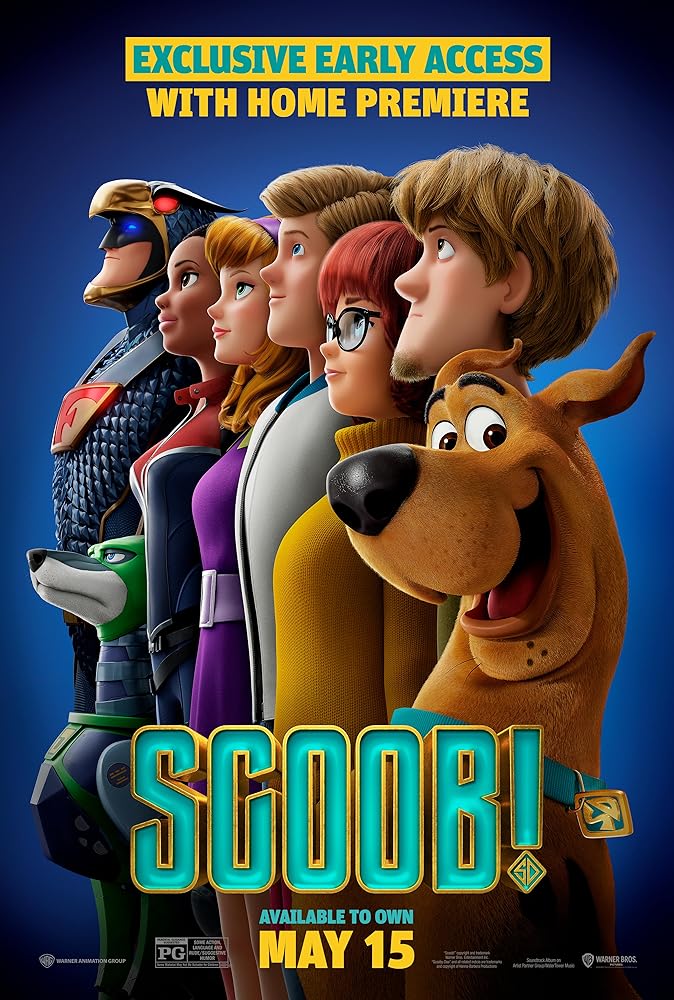
Scoob! (2020) review


Scoob! (2020)

There aren’t many franchises that have maintained a consistent spot in the annals of pop culture like Scooby-Doo has. It has now been more than half a century since Scooby-Doo, Where Are You first made its debut on CBS’ Saturday Morning cartoon block on September 13th, 1969. The show immediately proved to be a hit for its studio, the legendary Hanna-Barbera Productions, and proceeded to evolve over the next several decades with new incarnations of the show. And while these newer shows did occasionally make a few story changes here and there (whether it’s by having a series with the gang as kids or by having the monsters they encounter be real instead of fake), they almost always stayed true to the franchise’s classic formula. As of this year, there have been 14 TV series starring the Mystery Inc gang and more than 40 feature-length films. Most of these films, however, have been direct-to-video releases, although the franchise did make its way to the big screen in 2002 with the live-action Scooby-Doo film, which was then followed by Scooby-Doo 2: Monsters Unleashed in 2004. While neither film was a hit with critics, they both did solidly at the box-office, although the second film wasn’t as successful as its predecessor, resulting in a potential third film being canned. Thus, it wouldn’t have been until this year when the series would finally make its return to the big screen with a new animated feature titled Scoob!... that is, until the coronavirus pandemic hit, forcing theaters across the country to be shut down until further notice. And in Scoob’s case, this immediately proved to be a problem since it was originally set to come out on May 15th, which was now impossible. Thus, Warner Bros. ultimately decided to follow in the footsteps of DreamWorks’ Trolls: World Tour by forgoing its theatrical release in favor of it debuting via on-demand on the day it was slated to hit theaters. Not only that, but this new film is set to be the first in a new ‘Cinematic Universe’ that would be based around the classic characters of Hanna-Barbera, a prospect that I find quite exciting and solidly initiated through this entertaining new take on the Mystery Inc gang.

On an average summer day, a young, lonely boy named Norville ‘Shaggy’ Rogers (voiced by Iain Armitage as a kid and Will Forte as an adult) comes across a stray talking dog (voiced by Frank Welker). The two instantly begin to bond, resulting in Shaggy adopting him and giving him the name Scooby-Doo. Soon afterward, the two end up finding even more friends when they meet Fred Jones (voiced by Pierce Gagnon as a kid and Zac Efron as an adult), Daphne Blake (voiced by Mckenna Grace as a kid and Amanda Seyfried as an adult), and Velma Dinkley (voiced by Ariana Greenblatt as a kid and Gina Rodriguez as an adult). Together, they decide to tackle mysteries as the Mystery Inc gang, which they proceed to do for the next several years. And yet, despite their success, Shaggy and Scooby soon start to feel that they are the least valuable members of the group given their generally lax and cowardly nature. However, the two then find themselves summoned by their favorite superhero, the Blue Falcon… or rather, the Blue Falcon’s son Brian (voiced by Mark Wahlberg) who has taken up his father’s mantle in the wake of his retirement. After also meeting the Blue Falcon’s companions, tech-savvy Dee Dee Sykes (voiced by Kiersey Clemons) and the robotic dog Dynomutt (voiced by Ken Jeong), Shaggy and Scooby learn that Scooby is being pursued by the notorious Dick Dastardly (voiced by Jason Isaacs). Specifically, Dastardly plans to use Scooby to open the gates to the Underworld (since Scooby is revealed to be a descendant of Alexander the Great’s canine companion Peritas), potentially unleashing the three-headed dog monster Cerberus upon the world. Thus, both the Mystery Inc gang and the crew of the Blue Falcon’s ship, the Falcon Fury, find themselves in a race against time to prevent Dastardly from unleashing the Apocalypse as Shaggy and Scooby look to prove themselves worthy of being properly seen as heroes.  

Scoob is very much your traditional Scooby-Doo adventure albeit with a larger focus on other characters from the world of Hanna-Barbera. As such, I should probably start by noting that while this is very much a Scooby-Doo film, it isn’t as centered on the Mystery Inc gang when compared to the other films and shows that make up its massive franchise. In fact, given the nature of the plot, Shaggy and Scooby end up separated from Fred, Daphne, and Velma for a good chunk of the runtime. At the very least, the film does still allow for each member of the gang to have their own standout moment in the story, and if there is a major upside to all this, it’s that I believe that this film serves as a great gateway for new audiences to be introduced to some of the lesser-known characters from the Hanna-Barbera universe. I mean, if Marvel could do it for the likes of Guardians of the Galaxy, then Warner Bros and Hanna-Barbera can do it for the likes of the Blue Falcon, Dynomutt, and Captain Caveman (voiced by Tracy Morgan). And although the plot itself is rather basic (to the point where it somewhat rehashes the subplot of Scooby-Doo 2: Monsters Unleashed where Shaggy and Scooby look to prove themselves as valuable members of the gang), it still delivers solid emotional depth through its excellent handling of Shaggy and Scooby’s relationship. Plus, the film also does a great job of maintaining the overall spirit of the franchise even as a modernized adaptation of it. So yes, there are quite a lot of modern references here and there to things like Netflix and Harry Potter, but the film is also full of Hanna-Barbera trademarks from the delightfully cheesy sound effects to an impressive recreation of Where Are You’s title sequence (not to mention all the fun Easter eggs). And it all comes together thanks to some solid animation that reminds me a lot of 2015’s The Peanuts Movie in how it excellently manages to maintain the Scooby-Doo franchise’s traditionally 2-D animated roots even though it is a computer-animated feature.

There has been a bit of controversy, however, surrounding this film’s voice cast. Instead of utilizing the current ensemble that has been voicing the Mystery Inc gang on TV and film, this film goes for an all-star cast, with the legendary Frank Welker being the only one of the core crew reprising any of his roles (in this instance, Scooby-Doo, who he’s voiced since 2002). As you may have guessed, this didn’t go over well with some of the franchise’s current voice cast, namely Matthew Lillard, who took over the role of Shaggy from Casey Kasem after playing the character in the live-action films, and Grey Delisle, the current voice actress for Daphne. And while I completely understand where they’re coming from, especially since they’ve stated that they weren’t informed of this change, the cast for this film does end up doing a solid job. To be clear, I’m not saying that this new cast should completely replace the current voice cast (not in the slightest) but at the very least, Will Forte, Zac Efron, Gina Rodriguez, and Amanda Seyfried manage to be natural fits in their respective roles. But like I just said, not everyone has been onboard with this decision and have often argued that the ‘celebrity’ voices should’ve been reserved for the supporting characters like Mark Wahlberg as the Blue Falcon. On that note, Wahlberg is certainly a fun standout of the cast and a lot of this is thanks to how the film handles Brian’s role in the story since it primarily revolves around his struggles to live up to the legacy of his father. Because of this, he often avoids partaking in any superhero action (but still takes all the credit at the end of the day) while the far more competent duo of Dee Dee and Dynomutt do all the work, resulting in plenty of the film’s best comedic moments. Finally, Jason Isaacs is clearly having a lot of fun as the utterly diabolical Dick Dastardly, but perhaps the most fascinating part of this whole film is how even someone as villainous as Dick gets to partake in some of its emotional beats when the reason behind his plan to open up the Underworld is revealed. I won’t reveal it here for obvious reasons, but if you’re familiar with the character, then I don’t even need to say anything more because I’m sure you know exactly what I’m referring to.

All in all, Scoob is a delightful new spin on one of the most classic animated franchises of all-time. It may not be the best thing that has ever come out of the Scooby-Doo franchise, but it still delivers on a lot of what longtime fans have come to expect from it. Yes, it’s very much a modernized take on the property, but at the same time, it still does just enough to pay homage to the classic style of Hanna-Barbera. And while I fully understand why this film has been a notable source of controversy due to its revamped voice cast, I also feel that this will only become a genuine problem if this cast ends up replacing the current cast from the shows, which I strongly doubt it will. In short, I’m well-aware that quite a few people most likely groaned at the prospect of this being another film that’s meant to kick-start a new cinematic universe a la Marvel since, to be perfectly blunt, most of the attempts to follow the MCU’s winning formula have been underwhelming, to say the least. However, this is one of those cases where a potential cinematic universe would be highly appropriate since crossovers between Hanna-Barbera properties were quite common back in the studio’s heyday. Just look at the time that the Jetsons met the Flintstones or when the Mystery Inc gang cameoed in an episode of Johnny Bravo. And as someone whose experience with Hanna-Barbera is admittedly limited to The Flintstones, The Jetsons, the various Cartoon Network shows from the ’90s like Johnny Bravo and Dexter’s Laboratory, and of course, Scooby-Doo, I’m all for a Hanna-Barbera Cinematic Universe. As such, I do hope that this film’s fate as a direct-to-streaming release won’t end up affecting its potential franchise’s chances in the long run. Believe me, if it wasn’t for this crazy pandemic that we’re currently in right now, this was very much a film that I was planning to see in theaters.

Rating: 4/5

Saturday, June 27, 2015

Ted 2 (2015) review

Ted 2 poster.jpg

After creating one of the most successful shows of the 2000’s in ‘Family Guy’, a show that survived not one but two cancellations by Fox, Seth MacFarlane moved into film in 2012 with his directorial debut, ‘Ted’, the story of a Boston native by the name of John Bennett and his relationship with his talking teddy bear Ted, who came to life after John had made a wish on a shooting star back when he was a kid. The film ended up being a huge success, attracting solid critical reviews and grossing over half a billion dollars worldwide. Three years later, everyone’s favorite ‘Thunder Buddies’ are back with ‘Ted 2’. But of course, as we all know, comedy sequels are pretty darn tough to get right. Most of the time they end up being inferior to their predecessor, usually because they just end up rehashing the same jokes instead of doing something new. But at the end of the day, ‘Ted 2’ actually does manage to be one of the better comedy sequels out there, even if that may not necessarily be saying much given most of the other comedy sequels that have come out over the years. It’s by no means the absolute funniest comedy of the year, even when compared to the first film, and it does share some of the issues that plagued MacFarlane’s previous film, the general misfire that was ‘A Million Ways to Die in the West’. But unlike that film, those issues aren’t really as prevalent in ‘Ted 2’, which is thankfully much more consistent in terms of its humor. And that’s primarily thanks to the film’s great leading duo of John and Ted, who ultimately are the main reason why these two ‘Ted’ films have been so much fun to watch.

The film picks up about six months after the events of the first film, with John Bennett (Mark Wahlberg) coping with his recent divorce with Lori (in other words, Mila Kunis did not return for the sequel) while Ted (voiced by Seth MacFarlane) marries his girlfriend Tami-Lynn (Jessica Barth). One year later, the couple find themselves at great odds with each other so Ted suggests that they have a baby. But due to obvious reasons (i.e. Ted being a teddy bear), the two, with the help of John, instead have to resort to other methods to have a child. However, when they try to adopt, Ted learns that he is viewed only as ‘property’ by the government, which results in him losing his job and his marriage to Tami-Lynn being annulled. With nowhere else to go, Ted and John decide to take their issue to court to prove that Ted is as much of a person as everyone else. With the help of Samantha Jackson (Amanda Seyfried), a young up-and-coming lawyer who John and Ted immediately connect with due to their shared interests (e.g. marijuana), the ‘Thunder Buddies’ embark on a quest to get Ted’s life back by proving to the world that not only is he human but that he can also make positive contributions to society. All the while, the pals embark on another series of misadventures, including having to deal with the return of their nemesis Donny (Giovanni Ribisi), who once again hatches a plot to kidnap Ted, this time teaming up with Hasbro so that they can try and figure out what caused Ted to come alive so that they can produce more living teddy bears.

Like its predecessor, your overall enjoyment of ‘Ted 2’ will more than likely depend on whether or not you find MacFarlane’s general style of humor funny. ‘Ted 2’, just like the first film and ‘Family Guy’, is full of adult, immature, and sometimes even potentially offensive humor. It’s pretty much the live-action version of ‘Family Guy’, with John and Ted basically being the live-action equivalents of Peter and Brian Griffin. Me personally, I loved the first few seasons of ‘Family Guy’ but I haven’t watched the show in recent years mainly due to the simple fact that the show’s quality has dropped with each subsequent season that it is still on. But as for ‘Ted’, it was one of my favorite comedies of 2012 and ‘Ted 2’ is not too far off. Sure, like with MacFarlane’s last effort, ‘A Million Ways to Die in the West’, there are some ‘dead air’ moments in ‘Ted 2’ with no humor, which is usually whenever the film tries to be serious, more so than it needs to be. That and perhaps the film does go on just a bit too long, which was also a problem with ‘A Million Ways to Die in the West’. But unlike that film, the humor is a lot more consistent and like the first film, there are also some legitimately heartfelt moments even amidst all of the dirty humor. At the end of the day, all I can say is that it’s just really funny to see something like a teddy bear act so raunchy and that’s really one of the biggest strengths of both ‘Ted’ films; it’s just a fun and unique premise that only someone can Seth MacFarlane could pull off.

But once again, the best element of ‘Ted 2’, just like with the first, is the duo of John and Ted, who are just one of the best comedy duos of the past few years thanks to Mark Wahlberg and Seth MacFarlane’s excellent camaraderie. Sure, John and Ted can be immature and crude most of the time but there’s also something about them that actually still makes them such a likable pair, which is probably due to the strong bond of friendship between them. Mila Kunis doesn’t reprise her role of Lori in this film, which is disappointing not only because the plotline of her and John getting divorced basically goes against one of the most endearing elements of the first film (their relationship) but because she played just as big a role in the film as much as John and Ted and wasn’t just ‘the girlfriend who dislikes her boyfriend’s best friend’. But to her credit, Amanda Seyfried works just as well with Wahlberg and MacFarlane. At the end of the day though, John and Ted are the true heart of the film and whenever they aren’t onscreen, that’s where the film’s humor doesn’t hit. Usually this with any scene involving the character of Donny, whose plotline in the first film of him trying to kidnap Ted for his son was admittedly one of the weaker parts of that film. But, like with pretty much any MacFarlane production, you can also expect a whole bunch of memorable cameos, including Tom Brady, Morgan Freeman, and Liam Neeson, the latter of whom is thankfully used to greater effect here than in ‘A Million Ways to Die in the West’.

‘Ted 2’ is by no means the funniest comedy of all-time, especially when compared to the first film. That and it did share some of the issues that plagued ‘A Million Ways to Die in the West’ (e.g. ‘dead air’ moments and being just a bit overlong), even though those issues weren’t as big of a problem this time around. But still, at the end of the day, I had a good time watching ‘Ted 2’ which I would actually argue is almost just as funny as the first film. Like the first film, the main reason for this is the duo of John and Ted. They’re just a great comedy film duo and it’s fun to watch these two go on all sorts of misadventures and get into a bunch of hi-jinx. Yes, like its predecessor and MacFarlane’s iconic show ‘Family Guy’ (especially in recent seasons), the humor can be a bit harsh and mean-spirited at times. That’s just the kind of humor MacFarlane does and obviously it’s not for everyone. But what surprises me about both of these ‘Ted’ films is that despite all of that, there are still some moments that are actually legitimately touching, which again is usually due to the great friendship of John and Ted. All in all, ‘Ted 2’ does manage to be one of the better comedy sequels of all time. If you loved the first film, then I’m pretty sure that you’ll like this one too. But if you’re not a fan of MacFarlane’s brand of humor, then you’re better off with something else.


Rating: 4/5