Showing posts with label Sarah Paulson. Show all posts

Wednesday, January 23, 2019

Glass (2019) review

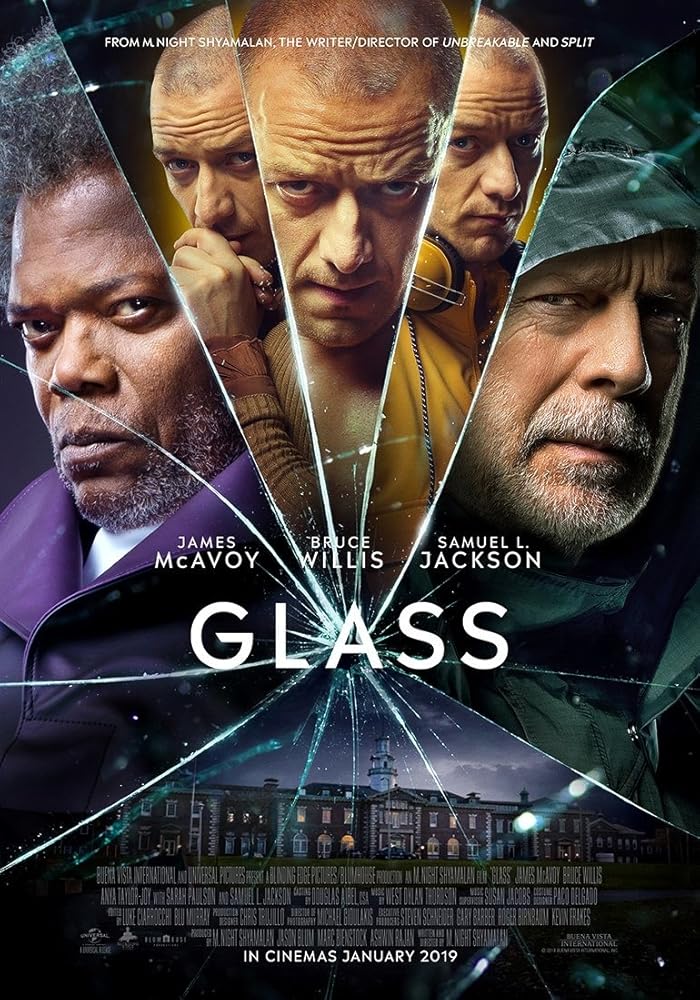
Samuel L. Jackson, Bruce Willis, and James McAvoy in Glass (2019)

One year after making it big with The Sixth Sense, writer/director M. Night Shyamalan released his next directorial effort, Unbreakable. Serving as a deconstruction of the superhero genre, the film followed a seemingly average man who ponders if he’s a superhero himself after miraculously surviving a devastating tragedy. Upon its release, the film didn’t quite do as good with critics and audiences as The Sixth Sense, but it has gone on to arguably surpass it as Shyamalan’s most popular film. And yet, because it wasn’t that big of a hit, plans for a sequel were put on hold for the next decade and a half. It wasn’t until 2017 when the idea of continuing the series was put into play thanks to Shyamalan’s then-latest effort, Split, which had continued his recent career resurgence after a string of critical flops in the 2000s. But while the film may have seemed like a simple small-scale thriller about a group of girls who found themselves kidnapped by a man with multiple identities, audiences were surprised to discover that the film was the long-awaited Unbreakable sequel thanks to a cameo by the previous film’s protagonist. And thus, the plans were set for a third film that would bring together the main characters of both films and provide a conclusive finale to what is now being referred to by fans as the Eastrail 177 trilogy, named after the train that started this whole ordeal. Taking its name from the first film’s main antagonist, Glass once again brings audiences into a world of real-life super-heroes and real-life super-villains. And while some may be put off by the ways in which it continues the story of Unbreakable, it’s still a highly engaging thriller with captivating performances.  

19 years ago, security guard David Dunn (Bruce Willis) was the sole survivor of a devastating train crash in the city of Philadelphia. After learning that he somehow managed to survive the crash without any injuries, David proceeds to undergo a journey where he starts to test himself to see if he’s a real-life superhero, a notion that’s encouraged by comic enthusiast Elijah Price (Samuel L. Jackson), a man who suffers from brittle bone disease. However, David eventually learns that Price was the one responsible for the train crash, having decided that his purpose in life was to be David’s arch-enemy, Mr. Glass, resulting in David alerting the authorities and Price being placed in a mental institution. Since then, David has continued to operate as the vigilante known as ‘The Overseer’, which leads him to a confrontation with Kevin Wendell Crumb (James McAvoy), an infamous kidnapper/murderer who has dissociative identity disorder and 24 distinct identities fighting for control of his mind, thus earning him the nickname ‘The Horde’. Their ensuing clash ends up with them both being arrested and sent to the Raven Hill Psychiatric Hospital where, as fate would have it, Price is being held as well. Whilst there, the three become the subjects of Dr. Ellie Staple (Sarah Paulson), who specializes in dealing with patients who have delusions of grandeur, specifically the idea that they possess super-powers. But as the three men find themselves subjected to intense psychological evaluations that put their abilities into question, the ever-devious Elijah begins planning his next criminal scheme that he promises will prove to the world once and for all that super-powered beings truly exist.

When it comes to this unexpected trilogy of films, Glass is a combination of the best elements of its two predecessors. Since Split wasn’t technically revealed as a sequel to Unbreakable until its ending, Glass is ultimately more in line with the first film when it comes to its structure and purpose as a commentary on the concept of comic-book superheroes. At the same time, though, Glass also carries over the psychological ideologies of Split’s plot to further strengthen its commentary. With that in mind, it should be noted that this isn’t meant to be a big-budget superhero flick with large-scale action sequences a la something out of the Marvel Cinematic Universe. Instead, Glass’ big action sequences are reserved for its first act and finale, with the rest of the film focusing on its main characters’ time spent in the mental institution. And overall, the film manages to maintain an engaging narrative throughout because of its layered characters and effective moments of emotional poignancy that come from taking the idea of super-powered beings and grounding it in realism. But just like any Shyamalan film, this story ends up leading to some major twists that, in this instance, seem to be a major source of contention amongst this film’s critics, and to be perfectly frank, in some ways it’s easy to see why this is. Without spoiling any of these twists, the biggest of the bunch could’ve benefitted from being built up a bit more because as is, it sort of feels like it came out of nowhere. And yet, despite this, the film then immediately course corrects itself with another twist that works a lot better because it manages to provide a thorough conclusion to the arcs of its main characters.

On that note, one of the biggest draws to this film is getting to see the three main leads of the franchise together in one big ‘crossover’. Starting with the cast from Unbreakable, Bruce Willis is excellent once again as main protagonist David Dunn. Instead of being one of Willis’ more recent outings where many have felt that he’s just ‘phoning it in’, he provides the film with several of its best emotional moments in his second go-around as the reluctant hero who’s been put through the emotional wringer more often than most. But, of course, you can’t have a hero without a villain, and that’s where Samuel L. Jackson comes in as Elijah Price AKA Mr. Glass. Now fully embracing his role as ‘the mastermind’, Jackson commands the screen as this series’ fascinating antagonist with the tragic backstory of a life that’s been considerably hindered by his condition. And yet, arguably the biggest standout of them all is James McAvoy reprising his role from Split as Kevin Wendell Crumb and his 24 unique identities. Just like in the previous film, the ways in which McAvoy slips in and out of each identity, whether it’s the innocent 9-year old Hedwig or a Southerner named Luke who has the tendency to spoil films, is a sight to behold in terms of all the physical and mental transformations that he undergoes. The three are then joined by a variety of returning players from the other films, including Spencer Treat Clark as David’s son Joseph and Anya Taylor-Joy as Casey, the sole survivor of Kevin’s rampage in Split, and they’re all good as well despite not having as much to do as Willis, Jackson, and McAvoy. Sarah Paulson then closes out the ensemble as this film’s primary new addition, Dr. Staple, and she shines as well as the film’s most mysterious character with an unclear agenda.  

With Glass, M. Night Shyamalan has been granted something that he hasn’t had in years, hype. While it may not have been as big of a hit as The Sixth Sense was upon its initial release, Unbreakable has since gone on to be regarded by many as his best film. As such, when it was revealed that his 2017 outing Split was the unexpected follow-up to Unbreakable, the anticipation began to mount for the concluding installment of the Eastrail 177 trilogy. Despite this, however, Glass is proving to be quite the polarizing affair amongst critics and audiences, with several feeling that it just didn’t live up to the hype and was a lackluster conclusion to this promising trilogy. And to be perfectly fair, there are certain aspects of this film that won’t exactly go over well with everyone when it comes to the ways in which it concludes the trilogy and, more importantly, the overall arcs of its main characters. Ultimately, though, I did find Glass to be a genuinely satisfying finale to this trilogy, as it combines the best elements of Unbreakable and Split to produce yet another highly engaging thriller. It may not boast the usual structure of a ‘superhero flick’ but the story is solidly written and the film benefits from an excellent collection of layered characters headlined by the phenomenal lead trio of James McAvoy, Bruce Willis, and Samuel L. Jackson. In short, it’s nice to see that after all these years, M. Night Shyamalan was finally able to return to the world of heroes and villains that he had initially created with Unbreakable to spawn a truly unique trilogy of superhero films.     


Rating: 4.5/5

Tuesday, June 12, 2018

Ocean's 8 (2018) review

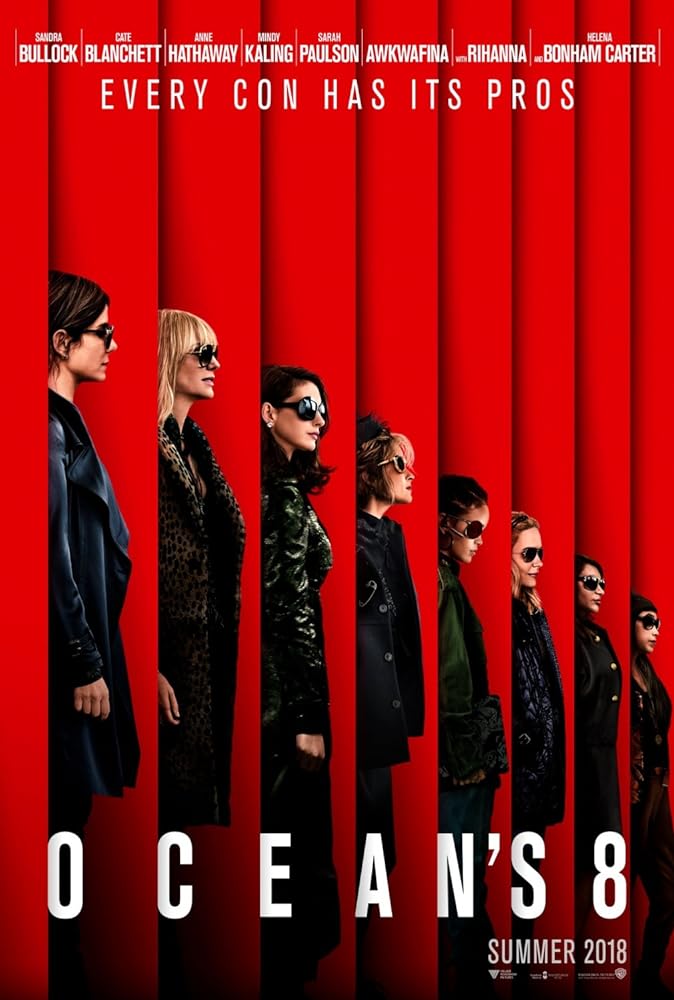
Sandra Bullock, Helena Bonham Carter, Cate Blanchett, Anne Hathaway, Sarah Paulson, Mindy Kaling, Rihanna, and Awkwafina in Ocean's Eight (2018)

In 1960, Warner Bros. released Ocean’s 11, a heist film set in Las Vegas that was directed by two-time Oscar-winning director Lewis Milestone. The film was notable for featuring a star-studded cast that was headlined by the five men who made up one of the entertainment industry’s most notable ‘groups’, the Rat Pack; Frank Sinatra, Dean Martin, Sammy Davis Jr., Peter Lawford, and Joey Bishop. And while the film itself wasn’t exactly a big hit with critics, it did do solidly at the box-office and is still considered as one of the group’s most iconic projects. Four decades later, the film was remade by auteur director Steven Soderbergh; like the original, it also featured a star-studded ensemble cast, including George Clooney, Brad Pitt, Matt Damon, and Julia Roberts, just to name a few. Upon its release in 2001, the film was a massive commercial hit that was followed by two sequels, Ocean’s Twelve in 2004 and Ocean’s Thirteen in 2007. All three films were commercially successful though critical reception towards them was varied (i.e. many consider Ocean’s Twelve to be the worst installment of the trilogy). One thing for certain, though, was that following the passing of Bernie Mac (who played con-man Frank Catton) in 2008, both Soderbergh and Clooney made it clear that there would not be a fourth Ocean’s film with the original cast. So instead, it was decided about a decade later to take the series in a different direction; thus, here we are now with Ocean’s 8, a female-led spin-off that, true to the franchise’s roots, features an all-star cast headlined by the likes of Sandra Bullock, Cate Blanchett, and Anne Hathaway… and again, that’s just to name a few. This time around, veteran writer/director Gary Ross is behind the camera for this spin-off, though Soderbergh is still involved as a producer. And as crazy as it might seem, Ross somehow manages to surpass several of the highs from Soderbergh’s trilogy even though his film does tend to abide by quite a few of the franchise’s usual trappings.

Following in the footsteps of her late brother Danny, professional thief Debbie Ocean (Sandra Bullock) is released on parole after spending the last five years (and eight months) in prison. As soon as she gets out, she reunites with her best friend and partner-in-crime Lou (Cate Blanchett) with her next planned heist already in the works. Said heist revolves around one of the most famous events in New York, the Metropolitan Museum of Art’s annual Met Gala, which several of the most famous people in the world attend. However, instead of just robbing the Gala itself, Debbie plans on stealing a valuable necklace known as the Touissant that is owned by the famous jeweler Cartier and is valued at around $150 million. To accomplish this heist, Debbie and Lou recruit a group of specialists, including down-on-her-luck fashion designer Rose Weil (Helena Bonham Carter), jewelry maker Amita (Mindy Kaling), profiteer Tammy (Sarah Paulson), street hustler Constance (Awkwafina), and tech genius ‘Nine Ball’ (Rihanna). Together, they plan on switching out the necklace for a fake one, with famous actress Daphne Kluger (Anne Hathaway) serving as their unsuspecting mule. However, things get a little more complicated once the group learns that one of the main reasons why Debbie has planned this heist is so that she can get revenge against her ex-boyfriend, art dealer Claude Becker (Richard Armitage), who was the one who sent her to prison in the first place.

Now admittedly, it’s safe to say that the plot of Ocean’s 8 has a lot in common with the Ocean’s 11 remake. Both start out with the main protagonist being released from jail and immediately meeting up with their best friend, both have montages where the two recruit their fellow crew members for the heist, and both heists end up getting complicated when it’s revealed that the main protagonist has quite the personal stake in it. Ultimately, though, if there’s one major advantage that Ocean’s 8 has over its three predecessors, it’s that it arguably carries a greater sense of confidence to it when compared to the original trilogy. Now, for the record, I’m not just saying this because this one is headlined by an all-female cast… though with that said, it does sort of play a factor into this (more on that in a bit…). After all, it’s worth noting that Ocean’s 8 ends up sharing a lot more in common with its predecessors than just similar plot-lines. While the film doesn’t necessarily maintain the same exact tight pacing of Soderbergh’s films, its primary heist is carried out in the same effortless manner that defined the heists of the previous films without any major source of conflict to undermine it, something that Debbie even assures her crewmates of before they do it. In other words, Ocean’s 8 does manage to maintain the same type of glitzy aesthetic that the previous films had even with the change in directors. With that said, though, it could be argued that the film loses just a little bit of the visual panache that Soderbergh brought to the table with his three films. And yet, in a way that I just can’t explain, this film ends up flowing a lot smoother than the previous films, and director Gary Ross does a good job of maintaining that flow throughout in this solidly-shot heist flick.   

One of the most common criticisms directed towards the Ocean’s trilogy is that while they do feature a terrific ensemble cast, some have argued that this gave the films an incredibly smug tone that ended up being a major turn-off for some audiences. Thankfully, that isn’t even remotely an issue here, as the terrific chemistry between its collection of female leads is arguably the best aspect of Ocean’s 8. This isn’t a case where one of the actresses tries to hog the limelight from their co-stars or, as John Mulaney pointed out in one of his stand-up routines, two characters go off on their own to ‘talk s***’ about their partners behind their backs. All these women work extremely well together, and just like the Avengers films, every member of the group gets to have her own standout moment, whether its screen veterans like Sandra Bullock and Cate Blanchett or reliable supporting players like Helena Bonham Carter and Mindy Kaling. Because of this, the successes that their characters have during the heist end up being a lot more satisfying when compared to the previous films, and it also helps that the film allows us to connect more with these characters in general when compared to Danny Ocean’s crew. Now, granted, character development in this film is sort of on par with the previous films, where the heist itself is emphasized over everything else. And yet, this film still manages to outdo its predecessors by having a more generally likable group of protagonists who have sympathetic reasons to partake in the heist, whether it’s Debbie’s goal of getting revenge against her ex for deceiving her or Rose and Amita just looking to get out of their dead-end careers.

As I noted in my retrospective of the original trilogy a few months back, I thoroughly enjoyed Steven Soderbergh’s remake of Ocean’s 11 even if I didn’t necessarily see it as one of the best films of its genre. Overall, it was a decently entertaining ‘popcorn flick’; nothing more, nothing less. Unfortunately, I, like many, found Ocean’s 12 to be a vastly disappointing follow-up. While I do recognize why it’s Soderbergh’s personal favorite due to him being able to experiment as a director, it’s ultimately a prime example of what happens when said directorial experimentation goes a bit too far. Thus, Ocean’s 13 ended up going ‘back to basics’, and I was pleasantly surprised to find that it was my personal favorite of the trilogy due to it having some of the franchise’s best writing and pacing. But as for Ocean’s 8, it may just be my new favorite installment of the Ocean’s franchise. Oh sure, in a lot of ways, it borrows heavily from Ocean’s 11, like having a similarly structured plot that doesn’t necessarily give the main protagonists a lot of opposition during their heist. However, it just ends up working a lot better than what we saw from the previous Ocean’s films, and while I usually don’t try to get into any sort of politically-based discussions when writing these reviews, it’s hard to deny that the fact that this film stars an all-female cast of leads is ultimately one of the biggest contributors to its overall success. The chemistry that these ladies have is far superior to what we got from the predominantly male cast of the original trilogy, and while the film still doesn’t rely too much on character development, these characters are ultimately a more likable group of protagonists by comparison. Thus, while I wouldn’t necessarily call this the ‘best-directed’ or the most ‘well-made’ installment of the Ocean’s franchise, it is quite easily the series’ most satisfying entry to date.  


Rating: 4.5/5