Showing posts with label Mindy Kaling. Show all posts

Tuesday, June 12, 2018

Ocean's 8 (2018) review

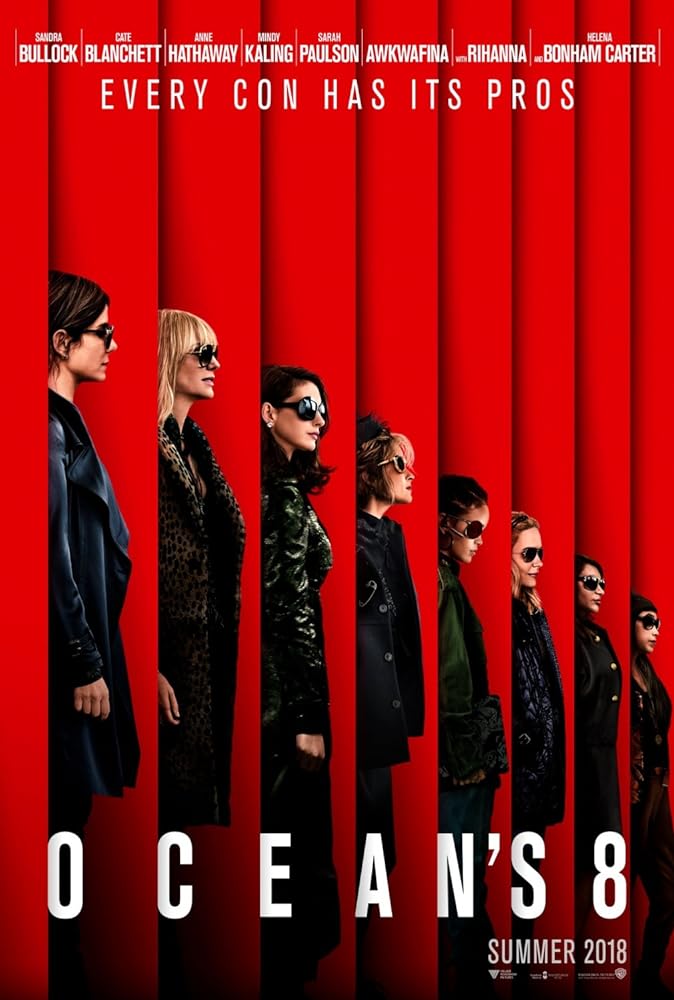
Sandra Bullock, Helena Bonham Carter, Cate Blanchett, Anne Hathaway, Sarah Paulson, Mindy Kaling, Rihanna, and Awkwafina in Ocean's Eight (2018)

In 1960, Warner Bros. released Ocean’s 11, a heist film set in Las Vegas that was directed by two-time Oscar-winning director Lewis Milestone. The film was notable for featuring a star-studded cast that was headlined by the five men who made up one of the entertainment industry’s most notable ‘groups’, the Rat Pack; Frank Sinatra, Dean Martin, Sammy Davis Jr., Peter Lawford, and Joey Bishop. And while the film itself wasn’t exactly a big hit with critics, it did do solidly at the box-office and is still considered as one of the group’s most iconic projects. Four decades later, the film was remade by auteur director Steven Soderbergh; like the original, it also featured a star-studded ensemble cast, including George Clooney, Brad Pitt, Matt Damon, and Julia Roberts, just to name a few. Upon its release in 2001, the film was a massive commercial hit that was followed by two sequels, Ocean’s Twelve in 2004 and Ocean’s Thirteen in 2007. All three films were commercially successful though critical reception towards them was varied (i.e. many consider Ocean’s Twelve to be the worst installment of the trilogy). One thing for certain, though, was that following the passing of Bernie Mac (who played con-man Frank Catton) in 2008, both Soderbergh and Clooney made it clear that there would not be a fourth Ocean’s film with the original cast. So instead, it was decided about a decade later to take the series in a different direction; thus, here we are now with Ocean’s 8, a female-led spin-off that, true to the franchise’s roots, features an all-star cast headlined by the likes of Sandra Bullock, Cate Blanchett, and Anne Hathaway… and again, that’s just to name a few. This time around, veteran writer/director Gary Ross is behind the camera for this spin-off, though Soderbergh is still involved as a producer. And as crazy as it might seem, Ross somehow manages to surpass several of the highs from Soderbergh’s trilogy even though his film does tend to abide by quite a few of the franchise’s usual trappings.

Following in the footsteps of her late brother Danny, professional thief Debbie Ocean (Sandra Bullock) is released on parole after spending the last five years (and eight months) in prison. As soon as she gets out, she reunites with her best friend and partner-in-crime Lou (Cate Blanchett) with her next planned heist already in the works. Said heist revolves around one of the most famous events in New York, the Metropolitan Museum of Art’s annual Met Gala, which several of the most famous people in the world attend. However, instead of just robbing the Gala itself, Debbie plans on stealing a valuable necklace known as the Touissant that is owned by the famous jeweler Cartier and is valued at around $150 million. To accomplish this heist, Debbie and Lou recruit a group of specialists, including down-on-her-luck fashion designer Rose Weil (Helena Bonham Carter), jewelry maker Amita (Mindy Kaling), profiteer Tammy (Sarah Paulson), street hustler Constance (Awkwafina), and tech genius ‘Nine Ball’ (Rihanna). Together, they plan on switching out the necklace for a fake one, with famous actress Daphne Kluger (Anne Hathaway) serving as their unsuspecting mule. However, things get a little more complicated once the group learns that one of the main reasons why Debbie has planned this heist is so that she can get revenge against her ex-boyfriend, art dealer Claude Becker (Richard Armitage), who was the one who sent her to prison in the first place.

Now admittedly, it’s safe to say that the plot of Ocean’s 8 has a lot in common with the Ocean’s 11 remake. Both start out with the main protagonist being released from jail and immediately meeting up with their best friend, both have montages where the two recruit their fellow crew members for the heist, and both heists end up getting complicated when it’s revealed that the main protagonist has quite the personal stake in it. Ultimately, though, if there’s one major advantage that Ocean’s 8 has over its three predecessors, it’s that it arguably carries a greater sense of confidence to it when compared to the original trilogy. Now, for the record, I’m not just saying this because this one is headlined by an all-female cast… though with that said, it does sort of play a factor into this (more on that in a bit…). After all, it’s worth noting that Ocean’s 8 ends up sharing a lot more in common with its predecessors than just similar plot-lines. While the film doesn’t necessarily maintain the same exact tight pacing of Soderbergh’s films, its primary heist is carried out in the same effortless manner that defined the heists of the previous films without any major source of conflict to undermine it, something that Debbie even assures her crewmates of before they do it. In other words, Ocean’s 8 does manage to maintain the same type of glitzy aesthetic that the previous films had even with the change in directors. With that said, though, it could be argued that the film loses just a little bit of the visual panache that Soderbergh brought to the table with his three films. And yet, in a way that I just can’t explain, this film ends up flowing a lot smoother than the previous films, and director Gary Ross does a good job of maintaining that flow throughout in this solidly-shot heist flick.   

One of the most common criticisms directed towards the Ocean’s trilogy is that while they do feature a terrific ensemble cast, some have argued that this gave the films an incredibly smug tone that ended up being a major turn-off for some audiences. Thankfully, that isn’t even remotely an issue here, as the terrific chemistry between its collection of female leads is arguably the best aspect of Ocean’s 8. This isn’t a case where one of the actresses tries to hog the limelight from their co-stars or, as John Mulaney pointed out in one of his stand-up routines, two characters go off on their own to ‘talk s***’ about their partners behind their backs. All these women work extremely well together, and just like the Avengers films, every member of the group gets to have her own standout moment, whether its screen veterans like Sandra Bullock and Cate Blanchett or reliable supporting players like Helena Bonham Carter and Mindy Kaling. Because of this, the successes that their characters have during the heist end up being a lot more satisfying when compared to the previous films, and it also helps that the film allows us to connect more with these characters in general when compared to Danny Ocean’s crew. Now, granted, character development in this film is sort of on par with the previous films, where the heist itself is emphasized over everything else. And yet, this film still manages to outdo its predecessors by having a more generally likable group of protagonists who have sympathetic reasons to partake in the heist, whether it’s Debbie’s goal of getting revenge against her ex for deceiving her or Rose and Amita just looking to get out of their dead-end careers.

As I noted in my retrospective of the original trilogy a few months back, I thoroughly enjoyed Steven Soderbergh’s remake of Ocean’s 11 even if I didn’t necessarily see it as one of the best films of its genre. Overall, it was a decently entertaining ‘popcorn flick’; nothing more, nothing less. Unfortunately, I, like many, found Ocean’s 12 to be a vastly disappointing follow-up. While I do recognize why it’s Soderbergh’s personal favorite due to him being able to experiment as a director, it’s ultimately a prime example of what happens when said directorial experimentation goes a bit too far. Thus, Ocean’s 13 ended up going ‘back to basics’, and I was pleasantly surprised to find that it was my personal favorite of the trilogy due to it having some of the franchise’s best writing and pacing. But as for Ocean’s 8, it may just be my new favorite installment of the Ocean’s franchise. Oh sure, in a lot of ways, it borrows heavily from Ocean’s 11, like having a similarly structured plot that doesn’t necessarily give the main protagonists a lot of opposition during their heist. However, it just ends up working a lot better than what we saw from the previous Ocean’s films, and while I usually don’t try to get into any sort of politically-based discussions when writing these reviews, it’s hard to deny that the fact that this film stars an all-female cast of leads is ultimately one of the biggest contributors to its overall success. The chemistry that these ladies have is far superior to what we got from the predominantly male cast of the original trilogy, and while the film still doesn’t rely too much on character development, these characters are ultimately a more likable group of protagonists by comparison. Thus, while I wouldn’t necessarily call this the ‘best-directed’ or the most ‘well-made’ installment of the Ocean’s franchise, it is quite easily the series’ most satisfying entry to date.  


Rating: 4.5/5

Saturday, March 10, 2018

A Wrinkle in Time (2018) review

Reese Witherspoon, Oprah Winfrey, Mindy Kaling, Chris Pine, Storm Reid, Levi Miller, and Deric McCabe in A Wrinkle in Time (2018)

In 1962, author Madeleine L’Engle published a novel that would end up becoming her most famous piece of work, A Wrinkle in Time. Despite being initially turned down by at least 26 different publishers, the novel went on to become a watershed entry in the science-fiction fantasy genre and a staple of classrooms across the country. And now, more than five and a half decades after its release, it graces the big-screen for the first time ever in Disney’s new adaptation of this timeless story. However, this is not the first time that A Wrinkle in Time has been adapted to film; in fact, this isn’t even Disney’s first adaptation of it. Back in 2003, Disney produced a made-for-TV film adaptation that aired on ABC in May 2004. However, the film ended up receiving negative reviews from both critics and fans of the book; even L’Engle herself was highly critical of it. And yet, despite her passing in 2007, I bet that she might have been a little more positive towards this new adaptation of her book if she had seen it. This new version is brought to us by Ava DuVernay, who’s become a major critical darling these past few years thanks to her work on films like the 2014 Martin Luther King Jr. drama Selma and the 2016 Netflix documentary 13th. Along with being the first $100 million+ film directed by a female director of color, it also boasts a screenplay written by Jennifer Lee, writer/co-director of Disney’s 2013 smash hit Frozen, and features an all-star cast highlighted by the trio of Reese Witherspoon, Mindy Kaling, and the one and only Oprah Winfrey. And while it ultimately may not be a completely successful adaptation of its source material, DuVernay does manage to deliver a visually spectacular sci-fi fantasy adventure capable of delighting both young and old.

In an average American suburb, teenager Meg Murry (Storm Reid) struggles to fit in at school due to her abrasive personality. However, this recent behavior was mainly brought upon by the disappearance of her father, noted astrophysicist Dr. Alex Murry (Chris Pine), who sought to uncover a way to travel across dimensions with ease. Now that it’s been at least four years since his disappearance, Meg begins to lose hope that her father is still alive; that is until she is visited by three omnipotent beings capable of traveling to the places that her father had always dreamed of reaching. This trio of women consists of the wise and all-powerful Mrs. Which (Oprah Winfrey), Mrs. Who (Mindy Kaling), who often quotes several historical figures, and the cheerfully eccentric Mrs. Whatsit (Reese Witherspoon). Meg learns from the three Mrs. W’s that her father is, in fact, still alive, having successfully managed to transport himself to another dimension through the process known as ‘tessering’. However, in doing so, he’s also become trapped by a dark force known as ‘the It’, which is the cause of all negativity across the universe. Thus, Meg must embark on an adventure with her precocious little brother Charles Wallace (Deric McCabe) and her classmate Calvin O’Keefe (Levi Miller) across dimensions with the help of the three Mrs. W’s to find her father and rescue him from ‘the It’, an adventure that, per Mrs. Which, will test them ‘every step of the way’.

A common criticism of this film has been towards its plot, with some calling it ‘convoluted’. Personally, though, I didn’t find the plot to be that convoluted. Granted, there are times where the film throws a lot of important story beats at you, but never enough to the point where it’d leave audiences totally confused as to what’s going on. However, in terms of the narrative, there is one thing that hurts the film from time to time, and that is its surprisingly brisk pacing. Simply put, this film attempts to get a lot done in the span of its 109-minute runtime, and because of this, not everything in the story gets as much attention as it should. This includes everything from a lack of development for the main threat that is ‘the It’ to even glossing over some story beats in the first half hour or so that are meant to set up this universe and its characters. Still, DuVernay and Lee do manage to convey the emotional poignancy of this story of a young girl trying to find her father (along with showcasing the strength of family) quite well; maybe not to its fullest potential but still just enough to register the right sense of emotional catharsis. And as far as the film’s visuals are concerned, this is one of the best-looking films to come out in recent memory. Once Meg, Calvin, and Charles Wallace begin traveling across dimensions, the CGI work that is on display here is second to none, syncing up perfectly with the film’s vibrant cinematography. And just like how Peter Jackson used the beautiful landscapes of his home country of New Zealand to their fullest effect in the Lord of the Rings and Hobbit trilogies, DuVernay does the same for this film, which was partially shot there as well.

Ultimately, though, arguably the best aspect of this film is the stellar ensemble cast that DuVernay has assembled to play these iconic roles. It’s all headlined by the phenomenal lead trio of Oprah, Reese Witherspoon, and Mindy Kaling as the three Mrs. W’s. Oprah, as always, dignifiedly graces the role of Mrs. Which with the same kind of class that has helped to make her the icon that she is today, Reese Witherspoon gets a lot of the best lines due to Mrs. Whatsit’s dry wit, and Mindy Kaling is an equally delightful combination of the two. The interesting thing to note, though, is that while the three of them do receive top billing, they’re only in about a third of the film. As such, it relies more on its young leads, who are all quite excellent. Newcomer Storm Reid very much shines in the role of Meg, even managing to hold her own against the likes of Oprah and Reese Witherspoon, as does Deric McCabe as her gifted brother Charles Wallace. And while Calvin doesn’t get as much to work with material-wise compared to Meg, Levi Miller does work well off both Reid and McCabe. There are also plenty of great supporting roles in this film as well. Chris Pine and Gugu Mbatha-Raw bring much warmth to the film as Meg and Charles Wallace’s parents, especially in terms of the strong ‘parent-child’ bond that Reid shares with them both. Zach Galifianakis gets some great humorous scenes as the eccentric Happy Medium, who aids Meg and co. in their adventure, while Michael Pena is also a major highlight as Red, a sinister agent of ‘the It’ who seduces Charles Wallace to their side.

A Wrinkle in Time has long been referred to by many as one of the prime examples of an ‘unfilmable’ novel, with some feeling that it’d be impossible to fully bring Madeline L’Engle’s fantastical narrative to life on the big screen. But while it may not fully succeed at doing so, Ava DuVernay’s take on this timeless tale is quite the admirable attempt at it. Sure, it suffers quite a bit in terms of pacing, namely through its attempts to try and cram so much of the story into a rather light under two-hour runtime. But when it comes to its visual department, that is where this film truly shines. This is very much one of those films that’s worth checking out on the big-screen, where one can experience the true scale of its vivid imagery. And despite a few instances where the film somewhat glosses over important parts of the plot, it does manage to be an effectively emotional sci-fi fantasy adventure that’s buoyed by an excellent ensemble cast. In short, I can’t really say much about how this film compares to its source material as I’ll admit that I’ve never read A Wrinkle in Time. Seriously, the only experience that I had with this story prior to seeing this film was when I saw an ad for the previously mentioned made-for-TV film from 2003 on an old Disney DVD. Despite this, though, I bet that this adaptation of it could very well satisfy fans of the book; at the very least, more so than the previous film version.


Rating: 4.5/5

Saturday, June 20, 2015

Inside Out (2015) review


Ah Pixar, what a great animation company you are! Ever since they first started making computer animated short films in 1986 (technically 1984 if you count ‘The Adventures of Andre and Wally B.’), which then led to them making feature-length computer animated films starting with 1995’s ‘Toy Story’, they have consistently entertained both kids and adults alike with their excellent lineup of animated classics that are not only beautifully animated but also show amazing maturity in their writing with their great stories and characters. But since ‘Toy Story 3’ in 2010, many feel that Pixar has been in a bit of a slump writing-wise. 2011’s ‘Cars 2’ was the first major Pixar film to receive primarily negative reviews from critics and while both 2012’s ‘Brave’ and 2013’s ‘Monsters University’ received better reviews, neither of which were as beloved by both critics and audiences as much as Pixar’s previous work. Personally I’m not really one of those people who thinks that Pixar has been going downhill. While I haven’t seen it since it first came out, I remember liking ‘Cars 2’. And while ‘Brave’ was rather disappointing due to the film’s shift in tone halfway through, I actually really loved ‘Monsters University’. But as for their newest film, ‘Inside Out’, the first of two Pixar films this year (a first for the studio), and the first since ‘Cars 2’ to be directed by one of Pixar’s main lineup of directors (in this case Pete Docter (‘Monsters Inc.’, ‘Up’)), I can safely say that this is the best film Pixar has done since ‘Toy Story 3’. Of course like with every Pixar film, the animation is superb. But the film also succeeds thanks to its incredibly effective emotional depth (pun intended). It’s a film that is guaranteed to tug at your heartstrings.

The film primarily focuses on a 11-year old girl named Riley (Kaitlyn Dias), who moves from Minnesota to San Francisco with her parents (Diane Lane and Kyle MacLachlan) when her father gets a new job. It is established that within everyone’s mind are a group of personified emotions that help guide their humans through life and form their memories, the most important of which, which are referred to as ‘Core Memories’, help define their personality. In the case of Riley, her main emotions are Joy (Amy Poehler), Sadness (Phyllis Smith), Fear (Bill Hader), Anger (Lewis Black), and Disgust (Mindy Kaling). As Riley starts to adjust to life in her new city, the other emotions start to express major concerns about the move while Joy tries to keep everything positive. But on Riley’s first day of school, trouble ensues when Sadness interferes with one of Riley’s memories. When Joy tries to fix the problem, both her and Sadness end up getting sucked out of Headquarters. Now stuck in Long Term Memory, the far reaches of Riley’s mind where all of her past memories are stored, the two try to get back to Headquarters in order to get Riley’s emotional state back to normal, which gets more and more out of whack as Fear, Anger, and Disgust try to keep everything under control back at Headquarters but end up alienating Riley from everyone around her.

Like with any Pixar production, the animation is superb; in fact, I’d argue it’s one of Pixar’s best-looking films to date. It’s definitely one of the company’s more ‘cartoonish’ visual styles but it results in some truly eye-catching imagery with all that goes on in Riley’s mind, particularly when Joy and Sadness go through Riley’s imagination and dreams. And that really correlates to how I describe this film as a whole; imaginative. It’s a fun concept that is explored further as we see inside the minds of other characters, including both of Riley’s parents and a whole slew of characters during the credits. But what really makes the film work is that it very much succeeds when it comes to its emotional depth and substance. For one thing, the events of the story are things that I’m pretty sure that we have all gone through at some point in our lives, whether it’s moving to a new town/city or being the new kid at school. And it’s all handled with the maturity that you would normally expect from Pixar. I guarantee you that you will get emotional at certain points in the film, with some scenes in particular being really hard-hitting. But at the same time, the film also manages to lighten things up at just the right moments with its fair share of humorous moments/dialogue. And really it couldn’t be any more fitting that a film primarily about the emotions in you heads highly succeeds in making you feel all sorts of emotions.

Speaking of said emotions, this film features a great cast of characters as personified by Riley’s emotions. One of the things that I really liked about the film was that, while the main conflict of the film (Joy and Sadness getting sucked out of HQ and having to find a way back) is caused by Sadness and the rest of the emotions, especially Joy, are rather hesitant about her due to her tendency to cause problems, it doesn’t try and paint her in a negative light. It shows that there will be times where you will feel sad and that this is perfectly okay. And as a result, it’s fun to see the interactions between all of the emotions, especially the polar opposites that are Joy and Sadness. And in regards to the film’s voice cast, Pixar couldn’t have gotten a better cast to fill these roles. Amy Poehler is incredibly charming and likable in the role of Joy while managing to not make Joy too overly, for lack of a better term, ‘joyful’, which admittedly could’ve made the character rather annoying. Phyllis Smith just has the perfect voice to fill the role of Sadness as does Bill Hader and Mindy Kaling as Fear and Disgust, respectively. And Lewis Black as Anger? I mean come on, that is the very definition of ‘perfect casting’. But then you also have arguably the standout character of the entire film in the form of Bing Bong (Richard Kind), an elephant, cat, and dolphin hybrid (you’ll understand what I mean when you see the film) and Riley’s former imaginary friend who helps Joy and Sadness get back to headquarters. He too also gets a few emotional moments as well; without giving anything major away, prepare to get ‘taken to the moon’.

As I noted earlier in the intro, I’m not one of those people who believes that Pixar went downhill after ‘Toy Story 3’. I mean sure, at the end of the day, I couldn’t say that ‘Cars 2’, ‘Brave’, or even ‘Monsters University’ are amongst Pixar’s absolutely best work but that doesn’t mean that I think that they’re terrible. They each still have their own unique good qualities to them that at the very least make them good for kids. But that’s not what many people expect from Pixar; to just be ‘good for kids’. Pixar’s greatest works have been able to transcend the limits of animated films with their mature writing, strong stories, and iconic characters, which ultimately makes many of their films highly appealing to adults just as much as they are to kids. And that is why ‘Inside Out’ is the best film that the company has made since ‘Toy Story 3’. Of course it’s got Pixar’s trademark excellent animation, which in the case of ‘Inside Out’ produces a whole lot of colorful and imaginative imagery, as well as a pitch perfect voice cast. But the term ‘imaginative’ goes even further than that as the film’s great premise also results in some of Pixar’s most mature story-telling to date. It captures the emotional side of its characters in ways that we can all relate to given some of the things that happen to the character of Riley as she and her family move to a new city. As silly as this next sentence may sound, you will get emotional over a film that is primarily about emotions. This is easily not only the best animated film of the year so far but also easily one of the best films of the year period. After some missteps the past few years, Pixar finally strikes pure gold for the first time in a while.


Rating: 5/5!