Showing posts with label Meryl Streep. Show all posts

Wednesday, December 16, 2020

The Prom (2020) review (Netflix)


On November 15th, 2018, a new musical titled The Prom officially opened on Broadway at the Longacre Theatre. With music by Matthew Sklar, lyrics by Chad Beguelin, and a script by Beguelin and Bob Martin based off an original concept by Jack Viertel, The Prom tells the story of a young lesbian student who is banned from attending her high-school prom but is helped in her efforts to fight back against this ruling by a group of Broadway stars. The musical was largely inspired by a similar incident that happened to Constance McMillen in 2010 when she was a senior at Itawamba Agricultural High School in Fulton, Mississippi, which attracted a bunch of supportive responses from celebrities. And upon its debut, the show proved to be a solid hit with critics. It was the first musical of that Broadway season to earn a Critics Pick honor from the New York Times, and while it didn’t win any Tony Awards, it earned 7 nominations including one for Best Musical. It also attracted plenty of attention at the 2018 Macy’s Thanksgiving Day Parade when stars Caitlin Kinnunen and Isabelle McCalla partook in the first LGBTQ kiss in the parade’s history. And now, in 2020, it’s been brought to life on film in a star-studded adaptation directed by Ryan Murphy. While it’s only his fourth feature-length directorial effort, Murphy has been touted as one of the most prominent creative forces in television having created hit shows like Glee and American Horror Story while also being a champion for the cause of greater inclusion within the film and television industry. The Prom serves as one of the first major projects that Murphy has developed for Netflix via the lucrative $300 million deal that they signed him to in 2018, and with a delightful cast and a great execution of its source material’s timely themes, we have ourselves a truly heartwarming musical extravaganza.  

In the conservative-minded town of Edgewater, Indiana, high-school student Emma Nolan (Jo Ellen Pellman) finds herself in an utterly devastating situation when her desire to attend her high-school prom with her girlfriend Alyssa Greene (Ariana DeBose) results in the local Parent-Teacher Association canceling it entirely, thus turning her into a full-blown social pariah. And if that wasn’t enough, the head of the PTA happens to be Alyssa’s mother (Kerry Washington), who is completely unaware of her daughter’s relationship with Emma. However, when all seems lost, Emma finds herself blessed with the most unexpected showing of support in the form of a quartet of actors from Broadway; specifically, self-centered stars Dee Dee Allen (Meryl Streep) and Barry Glickman (James Corden), long-time chorus girl Angie Dickinson (Nicole Kidman), and Julliard alum Trent Oliver (Andrew Rannells). In the immediate wake of a disastrous opening night for their latest Broadway production that results in them being labeled as a pair of narcissists by various critics, Dee Dee and Barry learn of Emma’s predicament and, along with Angie and Trent, decide to head to Edgewater on her behalf. But while they’re initially in it solely for the intent of salvaging their reputations by partaking in ‘a cause’, the group genuinely begins to bond with Emma and, with the help of her highly supportive principal Mr. Hawkins (Keegan-Michael Key), begin working tirelessly to make her prom dreams come true.  

Right off the bat, the best thing that I can say about this film is that it truly delivers on its strong themes that couldn’t be any more relevant given everything that’s been happening in the world recently. Obviously, one’s thoughts on how effective content like this is in highlighting the LGBTQ community may vary, but in this instance, I do believe that The Prom (which I would personally describe as a ‘modern-day version of Footloose’) is very much genuine in its themes of love and acceptance. And when paired with a filmmaker like Ryan Murphy who, as noted earlier, is big on inclusion, you get an adaptation that hits all the right emotional beats from the cathartically heartwarming to the utterly devastating. Admittedly, I can’t say much about how effective the film is as an adaptation of the musical since I haven’t seen the latter, but aside from expanding upon some plotlines such as Barry Glickman’s own struggles as a gay man and how it impacted his relationship with his parents, it seems like the film is as faithful to its source material as it could possibly be. Sure, it probably could’ve benefitted from some tighter editing here and there to make up for any parts of the film that start to drag a bit, but as a musical, it goes without saying that this is where The Prom shines the most. Matthew Sklar and Chad Beguelin’s songs are undeniable earworms and are a great mix of grand showstoppers and emotionally powerful melodies. And under Ryan Murphy’s solid direction, we get a film that, simply put, is just a highly entertaining musical comedy anchored by its lovable bunch of main protagonists.

That said, though, while the film does sport a star-studded ensemble cast, said cast has admittedly garnered some controversy from fans of the musical over the decision to have A-listers play the lead roles rather than Broadway stars. There are some Broadway alumni in this, to be fair, such as Andrew Rannells and Ariana DeBose, but it’s primarily headlined by those who have more experience in film than they do in theater. Still, for what it’s worth, practically everyone involved is clearly having a lot of fun in their respective roles. Whether it’s Meryl Streep being her usual scene-stealing self or Keegan-Michael Key serving as the straight man to all the shenanigans that the Broadway stars get into, you can’t fault this film for having an incredibly fun ensemble. However, when it comes to the film’s biggest standout, that honor goes to its biggest newcomer, Jo Ellen Pellman. It is almost entirely because of her that we care about Emma and her endeavors because she makes her a wholly sympathetic heroine right off the bat. In other words, she’s very much the heart of the film. But now we must address the elephant in the room that is the biggest source of controversy that this film has been attracting in the wake of its release; the casting of James Corden as the gay leading man of Broadway, Barry Glickman. Simply put, unlike Barry, Corden is not a gay man whereas the other LGBTQ characters in this story are more accurately cast (ironically, one of Corden’s main co-stars is Andrew Rannells and he’s playing a character whose sexuality is never made explicit). Now I’m not going to get into this whole situation that much since, as I’ve noted in the past, I usually don’t like to talk about sociopolitical matters such as this in these reviews. So instead, I’ll just say that while I’m not defending Corden’s performance in this, I’d argue that the rest of the cast makes up for any shortcomings that directly stem from him. Was he the ideal pick for the part? No, not at all, but at the same time, I also wouldn’t call this a case where his performance derails the film entirely even though Barry is arguably the most prominently featured member of the Broadway quartet.

I’ll admit that I don’t have a lot of experience with the world of Broadway, which could largely be attributed to the fact that I don’t live in New York where, at least before COVID became a thing, I would have a lot more opportunities to see Broadway shows regularly rather than just occasionally seeing a touring production of a popular show at my local theatres. And yet, as some of the past reviews that I’ve done for this site have arguably proven, I’m a big fan of the musical genre and have liked a fair share of adaptations of Broadway musicals such as the ever-enduring classic Grease and Tim Burton’s delightfully twisted take on Sweeney Todd. As such, it should probably go without saying that I thoroughly enjoyed the film adaptation of The Prom. While I admittedly haven’t seen the original show at the time of this review’s publication, the fact that all three of the key figures behind it (Matthew Sklar, Chad Beguelin, and Bob Martin) were involved in the film’s production makes it clear that this adaptation was in the right hands, and because of this, The Prom is the very definition of a feel-good film. With powerful themes, undeniably catchy tunes, and a great cast, The Prom is a film that very much wears its heart on its sleeve. I mean, there’s really nothing more that I can say about this film other than the fact that it’s a highly entertaining musical that excellently represents the wonderfully diverse nature of our ever-expanding pop cultural landscape. And to be perfectly blunt, folks, in the utterly terrible year that has been 2020, I’d argue that this is one of the best examples of a film that I can easily recommend to anyone out there who’s in desperate need of a pick-me-up.  

Rating: 5/5!

Monday, December 31, 2018

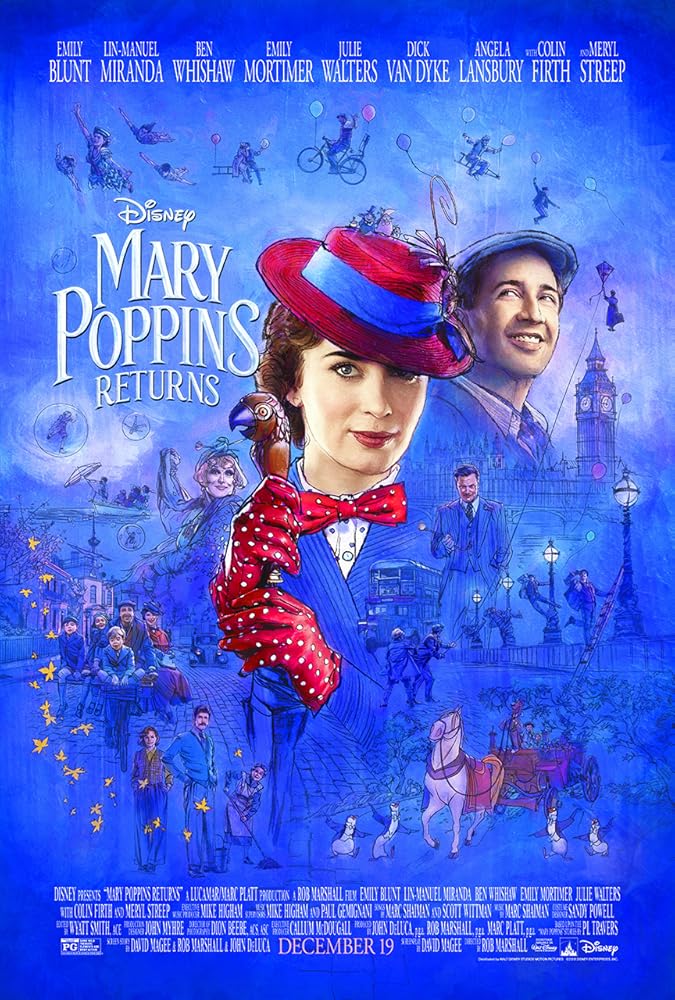
Mary Poppins Returns (2018) review

Colin Firth, Meryl Streep, Lin-Manuel Miranda, Emily Mortimer, Julie Walters, Ben Whishaw, and Emily Blunt in Mary Poppins Returns (2018)

Disney’s 1964 adaptation of P.L. Travers’ classic book series Mary Poppins is a film that needs no introduction. With a lovely visual style, iconic soundtrack by the Sherman brothers, and outstanding lead performances from Julie Andrews as the titular nanny and Dick Van Dyke as her lovable sidekick Bert, Mary Poppins is quite arguably the most beloved Disney film ever made. For starters, it achieved a studio record by earning 13 nominations at the 37th annual Academy Awards (including Best Picture) and ultimately won 5, with Andrews winning the Oscar for Best Actress. And with a total box-office gross of over $102 million achieved through its initial release and additional re-releases, it’s safe to say that this is a film that has continued to stand the test of time. One person who didn’t like the film, however, was P.L. Travers. As dramatized in the 2013 film Saving Mr. Banks, the film’s pre-production mostly consisted of disagreements between Travers and Walt Disney over changes that the latter and his team were making to her story. And because of all these creative conflicts, Travers forbid Disney from ever making a sequel… that is, until 2015, when the studio got the approval from Travers’ estate to do a sequel to the original classic. Under the direction of veteran filmmaker Rob Marshall, who’s no stranger to musicals having directed the 2002 Best Picture winner Chicago and Disney’s 2014 adaptation of the popular Broadway show Into the Woods, Mary Poppins Returns is not just a remake of the original Mary Poppins as many feared it would be when it was first announced. And while this new film does ultimately share quite a few things in common with its predecessor, it still comes together nicely for a truly heartwarming family flick.

It has been twenty-five years since Mary Poppins (Emily Blunt), the magical nanny who’s ‘practically perfect in every way’, came to the Banks family and changed their lives for the better. In the years since, Michael Banks (Ben Whishaw), who still lives at 17 Cherry Tree Lane, has started a family of his own with three kids, his daughter Annabel (Pixie Davies) and his two sons John (Nathanael Saleh) and Georgie (Joel Dawson). However, since the passing of his wife Kate one year prior, the family has been dealing with serious financial troubles which have only been made worse by the onslaught of the Great Depression. And to make matters worse, Michael is notified by his lawyers that he only has a few days to pay off the loan that he made after his wife’s passing or he and his family will be forced out of their home. To try and fix the problem, Michael and his sister Jane (Emily Mortimer) try to find the certificate that verifies their father’s shares at Fidelity Fiduciary Bank while Michael’s kids attempt to earn the money on their own accord. Luckily for all of them, Mary Poppins ends up coming back into the family’s lives, agreeing to look after Annabel, John, and Georgie while Michael and Jane deal with their current predicament. And just like their father and aunt before them, the new crop of Banks children discover the full extent of Mary Poppins’ magical abilities, which she uses with the help of a friendly lamplighter named Jack (Lin-Manuel Miranda) to turn their luck around.

Now let me start by saying that, while I usually try not to directly agree with popular opinion, I will admit that I do concur with one of the most common points that are being brought up about this film in that it has quite a bit in common with its predecessor. The main plot isn’t that different from the original save for a more tension-filled climax and a more pronounced villain. Heck, even the songs in this film’s soundtrack have similar set-ups to the ones from the original, from a show-stopping dance number to lighten the mood like ‘Step in Time’ to an uplifting grand finale tune a la ‘Let’s Go Fly a Kite’. And yet, despite all this, the film does a great job of maintaining the heartwarming atmosphere of the original Mary Poppins without being a direct carbon copy of it. Even with a similar plot, this new film is on par with the original when it comes to having a strong sense of emotional depth throughout via the Banks family’s current gloomy predicament and how they overcome it with the help of Mary Poppins. This is then matched nicely with all the whimsical adventures that Mary and the Banks children go on, and just like the original, this film boasts a gorgeous visual style throughout right down to the inclusion of a sequence where the characters interact with traditionally-animated characters. As for the soundtrack, courtesy of Hairspray songwriters Marc Shaiman and Scott Wittman, it generally matches the Sherman brothers’ soundtrack for the original film in terms of how perfectly well- balanced it is. In other words, there are just as many great emotional melodies in this (e.g. a heart-wrenching solo for Michael, ‘A Conversation’, and Mary Poppins’ big solo ‘The Place Where Lost Things Go’) as there are grandiose show-tunes (e.g. ‘Trip a Little Light Fantastic’ which, as previously mentioned, is basically this film’s version of ‘Step in Time’).

Clearly, a lot of expectations were set upon this film given the pedigree of its predecessor, and perhaps no one felt this greater than Emily Blunt when it came to her taking on the role of Mary Poppins from Julie Andrews. Luckily for Blunt, her take on the whimsical English nanny is a wonderful performance that fully allows her to make the part her own. Specifically, she gets to go off Travers’ books a bit more by having her Mary be a bit snarkier with the Banks family. However, the compassion that she has for them, AKA the one thing that made Andrews’ take on the character vastly different from the books but iconic nevertheless, is still there, providing a unique balance between book and film. And just like Andrews did with Dick Van Dyke all those years ago, Blunt works wonderfully off Lin-Manuel Miranda as this film’s ‘Bert’, Jack the lamplighter. But just like Blunt, Miranda manages to make his character more than just a copy of his predecessor, whether it’s through an opportunity for Miranda to show off his freestyle roots or a sweet little romance that forms between him and Jane. Speaking of the Banks children, both Ben Whishaw and Emily Mortimer are excellent in their respective roles, with Whishaw getting some of the most understated emotional moments in the film and Mortimer making the most out of what is basically the equivalent of Glynis Johns’ role from the original as Winifred Banks. The new Banks children are great as well thanks in large part to the strong sibling camaraderie between them that is apparent right out the gate. Lastly, just like the original, this film features some highly memorable cameos throughout, including Meryl Streep as Mary’s eccentric cousin/fix-it shop owner Topsy and even the one and only Dick Van Dyke as Fidelity Fiduciary Bank chairman Mr. Dawes Jr., a nod to his secondary role in the original as Mr. Dawes Sr.  

In short, it’s true that the new Mary Poppins has quite a lot in common with the original classic. Not only does it have a near-similar plot to its predecessor, but even its new soundtrack mirrors the original in terms of both song placement and premise. As such, the inevitable argument regarding this film’s necessity continues to be in play, especially given Disney’s current trend of revitalizing some of their classic stories for a new generation. But to be clear, this is not just a ‘remake’ of the original Mary Poppins (believe me, if it was, then it would’ve been dead in the water as soon as it was announced given how intense the internet gets about stuff like this). Yes, it feels like the original in a lot of ways, but considering how great the original Mary Poppins truly is, this isn’t such a bad thing in this instance. Under the solid direction of Rob Marshall, this film nobly follows in the footsteps of its predecessor when it comes to achieving that perfect balance of thoroughly emotional family drama and whimsical fantasy. The soundtrack by Marc Shaiman and Scott Wittman is quite arguably on par with the Sherman brothers’ iconic soundtrack from the original and the film maintains the same great visual style of its predecessor. And with a terrific ensemble cast headlined by Emily Blunt’s phenomenal turn as Mary Poppins, Mary Poppins Returns is easily one of the most delightful films to come out in recent years. Admittedly, I can’t say that it’s ‘better’ than the original, but it’s still very much a worthy follow-up to one of the most beloved Disney films of all-time. And to be perfectly frank, in these dark times that we’re currently facing, this is exactly the kind of film that we need right now.


Rating: 5/5!

Friday, January 13, 2017

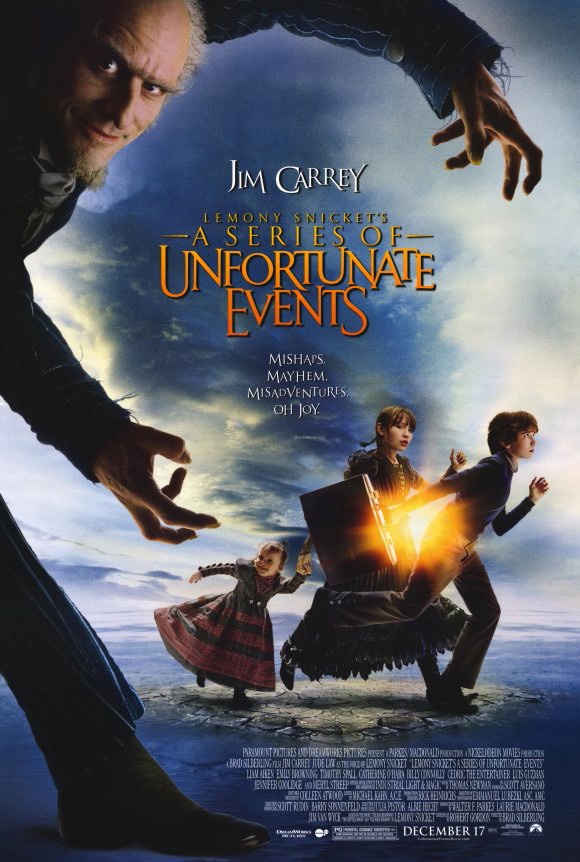
Lemony Snicket's A Series of Unfortunate Events (2004) review

Image result for a series of unfortunate events movie poster

I regret to inform you that the review that you’re about to read is for a dreadfully grim film in which terrible things happen to young children. If you wish to instead read a review for a family film with a much more light-hearted plot, feel free to browse one of the many other reviews on this site for films like Moana or The BFG… okay, I’m not going to do that narration for the entire review. But, today, we are talking about A Series of Unfortunate Events. Written by author Daniel Handler under the pen name Lemony Snicket, who serves as the series’ in-universe narrator, this 13-book series has been a major commercial success ever since it first debuted in 1999, selling over 65 million copies worldwide. I used to read these books quite often when I was younger. That’s because even though these books do live up to their namesake by being a series of stories in which bad things constantly happen to the main protagonists, they were engaging reads thanks in large part to Handler/Snicket’s descriptive writing and their entertainingly dark sense of humor (e.g. the routine running gag in which Snicket constantly warns the reader not to read the books). A new adaptation of the series makes its debut on Netflix this weekend by way of a TV series. But, before that, let’s look back at the franchise’s arguably now forgotten film adaptation from 2004, which was produced by Nickelodeon Movies, directed by Brad Silberling (Casper), and starred Jim Carrey in the role of the villainous Count Olaf. As someone who grew up with the books, I watched this film numerous times when I was younger. And although it had been years since I’d last seen it, the debut of the new Netflix series made me want to watch it again. And, upon re-watch, I found that I still enjoyed it a lot. Because for a film that ended up being a failed attempt at spawning a franchise in the era of Harry Potter, I’d argue that it’s quite underrated.

The film is based off the first three installments of the series; The Bad Beginning, The Reptile Room, and The Wide Window. It centers on the three Baudelaire children; 14-year old inventor extraordinaire Violet (Emily Browning), 12-year-old bookworm Klaus (Liam Aiken), and their infant sister Sunny (played by twins Kara and Shelby Hoffman), who loves to bite things with her sharp teeth. One day, while at the beach, the children learn from their family’s banker, Mr. Poe (Timothy Spall), that their parents have died in a severe fire that had destroyed their house. As the Baudelaires now find themselves orphaned, Mr. Poe immediately puts them into the care of their distant relative, Count Olaf (Jim Carrey), the leader of a theatre troupe who’s supposedly their ‘third cousin four times removed’ (or ‘fourth cousin three times removed’). However, the children quickly learn that Olaf is secretly plotting to inherit the Baudelaires’ vast fortune, which they themselves will inherit when Violet turns 18. Thus, he begins to treat them horribly and even tries to kill them from time to time so that he can inherit the fortune. With no one to help them, the Baudelaire orphans are forced to rely on their own strengths to thwart Olaf’s dastardly schemes. But, even after they manage to have Olaf removed from the position of being their guardian, he continues to pursue them wherever they go, coming up with new ways to get rid of them and donning disguises that manage to fool their subsequent guardians, including herpetologist ‘Monty’ Montgomery (Billy Connolly) and timid widow Josephine Anwhistle (Meryl Streep), but not the children. Along the way, the children also begin to learn some secrets regarding their parents, including a secret organization that they were once a part of.

The best thing about this film is that it does an excellent job of recreating the vivid and stylish world of the books on the big-screen. For a film that was shot entirely on sound stages, the production/set design is fantastic. It’s also backed by some solid cinematography from Emmanuel Lubezki, who of course would go on to win three straight Oscars about a decade later for his work on films like Gravity and The Revenant. The overall success that the film has in terms of visually staying faithful to the books also translates quite well when it comes to the overall story. Save for a few cosmetic changes here and there, the film is a generally faithful adaptation of the first three books. The only major narrative change is that the ending of The Bad Beginning, in which Olaf attempts to legally marry Violet to get the fortune under the guise of it being part of his new play, is repurposed to the end of the film, after the events of The Wide Window. Thus, the ‘ending’ of the first act instead sees the Baudelaires trying to escape from a trap set by Count Olaf in which they’re about to be hit by a train. I’ll admit that when I was younger, initially I used to hate this change solely for the fact that it was made. But, looking back at it now, I get the reason why this change was necessary. The ending of The Bad Beginning is a ‘finale’ that’s more suited for the end of the film instead of being the first act finale about half an hour in. Really, the biggest downfall of the film is the fact that, nowadays, it’s considerably hindered by it not getting a sequel. It’s clear that, while watching this film, there were plans to do a follow-up as the plot has quite a few mysteries that either end up unsolved or are vaguely explained. And not only did these mysteries ‘not’ end up being answered in regards to this specific iteration of the series, it also ends up being a problem for those who haven’t read the books because, again, they’re given little explanation, meaning that some moments may come off as being rather confusing to newcomers.  

In the role of Count Olaf, Jim Carrey is, to put it simply, absolutely hamming it up as the main villain. It’s been noted that the film avoids going down some of the darker routes of the books, namely in regards to Olaf himself. The more disturbing tendencies of Olaf were basically replaced by Carrey’s comedic banter. However, I’d say that Carrey still did a good job in the role. Yes, he’s over-acting like crazy but I’d argue that this is part of the character; Olaf is an actor, after all. Sure, as I just noted, it’s not really his defining trait in the books, but when you have someone like Jim Carrey in the role, you know that he’s going to bring a humorous slant to it, which he does, namely through moments that surely must’ve been unscripted and the ways in which Olaf disguises himself; first as an ‘Italian’ herpetologist named Stephano and then as a peg-legged sailor named Captain Sham, though, sadly, he doesn’t get much screen-time while disguised as the latter. In short, while film Olaf may come off as being more humorous than sinister, I think that Carrey’s take on the character is rather iconic. For the record, that’s nothing against his successor in the role, Neil Patrick Harris, but with that said, Harris does have quite a bit to live up to. As for the Baudelaire children, specifically, Violet and Klaus seeing how Sunny is only a baby, both Emily Browning and Liam Aiken do solid jobs in their respective roles. One of the key aspects of the series, in general, is the fact that, through it all, the Baudelaires are always portrayed as an endearing trio. No matter what happens to them, they’re always likable and you root for them to triumph against Olaf. This is handled perfectly in the film, making the scenes where they succeed in foiling Olaf’s plans satisfying and the more heartwarming scenes involving them effectively emotional (e.g. the scene at the end where they finally receive a letter that their parents had written them while they were in Europe). Aside from Olaf and the kids, this film has quite an impressive supporting ensemble full of recognizable faces, from Billy Connolly to Meryl Streep to Catherine O’Hara, and they all do solid jobs in providing the film with an eccentric cast of characters.

While I haven’t read the books in quite some time, I am looking forward to this new adaptation of A Series of Unfortunate Events. For one thing, it could finally result in a complete adaptation of the series, something that the 2004 film was sadly never able to achieve. While the film did do well with critics and audiences, and even though there were plans for a sequel, it ultimately didn’t get one, mainly due in part to the fact that it was taking too long to make and the young leads were getting too old for their roles. Heck, they even considered making an animated film at one point before deciding on doing a series on Netflix. Still, it’s a shame that the original film didn’t go anywhere because I’d argue that it’s rather underrated. Sure, it’s not necessarily a ‘perfect adaptation’ of the source material but it still does just enough to capture the spirit of the books, particularly in terms of the set and production design. And while it can be argued that Jim Carrey is perhaps over-doing it in the role of Olaf, he still manages to provide us with plenty of humorous moments out of his maniacal performance. There’s also some funny moments that stem from the film’s numerous fake-outs, including the opening, which makes you think that you’re watching a different film, and a scene where it seems like the Baudelaires are about to be attacked by a snake but then we cut back to Lemony Snicket (played in the film by Jude Law) having to fix his typewriter because the ribbon jammed, then culminating in the reveal that the snake wasn’t harmful. Sure, this is another thing that contributes to the film’s more humorous tone compared to the more serious nature of the books but, at the same time, it also correlates perfectly to the series’ trademark dark humor. With all this in mind, the original adaptation of A Series of Unfortunate Events is an entertaining little adventure that is sure to bring back nostalgic memories for those who grew up with it. I know I did; heck, I even went to go see it on New Years’ Eve back in 2004. So, yeah, you could say that I have a strong personal connection to this film.


Rating: 4.5/5

Sunday, December 28, 2014

Post Christmas Double Feature Short Reviews: 2014

Well folks, for the third year in a row, me and my co-panelist on ‘The Feature Presentation’, Matthew Goudreau, embarked on a cinematic double-header as we did our third straight post-Christmas double feature, as we went to go see a pair of potential award contenders yesterday, which has basically been the case with every film we’ve seen in this fashion since we started doing this. In 2012, we went to go see the musical epic ‘Les Miserables’ and Quentin Tarantino’s latest film, ‘Django Unchained’. Last year, it was Martin Scorcese’s hilarious, and in some cases rather underrated, black comedy ‘The Wolf of Wall Street’ and ‘American Hustle’, the film that unfortunately I wasn’t as big a fan of compared to most critics; I was more in the line with the general reaction from most audiences. Like I did these last two years, I’m not going to do full reviews of these two films, only because I’m currently busy prepping my end-of-the-year ‘Best of’ list. So instead, I’m just doing a pair of quick short reviews for each of the two films that Matt and I watched yesterday. So, without further ado, let’s get started.

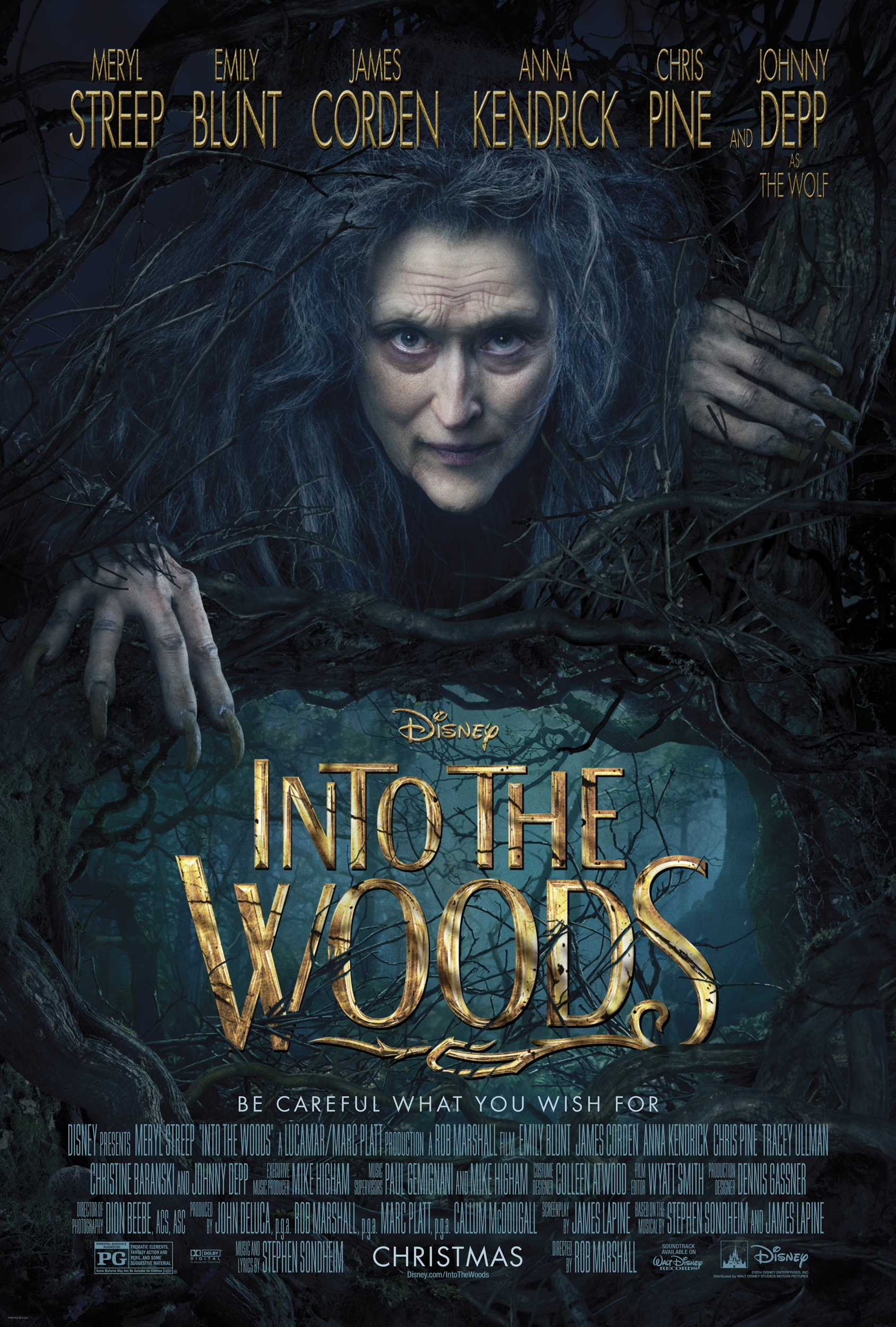
INTO THE WOODS


Disney has been known for some truly iconic movie musicals, from animated films like ‘The Lion King’ and ‘Frozen’ to live-action classics like ‘Mary Poppins’. Their latest musical, ‘Into the Woods’, certainly has quite the pedigree in terms of talent both behind and in front of the camera. It’s based off of the multi Tony Award winning musical of the same name by famous composer Stephen Sondheim and writer James Lapine. It’s directed by Rob Marshall, who helmed 2002’s Oscar-winning musical ‘Chicago’, and it’s got an all-star cast from top to bottom… and overall it’s a pretty damn good musical with stunning visuals and a nice light-hearted atmosphere that contrasts solidly with the darker turns of the second act. As some have joked, it’s sort of the fairytale equivalent of something like ‘The Avengers’ as it brings together many famous characters from classic fairytales, from Cinderella (Anna Kendrick) to Little Red Riding Hood (Lilla Crawford) to Jack from Jack and the Beanstalk (Daniel Huttlestone). It’s primarily focused around a Baker (James Corden) and his wife (Emily Blunt) who embark on a journey to lift a curse of infertility that was set upon the Baker’s family years ago by an old witch (Meryl Streep) by bringing her four items; “a cow as white as milk, a cape as red as blood, hair as yellow as corn, and a slipper as pure as gold”. And while they’re on this journey, they come across all of the aforementioned fairy tale characters who just so happen to have the items that they need.

There’s been much talk about whether or not Disney would ‘tone down’ some of the darker parts of the musical, like the sexual undertones of the scenes between Little Red Riding Hood and the Wolf (Johnny Depp, who I kid you not is literally in the film for only about five minutes). And it’s true that certain parts were definitely toned down to maintain a family friendly PG rating. But, for the most part, I think it’s for the better. While the story certainly does get dark near the end, this is, for the most part, a fairly light-hearted story with a lot of humor and some fairly over-the-top moments but it’s ‘over the top’ in a good way as it’s a fairly heightened reality being that it’s a fairy tale. The musical numbers are solid and the cast is spot on from top to bottom. A lot of people have been focusing on Meryl Streep as the Witch and while she is great in the role, I have to say the biggest standout of the cast would actually have to be Emily Blunt as the Baker’s Wife, as she provides a much more ‘down-to-earth’ persona compared to most of the other characters in the story. My only real complaint about the film is that sometimes it feels like the story rushes through some moments, like when Jack climbs the beanstalk. I mean, this was probably the case with the musical as well but I do kind of wish that we could’ve gotten to see some of these moments. Still, ‘Into the Woods’ is a solid musical and while I can’t really say how much it stays true to the original musical due to the fact that I haven’t seen it, I have the feeling that this film at least does it justice.

Rating: 4.5/5

THE IMITATION GAME


Then we have ‘The Imitation Game’, based on the true story of Alan Turing, the famous computer scientist who was one of the key figures in cracking the Enigma Code of Nazi Germany during the Second World War by developing a special deciphering machine known as the ‘bombe’ that could encrypt these secret messages much faster than any human can. This story is truly fascinating and in some cases fairly sad due to some key events that happen near the end. I mean, this was a man whose work saved countless lives during World War II and, as some have predicted, it shortened the length of the war by at least two years. And yet unfortunately, in 1952, he was prosecuted for being a homosexual, a way of life that was outlawed in the UK at the time. He died only two years later in 1954 on account of suicide, and it wasn’t until recently (just a year ago, in fact) when his work was finally given the proper recognition it truly deserves. With that in mind, this is without a doubt a must-see ‘true story’ film as Turing was a man who truly left a major impact on all of our lives. You know those devices that you and I use every day… computers? His work is what laid the groundwork for that technology and the fact that he was prosecuted just for being gay (which is just total BS) makes this film even more important in today’s society, where currently only 35 states in the U.S. (and the District of Columbia) allow same-sex marriage.

The main highlight of this film is easily Benedict Cumberbatch’s performance in the role of Turing. I can definitely see a bit of Cumberbatch’s version of Sherlock Holmes in this performance as both men have this sort of awkwardness to them. But while Sherlock is more confident in what he’s doing despite the fact that he seems awkward and strange to everyone around him, Turing is fairly shy in terms of his awkwardness, which makes sense due to the fact that he’s holding in a big secret from everyone around him. Keira Knightley is also superb here as well as Joan Clarke, a fellow code-breaker who Turing gets into a romantic relationship with before finally revealing his secret to her. Not only are the performances great, but the film is really captivating as we see Turing and his team in a race against time to break the Enigma Code as they only have a set amount of time each day to figure it out before it switches at the end of the day. All in all, ‘The Imitation Game’ is a well-acted and well-directed film that truly shines a light on a man who thankfully has begun to receive the recognition that he truly deserves and the struggles that he went through near the end of his life will certainly resonate for many people today.


Rating: 5/5!