Showing posts with label Jon Favreau. Show all posts

Thursday, October 22, 2020

The Mandalorian: Season 1 Review (Disney+)


“This is the way.”

WARNING: FOR THOSE WHO ARE NEW TO THIS SITE, WHENEVER I REVIEW A SEASON OF A TV SHOW, I USUALLY TEND TO DIVE RIGHT INTO SPOILER TERRITORY TO PROPERLY DISCUSS EVERY KEY DETAIL OF THAT SEASON. WITH THAT IN MIND, IF YOU HAVEN’T WATCHED SEASON 1 OF THE MANDALORIAN YET, MAJOR SPOILERS AHEAD!!!

(So… you’re probably wondering why it took me nearly a full year to get around to this. Well, you can primarily chalk that up to me being consistently preoccupied with other projects like my Top 12 of 2019 list and the retrospectives that I’ve done for franchises such as Scooby-Doo, National Treasure, and Bill & Ted. And yes, I know how incredibly ironic that argument is given the fact that COVID-19 basically left us with a lot more free time on our hands, but I guess you could say that I’m just one of those folks who likes to finish the projects that I’m currently working on before starting a new one. But now, with Season 2 set to debut on October 30th, the time has finally come for me to tackle the Star Wars franchise’s first live-action TV series.)

At this point, I really don’t need to explain how big of a franchise Star Wars has been for the past four decades since its enduring cultural legacy and monumental impact on practically every major form of media clearly does the job for me. However, some of you might be surprised to learn that the one facet of the media landscape that Star Wars hasn’t really delved into until recently is live-action television. Yes, for the longest time, the Star Wars franchise’s forays into television were primarily animated. This included, among others, the two spin-off series in the ’80s that were produced by the Canadian animation studio Nelvana, Droids and Ewoks, Genndy Tartakovsky’s critically-acclaimed Clone Wars series which ran from 2003 to 2005, and the various shows that have been produced by Dave Filoni such as The Clone Wars and Rebels. Now, to be clear, this doesn’t mean that there haven’t been any live-action Star Wars TV projects… it’s just that it’s been quite a while since they were made. For starters, there were a pair of made-for-television films centered around the Ewoks, Caravan of Courage: An Ewok Adventure in 1984 and Ewoks: The Battle for Endor in 1985. But for the longest time, the Star Wars franchise’s biggest connection to live-action television was the infamous 1978 production that was the Star Wars Holiday Special, and to mirror George Lucas’ own thoughts about it… the less said about it, the better. However, in 2005, not long before the release of Episode III – Revenge of the Sith, plans for a new live-action TV series set in the Star Wars universe were announced at that year’s Star Wars Celebration. Officially titled Star Wars: Underworld in 2012, it was reported that the show would be set in-between the events of the prequel and original trilogies and, unlike the films, was going to be more of a noir-inspired show that focused on both the criminal and political conflicts occurring all over a galaxy far, far away.

There were, reportedly, around 100 episodes planned with at least half of them having nearly completed scripts (according to prequel trilogy producer Rick McCallum, they were in the ‘second draft’ stage). However, the series soon found itself hitting a brick wall when it became clear that it would be way too expensive of a show to be produced for either network or cable television. And while it was reportedly still in the works following Disney’s purchase of Lucasfilm in 2012, Underworld ultimately never saw the light of day. The only noteworthy elements that came out of it were plotlines that influenced the franchise’s future anthology films, Rogue One and Solo. However, this did not stop Lucasfilm from making another attempt at developing the first official live-action Star Wars TV series, which finally came to be in the form of The Mandalorian, arguably the biggest project to headline the launch day content of Disney’s new streaming service, Disney+. The show is primarily the brainchild of Jon Favreau, AKA the man responsible for kick-starting the Marvel Cinematic Universe with the original Iron Man and other hits such as the modern holiday classic Elf and the live-action remake of Disney’s The Jungle Book. As the title suggests, the show largely focuses on the titular group of warriors within the Star Wars universe who often work as bounty hunters. Mandalorian culture was first introduced in Episode V – The Empire Strikes Back through the character of Boba Fett who, while not technically an official Mandalorian, has consistently been one of the franchise’s most popular characters despite his admittedly limited role in the original trilogy. But now there’s a new Mandalorian bounty hunter on the scene thanks to a show that not only does a wonderful job of expanding upon the considerably massive Star Wars universe, but also delivers on everything else that fans have come to expect from the biggest franchise in cinematic history.

The Mandalorian takes place about five years after the events of Episode VI – Return of the Jedi. While it’s still plenty of years before the remnants of the Galactic Empire reunite to form the First Order, the galaxy is still rife with plenty of lawless individuals. It is in this environment that Din Djarin (Pedro Pascal), a member of the Mandalorian tribe who is solely referred to by others as ‘The Mandalorian’, goes about his business as one of the galaxy’s most revered bounty hunters. After delivering his latest bounties to his primary associate on the planet Nevarro, Bounty Hunters’ Guild leader Greef Karga (Carl Weathers), Karga directs The Mandalorian to his newest client, a mysterious, unnamed man (Werner Herzog) who’s revealed to be a former member of the Empire. Said client promises the Mandalorian a large amount of Beskar steel, the material used to craft Mandalorian armor, in exchange for the capture and return of his target, and while he isn’t given much information about the target apart from its age and last known location, the Mandalorian promptly embarks on his new assignment. But while he does manage to successfully find the target, he is surprised to discover that it is a young green-skinned alien with large ears. And while the Mandalorian does obey the Bounty Hunter code by delivering the target back to the Client without any questions asked, he soon begins to form a bond with ‘The Child’ and ultimately decides to protect it when he begins to grow concerned about what the Client plans to do with it, especially once he learns that it possesses some mysterious abilities. Naturally, though, this promptly makes them two of the biggest targets in the galaxy as they are forced to go on the run from anyone daring enough to try and hunt them down.

To properly discuss this show, I’m going to have to mention something that is guaranteed to rile up the Star Wars fandom… subverting expectations. It’s a concept that has almost single-handedly fueled the flames of the franchise’s annoyingly vocal group of haters following the release of The Last Jedi, AKA another Star Wars release that made headlines for going against the fandom’s expectations. At the same time, though, it has also arguably become the internet’s new standard for how all future Star Wars projects are to be judged given the largely polarizing reaction towards The Rise of Skywalker. And yet, while none of this has ever had a significant impact on my thoughts towards the franchise’s recent outings, The Mandalorian is, indeed, another case where those involved genuinely managed to take us by surprise. In other words, I have the feeling that, going into this show, a lot of folks were primarily expecting it to be something along the lines of a gritty western given the fact that it would be focusing on one of the Star Wars galaxy’s many bounty hunters. And while that is very much an accurate description of the show in terms of both its plot and overall atmosphere, the reveal at the end of Chapter 1 regarding ‘The Child’, who is shown to be from the same race as Yoda, adds a unique additional layer to what this series is ultimately about. Instead of just being a story of an emotionally distant bounty hunter traversing the galaxy and hunting down his targets, it’s also about that same bounty hunter learning to take on the responsibility of being a father figure for the far more innocent being that he was originally sent to capture. Sure enough, this is what  gives this show the kind of emotional depth that has thoroughly bolstered the franchise’s best cinematic outings while still giving Jon Favreau and his crew plenty of great opportunities to showcase a different side of the Star Wars universe in a creatively satisfying manner.

Said story comes together phenomenally in this eight-episode season. That said, though, I am aware that there has been some criticism about the show’s pacing which, from what I can gather, often revolves around the fact that these episodes are usually about half an hour long at best. And yet, as cool as it would’ve been to have longer episodes that would have given us more time with these characters, I also feel that these shorter episodes allow for a much tighter overarching plot, which helps the show avoid any stretches where its proceedings start to drag. Sure, there are a few episodes around the halfway point that deviate a bit from the main plot, but as much as one could very well describe these as ‘filler’ episodes, they still manage to be just as engaging as the episodes where the Mandalorian contends with those who are hunting ‘The Child’. In fact, one of the best things that I can say about this show is that each of these episodes gives off a terrific episodic feel, which is an approach that has always worked wonderfully for Star Wars (almost all the films are referred to as ‘Episodes’, after all…). Of course, much of this is thanks to what Favreau has described as a “Dirty Dozen/Magnificent Seven type” crew of directors which consists of Dave Filoni, Rick Famuyiwa, Deborah Chow, Bryce Dallas Howard, and Taika Waititi. All five of them do a wonderful job of capturing that classic Star Wars feel in their respective episodes whether it’s thanks to the strong comedic banter between characters or the top-notch action sequences. The show also happens to boast some of the sharpest visuals from any Star Wars production to date. Much of this is due to how it was shot, with most sequences being filmed in front of a massive video wall that utilized fully rendered backgrounds courtesy of Epic Games’ Unreal Engine. It’s a technique that was clearly inspired by Favreau’s work on both The Jungle Book and The Lion King, and while this does mean that a lot of the show’s visuals are CG-based, the visual effects work here is so seamless that you’d legitimately never notice.

The show also follows in the footsteps of the franchise’s best outings by featuring a top-notch ensemble cast, although it is worth noting that, technically, Pedro Pascal is the only ‘main’ star since he’s the only one apart from ‘The Child’ (who, like Yoda before him, is a puppet) to appear in all eight episodes. And since the Mandalorian is always in full Mandalorian armor, sometimes it’s Pascal’s stunt doubles (Brendan Wayne and Lateef Crowder) in the suit instead of him. Nevertheless, Pascal (and, by extension, Wayne and Crowder) does a phenomenal job in the role as he perfectly conveys the character’s world-weary nature while simultaneously excelling at the physical demands that stem from a character who never shows his face but still manages to relay so much simply through his actions. Of course, I’d be remiss if I didn’t bring up the character that has clearly been the series’ breakout star, The Child, affectionately referred to by fans as ‘Baby Yoda’ for obvious reasons. Just like how Yoda was portrayed in the original trilogy (and The Last Jedi), The Child is brought to life by puppetry with only minimal CGI used… which can partially be attributed to the fact that co-star Werner Herzog straight-up called Favreau and his team ‘cowards’ for even considering going the full CGI route. Naturally, this is one of the many reasons why The Child instantly becomes an utterly adorable character and undeniable scene-stealer. As for everyone else in the cast, they very much make the most out of their roles even if they only appear in a few episodes. It all begins with the series’ female lead, Gina Carano as Cara Dune, a former Rebel shock trooper who’s later revealed to be from Princess Leia’s ill-fated home planet of Alderaan. Cara doesn’t appear until Episode 4 and only appears in 3 episodes overall, but that doesn’t stop Carano from being another fine addition to the franchise’s ever-growing line of terrific female heroines as her MMA background is a perfect match for a character who is immediately established as a no-nonsense, badass warrior.

Much of what I just noted with Carano also applies to the other main characters in this show. Established veterans such as Carl Weathers and Nick Nolte (the latter of whom provides the voice of Kuiil (who’s portrayed physically by stuntwoman Misty Rosas), an Ugnaught moisture farmer who becomes one of the Mandalorian’s most loyal allies) are great as always in their respective roles. The same can be said for other standout supporting players such as Emily Swallow as the Mandalorian tribe’s wise Armorer and Taika Waititi as bounty hunter droid IG-11, who immediately proves to be another great addition to the franchise’s collection of droid characters. This cast is so terrific that even characters who are only in single episodes such as Bill Burr’s hot-headed mercenary Mayfeld (a casting choice that has been widely noted as incredibly ironic given his long-standing criticisms of the franchise) and Ming-Na Wen’s cold and calculating assassin Fennec Shand prove to be just as memorable as the main protagonists. Finally, we come to the two main antagonists of the season, both of whom fully succeed at making quite an impression even with their admittedly limited screen-time. First, there’s Werner Herzog (yes, that Werner Herzog) as the Mandalorian’s enigmatic new client. He only appears in a few episodes and could ultimately be considered as being more of a ‘red herring’ villain given how the story plays out, but Herzog steals the screen in every scene that he’s in thanks to his strong screen presence. This then brings us to the other villain of the season, Giancarlo Esposito’s Moff Gideon, a former member of the Empire’s secret police. This character doesn’t even appear until the penultimate episode of the season and yet Esposito still manages to immediately set him up as one of the most imposing antagonists in franchise history, especially since it’s recently been confirmed that he’ll play a much larger role in Season 2.

Given my affinity for the recent Star Wars films, it probably isn’t that surprising that I really loved Season 1 of The Mandalorian. However, before we go any further, I just want to elaborate a bit on what I mean by that. You see, as much as I love this show, that doesn’t automatically mean that I think that it’s the ‘best’ Star Wars project that has come out since Disney purchased Lucasfilm in 2012. Now to be clear, I’m not trying to discourage anyone who legitimately thinks that it is because, in the show’s defense, it truly is a sharply produced series that is quite arguably worthy of that honor. It’s just that, from experience, I find that this argument often tends to stem from all those wholly obnoxious Last Jedi haters who use it as part of their unwavering efforts to rag on the recent trilogy. It’s even gotten to the point where they’ve been touting Jon Favreau and Dave Filoni as the ones who will allegedly ‘save’ Star Wars even though I know damn well that they’ll just start hating on them if the two of them ever did something that they don’t like because… well, that’s just what they always do. So instead, I’m just going to focus on why The Mandalorian is simply yet another rousing success for the Star Wars franchise. Thanks to the strong creative guidance of Jon Favreau and the phenomenal work from his directorial crew, The Mandalorian is a highly compelling, for lack of a better term, ‘episodic saga’ that manages to deliver a genuinely unique spin on the classic Western genre of storytelling that it’s very much inspired by. Its breathtaking visuals rival those of the recent Star Wars films and it also boasts one of the franchise’s best ensemble casts, and because of all this, it definitively sets the stage for what is sure to be an exciting new era for the Star Wars franchise.

SEASON 1 RATING: 5/5!

Now, before we conclude today’s review, I wanted to do something along the lines of what I did a few years back when I reviewed the first few seasons of Agents of S.H.I.E.L.D. and do a rankings list of my favorite episodes from this season. But since this season only consisted of eight episodes, I decided to rank them all instead of just doing a traditional Top 5. Before we continue, though, I need to stress one important detail. This will not be a case where I’ll be ranking them from ‘worst’ to ‘best’ because, as I alluded to earlier in this review, there were honestly no ‘bad’ episodes from this season. Each of these eight episodes were wonderfully crafted by their respective directors and are all memorable in their own unique ways, which is another reason why I decided to cover all of them instead of a select few.

8. CHAPTER 2: THE CHILD

We start this list off with Chapter 2, ‘The Child’, which was the first of two episodes directed by Rick Famuyiwa, fresh off 2015’s critically-acclaimed coming-of-age drama Dope. Precisely continuing from the pilot episode’s unforgettable cliffhanger, this episode sees the Mandalorian begin the journey back to Nevarro with The Child in tow. He does begin to run into some trouble, however, when he fights off a bunch of rival bounty hunters who are also after The Child. And if that wasn’t enough, he then discovers that his ship, the Razor Crest, has been thoroughly scavenged by Jawas, thus forcing him to try and negotiate with them (with the help of Kuiil) so that he can get it back in working order. As I noted earlier, this episode’s placement at the bottom of the list doesn’t mean that it’s a ‘bad’ episode. Sure, it may be a rather short one at just half an hour long, but it’s chock-full of great action sequences such as the Mandalorian’s first attempt at pursuing the Jawas, which promptly ends with him getting hit with a whole bunch of electric shocks that knock him right off the top of their Sandcrawler. There’s also a lot of great humorous moments, like when the Mandalorian gets so frustrated with the Jawas during their negotiation that he nearly sets some of them on fire with his flamethrower. Eventually, though, he and Kuiil manage to strike up a deal with them that results in him having to collect the egg of a vicious horned creature known as a Mudhorn. And while the Mudhorn does proceed to give him quite a bit of trouble, he ends up being aided by The Child, who manages to subdue it with the Force. Thus, the Mandalorian acquires the egg and gives it to the Jawas, who promptly devour its contents, and he and Kuiil manage to fix his ship, with the latter rejecting his offer to tag along as his new crew member. All in all, this is a really fun episode that, like the pilot, does a great job of slowly but surely revealing more of the overall story which, in this instance, namely stems from the reveal that The Child is one with the Force. Really, the only reason why it’s at the bottom of this list is that it simply ends up being outdone by the other 7 episodes.

7. CHAPTER 7: THE RECKONING

I realize that placing this episode at, fittingly enough, the number 7 spot on this list may be a bit controversial given the fact that it was one of two episodes this season that received a perfect 100% rating on Rotten Tomatoes. But just like Chapter 2, this ultimately comes down to overall preference rather than me having anything bad to say about it. The episode begins with the Mandalorian being contacted by Greef Karga, who requests his help in taking down the Client and his Imperial forces on Nevarro in exchange for Greef clearing up their current predicament with the Bounty Hunters’ Guild. He then proceeds to recruit both Cara Dune and Kuiil to aid in the mission but is surprised to learn that the latter has rebuilt IG-11 after he’d destroyed it in Episode 1 and has reprogrammed it so that it can now serve as The Child’s protector. Naturally, he ends up taking issue with this, not only because IG-11 was originally intent on killing The Child but because he’s also been established as having a severe distrust of droids, which is ultimately expanded upon in the finale. It also ties into a recurring plot-point in this episode where the group is repeatedly riddled with personal conflicts, such as The Child force-choking Cara due to a misunderstanding and Kuiil revealing that he used to work for the Empire (albeit as an indentured servant), which doesn’t fly well with Cara given her history with the Rebels. Despite running the occasional risk of over-complicating these proceedings, these moments serve as some excellent bits of character development for the Mandalorian and his crew, especially since many of them are given highly effective pay-offs by the end of the season.

Anyway, the group eventually makes their way back to Nevarro, where they meet up with Greef and his crew and are informed that they’ll have to travel to the town on foot since it’s been completely overtaken by the Client’s troops. At one point, the group is attacked by a group of winged creatures and while Greef sustains some serious injuries from this encounter, The Child ends up healing him with the Force (On a side note, remember when Rey did the exact same thing in Rise of Skywalker and yet a lot of people gave her crap for it?). Because of this, Greef ultimately decides to go against his group’s ‘true’ plan of killing the Mandalorian by killing his associates instead and promising to legitimately help the Mandalorian and his crew protect The Child. However, instead of just ending with a traditional finale where the Mandalorian and crew successfully take down the Client by fooling him into thinking that they’ve brought The Child to him, the episode ends up taking a much different route. During the meeting between the two parties, the Client receives a call from one of his associates… before he and his men are promptly annihilated by a barrage of gunfire. The Mandalorian, Cara, and Greef barely manage to survive this onslaught before finding themselves cornered by the Client’s associate, Moff Gideon, and his army of stormtroopers. Gideon proclaims that he’ll soon have The Child in his possession as we see a pair of scout troopers pursuing Kuiil as he brings The Child back to the Razor Crest. The episode ends on a tragic note as the Troopers kill Kuiil and grab The Child. And so, while this may not be my personal favorite episode from this season, its incredibly intense climax is an undisputed highlight as it perfectly sets the stage for an epic finale.

6. CHAPTER 1: THE MANDALORIAN

While the first episode of a new series usually ends up being overshadowed by the episodes that follow, that doesn’t mean that they can’t be just as great by comparison, and that certainly applies to The Mandalorian’s pilot episode, which served as Star Wars mainstay Dave Filoni’s live-action directorial debut. Thanks to this episode, we get an excellent introduction to the title character and the section of the Star Wars galaxy that he inhabits right from the opening sequence where he nabs an overly talkative bounty. This, of course, then paves the way for our first glimpses at the season’s main plot as the Mandalorian accepts a high-paying commission that’s being offered by a mysterious Client with former ties to the Empire. It’s the episode where we first meet the good-natured Kuiil, who helps the Mandalorian prepare for his journey by helping him learn how to ride a mountable creature known as a Blurrg. Ultimately, though, the biggest highlight of this episode is its action-packed climax in which the Mandalorian reaches his target’s location and proceeds to take on a whole bunch of goons with the help of droid bounty hunter IG-11. As he’s basically known to do nowadays, Taika Waititi is an utterly delightful standout as the no-nonsense assassin droid and the comedic rapport between IG-11 and the Mandalorian is fantastic, especially whenever the latter has to keep the former from initiating his self-destruct function. This, of course, then brings us to the episode’s instantly iconic finale as the two bounty hunters find their target and discover that it’s a young alien child. And while IG-11 intends on killing it, the Mandalorian proceeds to subdue his new associate since he intends on bringing The Child back alive. Thus, thanks to Dave Filoni’s excellent direction and the sharp script from Jon Favreau, this first episode is a brilliant kick-starter for this great new series.

5. CHAPTER 6: THE PRISONER

Rick Famuyiwa’s second episode of the season begins with the Mandalorian reuniting with one of his old colleagues, Ranzar ‘Ran’ Malk (Mark Boone Junior), who requests his help in teaming up with a bunch of his mercenaries to rescue one of their own from a New Republic prison ship. And while this is the only episode in which Ran’s crew of mercenaries appears, they instantly manage to be a solidly memorable gang of criminals. This includes Bill Burr’s ex-Imperial sharpshooter Mayfeld (“I wasn’t a stormtrooper, wise-ass!”), Natalia Tena’s Xi’an, a fiery Twi’lek who’s implied to be one of the Mandalorian’s old flames, Clancy Brown’s Burg, the group’s Devaronian muscle, and a protocol droid named Q9-O voiced by Richard Ayoade. Overall, this episode delivers a delightfully exciting heist plot as the crew infiltrates the ship, fights off its collection of guard droids, and rescues Xi’an’s brother Qin (Ismael Cruz Cordova), who’s shown to have a complicated history with the Mandalorian. Sure enough, the Mandalorian then finds himself double-crossed by Mayfeld and his crew but is eventually able to get back at them by subduing Mayfeld, Xi’an, and Burg and sticking them in one of the ship’s cells. And as for Q9-O, he gets destroyed when he attempts to kidnap The Child after learning about the Mandalorian’s current situation. The only one that he ‘spares’ is Qin, who is then brought back to Ran’s space station, and while Ran immediately sends a gunship after his old associate, he is instead met with a trio of X-Wing pilots who were ‘guided’ there by the Mandalorian thanks to a distress signal that he got from the prison ship and promptly attack his base of operations. Now admittedly, this is one of those episodes that, as I mentioned earlier, is more of a ‘filler’ type episode since it deviates quite a bit from the main plot. And unlike the other episode from this season that could also be described as a ‘filler’ episode, this one doesn’t open in a way that, at the very least, still feels somewhat connected to everything and there aren’t many allusions to what’s mainly going on apart from when the mercenaries discover The Child. Still, for what it’s worth, this is a highly entertaining episode that still managed to do quite a lot with its ‘B-plot’.  

(It’s also worth noting that this episode features a bunch of fun cameos from various veterans of the Star Wars universe. The lone human guard that the crew comes across while on the prison ship, Davan, is played by Matt Lanter who, of course, is best known for voicing Anakin Skywalker in The Clone Wars. And as for the three X-Wing pilots who attack Ran’s station, they’re played by series directors Dave Filoni, Rick Famuyiwa, and Deborah Chow.)

4. CHAPTER 3: THE SIN

Chapter 3 proved to be quite notable upon its debut as it was the first piece of live-action Star Wars material to be directed by a woman. In this case, the honor goes to Deborah Chow, who’s directed episodes for various shows over the years such as Mr. Robot and Jessica Jones and is set to headline the production of another upcoming Star Wars series centered on Obi-Wan Kenobi. And sure enough, as far as her role in the future of this franchise is concerned, she immediately makes one hell of an outstanding first impression thanks to this action-packed episode that also does a great job of officially setting some of the series’ biggest character beats into motion. While it opens with the Mandalorian finally returning to Nevarro and delivering The Child to his client, it ends with him openly defying the Bounty Hunter Code to rescue The Child out of concern for its safety. This then results in one of the best action sequences of the entire season as he infiltrates the client’s facility and takes out a whole bunch of his stormtroopers, including one that he thoroughly torches with his flamethrower. But the action doesn’t stop there as he soon finds himself cornered by Greef Karga and all the other bounty hunters in the area who now have a new target… him. And yet, at a point where it seems as if he’s fully outnumbered, he ends up being saved by his fellow Mandalorian warriors, which is a nice bit of payoff to an earlier scene where he was criticized by some of them for working with Imperials since their Tribe’s past conflict with the Empire, the Great Purge, was what forced them to go into hiding. Nevertheless, that doesn’t stop them from helping one of their own even if, as the Mandalorian points out, they’ll have to relocate now that they’ve made themselves known. This is, after all, the episode that properly establishes the Mandalorian tribe’s principles as best represented by what has easily become this show’s definitive quote, “This is the Way”. And with that, Chapter 3 is another standout piece of this great season thanks in large part to Deborah Chow’s fantastic direction.

3. CHAPTER 5: THE GUNSLINGER

Of these eight episodes, Chapter 5 has the lowest critical score of the bunch on Rotten Tomatoes with a 74% rating. While not panned, per se, the episode did catch quite a bit of flak from critics due to the one thing that has become the internet’s favorite topic when it comes to judging Star Wars, its use of nostalgia. But as I’ve said before, that sort of thing doesn’t affect my views on this franchise in the slightest, and because of that, I’d argue that this was a damn good episode regardless of how much it harkened back to the franchise’s past adventures. For one thing, it starts off on a fantastic note as the Mandalorian fends off a rival bounty hunter complete with a badass quip when the latter has the guts to use his “I can bring you in warm… or I can bring you in cold” line that he had used back in the first episode (“That’s my line!”). However, due to the damages that the Razor Crest sustained during the battle, the Mandalorian is forced to make a pit stop on Star Wars original sand planet, Tatooine, in that notoriously “wretched hive of scum and villainy”, Mos Eisley Spaceport. It is there that the Mandalorian meets a wannabe bounty hunter named Toro Calican (Jake Cannavale) who asks for his help in capturing mercenary Fennec Shand (Ming-Na Wen), who’s worked with practically every crime syndicate in the galaxy, so that he can officially join the Bounty Hunters’ Guild. The dynamic that forms between these two is easily one of the best parts of this whole episode as it’s largely defined by the great contrast between the battle-hardened and fully experienced Mandalorian and the rookie Toro, who’s clearly shown to be in over his head when it comes to this line of work.

As for the episode itself, we get a highly entertaining chase storyline as the two bounty hunters go after Fennec. They encounter some Tusken Raiders along the way (complete with a great humorous bit where Toro bad-mouths them before it’s revealed that a pair of them are standing right behind them) and unlike Anakin Skywalker in Revenge of the Sith, the Mandalorian recognizes exactly what they’re up against when it’s clear that Fennec… has the high ground. Sure, the finale of this episode is a rather predictable one as Fennec convinces Toro to turn on the Mandalorian by revealing his situation with The Child, which results in the Mandalorian promptly taking him out instead, but that doesn’t stop this from being a fun little subplot that nicely complements the main plot. Like Chapter 6, this could very well be described as a ‘filler’ episode but that doesn’t mean that it’s any lesser when compared to the other episodes just because it doesn’t focus too much on the Mandalorian and The Child’s predicament. Case in point, the whole opening sequence with the rival bounty hunter is what gives this episode the edge over Chapter 6 since it starts the episode off in a way that properly sets up its main conflict while still continuing to stress the fact that the Mandalorian is a wanted man. The other noteworthy aspect of this episode is Ming-Na Wen, who’s fantastic in the role of Fennec Shand, especially thanks to how she’s effectively established as a considerable foe for both the Mandalorian and Toro. Plus, while her role in this episode ultimately ends with her getting shot by Toro (who, at the very least, recognized the possibility of her betraying him), the episode ends with a mysterious figure approaching her body, implying that she may not be dead just yet. And so, with all this in mind, I’d argue that Chapter 5 is the most underrated episode of this season. I’m not denying that a lot of it is driven by that classic Star Wars nostalgia, but just like The Force Awakens and The Rise of Skywalker, I don’t really see why that’s such a bad thing.

2. CHAPTER 4: SANCTUARY

Jon Favreau has noted that Chapter 4 was the most challenging episode of the season due to its large-scale action sequences and forest setting… which is why he intentionally gave it to the most untested director of the bunch, Bryce Dallas Howard (who, to be fair, has directed a few short films and the 2019 documentary Dads). Ultimately, though, Howard delivers a true gem of an episode that is not only a great action-packed affair but one that also delivers on some strong emotional poignancy. The episode begins with the Mandalorian and The Child, now firmly on the run from the Bounty Hunters’ Guild, landing on the forest planet Sorgan. It is here where we are first introduced to Cara Dune who, despite seeming hostile at first to the point where she and the Mandalorian get into a brief brawl, ends up becoming a friendly acquaintance. The bulk of the episode’s plot, however, revolves around the two of them being approached by members of a nearby village who ask for their help in fending off a band of Klatooinian raiders. And if that wasn’t enough, the Mandalorian and Cara then discover that the raiders also happen to possess an Imperial AT-ST. Thus, in a nod to classic films such as Seven Samurai and The Magnificent Seven, the two proceed to train the villagers so that they can fight back, resulting in a great nighttime battle where the group is able to take down the powerful walker. Ultimately, though, the biggest moment of this episode occurs right at the end when the Mandalorian reveals that he plans on leaving The Child at the village so that he can be safe. One of the villagers, widower Omera (Julia Jones), suggests that he stays as well to the point where she nearly becomes the first person to take off his helmet since he was a child before he ultimately stops her. Sadly, this chance at a peaceful life is tragically shattered when another bounty hunter arrives on the scene, and while he’s quickly taken down by Cara, the Mandalorian quickly realizes that he and The Child are still very much in danger. And so, the episode ends with the two of them bidding a somber farewell to the villagers as they head back to their ship. With a devastating yet powerful ending like that, it’s easy to see why Chapter 4 has been touted as one of the season’s best.

1. CHAPTER 8: REDEMPTION

While Chapter 4 certainly gives it some competition, the best episode of this season ends up being Chapter 8, which was brought to us by everyone’s favorite comedic genius from New Zealand, Taika Waititi. Sure enough, the episode starts off in true Waititi fashion with a great comedic bit where the two Scout Troopers who grabbed The Child (played by Adam Pally and Jason Sudeikis) impatiently wait outside the town to bring it to Moff Gideon. One of them continuously tries to get a peek at The Child and they both shoot at a nearby transmitter with the exact kind of piss-poor accuracy that stormtroopers are notoriously known to have. And sure, there are a few points where the troopers mistreat The Child (to the point where one of them straight-up punches him after he gets bitten), but the little one is thankfully saved by IG-11. IG-11 then proceeds to help the Mandalorian, Cara, and Greef by riding into town on one of the scout troopers’ speeder bikes and taking out a whole bunch of Gideon’s stormtroopers. That said, though, there’s a lot more to the ensuing battle between the two sides than just that. For starters, even though he was only introduced at the end of the previous episode, Gideon immediately proves to be one hell of an imposing villain by subtly revealing that he knows all about our heroes. He knows that Cara was originally from Alderaan, that Greef is a disgraced magistrate, and that the Mandalorian’s real name is Din Djarin. And while the gang manages to put up quite a fight against Gideon’s forces (complete with The Child using the Force to fight off a flamethrower-wielding stormtrooper), the Mandalorian ends up suffering a devastating head injury. But while he initially tells the others to go on without him, he’s ultimately healed by IG-11, who becomes the first being to take off his helmet. And while the Mandalorian promptly reminds IG-11 of the Mandalorian creed that says that no one is to ever see his face, IG-11 reasons that he can be the exception given that he’s not human. It’s also worth noting that, after a few glimpses of it in previous episodes, we finally witness Din Djarin’s backstory where it’s revealed that he was the sole survivor of a Separatist droid attack that killed his parents before being rescued by the Mandalorians, who adopted him into their tribe as a Mandalorian foundling.

The group then proceeds to head to the Mandalorian tribe’s hidden covert but is stunned to find it almost completely abandoned save for the Armorer. After being shown The Child for the first time, the Armorer informs the Mandalorian that he’s to return it to its own kind, and given its powers, she suggests that The Child hails from an ancient enemy of the Mandalorians… the Jedi. Until then, The Child is a Mandalorian foundling and the Mandalorian is his protector as the Armorer officially appoints him his signet (modeled after the Mudhorn that they fought in Chapter 2) that designates them as a ‘Clan of Two’. He’s also given an official Mandalorian jetpack, which is a nice callback to a key moment from the end of Chapter 3 (“I’ve got to get one of those…”). But once again, the action doesn’t stop there. In their efforts to escape, the group finds themselves facing down a whole bunch of stormtroopers at the end of their escape route in the sewers. This then results in a solidly effective emotional moment in which IG-11 nobly sacrifices himself by finally initiating his self-destruct function to take them all out. And while the group is then attacked by Gideon in his TIE fighter, the Mandalorian uses his newly acquired jetpack to great effect and successfully manages to crash Gideon’s ship. With no immediate threat on the horizon, the Mandalorian officially heads off to find whoever The Child truly belongs to (though not before giving Kuiil a proper burial) while Cara decides to stay on Nevarro and serve as Greef’s enforcer. But then, if that wasn’t enough, the episode ends with Gideon breaking out of his crashed TIE Fighter with the help of a key weapon from Star Wars’ past, the Darksaber. This distinctive black lightsaber first appeared in Star Wars: The Clone Wars and, over the course of both that show and Star Wars: Rebels, has been in the possession of several major characters such as Darth Maul. And while I’ll openly admit that I’m not exactly up to date on all of Dave Filoni’s Star Wars shows, I can still see why this big reveal must’ve been a huge deal for fans of the franchise. With all that in mind, it should go without saying that Chapter 8 is a kick-ass season finale. Admittedly, it does cover quite a lot of ground in just 46 minutes, but thanks to Waititi’s excellent direction, none of it ever feels rushed. Instead, it’s just a high-octane thrill ride of an episode that ends this outstanding first season on an equally outstanding note.

And with that, we finally conclude this extensive review of Season 1 of The Mandalorian. Thanks for following along and be sure to sound off in the comments below with your own thoughts on the Star Wars franchise’s first live-action TV series. I also want to note that, unlike what happened here with Season 1, I will do my best to stay up-to-date on Season 2 so that I can get a review of that season published in a reasonable timeframe.

Saturday, July 27, 2019

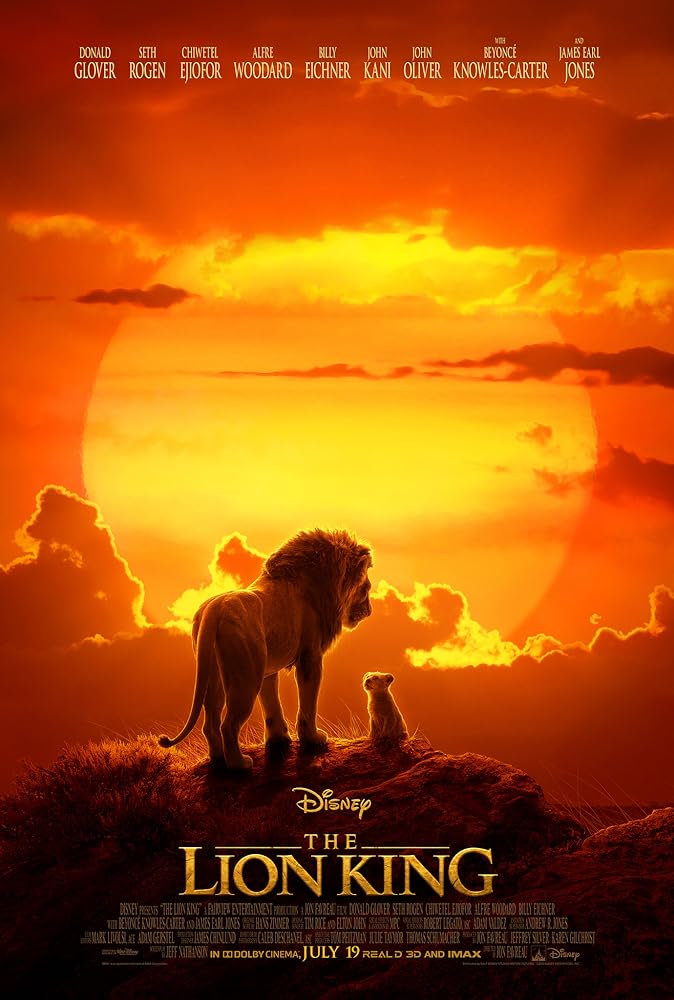
The Lion King (2019) review


James Earl Jones and JD McCrary in The Lion King (2019)

In 1991, Walt Disney Animation began production on two different films that would be the studio’s next big projects after the one-two punch of that year’s Beauty and the Beast and Aladdin the following year. Of the two films, the one that the studio ended up placing most of its focus on was an adaptation of the story of the Native American woman known as Pocahontas, and because it ended up attracting most of Disney’s prominent animators, the other film was primarily developed by the studio’s ‘B-Team’. Ironically, though, the B-Team would end up producing the more critically acclaimed affair; we, of course, know their project… as The Lion King. When it was released in the summer of 1994, The Lion King quickly became one of the biggest films of its time. It currently stands as the highest-grossing traditionally animated film of all-time at over $968 million worldwide, which also means that it was Disney Animation’s highest-grossing film for nearly two decades until it was ultimately out-grossed by Frozen in 2013. It’s also notably the best-selling VHS title of all-time with over 32 million copies sold. But now it’s joined the ranks of other Disney classics as the latest in Disney’s line of live-action remakes… however, calling this one ‘live-action’ would technically be false. Instead, this new version of The Lion King is a CGI remake of the original as it mirrors the style of the 2016 remake of The Jungle Book through its use of photorealistic environments and characters. The two films even share the same director in Jon Favreau AKA the man who effectively launched the MCU with the original Iron Man and is also responsible for modern classics like Elf and Chef. And while this one is sure to be a controversial release because of how it ultimately ‘remakes’ its predecessor, fans of the original Lion King will still probably find this to be an incredibly fun and gorgeously animated interpretation of an all-time Disney classic.

In the vast kingdom that is the Pride Lands of Africa, Mufasa, the King of Pride Rock (voiced by James Earl Jones) and his queen Sarabi (voiced by Alfre Woodard) celebrate the birth of their son, Simba. As he begins to grow up, Simba (voiced as a child by JD McCrary and as an adult by Donald Glover) eagerly anticipates the day when he will take his father’s place as King. However, unbeknownst to Simba, his uncle Scar (voiced by Chiwetel Ejiofor) secretly plots to get rid of both him and his father so that he can take over the Pride Lands. To do so, Scar puts Simba in increasingly terrifying situations that eventually results in a devastating tragedy, and when Scar has Simba fooled into thinking that the accident was his fault, Simba ends up running away from his home. After a while, he meets the happy-go-lucky duo of Timon the Meerkat (voiced by Billy Eichner) and Pumbaa the Warthog (voiced by Seth Rogen), who end up taking him in and showing him the benefits of their carefree lifestyle. But as Simba matures into adulthood, his childhood friend Nala (voiced as a child by Shahadi Wright Joseph and as an adult by Beyoncé) comes back into his life to warn him that Scar’s takeover of the Pride Lands has led it to ruin. Thus, Simba must now overcome the demons of his past to save his home from his diabolical uncle and to properly take his place as the new king of Pride Rock.

This new take on The Lion King is easily the closest that any of the recent Disney remakes have gotten when it comes to closely replicating their original counterparts. This isn’t a case like Maleficent, which retold the story of Sleeping Beauty from the titular villain’s perspective, or Pete’s Dragon, which nixed the original’s musical numbers in favor of a more traditional narrative. For all intent and purposes, this is the same exact story from the 1994 film with the same exact outcome. The only major differences from a narrative perspective come from minor deviations in dialogue and a different intro for Nala after she’s become an adult. As such, this could quite arguably be the most controversial Disney remake yet because of how tightly it adheres to the original film without really doing anything differently. And yet, at the same time, because it’s still The Lion King, it could potentially be argued that, at the very least, the film does maintain the original’s strong script and hits the biggest emotional moments just as effectively (i.e. that one scene that we always remember from this story). Nothing significant from the story is lost and nothing is added in that would drastically change anything. Ultimately, though, the biggest selling point of this film is its visuals. As noted in the intro, this film carries over the same method that Favreau used on The Jungle Book in which everything in it (save for Mowgli) was digitally created. And while some may take issue with the fact that the overall drive for realism results in certain moments from the original being toned down, it’s still an impressive feat of VFX work from the same team that won an Oscar for their work on Jungle Book.

Another key aspect of this film is its voice cast, as Jon Favreau selected a top-notch voice cast to portray these iconic characters. JD McCrary and Donald Glover (who have notably worked together before) headline the project excellently as Simba as a young cub and adult lion, respectively, thanks in large part to the terrific camaraderie/chemistry that they have with their co-stars. McCrary and Shahadi Wright Joseph are phenomenal together as young Simba and Nala, and while adult Nala’s role in the story isn’t really expanded upon too much when compared to the original film, Beyoncé does do a solid job in the role. Meanwhile, Chiwetel Ejiofor is a damn good replacement for Jeremy Irons in the role of Scar as he perfectly maintains that same, great sinister persona that was pivotal in making Scar such an iconic Disney villain. But as for Mufasa, the filmmakers clearly knew that there was no way you could replace the legendary voice that portrayed the character in the original film. Yes, James Earl Jones is back once again to reprise his role as the King of Pride Rock, and he is still just as commanding and awesome as he was in the original film. And to close out the main cast, we have Billy Eichner and Seth Rogen, who serve as phenomenal replacements for Nathan Lane and Ernie Sabella in the roles of Timon and Pumbaa. As many others have noted, they’re the biggest standouts of the film and their riffing is the primary source of the remake’s new material, whether it’s an entertaining fourth-wall gag or a downright brilliant homage to another Disney classic.

I have the feeling that this is the one Disney remake that some people were expecting me to be completely against. After all, the original Lion King still stands as my favorite Disney animated film of all-time. Well, to that I say… you’ve read my reviews of the other recent Disney remakes, right? If I haven’t made it clear before, I’m perfectly fine with this new trend of live-action remakes of classic Disney films (even though this one technically isn’t ‘live-action’) because I recognize that the old films will still be there when all’s said and done. More importantly, their legacies won’t be tarnished by a ‘lousy’ remake because they’re quite frankly better than they’re often given credit for. However, even with that said, I fully recognize that I won’t even remotely be able to convince any of the ‘live-action remake’ critics that this one is worthwhile because it’s almost literally the same as its traditionally-animated counterpart save for a CGI makeover. And because the CG is highly intent on maintaining a sense of realism, this means that this version of The Lion King is a lot more grounded compared to its predecessor (e.g. don’t expect Timon to don a hula skirt and ask some hyenas if they’re “aching for some bacon”). Despite this, Jon Favreau does do an excellent job of maintaining the same spirit of the original even with a different visual aesthetic. And at the end of the day, that visual aesthetic is the main reason to watch this film because it’s clear that the visual effects team went above and beyond to create an impressively photorealistic-looking film to the point where it could potentially pass as some kind of nature documentary. As such, while some may view this as the most pointless Disney remake yet, there’s no denying that it’s one of the best-looking films of 2019.

Rating: 5/5!

Tuesday, July 23, 2019

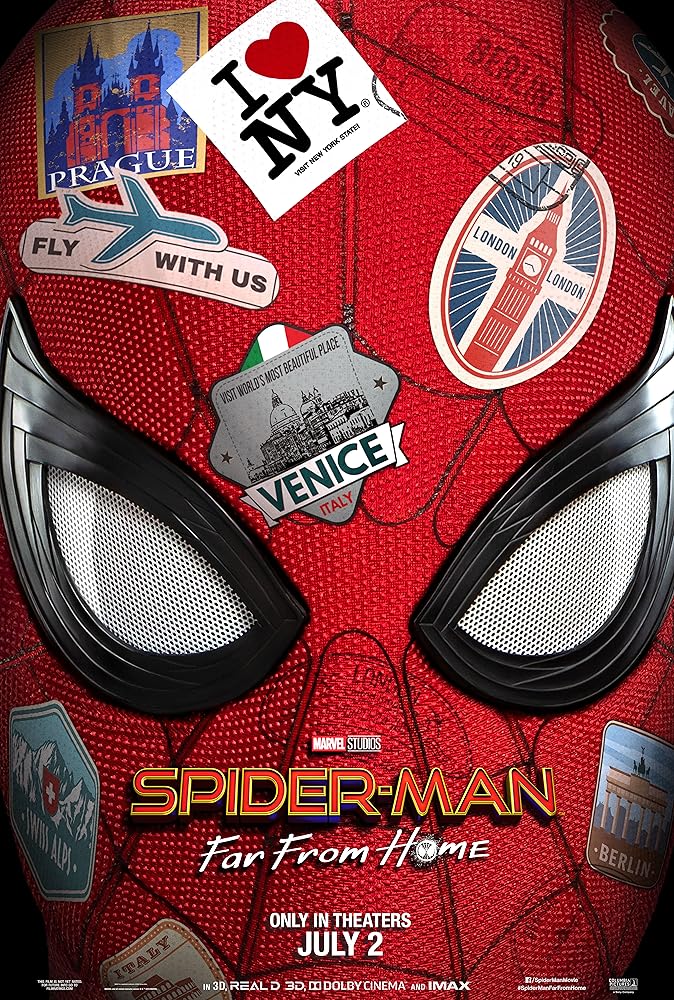
Spider-Man: Far From Home (2019) review


Spider-Man: Far from Home (2019)

(Disclaimer: I apologize in advance, folks, but due to the nature of this being the first MCU film after Avengers: Endgame, I will have to address what is easily the biggest of that film’s spoilers. I have the feeling that most of you reading this have already watched the film (it did just become the highest-grossing film of all time, after all…), but in the slim chance that you haven’t seen it yet, all I can recommend at this point is that you watch Endgame first.)

When we last left the Marvel Cinematic Universe, it had just reached the culmination of its legendary run up to this point with Avengers: Endgame. It goes without saying that the film was a true epic in every sense of the word, effectively providing the franchise’s dedicated fanbase with a satisfying conclusion to what has now officially been designated as ‘the Infinity Saga’. However, as it turns out, it ultimately wasn’t going to be the final installment of this saga. Instead, that honor goes to the follow-up to 2017’s Spider-Man: Homecoming, Spider-Man: Far From Home. As most of you know, Spider-Man’s inclusion in the MCU ultimately came courtesy of a deal between Marvel Studios and Sony. While the latter has held the character’s film rights for the past several decades, the lackluster performance of the Amazing Spider-Man reboot series led to this deal that would see both parties working together to develop a new iteration of the character, who made a phenomenal debut in Captain America: Civil War. Thus, just like Homecoming, Far From Home is an interesting release in terms of its distribution because while Marvel Studios is currently under the Disney banner, both Homecoming and Far From Home are officially Sony productions. And yet, because of Kevin Feige and co.’s involvement in the production, it’s still technically an MCU film at the end of the day, with Homecoming director Jon Watts returning to direct along with most of the main cast from the previous film. And because of this, Far From Home is yet another superb outing for the MCU that brilliantly handles the ramifications of the epic, emotional finale of its immediate predecessor while also giving us a taste of what’s to come for this legendary franchise.

Not long after the events of Endgame, teenager Peter Parker (Tom Holland) returns to his hometown of Queens to resume his duties as the friendly neighborhood web-slinger, Spider-Man. At the same time, though, Peter has struggled to overcome the death of his mentor/father figure Tony Stark. Thus, when Midtown High organizes a summer vacation to Europe, Peter signs up for it, eager to take a break from the superhero lifestyle and hopeful that this trip will give him a chance to reveal the blossoming feelings that he has for his classmate Michelle AKA MJ (Zendaya). Unfortunately for Peter, his superhero life quickly follows him to Europe, and he ends up being approached with a mission by Nick Fury (Samuel L. Jackson) and Maria Hill (Cobie Smulders). The two inform him that due to the cosmic implications of ‘the Snap’, four creatures from another dimension known as the Elementals have arrived on Earth and have caused mass destruction wherever they go. Luckily for them, they have gained a new ally in Quentin Beck (Jake Gyllenhaal), an illusion-based superhero who is also from the Elementals’ dimension and is promptly given the nickname ‘Mysterio’ by the media. Thus, as Peter now finds himself struggling once again to balance his responsibilities as Spider-Man with his desire for a stress-free vacation, he must also grapple with the biggest question of them all; can he live up to the expectations that have been set upon him and become ‘the next Iron Man’?

In the past, I’ve noted that Marvel Studios does a great job when it comes to the kind of films that they do right after the big ensemble pieces that are the Avengers films. The original Ant-Man followed the grand spectacle of Avengers: Age of Ultron with a refreshingly small-scaled affair (no pun intended) while Ant-Man and the Wasp allowed for some well-earned levity after the devastating finale of Avengers: Infinity War. The same situation applies to Far From Home, but in this case, its effectiveness as the immediate follow-up to Avengers: Endgame stems from the fact that the events of Endgame’s finale directly affect this film’s plot. Simply put, the death of Tony Stark is felt throughout, right down to the fact that tributes to him can be seen in practically every European country that Peter visits. Without spoiling anything from the plot, this film is all about Tony’s legacy and how Peter must now work to maintain it, and as one can only expect from an MCU film, this is where the franchise’s phenomenal sense of emotional poignancy comes into play because of how closely tied the MCU’s version of Peter has been to Tony. Another key aspect of this film is its European setting since Far From Home is the first main Spider-Man film (not counting Spidey’s trip to Germany in Civil War since that’s a Captain America film) that’s not primarily set in New York, and because of this, the new locales offer some fantastic imagery that’s even more amazing when viewed in IMAX. All this helps to bolster everything else that you’ve come to expect from an MCU film; I would elaborate on what that stuff is further but, let’s be frank, I’ve already done that in my previous MCU film reviews.  

Like Homecoming, Far From Home primarily revolves around its younger cast members to great effect. Of course, it’s all headlined by Tom Holland, who continues to be a wonderful iteration of Spider-Man. Not only does Holland perfectly embody the combination of Spider-Man’s wisecracking persona with Peter Parker’s endearing awkwardness, but he also brilliantly handles all the emotional turmoil that Peter’s been going through since Tony Stark’s death. He also continues to have excellent camaraderie with Jacob Batalon as Peter’s best friend Ned, who gets his own little subplot via a budding romance with their classmate Betty Brant (Angourie Rice), as well as some wonderful chemistry with Zendaya as the MCU’s ‘MJ’. As alluded to in the plot synopsis, the film begins to develop a relationship between the two that, in turn, does allow Zendaya to have a larger role this time around. After that, there’s the always reliable supporting characters like Jon Favreau as Happy Hogan, Marisa Tomei as Aunt May, and Samuel L. Jackson and Cobie Smulders as Fury and Maria Hill. Finally, there’s quite arguably the most anticipated addition to the cast, Jake Gyllenhaal as Mysterio, and sure enough, he is fantastic in the role thanks in large part to the excellent camaraderie that he forms with Holland. Now for those who are aware of Mysterio’s traditional role in the comics… yes, this film goes exactly the way you think it does when it comes to his overall characterization. Still, the way in which it translates this to tie him into the MCU’s lore is a brilliant method of subverting expectations.

Marvel Studios has been on a roll as of late when it comes to producing sequels that are superior to their already excellent predecessors. That was the case with films like Captain America: The Winter Soldier, Guardians of the Galaxy Vol. 2, and Ant-Man and the Wasp, just to name a few. And sure enough, that trend continues with Spider-Man: Far From Home, which has quite possibly become my new favorite Spider-Man film. Now don’t get me wrong, Spider-Man: Homecoming was a terrific outing for the web-slinger that perfectly encapsulated the character arc of the MCU’s rendition of the character; a young kid who wants to join the Avengers but quickly has to grapple with the reality that he’s still just a kid in a much larger universe. But then you have Far From Home, which takes everything great from Homecoming and amplifies it even further with better action sequences, better visuals, and a tightly-written script which sees Peter Parker now having to face the burden of proving exactly why Tony Stark made him an Avenger. In other words, while I’m sure that I’ve said this plenty of times before when it comes to the MCU, this truly is one of those films that is a pitch-perfect representation of everything great about this franchise. Thus, it ends up being a perfect epilogue to Marvel Studios’ ‘Infinity Saga’, which is quite arguably the most impressive run that any franchise has had in the history of film. And considering all the exciting films and TV shows that Marvel Studios announced at Comic-Con this past weekend, it’s undeniably clear that they’re not even remotely done yet.    

Rating: 5/5!

Tuesday, July 11, 2017

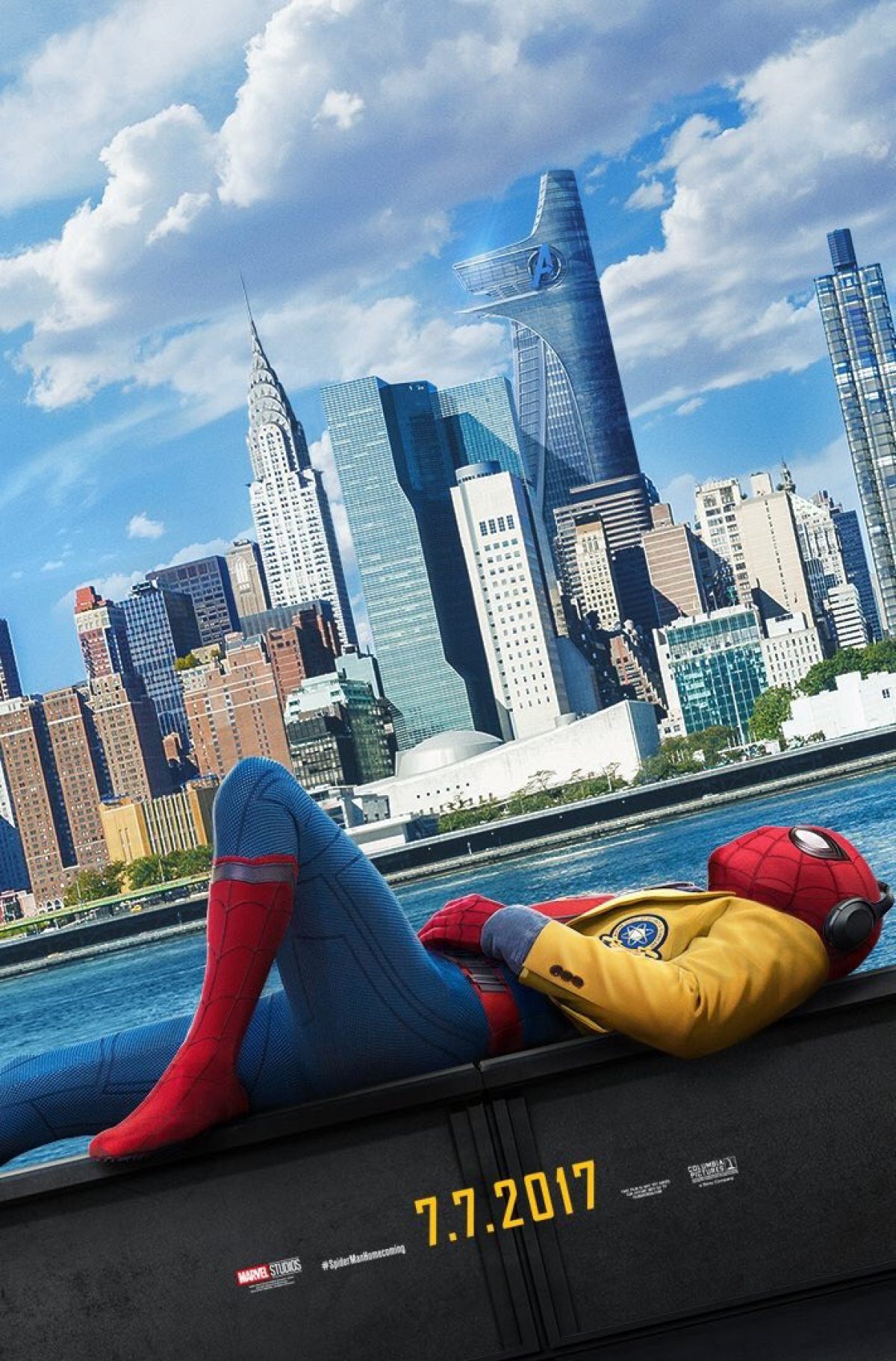
Spider-Man: Homecoming (2017) review

Image result for spider-man homecoming poster

It could be argued that Spider-Man is Marvel Comics’ most popular character. His characterization as a regular high-school student from New York who finds himself immersed in the larger Marvel universe has made him an incredibly endearing character to audiences young and old. This has also translated well to the web-slinger's time on the big-screen, as Spider-Man films have grossed over $3 billion worldwide. Of course, it all started with the trilogy of films directed by Sam Raimi and starring Tobey Maguire in the lead role, which ran from 2002 to 2007. The first film was one of the three major releases, alongside Bryan Singer’s X-Men and 1998’s Blade, that helped revitalize the superhero film genre after the low point that it experienced in the late 90’s. It was then followed by an even better-received sequel in 2004… and then an extremely polarizing third installment in 2007. That would ultimately be the final installment of the series, as Raimi backed out of directing the impending fourth installment when he felt pressured by the studio into getting it done by 2011. Thus, just one year later, Sony decided to reboot the Spider-Man franchise, with Marc Webb taking over as director and Andrew Garfield cast as the new Spidey. However, the short amount of time that had gone by since the Raimi series ended, paired with the fondness that many had for those films, ended up having a majorly negative effect on the Amazing Spider-Man films. While the first Amazing film managed to hold off a decent amount of the skepticism that had been surrounding it, the second Amazing film ended up being even more polarizing than Raimi’s third film. It was also the lowest-grossing Spider-Man film to date, barely grossing over $700 million worldwide.

The harsh reception to Amazing Spider-Man 2 put a lot of pressure on Sony, who have owned Spider-Man’s film rights since the 80’s. Clearly, their plans at the time to develop their own ‘Cinematic Universe’ a la Marvel Studios were not going over well with critics and audiences. And so, in 2015, they decided to strike a deal with Marvel Studios who, due to Marvel’s initial handling of their characters’ film rights, were originally unable to use some of the company’s biggest heroes for the first few years of the Marvel Cinematic Universe’s existence. This new deal, which was made official in February 2015, would allow Sony to hold onto Spider-Man’s film rights while also giving Kevin Feige and his team at Marvel Studios creative control over future films, thereby allowing everyone’s favorite neighborhood web-slinger to finally appear in the MCU. However, this also meant that the series would see another bit of rebooting for the second time in five years. Tom Holland, breakout star of 2012’s The Impossible, took on the role of Peter Parker and officially made his MCU debut in last year’s Captain America: Civil War. And overall, his turn as Spidey in that film was well-received by critics and audiences, proving that he was more than ready to take on the lead role in his own film. And so, here we are now with Spider-Man: Homecoming. General newcomer Jon Watts takes on directorial duties for this collaboration between Sony and Marvel Studios. To reiterate, because Sony still owns Spider-Man’s film rights, this is a Sony release, unlike the other MCU films which are distributed by Disney. However, given the involvement of Kevin Feige and co., it’s also the newest installment of the Marvel Cinematic Universe. Thus, with the involvement of the studio that has continued to deliver top-quality hits time and time again, I’m pleased to say that good ol’ ‘Underoos’ is indeed back and, more importantly, is better than ever in his latest on-screen adventure.

During the events of Captain America: Civil War, teenager Peter Parker AKA Spider-Man (Tom Holland), who gained spider-like abilities after being bitten by a genetically-altered spider, was recruited by billionaire Tony Stark AKA Iron Man (Robert Downey Jr.) to aid in the Avengers’ internal conflict in that film. Afterward, Tony gives Peter the new and improved suit that he had made for him but also tells him that he’s not yet a member of the Avengers. Thus, Peter returns home to Queens, where he lives with his Aunt May (Marisa Tomei), and his life as a ‘regular’ student at Midtown High while continuing to fight crime around town under the ‘supervision’ of Tony’s long-time bodyguard, Happy Hogan (Jon Favreau). But despite this, Peter is still left wishing for an opportunity to do more than just deal with minor incidents. He eventually manages to find a chance to prove himself when he starts to come across criminals that are using new and dangerous weapons that have been crafted from the Chitauri remains of the Battle of New York in the first Avengers. This soon leads to him coming into conflict with the man in charge of these recent criminal operations, Adrian Toomes (Michael Keaton), who uses a mechanical wingsuit to become ‘the Vulture’. However, the intensity of the situations that Peter soon finds himself in also gets him into trouble with Tony, who wanted him to maintain a more ‘grounded’ lifestyle. Thus, Peter now finds himself being pressured into proving that he’s capable of dealing with the kinds of threats that the Avengers face on a regular basis.

In the months leading up to its release, the filmmakers promoted Spider-Man: Homecoming as a high school film that was reminiscent of the classic 80’s films written and directed by John Hughes. And overall, the film does deliver on being just that, from its greater focus on the younger members of its cast to its various homages to films like Ferris Bueller’s Day Off. But, of course, at the end of the day, this is still a ‘Marvel Cinematic Universe’ film, so it also has all the great things that you’d expect from the MCU at this point. The action sequences are excellent, which in turn are backed by solid visual effects, and there are plenty of humorous moments that never take away from the more emotional moments of the story. And because this film is centered on a superhero who’s still in high-school, the advice that his mentor gives him (‘Stay close to the ground’) applies nicely to the overall scope of the film. Instead of being one of the high-level Avengers films, this is just a nicely scaled solo film that sometimes verges into the larger-scaled escapades of other MCU films but never once diverges from its high-school setting. I mean, if I had any sort of issue with this film, it’d be that it admittedly feels a bit overlong. Now, to be fair, this film is only about two hours and ten minutes long, which is on par with most of the other ‘solo’ MCU films. Heck, this isn’t even the longest Spider-Man film to date; The Amazing Spider-Man 2 was a little over two hours and twenty minutes long. Still, this film’s second half is made up mostly of its biggest action sequences, so it sometimes feels like the film never ends. Don’t get me wrong, I’m not saying that there were any points where the film dragged or anything, but perhaps it could’ve benefitted from some better pacing.

As noted before, this film focuses heavily on its younger stars, and all of them do excellent jobs in their respective roles. Of course, leading them all is Tom Holland who, as we already saw from Captain America: Civil War, is a great fit for the role of Peter Parker/Spider-Man. Not only does he have Spidey’s trademark quips down perfectly, but he’s also given a great overall arc in which he finds that he must prove himself within the larger world of the MCU. In some ways, it’s a lot like the arc that Tony Stark went through in Iron Man 3, in which he realized that his suit didn’t define who he was. And in this film, the fact that Tony knows himself well enough to not want Peter to go down the same route that he went truly goes to show how effective the MCU has been in terms of developing its characters in a consistent manner with each new film. Meanwhile, Holland is backed by some memorable supporting characters, including Jacob Batalon as Peter’s best friend Ned, who ends up learning about Peter’s big secret. And thanks to Batalon and Holland’s terrific camaraderie with each other, Ned proves to be one of the great MCU sidekicks, up there with the likes of Luis from Ant-Man and Wong from Doctor Strange. Another standout is Zendaya, who plays one of Peter’s classmates, Michelle. Her role in the film is a minor one but she does get some great lines of dialogue thanks to her hilariously dry wit. Rounding out the main ‘youth’ cast is Laura Harrier as Peter’s main love interest Liz Allan, who has solid chemistry with Holland, and Tony Revolori as Flash Thompson. It’s a different Flash than the ones we’ve seen in the previous film incarnations of Spider-Man but he still serves his purpose as a constant pain in Peter’s side.

As for the film’s adult leads, there was some controversy surrounding the casting of Marisa Tomei as Aunt May due to Tomei being the youngest actress to date in the role. However, Tomei does prove to be a great fit as the MCU version of Peter’s loving aunt. She works well with Holland while also getting one of the best humorous bits in the entire film right at the very end. Meanwhile, Jon Favreau gets to work with what is easily his biggest role in an MCU film to date (outside of directing, of course) as Happy Hogan, characterized excellently here as Peter’s begrudged liaison between him and Tony Stark. On that note, I’m aware that a lot of people were worried that Robert Downey Jr. was going to hog the limelight in this film to the point where it’d practically be Iron Man 4. Trust me, though, when I say that this isn’t the case. Tony’s only in the film for about 10 minutes and is used perfectly, both in terms of being the goofy genius, billionaire, playboy, philanthropist that we all know and love as well as being an effective mentor for Peter. And, of course, there’s the main villain, Adrian Toomes AKA the Vulture. Is he another one of Marvel’s ‘mediocre’ villains? No, not at all… in fact, I’d dare say that since the start of Phase 3, Marvel Studios has improved quite a bit when it comes to their villains. Michael Keaton is excellent in the role and the character is set up solidly as a former salvage operator who got screwed over by Stark Industries after the events of the first Avengers. This effectively continues the series’ tradition of having Spider-Man’s adversaries be more ‘sympathetic’ than just pure evil. And then, if that wasn’t enough, there’s one big twist surrounding the character that makes him even more of a personal threat for Peter.

There was quite a lot of backlash surrounding this film prior to its release, from its ‘allegedly spoiler-y’ trailers (personally, I didn’t think that they gave away too much) to its admittedly subpar main poster (though, seriously, how does a poster impact the quality of the film that it’s for?). Thankfully, though, that didn’t stop Spider-Man: Homecoming from becoming yet another satisfying entry in the Marvel Cinematic Universe, as well as a much-needed win for Sony after their last few attempts from this franchise fared poorly with audiences. Sure, this is still technically the second time in half a decade that Spider-Man has seen an on-screen reboot, but the filmmakers wisely avoid going down many of the same routes that the character’s previous incarnations went. Jon Watts’ direction is solid and the film finds a nice mix between the high-school antics that its young protagonist deals with on a regular basis and the grand-scale adventures within the larger MCU. And thanks to its terrific ensemble cast and the continuously great atmosphere that one can always expect from the MCU films, Spider-Man: Homecoming is a fun new spin on this beloved character. Now, with that said, I’ll admit that I’m still a little bummed about how the previous incarnation of Spider-Man, the Amazing Spider-Man series, was rather unceremoniously tossed aside after only two films. Yeah, I know I’m in the minority when it comes to liking those films, but why couldn’t they have just been given the opportunity to continue but through the way that they’re doing now and have Kevin Feige and his team come in to fix things up, allowing Andrew Garfield’s Spidey to be a part of the MCU? Still, I won’t lie… after his appearance in both Civil War and now this film, I’m fully onboard with Tom Holland’s portrayal of Spider-Man and, therefore, any future films featuring Marvel Studios’ version of the friendly neighborhood web-slinger.


Rating: 5/5!

Saturday, April 16, 2016

The Jungle Book (2016) review


As many of you know, Disney’s current schedule of upcoming live-action releases is almost entirely consisting of live-action remakes of their animated classics. These last few months in particular have seen the company announce numerous proposed films, including a new Winnie the Pooh, a new Mary Poppins film, and The Sword in the Stone, just to name a few. This of course is following the highly successful box-office runs of films like Tim Burton’s Alice in Wonderland and 2014’s Maleficent. However, this new practice of theirs has attracted a considerable amount of controversy amongst certain audiences for the same reasons that basically affect any announced remake, namely the question as to why one would attempt to remake a beloved film like the many animated classics that Disney has produced over the years. I, on the other hand, am a little more optimistic that a fair amount of these ‘Disney remakes’ are going to turn out fine. That mindset developed for me after I watched last year’s live-action version of Cinderella, which ended up being my #3 favorite film of 2015. Not only was the film full of gorgeous visuals but it was also big on heart and the end result was a film that both honored the original animated classic that inspired it while also doing enough to distinguish itself as its own entity. You could pretty much say that it is solely because of that film that I’m generally optimistic about these upcoming Disney remakes. Because if you ask me, if at least a few of these remakes happen to be as well-made as Cinderella by filmmakers who clearly show a lot of affection towards the original film, then that would mean that the fact that all of these remakes are getting announced is nowhere near as bad as some may claim.

Which brings us to the latest in this line of ‘Disney remakes’, The Jungle Book. It of course follows in the footsteps of the company’s 1967 animated adaptation of Rudyard Kipling’s iconic novel of the same name. Unfortunately, that version is forever connected to a tragic point in the history of Disney Animation as it was the last Disney animated feature that Walt Disney himself produced prior to his death in 1966, just ten months before the film’s release. But even with the loss of the studio’s visionary leader, the original Jungle Book became an animated classic and served as a very fitting swan song for the man who was responsible for some of the most famous animated films/shorts of all-time. This new version is directed by Jon Favreau, who in the past gave us hits like the first two Iron Man films, the modern holiday classic Elf, and his most recent effort, the charming (and also hunger-inducing) indie flick Chef. And just like Kenneth Branagh last year with Cinderella, Favreau very much succeeds in regards to how his take on the classic story of the man-cub Mowgli both honors the original film that inspired it while also making its own mark in film history. The new Jungle Book is easily one of the best-looking films of the year, which is even more impressive considering the method in which the film was made. But those visuals are only the icing on the cake as this remake very much succeeds in capturing the heart of the original Disney flick without being a complete rehash of what came before.

The film of course follows the same general plot of both the original Kipling novel and the 1967 Disney animated version. In the middle of the Indian jungle, a young orphaned baby boy is found by the panther Bagheera (Ben Kingsley). Realizing that he has no mother or father to look after him, Bagheera brings him to a wolf pack, which includes the boy’s ‘adoptive mother’ Raksha (Lupita Nyong’o) and the pack’s leader Akela (Giancarlo Esposito), who then proceed to raise the young man-cub, Mowgli (Neel Sethi), as one of their own. Mowgli’s peaceful life with the pack is soon threatened, however, when the vicious tiger Shere Khan (Idris Elba), who hates man after being threatened by them via man’s great asset, fire AKA what the animals refer to as ‘the red flower’, threatens to kill him and anyone who dares to protect him. Realizing that he is in danger, Bagheera and the wolf pack agree to have Mowgli brought to the nearby man-village so that he will be safe from Shere Khan’s wrath with his own kind. But while on the way to the man-village, Mowgli soon finds himself coming across all sorts of characters, from the laid-back bear Baloo (Bill Murray) to the devious and hypnotic snake Kaa (Scarlett Johansson) to the imposing ape King Louie (Christopher Walken), all while being simultaneously hunted by Shere Khan.

You want to know the most interesting thing about this film? It was shot entirely on a soundstage. Just like all of its animal characters, all of the jungle locales in the film are basically done entirely in CGI. And while some may argue that this would make the whole film ‘too artificial’ as a result, it actually does really work in regards to make everything look so photo-realistic even when knowing that most of it was created by computers. As for the film itself, it takes on a much darker tone compared to the original animated film, which does sort of make sense because the predator animals in this story could be considered as being more menacing in a live-action setting. However, it doesn’t get too dark to the point where it would completely draw younger audiences away. And aside from three new renditions of the songs ‘The Bare Necessities’, ‘I Wanna Be Like You’, and ‘Trust in Me’, the film avoids going the same musical route of its animated predecessor. All in all, this results in the film’s overall tone and plot being a generally equal mix of both the original animated film and Rudyard Kipling’s original novel. But of course this film is more than just pretty visuals, even though said visuals could very much make the film a worthwhile theater experience all on their own. At the end of the day, Favreau very much succeeds in capturing the heart of the original animated film in this new live-action setting. He does this through many things, including the multi-layered characters who are just as memorable as they were in the original animated film and the story’s strong themes of friendship and courage.  

As Mowgli, newcomer Neel Sethi is the only major live-action actor in the entire film. And considering that he had to go through the entire film shoot interacting with locations and characters that weren’t primarily added in until post-production, he definitely pulls off the act of managing to make it all seem natural quite well. At the same time, he also succeeds in making his Mowgli both likable and also very clever, the latter of which is represented by the many ‘inventions’ that he comes up with throughout the film. As for the animal characters, this film features a pitch-perfect voice cast as every actor/actress is an excellent fit for their respective roles. Bill Murray’s generally laid-back demeanor perfectly fits Baloo, who in this version is more sarcastic than his animated counterpart but is still a loyal friend to Mowgli through thick and thin. Ben Kingsley more than brings the right gravitas to the role of the noble panther Bagheera while Idris Elba provides one heck of an intimidation factor in the role of Shere Khan, who in this version gets a bit more backstory as to why he hates man. Some of the animal characters actually get more to do in this film compared to the animated film, particularly the wolf-pack and Mowgli’s ‘adoptive mother’ Raksha who, despite everyone telling her otherwise, very much treats Mowgli like her own son, resulting in a particularly emotional scene near the beginning when Mowgli decides to leave for the man-village. As for the characters of Kaa and King Louie, who each have one major scene in the film, Scarlett Johannsson’s alluring voice fits perfectly in the part of the hypnotizing snake while Christopher Walken’s wackier persona is fitting for King Louie. At the same time, however, this King Louie is considerably different than the one from the original film, as he is just as menacingly imposing as he is in size.

Now before I list my rating for this film, let me be clear about something first. While I’m about to give it a rating that’s ½ a star higher than my rating for the original Jungle Book, that doesn’t automatically mean that I view this new film as the ‘superior’ version, which is a claim that quite a few critics have been making these past few days. Just like with the new Cinderella, I view this new Jungle Book as a complement to the original film and not something that’s meant to ‘replace’ it. The original Jungle Book is still an undeniable classic (and one that, for the record, is far better than what Screen Junkies recently made it out to be) and this new version helps introduce the story of the man-cub Mowgli and his adventures in the jungle to a whole new generation. And it very much is an excellent new take on this classic story. From a technical perspective, it’s one of the most visually breathtaking films in recent memory which is saying a lot considering that the film is basically 95% CGI. But at its core lies the same heart that defined the original with a terrific cast bringing these classic characters to life. So yes… this isn’t the end of Disney’s live-action remakes. There are a lot more on the way, perhaps even a bit too many at this point. However, both this film and Cinderella are more than enough proof that they can be done and, more importantly, be done very, very well. So in short, contrary to what popular opinion may be, I am genuinely excited to see what Disney comes up with next in regards to re-imagining some of the classic films and stories that have defined many a childhood.   


Rating: 5/5!

Saturday, June 28, 2014

Chef (2014): Short Review


There’s no denying it; the studio system currently dominates the film industry and because of it, many argue that this is diminishing the value of true artistic visions from directors because nowadays most of them have to adhere to some occasionally very strict studio guidelines. Now while I’m not a filmmaker myself and I do feel that there are still some directors out there who are able to express their vision in the films that they make even with the occasional studio interference, I still can definitely see where a lot of these frustrated filmmakers are coming from and as proven by his new film ‘Chef’, Jon Favreau is one of those directors. In the film, he plays a chef named Carl Casper who’s the head chef at a successful restaurant in Los Angeles. But while he eagerly looks to try and cook some new menu items, he’s told to ‘stick to the classics’ by his boss Riva (Dustin Hoffman). This results in a famous food critic (Oliver Platt) giving the restaurant an unfavorable review, which then results in Carl berating him both online and in person, ultimately becoming a sensation on social media. With nowhere else to go, Carl ends up getting a food truck where he looks to both better express his culinary creativity and to also reconnect with his ex-wife Inez (Sofia Vergara) and their son Percy (EmJay Anthony).

It’s very much clear that this film represents Favreau’s own frustration with the studio system after he spent the last few years doing nothing but big-budget action films like the ‘Iron Man’ movies and ‘Cowboys and Aliens’; this time he’s able to make the film that he wanted to make without any sign of studio interference. Because of this, I really enjoyed this film’s message that emphasizes freedom of expression. This results in a very heartwarming and feel-good movie that is a nice change of pace from all of the summer blockbusters. Really, this is just a very pleasant movie, especially when Carl actually gets his new food truck and goes on a cross-country trip with his son and his friend Martin (John Leguizamo). I think that section of the film is its best part. Now, I don’t think that this is one of the ‘best’ films of the year, mainly because I didn’t really find the film to be as ‘funny’ as a lot of critics were saying it was. I mean sure, there were a few funny bits of dialogue peppered in here and there (no pun intended) but not really enough for me to say that it succeeds at being a ‘comedy’. Regardless of that, I still really enjoyed the film because of its charm, its solid cast (I’d say this is Favreau’s best performance to date as an actor, as his own frustrations with Hollywood really translate well into his character’s dilemmas), and of course its great message to be true to yourself. All of this makes ‘Chef’ a very satisfying treat… and of course, to quote IGN’s Chris Tilly, make sure that you “don’t go on an empty stomach”.

Rating: 4/5